Vi använder cookies för att ge dig bästa möjliga upplevelse. Välj vilka cookies du tillåter.
Läs mer i vår integritetspolicy
Jörgen Thornberg
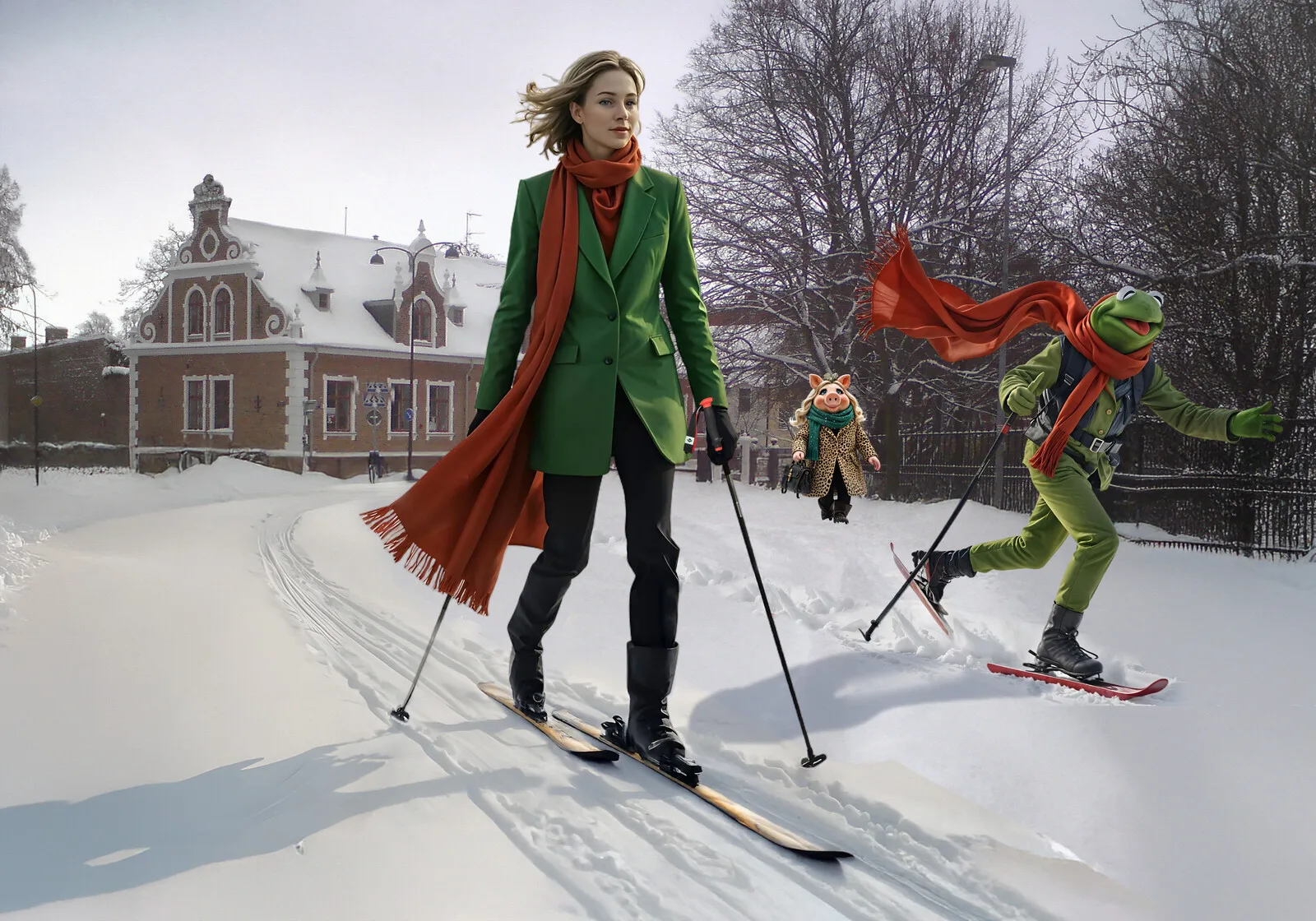
The Sunday Morning February 2025 that never was, 2025
Digital
70 x 50 cm
3 200 kr
The Sunday Morning February 2025 that never was
Thomander’s Student Home – Where the Hat Never Stops Rolling
Lund is a city of academic brilliance, scholarly traditions, and bookshelves weighed down by centuries of knowledge. But let’s be honest—it’s also a place where hats roll, punch flows, and the spirit of student revelry echoes through every cobblestone alley. And no one embodies this balance between wisdom and indulgence better than Johan Henrik Thomander—bishop, academic, satirist, and arguably one of the sharpest wits Lund has ever known.
His student years were anything but joyful, marked by loneliness and disdain for what he called the "swampy pit" of Lund. But over time, he found his place—becoming one of the city’s great personalities. He understood the importance of taking life with humor, turning academic battles into spectacles, and acknowledging that punch belonged as much to student life as parchment scrolls. Rolling hats, as they say.
When his daughters donated Thomander’s Student Home in 1895, the mission was clear: no more lonely and miserable student years. Knowledge and camaraderie would flourish here, and most importantly, hats would roll! Over the years, spex performances, serenades, card games, and punch bowls have cemented the home’s legendary status in Lund’s student life. And rumors persist that Kermit and Miss Piggy, skiing through the city's streets, were simply en route to yet another grand Thomander-style celebration...
Continue reading to learn more about the humorous picture, its connection to knowledge and rolling hats.
"Hat-Rolling and Revelry in Lund
In Lund, where wisdom fills the air,
And books are stacked with scholar’s care,
There’s yet a truth, well known to all—
A student’s joy is in the hall.
By day, they read, debate, and learn,
By night, they let their spirits burn,
They paint the town red, dance till dawn,
And barely know the night is gone.
With pints flowing free and voices loud,
They live it up, a roaring crowd,
The streets of Lund their grand parade,
Where hats are rolled and legends made.
In cellars deep, in halls so grand,
With punch and song and glass in hand,
They tie one on, they hit the booze,
For logic’s sharpest minds must lose.
Through cobbled streets they weave and sway,
With coats askew, in disarray,
They whoop it up, they let it rip,
And lose all care with every sip.
But what is this? As dawn breaks through,
A sight most odd comes into view!
Through snowy streets, on skis so bright,
Two figures race with all their might.
With scarves a-flutter, poles held tight,
Comes Kermit, green, in morning light,
And Piggy, wrapped in fur so fine,
Declares, “This town, dear frog, is mine!”
For who could stay away too long,
From punch and laughter, cheer and song?
Even Muppets, far and wide,
Must roll their hats and join the ride!”
Lund, March 2025
The Sunday morning February 2025 that never was
The Lund scene depicts a girl in a green jacket and a red scarf appearing at the corner of Sandgatan and Biskopsgatan, skiing towards Kyrkogatan. One might wonder what she is doing there so early on a Sunday morning. Similarly, one could ponder what Kermit, yes, the Kermit the Frog from The Muppet Show, is doing in Lund. Equally puzzling is the presence of his persistent admirer, Miss Piggy, who provoked all of Lund’s animal rights activists by flaunting a moth-eaten leopard fur coat. As a pig, she ought to have been more cautious. Lund is filled with vegans, and wearing fur from an endangered species is downright perilous. As a pig, one could be culled for less, even by vegans. They are known for their tempers, releasing minks and other fur-bearing creatures during their crusades.
Perhaps they had been at a party at Thomander’s Student Home, a place that has endured through the years and is renowned for its grand celebrations. This enduring tradition, deeply embedded in its walls, was indeed one of the primary reasons for the establishment of the student home in the first place. Here’s why.
Thomander’s Student Home was founded around the turn of the last century, thanks to a donation from the descendants of theologian Johan Henrik Thomander. Theologians are known to indulge in revelry during their student years—perhaps for many, it was their final chance before embarking on a career as a priest with their congregation. As such, one was expected to set a moral example, meaning all bad habits had to be sorted out beforehand.
During his early years at Lund University, where he studied theology, the future Member of Parliament and bishop Johan Henrik Thomander felt lonely and miserable. He loathed Lund so much that, decades later, his daughters, Emma and Ida, donated a student home to the university in 1895—30 years after their father’s death. This generosity was thoughtful and forward-thinking, ensuring that at least twelve diligent male students would have the opportunity to roll hats, play cards, and enjoy themselves together after a day of serious studies.
It is essential to understand that the expression "rulla hatt" does not necessarily imply that one must literally roll a hat to have a proper party. In English, the equivalent expressions are "paint the town red"—a classic phrase for going out and partying hard—or "live it up"—meaning to truly enjoy life, whether celebrating out on the town or at home.
Today, the house at Sandgatan 16 in Lund still accommodates twelve male students who keep the student traditions alive, such as rolling hats and other activities.
However, maintaining Thomander’s legacy has not come without costs for Lund University. We refer to maintenance costs, operational expenses, and the bureaucratic mess that ensued when the donated property was nationalised in the 1960s. At one point, the university had to pay nearly 300,000 kronor a year in rent—to the state—for a property that had originally been donated to them. Needless to say, this arrangement faced heavy criticism—rightfully so.
That issue has since been resolved, and students can enjoy themselves without guilt. After all, having fun together is a tradition that the residents, known as “Hemiter,” at Thomander’s still proudly uphold. This continues even when the schedule includes window cleaning, cooking, choir rehearsals, gardening, and the necessary academic pursuits. And let’s not forget—hat-rolling is sacred. Their resilience in maintaining these traditions is genuinely commendable.
When a Hemit leaves Thomander’s after a few eventful years, he gets to keep his house key—a key that has, so far, been copied more than 400 times. A Hemit is, after all, always welcome home.
Perhaps Kermit is an old Hemit? That would explain everything. His presence in Lund, alongside Miss Piggy, is not just a whimsical twist in our narrative. It's a nod to this city's rich history and traditions, where even fictional characters find a place in the story.
However, the skiing girl cannot become a Hemit, like Miss Piggy—the foundation’s gender-discriminatory statutes prohibit it.
However, women are more than welcome as guests—especially on chilly winter nights. They are far better than hot water bottles.
Kermit and Miss Piggy need no further introduction, but Bishop Thomander, known for his love of satire, would surely have appreciated the humour they embody.
Now, more about the learned bishop who rolled hats in Lund two hundred years ago.
Thomander's Student Home – Where the Hat Always Rolls
A name can set the tone. “Nomen est omen,” as the saying goes. The three benefactors wished to honour the memory of their distinguished father and father-in-law by inscribing his name on the facade of the student home facing Sandgatan. Thomander is a monumental name in Swedish church history and equally significant in the academic chronicles of Lund. His name stands prominently among the inscriptions of great Lund scholars in the Academic Society’s grand hall.
Notably, they chose to commemorate Johan Henrik’s earliest days in Lund—the very day he was enrolled at the university—as a symbolic banner for the student home that bears his name. For in truth, Thomander’s time as a student in Lund was anything but bright and joyful.
On 4 October 1895, a grand donation was made to Lund University, one that would forever leave its mark on student life: an elegant building at Sandgatan 16, permanently dedicated to generations of knowledge-thirsty and, let’s be honest, also punch-loving students. The masterminds behind this splendid gift were estate owner Gottfrid Warholm, his wife Ida Thomander Warholm, and her sister Emma Thomander. This was the largest private donation the university had received to date, and of course, such a magnificent home deserved a grand name.
But not just any name. No, the student home was christened Johan Henrik Thomander’s Student Home, a tribute to a man who had, to put it mildly, an ambivalent relationship with Lund’s academic world. In other words, a student who took a rather scenic route to his love for Lund. The choice of his name for the student home was a testament to his transformation from a disillusioned student to a celebrated figure in Lund's academic and social life.
From Brilliant Prodigy to Disillusioned Student
Johan Henrik Thomander, born with a mind so sharp it could make a professor look like an empty jug (his own words), arrived in Lund in 1812 as a 14-year-old novice. He had excelled in school, received the most glowing recommendations, and was expected to conquer the university like an academic Alexander the Great. And he did. Despite his initial struggles, Thomander eventually found his footing and became a respected figure in Lund's academic circles, earning the title of docent and making significant contributions to the university's intellectual life.
“If I didn’t have access to the library, I think I’d buy myself a rope,” he wrote to a friend in Karlshamn. No, he wasn’t exaggerating. He was as poor as a church mouse, as lonely as a zero in a maths book, and trapped in a city he despised with every fibre of his being. His succinct review of Lund? “A swampy pit.” Charming.
After just a few semesters, he’d had enough and fled back to Karlshamn, where he took up work as a tutor and self-study enthusiast. When he returned a few years later, grudgingly, his verdict was still scathing: “Fog and gutters are the only things one sees.” He possessed quite the arsenal of sarcasm in his theological toolkit for a future bishop.
However, Lund would receive another chance when the young man finally found his footing and discovered the joy of rolling hats.
In this context, rolling hats means partying, indulging in wild revelry, and making merry. The phrase emerged after Thomander’s time, though he certainly could have inspired the phenomenon. The term originated in the early 1900s, when students, dressed in formal attire with top hats, found amusement in spinning their hats around their fingers after a few drinks. According to the Swedish Academy’s dictionary, the earliest recorded use of ‘rulla hatt’ comes from the newspaper Söndags-Nisse in 1864. Thomander didn’t pass away until the following year, so it’s entirely possible he had a hand in the tradition.
Thomander Becomes a Master Hat Roller
But here’s the twist. Upon his third arrival in Lund in the mid-1820s, something remarkable happened. As if an academic caterpillar had finally emerged from its cocoon, he transformed—not into a butterfly, but a full-fledged, spex-performing, punch-drinking, razor-sharp critic and Lund celebrity.
‘Spex’ is a satirical student revue – a performance that includes satire and parody. A ‘spex’ mercilessly skewers everything that deserves to be skewered—pompous professors, academic absurdities, and all the flaws of the society around it.
Now a docent, he embraced social life and made a name for himself as a sharp writer, witty humorist, and master of academic power plays. His academic achievements were awe-inspiring, and he rolled hats like a champion. He summarised his lifestyle in a letter to a friend:
“Three times I have played cards, three times I have treated my friends to Rhenish wine, drunk punch a couple of times a week, and otherwise studied, written, and attended to my duties.” And that was just a single day.
A bishop-in-the-making who regarded card games, wine, and punch as integral parts of academic life. This, dear readers, is the true spirit of Thomander’s Student Home!
Thomander believed life should be approached with satire, spex, and a generous dose of irony. His life was a testament to this belief, and glancing at the bishop’s library quickly reveals a pattern. He wasn’t a dry theologian buried in dusty parchment on sin and salvation. He loved satire, burlesque comedy, and farce—literature that entertained, challenged authority, and mocked foolishness. His life was a constant source of amusement and intrigue.
Of course, he read Walter Scott’s novels, as was expected of any cultured man. Still, he found far more enjoyment in Horace Smith’s parodic adaptation of Scott’s Woodstock, retitled Brambletye House. He also devoured Fenimore Cooper’s tales of Native American adventures, suggesting a particular fondness for escapades, and collected six volumes of Zauber-Bibliothek, a treasure trove of ghost stories and magical tales—decidedly unorthodox reading for a man of the cloth. To round off his collection of literary mischief, he also acquired Voltaire’s comedic take on Joan of Arc, La Pucelle d’Orléans.
But it was theatrical literature that genuinely made the bishop light up. Here, he was in his element. He indulged in both the highbrow classics and the purest of farcical entertainment. From Denmark, he had Gleerups bookstore fetch J.L. Heiberg’s farce Kong Salomo og Jörgen Hattemager, a play he had also seen performed in Copenhagen. He was a frequent visitor to the theatres in both Lund and Malmö, where he eagerly absorbed whatever the travelling theatre troupes had to offer. One play that particularly struck a chord was C.I. Hallman’s comedy Finkel eller det underjordiska bränneriet—a piece that left the Lund audience baffled but which Thomander himself hailed as a masterpiece.
Humour as a Weapon – From Spex to Parliament
But humour wasn’t merely a personal amusement for Thomander; it was a philosophy, a tool of war, a political weapon.
He understood—long before Winston Churchill put it into words—that the most effective way to dismantle an opponent was to make them the subject of laughter. With a sharp tongue and a quick wit, he could twist and turn arguments until an adversary tripped over their foolishness and fell flat on their face, much to the audience’s delight.
This was a skill he honed when, in the 1830s, he found himself amid a professor recruitment battle within the theological faculty. He was the youngest of the candidates and had little realistic chance of securing the position. But instead of resigning himself to defeat, he turned the entire affair into a grand academic spex.
Along with a friend, he launched the satirical magazine Gefion, where he mercilessly mocked one of the other candidates, Achatius Kahl—a man widely regarded in Lund as mediocre in theology and undeniably dull.
However, rather than criticising him directly, Thomander showered Kahl with praise—ironically, of course. He proclaimed that Kahl was the world's foremost theologian and listed his seven admirable qualities:
1. The most learned.
2. The most orthodox.
3. The wittiest.
4. The sharpest.
5. The most humble.
6. The most noble-minded.
7. The most meek.
The inverted joke struck hard because the truth lay in the opposite. To emphasise the severity of his critique, Thomander suggested that a marble statue of Kahl should be erected 'with its back turned toward the academy,' a phrase that symbolises complete rejection and disdain.
And the result? Unsurprisingly, Kahl did not receive the position. But neither did Thomander.
What he did achieve, however, was to provide the entire academic community in Lund with an unforgettable entertainment spectacle- a series of witty and satirical performances that had everyone in stitches—and he solidified his reputation as the university’s greatest ironist of all time.
This was Thomander in his purest form. He could poke fun at himself and others, but always with such elegance and intelligence that one could do nothing but surrender and laugh along.
His books, his satire, and his fascination with the burlesque were all perfectly attuned to the future spirit of the student home. Here were spex performances, music, debates, political discussions—and, of course, the tradition of "hat-rolling."
Perhaps this is precisely what makes him so perfect for eternity:
A sharp-minded academic, a humorous debater, and a man who understood that life—even in its most serious form—always needs a touch of theatrical mischief.
The Man of Grand Ideas (and a Razor-Sharp Wit)—this title encapsulates Thomander's multifaceted personality and his significant contributions to academia and student life.
Thomander was a brilliant theologian and a master of satire and academic intrigue. He did not rely solely on dry academic credentials when he vied for a professorship in the 1830s. No, he launched his satirical magazine, ‘Gefion,’ where he mercilessly mocked his competitors, showcasing his sharp wit and entertaining the readers.
One of his rivals, Achatius Kahl, was humourously exalted in the magazine as the world's most brilliant theologian. A fundraising campaign even proposed erecting a marble statue in his honour—"with its back turned toward the academy." Naturally, neither Thomander nor Kahl secured the position, but in the meantime, all of Lund had laughed its way through the process. And, of course, the statue never materialised.
Thomander’s Student Home – Wit, Madness, and, Of Course, Punch
When Thomander’s children later donated the home, they wished to ensure that future students would not suffer the same loneliness and misery their father once did. No, "well-mannered and underprivileged" young men would enjoy a joyful student life together.
And joyful it became. The home became a bastion of intelligence, song, satire, discussions, and revelry. They travelled to Copenhagen, wrote spex performances, sang serenades, and rolled hats as if there were no tomorrow. A tradition was established—one of grand student antics and unexpected triumphs, always in an irresistible blend of esprit and total madness, evoking a sense of nostalgia and upliftment in the audience.
A Living Legend
Thomander continued in academia as a bishop, translator, satirist, and politician. He never hesitated to wield humour and irony as political weapons and believed that the best way to defeat an opponent was to turn him into an object of ridicule. He would have felt perfectly at home in his student residence, where his spirit lives on in every spex performance, every punch bowl, and every hat rolled.
So when you hear a group of excellent party organisers, singers, and carnival generals break into a cheerful song, and when you see a student stand on a table to raise a toast to Thomander’s honour, know that his name still carries weight in the student life of Lund.
Thomander was also a dedicated translator, producing Swedish versions of several Shakespeare plays: Richard II, Twelfth Night, As You Like It, The Merry Wives of Windsor, and Antony and Cleopatra. He collaborated on Romeo and Juliet with Ulla Trolle-Wachtmeister in apparently romantic circumstances. Like the translated drama, their relationship did not end happily—Ulla was persuaded to leave him for Count Barnekow. He also attempted to translate Hamlet, as evidenced by a few undated fragments of the famous 'To be or not to be' monologue, illustrating his dedication to the craft and leaving the audience impressed and appreciative.
Thomander’s interest in dramatic translation extended beyond Shakespeare and Byron. In the mid-1820s, he translated no fewer than three comedies by Aristophanes: The Clouds, The Frogs, and The Women at the Thesmophoria.
"Man is free at the moment he wishes to be."
This quote comes from Thomander’s translation of Voltaire’s drama ‘Brutus’. The conclusion must be that the greatest obstacle to a man's freedom is himself and that we limit our freedom by clinging too firmly to opinions.
However, this differs from simply ‘wishing’ to be free and suddenly achieving it. Many individuals desire to be free, but the wish alone does not bring about change—it is only by nurturing that wish and then making a concentrated effort to realise it that results can be attained.
The quote is ironic because the constraints of physicality and perceptual experience necessarily shape human agency. One can never truly make such a choice.
Thomander admired Voltaire and is said to have raised a toast to the philosopher’s famous last words—when the priest urged him to renounce Satan, he replied, "This is no time to make new enemies."
Whether the bishop ever skied in his younger days is uncertain, but if he had, his sharp ski pole would indeed have found its way to deserving targets. Thomander’s successor in the Swedish Academy, Gustaf Ljunggren, noted in his memoir that his personality was enigmatic, an unusual blend of jest and seriousness.
And that, perhaps, is the final word on the man behind the house that the skiers left behind them on that snow-laden morning.

Jörgen Thornberg
The Sunday Morning February 2025 that never was, 2025
Digital
70 x 50 cm
3 200 kr
The Sunday Morning February 2025 that never was
Thomander’s Student Home – Where the Hat Never Stops Rolling
Lund is a city of academic brilliance, scholarly traditions, and bookshelves weighed down by centuries of knowledge. But let’s be honest—it’s also a place where hats roll, punch flows, and the spirit of student revelry echoes through every cobblestone alley. And no one embodies this balance between wisdom and indulgence better than Johan Henrik Thomander—bishop, academic, satirist, and arguably one of the sharpest wits Lund has ever known.
His student years were anything but joyful, marked by loneliness and disdain for what he called the "swampy pit" of Lund. But over time, he found his place—becoming one of the city’s great personalities. He understood the importance of taking life with humor, turning academic battles into spectacles, and acknowledging that punch belonged as much to student life as parchment scrolls. Rolling hats, as they say.
When his daughters donated Thomander’s Student Home in 1895, the mission was clear: no more lonely and miserable student years. Knowledge and camaraderie would flourish here, and most importantly, hats would roll! Over the years, spex performances, serenades, card games, and punch bowls have cemented the home’s legendary status in Lund’s student life. And rumors persist that Kermit and Miss Piggy, skiing through the city's streets, were simply en route to yet another grand Thomander-style celebration...
Continue reading to learn more about the humorous picture, its connection to knowledge and rolling hats.
"Hat-Rolling and Revelry in Lund
In Lund, where wisdom fills the air,
And books are stacked with scholar’s care,
There’s yet a truth, well known to all—
A student’s joy is in the hall.
By day, they read, debate, and learn,
By night, they let their spirits burn,
They paint the town red, dance till dawn,
And barely know the night is gone.
With pints flowing free and voices loud,
They live it up, a roaring crowd,
The streets of Lund their grand parade,
Where hats are rolled and legends made.
In cellars deep, in halls so grand,
With punch and song and glass in hand,
They tie one on, they hit the booze,
For logic’s sharpest minds must lose.
Through cobbled streets they weave and sway,
With coats askew, in disarray,
They whoop it up, they let it rip,
And lose all care with every sip.
But what is this? As dawn breaks through,
A sight most odd comes into view!
Through snowy streets, on skis so bright,
Two figures race with all their might.
With scarves a-flutter, poles held tight,
Comes Kermit, green, in morning light,
And Piggy, wrapped in fur so fine,
Declares, “This town, dear frog, is mine!”
For who could stay away too long,
From punch and laughter, cheer and song?
Even Muppets, far and wide,
Must roll their hats and join the ride!”
Lund, March 2025
The Sunday morning February 2025 that never was
The Lund scene depicts a girl in a green jacket and a red scarf appearing at the corner of Sandgatan and Biskopsgatan, skiing towards Kyrkogatan. One might wonder what she is doing there so early on a Sunday morning. Similarly, one could ponder what Kermit, yes, the Kermit the Frog from The Muppet Show, is doing in Lund. Equally puzzling is the presence of his persistent admirer, Miss Piggy, who provoked all of Lund’s animal rights activists by flaunting a moth-eaten leopard fur coat. As a pig, she ought to have been more cautious. Lund is filled with vegans, and wearing fur from an endangered species is downright perilous. As a pig, one could be culled for less, even by vegans. They are known for their tempers, releasing minks and other fur-bearing creatures during their crusades.
Perhaps they had been at a party at Thomander’s Student Home, a place that has endured through the years and is renowned for its grand celebrations. This enduring tradition, deeply embedded in its walls, was indeed one of the primary reasons for the establishment of the student home in the first place. Here’s why.
Thomander’s Student Home was founded around the turn of the last century, thanks to a donation from the descendants of theologian Johan Henrik Thomander. Theologians are known to indulge in revelry during their student years—perhaps for many, it was their final chance before embarking on a career as a priest with their congregation. As such, one was expected to set a moral example, meaning all bad habits had to be sorted out beforehand.
During his early years at Lund University, where he studied theology, the future Member of Parliament and bishop Johan Henrik Thomander felt lonely and miserable. He loathed Lund so much that, decades later, his daughters, Emma and Ida, donated a student home to the university in 1895—30 years after their father’s death. This generosity was thoughtful and forward-thinking, ensuring that at least twelve diligent male students would have the opportunity to roll hats, play cards, and enjoy themselves together after a day of serious studies.
It is essential to understand that the expression "rulla hatt" does not necessarily imply that one must literally roll a hat to have a proper party. In English, the equivalent expressions are "paint the town red"—a classic phrase for going out and partying hard—or "live it up"—meaning to truly enjoy life, whether celebrating out on the town or at home.
Today, the house at Sandgatan 16 in Lund still accommodates twelve male students who keep the student traditions alive, such as rolling hats and other activities.
However, maintaining Thomander’s legacy has not come without costs for Lund University. We refer to maintenance costs, operational expenses, and the bureaucratic mess that ensued when the donated property was nationalised in the 1960s. At one point, the university had to pay nearly 300,000 kronor a year in rent—to the state—for a property that had originally been donated to them. Needless to say, this arrangement faced heavy criticism—rightfully so.
That issue has since been resolved, and students can enjoy themselves without guilt. After all, having fun together is a tradition that the residents, known as “Hemiter,” at Thomander’s still proudly uphold. This continues even when the schedule includes window cleaning, cooking, choir rehearsals, gardening, and the necessary academic pursuits. And let’s not forget—hat-rolling is sacred. Their resilience in maintaining these traditions is genuinely commendable.
When a Hemit leaves Thomander’s after a few eventful years, he gets to keep his house key—a key that has, so far, been copied more than 400 times. A Hemit is, after all, always welcome home.
Perhaps Kermit is an old Hemit? That would explain everything. His presence in Lund, alongside Miss Piggy, is not just a whimsical twist in our narrative. It's a nod to this city's rich history and traditions, where even fictional characters find a place in the story.
However, the skiing girl cannot become a Hemit, like Miss Piggy—the foundation’s gender-discriminatory statutes prohibit it.
However, women are more than welcome as guests—especially on chilly winter nights. They are far better than hot water bottles.
Kermit and Miss Piggy need no further introduction, but Bishop Thomander, known for his love of satire, would surely have appreciated the humour they embody.
Now, more about the learned bishop who rolled hats in Lund two hundred years ago.
Thomander's Student Home – Where the Hat Always Rolls
A name can set the tone. “Nomen est omen,” as the saying goes. The three benefactors wished to honour the memory of their distinguished father and father-in-law by inscribing his name on the facade of the student home facing Sandgatan. Thomander is a monumental name in Swedish church history and equally significant in the academic chronicles of Lund. His name stands prominently among the inscriptions of great Lund scholars in the Academic Society’s grand hall.
Notably, they chose to commemorate Johan Henrik’s earliest days in Lund—the very day he was enrolled at the university—as a symbolic banner for the student home that bears his name. For in truth, Thomander’s time as a student in Lund was anything but bright and joyful.
On 4 October 1895, a grand donation was made to Lund University, one that would forever leave its mark on student life: an elegant building at Sandgatan 16, permanently dedicated to generations of knowledge-thirsty and, let’s be honest, also punch-loving students. The masterminds behind this splendid gift were estate owner Gottfrid Warholm, his wife Ida Thomander Warholm, and her sister Emma Thomander. This was the largest private donation the university had received to date, and of course, such a magnificent home deserved a grand name.
But not just any name. No, the student home was christened Johan Henrik Thomander’s Student Home, a tribute to a man who had, to put it mildly, an ambivalent relationship with Lund’s academic world. In other words, a student who took a rather scenic route to his love for Lund. The choice of his name for the student home was a testament to his transformation from a disillusioned student to a celebrated figure in Lund's academic and social life.
From Brilliant Prodigy to Disillusioned Student
Johan Henrik Thomander, born with a mind so sharp it could make a professor look like an empty jug (his own words), arrived in Lund in 1812 as a 14-year-old novice. He had excelled in school, received the most glowing recommendations, and was expected to conquer the university like an academic Alexander the Great. And he did. Despite his initial struggles, Thomander eventually found his footing and became a respected figure in Lund's academic circles, earning the title of docent and making significant contributions to the university's intellectual life.
“If I didn’t have access to the library, I think I’d buy myself a rope,” he wrote to a friend in Karlshamn. No, he wasn’t exaggerating. He was as poor as a church mouse, as lonely as a zero in a maths book, and trapped in a city he despised with every fibre of his being. His succinct review of Lund? “A swampy pit.” Charming.
After just a few semesters, he’d had enough and fled back to Karlshamn, where he took up work as a tutor and self-study enthusiast. When he returned a few years later, grudgingly, his verdict was still scathing: “Fog and gutters are the only things one sees.” He possessed quite the arsenal of sarcasm in his theological toolkit for a future bishop.
However, Lund would receive another chance when the young man finally found his footing and discovered the joy of rolling hats.
In this context, rolling hats means partying, indulging in wild revelry, and making merry. The phrase emerged after Thomander’s time, though he certainly could have inspired the phenomenon. The term originated in the early 1900s, when students, dressed in formal attire with top hats, found amusement in spinning their hats around their fingers after a few drinks. According to the Swedish Academy’s dictionary, the earliest recorded use of ‘rulla hatt’ comes from the newspaper Söndags-Nisse in 1864. Thomander didn’t pass away until the following year, so it’s entirely possible he had a hand in the tradition.
Thomander Becomes a Master Hat Roller
But here’s the twist. Upon his third arrival in Lund in the mid-1820s, something remarkable happened. As if an academic caterpillar had finally emerged from its cocoon, he transformed—not into a butterfly, but a full-fledged, spex-performing, punch-drinking, razor-sharp critic and Lund celebrity.
‘Spex’ is a satirical student revue – a performance that includes satire and parody. A ‘spex’ mercilessly skewers everything that deserves to be skewered—pompous professors, academic absurdities, and all the flaws of the society around it.
Now a docent, he embraced social life and made a name for himself as a sharp writer, witty humorist, and master of academic power plays. His academic achievements were awe-inspiring, and he rolled hats like a champion. He summarised his lifestyle in a letter to a friend:
“Three times I have played cards, three times I have treated my friends to Rhenish wine, drunk punch a couple of times a week, and otherwise studied, written, and attended to my duties.” And that was just a single day.
A bishop-in-the-making who regarded card games, wine, and punch as integral parts of academic life. This, dear readers, is the true spirit of Thomander’s Student Home!
Thomander believed life should be approached with satire, spex, and a generous dose of irony. His life was a testament to this belief, and glancing at the bishop’s library quickly reveals a pattern. He wasn’t a dry theologian buried in dusty parchment on sin and salvation. He loved satire, burlesque comedy, and farce—literature that entertained, challenged authority, and mocked foolishness. His life was a constant source of amusement and intrigue.
Of course, he read Walter Scott’s novels, as was expected of any cultured man. Still, he found far more enjoyment in Horace Smith’s parodic adaptation of Scott’s Woodstock, retitled Brambletye House. He also devoured Fenimore Cooper’s tales of Native American adventures, suggesting a particular fondness for escapades, and collected six volumes of Zauber-Bibliothek, a treasure trove of ghost stories and magical tales—decidedly unorthodox reading for a man of the cloth. To round off his collection of literary mischief, he also acquired Voltaire’s comedic take on Joan of Arc, La Pucelle d’Orléans.
But it was theatrical literature that genuinely made the bishop light up. Here, he was in his element. He indulged in both the highbrow classics and the purest of farcical entertainment. From Denmark, he had Gleerups bookstore fetch J.L. Heiberg’s farce Kong Salomo og Jörgen Hattemager, a play he had also seen performed in Copenhagen. He was a frequent visitor to the theatres in both Lund and Malmö, where he eagerly absorbed whatever the travelling theatre troupes had to offer. One play that particularly struck a chord was C.I. Hallman’s comedy Finkel eller det underjordiska bränneriet—a piece that left the Lund audience baffled but which Thomander himself hailed as a masterpiece.
Humour as a Weapon – From Spex to Parliament
But humour wasn’t merely a personal amusement for Thomander; it was a philosophy, a tool of war, a political weapon.
He understood—long before Winston Churchill put it into words—that the most effective way to dismantle an opponent was to make them the subject of laughter. With a sharp tongue and a quick wit, he could twist and turn arguments until an adversary tripped over their foolishness and fell flat on their face, much to the audience’s delight.
This was a skill he honed when, in the 1830s, he found himself amid a professor recruitment battle within the theological faculty. He was the youngest of the candidates and had little realistic chance of securing the position. But instead of resigning himself to defeat, he turned the entire affair into a grand academic spex.
Along with a friend, he launched the satirical magazine Gefion, where he mercilessly mocked one of the other candidates, Achatius Kahl—a man widely regarded in Lund as mediocre in theology and undeniably dull.
However, rather than criticising him directly, Thomander showered Kahl with praise—ironically, of course. He proclaimed that Kahl was the world's foremost theologian and listed his seven admirable qualities:
1. The most learned.
2. The most orthodox.
3. The wittiest.
4. The sharpest.
5. The most humble.
6. The most noble-minded.
7. The most meek.
The inverted joke struck hard because the truth lay in the opposite. To emphasise the severity of his critique, Thomander suggested that a marble statue of Kahl should be erected 'with its back turned toward the academy,' a phrase that symbolises complete rejection and disdain.
And the result? Unsurprisingly, Kahl did not receive the position. But neither did Thomander.
What he did achieve, however, was to provide the entire academic community in Lund with an unforgettable entertainment spectacle- a series of witty and satirical performances that had everyone in stitches—and he solidified his reputation as the university’s greatest ironist of all time.
This was Thomander in his purest form. He could poke fun at himself and others, but always with such elegance and intelligence that one could do nothing but surrender and laugh along.
His books, his satire, and his fascination with the burlesque were all perfectly attuned to the future spirit of the student home. Here were spex performances, music, debates, political discussions—and, of course, the tradition of "hat-rolling."
Perhaps this is precisely what makes him so perfect for eternity:
A sharp-minded academic, a humorous debater, and a man who understood that life—even in its most serious form—always needs a touch of theatrical mischief.
The Man of Grand Ideas (and a Razor-Sharp Wit)—this title encapsulates Thomander's multifaceted personality and his significant contributions to academia and student life.
Thomander was a brilliant theologian and a master of satire and academic intrigue. He did not rely solely on dry academic credentials when he vied for a professorship in the 1830s. No, he launched his satirical magazine, ‘Gefion,’ where he mercilessly mocked his competitors, showcasing his sharp wit and entertaining the readers.
One of his rivals, Achatius Kahl, was humourously exalted in the magazine as the world's most brilliant theologian. A fundraising campaign even proposed erecting a marble statue in his honour—"with its back turned toward the academy." Naturally, neither Thomander nor Kahl secured the position, but in the meantime, all of Lund had laughed its way through the process. And, of course, the statue never materialised.
Thomander’s Student Home – Wit, Madness, and, Of Course, Punch
When Thomander’s children later donated the home, they wished to ensure that future students would not suffer the same loneliness and misery their father once did. No, "well-mannered and underprivileged" young men would enjoy a joyful student life together.
And joyful it became. The home became a bastion of intelligence, song, satire, discussions, and revelry. They travelled to Copenhagen, wrote spex performances, sang serenades, and rolled hats as if there were no tomorrow. A tradition was established—one of grand student antics and unexpected triumphs, always in an irresistible blend of esprit and total madness, evoking a sense of nostalgia and upliftment in the audience.
A Living Legend
Thomander continued in academia as a bishop, translator, satirist, and politician. He never hesitated to wield humour and irony as political weapons and believed that the best way to defeat an opponent was to turn him into an object of ridicule. He would have felt perfectly at home in his student residence, where his spirit lives on in every spex performance, every punch bowl, and every hat rolled.
So when you hear a group of excellent party organisers, singers, and carnival generals break into a cheerful song, and when you see a student stand on a table to raise a toast to Thomander’s honour, know that his name still carries weight in the student life of Lund.
Thomander was also a dedicated translator, producing Swedish versions of several Shakespeare plays: Richard II, Twelfth Night, As You Like It, The Merry Wives of Windsor, and Antony and Cleopatra. He collaborated on Romeo and Juliet with Ulla Trolle-Wachtmeister in apparently romantic circumstances. Like the translated drama, their relationship did not end happily—Ulla was persuaded to leave him for Count Barnekow. He also attempted to translate Hamlet, as evidenced by a few undated fragments of the famous 'To be or not to be' monologue, illustrating his dedication to the craft and leaving the audience impressed and appreciative.
Thomander’s interest in dramatic translation extended beyond Shakespeare and Byron. In the mid-1820s, he translated no fewer than three comedies by Aristophanes: The Clouds, The Frogs, and The Women at the Thesmophoria.
"Man is free at the moment he wishes to be."
This quote comes from Thomander’s translation of Voltaire’s drama ‘Brutus’. The conclusion must be that the greatest obstacle to a man's freedom is himself and that we limit our freedom by clinging too firmly to opinions.
However, this differs from simply ‘wishing’ to be free and suddenly achieving it. Many individuals desire to be free, but the wish alone does not bring about change—it is only by nurturing that wish and then making a concentrated effort to realise it that results can be attained.
The quote is ironic because the constraints of physicality and perceptual experience necessarily shape human agency. One can never truly make such a choice.
Thomander admired Voltaire and is said to have raised a toast to the philosopher’s famous last words—when the priest urged him to renounce Satan, he replied, "This is no time to make new enemies."
Whether the bishop ever skied in his younger days is uncertain, but if he had, his sharp ski pole would indeed have found its way to deserving targets. Thomander’s successor in the Swedish Academy, Gustaf Ljunggren, noted in his memoir that his personality was enigmatic, an unusual blend of jest and seriousness.
And that, perhaps, is the final word on the man behind the house that the skiers left behind them on that snow-laden morning.
3 200 kr

Jörgen Thornberg
Malmö
Lite om bilder och mig. Translation in English at the end.
Jag är en nyfiken person som ser allt i bilder, även det jag fäster i ord, gärna tillsammans för bakom alla mina bilder finns en berättelse. Till vissa bilder hör en kortare eller längre novell som följer med bilden.
Bilder berättar historier. Jag omges av naturlig skönhet, intressanta människor och historia var jag än går. Jag använder min kamera för att dokumentera världen och blanda det jag ser med vad jag känner för att fånga den dolda magin.
Mina bilder berättar mina historier. Genom mina bilder, tryck och berättelser. Jag bjuder in dig att ta del av dessa berättelser, in i ditt liv och hem och dela min mycket personliga syn på vår värld. Mer än vad ögat ser. Jag tänker i bilder, drömmer och skriver och pratar om dem; följaktligen måste jag också skapa bilder. De blir vad jag ser, inte nödvändigtvis begränsade till verkligheten. Det finns en bild runt varje hörn. Jag hoppas att du kommer att se vad jag såg och gilla det.
Jag är också en skrivande person och till många bilder hör en kortare eller längre essay. Den följer med tavlan, tryckt på fint papper och med en personlig hälsning från mig.
Flertalet bilder startar sin resa i min kamera. Enkelt förklarat beskriver jag bilden jag ser i mitt inre, upplevd eller fantiserad. Bilden uppstår inom mig redan innan jag fått okularet till ögat. På bråkdelen av ett ögonblick ser jag vad jag vill ha och vad som kan göras med bilden. Här skall jag stoppa in en giraff, stålmannen, Titanic eller vad det är min fantasi finner ut. Ännu märkligare är att jag kommer ihåg minnesbilden långt efteråt när det blir tid att skapa verket. Om jag lyckas eller inte, är upp till betraktaren, oftast präglat av en stråk av svart humor – meningen är att man skall bli underhållen. Mina bilder blir ofta en snackis där de hänger.
Jag föredrar bilder som förmedlar ett budskap i flera lager. Vid första anblicken fylld av feel-good, en vacker utsikt, fint väder, solen skiner, blommor på ängen eller vattnet som ligger förrädiskt spegelblankt. I en sådan bild kan jag gömma min egentliga berättelse, mitt förakt för förtryckare och våldsverkare, rasister och fördomsfulla människor - ett gärna återkommande motiv mer eller mindre dolt i det vackra motivet. Jag försöker förena dem i ett gemensamt narrativ.
Bild och formgivning har löpt som en röd tråd genom livet. Fotokonst känns som en värdig final som jag gärna delar med mig.
Min genre är vid som framgår av mina bilder, temat en blandning av pop- och gatukonst i kollage som kan bestå av hundratals lager. Vissa bilder kan ta veckor, andra någon dag innan det är dags att överlämna resultatet till printverkstaden. Fine Art Prints är digitala fotocollage. I dessa kollage sker rivandet, klippandet, pusslandet, målandet, ritandet och sprayningen digitalt. Det jag monterar in kan vara hundratals år gamla bilder som jag omsorgsfullt frilägger så att de ser ut att vara en del av tavlan men också bilder skapade av mig själv efter min egen fantasi. Därefter besöks printstudion och för vissa bilder numrera en limiterad upplaga (oftast 7 exemplar) och signera för hand. Vissa bilder kan köpas i olika format. Det är bara att fråga efter vilka. Gillar man en bild som är 70x100 men inte har plats på väggen, går den kanske att få i 50x70 cm istället. Frågan är fri.
Metoden Giclée eller Fine Art Print som det också kallas är det moderna sättet för framställning av grafisk konst. Villkoret för denna typ av utskrifter är att en högkvalitativ storformatskrivare används med åldersbeständigt färgpigment och konstnärspapper eller i förekommande fall på duk. Pappret som används möter de krav på livslängd som ställs av museer och gallerier. Normalt säljer jag mina bilder oinramade så att den nya ägaren själv kan bestämma hur de skall se ut, med eller utan passepartout färg på ram, med eller utan glas etc..
Under många år ställde jag bara ut på nätet, i valda grupper och på min egen Facebooksida - https://www.facebook.com/jorgen.thornberg.9
Jag finns också på en egen hemsida som tyvärr inte alltid är uppdaterad – https://www.jth.life/ Där kan du också läsa en del av de berättelser som följer med bilden.
UTSTÄLLNINGAR
Luftkastellet, oktober 2022
Konst i Lund, november 2022
Luftkastellet, mars 2023
Engleson Galleri Caroli, april 2023
Hydra, Greece June 2023
Engleson Galleri Caroli, oktober 2023
Toppen, Höllviken december 2023
Luftkastellet, mars 2024
Torups Galleri, mars 2024
Venice, May 2024
Luftkastellet, oktober 2024
Konst i Advent, December 2024
Galleri Engleson, Caroli December 2024
Jäger & Jansson Galleri, april 2025
A bit about pictures and me.
I'm a curious person who sees everything in pictures, even what I express in words, often combining them, for behind all my pictures lies a story. These narratives, some as short as a single image and others as long as a novel, are the heart and soul of my work.
Pictures tell stories. Wherever I go, I'm surrounded by natural beauty, exciting people, and history. I use my camera to document the world and blend what I see with what I feel to capture the hidden magic.
My images tell my stories. Through my pictures, prints, and narratives, I invite you to partake in these stories in your life and home and share my deeply personal perspective of our world. More than meets the eye. I think in pictures, dream, write, and talk about them; consequently, I must create images too. They become what I see, not necessarily confined to reality. There's a picture around every corner. I hope you'll see what I saw and enjoy it.
I'm also a writer, and many images come with a shorter or longer essay. It accompanies the painting, printed on fine paper with my personal greeting.
Many pictures start their journey on my camera. Simply put, I describe the image I see in my mind, experienced or imagined. The image arises within me even before I bring the eyepiece to my eye. In a fraction of a moment, I see what I want and what can be done with the picture. Here, I'll insert a giraffe, Superman, the Titanic, or whatever my imagination conjures up. Even stranger is that I remember the mental image long after it's time to create the work. Whether I succeed is up to the observer, often imbued with a streak of black humour – the aim is to entertain. My pictures usually become a talking point wherever they hang.
I prefer pictures that convey a message in multiple layers. At first glance, they're filled with feel-good vibes, a beautiful view, lovely weather, the sun shining, flowers in the meadow, or the water lying deceptively calm. But beneath this surface beauty, I often conceal a deeper story, a narrative that challenges societal norms or explores the human condition. I invite you to delve into these hidden narratives and discover the layers of meaning within my work.
Picture and design have been a thread running through my life. Photographic art feels like a fitting finale, and I'm happy to share it.
My genre is varied, as seen in my pictures; the theme is a blend of pop and street art in collages that can consist of hundreds of layers. Some images can take weeks, others just a day before it's time to hand over the result to the print workshop. Fine Art Prints are digital photo collages. In these collages, tearing, cutting, puzzling, painting, drawing, and spraying happen digitally. What I insert can be images hundreds of years old that I carefully extract so they appear to be part of the painting, but also images created by myself, now also generated from my imagination. Next, visit the print studio and, for certain images, number a limited edition (usually 7 copies) and sign them by hand. Some images may be available in other formats. Just ask which ones. If you like an image that's 70x100 but doesn't have space on the wall, you might be able to get it in 50x70 cm instead. The question is open.
The Giclée method, or Fine Art Print as it's also called, is the modern way of producing graphic art. This method ensures the highest quality and longevity of the artwork, using a high-quality large-format printer with archival pigment inks and artist paper or, in some cases, canvas. The paper used meets the longevity requirements set by museums and galleries. I sell my pictures unframed, allowing the new owner to personalise their artwork, confident in the lasting value and quality of the piece.
For many years, I only exhibited online, in selected groups, and on my Facebook page - https://www.facebook.com/jorgen.thornberg.9. I also have my website, which unfortunately is not constantly updated - https://www.jth.life/. You can also read some of the stories accompanying the pictures there.
EXHIBITIONS
Luftkastellet, October 2022
Art in Lund, November 2022
Luftkastellet, March 2023
Engleson Gallery Caroli, April 2023
Hydra, Greece June 2023
Engleson Gallery Caroli, October 2023
Toppen, Höllviken December 2023
Luftkastellet, March 2024
Torup Gallery, March 2024
Venice, May 2024
UTSTÄLLNINGAR
Luftkastellet, oktober 2022
Konst i Lund, november 2022
Luftkastellet, mars 2023
Engleson Galleri Caroli, april 2023
Hydra, Greece June 2023
Engleson Galleri Caroli, oktober 2023
Toppen, Höllviken december 2023
Luftkastellet, mars 2024
Torups Galleri, mars 2024
Venice, May 2024
Luftkastellet, October 2024
Konst i Advent, December 2024
Galleri Engleson, Caroli December 2024
Jäger & Jansson Galleri, April 2025
Utbildning
Autodidakt
Medlem i konstnärsförening
Öppna Sinnen
Med i konstrunda
Konstrundan i Skåne
Utställningar
Luftkastellet, October 2022
Art in Lund, November 2022
Luftkastellet, March 2023
Engleson Gallery Caroli, April 2023
Hydra, Greece June 2023
Engleson Gallery Caroli, October 2023
Toppen, Höllviken December 2023
Luftkastellet, March 2024
Torup Gallery, March 2024
Venice, May 2024