Vi använder cookies för att ge dig bästa möjliga upplevelse. Välj vilka cookies du tillåter.
Läs mer i vår integritetspolicy
Jörgen Thornberg
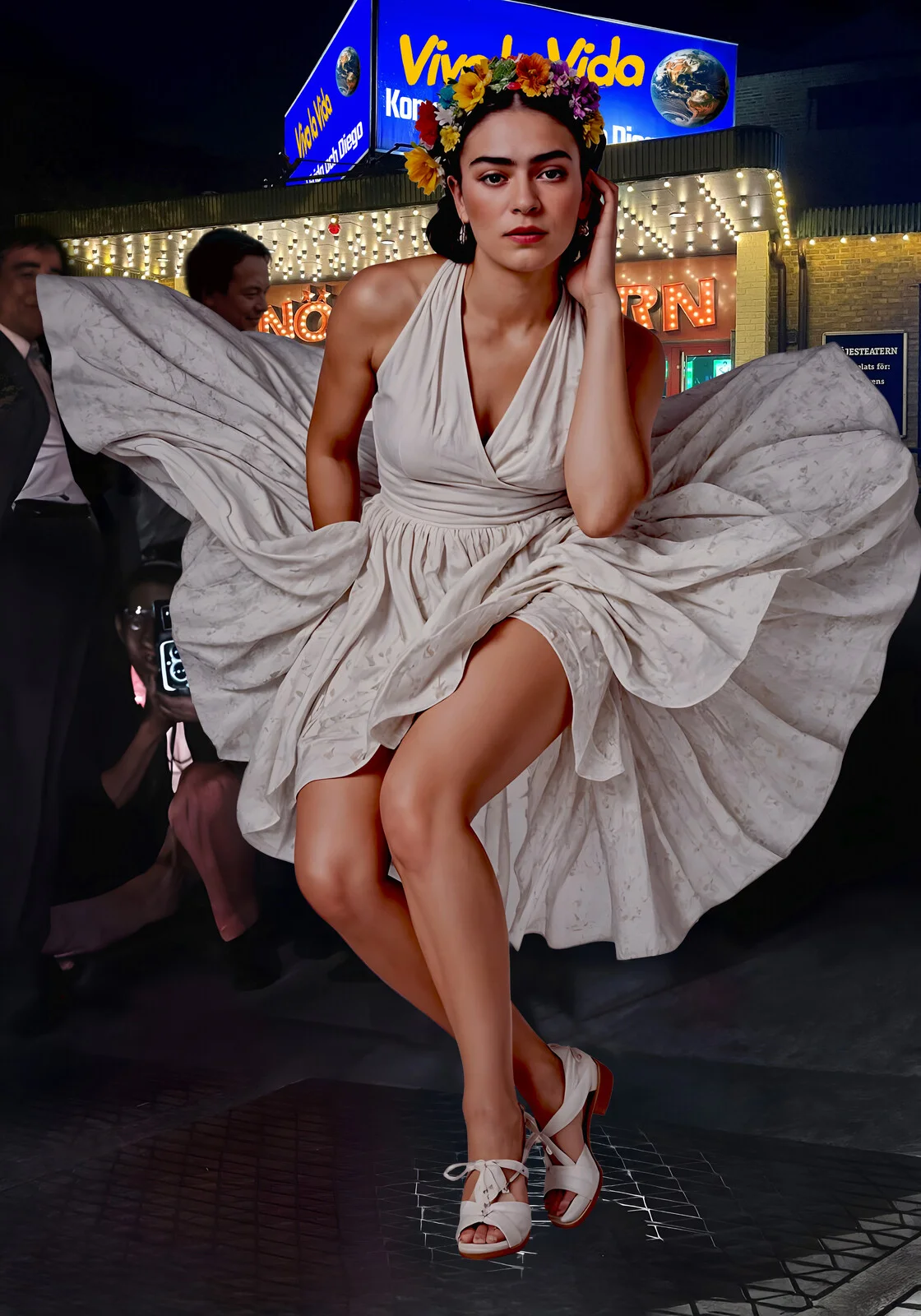
The Seven Year Paintbrush, 2025
Digital
70 x 100 cm
5 200 kr
The Seven Year Paintbrush
The Seven Year Paintbrush
Step into the vibrant and chaotic world of 1930s Mexico City with ‘The Seven Year Paintbrush’ a dazzling musical that reimagines the stormy romance of Frida Kahlo and Diego Rivera. This comedic spectacle brims with snappy dialogue, absurd misunderstandings, and larger-than-life personalities, blending the dramatic highs and lows of their tumultuous relationship with the surrealist energy of their art. Through witty banter, passionate melodies, and colourful settings, the story explores love, infidelity, and reconciliation—proving that even the most fractured relationships can create masterpieces.
Read on to explore what happens in the musical.
“The Seven Year Paintbrush
By brush and by heart, the story unfolds,
In strokes of laughter and hues of gold.
A tale of chaos, of love's delight,
With Frida and Diego in the spotlight.
In Mexico’s heat, their passion ignites,
An elephant and dove take their first flights.
Through grand murals and portraits stark,
Their love burns bright, a flame in the dark.
But seven years pass, and cracks appear,
With whispers of love triangles near.
Diego’s with Cristina, scandal abounds,
While Frida seeks solace where new love resounds.
The canvas is messy, the colours collide,
Yet both feel the pull, the love they can’t hide.
Through banter and bickering, they paint and fight,
Creating each a masterpiece every fiery night.
A mix-up, a mishap, mistaken affairs,
Absurd misunderstandings spark comical flares.
From shattered easels to spilt paint jars,
Their tempestuous bond outshines the stars.
As tempers explode and laughter rings,
Frida and Diego discover life’s swings.
Through music and wit, they realise anew,
No love is perfect, but some love is true.
The finale ascends in a symphony grand,
With Frida's ascent to the heavenly land.
On marble steps, she waves from the gate,
Yet her love for Diego defies even fate.
The chorus erupts, and their voices proclaim,
"Love conquers all through joy and pain!"
A celebration of art, of passion, of strife,
The vibrant musical that mirrors their life.
So cheers to the paintbrush, the love, and the song,
For Frida and Diego, where they both belong.
Malmö, January 2025
A Journey Through Passion and Turmoil with the Help of Brushes
The table was set for an intimate evening. The flickering glow of the candlelight reflected off the polished silverware, and the heady aroma of roasted duck breast, crispy Brussels sprouts, and fried potatoes filled the room. Outside the window, the Malmö harbour twinkled under the night sky. Occasionally, a pilot boat glided by, its lights cutting through the dark waters, meeting the larger ships on their way in or out of the port.
Frida Kahlo sat across from me, dressed in a flowing, embroidered blouse with her signature floral crown. A glass of robust Portuguese red wine cradled in her hand; she took a sip, her dark brown eyes glinting with mischief and thoughtfulness.
“Frida,” I began, carefully slicing into the duck, “your latest performance at Nöjesteatern sounds fascinating—a reimagining of ‘The Seven Year Itch’ no less. But it seems to go beyond a simple adaptation.”
She smiled, dabbing her lips with a napkin. “Indeed it does, but it’s ‘The Seven Year Itch’ with a twist. It’s not about a single marriage or a man tempted by his neighbour. It’s about Diego and me—our fire, storms, and the seven-year cycles that defined us.”
Me: “Let’s start from the beginnings of fire and canvas.”
Frida’s voice softened as she began to recount their first meeting. “I was just a teenager, curious and brash, watching Diego work on a mural at my school. I didn’t know it then, but something about his presence—his sheer size and booming laughter—stayed with me,” she said, her voice filled with the echoes of her teenage curiosity and the first stirrings of love.
Years later, their paths crossed again. Frida, recovering from the bus accident that nearly claimed her life, sought Diego’s opinion on her paintings. “He told me I had talent,” she said, a playful smirk curling her lips. “And then, he told me I had fire.”
Their whirlwind romance led to marriage in 1929. “My parents called it a union between an elephant and a dove,” she said, chuckling. “Diego was larger than life—literally and metaphorically—and I was still finding my wings.”
Me: “And then the storms begin.”
Frida: “That’s the least you can say. Their early years were both vibrant and volatile. Diego’s murals gained international acclaim, while Frida’s art began to attract attention for its raw, surreal beauty. But their union was anything but peaceful.
“Diego was unfaithful,” Frida admitted, her voice tightening. “I suppose I shouldn’t have been surprised. He had been married before—twice—and his appetite for women matched his appetite for life.”
The breaking point came when Diego had an affair with Cristina, Frida’s younger sister. “That betrayal cut deeper than any other,” she said, her hands clenching slightly around her wine glass. “But I was no saint either. I found solace in others— Leon Trotsky, among them.”
Her admission hung in the air, softened only by the candlelight. “But it wasn’t just about revenge,” she added. “It was about finding pieces of myself outside of Diego’s shadow.”
Me: “So this is the Seven-Year Itch defined.”
Frida: "Seven difficult years, a mixed bag following three mostly blissful ones spent floating on clouds—interrupted, of course, by storms. By 1939, our marriage crumbled under the weight of infidelities and fiery tempers. We divorced, though our separation was short-lived. By the next year, he proposed again, and we remarried, agreeing to a different kind of partnership that allowed for independence and acceptance of each other’s flaws."
“Diego and I were like two volcanoes,” Frida said, her eyes gleaming. “Sometimes we erupted, but the lava always cooled, leaving something new behind.”
Me: "Great metaphor."
Frida: “Our love, though unconventional, remained steadfast. He once told me I was the only woman he truly respected,” she said, her voice tinged with pride and sadness. “And I believed him.”
Me: "You must have suffered from the highs and lows of fame?"
Frida: "As our relationship evolved, so did our art. Diego’s grand murals celebrated the struggles of the working class, while my introspective works captured the pain and resilience of my soul. Our fame brought us to lavish parties and exhibitions around the world. For the most part, it was a wonderful life."
Me: "Truly, an extraordinary relationship—for better or worse, naturally."
Frida: "But things were always happening, throwing wrenches into the works and making our relationship grind, even when caused by others or external circumstances. We were in New York for his Rockefeller mural," she said, shaking her head with a wry smile. "Diego painted Lenin’s face as a minor part of the mural, and when the Rockefellers demanded he remove it, he refused. They destroyed the mural, and Diego laughed like a madman. Of course, I stayed loyal but ended up bearing the brunt of it—not Rockefeller."
Me: "No, those at the top are always untouchable."
Frida: “My first solo exhibition in Mexico in 1953 marked a turning point. By then, my body was failing,” she said, her fingers brushing the rim of her wine glass. “But Diego carried me there—literally, in my bed—so I could see the fruits of my labour.”
Me: "It feels like we’re approaching your star and the life beyond your departure from Earth."
Frida: “The final years were bittersweet. My health deteriorated, yet Diego remained by my side. “He organised everything—my medicine, my exhibitions,” she said, her voice trembling. “He was my anchor, even as I prepared to leave this world.”
Me: “Diego was a remarkable man, and despite your differences, I believe you were meant for each other—even on your star.”
Frida: “Thank you. After my departure in 1954, Diego confessed that I had been the love of his life. He said he realised too late what he had lost,” she murmured, her gaze distant, as though searching for something beyond the flickering candlelight. “But that’s the tragedy of love, isn’t it? We only see its value when it’s gone.”
Me: “Unfortunately, that’s true. I’ve had similar experiences, so I truly understand your feelings.”
Frida: “I’m sorry for your loss.” Her voice was warm with empathy, and a brief silence settled between us, the weight of shared pain and understanding palpable. She raised her glass, her expression softening. “Let us make a candlelit reflection—to love, in all its messy, beautiful forms.”
I mirrored her gesture, the amber glow of the candles shimmering in our wine glasses. “To love—and to the art it inspires.”
Outside, the harbour lights sparkled against the dark water, and the occasional hum of a passing boat seemed to punctuate Frida’s sentiment. Her story was not just one of art and fame but of passion, pain, and unyielding resilience—a testament to the profound beauty that can emerge even in the stormiest relationships.
While the play at Nöjesteatern was a comedy filled with laughter, it rested on the foundation of a dramatic and tumultuous life. Seen from the perspective of eternity, though, all ended well. A seven-year itch became an eternal joy.
When Frida had left in the taxi, I went back upstairs and began flipping through the program for ‘The Seven Year Paintbrush’. I started with the short blurb on the back cover:
"Set against the vibrant and chaotic backdrop of 1930s Mexico City, ‘The Seven Year Paintbrush’ is a comedic exploration of love, art, jealousy, and reconciliation. It features the larger-than-life artists Frida Kahlo and Diego Rivera. This whimsical retelling of their famously turbulent relationship introduces a classic love triangle—or rather, a love quadrangle—with plenty of dramatic flair and absurd misunderstandings, along with a delightful mix of snappy dialogue and captivating music, it was a perfect summary of the two-and-a-half-hour laugh riot—though the laughter occasionally caught in your throat when you remembered the real-life struggles underpinning the comedy, or musical, depending on what you chose to call it.”
I moved on to the inside pages, skimming through the synopsis and character breakdowns, smiling as I recalled scenes and moments. Having seen the play three times, I knew most of it by heart. Still, some moments made me laugh anew, the kind of belly laughs that felt absurdly cathartic. There was something profoundly entertaining yet poignant about the way Frida’s chaotic genius and Diego’s outlandish ego had been transformed into a comedy that teetered between absurdity and emotional resonance.
Frida’s self-deprecating, witty, and unapologetically vibrant portrayal of herself was magnetic. The audience couldn’t help but root for her, even as she navigated the ridiculous misunderstandings the play’s exaggerated version of her life threw at her. And Diego, painted as a bumbling yet charming philanderer with an oversized heart (and appetite), was the perfect foil.
The quadrangle of love—Frida, Diego, Cristina, and the enigmatic Leon Trotsky—was a whirlwind of misplaced affections, secret rendezvous, and comedic timing. Even knowing how it all played out, I couldn’t help but marvel at its cleverness.
As I turned the pages, I remembered how, during one performance, the audience had erupted in laughter when Diego tried to paint over Frida’s self-portrait in a fit of jealousy—only for Frida to march in, grab the brush, and turn the botched strokes into an even more striking masterpiece. It perfectly encapsulated their dynamic: competitive, messy, and ultimately brilliant.
By the time I reached the cast list and director’s note, I couldn’t help but wish I’d joined Frida for another round of the play. Her ability to laugh at herself—and at Diego—was infectious. The Seven Year Paintbrush might have been a comedy, but it reminded everyone of the power of resilience, humour, and love, even in the most turbulent relationships.
Act I: The Paint Cracks
Frida and Diego, seven years into their stormy marriage, are as passionate as ever—both in their love and their fights. Diego, the towering muralist with an insatiable appetite for life (and women), begins an affair with none other than Frida’s younger sister, Cristina Kahlo, under the pretence of giving her "art lessons."
Meanwhile, Frida, fed up with Diego’s constant infidelity, finds solace and romance in the arms of Leon Trotsky, the exiled Russian revolutionary staying at Casa Azul. Their secret rendezvous become the talk of the town, with whispered rumours swirling in cafés and cantinas.
Act II: Brushes Cross
The drama escalates when both couples unknowingly attend the same art exhibition opening. In his signature flamboyant style, Diego delivers a booming speech about artistic integrity while sneaking longing glances at Cristina. Frida, never one to be outdone, makes a dramatic entrance with Trotsky on her arm, her floral crown blazing like a beacon of defiance.
Misunderstandings pile up as Diego mistakes Trotsky’s latest political essay for a love letter to Frida. At the same time, Frida intercepts a gift Diego intended for Cristina—a necklace Frida recognises as her own design! Both suspect betrayal, but in classic comedic fashion, their confrontations only lead to more confusion and hilarity.
Act III: The Mural Falls
In the film’s climax, the four characters are in a surreal showdown at Casa Azul during a thunderstorm. Diego, attempting to win Frida back, paints a massive mural on the garden wall depicting their love story—but accidentally includes Cristina. Frida retaliates by adding her touches to the mural, turning Diego’s romantic ode into a chaotic revenge masterpiece.
When lightning strikes (literally), the mural is destroyed, leaving the garden covered in splashes of vibrant paint. As they sit in the aftermath of their artistic battle, Diego and Frida realise they’re at their best when creating—together.
Cristina and Trotsky, both exasperated, quietly exit the scene, realising they’ll never compete with the fiery bond between Frida and Diego.
Epilogue: Love and Laughter
The play ends on a comedic and hopeful note as Diego and Frida, paint-splattered and laughing, walk hand in hand into their studio to start a new collaborative work. Their love may not be perfect, but it’s undeniably theirs—messy, colourful, and larger than life.
As the credits roll, Trotsky and Cristina are seen exchanging glances in a nearby café, suggesting their budding romance. But as we know, that will not happen. Trotsky is murdered with an ice axe by Stalin's henchmen, and Cristina lives a relatively anonymous life compared to her iconic sister. She cared for Frida's house, Casa Azul, ensuring that many of Frida's belongings and artworks were preserved. Cristina also played a key role in ensuring Frida's legacy lived on.
Cristina had four children, two from her first marriage and two from her second relationship. She played a significant role in keeping the family united and remained a link to Frida and Diego's shared history. Although she did not achieve the same fame as her sister, Cristina remains a vital part of Frida's life story and artistic world.
Both as a sister and a model, her presence contributed to Frida's artistic expression and Diego Rivera's works. Her complicated relationship with Frida and Diego reminds us of the intricate ties between love, family, and art.
Like all musicals, it ends with the entire cast gathered on stage. After Frida’s bittersweet farewell song from her hospital bed, she takes her first steps onto the gleaming white marble staircase leading into the clouds, the Pearly Gates faintly visible in the distance. The ensemble bursts into a triumphant finale, singing a rousing anthem about love conquering all, their voices soaring together in harmony as the curtain falls.
The play left only positive impressions, both in tone and style. Filled with witty banter, absurd situations, and vibrant settings, ‘The Seven Year Paintbrush’ blends the comedic energy of classic screwball comedies with the surrealist flair of Frida’s art and Diego’s larger-than-life personality. It’s a celebration of love, imperfection, and the enduring power of creativity.
I closed the program, its pages filled with Frida’s richly coloured illustrations, and turned off the light.
Jörgen Thornberg
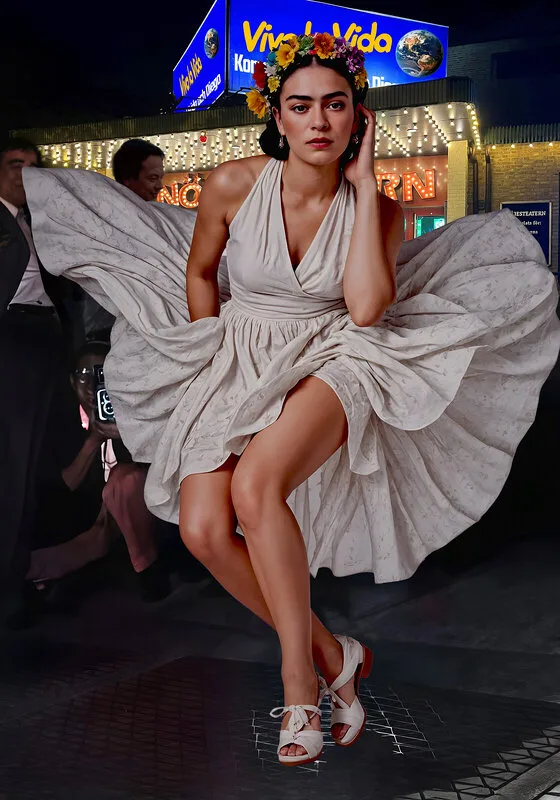
The Seven Year Paintbrush, 2025
Digital
70 x 100 cm
5 200 kr
The Seven Year Paintbrush
The Seven Year Paintbrush
Step into the vibrant and chaotic world of 1930s Mexico City with ‘The Seven Year Paintbrush’ a dazzling musical that reimagines the stormy romance of Frida Kahlo and Diego Rivera. This comedic spectacle brims with snappy dialogue, absurd misunderstandings, and larger-than-life personalities, blending the dramatic highs and lows of their tumultuous relationship with the surrealist energy of their art. Through witty banter, passionate melodies, and colourful settings, the story explores love, infidelity, and reconciliation—proving that even the most fractured relationships can create masterpieces.
Read on to explore what happens in the musical.
“The Seven Year Paintbrush
By brush and by heart, the story unfolds,
In strokes of laughter and hues of gold.
A tale of chaos, of love's delight,
With Frida and Diego in the spotlight.
In Mexico’s heat, their passion ignites,
An elephant and dove take their first flights.
Through grand murals and portraits stark,
Their love burns bright, a flame in the dark.
But seven years pass, and cracks appear,
With whispers of love triangles near.
Diego’s with Cristina, scandal abounds,
While Frida seeks solace where new love resounds.
The canvas is messy, the colours collide,
Yet both feel the pull, the love they can’t hide.
Through banter and bickering, they paint and fight,
Creating each a masterpiece every fiery night.
A mix-up, a mishap, mistaken affairs,
Absurd misunderstandings spark comical flares.
From shattered easels to spilt paint jars,
Their tempestuous bond outshines the stars.
As tempers explode and laughter rings,
Frida and Diego discover life’s swings.
Through music and wit, they realise anew,
No love is perfect, but some love is true.
The finale ascends in a symphony grand,
With Frida's ascent to the heavenly land.
On marble steps, she waves from the gate,
Yet her love for Diego defies even fate.
The chorus erupts, and their voices proclaim,
"Love conquers all through joy and pain!"
A celebration of art, of passion, of strife,
The vibrant musical that mirrors their life.
So cheers to the paintbrush, the love, and the song,
For Frida and Diego, where they both belong.
Malmö, January 2025
A Journey Through Passion and Turmoil with the Help of Brushes
The table was set for an intimate evening. The flickering glow of the candlelight reflected off the polished silverware, and the heady aroma of roasted duck breast, crispy Brussels sprouts, and fried potatoes filled the room. Outside the window, the Malmö harbour twinkled under the night sky. Occasionally, a pilot boat glided by, its lights cutting through the dark waters, meeting the larger ships on their way in or out of the port.
Frida Kahlo sat across from me, dressed in a flowing, embroidered blouse with her signature floral crown. A glass of robust Portuguese red wine cradled in her hand; she took a sip, her dark brown eyes glinting with mischief and thoughtfulness.
“Frida,” I began, carefully slicing into the duck, “your latest performance at Nöjesteatern sounds fascinating—a reimagining of ‘The Seven Year Itch’ no less. But it seems to go beyond a simple adaptation.”
She smiled, dabbing her lips with a napkin. “Indeed it does, but it’s ‘The Seven Year Itch’ with a twist. It’s not about a single marriage or a man tempted by his neighbour. It’s about Diego and me—our fire, storms, and the seven-year cycles that defined us.”
Me: “Let’s start from the beginnings of fire and canvas.”
Frida’s voice softened as she began to recount their first meeting. “I was just a teenager, curious and brash, watching Diego work on a mural at my school. I didn’t know it then, but something about his presence—his sheer size and booming laughter—stayed with me,” she said, her voice filled with the echoes of her teenage curiosity and the first stirrings of love.
Years later, their paths crossed again. Frida, recovering from the bus accident that nearly claimed her life, sought Diego’s opinion on her paintings. “He told me I had talent,” she said, a playful smirk curling her lips. “And then, he told me I had fire.”
Their whirlwind romance led to marriage in 1929. “My parents called it a union between an elephant and a dove,” she said, chuckling. “Diego was larger than life—literally and metaphorically—and I was still finding my wings.”
Me: “And then the storms begin.”
Frida: “That’s the least you can say. Their early years were both vibrant and volatile. Diego’s murals gained international acclaim, while Frida’s art began to attract attention for its raw, surreal beauty. But their union was anything but peaceful.
“Diego was unfaithful,” Frida admitted, her voice tightening. “I suppose I shouldn’t have been surprised. He had been married before—twice—and his appetite for women matched his appetite for life.”
The breaking point came when Diego had an affair with Cristina, Frida’s younger sister. “That betrayal cut deeper than any other,” she said, her hands clenching slightly around her wine glass. “But I was no saint either. I found solace in others— Leon Trotsky, among them.”
Her admission hung in the air, softened only by the candlelight. “But it wasn’t just about revenge,” she added. “It was about finding pieces of myself outside of Diego’s shadow.”
Me: “So this is the Seven-Year Itch defined.”
Frida: "Seven difficult years, a mixed bag following three mostly blissful ones spent floating on clouds—interrupted, of course, by storms. By 1939, our marriage crumbled under the weight of infidelities and fiery tempers. We divorced, though our separation was short-lived. By the next year, he proposed again, and we remarried, agreeing to a different kind of partnership that allowed for independence and acceptance of each other’s flaws."
“Diego and I were like two volcanoes,” Frida said, her eyes gleaming. “Sometimes we erupted, but the lava always cooled, leaving something new behind.”
Me: "Great metaphor."
Frida: “Our love, though unconventional, remained steadfast. He once told me I was the only woman he truly respected,” she said, her voice tinged with pride and sadness. “And I believed him.”
Me: "You must have suffered from the highs and lows of fame?"
Frida: "As our relationship evolved, so did our art. Diego’s grand murals celebrated the struggles of the working class, while my introspective works captured the pain and resilience of my soul. Our fame brought us to lavish parties and exhibitions around the world. For the most part, it was a wonderful life."
Me: "Truly, an extraordinary relationship—for better or worse, naturally."
Frida: "But things were always happening, throwing wrenches into the works and making our relationship grind, even when caused by others or external circumstances. We were in New York for his Rockefeller mural," she said, shaking her head with a wry smile. "Diego painted Lenin’s face as a minor part of the mural, and when the Rockefellers demanded he remove it, he refused. They destroyed the mural, and Diego laughed like a madman. Of course, I stayed loyal but ended up bearing the brunt of it—not Rockefeller."
Me: "No, those at the top are always untouchable."
Frida: “My first solo exhibition in Mexico in 1953 marked a turning point. By then, my body was failing,” she said, her fingers brushing the rim of her wine glass. “But Diego carried me there—literally, in my bed—so I could see the fruits of my labour.”
Me: "It feels like we’re approaching your star and the life beyond your departure from Earth."
Frida: “The final years were bittersweet. My health deteriorated, yet Diego remained by my side. “He organised everything—my medicine, my exhibitions,” she said, her voice trembling. “He was my anchor, even as I prepared to leave this world.”
Me: “Diego was a remarkable man, and despite your differences, I believe you were meant for each other—even on your star.”
Frida: “Thank you. After my departure in 1954, Diego confessed that I had been the love of his life. He said he realised too late what he had lost,” she murmured, her gaze distant, as though searching for something beyond the flickering candlelight. “But that’s the tragedy of love, isn’t it? We only see its value when it’s gone.”
Me: “Unfortunately, that’s true. I’ve had similar experiences, so I truly understand your feelings.”
Frida: “I’m sorry for your loss.” Her voice was warm with empathy, and a brief silence settled between us, the weight of shared pain and understanding palpable. She raised her glass, her expression softening. “Let us make a candlelit reflection—to love, in all its messy, beautiful forms.”
I mirrored her gesture, the amber glow of the candles shimmering in our wine glasses. “To love—and to the art it inspires.”
Outside, the harbour lights sparkled against the dark water, and the occasional hum of a passing boat seemed to punctuate Frida’s sentiment. Her story was not just one of art and fame but of passion, pain, and unyielding resilience—a testament to the profound beauty that can emerge even in the stormiest relationships.
While the play at Nöjesteatern was a comedy filled with laughter, it rested on the foundation of a dramatic and tumultuous life. Seen from the perspective of eternity, though, all ended well. A seven-year itch became an eternal joy.
When Frida had left in the taxi, I went back upstairs and began flipping through the program for ‘The Seven Year Paintbrush’. I started with the short blurb on the back cover:
"Set against the vibrant and chaotic backdrop of 1930s Mexico City, ‘The Seven Year Paintbrush’ is a comedic exploration of love, art, jealousy, and reconciliation. It features the larger-than-life artists Frida Kahlo and Diego Rivera. This whimsical retelling of their famously turbulent relationship introduces a classic love triangle—or rather, a love quadrangle—with plenty of dramatic flair and absurd misunderstandings, along with a delightful mix of snappy dialogue and captivating music, it was a perfect summary of the two-and-a-half-hour laugh riot—though the laughter occasionally caught in your throat when you remembered the real-life struggles underpinning the comedy, or musical, depending on what you chose to call it.”
I moved on to the inside pages, skimming through the synopsis and character breakdowns, smiling as I recalled scenes and moments. Having seen the play three times, I knew most of it by heart. Still, some moments made me laugh anew, the kind of belly laughs that felt absurdly cathartic. There was something profoundly entertaining yet poignant about the way Frida’s chaotic genius and Diego’s outlandish ego had been transformed into a comedy that teetered between absurdity and emotional resonance.
Frida’s self-deprecating, witty, and unapologetically vibrant portrayal of herself was magnetic. The audience couldn’t help but root for her, even as she navigated the ridiculous misunderstandings the play’s exaggerated version of her life threw at her. And Diego, painted as a bumbling yet charming philanderer with an oversized heart (and appetite), was the perfect foil.
The quadrangle of love—Frida, Diego, Cristina, and the enigmatic Leon Trotsky—was a whirlwind of misplaced affections, secret rendezvous, and comedic timing. Even knowing how it all played out, I couldn’t help but marvel at its cleverness.
As I turned the pages, I remembered how, during one performance, the audience had erupted in laughter when Diego tried to paint over Frida’s self-portrait in a fit of jealousy—only for Frida to march in, grab the brush, and turn the botched strokes into an even more striking masterpiece. It perfectly encapsulated their dynamic: competitive, messy, and ultimately brilliant.
By the time I reached the cast list and director’s note, I couldn’t help but wish I’d joined Frida for another round of the play. Her ability to laugh at herself—and at Diego—was infectious. The Seven Year Paintbrush might have been a comedy, but it reminded everyone of the power of resilience, humour, and love, even in the most turbulent relationships.
Act I: The Paint Cracks
Frida and Diego, seven years into their stormy marriage, are as passionate as ever—both in their love and their fights. Diego, the towering muralist with an insatiable appetite for life (and women), begins an affair with none other than Frida’s younger sister, Cristina Kahlo, under the pretence of giving her "art lessons."
Meanwhile, Frida, fed up with Diego’s constant infidelity, finds solace and romance in the arms of Leon Trotsky, the exiled Russian revolutionary staying at Casa Azul. Their secret rendezvous become the talk of the town, with whispered rumours swirling in cafés and cantinas.
Act II: Brushes Cross
The drama escalates when both couples unknowingly attend the same art exhibition opening. In his signature flamboyant style, Diego delivers a booming speech about artistic integrity while sneaking longing glances at Cristina. Frida, never one to be outdone, makes a dramatic entrance with Trotsky on her arm, her floral crown blazing like a beacon of defiance.
Misunderstandings pile up as Diego mistakes Trotsky’s latest political essay for a love letter to Frida. At the same time, Frida intercepts a gift Diego intended for Cristina—a necklace Frida recognises as her own design! Both suspect betrayal, but in classic comedic fashion, their confrontations only lead to more confusion and hilarity.
Act III: The Mural Falls
In the film’s climax, the four characters are in a surreal showdown at Casa Azul during a thunderstorm. Diego, attempting to win Frida back, paints a massive mural on the garden wall depicting their love story—but accidentally includes Cristina. Frida retaliates by adding her touches to the mural, turning Diego’s romantic ode into a chaotic revenge masterpiece.
When lightning strikes (literally), the mural is destroyed, leaving the garden covered in splashes of vibrant paint. As they sit in the aftermath of their artistic battle, Diego and Frida realise they’re at their best when creating—together.
Cristina and Trotsky, both exasperated, quietly exit the scene, realising they’ll never compete with the fiery bond between Frida and Diego.
Epilogue: Love and Laughter
The play ends on a comedic and hopeful note as Diego and Frida, paint-splattered and laughing, walk hand in hand into their studio to start a new collaborative work. Their love may not be perfect, but it’s undeniably theirs—messy, colourful, and larger than life.
As the credits roll, Trotsky and Cristina are seen exchanging glances in a nearby café, suggesting their budding romance. But as we know, that will not happen. Trotsky is murdered with an ice axe by Stalin's henchmen, and Cristina lives a relatively anonymous life compared to her iconic sister. She cared for Frida's house, Casa Azul, ensuring that many of Frida's belongings and artworks were preserved. Cristina also played a key role in ensuring Frida's legacy lived on.
Cristina had four children, two from her first marriage and two from her second relationship. She played a significant role in keeping the family united and remained a link to Frida and Diego's shared history. Although she did not achieve the same fame as her sister, Cristina remains a vital part of Frida's life story and artistic world.
Both as a sister and a model, her presence contributed to Frida's artistic expression and Diego Rivera's works. Her complicated relationship with Frida and Diego reminds us of the intricate ties between love, family, and art.
Like all musicals, it ends with the entire cast gathered on stage. After Frida’s bittersweet farewell song from her hospital bed, she takes her first steps onto the gleaming white marble staircase leading into the clouds, the Pearly Gates faintly visible in the distance. The ensemble bursts into a triumphant finale, singing a rousing anthem about love conquering all, their voices soaring together in harmony as the curtain falls.
The play left only positive impressions, both in tone and style. Filled with witty banter, absurd situations, and vibrant settings, ‘The Seven Year Paintbrush’ blends the comedic energy of classic screwball comedies with the surrealist flair of Frida’s art and Diego’s larger-than-life personality. It’s a celebration of love, imperfection, and the enduring power of creativity.
I closed the program, its pages filled with Frida’s richly coloured illustrations, and turned off the light.
5 200 kr

Jörgen Thornberg
Malmö
Lite om bilder och mig. Translation in English at the end.
Jag är en nyfiken person som ser allt i bilder, även det jag fäster i ord, gärna tillsammans för bakom alla mina bilder finns en berättelse. Till vissa bilder hör en kortare eller längre novell som följer med bilden.
Bilder berättar historier. Jag omges av naturlig skönhet, intressanta människor och historia var jag än går. Jag använder min kamera för att dokumentera världen och blanda det jag ser med vad jag känner för att fånga den dolda magin.
Mina bilder berättar mina historier. Genom mina bilder, tryck och berättelser. Jag bjuder in dig att ta del av dessa berättelser, in i ditt liv och hem och dela min mycket personliga syn på vår värld. Mer än vad ögat ser. Jag tänker i bilder, drömmer och skriver och pratar om dem; följaktligen måste jag också skapa bilder. De blir vad jag ser, inte nödvändigtvis begränsade till verkligheten. Det finns en bild runt varje hörn. Jag hoppas att du kommer att se vad jag såg och gilla det.
Jag är också en skrivande person och till många bilder hör en kortare eller längre essay. Den följer med tavlan, tryckt på fint papper och med en personlig hälsning från mig.
Flertalet bilder startar sin resa i min kamera. Enkelt förklarat beskriver jag bilden jag ser i mitt inre, upplevd eller fantiserad. Bilden uppstår inom mig redan innan jag fått okularet till ögat. På bråkdelen av ett ögonblick ser jag vad jag vill ha och vad som kan göras med bilden. Här skall jag stoppa in en giraff, stålmannen, Titanic eller vad det är min fantasi finner ut. Ännu märkligare är att jag kommer ihåg minnesbilden långt efteråt när det blir tid att skapa verket. Om jag lyckas eller inte, är upp till betraktaren, oftast präglat av en stråk av svart humor – meningen är att man skall bli underhållen. Mina bilder blir ofta en snackis där de hänger.
Jag föredrar bilder som förmedlar ett budskap i flera lager. Vid första anblicken fylld av feel-good, en vacker utsikt, fint väder, solen skiner, blommor på ängen eller vattnet som ligger förrädiskt spegelblankt. I en sådan bild kan jag gömma min egentliga berättelse, mitt förakt för förtryckare och våldsverkare, rasister och fördomsfulla människor - ett gärna återkommande motiv mer eller mindre dolt i det vackra motivet. Jag försöker förena dem i ett gemensamt narrativ.
Bild och formgivning har löpt som en röd tråd genom livet. Fotokonst känns som en värdig final som jag gärna delar med mig.
Min genre är vid som framgår av mina bilder, temat en blandning av pop- och gatukonst i kollage som kan bestå av hundratals lager. Vissa bilder kan ta veckor, andra någon dag innan det är dags att överlämna resultatet till printverkstaden. Fine Art Prints är digitala fotocollage. I dessa kollage sker rivandet, klippandet, pusslandet, målandet, ritandet och sprayningen digitalt. Det jag monterar in kan vara hundratals år gamla bilder som jag omsorgsfullt frilägger så att de ser ut att vara en del av tavlan men också bilder skapade av mig själv efter min egen fantasi. Därefter besöks printstudion och för vissa bilder numrera en limiterad upplaga (oftast 7 exemplar) och signera för hand. Vissa bilder kan köpas i olika format. Det är bara att fråga efter vilka. Gillar man en bild som är 70x100 men inte har plats på väggen, går den kanske att få i 50x70 cm istället. Frågan är fri.
Metoden Giclée eller Fine Art Print som det också kallas är det moderna sättet för framställning av grafisk konst. Villkoret för denna typ av utskrifter är att en högkvalitativ storformatskrivare används med åldersbeständigt färgpigment och konstnärspapper eller i förekommande fall på duk. Pappret som används möter de krav på livslängd som ställs av museer och gallerier. Normalt säljer jag mina bilder oinramade så att den nya ägaren själv kan bestämma hur de skall se ut, med eller utan passepartout färg på ram, med eller utan glas etc..
Under många år ställde jag bara ut på nätet, i valda grupper och på min egen Facebooksida - https://www.facebook.com/jorgen.thornberg.9
Jag finns också på en egen hemsida som tyvärr inte alltid är uppdaterad – https://www.jth.life/ Där kan du också läsa en del av de berättelser som följer med bilden.
UTSTÄLLNINGAR
Luftkastellet, oktober 2022
Konst i Lund, november 2022
Luftkastellet, mars 2023
Engleson Galleri Caroli, april 2023
Hydra, Greece June 2023
Engleson Galleri Caroli, oktober 2023
Toppen, Höllviken december 2023
Luftkastellet, mars 2024
Torups Galleri, mars 2024
Venice, May 2024
Luftkastellet, oktober 2024
Konst i Advent, December 2024
Galleri Engleson, Caroli December 2024
Jäger & Jansson Galleri, april 2025
A bit about pictures and me.
I'm a curious person who sees everything in pictures, even what I express in words, often combining them, for behind all my pictures lies a story. These narratives, some as short as a single image and others as long as a novel, are the heart and soul of my work.
Pictures tell stories. Wherever I go, I'm surrounded by natural beauty, exciting people, and history. I use my camera to document the world and blend what I see with what I feel to capture the hidden magic.
My images tell my stories. Through my pictures, prints, and narratives, I invite you to partake in these stories in your life and home and share my deeply personal perspective of our world. More than meets the eye. I think in pictures, dream, write, and talk about them; consequently, I must create images too. They become what I see, not necessarily confined to reality. There's a picture around every corner. I hope you'll see what I saw and enjoy it.
I'm also a writer, and many images come with a shorter or longer essay. It accompanies the painting, printed on fine paper with my personal greeting.
Many pictures start their journey on my camera. Simply put, I describe the image I see in my mind, experienced or imagined. The image arises within me even before I bring the eyepiece to my eye. In a fraction of a moment, I see what I want and what can be done with the picture. Here, I'll insert a giraffe, Superman, the Titanic, or whatever my imagination conjures up. Even stranger is that I remember the mental image long after it's time to create the work. Whether I succeed is up to the observer, often imbued with a streak of black humour – the aim is to entertain. My pictures usually become a talking point wherever they hang.
I prefer pictures that convey a message in multiple layers. At first glance, they're filled with feel-good vibes, a beautiful view, lovely weather, the sun shining, flowers in the meadow, or the water lying deceptively calm. But beneath this surface beauty, I often conceal a deeper story, a narrative that challenges societal norms or explores the human condition. I invite you to delve into these hidden narratives and discover the layers of meaning within my work.
Picture and design have been a thread running through my life. Photographic art feels like a fitting finale, and I'm happy to share it.
My genre is varied, as seen in my pictures; the theme is a blend of pop and street art in collages that can consist of hundreds of layers. Some images can take weeks, others just a day before it's time to hand over the result to the print workshop. Fine Art Prints are digital photo collages. In these collages, tearing, cutting, puzzling, painting, drawing, and spraying happen digitally. What I insert can be images hundreds of years old that I carefully extract so they appear to be part of the painting, but also images created by myself, now also generated from my imagination. Next, visit the print studio and, for certain images, number a limited edition (usually 7 copies) and sign them by hand. Some images may be available in other formats. Just ask which ones. If you like an image that's 70x100 but doesn't have space on the wall, you might be able to get it in 50x70 cm instead. The question is open.
The Giclée method, or Fine Art Print as it's also called, is the modern way of producing graphic art. This method ensures the highest quality and longevity of the artwork, using a high-quality large-format printer with archival pigment inks and artist paper or, in some cases, canvas. The paper used meets the longevity requirements set by museums and galleries. I sell my pictures unframed, allowing the new owner to personalise their artwork, confident in the lasting value and quality of the piece.
For many years, I only exhibited online, in selected groups, and on my Facebook page - https://www.facebook.com/jorgen.thornberg.9. I also have my website, which unfortunately is not constantly updated - https://www.jth.life/. You can also read some of the stories accompanying the pictures there.
EXHIBITIONS
Luftkastellet, October 2022
Art in Lund, November 2022
Luftkastellet, March 2023
Engleson Gallery Caroli, April 2023
Hydra, Greece June 2023
Engleson Gallery Caroli, October 2023
Toppen, Höllviken December 2023
Luftkastellet, March 2024
Torup Gallery, March 2024
Venice, May 2024
UTSTÄLLNINGAR
Luftkastellet, oktober 2022
Konst i Lund, november 2022
Luftkastellet, mars 2023
Engleson Galleri Caroli, april 2023
Hydra, Greece June 2023
Engleson Galleri Caroli, oktober 2023
Toppen, Höllviken december 2023
Luftkastellet, mars 2024
Torups Galleri, mars 2024
Venice, May 2024
Luftkastellet, October 2024
Konst i Advent, December 2024
Galleri Engleson, Caroli December 2024
Jäger & Jansson Galleri, April 2025
Utbildning
Autodidakt
Medlem i konstnärsförening
Öppna Sinnen
Med i konstrunda
Konstrundan i Skåne
Utställningar
Luftkastellet, October 2022
Art in Lund, November 2022
Luftkastellet, March 2023
Engleson Gallery Caroli, April 2023
Hydra, Greece June 2023
Engleson Gallery Caroli, October 2023
Toppen, Höllviken December 2023
Luftkastellet, March 2024
Torup Gallery, March 2024
Venice, May 2024