Vi använder cookies för att ge dig bästa möjliga upplevelse. Välj vilka cookies du tillåter.
Läs mer i vår integritetspolicy
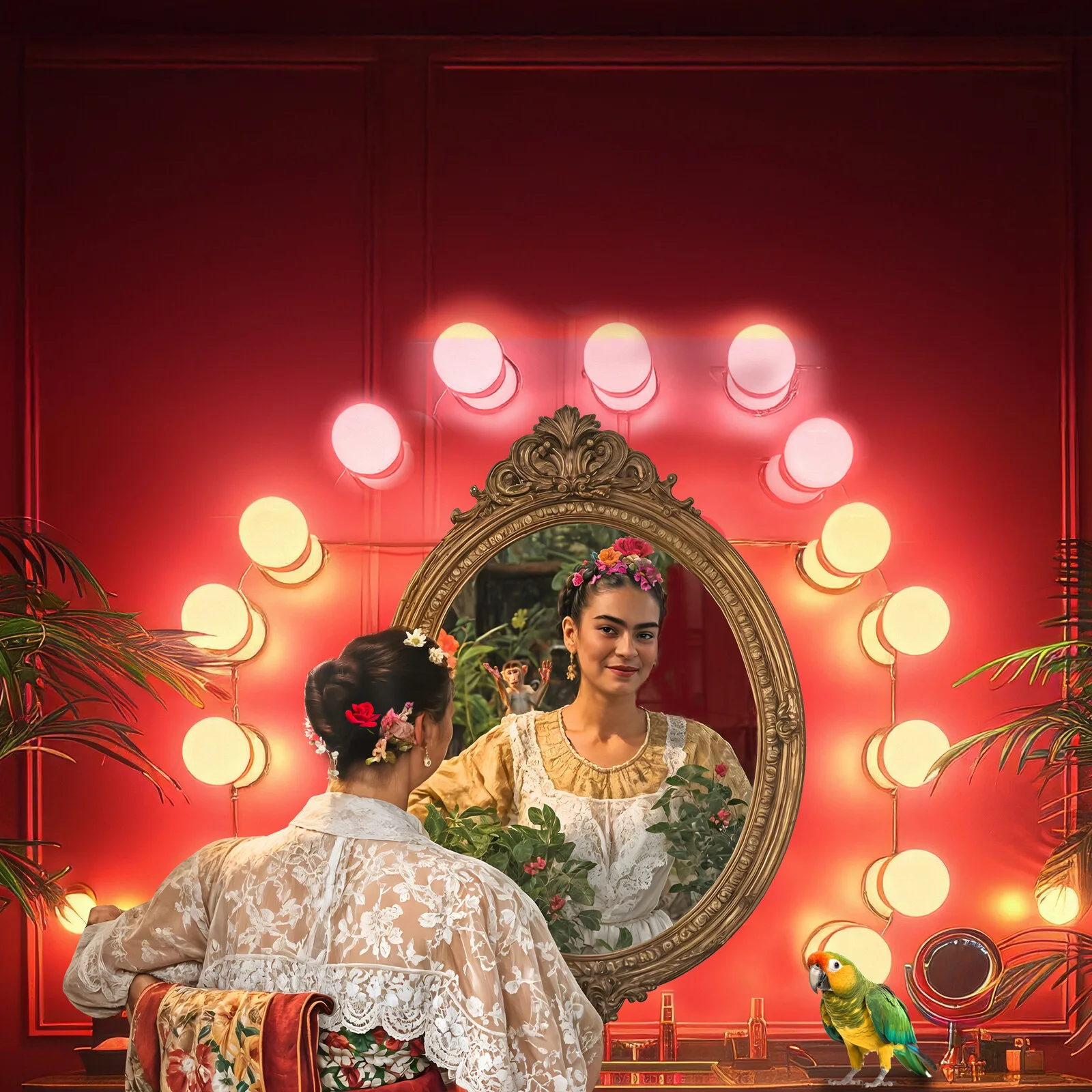
Jörgen Thornberg
Mirror, Mirror on the wall.... Frida Kahlo på Nöjesteatern, 2025
Digital
90 x 90 cm
5 500 kr
Mirror, Mirror on the Wall. Who is the fairest Of Them All
Step Inside Frida Kahlo’s Dressing Room: A Journey Through Art, Identity, and Makeup
What if you could sit with Frida Kahlo as she prepared for a performance, her vanity lit with soft bulbs and her makeup tools laid out like an artist’s palette? At Malmö's Nöjesteatern, Frida’s dressing room became a sanctuary where history, humour, and beauty collided. As she carefully painted her iconic monobrow and applied her signature Raven Red polish, she wove tales of ancient philosophers, the artistry of Cleopatra, and the vanity of Louis XIV’s court.
Her parrot Diego demanded a dab of nail polish, her mischievous monkey mimicked her lip colour, and Frida laughed, brushing aside their antics. “Makeup is not just for beauty,” she said, “it’s for defiance, art, and revelation.” Her unique perspective on makeup, as a tool for self-expression and empowerment, is truly inspiring.
In this intimate conversation, Frida reclaims makeup as her battlefield and canvas, where ancient wisdom meets timeless artistry. This is not just makeup—it’s a philosophy.
Will you join her in the mirror’s reflection? Please read on.
“An Honest Mirror
Mirror, mirror on the wall,
Who’s the fairest of them all?
Frida stands with a steady hand,
A palette of colours at her command.
With raven brows like blackbird wings,
She paints the strength her spirit brings.
A touch of blush, a sunlit glow,
Her cheeks, the canvas, softly show.
Ruby lips, her fiery mark,
A warrior's weapon in the dark.
Each stroke is defiant, bold, and true,
She carves her lovely image, anew, anew.
Her nails shine red like roses kissed,
No detail of beauty will be missed.
Her hands, her tools, her story's thread,
Creating a life where dreams have fled.
Her monkey watches, eyes alight,
Insisting her lips need a crimson bite.
And Diego squawks with jealous flair,
Until his beak gleams bright and rare.
Mirror, mirror on the wall,
Who’s the fairest of them all?
The answer rings, both proud and clear:
Frida, radiant, now stands here.
Malmö January 2025
Frida Kahlo in Her Dressing Room: A Conversation About Makeup
Sitting in her dressing room at Malmö's Nöjesteatern, Frida Kahlo prepared for another To Be or Not to Be performance. This was her favourite time of the day. She loved applying makeup—a process that was not merely about aesthetics but an extension of her identity and art. Her relationship with makeup was deeply personal, celebrating her uniqueness and individuality.
Frida laughed as she began her ritual. Her little monkey, always curious, hopped onto the vanity and insisted on having her lips painted too. Meanwhile, Diego, her vain parrot, squawked until Frida dabbed a tiny bit of red nail polish on his beak. “Diego may be a boy,” she teased, “but he’s the vainest of us all!”
With her tools laid out before her—Revlon’s 'Clear Red' blush, 'Raven Red' nail polish, and 'Everything’s Rosy' lipstick—Frida began.
“Makeup is art and identity. I will give you a step-by-step journey.” She paused briefly to perfect the line of her lips. Frida explained each step of her routine with both precision and humour:
“The Brow is my major signature. First, I take my trusty Revlon eyebrow pencil in 'Ebony,'” she said, holding it up. “My brows are not a flaw to hide; they are wings of a blackbird, framing my face with power. Diego used to say they framed my extraordinary eyes. I like to believe he was right.” Leaning closer to the mirror, she carefully defined the bold arches that crowned her face, pausing occasionally to check for symmetry.
“Rouge is for Vivacity. My cheeks must glow, you see, but not too much. A 'Clear Red' touch on each cheek makes me look alive—like the Mexican sun has kissed my skin.” She patted the blush onto her cheeks with her fingertips, her reflection glowing warmly as she adjusted the balance on each side.
“My Lips of a Fighter are my weapons,” she smirked, applying 'Everything’s Rosy.' “Bold, red, and unapologetic. When I speak, I want the world to remember my words. And when I kiss, let’s say I leave a mark.” She laughed, then leaned back slightly to admire her work before refining the edges of her lip line.
“Nails must match my jewels.” Carefully brushing on 'Raven Red' nail polish, Frida added, “My hands are my tools. They paint my pain, my dreams, my soul. Why shouldn’t they look beautiful too?” She paused, holding her fingers to the light to ensure an even coat before continuing.
“Can you give me a brief history of makeup?” I asked.
As she applied each layer, Frida launched into an impromptu history lesson, weaving humour and fascination into the tale of humanity’s love affair with makeup. Between sentences, she would pause to adjust her eyeliner or examine her nails, her words flowing seamlessly with her meticulous routine.
“Let’s take it from the beginning then and start with Lucy and the dawn of makeup. Do you know, even Lucy—the famous Australopithecus who lived 3 million years ago—probably dabbled in self-decoration? Not with lipstick or rouge, of course, but with red ochre. Can you imagine her smearing it on her face, looking at her reflection in a pool? Maybe even thinking, ‘I look fierce!’” Frida grinned as she mimicked Lucy’s hypothetical pose, her hands moving deftly to apply a second coat of polish.
“And how about the Neanderthals and us Homo sapiens?”
“Later, Neanderthals joined in. They used pigments, beads, and shells to adorn themselves. It wasn’t just survival for them—they had style! And we Homo sapiens? We took it even further. When we hit the Stone Age, women ground minerals into powder to paint their faces. Functional and fabulous!”
“The Egyptians were masters of elegance, weren’t they?”
“Ah, the Egyptians,” Frida continued with dramatic flair. She reached for her eyeliner, pausing to draw a precise line as she spoke. “They didn’t just paint their faces; they perfected the art! Kohl-lined eyes to protect against the sun and ward off evil spirits, crushed malachite for shimmering green shadows, and henna for their nails. Cleopatra would have adored Revlon!”
“How about the Sumerians, Greeks, and Romans?”
“The Sumerians had lipsticks made of crushed gemstones—imagine the luxury! The Greeks painted even their statues; you'd be amazed at how they dolled up Pallas Athena. And the Romans? They loved their blush and even invented crude nail polish using animal fats. Barbaric, but effective!”
“And the East?”
“In short—subtlety and sophistication,” she said, nodding knowingly as she began to arrange the flowers in her hair. “In China and Japan, makeup became an art form. Chinese women painted their faces with rice powder, their lips with vermillion, and sometimes adorned their nails with gold. Meanwhile, Japanese geishas mastered the white face and red lips we know so well. Their precision was unmatched.”
“And men have worn makeup too, not just today’s queer community.”
“Men in Makeup. Definitely! A Timeless Rivalry.” Frida chuckled, her hands still busy with her hair. “And let’s not forget the men! In ancient Egypt, they wore kohl just like the women. The French courtiers in Louis XIV’s court took it to the next level with powdered wigs, rouge, and beauty spots. Even Aztec warriors painted their faces for battle. Men and women, we’ve always competed to outshine one another!”
“What is your philosophy of makeup?”
As she finished her ritual, Frida looked into the mirror, adjusting the final flower in her hair. “Makeup is not just about beauty. It is art, defiance, a mask, and a revelation. In life, I used it to highlight my identity and reclaim control over my body. It’s just for fun in eternity—but what fun it is! Even the philosophers of antiquity took it seriously.”
Her laugh echoed through the room as Diego flapped his wings in approval. The sound of a bell rang from the hallway outside, signalling it was time to start wrapping up.
Me: ”What is your philosophy of makeup?”
As she finished her ritual, Frida looked into the mirror. “Makeup is not just about beauty. It is art, defiance, a mask and a revelation. In life, I used it to highlight my identity and reclaim control over my body. It’s just for fun in eternity—but what fun it is! Och till och med antikens filosofer tog saken på allvar.”
Her laugh echoed through the room as Diego squawked approval. Even in the afterlife, Frida Kahlo wore her makeup as she wore her soul—boldly, unapologetically, and with immense joy.
Me: “Please, tell me.”
Frida: “The philosophers of antiquity were often critical of makeup, seeing it as a form of deception, vanity, or a distraction from more important matters like virtue and morality. At the same time, there were voices like Ovid’s, who considered makeup an art and a way to express beauty. Their reflections mirror the values of their time and have continued to influence how we perceive makeup and external beauty today.”
Me: “Thought-provoking, and when you see all the excesses today, it’s easy to understand their ambivalence.”
Frida: “Tired old men, I’d call many of them. Plato was sceptical of makeup and thought it could be a deception. He linked it to his critique of art as an imitation of reality. In The Republic, he expressed concern that makeup could be used to conceal true nature, which he saw as a barrier to genuine knowledge and understanding.
Aristotle didn’t mention makeup directly, but his thoughts on virtue and naturalness could be interpreted as a critique of excessive focus on external beauty. He emphasised the importance of living according to one’s true nature and would likely have seen makeup as potentially distracting from inner life and virtues.
The Stoic philosopher Seneca was critical of makeup and beauty products. He considered them superficial and a sign of vanity. In his letters and writings, he maintained that true beauty comes from within and that makeup can conceal but never replace a person’s character and morality.
The Roman poet Ovid had a different perspective. In his book Medicamina Faciei Femineae (The Art of Beauty), he gave tips on how women could care for their skin and use makeup to enhance their beauty. He saw it as a form of art and seductive power rather than something negative. For Ovid, beauty was an essential tool for social and romantic success.
Cicero, like Seneca, was critical of makeup. He associated it with moral decay and condemned it as a tool for manipulation. He advocated for virtue and naturalness over artificiality.
Plutarch wrote about makeup in his essay Moralia. He was critical of women who spent too much time and energy on makeup and urged them instead to focus on their inner lives and virtues. He believed that true beauty was the outward expression of virtue.”
Me: “But seen from a female perspective?”
Frida: “Although we don’t have many preserved texts from female philosophers of antiquity, it’s likely that makeup played an important role in women’s daily lives and that their views on makeup varied, just like the men’s. Much of what was written by men about makeup was influenced by patriarchal values.”
Me: “What about Sappho?”
Frida: “Sappho, the ancient Greek poet from the island of Lesbos, is best known for her lyrical poems about love, beauty, and passion. Although her surviving works are fragmentary, her poetry does not directly discuss makeup or cosmetics. However, she often celebrated women’s beauty and praised the aesthetic aspects of love and attraction, suggesting that she appreciated natural and enhanced beauty. Sappho described women’s beauty with deep admiration and lyrical detail, but it was more about their natural features, body harmony, and movement than anything artificial. For instance, she wrote about radiant faces and rosy cheeks, which could be interpreted as poetic imagery for what cosmetics often enhance. After all, without blushing, cheeks are seldom rosy.”
Me: “I find it hard to imagine her without makeup. As you mentioned, she lived in a time when cosmetics and adornments were part of social life. Women used powders to lighten their skin, rouge for their cheeks, and dark pigments to accentuate their eyes.”
Frida: “An example of Sappho’s focus on aesthetics and sensuality is found in a poetic fragment where she describes a woman’s gait as more graceful than a racing horse:
‘She moves with grace more beautiful than racing steeds.’”
The bell rang twice outside, signalling that it was high time for Frida to finish her makeup, which she had been doing throughout our conversation.
Jörgen Thornberg
Mirror, Mirror on the wall.... Frida Kahlo på Nöjesteatern, 2025
Digital
90 x 90 cm
5 500 kr
Mirror, Mirror on the Wall. Who is the fairest Of Them All
Step Inside Frida Kahlo’s Dressing Room: A Journey Through Art, Identity, and Makeup
What if you could sit with Frida Kahlo as she prepared for a performance, her vanity lit with soft bulbs and her makeup tools laid out like an artist’s palette? At Malmö's Nöjesteatern, Frida’s dressing room became a sanctuary where history, humour, and beauty collided. As she carefully painted her iconic monobrow and applied her signature Raven Red polish, she wove tales of ancient philosophers, the artistry of Cleopatra, and the vanity of Louis XIV’s court.
Her parrot Diego demanded a dab of nail polish, her mischievous monkey mimicked her lip colour, and Frida laughed, brushing aside their antics. “Makeup is not just for beauty,” she said, “it’s for defiance, art, and revelation.” Her unique perspective on makeup, as a tool for self-expression and empowerment, is truly inspiring.
In this intimate conversation, Frida reclaims makeup as her battlefield and canvas, where ancient wisdom meets timeless artistry. This is not just makeup—it’s a philosophy.
Will you join her in the mirror’s reflection? Please read on.
“An Honest Mirror
Mirror, mirror on the wall,
Who’s the fairest of them all?
Frida stands with a steady hand,
A palette of colours at her command.
With raven brows like blackbird wings,
She paints the strength her spirit brings.
A touch of blush, a sunlit glow,
Her cheeks, the canvas, softly show.
Ruby lips, her fiery mark,
A warrior's weapon in the dark.
Each stroke is defiant, bold, and true,
She carves her lovely image, anew, anew.
Her nails shine red like roses kissed,
No detail of beauty will be missed.
Her hands, her tools, her story's thread,
Creating a life where dreams have fled.
Her monkey watches, eyes alight,
Insisting her lips need a crimson bite.
And Diego squawks with jealous flair,
Until his beak gleams bright and rare.
Mirror, mirror on the wall,
Who’s the fairest of them all?
The answer rings, both proud and clear:
Frida, radiant, now stands here.
Malmö January 2025
Frida Kahlo in Her Dressing Room: A Conversation About Makeup
Sitting in her dressing room at Malmö's Nöjesteatern, Frida Kahlo prepared for another To Be or Not to Be performance. This was her favourite time of the day. She loved applying makeup—a process that was not merely about aesthetics but an extension of her identity and art. Her relationship with makeup was deeply personal, celebrating her uniqueness and individuality.
Frida laughed as she began her ritual. Her little monkey, always curious, hopped onto the vanity and insisted on having her lips painted too. Meanwhile, Diego, her vain parrot, squawked until Frida dabbed a tiny bit of red nail polish on his beak. “Diego may be a boy,” she teased, “but he’s the vainest of us all!”
With her tools laid out before her—Revlon’s 'Clear Red' blush, 'Raven Red' nail polish, and 'Everything’s Rosy' lipstick—Frida began.
“Makeup is art and identity. I will give you a step-by-step journey.” She paused briefly to perfect the line of her lips. Frida explained each step of her routine with both precision and humour:
“The Brow is my major signature. First, I take my trusty Revlon eyebrow pencil in 'Ebony,'” she said, holding it up. “My brows are not a flaw to hide; they are wings of a blackbird, framing my face with power. Diego used to say they framed my extraordinary eyes. I like to believe he was right.” Leaning closer to the mirror, she carefully defined the bold arches that crowned her face, pausing occasionally to check for symmetry.
“Rouge is for Vivacity. My cheeks must glow, you see, but not too much. A 'Clear Red' touch on each cheek makes me look alive—like the Mexican sun has kissed my skin.” She patted the blush onto her cheeks with her fingertips, her reflection glowing warmly as she adjusted the balance on each side.
“My Lips of a Fighter are my weapons,” she smirked, applying 'Everything’s Rosy.' “Bold, red, and unapologetic. When I speak, I want the world to remember my words. And when I kiss, let’s say I leave a mark.” She laughed, then leaned back slightly to admire her work before refining the edges of her lip line.
“Nails must match my jewels.” Carefully brushing on 'Raven Red' nail polish, Frida added, “My hands are my tools. They paint my pain, my dreams, my soul. Why shouldn’t they look beautiful too?” She paused, holding her fingers to the light to ensure an even coat before continuing.
“Can you give me a brief history of makeup?” I asked.
As she applied each layer, Frida launched into an impromptu history lesson, weaving humour and fascination into the tale of humanity’s love affair with makeup. Between sentences, she would pause to adjust her eyeliner or examine her nails, her words flowing seamlessly with her meticulous routine.
“Let’s take it from the beginning then and start with Lucy and the dawn of makeup. Do you know, even Lucy—the famous Australopithecus who lived 3 million years ago—probably dabbled in self-decoration? Not with lipstick or rouge, of course, but with red ochre. Can you imagine her smearing it on her face, looking at her reflection in a pool? Maybe even thinking, ‘I look fierce!’” Frida grinned as she mimicked Lucy’s hypothetical pose, her hands moving deftly to apply a second coat of polish.
“And how about the Neanderthals and us Homo sapiens?”
“Later, Neanderthals joined in. They used pigments, beads, and shells to adorn themselves. It wasn’t just survival for them—they had style! And we Homo sapiens? We took it even further. When we hit the Stone Age, women ground minerals into powder to paint their faces. Functional and fabulous!”
“The Egyptians were masters of elegance, weren’t they?”
“Ah, the Egyptians,” Frida continued with dramatic flair. She reached for her eyeliner, pausing to draw a precise line as she spoke. “They didn’t just paint their faces; they perfected the art! Kohl-lined eyes to protect against the sun and ward off evil spirits, crushed malachite for shimmering green shadows, and henna for their nails. Cleopatra would have adored Revlon!”
“How about the Sumerians, Greeks, and Romans?”
“The Sumerians had lipsticks made of crushed gemstones—imagine the luxury! The Greeks painted even their statues; you'd be amazed at how they dolled up Pallas Athena. And the Romans? They loved their blush and even invented crude nail polish using animal fats. Barbaric, but effective!”
“And the East?”
“In short—subtlety and sophistication,” she said, nodding knowingly as she began to arrange the flowers in her hair. “In China and Japan, makeup became an art form. Chinese women painted their faces with rice powder, their lips with vermillion, and sometimes adorned their nails with gold. Meanwhile, Japanese geishas mastered the white face and red lips we know so well. Their precision was unmatched.”
“And men have worn makeup too, not just today’s queer community.”
“Men in Makeup. Definitely! A Timeless Rivalry.” Frida chuckled, her hands still busy with her hair. “And let’s not forget the men! In ancient Egypt, they wore kohl just like the women. The French courtiers in Louis XIV’s court took it to the next level with powdered wigs, rouge, and beauty spots. Even Aztec warriors painted their faces for battle. Men and women, we’ve always competed to outshine one another!”
“What is your philosophy of makeup?”
As she finished her ritual, Frida looked into the mirror, adjusting the final flower in her hair. “Makeup is not just about beauty. It is art, defiance, a mask, and a revelation. In life, I used it to highlight my identity and reclaim control over my body. It’s just for fun in eternity—but what fun it is! Even the philosophers of antiquity took it seriously.”
Her laugh echoed through the room as Diego flapped his wings in approval. The sound of a bell rang from the hallway outside, signalling it was time to start wrapping up.
Me: ”What is your philosophy of makeup?”
As she finished her ritual, Frida looked into the mirror. “Makeup is not just about beauty. It is art, defiance, a mask and a revelation. In life, I used it to highlight my identity and reclaim control over my body. It’s just for fun in eternity—but what fun it is! Och till och med antikens filosofer tog saken på allvar.”
Her laugh echoed through the room as Diego squawked approval. Even in the afterlife, Frida Kahlo wore her makeup as she wore her soul—boldly, unapologetically, and with immense joy.
Me: “Please, tell me.”
Frida: “The philosophers of antiquity were often critical of makeup, seeing it as a form of deception, vanity, or a distraction from more important matters like virtue and morality. At the same time, there were voices like Ovid’s, who considered makeup an art and a way to express beauty. Their reflections mirror the values of their time and have continued to influence how we perceive makeup and external beauty today.”
Me: “Thought-provoking, and when you see all the excesses today, it’s easy to understand their ambivalence.”
Frida: “Tired old men, I’d call many of them. Plato was sceptical of makeup and thought it could be a deception. He linked it to his critique of art as an imitation of reality. In The Republic, he expressed concern that makeup could be used to conceal true nature, which he saw as a barrier to genuine knowledge and understanding.
Aristotle didn’t mention makeup directly, but his thoughts on virtue and naturalness could be interpreted as a critique of excessive focus on external beauty. He emphasised the importance of living according to one’s true nature and would likely have seen makeup as potentially distracting from inner life and virtues.
The Stoic philosopher Seneca was critical of makeup and beauty products. He considered them superficial and a sign of vanity. In his letters and writings, he maintained that true beauty comes from within and that makeup can conceal but never replace a person’s character and morality.
The Roman poet Ovid had a different perspective. In his book Medicamina Faciei Femineae (The Art of Beauty), he gave tips on how women could care for their skin and use makeup to enhance their beauty. He saw it as a form of art and seductive power rather than something negative. For Ovid, beauty was an essential tool for social and romantic success.
Cicero, like Seneca, was critical of makeup. He associated it with moral decay and condemned it as a tool for manipulation. He advocated for virtue and naturalness over artificiality.
Plutarch wrote about makeup in his essay Moralia. He was critical of women who spent too much time and energy on makeup and urged them instead to focus on their inner lives and virtues. He believed that true beauty was the outward expression of virtue.”
Me: “But seen from a female perspective?”
Frida: “Although we don’t have many preserved texts from female philosophers of antiquity, it’s likely that makeup played an important role in women’s daily lives and that their views on makeup varied, just like the men’s. Much of what was written by men about makeup was influenced by patriarchal values.”
Me: “What about Sappho?”
Frida: “Sappho, the ancient Greek poet from the island of Lesbos, is best known for her lyrical poems about love, beauty, and passion. Although her surviving works are fragmentary, her poetry does not directly discuss makeup or cosmetics. However, she often celebrated women’s beauty and praised the aesthetic aspects of love and attraction, suggesting that she appreciated natural and enhanced beauty. Sappho described women’s beauty with deep admiration and lyrical detail, but it was more about their natural features, body harmony, and movement than anything artificial. For instance, she wrote about radiant faces and rosy cheeks, which could be interpreted as poetic imagery for what cosmetics often enhance. After all, without blushing, cheeks are seldom rosy.”
Me: “I find it hard to imagine her without makeup. As you mentioned, she lived in a time when cosmetics and adornments were part of social life. Women used powders to lighten their skin, rouge for their cheeks, and dark pigments to accentuate their eyes.”
Frida: “An example of Sappho’s focus on aesthetics and sensuality is found in a poetic fragment where she describes a woman’s gait as more graceful than a racing horse:
‘She moves with grace more beautiful than racing steeds.’”
The bell rang twice outside, signalling that it was high time for Frida to finish her makeup, which she had been doing throughout our conversation.
5 500 kr

Jörgen Thornberg
Malmö
Lite om bilder och mig. Translation in English at the end.
Jag är en nyfiken person som ser allt i bilder, även det jag fäster i ord, gärna tillsammans för bakom alla mina bilder finns en berättelse. Till vissa bilder hör en kortare eller längre novell som följer med bilden.
Bilder berättar historier. Jag omges av naturlig skönhet, intressanta människor och historia var jag än går. Jag använder min kamera för att dokumentera världen och blanda det jag ser med vad jag känner för att fånga den dolda magin.
Mina bilder berättar mina historier. Genom mina bilder, tryck och berättelser. Jag bjuder in dig att ta del av dessa berättelser, in i ditt liv och hem och dela min mycket personliga syn på vår värld. Mer än vad ögat ser. Jag tänker i bilder, drömmer och skriver och pratar om dem; följaktligen måste jag också skapa bilder. De blir vad jag ser, inte nödvändigtvis begränsade till verkligheten. Det finns en bild runt varje hörn. Jag hoppas att du kommer att se vad jag såg och gilla det.
Jag är också en skrivande person och till många bilder hör en kortare eller längre essay. Den följer med tavlan, tryckt på fint papper och med en personlig hälsning från mig.
Flertalet bilder startar sin resa i min kamera. Enkelt förklarat beskriver jag bilden jag ser i mitt inre, upplevd eller fantiserad. Bilden uppstår inom mig redan innan jag fått okularet till ögat. På bråkdelen av ett ögonblick ser jag vad jag vill ha och vad som kan göras med bilden. Här skall jag stoppa in en giraff, stålmannen, Titanic eller vad det är min fantasi finner ut. Ännu märkligare är att jag kommer ihåg minnesbilden långt efteråt när det blir tid att skapa verket. Om jag lyckas eller inte, är upp till betraktaren, oftast präglat av en stråk av svart humor – meningen är att man skall bli underhållen. Mina bilder blir ofta en snackis där de hänger.
Jag föredrar bilder som förmedlar ett budskap i flera lager. Vid första anblicken fylld av feel-good, en vacker utsikt, fint väder, solen skiner, blommor på ängen eller vattnet som ligger förrädiskt spegelblankt. I en sådan bild kan jag gömma min egentliga berättelse, mitt förakt för förtryckare och våldsverkare, rasister och fördomsfulla människor - ett gärna återkommande motiv mer eller mindre dolt i det vackra motivet. Jag försöker förena dem i ett gemensamt narrativ.
Bild och formgivning har löpt som en röd tråd genom livet. Fotokonst känns som en värdig final som jag gärna delar med mig.
Min genre är vid som framgår av mina bilder, temat en blandning av pop- och gatukonst i kollage som kan bestå av hundratals lager. Vissa bilder kan ta veckor, andra någon dag innan det är dags att överlämna resultatet till printverkstaden. Fine Art Prints är digitala fotocollage. I dessa kollage sker rivandet, klippandet, pusslandet, målandet, ritandet och sprayningen digitalt. Det jag monterar in kan vara hundratals år gamla bilder som jag omsorgsfullt frilägger så att de ser ut att vara en del av tavlan men också bilder skapade av mig själv efter min egen fantasi. Därefter besöks printstudion och för vissa bilder numrera en limiterad upplaga (oftast 7 exemplar) och signera för hand. Vissa bilder kan köpas i olika format. Det är bara att fråga efter vilka. Gillar man en bild som är 70x100 men inte har plats på väggen, går den kanske att få i 50x70 cm istället. Frågan är fri.
Metoden Giclée eller Fine Art Print som det också kallas är det moderna sättet för framställning av grafisk konst. Villkoret för denna typ av utskrifter är att en högkvalitativ storformatskrivare används med åldersbeständigt färgpigment och konstnärspapper eller i förekommande fall på duk. Pappret som används möter de krav på livslängd som ställs av museer och gallerier. Normalt säljer jag mina bilder oinramade så att den nya ägaren själv kan bestämma hur de skall se ut, med eller utan passepartout färg på ram, med eller utan glas etc..
Under många år ställde jag bara ut på nätet, i valda grupper och på min egen Facebooksida - https://www.facebook.com/jorgen.thornberg.9
Jag finns också på en egen hemsida som tyvärr inte alltid är uppdaterad – https://www.jth.life/ Där kan du också läsa en del av de berättelser som följer med bilden.
UTSTÄLLNINGAR
Luftkastellet, oktober 2022
Konst i Lund, november 2022
Luftkastellet, mars 2023
Engleson Galleri Caroli, april 2023
Hydra, Greece June 2023
Engleson Galleri Caroli, oktober 2023
Toppen, Höllviken december 2023
Luftkastellet, mars 2024
Torups Galleri, mars 2024
Venice, May 2024
Luftkastellet, oktober 2024
Konst i Advent, December 2024
Galleri Engleson, Caroli December 2024
Jäger & Jansson Galleri, april 2025
A bit about pictures and me.
I'm a curious person who sees everything in pictures, even what I express in words, often combining them, for behind all my pictures lies a story. These narratives, some as short as a single image and others as long as a novel, are the heart and soul of my work.
Pictures tell stories. Wherever I go, I'm surrounded by natural beauty, exciting people, and history. I use my camera to document the world and blend what I see with what I feel to capture the hidden magic.
My images tell my stories. Through my pictures, prints, and narratives, I invite you to partake in these stories in your life and home and share my deeply personal perspective of our world. More than meets the eye. I think in pictures, dream, write, and talk about them; consequently, I must create images too. They become what I see, not necessarily confined to reality. There's a picture around every corner. I hope you'll see what I saw and enjoy it.
I'm also a writer, and many images come with a shorter or longer essay. It accompanies the painting, printed on fine paper with my personal greeting.
Many pictures start their journey on my camera. Simply put, I describe the image I see in my mind, experienced or imagined. The image arises within me even before I bring the eyepiece to my eye. In a fraction of a moment, I see what I want and what can be done with the picture. Here, I'll insert a giraffe, Superman, the Titanic, or whatever my imagination conjures up. Even stranger is that I remember the mental image long after it's time to create the work. Whether I succeed is up to the observer, often imbued with a streak of black humour – the aim is to entertain. My pictures usually become a talking point wherever they hang.
I prefer pictures that convey a message in multiple layers. At first glance, they're filled with feel-good vibes, a beautiful view, lovely weather, the sun shining, flowers in the meadow, or the water lying deceptively calm. But beneath this surface beauty, I often conceal a deeper story, a narrative that challenges societal norms or explores the human condition. I invite you to delve into these hidden narratives and discover the layers of meaning within my work.
Picture and design have been a thread running through my life. Photographic art feels like a fitting finale, and I'm happy to share it.
My genre is varied, as seen in my pictures; the theme is a blend of pop and street art in collages that can consist of hundreds of layers. Some images can take weeks, others just a day before it's time to hand over the result to the print workshop. Fine Art Prints are digital photo collages. In these collages, tearing, cutting, puzzling, painting, drawing, and spraying happen digitally. What I insert can be images hundreds of years old that I carefully extract so they appear to be part of the painting, but also images created by myself, now also generated from my imagination. Next, visit the print studio and, for certain images, number a limited edition (usually 7 copies) and sign them by hand. Some images may be available in other formats. Just ask which ones. If you like an image that's 70x100 but doesn't have space on the wall, you might be able to get it in 50x70 cm instead. The question is open.
The Giclée method, or Fine Art Print as it's also called, is the modern way of producing graphic art. This method ensures the highest quality and longevity of the artwork, using a high-quality large-format printer with archival pigment inks and artist paper or, in some cases, canvas. The paper used meets the longevity requirements set by museums and galleries. I sell my pictures unframed, allowing the new owner to personalise their artwork, confident in the lasting value and quality of the piece.
For many years, I only exhibited online, in selected groups, and on my Facebook page - https://www.facebook.com/jorgen.thornberg.9. I also have my website, which unfortunately is not constantly updated - https://www.jth.life/. You can also read some of the stories accompanying the pictures there.
EXHIBITIONS
Luftkastellet, October 2022
Art in Lund, November 2022
Luftkastellet, March 2023
Engleson Gallery Caroli, April 2023
Hydra, Greece June 2023
Engleson Gallery Caroli, October 2023
Toppen, Höllviken December 2023
Luftkastellet, March 2024
Torup Gallery, March 2024
Venice, May 2024
UTSTÄLLNINGAR
Luftkastellet, oktober 2022
Konst i Lund, november 2022
Luftkastellet, mars 2023
Engleson Galleri Caroli, april 2023
Hydra, Greece June 2023
Engleson Galleri Caroli, oktober 2023
Toppen, Höllviken december 2023
Luftkastellet, mars 2024
Torups Galleri, mars 2024
Venice, May 2024
Luftkastellet, October 2024
Konst i Advent, December 2024
Galleri Engleson, Caroli December 2024
Jäger & Jansson Galleri, April 2025
Utbildning
Autodidakt
Medlem i konstnärsförening
Öppna Sinnen
Med i konstrunda
Konstrundan i Skåne
Utställningar
Luftkastellet, October 2022
Art in Lund, November 2022
Luftkastellet, March 2023
Engleson Gallery Caroli, April 2023
Hydra, Greece June 2023
Engleson Gallery Caroli, October 2023
Toppen, Höllviken December 2023
Luftkastellet, March 2024
Torup Gallery, March 2024
Venice, May 2024