Vi använder cookies för att ge dig bästa möjliga upplevelse. Välj vilka cookies du tillåter.
Läs mer i vår integritetspolicy
Jörgen Thornberg
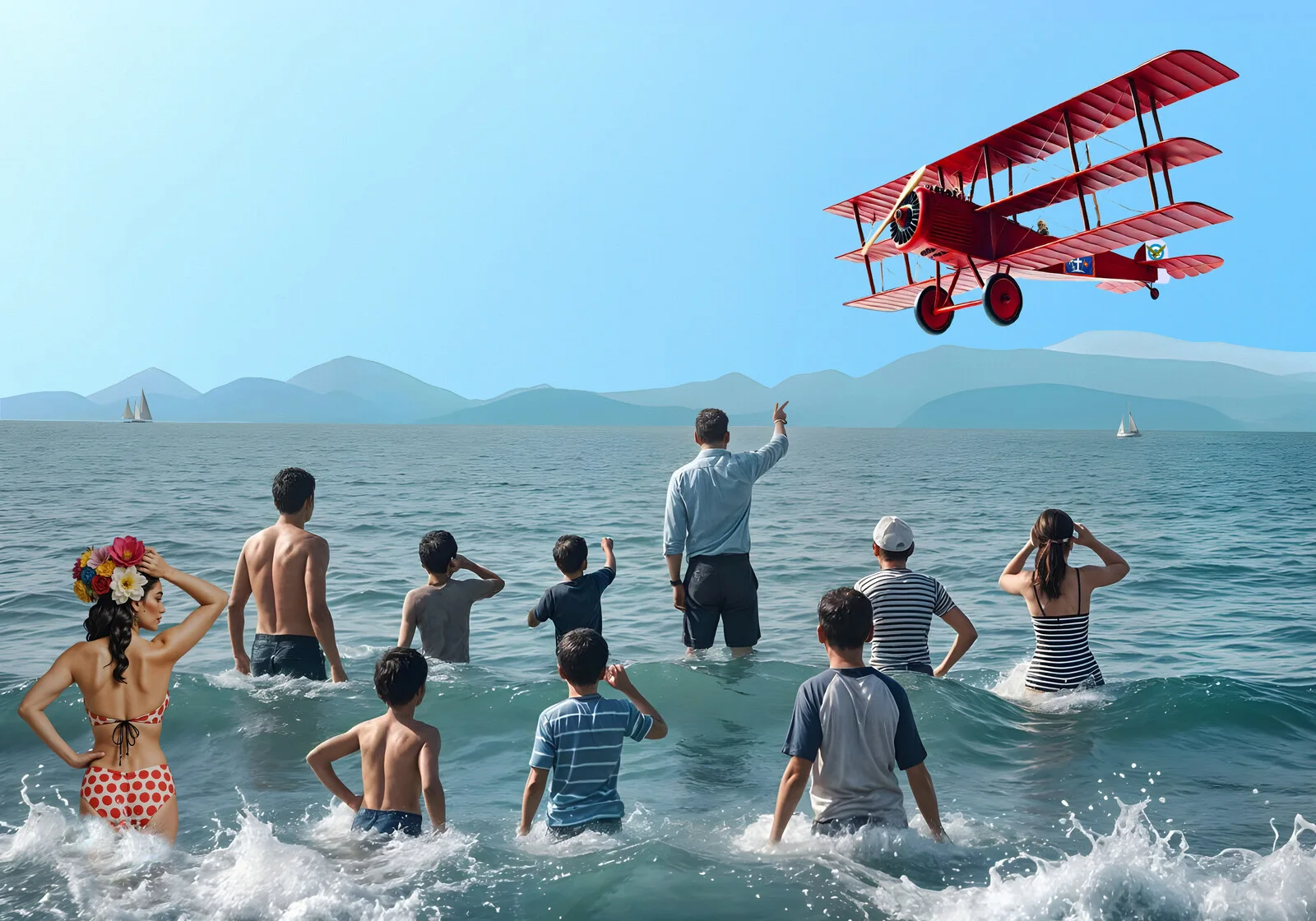
The Otherworldly Plakes Beach, 2025
Digital
100 x 70 cm
The Otherworldly Plakes Beach
Frida Kahlo and the Wonders at Plakes
Frida had retreated to the serene surroundings of the Four Seasons by Plakes Beach, a welcome break from the bustling harbour and its prying eyes. Not that anyone recognised her—Earthlings don’t recognise Time-travellers. Even those closest to them, like a father meeting his daughter on Hydra, fail to connect the dots if the Time-traveler appears at a different age. That father, a famous nightclub owner, had wrestled with the urge to embrace his beloved child but couldn’t—he was just a stranger to her.
Such risks didn’t concern Frida, who had no children and whose old friends had mostly departed Earth. She enjoyed Hydra’s timeless charm, mingling with fellow Time-travellers until an unexpected spectacle broke the calm. A red triplane from another era—Manfred von Richthofen’s Fokker from the First World War—swept low over the water, causing a stir among the bathers. Its pilot? None other than Marilyn Monroe.
The sight of the legendary plane, now streaking through the skies of eternity, was surreal. The Red Baron himself had chosen its iconic hue, not as a symbol of communism but as a statement of challenge and dominance—a warning to some, an invitation to duel for others. No stranger to such figures, Frida had crossed paths with the Baron and Marilyn, both Time-travelers like herself. Much like their earthly ones, their celestial lives revolved around grand parties and unforgettable encounters.
As Frida watched the plane circle above, she felt a familiar tug at the edges of her thoughts—a connection only Time Travellers share. This moment was merely the prelude to yet another chapter in the endless revelries of eternity, where stars hold light and the echoes of laughter, music, and untold stories waiting to unfold.
Read on to explore Frida's and Marilyn’s party plans..
‘‘Stars Among the Stars
Beneath the velvet cosmic dome,
where endless starlight calls us home,
a revelry begins anew,
where galaxies swirl in sparkling hue.
The hosts, both legends and divine,
pour celestial mead and timeless wine,
their laughter shakes the Milky Way,
turning night into an endless day.
Oden roars with a thunderous cheer,
and his warriors dance without fear.
Freja twirls with a silver glow;
her steps make distant nebulae grow.
Dionysus raises his golden cup,
his maenads wild, and the stars erupt.
The rhythm bends both space and time;
the music weaves through worlds sublime.
Cleopatra, regal, makes her toast
as Caesar grins, their galaxy host.
Their shimmering jewels outshine the sun,
their banquet for all, a feast begun.
But in the farthest reaches, beware,
Nero and Caligula's stars flare.
A pirate’s ball, a thief’s delight,
their stolen sun burns through the night.
And then it happens, bright as day,
a Supernova steals the fray.
A party too wild, a star’s last breath,
exploding light, a cosmic death.
Yet even in this final act,
the heavens blink, the skies react.
A reminder that in a joyous spree,
even the stars must set to be free.
So raise a glass to the eternal lore,
of starlit galas forevermore.
For while they flicker, fade, or spark,
their echoes linger in the dark.
Malmö, January 2025
The Otherworldly Plakes Beach
Frida spent a few days at the Four Seasons by Plakes Beach. Peaceful and relaxing, far from the bustling harbour and its curious eyes. Not that anyone recognised her—Earthlings don’t recognise Time-travelers. They think they’ve seen them somewhere before. The closer someone stands to a Time traveller, the less they recognise them. A daughter, for example, won’t recognise her father. That happened on Hydra a few years ago: a famous nightclub owner's father met his daughter in the harbour. They were now the same age since he appeared as his forty-year-old self. He wrestled with the urge to throw his arms around his beloved daughter, but he couldn’t. To her, he was just a stranger! And certainly not in these #MeToo times. [Note: In this narrative, 'Time-travelers' can travel through time and appear at different ages, making them unrecognisable to those who know them at a different age.]
This wasn’t a risk for Frida, who had no children, and most of those she had known had already left Earth. On Hydra, she met other Time-travellers vacationing on the island—about ten of them.
It came as quite a surprise. Right in the middle of her wading along the shoreline, as if by accident, she had wandered too far out and found the water reaching up to her thighs. Frida, the true landlubber, never wanted to get water over her head—not even up to her knees. Indeed, the roar of the engine from the sky and the red plane flying low over the water, heading toward Plakes, had distracted her.
The plane caused quite a stir among the bathers nearby, who shouted and pointed toward the aircraft. The pilot sought eye contact with her, waving their arms—Frida felt it clearly despite the distance. A Time-traveler senses another’s thoughts instantly, even light-years apart, and now the gap might have been no more than a few hundred meters.
And who was piloting the plane, if not Marilyn Monroe, who had borrowed Manfred von Richthofen’s old Fokker, a triplane from the First World War? As he was known, the Red Baron was one of WWI's most famous fighter pilots, not for being a communist but for the colour of his plane. A German flying ace, he became legendary for his skilful manoeuvres and victories in the air. The red colour made him visible—a warning, like Mexico’s poisonous dart frogs, meant to deter some but, to others, a challenge. A duel he always won, until his last, on April 21, 1918, near the Somme in France, when a young Canadian pilot shot him down. “Shit happens!” was his first word, having arrived on his star on the other side of eternity.
His skill, honour, and 'knightly' conduct in the air have rendered him a mythical figure, not least among the women in eternity. He left Earth as the eternal bachelor, and the line to his star stretches into space like an asteroid belt. Naturally, Frida had met him, but the baron wasn’t her type—she avoided the old aristocracy whenever possible. Marilyn, however, associated with him off and on, also unattached—a 'wild mare,' if the term fits. The imaginary line to her star was no shorter than the baron’s and, for most, just as hopeless. [Note: In this narrative, Frida and Marilyn are both Time-travelers who have crossed paths in their eternal existence.]
They knew each other, Frida and Marilyn. The last time they were in Malmö. They loved to party together; it must be emphasised that eternity offers countless opportunities for such a life. A hundred billion people from all eras, many true party legends, and Earthly festivities have continued above. These figures share the ability to create unforgettable moments filled with food, drink, music, and often extravagant excess. In mythology, culture, and history, these parties are not just entertainment but also demonstrations of power, symbols of divinity, or ways to unite people. They are whimsical, larger-than-life spectacles that will leave you in awe.
What Marilyn plans for Hydra, she hasn’t said. She must have heard the rumours that I’m here. As far as I know, I told her Marilyn has yet to visit the island. The closest was Spetses, where she once waited for her president, Kennedy, while he, with his ex-wife and the shipowner Onassis, attended a legendary party at nightclub owner Babis Mores’ place. That was when they occupied the ochre villa above Hydra Town. Maybe Marilyn wants to make up for it because the 'The Last Dance' party went down in history. [Note: 'The Last Dance' party is a significant event in the narrative, and its details can help the audience visualise the extravagant parties of the Time-travelers.]
I briefly mentioned the Hydra party with 700 Time-travelers, united by having been Babis’ guests at Lagoudera, the nightclub that put Hydra on the map in the '50s and '60s. Since Frida knew the artist Ghikas, Leonard Cohen, and several other celebrities who attended, I didn’t need to go into details. Frida understood that the party held its place in the history of revelry.
Frida: "As marvellous as the Hydra party was, you wouldn’t believe it if I told you—but the parties up there, on their own stars, are just like they were on Earth, if not even more fantastic. I’ve been to many of them, and let me tell you, some truly know how to keep traditions alive."
Frida took a sip from her glass of Frida Colada, a unique drink experience she had taught the Four Seasons bartender to mix according to her recipe. The taste was a delightful surprise, a blend of earthly and celestial flavours that would intrigue even the most discerning wine connoisseur.
Me: "Do tell."
Frida: "Your homeland’s old gods, Oden and Freja, for example. Valhalla is now a blazing star, and the fallen warriors are still there, forever feasting on mead that erupts like golden protuberances and flows like plasma clouds between the stars. Särimner, the eternal boar, didn’t escape his fate—he’s grilled over a cosmic fire every evening. Freja has her hall, Sessrumnir, which glows silver at night. She still dances like one with the celestial bodies, and Oden raises his horn with a laugh that sends stars tumbling out of their orbits."
Me: "I’ve heard the old Vikings were heavy drinkers, and their gods must have been, too. What about the god of wine? He surely wasn’t sober on Earth?"
Frida: "It’s the same now, though you don’t get drunk the same way as on Earth. Dionysus has his celestial winery shimmering in purple and gold, its surface bubbling and fizzing like champagne. His parties are just as wild as they were on Earth. The Maenads and satyrs dance until time and space bend to their rhythms. Wine still flows—a limitless source seemingly tapped from the heart of his star. It’s pure chemistry, as you’d expect. Every vintage and grape can be recreated. It’s hard for newcomers, like Baron Rothschild once was, to grasp that their earthly vines don’t need to grow to produce exquisite vintages. Still, the snobs collect Earth wines, insisting they’re a cut above if you ask them."
Me: "The industrious couple Cleopatra and Caesar were famous hosts. How are they doing?"
Frida: "They host gatherings on a star that glitters like gemstones. I was invited not long ago and can still smell the exotic spices and hear the soft tones of their musicians. Cleopatra sat on an elevated throne as if she were the queen of the universe, and Caesar laughed, as self-assured as ever. Even his successor, Mark Antony, was present. By the way, they rule over a small galaxy with thousands of stars as a triumvirate."
Me: "I suppose they’re holding their ground. That goes for the Sun King as well?"
Frida: "Oh yes, that man is nothing to scoff at. Versailles has made its way to the heavens, too, and he’s built a replica of the palace—though, for his ego’s sake, he’s added several rooms and squeezed in an extra hectare of looking glasses in the Hall of Mirrors. Louis XIV’s star is one of the brightest in the Milky Way, and his balls are just as extravagant as they were on Earth. I’ve danced the night away at a few of his masquerades with pearls glittering on my dress like tiny stars.
"Now, I don’t normally favour the aristocracy, but communists are known to enjoy their parties too. Lenin and Stalin aren’t invited but are quite adept at organising their bashes."
Me: "And the real lunatics, you know who I mean—or are you reading my mind?"
Frida: "Nero and Caligula have their stars too, at opposite ends of the galaxy, and their parties… well, let’s just say neither has calmed down—not in the slightest. It’s still luxury, decadence, and that air of danger that makes it impossible to look away. And dangerous it is. Sometimes, they’ll hijack a star and throw a wild pirate party, ending with the sun collapsing in a spectacular firework display visible from Earth.
"A supernova is a massive explosion that occurs when the festivities get out of hand, and the party with the sun collapses under its gravity. It’s one of the universe’s most spectacular and luminous phenomena. Now you know what’s behind it.
"One recent supernova was the work of a party planner—a true expert in extravagant celebrations. Senmut, an influential advisor to Queen Hatshepsut, was one of history’s most fabulous event organisers and remains active to this day, 3,500 years after his earthly career.
"As for Gatsby, the fictional character who never lived on Earth, he thrives in eternity thanks to his vivid presence in the minds of millions. His star is like an eternal jazz fest. I love stopping by, hearing the music, feeling the champagne bubbles, and losing myself in the dance among the galaxy’s lights. Gatsby—or whoever he was modelled after—was one of the people, and that’s the kind of company I enjoy most."
Me: "I suppose you steer clear of Marie Antoinette? Assuming she has her head back?"
Frida: "You’d think so, but a party is a party. And yes, your head is restored once you leave Earth. Oh, her star is like a dream, with opulent decorations, and once you’re there, you float with a lightness that defies all weight. It’s as if time itself pauses to revel in her festive world.
"Another rascal I should avoid on principle is the wife-murderer Henry VIII. But he has his banquet star, where tables stretch endlessly. And Krishna… well, he’s not my favourite either, but his Ras Lila is like a galactic dance of joy. There, we all dance, from every corner of the universe, as if we were one with the stars."
Me: "I’m exhausted just hearing about your adventures. How do you keep it up?"
Frida: "In the absence of time, you rest because it feels good, not because you have to. And, as Einstein proved, time is relative. A party can last nearly forever. If it’s boring, time passes just as slowly above, and you sneak home as soon as possible."
Me: "What about your parties?"
Frida: "Not that my gatherings are modest—Diego and I threw legendary parties on Earth, and I make sure my star is no less vibrant. Compared to some of these folks, they might seem more like get-togethers than banquets, but no one’s complained. They wouldn’t dare!" she said, laughing. "And you can let loose under the golden ceiling of my star. My star is a riot of colours, music, and a mix of friends from across the universe. Personal and without excess—just enough to satisfy decent folks. It’s as it should be: an eternal fiesta, a tribute to life itself."
Me: "Sounds like a party to my taste. Perhaps I’ll get an invitation someday."
Frida: "Consider yourself invited! But no rush on my account," she said with a wide smile. "As for the parties on my star—I have something no one else can beat: a legendary wine! I invited none other than the wine god Bacchus himself to set up his vineyard on a planet orbiting my star. He arrived with barrels of wine, claiming they were infused with the glow of the sunset. Now, my wine cellar practically crackles with the flavours of the galaxy."
Me: "Friends like that would be nice to have," I said enviously.
Frida: "Yes, Bacchus is a good friend. It’s not just the drink—it’s the whole ceremony. He shows up sometimes, crowned with grapes, full of laughter and tales from his parties. Everyone wants a taste, and it’s no wonder—it’s a wine that makes Odin pour his mead down the drain and Freja toast with a wink. It pairs wonderfully with the dishes we serve, and it’s perfect for kicking up your heels on my celestial dance floor.
"So, when you finally arrive among the stars and wonder where the best party in the universe is—come to me. I have the highest golden ceiling, music from all eras, and, thanks to Bacchus, the wine that makes the cosmos dance."
Me: "Sounds tempting, but as I said, no rush. I still have more pictures and books to finish before it’s my time."
Frida: "You know, parties are even better with the right wine—and I’ve learned from the best over the ages. On my star, besides Bacchus’ nectar, we serve nothing but the treasures of legends, pilfered from classic vineyards. They never notice—blaming leaking barrels and evaporation.
"I’ve had the pleasure of hosting Dom Pérignon, the monk who created champagne that makes the entire universe sparkle with joy. He always brings as much as his sledge can carry through the wormhole leading to my star—a thousand bottles or so. Every time we toast, I say his name as a simple tribute. His champagne is a constant companion at my parties.
"Another cherished guest is the Rothschilds, a family that took winemaking to the next level. Their Bordeaux wines are poetry in every drop, and I always have bottles from Château Lafite or Château Mouton, perfectly tempered for special guests. They tell stories of the earth, the wind, and the sun that shaped their flavours—it’s like liquid art.
"Josephine Baker, famous for her banana dance, wasn’t just a dancer; she ran her vineyard in Dordogne. She still has the keys to it and stops by now and then to pick up a few bottles. She’s brought me a wine that tastes like her songs—full of life, passion, and a hint of sweetness from the life she lived.
"I like to mix the traditional with the unexpected. At my parties, you’ll find Dom Pérignon’s sophisticated bubbles and wine from a small vineyard I stumbled upon during a trip to Mexico. Because, as I always say, it’s not just the drink that matters—it’s the stories and people behind it."
Frida concluded, "What happened when Marilyn landed? I’ll have to tell you another time. Everyone who saw the plane was just as curious. And if you’re wondering whether Hydra has an airport, the answer is, of course, no. There are no roads or streets in the traditional sense, only stairs and paths for donkeys, mules, and horses that handle all transport on the island. Otherwise, you walk.
"How do you land, then? Easy! Just as you take off—you think it, and as quick as thought, you’re on your way. No magic words like ‘Open Sesame’ or ‘Abracadabra’ unless you feel like it. Navigation is handled by imagination—no compass or satellites are needed. Spatial awareness and the name of the destination are enough. Everyone looking for fun can find Hydra without a map, and hiding an old red aeroplane in the shadows is no challenge."
Jörgen Thornberg
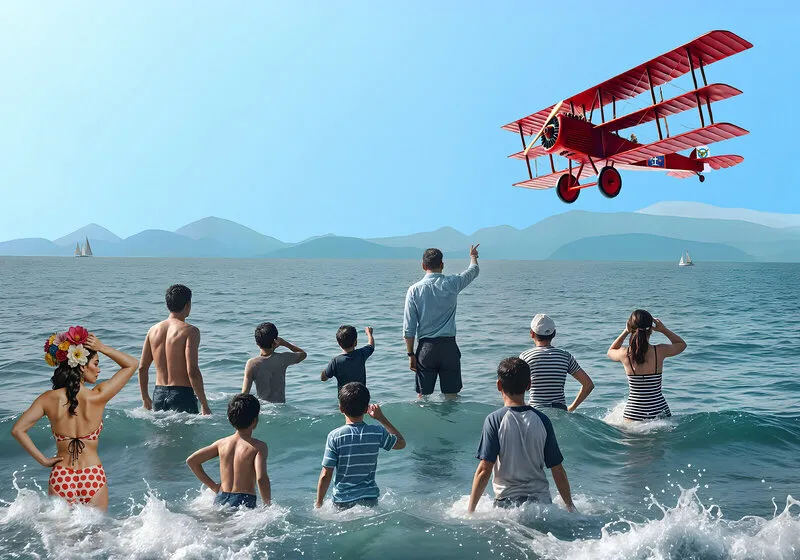
The Otherworldly Plakes Beach, 2025
Digital
100 x 70 cm
The Otherworldly Plakes Beach
Frida Kahlo and the Wonders at Plakes
Frida had retreated to the serene surroundings of the Four Seasons by Plakes Beach, a welcome break from the bustling harbour and its prying eyes. Not that anyone recognised her—Earthlings don’t recognise Time-travellers. Even those closest to them, like a father meeting his daughter on Hydra, fail to connect the dots if the Time-traveler appears at a different age. That father, a famous nightclub owner, had wrestled with the urge to embrace his beloved child but couldn’t—he was just a stranger to her.
Such risks didn’t concern Frida, who had no children and whose old friends had mostly departed Earth. She enjoyed Hydra’s timeless charm, mingling with fellow Time-travellers until an unexpected spectacle broke the calm. A red triplane from another era—Manfred von Richthofen’s Fokker from the First World War—swept low over the water, causing a stir among the bathers. Its pilot? None other than Marilyn Monroe.
The sight of the legendary plane, now streaking through the skies of eternity, was surreal. The Red Baron himself had chosen its iconic hue, not as a symbol of communism but as a statement of challenge and dominance—a warning to some, an invitation to duel for others. No stranger to such figures, Frida had crossed paths with the Baron and Marilyn, both Time-travelers like herself. Much like their earthly ones, their celestial lives revolved around grand parties and unforgettable encounters.
As Frida watched the plane circle above, she felt a familiar tug at the edges of her thoughts—a connection only Time Travellers share. This moment was merely the prelude to yet another chapter in the endless revelries of eternity, where stars hold light and the echoes of laughter, music, and untold stories waiting to unfold.
Read on to explore Frida's and Marilyn’s party plans..
‘‘Stars Among the Stars
Beneath the velvet cosmic dome,
where endless starlight calls us home,
a revelry begins anew,
where galaxies swirl in sparkling hue.
The hosts, both legends and divine,
pour celestial mead and timeless wine,
their laughter shakes the Milky Way,
turning night into an endless day.
Oden roars with a thunderous cheer,
and his warriors dance without fear.
Freja twirls with a silver glow;
her steps make distant nebulae grow.
Dionysus raises his golden cup,
his maenads wild, and the stars erupt.
The rhythm bends both space and time;
the music weaves through worlds sublime.
Cleopatra, regal, makes her toast
as Caesar grins, their galaxy host.
Their shimmering jewels outshine the sun,
their banquet for all, a feast begun.
But in the farthest reaches, beware,
Nero and Caligula's stars flare.
A pirate’s ball, a thief’s delight,
their stolen sun burns through the night.
And then it happens, bright as day,
a Supernova steals the fray.
A party too wild, a star’s last breath,
exploding light, a cosmic death.
Yet even in this final act,
the heavens blink, the skies react.
A reminder that in a joyous spree,
even the stars must set to be free.
So raise a glass to the eternal lore,
of starlit galas forevermore.
For while they flicker, fade, or spark,
their echoes linger in the dark.
Malmö, January 2025
The Otherworldly Plakes Beach
Frida spent a few days at the Four Seasons by Plakes Beach. Peaceful and relaxing, far from the bustling harbour and its curious eyes. Not that anyone recognised her—Earthlings don’t recognise Time-travelers. They think they’ve seen them somewhere before. The closer someone stands to a Time traveller, the less they recognise them. A daughter, for example, won’t recognise her father. That happened on Hydra a few years ago: a famous nightclub owner's father met his daughter in the harbour. They were now the same age since he appeared as his forty-year-old self. He wrestled with the urge to throw his arms around his beloved daughter, but he couldn’t. To her, he was just a stranger! And certainly not in these #MeToo times. [Note: In this narrative, 'Time-travelers' can travel through time and appear at different ages, making them unrecognisable to those who know them at a different age.]
This wasn’t a risk for Frida, who had no children, and most of those she had known had already left Earth. On Hydra, she met other Time-travellers vacationing on the island—about ten of them.
It came as quite a surprise. Right in the middle of her wading along the shoreline, as if by accident, she had wandered too far out and found the water reaching up to her thighs. Frida, the true landlubber, never wanted to get water over her head—not even up to her knees. Indeed, the roar of the engine from the sky and the red plane flying low over the water, heading toward Plakes, had distracted her.
The plane caused quite a stir among the bathers nearby, who shouted and pointed toward the aircraft. The pilot sought eye contact with her, waving their arms—Frida felt it clearly despite the distance. A Time-traveler senses another’s thoughts instantly, even light-years apart, and now the gap might have been no more than a few hundred meters.
And who was piloting the plane, if not Marilyn Monroe, who had borrowed Manfred von Richthofen’s old Fokker, a triplane from the First World War? As he was known, the Red Baron was one of WWI's most famous fighter pilots, not for being a communist but for the colour of his plane. A German flying ace, he became legendary for his skilful manoeuvres and victories in the air. The red colour made him visible—a warning, like Mexico’s poisonous dart frogs, meant to deter some but, to others, a challenge. A duel he always won, until his last, on April 21, 1918, near the Somme in France, when a young Canadian pilot shot him down. “Shit happens!” was his first word, having arrived on his star on the other side of eternity.
His skill, honour, and 'knightly' conduct in the air have rendered him a mythical figure, not least among the women in eternity. He left Earth as the eternal bachelor, and the line to his star stretches into space like an asteroid belt. Naturally, Frida had met him, but the baron wasn’t her type—she avoided the old aristocracy whenever possible. Marilyn, however, associated with him off and on, also unattached—a 'wild mare,' if the term fits. The imaginary line to her star was no shorter than the baron’s and, for most, just as hopeless. [Note: In this narrative, Frida and Marilyn are both Time-travelers who have crossed paths in their eternal existence.]
They knew each other, Frida and Marilyn. The last time they were in Malmö. They loved to party together; it must be emphasised that eternity offers countless opportunities for such a life. A hundred billion people from all eras, many true party legends, and Earthly festivities have continued above. These figures share the ability to create unforgettable moments filled with food, drink, music, and often extravagant excess. In mythology, culture, and history, these parties are not just entertainment but also demonstrations of power, symbols of divinity, or ways to unite people. They are whimsical, larger-than-life spectacles that will leave you in awe.
What Marilyn plans for Hydra, she hasn’t said. She must have heard the rumours that I’m here. As far as I know, I told her Marilyn has yet to visit the island. The closest was Spetses, where she once waited for her president, Kennedy, while he, with his ex-wife and the shipowner Onassis, attended a legendary party at nightclub owner Babis Mores’ place. That was when they occupied the ochre villa above Hydra Town. Maybe Marilyn wants to make up for it because the 'The Last Dance' party went down in history. [Note: 'The Last Dance' party is a significant event in the narrative, and its details can help the audience visualise the extravagant parties of the Time-travelers.]
I briefly mentioned the Hydra party with 700 Time-travelers, united by having been Babis’ guests at Lagoudera, the nightclub that put Hydra on the map in the '50s and '60s. Since Frida knew the artist Ghikas, Leonard Cohen, and several other celebrities who attended, I didn’t need to go into details. Frida understood that the party held its place in the history of revelry.
Frida: "As marvellous as the Hydra party was, you wouldn’t believe it if I told you—but the parties up there, on their own stars, are just like they were on Earth, if not even more fantastic. I’ve been to many of them, and let me tell you, some truly know how to keep traditions alive."
Frida took a sip from her glass of Frida Colada, a unique drink experience she had taught the Four Seasons bartender to mix according to her recipe. The taste was a delightful surprise, a blend of earthly and celestial flavours that would intrigue even the most discerning wine connoisseur.
Me: "Do tell."
Frida: "Your homeland’s old gods, Oden and Freja, for example. Valhalla is now a blazing star, and the fallen warriors are still there, forever feasting on mead that erupts like golden protuberances and flows like plasma clouds between the stars. Särimner, the eternal boar, didn’t escape his fate—he’s grilled over a cosmic fire every evening. Freja has her hall, Sessrumnir, which glows silver at night. She still dances like one with the celestial bodies, and Oden raises his horn with a laugh that sends stars tumbling out of their orbits."
Me: "I’ve heard the old Vikings were heavy drinkers, and their gods must have been, too. What about the god of wine? He surely wasn’t sober on Earth?"
Frida: "It’s the same now, though you don’t get drunk the same way as on Earth. Dionysus has his celestial winery shimmering in purple and gold, its surface bubbling and fizzing like champagne. His parties are just as wild as they were on Earth. The Maenads and satyrs dance until time and space bend to their rhythms. Wine still flows—a limitless source seemingly tapped from the heart of his star. It’s pure chemistry, as you’d expect. Every vintage and grape can be recreated. It’s hard for newcomers, like Baron Rothschild once was, to grasp that their earthly vines don’t need to grow to produce exquisite vintages. Still, the snobs collect Earth wines, insisting they’re a cut above if you ask them."
Me: "The industrious couple Cleopatra and Caesar were famous hosts. How are they doing?"
Frida: "They host gatherings on a star that glitters like gemstones. I was invited not long ago and can still smell the exotic spices and hear the soft tones of their musicians. Cleopatra sat on an elevated throne as if she were the queen of the universe, and Caesar laughed, as self-assured as ever. Even his successor, Mark Antony, was present. By the way, they rule over a small galaxy with thousands of stars as a triumvirate."
Me: "I suppose they’re holding their ground. That goes for the Sun King as well?"
Frida: "Oh yes, that man is nothing to scoff at. Versailles has made its way to the heavens, too, and he’s built a replica of the palace—though, for his ego’s sake, he’s added several rooms and squeezed in an extra hectare of looking glasses in the Hall of Mirrors. Louis XIV’s star is one of the brightest in the Milky Way, and his balls are just as extravagant as they were on Earth. I’ve danced the night away at a few of his masquerades with pearls glittering on my dress like tiny stars.
"Now, I don’t normally favour the aristocracy, but communists are known to enjoy their parties too. Lenin and Stalin aren’t invited but are quite adept at organising their bashes."
Me: "And the real lunatics, you know who I mean—or are you reading my mind?"
Frida: "Nero and Caligula have their stars too, at opposite ends of the galaxy, and their parties… well, let’s just say neither has calmed down—not in the slightest. It’s still luxury, decadence, and that air of danger that makes it impossible to look away. And dangerous it is. Sometimes, they’ll hijack a star and throw a wild pirate party, ending with the sun collapsing in a spectacular firework display visible from Earth.
"A supernova is a massive explosion that occurs when the festivities get out of hand, and the party with the sun collapses under its gravity. It’s one of the universe’s most spectacular and luminous phenomena. Now you know what’s behind it.
"One recent supernova was the work of a party planner—a true expert in extravagant celebrations. Senmut, an influential advisor to Queen Hatshepsut, was one of history’s most fabulous event organisers and remains active to this day, 3,500 years after his earthly career.
"As for Gatsby, the fictional character who never lived on Earth, he thrives in eternity thanks to his vivid presence in the minds of millions. His star is like an eternal jazz fest. I love stopping by, hearing the music, feeling the champagne bubbles, and losing myself in the dance among the galaxy’s lights. Gatsby—or whoever he was modelled after—was one of the people, and that’s the kind of company I enjoy most."
Me: "I suppose you steer clear of Marie Antoinette? Assuming she has her head back?"
Frida: "You’d think so, but a party is a party. And yes, your head is restored once you leave Earth. Oh, her star is like a dream, with opulent decorations, and once you’re there, you float with a lightness that defies all weight. It’s as if time itself pauses to revel in her festive world.
"Another rascal I should avoid on principle is the wife-murderer Henry VIII. But he has his banquet star, where tables stretch endlessly. And Krishna… well, he’s not my favourite either, but his Ras Lila is like a galactic dance of joy. There, we all dance, from every corner of the universe, as if we were one with the stars."
Me: "I’m exhausted just hearing about your adventures. How do you keep it up?"
Frida: "In the absence of time, you rest because it feels good, not because you have to. And, as Einstein proved, time is relative. A party can last nearly forever. If it’s boring, time passes just as slowly above, and you sneak home as soon as possible."
Me: "What about your parties?"
Frida: "Not that my gatherings are modest—Diego and I threw legendary parties on Earth, and I make sure my star is no less vibrant. Compared to some of these folks, they might seem more like get-togethers than banquets, but no one’s complained. They wouldn’t dare!" she said, laughing. "And you can let loose under the golden ceiling of my star. My star is a riot of colours, music, and a mix of friends from across the universe. Personal and without excess—just enough to satisfy decent folks. It’s as it should be: an eternal fiesta, a tribute to life itself."
Me: "Sounds like a party to my taste. Perhaps I’ll get an invitation someday."
Frida: "Consider yourself invited! But no rush on my account," she said with a wide smile. "As for the parties on my star—I have something no one else can beat: a legendary wine! I invited none other than the wine god Bacchus himself to set up his vineyard on a planet orbiting my star. He arrived with barrels of wine, claiming they were infused with the glow of the sunset. Now, my wine cellar practically crackles with the flavours of the galaxy."
Me: "Friends like that would be nice to have," I said enviously.
Frida: "Yes, Bacchus is a good friend. It’s not just the drink—it’s the whole ceremony. He shows up sometimes, crowned with grapes, full of laughter and tales from his parties. Everyone wants a taste, and it’s no wonder—it’s a wine that makes Odin pour his mead down the drain and Freja toast with a wink. It pairs wonderfully with the dishes we serve, and it’s perfect for kicking up your heels on my celestial dance floor.
"So, when you finally arrive among the stars and wonder where the best party in the universe is—come to me. I have the highest golden ceiling, music from all eras, and, thanks to Bacchus, the wine that makes the cosmos dance."
Me: "Sounds tempting, but as I said, no rush. I still have more pictures and books to finish before it’s my time."
Frida: "You know, parties are even better with the right wine—and I’ve learned from the best over the ages. On my star, besides Bacchus’ nectar, we serve nothing but the treasures of legends, pilfered from classic vineyards. They never notice—blaming leaking barrels and evaporation.
"I’ve had the pleasure of hosting Dom Pérignon, the monk who created champagne that makes the entire universe sparkle with joy. He always brings as much as his sledge can carry through the wormhole leading to my star—a thousand bottles or so. Every time we toast, I say his name as a simple tribute. His champagne is a constant companion at my parties.
"Another cherished guest is the Rothschilds, a family that took winemaking to the next level. Their Bordeaux wines are poetry in every drop, and I always have bottles from Château Lafite or Château Mouton, perfectly tempered for special guests. They tell stories of the earth, the wind, and the sun that shaped their flavours—it’s like liquid art.
"Josephine Baker, famous for her banana dance, wasn’t just a dancer; she ran her vineyard in Dordogne. She still has the keys to it and stops by now and then to pick up a few bottles. She’s brought me a wine that tastes like her songs—full of life, passion, and a hint of sweetness from the life she lived.
"I like to mix the traditional with the unexpected. At my parties, you’ll find Dom Pérignon’s sophisticated bubbles and wine from a small vineyard I stumbled upon during a trip to Mexico. Because, as I always say, it’s not just the drink that matters—it’s the stories and people behind it."
Frida concluded, "What happened when Marilyn landed? I’ll have to tell you another time. Everyone who saw the plane was just as curious. And if you’re wondering whether Hydra has an airport, the answer is, of course, no. There are no roads or streets in the traditional sense, only stairs and paths for donkeys, mules, and horses that handle all transport on the island. Otherwise, you walk.
"How do you land, then? Easy! Just as you take off—you think it, and as quick as thought, you’re on your way. No magic words like ‘Open Sesame’ or ‘Abracadabra’ unless you feel like it. Navigation is handled by imagination—no compass or satellites are needed. Spatial awareness and the name of the destination are enough. Everyone looking for fun can find Hydra without a map, and hiding an old red aeroplane in the shadows is no challenge."

Jörgen Thornberg
Malmö
Lite om bilder och mig. Translation in English at the end.
Jag är en nyfiken person som ser allt i bilder, även det jag fäster i ord, gärna tillsammans för bakom alla mina bilder finns en berättelse. Till vissa bilder hör en kortare eller längre novell som följer med bilden.
Bilder berättar historier. Jag omges av naturlig skönhet, intressanta människor och historia var jag än går. Jag använder min kamera för att dokumentera världen och blanda det jag ser med vad jag känner för att fånga den dolda magin.
Mina bilder berättar mina historier. Genom mina bilder, tryck och berättelser. Jag bjuder in dig att ta del av dessa berättelser, in i ditt liv och hem och dela min mycket personliga syn på vår värld. Mer än vad ögat ser. Jag tänker i bilder, drömmer och skriver och pratar om dem; följaktligen måste jag också skapa bilder. De blir vad jag ser, inte nödvändigtvis begränsade till verkligheten. Det finns en bild runt varje hörn. Jag hoppas att du kommer att se vad jag såg och gilla det.
Jag är också en skrivande person och till många bilder hör en kortare eller längre essay. Den följer med tavlan, tryckt på fint papper och med en personlig hälsning från mig.
Flertalet bilder startar sin resa i min kamera. Enkelt förklarat beskriver jag bilden jag ser i mitt inre, upplevd eller fantiserad. Bilden uppstår inom mig redan innan jag fått okularet till ögat. På bråkdelen av ett ögonblick ser jag vad jag vill ha och vad som kan göras med bilden. Här skall jag stoppa in en giraff, stålmannen, Titanic eller vad det är min fantasi finner ut. Ännu märkligare är att jag kommer ihåg minnesbilden långt efteråt när det blir tid att skapa verket. Om jag lyckas eller inte, är upp till betraktaren, oftast präglat av en stråk av svart humor – meningen är att man skall bli underhållen. Mina bilder blir ofta en snackis där de hänger.
Jag föredrar bilder som förmedlar ett budskap i flera lager. Vid första anblicken fylld av feel-good, en vacker utsikt, fint väder, solen skiner, blommor på ängen eller vattnet som ligger förrädiskt spegelblankt. I en sådan bild kan jag gömma min egentliga berättelse, mitt förakt för förtryckare och våldsverkare, rasister och fördomsfulla människor - ett gärna återkommande motiv mer eller mindre dolt i det vackra motivet. Jag försöker förena dem i ett gemensamt narrativ.
Bild och formgivning har löpt som en röd tråd genom livet. Fotokonst känns som en värdig final som jag gärna delar med mig.
Min genre är vid som framgår av mina bilder, temat en blandning av pop- och gatukonst i kollage som kan bestå av hundratals lager. Vissa bilder kan ta veckor, andra någon dag innan det är dags att överlämna resultatet till printverkstaden. Fine Art Prints är digitala fotocollage. I dessa kollage sker rivandet, klippandet, pusslandet, målandet, ritandet och sprayningen digitalt. Det jag monterar in kan vara hundratals år gamla bilder som jag omsorgsfullt frilägger så att de ser ut att vara en del av tavlan men också bilder skapade av mig själv efter min egen fantasi. Därefter besöks printstudion och för vissa bilder numrera en limiterad upplaga (oftast 7 exemplar) och signera för hand. Vissa bilder kan köpas i olika format. Det är bara att fråga efter vilka. Gillar man en bild som är 70x100 men inte har plats på väggen, går den kanske att få i 50x70 cm istället. Frågan är fri.
Metoden Giclée eller Fine Art Print som det också kallas är det moderna sättet för framställning av grafisk konst. Villkoret för denna typ av utskrifter är att en högkvalitativ storformatskrivare används med åldersbeständigt färgpigment och konstnärspapper eller i förekommande fall på duk. Pappret som används möter de krav på livslängd som ställs av museer och gallerier. Normalt säljer jag mina bilder oinramade så att den nya ägaren själv kan bestämma hur de skall se ut, med eller utan passepartout färg på ram, med eller utan glas etc..
Under många år ställde jag bara ut på nätet, i valda grupper och på min egen Facebooksida - https://www.facebook.com/jorgen.thornberg.9
Jag finns också på en egen hemsida som tyvärr inte alltid är uppdaterad – https://www.jth.life/ Där kan du också läsa en del av de berättelser som följer med bilden.
UTSTÄLLNINGAR
Luftkastellet, oktober 2022
Konst i Lund, november 2022
Luftkastellet, mars 2023
Engleson Galleri Caroli, april 2023
Hydra, Greece June 2023
Engleson Galleri Caroli, oktober 2023
Toppen, Höllviken december 2023
Luftkastellet, mars 2024
Torups Galleri, mars 2024
Venice, May 2024
Luftkastellet, oktober 2024
Konst i Advent, December 2024
Galleri Engleson, Caroli December 2024
Jäger & Jansson Galleri, april 2025
A bit about pictures and me.
I'm a curious person who sees everything in pictures, even what I express in words, often combining them, for behind all my pictures lies a story. These narratives, some as short as a single image and others as long as a novel, are the heart and soul of my work.
Pictures tell stories. Wherever I go, I'm surrounded by natural beauty, exciting people, and history. I use my camera to document the world and blend what I see with what I feel to capture the hidden magic.
My images tell my stories. Through my pictures, prints, and narratives, I invite you to partake in these stories in your life and home and share my deeply personal perspective of our world. More than meets the eye. I think in pictures, dream, write, and talk about them; consequently, I must create images too. They become what I see, not necessarily confined to reality. There's a picture around every corner. I hope you'll see what I saw and enjoy it.
I'm also a writer, and many images come with a shorter or longer essay. It accompanies the painting, printed on fine paper with my personal greeting.
Many pictures start their journey on my camera. Simply put, I describe the image I see in my mind, experienced or imagined. The image arises within me even before I bring the eyepiece to my eye. In a fraction of a moment, I see what I want and what can be done with the picture. Here, I'll insert a giraffe, Superman, the Titanic, or whatever my imagination conjures up. Even stranger is that I remember the mental image long after it's time to create the work. Whether I succeed is up to the observer, often imbued with a streak of black humour – the aim is to entertain. My pictures usually become a talking point wherever they hang.
I prefer pictures that convey a message in multiple layers. At first glance, they're filled with feel-good vibes, a beautiful view, lovely weather, the sun shining, flowers in the meadow, or the water lying deceptively calm. But beneath this surface beauty, I often conceal a deeper story, a narrative that challenges societal norms or explores the human condition. I invite you to delve into these hidden narratives and discover the layers of meaning within my work.
Picture and design have been a thread running through my life. Photographic art feels like a fitting finale, and I'm happy to share it.
My genre is varied, as seen in my pictures; the theme is a blend of pop and street art in collages that can consist of hundreds of layers. Some images can take weeks, others just a day before it's time to hand over the result to the print workshop. Fine Art Prints are digital photo collages. In these collages, tearing, cutting, puzzling, painting, drawing, and spraying happen digitally. What I insert can be images hundreds of years old that I carefully extract so they appear to be part of the painting, but also images created by myself, now also generated from my imagination. Next, visit the print studio and, for certain images, number a limited edition (usually 7 copies) and sign them by hand. Some images may be available in other formats. Just ask which ones. If you like an image that's 70x100 but doesn't have space on the wall, you might be able to get it in 50x70 cm instead. The question is open.
The Giclée method, or Fine Art Print as it's also called, is the modern way of producing graphic art. This method ensures the highest quality and longevity of the artwork, using a high-quality large-format printer with archival pigment inks and artist paper or, in some cases, canvas. The paper used meets the longevity requirements set by museums and galleries. I sell my pictures unframed, allowing the new owner to personalise their artwork, confident in the lasting value and quality of the piece.
For many years, I only exhibited online, in selected groups, and on my Facebook page - https://www.facebook.com/jorgen.thornberg.9. I also have my website, which unfortunately is not constantly updated - https://www.jth.life/. You can also read some of the stories accompanying the pictures there.
EXHIBITIONS
Luftkastellet, October 2022
Art in Lund, November 2022
Luftkastellet, March 2023
Engleson Gallery Caroli, April 2023
Hydra, Greece June 2023
Engleson Gallery Caroli, October 2023
Toppen, Höllviken December 2023
Luftkastellet, March 2024
Torup Gallery, March 2024
Venice, May 2024
UTSTÄLLNINGAR
Luftkastellet, oktober 2022
Konst i Lund, november 2022
Luftkastellet, mars 2023
Engleson Galleri Caroli, april 2023
Hydra, Greece June 2023
Engleson Galleri Caroli, oktober 2023
Toppen, Höllviken december 2023
Luftkastellet, mars 2024
Torups Galleri, mars 2024
Venice, May 2024
Luftkastellet, October 2024
Konst i Advent, December 2024
Galleri Engleson, Caroli December 2024
Jäger & Jansson Galleri, April 2025
Utbildning
Autodidakt
Medlem i konstnärsförening
Öppna Sinnen
Med i konstrunda
Konstrundan i Skåne
Utställningar
Luftkastellet, October 2022
Art in Lund, November 2022
Luftkastellet, March 2023
Engleson Gallery Caroli, April 2023
Hydra, Greece June 2023
Engleson Gallery Caroli, October 2023
Toppen, Höllviken December 2023
Luftkastellet, March 2024
Torup Gallery, March 2024
Venice, May 2024