Vi använder cookies för att ge dig bästa möjliga upplevelse. Välj vilka cookies du tillåter.
Läs mer i vår integritetspolicy
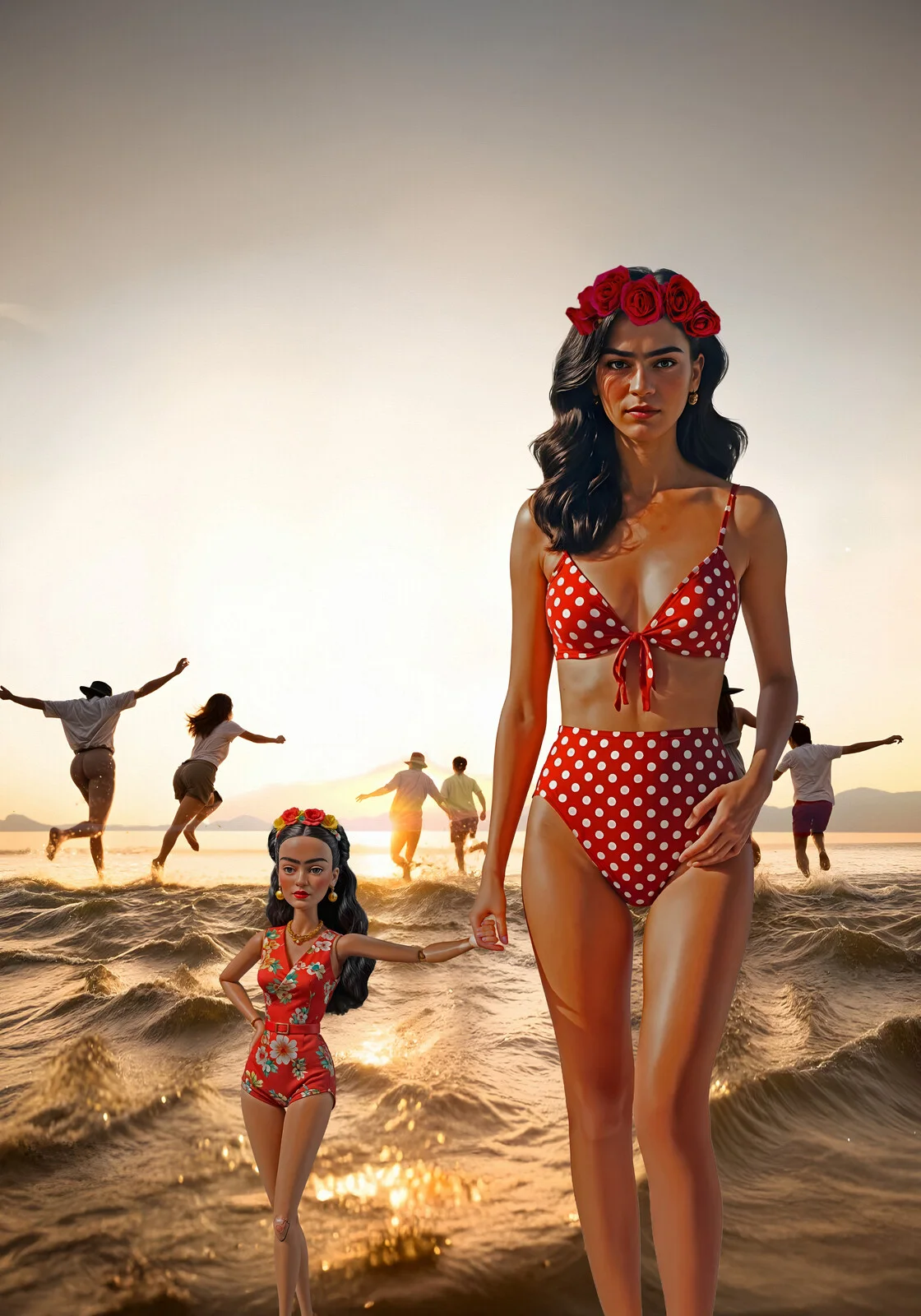
Jörgen Thornberg
Best Friends at Plakes, 7.05 PM, September 23rd, 2025
Digital
70 x 100 cm
Best Friends at Plakes, 7.05 PM, September 23rd
Frida Kahlo and Her Timeless Dance with Vivaldi
Frida Kahlo was visibly upset. Her newly purchased bikini, a vivid reminder of her bold and colourful persona, had gotten wet. A woman who preferred the shoreline to the open sea, Frida was the epitome of a landlubber, born far from the ocean’s embrace and more comfortable painting deserts than navigating waves. She only ventured into the water ankle-deep, calf-high at most—knees were unthinkable unless a careless water taxi sprayed too close to shore. Yet, even in her annoyance, she carried the poise of an artist who had turned pain into beauty countless times.
Polka dots adorned her swimsuit, a timeless pattern Frida had embraced long before becoming a global symbol of playful femininity. With origins in folk textiles and the lively polka dance of the 19th century, polka dots had a unique resonance with Frida's eclectic style. Her art rarely depicted water or dancing, but her life’s rhythm and bold expressions mirrored the vibrant movement of both.
On this September evening, Vivaldi's ‘The Four Seasons’ tones floated through the air at a beachside café. Frida sat with her oversized Frida doll, both turning their backs to the panoramic sunset and sea to focus instead on their drinks and conversation. As Vivaldi’s ‘Summer’ transitioned into ‘Autumn,’ the dialogue flowed from fashion and dance to the genius of the Red Priest himself. Frida’s vivid storytelling brought the timeless music to life, weaving connections between art, history, and the emotions that transcend time and space.
The doll, representing a younger, more curious Frida, listened intently, her questions leading to anecdotes about Vivaldi's fiery passion, his forgotten legacy, and the feminist undertones of his music. Together, the two Fridas danced through a tapestry of stories, their dialogue a celebration of creativity, resilience, and the enduring power of art. As *Autumn* settled into its softest notes, Frida gazed at the horizon, reflecting the beauty, chaos, and balance that both she and Vivaldi sought to capture in their masterpieces.
Read on to explore Frida's and her Doll’s sunset with Vivaldi.
‘‘A Dance Through the Seasons
Spring
Awake, dear Earth, from slumber's hold,
Your meadows blush with green and gold.
The streams do sing, the blossoms sway,
Life renews in April’s play.
The violins burst, a brook’s rippling delight,
A shepherd guards through the morning light.
With storms that stir the budding trees,
Spring hums its tune on the playful breeze.
Summer
Oh, blazing sun, with fiery gaze,
You paint the skies in a golden haze.
The cicadas sing in rhythmic heat,
Fields of grain bow in defeat.
A sudden storm, the heavens roar,
Lightning dances on the forest floor.
Summer laughs in its burning pride,
A tempest strong yet mystified.
Autumn
The harvest calls, the grapes are pressed,
Earth offers forth its richest best.
In autumn’s glow, the violins hum,
Songs of wine and beating drum.
The revellers spin, their laughter loud,
Beneath the moon, beneath the cloud.
But leaves grow tired; the trees do sigh,
Their amber tears fall from the sky.
Winter
The frost creeps in, the winds do moan,
The earth retreats, now cold, alone.
Ice grips the streams, snow cloaks the ground,
A silent peace, no warmer sound.
Yet by the hearth, a flame’s embrace,
Gives winter’s chill a softened grace.
Through shivering strings, the violins play,
Winter whispers of life delayed.
Through ‘The Four Seasons,’ we live, we feel,
The cycles are eternal; our hearts they steal.
With Vivaldi’s bow, each note is spun,
A hymn to time, to earth, to sun.
Malmö, January 2025
”Best Friends at Plakes, 7.05 PM, September 23rd”
Frida Kahlo was genuinely upset that her newly purchased bikini had gotten wet. She was the type who only wades along the shoreline to cool her feet—water up to her ankles was just right, up to her calves was an adventure, and anything approaching her knees was almost unthinkable, only happening when some idiot in a water taxi sped too close to the shore. Frida was a true landlubber, born far from the sea and had spent her entire life living and working at a respectable distance from the coast. Water is rarer in her paintings than oases in the Sonoran Desert, one of the world's hottest and driest deserts, with extreme summer temperatures.
That said, Frida had visited a beach before and had previously owned a swimsuit. In the 1930s, she had a polka-dot one-piece swimsuit, modest but bold in an angry red colour—she was a communist, after all. She also owned several dresses with polka-dot patterns, including a striking floor-length dress from the late '30s, with a floral skirt and a bright red polka-dot top. A photograph of her wearing it exists, and she even painted herself in the dress. That painting was exhibited in her retrospective in Malmö.
Polka dots suited Frida well, with their origins in folk textiles and their connection to the polka dance of the 19th century. The polka, while not as prominent throughout Mexico as other dances, such as the country's national dance, the jarabe tapatío, holds a unique and vibrant role in the northern regions of Mexico, acting as a bridge between European and Mexican cultural heritage. Yet, like water, dancing is rare, if not absent, in Frida's work. This is surprising, given that one could argue her art itself is a form of 'dance'—a movement between symbolism, surrealism, and realism; between joy and sorrow; between Mexico and the world. Her paintings carry a rhythm and sense of motion that can be interpreted as a dance through life's complexities.
Polka dots have evolved into a timeless pattern, influencing fashion, art, and culture for over a century. Their charming simplicity and association with joy and femininity have made them a beloved motif worldwide, evoking a sense of nostalgia for simpler, more elegant times.
Frida: “Did you see that, Frida? They just ran past us as if we were invisible! Unbelievable! I’m actually 117 years old, and a little respect would be nice,” she said to her doll, who was just as wet, her voice carrying a hint of playful indignation.
Doll Frida: “Exactly! Those jerks splashed us. You’d think young people would know better.” Frida’s extra-large Barbie doll was relatively young—manufactured only this past spring—but sensible and well-mannered. She had a mischievous twinkle in her eye, a testament to her adventurous spirit. “Maybe they didn’t realise you’re much older than you look.” That’s the problem with Time Travelers—they can choose how old they appear. On Hydra right now, for instance, the goddess Aphrodite was vacationing. Born not far from here over 5,000 years ago, she didn’t look like an ancient mummy; instead, she remained as young as the day she was born, eternally 22 years old.
Frida: “But no matter the age, you don’t splash water on women like that, right, little Frida?” She held the doll’s hand to prevent her from stumbling on the stones in the water—some could be pretty slippery. Frida had bought the doll in London on her way to Hydra, and they had become fast friends. The doll, representing her younger self, was a constant reminder of her resilience and creativity and a source of comfort in her solitary travels.
On the foothills of the steep, rocky cliffs at Plakes Beach, in front of the Four Seasons Hotel, the two friends, Frida and Frida, returned to their table to finish their drinks.
They demonstratively turned their backs to the panoramic wet view of the Saronic Sea and the magnificent sunset that should have calmed two ruffled spirits. Their clothes would soon dry and appear miraculously unwrinkled. Frida picked up her large silk wrap, which matched the colour of her bikini and the roses in her hair, and draped it around herself. No woman with style, regardless of age, would sit in a bikini at an outdoor café. From the restaurant’s speakers, the tones of Vivaldi’s Summer gently caressed the waves.
Doll Frida: “What beautiful music, Auntie Frida.”
And so fitting, as it’s Summer from Antonio Vivaldi’s The Four Seasons. The hotel took its name from this brilliant composer and his music. It couldn’t possibly be the other way around since these four violin concertos were written in the early 1700s, and the hotel is barely fifteen years old. Like the timeless appeal of polka dots, the music seems to transcend the years, making the moment feel eternal. And please, don’t call me ‘Auntie.’ For you, I’m just ‘Frida.’”
Doll Frida: “How clever of them. It must attract music lovers.”
Frida: “Certainly! Besides the beautiful music, The Four Seasons has sparked drama and interesting episodes throughout history—not least when it was rediscovered and its impact on the music world.”
Doll Frida: “Have you met Vivaldi up there?”
Frida: “Many times, during concerts on his star and when he conducted his work at the universe’s largest opera venue, Grotta Obscura, near the North Star. The opera house is a hundred times larger than the Metropolitan and can hold nearly 400,000 spectators. The acoustics are incredible, and you don’t disturb any neighbours since neither sound nor light escapes a black hole.”
Doll Frida: “That must be crowded.”
Frida: “Not at all. Since visitors come from all over the universe and beam directly to their seats, it runs smoothly. You must remember more than a hundred billion people live in eternity, so such a venue is essential.”
Doll Frida: “Vivaldi must have been thrilled.”
Frida: “Absolutely. After Vivaldi died in 1741, much of his music fell into obscurity. His works were considered passé and remained unnoticed for centuries. I was a newly minted teenager when, in the 1920s, his manuscripts were rediscovered by an Italian music historian and composer. When The Four Seasons was performed again, it became a sensation and a source of controversy. How could such groundbreaking compositions have been forgotten for so long? It sparked debates about how culture tends to ignore artists who don’t fit the tastes of their time. That debate continues for eternity, I assure you. And there are many more forgotten artists, especially women, like the poet Sappho.”
Doll Frida: “But justice prevails in the end.”
Frida: “Not always, unfortunately, and sometimes things still go awry. When The Four Seasons was reintroduced in the 1920s and ’30s, it stirred emotions due to its expressiveness and dramatic dynamics. Some in the classical music elite considered it ‘too populist’ because it directly reflected the sounds and feelings of nature, which clashed with the prevailing idea that music should be more abstract and not ‘tell stories.’ It was a case of the people’s passion clashing with the irritation of the elite, wouldn’t you agree?”
Doll Frida: “It certainly sounds that way.”
Frida: “Because The Four Seasons was originally written for the young women of the Ospedale della Pietà in Venice, it has since become a symbol of women’s contributions to music history. In contemporary discussions, feminist movements have highlighted the work as an example of how women played a central role in musical life but rarely received recognition. This has led to new productions where only female musicians perform the piece to honour Vivaldi’s students. It’s a distinctly feminist piece of music, though many don’t realise it.”
Doll Frida: “Good thing, too, or the men might have burned the manuscript.”
Frida: “Indeed, people can argue over anything. The Four Seasons, particularly Spring and Summer, has recently become a soundtrack for environmental protests. At a concert in Berlin in 2021, climate activists stormed the stage during Spring as part of a campaign against global warming. They claimed that Vivaldi’s music illustrates a balanced nature, something human activity threatens. The protest temporarily halted the concert and made headlines worldwide.”
Doll Frida: “Can you tell me more about Vivaldi and his music?”
Frida: “Of course, mi pequeña,” she began, gazing at the tiny Frida doll perched delicately on the chair near the sea, where the waves served as a resonant base for Vivaldi’s music. “Vivaldi. They call him the Red Priest—not for the fire in his soul but for the flame in his hair. He was a Venetian from the waterlogged city where gondolas glide like brushstrokes across a canvas. Antonio Vivaldi. A religious man whose violin sang louder than his sermons.”
The soft strains of Summer filled the air, the violins mimicking the crackle of heat and sudden bursts of wind, though the day offered little of either. Frida gestured toward the horizon, where the sun hung low. “This is music that breathes the world, my dear. His Four Seasons are like my paintings—not perfect replicas of nature but emotions, feelings, and ideas captured in sound. Can you hear the storm in this music? It’s not just summer; the chaos and fury lie beneath the sunshine.”
The doll tilted her tiny head, her miniature floral crown catching the golden light. “But, Frida, why did he write it? Was he inspired, like you with your brush?”
Frida chuckled, her voice as warm as the late September sun. “Inspired? Yes, but also practical. Vivaldi was a composer at an orphanage for girls in Venice—Ospedale della Pietà. He taught music to young women, many abandoned or orphaned. He wrote his music for them to play, showcasing their talents. Imagine it, mi pequeña: a room filled with young girls, their bows moving as one, creating storms breezes, and rustling leaves. His ‘Four Seasons’ was a masterpiece and a teaching tool.”
The violins shifted now, the vibrant warmth of Summer giving way to the earthy tones of Autumn. Frida closed her eyes for a moment, savouring the transition. “Autumn—Otoño. Do you hear the harvest? The wine? The celebration of the land’s abundance? Vivaldi painted this with sound. They say he wrote sonnets to accompany the music, poems that explain each season. Autumn speaks of harvest's joys and revellers' tipsy dances.”
The little doll piped up again. “Did people love it right away?”
Frida smiled, her lips quirking with a hint of mischief. “Not at first. In Vivaldi’s time, people thought music should be calm and proper, like a restrained garden. But ‘The Four Seasons’ was wild—roaring, laughing, and dancing. Like me, Vivaldi was not always understood in his lifetime. His music was popular, then forgotten, like many artists who dared to break the rules. It wasn’t until long after he had passed that people rediscovered his genius.”
The doll leaned forward slightly as though to ask another question, but Frida anticipated her. “An anecdote, you ask? Let me tell you one. Vivaldi was a man who lived between the sacred and the profane. A priest who didn’t say Mass often because of his health—or so he claimed. Once, he was conducting an opera when he left the theatre abruptly to write down a musical idea in the middle of it. He could not contain his inspiration. His critics called him impulsive, even improper, but I call him passionate. Doesn’t that sound like me?”
The doll clapped her tiny hands. “I think he would have liked you, Frida.”
Frida laughed, throwing her head back as the violins swelled. “Perhaps. Or maybe we would have driven each other mad, two artists with tempers as fierce as summer storms. But listen, mi pequeña, listen to how the music changes. Now, autumn’s revellers grow tired. The notes are softer, like leaves drifting from the trees. This, my little one, is how Vivaldi teaches us to feel the seasons—not just see them.”
The final strains of Autumn echoed as the sun dipped below the horizon. Frida gazed out over the sea, the glow of the evening settling around her like a warm embrace. “And now, autumn begins—the season of reflection. Like Vivaldi, we must look at what we’ve created and harvested and prepare for the winter ahead. But for now, let’s listen. Let’s dream. And let’s imagine what storms and joys tomorrow’s music will bring.”
The little doll sat in silent awe, her tiny hands resting in her lap, the melodies of Vivaldi weaving a tapestry around them both.
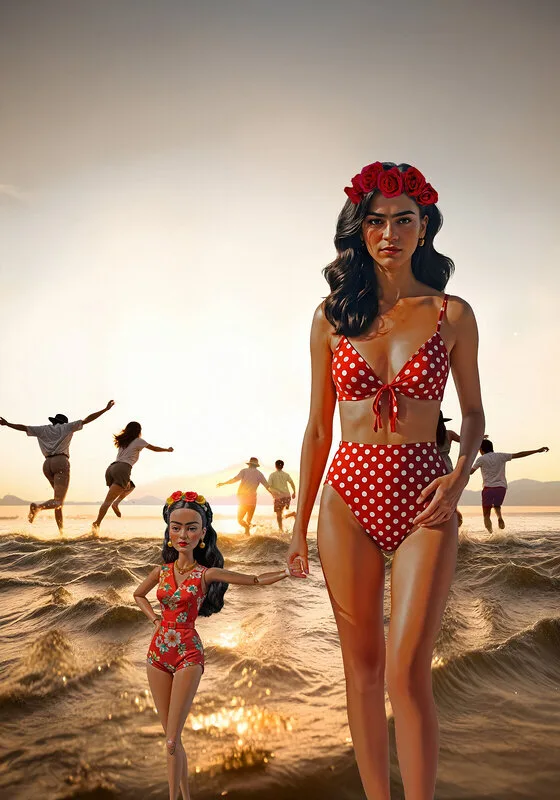
Jörgen Thornberg
Best Friends at Plakes, 7.05 PM, September 23rd, 2025
Digital
70 x 100 cm
Best Friends at Plakes, 7.05 PM, September 23rd
Frida Kahlo and Her Timeless Dance with Vivaldi
Frida Kahlo was visibly upset. Her newly purchased bikini, a vivid reminder of her bold and colourful persona, had gotten wet. A woman who preferred the shoreline to the open sea, Frida was the epitome of a landlubber, born far from the ocean’s embrace and more comfortable painting deserts than navigating waves. She only ventured into the water ankle-deep, calf-high at most—knees were unthinkable unless a careless water taxi sprayed too close to shore. Yet, even in her annoyance, she carried the poise of an artist who had turned pain into beauty countless times.
Polka dots adorned her swimsuit, a timeless pattern Frida had embraced long before becoming a global symbol of playful femininity. With origins in folk textiles and the lively polka dance of the 19th century, polka dots had a unique resonance with Frida's eclectic style. Her art rarely depicted water or dancing, but her life’s rhythm and bold expressions mirrored the vibrant movement of both.
On this September evening, Vivaldi's ‘The Four Seasons’ tones floated through the air at a beachside café. Frida sat with her oversized Frida doll, both turning their backs to the panoramic sunset and sea to focus instead on their drinks and conversation. As Vivaldi’s ‘Summer’ transitioned into ‘Autumn,’ the dialogue flowed from fashion and dance to the genius of the Red Priest himself. Frida’s vivid storytelling brought the timeless music to life, weaving connections between art, history, and the emotions that transcend time and space.
The doll, representing a younger, more curious Frida, listened intently, her questions leading to anecdotes about Vivaldi's fiery passion, his forgotten legacy, and the feminist undertones of his music. Together, the two Fridas danced through a tapestry of stories, their dialogue a celebration of creativity, resilience, and the enduring power of art. As *Autumn* settled into its softest notes, Frida gazed at the horizon, reflecting the beauty, chaos, and balance that both she and Vivaldi sought to capture in their masterpieces.
Read on to explore Frida's and her Doll’s sunset with Vivaldi.
‘‘A Dance Through the Seasons
Spring
Awake, dear Earth, from slumber's hold,
Your meadows blush with green and gold.
The streams do sing, the blossoms sway,
Life renews in April’s play.
The violins burst, a brook’s rippling delight,
A shepherd guards through the morning light.
With storms that stir the budding trees,
Spring hums its tune on the playful breeze.
Summer
Oh, blazing sun, with fiery gaze,
You paint the skies in a golden haze.
The cicadas sing in rhythmic heat,
Fields of grain bow in defeat.
A sudden storm, the heavens roar,
Lightning dances on the forest floor.
Summer laughs in its burning pride,
A tempest strong yet mystified.
Autumn
The harvest calls, the grapes are pressed,
Earth offers forth its richest best.
In autumn’s glow, the violins hum,
Songs of wine and beating drum.
The revellers spin, their laughter loud,
Beneath the moon, beneath the cloud.
But leaves grow tired; the trees do sigh,
Their amber tears fall from the sky.
Winter
The frost creeps in, the winds do moan,
The earth retreats, now cold, alone.
Ice grips the streams, snow cloaks the ground,
A silent peace, no warmer sound.
Yet by the hearth, a flame’s embrace,
Gives winter’s chill a softened grace.
Through shivering strings, the violins play,
Winter whispers of life delayed.
Through ‘The Four Seasons,’ we live, we feel,
The cycles are eternal; our hearts they steal.
With Vivaldi’s bow, each note is spun,
A hymn to time, to earth, to sun.
Malmö, January 2025
”Best Friends at Plakes, 7.05 PM, September 23rd”
Frida Kahlo was genuinely upset that her newly purchased bikini had gotten wet. She was the type who only wades along the shoreline to cool her feet—water up to her ankles was just right, up to her calves was an adventure, and anything approaching her knees was almost unthinkable, only happening when some idiot in a water taxi sped too close to the shore. Frida was a true landlubber, born far from the sea and had spent her entire life living and working at a respectable distance from the coast. Water is rarer in her paintings than oases in the Sonoran Desert, one of the world's hottest and driest deserts, with extreme summer temperatures.
That said, Frida had visited a beach before and had previously owned a swimsuit. In the 1930s, she had a polka-dot one-piece swimsuit, modest but bold in an angry red colour—she was a communist, after all. She also owned several dresses with polka-dot patterns, including a striking floor-length dress from the late '30s, with a floral skirt and a bright red polka-dot top. A photograph of her wearing it exists, and she even painted herself in the dress. That painting was exhibited in her retrospective in Malmö.
Polka dots suited Frida well, with their origins in folk textiles and their connection to the polka dance of the 19th century. The polka, while not as prominent throughout Mexico as other dances, such as the country's national dance, the jarabe tapatío, holds a unique and vibrant role in the northern regions of Mexico, acting as a bridge between European and Mexican cultural heritage. Yet, like water, dancing is rare, if not absent, in Frida's work. This is surprising, given that one could argue her art itself is a form of 'dance'—a movement between symbolism, surrealism, and realism; between joy and sorrow; between Mexico and the world. Her paintings carry a rhythm and sense of motion that can be interpreted as a dance through life's complexities.
Polka dots have evolved into a timeless pattern, influencing fashion, art, and culture for over a century. Their charming simplicity and association with joy and femininity have made them a beloved motif worldwide, evoking a sense of nostalgia for simpler, more elegant times.
Frida: “Did you see that, Frida? They just ran past us as if we were invisible! Unbelievable! I’m actually 117 years old, and a little respect would be nice,” she said to her doll, who was just as wet, her voice carrying a hint of playful indignation.
Doll Frida: “Exactly! Those jerks splashed us. You’d think young people would know better.” Frida’s extra-large Barbie doll was relatively young—manufactured only this past spring—but sensible and well-mannered. She had a mischievous twinkle in her eye, a testament to her adventurous spirit. “Maybe they didn’t realise you’re much older than you look.” That’s the problem with Time Travelers—they can choose how old they appear. On Hydra right now, for instance, the goddess Aphrodite was vacationing. Born not far from here over 5,000 years ago, she didn’t look like an ancient mummy; instead, she remained as young as the day she was born, eternally 22 years old.
Frida: “But no matter the age, you don’t splash water on women like that, right, little Frida?” She held the doll’s hand to prevent her from stumbling on the stones in the water—some could be pretty slippery. Frida had bought the doll in London on her way to Hydra, and they had become fast friends. The doll, representing her younger self, was a constant reminder of her resilience and creativity and a source of comfort in her solitary travels.
On the foothills of the steep, rocky cliffs at Plakes Beach, in front of the Four Seasons Hotel, the two friends, Frida and Frida, returned to their table to finish their drinks.
They demonstratively turned their backs to the panoramic wet view of the Saronic Sea and the magnificent sunset that should have calmed two ruffled spirits. Their clothes would soon dry and appear miraculously unwrinkled. Frida picked up her large silk wrap, which matched the colour of her bikini and the roses in her hair, and draped it around herself. No woman with style, regardless of age, would sit in a bikini at an outdoor café. From the restaurant’s speakers, the tones of Vivaldi’s Summer gently caressed the waves.
Doll Frida: “What beautiful music, Auntie Frida.”
And so fitting, as it’s Summer from Antonio Vivaldi’s The Four Seasons. The hotel took its name from this brilliant composer and his music. It couldn’t possibly be the other way around since these four violin concertos were written in the early 1700s, and the hotel is barely fifteen years old. Like the timeless appeal of polka dots, the music seems to transcend the years, making the moment feel eternal. And please, don’t call me ‘Auntie.’ For you, I’m just ‘Frida.’”
Doll Frida: “How clever of them. It must attract music lovers.”
Frida: “Certainly! Besides the beautiful music, The Four Seasons has sparked drama and interesting episodes throughout history—not least when it was rediscovered and its impact on the music world.”
Doll Frida: “Have you met Vivaldi up there?”
Frida: “Many times, during concerts on his star and when he conducted his work at the universe’s largest opera venue, Grotta Obscura, near the North Star. The opera house is a hundred times larger than the Metropolitan and can hold nearly 400,000 spectators. The acoustics are incredible, and you don’t disturb any neighbours since neither sound nor light escapes a black hole.”
Doll Frida: “That must be crowded.”
Frida: “Not at all. Since visitors come from all over the universe and beam directly to their seats, it runs smoothly. You must remember more than a hundred billion people live in eternity, so such a venue is essential.”
Doll Frida: “Vivaldi must have been thrilled.”
Frida: “Absolutely. After Vivaldi died in 1741, much of his music fell into obscurity. His works were considered passé and remained unnoticed for centuries. I was a newly minted teenager when, in the 1920s, his manuscripts were rediscovered by an Italian music historian and composer. When The Four Seasons was performed again, it became a sensation and a source of controversy. How could such groundbreaking compositions have been forgotten for so long? It sparked debates about how culture tends to ignore artists who don’t fit the tastes of their time. That debate continues for eternity, I assure you. And there are many more forgotten artists, especially women, like the poet Sappho.”
Doll Frida: “But justice prevails in the end.”
Frida: “Not always, unfortunately, and sometimes things still go awry. When The Four Seasons was reintroduced in the 1920s and ’30s, it stirred emotions due to its expressiveness and dramatic dynamics. Some in the classical music elite considered it ‘too populist’ because it directly reflected the sounds and feelings of nature, which clashed with the prevailing idea that music should be more abstract and not ‘tell stories.’ It was a case of the people’s passion clashing with the irritation of the elite, wouldn’t you agree?”
Doll Frida: “It certainly sounds that way.”
Frida: “Because The Four Seasons was originally written for the young women of the Ospedale della Pietà in Venice, it has since become a symbol of women’s contributions to music history. In contemporary discussions, feminist movements have highlighted the work as an example of how women played a central role in musical life but rarely received recognition. This has led to new productions where only female musicians perform the piece to honour Vivaldi’s students. It’s a distinctly feminist piece of music, though many don’t realise it.”
Doll Frida: “Good thing, too, or the men might have burned the manuscript.”
Frida: “Indeed, people can argue over anything. The Four Seasons, particularly Spring and Summer, has recently become a soundtrack for environmental protests. At a concert in Berlin in 2021, climate activists stormed the stage during Spring as part of a campaign against global warming. They claimed that Vivaldi’s music illustrates a balanced nature, something human activity threatens. The protest temporarily halted the concert and made headlines worldwide.”
Doll Frida: “Can you tell me more about Vivaldi and his music?”
Frida: “Of course, mi pequeña,” she began, gazing at the tiny Frida doll perched delicately on the chair near the sea, where the waves served as a resonant base for Vivaldi’s music. “Vivaldi. They call him the Red Priest—not for the fire in his soul but for the flame in his hair. He was a Venetian from the waterlogged city where gondolas glide like brushstrokes across a canvas. Antonio Vivaldi. A religious man whose violin sang louder than his sermons.”
The soft strains of Summer filled the air, the violins mimicking the crackle of heat and sudden bursts of wind, though the day offered little of either. Frida gestured toward the horizon, where the sun hung low. “This is music that breathes the world, my dear. His Four Seasons are like my paintings—not perfect replicas of nature but emotions, feelings, and ideas captured in sound. Can you hear the storm in this music? It’s not just summer; the chaos and fury lie beneath the sunshine.”
The doll tilted her tiny head, her miniature floral crown catching the golden light. “But, Frida, why did he write it? Was he inspired, like you with your brush?”
Frida chuckled, her voice as warm as the late September sun. “Inspired? Yes, but also practical. Vivaldi was a composer at an orphanage for girls in Venice—Ospedale della Pietà. He taught music to young women, many abandoned or orphaned. He wrote his music for them to play, showcasing their talents. Imagine it, mi pequeña: a room filled with young girls, their bows moving as one, creating storms breezes, and rustling leaves. His ‘Four Seasons’ was a masterpiece and a teaching tool.”
The violins shifted now, the vibrant warmth of Summer giving way to the earthy tones of Autumn. Frida closed her eyes for a moment, savouring the transition. “Autumn—Otoño. Do you hear the harvest? The wine? The celebration of the land’s abundance? Vivaldi painted this with sound. They say he wrote sonnets to accompany the music, poems that explain each season. Autumn speaks of harvest's joys and revellers' tipsy dances.”
The little doll piped up again. “Did people love it right away?”
Frida smiled, her lips quirking with a hint of mischief. “Not at first. In Vivaldi’s time, people thought music should be calm and proper, like a restrained garden. But ‘The Four Seasons’ was wild—roaring, laughing, and dancing. Like me, Vivaldi was not always understood in his lifetime. His music was popular, then forgotten, like many artists who dared to break the rules. It wasn’t until long after he had passed that people rediscovered his genius.”
The doll leaned forward slightly as though to ask another question, but Frida anticipated her. “An anecdote, you ask? Let me tell you one. Vivaldi was a man who lived between the sacred and the profane. A priest who didn’t say Mass often because of his health—or so he claimed. Once, he was conducting an opera when he left the theatre abruptly to write down a musical idea in the middle of it. He could not contain his inspiration. His critics called him impulsive, even improper, but I call him passionate. Doesn’t that sound like me?”
The doll clapped her tiny hands. “I think he would have liked you, Frida.”
Frida laughed, throwing her head back as the violins swelled. “Perhaps. Or maybe we would have driven each other mad, two artists with tempers as fierce as summer storms. But listen, mi pequeña, listen to how the music changes. Now, autumn’s revellers grow tired. The notes are softer, like leaves drifting from the trees. This, my little one, is how Vivaldi teaches us to feel the seasons—not just see them.”
The final strains of Autumn echoed as the sun dipped below the horizon. Frida gazed out over the sea, the glow of the evening settling around her like a warm embrace. “And now, autumn begins—the season of reflection. Like Vivaldi, we must look at what we’ve created and harvested and prepare for the winter ahead. But for now, let’s listen. Let’s dream. And let’s imagine what storms and joys tomorrow’s music will bring.”
The little doll sat in silent awe, her tiny hands resting in her lap, the melodies of Vivaldi weaving a tapestry around them both.

Jörgen Thornberg
Malmö
Lite om bilder och mig. Translation in English at the end.
Jag är en nyfiken person som ser allt i bilder, även det jag fäster i ord, gärna tillsammans för bakom alla mina bilder finns en berättelse. Till vissa bilder hör en kortare eller längre novell som följer med bilden.
Bilder berättar historier. Jag omges av naturlig skönhet, intressanta människor och historia var jag än går. Jag använder min kamera för att dokumentera världen och blanda det jag ser med vad jag känner för att fånga den dolda magin.
Mina bilder berättar mina historier. Genom mina bilder, tryck och berättelser. Jag bjuder in dig att ta del av dessa berättelser, in i ditt liv och hem och dela min mycket personliga syn på vår värld. Mer än vad ögat ser. Jag tänker i bilder, drömmer och skriver och pratar om dem; följaktligen måste jag också skapa bilder. De blir vad jag ser, inte nödvändigtvis begränsade till verkligheten. Det finns en bild runt varje hörn. Jag hoppas att du kommer att se vad jag såg och gilla det.
Jag är också en skrivande person och till många bilder hör en kortare eller längre essay. Den följer med tavlan, tryckt på fint papper och med en personlig hälsning från mig.
Flertalet bilder startar sin resa i min kamera. Enkelt förklarat beskriver jag bilden jag ser i mitt inre, upplevd eller fantiserad. Bilden uppstår inom mig redan innan jag fått okularet till ögat. På bråkdelen av ett ögonblick ser jag vad jag vill ha och vad som kan göras med bilden. Här skall jag stoppa in en giraff, stålmannen, Titanic eller vad det är min fantasi finner ut. Ännu märkligare är att jag kommer ihåg minnesbilden långt efteråt när det blir tid att skapa verket. Om jag lyckas eller inte, är upp till betraktaren, oftast präglat av en stråk av svart humor – meningen är att man skall bli underhållen. Mina bilder blir ofta en snackis där de hänger.
Jag föredrar bilder som förmedlar ett budskap i flera lager. Vid första anblicken fylld av feel-good, en vacker utsikt, fint väder, solen skiner, blommor på ängen eller vattnet som ligger förrädiskt spegelblankt. I en sådan bild kan jag gömma min egentliga berättelse, mitt förakt för förtryckare och våldsverkare, rasister och fördomsfulla människor - ett gärna återkommande motiv mer eller mindre dolt i det vackra motivet. Jag försöker förena dem i ett gemensamt narrativ.
Bild och formgivning har löpt som en röd tråd genom livet. Fotokonst känns som en värdig final som jag gärna delar med mig.
Min genre är vid som framgår av mina bilder, temat en blandning av pop- och gatukonst i kollage som kan bestå av hundratals lager. Vissa bilder kan ta veckor, andra någon dag innan det är dags att överlämna resultatet till printverkstaden. Fine Art Prints är digitala fotocollage. I dessa kollage sker rivandet, klippandet, pusslandet, målandet, ritandet och sprayningen digitalt. Det jag monterar in kan vara hundratals år gamla bilder som jag omsorgsfullt frilägger så att de ser ut att vara en del av tavlan men också bilder skapade av mig själv efter min egen fantasi. Därefter besöks printstudion och för vissa bilder numrera en limiterad upplaga (oftast 7 exemplar) och signera för hand. Vissa bilder kan köpas i olika format. Det är bara att fråga efter vilka. Gillar man en bild som är 70x100 men inte har plats på väggen, går den kanske att få i 50x70 cm istället. Frågan är fri.
Metoden Giclée eller Fine Art Print som det också kallas är det moderna sättet för framställning av grafisk konst. Villkoret för denna typ av utskrifter är att en högkvalitativ storformatskrivare används med åldersbeständigt färgpigment och konstnärspapper eller i förekommande fall på duk. Pappret som används möter de krav på livslängd som ställs av museer och gallerier. Normalt säljer jag mina bilder oinramade så att den nya ägaren själv kan bestämma hur de skall se ut, med eller utan passepartout färg på ram, med eller utan glas etc..
Under många år ställde jag bara ut på nätet, i valda grupper och på min egen Facebooksida - https://www.facebook.com/jorgen.thornberg.9
Jag finns också på en egen hemsida som tyvärr inte alltid är uppdaterad – https://www.jth.life/ Där kan du också läsa en del av de berättelser som följer med bilden.
UTSTÄLLNINGAR
Luftkastellet, oktober 2022
Konst i Lund, november 2022
Luftkastellet, mars 2023
Engleson Galleri Caroli, april 2023
Hydra, Greece June 2023
Engleson Galleri Caroli, oktober 2023
Toppen, Höllviken december 2023
Luftkastellet, mars 2024
Torups Galleri, mars 2024
Venice, May 2024
Luftkastellet, oktober 2024
Konst i Advent, December 2024
Galleri Engleson, Caroli December 2024
Jäger & Jansson Galleri, april 2025
A bit about pictures and me.
I'm a curious person who sees everything in pictures, even what I express in words, often combining them, for behind all my pictures lies a story. These narratives, some as short as a single image and others as long as a novel, are the heart and soul of my work.
Pictures tell stories. Wherever I go, I'm surrounded by natural beauty, exciting people, and history. I use my camera to document the world and blend what I see with what I feel to capture the hidden magic.
My images tell my stories. Through my pictures, prints, and narratives, I invite you to partake in these stories in your life and home and share my deeply personal perspective of our world. More than meets the eye. I think in pictures, dream, write, and talk about them; consequently, I must create images too. They become what I see, not necessarily confined to reality. There's a picture around every corner. I hope you'll see what I saw and enjoy it.
I'm also a writer, and many images come with a shorter or longer essay. It accompanies the painting, printed on fine paper with my personal greeting.
Many pictures start their journey on my camera. Simply put, I describe the image I see in my mind, experienced or imagined. The image arises within me even before I bring the eyepiece to my eye. In a fraction of a moment, I see what I want and what can be done with the picture. Here, I'll insert a giraffe, Superman, the Titanic, or whatever my imagination conjures up. Even stranger is that I remember the mental image long after it's time to create the work. Whether I succeed is up to the observer, often imbued with a streak of black humour – the aim is to entertain. My pictures usually become a talking point wherever they hang.
I prefer pictures that convey a message in multiple layers. At first glance, they're filled with feel-good vibes, a beautiful view, lovely weather, the sun shining, flowers in the meadow, or the water lying deceptively calm. But beneath this surface beauty, I often conceal a deeper story, a narrative that challenges societal norms or explores the human condition. I invite you to delve into these hidden narratives and discover the layers of meaning within my work.
Picture and design have been a thread running through my life. Photographic art feels like a fitting finale, and I'm happy to share it.
My genre is varied, as seen in my pictures; the theme is a blend of pop and street art in collages that can consist of hundreds of layers. Some images can take weeks, others just a day before it's time to hand over the result to the print workshop. Fine Art Prints are digital photo collages. In these collages, tearing, cutting, puzzling, painting, drawing, and spraying happen digitally. What I insert can be images hundreds of years old that I carefully extract so they appear to be part of the painting, but also images created by myself, now also generated from my imagination. Next, visit the print studio and, for certain images, number a limited edition (usually 7 copies) and sign them by hand. Some images may be available in other formats. Just ask which ones. If you like an image that's 70x100 but doesn't have space on the wall, you might be able to get it in 50x70 cm instead. The question is open.
The Giclée method, or Fine Art Print as it's also called, is the modern way of producing graphic art. This method ensures the highest quality and longevity of the artwork, using a high-quality large-format printer with archival pigment inks and artist paper or, in some cases, canvas. The paper used meets the longevity requirements set by museums and galleries. I sell my pictures unframed, allowing the new owner to personalise their artwork, confident in the lasting value and quality of the piece.
For many years, I only exhibited online, in selected groups, and on my Facebook page - https://www.facebook.com/jorgen.thornberg.9. I also have my website, which unfortunately is not constantly updated - https://www.jth.life/. You can also read some of the stories accompanying the pictures there.
EXHIBITIONS
Luftkastellet, October 2022
Art in Lund, November 2022
Luftkastellet, March 2023
Engleson Gallery Caroli, April 2023
Hydra, Greece June 2023
Engleson Gallery Caroli, October 2023
Toppen, Höllviken December 2023
Luftkastellet, March 2024
Torup Gallery, March 2024
Venice, May 2024
UTSTÄLLNINGAR
Luftkastellet, oktober 2022
Konst i Lund, november 2022
Luftkastellet, mars 2023
Engleson Galleri Caroli, april 2023
Hydra, Greece June 2023
Engleson Galleri Caroli, oktober 2023
Toppen, Höllviken december 2023
Luftkastellet, mars 2024
Torups Galleri, mars 2024
Venice, May 2024
Luftkastellet, October 2024
Konst i Advent, December 2024
Galleri Engleson, Caroli December 2024
Jäger & Jansson Galleri, April 2025
Utbildning
Autodidakt
Medlem i konstnärsförening
Öppna Sinnen
Med i konstrunda
Konstrundan i Skåne
Utställningar
Luftkastellet, October 2022
Art in Lund, November 2022
Luftkastellet, March 2023
Engleson Gallery Caroli, April 2023
Hydra, Greece June 2023
Engleson Gallery Caroli, October 2023
Toppen, Höllviken December 2023
Luftkastellet, March 2024
Torup Gallery, March 2024
Venice, May 2024