Vi använder cookies för att ge dig bästa möjliga upplevelse. Välj vilka cookies du tillåter.
Läs mer i vår integritetspolicy
Jörgen Thornberg
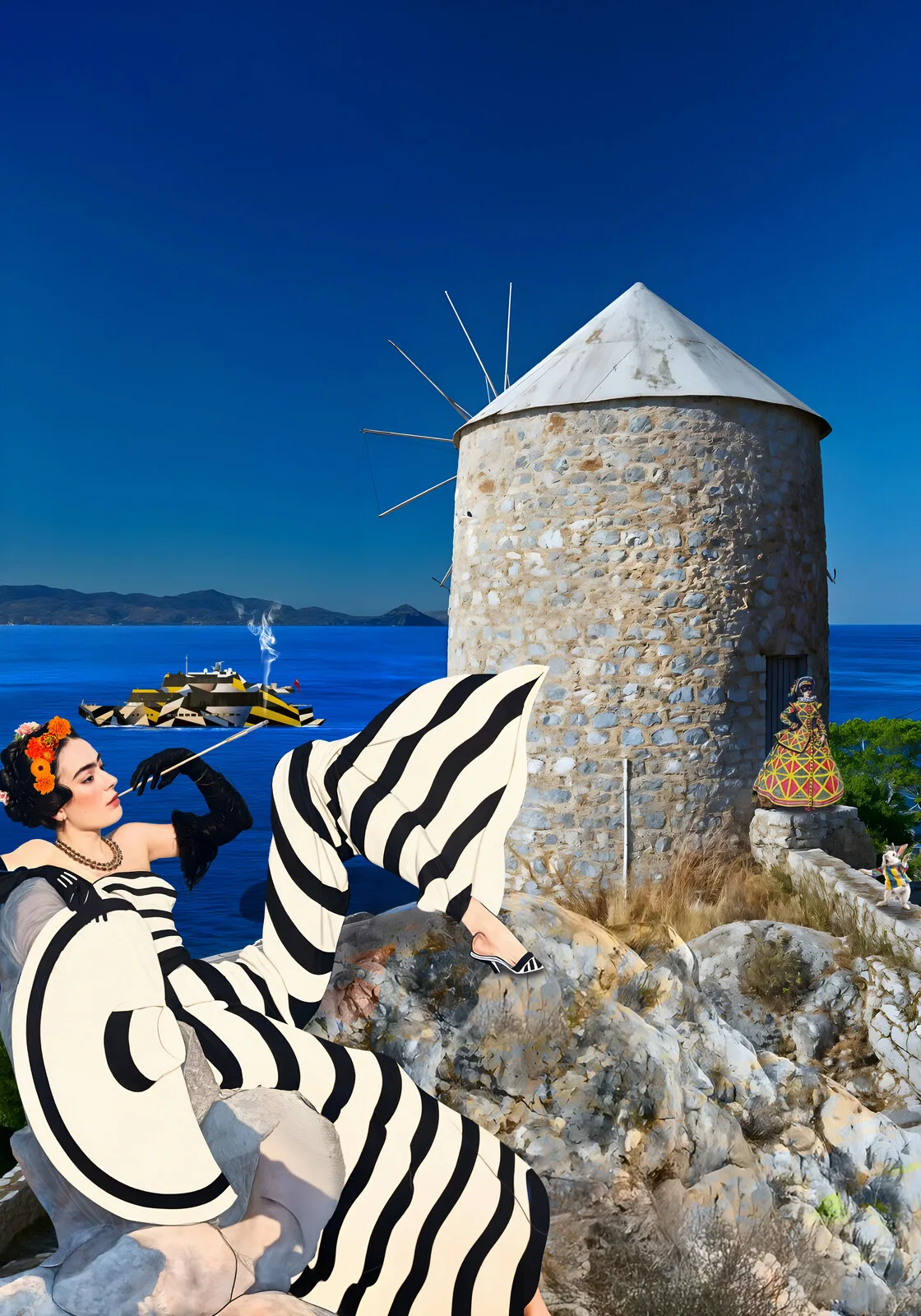
Potpourri - Striped, Checkered, and Motley, 2025
Digital
70 x 100 cm
Potpourri - Striped, Checkered, and Motley
Frida Kahlo Dressed in an Installation
Perched gracefully on a cliff by the windmill above the Hydroneta bar, Frida Kahlo gazed out at the sea, ready to witness the breathtaking sunset from this idyllic spot. A trailblazer of art and individuality, Frida’s timeless presence seamlessly intertwined with Hydra’s vibrant energy.
Hydra was abuzz with inspiration, from boutique treasures to floating art installations like ‘Guilty’, a yacht that blurred the lines between function and masterpiece. The island, a haven for artists and collectors, was a testament to the enduring dialogue between the old and the avant-garde.
In this unique setting, Frida reflected on art, life, and fashion. Her wave-patterned jumpsuit was a nod to the op art she had only recently discovered—a fitting symbol of her ability to bridge the eternal and the ephemeral. For Frida, every detail carried meaning, every pattern a story, and every moment an opportunity to transform life into art.
Do you want to know about OP? Please read on and delve deeper into the story behind the trend.
“Op-tical Illusions and Fashion Confusions
Oh, the world of op, where the patterns play,
With stripes and waves that dance and sway.
Black and white, with a splash of hue,
A dizzying maze in every view.
“Is it a dress, or is it a door?
Does it move, or is it the floor?”
A-line skirts with a checkerboard spin,
Miniskirts turning heads, where do we begin?
There’s a yacht called ‘Guilty’, a floating mirage,
Decked out in triangles, its camouflage is large.
“Is it a ship or a modern-day puzzle?”
Koons had us scratching our heads in a tussle.
Fashion meets art, and art meets confusion,
A geometric, kaleidoscopic illusion.
“Try on these boots, they’re knee-high and bright,
But don’t stare too long, or you’ll lose your sight.”
On Hydra’s cliffs, the artists convene,
With futuristic dreams and a touch of the obscene.
“Let’s wrap this goat in a checkerboard wrap,
And call it an ‘installation’—how about that?”
Frida herself, with a cigarette poised,
Surveyed the chaos, half-annoyed.
“Where are the flowers? The passion? The flame?
These squares and swirls are not my game.”
Yet she grinned at the brilliance, the oddity, the flair,
For even in madness, art was everywhere.
So raise a toast to op-art delight,
To illusions by day and fashion by night!
Malmö January 2025
Frida Kahlo dressed in an installation
Frida Kahlo had settled herself comfortably on a cliff by the windmill above the Hydroneta bar, intending to stay until sunset, which was particularly breathtaking from this spot.
Frida Kahlo smoked. That was customary in her time. Smoking was also a common habit among artists and intellectuals. Frida was known for her rebellious and bohemian lifestyle; cigarettes were part of that image. Many photographs depict her with a cigarette, reflecting her independence and nonchalant attitude toward conventions and societal norms. Frida was also passionate about the unique and personal, often preferring hand-rolled cigarettes over commercial brands. The popular Mexican brand ‘Delicados’, made from darker tobacco leaves, would suffice in a pinch. The long holder she sometimes used made the act of smoking even more dramatic.
I had invited her to visit Hydra after her retrospective exhibition had just closed, and the theatre was on summer hiatus. Word of mouth had reached her in the form of other Time Travelers extolling the virtues of this extraordinary island. One such admirer was her fellow artist Ghikas, who still avoided Hydra after his castle-like mansion burned down in 1961.
In one of the harbour’s boutiques, 21st Century, owned by my good friend Lakis, Frida had discovered an intriguing black, horizontally wave-patterned jumpsuit with a sleeveless top and wide-legged pants. The outfit reminded her of the daring 1960s era of op-art fashion, a period after she left Earth in 1954. It was entirely new for Frida—though she had seen it from eternity. But among the countless fashions Earth has seen since time immemorial, each more elaborate than the next, even a fashion-savvy woman like Frida might miss a few.
Lakis, the owner of the 21st-century boutique, stood behind the counter of his luxurious establishment, a gem in Hydra’s harbour. The carefully curated collection of timeless and trendy clothing, bags, shoes, and a dazzling selection of jewellery and bijouterie exuded an atmosphere of luxury and sophistication. The boutique, where modern meets classic and invites exploration and indulgence, perfectly matches Frida's unique style.
Lakis opened a chilled bottle of white wine, poured three glasses, and handed one to Frida, who was standing by a full-length mirror admiring her latest find. The black wave-patterned jumpsuit with its wide-legged pants and sleeveless top accentuated her natural strength and elegance. Frida gently pulled at the soft fabric and smiled.
“This is very feminine,” she mused thoughtfully, “but it could use more colours. A streak of red here, maybe green or blue there. Clothes should have life, just like art.”
Lakis sipped his wine and leaned casually against a shelf filled with statement jewellery sparkling in the warm afternoon light. “Frida, you have an impeccable eye for detail. But you know, precisely the stark, monochrome palette creates the illusions in op art. It’s about playing with the eye and visual movement. Simplicity can be powerful.”
Like her namesake, Frida Kahlo, I explained that she was an artist who had just completed a major exhibition in Malmö dedicated to preserving and celebrating Frida Kahlo’s legacy. Both on stage and in her studio, she embodied Frida’s spirit. Of course, I mentioned nothing about her being Frida or the other Time-travelers. Lakis would’ve thought me mad—or, at least, pulling his leg.
Frida took a sip of wine and pondered for a moment. “I see your point, Lakis. It’s about balance. But, like Frida Kahlo, I’m too much of a colourist to stick to black and white. She would’ve added flowers or flames—something to break the pattern. And mixed in a touch of Mexico.”
She explained how she often designed her own clothes, inspired by the original Frida Kahlo.
Lakis chuckled. “And that’s why you’re like Frida Kahlo. If she had lived in the 60s, she would’ve taken op art fashion and turned it into something unique—something no one else could have imagined. Perhaps one day I can commission a special collection from you?”
Frida grinned, her eyes sparkling with humour and confidence. “If you can find a place between heaven and Earth where I can set up my studio, why not?”
We toasted and gazed at the harbour, where the afternoon sun slowly descended over the Peloponnese in the distance. Time felt still as if the world had paused just for their conversation. And in that moment, between stories of fashion, art, and life, it felt like anything was possible.
Frida: “You’ll have to tell me more about this fashion I missed.”
Lakis launched into a description of 1960s op art fashion, inspired by op art (optical art)—a movement characterised by optical illusions and geometric patterns pioneered by artists like Victor Vasarely and Bridget Riley. It was part of a broader modernist aesthetic, reflecting the era’s fascination with futurism, technology, and psychedelic culture.
Lakis: "So, Frida, ‘op fashion’ was a movement in the 1960s inspired by optical art—’ op art’, you know—focusing on optical illusions and geometric patterns. It was a time when people loved everything futuristic, technological, and even a bit psychedelic."
Frida: "Illusions, you say? Was it like creating art to play with the viewer's eye, or more to hide something?" She glanced at Lakis with a sly look.
Lakis: 'Good question! It was more about playing with perception, making the eye perceive movement and depth where there was none. The clothes featured bold graphic prints—stripes, circles, checkered patterns, even waves—that gave a sense of motion. Black-and-white patterns were especially popular for creating these effects. It was a way of bringing the dynamism of art into everyday life.'
Frida: "Black and white? How daringly minimalist! Wasn't 1960s fashion also colourful and experimental?"
Lakis: "It was, but ‘op fashion’ also used strong colours like red, blue, and yellow to create contrasts. Still, the clean black-and-white aesthetic became the signature look—very futuristic and streamlined."
Frida: "And what did the dresses look like? Something I could have worn?" She smiled playfully, sweeping her hand over her colourful skirts.
Lakis: "Well, ‘op fashion’ slightly differed from your style, Frida. You look far too young to have experienced that era. The dresses were often figure-hugging, like A-line mini dresses—very modern and simple in the cut. They were often paired with futuristic accessories, like high boots, oversized sunglasses, and minimalist jewellery. I imagine you would have enjoyed experimenting, but your traditional patterns and colours are unique."
Frida: "And who created these modern dreams? Was there someone who stood out?"
Lakis: "Pierre Cardin and André Courrèges were big names, and Mary Quant, who created the miniskirt, also popularised these graphic patterns among young women. They drew inspiration from ‘op art’ and brought it into their designs."
Frida: "So it was about dressing like an art installation? That’s fantastic! But why did it become so big back then?"
Lakis: "Installation! Bravo! You could call it that. ‘Op fashion’ fit perfectly into the spirit of the 1960s, with technological advancements, the space race, and dreams of the future. It was a time of optimism and fascination with what lay beyond the horizon. The ‘op patterns’ reflected that feeling—hope for the new and the unknown. I was a young man, not yet in the fashion business."
Frida: "It sounds like a playful mix of hope and illusion. It's like art but wearable. I like it." She leaned back and took a sip of her mezcal. "So, Lakis, if Frida Kahlo had lived in the 1960s, do you think I could have been part of this movement?"
Lakis: "Frida, if you and she had lived back then, you wouldn’t just have been part of the movement—you would have led it. I can see Frida Kahlo, in a striped self-designed dress and one of her iconic flower crowns, putting her spin on ‘op art’. She was the very definition of blurring the lines between art and life."
Frida smiled, a smile radiating creativity and inspiration. "It certainly would have been fun, Lakis. But I think the world needs stripes, checks, optical illusions, and flowers to understand what art is all about truly."
‘‘Back on the cliff, where the breeze from the sea made the late afternoon temperature bearable.’’
The remarkable thing about Time-travelers is how they seem to attract one another. Outside the windmill stood an actress of a comical type, dressed as though she had stepped straight out of the Italian ‘commedia dell’arte’ of the 16th century.
“‘Harlekina’,” said Frida. “She loitered above the clouds and has been shadowing me ever since. ‘Harpalten’ is part of her ensemble, and both wear colourful clothes that align more with my version of ‘op art’.”
“Hydra seems very ‘OP’ today!” I said, pointing to the boat anchored in the bay.
“That’s extraordinary,” exclaimed Frida.
“That is a true installation—a floating work of art, 35 meters long. It’s called ‘Guilty’ and was commissioned by the Greek entrepreneur and contemporary art collector Dakis Joannou from the artist Jeff Koons.
‘Guilty’ is an open-air museum and a work within a work of art because the yacht houses some of the most fascinating artistic evidence of our century. The boat’s name is inspired by one of the works displayed on it—’Guilty’ by Sarah Morris, a colleague of yours, painted on canvas in one of the cabins.
The geometric designs—yellow rhombuses, pink triangles, and blue polygons—are inspired by ‘Razzle Dazzle’, the British naval camouflage used during World War I. This is quite fitting for Hydra today.
‘Razzle Dazzle’ was used to obscure vessels or military equipment during the war. Instead of hiding the object, it aimed to confuse the viewer. Jeff Koons hand-painted the yacht to achieve this disorienting effect. On the ship’s sides, he played with the concepts of pyramids, an oasis, and a mirage. ‘If the sea was calm,’ the artist explained, ‘you would see a reflection, and the design would have a doubling effect that makes it even more abstract.’”
I told Frida about Dakis Joannou’s art museum on Hydra, located in the island’s old slaughterhouse. Joannou, an art patron with the mind of a pragmatist and the soul of a poet, had transformed it into the Deste Project Space Slaughterhouse.
The restored and renovated building retains features of the old slaughterhouse and has become a unique art museum hosting a series of contemporary exhibitions each summer. In 2022, the featured artist was Jeff Koons. The word ‘Deste’ means “to see” in Greek.
For years, the Greek island of Hydra has been a regular destination for the art world’s jet set, with artists, dealers, collectors, and curators flocking to its shores. Since 2009, Joannou’s DESTE Foundation has invited an artist or group of artists to create an exhibition in the Foundation's Project Space, a former slaughterhouse.
A towering golden sun, one of the most iconic pieces from Koons’ show, still stands at the Project Space Slaughterhouse, serving as a symbol for the foundation and the island itself. In its polished stainless steel reflection, Apollo continues to inspire conversations between Greek mythology and contemporary art—something Hydra seems to do effortlessly.
I promised Frida we’d visit the site the following day with or without her ‘op art’ jumpsuit.
Did she like Hydra? What Time-Traveler doesn’t?
Jörgen Thornberg
Potpourri - Striped, Checkered, and Motley, 2025
Digital
70 x 100 cm
Potpourri - Striped, Checkered, and Motley
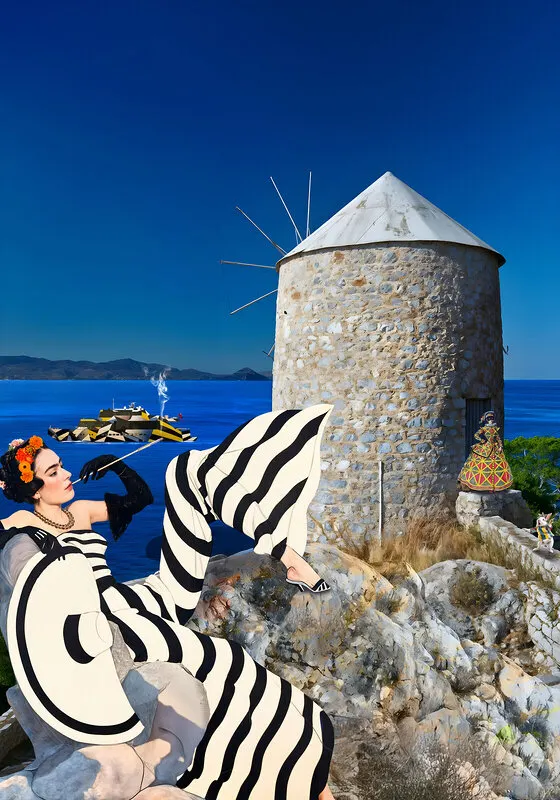
Frida Kahlo Dressed in an Installation
Perched gracefully on a cliff by the windmill above the Hydroneta bar, Frida Kahlo gazed out at the sea, ready to witness the breathtaking sunset from this idyllic spot. A trailblazer of art and individuality, Frida’s timeless presence seamlessly intertwined with Hydra’s vibrant energy.
Hydra was abuzz with inspiration, from boutique treasures to floating art installations like ‘Guilty’, a yacht that blurred the lines between function and masterpiece. The island, a haven for artists and collectors, was a testament to the enduring dialogue between the old and the avant-garde.
In this unique setting, Frida reflected on art, life, and fashion. Her wave-patterned jumpsuit was a nod to the op art she had only recently discovered—a fitting symbol of her ability to bridge the eternal and the ephemeral. For Frida, every detail carried meaning, every pattern a story, and every moment an opportunity to transform life into art.
Do you want to know about OP? Please read on and delve deeper into the story behind the trend.
“Op-tical Illusions and Fashion Confusions
Oh, the world of op, where the patterns play,
With stripes and waves that dance and sway.
Black and white, with a splash of hue,
A dizzying maze in every view.
“Is it a dress, or is it a door?
Does it move, or is it the floor?”
A-line skirts with a checkerboard spin,
Miniskirts turning heads, where do we begin?
There’s a yacht called ‘Guilty’, a floating mirage,
Decked out in triangles, its camouflage is large.
“Is it a ship or a modern-day puzzle?”
Koons had us scratching our heads in a tussle.
Fashion meets art, and art meets confusion,
A geometric, kaleidoscopic illusion.
“Try on these boots, they’re knee-high and bright,
But don’t stare too long, or you’ll lose your sight.”
On Hydra’s cliffs, the artists convene,
With futuristic dreams and a touch of the obscene.
“Let’s wrap this goat in a checkerboard wrap,
And call it an ‘installation’—how about that?”
Frida herself, with a cigarette poised,
Surveyed the chaos, half-annoyed.
“Where are the flowers? The passion? The flame?
These squares and swirls are not my game.”
Yet she grinned at the brilliance, the oddity, the flair,
For even in madness, art was everywhere.
So raise a toast to op-art delight,
To illusions by day and fashion by night!
Malmö January 2025
Frida Kahlo dressed in an installation
Frida Kahlo had settled herself comfortably on a cliff by the windmill above the Hydroneta bar, intending to stay until sunset, which was particularly breathtaking from this spot.
Frida Kahlo smoked. That was customary in her time. Smoking was also a common habit among artists and intellectuals. Frida was known for her rebellious and bohemian lifestyle; cigarettes were part of that image. Many photographs depict her with a cigarette, reflecting her independence and nonchalant attitude toward conventions and societal norms. Frida was also passionate about the unique and personal, often preferring hand-rolled cigarettes over commercial brands. The popular Mexican brand ‘Delicados’, made from darker tobacco leaves, would suffice in a pinch. The long holder she sometimes used made the act of smoking even more dramatic.
I had invited her to visit Hydra after her retrospective exhibition had just closed, and the theatre was on summer hiatus. Word of mouth had reached her in the form of other Time Travelers extolling the virtues of this extraordinary island. One such admirer was her fellow artist Ghikas, who still avoided Hydra after his castle-like mansion burned down in 1961.
In one of the harbour’s boutiques, 21st Century, owned by my good friend Lakis, Frida had discovered an intriguing black, horizontally wave-patterned jumpsuit with a sleeveless top and wide-legged pants. The outfit reminded her of the daring 1960s era of op-art fashion, a period after she left Earth in 1954. It was entirely new for Frida—though she had seen it from eternity. But among the countless fashions Earth has seen since time immemorial, each more elaborate than the next, even a fashion-savvy woman like Frida might miss a few.
Lakis, the owner of the 21st-century boutique, stood behind the counter of his luxurious establishment, a gem in Hydra’s harbour. The carefully curated collection of timeless and trendy clothing, bags, shoes, and a dazzling selection of jewellery and bijouterie exuded an atmosphere of luxury and sophistication. The boutique, where modern meets classic and invites exploration and indulgence, perfectly matches Frida's unique style.
Lakis opened a chilled bottle of white wine, poured three glasses, and handed one to Frida, who was standing by a full-length mirror admiring her latest find. The black wave-patterned jumpsuit with its wide-legged pants and sleeveless top accentuated her natural strength and elegance. Frida gently pulled at the soft fabric and smiled.
“This is very feminine,” she mused thoughtfully, “but it could use more colours. A streak of red here, maybe green or blue there. Clothes should have life, just like art.”
Lakis sipped his wine and leaned casually against a shelf filled with statement jewellery sparkling in the warm afternoon light. “Frida, you have an impeccable eye for detail. But you know, precisely the stark, monochrome palette creates the illusions in op art. It’s about playing with the eye and visual movement. Simplicity can be powerful.”
Like her namesake, Frida Kahlo, I explained that she was an artist who had just completed a major exhibition in Malmö dedicated to preserving and celebrating Frida Kahlo’s legacy. Both on stage and in her studio, she embodied Frida’s spirit. Of course, I mentioned nothing about her being Frida or the other Time-travelers. Lakis would’ve thought me mad—or, at least, pulling his leg.
Frida took a sip of wine and pondered for a moment. “I see your point, Lakis. It’s about balance. But, like Frida Kahlo, I’m too much of a colourist to stick to black and white. She would’ve added flowers or flames—something to break the pattern. And mixed in a touch of Mexico.”
She explained how she often designed her own clothes, inspired by the original Frida Kahlo.
Lakis chuckled. “And that’s why you’re like Frida Kahlo. If she had lived in the 60s, she would’ve taken op art fashion and turned it into something unique—something no one else could have imagined. Perhaps one day I can commission a special collection from you?”
Frida grinned, her eyes sparkling with humour and confidence. “If you can find a place between heaven and Earth where I can set up my studio, why not?”
We toasted and gazed at the harbour, where the afternoon sun slowly descended over the Peloponnese in the distance. Time felt still as if the world had paused just for their conversation. And in that moment, between stories of fashion, art, and life, it felt like anything was possible.
Frida: “You’ll have to tell me more about this fashion I missed.”
Lakis launched into a description of 1960s op art fashion, inspired by op art (optical art)—a movement characterised by optical illusions and geometric patterns pioneered by artists like Victor Vasarely and Bridget Riley. It was part of a broader modernist aesthetic, reflecting the era’s fascination with futurism, technology, and psychedelic culture.
Lakis: "So, Frida, ‘op fashion’ was a movement in the 1960s inspired by optical art—’ op art’, you know—focusing on optical illusions and geometric patterns. It was a time when people loved everything futuristic, technological, and even a bit psychedelic."
Frida: "Illusions, you say? Was it like creating art to play with the viewer's eye, or more to hide something?" She glanced at Lakis with a sly look.
Lakis: 'Good question! It was more about playing with perception, making the eye perceive movement and depth where there was none. The clothes featured bold graphic prints—stripes, circles, checkered patterns, even waves—that gave a sense of motion. Black-and-white patterns were especially popular for creating these effects. It was a way of bringing the dynamism of art into everyday life.'
Frida: "Black and white? How daringly minimalist! Wasn't 1960s fashion also colourful and experimental?"
Lakis: "It was, but ‘op fashion’ also used strong colours like red, blue, and yellow to create contrasts. Still, the clean black-and-white aesthetic became the signature look—very futuristic and streamlined."
Frida: "And what did the dresses look like? Something I could have worn?" She smiled playfully, sweeping her hand over her colourful skirts.
Lakis: "Well, ‘op fashion’ slightly differed from your style, Frida. You look far too young to have experienced that era. The dresses were often figure-hugging, like A-line mini dresses—very modern and simple in the cut. They were often paired with futuristic accessories, like high boots, oversized sunglasses, and minimalist jewellery. I imagine you would have enjoyed experimenting, but your traditional patterns and colours are unique."
Frida: "And who created these modern dreams? Was there someone who stood out?"
Lakis: "Pierre Cardin and André Courrèges were big names, and Mary Quant, who created the miniskirt, also popularised these graphic patterns among young women. They drew inspiration from ‘op art’ and brought it into their designs."
Frida: "So it was about dressing like an art installation? That’s fantastic! But why did it become so big back then?"
Lakis: "Installation! Bravo! You could call it that. ‘Op fashion’ fit perfectly into the spirit of the 1960s, with technological advancements, the space race, and dreams of the future. It was a time of optimism and fascination with what lay beyond the horizon. The ‘op patterns’ reflected that feeling—hope for the new and the unknown. I was a young man, not yet in the fashion business."
Frida: "It sounds like a playful mix of hope and illusion. It's like art but wearable. I like it." She leaned back and took a sip of her mezcal. "So, Lakis, if Frida Kahlo had lived in the 1960s, do you think I could have been part of this movement?"
Lakis: "Frida, if you and she had lived back then, you wouldn’t just have been part of the movement—you would have led it. I can see Frida Kahlo, in a striped self-designed dress and one of her iconic flower crowns, putting her spin on ‘op art’. She was the very definition of blurring the lines between art and life."
Frida smiled, a smile radiating creativity and inspiration. "It certainly would have been fun, Lakis. But I think the world needs stripes, checks, optical illusions, and flowers to understand what art is all about truly."
‘‘Back on the cliff, where the breeze from the sea made the late afternoon temperature bearable.’’
The remarkable thing about Time-travelers is how they seem to attract one another. Outside the windmill stood an actress of a comical type, dressed as though she had stepped straight out of the Italian ‘commedia dell’arte’ of the 16th century.
“‘Harlekina’,” said Frida. “She loitered above the clouds and has been shadowing me ever since. ‘Harpalten’ is part of her ensemble, and both wear colourful clothes that align more with my version of ‘op art’.”
“Hydra seems very ‘OP’ today!” I said, pointing to the boat anchored in the bay.
“That’s extraordinary,” exclaimed Frida.
“That is a true installation—a floating work of art, 35 meters long. It’s called ‘Guilty’ and was commissioned by the Greek entrepreneur and contemporary art collector Dakis Joannou from the artist Jeff Koons.
‘Guilty’ is an open-air museum and a work within a work of art because the yacht houses some of the most fascinating artistic evidence of our century. The boat’s name is inspired by one of the works displayed on it—’Guilty’ by Sarah Morris, a colleague of yours, painted on canvas in one of the cabins.
The geometric designs—yellow rhombuses, pink triangles, and blue polygons—are inspired by ‘Razzle Dazzle’, the British naval camouflage used during World War I. This is quite fitting for Hydra today.
‘Razzle Dazzle’ was used to obscure vessels or military equipment during the war. Instead of hiding the object, it aimed to confuse the viewer. Jeff Koons hand-painted the yacht to achieve this disorienting effect. On the ship’s sides, he played with the concepts of pyramids, an oasis, and a mirage. ‘If the sea was calm,’ the artist explained, ‘you would see a reflection, and the design would have a doubling effect that makes it even more abstract.’”
I told Frida about Dakis Joannou’s art museum on Hydra, located in the island’s old slaughterhouse. Joannou, an art patron with the mind of a pragmatist and the soul of a poet, had transformed it into the Deste Project Space Slaughterhouse.
The restored and renovated building retains features of the old slaughterhouse and has become a unique art museum hosting a series of contemporary exhibitions each summer. In 2022, the featured artist was Jeff Koons. The word ‘Deste’ means “to see” in Greek.
For years, the Greek island of Hydra has been a regular destination for the art world’s jet set, with artists, dealers, collectors, and curators flocking to its shores. Since 2009, Joannou’s DESTE Foundation has invited an artist or group of artists to create an exhibition in the Foundation's Project Space, a former slaughterhouse.
A towering golden sun, one of the most iconic pieces from Koons’ show, still stands at the Project Space Slaughterhouse, serving as a symbol for the foundation and the island itself. In its polished stainless steel reflection, Apollo continues to inspire conversations between Greek mythology and contemporary art—something Hydra seems to do effortlessly.
I promised Frida we’d visit the site the following day with or without her ‘op art’ jumpsuit.
Did she like Hydra? What Time-Traveler doesn’t?

Jörgen Thornberg
Malmö
Lite om bilder och mig. Translation in English at the end.
Jag är en nyfiken person som ser allt i bilder, även det jag fäster i ord, gärna tillsammans för bakom alla mina bilder finns en berättelse. Till vissa bilder hör en kortare eller längre novell som följer med bilden.
Bilder berättar historier. Jag omges av naturlig skönhet, intressanta människor och historia var jag än går. Jag använder min kamera för att dokumentera världen och blanda det jag ser med vad jag känner för att fånga den dolda magin.
Mina bilder berättar mina historier. Genom mina bilder, tryck och berättelser. Jag bjuder in dig att ta del av dessa berättelser, in i ditt liv och hem och dela min mycket personliga syn på vår värld. Mer än vad ögat ser. Jag tänker i bilder, drömmer och skriver och pratar om dem; följaktligen måste jag också skapa bilder. De blir vad jag ser, inte nödvändigtvis begränsade till verkligheten. Det finns en bild runt varje hörn. Jag hoppas att du kommer att se vad jag såg och gilla det.
Jag är också en skrivande person och till många bilder hör en kortare eller längre essay. Den följer med tavlan, tryckt på fint papper och med en personlig hälsning från mig.
Flertalet bilder startar sin resa i min kamera. Enkelt förklarat beskriver jag bilden jag ser i mitt inre, upplevd eller fantiserad. Bilden uppstår inom mig redan innan jag fått okularet till ögat. På bråkdelen av ett ögonblick ser jag vad jag vill ha och vad som kan göras med bilden. Här skall jag stoppa in en giraff, stålmannen, Titanic eller vad det är min fantasi finner ut. Ännu märkligare är att jag kommer ihåg minnesbilden långt efteråt när det blir tid att skapa verket. Om jag lyckas eller inte, är upp till betraktaren, oftast präglat av en stråk av svart humor – meningen är att man skall bli underhållen. Mina bilder blir ofta en snackis där de hänger.
Jag föredrar bilder som förmedlar ett budskap i flera lager. Vid första anblicken fylld av feel-good, en vacker utsikt, fint väder, solen skiner, blommor på ängen eller vattnet som ligger förrädiskt spegelblankt. I en sådan bild kan jag gömma min egentliga berättelse, mitt förakt för förtryckare och våldsverkare, rasister och fördomsfulla människor - ett gärna återkommande motiv mer eller mindre dolt i det vackra motivet. Jag försöker förena dem i ett gemensamt narrativ.
Bild och formgivning har löpt som en röd tråd genom livet. Fotokonst känns som en värdig final som jag gärna delar med mig.
Min genre är vid som framgår av mina bilder, temat en blandning av pop- och gatukonst i kollage som kan bestå av hundratals lager. Vissa bilder kan ta veckor, andra någon dag innan det är dags att överlämna resultatet till printverkstaden. Fine Art Prints är digitala fotocollage. I dessa kollage sker rivandet, klippandet, pusslandet, målandet, ritandet och sprayningen digitalt. Det jag monterar in kan vara hundratals år gamla bilder som jag omsorgsfullt frilägger så att de ser ut att vara en del av tavlan men också bilder skapade av mig själv efter min egen fantasi. Därefter besöks printstudion och för vissa bilder numrera en limiterad upplaga (oftast 7 exemplar) och signera för hand. Vissa bilder kan köpas i olika format. Det är bara att fråga efter vilka. Gillar man en bild som är 70x100 men inte har plats på väggen, går den kanske att få i 50x70 cm istället. Frågan är fri.
Metoden Giclée eller Fine Art Print som det också kallas är det moderna sättet för framställning av grafisk konst. Villkoret för denna typ av utskrifter är att en högkvalitativ storformatskrivare används med åldersbeständigt färgpigment och konstnärspapper eller i förekommande fall på duk. Pappret som används möter de krav på livslängd som ställs av museer och gallerier. Normalt säljer jag mina bilder oinramade så att den nya ägaren själv kan bestämma hur de skall se ut, med eller utan passepartout färg på ram, med eller utan glas etc..
Under många år ställde jag bara ut på nätet, i valda grupper och på min egen Facebooksida - https://www.facebook.com/jorgen.thornberg.9
Jag finns också på en egen hemsida som tyvärr inte alltid är uppdaterad – https://www.jth.life/ Där kan du också läsa en del av de berättelser som följer med bilden.
UTSTÄLLNINGAR
Luftkastellet, oktober 2022
Konst i Lund, november 2022
Luftkastellet, mars 2023
Engleson Galleri Caroli, april 2023
Hydra, Greece June 2023
Engleson Galleri Caroli, oktober 2023
Toppen, Höllviken december 2023
Luftkastellet, mars 2024
Torups Galleri, mars 2024
Venice, May 2024
Luftkastellet, oktober 2024
Konst i Advent, December 2024
Galleri Engleson, Caroli December 2024
Jäger & Jansson Galleri, april 2025
A bit about pictures and me.
I'm a curious person who sees everything in pictures, even what I express in words, often combining them, for behind all my pictures lies a story. These narratives, some as short as a single image and others as long as a novel, are the heart and soul of my work.
Pictures tell stories. Wherever I go, I'm surrounded by natural beauty, exciting people, and history. I use my camera to document the world and blend what I see with what I feel to capture the hidden magic.
My images tell my stories. Through my pictures, prints, and narratives, I invite you to partake in these stories in your life and home and share my deeply personal perspective of our world. More than meets the eye. I think in pictures, dream, write, and talk about them; consequently, I must create images too. They become what I see, not necessarily confined to reality. There's a picture around every corner. I hope you'll see what I saw and enjoy it.
I'm also a writer, and many images come with a shorter or longer essay. It accompanies the painting, printed on fine paper with my personal greeting.
Many pictures start their journey on my camera. Simply put, I describe the image I see in my mind, experienced or imagined. The image arises within me even before I bring the eyepiece to my eye. In a fraction of a moment, I see what I want and what can be done with the picture. Here, I'll insert a giraffe, Superman, the Titanic, or whatever my imagination conjures up. Even stranger is that I remember the mental image long after it's time to create the work. Whether I succeed is up to the observer, often imbued with a streak of black humour – the aim is to entertain. My pictures usually become a talking point wherever they hang.
I prefer pictures that convey a message in multiple layers. At first glance, they're filled with feel-good vibes, a beautiful view, lovely weather, the sun shining, flowers in the meadow, or the water lying deceptively calm. But beneath this surface beauty, I often conceal a deeper story, a narrative that challenges societal norms or explores the human condition. I invite you to delve into these hidden narratives and discover the layers of meaning within my work.
Picture and design have been a thread running through my life. Photographic art feels like a fitting finale, and I'm happy to share it.
My genre is varied, as seen in my pictures; the theme is a blend of pop and street art in collages that can consist of hundreds of layers. Some images can take weeks, others just a day before it's time to hand over the result to the print workshop. Fine Art Prints are digital photo collages. In these collages, tearing, cutting, puzzling, painting, drawing, and spraying happen digitally. What I insert can be images hundreds of years old that I carefully extract so they appear to be part of the painting, but also images created by myself, now also generated from my imagination. Next, visit the print studio and, for certain images, number a limited edition (usually 7 copies) and sign them by hand. Some images may be available in other formats. Just ask which ones. If you like an image that's 70x100 but doesn't have space on the wall, you might be able to get it in 50x70 cm instead. The question is open.
The Giclée method, or Fine Art Print as it's also called, is the modern way of producing graphic art. This method ensures the highest quality and longevity of the artwork, using a high-quality large-format printer with archival pigment inks and artist paper or, in some cases, canvas. The paper used meets the longevity requirements set by museums and galleries. I sell my pictures unframed, allowing the new owner to personalise their artwork, confident in the lasting value and quality of the piece.
For many years, I only exhibited online, in selected groups, and on my Facebook page - https://www.facebook.com/jorgen.thornberg.9. I also have my website, which unfortunately is not constantly updated - https://www.jth.life/. You can also read some of the stories accompanying the pictures there.
EXHIBITIONS
Luftkastellet, October 2022
Art in Lund, November 2022
Luftkastellet, March 2023
Engleson Gallery Caroli, April 2023
Hydra, Greece June 2023
Engleson Gallery Caroli, October 2023
Toppen, Höllviken December 2023
Luftkastellet, March 2024
Torup Gallery, March 2024
Venice, May 2024
UTSTÄLLNINGAR
Luftkastellet, oktober 2022
Konst i Lund, november 2022
Luftkastellet, mars 2023
Engleson Galleri Caroli, april 2023
Hydra, Greece June 2023
Engleson Galleri Caroli, oktober 2023
Toppen, Höllviken december 2023
Luftkastellet, mars 2024
Torups Galleri, mars 2024
Venice, May 2024
Luftkastellet, October 2024
Konst i Advent, December 2024
Galleri Engleson, Caroli December 2024
Jäger & Jansson Galleri, April 2025
Utbildning
Autodidakt
Medlem i konstnärsförening
Öppna Sinnen
Med i konstrunda
Konstrundan i Skåne
Utställningar
Luftkastellet, October 2022
Art in Lund, November 2022
Luftkastellet, March 2023
Engleson Gallery Caroli, April 2023
Hydra, Greece June 2023
Engleson Gallery Caroli, October 2023
Toppen, Höllviken December 2023
Luftkastellet, March 2024
Torup Gallery, March 2024
Venice, May 2024