Vi använder cookies för att ge dig bästa möjliga upplevelse. Välj vilka cookies du tillåter.
Läs mer i vår integritetspolicy
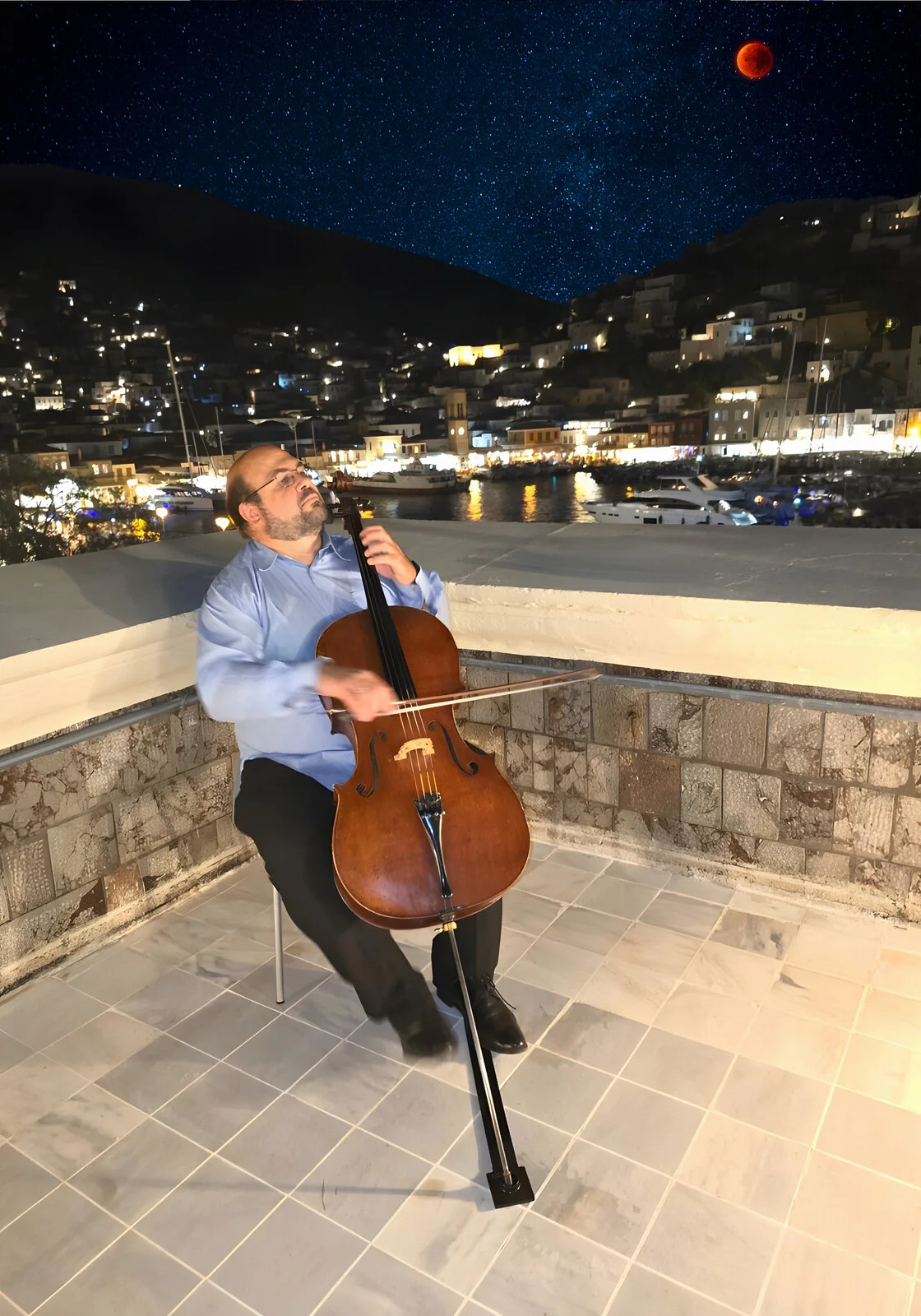
Jörgen Thornberg
Vivaldi Autumn on Hydra, 2024
Digital
50 x 70 cm
The Four Seasons on Hydra
Spring awakens in Hydra's embrace,
Blossoms dance with the sea's warm grace.
The air is sweet with wildflowers bloom,
Waves hum softly, dispelling the gloom.
Olive trees rustle with a gentle cheer,
The island whispers, "Spring is here."
Summer ignites with a golden flame,
Sun-kissed shores where no two days are the same.
The waters sparkle, turquoise and bright,
Fishermen’s boats drift into the night.
Stone houses glow in the evening's hue,
As the cicadas sing, their song rings true.
Then comes **Autumn**, with a softer song,
Days grow shorter; the nights grow long.
The red full moon hangs heavy and low,
Casting its glow on the harbour below.
Warm breezes carry the scent of pine,
As leaves turn gold on the twisted vine.
Evenings are mild, dark yet clear,
It's a perfect time for wine and cheer.
Tables are set with harvest’s delight,
Under the stars, in the amber light.
Hydra is quieter, serene and wise,
Reflecting autumn’s crimson skies.
Winter arrives with a tranquil chill,
Mists wrap the island, calm and still.
The sea turns silver, deep and vast,
Stories of the past in each breeze that blasts.
Fireplaces glow in the island's heart,
As Hydra and Vivaldi’s notes never part.
Through each season, Hydra remains,
Timeless and pure in her ancient veins.
As Vivaldi’s notes drift over the shore,
The island's essence is forevermore.
From spring's first bloom to autumn's red glow,
Hydra's seasons, like music, endlessly flow.
Malmö, October 2024
‘The Four Seasons’ makes an immortal journey through time and space.
On the museum's rooftop, he sat with his gaze dreamily fixed among the stars, the cello cradled between his knees, and the notes of ‘The Four Seasons’ flowed across the terrace. The mild evening couldn't have been more perfect as Vivaldi's ‘Autumn’ merged with the light of the full red moon and the distant sounds from the harbour. Hydra has calmed down this time of year—the tourists are fewer and more discerning. It’s the professionals who come this season. It’s simply Hydra at its best.
Antonio Vivaldi’s ‘The Four Seasons’ (‘Le Quattro Stagioni’) is a timeless masterpiece that has transcended generations and continues to captivate music lovers worldwide. Composed in 1723 as part of his collection of twelve violin concertos called ‘Il cimento dell'armonia e dell'inventione’, these four concertos—’Spring’, ‘Summer’, ‘Autumn’, and ‘Winter’—not only capture the changing moods of nature but have also become a cultural phenomenon. Their enduring popularity is a testament to their rich cultural legacy.
A Musical Mirror of Nature
Each season is an independent concerto with three movements, and Vivaldi accompanied them with sonnets, which he is believed to have written himself. In these sonnets, he describes the specific scenes and emotions portrayed in each movement—from the chirping of birds and the babbling of brooks in spring to the cold winds and icy landscapes of winter. Vivaldi's music is not just a reflection of nature, but a profound expression of human emotions, capturing them with rare precision and sensitivity, making us feel the depth of these emotions.
The Music and Its Impact Through the Centuries
In the 18th century, particularly in Venice, where Vivaldi lived and worked, the piece was admired for its innovative violin use and frequently performed in musical salons. His unique ability to utilise the violin’s complete range—from the bright and dancing spring to the dark and thundering summer—was a testament to his skill and made him one of the foremost violin virtuosos of his time.
However, Vivaldi’s music fell into obscurity after his death, and it wasn’t until the 20th century that ‘The Four Seasons’ was rediscovered in earnest. In the 1950s, when classical music began to explore Baroque compositions again, the work found a new audience. The Russian violinist David Oistrakh and the Italian conductor Claudio Scimone were pioneers in reviving Vivaldi’s work, helping to establish ‘The Four Seasons’ as a beloved classic. In the 1970s, recordings by Nigel Kennedy and Itzhak Perlman took the piece to new heights, with interpretations that were both energetic and bold, winning over a broad audience.
A Work That Continues to Inspire and Challenge
Vivaldi's music possesses a unique charm that has kept it relevant through the centuries. The music’s dynamic contrasts and sharp transitions between faster and slower movements offer musicians a platform to express their creativity and skill. Each generation brings a new interpretation of the work—from traditional Baroque ensembles aiming to recreate Vivaldi’s original intention to modern interpretations with electric instruments or other new arrangements.
In recent years, crossover musicians like violinist Vanessa-Mae have taken on ‘The Four Seasons’, transforming the work into a part of modern popular culture. Although some purists may view these interpretations as irreverent, they demonstrate the piece’s flexibility and ability to communicate across time and space. It serves as a reminder that Vivaldi's work is a living art form that evolves over time and still has much to say to contemporary audiences.
A Musically Multifaceted Masterpiece
Vivaldi’s ‘The Four Seasons’ has also been used to illustrate the changing faces of nature and humanity. ‘Spring’ is a musical celebration of new life, an explosion of vitality and light where birds sing, and brooks flow. In contrast, ‘Summer’ is a violent journey through heat and thunder, with the violin almost seeming to sweat under the sun’s oppressive heat. ‘Autumn’ is a festive depiction of the harvest season, with music that almost smells of ripe fruits and fresh winds. And finally, ‘Winter’, a chilly yet beautiful reflection of nature’s rest, where every note is almost like an ice floe slowly drifting through the water.
Vivaldi's ability to use music to capture the unexpected is particularly amusing about' The Four Seasons'—he was unafraid to exaggerate or use extreme dynamics to create an almost humorous effect. An example is in ‘Summer’, where he includes a scene in which a farmer, struggling under the heat, falls asleep to the sound of cicadas, illustrated by the violin's swaying rhythm.
An Immortal Classic
The fact that ‘The Four Seasons’ has survived throughout history is a testament to its universal appeal. Vivaldi managed to create a work that is not only a study of the beauty of nature but also a depiction of the human experience—the joy, sorrow, passion, and tranquillity we all recognise, regardless of time and place. The music remains a favourite among newcomers and veterans of classical music, and its beauty is as convincing for young listeners as for those who have heard it countless times.
Even though it depicts specific seasons, its theme is fundamentally timeless. Vivaldi didn’t just capture weather patterns; he captured the emotions they evoke within us. His work speaks to our hearts and minds, reminding us again and again that every season, just like life itself, carries its gifts and challenges.
So every time we listen to ‘The Four Seasons’, whether in a church in Venice, a concert hall in Berlin, or even at the kitchen table at home, it is as if we step into Vivaldi’s world—a world where music still has the power to move us, amuse us, and remind us of the timeless beauty of nature and the human soul.
Vivaldi’s ‘Autumn’ is a symphony for harvest and celebration.
In Vivaldi’s ‘The Four Seasons’, ‘Autumn’ (‘L'autunno’) stands as a joyful tribute to the harvest season—a time of gathering, revelry, and celebration. The concerto captures the essence of autumn with its rich and lively melodies that dance like falling leaves in a golden breeze. It’s as if Vivaldi’s music invites us to embrace the season's warmth, indulgence, and cosy darkness that wraps around us as the days grow shorter.
Warm Nights Under a Crimson Moon
As the concerto unfolds, Vivaldi’s ‘Autumn’ feels like the musical equivalent of a warm, dark evening under a full, crimson harvest moon. The music mirrors the season's deep reds and golden hues, evoking the sensation of walking through a forest where leaves crunch underfoot and the trees are ablaze in shades of amber and scarlet. The concerto's first movement is filled with joy and festivity, its playful rhythms reminiscent of the carefree spirit of a crisp autumn night, where the air is filled with the mingled scent of woodsmoke and fallen leaves.
In many cultures, the full moon of autumn is associated with the harvest and celebration, and Vivaldi’s ‘Autumn’ is a fitting soundtrack to such moments. The concerto’s crescendos mirror the moon's rising in the twilight sky, a moon that casts a magical glow over the landscape and invites reflection and delight. The rich tones of the strings seem to shimmer like moonlight on a still lake, adding a sense of mystery and wonder to the autumnal night.
A Feast for the Senses: Autumn Buffets and Champagne Toasts
‘Autumn’ is the season of abundance, when the earth gives its final and most generous gifts before the long winter. Vivaldi’s music beautifully captures this sense of fullness and plenty, making it the perfect accompaniment to luxurious autumn feasts. The second movement slows down, bringing to mind the elegant atmosphere of a bountiful harvest table, where gourds, ripe fruits, and hearty dishes are spread out in a delicious display. The strings in this section are smoother and more reflective, inviting the listener to savour each bite of a seasonal delicacy.
Imagine the music playing softly in the background during an evening gathering, the dining room filled with the warm glow of candlelight, glasses of champagne catching the flickering light. The toasts rise and fall in rhythm with the concerto’s melodies, a shared joy that mirrors the communal spirit of harvest celebrations. Vivaldi’s lively tempos capture the sense of good company and laughter. At the same time, the deeper notes evoke the more decadent flavours of autumn—earthy mushrooms, slow-cooked stews, and the rich, golden hue of a crisp apple cider or sparkling wine.
The final movement of ‘Autumn’ is a spirited dance, a joyful celebration that evokes the image of dancing flames and twirling skirts under the full autumn moon. It’s a time of revelry and indulgence, a moment to let go of the year's worries and delight in the present. The energetic strings seem to leap and spin, mirroring the bubbles in a glass of champagne and the merriment of friends gathered for a festive autumn soirée.
Champagne and the Spirit of ‘Autumn’
Like ‘Autumn’, Champagne uniquely captures the season’s luxurious yet transient nature. The music's lively passages are as effervescent as the bubbles in a freshly poured glass of champagne—light, playful, and full of zest. Vivaldi’s sparkling arpeggios mimic the fizz and pop of the drink, while the more profound harmonies remind us of autumn’s grounding and earthy side.
Just as a glass of champagne elevates an autumn gathering, so does Vivaldi’s ‘Autumn’ transform a simple evening into a celebration. The concerto’s bright, clear notes are a toast to the fleeting beauty of the season—a reminder to savour every moment, delight in the simple pleasures of life, and let the music carry us into the heart of autumn’s magic.
In Vivaldi’s hands, ‘Autumn’ becomes more than a mere season—it is an experience, a feast for the senses, a time of warmth and laughter set against the crisp coolness of fall. It invites us to dance, taste, celebrate, and embrace the rich, fleeting beauty that autumn offers—a beauty that shines brightest under the full, red moon of the season’s longest nights.
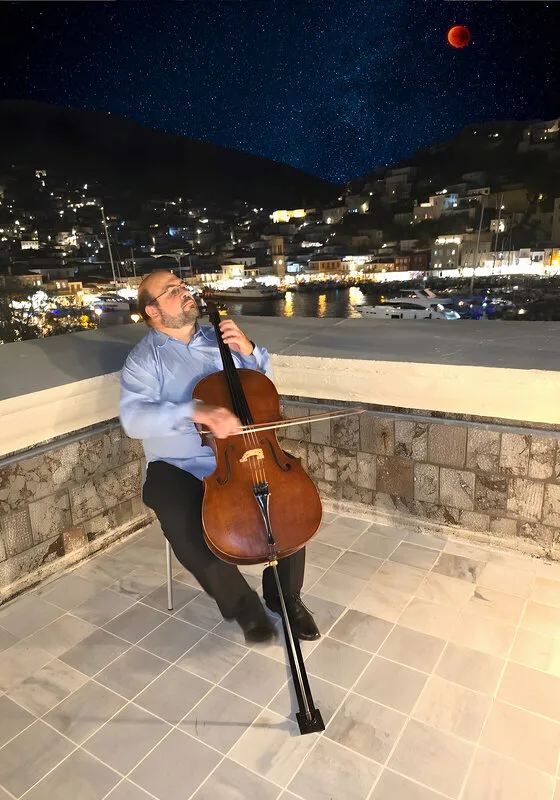
Jörgen Thornberg
Vivaldi Autumn on Hydra, 2024
Digital
50 x 70 cm
The Four Seasons on Hydra
Spring awakens in Hydra's embrace,
Blossoms dance with the sea's warm grace.
The air is sweet with wildflowers bloom,
Waves hum softly, dispelling the gloom.
Olive trees rustle with a gentle cheer,
The island whispers, "Spring is here."
Summer ignites with a golden flame,
Sun-kissed shores where no two days are the same.
The waters sparkle, turquoise and bright,
Fishermen’s boats drift into the night.
Stone houses glow in the evening's hue,
As the cicadas sing, their song rings true.
Then comes **Autumn**, with a softer song,
Days grow shorter; the nights grow long.
The red full moon hangs heavy and low,
Casting its glow on the harbour below.
Warm breezes carry the scent of pine,
As leaves turn gold on the twisted vine.
Evenings are mild, dark yet clear,
It's a perfect time for wine and cheer.
Tables are set with harvest’s delight,
Under the stars, in the amber light.
Hydra is quieter, serene and wise,
Reflecting autumn’s crimson skies.
Winter arrives with a tranquil chill,
Mists wrap the island, calm and still.
The sea turns silver, deep and vast,
Stories of the past in each breeze that blasts.
Fireplaces glow in the island's heart,
As Hydra and Vivaldi’s notes never part.
Through each season, Hydra remains,
Timeless and pure in her ancient veins.
As Vivaldi’s notes drift over the shore,
The island's essence is forevermore.
From spring's first bloom to autumn's red glow,
Hydra's seasons, like music, endlessly flow.
Malmö, October 2024
‘The Four Seasons’ makes an immortal journey through time and space.
On the museum's rooftop, he sat with his gaze dreamily fixed among the stars, the cello cradled between his knees, and the notes of ‘The Four Seasons’ flowed across the terrace. The mild evening couldn't have been more perfect as Vivaldi's ‘Autumn’ merged with the light of the full red moon and the distant sounds from the harbour. Hydra has calmed down this time of year—the tourists are fewer and more discerning. It’s the professionals who come this season. It’s simply Hydra at its best.
Antonio Vivaldi’s ‘The Four Seasons’ (‘Le Quattro Stagioni’) is a timeless masterpiece that has transcended generations and continues to captivate music lovers worldwide. Composed in 1723 as part of his collection of twelve violin concertos called ‘Il cimento dell'armonia e dell'inventione’, these four concertos—’Spring’, ‘Summer’, ‘Autumn’, and ‘Winter’—not only capture the changing moods of nature but have also become a cultural phenomenon. Their enduring popularity is a testament to their rich cultural legacy.
A Musical Mirror of Nature
Each season is an independent concerto with three movements, and Vivaldi accompanied them with sonnets, which he is believed to have written himself. In these sonnets, he describes the specific scenes and emotions portrayed in each movement—from the chirping of birds and the babbling of brooks in spring to the cold winds and icy landscapes of winter. Vivaldi's music is not just a reflection of nature, but a profound expression of human emotions, capturing them with rare precision and sensitivity, making us feel the depth of these emotions.
The Music and Its Impact Through the Centuries
In the 18th century, particularly in Venice, where Vivaldi lived and worked, the piece was admired for its innovative violin use and frequently performed in musical salons. His unique ability to utilise the violin’s complete range—from the bright and dancing spring to the dark and thundering summer—was a testament to his skill and made him one of the foremost violin virtuosos of his time.
However, Vivaldi’s music fell into obscurity after his death, and it wasn’t until the 20th century that ‘The Four Seasons’ was rediscovered in earnest. In the 1950s, when classical music began to explore Baroque compositions again, the work found a new audience. The Russian violinist David Oistrakh and the Italian conductor Claudio Scimone were pioneers in reviving Vivaldi’s work, helping to establish ‘The Four Seasons’ as a beloved classic. In the 1970s, recordings by Nigel Kennedy and Itzhak Perlman took the piece to new heights, with interpretations that were both energetic and bold, winning over a broad audience.
A Work That Continues to Inspire and Challenge
Vivaldi's music possesses a unique charm that has kept it relevant through the centuries. The music’s dynamic contrasts and sharp transitions between faster and slower movements offer musicians a platform to express their creativity and skill. Each generation brings a new interpretation of the work—from traditional Baroque ensembles aiming to recreate Vivaldi’s original intention to modern interpretations with electric instruments or other new arrangements.
In recent years, crossover musicians like violinist Vanessa-Mae have taken on ‘The Four Seasons’, transforming the work into a part of modern popular culture. Although some purists may view these interpretations as irreverent, they demonstrate the piece’s flexibility and ability to communicate across time and space. It serves as a reminder that Vivaldi's work is a living art form that evolves over time and still has much to say to contemporary audiences.
A Musically Multifaceted Masterpiece
Vivaldi’s ‘The Four Seasons’ has also been used to illustrate the changing faces of nature and humanity. ‘Spring’ is a musical celebration of new life, an explosion of vitality and light where birds sing, and brooks flow. In contrast, ‘Summer’ is a violent journey through heat and thunder, with the violin almost seeming to sweat under the sun’s oppressive heat. ‘Autumn’ is a festive depiction of the harvest season, with music that almost smells of ripe fruits and fresh winds. And finally, ‘Winter’, a chilly yet beautiful reflection of nature’s rest, where every note is almost like an ice floe slowly drifting through the water.
Vivaldi's ability to use music to capture the unexpected is particularly amusing about' The Four Seasons'—he was unafraid to exaggerate or use extreme dynamics to create an almost humorous effect. An example is in ‘Summer’, where he includes a scene in which a farmer, struggling under the heat, falls asleep to the sound of cicadas, illustrated by the violin's swaying rhythm.
An Immortal Classic
The fact that ‘The Four Seasons’ has survived throughout history is a testament to its universal appeal. Vivaldi managed to create a work that is not only a study of the beauty of nature but also a depiction of the human experience—the joy, sorrow, passion, and tranquillity we all recognise, regardless of time and place. The music remains a favourite among newcomers and veterans of classical music, and its beauty is as convincing for young listeners as for those who have heard it countless times.
Even though it depicts specific seasons, its theme is fundamentally timeless. Vivaldi didn’t just capture weather patterns; he captured the emotions they evoke within us. His work speaks to our hearts and minds, reminding us again and again that every season, just like life itself, carries its gifts and challenges.
So every time we listen to ‘The Four Seasons’, whether in a church in Venice, a concert hall in Berlin, or even at the kitchen table at home, it is as if we step into Vivaldi’s world—a world where music still has the power to move us, amuse us, and remind us of the timeless beauty of nature and the human soul.
Vivaldi’s ‘Autumn’ is a symphony for harvest and celebration.
In Vivaldi’s ‘The Four Seasons’, ‘Autumn’ (‘L'autunno’) stands as a joyful tribute to the harvest season—a time of gathering, revelry, and celebration. The concerto captures the essence of autumn with its rich and lively melodies that dance like falling leaves in a golden breeze. It’s as if Vivaldi’s music invites us to embrace the season's warmth, indulgence, and cosy darkness that wraps around us as the days grow shorter.
Warm Nights Under a Crimson Moon
As the concerto unfolds, Vivaldi’s ‘Autumn’ feels like the musical equivalent of a warm, dark evening under a full, crimson harvest moon. The music mirrors the season's deep reds and golden hues, evoking the sensation of walking through a forest where leaves crunch underfoot and the trees are ablaze in shades of amber and scarlet. The concerto's first movement is filled with joy and festivity, its playful rhythms reminiscent of the carefree spirit of a crisp autumn night, where the air is filled with the mingled scent of woodsmoke and fallen leaves.
In many cultures, the full moon of autumn is associated with the harvest and celebration, and Vivaldi’s ‘Autumn’ is a fitting soundtrack to such moments. The concerto’s crescendos mirror the moon's rising in the twilight sky, a moon that casts a magical glow over the landscape and invites reflection and delight. The rich tones of the strings seem to shimmer like moonlight on a still lake, adding a sense of mystery and wonder to the autumnal night.
A Feast for the Senses: Autumn Buffets and Champagne Toasts
‘Autumn’ is the season of abundance, when the earth gives its final and most generous gifts before the long winter. Vivaldi’s music beautifully captures this sense of fullness and plenty, making it the perfect accompaniment to luxurious autumn feasts. The second movement slows down, bringing to mind the elegant atmosphere of a bountiful harvest table, where gourds, ripe fruits, and hearty dishes are spread out in a delicious display. The strings in this section are smoother and more reflective, inviting the listener to savour each bite of a seasonal delicacy.
Imagine the music playing softly in the background during an evening gathering, the dining room filled with the warm glow of candlelight, glasses of champagne catching the flickering light. The toasts rise and fall in rhythm with the concerto’s melodies, a shared joy that mirrors the communal spirit of harvest celebrations. Vivaldi’s lively tempos capture the sense of good company and laughter. At the same time, the deeper notes evoke the more decadent flavours of autumn—earthy mushrooms, slow-cooked stews, and the rich, golden hue of a crisp apple cider or sparkling wine.
The final movement of ‘Autumn’ is a spirited dance, a joyful celebration that evokes the image of dancing flames and twirling skirts under the full autumn moon. It’s a time of revelry and indulgence, a moment to let go of the year's worries and delight in the present. The energetic strings seem to leap and spin, mirroring the bubbles in a glass of champagne and the merriment of friends gathered for a festive autumn soirée.
Champagne and the Spirit of ‘Autumn’
Like ‘Autumn’, Champagne uniquely captures the season’s luxurious yet transient nature. The music's lively passages are as effervescent as the bubbles in a freshly poured glass of champagne—light, playful, and full of zest. Vivaldi’s sparkling arpeggios mimic the fizz and pop of the drink, while the more profound harmonies remind us of autumn’s grounding and earthy side.
Just as a glass of champagne elevates an autumn gathering, so does Vivaldi’s ‘Autumn’ transform a simple evening into a celebration. The concerto’s bright, clear notes are a toast to the fleeting beauty of the season—a reminder to savour every moment, delight in the simple pleasures of life, and let the music carry us into the heart of autumn’s magic.
In Vivaldi’s hands, ‘Autumn’ becomes more than a mere season—it is an experience, a feast for the senses, a time of warmth and laughter set against the crisp coolness of fall. It invites us to dance, taste, celebrate, and embrace the rich, fleeting beauty that autumn offers—a beauty that shines brightest under the full, red moon of the season’s longest nights.

Jörgen Thornberg
Malmö
Lite om bilder och mig. Translation in English at the end.
Jag är en nyfiken person som ser allt i bilder, även det jag fäster i ord, gärna tillsammans för bakom alla mina bilder finns en berättelse. Till vissa bilder hör en kortare eller längre novell som följer med bilden.
Bilder berättar historier. Jag omges av naturlig skönhet, intressanta människor och historia var jag än går. Jag använder min kamera för att dokumentera världen och blanda det jag ser med vad jag känner för att fånga den dolda magin.
Mina bilder berättar mina historier. Genom mina bilder, tryck och berättelser. Jag bjuder in dig att ta del av dessa berättelser, in i ditt liv och hem och dela min mycket personliga syn på vår värld. Mer än vad ögat ser. Jag tänker i bilder, drömmer och skriver och pratar om dem; följaktligen måste jag också skapa bilder. De blir vad jag ser, inte nödvändigtvis begränsade till verkligheten. Det finns en bild runt varje hörn. Jag hoppas att du kommer att se vad jag såg och gilla det.
Jag är också en skrivande person och till många bilder hör en kortare eller längre essay. Den följer med tavlan, tryckt på fint papper och med en personlig hälsning från mig.
Flertalet bilder startar sin resa i min kamera. Enkelt förklarat beskriver jag bilden jag ser i mitt inre, upplevd eller fantiserad. Bilden uppstår inom mig redan innan jag fått okularet till ögat. På bråkdelen av ett ögonblick ser jag vad jag vill ha och vad som kan göras med bilden. Här skall jag stoppa in en giraff, stålmannen, Titanic eller vad det är min fantasi finner ut. Ännu märkligare är att jag kommer ihåg minnesbilden långt efteråt när det blir tid att skapa verket. Om jag lyckas eller inte, är upp till betraktaren, oftast präglat av en stråk av svart humor – meningen är att man skall bli underhållen. Mina bilder blir ofta en snackis där de hänger.
Jag föredrar bilder som förmedlar ett budskap i flera lager. Vid första anblicken fylld av feel-good, en vacker utsikt, fint väder, solen skiner, blommor på ängen eller vattnet som ligger förrädiskt spegelblankt. I en sådan bild kan jag gömma min egentliga berättelse, mitt förakt för förtryckare och våldsverkare, rasister och fördomsfulla människor - ett gärna återkommande motiv mer eller mindre dolt i det vackra motivet. Jag försöker förena dem i ett gemensamt narrativ.
Bild och formgivning har löpt som en röd tråd genom livet. Fotokonst känns som en värdig final som jag gärna delar med mig.
Min genre är vid som framgår av mina bilder, temat en blandning av pop- och gatukonst i kollage som kan bestå av hundratals lager. Vissa bilder kan ta veckor, andra någon dag innan det är dags att överlämna resultatet till printverkstaden. Fine Art Prints är digitala fotocollage. I dessa kollage sker rivandet, klippandet, pusslandet, målandet, ritandet och sprayningen digitalt. Det jag monterar in kan vara hundratals år gamla bilder som jag omsorgsfullt frilägger så att de ser ut att vara en del av tavlan men också bilder skapade av mig själv efter min egen fantasi. Därefter besöks printstudion och för vissa bilder numrera en limiterad upplaga (oftast 7 exemplar) och signera för hand. Vissa bilder kan köpas i olika format. Det är bara att fråga efter vilka. Gillar man en bild som är 70x100 men inte har plats på väggen, går den kanske att få i 50x70 cm istället. Frågan är fri.
Metoden Giclée eller Fine Art Print som det också kallas är det moderna sättet för framställning av grafisk konst. Villkoret för denna typ av utskrifter är att en högkvalitativ storformatskrivare används med åldersbeständigt färgpigment och konstnärspapper eller i förekommande fall på duk. Pappret som används möter de krav på livslängd som ställs av museer och gallerier. Normalt säljer jag mina bilder oinramade så att den nya ägaren själv kan bestämma hur de skall se ut, med eller utan passepartout färg på ram, med eller utan glas etc..
Under många år ställde jag bara ut på nätet, i valda grupper och på min egen Facebooksida - https://www.facebook.com/jorgen.thornberg.9
Jag finns också på en egen hemsida som tyvärr inte alltid är uppdaterad – https://www.jth.life/ Där kan du också läsa en del av de berättelser som följer med bilden.
UTSTÄLLNINGAR
Luftkastellet, oktober 2022
Konst i Lund, november 2022
Luftkastellet, mars 2023
Engleson Galleri Caroli, april 2023
Hydra, Greece June 2023
Engleson Galleri Caroli, oktober 2023
Toppen, Höllviken december 2023
Luftkastellet, mars 2024
Torups Galleri, mars 2024
Venice, May 2024
Luftkastellet, oktober 2024
Konst i Advent, December 2024
Galleri Engleson, Caroli December 2024
Jäger & Jansson Galleri, april 2025
A bit about pictures and me.
I'm a curious person who sees everything in pictures, even what I express in words, often combining them, for behind all my pictures lies a story. These narratives, some as short as a single image and others as long as a novel, are the heart and soul of my work.
Pictures tell stories. Wherever I go, I'm surrounded by natural beauty, exciting people, and history. I use my camera to document the world and blend what I see with what I feel to capture the hidden magic.
My images tell my stories. Through my pictures, prints, and narratives, I invite you to partake in these stories in your life and home and share my deeply personal perspective of our world. More than meets the eye. I think in pictures, dream, write, and talk about them; consequently, I must create images too. They become what I see, not necessarily confined to reality. There's a picture around every corner. I hope you'll see what I saw and enjoy it.
I'm also a writer, and many images come with a shorter or longer essay. It accompanies the painting, printed on fine paper with my personal greeting.
Many pictures start their journey on my camera. Simply put, I describe the image I see in my mind, experienced or imagined. The image arises within me even before I bring the eyepiece to my eye. In a fraction of a moment, I see what I want and what can be done with the picture. Here, I'll insert a giraffe, Superman, the Titanic, or whatever my imagination conjures up. Even stranger is that I remember the mental image long after it's time to create the work. Whether I succeed is up to the observer, often imbued with a streak of black humour – the aim is to entertain. My pictures usually become a talking point wherever they hang.
I prefer pictures that convey a message in multiple layers. At first glance, they're filled with feel-good vibes, a beautiful view, lovely weather, the sun shining, flowers in the meadow, or the water lying deceptively calm. But beneath this surface beauty, I often conceal a deeper story, a narrative that challenges societal norms or explores the human condition. I invite you to delve into these hidden narratives and discover the layers of meaning within my work.
Picture and design have been a thread running through my life. Photographic art feels like a fitting finale, and I'm happy to share it.
My genre is varied, as seen in my pictures; the theme is a blend of pop and street art in collages that can consist of hundreds of layers. Some images can take weeks, others just a day before it's time to hand over the result to the print workshop. Fine Art Prints are digital photo collages. In these collages, tearing, cutting, puzzling, painting, drawing, and spraying happen digitally. What I insert can be images hundreds of years old that I carefully extract so they appear to be part of the painting, but also images created by myself, now also generated from my imagination. Next, visit the print studio and, for certain images, number a limited edition (usually 7 copies) and sign them by hand. Some images may be available in other formats. Just ask which ones. If you like an image that's 70x100 but doesn't have space on the wall, you might be able to get it in 50x70 cm instead. The question is open.
The Giclée method, or Fine Art Print as it's also called, is the modern way of producing graphic art. This method ensures the highest quality and longevity of the artwork, using a high-quality large-format printer with archival pigment inks and artist paper or, in some cases, canvas. The paper used meets the longevity requirements set by museums and galleries. I sell my pictures unframed, allowing the new owner to personalise their artwork, confident in the lasting value and quality of the piece.
For many years, I only exhibited online, in selected groups, and on my Facebook page - https://www.facebook.com/jorgen.thornberg.9. I also have my website, which unfortunately is not constantly updated - https://www.jth.life/. You can also read some of the stories accompanying the pictures there.
EXHIBITIONS
Luftkastellet, October 2022
Art in Lund, November 2022
Luftkastellet, March 2023
Engleson Gallery Caroli, April 2023
Hydra, Greece June 2023
Engleson Gallery Caroli, October 2023
Toppen, Höllviken December 2023
Luftkastellet, March 2024
Torup Gallery, March 2024
Venice, May 2024
UTSTÄLLNINGAR
Luftkastellet, oktober 2022
Konst i Lund, november 2022
Luftkastellet, mars 2023
Engleson Galleri Caroli, april 2023
Hydra, Greece June 2023
Engleson Galleri Caroli, oktober 2023
Toppen, Höllviken december 2023
Luftkastellet, mars 2024
Torups Galleri, mars 2024
Venice, May 2024
Luftkastellet, October 2024
Konst i Advent, December 2024
Galleri Engleson, Caroli December 2024
Jäger & Jansson Galleri, April 2025
Utbildning
Autodidakt
Medlem i konstnärsförening
Öppna Sinnen
Med i konstrunda
Konstrundan i Skåne
Utställningar
Luftkastellet, October 2022
Art in Lund, November 2022
Luftkastellet, March 2023
Engleson Gallery Caroli, April 2023
Hydra, Greece June 2023
Engleson Gallery Caroli, October 2023
Toppen, Höllviken December 2023
Luftkastellet, March 2024
Torup Gallery, March 2024
Venice, May 2024