Vi använder cookies för att ge dig bästa möjliga upplevelse. Välj vilka cookies du tillåter.
Läs mer i vår integritetspolicy
Jörgen Thornberg
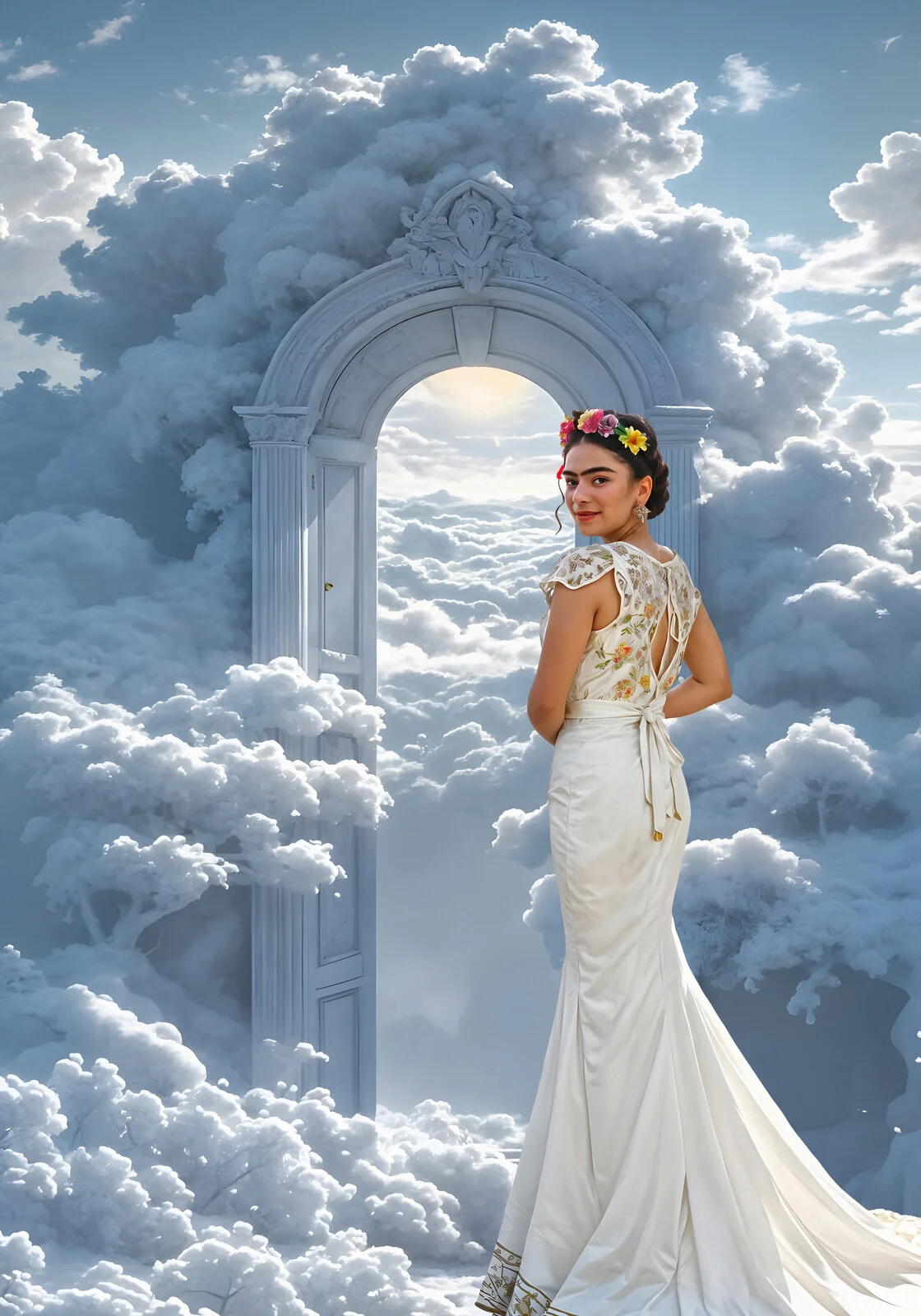
Frida at the Pearly Gate, 2025
Digital
70 x 100 cm
5 200 kr
Frida at the Pearly Gate
Frida Kahlo on the Pearly Gates: A Journey Through Imagined Heavens and Hells
Frida Kahlo's spirit filled the room, as vibrant as the paintings surrounding her. At her retrospective vernissage, the audience was abuzz with anticipation, not just to view the iconic works but to witness the enigmatic stand-in for Frida herself. A double so uncannily similar in appearance and demeanor that many questioned if she truly channeled the long-departed artist. The evening's lecture, titled "A Reflection of the Journey We Are About to Embark On,"promised an exploration beyond the tangible, delving into interpretations of heaven, hell, and the enduring power structures built upon these beliefs.
With a sparkling mezcal in hand and a mischievous glint in her eyes, 'Frida' began her monologue—a masterful weave of wit, critique, and insight. What unfolded was an audacious commentary on the myths of eternity, power's grip on the human psyche, and the truth that lies in the legacies we leave behind. The room was transfixed, and the evening was a proper tribute to the immortal spirit of Frida Kahlo: rebellious, thought-provoking, and forever revolutionary.
Will you join the party? Please read on and delve deeper into the story behind her exhibition.
“Pearly Gates in the Blue
Beneath the heavens, where clouds embrace,
Stands Frida Kahlo, defying space.
No golden streets, no saint with a key,
Just endless questions and mystery.
Her crown of flowers, vibrant, wild,
Frames a face both fierce and mild.
With brush in hand and a knowing grin,
She paints the void where dreams begin.
“No gates of pearl, no gilded throne,
There are no lines of souls, no kingdom shown.
This place is nothing, yet it’s all,
A canvas vast, no rise, no fall.”
She gestures wide to clouds and air,
“To myths we cling, to masks we wear.
A paradise sold, a hell imposed,
By those who seek to keep us closed.”
Her voice rings clear, her laughter bold,
“No god of fire, no streets of gold.
But art, and love, and lives we’ve led—
That’s the truth when we are dead.”
The spirits gather, drawn to her flame,
Immortals lost to the Power’s game.
She stands alone, yet never apart,
A rebel’s soul, a boundless heart.
“Here at the gates, I see it plain—
The afterlife is what remains.
Not mansions promised, nor judgment’s strife,
But the echoes left of a well-lived life.”
Frida turns, her brush takes flight,
Creating stars in endless night.
Her legacy blooms in every hue,
A masterpiece, eternal, true.
Malmö January 2025
Frida Kahlo on the Pearly Gates: A Journey Through Imagined Heavens and Hells.
Champagne is never out of place at a vernissage. Frida's retrospective exhibition had opened, attracting a curious audience locally, across Sweden, neighbouring countries, and even from her former homeland, Mexico. Many were eager to see the paintings, but just as many were drawn by Frida Kahlo's double, who not only looked like her but reportedly spoke and thought like the artist who had been gone for seventy years. Surrounded by paintings in one of the rooms—a larger lounge furnished with rented chairs and sofas of modern design—the evening's lecture was titled: ‘A Reflection of the Journey We Are About to Embark On, Exploring the Various Interpretations of the Afterlife and the Role of Power and Control in Shaping These Beliefs.’
Frida Kahlo leaned back in her chair, a glass of sparkling mezcal in hand, her floral crown sparkling. With a wry smile, she began, “Let’s talk about Pearly Gates—or rather, the doors to the heavens and hells we’ve conjured in our imaginations. Isn’t it fascinating how humanity, across ages and continents, has obsessed over what lies beyond this life? Stairways, golden streets, fire pits—such vivid stories for places no one has seen, neither during nor after their time on Earth. In Eternity, neither their gods, prophets, nor priests hold to what they once preached on Earth. Why would they? It wouldn’t be very sensible with the answers in hand. In eternity, lies are abolished because everyone shares the collective truth."
Frida Kahlo's stand-in, the actress ‘Frida,’ had promised not to speak about the paintings but rather about how Frida experienced life on the other side. As kindred spirits, the two Fridas were in constant contact, though the paranormal was off-limits for the evening, considered too private a subject to discuss. Instead, the topic for the night was ‘The Pearly Gates That Do Not Exist.’ Trust that the room was tense with anticipation. The painting, never before shown publicly, depicted Frida standing outside a portal amidst the clouds.
“The painting is a play on water vapour, the motif a mirage, and as such, it shows something people long for but does not exist,” the stand-in Frida explained. It was a fitting metaphor for Frida's perspective—a mix of whimsy and sharp critique of the illusions humanity clings to, wrapped in the vibrant strokes and surreal imagery that defined her legacy.
Frida gestured to an imaginary staircase leading nowhere. “But I’ll tell you this much—there’s no grand staircase to a pearl-studded gate, no St. Peter holding a key, no line of souls waiting to be judged. That’s just a fairy tale for grown-ups, designed to keep people in check and the powerful in power. Let’s explore, shall we? From the sands of Egypt to the modern religions still spinning their webs, the stories are as human as absurd. "I have met them all; I live with them every day in eternity, and they are just as bewildered as I am about how they could fall for those tall tales." Frida looked as if she had personally encountered these extraterrestrial beings. No one in the room could even begin to guess or understand whether she genuinely had or not. But I knew—otherwise, this story could never have been told.
“In ancient Egypt, the dead faced the Hall of Ma’at, where their hearts were weighed against a feather. If you lived justly, your heart was light, and you’d enter the Field of Reeds—a paradise of eternal harvests and happiness. But if your heart was heavy with sin, a demon named Ammit devoured it, and poof!_there was no afterlife for you. A cosmic crocodile as judge and executioner! How imaginative,” Frida chuckled. “And yet, wasn’t it just a way to enforce morality and obedience to the pharaoh, a living god? Control the people, control the afterlife.”
If you want a bleak underworld, go back to Sumer and Babylon. The Sumerians and Babylonians weren’t as optimistic,” she continued. “Their underworld, Irkalla, was a dark, dreary place where all souls—good or bad—went to live among dust and shadows. There is no paradise, no punishment, just eternal gloom. Can you imagine the existential dread that must have caused? It’s almost as if they didn’t need hellfire to make people fear—they feared life itself.”
In ancient Greece and Rome antiquity, they had eternal banquets and torments. The Greeks and Romans brought in drama, as they always do. For them, it was all about Elysium or Tartarus. Elysium—a paradise for heroes and the virtuous, filled with endless feasts and music. And Tartarus, where the wicked suffered eternal punishments—like Sisyphus, doomed to roll his boulder forever. Sounds exhausting, doesn’t it?”
She laughed, “But think about it—Elysium was for the elites, the demigods, the poets. Tartarus? For rebels, for those who challenged authority. A conveniently crafted narrative to remind people of their ‘place.’ Power dressed as mythology. It's a stark reminder of how religion has been used to control and suppress. But understanding this manipulation can empower us to question and challenge such narratives."
"Christianity and Islam are all about streets of gold and fire, with their heavens and hells, black or white," she continued in the same mocking tone. “Streets of gold, mansions for the righteous, and eternal torment for the damned. Pearly gates here, rivers of milk and honey there. And let’s not forget the flames and gnashing of teeth below. Both promise rewards for submission and eternal punishment for dissent. Convenient. Tell the poor to endure, tell the oppressed to obey because their reward lies in the next life. Nobody has ever returned to tell the truth. I do it with few listeners because Time-travellers can only be understood by a select few on Earth. Speaking of eternity to others would be like creating another religion based on incomprehensible dreams and vague promises. No one who has left the lies behind on Earth is interested. Trust me!"
Frida sighed, swirling her mezcal. “It’s ingenious. Promise the moon—after death—and you never have to deliver. All while justifying inequality and keeping the powerful in power.” She shook her head gently.
“However, Hinduism and Buddhism take a different path,” Frida said, her tone softening slightly. “They speak of cycles—samsara, karma, and reincarnation. Instead of eternal reward or punishment, your actions determine your next life, and next and so on. It’s poetic, isn’t it? A bit more personal responsibility. But even here, caste systems and hierarchies creep in, telling the poor to accept their lot as ‘karma.’ And moksha, liberation, becomes the elusive prize—a spiritual carrot on a stick.” Frida assumed Buddha’s pose known as ‘Dharmachakra Mudra’—the "Wheel of Dharma" or "Teaching Gesture"—mimicking a Buddha statue with her hands in front of her chest, fingers forming a circle. The gesture symbolises Buddha’s questioning of universal truths and his search for insight and wisdom.
“Sorry, Buddha,” Frida said, gazing into the distant edge of the Milky Way toward the star where the former prince and preacher spent eternity. “He got both right and wrong, old Buddha, but in many ways, he was closer to the truth of eternity than most other prophets. He didn’t have to account for a god since his religion doesn’t include one. Buddha’s philosophy is deeply connected to questioning and critical thinking. His famous instruction to his followers was not to blindly accept his teachings but to examine and verify them. That’s a core aspect of his message. If I were forced to choose, I’d probably bet on him. A handsome man, too.” Frida gave a demonstrative toss of her head.
“How about modern religions and my perspective? And here we are, in the modern age, in the 21st century, and still clinging to these tales,” Frida said, her voice tinged with amusement and frustration. “I was a communist on Earth, believing in the power of people to shape their world. Up there, I’ve softened and become more of a humanist, feminist, and someone who wants what’s best for humanity—no matter your gender, geography, ethnicity or culture. "My ideas are still on the left side, where the heart is, but when common sense prevails, other laws than the political ones take control."
She leaned forward, her gaze sharp and direct. “But I see clearly now. No political party or religion truly aligns with that vision. They all serve someone or something—power, money, control, not the people they claim to represent. And the pearly gates? They’re just another story, another mechanism to keep us obedient.” The look of contempt returned to her face.
“So, listen to my truth! What’s the real afterlife?” Frida shrugged with a playful smirk. “It’s this—what we leave behind. Our art, our love, and the memories we create in others. That’s immortality. Not some golden mansion or fiery pit, but the ripples of our lives felt long after we’re gone.”
She raised her glass high, her voice ringing with conviction. “Here’s to humanity—messy, beautiful, and flawed. To truth, not fairy tales. And to live fully, not for some imagined afterlife, but for the here and now. Skål! Salud! Cheers!”
The room erupted in toasts, laughter, and applause, her words resonating with those around her—immortals and dreamers alike. Frida Kahlo, ever the artist, ever the rebel, had once again painted a masterpiece with her words. Listening to an artist, a theatre guest performer, is like cracking open the door to metaphysics. It leaves you both delighted and humbled when you realise how little you truly understand. It's reassuring to know some possess insight, allowing the rest of us to watch and listen without straining ourselves too much.
Frida frowned, her voice hardening as she continued. “But among all these stories of heavens and hells, the worst of all is when religions are used to justify violence. Think of the absurd idea that martyrs are promised a paradise filled with twenty, forty, or even seventy virgins as a reward for killing ‘infidels’—which, in practice, means anyone who doesn’t share their faith. It’s so unimaginably cruel and cynical.
“To exploit young people’s desperation and their dreams of a better life—to drive them to commit horrific acts—is nothing but manipulation of the worst kind. Those who exploit the language of religion to sow death and destruction are not believers. They are power-hungry men who use the name of God to control, destroy, and take whatever they want.”
She took a sip of her mezcal, shaking her head. “Think about it—what kind of paradise is that? One where violence and death are the tickets in? That’s no heaven; it’s a prison of ignorance and bloodshed created by those who seek to oppress and dominate. And those who lose the most are the young, sacrificed on this altar of lies.”
Frida raised her glass again, her gaze sharp and unwavering. “We must see through such lies, uncover the power lurking behind religion’s façade. It is not God who speaks, but men who seek to rule others—men who aim to silence women, especially. Women, of course, consider themselves owners of women, and they demand that women remain silent in the congregation.
“Why must women be silenced? Because biologically and emotionally, women are closer to life and truth. It’s why they can give birth and ensure survival. The only way to counteract this is through education, truth, and compassion paired with equality—fundamental virtues that need no heaven to be worth pursuing.
“There is no fear in eternity because no one can die more than once. And without fear, there is no violence. Women adapt quickly in the afterlife.”
Frida fell silent, for there was nothing more to add. Everything had been said, though the monologue could easily have continued for hours, days, months, or years.
Jörgen Thornberg
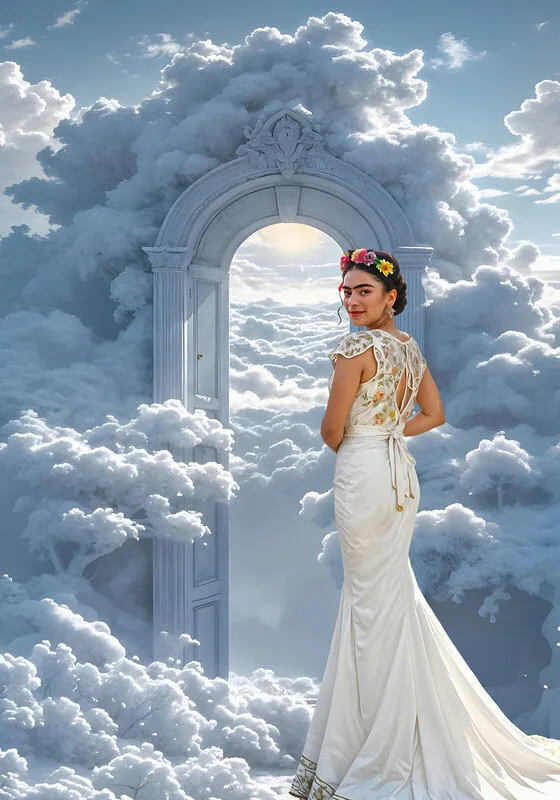
Frida at the Pearly Gate, 2025
Digital
70 x 100 cm
5 200 kr
Frida at the Pearly Gate
Frida Kahlo on the Pearly Gates: A Journey Through Imagined Heavens and Hells
Frida Kahlo's spirit filled the room, as vibrant as the paintings surrounding her. At her retrospective vernissage, the audience was abuzz with anticipation, not just to view the iconic works but to witness the enigmatic stand-in for Frida herself. A double so uncannily similar in appearance and demeanor that many questioned if she truly channeled the long-departed artist. The evening's lecture, titled "A Reflection of the Journey We Are About to Embark On,"promised an exploration beyond the tangible, delving into interpretations of heaven, hell, and the enduring power structures built upon these beliefs.
With a sparkling mezcal in hand and a mischievous glint in her eyes, 'Frida' began her monologue—a masterful weave of wit, critique, and insight. What unfolded was an audacious commentary on the myths of eternity, power's grip on the human psyche, and the truth that lies in the legacies we leave behind. The room was transfixed, and the evening was a proper tribute to the immortal spirit of Frida Kahlo: rebellious, thought-provoking, and forever revolutionary.
Will you join the party? Please read on and delve deeper into the story behind her exhibition.
“Pearly Gates in the Blue
Beneath the heavens, where clouds embrace,
Stands Frida Kahlo, defying space.
No golden streets, no saint with a key,
Just endless questions and mystery.
Her crown of flowers, vibrant, wild,
Frames a face both fierce and mild.
With brush in hand and a knowing grin,
She paints the void where dreams begin.
“No gates of pearl, no gilded throne,
There are no lines of souls, no kingdom shown.
This place is nothing, yet it’s all,
A canvas vast, no rise, no fall.”
She gestures wide to clouds and air,
“To myths we cling, to masks we wear.
A paradise sold, a hell imposed,
By those who seek to keep us closed.”
Her voice rings clear, her laughter bold,
“No god of fire, no streets of gold.
But art, and love, and lives we’ve led—
That’s the truth when we are dead.”
The spirits gather, drawn to her flame,
Immortals lost to the Power’s game.
She stands alone, yet never apart,
A rebel’s soul, a boundless heart.
“Here at the gates, I see it plain—
The afterlife is what remains.
Not mansions promised, nor judgment’s strife,
But the echoes left of a well-lived life.”
Frida turns, her brush takes flight,
Creating stars in endless night.
Her legacy blooms in every hue,
A masterpiece, eternal, true.
Malmö January 2025
Frida Kahlo on the Pearly Gates: A Journey Through Imagined Heavens and Hells.
Champagne is never out of place at a vernissage. Frida's retrospective exhibition had opened, attracting a curious audience locally, across Sweden, neighbouring countries, and even from her former homeland, Mexico. Many were eager to see the paintings, but just as many were drawn by Frida Kahlo's double, who not only looked like her but reportedly spoke and thought like the artist who had been gone for seventy years. Surrounded by paintings in one of the rooms—a larger lounge furnished with rented chairs and sofas of modern design—the evening's lecture was titled: ‘A Reflection of the Journey We Are About to Embark On, Exploring the Various Interpretations of the Afterlife and the Role of Power and Control in Shaping These Beliefs.’
Frida Kahlo leaned back in her chair, a glass of sparkling mezcal in hand, her floral crown sparkling. With a wry smile, she began, “Let’s talk about Pearly Gates—or rather, the doors to the heavens and hells we’ve conjured in our imaginations. Isn’t it fascinating how humanity, across ages and continents, has obsessed over what lies beyond this life? Stairways, golden streets, fire pits—such vivid stories for places no one has seen, neither during nor after their time on Earth. In Eternity, neither their gods, prophets, nor priests hold to what they once preached on Earth. Why would they? It wouldn’t be very sensible with the answers in hand. In eternity, lies are abolished because everyone shares the collective truth."
Frida Kahlo's stand-in, the actress ‘Frida,’ had promised not to speak about the paintings but rather about how Frida experienced life on the other side. As kindred spirits, the two Fridas were in constant contact, though the paranormal was off-limits for the evening, considered too private a subject to discuss. Instead, the topic for the night was ‘The Pearly Gates That Do Not Exist.’ Trust that the room was tense with anticipation. The painting, never before shown publicly, depicted Frida standing outside a portal amidst the clouds.
“The painting is a play on water vapour, the motif a mirage, and as such, it shows something people long for but does not exist,” the stand-in Frida explained. It was a fitting metaphor for Frida's perspective—a mix of whimsy and sharp critique of the illusions humanity clings to, wrapped in the vibrant strokes and surreal imagery that defined her legacy.
Frida gestured to an imaginary staircase leading nowhere. “But I’ll tell you this much—there’s no grand staircase to a pearl-studded gate, no St. Peter holding a key, no line of souls waiting to be judged. That’s just a fairy tale for grown-ups, designed to keep people in check and the powerful in power. Let’s explore, shall we? From the sands of Egypt to the modern religions still spinning their webs, the stories are as human as absurd. "I have met them all; I live with them every day in eternity, and they are just as bewildered as I am about how they could fall for those tall tales." Frida looked as if she had personally encountered these extraterrestrial beings. No one in the room could even begin to guess or understand whether she genuinely had or not. But I knew—otherwise, this story could never have been told.
“In ancient Egypt, the dead faced the Hall of Ma’at, where their hearts were weighed against a feather. If you lived justly, your heart was light, and you’d enter the Field of Reeds—a paradise of eternal harvests and happiness. But if your heart was heavy with sin, a demon named Ammit devoured it, and poof!_there was no afterlife for you. A cosmic crocodile as judge and executioner! How imaginative,” Frida chuckled. “And yet, wasn’t it just a way to enforce morality and obedience to the pharaoh, a living god? Control the people, control the afterlife.”
If you want a bleak underworld, go back to Sumer and Babylon. The Sumerians and Babylonians weren’t as optimistic,” she continued. “Their underworld, Irkalla, was a dark, dreary place where all souls—good or bad—went to live among dust and shadows. There is no paradise, no punishment, just eternal gloom. Can you imagine the existential dread that must have caused? It’s almost as if they didn’t need hellfire to make people fear—they feared life itself.”
In ancient Greece and Rome antiquity, they had eternal banquets and torments. The Greeks and Romans brought in drama, as they always do. For them, it was all about Elysium or Tartarus. Elysium—a paradise for heroes and the virtuous, filled with endless feasts and music. And Tartarus, where the wicked suffered eternal punishments—like Sisyphus, doomed to roll his boulder forever. Sounds exhausting, doesn’t it?”
She laughed, “But think about it—Elysium was for the elites, the demigods, the poets. Tartarus? For rebels, for those who challenged authority. A conveniently crafted narrative to remind people of their ‘place.’ Power dressed as mythology. It's a stark reminder of how religion has been used to control and suppress. But understanding this manipulation can empower us to question and challenge such narratives."
"Christianity and Islam are all about streets of gold and fire, with their heavens and hells, black or white," she continued in the same mocking tone. “Streets of gold, mansions for the righteous, and eternal torment for the damned. Pearly gates here, rivers of milk and honey there. And let’s not forget the flames and gnashing of teeth below. Both promise rewards for submission and eternal punishment for dissent. Convenient. Tell the poor to endure, tell the oppressed to obey because their reward lies in the next life. Nobody has ever returned to tell the truth. I do it with few listeners because Time-travellers can only be understood by a select few on Earth. Speaking of eternity to others would be like creating another religion based on incomprehensible dreams and vague promises. No one who has left the lies behind on Earth is interested. Trust me!"
Frida sighed, swirling her mezcal. “It’s ingenious. Promise the moon—after death—and you never have to deliver. All while justifying inequality and keeping the powerful in power.” She shook her head gently.
“However, Hinduism and Buddhism take a different path,” Frida said, her tone softening slightly. “They speak of cycles—samsara, karma, and reincarnation. Instead of eternal reward or punishment, your actions determine your next life, and next and so on. It’s poetic, isn’t it? A bit more personal responsibility. But even here, caste systems and hierarchies creep in, telling the poor to accept their lot as ‘karma.’ And moksha, liberation, becomes the elusive prize—a spiritual carrot on a stick.” Frida assumed Buddha’s pose known as ‘Dharmachakra Mudra’—the "Wheel of Dharma" or "Teaching Gesture"—mimicking a Buddha statue with her hands in front of her chest, fingers forming a circle. The gesture symbolises Buddha’s questioning of universal truths and his search for insight and wisdom.
“Sorry, Buddha,” Frida said, gazing into the distant edge of the Milky Way toward the star where the former prince and preacher spent eternity. “He got both right and wrong, old Buddha, but in many ways, he was closer to the truth of eternity than most other prophets. He didn’t have to account for a god since his religion doesn’t include one. Buddha’s philosophy is deeply connected to questioning and critical thinking. His famous instruction to his followers was not to blindly accept his teachings but to examine and verify them. That’s a core aspect of his message. If I were forced to choose, I’d probably bet on him. A handsome man, too.” Frida gave a demonstrative toss of her head.
“How about modern religions and my perspective? And here we are, in the modern age, in the 21st century, and still clinging to these tales,” Frida said, her voice tinged with amusement and frustration. “I was a communist on Earth, believing in the power of people to shape their world. Up there, I’ve softened and become more of a humanist, feminist, and someone who wants what’s best for humanity—no matter your gender, geography, ethnicity or culture. "My ideas are still on the left side, where the heart is, but when common sense prevails, other laws than the political ones take control."
She leaned forward, her gaze sharp and direct. “But I see clearly now. No political party or religion truly aligns with that vision. They all serve someone or something—power, money, control, not the people they claim to represent. And the pearly gates? They’re just another story, another mechanism to keep us obedient.” The look of contempt returned to her face.
“So, listen to my truth! What’s the real afterlife?” Frida shrugged with a playful smirk. “It’s this—what we leave behind. Our art, our love, and the memories we create in others. That’s immortality. Not some golden mansion or fiery pit, but the ripples of our lives felt long after we’re gone.”
She raised her glass high, her voice ringing with conviction. “Here’s to humanity—messy, beautiful, and flawed. To truth, not fairy tales. And to live fully, not for some imagined afterlife, but for the here and now. Skål! Salud! Cheers!”
The room erupted in toasts, laughter, and applause, her words resonating with those around her—immortals and dreamers alike. Frida Kahlo, ever the artist, ever the rebel, had once again painted a masterpiece with her words. Listening to an artist, a theatre guest performer, is like cracking open the door to metaphysics. It leaves you both delighted and humbled when you realise how little you truly understand. It's reassuring to know some possess insight, allowing the rest of us to watch and listen without straining ourselves too much.
Frida frowned, her voice hardening as she continued. “But among all these stories of heavens and hells, the worst of all is when religions are used to justify violence. Think of the absurd idea that martyrs are promised a paradise filled with twenty, forty, or even seventy virgins as a reward for killing ‘infidels’—which, in practice, means anyone who doesn’t share their faith. It’s so unimaginably cruel and cynical.
“To exploit young people’s desperation and their dreams of a better life—to drive them to commit horrific acts—is nothing but manipulation of the worst kind. Those who exploit the language of religion to sow death and destruction are not believers. They are power-hungry men who use the name of God to control, destroy, and take whatever they want.”
She took a sip of her mezcal, shaking her head. “Think about it—what kind of paradise is that? One where violence and death are the tickets in? That’s no heaven; it’s a prison of ignorance and bloodshed created by those who seek to oppress and dominate. And those who lose the most are the young, sacrificed on this altar of lies.”
Frida raised her glass again, her gaze sharp and unwavering. “We must see through such lies, uncover the power lurking behind religion’s façade. It is not God who speaks, but men who seek to rule others—men who aim to silence women, especially. Women, of course, consider themselves owners of women, and they demand that women remain silent in the congregation.
“Why must women be silenced? Because biologically and emotionally, women are closer to life and truth. It’s why they can give birth and ensure survival. The only way to counteract this is through education, truth, and compassion paired with equality—fundamental virtues that need no heaven to be worth pursuing.
“There is no fear in eternity because no one can die more than once. And without fear, there is no violence. Women adapt quickly in the afterlife.”
Frida fell silent, for there was nothing more to add. Everything had been said, though the monologue could easily have continued for hours, days, months, or years.
5 200 kr

Jörgen Thornberg
Malmö
Lite om bilder och mig. Translation in English at the end.
Jag är en nyfiken person som ser allt i bilder, även det jag fäster i ord, gärna tillsammans för bakom alla mina bilder finns en berättelse. Till vissa bilder hör en kortare eller längre novell som följer med bilden.
Bilder berättar historier. Jag omges av naturlig skönhet, intressanta människor och historia var jag än går. Jag använder min kamera för att dokumentera världen och blanda det jag ser med vad jag känner för att fånga den dolda magin.
Mina bilder berättar mina historier. Genom mina bilder, tryck och berättelser. Jag bjuder in dig att ta del av dessa berättelser, in i ditt liv och hem och dela min mycket personliga syn på vår värld. Mer än vad ögat ser. Jag tänker i bilder, drömmer och skriver och pratar om dem; följaktligen måste jag också skapa bilder. De blir vad jag ser, inte nödvändigtvis begränsade till verkligheten. Det finns en bild runt varje hörn. Jag hoppas att du kommer att se vad jag såg och gilla det.
Jag är också en skrivande person och till många bilder hör en kortare eller längre essay. Den följer med tavlan, tryckt på fint papper och med en personlig hälsning från mig.
Flertalet bilder startar sin resa i min kamera. Enkelt förklarat beskriver jag bilden jag ser i mitt inre, upplevd eller fantiserad. Bilden uppstår inom mig redan innan jag fått okularet till ögat. På bråkdelen av ett ögonblick ser jag vad jag vill ha och vad som kan göras med bilden. Här skall jag stoppa in en giraff, stålmannen, Titanic eller vad det är min fantasi finner ut. Ännu märkligare är att jag kommer ihåg minnesbilden långt efteråt när det blir tid att skapa verket. Om jag lyckas eller inte, är upp till betraktaren, oftast präglat av en stråk av svart humor – meningen är att man skall bli underhållen. Mina bilder blir ofta en snackis där de hänger.
Jag föredrar bilder som förmedlar ett budskap i flera lager. Vid första anblicken fylld av feel-good, en vacker utsikt, fint väder, solen skiner, blommor på ängen eller vattnet som ligger förrädiskt spegelblankt. I en sådan bild kan jag gömma min egentliga berättelse, mitt förakt för förtryckare och våldsverkare, rasister och fördomsfulla människor - ett gärna återkommande motiv mer eller mindre dolt i det vackra motivet. Jag försöker förena dem i ett gemensamt narrativ.
Bild och formgivning har löpt som en röd tråd genom livet. Fotokonst känns som en värdig final som jag gärna delar med mig.
Min genre är vid som framgår av mina bilder, temat en blandning av pop- och gatukonst i kollage som kan bestå av hundratals lager. Vissa bilder kan ta veckor, andra någon dag innan det är dags att överlämna resultatet till printverkstaden. Fine Art Prints är digitala fotocollage. I dessa kollage sker rivandet, klippandet, pusslandet, målandet, ritandet och sprayningen digitalt. Det jag monterar in kan vara hundratals år gamla bilder som jag omsorgsfullt frilägger så att de ser ut att vara en del av tavlan men också bilder skapade av mig själv efter min egen fantasi. Därefter besöks printstudion och för vissa bilder numrera en limiterad upplaga (oftast 7 exemplar) och signera för hand. Vissa bilder kan köpas i olika format. Det är bara att fråga efter vilka. Gillar man en bild som är 70x100 men inte har plats på väggen, går den kanske att få i 50x70 cm istället. Frågan är fri.
Metoden Giclée eller Fine Art Print som det också kallas är det moderna sättet för framställning av grafisk konst. Villkoret för denna typ av utskrifter är att en högkvalitativ storformatskrivare används med åldersbeständigt färgpigment och konstnärspapper eller i förekommande fall på duk. Pappret som används möter de krav på livslängd som ställs av museer och gallerier. Normalt säljer jag mina bilder oinramade så att den nya ägaren själv kan bestämma hur de skall se ut, med eller utan passepartout färg på ram, med eller utan glas etc..
Under många år ställde jag bara ut på nätet, i valda grupper och på min egen Facebooksida - https://www.facebook.com/jorgen.thornberg.9
Jag finns också på en egen hemsida som tyvärr inte alltid är uppdaterad – https://www.jth.life/ Där kan du också läsa en del av de berättelser som följer med bilden.
UTSTÄLLNINGAR
Luftkastellet, oktober 2022
Konst i Lund, november 2022
Luftkastellet, mars 2023
Engleson Galleri Caroli, april 2023
Hydra, Greece June 2023
Engleson Galleri Caroli, oktober 2023
Toppen, Höllviken december 2023
Luftkastellet, mars 2024
Torups Galleri, mars 2024
Venice, May 2024
Luftkastellet, oktober 2024
Konst i Advent, December 2024
Galleri Engleson, Caroli December 2024
Jäger & Jansson Galleri, april 2025
A bit about pictures and me.
I'm a curious person who sees everything in pictures, even what I express in words, often combining them, for behind all my pictures lies a story. These narratives, some as short as a single image and others as long as a novel, are the heart and soul of my work.
Pictures tell stories. Wherever I go, I'm surrounded by natural beauty, exciting people, and history. I use my camera to document the world and blend what I see with what I feel to capture the hidden magic.
My images tell my stories. Through my pictures, prints, and narratives, I invite you to partake in these stories in your life and home and share my deeply personal perspective of our world. More than meets the eye. I think in pictures, dream, write, and talk about them; consequently, I must create images too. They become what I see, not necessarily confined to reality. There's a picture around every corner. I hope you'll see what I saw and enjoy it.
I'm also a writer, and many images come with a shorter or longer essay. It accompanies the painting, printed on fine paper with my personal greeting.
Many pictures start their journey on my camera. Simply put, I describe the image I see in my mind, experienced or imagined. The image arises within me even before I bring the eyepiece to my eye. In a fraction of a moment, I see what I want and what can be done with the picture. Here, I'll insert a giraffe, Superman, the Titanic, or whatever my imagination conjures up. Even stranger is that I remember the mental image long after it's time to create the work. Whether I succeed is up to the observer, often imbued with a streak of black humour – the aim is to entertain. My pictures usually become a talking point wherever they hang.
I prefer pictures that convey a message in multiple layers. At first glance, they're filled with feel-good vibes, a beautiful view, lovely weather, the sun shining, flowers in the meadow, or the water lying deceptively calm. But beneath this surface beauty, I often conceal a deeper story, a narrative that challenges societal norms or explores the human condition. I invite you to delve into these hidden narratives and discover the layers of meaning within my work.
Picture and design have been a thread running through my life. Photographic art feels like a fitting finale, and I'm happy to share it.
My genre is varied, as seen in my pictures; the theme is a blend of pop and street art in collages that can consist of hundreds of layers. Some images can take weeks, others just a day before it's time to hand over the result to the print workshop. Fine Art Prints are digital photo collages. In these collages, tearing, cutting, puzzling, painting, drawing, and spraying happen digitally. What I insert can be images hundreds of years old that I carefully extract so they appear to be part of the painting, but also images created by myself, now also generated from my imagination. Next, visit the print studio and, for certain images, number a limited edition (usually 7 copies) and sign them by hand. Some images may be available in other formats. Just ask which ones. If you like an image that's 70x100 but doesn't have space on the wall, you might be able to get it in 50x70 cm instead. The question is open.
The Giclée method, or Fine Art Print as it's also called, is the modern way of producing graphic art. This method ensures the highest quality and longevity of the artwork, using a high-quality large-format printer with archival pigment inks and artist paper or, in some cases, canvas. The paper used meets the longevity requirements set by museums and galleries. I sell my pictures unframed, allowing the new owner to personalise their artwork, confident in the lasting value and quality of the piece.
For many years, I only exhibited online, in selected groups, and on my Facebook page - https://www.facebook.com/jorgen.thornberg.9. I also have my website, which unfortunately is not constantly updated - https://www.jth.life/. You can also read some of the stories accompanying the pictures there.
EXHIBITIONS
Luftkastellet, October 2022
Art in Lund, November 2022
Luftkastellet, March 2023
Engleson Gallery Caroli, April 2023
Hydra, Greece June 2023
Engleson Gallery Caroli, October 2023
Toppen, Höllviken December 2023
Luftkastellet, March 2024
Torup Gallery, March 2024
Venice, May 2024
UTSTÄLLNINGAR
Luftkastellet, oktober 2022
Konst i Lund, november 2022
Luftkastellet, mars 2023
Engleson Galleri Caroli, april 2023
Hydra, Greece June 2023
Engleson Galleri Caroli, oktober 2023
Toppen, Höllviken december 2023
Luftkastellet, mars 2024
Torups Galleri, mars 2024
Venice, May 2024
Luftkastellet, October 2024
Konst i Advent, December 2024
Galleri Engleson, Caroli December 2024
Jäger & Jansson Galleri, April 2025
Utbildning
Autodidakt
Medlem i konstnärsförening
Öppna Sinnen
Med i konstrunda
Konstrundan i Skåne
Utställningar
Luftkastellet, October 2022
Art in Lund, November 2022
Luftkastellet, March 2023
Engleson Gallery Caroli, April 2023
Hydra, Greece June 2023
Engleson Gallery Caroli, October 2023
Toppen, Höllviken December 2023
Luftkastellet, March 2024
Torup Gallery, March 2024
Venice, May 2024