Vi använder cookies för att ge dig bästa möjliga upplevelse. Välj vilka cookies du tillåter.
Läs mer i vår integritetspolicy
Jörgen Thornberg
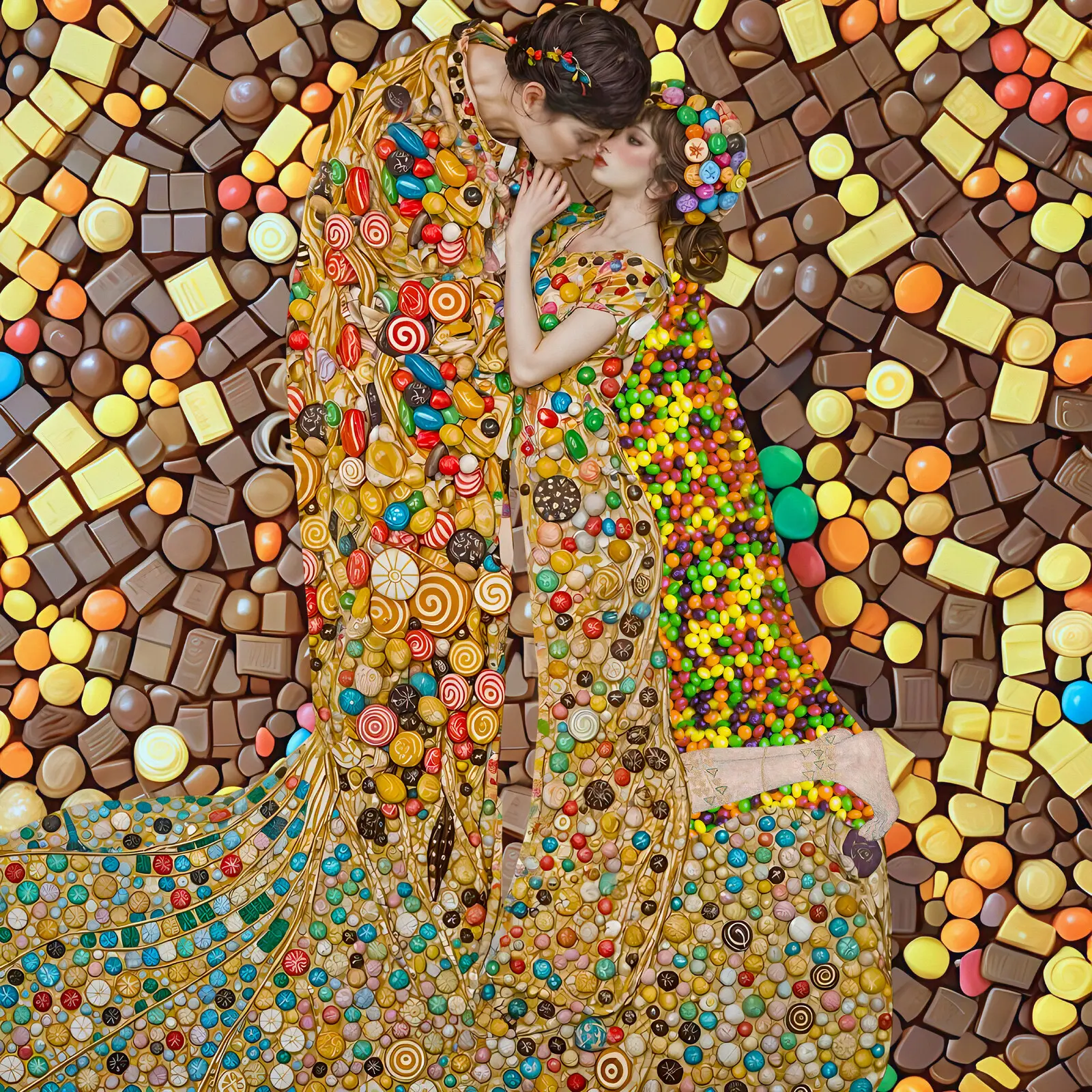
Candy Kiss - Dreamy Delights, 2024
Digital
70 x 70 cm
A pigling’s delight
Little Knut, a sweet-toothed pig,
With a curly tail so cute and big,
He got candy every time he pranced,
And his tail would curl with every chance!
But poor pigling Knut had a weak resolve,
And never learned from his troubles at all.
He’d overeat and grow round and stout,
Then, soon enough, his tummy would shout!
"Never again!" he’d swear in pain,
"My tummy aches drive me insane!"
But when the candy bowl was filled,
His promise was forgotten, and he was thrilled.
So now we hear Knut with a sad "oink oink,"
A pig in pain from gobbling too much junk.
But despite the ache, what does he do?
He eats more candy, through and through!
Hydra, August 2024
It’s incredible how a picture can bring out thoughts and memories. An article on the internet about Gustav Klimt’s famous The Kiss set my mind spinning, reminding me of the profound power of art to evoke emotions. And desire. Pastry chefs are known for creating fantastic masterpieces as part of their craft, but some candy shop owners don’t want to be outdone. One had been inspired by Klimt’s sweet kiss and assembled candy into a picture of a couple sharing a truly sugary kiss right in the middle of the shop. That was all it took to trigger my candy craving while sitting at the computer—poor me.
Subsequently, I had a massive craving for something tasty to pop into my mouth, something to suck on while I worked on my pictures—candy, pure and simple. It happens far too often, but I like to think it contributes to my creativity. Or at least that's what I tell myself. In any case, it's a good excuse.
In my taste memory, a sweet symphony was playing, and in my thoughts, I was on a journey through the World's most beloved candies. My mouth was watering. From experience, I know that for a spoiled Swede, it's not easy to satisfy a sweet tooth on Hydra. The absence of Swedish candy is a constant frustration. Sure, there's plenty of lovely stuff on Hydra—if you're into cakes, that is. But they don't give the same concentrated kick as candy. And that kind of candy is only available in bags on the island. If the ones you like aren't sold out, which they usually are. The selection is limited to just a few types. A typical supermarket in Sweden has about a hundred different kinds of candy to choose from, and well-stocked candy shops can have more than a thousand. No wonder that on Hydra, I feel deprived and suffer from withdrawal symptoms.
Undeterred, I embarked on the winding kilometre-long Donkey Shit Lane to the harbour for a candy hunt, a quest that always feels like hunting an endangered species, like big game hunting on Hydra. The descent was manageable, but the arduous climb back uphill was a true test of my determination.
The first shop I visited had run out of marshmallow-type candies that almost tasted like the ones from home, leaving only a few sad bags of gummy sweets that lacked discernible flavour. It was a disheartening sight. I moved on to the next place, only to find every roll of Mentos sold out—some miscreant had clearly emptied the shop, which happened to be the only one on the island that carried this candy found worldwide. My last hope was further up the road, where two measly bags of something sweet and sour had to suffice for the evening and the next day. The disappointment was palpable.
Thankfully, the next day was Thursday, the day when candy supplies on Hydra were supposed to be replenished. However, the local stores' logistics were often unreliable, and the shelves were not always restocked as expected. Whether the selection was influenced by the owner's taste or just random, certain items, like the hard, sour candies I enjoyed, often disappeared without a trace.
For those of us with a sweet tooth, or as we say in Sweden, a 'Gottegris,' candy isn't just a treat—it's a way of life, a sensory experience that delights the taste buds and stirs the soul. From the bustling markets of Belgium, where the finest chocolates melt on the tongue like butter, to the colourful bins of Swedish ‘lösgodis’ that offer endless combinations of sugary bliss, candy transcends borders, speaking a universal language of pleasure. The journey of discovering candy in different countries is a feast of flavours, textures, and cultural traditions that deserve to be savoured with all the indulgence they inspire. It's a joyous adventure that never fails to excite.
It should be mentioned that the Swedish term "gotten is" is a playful expression, where "Gott" means "something tasty or sweet," and "gris" means "pig." The term likens someone who loves sweets or indulges in treats to a pig, often seen as an animal that enjoys eating greedily. It’s not meant negatively but rather in a lighthearted or affectionate sense, suggesting someone who loves indulging in tasty or sweet things—like a pig happily devouring its food.
Sweden is the Kingdom of ‘Lösgodis’
When it comes to candy consumption, Swedes reign supreme. Sweden holds the record for eating more candy per capita than any other nation, a title proudly upheld thanks to the beloved tradition of ‘lösgodis’—literally “loose candy.” There isn’t a direct one-word translation for ‘lösgodis’ in English, but the closest term would be “pick and mix candy” or the more prosaic “bulk candy.” These terms describe candy sold by weight, where you can choose different types from bins or containers, just like ‘lösgodis’ in Sweden. This unique tradition is not just a way of buying candy but a cultural institution reflecting Swedish culinary tastes' diversity and individuality.
‘Lösgodis’ has been a Swedish phenomenon since the 1980s, when it became legal for customers to pick their candy themselves. This tradition of 'lösgodis' is deeply ingrained in Swedish culture, with many Swedes having fond memories of visiting candy stores and selecting their favourite treats. Today, Swedes consume about 15 kilos of candy per person each year. After a dip during the pandemic, ‘lösgodis’ sales are nearly back to their previous levels.
Swedish ‘lösgodis’ has also gained an international market thanks to the internet phenomenon "Swedish candy," which has taken off on TikTok and Instagram. It seems the whole world now wants Swedish ‘lösgodis’. Except Hydra
Every weekend, a unique Swedish tradition unfolds in the country's supermarkets. ‘Lösgodis’, a colourful, chaotic, and satisfying ritual, allows people to craft their perfect bag of sweet delights and mirrors the diversity of Swedish culinary tastes. This personalisation, unique to ‘lösgodis’, is a significant aspect of Swedish culture, setting it apart from other candy traditions.
But ‘lösgodis’ is more than just a snack—it’s a cultural institution that brings joy to children across Sweden. They eagerly await ‘lördagsgodis’, or ‘Saturday candy,’ a tradition where they can indulge in their favourite treats after a long week. The sheer variety on offer is staggering, and for Swedes, who enjoy both the pleasure of choice and the fun of indulgence, lösgodis is more than a treat—it’s an art form that brings back fond memories of childhood excitement and joy.
The Chocolate Paradise
If Sweden is the home of ‘lösgodis’, then Belgium is undoubtedly the temple of chocolate. Walk through the cobbled streets of Brussels, and the air itself seems infused with the rich aroma of cocoa. Belgian chocolates, or pralines as they are called, are revered worldwide for their craftsmanship and decadence. The variety on offer, whether filled with hazelnut cream, ganache, or caramel, is staggering, making each piece a unique masterpiece, handcrafted with care and precision.
Belgian chocolatiers treat their craft with almost religious reverence. From the velvety smoothness of fine milk chocolate to the bold intensity of a dark, 70% cacao bar, Belgian chocolates are a study in balance. But it’s the filled pralines that truly steal the show. Biting into one reveals layers of flavour that seem to unfold like a story: a crisp outer shell that gives way to a soft, creamy filling, sometimes infused with liqueur or exotic spices. For the true candy connoisseur, visiting Belgium’s chocolatiers is like a pilgrimage to the heart of indulgence and a chance to admire and respect the craftsmanship of these artisans.
The Heritage of Sweet Brands
No candy lover's journey would be complete without a stop in England, a country with a proud tradition of iconic sweets and brands that have stood the test of time. Cadbury, the hallmark of British chocolate for over a century, has been producing its famous Dairy Milk bars, beloved for their creamy texture and rich cocoa flavour. Founded in 1824, Cadbury has become synonymous with comfort and nostalgia, making it a key player in British confectionery.
But Cadbury is just one part of England’s sweet story. The country is home to a treasure trove of old-fashioned sweets sold in quaint corner shops and traditional sweet stores. Think boiled sweets like rhubarb and custard, sherbet lemons, and pear drops—candies that evoke a sense of history and tradition with every bite and a deep sense of nostalgia and cultural connection. Licorice, too, holds a special place in British hearts, with brands like Bassett's Allsorts delivering a kaleidoscope of colours and flavours, from aniseed to fruity notes.
Of course, no trip through England’s candy world would be complete without the childhood favourite, Rowntree’s. Known for classics like Fruit Pastilles and Jelly Tots, these chewy candies have been enjoyed for generations, offering a bright, fruity contrast to the chocolate-dominated shelves. The British love for sweets runs deep, blending a sense of heritage with modern-day cravings.
A Box of Sweet Delights
In Greece, candy may take a backseat to the decadent, syrupy sweets adored nationwide. Greeks, known for their love of food and hospitality, often favour baked treats bursting with honey, nuts, and spices. Families go to the local Zacharoplasteío (pastry shops) each weekend to select an assortment of sweets to take home, presented in elegant boxes tied with ribbons. These bakeries offer a compelling display of confections such as baklava, galaktoboureko, and kataifi, dripping with honey syrup and packed with layers of phyllo dough, almonds, and walnuts. It’s delicious but disastrous for the waistline if you eat that while working.
While Swedes might bring a bottle of champagne when visiting friends, Greeks arrive with a box of these sweet pastries, a gesture of warmth and tradition. These treats are shared around the table, accompanied by lively conversation and often a strong cup of coffee. With their intense flavours and indulgent textures, Greek sweets provide a rich, comforting contrast to the candies of other nations, steeped in centuries-old traditions of baking and hospitality.
The Art of Innovation
Travel east and find yourself in Japan, where candy isn’t just food—it’s an art form. Known for its creativity and attention to detail, the Japanese candy scene is as innovative as beautiful. From intricately shaped wagashi, traditional sweets often served with tea, to modern-day marvels like Pocky Sticks and mochi-filled candies, Japan’s candy culture is a testament to the joy of experimentation.
Japanese candies often come in seasonal varieties, with flavours that reflect the time of year—sakura (cherry blossom) in spring, matcha (green tea) in summer, and chestnut in fall. Kit Kats, one of the most iconic sweets, come in an astonishing array of flavours, including wasabi, sake, and sweet potato, offering a playful take on what a simple candy bar can be. Every bite feels like an adventure, a glimpse into a world where candy-making combines tradition, innovation, and sheer fun.
Where Everything is Bigger and Sweeter
Cross the ocean to the United States, and candy takes on a new level of extravagance. American candy culture is loud, bold, and unapologetically sweet, from towering candy stores like Dylan’s Candy Bar in New York to the nostalgic favourites found in old-fashioned corner shops. Think oversized peanut butter cups, rainbow-coloured lollipops, and sour gummies that make your eyes water. In the U.S., candy is all about indulgence—often larger-than-life proportions.
American favourites like Reese’s Peanut Butter Cups, M&M’s, and Hershey’s Bars are known worldwide, but there’s also a treasure trove of regional specialities. Saltwater taffy from the East Coast, sweet pralines from the South, and artisanal caramels from small, family-owned shops highlight the diversity of the American candy landscape. Each bite brings a sense of nostalgia, reminding you of simpler times, childhood adventures, and the joy of a sugar rush.
A Sweet Celebration Across Cultures
Whether it’s the colourful chaos of Swedish ‘lösgodis’, the refined elegance of Belgian chocolates, the nostalgic charm of British sweets, or the syrupy indulgence of Greek pastries, candy and confections connect us across cultures and continents. Each country has its way of crafting these sugary treasures, shaped by history, tradition, and a love for indulgence. Candy and sweets are more than just snacks—they reflect a culture’s personality, a shared experience that brings people together in moments of joy and celebration.
So for the actual ‘gottegris’, the world is a treasure trove of sugary delights waiting to be explored, tasted, and savoured. In every sweet bite, we are reminded that candy, in all its forms, is a universal language of happiness—a little piece of pleasure that transcends borders and speaks directly to the heart.
Jörgen Thornberg
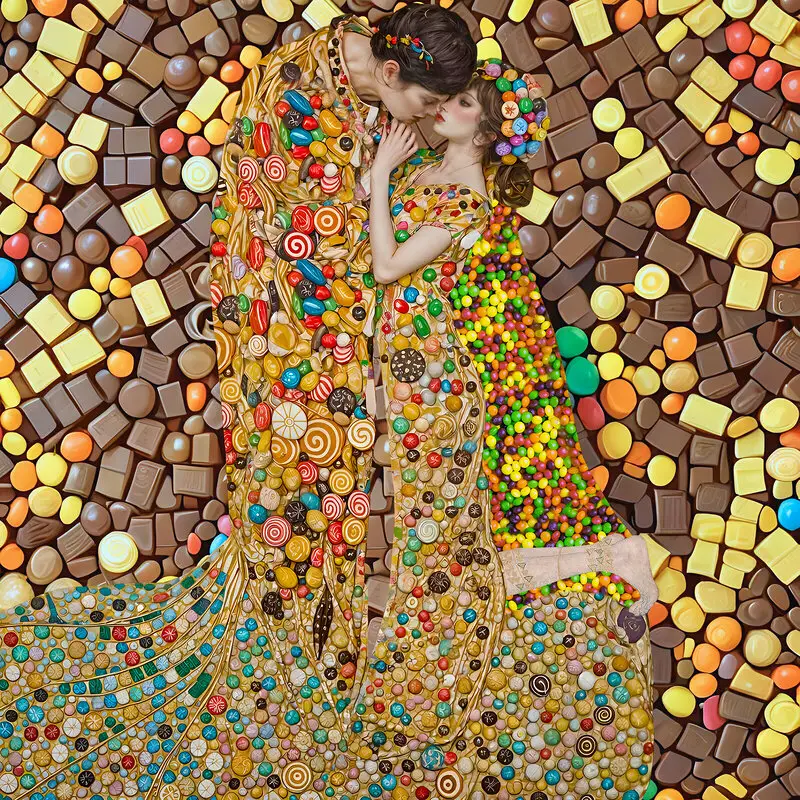
Candy Kiss - Dreamy Delights, 2024
Digital
70 x 70 cm
A pigling’s delight
Little Knut, a sweet-toothed pig,
With a curly tail so cute and big,
He got candy every time he pranced,
And his tail would curl with every chance!
But poor pigling Knut had a weak resolve,
And never learned from his troubles at all.
He’d overeat and grow round and stout,
Then, soon enough, his tummy would shout!
"Never again!" he’d swear in pain,
"My tummy aches drive me insane!"
But when the candy bowl was filled,
His promise was forgotten, and he was thrilled.
So now we hear Knut with a sad "oink oink,"
A pig in pain from gobbling too much junk.
But despite the ache, what does he do?
He eats more candy, through and through!
Hydra, August 2024
It’s incredible how a picture can bring out thoughts and memories. An article on the internet about Gustav Klimt’s famous The Kiss set my mind spinning, reminding me of the profound power of art to evoke emotions. And desire. Pastry chefs are known for creating fantastic masterpieces as part of their craft, but some candy shop owners don’t want to be outdone. One had been inspired by Klimt’s sweet kiss and assembled candy into a picture of a couple sharing a truly sugary kiss right in the middle of the shop. That was all it took to trigger my candy craving while sitting at the computer—poor me.
Subsequently, I had a massive craving for something tasty to pop into my mouth, something to suck on while I worked on my pictures—candy, pure and simple. It happens far too often, but I like to think it contributes to my creativity. Or at least that's what I tell myself. In any case, it's a good excuse.
In my taste memory, a sweet symphony was playing, and in my thoughts, I was on a journey through the World's most beloved candies. My mouth was watering. From experience, I know that for a spoiled Swede, it's not easy to satisfy a sweet tooth on Hydra. The absence of Swedish candy is a constant frustration. Sure, there's plenty of lovely stuff on Hydra—if you're into cakes, that is. But they don't give the same concentrated kick as candy. And that kind of candy is only available in bags on the island. If the ones you like aren't sold out, which they usually are. The selection is limited to just a few types. A typical supermarket in Sweden has about a hundred different kinds of candy to choose from, and well-stocked candy shops can have more than a thousand. No wonder that on Hydra, I feel deprived and suffer from withdrawal symptoms.
Undeterred, I embarked on the winding kilometre-long Donkey Shit Lane to the harbour for a candy hunt, a quest that always feels like hunting an endangered species, like big game hunting on Hydra. The descent was manageable, but the arduous climb back uphill was a true test of my determination.
The first shop I visited had run out of marshmallow-type candies that almost tasted like the ones from home, leaving only a few sad bags of gummy sweets that lacked discernible flavour. It was a disheartening sight. I moved on to the next place, only to find every roll of Mentos sold out—some miscreant had clearly emptied the shop, which happened to be the only one on the island that carried this candy found worldwide. My last hope was further up the road, where two measly bags of something sweet and sour had to suffice for the evening and the next day. The disappointment was palpable.
Thankfully, the next day was Thursday, the day when candy supplies on Hydra were supposed to be replenished. However, the local stores' logistics were often unreliable, and the shelves were not always restocked as expected. Whether the selection was influenced by the owner's taste or just random, certain items, like the hard, sour candies I enjoyed, often disappeared without a trace.
For those of us with a sweet tooth, or as we say in Sweden, a 'Gottegris,' candy isn't just a treat—it's a way of life, a sensory experience that delights the taste buds and stirs the soul. From the bustling markets of Belgium, where the finest chocolates melt on the tongue like butter, to the colourful bins of Swedish ‘lösgodis’ that offer endless combinations of sugary bliss, candy transcends borders, speaking a universal language of pleasure. The journey of discovering candy in different countries is a feast of flavours, textures, and cultural traditions that deserve to be savoured with all the indulgence they inspire. It's a joyous adventure that never fails to excite.
It should be mentioned that the Swedish term "gotten is" is a playful expression, where "Gott" means "something tasty or sweet," and "gris" means "pig." The term likens someone who loves sweets or indulges in treats to a pig, often seen as an animal that enjoys eating greedily. It’s not meant negatively but rather in a lighthearted or affectionate sense, suggesting someone who loves indulging in tasty or sweet things—like a pig happily devouring its food.
Sweden is the Kingdom of ‘Lösgodis’
When it comes to candy consumption, Swedes reign supreme. Sweden holds the record for eating more candy per capita than any other nation, a title proudly upheld thanks to the beloved tradition of ‘lösgodis’—literally “loose candy.” There isn’t a direct one-word translation for ‘lösgodis’ in English, but the closest term would be “pick and mix candy” or the more prosaic “bulk candy.” These terms describe candy sold by weight, where you can choose different types from bins or containers, just like ‘lösgodis’ in Sweden. This unique tradition is not just a way of buying candy but a cultural institution reflecting Swedish culinary tastes' diversity and individuality.
‘Lösgodis’ has been a Swedish phenomenon since the 1980s, when it became legal for customers to pick their candy themselves. This tradition of 'lösgodis' is deeply ingrained in Swedish culture, with many Swedes having fond memories of visiting candy stores and selecting their favourite treats. Today, Swedes consume about 15 kilos of candy per person each year. After a dip during the pandemic, ‘lösgodis’ sales are nearly back to their previous levels.
Swedish ‘lösgodis’ has also gained an international market thanks to the internet phenomenon "Swedish candy," which has taken off on TikTok and Instagram. It seems the whole world now wants Swedish ‘lösgodis’. Except Hydra
Every weekend, a unique Swedish tradition unfolds in the country's supermarkets. ‘Lösgodis’, a colourful, chaotic, and satisfying ritual, allows people to craft their perfect bag of sweet delights and mirrors the diversity of Swedish culinary tastes. This personalisation, unique to ‘lösgodis’, is a significant aspect of Swedish culture, setting it apart from other candy traditions.
But ‘lösgodis’ is more than just a snack—it’s a cultural institution that brings joy to children across Sweden. They eagerly await ‘lördagsgodis’, or ‘Saturday candy,’ a tradition where they can indulge in their favourite treats after a long week. The sheer variety on offer is staggering, and for Swedes, who enjoy both the pleasure of choice and the fun of indulgence, lösgodis is more than a treat—it’s an art form that brings back fond memories of childhood excitement and joy.
The Chocolate Paradise
If Sweden is the home of ‘lösgodis’, then Belgium is undoubtedly the temple of chocolate. Walk through the cobbled streets of Brussels, and the air itself seems infused with the rich aroma of cocoa. Belgian chocolates, or pralines as they are called, are revered worldwide for their craftsmanship and decadence. The variety on offer, whether filled with hazelnut cream, ganache, or caramel, is staggering, making each piece a unique masterpiece, handcrafted with care and precision.
Belgian chocolatiers treat their craft with almost religious reverence. From the velvety smoothness of fine milk chocolate to the bold intensity of a dark, 70% cacao bar, Belgian chocolates are a study in balance. But it’s the filled pralines that truly steal the show. Biting into one reveals layers of flavour that seem to unfold like a story: a crisp outer shell that gives way to a soft, creamy filling, sometimes infused with liqueur or exotic spices. For the true candy connoisseur, visiting Belgium’s chocolatiers is like a pilgrimage to the heart of indulgence and a chance to admire and respect the craftsmanship of these artisans.
The Heritage of Sweet Brands
No candy lover's journey would be complete without a stop in England, a country with a proud tradition of iconic sweets and brands that have stood the test of time. Cadbury, the hallmark of British chocolate for over a century, has been producing its famous Dairy Milk bars, beloved for their creamy texture and rich cocoa flavour. Founded in 1824, Cadbury has become synonymous with comfort and nostalgia, making it a key player in British confectionery.
But Cadbury is just one part of England’s sweet story. The country is home to a treasure trove of old-fashioned sweets sold in quaint corner shops and traditional sweet stores. Think boiled sweets like rhubarb and custard, sherbet lemons, and pear drops—candies that evoke a sense of history and tradition with every bite and a deep sense of nostalgia and cultural connection. Licorice, too, holds a special place in British hearts, with brands like Bassett's Allsorts delivering a kaleidoscope of colours and flavours, from aniseed to fruity notes.
Of course, no trip through England’s candy world would be complete without the childhood favourite, Rowntree’s. Known for classics like Fruit Pastilles and Jelly Tots, these chewy candies have been enjoyed for generations, offering a bright, fruity contrast to the chocolate-dominated shelves. The British love for sweets runs deep, blending a sense of heritage with modern-day cravings.
A Box of Sweet Delights
In Greece, candy may take a backseat to the decadent, syrupy sweets adored nationwide. Greeks, known for their love of food and hospitality, often favour baked treats bursting with honey, nuts, and spices. Families go to the local Zacharoplasteío (pastry shops) each weekend to select an assortment of sweets to take home, presented in elegant boxes tied with ribbons. These bakeries offer a compelling display of confections such as baklava, galaktoboureko, and kataifi, dripping with honey syrup and packed with layers of phyllo dough, almonds, and walnuts. It’s delicious but disastrous for the waistline if you eat that while working.
While Swedes might bring a bottle of champagne when visiting friends, Greeks arrive with a box of these sweet pastries, a gesture of warmth and tradition. These treats are shared around the table, accompanied by lively conversation and often a strong cup of coffee. With their intense flavours and indulgent textures, Greek sweets provide a rich, comforting contrast to the candies of other nations, steeped in centuries-old traditions of baking and hospitality.
The Art of Innovation
Travel east and find yourself in Japan, where candy isn’t just food—it’s an art form. Known for its creativity and attention to detail, the Japanese candy scene is as innovative as beautiful. From intricately shaped wagashi, traditional sweets often served with tea, to modern-day marvels like Pocky Sticks and mochi-filled candies, Japan’s candy culture is a testament to the joy of experimentation.
Japanese candies often come in seasonal varieties, with flavours that reflect the time of year—sakura (cherry blossom) in spring, matcha (green tea) in summer, and chestnut in fall. Kit Kats, one of the most iconic sweets, come in an astonishing array of flavours, including wasabi, sake, and sweet potato, offering a playful take on what a simple candy bar can be. Every bite feels like an adventure, a glimpse into a world where candy-making combines tradition, innovation, and sheer fun.
Where Everything is Bigger and Sweeter
Cross the ocean to the United States, and candy takes on a new level of extravagance. American candy culture is loud, bold, and unapologetically sweet, from towering candy stores like Dylan’s Candy Bar in New York to the nostalgic favourites found in old-fashioned corner shops. Think oversized peanut butter cups, rainbow-coloured lollipops, and sour gummies that make your eyes water. In the U.S., candy is all about indulgence—often larger-than-life proportions.
American favourites like Reese’s Peanut Butter Cups, M&M’s, and Hershey’s Bars are known worldwide, but there’s also a treasure trove of regional specialities. Saltwater taffy from the East Coast, sweet pralines from the South, and artisanal caramels from small, family-owned shops highlight the diversity of the American candy landscape. Each bite brings a sense of nostalgia, reminding you of simpler times, childhood adventures, and the joy of a sugar rush.
A Sweet Celebration Across Cultures
Whether it’s the colourful chaos of Swedish ‘lösgodis’, the refined elegance of Belgian chocolates, the nostalgic charm of British sweets, or the syrupy indulgence of Greek pastries, candy and confections connect us across cultures and continents. Each country has its way of crafting these sugary treasures, shaped by history, tradition, and a love for indulgence. Candy and sweets are more than just snacks—they reflect a culture’s personality, a shared experience that brings people together in moments of joy and celebration.
So for the actual ‘gottegris’, the world is a treasure trove of sugary delights waiting to be explored, tasted, and savoured. In every sweet bite, we are reminded that candy, in all its forms, is a universal language of happiness—a little piece of pleasure that transcends borders and speaks directly to the heart.

Jörgen Thornberg
Malmö
Lite om bilder och mig. Translation in English at the end.
Jag är en nyfiken person som ser allt i bilder, även det jag fäster i ord, gärna tillsammans för bakom alla mina bilder finns en berättelse. Till vissa bilder hör en kortare eller längre novell som följer med bilden.
Bilder berättar historier. Jag omges av naturlig skönhet, intressanta människor och historia var jag än går. Jag använder min kamera för att dokumentera världen och blanda det jag ser med vad jag känner för att fånga den dolda magin.
Mina bilder berättar mina historier. Genom mina bilder, tryck och berättelser. Jag bjuder in dig att ta del av dessa berättelser, in i ditt liv och hem och dela min mycket personliga syn på vår värld. Mer än vad ögat ser. Jag tänker i bilder, drömmer och skriver och pratar om dem; följaktligen måste jag också skapa bilder. De blir vad jag ser, inte nödvändigtvis begränsade till verkligheten. Det finns en bild runt varje hörn. Jag hoppas att du kommer att se vad jag såg och gilla det.
Jag är också en skrivande person och till många bilder hör en kortare eller längre essay. Den följer med tavlan, tryckt på fint papper och med en personlig hälsning från mig.
Flertalet bilder startar sin resa i min kamera. Enkelt förklarat beskriver jag bilden jag ser i mitt inre, upplevd eller fantiserad. Bilden uppstår inom mig redan innan jag fått okularet till ögat. På bråkdelen av ett ögonblick ser jag vad jag vill ha och vad som kan göras med bilden. Här skall jag stoppa in en giraff, stålmannen, Titanic eller vad det är min fantasi finner ut. Ännu märkligare är att jag kommer ihåg minnesbilden långt efteråt när det blir tid att skapa verket. Om jag lyckas eller inte, är upp till betraktaren, oftast präglat av en stråk av svart humor – meningen är att man skall bli underhållen. Mina bilder blir ofta en snackis där de hänger.
Jag föredrar bilder som förmedlar ett budskap i flera lager. Vid första anblicken fylld av feel-good, en vacker utsikt, fint väder, solen skiner, blommor på ängen eller vattnet som ligger förrädiskt spegelblankt. I en sådan bild kan jag gömma min egentliga berättelse, mitt förakt för förtryckare och våldsverkare, rasister och fördomsfulla människor - ett gärna återkommande motiv mer eller mindre dolt i det vackra motivet. Jag försöker förena dem i ett gemensamt narrativ.
Bild och formgivning har löpt som en röd tråd genom livet. Fotokonst känns som en värdig final som jag gärna delar med mig.
Min genre är vid som framgår av mina bilder, temat en blandning av pop- och gatukonst i kollage som kan bestå av hundratals lager. Vissa bilder kan ta veckor, andra någon dag innan det är dags att överlämna resultatet till printverkstaden. Fine Art Prints är digitala fotocollage. I dessa kollage sker rivandet, klippandet, pusslandet, målandet, ritandet och sprayningen digitalt. Det jag monterar in kan vara hundratals år gamla bilder som jag omsorgsfullt frilägger så att de ser ut att vara en del av tavlan men också bilder skapade av mig själv efter min egen fantasi. Därefter besöks printstudion och för vissa bilder numrera en limiterad upplaga (oftast 7 exemplar) och signera för hand. Vissa bilder kan köpas i olika format. Det är bara att fråga efter vilka. Gillar man en bild som är 70x100 men inte har plats på väggen, går den kanske att få i 50x70 cm istället. Frågan är fri.
Metoden Giclée eller Fine Art Print som det också kallas är det moderna sättet för framställning av grafisk konst. Villkoret för denna typ av utskrifter är att en högkvalitativ storformatskrivare används med åldersbeständigt färgpigment och konstnärspapper eller i förekommande fall på duk. Pappret som används möter de krav på livslängd som ställs av museer och gallerier. Normalt säljer jag mina bilder oinramade så att den nya ägaren själv kan bestämma hur de skall se ut, med eller utan passepartout färg på ram, med eller utan glas etc..
Under många år ställde jag bara ut på nätet, i valda grupper och på min egen Facebooksida - https://www.facebook.com/jorgen.thornberg.9
Jag finns också på en egen hemsida som tyvärr inte alltid är uppdaterad – https://www.jth.life/ Där kan du också läsa en del av de berättelser som följer med bilden.
UTSTÄLLNINGAR
Luftkastellet, oktober 2022
Konst i Lund, november 2022
Luftkastellet, mars 2023
Engleson Galleri Caroli, april 2023
Hydra, Greece June 2023
Engleson Galleri Caroli, oktober 2023
Toppen, Höllviken december 2023
Luftkastellet, mars 2024
Torups Galleri, mars 2024
Venice, May 2024
Luftkastellet, oktober 2024
Konst i Advent, December 2024
Galleri Engleson, Caroli December 2024
Jäger & Jansson Galleri, april 2025
A bit about pictures and me.
I'm a curious person who sees everything in pictures, even what I express in words, often combining them, for behind all my pictures lies a story. These narratives, some as short as a single image and others as long as a novel, are the heart and soul of my work.
Pictures tell stories. Wherever I go, I'm surrounded by natural beauty, exciting people, and history. I use my camera to document the world and blend what I see with what I feel to capture the hidden magic.
My images tell my stories. Through my pictures, prints, and narratives, I invite you to partake in these stories in your life and home and share my deeply personal perspective of our world. More than meets the eye. I think in pictures, dream, write, and talk about them; consequently, I must create images too. They become what I see, not necessarily confined to reality. There's a picture around every corner. I hope you'll see what I saw and enjoy it.
I'm also a writer, and many images come with a shorter or longer essay. It accompanies the painting, printed on fine paper with my personal greeting.
Many pictures start their journey on my camera. Simply put, I describe the image I see in my mind, experienced or imagined. The image arises within me even before I bring the eyepiece to my eye. In a fraction of a moment, I see what I want and what can be done with the picture. Here, I'll insert a giraffe, Superman, the Titanic, or whatever my imagination conjures up. Even stranger is that I remember the mental image long after it's time to create the work. Whether I succeed is up to the observer, often imbued with a streak of black humour – the aim is to entertain. My pictures usually become a talking point wherever they hang.
I prefer pictures that convey a message in multiple layers. At first glance, they're filled with feel-good vibes, a beautiful view, lovely weather, the sun shining, flowers in the meadow, or the water lying deceptively calm. But beneath this surface beauty, I often conceal a deeper story, a narrative that challenges societal norms or explores the human condition. I invite you to delve into these hidden narratives and discover the layers of meaning within my work.
Picture and design have been a thread running through my life. Photographic art feels like a fitting finale, and I'm happy to share it.
My genre is varied, as seen in my pictures; the theme is a blend of pop and street art in collages that can consist of hundreds of layers. Some images can take weeks, others just a day before it's time to hand over the result to the print workshop. Fine Art Prints are digital photo collages. In these collages, tearing, cutting, puzzling, painting, drawing, and spraying happen digitally. What I insert can be images hundreds of years old that I carefully extract so they appear to be part of the painting, but also images created by myself, now also generated from my imagination. Next, visit the print studio and, for certain images, number a limited edition (usually 7 copies) and sign them by hand. Some images may be available in other formats. Just ask which ones. If you like an image that's 70x100 but doesn't have space on the wall, you might be able to get it in 50x70 cm instead. The question is open.
The Giclée method, or Fine Art Print as it's also called, is the modern way of producing graphic art. This method ensures the highest quality and longevity of the artwork, using a high-quality large-format printer with archival pigment inks and artist paper or, in some cases, canvas. The paper used meets the longevity requirements set by museums and galleries. I sell my pictures unframed, allowing the new owner to personalise their artwork, confident in the lasting value and quality of the piece.
For many years, I only exhibited online, in selected groups, and on my Facebook page - https://www.facebook.com/jorgen.thornberg.9. I also have my website, which unfortunately is not constantly updated - https://www.jth.life/. You can also read some of the stories accompanying the pictures there.
EXHIBITIONS
Luftkastellet, October 2022
Art in Lund, November 2022
Luftkastellet, March 2023
Engleson Gallery Caroli, April 2023
Hydra, Greece June 2023
Engleson Gallery Caroli, October 2023
Toppen, Höllviken December 2023
Luftkastellet, March 2024
Torup Gallery, March 2024
Venice, May 2024
UTSTÄLLNINGAR
Luftkastellet, oktober 2022
Konst i Lund, november 2022
Luftkastellet, mars 2023
Engleson Galleri Caroli, april 2023
Hydra, Greece June 2023
Engleson Galleri Caroli, oktober 2023
Toppen, Höllviken december 2023
Luftkastellet, mars 2024
Torups Galleri, mars 2024
Venice, May 2024
Luftkastellet, October 2024
Konst i Advent, December 2024
Galleri Engleson, Caroli December 2024
Jäger & Jansson Galleri, April 2025
Utbildning
Autodidakt
Medlem i konstnärsförening
Öppna Sinnen
Med i konstrunda
Konstrundan i Skåne
Utställningar
Luftkastellet, October 2022
Art in Lund, November 2022
Luftkastellet, March 2023
Engleson Gallery Caroli, April 2023
Hydra, Greece June 2023
Engleson Gallery Caroli, October 2023
Toppen, Höllviken December 2023
Luftkastellet, March 2024
Torup Gallery, March 2024
Venice, May 2024