Vi använder cookies för att ge dig bästa möjliga upplevelse. Välj vilka cookies du tillåter.
Läs mer i vår integritetspolicy
Jörgen Thornberg
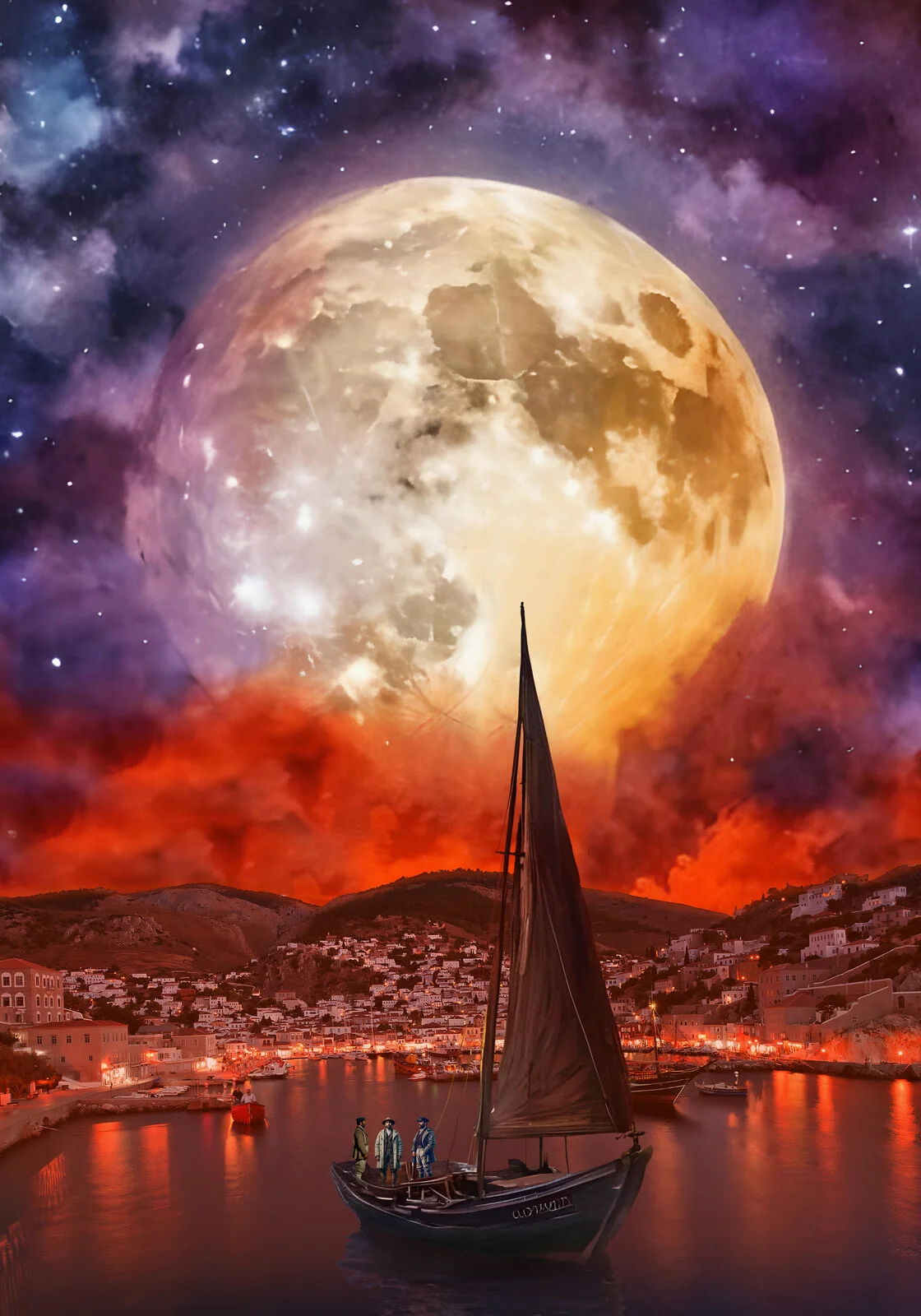
Optical illusions, 2024
Digital
50 x 70 cm
A Fool's Moon
The full moon rises, bold and bright,
It’s so large it swallows cities’ light.
But the Man in the Moon, with a clever grin,
Is fooling us all as night begins.
In lands where truth is paper-thin,
And what’s beneath is never seen,
A fool becomes the wise man’s king,
And leads the world with simple schemes.
The crowd cheers loudly and can’t resist,
For black is white, and fog is bliss.
They see the world they wish to see,
Blind to the tangled web of fantasy.
He speaks in riddles, short and sweet,
“Just close your eyes and taste defeat.”
With simple lies, he paints the day,
As reason slowly melts away.
A crown of nothing rests on high,
While saner voices wonder why.
But they’re too slow, too dull, too few,
The fools are now wise and true.
So watch the world, its twisted plight,
As wrong turns left, and day turns to night.
For illusion’s grip is strong and wide,
Where emperors without clothes still stride.
Hydra, August 2024
Far from mere tricks, optical illusions are a fascinating aspect of human perception. They have shaped our world understanding, influenced decisions, and led to surprising consequences throughout history. Let’s delve into some intriguing examples of these illusions that have led people astray or created larger-than-life experiences, highlighting their historical and practical implications.
The Mirage: A Thirsty Traveler's False Hope
Imagine you’re trudging through the scorching, unforgiving desert. The relentless sun is beating down, your parched lips are aching, and suddenly, you see a shimmering, compelling body of water in the distance. Relief floods you, and you press on, only to find no water. This is the mirage, a classic optical illusion. It happens when light bends (or refracts) as it passes through layers of air with different temperatures. On hot days, the heated air near the ground bends light upward, creating the illusion of water or distant objects.
The Mirage, a cruel trick played on lost wanderers, has had more than a temporary impact. In the days of early explorers, false mirages led people further into the desert, believing they were chasing life-saving water. These travellers sometimes perished because they followed what their brains promised, but nature didn’t deliver. The illusion played on their visual perception and desperate hope, leaving a tragic mark on history.
The Moon Illusion: A Massive Deception
Who hasn’t looked at a giant moon on the horizon and marvelled at its size? It’s enormous, looming large like it’s about to crash into Earth. Yet, a few hours later, when that same moon is high in the sky, it seems like it’s shrunk. This is called the moon illusion. The moon never changes size; our perception alters based on its position in the sky.
Despite scientific explanations, the Moon Illusion continues to baffle and delight even today. In ancient times, people attributed this phenomenon to supernatural causes, fueling myths about the moon’s magical powers. The fact that this illusion has persisted through the ages, despite our understanding of its scientific basis, is a testament to its enduring mystery that continues to captivate us, inviting us to explore the depths of our perception.
Foehn Wind Illusion: Mountains Closer Than They Appear
A curious illusion plays out during particular weather conditions, specifically in areas near mountains. During a Foehn wind, a warm, dry wind that blows down from the mountains, the peaks appear significantly closer than they are. In clear weather with low humidity, distant mountains seem almost impossible. This happens because our brains rely on haze and atmospheric perspective to gauge distance. When the air is clear, there’s no haze to give us a sense of how far away the mountains are, leading to the illusion that they’re nearer than they are.
Historically, this illusion caused early travellers to misjudge distances, sometimes leading them into dangerous mountain journeys without enough supplies, thinking they were much closer to their destination than they were.
Pareidolia: Faces in the Clouds and Beyond
If you’ve ever gazed up at a cloud and seen a face or spotted a grinning expression in a rock formation, congratulations—you’ve experienced pareidolia. This cognitive illusion is where the brain sees familiar patterns, especially faces, in random stimuli. While it may seem harmless, pareidolia has had notable impacts.
One famous example is the “Face on Mars.” In 1976, NASA’s Viking 1 orbiter returned images of the Martian surface, and one particular region appeared to show a human face. For years, conspiracy theories and wild speculation surrounded the so-called “Face on Mars,” with people believing it was evidence of an ancient Martian civilisation. It wasn’t until later that high-resolution images showed it to be nothing more than a natural rock formation, casting shadows that resembled facial features.
The Ponzo Illusion: A Railroad Trick
The Ponzo illusion plays with your perception of size and distance. Imagine two identical lines placed between two converging lines, like train tracks that narrow into the distance. Even though the two lines are the same size, the one higher up (where the tracks seem to converge) appears longer. This happens because your brain interprets the upper line as farther away, compensating by making it appear larger.
While the Ponzo illusion is harmless in most cases, this trick of the eye has practical implications in design and architecture. Understanding how depth and perspective affect perception can influence everything from road markings to room design, ensuring that visual tricks don’t lead to confusion or accidents. This awareness can help us navigate our surroundings with caution, empowering us with the knowledge to see beyond the illusion.
The Herring Illusion: Driving Perception
Have you ever driven on a long, straight road and suddenly felt like the road was narrowing or expanding? This is similar to the Herring illusion, where straight lines seem to bend when surrounded by radial lines. This illusion occurs when our brain tries to interpret depth and motion, which can lead to misjudgments when driving or navigating specific paths.
In extreme cases, optical illusions like this one have contributed to accidents. Drivers who misjudge the curvature of a road or the distance to an object because of how the surroundings appear can make dangerous decisions. This incident reminds us that even simple illusions can have genuine consequences.
The Bent Stick Illusion: Refraction at Play
A classic example of optical distortion is the bent stick illusion. Place a straight stick into a glass of water, and suddenly, it appears to bend where it enters the water. This isn’t magic; it’s the refraction of light. When light passes from one medium (air) into another (water), it changes speed, causing the image of the stick to appear bent.
While this is a fun trick for school science experiments, it also highlights how our visual system can misinterpret physical properties. In history, this bending illusion puzzled ancient philosophers like Ptolemy, who used it as an example to discuss how perception could lead to false conclusions about reality.
One of the most famous optical illusions is Hans Christian Andersen's story, *The Emperor's New Clothes*. In this tale, two tailors make new clothes for the emperor. They claim to use a magical fabric that cannot be seen by anyone unworthy or incompetent. In reality, they use no fabric, but since no one wants to appear unworthy or less intelligent, everyone pretends to see the “clothes,” and the emperor parades around naked. A small child finally exclaims, “But he isn’t wearing any clothes!” These innocent words reveal the truth in the story's world. Sadly, there are no children who can expose the madness of adult society in real life. We live in an age of illusions and alternative truths, where lies are often twisted into reality.
The moral of the story is often used as a symbol for how people conform to group behaviour, outwardly agreeing with the majority, even when it's clear to them that the group is wrong. To shout out like the child in the story, “The emperor has no clothes!” means pointing out something everyone knows but no one dares to say because it doesn’t fit their agenda or worldview.
Political Illusions and The Emperor's New Clothes
We see illusions daily, dividing humanity. Where one person sees a threat to freedom and democracy, another considers a strongman who promises to fix everything—and it's almost always a man. During his presidency, Mr. Trump attempted to limit voting rights, questioned court rulings, and attacked free media. He refused to admit defeat in 2020, tried to invalidate the election results, and urged officials to "find" more votes. All of this culminated in the storming of the Capitol on January 6, 2021—an attempted coup, the worst attack on democracy since the Civil War.
Trump's allies, such as Putin and Orban, should serve as transparent, real-life examples—not verbal or optical illusions. Everyone should see what is before them, yet many choose to see and hear something else.
Warning voters by painting authoritarian threats can be challenging and might even strengthen the image of a strong leader. However, calling attention to the absurdity of the "emperor’s nakedness" could spark broad public engagement.
Trump's opponent, Kamala Harris, has a contagious laugh and excellent rapport with her running mate, Tim Walz. This dynamic should not be underestimated in politics. It’s essential to be serious but also to engage people. Harris and Walz reportedly chuckle together about their rivals Trump and VP candidate JD Vance, whom Walz calls weird, ‘nutcases’.
Remember Trump’s unexpected victory in 2016. The illusion carried him to the White House. His opponents took his words literally but not seriously, while voters took him seriously but not literally. This could happen again—he who laughs last laughs best. Let’s hope that in 2024, two dangerous charlatans will be exposed for what they are and that freedom and democracy will win over the laughers, revealing the emperors to be naked.
Conclusion: Seeing Isn’t Always Believing
Optical illusions remind us that seeing isn’t always believing. Whether we’re fooled by the size of the moon, lured by a desert mirage, or tricked into seeing faces where none exist, these visual phenomena reveal the complexity of human perception. They’re not just quirky tricks but windows into how our brains make sense of the world—sometimes inaccurately. From humorous deceptions to life-altering consequences, optical illusions have repeatedly proven that reality is often more than what meets the eye.
So next time you’re out under a massive full moon or staring at a stick in water, take a moment to appreciate how easily your eyes—and brain—can be fooled!
Jörgen Thornberg
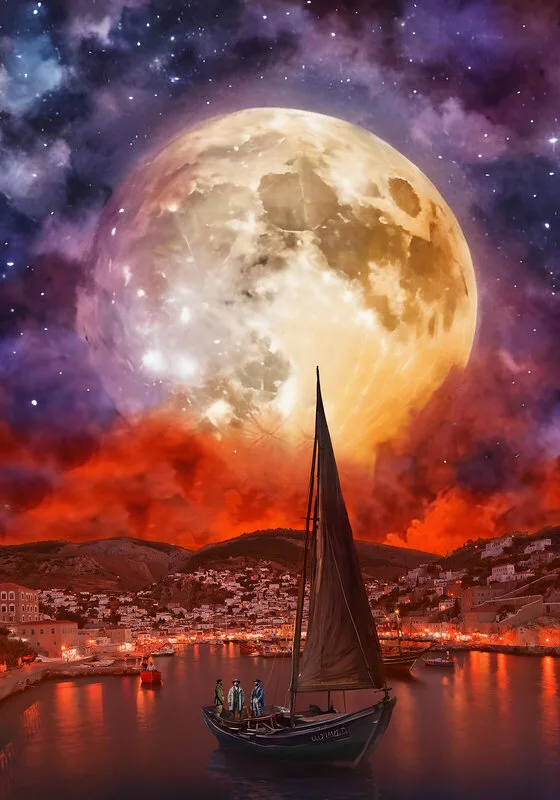
Optical illusions, 2024
Digital
50 x 70 cm
A Fool's Moon
The full moon rises, bold and bright,
It’s so large it swallows cities’ light.
But the Man in the Moon, with a clever grin,
Is fooling us all as night begins.
In lands where truth is paper-thin,
And what’s beneath is never seen,
A fool becomes the wise man’s king,
And leads the world with simple schemes.
The crowd cheers loudly and can’t resist,
For black is white, and fog is bliss.
They see the world they wish to see,
Blind to the tangled web of fantasy.
He speaks in riddles, short and sweet,
“Just close your eyes and taste defeat.”
With simple lies, he paints the day,
As reason slowly melts away.
A crown of nothing rests on high,
While saner voices wonder why.
But they’re too slow, too dull, too few,
The fools are now wise and true.
So watch the world, its twisted plight,
As wrong turns left, and day turns to night.
For illusion’s grip is strong and wide,
Where emperors without clothes still stride.
Hydra, August 2024
Far from mere tricks, optical illusions are a fascinating aspect of human perception. They have shaped our world understanding, influenced decisions, and led to surprising consequences throughout history. Let’s delve into some intriguing examples of these illusions that have led people astray or created larger-than-life experiences, highlighting their historical and practical implications.
The Mirage: A Thirsty Traveler's False Hope
Imagine you’re trudging through the scorching, unforgiving desert. The relentless sun is beating down, your parched lips are aching, and suddenly, you see a shimmering, compelling body of water in the distance. Relief floods you, and you press on, only to find no water. This is the mirage, a classic optical illusion. It happens when light bends (or refracts) as it passes through layers of air with different temperatures. On hot days, the heated air near the ground bends light upward, creating the illusion of water or distant objects.
The Mirage, a cruel trick played on lost wanderers, has had more than a temporary impact. In the days of early explorers, false mirages led people further into the desert, believing they were chasing life-saving water. These travellers sometimes perished because they followed what their brains promised, but nature didn’t deliver. The illusion played on their visual perception and desperate hope, leaving a tragic mark on history.
The Moon Illusion: A Massive Deception
Who hasn’t looked at a giant moon on the horizon and marvelled at its size? It’s enormous, looming large like it’s about to crash into Earth. Yet, a few hours later, when that same moon is high in the sky, it seems like it’s shrunk. This is called the moon illusion. The moon never changes size; our perception alters based on its position in the sky.
Despite scientific explanations, the Moon Illusion continues to baffle and delight even today. In ancient times, people attributed this phenomenon to supernatural causes, fueling myths about the moon’s magical powers. The fact that this illusion has persisted through the ages, despite our understanding of its scientific basis, is a testament to its enduring mystery that continues to captivate us, inviting us to explore the depths of our perception.
Foehn Wind Illusion: Mountains Closer Than They Appear
A curious illusion plays out during particular weather conditions, specifically in areas near mountains. During a Foehn wind, a warm, dry wind that blows down from the mountains, the peaks appear significantly closer than they are. In clear weather with low humidity, distant mountains seem almost impossible. This happens because our brains rely on haze and atmospheric perspective to gauge distance. When the air is clear, there’s no haze to give us a sense of how far away the mountains are, leading to the illusion that they’re nearer than they are.
Historically, this illusion caused early travellers to misjudge distances, sometimes leading them into dangerous mountain journeys without enough supplies, thinking they were much closer to their destination than they were.
Pareidolia: Faces in the Clouds and Beyond
If you’ve ever gazed up at a cloud and seen a face or spotted a grinning expression in a rock formation, congratulations—you’ve experienced pareidolia. This cognitive illusion is where the brain sees familiar patterns, especially faces, in random stimuli. While it may seem harmless, pareidolia has had notable impacts.
One famous example is the “Face on Mars.” In 1976, NASA’s Viking 1 orbiter returned images of the Martian surface, and one particular region appeared to show a human face. For years, conspiracy theories and wild speculation surrounded the so-called “Face on Mars,” with people believing it was evidence of an ancient Martian civilisation. It wasn’t until later that high-resolution images showed it to be nothing more than a natural rock formation, casting shadows that resembled facial features.
The Ponzo Illusion: A Railroad Trick
The Ponzo illusion plays with your perception of size and distance. Imagine two identical lines placed between two converging lines, like train tracks that narrow into the distance. Even though the two lines are the same size, the one higher up (where the tracks seem to converge) appears longer. This happens because your brain interprets the upper line as farther away, compensating by making it appear larger.
While the Ponzo illusion is harmless in most cases, this trick of the eye has practical implications in design and architecture. Understanding how depth and perspective affect perception can influence everything from road markings to room design, ensuring that visual tricks don’t lead to confusion or accidents. This awareness can help us navigate our surroundings with caution, empowering us with the knowledge to see beyond the illusion.
The Herring Illusion: Driving Perception
Have you ever driven on a long, straight road and suddenly felt like the road was narrowing or expanding? This is similar to the Herring illusion, where straight lines seem to bend when surrounded by radial lines. This illusion occurs when our brain tries to interpret depth and motion, which can lead to misjudgments when driving or navigating specific paths.
In extreme cases, optical illusions like this one have contributed to accidents. Drivers who misjudge the curvature of a road or the distance to an object because of how the surroundings appear can make dangerous decisions. This incident reminds us that even simple illusions can have genuine consequences.
The Bent Stick Illusion: Refraction at Play
A classic example of optical distortion is the bent stick illusion. Place a straight stick into a glass of water, and suddenly, it appears to bend where it enters the water. This isn’t magic; it’s the refraction of light. When light passes from one medium (air) into another (water), it changes speed, causing the image of the stick to appear bent.
While this is a fun trick for school science experiments, it also highlights how our visual system can misinterpret physical properties. In history, this bending illusion puzzled ancient philosophers like Ptolemy, who used it as an example to discuss how perception could lead to false conclusions about reality.
One of the most famous optical illusions is Hans Christian Andersen's story, *The Emperor's New Clothes*. In this tale, two tailors make new clothes for the emperor. They claim to use a magical fabric that cannot be seen by anyone unworthy or incompetent. In reality, they use no fabric, but since no one wants to appear unworthy or less intelligent, everyone pretends to see the “clothes,” and the emperor parades around naked. A small child finally exclaims, “But he isn’t wearing any clothes!” These innocent words reveal the truth in the story's world. Sadly, there are no children who can expose the madness of adult society in real life. We live in an age of illusions and alternative truths, where lies are often twisted into reality.
The moral of the story is often used as a symbol for how people conform to group behaviour, outwardly agreeing with the majority, even when it's clear to them that the group is wrong. To shout out like the child in the story, “The emperor has no clothes!” means pointing out something everyone knows but no one dares to say because it doesn’t fit their agenda or worldview.
Political Illusions and The Emperor's New Clothes
We see illusions daily, dividing humanity. Where one person sees a threat to freedom and democracy, another considers a strongman who promises to fix everything—and it's almost always a man. During his presidency, Mr. Trump attempted to limit voting rights, questioned court rulings, and attacked free media. He refused to admit defeat in 2020, tried to invalidate the election results, and urged officials to "find" more votes. All of this culminated in the storming of the Capitol on January 6, 2021—an attempted coup, the worst attack on democracy since the Civil War.
Trump's allies, such as Putin and Orban, should serve as transparent, real-life examples—not verbal or optical illusions. Everyone should see what is before them, yet many choose to see and hear something else.
Warning voters by painting authoritarian threats can be challenging and might even strengthen the image of a strong leader. However, calling attention to the absurdity of the "emperor’s nakedness" could spark broad public engagement.
Trump's opponent, Kamala Harris, has a contagious laugh and excellent rapport with her running mate, Tim Walz. This dynamic should not be underestimated in politics. It’s essential to be serious but also to engage people. Harris and Walz reportedly chuckle together about their rivals Trump and VP candidate JD Vance, whom Walz calls weird, ‘nutcases’.
Remember Trump’s unexpected victory in 2016. The illusion carried him to the White House. His opponents took his words literally but not seriously, while voters took him seriously but not literally. This could happen again—he who laughs last laughs best. Let’s hope that in 2024, two dangerous charlatans will be exposed for what they are and that freedom and democracy will win over the laughers, revealing the emperors to be naked.
Conclusion: Seeing Isn’t Always Believing
Optical illusions remind us that seeing isn’t always believing. Whether we’re fooled by the size of the moon, lured by a desert mirage, or tricked into seeing faces where none exist, these visual phenomena reveal the complexity of human perception. They’re not just quirky tricks but windows into how our brains make sense of the world—sometimes inaccurately. From humorous deceptions to life-altering consequences, optical illusions have repeatedly proven that reality is often more than what meets the eye.
So next time you’re out under a massive full moon or staring at a stick in water, take a moment to appreciate how easily your eyes—and brain—can be fooled!
Jörgen Thornberg
Malmö
Lite om bilder och mig. Translation in English at the end.
Jag är en nyfiken person som ser allt i bilder, även det jag fäster i ord, gärna tillsammans för bakom alla mina bilder finns en berättelse. Till vissa bilder hör en kortare eller längre novell som följer med bilden.
Bilder berättar historier. Jag omges av naturlig skönhet, intressanta människor och historia var jag än går. Jag använder min kamera för att dokumentera världen och blanda det jag ser med vad jag känner för att fånga den dolda magin.
Mina bilder berättar mina historier. Genom mina bilder, tryck och berättelser. Jag bjuder in dig att ta del av dessa berättelser, in i ditt liv och hem och dela min mycket personliga syn på vår värld. Mer än vad ögat ser. Jag tänker i bilder, drömmer och skriver och pratar om dem; följaktligen måste jag också skapa bilder. De blir vad jag ser, inte nödvändigtvis begränsade till verkligheten. Det finns en bild runt varje hörn. Jag hoppas att du kommer att se vad jag såg och gilla det.
Jag är också en skrivande person och till många bilder hör en kortare eller längre essay. Den följer med tavlan, tryckt på fint papper och med en personlig hälsning från mig.
Flertalet bilder startar sin resa i min kamera. Enkelt förklarat beskriver jag bilden jag ser i mitt inre, upplevd eller fantiserad. Bilden uppstår inom mig redan innan jag fått okularet till ögat. På bråkdelen av ett ögonblick ser jag vad jag vill ha och vad som kan göras med bilden. Här skall jag stoppa in en giraff, stålmannen, Titanic eller vad det är min fantasi finner ut. Ännu märkligare är att jag kommer ihåg minnesbilden långt efteråt när det blir tid att skapa verket. Om jag lyckas eller inte, är upp till betraktaren, oftast präglat av en stråk av svart humor – meningen är att man skall bli underhållen. Mina bilder blir ofta en snackis där de hänger.
Jag föredrar bilder som förmedlar ett budskap i flera lager. Vid första anblicken fylld av feel-good, en vacker utsikt, fint väder, solen skiner, blommor på ängen eller vattnet som ligger förrädiskt spegelblankt. I en sådan bild kan jag gömma min egentliga berättelse, mitt förakt för förtryckare och våldsverkare, rasister och fördomsfulla människor - ett gärna återkommande motiv mer eller mindre dolt i det vackra motivet. Jag försöker förena dem i ett gemensamt narrativ.
Bild och formgivning har löpt som en röd tråd genom livet. Fotokonst känns som en värdig final som jag gärna delar med mig.
Min genre är vid som framgår av mina bilder, temat en blandning av pop- och gatukonst i kollage som kan bestå av hundratals lager. Vissa bilder kan ta veckor, andra någon dag innan det är dags att överlämna resultatet till printverkstaden. Fine Art Prints är digitala fotocollage. I dessa kollage sker rivandet, klippandet, pusslandet, målandet, ritandet och sprayningen digitalt. Det jag monterar in kan vara hundratals år gamla bilder som jag omsorgsfullt frilägger så att de ser ut att vara en del av tavlan men också bilder skapade av mig själv efter min egen fantasi. Därefter besöks printstudion och för vissa bilder numrera en limiterad upplaga (oftast 7 exemplar) och signera för hand. Vissa bilder kan köpas i olika format. Det är bara att fråga efter vilka. Gillar man en bild som är 70x100 men inte har plats på väggen, går den kanske att få i 50x70 cm istället. Frågan är fri.
Metoden Giclée eller Fine Art Print som det också kallas är det moderna sättet för framställning av grafisk konst. Villkoret för denna typ av utskrifter är att en högkvalitativ storformatskrivare används med åldersbeständigt färgpigment och konstnärspapper eller i förekommande fall på duk. Pappret som används möter de krav på livslängd som ställs av museer och gallerier. Normalt säljer jag mina bilder oinramade så att den nya ägaren själv kan bestämma hur de skall se ut, med eller utan passepartout färg på ram, med eller utan glas etc..
Under många år ställde jag bara ut på nätet, i valda grupper och på min egen Facebooksida - https://www.facebook.com/jorgen.thornberg.9
Jag finns också på en egen hemsida som tyvärr inte alltid är uppdaterad – https://www.jth.life/ Där kan du också läsa en del av de berättelser som följer med bilden.
UTSTÄLLNINGAR
Luftkastellet, oktober 2022
Konst i Lund, november 2022
Luftkastellet, mars 2023
Engleson Galleri Caroli, april 2023
Hydra, Greece June 2023
Engleson Galleri Caroli, oktober 2023
Toppen, Höllviken december 2023
Luftkastellet, mars 2024
Torups Galleri, mars 2024
Venice, May 2024
Luftkastellet, oktober 2024
Konst i Advent, December 2024
Galleri Engleson, Caroli December 2024
Jäger & Jansson Galleri, april 2025
A bit about pictures and me.
I'm a curious person who sees everything in pictures, even what I express in words, often combining them, for behind all my pictures lies a story. These narratives, some as short as a single image and others as long as a novel, are the heart and soul of my work.
Pictures tell stories. Wherever I go, I'm surrounded by natural beauty, exciting people, and history. I use my camera to document the world and blend what I see with what I feel to capture the hidden magic.
My images tell my stories. Through my pictures, prints, and narratives, I invite you to partake in these stories in your life and home and share my deeply personal perspective of our world. More than meets the eye. I think in pictures, dream, write, and talk about them; consequently, I must create images too. They become what I see, not necessarily confined to reality. There's a picture around every corner. I hope you'll see what I saw and enjoy it.
I'm also a writer, and many images come with a shorter or longer essay. It accompanies the painting, printed on fine paper with my personal greeting.
Many pictures start their journey on my camera. Simply put, I describe the image I see in my mind, experienced or imagined. The image arises within me even before I bring the eyepiece to my eye. In a fraction of a moment, I see what I want and what can be done with the picture. Here, I'll insert a giraffe, Superman, the Titanic, or whatever my imagination conjures up. Even stranger is that I remember the mental image long after it's time to create the work. Whether I succeed is up to the observer, often imbued with a streak of black humour – the aim is to entertain. My pictures usually become a talking point wherever they hang.
I prefer pictures that convey a message in multiple layers. At first glance, they're filled with feel-good vibes, a beautiful view, lovely weather, the sun shining, flowers in the meadow, or the water lying deceptively calm. But beneath this surface beauty, I often conceal a deeper story, a narrative that challenges societal norms or explores the human condition. I invite you to delve into these hidden narratives and discover the layers of meaning within my work.
Picture and design have been a thread running through my life. Photographic art feels like a fitting finale, and I'm happy to share it.
My genre is varied, as seen in my pictures; the theme is a blend of pop and street art in collages that can consist of hundreds of layers. Some images can take weeks, others just a day before it's time to hand over the result to the print workshop. Fine Art Prints are digital photo collages. In these collages, tearing, cutting, puzzling, painting, drawing, and spraying happen digitally. What I insert can be images hundreds of years old that I carefully extract so they appear to be part of the painting, but also images created by myself, now also generated from my imagination. Next, visit the print studio and, for certain images, number a limited edition (usually 7 copies) and sign them by hand. Some images may be available in other formats. Just ask which ones. If you like an image that's 70x100 but doesn't have space on the wall, you might be able to get it in 50x70 cm instead. The question is open.
The Giclée method, or Fine Art Print as it's also called, is the modern way of producing graphic art. This method ensures the highest quality and longevity of the artwork, using a high-quality large-format printer with archival pigment inks and artist paper or, in some cases, canvas. The paper used meets the longevity requirements set by museums and galleries. I sell my pictures unframed, allowing the new owner to personalise their artwork, confident in the lasting value and quality of the piece.
For many years, I only exhibited online, in selected groups, and on my Facebook page - https://www.facebook.com/jorgen.thornberg.9. I also have my website, which unfortunately is not constantly updated - https://www.jth.life/. You can also read some of the stories accompanying the pictures there.
EXHIBITIONS
Luftkastellet, October 2022
Art in Lund, November 2022
Luftkastellet, March 2023
Engleson Gallery Caroli, April 2023
Hydra, Greece June 2023
Engleson Gallery Caroli, October 2023
Toppen, Höllviken December 2023
Luftkastellet, March 2024
Torup Gallery, March 2024
Venice, May 2024
UTSTÄLLNINGAR
Luftkastellet, oktober 2022
Konst i Lund, november 2022
Luftkastellet, mars 2023
Engleson Galleri Caroli, april 2023
Hydra, Greece June 2023
Engleson Galleri Caroli, oktober 2023
Toppen, Höllviken december 2023
Luftkastellet, mars 2024
Torups Galleri, mars 2024
Venice, May 2024
Luftkastellet, October 2024
Konst i Advent, December 2024
Galleri Engleson, Caroli December 2024
Jäger & Jansson Galleri, April 2025
Utbildning
Autodidakt
Medlem i konstnärsförening
Öppna Sinnen
Med i konstrunda
Konstrundan i Skåne
Utställningar
Luftkastellet, October 2022
Art in Lund, November 2022
Luftkastellet, March 2023
Engleson Gallery Caroli, April 2023
Hydra, Greece June 2023
Engleson Gallery Caroli, October 2023
Toppen, Höllviken December 2023
Luftkastellet, March 2024
Torup Gallery, March 2024
Venice, May 2024