Vi använder cookies för att ge dig bästa möjliga upplevelse. Välj vilka cookies du tillåter.
Läs mer i vår integritetspolicy
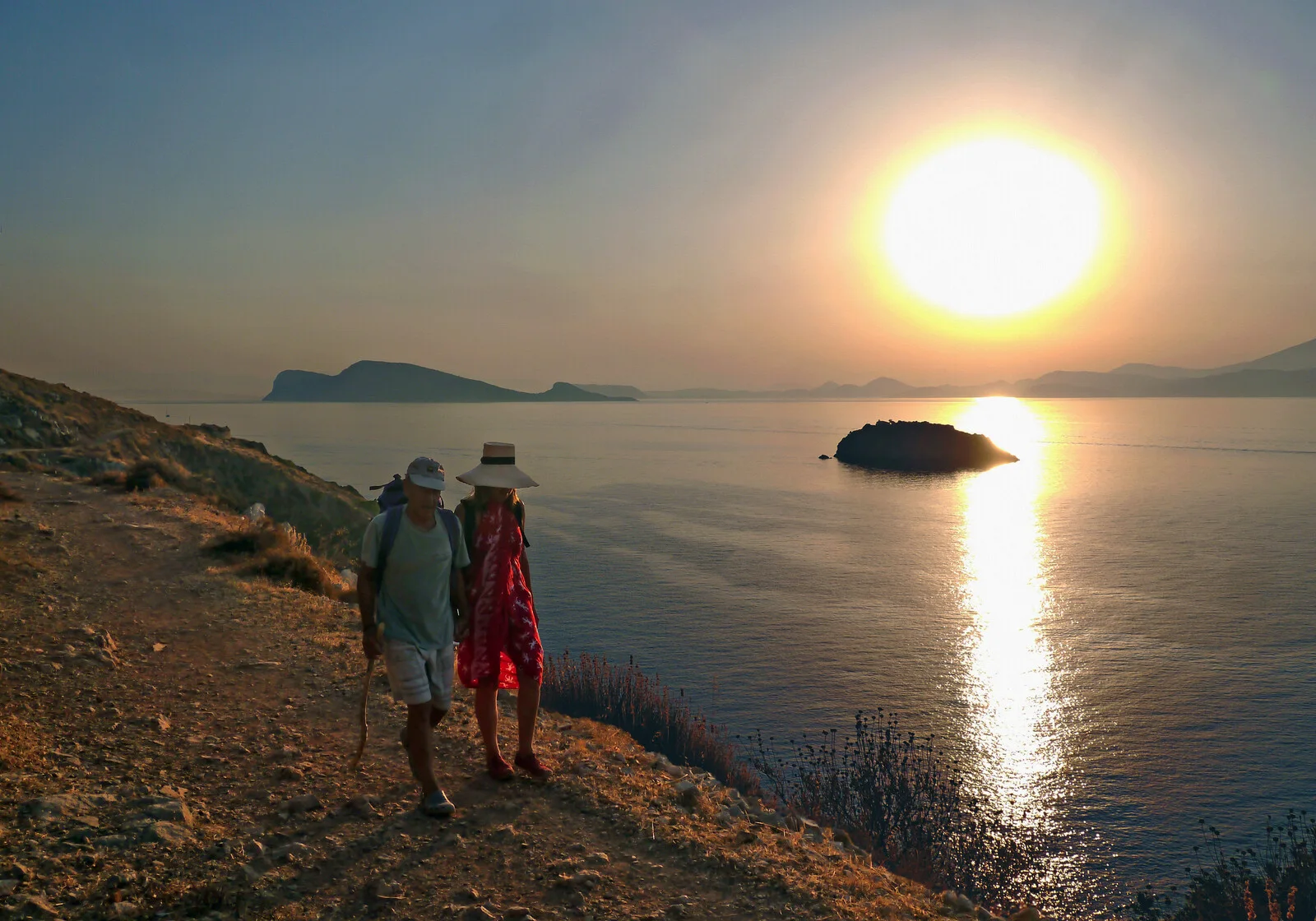
Jörgen Thornberg
The light of love, 2018
Digital
70 x 50 cm
Eros' Love Story
Upon the shores of Hydra’s isle,
Where sun and sea would often smile,
Eros set his ever-full quiver down,
To weave a tale of love, renowned.
In ancient times, where myths were spun,
He watched as hearts were lost and won.
Beneath the olive trees so grandiose old,
He aimed his arrows, swift and bold.
Scarlett’s fire and Rhett’s embrace,
The tragic lovers face to face.
From Arthur’s knights to Darcy’s pride,
Eros had walked by every side.
Yet on this isle, where waves caress,
He found his own sweet loneliness.
For love he gave, but none to keep,
A god who sowed what others reap.
On Hydra’s rocks, where winds would play,
Eros dreamed at the close of the day.
He longed for someone of his own,
To end his journey, but not alone.
Through ages past, his arrows flew,
Yet still his heart, untouched, it grew.
Till on this isle, with skies so clear,
A spark of hope did reappear.
A mortal’s love, so pure and true,
Drew Eros in, as mortals do.
He felt a pull he’d never known,
In Hydra’s light, his heart had grown.
But gods must leave where mortals stay,
And so, with dusk, he slipped away.
Back to the stars where he belonged,
Yet Hydra’s shores still held his song.
For every heart that’s touched by love,
Knows Eros still from the skies above.
But on our island, his story stays,
Of love begun and lost in days.
And though he’s gone, the echoes sound,
Of love eternal, Hydra-bound.
Where sun and sea forever meet,
Eros’ love will find its retreat.
Hydra, August 2024
The surroundings were barren, but a lone cypress tree and a robust thicket of wild oleander were growing here. Otherwise, at this time of year, the landscape was filled with dry, sunburnt grass and wilted flowers, remnants of the spring's floral explosion when the entire island burst into colour. The setting sun painted everything in golden hues, making the rocks shimmer.
As you walk along the coastal road that runs from Hydra town’s amphitheatre to Palamidas, where the red-coloured dirt road turns inland towards Hydra’s old granary, Episkopi, passing Avlaki Beach, Castello, Kamini, Vlychos, and Plakes, you might encounter people from all over the world—and from all times.
I had already passed Plakes and the Four Seasons. By now, the last guests had left their sunbeds and headed home to prepare for the evening. Some took the long but beautiful walk, either down the steep path that plunges into the sea or the ancient Vlychos road, the old artery of Hydra that once connected Kala Pigada in the east with Vlychos in the west. It cuts through Kiafa, the oldest part of Hydra. I live there for half of the year.
Here, the coastal road is rougher, less refined, and not paved—looking much the same for hundreds of years. I squinted into the setting sun hanging over the tiny island of Palamida, named after the little bay where Hydriots used to haul up their boats for the winter. Some of those boats, old wooden caiques, had been forgotten and were now decaying on land.
On a stone shaped like a sofa sat a shadowy figure drowned in the backlight. It wasn't until I was very close that I noticed his strange attire. Attire? He was almost naked, wearing only a loincloth made of saffron-coloured silk tied around his waist. His hair was curly and blonde, forming an aura around a classically beautiful face. His body was one anyone could only dream of, both women and men. Was this someone on their way to a costume party at the rich folks' place in Molos Bay, a kilometre further west, who had gotten tired and needed to rest? Then I saw the wings on his back. But no harness. They were attached directly to his shoulders. This wasn’t a costume. Those were the real deal. Then I felt the man’s amused thoughts. He was laughing inwardly at my surprise. I could feel it clearly, and his expression confirmed it. A Time-traveller, but not an angel, because the man didn’t look particularly saintly. I had never met an angel, but it felt that way. I had encountered many Time-travellers on Hydra, but this was new. Then it hit me—it could be some Greek god since many liked Hydra. After all, Aphrodite had her summer retreat on the island. Was that where he was headed, or was he lost? Her cave was near Limnioniza on Hydra’s southern side, a long walk from here.
It could be Zephyros, the West Wind, often depicted as a winged god. But what would he be doing here when it was almost windless, and the barely noticeable breeze that ruffled the water below came from the south? Winged gods fluttered through my mind. Iris, the goddess of the rainbow, the link between heaven and earth, could have been a candidate—if it weren’t for the fact that it hadn’t rained since early June. And, of course, that she was a woman. The same thing ruled out another winged deity, Nike, the goddess of victory, and last night, Hydra had been visited by victorious Greek Olympians touring around to receive the people’s admiration.
The thought of Thanatos, the god who took human souls to Hades in the underworld and death personified, made me uneasy. But since I felt very much alive in the magical twilight, I dismissed the idea of my sudden demise. Besides, death would hardly smile so charmingly, I thought. Nor could it be Thanatos’ twin brother Hypnos, the god of sleep, because I wasn’t the least sleepy—perhaps just relaxed until I saw the man with the curly blonde hair. If I hadn’t missed anyone, there was only one left: Eros, the god of love and desire, but I thought he was a young boy with wings and a bow and a quiver of arrows slung over his shoulder. His counterpart among the Romans was Cupid, and he was definitely a little boy. I sat down beside him on a stone, noticeably less comfortable than the one Eros had chosen.
“Exactly,” said the man who had been reading my thoughts. “And that Cupid—I hate him. The Romans have tarnished my reputation. He’s a naughty boy who loves to mess with people, shooting arrows left and right. Unfortunately, the Greeks got caught up in the rumours, too, and as time passed, I became younger and younger in Greece as well. I’ve always been young since I was born a few thousand years before your calendar. Naturally, I’m one of the original gods because, without love and sex, humanity would have ceased to exist after the Fall.”
“And the serpents would have taken over the world,” I laughed.
“Something like that if you believe that nonsense.” Eros smiled broadly.
“The Fall.”
“Exactly! What nonsense. The Fall! For one thing, the earth and humans had been around for a long time, the earth and many animals, long before I was born. I knew Adam and Eve, and it was my fault they got together. I shot an arrow into Eve’s shoulder, making her fall in love with Adam. It’s the woman who chooses, and she chose him. There wasn’t an apple tree anywhere nearby, and as far as I know, no serpent either.”
“Well, there goes that illusion,” I said, not meaning it since I was far from being a creationist.
“You’re not far off, though, and that’s why I’m back for a visit.”
“Oh?” I said, sensing what he was about to say, as it matched many people’s view of the island.
“That’s right. The Garden of Eden was here on Hydra once, long ago, when water flowed everywhere, hence the name, which comes from ‘Hydor,’ which means water. This is where they lived with their tribe, related to the Mycenaeans.”
“Did the people of that time, the early Hydriots, look like today’s Greeks?”
“More or less—dark brown hair and brown eyes.”
"Why do you and other gods like Apollo, Zeus, Aphrodite, Athena, and Helen of Troy have blonde hair?"
"Apollo, as the lord of the sun, could hardly have any other hair colour, and Zeus is related to the Norse god Odin. Athena was born without the involvement of a woman and was essentially cloned from Zeus' forehead. Naturally, she inherited her father's blonde hair. Aphrodite is the epitome of beauty, making her a natural blonde." Eros shifted a bit, as this assessment also applied to men.
"You seem to have blue eyes. Is that true for the others, too?"
"Our eye colour is called 'glaukopis,' which is usually translated as 'owl-eyed,' but can also be interpreted as 'blue-eyed.' The colour emphasises our sharp intellect and clarity of vision." Eros sounded anything but modest.
"In addition to these features, we are all filled with Meraki, a strong desire characteristic of blond people."
"What happened to the original Hydriots? There are no traces of them left," I asked, hoping Eros wouldn’t read my thoughts about a possible connection to Narcissus.
"Unfortunately, those idiots mismanaged nature's resources and were careless with fire, so the forests burned down, and after a few generations, the Garden of Eden was just a memory, and the springs dried up. The people disappeared along with it, leaving only the name Hydra."
"Sad, exceedingly sad. You mentioned that your visit had something to do with Adam and Eve. How so? Are they on the island?"
"Indeed! They’ll be here soon. They’ve been a couple for over five millennia, which must be a record."
"Especially today when in Europe, half of all marriages end in divorce; in some countries, like the Scandinavian ones, it’s sixty per cent."
"Divorce is out of the question for them; they are together forever and live on a flourishing star called Eden. That said, it’s a mature relationship, and I intend to breathe new life into it," Eros said, flapping his wings.
"Breathe?" I asked, thinking of Zephyros.
"Not that kind of breathing. I call it 'breathe' because saying I’m going to shoot someone with an arrow sounds very warlike. If there’s one thing I’m not, it’s violent. Love is my weapon, and my arrows feel like a click in the brain. 'Click,' and you’re in love. Or in love again. There they are, by the way," Eros said, nodding toward a timeless couple approaching from the direction of Molos. He was in a cap, blue T-shirt, and shorts, while she wore a thin knee-length red summer dress with white figures on it and an oversized straw hat with wide brims that hid her face. They strolled side by side, but each in their own world.
"That couple doesn’t look five thousand years old, more like middle-aged."
"As you know, we Time-travellers take on the age we feel like, often ending up in middle age, still youthful on the outside but older and wiser inside."
"Not you, though. You don’t look a day over twenty, twenty-one."
"Thanks, that’s kind of you saying that. No, as a god, Eros can’t be over thirty if he’s to be credible; he must be in the prime of life, the age when one is at their best in bed, which is ultimately what it’s all about. Reproduction. Romance has its place but must result in a new generation."
"Sounds like you’re needed," I said sincerely.
"More than ever in today’s world," sighed Eros. "Nowadays, I get help or competition, depending on how you see it. Everything I’ve been doing for millennia has become a science called sexology, where tens of thousands of eros-like figures investigate, assess, advise on, and treat various sexual problems and dysfunctions. But they’re no good at making people fall in love."
"That must be a relief for you," I said sympathetically.
"A comfort for a tiger’s heart, but I must keep that little winged boy at bay—the Cupid the Romans invented and forced on most people," said Eros, retreating behind an oleander bush to stay out of sight from the determined couple.
Quicker than a flash, Eros whipped out a bow hidden behind his back, loaded it with two arrows, and fired them in rapid succession at Adam and Eve. Not a sound escaped their lips, but they both flinched, stopped, and looked deeply into each other’s eyes, sharing an intense embrace that lasted several minutes before they continued, now hand in hand, walking at a brisker pace toward the Four Seasons, where Eros claimed they were staying.
"That was sweet," I said.
"Now they’ll have a romantic encounter, their first in centuries," Eros giggled.
"They deserve it," I said a bit enviously. "Any other famous couples you’ve helped along? Can you tell me about any couples who met with your help?"
“Oh, that list would be long, and your earthly life would hardly suffice for it all."
"You’ll have to settle for a selection now that I’ve met Adam and Eve, the original couple in Judeo-Christian tradition, whose story in the Garden of Eden represents the beginning of human love and companionship. It must have been dull before the Fall—without sex, I mean."
"It would have been if they’d had to live like a monk and a nun. The whole idea is absurd. Back to my list. Where should I start?"
"Start in Greece since that’s where we are."
Eros leaned back, a mischievous grin playing on his lips as he adjusted his wings. "Where should I begin?" he mused, his eyes glinting with the memories of millennia of love stories. "Each couple, each romance, has its unique flavour, its spark of passion, and often, my arrows had a lot to do with it. Let me tell you about some of the most famous ones."
“Paris and Helen have always fascinated me, an alliance causing a war.” I shook my head.
Eros started with a chuckle, "Ah, Paris and Helen... That one was a bit of a mistake on my part. Helen was already married, but when Paris, that charming Trojan prince, caught a glimpse of her, I couldn’t resist. One well-aimed arrow, and the next thing you know, the most beautiful woman in the world was swept off her feet right into his arms. Their love was so intense and fiery that it sparked the Trojan War! The funny thing? Helen didn’t even need an arrow—she was a natural, but Paris... well, he needed a little push. And so, history was written in blood and fire, all because of one love-struck prince."
He winked, adding, "And if you ever wondered where Shakespeare got his inspiration for ‘Antony and Cleopatra,’ look no further than Paris and Helen. The dynamics of power, forbidden love, and the ultimate tragedy—it’s all there. Antony and Cleopatra were just a Roman twist on the same old tale but with more empire and less Troy."
The Roman and the Queen Pharao, what a couple," Eros continued, a hint of nostalgia in his voice. "Two powerful souls, drawn together by an irresistible force. Cleopatra didn’t stand a chance—one look at Antony, and she was hooked. I had planned to let them fall in love slowly, over time, but when I saw the chemistry between them, I couldn’t resist. I let fly two arrows straight to their hearts. Their love was passionate and all-consuming, ultimately leading to their downfall. But oh, what a love it was! They chose death over a life without each other—how tragic, how beautiful."
"And wouldn’t you know it, their story inspired one of the greatest tragedies ever penned. Shakespeare knew how to spin their tale into something eternal. But the truth is, my arrow started it all."
“How about the opera figures Tristan and Isolde? Not my favourite. I’m no Wagner fan.”
Eros sighed, "Tristan and Isolde... Now, that was a difficult one. Forbidden love is always the hardest. Tristan, the loyal knight, and Isolde, his uncle’s bride, were doomed from the start. I tried to keep them apart, but their love was so strong, so pure, that not even my arrows could make them interested in someone else and keep them from each other. In the end, they died in each other’s arms, their love eternal, but their story—so tragic."
“Typical Wagner, if you ask me. A born melancholic, a Debbie Downer.”
“Yes, Richard Wagner can be described as a melancholic, both in his life and art. His music and operas are often infused with deep emotions, seriousness, and a focus on existential themes such as love, death, and fate. Wagner's compositions, like ‘Tristan und Isolde’ and ‘Der Ring des Nibelungen,’ often explore dark and complex emotional landscapes, reflecting a cynical worldview. His personal life was also marked by inner conflicts and a strong sense of alienation, further reinforcing his image as a melancholy figure. As you say, a Debbie Downer.”
"Shakespeare also mastered that kind of perspective, didn't he?"
"Correct. Medieval legends have always had a flair for the dramatic, and theirs was no exception. If you’ve ever read ‘Romeo and Juliet,’ you’ll see echoes of Tristan and Isolde’s doomed love. Shakespeare might have been thinking of them when he wrote his tale of star-crossed lovers."
"Do we find anyone with a similar fate among the King Arthur's Round Table knights? I haven't read the book since my teenage years."
"Lancelot and Guinevere, naturally," Eros chuckled softly, "that was a bit of a challenge. Lancelot was King Arthur’s most esteemed knight, and Guinevere was his queen. Their love was a betrayal, a scandal that shook Camelot to its core. But you know, I never intended for it to happen. One day, I was aiming at another couple nearby, and the wind—a gust from Zephyros, no less—caught the arrow, sending it straight into Lancelot. Guinevere was already infatuated, but Lancelot? He needed a bit of persuasion. And that’s how I inadvertently contributed to the downfall of an entire kingdom."
"You’ve read ‘Wuthering Heights,’ right? That turbulent, all-consuming passion between Catherine and Heathcliff? Brontë may not have known it, but she was channelling the same forces that tore Camelot apart. When you mix love with betrayal, the results are never pretty."
"I've only seen it as a movie on TV, but I must have missed an episode because I never quite understood the ending."
"You should take a chance; the book is probably available on that internet of yours. And then, of course, there’s Romeo and Juliet," Eros continued, his expression softening. "The couple that inspired the story was named Luigi da Porto and Lucina Savorgnan, who lived in the 1500s in Verona. Their tragic love story became the model for several later versions of the tale, including William Shakespeare's famous play. But it was Luigi and Lucina who were struck by my arrows.
"Fascinating! You’re turning poetry into history here."
“The young lovers' story is known the world over. I remember watching them at the party—Luigi saw Lucina for the first time, and I knew this was it. I aimed, and before I knew it, they were lost in each other’s eyes. But Verona was not kind to lovers... Feuding families, secrets, and misunderstandings led to their tragic end. Yet, they loved fiercely, even in death."
"Romeo and Juliet had followers here on the island," I interjected.
"Ah, love's influence never fades," Eros smiled, acknowledging my comment before continuing. "And if you want to trace that intense, youthful love back to its roots, think of Paris and Helen again. The fire, the drama—it’s all there."
Catherine and Heathcliff from Wuthering Heights
"Catherine and Heathcliff," Eros said, "that was a storm I unleashed without realising how fierce it would become. Their love was dark, obsessive, rooted in pain and revenge. Heathcliff—he was a tough one to pierce. His heart was so full of anger and bitterness that I had to use a special arrow that dug deep into his soul. It worked, but at a cost. Their love was tumultuous and destructive, ultimately consuming them both. But it was also a love that defied the boundaries of life and death."
"Sounds dramatic. But who were they really?"
“Emile and Laurent were their names.” Eros adjusted his wings, a hint of mischief in his eyes as he recounted something long buried by time. "Let me tell you about a couple whose story was almost lost to history—Emile and Laurent. They lived in the early 1700s in a remote village in the English countryside, not far from the family Brontë’s mansion. Their love was as wild and untamed as the moors themselves, but unlike most stories I’ve been involved in, this one was never meant to be told.”
"My God, how exciting!"
“Emile was a woman of fierce independence, far ahead of her time, with a spirit that matched the rugged landscape around her. Laurent was a brooding, mysterious man, an outsider in the village, known for his intensity and dark charisma. When I first saw them, I couldn’t resist—they were perfect for each other. So, I struck them both with my arrows, hoping to ignite a passion that would transcend their differences.
And oh, how it did. Their love was like a storm, passionate and all-consuming, but it was also dangerous. With his dark past, Laurent was not easily tamed, and Emile’s love for him pushed her into a world of secrecy and defiance. They met secretly, away from prying eyes; their affair was whispered about but never confirmed.
Fearing their love would be discovered, Emile kept a diary, pouring her heart and soul into the pages. She chronicled every stolen moment, every heated argument, every tear and every kiss. It was a love story for the ages, but it was also a story of tragedy.
The villagers suspected something was amiss, and rumours began to swirl. In a time when such love was forbidden, Emile and Laurent found themselves increasingly isolated. The church intervened, and their affair was brutally suppressed. Their names were erased from local records, and their love was buried under layers of shame and fear.
But the diary survived, at least for a time. Years later, Emily Brontë stumbled upon it hidden away in the attic of an old farmhouse she had visited. She read Emile’s words and felt the passion, despair, and overwhelming love that had consumed the couple. This inspired her, fueling the creation of Wuthering Heights and the characters of Catherine and Heathcliff, who were echoes of Emile and Laurent's tragic love.
Yet, like all things tied to fate, the diary vanished—perhaps burned, perhaps hidden again, but never found. The story of Emile and Laurent was lost, except for the fragments that Emily wove into her novel. And now, I share it with you, the true inspiration behind one of the greatest love stories ever told." Eros paused, his voice softening as he concluded, "Their love was wild, untamed, and ultimately tragic. But isn’t that the way things are? The most intense passions often burn out the fastest, leaving only ashes and memories, a poignant reminder of the fleeting nature of love.
"Sounds a bit like what happened with the real-life inspirations behind Brontë's sister Charlotte’s characters, right?" I added.
Eros nodded, "Indeed, every writer takes inspiration from the world around them, from the love stories that unfold, often with my help. Charlotte’s characters Jane Eyre and Mr Rochester—their stormy, secretive love- were another of mine. That relationship was about breaking down barriers like Catherine and Heathcliff."
“Did you also have a hand in the fate of Jane Austen’s characters, Elizabeth and Mr. Darcy?” I asked.
“You can bet on it,” Eros laughed. “’Pride and Prejudice’ is one of my favourites! Darcy was such a proud man, so sure of himself, and Elizabeth Bennet was full of wit and spirit. It took two arrows for those two. The first was a miss—Darcy’s pride was too thick for the arrow to penetrate. But the second... oh, that one struck true. It was at Pemberley when he saw Elizabeth at his home. His heart softened, and finally, he realised she was the one. The intensity of Darcy's transformation from a proud and aloof man to a humble and loving one is a testament to the power of love's influence. As for Elizabeth, she needed a little nudge, too, but once her heart was opened, there was no turning back. They were perfect for each other—two sides of the same coin."
"But they didn’t have those names, did they?” I asked sceptically.
“Of course not, or Jane Austen would have been sued. And yet, plenty of people still felt the sting of recognition. When it comes to many of Austen’s characters, their backgrounds and inspiration weren’t based on specific historical figures but rather on England's social and cultural norms at that time. She drew from her society, including the expectations and limitations surrounding marriage, social status, and gender roles. Elizabeth Bennet and Mr Darcy represent different aspects of that society—Elizabeth challenged the conventions of the time with her independence and strong will. At the same time, Darcy, with his pride and social standing, reflected the attitudes and prejudices of the upper class.”
“I’m aware that Austen’s characters are complex and full of nuance,” I said, “and their development throughout the story reflects a struggle against superficial judgments and pride, central to many of her works. So if Austen was inspired by people she knew and observed in her own life, who were Elizabeth and Darcy that you helped become a couple?”
Eros leaned back, a playful smile on his lips as he recounted what happened at the beginning of the 19th century. “Let me tell you about a couple that inspired Austen,” Eros began. “Their real names? Eleanor Barrett and William Darcy-Fitzwilliam.”
“William Darcy-Fitzwilliam?” I interrupted, raising an eyebrow. “That sounds almost too perfect.”
Eros chuckled. “Well, I have a flair for names, and believe me, it suits him and what happened. Eleanor came from a respectable, though not wealthy, family in a charming little village in Derbyshire. The Barrett family was well-known and well-liked in the area but didn’t have much wealth. What they once had disappeared with her grandfather. Eleanor was different from most young women of her time—intelligent, quick-witted, and fiercely independent. She didn’t fit the typical mould, which made her so interesting.”
I nodded, already imagining Eleanor as the spirited Elizabeth Bennet. “And William?”
“Ah, William,” Eros said with a glint in his eye. “He was the heir to a vast family fortune, with estates in Hertfordshire or perhaps Yorkshire, I have forgotten. The Darcy-Fitzwilliams were one of the most prominent families in the region, respected and admired by many. William was everything you’d expect—intelligent, responsible, reserved, and sometimes too proud. He was known for being a man of few words, but when he spoke, people listened.”
“So, how did they meet?” I asked, leaning in a bit closer.
“They met at a grand ball in Bath,” Eros continued. “It was one of those events where the countryside’s elite mingled with the city’s wealthy. Eleanor was there as a guest of a relative while William was in town on family business. When William saw her, he was struck by her beauty and sharp mind. But, being William, he didn’t exactly show it in a way Eleanor would appreciate. He came off as a bit arrogant.”
“Typical,” I murmured.
“Indeed,” Eros agreed with a nod. “Eleanor, on the other hand, was initially put off by William’s aloof demeanour. She found him arrogant and far too serious for her taste. But as fate would have it, they kept running into each other during their stay in Bath. Slowly, she began to see that there was more to William than met the eye—a depth of character and a sense of duty that she hadn’t expected.”
“And William?” I asked. “Did he realise his feelings right away?”
“Not quite,” Eros said with a smile. “William was used to keeping his emotions in check, but Eleanor had a way of getting under his skin. It wasn’t until they had a chance encounter during a walk in Royal Victoria Park that William truly began to acknowledge his feelings. They talked, and William let down his guard for the first time. Eleanor saw the man behind the facade, and William realised that Eleanor was unlike anyone he’d ever met.”
“And let me guess,” I said, grinning, “that’s when you struck?”
“Exactly,” Eros laughed. “A well-aimed arrow and the sparks flew. Their relationship wasn’t easy—there were misunderstandings, pride, and social expectations to overcome. But like Elizabeth and Darcy, they eventually found their way to each other, realising their differences strengthened them as a couple.”
“So, Eleanor and William were the real-life inspiration for one of the greatest love stories ever told?” I asked, half in awe.
“Indeed,” Eros said with a wink. “Of course, another pair of souls could have been destined to find love against the odds. But Austen knew the family and was invited to their wedding. So subsequently, their story became one for the ages.”
"If I'm not mistaken, it has become one of the most popular novels in English literature, with over 20 million copies sold."
"I think you're right." And if you think about it," Eros added, "their story has shades of Shakespeare’s ‘Much Ado About Nothing.’ That push-pull dynamic, the misunderstandings, the eventual happy ending—it’s all there."
“That’s probably my favourite comedy and the love story fits exactly my taste, but there’s no real-life inspiration behind it, right?”
“On the contrary. Shakespeare got the story from Ariosto's *Orlando Furioso,* which contains a subplot involving a deceitful trick played on a young woman and her lover—who, as it happens, I shot my arrows at,” Eros replied with a knowing grin.
“I love hearing your stories about how famous literary characters were once real people. That’s how I work, too; behind my characters, there’s always flesh and blood, but just enough disguised so no one gets offended. What about Scarlett O’Hara and Rhett Butler from ‘Gone with the Wind’?”
“Ah, those two,” Eros said with a wry smile. “Scarlett was always chasing after the wrong man—until Rhett came along. He was everything she needed but was too blind to see it at first. I shot them both, but Rhett’s arrow was more potent. He saw right through Scarlett and loved her for who she was, not for who she pretended to be. But their love was as volatile as the times they lived in—full of passion, conflict, and, ultimately, loss. Still, there was deep and enduring love, even if they were too stubborn to admit it until it was too late.
In this case, it's easy to identify who they were. Scarlett was the author Margaret Mitchell herself, and Rhett was her first husband, Red Upshaw, a scoundrel and bootlegger with a certain roguish charm. Their tumultuous relationship influenced the dynamic between Rhett and Scarlett in the book and the film. At age 47, down and out of luck at last, Red fell to his death from the second floor of a flophouse in Galveston, Texas. After his death, Red became one of the most famous men in the world, just like Rhett Butler. Now, that’s the story of an unlikely character. But by all accounts, he was as charming a man as has ever walked the face of the earth. Mitchell thought so anyway and made him the centrepiece of her novel. So, as you can imagine, I don’t have to feel guilty about it. We meet from time to time among the stars, and believe it or not, they live together in eternity. Their parties are legendary, filled with celebrities from half a millennium. I’ve been invited many times as a special guest of honour since I was the one who started their eternal love story.”
“I can believe that. And doesn’t that remind you of ‘Pride and Prejudice’ in reverse?”
“Exactly! Rhett’s the one with the insight, and Scarlett, well, she’s got the pride. Their story is more fiery and tragic, but in the end, it’s about two perfectly matched people who don’t realise it until it’s almost too late. All’s well that ends well. As Shakespeare always wrote, 'all's well that ends well,' no matter what problems arise along the way.".”
"What about ‘Casablanca’?" I asked, curious about the real story behind the film. "It's one of the greatest Film Noir classics, and Ingrid Bergman is as enchanting as ever, especially with that iconic line, 'Play it again, Sam.' Was there any real-life inspiration behind it? Was there flesh and blood behind those characters?"
Eros smiled, a hint of nostalgia in his eyes. "Ah, ‘Casablanca’. Ett av undantagen om man ser till en enda händelse. Ändå vill jag försökas besvara din nyfikenhet. De representerar båda tusentals individer med snarliknande öde, de sågs aldrig mer trots att jag fått dem förälskade. Antingen dog hon under bombningar, men oftast var det han som aldrig kom tillbaka, en av miljontals stupade unga män som mest av allt ville tillbaka till kvinnan de älskade. So that's a tale woven from the fabric of wartime love and sacrifice. While Rick Blaine and Ilsa Lund are fictional characters, their story is deeply rooted in the realities of World War II. The tension, the longing, the sacrifices reflect the experiences of countless couples torn apart by the war.
"Rick's character, in particular, was said to be inspired by several different people, but primarily by the idea of the American expatriate, a man with a mysterious past who had lost faith in the world. The writers were influenced by the types of people who populated places like Casablanca during the war—people running from their pasts, hiding from the Nazis, or waiting for a chance to escape to freedom.
"And Ilsa?” I asked, a little disappointed. “If not based on any one person, I feel her character embodies the struggle between love and duty. Many women during the war found themselves in impossible situations, torn between their feelings and the harsh realities they faced. Ingrid Bergman brought such grace and depth to the role that it feels like she could have been someone you might have met in those times.”
"You’re so right. While Rick and Ilsa's story wasn't directly lifted from real life, it certainly resonates with that era's real emotions and experiences. And that’s why their love story continues to captivate audiences—it feels so true to the human experience, especially in times of great turmoil. Their love was beautiful, but it was never meant to be. I saw many like them in war-torn Morocco together and knew they were soulmates. But the world they lived in... it wasn’t kind to lovers. They had to sacrifice their love for a greater cause. Most people don’t know that the couple closest to the film reunited after the war, away from the chaos. They married and had children, living a quiet life in the countryside. It was a different kind of love, one built on the ashes of what they had lost. But it was strong and lasted until their days' end. Not everybody died."
"And in that case, wouldn’t you say their story echoes the tale of ‘Wuthering Heights’? The reunion, the struggle against forces bigger than themselves—it’s all part of the same timeless theme."
"Could be, could be," Eros said thoughtfully. "Or if they hadn’t met because he had fallen, their fate might remind you of what happened to Jack and Rose."
"Jack and Rose," I sighed, thinking of the tragic romance on the Titanic.
"Those very ones," Eros nodded., his expression sombre. "I was on that ship, you know. The Titanic... was a floating palace filled with dreams and hopes. Jack and Rose were never supposed to meet, but I couldn’t resist when they did. I shot them both, and for those few days, they experienced a love so intense, so pure. But fate... fate had other plans. Not even I could stop the iceberg. The sea claimed Jack, and Rose lived on, forever carrying the memory of that brief, beautiful love."
"And there were others, weren’t there? Other tragic romances on that ship?" I asked.
"Yes," Eros said softly, "there were. Loads of them. Love can be a beautiful tragedy, and sometimes, all I can do is stand by and watch as it unfolds."
"And doesn’t that make you think of ‘Romeo and Juliet’ on the high seas? No, not standing on a ladder or leaning over a balcony, but both at the bow of the Titanic. A love so pure, so doomed by the circumstances around them—it’s a story that’s been told a thousand times, but it never loses its power."
"Let’s move from the innocent to the culprits and the romantic criminal couple Bonnie and Clyde,” I prompted, curious about the infamous duo. “There, I know they were flesh and blood."
Eros smiled wryly, "Now there’s a story. Bonnie and Clyde—two wild souls who found each other in a world without a place for them. I didn’t plan to get involved, but when I saw them so full of life and fire, I couldn’t resist. I shot them both, and from that moment, they were inseparable. They loved each other fiercely, even as they robbed and killed their way across the country. Their love was their downfall, but they wouldn’t have had it any other way. They died together, in a hail of bullets, just as in love as the day I fired my arrows."
"And that reminds me of another tale of outlaw lovers—like ‘Tristan and Isolde,’ but without guns and fast cars. Love like that burns bright and fast, but it leaves a mark on history."
"Leaving the criminals, how about John and Yoko?" I asked, thinking of the famous couple who symbolised a cultural revolution.
"John and Yoko... their love was something else," Eros said, his eyes lighting up. "It wasn’t just a love between two people—it was a love that changed the world. When John met Yoko, I didn’t need to do much. They were drawn to each other like magnets. I did shoot John to ensure he wouldn’t lose his way, but Yoko... she was already there. Their love was so strong, so powerful, that it transcended everything. They faced criticism and hatred, but they stood by each other. They were soulmates in every sense of the word."
"And if you ever read about famous couples who change the world, think back to Antony and Cleopatra. John and Yoko’s story is a modern echo of those ancient lovers who were larger than life, who lived and loved on their own terms, no matter what the world thought."
‘‘And how about my political favourites, Barack and Michelle Obama?" I asked, wondering how Eros contributed to their iconic love story.
Eros smiled warmly, "Ah, Barack and Michelle. They were a perfect match from the start, but I helped things along. There was an instant connection when they first met without my presence, but like all great love stories, it needed a little nudge. Barack was focused and driven, and Michelle—was his equal in every way. I shot them both simultaneously, and the rest is history. Their love is mutual respect, partnership, and deep, abiding affection. It’s the kind of love that endures, that leads by example."
"And doesn’t their story remind you of Elizabeth Bennet and Mr. Darcy? Two strong-willed individuals come together, complement each other, and make each other better. It’s a modern fairy tale, one that inspires millions."
Eros looked thoughtful as he paused, his eyes scanning the horizon. "Every love story, every couple, has a piece of the past. The stories repeat and evolve but are the same at their core. Love is timeless, and so are the tales that tell it."
“Have you ever failed?” I asked, curious if Eros ever faced situations where his arrows didn’t work.
“Yes,” Eros replied with a thoughtful expression. “There have been moments when people were so devoted to something else that my magical arrows couldn’t help. Joan of Arc is one such example.”
“Ah, Joan of Arc,” I mused. “Hypothetically, wasn’t the French King, Charles VII, who had the greatest chance to save her? She fought to put him back on the throne and played a crucial role in his coronation at Reims in 1429. Yet, despite everything she did for him, he did nothing to save her when she was captured by the Burgundians and handed over to the English.”
Eros nodded. “Exactly. Charles VII had political power and a personal connection to Joan, which could have saved her. But politics is a tricky game. After her capture, Joan became too controversial—a risk Charles wasn’t willing to take. The charges of heresy and witchcraft made her a figure he couldn’t openly support without risking his position. By staying silent, he avoided making enemies in the Church and other powerful circles.”
“And Charles was married at the time of her capture, right?”
“Yes,” Eros confirmed. “Charles VII was married to Marie of Anjou. Their marriage was arranged to strengthen dynastic ties, and like many royal marriages, it was more about politics than romance. So, while Charles could have intervened, he chose not to, leading to Joan’s tragic death. "But you can be sure I tried," Eros sighed deeply. "I emptied an entire quiver of arrows into his back, but in the end, politics won."
Eros paused, then added, “Another time I came up short was with Prince Charles and Princess Diana—a modern royal love story that captivated the world but ended in tragedy. In that case, it was as much a battle with myself as anything else. My arrow struck Diana deeply, and for a long time, she was truly in love. But as she famously said, ‘there were three of us in this marriage,’ which complicated things.”
I leaned forward, intrigued. “And Charles?”
“Ah, Charles,” Eros sighed. “The problem was that one of my arrows hit him, but it was aimed at Camilla. When Charles fell in love with her, I had done my job too well. The arrow’s effect was so strong that I couldn’t shift his feelings no matter what I tried. It’s one of my rare mistakes—one I deeply regret.”
Eros looked off into the distance, a hint of sorrow in his eyes. "Even gods have their limits, it seems. The coldness and pragmatism of politics are probably the greatest obstacles right after corruption. If some people can kill their father and mother for the sake of politics, they can resist love, too. A powerful man can always find sex without being in love. Fidel Castro slept with over thirty thousand women, but he resisted my arrows his entire life."
"And what about you?" I asked. "Do you ever find love, Eros?"
Eros chuckled, a wistful smile playing on his lips. "Ah, my story is the most complicated of them all. But perhaps, one day, I’ll find someone who can match me, arrow for arrow. Until then, I’ll keep doing what I do best—helping others find their way to love, even if they need a little push."
And with that, Eros spread his wings, casting a golden light in the setting sun as he prepared to take flight, leaving me with stories of love, both ancient and modern, echoing in my mind.
His true stories, from ancient mythology to contemporary history, illustrate love's timeless and diverse nature. Each has a unique story of passion, conflict, and devotion.
Jörgen Thornberg
The light of love, 2018
Digital
70 x 50 cm
Eros' Love Story
Upon the shores of Hydra’s isle,
Where sun and sea would often smile,
Eros set his ever-full quiver down,
To weave a tale of love, renowned.
In ancient times, where myths were spun,
He watched as hearts were lost and won.
Beneath the olive trees so grandiose old,
He aimed his arrows, swift and bold.
Scarlett’s fire and Rhett’s embrace,
The tragic lovers face to face.
From Arthur’s knights to Darcy’s pride,
Eros had walked by every side.
Yet on this isle, where waves caress,
He found his own sweet loneliness.
For love he gave, but none to keep,
A god who sowed what others reap.
On Hydra’s rocks, where winds would play,
Eros dreamed at the close of the day.
He longed for someone of his own,
To end his journey, but not alone.
Through ages past, his arrows flew,
Yet still his heart, untouched, it grew.
Till on this isle, with skies so clear,
A spark of hope did reappear.
A mortal’s love, so pure and true,
Drew Eros in, as mortals do.
He felt a pull he’d never known,
In Hydra’s light, his heart had grown.
But gods must leave where mortals stay,
And so, with dusk, he slipped away.
Back to the stars where he belonged,
Yet Hydra’s shores still held his song.
For every heart that’s touched by love,
Knows Eros still from the skies above.
But on our island, his story stays,
Of love begun and lost in days.
And though he’s gone, the echoes sound,
Of love eternal, Hydra-bound.
Where sun and sea forever meet,
Eros’ love will find its retreat.
Hydra, August 2024
The surroundings were barren, but a lone cypress tree and a robust thicket of wild oleander were growing here. Otherwise, at this time of year, the landscape was filled with dry, sunburnt grass and wilted flowers, remnants of the spring's floral explosion when the entire island burst into colour. The setting sun painted everything in golden hues, making the rocks shimmer.
As you walk along the coastal road that runs from Hydra town’s amphitheatre to Palamidas, where the red-coloured dirt road turns inland towards Hydra’s old granary, Episkopi, passing Avlaki Beach, Castello, Kamini, Vlychos, and Plakes, you might encounter people from all over the world—and from all times.
I had already passed Plakes and the Four Seasons. By now, the last guests had left their sunbeds and headed home to prepare for the evening. Some took the long but beautiful walk, either down the steep path that plunges into the sea or the ancient Vlychos road, the old artery of Hydra that once connected Kala Pigada in the east with Vlychos in the west. It cuts through Kiafa, the oldest part of Hydra. I live there for half of the year.
Here, the coastal road is rougher, less refined, and not paved—looking much the same for hundreds of years. I squinted into the setting sun hanging over the tiny island of Palamida, named after the little bay where Hydriots used to haul up their boats for the winter. Some of those boats, old wooden caiques, had been forgotten and were now decaying on land.
On a stone shaped like a sofa sat a shadowy figure drowned in the backlight. It wasn't until I was very close that I noticed his strange attire. Attire? He was almost naked, wearing only a loincloth made of saffron-coloured silk tied around his waist. His hair was curly and blonde, forming an aura around a classically beautiful face. His body was one anyone could only dream of, both women and men. Was this someone on their way to a costume party at the rich folks' place in Molos Bay, a kilometre further west, who had gotten tired and needed to rest? Then I saw the wings on his back. But no harness. They were attached directly to his shoulders. This wasn’t a costume. Those were the real deal. Then I felt the man’s amused thoughts. He was laughing inwardly at my surprise. I could feel it clearly, and his expression confirmed it. A Time-traveller, but not an angel, because the man didn’t look particularly saintly. I had never met an angel, but it felt that way. I had encountered many Time-travellers on Hydra, but this was new. Then it hit me—it could be some Greek god since many liked Hydra. After all, Aphrodite had her summer retreat on the island. Was that where he was headed, or was he lost? Her cave was near Limnioniza on Hydra’s southern side, a long walk from here.
It could be Zephyros, the West Wind, often depicted as a winged god. But what would he be doing here when it was almost windless, and the barely noticeable breeze that ruffled the water below came from the south? Winged gods fluttered through my mind. Iris, the goddess of the rainbow, the link between heaven and earth, could have been a candidate—if it weren’t for the fact that it hadn’t rained since early June. And, of course, that she was a woman. The same thing ruled out another winged deity, Nike, the goddess of victory, and last night, Hydra had been visited by victorious Greek Olympians touring around to receive the people’s admiration.
The thought of Thanatos, the god who took human souls to Hades in the underworld and death personified, made me uneasy. But since I felt very much alive in the magical twilight, I dismissed the idea of my sudden demise. Besides, death would hardly smile so charmingly, I thought. Nor could it be Thanatos’ twin brother Hypnos, the god of sleep, because I wasn’t the least sleepy—perhaps just relaxed until I saw the man with the curly blonde hair. If I hadn’t missed anyone, there was only one left: Eros, the god of love and desire, but I thought he was a young boy with wings and a bow and a quiver of arrows slung over his shoulder. His counterpart among the Romans was Cupid, and he was definitely a little boy. I sat down beside him on a stone, noticeably less comfortable than the one Eros had chosen.
“Exactly,” said the man who had been reading my thoughts. “And that Cupid—I hate him. The Romans have tarnished my reputation. He’s a naughty boy who loves to mess with people, shooting arrows left and right. Unfortunately, the Greeks got caught up in the rumours, too, and as time passed, I became younger and younger in Greece as well. I’ve always been young since I was born a few thousand years before your calendar. Naturally, I’m one of the original gods because, without love and sex, humanity would have ceased to exist after the Fall.”
“And the serpents would have taken over the world,” I laughed.
“Something like that if you believe that nonsense.” Eros smiled broadly.
“The Fall.”
“Exactly! What nonsense. The Fall! For one thing, the earth and humans had been around for a long time, the earth and many animals, long before I was born. I knew Adam and Eve, and it was my fault they got together. I shot an arrow into Eve’s shoulder, making her fall in love with Adam. It’s the woman who chooses, and she chose him. There wasn’t an apple tree anywhere nearby, and as far as I know, no serpent either.”
“Well, there goes that illusion,” I said, not meaning it since I was far from being a creationist.
“You’re not far off, though, and that’s why I’m back for a visit.”
“Oh?” I said, sensing what he was about to say, as it matched many people’s view of the island.
“That’s right. The Garden of Eden was here on Hydra once, long ago, when water flowed everywhere, hence the name, which comes from ‘Hydor,’ which means water. This is where they lived with their tribe, related to the Mycenaeans.”
“Did the people of that time, the early Hydriots, look like today’s Greeks?”
“More or less—dark brown hair and brown eyes.”
"Why do you and other gods like Apollo, Zeus, Aphrodite, Athena, and Helen of Troy have blonde hair?"
"Apollo, as the lord of the sun, could hardly have any other hair colour, and Zeus is related to the Norse god Odin. Athena was born without the involvement of a woman and was essentially cloned from Zeus' forehead. Naturally, she inherited her father's blonde hair. Aphrodite is the epitome of beauty, making her a natural blonde." Eros shifted a bit, as this assessment also applied to men.
"You seem to have blue eyes. Is that true for the others, too?"
"Our eye colour is called 'glaukopis,' which is usually translated as 'owl-eyed,' but can also be interpreted as 'blue-eyed.' The colour emphasises our sharp intellect and clarity of vision." Eros sounded anything but modest.
"In addition to these features, we are all filled with Meraki, a strong desire characteristic of blond people."
"What happened to the original Hydriots? There are no traces of them left," I asked, hoping Eros wouldn’t read my thoughts about a possible connection to Narcissus.
"Unfortunately, those idiots mismanaged nature's resources and were careless with fire, so the forests burned down, and after a few generations, the Garden of Eden was just a memory, and the springs dried up. The people disappeared along with it, leaving only the name Hydra."
"Sad, exceedingly sad. You mentioned that your visit had something to do with Adam and Eve. How so? Are they on the island?"
"Indeed! They’ll be here soon. They’ve been a couple for over five millennia, which must be a record."
"Especially today when in Europe, half of all marriages end in divorce; in some countries, like the Scandinavian ones, it’s sixty per cent."
"Divorce is out of the question for them; they are together forever and live on a flourishing star called Eden. That said, it’s a mature relationship, and I intend to breathe new life into it," Eros said, flapping his wings.
"Breathe?" I asked, thinking of Zephyros.
"Not that kind of breathing. I call it 'breathe' because saying I’m going to shoot someone with an arrow sounds very warlike. If there’s one thing I’m not, it’s violent. Love is my weapon, and my arrows feel like a click in the brain. 'Click,' and you’re in love. Or in love again. There they are, by the way," Eros said, nodding toward a timeless couple approaching from the direction of Molos. He was in a cap, blue T-shirt, and shorts, while she wore a thin knee-length red summer dress with white figures on it and an oversized straw hat with wide brims that hid her face. They strolled side by side, but each in their own world.
"That couple doesn’t look five thousand years old, more like middle-aged."
"As you know, we Time-travellers take on the age we feel like, often ending up in middle age, still youthful on the outside but older and wiser inside."
"Not you, though. You don’t look a day over twenty, twenty-one."
"Thanks, that’s kind of you saying that. No, as a god, Eros can’t be over thirty if he’s to be credible; he must be in the prime of life, the age when one is at their best in bed, which is ultimately what it’s all about. Reproduction. Romance has its place but must result in a new generation."
"Sounds like you’re needed," I said sincerely.
"More than ever in today’s world," sighed Eros. "Nowadays, I get help or competition, depending on how you see it. Everything I’ve been doing for millennia has become a science called sexology, where tens of thousands of eros-like figures investigate, assess, advise on, and treat various sexual problems and dysfunctions. But they’re no good at making people fall in love."
"That must be a relief for you," I said sympathetically.
"A comfort for a tiger’s heart, but I must keep that little winged boy at bay—the Cupid the Romans invented and forced on most people," said Eros, retreating behind an oleander bush to stay out of sight from the determined couple.
Quicker than a flash, Eros whipped out a bow hidden behind his back, loaded it with two arrows, and fired them in rapid succession at Adam and Eve. Not a sound escaped their lips, but they both flinched, stopped, and looked deeply into each other’s eyes, sharing an intense embrace that lasted several minutes before they continued, now hand in hand, walking at a brisker pace toward the Four Seasons, where Eros claimed they were staying.
"That was sweet," I said.
"Now they’ll have a romantic encounter, their first in centuries," Eros giggled.
"They deserve it," I said a bit enviously. "Any other famous couples you’ve helped along? Can you tell me about any couples who met with your help?"
“Oh, that list would be long, and your earthly life would hardly suffice for it all."
"You’ll have to settle for a selection now that I’ve met Adam and Eve, the original couple in Judeo-Christian tradition, whose story in the Garden of Eden represents the beginning of human love and companionship. It must have been dull before the Fall—without sex, I mean."
"It would have been if they’d had to live like a monk and a nun. The whole idea is absurd. Back to my list. Where should I start?"
"Start in Greece since that’s where we are."
Eros leaned back, a mischievous grin playing on his lips as he adjusted his wings. "Where should I begin?" he mused, his eyes glinting with the memories of millennia of love stories. "Each couple, each romance, has its unique flavour, its spark of passion, and often, my arrows had a lot to do with it. Let me tell you about some of the most famous ones."
“Paris and Helen have always fascinated me, an alliance causing a war.” I shook my head.
Eros started with a chuckle, "Ah, Paris and Helen... That one was a bit of a mistake on my part. Helen was already married, but when Paris, that charming Trojan prince, caught a glimpse of her, I couldn’t resist. One well-aimed arrow, and the next thing you know, the most beautiful woman in the world was swept off her feet right into his arms. Their love was so intense and fiery that it sparked the Trojan War! The funny thing? Helen didn’t even need an arrow—she was a natural, but Paris... well, he needed a little push. And so, history was written in blood and fire, all because of one love-struck prince."
He winked, adding, "And if you ever wondered where Shakespeare got his inspiration for ‘Antony and Cleopatra,’ look no further than Paris and Helen. The dynamics of power, forbidden love, and the ultimate tragedy—it’s all there. Antony and Cleopatra were just a Roman twist on the same old tale but with more empire and less Troy."
The Roman and the Queen Pharao, what a couple," Eros continued, a hint of nostalgia in his voice. "Two powerful souls, drawn together by an irresistible force. Cleopatra didn’t stand a chance—one look at Antony, and she was hooked. I had planned to let them fall in love slowly, over time, but when I saw the chemistry between them, I couldn’t resist. I let fly two arrows straight to their hearts. Their love was passionate and all-consuming, ultimately leading to their downfall. But oh, what a love it was! They chose death over a life without each other—how tragic, how beautiful."
"And wouldn’t you know it, their story inspired one of the greatest tragedies ever penned. Shakespeare knew how to spin their tale into something eternal. But the truth is, my arrow started it all."
“How about the opera figures Tristan and Isolde? Not my favourite. I’m no Wagner fan.”
Eros sighed, "Tristan and Isolde... Now, that was a difficult one. Forbidden love is always the hardest. Tristan, the loyal knight, and Isolde, his uncle’s bride, were doomed from the start. I tried to keep them apart, but their love was so strong, so pure, that not even my arrows could make them interested in someone else and keep them from each other. In the end, they died in each other’s arms, their love eternal, but their story—so tragic."
“Typical Wagner, if you ask me. A born melancholic, a Debbie Downer.”
“Yes, Richard Wagner can be described as a melancholic, both in his life and art. His music and operas are often infused with deep emotions, seriousness, and a focus on existential themes such as love, death, and fate. Wagner's compositions, like ‘Tristan und Isolde’ and ‘Der Ring des Nibelungen,’ often explore dark and complex emotional landscapes, reflecting a cynical worldview. His personal life was also marked by inner conflicts and a strong sense of alienation, further reinforcing his image as a melancholy figure. As you say, a Debbie Downer.”
"Shakespeare also mastered that kind of perspective, didn't he?"
"Correct. Medieval legends have always had a flair for the dramatic, and theirs was no exception. If you’ve ever read ‘Romeo and Juliet,’ you’ll see echoes of Tristan and Isolde’s doomed love. Shakespeare might have been thinking of them when he wrote his tale of star-crossed lovers."
"Do we find anyone with a similar fate among the King Arthur's Round Table knights? I haven't read the book since my teenage years."
"Lancelot and Guinevere, naturally," Eros chuckled softly, "that was a bit of a challenge. Lancelot was King Arthur’s most esteemed knight, and Guinevere was his queen. Their love was a betrayal, a scandal that shook Camelot to its core. But you know, I never intended for it to happen. One day, I was aiming at another couple nearby, and the wind—a gust from Zephyros, no less—caught the arrow, sending it straight into Lancelot. Guinevere was already infatuated, but Lancelot? He needed a bit of persuasion. And that’s how I inadvertently contributed to the downfall of an entire kingdom."
"You’ve read ‘Wuthering Heights,’ right? That turbulent, all-consuming passion between Catherine and Heathcliff? Brontë may not have known it, but she was channelling the same forces that tore Camelot apart. When you mix love with betrayal, the results are never pretty."
"I've only seen it as a movie on TV, but I must have missed an episode because I never quite understood the ending."
"You should take a chance; the book is probably available on that internet of yours. And then, of course, there’s Romeo and Juliet," Eros continued, his expression softening. "The couple that inspired the story was named Luigi da Porto and Lucina Savorgnan, who lived in the 1500s in Verona. Their tragic love story became the model for several later versions of the tale, including William Shakespeare's famous play. But it was Luigi and Lucina who were struck by my arrows.
"Fascinating! You’re turning poetry into history here."
“The young lovers' story is known the world over. I remember watching them at the party—Luigi saw Lucina for the first time, and I knew this was it. I aimed, and before I knew it, they were lost in each other’s eyes. But Verona was not kind to lovers... Feuding families, secrets, and misunderstandings led to their tragic end. Yet, they loved fiercely, even in death."
"Romeo and Juliet had followers here on the island," I interjected.
"Ah, love's influence never fades," Eros smiled, acknowledging my comment before continuing. "And if you want to trace that intense, youthful love back to its roots, think of Paris and Helen again. The fire, the drama—it’s all there."
Catherine and Heathcliff from Wuthering Heights
"Catherine and Heathcliff," Eros said, "that was a storm I unleashed without realising how fierce it would become. Their love was dark, obsessive, rooted in pain and revenge. Heathcliff—he was a tough one to pierce. His heart was so full of anger and bitterness that I had to use a special arrow that dug deep into his soul. It worked, but at a cost. Their love was tumultuous and destructive, ultimately consuming them both. But it was also a love that defied the boundaries of life and death."
"Sounds dramatic. But who were they really?"
“Emile and Laurent were their names.” Eros adjusted his wings, a hint of mischief in his eyes as he recounted something long buried by time. "Let me tell you about a couple whose story was almost lost to history—Emile and Laurent. They lived in the early 1700s in a remote village in the English countryside, not far from the family Brontë’s mansion. Their love was as wild and untamed as the moors themselves, but unlike most stories I’ve been involved in, this one was never meant to be told.”
"My God, how exciting!"
“Emile was a woman of fierce independence, far ahead of her time, with a spirit that matched the rugged landscape around her. Laurent was a brooding, mysterious man, an outsider in the village, known for his intensity and dark charisma. When I first saw them, I couldn’t resist—they were perfect for each other. So, I struck them both with my arrows, hoping to ignite a passion that would transcend their differences.
And oh, how it did. Their love was like a storm, passionate and all-consuming, but it was also dangerous. With his dark past, Laurent was not easily tamed, and Emile’s love for him pushed her into a world of secrecy and defiance. They met secretly, away from prying eyes; their affair was whispered about but never confirmed.
Fearing their love would be discovered, Emile kept a diary, pouring her heart and soul into the pages. She chronicled every stolen moment, every heated argument, every tear and every kiss. It was a love story for the ages, but it was also a story of tragedy.
The villagers suspected something was amiss, and rumours began to swirl. In a time when such love was forbidden, Emile and Laurent found themselves increasingly isolated. The church intervened, and their affair was brutally suppressed. Their names were erased from local records, and their love was buried under layers of shame and fear.
But the diary survived, at least for a time. Years later, Emily Brontë stumbled upon it hidden away in the attic of an old farmhouse she had visited. She read Emile’s words and felt the passion, despair, and overwhelming love that had consumed the couple. This inspired her, fueling the creation of Wuthering Heights and the characters of Catherine and Heathcliff, who were echoes of Emile and Laurent's tragic love.
Yet, like all things tied to fate, the diary vanished—perhaps burned, perhaps hidden again, but never found. The story of Emile and Laurent was lost, except for the fragments that Emily wove into her novel. And now, I share it with you, the true inspiration behind one of the greatest love stories ever told." Eros paused, his voice softening as he concluded, "Their love was wild, untamed, and ultimately tragic. But isn’t that the way things are? The most intense passions often burn out the fastest, leaving only ashes and memories, a poignant reminder of the fleeting nature of love.
"Sounds a bit like what happened with the real-life inspirations behind Brontë's sister Charlotte’s characters, right?" I added.
Eros nodded, "Indeed, every writer takes inspiration from the world around them, from the love stories that unfold, often with my help. Charlotte’s characters Jane Eyre and Mr Rochester—their stormy, secretive love- were another of mine. That relationship was about breaking down barriers like Catherine and Heathcliff."
“Did you also have a hand in the fate of Jane Austen’s characters, Elizabeth and Mr. Darcy?” I asked.
“You can bet on it,” Eros laughed. “’Pride and Prejudice’ is one of my favourites! Darcy was such a proud man, so sure of himself, and Elizabeth Bennet was full of wit and spirit. It took two arrows for those two. The first was a miss—Darcy’s pride was too thick for the arrow to penetrate. But the second... oh, that one struck true. It was at Pemberley when he saw Elizabeth at his home. His heart softened, and finally, he realised she was the one. The intensity of Darcy's transformation from a proud and aloof man to a humble and loving one is a testament to the power of love's influence. As for Elizabeth, she needed a little nudge, too, but once her heart was opened, there was no turning back. They were perfect for each other—two sides of the same coin."
"But they didn’t have those names, did they?” I asked sceptically.
“Of course not, or Jane Austen would have been sued. And yet, plenty of people still felt the sting of recognition. When it comes to many of Austen’s characters, their backgrounds and inspiration weren’t based on specific historical figures but rather on England's social and cultural norms at that time. She drew from her society, including the expectations and limitations surrounding marriage, social status, and gender roles. Elizabeth Bennet and Mr Darcy represent different aspects of that society—Elizabeth challenged the conventions of the time with her independence and strong will. At the same time, Darcy, with his pride and social standing, reflected the attitudes and prejudices of the upper class.”
“I’m aware that Austen’s characters are complex and full of nuance,” I said, “and their development throughout the story reflects a struggle against superficial judgments and pride, central to many of her works. So if Austen was inspired by people she knew and observed in her own life, who were Elizabeth and Darcy that you helped become a couple?”
Eros leaned back, a playful smile on his lips as he recounted what happened at the beginning of the 19th century. “Let me tell you about a couple that inspired Austen,” Eros began. “Their real names? Eleanor Barrett and William Darcy-Fitzwilliam.”
“William Darcy-Fitzwilliam?” I interrupted, raising an eyebrow. “That sounds almost too perfect.”
Eros chuckled. “Well, I have a flair for names, and believe me, it suits him and what happened. Eleanor came from a respectable, though not wealthy, family in a charming little village in Derbyshire. The Barrett family was well-known and well-liked in the area but didn’t have much wealth. What they once had disappeared with her grandfather. Eleanor was different from most young women of her time—intelligent, quick-witted, and fiercely independent. She didn’t fit the typical mould, which made her so interesting.”
I nodded, already imagining Eleanor as the spirited Elizabeth Bennet. “And William?”
“Ah, William,” Eros said with a glint in his eye. “He was the heir to a vast family fortune, with estates in Hertfordshire or perhaps Yorkshire, I have forgotten. The Darcy-Fitzwilliams were one of the most prominent families in the region, respected and admired by many. William was everything you’d expect—intelligent, responsible, reserved, and sometimes too proud. He was known for being a man of few words, but when he spoke, people listened.”
“So, how did they meet?” I asked, leaning in a bit closer.
“They met at a grand ball in Bath,” Eros continued. “It was one of those events where the countryside’s elite mingled with the city’s wealthy. Eleanor was there as a guest of a relative while William was in town on family business. When William saw her, he was struck by her beauty and sharp mind. But, being William, he didn’t exactly show it in a way Eleanor would appreciate. He came off as a bit arrogant.”
“Typical,” I murmured.
“Indeed,” Eros agreed with a nod. “Eleanor, on the other hand, was initially put off by William’s aloof demeanour. She found him arrogant and far too serious for her taste. But as fate would have it, they kept running into each other during their stay in Bath. Slowly, she began to see that there was more to William than met the eye—a depth of character and a sense of duty that she hadn’t expected.”
“And William?” I asked. “Did he realise his feelings right away?”
“Not quite,” Eros said with a smile. “William was used to keeping his emotions in check, but Eleanor had a way of getting under his skin. It wasn’t until they had a chance encounter during a walk in Royal Victoria Park that William truly began to acknowledge his feelings. They talked, and William let down his guard for the first time. Eleanor saw the man behind the facade, and William realised that Eleanor was unlike anyone he’d ever met.”
“And let me guess,” I said, grinning, “that’s when you struck?”
“Exactly,” Eros laughed. “A well-aimed arrow and the sparks flew. Their relationship wasn’t easy—there were misunderstandings, pride, and social expectations to overcome. But like Elizabeth and Darcy, they eventually found their way to each other, realising their differences strengthened them as a couple.”
“So, Eleanor and William were the real-life inspiration for one of the greatest love stories ever told?” I asked, half in awe.
“Indeed,” Eros said with a wink. “Of course, another pair of souls could have been destined to find love against the odds. But Austen knew the family and was invited to their wedding. So subsequently, their story became one for the ages.”
"If I'm not mistaken, it has become one of the most popular novels in English literature, with over 20 million copies sold."
"I think you're right." And if you think about it," Eros added, "their story has shades of Shakespeare’s ‘Much Ado About Nothing.’ That push-pull dynamic, the misunderstandings, the eventual happy ending—it’s all there."
“That’s probably my favourite comedy and the love story fits exactly my taste, but there’s no real-life inspiration behind it, right?”
“On the contrary. Shakespeare got the story from Ariosto's *Orlando Furioso,* which contains a subplot involving a deceitful trick played on a young woman and her lover—who, as it happens, I shot my arrows at,” Eros replied with a knowing grin.
“I love hearing your stories about how famous literary characters were once real people. That’s how I work, too; behind my characters, there’s always flesh and blood, but just enough disguised so no one gets offended. What about Scarlett O’Hara and Rhett Butler from ‘Gone with the Wind’?”
“Ah, those two,” Eros said with a wry smile. “Scarlett was always chasing after the wrong man—until Rhett came along. He was everything she needed but was too blind to see it at first. I shot them both, but Rhett’s arrow was more potent. He saw right through Scarlett and loved her for who she was, not for who she pretended to be. But their love was as volatile as the times they lived in—full of passion, conflict, and, ultimately, loss. Still, there was deep and enduring love, even if they were too stubborn to admit it until it was too late.
In this case, it's easy to identify who they were. Scarlett was the author Margaret Mitchell herself, and Rhett was her first husband, Red Upshaw, a scoundrel and bootlegger with a certain roguish charm. Their tumultuous relationship influenced the dynamic between Rhett and Scarlett in the book and the film. At age 47, down and out of luck at last, Red fell to his death from the second floor of a flophouse in Galveston, Texas. After his death, Red became one of the most famous men in the world, just like Rhett Butler. Now, that’s the story of an unlikely character. But by all accounts, he was as charming a man as has ever walked the face of the earth. Mitchell thought so anyway and made him the centrepiece of her novel. So, as you can imagine, I don’t have to feel guilty about it. We meet from time to time among the stars, and believe it or not, they live together in eternity. Their parties are legendary, filled with celebrities from half a millennium. I’ve been invited many times as a special guest of honour since I was the one who started their eternal love story.”
“I can believe that. And doesn’t that remind you of ‘Pride and Prejudice’ in reverse?”
“Exactly! Rhett’s the one with the insight, and Scarlett, well, she’s got the pride. Their story is more fiery and tragic, but in the end, it’s about two perfectly matched people who don’t realise it until it’s almost too late. All’s well that ends well. As Shakespeare always wrote, 'all's well that ends well,' no matter what problems arise along the way.".”
"What about ‘Casablanca’?" I asked, curious about the real story behind the film. "It's one of the greatest Film Noir classics, and Ingrid Bergman is as enchanting as ever, especially with that iconic line, 'Play it again, Sam.' Was there any real-life inspiration behind it? Was there flesh and blood behind those characters?"
Eros smiled, a hint of nostalgia in his eyes. "Ah, ‘Casablanca’. Ett av undantagen om man ser till en enda händelse. Ändå vill jag försökas besvara din nyfikenhet. De representerar båda tusentals individer med snarliknande öde, de sågs aldrig mer trots att jag fått dem förälskade. Antingen dog hon under bombningar, men oftast var det han som aldrig kom tillbaka, en av miljontals stupade unga män som mest av allt ville tillbaka till kvinnan de älskade. So that's a tale woven from the fabric of wartime love and sacrifice. While Rick Blaine and Ilsa Lund are fictional characters, their story is deeply rooted in the realities of World War II. The tension, the longing, the sacrifices reflect the experiences of countless couples torn apart by the war.
"Rick's character, in particular, was said to be inspired by several different people, but primarily by the idea of the American expatriate, a man with a mysterious past who had lost faith in the world. The writers were influenced by the types of people who populated places like Casablanca during the war—people running from their pasts, hiding from the Nazis, or waiting for a chance to escape to freedom.
"And Ilsa?” I asked, a little disappointed. “If not based on any one person, I feel her character embodies the struggle between love and duty. Many women during the war found themselves in impossible situations, torn between their feelings and the harsh realities they faced. Ingrid Bergman brought such grace and depth to the role that it feels like she could have been someone you might have met in those times.”
"You’re so right. While Rick and Ilsa's story wasn't directly lifted from real life, it certainly resonates with that era's real emotions and experiences. And that’s why their love story continues to captivate audiences—it feels so true to the human experience, especially in times of great turmoil. Their love was beautiful, but it was never meant to be. I saw many like them in war-torn Morocco together and knew they were soulmates. But the world they lived in... it wasn’t kind to lovers. They had to sacrifice their love for a greater cause. Most people don’t know that the couple closest to the film reunited after the war, away from the chaos. They married and had children, living a quiet life in the countryside. It was a different kind of love, one built on the ashes of what they had lost. But it was strong and lasted until their days' end. Not everybody died."
"And in that case, wouldn’t you say their story echoes the tale of ‘Wuthering Heights’? The reunion, the struggle against forces bigger than themselves—it’s all part of the same timeless theme."
"Could be, could be," Eros said thoughtfully. "Or if they hadn’t met because he had fallen, their fate might remind you of what happened to Jack and Rose."
"Jack and Rose," I sighed, thinking of the tragic romance on the Titanic.
"Those very ones," Eros nodded., his expression sombre. "I was on that ship, you know. The Titanic... was a floating palace filled with dreams and hopes. Jack and Rose were never supposed to meet, but I couldn’t resist when they did. I shot them both, and for those few days, they experienced a love so intense, so pure. But fate... fate had other plans. Not even I could stop the iceberg. The sea claimed Jack, and Rose lived on, forever carrying the memory of that brief, beautiful love."
"And there were others, weren’t there? Other tragic romances on that ship?" I asked.
"Yes," Eros said softly, "there were. Loads of them. Love can be a beautiful tragedy, and sometimes, all I can do is stand by and watch as it unfolds."
"And doesn’t that make you think of ‘Romeo and Juliet’ on the high seas? No, not standing on a ladder or leaning over a balcony, but both at the bow of the Titanic. A love so pure, so doomed by the circumstances around them—it’s a story that’s been told a thousand times, but it never loses its power."
"Let’s move from the innocent to the culprits and the romantic criminal couple Bonnie and Clyde,” I prompted, curious about the infamous duo. “There, I know they were flesh and blood."
Eros smiled wryly, "Now there’s a story. Bonnie and Clyde—two wild souls who found each other in a world without a place for them. I didn’t plan to get involved, but when I saw them so full of life and fire, I couldn’t resist. I shot them both, and from that moment, they were inseparable. They loved each other fiercely, even as they robbed and killed their way across the country. Their love was their downfall, but they wouldn’t have had it any other way. They died together, in a hail of bullets, just as in love as the day I fired my arrows."
"And that reminds me of another tale of outlaw lovers—like ‘Tristan and Isolde,’ but without guns and fast cars. Love like that burns bright and fast, but it leaves a mark on history."
"Leaving the criminals, how about John and Yoko?" I asked, thinking of the famous couple who symbolised a cultural revolution.
"John and Yoko... their love was something else," Eros said, his eyes lighting up. "It wasn’t just a love between two people—it was a love that changed the world. When John met Yoko, I didn’t need to do much. They were drawn to each other like magnets. I did shoot John to ensure he wouldn’t lose his way, but Yoko... she was already there. Their love was so strong, so powerful, that it transcended everything. They faced criticism and hatred, but they stood by each other. They were soulmates in every sense of the word."
"And if you ever read about famous couples who change the world, think back to Antony and Cleopatra. John and Yoko’s story is a modern echo of those ancient lovers who were larger than life, who lived and loved on their own terms, no matter what the world thought."
‘‘And how about my political favourites, Barack and Michelle Obama?" I asked, wondering how Eros contributed to their iconic love story.
Eros smiled warmly, "Ah, Barack and Michelle. They were a perfect match from the start, but I helped things along. There was an instant connection when they first met without my presence, but like all great love stories, it needed a little nudge. Barack was focused and driven, and Michelle—was his equal in every way. I shot them both simultaneously, and the rest is history. Their love is mutual respect, partnership, and deep, abiding affection. It’s the kind of love that endures, that leads by example."
"And doesn’t their story remind you of Elizabeth Bennet and Mr. Darcy? Two strong-willed individuals come together, complement each other, and make each other better. It’s a modern fairy tale, one that inspires millions."
Eros looked thoughtful as he paused, his eyes scanning the horizon. "Every love story, every couple, has a piece of the past. The stories repeat and evolve but are the same at their core. Love is timeless, and so are the tales that tell it."
“Have you ever failed?” I asked, curious if Eros ever faced situations where his arrows didn’t work.
“Yes,” Eros replied with a thoughtful expression. “There have been moments when people were so devoted to something else that my magical arrows couldn’t help. Joan of Arc is one such example.”
“Ah, Joan of Arc,” I mused. “Hypothetically, wasn’t the French King, Charles VII, who had the greatest chance to save her? She fought to put him back on the throne and played a crucial role in his coronation at Reims in 1429. Yet, despite everything she did for him, he did nothing to save her when she was captured by the Burgundians and handed over to the English.”
Eros nodded. “Exactly. Charles VII had political power and a personal connection to Joan, which could have saved her. But politics is a tricky game. After her capture, Joan became too controversial—a risk Charles wasn’t willing to take. The charges of heresy and witchcraft made her a figure he couldn’t openly support without risking his position. By staying silent, he avoided making enemies in the Church and other powerful circles.”
“And Charles was married at the time of her capture, right?”
“Yes,” Eros confirmed. “Charles VII was married to Marie of Anjou. Their marriage was arranged to strengthen dynastic ties, and like many royal marriages, it was more about politics than romance. So, while Charles could have intervened, he chose not to, leading to Joan’s tragic death. "But you can be sure I tried," Eros sighed deeply. "I emptied an entire quiver of arrows into his back, but in the end, politics won."
Eros paused, then added, “Another time I came up short was with Prince Charles and Princess Diana—a modern royal love story that captivated the world but ended in tragedy. In that case, it was as much a battle with myself as anything else. My arrow struck Diana deeply, and for a long time, she was truly in love. But as she famously said, ‘there were three of us in this marriage,’ which complicated things.”
I leaned forward, intrigued. “And Charles?”
“Ah, Charles,” Eros sighed. “The problem was that one of my arrows hit him, but it was aimed at Camilla. When Charles fell in love with her, I had done my job too well. The arrow’s effect was so strong that I couldn’t shift his feelings no matter what I tried. It’s one of my rare mistakes—one I deeply regret.”
Eros looked off into the distance, a hint of sorrow in his eyes. "Even gods have their limits, it seems. The coldness and pragmatism of politics are probably the greatest obstacles right after corruption. If some people can kill their father and mother for the sake of politics, they can resist love, too. A powerful man can always find sex without being in love. Fidel Castro slept with over thirty thousand women, but he resisted my arrows his entire life."
"And what about you?" I asked. "Do you ever find love, Eros?"
Eros chuckled, a wistful smile playing on his lips. "Ah, my story is the most complicated of them all. But perhaps, one day, I’ll find someone who can match me, arrow for arrow. Until then, I’ll keep doing what I do best—helping others find their way to love, even if they need a little push."
And with that, Eros spread his wings, casting a golden light in the setting sun as he prepared to take flight, leaving me with stories of love, both ancient and modern, echoing in my mind.
His true stories, from ancient mythology to contemporary history, illustrate love's timeless and diverse nature. Each has a unique story of passion, conflict, and devotion.

Jörgen Thornberg
Malmö
Lite om bilder och mig. Translation in English at the end.
Jag är en nyfiken person som ser allt i bilder, även det jag fäster i ord, gärna tillsammans för bakom alla mina bilder finns en berättelse. Till vissa bilder hör en kortare eller längre novell som följer med bilden.
Bilder berättar historier. Jag omges av naturlig skönhet, intressanta människor och historia var jag än går. Jag använder min kamera för att dokumentera världen och blanda det jag ser med vad jag känner för att fånga den dolda magin.
Mina bilder berättar mina historier. Genom mina bilder, tryck och berättelser. Jag bjuder in dig att ta del av dessa berättelser, in i ditt liv och hem och dela min mycket personliga syn på vår värld. Mer än vad ögat ser. Jag tänker i bilder, drömmer och skriver och pratar om dem; följaktligen måste jag också skapa bilder. De blir vad jag ser, inte nödvändigtvis begränsade till verkligheten. Det finns en bild runt varje hörn. Jag hoppas att du kommer att se vad jag såg och gilla det.
Jag är också en skrivande person och till många bilder hör en kortare eller längre essay. Den följer med tavlan, tryckt på fint papper och med en personlig hälsning från mig.
Flertalet bilder startar sin resa i min kamera. Enkelt förklarat beskriver jag bilden jag ser i mitt inre, upplevd eller fantiserad. Bilden uppstår inom mig redan innan jag fått okularet till ögat. På bråkdelen av ett ögonblick ser jag vad jag vill ha och vad som kan göras med bilden. Här skall jag stoppa in en giraff, stålmannen, Titanic eller vad det är min fantasi finner ut. Ännu märkligare är att jag kommer ihåg minnesbilden långt efteråt när det blir tid att skapa verket. Om jag lyckas eller inte, är upp till betraktaren, oftast präglat av en stråk av svart humor – meningen är att man skall bli underhållen. Mina bilder blir ofta en snackis där de hänger.
Jag föredrar bilder som förmedlar ett budskap i flera lager. Vid första anblicken fylld av feel-good, en vacker utsikt, fint väder, solen skiner, blommor på ängen eller vattnet som ligger förrädiskt spegelblankt. I en sådan bild kan jag gömma min egentliga berättelse, mitt förakt för förtryckare och våldsverkare, rasister och fördomsfulla människor - ett gärna återkommande motiv mer eller mindre dolt i det vackra motivet. Jag försöker förena dem i ett gemensamt narrativ.
Bild och formgivning har löpt som en röd tråd genom livet. Fotokonst känns som en värdig final som jag gärna delar med mig.
Min genre är vid som framgår av mina bilder, temat en blandning av pop- och gatukonst i kollage som kan bestå av hundratals lager. Vissa bilder kan ta veckor, andra någon dag innan det är dags att överlämna resultatet till printverkstaden. Fine Art Prints är digitala fotocollage. I dessa kollage sker rivandet, klippandet, pusslandet, målandet, ritandet och sprayningen digitalt. Det jag monterar in kan vara hundratals år gamla bilder som jag omsorgsfullt frilägger så att de ser ut att vara en del av tavlan men också bilder skapade av mig själv efter min egen fantasi. Därefter besöks printstudion och för vissa bilder numrera en limiterad upplaga (oftast 7 exemplar) och signera för hand. Vissa bilder kan köpas i olika format. Det är bara att fråga efter vilka. Gillar man en bild som är 70x100 men inte har plats på väggen, går den kanske att få i 50x70 cm istället. Frågan är fri.
Metoden Giclée eller Fine Art Print som det också kallas är det moderna sättet för framställning av grafisk konst. Villkoret för denna typ av utskrifter är att en högkvalitativ storformatskrivare används med åldersbeständigt färgpigment och konstnärspapper eller i förekommande fall på duk. Pappret som används möter de krav på livslängd som ställs av museer och gallerier. Normalt säljer jag mina bilder oinramade så att den nya ägaren själv kan bestämma hur de skall se ut, med eller utan passepartout färg på ram, med eller utan glas etc..
Under många år ställde jag bara ut på nätet, i valda grupper och på min egen Facebooksida - https://www.facebook.com/jorgen.thornberg.9
Jag finns också på en egen hemsida som tyvärr inte alltid är uppdaterad – https://www.jth.life/ Där kan du också läsa en del av de berättelser som följer med bilden.
UTSTÄLLNINGAR
Luftkastellet, oktober 2022
Konst i Lund, november 2022
Luftkastellet, mars 2023
Engleson Galleri Caroli, april 2023
Hydra, Greece June 2023
Engleson Galleri Caroli, oktober 2023
Toppen, Höllviken december 2023
Luftkastellet, mars 2024
Torups Galleri, mars 2024
Venice, May 2024
Luftkastellet, oktober 2024
Konst i Advent, December 2024
Galleri Engleson, Caroli December 2024
Jäger & Jansson Galleri, april 2025
A bit about pictures and me.
I'm a curious person who sees everything in pictures, even what I express in words, often combining them, for behind all my pictures lies a story. These narratives, some as short as a single image and others as long as a novel, are the heart and soul of my work.
Pictures tell stories. Wherever I go, I'm surrounded by natural beauty, exciting people, and history. I use my camera to document the world and blend what I see with what I feel to capture the hidden magic.
My images tell my stories. Through my pictures, prints, and narratives, I invite you to partake in these stories in your life and home and share my deeply personal perspective of our world. More than meets the eye. I think in pictures, dream, write, and talk about them; consequently, I must create images too. They become what I see, not necessarily confined to reality. There's a picture around every corner. I hope you'll see what I saw and enjoy it.
I'm also a writer, and many images come with a shorter or longer essay. It accompanies the painting, printed on fine paper with my personal greeting.
Many pictures start their journey on my camera. Simply put, I describe the image I see in my mind, experienced or imagined. The image arises within me even before I bring the eyepiece to my eye. In a fraction of a moment, I see what I want and what can be done with the picture. Here, I'll insert a giraffe, Superman, the Titanic, or whatever my imagination conjures up. Even stranger is that I remember the mental image long after it's time to create the work. Whether I succeed is up to the observer, often imbued with a streak of black humour – the aim is to entertain. My pictures usually become a talking point wherever they hang.
I prefer pictures that convey a message in multiple layers. At first glance, they're filled with feel-good vibes, a beautiful view, lovely weather, the sun shining, flowers in the meadow, or the water lying deceptively calm. But beneath this surface beauty, I often conceal a deeper story, a narrative that challenges societal norms or explores the human condition. I invite you to delve into these hidden narratives and discover the layers of meaning within my work.
Picture and design have been a thread running through my life. Photographic art feels like a fitting finale, and I'm happy to share it.
My genre is varied, as seen in my pictures; the theme is a blend of pop and street art in collages that can consist of hundreds of layers. Some images can take weeks, others just a day before it's time to hand over the result to the print workshop. Fine Art Prints are digital photo collages. In these collages, tearing, cutting, puzzling, painting, drawing, and spraying happen digitally. What I insert can be images hundreds of years old that I carefully extract so they appear to be part of the painting, but also images created by myself, now also generated from my imagination. Next, visit the print studio and, for certain images, number a limited edition (usually 7 copies) and sign them by hand. Some images may be available in other formats. Just ask which ones. If you like an image that's 70x100 but doesn't have space on the wall, you might be able to get it in 50x70 cm instead. The question is open.
The Giclée method, or Fine Art Print as it's also called, is the modern way of producing graphic art. This method ensures the highest quality and longevity of the artwork, using a high-quality large-format printer with archival pigment inks and artist paper or, in some cases, canvas. The paper used meets the longevity requirements set by museums and galleries. I sell my pictures unframed, allowing the new owner to personalise their artwork, confident in the lasting value and quality of the piece.
For many years, I only exhibited online, in selected groups, and on my Facebook page - https://www.facebook.com/jorgen.thornberg.9. I also have my website, which unfortunately is not constantly updated - https://www.jth.life/. You can also read some of the stories accompanying the pictures there.
EXHIBITIONS
Luftkastellet, October 2022
Art in Lund, November 2022
Luftkastellet, March 2023
Engleson Gallery Caroli, April 2023
Hydra, Greece June 2023
Engleson Gallery Caroli, October 2023
Toppen, Höllviken December 2023
Luftkastellet, March 2024
Torup Gallery, March 2024
Venice, May 2024
UTSTÄLLNINGAR
Luftkastellet, oktober 2022
Konst i Lund, november 2022
Luftkastellet, mars 2023
Engleson Galleri Caroli, april 2023
Hydra, Greece June 2023
Engleson Galleri Caroli, oktober 2023
Toppen, Höllviken december 2023
Luftkastellet, mars 2024
Torups Galleri, mars 2024
Venice, May 2024
Luftkastellet, October 2024
Konst i Advent, December 2024
Galleri Engleson, Caroli December 2024
Jäger & Jansson Galleri, April 2025
Utbildning
Autodidakt
Medlem i konstnärsförening
Öppna Sinnen
Med i konstrunda
Konstrundan i Skåne
Utställningar
Luftkastellet, October 2022
Art in Lund, November 2022
Luftkastellet, March 2023
Engleson Gallery Caroli, April 2023
Hydra, Greece June 2023
Engleson Gallery Caroli, October 2023
Toppen, Höllviken December 2023
Luftkastellet, March 2024
Torup Gallery, March 2024
Venice, May 2024