Vi använder cookies för att ge dig bästa möjliga upplevelse. Välj vilka cookies du tillåter.
Läs mer i vår integritetspolicy
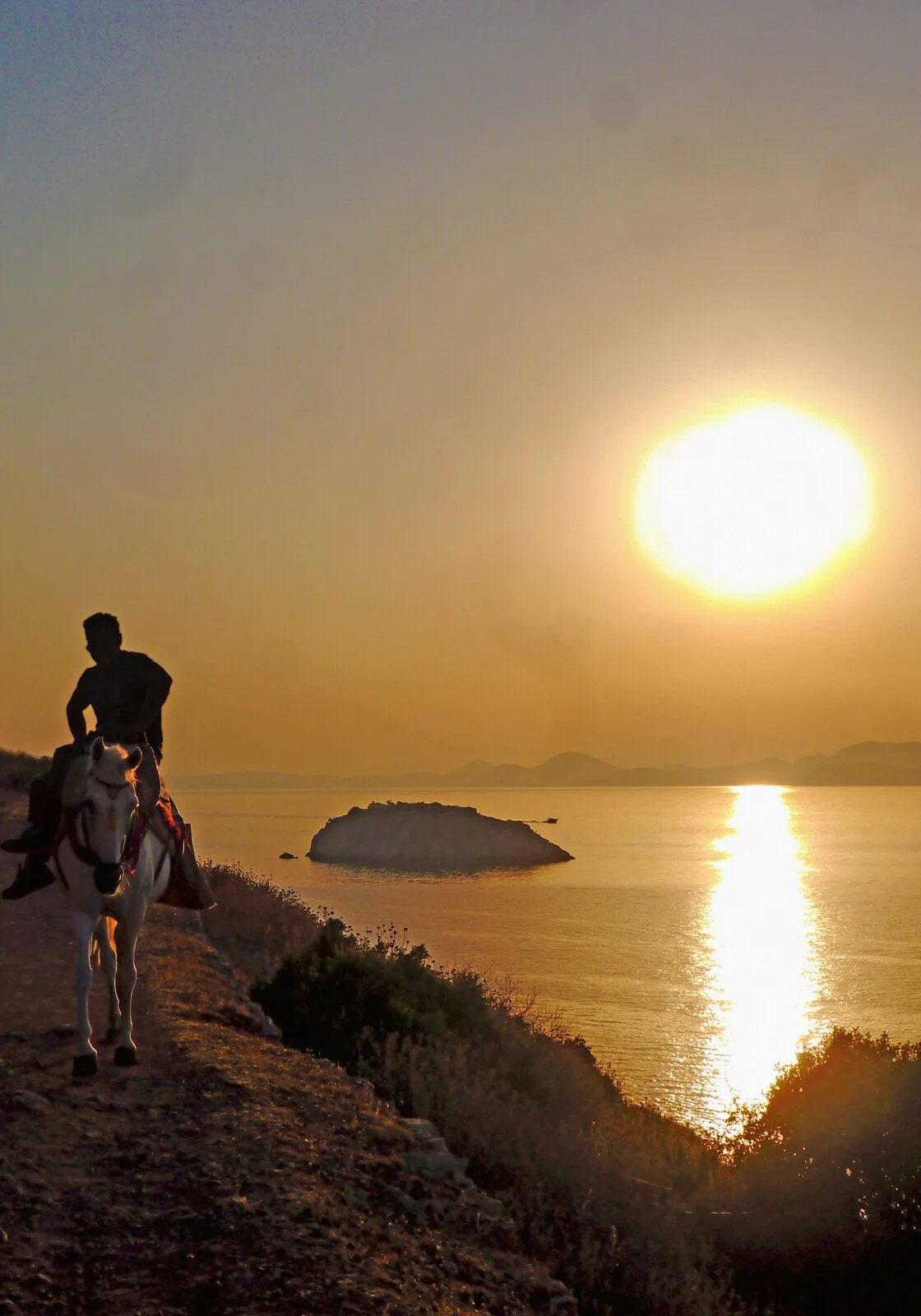
Jörgen Thornberg
Lonesome Rider, 2018
Digital
50 x 70 cm
The Lonesome Rider
In the dawn of time, when Earth was young,
He met a horse where rivers swung,
A bond was formed, both wild and free,
The rider and his steed, their destiny.
Through valleys deep and mountains high,
Together, they rode beneath the sky,
The world was vast, with roads untold,
But they pressed on, both brave and bold.
Years turned to decades, and decades to dust,
Yet through the ages, ride they must,
The rider's face grew lined and worn,
But in his heart, a passion was born.
The horse grew old, but strong they stayed,
Through battles fought and debts repaid,
In silence shared, no words were needed,
For every path, they both had heeded.
Centuries slipped by, like sand through hand,
And they journeyed far across unknown land,
Through every season, storm, dusk and sun,
Two lonesome spirits bound, yet still as one.
And when the day turned into night,
The stars above began to light,
Their final path, their last long ride,
Together to the universe wide.
Up to a star, the faithful pair softly trod,
No longer bound by earth or sod,
The rider and his mate, now complete,
Found peace at last in Starlight’s seat.
Forevermore, they roam the skies,
A pair of souls, where no one dies,
The Lonesome Rider and his steed,
Together, in the night, they lead.
Hydra, August 2024
The meeting in the backlight at sunset, just beyond Vlychos, was a sight to behold. The silhouette of someone riding toward Kamini and Hydra town atop a white horse was a vision of beauty. The association came instantly—the Lonesome Rider.
As I beheld the lone rider on their white horse, my mind was immediately drawn to Leonard Cohen's ‘The Ballad of the Absent Mare’, one of my favourites. This ballad, a significant piece in the narrative poetry genre, is a profound exploration of solitude, longing, and quiet reconciliation. It was as if the entire scene had been plucked from the song, imbued with the same emotions and themes that Cohen masterfully weaves in his work. The impact of this ballad on the narrative poetry genre is undeniable, and its influence can be seen in the work of many contemporary poets.
Inspired by country & western, Cohen's song weaves an allegorical tale of a rider searching for his lost horse. It’s a simple story but a profound symbol of love, loss, and reunion. The rider in the song and the one I saw before me both appeared to be on a solitary journey, filled with reflection and perhaps a glimmer of hope. Their journey, like the song, was laden with meaning and significance.
It was as if I had stepped into Cohen’s world—a place where every detail is laden with meaning, and every movement carries a story. It was impossible not to imagine that this rider was on the same journey as the one Cohen sings about and that the music in my mind was an echo of the long, silent passage ahead.
"Ballad Of The Absent Mare," a profound and meandering narrative from Leonard Cohen's 1979 album Recent Songs, emerges as one of his most evocative pieces. The title hints at the central theme of loss and the search for something that may not be truly lost. With its intricate layers and profound themes, Cohen's narrative is a captivating journey that leaves the reader spellbound. While the intricacies of Cohen's songwriting process often remain enigmatic, his close collaborator Jennifer Warnes has provided fascinating insights into this particular song in an essay on her website.
Warnes reminisced that Cohen had stumbled upon a series of old Japanese woodcuts known as "The Ten Bulls," which depict a monk's journey toward enlightenment. These images tell the story of a boy and a bull—how the boy loses the bull, searches for it, and finally realises that the bull was never truly lost. The boy eventually rides the bull back to his village. "I thought this would make a great cowboy song," Cohen quipped.
True to Cohen's style, he intricately weaves the metaphor with ambiguity, leaving the listener to marvel at the depth of the cowboy’s quest. For those unfamiliar with the reference to "The Ten Bulls," the song might easily be interpreted as a tale of a turbulent romantic relationship marked by cycles of separation and reunion. Cohen's mastery at blending the spiritual with the sensual is a testament to his artistry, and "Ballad Of The Absent Mare" is a perfect example of this breathtaking fusion.
The cowboy in the song is introduced in a state of despair, mourning the loss of his mare. He’s consumed by the "panic of loss," a feeling of intense fear and anxiety that often accompanies the realisation of losing something or someone dear. This panic, coupled with his pride and sorrow, prevents him from seeing the mare just a minute away, though not visible. His emotional journey, filled with despair and longing, is one that many can empathise with.
A songbird, a symbol of hope and guidance, breaks through his haze of self-pity, guiding him to the mare’s location at the boundary between light and darkness. Cohen's lyrics are descriptive and filled with vivid and captivating symbolism: “And the steam’s coming over/She’s huge and she’s shy/And she steps on the moon/When she paws at the sky.” This rich symbolism, which can be interpreted in various ways, adds an intriguing layer to the narrative, inviting the reader to delve deeper into its meaning and appreciate the depth of Cohen's storytelling.
Even as they reunite, Cohen subtly acknowledges the forces within the cowboy and the mare that drove them apart. These forces could be interpreted as the cowboy's pride and the mare's shyness or as more abstract concepts such as fate or the passage of time. Their ride off into the sunset isn’t the typical romantic conclusion; it’s tinged with the understanding that their bond is fragile (“Who snaps it as under the very next night.”). Love, the narrator reflects, might be “like the smoke/Beyond all repair.”
In a final twist, Cohen steps out of the narrative, revealing that the entire story has been a vision within his mind as he and his wife observe “That old silhouette/On the great western sky.” This silhouette, a symbol of the cowboy's journey and the mare's absence, is a powerful metaphor for the intangible nature of love and the human experience. It could be interpreted as the cowboy and the mare themselves or as a more abstract representation of their journey. In this moment, Cohen merges his concepts of romance and spiritual transcendence, hinting at the elusive nature of both. The 'old silhouette' is a symbol of the cowboy's journey and the mare's absence, representing the intangible nature of love and the human experience. It could be interpreted as the cowboy and the mare themselves or as a more abstract representation of their journey. In this moment, Cohen merges his concepts of romance and spiritual transcendence, hinting at the elusive nature of both. "Ballad Of The Absent Mare" fulfils Cohen's intention—it’s a profound cowboy song, as expansive and intangible as the horizon itself.
Just like the scene before me. Cohen faded out, and another song emerged, just as enigmatic but with a more brutal undertone.
"The Lonesome Rider" by Volbeat is one song that blends sadness, romance, blues, country, and rock. The song tells the story of a soldier who returns home from war, but the twist is that he's dead and doesn't realise it. His wife at home sees Death himself following her around, along with her husband. She tries to make a deal with Death to stay with her husband, but Death tells her that the only way is through death. So, she jumps from a cliff while Death watches. They find each other on their way to the afterlife on a distant star. This song, with its themes of love, loss, and reunion, echoes the narrative of Cohen's 'The Ballad of the Absent Mare ', providing a different perspective on the same themes. A happy ending? That depends on your perspective.
There’s also a movie, though the title was reversed to "Ride Lonesome," even though audiences often called it "Lonesome Rider" because it sounded better. The 1959 film is about an innocent man who has been wrongfully convicted of murder and is on the run from the law. Billy, the wanted murderer, is captured by Ben Brigade, a bounty hunter who plans to take him to Santa Cruz to be hanged. It might seem like a typical plot and could quickly have become a melodrama, but the fact is that the film has a 7.1 out of 10 rating on IMDb—a high score. The cast is filled with established and rising stars, including Randolph Scott, Karen Steele, Pernell Roberts, Lee Van Cleef, and James Coburn in his film debut.
Since the film is so old and the likelihood that you’ll stumble upon it is slim, I’ll reveal the ending, where everything is resolved in typical Wild West fashion with the help of firearms. Frank opens fire, causing Billy's horse to bolt and leave Billy hanging from the tree. Brigade kills Frank and shoots the rope, freeing Billy, while Boone and Whit chase off the rest of the gang. Brigade then turns Billy over to Boone and warns him to keep his promise to go straight. Typical Wild West morality—behave yourself, or else! No wonder America is so full of guns.
On Hydra, all handlers of hoofed animals are called "donkey men," regardless of whether they’re riding a donkey, mule, or horse. It’s a practical term that shouldn’t be misunderstood. Not too long ago, most animals transporting goods and people were donkeys, faithful companions to humans since ancient times. Donkeys were sufficient for most needs, and mules were significantly more expensive due to the complex breeding process. To produce a new donkey, you only need a mare and a stallion—they take care of the rest. If the mare becomes pregnant, a new donkey is automatically born, whether male or female. But to create a mule, you can't just leave a mare and a stallion alone in a field. No matter how much they mate, nature puts obstacles in the way. Only a few times in history has a foal resulted. Horses are a bit more luxurious, but their numbers have recently increased on Hydra. These aren’t large draft horses like Ardennes but smaller, more manageable ones that can navigate Hydra’s narrow alleys. Harriet’s horses have become a phenomenon on Hydra, offering tourists longer rides; some end on a secluded beach where the horses joyfully swim with their riders.
Humans and donkeys have shared a bond for thousands of years, though their shared history isn’t as long as that between humans and dogs. Donkeys were domesticated about 5,000–7,000 years ago in North Africa, likely in what is now Egypt and Sudan. Donkeys were primarily used as pack animals and for agricultural work, playing a crucial role in many cultures throughout history.
The relationship between humans and dogs stretches back at least 15,000 years, with some estimates suggesting that dogs may have been domesticated over 30,000 years ago. The dog was the first to be domesticated, and the bond between humans and dogs likely began as a mutually beneficial relationship, with dogs assisting in hunting and protecting.
Cats were domesticated around 9,000 years ago, along with the rise of agriculture in the Middle East. Cats were drawn to human settlements to hunt rodents attracted to grain stores.
Humans have had a more extended history with dogs than with donkeys and cats, but these animals have played significant roles in human development and culture.
The mule, often called a jackass, is a hybrid created by crossing a horse mare (a dam) with a donkey stallion (a jack). Mules have a long history and have been used by humans for thousands of years due to their strength, endurance, and resilience, making them ideal working animals in many cultures.
Mules have been in human service for over 3,000 years. The earliest documentation of mules comes from Mesopotamia and Egypt. In ancient Egypt, mules were already in use during the second millennium B.C., and they are mentioned in the Bible and other ancient texts. They were used for transportation, agriculture, and military purposes because of their ability to carry heavy loads over long distances and rough terrain. The pyramids would have been challenging to build without these strong animals.
Mules, often referred to as jackasses, are a unique hybrid, combining the best qualities of both their parent species. They are generally larger and more robust than donkeys, yet more durable and disease-resistant than horses. Their tough hooves and strong legs make them especially well-suited for work in mountainous or rugged areas, making them invaluable in regions like the Andes, the Himalayas, and parts of North Africa and the Middle East. Their unique qualities make them a versatile and valuable asset in various industries and cultures.
Mules have also been extensively used in agriculture, construction, and military campaigns throughout history, particularly in situations where horses would struggle. In many cultures, the mule has been seen as an indispensable animal on farms and for transportation.
Today, mules continue to play a significant role in many parts of the world, particularly in developing countries and areas where modern technology is not easily accessible or suitable. Their versatility and endurance make them ideal for agriculture, construction, and transportation tasks. They are also used in tourism, especially in mountainous regions where they help carry loads for tourists and hikers. For these reasons, most animals on Hydra today are mules, a testament to their enduring relevance and value.
In modern times, mules have also become popular in specialised areas, such as the Grand Canyon, where they transport visitors and supplies up and down steep trails.
Since mules are hybrids between two different species, they are typically sterile. This means they cannot reproduce, and each new generation of mules must be produced by crossing a horse mare with a donkey stallion. However, there are rare exceptions where a female mule has been able to reproduce, but this is very uncommon.
The mule symbolises hard work, endurance, and humility in many cultures. Although they are often seen as less noble than horses, they have nonetheless played a central role in many societies' economies and daily lives.
The history of the mule is a testament to how humans have adapted and bred animals to meet specific needs. The mule continues to be an important part of life in many parts of the world, both as a worker and a symbol.
In Hydra’s harbour, rows of hoofed animals patiently wait for a tourist to appear, willing to pay a hefty sum for a short tour around Hydra’s lower part. Just like the taxi boats nearby, it’s last in line and last to get a customer. The donkey men and the taxi boat drivers spend their waiting time at one of the nearby cafés, so they’re not too badly off. It was worse for the poor animals until a few years ago. Nowadays, they have parasols providing shade, which has become increasingly important in this age of climate change. These days, nine out of ten animals are mules; occasionally, you’ll find a horse and donkeys, as everywhere around the Mediterranean, are becoming increasingly rare.
We sat at Hydra Corner, a café conveniently located near the waiting animals. The donkey handler with the first animal in line always has to be on standby. As soon as he sets off with his load, it’s time for the following handler to get up from their coffee break.
I turned to Nikos, one of the donkey handlers, and asked, "How do you find a donkey if someone insists on riding like they did in the old days? For the uninitiated, it can be tricky."
Nikos nodded thoughtfully, then took a sip of his coffee. "Ah, it’s not as hard as it seems once you know what to look for," he began, setting his cup on the table. "First off, the ears are a dead giveaway. Donkeys have these long, narrow ears—much longer in proportion to their heads than any horse or mule."
"So, if I see those big ears, I’m probably looking at a donkey?" I asked, slightly amused.
"Exactly!" Nikos replied with a faint smile. He scraped his foot lightly against the ground and continued, "And the body shape is another clue. Donkeys have a more compact and robust build. They’re smaller overall, with skinnier legs and little hooves. Their backs are pretty straight and don’t have much mane, just a short, tufted one."
"Okay, so smaller, more compact, and straight-backed," I said, leaning back in my chair as the scent of freshly baked pastries wafted from the café. "But what if I come across a mule? They’re kind of a mix, right?"
Nikos nodded, his expression turning a bit more serious. "Yes, mules are a bit of a blend between a horse and a donkey," he explained. "They’re usually bigger than donkeys, sometimes almost the size of a horse, but they still have some of the donkey’s features. The ears, for instance, are longer than a horse’s but not quite as long as a donkey’s—sort of in between."
"That makes sense," I said as Nikos slowly lowered his cup. "And what about the tail? Does that help in telling them apart?"
"Absolutely!" Nikos gestured with his hand to indicate the different types of tails. "A donkey’s tail is more like a cow’s—thin with a tuft at the end. But a mule’s tail looks more like a horse’s, full and bushy, though sometimes it still has a bit of a tuft like a donkey’s."
"So, a bushy tail might mean it’s a mule, but a thin, tufted tail means it’s definitely a donkey," I said, somewhat impressed by how much you can discern from an animal’s appearance.
"Right on!" Nikos said, his voice warming as he continued, "And if you’re still unsure, just listen. Donkeys have this loud, braying sound—it’s pretty unique. On the other hand, Mules might make a noise that’s a mix between a horse’s neigh and a donkey’s bray." He raised an eyebrow as if recalling a particularly loud example.
"Oh, I’ve heard that bray before—definitely hard to miss," I said with a smile. "What about their heads and faces?"
"A donkey’s head is bigger compared to its body, with a straight or sometimes slightly concave nose," Nikos explained. "Mules have a head somewhere in between—smaller than a donkey’s but still a bit bigger than a horse’s."
Nikos nodded and gave me a final pat on the shoulder before standing up, ready to return to his animals. "Just remember," he said with a small smile, "big ears, compact body, and that unforgettable sound – then you’ve got yourself a donkey."
"So, if it’s got an oversized head and a straight nose, it’s likely a donkey. And if it’s somewhere in between, it’s probably a mule," I said, feeling like I was getting the hang of it.
Nikos nodded, then leaned back in his chair, his eyes twinkling as he took a moment to gather his thoughts. “You know, there’s a lot more to these animals than just their looks. People often say donkeys are stubborn, and there’s some truth to that. But it’s not just stubbornness—it’s more like they’re cautious, careful. A donkey won’t do something if it doesn’t feel safe. They’ve got this instinct to protect themselves, and that’s where the so-called stubbornness comes from.”
I raised an eyebrow, intrigued. “So, does that mean mules are the same way? Are they just as cautious or have a different temperament?”
Nikos smiled, taking a sip of his coffee before answering. “Mules have a bit of both. They inherit the donkey’s cautious nature, but they also get some of the horse’s spirit and willingness to work. Mules can be stubborn, too, but they’re usually more willing to take a risk if they trust the person handling them. That’s the key—trust. A mule that trusts its handler can be very dependable, but if they don’t trust you, they can be just as stubborn as any donkey.”
I nodded, thinking it over. “So, which one is easier to handle—donkeys or mules?”
Nikos chuckled softly. “That depends on what you’re looking for. Donkeys are generally more predictable because they’re so careful, but that also means they’re slower to move or to try new things. Conversely, mules can be a bit more spirited, but they’re also stronger and more versatile. A mule can be a fantastic partner if you’re patient and know how to build trust. But a donkey might be better if you want something steady and reliable.”
“So, it’s a trade-off,” I said, sipping my coffee. “Cautious and steady with a donkey, or a bit more spirited but versatile with a mule.”
“Exactly,” Nikos agreed. “It comes down to what you need them for and how well you can connect with the animal. Both have their strengths, but they also require understanding and patience. No matter which one you’re working with, you’ve got to respect their nature.”
I smiled, feeling like I was starting to appreciate the nuances of these animals. “Thanks, Nikos. I’m starting to see why people have relied on these animals for so long.”
Nikos nodded, a satisfied look on his face. “They’ve been with us for centuries for good reason. They may be stubborn, but they’re also smart, strong, and, with the right touch, loyal to a fault.”
I chuckled and nodded. "Thanks, Nikos. I think I’ve learned something new today."
With that, Nikos returned to his animals, ready to lead the next group up the narrow paths of Hydra, while I stayed a moment longer, savouring the quiet morning and the knowledge I had just gained.
Early in Greek history, probably during the eighth and seventh centuries s.c., there spread through
Greece was a religious movement, and the name Orphism, derived from the Orpheus of legend, was given. Orphism taught that man was a creature of sin and blasphemy, that the body was the soul's prison, and that by ceremonial purification, the soul could win a more blessed existence in the world to come. This movement found concrete expression in the “ mysteries," which were sought by those depressed by a consciousness of sin or the awful facts of life and death. Mysteries were associated with the worship of the dead and with various deities! But especially with Demeter and her worship at Eleusis.
The ritual, if we may judge from the little we know about it,? was trivial and absurd, but there can be no doubt that it did much to satisfy the emotional side of the religious instincts of the Greeks.
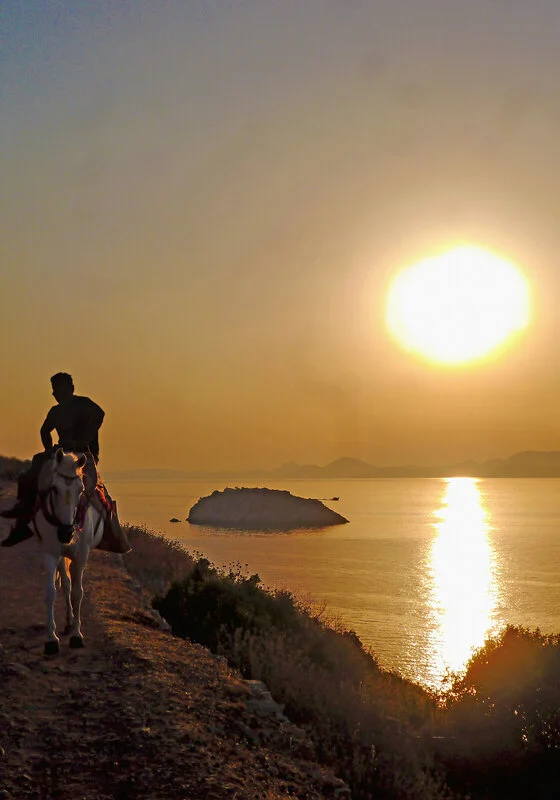
Jörgen Thornberg
Lonesome Rider, 2018
Digital
50 x 70 cm
The Lonesome Rider
In the dawn of time, when Earth was young,
He met a horse where rivers swung,
A bond was formed, both wild and free,
The rider and his steed, their destiny.
Through valleys deep and mountains high,
Together, they rode beneath the sky,
The world was vast, with roads untold,
But they pressed on, both brave and bold.
Years turned to decades, and decades to dust,
Yet through the ages, ride they must,
The rider's face grew lined and worn,
But in his heart, a passion was born.
The horse grew old, but strong they stayed,
Through battles fought and debts repaid,
In silence shared, no words were needed,
For every path, they both had heeded.
Centuries slipped by, like sand through hand,
And they journeyed far across unknown land,
Through every season, storm, dusk and sun,
Two lonesome spirits bound, yet still as one.
And when the day turned into night,
The stars above began to light,
Their final path, their last long ride,
Together to the universe wide.
Up to a star, the faithful pair softly trod,
No longer bound by earth or sod,
The rider and his mate, now complete,
Found peace at last in Starlight’s seat.
Forevermore, they roam the skies,
A pair of souls, where no one dies,
The Lonesome Rider and his steed,
Together, in the night, they lead.
Hydra, August 2024
The meeting in the backlight at sunset, just beyond Vlychos, was a sight to behold. The silhouette of someone riding toward Kamini and Hydra town atop a white horse was a vision of beauty. The association came instantly—the Lonesome Rider.
As I beheld the lone rider on their white horse, my mind was immediately drawn to Leonard Cohen's ‘The Ballad of the Absent Mare’, one of my favourites. This ballad, a significant piece in the narrative poetry genre, is a profound exploration of solitude, longing, and quiet reconciliation. It was as if the entire scene had been plucked from the song, imbued with the same emotions and themes that Cohen masterfully weaves in his work. The impact of this ballad on the narrative poetry genre is undeniable, and its influence can be seen in the work of many contemporary poets.
Inspired by country & western, Cohen's song weaves an allegorical tale of a rider searching for his lost horse. It’s a simple story but a profound symbol of love, loss, and reunion. The rider in the song and the one I saw before me both appeared to be on a solitary journey, filled with reflection and perhaps a glimmer of hope. Their journey, like the song, was laden with meaning and significance.
It was as if I had stepped into Cohen’s world—a place where every detail is laden with meaning, and every movement carries a story. It was impossible not to imagine that this rider was on the same journey as the one Cohen sings about and that the music in my mind was an echo of the long, silent passage ahead.
"Ballad Of The Absent Mare," a profound and meandering narrative from Leonard Cohen's 1979 album Recent Songs, emerges as one of his most evocative pieces. The title hints at the central theme of loss and the search for something that may not be truly lost. With its intricate layers and profound themes, Cohen's narrative is a captivating journey that leaves the reader spellbound. While the intricacies of Cohen's songwriting process often remain enigmatic, his close collaborator Jennifer Warnes has provided fascinating insights into this particular song in an essay on her website.
Warnes reminisced that Cohen had stumbled upon a series of old Japanese woodcuts known as "The Ten Bulls," which depict a monk's journey toward enlightenment. These images tell the story of a boy and a bull—how the boy loses the bull, searches for it, and finally realises that the bull was never truly lost. The boy eventually rides the bull back to his village. "I thought this would make a great cowboy song," Cohen quipped.
True to Cohen's style, he intricately weaves the metaphor with ambiguity, leaving the listener to marvel at the depth of the cowboy’s quest. For those unfamiliar with the reference to "The Ten Bulls," the song might easily be interpreted as a tale of a turbulent romantic relationship marked by cycles of separation and reunion. Cohen's mastery at blending the spiritual with the sensual is a testament to his artistry, and "Ballad Of The Absent Mare" is a perfect example of this breathtaking fusion.
The cowboy in the song is introduced in a state of despair, mourning the loss of his mare. He’s consumed by the "panic of loss," a feeling of intense fear and anxiety that often accompanies the realisation of losing something or someone dear. This panic, coupled with his pride and sorrow, prevents him from seeing the mare just a minute away, though not visible. His emotional journey, filled with despair and longing, is one that many can empathise with.
A songbird, a symbol of hope and guidance, breaks through his haze of self-pity, guiding him to the mare’s location at the boundary between light and darkness. Cohen's lyrics are descriptive and filled with vivid and captivating symbolism: “And the steam’s coming over/She’s huge and she’s shy/And she steps on the moon/When she paws at the sky.” This rich symbolism, which can be interpreted in various ways, adds an intriguing layer to the narrative, inviting the reader to delve deeper into its meaning and appreciate the depth of Cohen's storytelling.
Even as they reunite, Cohen subtly acknowledges the forces within the cowboy and the mare that drove them apart. These forces could be interpreted as the cowboy's pride and the mare's shyness or as more abstract concepts such as fate or the passage of time. Their ride off into the sunset isn’t the typical romantic conclusion; it’s tinged with the understanding that their bond is fragile (“Who snaps it as under the very next night.”). Love, the narrator reflects, might be “like the smoke/Beyond all repair.”
In a final twist, Cohen steps out of the narrative, revealing that the entire story has been a vision within his mind as he and his wife observe “That old silhouette/On the great western sky.” This silhouette, a symbol of the cowboy's journey and the mare's absence, is a powerful metaphor for the intangible nature of love and the human experience. It could be interpreted as the cowboy and the mare themselves or as a more abstract representation of their journey. In this moment, Cohen merges his concepts of romance and spiritual transcendence, hinting at the elusive nature of both. The 'old silhouette' is a symbol of the cowboy's journey and the mare's absence, representing the intangible nature of love and the human experience. It could be interpreted as the cowboy and the mare themselves or as a more abstract representation of their journey. In this moment, Cohen merges his concepts of romance and spiritual transcendence, hinting at the elusive nature of both. "Ballad Of The Absent Mare" fulfils Cohen's intention—it’s a profound cowboy song, as expansive and intangible as the horizon itself.
Just like the scene before me. Cohen faded out, and another song emerged, just as enigmatic but with a more brutal undertone.
"The Lonesome Rider" by Volbeat is one song that blends sadness, romance, blues, country, and rock. The song tells the story of a soldier who returns home from war, but the twist is that he's dead and doesn't realise it. His wife at home sees Death himself following her around, along with her husband. She tries to make a deal with Death to stay with her husband, but Death tells her that the only way is through death. So, she jumps from a cliff while Death watches. They find each other on their way to the afterlife on a distant star. This song, with its themes of love, loss, and reunion, echoes the narrative of Cohen's 'The Ballad of the Absent Mare ', providing a different perspective on the same themes. A happy ending? That depends on your perspective.
There’s also a movie, though the title was reversed to "Ride Lonesome," even though audiences often called it "Lonesome Rider" because it sounded better. The 1959 film is about an innocent man who has been wrongfully convicted of murder and is on the run from the law. Billy, the wanted murderer, is captured by Ben Brigade, a bounty hunter who plans to take him to Santa Cruz to be hanged. It might seem like a typical plot and could quickly have become a melodrama, but the fact is that the film has a 7.1 out of 10 rating on IMDb—a high score. The cast is filled with established and rising stars, including Randolph Scott, Karen Steele, Pernell Roberts, Lee Van Cleef, and James Coburn in his film debut.
Since the film is so old and the likelihood that you’ll stumble upon it is slim, I’ll reveal the ending, where everything is resolved in typical Wild West fashion with the help of firearms. Frank opens fire, causing Billy's horse to bolt and leave Billy hanging from the tree. Brigade kills Frank and shoots the rope, freeing Billy, while Boone and Whit chase off the rest of the gang. Brigade then turns Billy over to Boone and warns him to keep his promise to go straight. Typical Wild West morality—behave yourself, or else! No wonder America is so full of guns.
On Hydra, all handlers of hoofed animals are called "donkey men," regardless of whether they’re riding a donkey, mule, or horse. It’s a practical term that shouldn’t be misunderstood. Not too long ago, most animals transporting goods and people were donkeys, faithful companions to humans since ancient times. Donkeys were sufficient for most needs, and mules were significantly more expensive due to the complex breeding process. To produce a new donkey, you only need a mare and a stallion—they take care of the rest. If the mare becomes pregnant, a new donkey is automatically born, whether male or female. But to create a mule, you can't just leave a mare and a stallion alone in a field. No matter how much they mate, nature puts obstacles in the way. Only a few times in history has a foal resulted. Horses are a bit more luxurious, but their numbers have recently increased on Hydra. These aren’t large draft horses like Ardennes but smaller, more manageable ones that can navigate Hydra’s narrow alleys. Harriet’s horses have become a phenomenon on Hydra, offering tourists longer rides; some end on a secluded beach where the horses joyfully swim with their riders.
Humans and donkeys have shared a bond for thousands of years, though their shared history isn’t as long as that between humans and dogs. Donkeys were domesticated about 5,000–7,000 years ago in North Africa, likely in what is now Egypt and Sudan. Donkeys were primarily used as pack animals and for agricultural work, playing a crucial role in many cultures throughout history.
The relationship between humans and dogs stretches back at least 15,000 years, with some estimates suggesting that dogs may have been domesticated over 30,000 years ago. The dog was the first to be domesticated, and the bond between humans and dogs likely began as a mutually beneficial relationship, with dogs assisting in hunting and protecting.
Cats were domesticated around 9,000 years ago, along with the rise of agriculture in the Middle East. Cats were drawn to human settlements to hunt rodents attracted to grain stores.
Humans have had a more extended history with dogs than with donkeys and cats, but these animals have played significant roles in human development and culture.
The mule, often called a jackass, is a hybrid created by crossing a horse mare (a dam) with a donkey stallion (a jack). Mules have a long history and have been used by humans for thousands of years due to their strength, endurance, and resilience, making them ideal working animals in many cultures.
Mules have been in human service for over 3,000 years. The earliest documentation of mules comes from Mesopotamia and Egypt. In ancient Egypt, mules were already in use during the second millennium B.C., and they are mentioned in the Bible and other ancient texts. They were used for transportation, agriculture, and military purposes because of their ability to carry heavy loads over long distances and rough terrain. The pyramids would have been challenging to build without these strong animals.
Mules, often referred to as jackasses, are a unique hybrid, combining the best qualities of both their parent species. They are generally larger and more robust than donkeys, yet more durable and disease-resistant than horses. Their tough hooves and strong legs make them especially well-suited for work in mountainous or rugged areas, making them invaluable in regions like the Andes, the Himalayas, and parts of North Africa and the Middle East. Their unique qualities make them a versatile and valuable asset in various industries and cultures.
Mules have also been extensively used in agriculture, construction, and military campaigns throughout history, particularly in situations where horses would struggle. In many cultures, the mule has been seen as an indispensable animal on farms and for transportation.
Today, mules continue to play a significant role in many parts of the world, particularly in developing countries and areas where modern technology is not easily accessible or suitable. Their versatility and endurance make them ideal for agriculture, construction, and transportation tasks. They are also used in tourism, especially in mountainous regions where they help carry loads for tourists and hikers. For these reasons, most animals on Hydra today are mules, a testament to their enduring relevance and value.
In modern times, mules have also become popular in specialised areas, such as the Grand Canyon, where they transport visitors and supplies up and down steep trails.
Since mules are hybrids between two different species, they are typically sterile. This means they cannot reproduce, and each new generation of mules must be produced by crossing a horse mare with a donkey stallion. However, there are rare exceptions where a female mule has been able to reproduce, but this is very uncommon.
The mule symbolises hard work, endurance, and humility in many cultures. Although they are often seen as less noble than horses, they have nonetheless played a central role in many societies' economies and daily lives.
The history of the mule is a testament to how humans have adapted and bred animals to meet specific needs. The mule continues to be an important part of life in many parts of the world, both as a worker and a symbol.
In Hydra’s harbour, rows of hoofed animals patiently wait for a tourist to appear, willing to pay a hefty sum for a short tour around Hydra’s lower part. Just like the taxi boats nearby, it’s last in line and last to get a customer. The donkey men and the taxi boat drivers spend their waiting time at one of the nearby cafés, so they’re not too badly off. It was worse for the poor animals until a few years ago. Nowadays, they have parasols providing shade, which has become increasingly important in this age of climate change. These days, nine out of ten animals are mules; occasionally, you’ll find a horse and donkeys, as everywhere around the Mediterranean, are becoming increasingly rare.
We sat at Hydra Corner, a café conveniently located near the waiting animals. The donkey handler with the first animal in line always has to be on standby. As soon as he sets off with his load, it’s time for the following handler to get up from their coffee break.
I turned to Nikos, one of the donkey handlers, and asked, "How do you find a donkey if someone insists on riding like they did in the old days? For the uninitiated, it can be tricky."
Nikos nodded thoughtfully, then took a sip of his coffee. "Ah, it’s not as hard as it seems once you know what to look for," he began, setting his cup on the table. "First off, the ears are a dead giveaway. Donkeys have these long, narrow ears—much longer in proportion to their heads than any horse or mule."
"So, if I see those big ears, I’m probably looking at a donkey?" I asked, slightly amused.
"Exactly!" Nikos replied with a faint smile. He scraped his foot lightly against the ground and continued, "And the body shape is another clue. Donkeys have a more compact and robust build. They’re smaller overall, with skinnier legs and little hooves. Their backs are pretty straight and don’t have much mane, just a short, tufted one."
"Okay, so smaller, more compact, and straight-backed," I said, leaning back in my chair as the scent of freshly baked pastries wafted from the café. "But what if I come across a mule? They’re kind of a mix, right?"
Nikos nodded, his expression turning a bit more serious. "Yes, mules are a bit of a blend between a horse and a donkey," he explained. "They’re usually bigger than donkeys, sometimes almost the size of a horse, but they still have some of the donkey’s features. The ears, for instance, are longer than a horse’s but not quite as long as a donkey’s—sort of in between."
"That makes sense," I said as Nikos slowly lowered his cup. "And what about the tail? Does that help in telling them apart?"
"Absolutely!" Nikos gestured with his hand to indicate the different types of tails. "A donkey’s tail is more like a cow’s—thin with a tuft at the end. But a mule’s tail looks more like a horse’s, full and bushy, though sometimes it still has a bit of a tuft like a donkey’s."
"So, a bushy tail might mean it’s a mule, but a thin, tufted tail means it’s definitely a donkey," I said, somewhat impressed by how much you can discern from an animal’s appearance.
"Right on!" Nikos said, his voice warming as he continued, "And if you’re still unsure, just listen. Donkeys have this loud, braying sound—it’s pretty unique. On the other hand, Mules might make a noise that’s a mix between a horse’s neigh and a donkey’s bray." He raised an eyebrow as if recalling a particularly loud example.
"Oh, I’ve heard that bray before—definitely hard to miss," I said with a smile. "What about their heads and faces?"
"A donkey’s head is bigger compared to its body, with a straight or sometimes slightly concave nose," Nikos explained. "Mules have a head somewhere in between—smaller than a donkey’s but still a bit bigger than a horse’s."
Nikos nodded and gave me a final pat on the shoulder before standing up, ready to return to his animals. "Just remember," he said with a small smile, "big ears, compact body, and that unforgettable sound – then you’ve got yourself a donkey."
"So, if it’s got an oversized head and a straight nose, it’s likely a donkey. And if it’s somewhere in between, it’s probably a mule," I said, feeling like I was getting the hang of it.
Nikos nodded, then leaned back in his chair, his eyes twinkling as he took a moment to gather his thoughts. “You know, there’s a lot more to these animals than just their looks. People often say donkeys are stubborn, and there’s some truth to that. But it’s not just stubbornness—it’s more like they’re cautious, careful. A donkey won’t do something if it doesn’t feel safe. They’ve got this instinct to protect themselves, and that’s where the so-called stubbornness comes from.”
I raised an eyebrow, intrigued. “So, does that mean mules are the same way? Are they just as cautious or have a different temperament?”
Nikos smiled, taking a sip of his coffee before answering. “Mules have a bit of both. They inherit the donkey’s cautious nature, but they also get some of the horse’s spirit and willingness to work. Mules can be stubborn, too, but they’re usually more willing to take a risk if they trust the person handling them. That’s the key—trust. A mule that trusts its handler can be very dependable, but if they don’t trust you, they can be just as stubborn as any donkey.”
I nodded, thinking it over. “So, which one is easier to handle—donkeys or mules?”
Nikos chuckled softly. “That depends on what you’re looking for. Donkeys are generally more predictable because they’re so careful, but that also means they’re slower to move or to try new things. Conversely, mules can be a bit more spirited, but they’re also stronger and more versatile. A mule can be a fantastic partner if you’re patient and know how to build trust. But a donkey might be better if you want something steady and reliable.”
“So, it’s a trade-off,” I said, sipping my coffee. “Cautious and steady with a donkey, or a bit more spirited but versatile with a mule.”
“Exactly,” Nikos agreed. “It comes down to what you need them for and how well you can connect with the animal. Both have their strengths, but they also require understanding and patience. No matter which one you’re working with, you’ve got to respect their nature.”
I smiled, feeling like I was starting to appreciate the nuances of these animals. “Thanks, Nikos. I’m starting to see why people have relied on these animals for so long.”
Nikos nodded, a satisfied look on his face. “They’ve been with us for centuries for good reason. They may be stubborn, but they’re also smart, strong, and, with the right touch, loyal to a fault.”
I chuckled and nodded. "Thanks, Nikos. I think I’ve learned something new today."
With that, Nikos returned to his animals, ready to lead the next group up the narrow paths of Hydra, while I stayed a moment longer, savouring the quiet morning and the knowledge I had just gained.
Early in Greek history, probably during the eighth and seventh centuries s.c., there spread through
Greece was a religious movement, and the name Orphism, derived from the Orpheus of legend, was given. Orphism taught that man was a creature of sin and blasphemy, that the body was the soul's prison, and that by ceremonial purification, the soul could win a more blessed existence in the world to come. This movement found concrete expression in the “ mysteries," which were sought by those depressed by a consciousness of sin or the awful facts of life and death. Mysteries were associated with the worship of the dead and with various deities! But especially with Demeter and her worship at Eleusis.
The ritual, if we may judge from the little we know about it,? was trivial and absurd, but there can be no doubt that it did much to satisfy the emotional side of the religious instincts of the Greeks.

Jörgen Thornberg
Malmö
Lite om bilder och mig. Translation in English at the end.
Jag är en nyfiken person som ser allt i bilder, även det jag fäster i ord, gärna tillsammans för bakom alla mina bilder finns en berättelse. Till vissa bilder hör en kortare eller längre novell som följer med bilden.
Bilder berättar historier. Jag omges av naturlig skönhet, intressanta människor och historia var jag än går. Jag använder min kamera för att dokumentera världen och blanda det jag ser med vad jag känner för att fånga den dolda magin.
Mina bilder berättar mina historier. Genom mina bilder, tryck och berättelser. Jag bjuder in dig att ta del av dessa berättelser, in i ditt liv och hem och dela min mycket personliga syn på vår värld. Mer än vad ögat ser. Jag tänker i bilder, drömmer och skriver och pratar om dem; följaktligen måste jag också skapa bilder. De blir vad jag ser, inte nödvändigtvis begränsade till verkligheten. Det finns en bild runt varje hörn. Jag hoppas att du kommer att se vad jag såg och gilla det.
Jag är också en skrivande person och till många bilder hör en kortare eller längre essay. Den följer med tavlan, tryckt på fint papper och med en personlig hälsning från mig.
Flertalet bilder startar sin resa i min kamera. Enkelt förklarat beskriver jag bilden jag ser i mitt inre, upplevd eller fantiserad. Bilden uppstår inom mig redan innan jag fått okularet till ögat. På bråkdelen av ett ögonblick ser jag vad jag vill ha och vad som kan göras med bilden. Här skall jag stoppa in en giraff, stålmannen, Titanic eller vad det är min fantasi finner ut. Ännu märkligare är att jag kommer ihåg minnesbilden långt efteråt när det blir tid att skapa verket. Om jag lyckas eller inte, är upp till betraktaren, oftast präglat av en stråk av svart humor – meningen är att man skall bli underhållen. Mina bilder blir ofta en snackis där de hänger.
Jag föredrar bilder som förmedlar ett budskap i flera lager. Vid första anblicken fylld av feel-good, en vacker utsikt, fint väder, solen skiner, blommor på ängen eller vattnet som ligger förrädiskt spegelblankt. I en sådan bild kan jag gömma min egentliga berättelse, mitt förakt för förtryckare och våldsverkare, rasister och fördomsfulla människor - ett gärna återkommande motiv mer eller mindre dolt i det vackra motivet. Jag försöker förena dem i ett gemensamt narrativ.
Bild och formgivning har löpt som en röd tråd genom livet. Fotokonst känns som en värdig final som jag gärna delar med mig.
Min genre är vid som framgår av mina bilder, temat en blandning av pop- och gatukonst i kollage som kan bestå av hundratals lager. Vissa bilder kan ta veckor, andra någon dag innan det är dags att överlämna resultatet till printverkstaden. Fine Art Prints är digitala fotocollage. I dessa kollage sker rivandet, klippandet, pusslandet, målandet, ritandet och sprayningen digitalt. Det jag monterar in kan vara hundratals år gamla bilder som jag omsorgsfullt frilägger så att de ser ut att vara en del av tavlan men också bilder skapade av mig själv efter min egen fantasi. Därefter besöks printstudion och för vissa bilder numrera en limiterad upplaga (oftast 7 exemplar) och signera för hand. Vissa bilder kan köpas i olika format. Det är bara att fråga efter vilka. Gillar man en bild som är 70x100 men inte har plats på väggen, går den kanske att få i 50x70 cm istället. Frågan är fri.
Metoden Giclée eller Fine Art Print som det också kallas är det moderna sättet för framställning av grafisk konst. Villkoret för denna typ av utskrifter är att en högkvalitativ storformatskrivare används med åldersbeständigt färgpigment och konstnärspapper eller i förekommande fall på duk. Pappret som används möter de krav på livslängd som ställs av museer och gallerier. Normalt säljer jag mina bilder oinramade så att den nya ägaren själv kan bestämma hur de skall se ut, med eller utan passepartout färg på ram, med eller utan glas etc..
Under många år ställde jag bara ut på nätet, i valda grupper och på min egen Facebooksida - https://www.facebook.com/jorgen.thornberg.9
Jag finns också på en egen hemsida som tyvärr inte alltid är uppdaterad – https://www.jth.life/ Där kan du också läsa en del av de berättelser som följer med bilden.
UTSTÄLLNINGAR
Luftkastellet, oktober 2022
Konst i Lund, november 2022
Luftkastellet, mars 2023
Engleson Galleri Caroli, april 2023
Hydra, Greece June 2023
Engleson Galleri Caroli, oktober 2023
Toppen, Höllviken december 2023
Luftkastellet, mars 2024
Torups Galleri, mars 2024
Venice, May 2024
Luftkastellet, oktober 2024
Konst i Advent, December 2024
Galleri Engleson, Caroli December 2024
Jäger & Jansson Galleri, april 2025
A bit about pictures and me.
I'm a curious person who sees everything in pictures, even what I express in words, often combining them, for behind all my pictures lies a story. These narratives, some as short as a single image and others as long as a novel, are the heart and soul of my work.
Pictures tell stories. Wherever I go, I'm surrounded by natural beauty, exciting people, and history. I use my camera to document the world and blend what I see with what I feel to capture the hidden magic.
My images tell my stories. Through my pictures, prints, and narratives, I invite you to partake in these stories in your life and home and share my deeply personal perspective of our world. More than meets the eye. I think in pictures, dream, write, and talk about them; consequently, I must create images too. They become what I see, not necessarily confined to reality. There's a picture around every corner. I hope you'll see what I saw and enjoy it.
I'm also a writer, and many images come with a shorter or longer essay. It accompanies the painting, printed on fine paper with my personal greeting.
Many pictures start their journey on my camera. Simply put, I describe the image I see in my mind, experienced or imagined. The image arises within me even before I bring the eyepiece to my eye. In a fraction of a moment, I see what I want and what can be done with the picture. Here, I'll insert a giraffe, Superman, the Titanic, or whatever my imagination conjures up. Even stranger is that I remember the mental image long after it's time to create the work. Whether I succeed is up to the observer, often imbued with a streak of black humour – the aim is to entertain. My pictures usually become a talking point wherever they hang.
I prefer pictures that convey a message in multiple layers. At first glance, they're filled with feel-good vibes, a beautiful view, lovely weather, the sun shining, flowers in the meadow, or the water lying deceptively calm. But beneath this surface beauty, I often conceal a deeper story, a narrative that challenges societal norms or explores the human condition. I invite you to delve into these hidden narratives and discover the layers of meaning within my work.
Picture and design have been a thread running through my life. Photographic art feels like a fitting finale, and I'm happy to share it.
My genre is varied, as seen in my pictures; the theme is a blend of pop and street art in collages that can consist of hundreds of layers. Some images can take weeks, others just a day before it's time to hand over the result to the print workshop. Fine Art Prints are digital photo collages. In these collages, tearing, cutting, puzzling, painting, drawing, and spraying happen digitally. What I insert can be images hundreds of years old that I carefully extract so they appear to be part of the painting, but also images created by myself, now also generated from my imagination. Next, visit the print studio and, for certain images, number a limited edition (usually 7 copies) and sign them by hand. Some images may be available in other formats. Just ask which ones. If you like an image that's 70x100 but doesn't have space on the wall, you might be able to get it in 50x70 cm instead. The question is open.
The Giclée method, or Fine Art Print as it's also called, is the modern way of producing graphic art. This method ensures the highest quality and longevity of the artwork, using a high-quality large-format printer with archival pigment inks and artist paper or, in some cases, canvas. The paper used meets the longevity requirements set by museums and galleries. I sell my pictures unframed, allowing the new owner to personalise their artwork, confident in the lasting value and quality of the piece.
For many years, I only exhibited online, in selected groups, and on my Facebook page - https://www.facebook.com/jorgen.thornberg.9. I also have my website, which unfortunately is not constantly updated - https://www.jth.life/. You can also read some of the stories accompanying the pictures there.
EXHIBITIONS
Luftkastellet, October 2022
Art in Lund, November 2022
Luftkastellet, March 2023
Engleson Gallery Caroli, April 2023
Hydra, Greece June 2023
Engleson Gallery Caroli, October 2023
Toppen, Höllviken December 2023
Luftkastellet, March 2024
Torup Gallery, March 2024
Venice, May 2024
UTSTÄLLNINGAR
Luftkastellet, oktober 2022
Konst i Lund, november 2022
Luftkastellet, mars 2023
Engleson Galleri Caroli, april 2023
Hydra, Greece June 2023
Engleson Galleri Caroli, oktober 2023
Toppen, Höllviken december 2023
Luftkastellet, mars 2024
Torups Galleri, mars 2024
Venice, May 2024
Luftkastellet, October 2024
Konst i Advent, December 2024
Galleri Engleson, Caroli December 2024
Jäger & Jansson Galleri, April 2025
Utbildning
Autodidakt
Medlem i konstnärsförening
Öppna Sinnen
Med i konstrunda
Konstrundan i Skåne
Utställningar
Luftkastellet, October 2022
Art in Lund, November 2022
Luftkastellet, March 2023
Engleson Gallery Caroli, April 2023
Hydra, Greece June 2023
Engleson Gallery Caroli, October 2023
Toppen, Höllviken December 2023
Luftkastellet, March 2024
Torup Gallery, March 2024
Venice, May 2024