Vi använder cookies för att ge dig bästa möjliga upplevelse. Välj vilka cookies du tillåter.
Läs mer i vår integritetspolicy
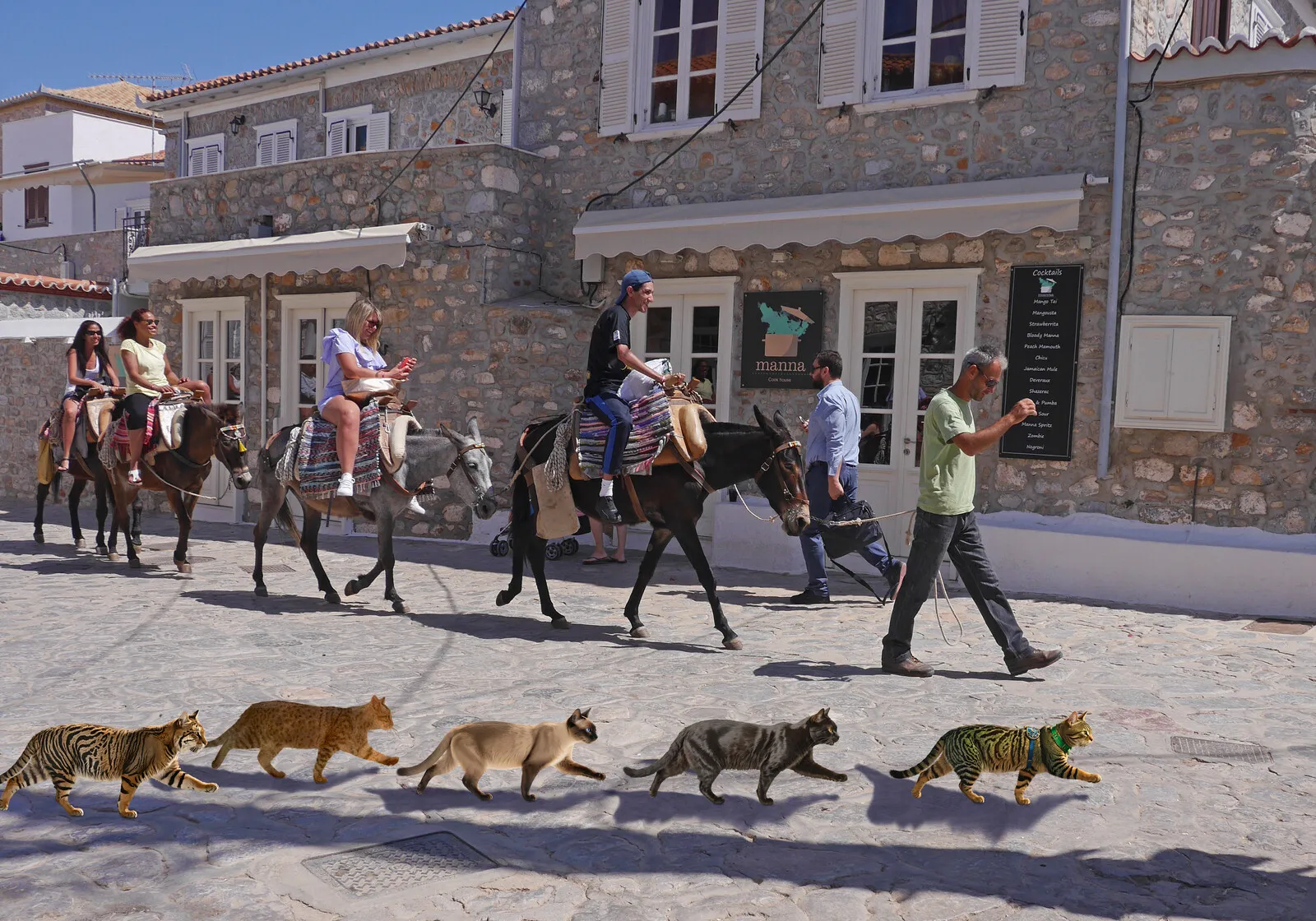
Jörgen Thornberg
In tandem, please, 2024
Digital
70 x 50 cm
Cat March
In the late afternoon's strong, white light,
With shadows stretching into the bright,
The cats marched on in perfect sync,
Toward Bratsera, no need to think.
Under the sun’s glow, the cats align,
A hungry troop, in perfect line.
To Bratsera’s door, they march as one,
Their daily feast has just begun.
With tails held high and paws in sync,
They move as one, no need to think.
The scent of fish, a siren's call,
Draws them to the restaurant's hall.
Through cobbled streets, they swiftly glide,
Their hunger's pull, their only guide.
For scraps and bites, they’ve come to dine,
Where human taste has drawn the line.
The red tabby craved smoked octopus fine,
While the tiger-striped dreamed of sardines in vine.
The black lady's favourite? Lamb Kotsi, of course,
Hydra’s best dish, without remorse.
The white cat longed for red tuna so grand,
With pistachio crust, the finest in the land.
And the grey tomcat, with his sweet-tooth flair,
Dreamed of cheese pie with apples to share.
Step by step, to the feast they tread,
Their bellies rumbling, thoughts of being fed.
To Bratsera’s kitchen, they marched with pride,
Where tasty delights awaited inside.
Yet to these cats, the food’s a prize,
No need for fresh, no need for lies.
They'll feast after this grand parade,
Till dawn arrives, and shadows fade.
Hydra, August 2024
The cats and the donkey train were headed in the same direction, an occurrence that, even on cat-rich Hydra, doesn’t happen daily. Though they were mules, we still call it a "donkey train" locally and the driver a "donkey man," regardless of which hoofed animal we’re talking about. Cats and mules marched in step, led by the donkey man. When such things happen, the imagination is sparked, and within me, I was filled with march music, specifically the Radetzky March—a contagious rhythm. This march, which shares its name with the month of March and the military term, is a staple of the New Year’s Concert from Vienna every year and, in some way, has become the march of all marches. The strange thing was that we all must have heard the same melody because they marched in sync with that music. The connection between the Radetzky March and the donkey train lies in their movements' shared rhythm and discipline, highlighting the universal nature of the march's influence and fostering a sense of shared cultural experience among the audience.
Josef Wenzel Radetzky von Radetz had already reached retirement age during his famous victory against the Sardinian army in the Battle of Custoza on July 25, 1848. The highly decorated field marshal from an aristocratic family in Bohemia was an impressive 81-year-old at the time. His victory did more than just secure Austrian dominance in Northern Italy: It buoyed the reactionary forces in Vienna, who did not want to give in to liberal demands, although they had been beleaguered with uprisings all over the multinational monarchy ever since the March revolutions of 1848.
This is why Radetzky’s triumph was celebrated with great fanfare. A big celebration was planned for August 31, 1848, and Johann Strauss was commissioned to contribute a new piece. The "Radetzky March," Op. The "Radetzky March," Op. The "Radetzky March," Op. The "Radetzky March," Op. The "Radetzky March," Op. The "Radetzky March," Op. 228 was a logical choice. By accepting the commission, Strauss firmly positioned himself as loyal to the emperor—contrary to his even more famous son, who sympathised with the revolutionaries. The march, associated with a significant historical event, symbolises Austrian pride and resilience. The march was not just a piece of music but a symbol of the victory and the unity of the Austrian people during a turbulent time in their history. The composition of the Radetzky March in the aftermath of the Battle of Custoza and its subsequent association with the emperor's celebration underscores its role as a symbol of national unity and resilience, connecting the audience to the historical context of the Radetzky March.
The premiere of the 'Radetzky March' was an immediate success. The piece had to be repeated twice, and the audience was said to have clapped along enthusiastically. This effect can be observed at the annual New Year’s Concert of The Vienna Philharmonics: Since 1946, the Radetzky March has been performed as an encore, and it has become a proud tradition for the audience to clap along—either loudly or quietly—at just the right moments. The composition's association with this prestigious concert has further solidified its status as a cultural icon, adding to the event's significance.
The Austrian author and journalist Joseph Roth immortalised Strauss’s music in his 1932 novel Radetzky March. This family saga chronicles the decline and fall of the Austro-Hungarian Empire through the story of the Trotta family over three generations.
The march is played at home matches of Austria’s national football team, a tradition that dates back to the early 20th century. It is a symbol of national pride and unity, and it energises the players and the fans. It is even recommended in first-aid courses to find the right chest compression rhythm during CPR, showing its widespread recognition and influence. Over time, the characteristic rhythmic pattern of the head motif—three anapests and one iambus—has inspired numerous lyrical versions to accompany the melody, from amusing vernacular expressions (roughly: "when the cat / with a treat / over hurdles jumps") to commercials for canned cat food.
In the Julian and Gregorian calendars, March is the year's third month. It is 31 days long and originates from "Martius," the first month of the earliest Roman calendar. It was named after Mars, the Roman god of war and an ancestor of the Roman people through his sons Romulus and Remus. Martius was the beginning of the season for warfare, and the festivals held in his honour during the month were mirrored by others in October when the season for these activities came to a close. This dual significance of March in cultural and military contexts adds depth to its historical importance, connecting us to our ancestors' rich traditions and history.
March is the first month of spring in the Northern Hemisphere (North America, Europe, Asia, and parts of Africa) and autumn in the Southern Hemisphere (South America, parts of Africa, and Oceania).
The word "march" describes the regular, rhythmic walking style often employed by military personnel or groups during parades and processions. It comes from the French word "marcher," which means "to walk" or "to march." In a military context, "march" refers to a disciplined and organised form of walking where troops move in step, often in a line or column, giving an impression of order and strength. Understanding this concept is crucial to appreciating the historical importance of the Radetzky March and other similar compositions. The disciplined and organised nature of a march symbolises unity and strength and has been historically used in military contexts to showcase the discipline and readiness of troops.
It's called a "march" precisely because of the rhythm and discipline required, distinguishing it from ordinary walking. The march is often accompanied by music, such as marching music, which helps the troops keep in step and move as a unit. It’s a symbol of unity and strength and has been historically used in military contexts to showcase the discipline and readiness of troops.
Marching has been a fundamental part of military history for thousands of years. It is a display of power, unity, and discipline that has evolved into the grand military parades we recognise today. From the ancient battlefields to modern ceremonial occasions, the march has played a pivotal role in the story of civilisation, with soldiers in tight formation demonstrating their skill and the might of their nation. This continuity of history makes the tradition of marching so fascinating and significant.
The origins of military parades can be traced back to ancient times when soldiers began to fight not as individuals but as cohesive units. The concept of drilling—repetitive practice to engrain movements into muscle memory—was essential to maintaining order in the chaos of battle. The early drill masters understood that a well-disciplined army could outmanoeuvre and overwhelm less organised forces, and thus, the art of marching was born.
One of the earliest and most effective utilisation of drilling in warfare came from the strategic brilliance of Philip II of Macedon, the father of Alexander the Great. He disciplined his army to quickly form phalanxes, tight-knit groups of soldiers with long spears, which became a critical component of his military success. This concept of formation fighting was later refined by the Romans, who used drilling to maintain their legions' efficiency and deadliness. The Roman military parade was not just a show of force; it was a well-oiled machine that struck fear into the hearts of their enemies.
The tradition of military parades continued through the centuries, becoming a symbol of power and victory. One of the most famous parades in ancient history occurred in 70 AD when the Romans held a grand victory procession to celebrate their conquest of Jerusalem. The highlight of this parade was the display of the seven-branched menorah, a sacred artefact from the Temple of Jerusalem, paraded through the streets of Rome as a trophy of war. Immortalised on the Arch of Titus, this moment symbolised Rome’s dominance. It was a stark reminder of their military prowess, a legacy that continues to echo through the annals of history.
As time marched on, the nature of military parades evolved. Military drills became more sophisticated during the Age of Enlightenment, with each movement meticulously planned and executed. This period saw the rise of formalised military education, where recruits were taught to move as a single, unified body. The precision and discipline displayed in these parades demonstrated a nation's military strength and a tool for instilling confidence and pride among the troops.
In the United States, the tradition of military drill was significantly influenced by Baron von Steuben, a Prussian Army officer who served in the Continental Army during the American Revolution. Von Steuben's rigorous training helped transform the ragtag group of American soldiers into a disciplined fighting force. His drills were instrumental in the American victory, and the principles he taught are still evident in military parades today.
One of Europe's oldest and most renowned military parades is the Bastille Day Military Parade in France, held each year on July 14th along the Champs-Élysées in Paris. This parade, which dates back to the French Revolution, is a grand spectacle that showcases the might and tradition of the French military. It has become a symbol of national pride and is attended by the President of France, other dignitaries, and thousands of spectators.
Military parades are not just about soldiers marching in unison; they are complex events that can include various displays. A ‘flypast’, for example, involves aircraft flying in formation over the parade ground, showcasing the air force's capabilities. A ‘victory parade’ celebrates the end of a conflict and the triumph of the military forces, such as the Victory Day Parades held in Russia to commemorate the defeat of Nazi Germany in World War II. ‘Naval parades’ feature ships sailing in formation, often accompanied by a show of firepower, while a ‘pass in review’ allows a commander or head of state to inspect the troops, usually on a significant national holiday.
These parades are not just for show; they serve multiple purposes. They demonstrate discipline, cohesion, and the ability to move and fight as a single unit. They instil pride in the troops and confidence in the nation’s military capabilities. In many countries, military parades are held on occasions of national importance, such as Independence Day or a significant military anniversary. The soldiers on parade wear their ceremonial uniforms, carry the standards of their battalions, and march to the rhythmic beat of military bands. These parades are often joined by police, firefighters, veterans, and youth cadet organisations, symbolising the unity and strength of the entire nation.
Historically, these parades have been used to send a message—of power, victory, and sometimes propaganda. They remind us of the discipline and training that go into creating an effective fighting force. Even today, as warfare evolves with technology, the military parade remains a potent symbol of a nation's strength and unity, a tradition that has stood the test of time.
And who knows, perhaps even our Stone Age ancestors had their form of marching, gathering in close ranks to demonstrate their unity and strength before a hunt or battle. After all, the rhythm of a march is as ancient as the human heart, beating in time with the drum, the footsteps of soldiers, and the pulse of history itself.
As a synchronised movement, Marching has taken on many shapes and styles over the centuries, adapting to various cultural and social contexts. In some traditions, the march has become a spectacle of exaggerated movements and flamboyant gestures. Consider the ‘high-stepping goose step’ famously employed by several military forces worldwide. With its rigid posture and over-the-top leg swings, this dramatic marching style is designed to project an image of power and discipline. The goose step is a clear example of how marching can be used not only as a practical military exercise but also as a tool of intimidation and propaganda. This adaptability of marching to different contexts adds to the diversity and richness of this tradition.
On the other end of the spectrum, we have the distinctly civilian and often playful marches seen in the United States, particularly during large sporting events. With their sequined uniforms and dazzling smiles, the cheerleaders and majorettes perform highly choreographed routines that are as much about entertainment as they are about precision. These young women, often marching in front of thousands of spectators, blend athleticism with artistry, turning the march into a dance that celebrates team spirit and individual expression. Their high kicks and coordinated movements may be far removed from the military origins of marching, yet they carry the same sense of rhythm, unity, and spectacle.
In Greece, marching takes on a uniquely cultural significance, blending the military with the sacred to reflect the country's deep traditions. During national holidays and religious festivals, there are numerous, and you’ll find soldiers marching in formation alongside clergy in elaborate processions. These events are solemn and deeply symbolic as the military and church unite to honour the nation’s history and faith. While the music accompanying these processions is not as strictly martial as in a military parade, an unmistakable rhythm still guides the participants' steps, creating a sense of order and reverence. The mix of military precision with the spiritual cadence of religious hymns illustrates how marching can transcend its purely practical origins to become a powerful cultural ritual, embodying the unity and resilience of a people.
The cats were on their way to one of Hydra’s finest kitchens, the restaurant Bratsera, a short distance away. At this time of day, the restaurant shared leftovers and food that had become too old for paying guests but was perfectly suitable for less picky cats. Their Mediterranean cuisine was very tasteful and fresh, and they always had something delicious for the cats. The service was excellent.
The red tabby loved smoked octopus with red pepper spread, while the tiger-striped one preferred vine-wrapped sardines with fava. Prosciutto was never a wrong choice, and naturally, Lamb Kotsi—Hydra’s best, according to the black lady. Cats have a particular fondness for seafood, and if the white cat could choose, Red Tuna with a crust of Aegina pistachios would top the list. With a sweet tooth, the grey tomcat looked forward to a cheese pie with apple sauce. No wonder they marched in step.
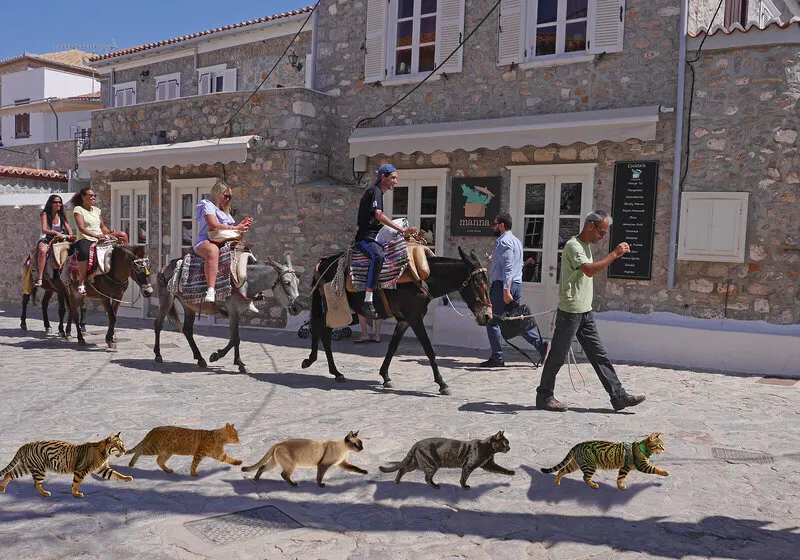
Jörgen Thornberg
In tandem, please, 2024
Digital
70 x 50 cm
Cat March
In the late afternoon's strong, white light,
With shadows stretching into the bright,
The cats marched on in perfect sync,
Toward Bratsera, no need to think.
Under the sun’s glow, the cats align,
A hungry troop, in perfect line.
To Bratsera’s door, they march as one,
Their daily feast has just begun.
With tails held high and paws in sync,
They move as one, no need to think.
The scent of fish, a siren's call,
Draws them to the restaurant's hall.
Through cobbled streets, they swiftly glide,
Their hunger's pull, their only guide.
For scraps and bites, they’ve come to dine,
Where human taste has drawn the line.
The red tabby craved smoked octopus fine,
While the tiger-striped dreamed of sardines in vine.
The black lady's favourite? Lamb Kotsi, of course,
Hydra’s best dish, without remorse.
The white cat longed for red tuna so grand,
With pistachio crust, the finest in the land.
And the grey tomcat, with his sweet-tooth flair,
Dreamed of cheese pie with apples to share.
Step by step, to the feast they tread,
Their bellies rumbling, thoughts of being fed.
To Bratsera’s kitchen, they marched with pride,
Where tasty delights awaited inside.
Yet to these cats, the food’s a prize,
No need for fresh, no need for lies.
They'll feast after this grand parade,
Till dawn arrives, and shadows fade.
Hydra, August 2024
The cats and the donkey train were headed in the same direction, an occurrence that, even on cat-rich Hydra, doesn’t happen daily. Though they were mules, we still call it a "donkey train" locally and the driver a "donkey man," regardless of which hoofed animal we’re talking about. Cats and mules marched in step, led by the donkey man. When such things happen, the imagination is sparked, and within me, I was filled with march music, specifically the Radetzky March—a contagious rhythm. This march, which shares its name with the month of March and the military term, is a staple of the New Year’s Concert from Vienna every year and, in some way, has become the march of all marches. The strange thing was that we all must have heard the same melody because they marched in sync with that music. The connection between the Radetzky March and the donkey train lies in their movements' shared rhythm and discipline, highlighting the universal nature of the march's influence and fostering a sense of shared cultural experience among the audience.
Josef Wenzel Radetzky von Radetz had already reached retirement age during his famous victory against the Sardinian army in the Battle of Custoza on July 25, 1848. The highly decorated field marshal from an aristocratic family in Bohemia was an impressive 81-year-old at the time. His victory did more than just secure Austrian dominance in Northern Italy: It buoyed the reactionary forces in Vienna, who did not want to give in to liberal demands, although they had been beleaguered with uprisings all over the multinational monarchy ever since the March revolutions of 1848.
This is why Radetzky’s triumph was celebrated with great fanfare. A big celebration was planned for August 31, 1848, and Johann Strauss was commissioned to contribute a new piece. The "Radetzky March," Op. The "Radetzky March," Op. The "Radetzky March," Op. The "Radetzky March," Op. The "Radetzky March," Op. The "Radetzky March," Op. 228 was a logical choice. By accepting the commission, Strauss firmly positioned himself as loyal to the emperor—contrary to his even more famous son, who sympathised with the revolutionaries. The march, associated with a significant historical event, symbolises Austrian pride and resilience. The march was not just a piece of music but a symbol of the victory and the unity of the Austrian people during a turbulent time in their history. The composition of the Radetzky March in the aftermath of the Battle of Custoza and its subsequent association with the emperor's celebration underscores its role as a symbol of national unity and resilience, connecting the audience to the historical context of the Radetzky March.
The premiere of the 'Radetzky March' was an immediate success. The piece had to be repeated twice, and the audience was said to have clapped along enthusiastically. This effect can be observed at the annual New Year’s Concert of The Vienna Philharmonics: Since 1946, the Radetzky March has been performed as an encore, and it has become a proud tradition for the audience to clap along—either loudly or quietly—at just the right moments. The composition's association with this prestigious concert has further solidified its status as a cultural icon, adding to the event's significance.
The Austrian author and journalist Joseph Roth immortalised Strauss’s music in his 1932 novel Radetzky March. This family saga chronicles the decline and fall of the Austro-Hungarian Empire through the story of the Trotta family over three generations.
The march is played at home matches of Austria’s national football team, a tradition that dates back to the early 20th century. It is a symbol of national pride and unity, and it energises the players and the fans. It is even recommended in first-aid courses to find the right chest compression rhythm during CPR, showing its widespread recognition and influence. Over time, the characteristic rhythmic pattern of the head motif—three anapests and one iambus—has inspired numerous lyrical versions to accompany the melody, from amusing vernacular expressions (roughly: "when the cat / with a treat / over hurdles jumps") to commercials for canned cat food.
In the Julian and Gregorian calendars, March is the year's third month. It is 31 days long and originates from "Martius," the first month of the earliest Roman calendar. It was named after Mars, the Roman god of war and an ancestor of the Roman people through his sons Romulus and Remus. Martius was the beginning of the season for warfare, and the festivals held in his honour during the month were mirrored by others in October when the season for these activities came to a close. This dual significance of March in cultural and military contexts adds depth to its historical importance, connecting us to our ancestors' rich traditions and history.
March is the first month of spring in the Northern Hemisphere (North America, Europe, Asia, and parts of Africa) and autumn in the Southern Hemisphere (South America, parts of Africa, and Oceania).
The word "march" describes the regular, rhythmic walking style often employed by military personnel or groups during parades and processions. It comes from the French word "marcher," which means "to walk" or "to march." In a military context, "march" refers to a disciplined and organised form of walking where troops move in step, often in a line or column, giving an impression of order and strength. Understanding this concept is crucial to appreciating the historical importance of the Radetzky March and other similar compositions. The disciplined and organised nature of a march symbolises unity and strength and has been historically used in military contexts to showcase the discipline and readiness of troops.
It's called a "march" precisely because of the rhythm and discipline required, distinguishing it from ordinary walking. The march is often accompanied by music, such as marching music, which helps the troops keep in step and move as a unit. It’s a symbol of unity and strength and has been historically used in military contexts to showcase the discipline and readiness of troops.
Marching has been a fundamental part of military history for thousands of years. It is a display of power, unity, and discipline that has evolved into the grand military parades we recognise today. From the ancient battlefields to modern ceremonial occasions, the march has played a pivotal role in the story of civilisation, with soldiers in tight formation demonstrating their skill and the might of their nation. This continuity of history makes the tradition of marching so fascinating and significant.
The origins of military parades can be traced back to ancient times when soldiers began to fight not as individuals but as cohesive units. The concept of drilling—repetitive practice to engrain movements into muscle memory—was essential to maintaining order in the chaos of battle. The early drill masters understood that a well-disciplined army could outmanoeuvre and overwhelm less organised forces, and thus, the art of marching was born.
One of the earliest and most effective utilisation of drilling in warfare came from the strategic brilliance of Philip II of Macedon, the father of Alexander the Great. He disciplined his army to quickly form phalanxes, tight-knit groups of soldiers with long spears, which became a critical component of his military success. This concept of formation fighting was later refined by the Romans, who used drilling to maintain their legions' efficiency and deadliness. The Roman military parade was not just a show of force; it was a well-oiled machine that struck fear into the hearts of their enemies.
The tradition of military parades continued through the centuries, becoming a symbol of power and victory. One of the most famous parades in ancient history occurred in 70 AD when the Romans held a grand victory procession to celebrate their conquest of Jerusalem. The highlight of this parade was the display of the seven-branched menorah, a sacred artefact from the Temple of Jerusalem, paraded through the streets of Rome as a trophy of war. Immortalised on the Arch of Titus, this moment symbolised Rome’s dominance. It was a stark reminder of their military prowess, a legacy that continues to echo through the annals of history.
As time marched on, the nature of military parades evolved. Military drills became more sophisticated during the Age of Enlightenment, with each movement meticulously planned and executed. This period saw the rise of formalised military education, where recruits were taught to move as a single, unified body. The precision and discipline displayed in these parades demonstrated a nation's military strength and a tool for instilling confidence and pride among the troops.
In the United States, the tradition of military drill was significantly influenced by Baron von Steuben, a Prussian Army officer who served in the Continental Army during the American Revolution. Von Steuben's rigorous training helped transform the ragtag group of American soldiers into a disciplined fighting force. His drills were instrumental in the American victory, and the principles he taught are still evident in military parades today.
One of Europe's oldest and most renowned military parades is the Bastille Day Military Parade in France, held each year on July 14th along the Champs-Élysées in Paris. This parade, which dates back to the French Revolution, is a grand spectacle that showcases the might and tradition of the French military. It has become a symbol of national pride and is attended by the President of France, other dignitaries, and thousands of spectators.
Military parades are not just about soldiers marching in unison; they are complex events that can include various displays. A ‘flypast’, for example, involves aircraft flying in formation over the parade ground, showcasing the air force's capabilities. A ‘victory parade’ celebrates the end of a conflict and the triumph of the military forces, such as the Victory Day Parades held in Russia to commemorate the defeat of Nazi Germany in World War II. ‘Naval parades’ feature ships sailing in formation, often accompanied by a show of firepower, while a ‘pass in review’ allows a commander or head of state to inspect the troops, usually on a significant national holiday.
These parades are not just for show; they serve multiple purposes. They demonstrate discipline, cohesion, and the ability to move and fight as a single unit. They instil pride in the troops and confidence in the nation’s military capabilities. In many countries, military parades are held on occasions of national importance, such as Independence Day or a significant military anniversary. The soldiers on parade wear their ceremonial uniforms, carry the standards of their battalions, and march to the rhythmic beat of military bands. These parades are often joined by police, firefighters, veterans, and youth cadet organisations, symbolising the unity and strength of the entire nation.
Historically, these parades have been used to send a message—of power, victory, and sometimes propaganda. They remind us of the discipline and training that go into creating an effective fighting force. Even today, as warfare evolves with technology, the military parade remains a potent symbol of a nation's strength and unity, a tradition that has stood the test of time.
And who knows, perhaps even our Stone Age ancestors had their form of marching, gathering in close ranks to demonstrate their unity and strength before a hunt or battle. After all, the rhythm of a march is as ancient as the human heart, beating in time with the drum, the footsteps of soldiers, and the pulse of history itself.
As a synchronised movement, Marching has taken on many shapes and styles over the centuries, adapting to various cultural and social contexts. In some traditions, the march has become a spectacle of exaggerated movements and flamboyant gestures. Consider the ‘high-stepping goose step’ famously employed by several military forces worldwide. With its rigid posture and over-the-top leg swings, this dramatic marching style is designed to project an image of power and discipline. The goose step is a clear example of how marching can be used not only as a practical military exercise but also as a tool of intimidation and propaganda. This adaptability of marching to different contexts adds to the diversity and richness of this tradition.
On the other end of the spectrum, we have the distinctly civilian and often playful marches seen in the United States, particularly during large sporting events. With their sequined uniforms and dazzling smiles, the cheerleaders and majorettes perform highly choreographed routines that are as much about entertainment as they are about precision. These young women, often marching in front of thousands of spectators, blend athleticism with artistry, turning the march into a dance that celebrates team spirit and individual expression. Their high kicks and coordinated movements may be far removed from the military origins of marching, yet they carry the same sense of rhythm, unity, and spectacle.
In Greece, marching takes on a uniquely cultural significance, blending the military with the sacred to reflect the country's deep traditions. During national holidays and religious festivals, there are numerous, and you’ll find soldiers marching in formation alongside clergy in elaborate processions. These events are solemn and deeply symbolic as the military and church unite to honour the nation’s history and faith. While the music accompanying these processions is not as strictly martial as in a military parade, an unmistakable rhythm still guides the participants' steps, creating a sense of order and reverence. The mix of military precision with the spiritual cadence of religious hymns illustrates how marching can transcend its purely practical origins to become a powerful cultural ritual, embodying the unity and resilience of a people.
The cats were on their way to one of Hydra’s finest kitchens, the restaurant Bratsera, a short distance away. At this time of day, the restaurant shared leftovers and food that had become too old for paying guests but was perfectly suitable for less picky cats. Their Mediterranean cuisine was very tasteful and fresh, and they always had something delicious for the cats. The service was excellent.
The red tabby loved smoked octopus with red pepper spread, while the tiger-striped one preferred vine-wrapped sardines with fava. Prosciutto was never a wrong choice, and naturally, Lamb Kotsi—Hydra’s best, according to the black lady. Cats have a particular fondness for seafood, and if the white cat could choose, Red Tuna with a crust of Aegina pistachios would top the list. With a sweet tooth, the grey tomcat looked forward to a cheese pie with apple sauce. No wonder they marched in step.

Jörgen Thornberg
Malmö
Lite om bilder och mig. Translation in English at the end.
Jag är en nyfiken person som ser allt i bilder, även det jag fäster i ord, gärna tillsammans för bakom alla mina bilder finns en berättelse. Till vissa bilder hör en kortare eller längre novell som följer med bilden.
Bilder berättar historier. Jag omges av naturlig skönhet, intressanta människor och historia var jag än går. Jag använder min kamera för att dokumentera världen och blanda det jag ser med vad jag känner för att fånga den dolda magin.
Mina bilder berättar mina historier. Genom mina bilder, tryck och berättelser. Jag bjuder in dig att ta del av dessa berättelser, in i ditt liv och hem och dela min mycket personliga syn på vår värld. Mer än vad ögat ser. Jag tänker i bilder, drömmer och skriver och pratar om dem; följaktligen måste jag också skapa bilder. De blir vad jag ser, inte nödvändigtvis begränsade till verkligheten. Det finns en bild runt varje hörn. Jag hoppas att du kommer att se vad jag såg och gilla det.
Jag är också en skrivande person och till många bilder hör en kortare eller längre essay. Den följer med tavlan, tryckt på fint papper och med en personlig hälsning från mig.
Flertalet bilder startar sin resa i min kamera. Enkelt förklarat beskriver jag bilden jag ser i mitt inre, upplevd eller fantiserad. Bilden uppstår inom mig redan innan jag fått okularet till ögat. På bråkdelen av ett ögonblick ser jag vad jag vill ha och vad som kan göras med bilden. Här skall jag stoppa in en giraff, stålmannen, Titanic eller vad det är min fantasi finner ut. Ännu märkligare är att jag kommer ihåg minnesbilden långt efteråt när det blir tid att skapa verket. Om jag lyckas eller inte, är upp till betraktaren, oftast präglat av en stråk av svart humor – meningen är att man skall bli underhållen. Mina bilder blir ofta en snackis där de hänger.
Jag föredrar bilder som förmedlar ett budskap i flera lager. Vid första anblicken fylld av feel-good, en vacker utsikt, fint väder, solen skiner, blommor på ängen eller vattnet som ligger förrädiskt spegelblankt. I en sådan bild kan jag gömma min egentliga berättelse, mitt förakt för förtryckare och våldsverkare, rasister och fördomsfulla människor - ett gärna återkommande motiv mer eller mindre dolt i det vackra motivet. Jag försöker förena dem i ett gemensamt narrativ.
Bild och formgivning har löpt som en röd tråd genom livet. Fotokonst känns som en värdig final som jag gärna delar med mig.
Min genre är vid som framgår av mina bilder, temat en blandning av pop- och gatukonst i kollage som kan bestå av hundratals lager. Vissa bilder kan ta veckor, andra någon dag innan det är dags att överlämna resultatet till printverkstaden. Fine Art Prints är digitala fotocollage. I dessa kollage sker rivandet, klippandet, pusslandet, målandet, ritandet och sprayningen digitalt. Det jag monterar in kan vara hundratals år gamla bilder som jag omsorgsfullt frilägger så att de ser ut att vara en del av tavlan men också bilder skapade av mig själv efter min egen fantasi. Därefter besöks printstudion och för vissa bilder numrera en limiterad upplaga (oftast 7 exemplar) och signera för hand. Vissa bilder kan köpas i olika format. Det är bara att fråga efter vilka. Gillar man en bild som är 70x100 men inte har plats på väggen, går den kanske att få i 50x70 cm istället. Frågan är fri.
Metoden Giclée eller Fine Art Print som det också kallas är det moderna sättet för framställning av grafisk konst. Villkoret för denna typ av utskrifter är att en högkvalitativ storformatskrivare används med åldersbeständigt färgpigment och konstnärspapper eller i förekommande fall på duk. Pappret som används möter de krav på livslängd som ställs av museer och gallerier. Normalt säljer jag mina bilder oinramade så att den nya ägaren själv kan bestämma hur de skall se ut, med eller utan passepartout färg på ram, med eller utan glas etc..
Under många år ställde jag bara ut på nätet, i valda grupper och på min egen Facebooksida - https://www.facebook.com/jorgen.thornberg.9
Jag finns också på en egen hemsida som tyvärr inte alltid är uppdaterad – https://www.jth.life/ Där kan du också läsa en del av de berättelser som följer med bilden.
UTSTÄLLNINGAR
Luftkastellet, oktober 2022
Konst i Lund, november 2022
Luftkastellet, mars 2023
Engleson Galleri Caroli, april 2023
Hydra, Greece June 2023
Engleson Galleri Caroli, oktober 2023
Toppen, Höllviken december 2023
Luftkastellet, mars 2024
Torups Galleri, mars 2024
Venice, May 2024
Luftkastellet, oktober 2024
Konst i Advent, December 2024
Galleri Engleson, Caroli December 2024
Jäger & Jansson Galleri, april 2025
A bit about pictures and me.
I'm a curious person who sees everything in pictures, even what I express in words, often combining them, for behind all my pictures lies a story. These narratives, some as short as a single image and others as long as a novel, are the heart and soul of my work.
Pictures tell stories. Wherever I go, I'm surrounded by natural beauty, exciting people, and history. I use my camera to document the world and blend what I see with what I feel to capture the hidden magic.
My images tell my stories. Through my pictures, prints, and narratives, I invite you to partake in these stories in your life and home and share my deeply personal perspective of our world. More than meets the eye. I think in pictures, dream, write, and talk about them; consequently, I must create images too. They become what I see, not necessarily confined to reality. There's a picture around every corner. I hope you'll see what I saw and enjoy it.
I'm also a writer, and many images come with a shorter or longer essay. It accompanies the painting, printed on fine paper with my personal greeting.
Many pictures start their journey on my camera. Simply put, I describe the image I see in my mind, experienced or imagined. The image arises within me even before I bring the eyepiece to my eye. In a fraction of a moment, I see what I want and what can be done with the picture. Here, I'll insert a giraffe, Superman, the Titanic, or whatever my imagination conjures up. Even stranger is that I remember the mental image long after it's time to create the work. Whether I succeed is up to the observer, often imbued with a streak of black humour – the aim is to entertain. My pictures usually become a talking point wherever they hang.
I prefer pictures that convey a message in multiple layers. At first glance, they're filled with feel-good vibes, a beautiful view, lovely weather, the sun shining, flowers in the meadow, or the water lying deceptively calm. But beneath this surface beauty, I often conceal a deeper story, a narrative that challenges societal norms or explores the human condition. I invite you to delve into these hidden narratives and discover the layers of meaning within my work.
Picture and design have been a thread running through my life. Photographic art feels like a fitting finale, and I'm happy to share it.
My genre is varied, as seen in my pictures; the theme is a blend of pop and street art in collages that can consist of hundreds of layers. Some images can take weeks, others just a day before it's time to hand over the result to the print workshop. Fine Art Prints are digital photo collages. In these collages, tearing, cutting, puzzling, painting, drawing, and spraying happen digitally. What I insert can be images hundreds of years old that I carefully extract so they appear to be part of the painting, but also images created by myself, now also generated from my imagination. Next, visit the print studio and, for certain images, number a limited edition (usually 7 copies) and sign them by hand. Some images may be available in other formats. Just ask which ones. If you like an image that's 70x100 but doesn't have space on the wall, you might be able to get it in 50x70 cm instead. The question is open.
The Giclée method, or Fine Art Print as it's also called, is the modern way of producing graphic art. This method ensures the highest quality and longevity of the artwork, using a high-quality large-format printer with archival pigment inks and artist paper or, in some cases, canvas. The paper used meets the longevity requirements set by museums and galleries. I sell my pictures unframed, allowing the new owner to personalise their artwork, confident in the lasting value and quality of the piece.
For many years, I only exhibited online, in selected groups, and on my Facebook page - https://www.facebook.com/jorgen.thornberg.9. I also have my website, which unfortunately is not constantly updated - https://www.jth.life/. You can also read some of the stories accompanying the pictures there.
EXHIBITIONS
Luftkastellet, October 2022
Art in Lund, November 2022
Luftkastellet, March 2023
Engleson Gallery Caroli, April 2023
Hydra, Greece June 2023
Engleson Gallery Caroli, October 2023
Toppen, Höllviken December 2023
Luftkastellet, March 2024
Torup Gallery, March 2024
Venice, May 2024
UTSTÄLLNINGAR
Luftkastellet, oktober 2022
Konst i Lund, november 2022
Luftkastellet, mars 2023
Engleson Galleri Caroli, april 2023
Hydra, Greece June 2023
Engleson Galleri Caroli, oktober 2023
Toppen, Höllviken december 2023
Luftkastellet, mars 2024
Torups Galleri, mars 2024
Venice, May 2024
Luftkastellet, October 2024
Konst i Advent, December 2024
Galleri Engleson, Caroli December 2024
Jäger & Jansson Galleri, April 2025
Utbildning
Autodidakt
Medlem i konstnärsförening
Öppna Sinnen
Med i konstrunda
Konstrundan i Skåne
Utställningar
Luftkastellet, October 2022
Art in Lund, November 2022
Luftkastellet, March 2023
Engleson Gallery Caroli, April 2023
Hydra, Greece June 2023
Engleson Gallery Caroli, October 2023
Toppen, Höllviken December 2023
Luftkastellet, March 2024
Torup Gallery, March 2024
Venice, May 2024