Vi använder cookies för att ge dig bästa möjliga upplevelse. Välj vilka cookies du tillåter.
Läs mer i vår integritetspolicy
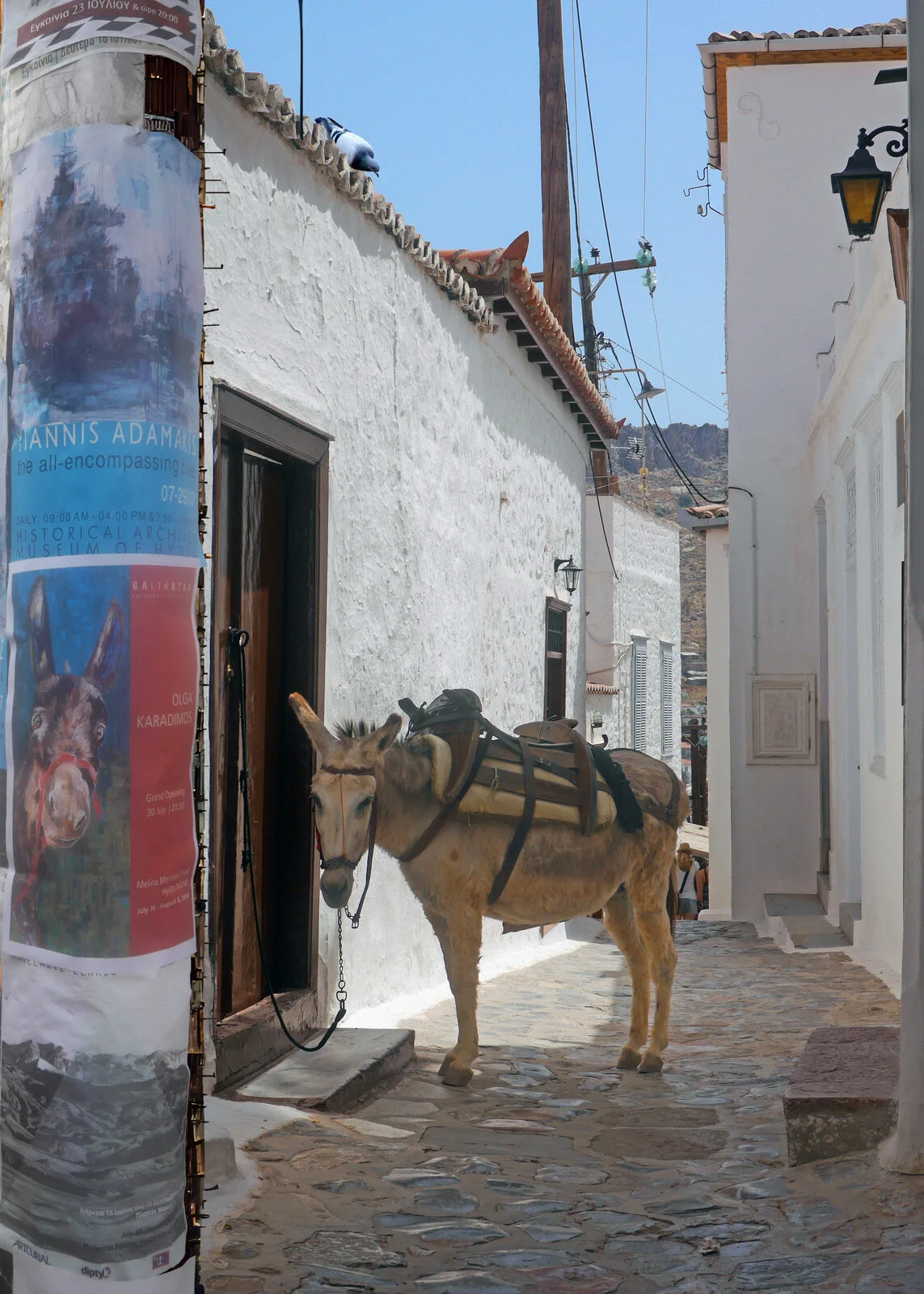
Jörgen Thornberg
A Donkey is a Donkey, 2020
Digital
50 x 70 cm
Olga, the Romantic Donkey
In galleries grand, on walls, she did grace,
Olga the donkey, with a gentle face.
Across the world, her image hung high,
Twice on Hydra, beneath a clear blue sky.
With birds of bright colours, she often did share,
The space on the canvas making a whimsical pair.
But once by a raging bull, charging with might,
Trapped in a painting, Olga trembled, fearing his flight.
The frame did halt the bull’s wild stride,
Leaving Olga safe, no need to hide.
Between exhibitions, in storage, she lay,
Pondering life's lessons, day after day.
She thought of donkeys and creatures diverse,
In the grand tapestry of the universe.
Conversation with Sam, the transport steed,
And Lily the little dove filled her with need.
To understand, to learn, to grow,
In the silent moments, wisdom would flow.
Lily chirped, “We learn as we soar,”
A truth that Olga couldn’t ignore.
In quiet times, she’d recall her plight,
The bull that charged, the canvas tight.
Life’s a journey, here and there, both wild and tame,
With friends like Sam and Lily, she’d never be the same.
A romantic soul with stories to share,
Olga found beauty everywhere.
In art and thought, in friends and lore,
She discovered her heart had room for more.
Hydra, August 2024
Just beyond Four Corner, Sam, one of Hydra's brave transport donkeys, had struck up a conversation with one of Olga Karadimos's donkeys. Sam stood tied to the door where his master was having lunch and enjoying a well-deserved siesta. The warm sun beat down on his back, and the sound of the bustling harbour in the distance filled his ears. Sam had been dozing, standing up, until a mare's voice from one of the posters pinned to a telephone pole woke him with its unique female donkey communication style.
“Are you going to wake up and be a bit social?” said the voice. “By the way, my name is Olga, just like the one who created me. What's the name of my temporary neighbour?”
“Sam,” he answered a bit groggily.
“I saw you coming,” said Olga, rustling a little with the paper of the poster. Her creator was exhibiting Olga and a bunch of other pictures of donkeys at the Melina Mercouri Gallery. She would hang there for a whole week before heading off to Athens. In Olga's case, she didn't have to wear down her hooves but travelled constantly, resting on a canvas. “How's life treating you?”
“There are a bit too many people these days,” said Sam, snorting in displeasure. It's so crowded in the harbour sometimes that people step on my hooves.”
“That doesn't sound pleasant,” said Olga sympathetically.
“Not exactly. Yesterday, I got a little girl's ice cream cone right in my snout.”
“But ice cream is delicious,” said Olga, licking around her mouth.
“I hate pistachio ice cream!” Sam spat demonstratively. “People laughed, but not at the ice cream, at my ears.” His sad expression deepened, a mix of frustration and embarrassment evident in his gaze.
“People should look at their own,” said Olga diplomatically because Sam didn't look like he was heading to a party. He was unbrushed, with a rather ragged coat, tangled mane, and tail. His ears drooped slightly, and his eyes held a weary look.
“Exactly,” said Sam, agitated. “Carrying cement sacks is one thing, but now I can only carry four by law. They call it a hundred kilos. But the tourists my master occasionally let ride on me for money, which goes to his beer, are getting heavier and heavier. Him too. The way home in the evening with him on my back is a torment. That's my everyday life. And yours?” said Sam, stretching his neck to see the donkey girl on the poster.
“I get to see quite a lot of people up close when they stick their faces right in my snout. Some are so ugly. But most of the day, I hang idly until the exhibition opens again around mid-morning. But my company can vary; sometimes, I hang next to some of my creator’s other animals, tiny colourful birds. I ended up aside a furious bull in full charge a month ago. I was scared almost all the time because imagine if he tore himself loose and rushed out of the painting and right over me. Then I'd be even flatter.”
“Sounds like you still live a varied life. For me, it’s mostly sacks that look the same on the outside, from the harbour up to some house project sacks with cement or sand, on the way from a construction site, white, jagged ones full of debris going to the dump. The white ones hurt when the sharp edges of the contents press against my body. Sometimes, it gets fun with demanding transports, long poles, and fragile marble slabs. Then, I can show my skills when I steer around sharp corners without hitting the walls. The most fun I have is when I can poop on Donkey Shit Lane. My master has to stop and pick up my poop, then. He looks around, and if there’s no one in sight or just some dumb tourist, he leaves my droppings, and one of the municipality’s sanitation workers has to pick them up. That’s fun!” said Sam, his humour shining through.
“Varied! Yes, but most of the time is spent waiting, long periods lying on a shelf waiting for the next exhibition. I’m not for sale, my creator's own. She could have sold many of me, but no! So I have a lot of time for myself and think a lot to pass the time.”
“What do you think about, then?” asked Sam, who was also a thinking type—as are most donkeys.
“People are often surprised to hear that donkeys are equines too. Our ancestors came from the rocky, dry climes of Northern Africa and have lived alongside humans, bearing their burdens and building trade routes and civilisations since ancient times. That's how it's been for as long as humans have existed. But we've been around longer,” said Olga, stretching her neck.
“I love horses, but you donkeys make me feel part of the pack. Horses strike me as regal and royal, aloof in their majesty. At the same time, donkeys—smaller in scale and physically affectionate—feel like old huggable buddies," said the pigeon perched on the gutter above, joining the conversation. “Maybe I should introduce myself. My name is Lily.”
“Nice to meet you,” said Olga, smacking her lips upwards at the pigeon on the gutter.
“Last month, I spent a whole morning with Virginia and Daisy, two Vlychos donkeys who came to my master's farm, which we donkeys call ‘Save Your Ass’. At noon, I walked away to the market with the sweet smell of hay in my hair and a few valuable lessons learned from these affectionate, mindful, and playful creatures,” Sam said, shifting contentedly at the memory.
“We all know how it feels when a close talker invades our space. We don’t like being crowded, nor do donkeys,” said Olga.
“While donkeys and horses are prey animals, that’s when other animals hunt us,” Sam directed at Lily, who had to keep an eye on the cats but could quickly fly away.
Equines have strikingly different defence mechanisms. The horse flees while the donkey fights. Just like humans, our survival style affects our interactions.
“We donkeys don’t like being snuck up on—and who does? We have a blind spot behind us and poor vision in front of our faces. I didn’t want to test out Virginia’s powerful defensive kick, so I knew to gently announce my presence with touch and steer clear of her rear. Donkey kicks are no joke,” continued Sam.
“You better approach donkeys by their shoulder rather than from behind or directly head-on to give ample clues of where you are and to show that you are not a threat,” said Olga, directing her comment at a human passing by without noticing the well-meaning advice.
“Standing by a donkey’s side is more respectful than sticking your face in our snout. Most people would agree. They wouldn’t like a snout right in their face either,” added Sam.
“You donkeys have huge listening ears and loud, powerful voices that let you communicate over great distances,” said the little pigeon.
“Donkeys, like horses, are prey animals. But our communication style is unique. We’re very intentional about expressing ourselves verbally or physically. Dumb people think of donkeys as braying and kicking, but we offer a lot of clues to our thoughts and feelings first. 'But when it comes down to it, the best defence is a good offence, '" Olga explained, shedding light on the often misunderstood communication of donkeys.
“As someone who constantly listens to people talk over each other, I know that just because we can use words powerfully doesn’t mean we can’t be more selective about how we use our power,” said Sam.
“There’s a classic cartoon of a human arduously pulling a leash attached to a stubborn donkey,” said Lily, chuckling.
“That shows an overwhelmed and threatened animal,” said Olga. “Humans call it stubbornness because it’s not the response they want. But the donkey is communicating as a form of self-preservation. It is a warning signal that should be taken seriously. Or a cry for help. Or a call for understanding.”
“We tend to align with the kind of leadership horses seek—someone who says, ‘Go this way now.’ It’s how horse herds stay safe; teams win games, and loners are losers. But as a donkey, I don’t care about trophies or treasures. I am a practical creature who craves security,” said Sam, straightening his back.
“Pulling harder on the leash won’t work, but if the human takes the time to learn how any living being responds to pressure—in the stubborn donkey’s case, by leaning against it instead of into it—they can change how to ask the donkey to move, appeal for cooperation instead of demanding action.”
“We donkeys have our own minds, and so do humans,” said Olga.
“So, how do you get a resolute donkey to move along?” asked Lily.
“The answer lies in establishing trust and finding a point of balance. We should work together, not oppose each other,” said Olga.
“When going up a mountainous Hydra path, pack donkeys lean into each other as they ascend to ease the journey for everybody. Finding a point of balance between us helps each of us carry our load. It doesn’t matter if we are small or big or if the burdens are different. We lean into each other for comfort, stability, and support,” Sam explained.
"I recognise that," said Lily. "Pigeons are social birds, and we tend to cooperate within the flock, especially when finding food and protecting ourselves from predators. We have complex social structures and communicate through calls and body language. Sure, there's competition for food—first come, first served. But it's more common for us to share information about food sources and work together to protect one another."
“Donkeys respond to pressure, so when you pull on us, we counter that movement by leaning against the pressure and pulling back the other way. It’s less logical and more intuitive,” said Olga.
“Patience is the donkey’s superpower,” said Sam. “We’re willing to wait and thoroughly think through our move. Unilateral decisions will not fly in such partnership: a conversation must unfold before a hoof is raised.”
“We have evolved to think more about where we put or hoves—and will avoid confrontation whenever possible—but if cornered, we will stand and fight before running. Horses are fast and built to run in herds to escape predators, but if we donkeys used such tactics in the mountains, we would have run ourselves off cliffs and out of existence as a species. That should have ended badly. But we're too smart to fall into that trap,” said Olga.
“Faster isn’t always better, you mean,” said Lily, who personally would rather flee than fight, as humans put it. Translated to pigeon language, it means she'd rather fly away than be eaten.
“Donkeys cannot,” said Olga, “be rushed into doing something they don’t want to do. We need time to assess, think critically, and find a better way forward. A smart donkey-man lets the donkey choose the path, often resulting in a better outcome for both.”
“You’re not as much of a herd animal as horses, for example?” asked Lily.
“Correct. We develop super strong ties with our companions. We call it pair bonding. Two pals typically graze close together, often touching noses and falling asleep with their heads draped over each other like puppies. Still standing, of course,” said Olga.
“If one moves on, the other will follow,” added Sam. “If separated, we become agitated and might breathe more heavily, restlessly pace and nervously paw the ground, or bray loudly to locate our friend. I’ve heard a veterinarian explain that separation distress can become so great that we might refuse to eat, which subsequently can lead to hyperlipemia, a potentially fatal condition.”
Lily thought briefly about what Sam had said. "It sounds a bit like us pigeons," she said. "When one pigeon flies away, the rest of the flock tends to follow. If we separate, we also become anxious and start looking for each other. We can fly restlessly and use special calls to reunite our flock. If we can't find the missing one, we may even stop eating out of worry. It's as if our bonds are just as strong as yours, and separation can be just as stressful for us as it is for donkeys."
Lily continued, "Pigeons love to kiss and show affection to each other. Our partnerships are often long-lasting and very strong. We stick together through thick and thin, just like you do. There is something beautiful about having a strong and reliable partner by your side."
“But on the other hand, donkey reunions might be the most joyous occasions ever witnessed. The depth of emotion and devotion we have for our companions is staggering. It makes sense that historically and culturally, donkeys have been steadfast and faithful companions for religious figures like Jesus and Buddha and famous fictional characters ranging from Don Quixote’s faithful squire Sancho Panza to the film character Shrek,” said Olga.
“Jesus Christ was close to us from the day he was born, and a donkey stood by his side, the same one that let his mother ride to Nazareth with him in her belly,” added Sam a bit proudly.
“Spiritually, we donkeys are linked to wisdom and humility, and it’s no surprise that people have chosen donkeys as their cohorts—for practical journeys or personal quests, from the commonplace to the romantic. We are willing partners if they earn our trust, and we can help connect abstract concepts in concrete ways, which is invaluable,” said Olga.
“As mountain animals, we are incredibly well-balanced, sure-footed foundational creatures. We are the best, simply put,” said Sam, getting the last word in as the door opened and his master came out.
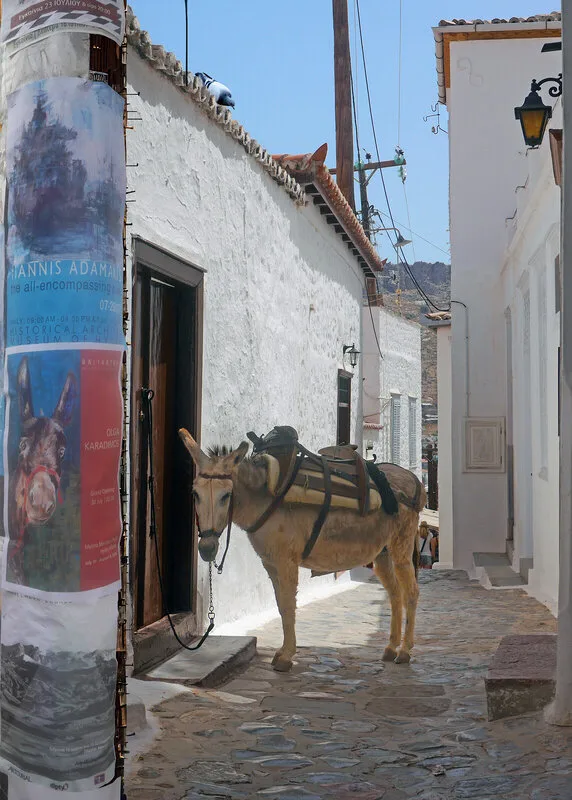
Jörgen Thornberg
A Donkey is a Donkey, 2020
Digital
50 x 70 cm
Olga, the Romantic Donkey
In galleries grand, on walls, she did grace,
Olga the donkey, with a gentle face.
Across the world, her image hung high,
Twice on Hydra, beneath a clear blue sky.
With birds of bright colours, she often did share,
The space on the canvas making a whimsical pair.
But once by a raging bull, charging with might,
Trapped in a painting, Olga trembled, fearing his flight.
The frame did halt the bull’s wild stride,
Leaving Olga safe, no need to hide.
Between exhibitions, in storage, she lay,
Pondering life's lessons, day after day.
She thought of donkeys and creatures diverse,
In the grand tapestry of the universe.
Conversation with Sam, the transport steed,
And Lily the little dove filled her with need.
To understand, to learn, to grow,
In the silent moments, wisdom would flow.
Lily chirped, “We learn as we soar,”
A truth that Olga couldn’t ignore.
In quiet times, she’d recall her plight,
The bull that charged, the canvas tight.
Life’s a journey, here and there, both wild and tame,
With friends like Sam and Lily, she’d never be the same.
A romantic soul with stories to share,
Olga found beauty everywhere.
In art and thought, in friends and lore,
She discovered her heart had room for more.
Hydra, August 2024
Just beyond Four Corner, Sam, one of Hydra's brave transport donkeys, had struck up a conversation with one of Olga Karadimos's donkeys. Sam stood tied to the door where his master was having lunch and enjoying a well-deserved siesta. The warm sun beat down on his back, and the sound of the bustling harbour in the distance filled his ears. Sam had been dozing, standing up, until a mare's voice from one of the posters pinned to a telephone pole woke him with its unique female donkey communication style.
“Are you going to wake up and be a bit social?” said the voice. “By the way, my name is Olga, just like the one who created me. What's the name of my temporary neighbour?”
“Sam,” he answered a bit groggily.
“I saw you coming,” said Olga, rustling a little with the paper of the poster. Her creator was exhibiting Olga and a bunch of other pictures of donkeys at the Melina Mercouri Gallery. She would hang there for a whole week before heading off to Athens. In Olga's case, she didn't have to wear down her hooves but travelled constantly, resting on a canvas. “How's life treating you?”
“There are a bit too many people these days,” said Sam, snorting in displeasure. It's so crowded in the harbour sometimes that people step on my hooves.”
“That doesn't sound pleasant,” said Olga sympathetically.
“Not exactly. Yesterday, I got a little girl's ice cream cone right in my snout.”
“But ice cream is delicious,” said Olga, licking around her mouth.
“I hate pistachio ice cream!” Sam spat demonstratively. “People laughed, but not at the ice cream, at my ears.” His sad expression deepened, a mix of frustration and embarrassment evident in his gaze.
“People should look at their own,” said Olga diplomatically because Sam didn't look like he was heading to a party. He was unbrushed, with a rather ragged coat, tangled mane, and tail. His ears drooped slightly, and his eyes held a weary look.
“Exactly,” said Sam, agitated. “Carrying cement sacks is one thing, but now I can only carry four by law. They call it a hundred kilos. But the tourists my master occasionally let ride on me for money, which goes to his beer, are getting heavier and heavier. Him too. The way home in the evening with him on my back is a torment. That's my everyday life. And yours?” said Sam, stretching his neck to see the donkey girl on the poster.
“I get to see quite a lot of people up close when they stick their faces right in my snout. Some are so ugly. But most of the day, I hang idly until the exhibition opens again around mid-morning. But my company can vary; sometimes, I hang next to some of my creator’s other animals, tiny colourful birds. I ended up aside a furious bull in full charge a month ago. I was scared almost all the time because imagine if he tore himself loose and rushed out of the painting and right over me. Then I'd be even flatter.”
“Sounds like you still live a varied life. For me, it’s mostly sacks that look the same on the outside, from the harbour up to some house project sacks with cement or sand, on the way from a construction site, white, jagged ones full of debris going to the dump. The white ones hurt when the sharp edges of the contents press against my body. Sometimes, it gets fun with demanding transports, long poles, and fragile marble slabs. Then, I can show my skills when I steer around sharp corners without hitting the walls. The most fun I have is when I can poop on Donkey Shit Lane. My master has to stop and pick up my poop, then. He looks around, and if there’s no one in sight or just some dumb tourist, he leaves my droppings, and one of the municipality’s sanitation workers has to pick them up. That’s fun!” said Sam, his humour shining through.
“Varied! Yes, but most of the time is spent waiting, long periods lying on a shelf waiting for the next exhibition. I’m not for sale, my creator's own. She could have sold many of me, but no! So I have a lot of time for myself and think a lot to pass the time.”
“What do you think about, then?” asked Sam, who was also a thinking type—as are most donkeys.
“People are often surprised to hear that donkeys are equines too. Our ancestors came from the rocky, dry climes of Northern Africa and have lived alongside humans, bearing their burdens and building trade routes and civilisations since ancient times. That's how it's been for as long as humans have existed. But we've been around longer,” said Olga, stretching her neck.
“I love horses, but you donkeys make me feel part of the pack. Horses strike me as regal and royal, aloof in their majesty. At the same time, donkeys—smaller in scale and physically affectionate—feel like old huggable buddies," said the pigeon perched on the gutter above, joining the conversation. “Maybe I should introduce myself. My name is Lily.”
“Nice to meet you,” said Olga, smacking her lips upwards at the pigeon on the gutter.
“Last month, I spent a whole morning with Virginia and Daisy, two Vlychos donkeys who came to my master's farm, which we donkeys call ‘Save Your Ass’. At noon, I walked away to the market with the sweet smell of hay in my hair and a few valuable lessons learned from these affectionate, mindful, and playful creatures,” Sam said, shifting contentedly at the memory.
“We all know how it feels when a close talker invades our space. We don’t like being crowded, nor do donkeys,” said Olga.
“While donkeys and horses are prey animals, that’s when other animals hunt us,” Sam directed at Lily, who had to keep an eye on the cats but could quickly fly away.
Equines have strikingly different defence mechanisms. The horse flees while the donkey fights. Just like humans, our survival style affects our interactions.
“We donkeys don’t like being snuck up on—and who does? We have a blind spot behind us and poor vision in front of our faces. I didn’t want to test out Virginia’s powerful defensive kick, so I knew to gently announce my presence with touch and steer clear of her rear. Donkey kicks are no joke,” continued Sam.
“You better approach donkeys by their shoulder rather than from behind or directly head-on to give ample clues of where you are and to show that you are not a threat,” said Olga, directing her comment at a human passing by without noticing the well-meaning advice.
“Standing by a donkey’s side is more respectful than sticking your face in our snout. Most people would agree. They wouldn’t like a snout right in their face either,” added Sam.
“You donkeys have huge listening ears and loud, powerful voices that let you communicate over great distances,” said the little pigeon.
“Donkeys, like horses, are prey animals. But our communication style is unique. We’re very intentional about expressing ourselves verbally or physically. Dumb people think of donkeys as braying and kicking, but we offer a lot of clues to our thoughts and feelings first. 'But when it comes down to it, the best defence is a good offence, '" Olga explained, shedding light on the often misunderstood communication of donkeys.
“As someone who constantly listens to people talk over each other, I know that just because we can use words powerfully doesn’t mean we can’t be more selective about how we use our power,” said Sam.
“There’s a classic cartoon of a human arduously pulling a leash attached to a stubborn donkey,” said Lily, chuckling.
“That shows an overwhelmed and threatened animal,” said Olga. “Humans call it stubbornness because it’s not the response they want. But the donkey is communicating as a form of self-preservation. It is a warning signal that should be taken seriously. Or a cry for help. Or a call for understanding.”
“We tend to align with the kind of leadership horses seek—someone who says, ‘Go this way now.’ It’s how horse herds stay safe; teams win games, and loners are losers. But as a donkey, I don’t care about trophies or treasures. I am a practical creature who craves security,” said Sam, straightening his back.
“Pulling harder on the leash won’t work, but if the human takes the time to learn how any living being responds to pressure—in the stubborn donkey’s case, by leaning against it instead of into it—they can change how to ask the donkey to move, appeal for cooperation instead of demanding action.”
“We donkeys have our own minds, and so do humans,” said Olga.
“So, how do you get a resolute donkey to move along?” asked Lily.
“The answer lies in establishing trust and finding a point of balance. We should work together, not oppose each other,” said Olga.
“When going up a mountainous Hydra path, pack donkeys lean into each other as they ascend to ease the journey for everybody. Finding a point of balance between us helps each of us carry our load. It doesn’t matter if we are small or big or if the burdens are different. We lean into each other for comfort, stability, and support,” Sam explained.
"I recognise that," said Lily. "Pigeons are social birds, and we tend to cooperate within the flock, especially when finding food and protecting ourselves from predators. We have complex social structures and communicate through calls and body language. Sure, there's competition for food—first come, first served. But it's more common for us to share information about food sources and work together to protect one another."
“Donkeys respond to pressure, so when you pull on us, we counter that movement by leaning against the pressure and pulling back the other way. It’s less logical and more intuitive,” said Olga.
“Patience is the donkey’s superpower,” said Sam. “We’re willing to wait and thoroughly think through our move. Unilateral decisions will not fly in such partnership: a conversation must unfold before a hoof is raised.”
“We have evolved to think more about where we put or hoves—and will avoid confrontation whenever possible—but if cornered, we will stand and fight before running. Horses are fast and built to run in herds to escape predators, but if we donkeys used such tactics in the mountains, we would have run ourselves off cliffs and out of existence as a species. That should have ended badly. But we're too smart to fall into that trap,” said Olga.
“Faster isn’t always better, you mean,” said Lily, who personally would rather flee than fight, as humans put it. Translated to pigeon language, it means she'd rather fly away than be eaten.
“Donkeys cannot,” said Olga, “be rushed into doing something they don’t want to do. We need time to assess, think critically, and find a better way forward. A smart donkey-man lets the donkey choose the path, often resulting in a better outcome for both.”
“You’re not as much of a herd animal as horses, for example?” asked Lily.
“Correct. We develop super strong ties with our companions. We call it pair bonding. Two pals typically graze close together, often touching noses and falling asleep with their heads draped over each other like puppies. Still standing, of course,” said Olga.
“If one moves on, the other will follow,” added Sam. “If separated, we become agitated and might breathe more heavily, restlessly pace and nervously paw the ground, or bray loudly to locate our friend. I’ve heard a veterinarian explain that separation distress can become so great that we might refuse to eat, which subsequently can lead to hyperlipemia, a potentially fatal condition.”
Lily thought briefly about what Sam had said. "It sounds a bit like us pigeons," she said. "When one pigeon flies away, the rest of the flock tends to follow. If we separate, we also become anxious and start looking for each other. We can fly restlessly and use special calls to reunite our flock. If we can't find the missing one, we may even stop eating out of worry. It's as if our bonds are just as strong as yours, and separation can be just as stressful for us as it is for donkeys."
Lily continued, "Pigeons love to kiss and show affection to each other. Our partnerships are often long-lasting and very strong. We stick together through thick and thin, just like you do. There is something beautiful about having a strong and reliable partner by your side."
“But on the other hand, donkey reunions might be the most joyous occasions ever witnessed. The depth of emotion and devotion we have for our companions is staggering. It makes sense that historically and culturally, donkeys have been steadfast and faithful companions for religious figures like Jesus and Buddha and famous fictional characters ranging from Don Quixote’s faithful squire Sancho Panza to the film character Shrek,” said Olga.
“Jesus Christ was close to us from the day he was born, and a donkey stood by his side, the same one that let his mother ride to Nazareth with him in her belly,” added Sam a bit proudly.
“Spiritually, we donkeys are linked to wisdom and humility, and it’s no surprise that people have chosen donkeys as their cohorts—for practical journeys or personal quests, from the commonplace to the romantic. We are willing partners if they earn our trust, and we can help connect abstract concepts in concrete ways, which is invaluable,” said Olga.
“As mountain animals, we are incredibly well-balanced, sure-footed foundational creatures. We are the best, simply put,” said Sam, getting the last word in as the door opened and his master came out.

Jörgen Thornberg
Malmö
Lite om bilder och mig. Translation in English at the end.
Jag är en nyfiken person som ser allt i bilder, även det jag fäster i ord, gärna tillsammans för bakom alla mina bilder finns en berättelse. Till vissa bilder hör en kortare eller längre novell som följer med bilden.
Bilder berättar historier. Jag omges av naturlig skönhet, intressanta människor och historia var jag än går. Jag använder min kamera för att dokumentera världen och blanda det jag ser med vad jag känner för att fånga den dolda magin.
Mina bilder berättar mina historier. Genom mina bilder, tryck och berättelser. Jag bjuder in dig att ta del av dessa berättelser, in i ditt liv och hem och dela min mycket personliga syn på vår värld. Mer än vad ögat ser. Jag tänker i bilder, drömmer och skriver och pratar om dem; följaktligen måste jag också skapa bilder. De blir vad jag ser, inte nödvändigtvis begränsade till verkligheten. Det finns en bild runt varje hörn. Jag hoppas att du kommer att se vad jag såg och gilla det.
Jag är också en skrivande person och till många bilder hör en kortare eller längre essay. Den följer med tavlan, tryckt på fint papper och med en personlig hälsning från mig.
Flertalet bilder startar sin resa i min kamera. Enkelt förklarat beskriver jag bilden jag ser i mitt inre, upplevd eller fantiserad. Bilden uppstår inom mig redan innan jag fått okularet till ögat. På bråkdelen av ett ögonblick ser jag vad jag vill ha och vad som kan göras med bilden. Här skall jag stoppa in en giraff, stålmannen, Titanic eller vad det är min fantasi finner ut. Ännu märkligare är att jag kommer ihåg minnesbilden långt efteråt när det blir tid att skapa verket. Om jag lyckas eller inte, är upp till betraktaren, oftast präglat av en stråk av svart humor – meningen är att man skall bli underhållen. Mina bilder blir ofta en snackis där de hänger.
Jag föredrar bilder som förmedlar ett budskap i flera lager. Vid första anblicken fylld av feel-good, en vacker utsikt, fint väder, solen skiner, blommor på ängen eller vattnet som ligger förrädiskt spegelblankt. I en sådan bild kan jag gömma min egentliga berättelse, mitt förakt för förtryckare och våldsverkare, rasister och fördomsfulla människor - ett gärna återkommande motiv mer eller mindre dolt i det vackra motivet. Jag försöker förena dem i ett gemensamt narrativ.
Bild och formgivning har löpt som en röd tråd genom livet. Fotokonst känns som en värdig final som jag gärna delar med mig.
Min genre är vid som framgår av mina bilder, temat en blandning av pop- och gatukonst i kollage som kan bestå av hundratals lager. Vissa bilder kan ta veckor, andra någon dag innan det är dags att överlämna resultatet till printverkstaden. Fine Art Prints är digitala fotocollage. I dessa kollage sker rivandet, klippandet, pusslandet, målandet, ritandet och sprayningen digitalt. Det jag monterar in kan vara hundratals år gamla bilder som jag omsorgsfullt frilägger så att de ser ut att vara en del av tavlan men också bilder skapade av mig själv efter min egen fantasi. Därefter besöks printstudion och för vissa bilder numrera en limiterad upplaga (oftast 7 exemplar) och signera för hand. Vissa bilder kan köpas i olika format. Det är bara att fråga efter vilka. Gillar man en bild som är 70x100 men inte har plats på väggen, går den kanske att få i 50x70 cm istället. Frågan är fri.
Metoden Giclée eller Fine Art Print som det också kallas är det moderna sättet för framställning av grafisk konst. Villkoret för denna typ av utskrifter är att en högkvalitativ storformatskrivare används med åldersbeständigt färgpigment och konstnärspapper eller i förekommande fall på duk. Pappret som används möter de krav på livslängd som ställs av museer och gallerier. Normalt säljer jag mina bilder oinramade så att den nya ägaren själv kan bestämma hur de skall se ut, med eller utan passepartout färg på ram, med eller utan glas etc..
Under många år ställde jag bara ut på nätet, i valda grupper och på min egen Facebooksida - https://www.facebook.com/jorgen.thornberg.9
Jag finns också på en egen hemsida som tyvärr inte alltid är uppdaterad – https://www.jth.life/ Där kan du också läsa en del av de berättelser som följer med bilden.
UTSTÄLLNINGAR
Luftkastellet, oktober 2022
Konst i Lund, november 2022
Luftkastellet, mars 2023
Engleson Galleri Caroli, april 2023
Hydra, Greece June 2023
Engleson Galleri Caroli, oktober 2023
Toppen, Höllviken december 2023
Luftkastellet, mars 2024
Torups Galleri, mars 2024
Venice, May 2024
Luftkastellet, oktober 2024
Konst i Advent, December 2024
Galleri Engleson, Caroli December 2024
Jäger & Jansson Galleri, april 2025
A bit about pictures and me.
I'm a curious person who sees everything in pictures, even what I express in words, often combining them, for behind all my pictures lies a story. These narratives, some as short as a single image and others as long as a novel, are the heart and soul of my work.
Pictures tell stories. Wherever I go, I'm surrounded by natural beauty, exciting people, and history. I use my camera to document the world and blend what I see with what I feel to capture the hidden magic.
My images tell my stories. Through my pictures, prints, and narratives, I invite you to partake in these stories in your life and home and share my deeply personal perspective of our world. More than meets the eye. I think in pictures, dream, write, and talk about them; consequently, I must create images too. They become what I see, not necessarily confined to reality. There's a picture around every corner. I hope you'll see what I saw and enjoy it.
I'm also a writer, and many images come with a shorter or longer essay. It accompanies the painting, printed on fine paper with my personal greeting.
Many pictures start their journey on my camera. Simply put, I describe the image I see in my mind, experienced or imagined. The image arises within me even before I bring the eyepiece to my eye. In a fraction of a moment, I see what I want and what can be done with the picture. Here, I'll insert a giraffe, Superman, the Titanic, or whatever my imagination conjures up. Even stranger is that I remember the mental image long after it's time to create the work. Whether I succeed is up to the observer, often imbued with a streak of black humour – the aim is to entertain. My pictures usually become a talking point wherever they hang.
I prefer pictures that convey a message in multiple layers. At first glance, they're filled with feel-good vibes, a beautiful view, lovely weather, the sun shining, flowers in the meadow, or the water lying deceptively calm. But beneath this surface beauty, I often conceal a deeper story, a narrative that challenges societal norms or explores the human condition. I invite you to delve into these hidden narratives and discover the layers of meaning within my work.
Picture and design have been a thread running through my life. Photographic art feels like a fitting finale, and I'm happy to share it.
My genre is varied, as seen in my pictures; the theme is a blend of pop and street art in collages that can consist of hundreds of layers. Some images can take weeks, others just a day before it's time to hand over the result to the print workshop. Fine Art Prints are digital photo collages. In these collages, tearing, cutting, puzzling, painting, drawing, and spraying happen digitally. What I insert can be images hundreds of years old that I carefully extract so they appear to be part of the painting, but also images created by myself, now also generated from my imagination. Next, visit the print studio and, for certain images, number a limited edition (usually 7 copies) and sign them by hand. Some images may be available in other formats. Just ask which ones. If you like an image that's 70x100 but doesn't have space on the wall, you might be able to get it in 50x70 cm instead. The question is open.
The Giclée method, or Fine Art Print as it's also called, is the modern way of producing graphic art. This method ensures the highest quality and longevity of the artwork, using a high-quality large-format printer with archival pigment inks and artist paper or, in some cases, canvas. The paper used meets the longevity requirements set by museums and galleries. I sell my pictures unframed, allowing the new owner to personalise their artwork, confident in the lasting value and quality of the piece.
For many years, I only exhibited online, in selected groups, and on my Facebook page - https://www.facebook.com/jorgen.thornberg.9. I also have my website, which unfortunately is not constantly updated - https://www.jth.life/. You can also read some of the stories accompanying the pictures there.
EXHIBITIONS
Luftkastellet, October 2022
Art in Lund, November 2022
Luftkastellet, March 2023
Engleson Gallery Caroli, April 2023
Hydra, Greece June 2023
Engleson Gallery Caroli, October 2023
Toppen, Höllviken December 2023
Luftkastellet, March 2024
Torup Gallery, March 2024
Venice, May 2024
UTSTÄLLNINGAR
Luftkastellet, oktober 2022
Konst i Lund, november 2022
Luftkastellet, mars 2023
Engleson Galleri Caroli, april 2023
Hydra, Greece June 2023
Engleson Galleri Caroli, oktober 2023
Toppen, Höllviken december 2023
Luftkastellet, mars 2024
Torups Galleri, mars 2024
Venice, May 2024
Luftkastellet, October 2024
Konst i Advent, December 2024
Galleri Engleson, Caroli December 2024
Jäger & Jansson Galleri, April 2025
Utbildning
Autodidakt
Medlem i konstnärsförening
Öppna Sinnen
Med i konstrunda
Konstrundan i Skåne
Utställningar
Luftkastellet, October 2022
Art in Lund, November 2022
Luftkastellet, March 2023
Engleson Gallery Caroli, April 2023
Hydra, Greece June 2023
Engleson Gallery Caroli, October 2023
Toppen, Höllviken December 2023
Luftkastellet, March 2024
Torup Gallery, March 2024
Venice, May 2024