Vi använder cookies för att ge dig bästa möjliga upplevelse. Välj vilka cookies du tillåter.
Läs mer i vår integritetspolicy
Jörgen Thornberg
Hydra, the island of contrasts - a day in June when everyone seemed to be looking in a different direction., 2024
Digital
70 x 100 cm
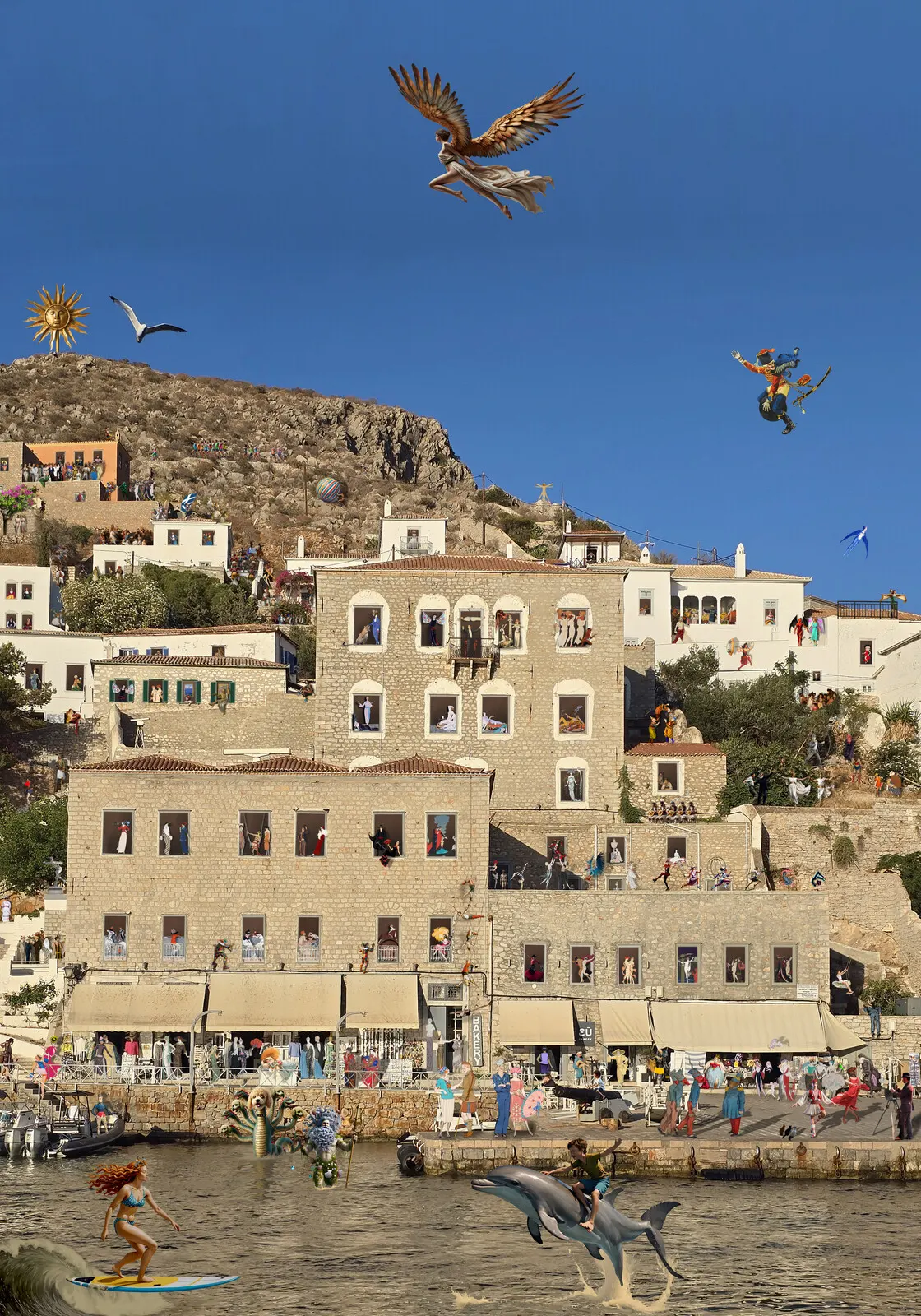
Hydra has many faces, most unassailable but all fantastic. Like faces, people experience Hydra in different ways; you see what you want to see, what appeals to you, while your eyes filter out the rest. Or you don't see it at all. It is so with an old city that if the walls could speak, they would remain silent about what they have witnessed. Like all the windows, they would have much to tell that is unknown to most if they could talk. Just like this day when the siesta had cast a filter over the town, those not dozing over a late lunch or seeking shelter from the sun under the café awnings. Everyone's attention was directed south and west, where the sun was. It seemed to be only me and my camera with the lens turned north toward the side, gasping in the scorching sunlight.
Many windows, usually empty of life except during a few vacation weeks a year, suddenly buzzed with activity. Hundreds of people were enjoying themselves without a sound. Several orchestras played, troubadours strummed bouzoukis, singers sang bel canto, and hundreds of souls screeched from windows and terraces. That is, not for me, who had been initiated into the presence of the Time-travellers. I could hear the cacophony and see the circus act on the other side.
It seemed like a carnival was taking place in the town. Why not? On Hydra, especially in the neighbourhoods around the harbour, a carnival almost runs around the clock during the summer months. This kind of can be pretty disruptive. It struck me that it must be what happens every year, by chance, the week before Miaoulia, the great event of the Hydriots and memories. 'Retention Day,' the Time-travellers call the occasion.
The Hydriots' 'Miaoulia' celebrates the memory of the fight for freedom and the regained independence, and in doing so, also death. Thousands died during the Greek War of Independence (1821-1829). Estimates of the number of deaths vary, but it is generally accepted that between 100,000 and 200,000 Greeks died during the conflict, in battles, massacres, and from starvation, many from Hydra. 'Retention Day,' an extraordinary day in eternity of recalling and expressing friendship and affection, is an Eternity's Remembrance Day. But not like the Greek May 19th, praising the dead, the Remembrance Day for the Genocide of the Pontic Greeks. A Sacred Day of Remembrance for hundreds of thousands of genocided ancestors killed by the Turks in the 1900s.
Since Time-travellers are not living on Earth anymore, they all stay in eternity on their respective stars. Instead, they celebrate life, what once was, even though death was always present among the memories. What unfolded before my eyes was like a chronicle play, a performance with much lighting resulting from a skilled dramaturge. She was here on one of the upper terraces, Thalia, one of the muses, a goddess of theatre. She cheerfully waved her happiest mask. The actual celebration begins when darkness has long since fallen over Hydra and the Hydriots have gone to bed. Now, during the siesta, the carnival-like part played out in full daylight. As exuberant as the carnival in Venice, the Time-travellers repeated their good and bad memories, but predominantly the good ones. To enumerate all the tableaux, scenes, and settings would take too long. Instead, I will briefly try to describe what the image I saw depicted. There was a thought behind Thalia's dramaturgical masterpiece, and no scene could work better than Hydra's horseshoe shape.
The picture, which is the most extensive I have ever created, contains, for this occasion, just over fifty open windows, three balconies, a dozen terraces, just as many shops, lots of stairs, and parapets, all filled with Time Travelers busy doing their part in a unique staging of times gone by.
The Retention Day makes all carnivals look like simple spectacles. About twenty tableaux, historical scenes depicted by those who were once part of them, they played themselves. It was a colourful spectacle created by the highest goddess of theatre, Thalia, who could be satisfied standing on one of the top terraces surrounded by her audience, who were also part of the performance.
Above it all shone Mother Sun, Jeff Koons' creation, which usually sits above The Slaughterhouse by the road to Mandraki. Since everything Time Travelers do is based on illusions and telepathy, the sun could shine from two places this day—three if you include the one highest in the sky.
Closest to the sun among today's guests hovered Icarus' sister Metiadusa with her wings attached with beeswax. Now, no one needed to worry about her, partly because you can only die once and partly because Metiadusa, as a woman, was too bright to be tempted to fly too high. She had nothing to prove and could focus on enjoying the view. A bit beyond her, the boastful Baron von Munchausen came flying on his cannonball on his way to Constantinople; yes, that's the city's eternal name. A little further away, a girl floated lightly like a swallow; I had forgotten her name, but I did not know how elegantly she flew.
On the large terrace of a high ochre-coloured house at the top left of the picture, two dozen celebrities from Hydra's history had gathered to exchange memories. The number one party-goer oversaw them, their former host, Babis Mores, owner of the club Lagoudera, which for a couple of decades made famous people from all over the world steer their course to Hydra. Not least because of him, the guest list was packed with notables. Last year, he arranged the party of all parties, 'The Last Dance', in another ochre villa even higher up. I have written an entire book about that.
In the adjacent window stood a stern gentleman, the Hydriot hero and admiral Pavlos Kountouriotis. He was upset because the pigeons had defecated on his statue in the harbour. According to the admiral, pigeons were best suited as roasted stuffed and served with grilled pears and drenched in port wine sauce. On the terrace below stood about twenty movie stars, artists, writers, and painters, all known to belong to Hydra's inner circle. The main character here, Onassis and John Lennon excuse me, was the aforementioned theatre goddess Thalia, who shone with all the praise she received. On the terrace below to the right, it steamed with little-restrained desire, the bisexual couple Bilitis with harp and lover. Next to them, the God of wine, Dionysos' lustful tutor Silenus, with a magnificent erection, and a female harlequin kept herself clothed away from the naked, frivolous company.
A curious boy from the revolution era peeking down at the heroes he had only heard about before he, as a ship's boy, too young, was cut down by the enemy outside Naphlion. Now, in eternity, preserved as a fourteen-year-old, he could meet them as much as he wanted, and he had all the time in the world. In another window, another critical gentleman appeared who thought time was out of joint. Saint Patriarch Gregory V of Constantinople suffered martyrdom when the Turks murdered him. No wonder the unforgiveness remains; Turks and Greeks prefer different constellations. Gregory kept an eye on the rebellious Hydriots from his star even though the concept of God in eternity had no significance.
A lone grey-haired retired Superman sat on the terrace below, wondering what was happening. He remains a fading superhero in his rarely-bought comic books. But being old and former, his presence was since he had more or less died as a phenomenon. Hence, his presence among the stars was where he thrived best with the equally unlikely Greek gods. Who, for example, believes in any of Hercules' great deeds? No one among the stars.
On a smaller terrace below Thalia's outstretched hand with the happy mask, in a mini Gethsemane, in the shade of a large bougainvillaea tree stood Jesus Christ with his great love Mary Magdalene, a couple who live together in eternity. They often and gladly return to Hydra, to their old homeland, now Israel, they seldom travel, where Jesus was poorly regarded as a false apostle, not the Messiah they are still waiting for. Moreover, there was a constant war there, and the peace of Hydra suited them better.
The villa to the right, with yet another large terrace, has been occupied by the heroes of the War of Independence who, in a dozen tableaux, show off their heroic deeds when they brutally drove the Turks out of their country from 1821 to 1829. Miaoulis had replicated himself and was also among the heroes who burned a Turkish ship that had grown larger than the Titanic over time. Objectively speaking, one could say he was overrepresented. But he was a capable man and a skilled businessman.
Diagonally above, alone on a balcony, stands Marilyn Monroe waving. She claims to have been to Hydra, or her longing was so strong that it connected her with her acting colleagues. Reading my book, The Last Dance, one understands better.
Below, in the world's oldest Naval Academy, every window looks into activities that have little to do with maritime safety and navigation knowledge. Behind the facade, something of an orgy was going on, a performance reminiscent of the happy 60s when they kicked up their heels among the beatniks of the time, a partying like no other, scenes reminiscent of all kinds of escapades, from wild copulating among Leonard's and Marianne's friends, coupled with all sorts of intoxicants and drugs.
There was dancing, loud music, and people hanging out in various bars, mixed with magicians and mystical wizards who knew everything about strange mushrooms. About twenty girls were having fun on the terrace next door and the windows below, as only girls can. An almost naked Apollo joined, though the girls seemed uninterested. They danced to a group of Bouzouki musicians on a mezzanine above.
A dozen Time Travellers are strolling in the picture on the promenade at the bottom, which runs around the harbour basin. They are gawking at each other and the shops' selection of imported goods from China. A couple of girls of the god Eros have been inside and bought a bag of Koulourakia, an everyday treat but still, a confection reserved for holidays, special occasions, and significant social events.
In front of them, the harbour square was full of guests from above. Some were conversing; others were looking at the boy riding his dolphin right next to where I stood on the other side. The narrow waters of the harbour basin were bustling with activity as a group of port policemen, retired for a hundred years, seemingly recruits, were getting a dressing down from their commander. A boy sits on an old cannon aiming at Poseidon, who stands in the water outside with his pet, the poodle-headed Hydra. He had the monster on a tight leash. A photographer from yesteryear took a picture of some people dancing a Sirtaki. A stupid photographer who insisted on using a camera from the early days of photography, one with plates. Not precisely for snapshots. He missed the chance to take a picture of the forever newborn Venus surfing in from the strait outside. Had he then aimed his camera more to the left and towards the houses above, he could have caught Anthony Quinn and Alan Bates dancing Zorba's dance together with some girls.
In a lone window high above, a laughing Pan sat with an equally laughing donkey. What were they laughing at? When I surveyed the surroundings, I saw three acrobatic clowns. It could hardly be at the tightrope-walking girl next to them; sure, her umbrella wobbled a bit comically, but her artistry was nothing to laugh at; she skillfully balanced on an electric cable stretched between two buildings. Time-travellers may defy the laws of physics when travelling through the universe, but on Earth, gravity is relentless. Newton discovered that his laws still applied to the Earth as early as the seventeenth century.
A circus orchestra played for dancing on an overdecked terrace between stately columns. A bit too modern, thought Zeus, whom I saw take the stairs down to quieter domains. A bottle in one hand and a glass in the other indicated he was in good company. In the window nearest the musicians, Hypatia had somewhat the same thoughts. Judging by her expression, it was not her kind of music. The female pioneer and astronomer lived in the third century in Alexandria, so that can be understood.
Hand in hand, one of the devil's girls, red as the glow of hell, with horns on her forehead and black wings, walked with one of God's angels dressed in a form-fitting pastel green dress and matching green shoes. Good and evil seemed to get along, their unlikely companionship challenging the conventional notions of morality and righteousness.
Betty Boop is outdated as a female ideal, and despite her red garter, there was no crowd below her window. Above her head, on a terrace that, with its iron railing, resembled the bow of the Titanic, stood the immortalised couple Rose and Jack. With their outstretched arms, his supporting hers, they created the image that they could fly away from their fate. They could not, and that was also why they were here.
After leaving Earth, Jack returned to train navigation. He had difficulty reconciling with his fate because Rose survived and would find someone else. Circumstances determined where he ended up. Among the stars, he had met Antonis Oikonomou, the revolutionary hero murdered by his own, Miaoulis, and others who felt threatened by Antonis's revolutionary ideas.
Jack, a working-class member, easily connected with Antonis's ideas and formed a strong bond. Antonis, his eternal friend, taught him everything about navigation and seamanship. Together, they embarked on adventurous nocturne boat trips around Hydra, borrowing caiques from unsuspecting owners. Their friendship was a source of joy and warmth, a testament to the power of learning and companionship.
Da Vinci's Vitruvian Man had found his way to Hydra. Since he was stuck in his eternal pose, he rolled like a circle through eternity. Why Hydra? An island, like himself, somewhat perfect by Vitruvian standards, balancing between Culture, History, and Entertainment. It's as simple as that.
Naturally, not everyone had as much fun but drifted through eternity, trapped by conventions and their phobias. One who also distanced himself from modern circus music was Sisyphus, who pushed a gigantic stone beach ball. After being forced to haul a piece of grey-speckled bedrock for thousands of years, the gods finally took pity on the old tyrant and replaced the dull boulder with a much happier beach ball of granite. The weight was the same, but Sisyphus was cheered by the colourful striped company. He was so accustomed to his rolling that he found it more enjoyable than meaningless discussions with other old-timers from the past. That he left the party for a trip up the mountain should, with history in mind, not be misunderstood. He would soon return to roll it up again in his eternal cycle. Others played Sudoku; Sisyphus rolled stone. The moral is that he did not escape his fate by moving to eternity, but he had a magnificent view of the brutal rocky landscape and the azure sea.
That day, he shared the view with a group that did not like to sit still. They made their version of Hydra's annual Trail Marathon, designed to showcase the loveliness of the island's mountainous regions. They travelled around the universe and participated in all sorts of long-distance races.
The Monkey King Sun Wukong, accustomed to crossing 54,000 kilometres in a single leap, found the 38.5-km-long Hydra Trail a mere warm-up. His ease and prowess in the race were impressive, leaving the audience in awe of his abilities.
Zeus' son Hermes was the messenger of the gods. He was also responsible for guiding the dead to the underworld. Hermes was said to be the fastest of the gods and wore winged sandals and a winged hat. That did not help in this fast company; a really old lady led the pack.
The Finnish forest spirit Hippa was no beauty, resembling gnomes and leprechauns. A misunderstanding long ago transformed the spirit into a man. However, Hippa is actually a woman, more than five thousand years old, with grey hair full of needles, cones, and old leaves that got stuck during her rapid runs through the Scandinavian primaeval forest. Hippa represents running and hunting because she can run fast. Hippas enthusiastically chased people for fun over woods and fields. For this reason, tag-play is called "Hippa" in Finland. Now, she ran away from the whole gang of fleet-footed gods. So differently falls a lot of fate.
Time-travellers are as disparate as their living successors. No one is the same as another, even though they resemble each other, all a mirror of their own time and culture. Professions come and go, and language changes, but fundamentally, humans remain the same. Jesters, funnymen, bores, narcissists, and psychopaths have existed in all ages.
Have you ever wondered why people act the way they do and respond differently to the same situation? Have you wished to understand someone better… your loved one? And how could you get along with friends and colleagues?
Reality is a masterpiece of diverse personalities, each contributing brushstrokes to our impressionistic canvas. These differences, far from causing conflict, make our world a fascinating and dynamic place. Can you imagine how monotonous it would be if we were all the same?
Imagine your house was on fire; you'd see some brave person rushing in to check if anyone was trapped, risking their own life because it felt like the right thing to do. Others would stay outside to comfort the victims and offer help. Some would write on the Internet about the fire to inform people and afterwards analyse how to prevent such incidents. Another might go home after witnessing the fire, reflecting on life and the fear and expressing the suffering experienced by the victims. Then, some would help maintain order around the scene, working to keep the peace. Unfortunately, the majority will stay there as passive voyeurs. Some few would even be happy seeing a neighbour's house be destroyed, not their own.
Our desires and fears shape our unique personalities. These motivations guide our thoughts and actions, weaving the intricate tapestry of human behaviour.
So, among the audience were former police officers, singers, actors, directors, artists, cultural workers, and fishermen, all with the commonality that they had once lived in or visited Hydra. Many were from the War of Independence, but most were from modern times, Hydra's heyday as the entertainment metropolis of the Mediterranean. A satisfied Babis Mores waved from a window to all of Lagoudera's old guests, the Onassis couple, Melina Mercouri, and other celebrities from the golden years of the '60s and '70s. I could recognise priests and monks who were not so pious that they didn't participate with their whole soul in the performance before my eyes. I can promise that very few seemed unaffected by alcohol or other stimulants. I dare say that some were quite drunk, for even a Time-traveller can become intoxicated, though they never suffer from hangovers.
Present were also a half dozen Vikings who once visited the then-inhibited island on their way to Constantinople, a bunch of Potentates from the past, Gods and Goddesses in splendid grandeur but nowadays without power, and Kings left with no realms, Counts, Barons, Princes and Princesses and not to forget Soraya, once an Emperess. Still, the God of love, Eros, and his colleague Dionysus, the God of wine and his satyrs, were always present in the enchanted Hydra that Time-travellers call their own. Hydra is addictive both in the past and now.
Hydra has long been a source of inspiration for artists, drawing in a diverse array of talent worldwide. Since the late 1930s, the island has been a vibrant melting pot of international and Greek artists, each bringing unique perspectives and skills to enrich Hydra's artistic scene.
One of Hydra's most notable sons, Nikos Hadjikyriakos-Ghikas, found profound inspiration on the island. His childhood memories of Hydra significantly influenced his multi-talented nature and artistic development from an early age. Ghikas' early works, which skillfully blend cubism with nature, light, and Greek architecture, directly result from this influence. Today, his art is celebrated in world-renowned galleries and museums, with some pieces displayed in his former residence in Athens, now known as the Ghika Gallery. On Hydra, his legacy endures, though all that remains of his former home is an abandoned, burnt ruin of forty-five rooms of bygone grandeur.
The island's charm also captivated George Seferis, one of Greece's most esteemed poets and a Nobel Prize in Literature laureate. In addition to his literary achievements, Seferis was an amateur photographer who captured the essence of Hydra in the 1940s. His surviving photographs, including images of Seferis with American writer Henry Miller and detailed shots of Hydrian houses, offer a nostalgic glimpse into the island's past.
Another celebrated poet, Odysseas Elytis, drew significant inspiration from Hydra's stunning scenery. His famous poem, "The Dolphin Girl," is a tribute to the island's beauty.
"There off Hydra's and Spetses' open sea
look there, a dolphin-girl appears to me.
I say, "You're naked, where's your petticoat
you're going off to your boyfriend like that?"
"I have no boyfriend," she says with a pout
"To see what's going on is why I'm out."
She dives headlong into a wave and then
she reappears and grabs the boat again.
God save me, but I lean to see all this
Then the naughty girl gives me a kiss.
Her breasts are fragrant as lemons in the brine
And in her eyes, all azure sparkle and shine.
"Come now, girl, get on the boat. Let's fly
five times, we'll take a turn about the sky."
Henry Miller, who stayed at Ghika's Mansion, was similarly enchanted by Hydra's landscape. He spent considerable time on the island, which profoundly influenced his writing. Miller's experiences in Greece are vividly recounted in his book "The Colossus of Maroussi," a significant portion of which was written on Hydra.
Hydra, a once thriving island with a population of around 30,000, faced a decline following its illustrious days in the 1700s and early 19th century. Despite the victory over the Turks, the island's population dwindled as job opportunities decreased. A brief revival occurred in the late 19th century due to the demand for sponges, but the new century brought poverty and further depopulation. The 1950s marked a turning point for Hydra when it was 'discovered' by artists and filmmakers. Their extensive use of the island in their movies sparked a significant transformation, rapidly increasing tourism and economic development. This resilience and adaptability turned Hydra into a cosmopolitan tourist destination, inspiring hope for its future.
In the 1950s and 60s, foreign writers like Australian George Johnston, Swede Axel Jensen, and Canadian Leonard Cohen bought houses on the island, establishing a foreign community that still thrives today. Hydra's appeal extends to almost every celebrity who has visited the island at some point. What sets Hydra apart is its egalitarian treatment of visitors; here, celebrities and anonymous visitors are treated with the same warmth and hospitality. This inclusive atmosphere ensures that everyone feels welcomed and included regardless of status. Today, no one would recognise the visitors because that's how it works. Leonard can walk through the harbour without causing a stir; the fact that he reminds someone of a person they admired or even knew doesn't matter. Other than positive or negative vibes, such encounters leave no trace.
Hydra gained worldwide fame with the 1957 film Boy on a Dolphin, which was shot on the island and starred Sophia Loren. If she were still alive, she would undoubtedly have been a guest on this day. Many of her colleagues from the film shoot were present.
Among the most famous films shot on Hydra is Michael Cacoyannis's "Girl with Black," starring Ellie Lambeti, which received rave reviews at European festivals. Ten years later, Jules Dassin's film "Phaedra," featuring the enchanting Melina Mercouri, Anthony Perkins, and Ralph Vallone, was filmed on the island.
Hydra became a famous destination mainly between 1960 and 1970 when celebrities from around the world, like John Lennon, Eric Clapton, the pop group Rolling Stones, Onassis and Callas, Rex Harrison, Peter Ustinov, Leonard Cohen, and many others, passed through here. John Lennon was here this day, as were Brian Jones and Charlie Watts, Onassis and Callas, and Jackie. Rex and Peter had joined Leonard and travelled through a wormhole to Earth.
Today, the Hydra of Miller, Seferis, Gikas, Engonopoulos, Byzantios, and Tetsis remain the jewel of the Gulf Islands, with the continuous offering to tourism and our country's cultural life. Its unique blend of historical and architectural wonders and constant contribution to our country's cultural life make Hydra a destination that intrigues and invites exploration. It is undoubtedly one of the finest resorts in Greece, a testament to its rich history and cultural significance.
The Hydriot poet George Seferis once said, "It is a small country, but its tradition is immense and has been handed down through the centuries without interruption. Sixty-eight years ago, in 1963, he was awarded the Nobel Prize and was chosen for his excellent lyrical style, inspired by a deep feeling for the Greek cultural ideal.
The same goes for Hydra.
Jörgen Thornberg
Hydra, the island of contrasts - a day in June when everyone seemed to be looking in a different direction., 2024
Digital
70 x 100 cm
Hydra has many faces, most unassailable but all fantastic. Like faces, people experience Hydra in different ways; you see what you want to see, what appeals to you, while your eyes filter out the rest. Or you don't see it at all. It is so with an old city that if the walls could speak, they would remain silent about what they have witnessed. Like all the windows, they would have much to tell that is unknown to most if they could talk. Just like this day when the siesta had cast a filter over the town, those not dozing over a late lunch or seeking shelter from the sun under the café awnings. Everyone's attention was directed south and west, where the sun was. It seemed to be only me and my camera with the lens turned north toward the side, gasping in the scorching sunlight.
Many windows, usually empty of life except during a few vacation weeks a year, suddenly buzzed with activity. Hundreds of people were enjoying themselves without a sound. Several orchestras played, troubadours strummed bouzoukis, singers sang bel canto, and hundreds of souls screeched from windows and terraces. That is, not for me, who had been initiated into the presence of the Time-travellers. I could hear the cacophony and see the circus act on the other side.
It seemed like a carnival was taking place in the town. Why not? On Hydra, especially in the neighbourhoods around the harbour, a carnival almost runs around the clock during the summer months. This kind of can be pretty disruptive. It struck me that it must be what happens every year, by chance, the week before Miaoulia, the great event of the Hydriots and memories. 'Retention Day,' the Time-travellers call the occasion.
The Hydriots' 'Miaoulia' celebrates the memory of the fight for freedom and the regained independence, and in doing so, also death. Thousands died during the Greek War of Independence (1821-1829). Estimates of the number of deaths vary, but it is generally accepted that between 100,000 and 200,000 Greeks died during the conflict, in battles, massacres, and from starvation, many from Hydra. 'Retention Day,' an extraordinary day in eternity of recalling and expressing friendship and affection, is an Eternity's Remembrance Day. But not like the Greek May 19th, praising the dead, the Remembrance Day for the Genocide of the Pontic Greeks. A Sacred Day of Remembrance for hundreds of thousands of genocided ancestors killed by the Turks in the 1900s.
Since Time-travellers are not living on Earth anymore, they all stay in eternity on their respective stars. Instead, they celebrate life, what once was, even though death was always present among the memories. What unfolded before my eyes was like a chronicle play, a performance with much lighting resulting from a skilled dramaturge. She was here on one of the upper terraces, Thalia, one of the muses, a goddess of theatre. She cheerfully waved her happiest mask. The actual celebration begins when darkness has long since fallen over Hydra and the Hydriots have gone to bed. Now, during the siesta, the carnival-like part played out in full daylight. As exuberant as the carnival in Venice, the Time-travellers repeated their good and bad memories, but predominantly the good ones. To enumerate all the tableaux, scenes, and settings would take too long. Instead, I will briefly try to describe what the image I saw depicted. There was a thought behind Thalia's dramaturgical masterpiece, and no scene could work better than Hydra's horseshoe shape.
The picture, which is the most extensive I have ever created, contains, for this occasion, just over fifty open windows, three balconies, a dozen terraces, just as many shops, lots of stairs, and parapets, all filled with Time Travelers busy doing their part in a unique staging of times gone by.
The Retention Day makes all carnivals look like simple spectacles. About twenty tableaux, historical scenes depicted by those who were once part of them, they played themselves. It was a colourful spectacle created by the highest goddess of theatre, Thalia, who could be satisfied standing on one of the top terraces surrounded by her audience, who were also part of the performance.
Above it all shone Mother Sun, Jeff Koons' creation, which usually sits above The Slaughterhouse by the road to Mandraki. Since everything Time Travelers do is based on illusions and telepathy, the sun could shine from two places this day—three if you include the one highest in the sky.
Closest to the sun among today's guests hovered Icarus' sister Metiadusa with her wings attached with beeswax. Now, no one needed to worry about her, partly because you can only die once and partly because Metiadusa, as a woman, was too bright to be tempted to fly too high. She had nothing to prove and could focus on enjoying the view. A bit beyond her, the boastful Baron von Munchausen came flying on his cannonball on his way to Constantinople; yes, that's the city's eternal name. A little further away, a girl floated lightly like a swallow; I had forgotten her name, but I did not know how elegantly she flew.
On the large terrace of a high ochre-coloured house at the top left of the picture, two dozen celebrities from Hydra's history had gathered to exchange memories. The number one party-goer oversaw them, their former host, Babis Mores, owner of the club Lagoudera, which for a couple of decades made famous people from all over the world steer their course to Hydra. Not least because of him, the guest list was packed with notables. Last year, he arranged the party of all parties, 'The Last Dance', in another ochre villa even higher up. I have written an entire book about that.
In the adjacent window stood a stern gentleman, the Hydriot hero and admiral Pavlos Kountouriotis. He was upset because the pigeons had defecated on his statue in the harbour. According to the admiral, pigeons were best suited as roasted stuffed and served with grilled pears and drenched in port wine sauce. On the terrace below stood about twenty movie stars, artists, writers, and painters, all known to belong to Hydra's inner circle. The main character here, Onassis and John Lennon excuse me, was the aforementioned theatre goddess Thalia, who shone with all the praise she received. On the terrace below to the right, it steamed with little-restrained desire, the bisexual couple Bilitis with harp and lover. Next to them, the God of wine, Dionysos' lustful tutor Silenus, with a magnificent erection, and a female harlequin kept herself clothed away from the naked, frivolous company.
A curious boy from the revolution era peeking down at the heroes he had only heard about before he, as a ship's boy, too young, was cut down by the enemy outside Naphlion. Now, in eternity, preserved as a fourteen-year-old, he could meet them as much as he wanted, and he had all the time in the world. In another window, another critical gentleman appeared who thought time was out of joint. Saint Patriarch Gregory V of Constantinople suffered martyrdom when the Turks murdered him. No wonder the unforgiveness remains; Turks and Greeks prefer different constellations. Gregory kept an eye on the rebellious Hydriots from his star even though the concept of God in eternity had no significance.
A lone grey-haired retired Superman sat on the terrace below, wondering what was happening. He remains a fading superhero in his rarely-bought comic books. But being old and former, his presence was since he had more or less died as a phenomenon. Hence, his presence among the stars was where he thrived best with the equally unlikely Greek gods. Who, for example, believes in any of Hercules' great deeds? No one among the stars.
On a smaller terrace below Thalia's outstretched hand with the happy mask, in a mini Gethsemane, in the shade of a large bougainvillaea tree stood Jesus Christ with his great love Mary Magdalene, a couple who live together in eternity. They often and gladly return to Hydra, to their old homeland, now Israel, they seldom travel, where Jesus was poorly regarded as a false apostle, not the Messiah they are still waiting for. Moreover, there was a constant war there, and the peace of Hydra suited them better.
The villa to the right, with yet another large terrace, has been occupied by the heroes of the War of Independence who, in a dozen tableaux, show off their heroic deeds when they brutally drove the Turks out of their country from 1821 to 1829. Miaoulis had replicated himself and was also among the heroes who burned a Turkish ship that had grown larger than the Titanic over time. Objectively speaking, one could say he was overrepresented. But he was a capable man and a skilled businessman.
Diagonally above, alone on a balcony, stands Marilyn Monroe waving. She claims to have been to Hydra, or her longing was so strong that it connected her with her acting colleagues. Reading my book, The Last Dance, one understands better.
Below, in the world's oldest Naval Academy, every window looks into activities that have little to do with maritime safety and navigation knowledge. Behind the facade, something of an orgy was going on, a performance reminiscent of the happy 60s when they kicked up their heels among the beatniks of the time, a partying like no other, scenes reminiscent of all kinds of escapades, from wild copulating among Leonard's and Marianne's friends, coupled with all sorts of intoxicants and drugs.
There was dancing, loud music, and people hanging out in various bars, mixed with magicians and mystical wizards who knew everything about strange mushrooms. About twenty girls were having fun on the terrace next door and the windows below, as only girls can. An almost naked Apollo joined, though the girls seemed uninterested. They danced to a group of Bouzouki musicians on a mezzanine above.
A dozen Time Travellers are strolling in the picture on the promenade at the bottom, which runs around the harbour basin. They are gawking at each other and the shops' selection of imported goods from China. A couple of girls of the god Eros have been inside and bought a bag of Koulourakia, an everyday treat but still, a confection reserved for holidays, special occasions, and significant social events.
In front of them, the harbour square was full of guests from above. Some were conversing; others were looking at the boy riding his dolphin right next to where I stood on the other side. The narrow waters of the harbour basin were bustling with activity as a group of port policemen, retired for a hundred years, seemingly recruits, were getting a dressing down from their commander. A boy sits on an old cannon aiming at Poseidon, who stands in the water outside with his pet, the poodle-headed Hydra. He had the monster on a tight leash. A photographer from yesteryear took a picture of some people dancing a Sirtaki. A stupid photographer who insisted on using a camera from the early days of photography, one with plates. Not precisely for snapshots. He missed the chance to take a picture of the forever newborn Venus surfing in from the strait outside. Had he then aimed his camera more to the left and towards the houses above, he could have caught Anthony Quinn and Alan Bates dancing Zorba's dance together with some girls.
In a lone window high above, a laughing Pan sat with an equally laughing donkey. What were they laughing at? When I surveyed the surroundings, I saw three acrobatic clowns. It could hardly be at the tightrope-walking girl next to them; sure, her umbrella wobbled a bit comically, but her artistry was nothing to laugh at; she skillfully balanced on an electric cable stretched between two buildings. Time-travellers may defy the laws of physics when travelling through the universe, but on Earth, gravity is relentless. Newton discovered that his laws still applied to the Earth as early as the seventeenth century.
A circus orchestra played for dancing on an overdecked terrace between stately columns. A bit too modern, thought Zeus, whom I saw take the stairs down to quieter domains. A bottle in one hand and a glass in the other indicated he was in good company. In the window nearest the musicians, Hypatia had somewhat the same thoughts. Judging by her expression, it was not her kind of music. The female pioneer and astronomer lived in the third century in Alexandria, so that can be understood.
Hand in hand, one of the devil's girls, red as the glow of hell, with horns on her forehead and black wings, walked with one of God's angels dressed in a form-fitting pastel green dress and matching green shoes. Good and evil seemed to get along, their unlikely companionship challenging the conventional notions of morality and righteousness.
Betty Boop is outdated as a female ideal, and despite her red garter, there was no crowd below her window. Above her head, on a terrace that, with its iron railing, resembled the bow of the Titanic, stood the immortalised couple Rose and Jack. With their outstretched arms, his supporting hers, they created the image that they could fly away from their fate. They could not, and that was also why they were here.
After leaving Earth, Jack returned to train navigation. He had difficulty reconciling with his fate because Rose survived and would find someone else. Circumstances determined where he ended up. Among the stars, he had met Antonis Oikonomou, the revolutionary hero murdered by his own, Miaoulis, and others who felt threatened by Antonis's revolutionary ideas.
Jack, a working-class member, easily connected with Antonis's ideas and formed a strong bond. Antonis, his eternal friend, taught him everything about navigation and seamanship. Together, they embarked on adventurous nocturne boat trips around Hydra, borrowing caiques from unsuspecting owners. Their friendship was a source of joy and warmth, a testament to the power of learning and companionship.
Da Vinci's Vitruvian Man had found his way to Hydra. Since he was stuck in his eternal pose, he rolled like a circle through eternity. Why Hydra? An island, like himself, somewhat perfect by Vitruvian standards, balancing between Culture, History, and Entertainment. It's as simple as that.
Naturally, not everyone had as much fun but drifted through eternity, trapped by conventions and their phobias. One who also distanced himself from modern circus music was Sisyphus, who pushed a gigantic stone beach ball. After being forced to haul a piece of grey-speckled bedrock for thousands of years, the gods finally took pity on the old tyrant and replaced the dull boulder with a much happier beach ball of granite. The weight was the same, but Sisyphus was cheered by the colourful striped company. He was so accustomed to his rolling that he found it more enjoyable than meaningless discussions with other old-timers from the past. That he left the party for a trip up the mountain should, with history in mind, not be misunderstood. He would soon return to roll it up again in his eternal cycle. Others played Sudoku; Sisyphus rolled stone. The moral is that he did not escape his fate by moving to eternity, but he had a magnificent view of the brutal rocky landscape and the azure sea.
That day, he shared the view with a group that did not like to sit still. They made their version of Hydra's annual Trail Marathon, designed to showcase the loveliness of the island's mountainous regions. They travelled around the universe and participated in all sorts of long-distance races.
The Monkey King Sun Wukong, accustomed to crossing 54,000 kilometres in a single leap, found the 38.5-km-long Hydra Trail a mere warm-up. His ease and prowess in the race were impressive, leaving the audience in awe of his abilities.
Zeus' son Hermes was the messenger of the gods. He was also responsible for guiding the dead to the underworld. Hermes was said to be the fastest of the gods and wore winged sandals and a winged hat. That did not help in this fast company; a really old lady led the pack.
The Finnish forest spirit Hippa was no beauty, resembling gnomes and leprechauns. A misunderstanding long ago transformed the spirit into a man. However, Hippa is actually a woman, more than five thousand years old, with grey hair full of needles, cones, and old leaves that got stuck during her rapid runs through the Scandinavian primaeval forest. Hippa represents running and hunting because she can run fast. Hippas enthusiastically chased people for fun over woods and fields. For this reason, tag-play is called "Hippa" in Finland. Now, she ran away from the whole gang of fleet-footed gods. So differently falls a lot of fate.
Time-travellers are as disparate as their living successors. No one is the same as another, even though they resemble each other, all a mirror of their own time and culture. Professions come and go, and language changes, but fundamentally, humans remain the same. Jesters, funnymen, bores, narcissists, and psychopaths have existed in all ages.
Have you ever wondered why people act the way they do and respond differently to the same situation? Have you wished to understand someone better… your loved one? And how could you get along with friends and colleagues?
Reality is a masterpiece of diverse personalities, each contributing brushstrokes to our impressionistic canvas. These differences, far from causing conflict, make our world a fascinating and dynamic place. Can you imagine how monotonous it would be if we were all the same?
Imagine your house was on fire; you'd see some brave person rushing in to check if anyone was trapped, risking their own life because it felt like the right thing to do. Others would stay outside to comfort the victims and offer help. Some would write on the Internet about the fire to inform people and afterwards analyse how to prevent such incidents. Another might go home after witnessing the fire, reflecting on life and the fear and expressing the suffering experienced by the victims. Then, some would help maintain order around the scene, working to keep the peace. Unfortunately, the majority will stay there as passive voyeurs. Some few would even be happy seeing a neighbour's house be destroyed, not their own.
Our desires and fears shape our unique personalities. These motivations guide our thoughts and actions, weaving the intricate tapestry of human behaviour.
So, among the audience were former police officers, singers, actors, directors, artists, cultural workers, and fishermen, all with the commonality that they had once lived in or visited Hydra. Many were from the War of Independence, but most were from modern times, Hydra's heyday as the entertainment metropolis of the Mediterranean. A satisfied Babis Mores waved from a window to all of Lagoudera's old guests, the Onassis couple, Melina Mercouri, and other celebrities from the golden years of the '60s and '70s. I could recognise priests and monks who were not so pious that they didn't participate with their whole soul in the performance before my eyes. I can promise that very few seemed unaffected by alcohol or other stimulants. I dare say that some were quite drunk, for even a Time-traveller can become intoxicated, though they never suffer from hangovers.
Present were also a half dozen Vikings who once visited the then-inhibited island on their way to Constantinople, a bunch of Potentates from the past, Gods and Goddesses in splendid grandeur but nowadays without power, and Kings left with no realms, Counts, Barons, Princes and Princesses and not to forget Soraya, once an Emperess. Still, the God of love, Eros, and his colleague Dionysus, the God of wine and his satyrs, were always present in the enchanted Hydra that Time-travellers call their own. Hydra is addictive both in the past and now.
Hydra has long been a source of inspiration for artists, drawing in a diverse array of talent worldwide. Since the late 1930s, the island has been a vibrant melting pot of international and Greek artists, each bringing unique perspectives and skills to enrich Hydra's artistic scene.
One of Hydra's most notable sons, Nikos Hadjikyriakos-Ghikas, found profound inspiration on the island. His childhood memories of Hydra significantly influenced his multi-talented nature and artistic development from an early age. Ghikas' early works, which skillfully blend cubism with nature, light, and Greek architecture, directly result from this influence. Today, his art is celebrated in world-renowned galleries and museums, with some pieces displayed in his former residence in Athens, now known as the Ghika Gallery. On Hydra, his legacy endures, though all that remains of his former home is an abandoned, burnt ruin of forty-five rooms of bygone grandeur.
The island's charm also captivated George Seferis, one of Greece's most esteemed poets and a Nobel Prize in Literature laureate. In addition to his literary achievements, Seferis was an amateur photographer who captured the essence of Hydra in the 1940s. His surviving photographs, including images of Seferis with American writer Henry Miller and detailed shots of Hydrian houses, offer a nostalgic glimpse into the island's past.
Another celebrated poet, Odysseas Elytis, drew significant inspiration from Hydra's stunning scenery. His famous poem, "The Dolphin Girl," is a tribute to the island's beauty.
"There off Hydra's and Spetses' open sea
look there, a dolphin-girl appears to me.
I say, "You're naked, where's your petticoat
you're going off to your boyfriend like that?"
"I have no boyfriend," she says with a pout
"To see what's going on is why I'm out."
She dives headlong into a wave and then
she reappears and grabs the boat again.
God save me, but I lean to see all this
Then the naughty girl gives me a kiss.
Her breasts are fragrant as lemons in the brine
And in her eyes, all azure sparkle and shine.
"Come now, girl, get on the boat. Let's fly
five times, we'll take a turn about the sky."
Henry Miller, who stayed at Ghika's Mansion, was similarly enchanted by Hydra's landscape. He spent considerable time on the island, which profoundly influenced his writing. Miller's experiences in Greece are vividly recounted in his book "The Colossus of Maroussi," a significant portion of which was written on Hydra.
Hydra, a once thriving island with a population of around 30,000, faced a decline following its illustrious days in the 1700s and early 19th century. Despite the victory over the Turks, the island's population dwindled as job opportunities decreased. A brief revival occurred in the late 19th century due to the demand for sponges, but the new century brought poverty and further depopulation. The 1950s marked a turning point for Hydra when it was 'discovered' by artists and filmmakers. Their extensive use of the island in their movies sparked a significant transformation, rapidly increasing tourism and economic development. This resilience and adaptability turned Hydra into a cosmopolitan tourist destination, inspiring hope for its future.
In the 1950s and 60s, foreign writers like Australian George Johnston, Swede Axel Jensen, and Canadian Leonard Cohen bought houses on the island, establishing a foreign community that still thrives today. Hydra's appeal extends to almost every celebrity who has visited the island at some point. What sets Hydra apart is its egalitarian treatment of visitors; here, celebrities and anonymous visitors are treated with the same warmth and hospitality. This inclusive atmosphere ensures that everyone feels welcomed and included regardless of status. Today, no one would recognise the visitors because that's how it works. Leonard can walk through the harbour without causing a stir; the fact that he reminds someone of a person they admired or even knew doesn't matter. Other than positive or negative vibes, such encounters leave no trace.
Hydra gained worldwide fame with the 1957 film Boy on a Dolphin, which was shot on the island and starred Sophia Loren. If she were still alive, she would undoubtedly have been a guest on this day. Many of her colleagues from the film shoot were present.
Among the most famous films shot on Hydra is Michael Cacoyannis's "Girl with Black," starring Ellie Lambeti, which received rave reviews at European festivals. Ten years later, Jules Dassin's film "Phaedra," featuring the enchanting Melina Mercouri, Anthony Perkins, and Ralph Vallone, was filmed on the island.
Hydra became a famous destination mainly between 1960 and 1970 when celebrities from around the world, like John Lennon, Eric Clapton, the pop group Rolling Stones, Onassis and Callas, Rex Harrison, Peter Ustinov, Leonard Cohen, and many others, passed through here. John Lennon was here this day, as were Brian Jones and Charlie Watts, Onassis and Callas, and Jackie. Rex and Peter had joined Leonard and travelled through a wormhole to Earth.
Today, the Hydra of Miller, Seferis, Gikas, Engonopoulos, Byzantios, and Tetsis remain the jewel of the Gulf Islands, with the continuous offering to tourism and our country's cultural life. Its unique blend of historical and architectural wonders and constant contribution to our country's cultural life make Hydra a destination that intrigues and invites exploration. It is undoubtedly one of the finest resorts in Greece, a testament to its rich history and cultural significance.
The Hydriot poet George Seferis once said, "It is a small country, but its tradition is immense and has been handed down through the centuries without interruption. Sixty-eight years ago, in 1963, he was awarded the Nobel Prize and was chosen for his excellent lyrical style, inspired by a deep feeling for the Greek cultural ideal.
The same goes for Hydra.

Jörgen Thornberg
Malmö
Lite om bilder och mig. Translation in English at the end.
Jag är en nyfiken person som ser allt i bilder, även det jag fäster i ord, gärna tillsammans för bakom alla mina bilder finns en berättelse. Till vissa bilder hör en kortare eller längre novell som följer med bilden.
Bilder berättar historier. Jag omges av naturlig skönhet, intressanta människor och historia var jag än går. Jag använder min kamera för att dokumentera världen och blanda det jag ser med vad jag känner för att fånga den dolda magin.
Mina bilder berättar mina historier. Genom mina bilder, tryck och berättelser. Jag bjuder in dig att ta del av dessa berättelser, in i ditt liv och hem och dela min mycket personliga syn på vår värld. Mer än vad ögat ser. Jag tänker i bilder, drömmer och skriver och pratar om dem; följaktligen måste jag också skapa bilder. De blir vad jag ser, inte nödvändigtvis begränsade till verkligheten. Det finns en bild runt varje hörn. Jag hoppas att du kommer att se vad jag såg och gilla det.
Jag är också en skrivande person och till många bilder hör en kortare eller längre essay. Den följer med tavlan, tryckt på fint papper och med en personlig hälsning från mig.
Flertalet bilder startar sin resa i min kamera. Enkelt förklarat beskriver jag bilden jag ser i mitt inre, upplevd eller fantiserad. Bilden uppstår inom mig redan innan jag fått okularet till ögat. På bråkdelen av ett ögonblick ser jag vad jag vill ha och vad som kan göras med bilden. Här skall jag stoppa in en giraff, stålmannen, Titanic eller vad det är min fantasi finner ut. Ännu märkligare är att jag kommer ihåg minnesbilden långt efteråt när det blir tid att skapa verket. Om jag lyckas eller inte, är upp till betraktaren, oftast präglat av en stråk av svart humor – meningen är att man skall bli underhållen. Mina bilder blir ofta en snackis där de hänger.
Jag föredrar bilder som förmedlar ett budskap i flera lager. Vid första anblicken fylld av feel-good, en vacker utsikt, fint väder, solen skiner, blommor på ängen eller vattnet som ligger förrädiskt spegelblankt. I en sådan bild kan jag gömma min egentliga berättelse, mitt förakt för förtryckare och våldsverkare, rasister och fördomsfulla människor - ett gärna återkommande motiv mer eller mindre dolt i det vackra motivet. Jag försöker förena dem i ett gemensamt narrativ.
Bild och formgivning har löpt som en röd tråd genom livet. Fotokonst känns som en värdig final som jag gärna delar med mig.
Min genre är vid som framgår av mina bilder, temat en blandning av pop- och gatukonst i kollage som kan bestå av hundratals lager. Vissa bilder kan ta veckor, andra någon dag innan det är dags att överlämna resultatet till printverkstaden. Fine Art Prints är digitala fotocollage. I dessa kollage sker rivandet, klippandet, pusslandet, målandet, ritandet och sprayningen digitalt. Det jag monterar in kan vara hundratals år gamla bilder som jag omsorgsfullt frilägger så att de ser ut att vara en del av tavlan men också bilder skapade av mig själv efter min egen fantasi. Därefter besöks printstudion och för vissa bilder numrera en limiterad upplaga (oftast 7 exemplar) och signera för hand. Vissa bilder kan köpas i olika format. Det är bara att fråga efter vilka. Gillar man en bild som är 70x100 men inte har plats på väggen, går den kanske att få i 50x70 cm istället. Frågan är fri.
Metoden Giclée eller Fine Art Print som det också kallas är det moderna sättet för framställning av grafisk konst. Villkoret för denna typ av utskrifter är att en högkvalitativ storformatskrivare används med åldersbeständigt färgpigment och konstnärspapper eller i förekommande fall på duk. Pappret som används möter de krav på livslängd som ställs av museer och gallerier. Normalt säljer jag mina bilder oinramade så att den nya ägaren själv kan bestämma hur de skall se ut, med eller utan passepartout färg på ram, med eller utan glas etc..
Under många år ställde jag bara ut på nätet, i valda grupper och på min egen Facebooksida - https://www.facebook.com/jorgen.thornberg.9
Jag finns också på en egen hemsida som tyvärr inte alltid är uppdaterad – https://www.jth.life/ Där kan du också läsa en del av de berättelser som följer med bilden.
UTSTÄLLNINGAR
Luftkastellet, oktober 2022
Konst i Lund, november 2022
Luftkastellet, mars 2023
Engleson Galleri Caroli, april 2023
Hydra, Greece June 2023
Engleson Galleri Caroli, oktober 2023
Toppen, Höllviken december 2023
Luftkastellet, mars 2024
Torups Galleri, mars 2024
Venice, May 2024
Luftkastellet, oktober 2024
Konst i Advent, December 2024
Galleri Engleson, Caroli December 2024
Jäger & Jansson Galleri, april 2025
A bit about pictures and me.
I'm a curious person who sees everything in pictures, even what I express in words, often combining them, for behind all my pictures lies a story. These narratives, some as short as a single image and others as long as a novel, are the heart and soul of my work.
Pictures tell stories. Wherever I go, I'm surrounded by natural beauty, exciting people, and history. I use my camera to document the world and blend what I see with what I feel to capture the hidden magic.
My images tell my stories. Through my pictures, prints, and narratives, I invite you to partake in these stories in your life and home and share my deeply personal perspective of our world. More than meets the eye. I think in pictures, dream, write, and talk about them; consequently, I must create images too. They become what I see, not necessarily confined to reality. There's a picture around every corner. I hope you'll see what I saw and enjoy it.
I'm also a writer, and many images come with a shorter or longer essay. It accompanies the painting, printed on fine paper with my personal greeting.
Many pictures start their journey on my camera. Simply put, I describe the image I see in my mind, experienced or imagined. The image arises within me even before I bring the eyepiece to my eye. In a fraction of a moment, I see what I want and what can be done with the picture. Here, I'll insert a giraffe, Superman, the Titanic, or whatever my imagination conjures up. Even stranger is that I remember the mental image long after it's time to create the work. Whether I succeed is up to the observer, often imbued with a streak of black humour – the aim is to entertain. My pictures usually become a talking point wherever they hang.
I prefer pictures that convey a message in multiple layers. At first glance, they're filled with feel-good vibes, a beautiful view, lovely weather, the sun shining, flowers in the meadow, or the water lying deceptively calm. But beneath this surface beauty, I often conceal a deeper story, a narrative that challenges societal norms or explores the human condition. I invite you to delve into these hidden narratives and discover the layers of meaning within my work.
Picture and design have been a thread running through my life. Photographic art feels like a fitting finale, and I'm happy to share it.
My genre is varied, as seen in my pictures; the theme is a blend of pop and street art in collages that can consist of hundreds of layers. Some images can take weeks, others just a day before it's time to hand over the result to the print workshop. Fine Art Prints are digital photo collages. In these collages, tearing, cutting, puzzling, painting, drawing, and spraying happen digitally. What I insert can be images hundreds of years old that I carefully extract so they appear to be part of the painting, but also images created by myself, now also generated from my imagination. Next, visit the print studio and, for certain images, number a limited edition (usually 7 copies) and sign them by hand. Some images may be available in other formats. Just ask which ones. If you like an image that's 70x100 but doesn't have space on the wall, you might be able to get it in 50x70 cm instead. The question is open.
The Giclée method, or Fine Art Print as it's also called, is the modern way of producing graphic art. This method ensures the highest quality and longevity of the artwork, using a high-quality large-format printer with archival pigment inks and artist paper or, in some cases, canvas. The paper used meets the longevity requirements set by museums and galleries. I sell my pictures unframed, allowing the new owner to personalise their artwork, confident in the lasting value and quality of the piece.
For many years, I only exhibited online, in selected groups, and on my Facebook page - https://www.facebook.com/jorgen.thornberg.9. I also have my website, which unfortunately is not constantly updated - https://www.jth.life/. You can also read some of the stories accompanying the pictures there.
EXHIBITIONS
Luftkastellet, October 2022
Art in Lund, November 2022
Luftkastellet, March 2023
Engleson Gallery Caroli, April 2023
Hydra, Greece June 2023
Engleson Gallery Caroli, October 2023
Toppen, Höllviken December 2023
Luftkastellet, March 2024
Torup Gallery, March 2024
Venice, May 2024
UTSTÄLLNINGAR
Luftkastellet, oktober 2022
Konst i Lund, november 2022
Luftkastellet, mars 2023
Engleson Galleri Caroli, april 2023
Hydra, Greece June 2023
Engleson Galleri Caroli, oktober 2023
Toppen, Höllviken december 2023
Luftkastellet, mars 2024
Torups Galleri, mars 2024
Venice, May 2024
Luftkastellet, October 2024
Konst i Advent, December 2024
Galleri Engleson, Caroli December 2024
Jäger & Jansson Galleri, April 2025
Utbildning
Autodidakt
Medlem i konstnärsförening
Öppna Sinnen
Med i konstrunda
Konstrundan i Skåne
Utställningar
Luftkastellet, October 2022
Art in Lund, November 2022
Luftkastellet, March 2023
Engleson Gallery Caroli, April 2023
Hydra, Greece June 2023
Engleson Gallery Caroli, October 2023
Toppen, Höllviken December 2023
Luftkastellet, March 2024
Torup Gallery, March 2024
Venice, May 2024