Vi använder cookies för att ge dig bästa möjliga upplevelse. Välj vilka cookies du tillåter.
Läs mer i vår integritetspolicy
Jörgen Thornberg
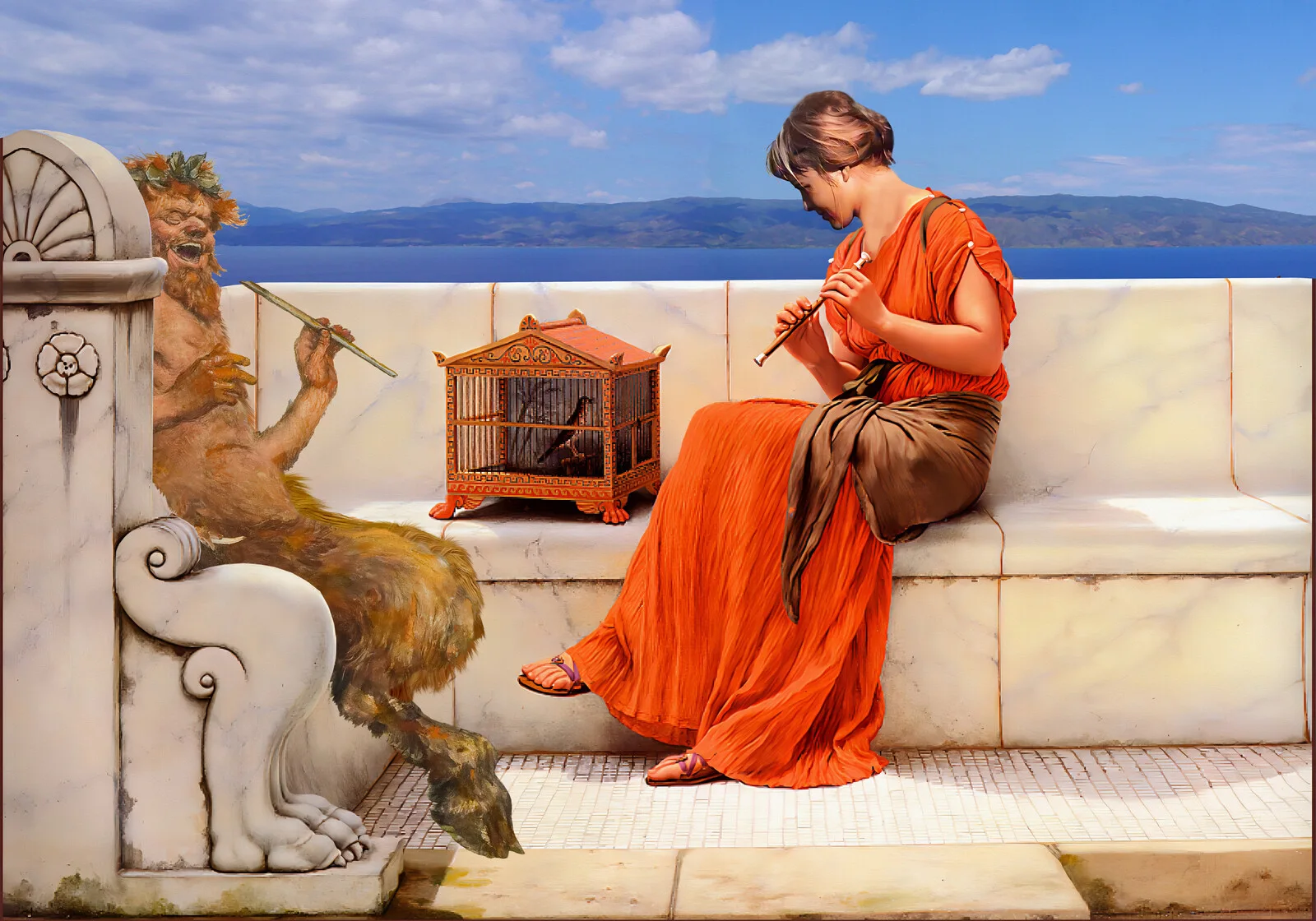
Marianne, a Pan-girl, and Leonard’s Muse in a song without words, 2024
Digital
70 x 50 cm
Anthem
Ring the bells that still can ring
Forget your perfect offering
There is a crack, a crack in everything
That's how the light gets in.
Leonard Cohen, 1992
The lines from “Anthem” open for the light in a dark world. Since Cohen left this world for his star, the lyrics of “Anthem” resonate across the internet in a poetic marriage of the sacred and profane. Christian imagery—the dove, the bells—infuses it.
Marianne plays Leonard Cohen’s beautiful song on her flute; the Nightingale in her red cage sings the lyrics without words, and Pan joins in. Why is the divisive god singing and laughing with Leonard’s muse on her terrace? Despite the god’s weird looks, they have much in common: Leonard, Marianne, and him. Music, of course, and undeniable, is Marianne a Pan-girl and the absent Leonard a womaniser like the god Pan. But there is much more. Their love for Hydra, for instance.
It was a day of celebration. The second Saturday in May marked Pan’s birthday, a joyous occasion for the unwanted child born on Itaca in 1174 BC. The same day also coincided with World Migratory Bird Day, a global celebration of our feathered friends. The picture, with its romantic undertones and the little bird's accompaniment to the flutes, exudes a festive spirit. It looks romantic, and maybe the little bird enjoys accompanying two flutes. We will never know.
Queen Penelope of Ithaca gave birth to Pan after sleeping with all 108 suitors in her husband’s absence. Her last lover was Hermes, the protector of human heralds, travellers, thieves, rascals, merchants, and orators. It could just end in one way. A spell was put on Hermes’ child, explaining why the poor baby was born a half man and half goat. 2024 is our way of counting the years, Pan’s Three thousand one hundred ninety-eight years birthday, a considerable age for a goat. The reason for the picture’s joy, laughter, singing, and happy faces is that the Nightingale also has something to celebrate. Saturday was World Migratory Bird Day. However, every day is Bird Day, and our feathered fellows celebrate three hundred sixty-five every year. That is why they all seem so happy, crisping and looping around. It doesn’t end with that. Marianne will have her 89th anniversary the coming week, but she has stopped counting since she left Earth in 2016. Time-travellers do so because time stands still in eternity. And women don't like to talk about age. They don't count years but wrinkles. The fewer, the better. That's why eternity suits women well; as time stands still, the wrinkles don't increase.
Please continue reading if you want to know why Leonard is not in the picture and more about Pan, migrating birds, Sex, Drugs and Music, including Marianne’s specially prepared hash buns and a line or two about Penelope.
What does Marianne have to do with the god Pan? At first thought, not much, I presume. But a further analysis gives more clues—music, Leonard and the strange-looking furry fellow’s undisputable charm and good taste for delicious wine. That was enough to accept him on the terrace.
"Sweet, piercing sweet” was the music of Pan's pipe. Also, the nightingale is in his cage. And the tunes from Marianne’s flute playing. They made a well-tuned trio. They put the area in a good mood.
The absent Leonard could have been Pan in many ways, despite less hair on his chest and toes instead of hooves. Leonard seduced women with music and poetry like the furry god. Of course, there was a difference in culture and age. Leonard’s background is Jewish, and Pan did not need gods other than himself. Leonard’s experience as a womaniser lasted seventy years; Pan has never stopped, although he is starting his third millennium as a woman’s man this year.
Leonard and Pan shared a lot. In ancient Greek mythology, Pan is the god of the wild, shepherds and flocks, rustic music and impromptus, and companion of the nymphs. Leonard was not rural, born in Montreal, but easy-going, always modest and kind. He lived his life without extravagance and was like Pan extrovert. Being together with women as Pan, indeed. Leonard loved the other sex and sought their company. In sex, he was impromptu, but working with his poetry and music, the contrary. Leonard could work for years before being satisfied with a song. Cohen is reputed to have written as many as 180 draft verses for ‘Hallelujah’ — and, according to himself, never finished it.
Even if Leonard was not particularly satisfied with himself, his body, and his soul, he was handsome and shared nothing physical with Pan. The furry god had the hindquarters, legs, and horns of a goat in the same manner as a faun or satyr. Pan is connected to fertility and the spring season, is famous for his sexual prowess, and is often depicted with a poignant phallus. Leonard was very proud of his schlong, so they also shared these essential capacities for men.
Leonard's philosophical musings on God and sex are intriguing. He said, “If God is left out of sex, it becomes pornographic; If sex is left out of God, it becomes pious and self-righteous. Leonard searched for God his whole life but kept him in his bed for safety’s sake. Pan could not agree less.
Part goat, part man, Pan bridges the divide between the human and animal worlds. Pan is sometimes a dangerous, destabilising force but knows most about life. So does Leonard. Though such a nice guy, he looked through everything and thus was troubling in his poetry as in ‘Everybody knows’—brutal lines disguised in catchy music.
Leonard was not on the terrace when I captured the scene. So why was Leonard not present? His official explanation was sneaking away to get the buns. Oddly enough, he wanted to stay out of the sun on this scorching early summer day. Climate change, I had explained—something with no effect on their star. Leonard had explained that sunlight comes from above on Earth, frying his brain and slowing his thoughts. “Out there in space, you step on the rays of your star, so they don’t bother you”, he said halfway down the stairs toward buns.
His and Mariane’s eternal home is on Algebar, sometimes called Rigel, a star big enough for the two of them and all their friends and visiting admirers. The name means 'left foot' but has nothing to do with the dance quickstep. It was an Arab astronomer with a sense of wit who wanted to tell that Leonard's and Marianne's sun lay on the left in the constellation of Orion. Rigel shines 40,000 times brighter than our Sun. Marianne claims that it is because of Leonard. That is kindly said but possibly better explained by her blonde hair. She loved my comment.
Time travellers bring everything from their previous lives; if you are a Cohen fan, you remain one in eternity. The only thing you leave behind is your anatomy and sicknesses. The body you use in eternity is one of your choices. You may alter between ages. During this visit to Hydra, Marianne and Leonard have chosen one of their early forties, still in shape but with a mature charm that suits their soul best.
Leonard went to their old house to pick up some of Marianne’s tasty buns. He had bragged to Pan over their happy-making effect, and the old goat was eager for a taste. Leonard told him how their fellow Time-travellers found little problem in eternity after tasting Marianne's specially prepared cannabis buns. Leonard explained to Pan when he had returned with a bag full of buns. The supply of cannabis in eternity is endless; in the Milky Way alone, there are hundreds of cannabis planets, every hippie's dream. Imagine that every breath is a trip. All you need to do is clear a meadow in the endless forest and breathe. No oxygen is on their respective stars so that the lungs can rest. A weekend trip to one of these planets is a cherished break in eternity.
“After all these years, I still have no idea what they contain other than hemp. But they are good. If Yahweh closed his eyes when mixing hashish in the batter, he would not care about the rest. There was never a rumble from the sky when Marianne fried her extra tasty buns, so I ate calmly. Flesh or not flesh, I didn’t give a damn, though born a Jew,” Leonard said. “It was not until after having left Earth that I found Jahve, and he fell in love with her buns like me. Fifty-fifty flesh and meat make them juicy, and the hemp gives the kick. You should see the old god dance the Horah to Hava Nagila, Pan. Four millennia old.” Leonard laughed.
“Are you talking about Yahweh? Does he really exist?” I asked, surprised.
“Sure! In space, there are many other old men considered important on Earth, but in eternity, they are no different from the humans who once created and worshipped them, in the image of man, not the other way around.” Leonard shook his head amusedly, though he had spent most of his life searching in vain for the image. Pan was not as amused and looked like he wanted to be elsewhere.
“It's a dizzying perspective,” I said.
“Isn’t it?” Marianne nodded.
“It's fascinating to think about the sheer number of gods that have been worshipped throughout human history,” Leonard said. “I have heard that humans have revered at least 18,000 different deities, animals, and objects since we first appeared on this planet. This number is staggering and reflects the immense diversity in our spiritual and religious practices. When I spent my life searching for God, I had no idea what an impossible task it was. Old Sisyphus's boulder was light as a grain of sand in comparison.
Consider the vast pantheon of Hinduism, which alone includes thousands of gods. The ancient Egyptian religion recognised over 2,000 deities. These ancient beliefs contributed significantly to the tapestry of human spirituality. Gods like Ra, the sun god of ancient Egypt, were once widely worshipped and now remain powerful historical symbols, though they have vanished from modern worship.
These deities have played diverse roles throughout the centuries, embodying various attributes and stories that have shaped cultures and societies. In their way, each god offers a glimpse into the values and fears of the people who worshipped them.
Isn’t it remarkable how, despite the countless gods and the myriad ways people have sought the divine, the search for meaning remains a constant thread in the human experience? It’s as if we’re all looking for something greater, something beyond ourselves, something eternal. And when we can't find them, no matter how much we search on high mountains and deep valleys, we invent them, giving them faces, idols, hooves, and superhuman powers worse than Superman and all superheroes combined.” Pan tried to pretend he wasn't there.
Marianne laughed hysterically at the comparison. Pan looked mostly dejected because eternity meant eternal degradation for him and all the other gods. Luckily for him, pleasures remained: all the women, hash, and rivers of wine. It was a meagre compensation, but it filled the days.
“As I ponder this, I can’t help but feel a deep connection to me and all those who have come before us, searching for answers in the stars, the earth, and the gods they created. It’s a beautiful, never-ending journey, isn’t it?” Leonard tried to appear unaffected, but his voice betrayed a hint of regret, the pale cast of reflection. So many of his songs and poems had been about ghosts and visions.
“So, while the number of gods is vast and their stories varied, they all converge on the same fundamental human desire: to comprehend, to find significance, and to feel linked to something greater than ourselves. In this quest, we are all united, bound by our shared curiosity and longing for connection.”
"Now, you must end this philosophising, stop offending my guest Pan, and stop exhausting the poor bird," Marianne firmly said, playing a trill on her flute to cheer up the nightingale.
"George, you know that the Nightingale is a migratory bird known for its powerful and beautiful song. Shelley wrote in his ‘A Defense of Poetry’ – “A poet is a nightingale who sits in darkness and sings to cheer its solitude with sweet sounds”. I can assure you that it also fits into a writer’s reality. Like many birds, it passes Hydra en route between North Europe and Africa, where they spend the winter. He heard Marianne playing Leonard’s music and liked it. So much so that he decided to stay and form a duo. The cage protected him from hungry stray cats, but he was released for every jam session.
Avian migration is Nature’s miracle. Migratory birds fly hundreds and thousands of kilometres to find the best ecological conditions and habitats for feeding, breeding, and raising their young. When one place becomes unfavourable, it is time to fly to regions where conditions are better. Hydra is typically just a stopover. Unfortunately, both here and elsewhere, it is something exploited by hunters. Today, it is not needed for people’s survival but only for pleasure, killing time in the company of like-minded.” The little nightingale whistled a discontented lament for all the migratory birds that met their end in this ruthless hunt. As I watch these birds on their journey, I can't help but marvel at the beauty and resilience of nature and feel a deep sense of connection to this cycle of life and death.
“Nightingales travel far, from Scandinavia to the south of the Sahara, a roundtrip of 20.000 kilometres,” Marianne continued. “They are impressive but average among passerines. The Arctic Tern has by far the longest migration in the animal kingdom, travelling back and forth 90,000 km from pole to pole every year — from Greenland in the North to the Weddell Sea in the South. They can bounce around every continent instead of flying in a straight line back home. The journey only takes the terns a few months, but to my knowledge, the poor fellows miss Hydra,” Marianne finished and offered the tray of buns.
It didn’t take long before old Pan’s legs started to twitch, and he jumped up and began dancing to the tune of Leonard’s “Everybody Knows.” The nightingale trilled, Pan and Marianne played their flutes, and above them, perched on the gutter, the song thrush whistled. You can imagine how the trio sounded after feasting Marianne’s buns, supported by Leonard’s deep voice, which was fine-tuned by the ages of cigarettes.
Before the music took over, Pan shared a personal anecdote about Penelope's illegitimate child with Hermes. It took two thousand years for Odysseus to forgive her for the infidelity. This interaction with the gods and this glimpse into their lives and stories make our search for understanding and meaning fascinating and profound.
Pan, always the outsider, has been the god of choice for gay writers, occult practitioners, and New Age mystics; he picked up another of Leonard’s songs, ‘Everybody Knows’. According to him, it exposes the truth about life on Earth and leaves little room for excuses in the human blame game. With its raw and rustic nature, the song resonates with everyone, even those who continue denying their guilt. That explains Pan’s fascination with Leonard’s poem and its relevance to our discussion on the diversity of gods and the universal human desire for understanding and meaning.
Everybody knows that the dice are loaded
Everybody rolls with their fingers crossed
Everybody knows the war is over
Everybody knows the good guys lost
Everybody knows the fight was fixed
The poor stay poor, the rich get rich
That's how it goes
Everybody knows.
Leonard Cohen, 1988.
Jörgen Thornberg
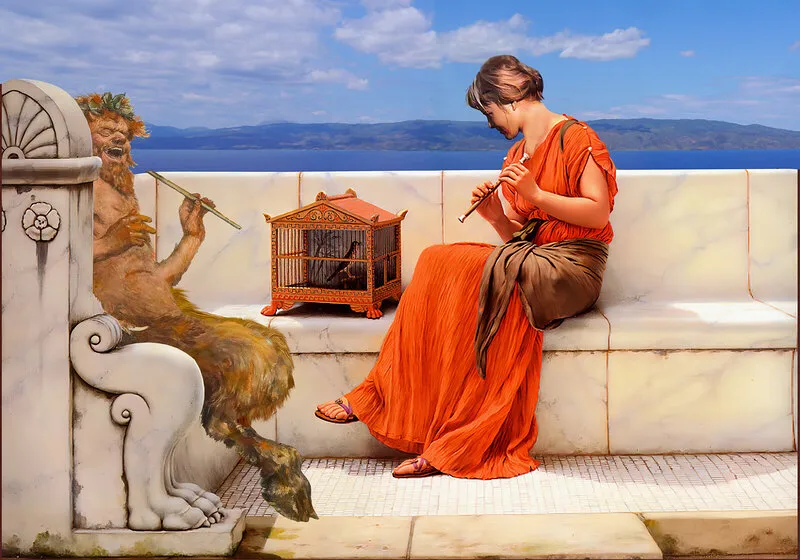
Marianne, a Pan-girl, and Leonard’s Muse in a song without words, 2024
Digital
70 x 50 cm
Anthem
Ring the bells that still can ring
Forget your perfect offering
There is a crack, a crack in everything
That's how the light gets in.
Leonard Cohen, 1992
The lines from “Anthem” open for the light in a dark world. Since Cohen left this world for his star, the lyrics of “Anthem” resonate across the internet in a poetic marriage of the sacred and profane. Christian imagery—the dove, the bells—infuses it.
Marianne plays Leonard Cohen’s beautiful song on her flute; the Nightingale in her red cage sings the lyrics without words, and Pan joins in. Why is the divisive god singing and laughing with Leonard’s muse on her terrace? Despite the god’s weird looks, they have much in common: Leonard, Marianne, and him. Music, of course, and undeniable, is Marianne a Pan-girl and the absent Leonard a womaniser like the god Pan. But there is much more. Their love for Hydra, for instance.
It was a day of celebration. The second Saturday in May marked Pan’s birthday, a joyous occasion for the unwanted child born on Itaca in 1174 BC. The same day also coincided with World Migratory Bird Day, a global celebration of our feathered friends. The picture, with its romantic undertones and the little bird's accompaniment to the flutes, exudes a festive spirit. It looks romantic, and maybe the little bird enjoys accompanying two flutes. We will never know.
Queen Penelope of Ithaca gave birth to Pan after sleeping with all 108 suitors in her husband’s absence. Her last lover was Hermes, the protector of human heralds, travellers, thieves, rascals, merchants, and orators. It could just end in one way. A spell was put on Hermes’ child, explaining why the poor baby was born a half man and half goat. 2024 is our way of counting the years, Pan’s Three thousand one hundred ninety-eight years birthday, a considerable age for a goat. The reason for the picture’s joy, laughter, singing, and happy faces is that the Nightingale also has something to celebrate. Saturday was World Migratory Bird Day. However, every day is Bird Day, and our feathered fellows celebrate three hundred sixty-five every year. That is why they all seem so happy, crisping and looping around. It doesn’t end with that. Marianne will have her 89th anniversary the coming week, but she has stopped counting since she left Earth in 2016. Time-travellers do so because time stands still in eternity. And women don't like to talk about age. They don't count years but wrinkles. The fewer, the better. That's why eternity suits women well; as time stands still, the wrinkles don't increase.
Please continue reading if you want to know why Leonard is not in the picture and more about Pan, migrating birds, Sex, Drugs and Music, including Marianne’s specially prepared hash buns and a line or two about Penelope.
What does Marianne have to do with the god Pan? At first thought, not much, I presume. But a further analysis gives more clues—music, Leonard and the strange-looking furry fellow’s undisputable charm and good taste for delicious wine. That was enough to accept him on the terrace.
"Sweet, piercing sweet” was the music of Pan's pipe. Also, the nightingale is in his cage. And the tunes from Marianne’s flute playing. They made a well-tuned trio. They put the area in a good mood.
The absent Leonard could have been Pan in many ways, despite less hair on his chest and toes instead of hooves. Leonard seduced women with music and poetry like the furry god. Of course, there was a difference in culture and age. Leonard’s background is Jewish, and Pan did not need gods other than himself. Leonard’s experience as a womaniser lasted seventy years; Pan has never stopped, although he is starting his third millennium as a woman’s man this year.
Leonard and Pan shared a lot. In ancient Greek mythology, Pan is the god of the wild, shepherds and flocks, rustic music and impromptus, and companion of the nymphs. Leonard was not rural, born in Montreal, but easy-going, always modest and kind. He lived his life without extravagance and was like Pan extrovert. Being together with women as Pan, indeed. Leonard loved the other sex and sought their company. In sex, he was impromptu, but working with his poetry and music, the contrary. Leonard could work for years before being satisfied with a song. Cohen is reputed to have written as many as 180 draft verses for ‘Hallelujah’ — and, according to himself, never finished it.
Even if Leonard was not particularly satisfied with himself, his body, and his soul, he was handsome and shared nothing physical with Pan. The furry god had the hindquarters, legs, and horns of a goat in the same manner as a faun or satyr. Pan is connected to fertility and the spring season, is famous for his sexual prowess, and is often depicted with a poignant phallus. Leonard was very proud of his schlong, so they also shared these essential capacities for men.
Leonard's philosophical musings on God and sex are intriguing. He said, “If God is left out of sex, it becomes pornographic; If sex is left out of God, it becomes pious and self-righteous. Leonard searched for God his whole life but kept him in his bed for safety’s sake. Pan could not agree less.
Part goat, part man, Pan bridges the divide between the human and animal worlds. Pan is sometimes a dangerous, destabilising force but knows most about life. So does Leonard. Though such a nice guy, he looked through everything and thus was troubling in his poetry as in ‘Everybody knows’—brutal lines disguised in catchy music.
Leonard was not on the terrace when I captured the scene. So why was Leonard not present? His official explanation was sneaking away to get the buns. Oddly enough, he wanted to stay out of the sun on this scorching early summer day. Climate change, I had explained—something with no effect on their star. Leonard had explained that sunlight comes from above on Earth, frying his brain and slowing his thoughts. “Out there in space, you step on the rays of your star, so they don’t bother you”, he said halfway down the stairs toward buns.
His and Mariane’s eternal home is on Algebar, sometimes called Rigel, a star big enough for the two of them and all their friends and visiting admirers. The name means 'left foot' but has nothing to do with the dance quickstep. It was an Arab astronomer with a sense of wit who wanted to tell that Leonard's and Marianne's sun lay on the left in the constellation of Orion. Rigel shines 40,000 times brighter than our Sun. Marianne claims that it is because of Leonard. That is kindly said but possibly better explained by her blonde hair. She loved my comment.
Time travellers bring everything from their previous lives; if you are a Cohen fan, you remain one in eternity. The only thing you leave behind is your anatomy and sicknesses. The body you use in eternity is one of your choices. You may alter between ages. During this visit to Hydra, Marianne and Leonard have chosen one of their early forties, still in shape but with a mature charm that suits their soul best.
Leonard went to their old house to pick up some of Marianne’s tasty buns. He had bragged to Pan over their happy-making effect, and the old goat was eager for a taste. Leonard told him how their fellow Time-travellers found little problem in eternity after tasting Marianne's specially prepared cannabis buns. Leonard explained to Pan when he had returned with a bag full of buns. The supply of cannabis in eternity is endless; in the Milky Way alone, there are hundreds of cannabis planets, every hippie's dream. Imagine that every breath is a trip. All you need to do is clear a meadow in the endless forest and breathe. No oxygen is on their respective stars so that the lungs can rest. A weekend trip to one of these planets is a cherished break in eternity.
“After all these years, I still have no idea what they contain other than hemp. But they are good. If Yahweh closed his eyes when mixing hashish in the batter, he would not care about the rest. There was never a rumble from the sky when Marianne fried her extra tasty buns, so I ate calmly. Flesh or not flesh, I didn’t give a damn, though born a Jew,” Leonard said. “It was not until after having left Earth that I found Jahve, and he fell in love with her buns like me. Fifty-fifty flesh and meat make them juicy, and the hemp gives the kick. You should see the old god dance the Horah to Hava Nagila, Pan. Four millennia old.” Leonard laughed.
“Are you talking about Yahweh? Does he really exist?” I asked, surprised.
“Sure! In space, there are many other old men considered important on Earth, but in eternity, they are no different from the humans who once created and worshipped them, in the image of man, not the other way around.” Leonard shook his head amusedly, though he had spent most of his life searching in vain for the image. Pan was not as amused and looked like he wanted to be elsewhere.
“It's a dizzying perspective,” I said.
“Isn’t it?” Marianne nodded.
“It's fascinating to think about the sheer number of gods that have been worshipped throughout human history,” Leonard said. “I have heard that humans have revered at least 18,000 different deities, animals, and objects since we first appeared on this planet. This number is staggering and reflects the immense diversity in our spiritual and religious practices. When I spent my life searching for God, I had no idea what an impossible task it was. Old Sisyphus's boulder was light as a grain of sand in comparison.
Consider the vast pantheon of Hinduism, which alone includes thousands of gods. The ancient Egyptian religion recognised over 2,000 deities. These ancient beliefs contributed significantly to the tapestry of human spirituality. Gods like Ra, the sun god of ancient Egypt, were once widely worshipped and now remain powerful historical symbols, though they have vanished from modern worship.
These deities have played diverse roles throughout the centuries, embodying various attributes and stories that have shaped cultures and societies. In their way, each god offers a glimpse into the values and fears of the people who worshipped them.
Isn’t it remarkable how, despite the countless gods and the myriad ways people have sought the divine, the search for meaning remains a constant thread in the human experience? It’s as if we’re all looking for something greater, something beyond ourselves, something eternal. And when we can't find them, no matter how much we search on high mountains and deep valleys, we invent them, giving them faces, idols, hooves, and superhuman powers worse than Superman and all superheroes combined.” Pan tried to pretend he wasn't there.
Marianne laughed hysterically at the comparison. Pan looked mostly dejected because eternity meant eternal degradation for him and all the other gods. Luckily for him, pleasures remained: all the women, hash, and rivers of wine. It was a meagre compensation, but it filled the days.
“As I ponder this, I can’t help but feel a deep connection to me and all those who have come before us, searching for answers in the stars, the earth, and the gods they created. It’s a beautiful, never-ending journey, isn’t it?” Leonard tried to appear unaffected, but his voice betrayed a hint of regret, the pale cast of reflection. So many of his songs and poems had been about ghosts and visions.
“So, while the number of gods is vast and their stories varied, they all converge on the same fundamental human desire: to comprehend, to find significance, and to feel linked to something greater than ourselves. In this quest, we are all united, bound by our shared curiosity and longing for connection.”
"Now, you must end this philosophising, stop offending my guest Pan, and stop exhausting the poor bird," Marianne firmly said, playing a trill on her flute to cheer up the nightingale.
"George, you know that the Nightingale is a migratory bird known for its powerful and beautiful song. Shelley wrote in his ‘A Defense of Poetry’ – “A poet is a nightingale who sits in darkness and sings to cheer its solitude with sweet sounds”. I can assure you that it also fits into a writer’s reality. Like many birds, it passes Hydra en route between North Europe and Africa, where they spend the winter. He heard Marianne playing Leonard’s music and liked it. So much so that he decided to stay and form a duo. The cage protected him from hungry stray cats, but he was released for every jam session.
Avian migration is Nature’s miracle. Migratory birds fly hundreds and thousands of kilometres to find the best ecological conditions and habitats for feeding, breeding, and raising their young. When one place becomes unfavourable, it is time to fly to regions where conditions are better. Hydra is typically just a stopover. Unfortunately, both here and elsewhere, it is something exploited by hunters. Today, it is not needed for people’s survival but only for pleasure, killing time in the company of like-minded.” The little nightingale whistled a discontented lament for all the migratory birds that met their end in this ruthless hunt. As I watch these birds on their journey, I can't help but marvel at the beauty and resilience of nature and feel a deep sense of connection to this cycle of life and death.
“Nightingales travel far, from Scandinavia to the south of the Sahara, a roundtrip of 20.000 kilometres,” Marianne continued. “They are impressive but average among passerines. The Arctic Tern has by far the longest migration in the animal kingdom, travelling back and forth 90,000 km from pole to pole every year — from Greenland in the North to the Weddell Sea in the South. They can bounce around every continent instead of flying in a straight line back home. The journey only takes the terns a few months, but to my knowledge, the poor fellows miss Hydra,” Marianne finished and offered the tray of buns.
It didn’t take long before old Pan’s legs started to twitch, and he jumped up and began dancing to the tune of Leonard’s “Everybody Knows.” The nightingale trilled, Pan and Marianne played their flutes, and above them, perched on the gutter, the song thrush whistled. You can imagine how the trio sounded after feasting Marianne’s buns, supported by Leonard’s deep voice, which was fine-tuned by the ages of cigarettes.
Before the music took over, Pan shared a personal anecdote about Penelope's illegitimate child with Hermes. It took two thousand years for Odysseus to forgive her for the infidelity. This interaction with the gods and this glimpse into their lives and stories make our search for understanding and meaning fascinating and profound.
Pan, always the outsider, has been the god of choice for gay writers, occult practitioners, and New Age mystics; he picked up another of Leonard’s songs, ‘Everybody Knows’. According to him, it exposes the truth about life on Earth and leaves little room for excuses in the human blame game. With its raw and rustic nature, the song resonates with everyone, even those who continue denying their guilt. That explains Pan’s fascination with Leonard’s poem and its relevance to our discussion on the diversity of gods and the universal human desire for understanding and meaning.
Everybody knows that the dice are loaded
Everybody rolls with their fingers crossed
Everybody knows the war is over
Everybody knows the good guys lost
Everybody knows the fight was fixed
The poor stay poor, the rich get rich
That's how it goes
Everybody knows.
Leonard Cohen, 1988.

Jörgen Thornberg
Malmö
Lite om bilder och mig. Translation in English at the end.
Jag är en nyfiken person som ser allt i bilder, även det jag fäster i ord, gärna tillsammans för bakom alla mina bilder finns en berättelse. Till vissa bilder hör en kortare eller längre novell som följer med bilden.
Bilder berättar historier. Jag omges av naturlig skönhet, intressanta människor och historia var jag än går. Jag använder min kamera för att dokumentera världen och blanda det jag ser med vad jag känner för att fånga den dolda magin.
Mina bilder berättar mina historier. Genom mina bilder, tryck och berättelser. Jag bjuder in dig att ta del av dessa berättelser, in i ditt liv och hem och dela min mycket personliga syn på vår värld. Mer än vad ögat ser. Jag tänker i bilder, drömmer och skriver och pratar om dem; följaktligen måste jag också skapa bilder. De blir vad jag ser, inte nödvändigtvis begränsade till verkligheten. Det finns en bild runt varje hörn. Jag hoppas att du kommer att se vad jag såg och gilla det.
Jag är också en skrivande person och till många bilder hör en kortare eller längre essay. Den följer med tavlan, tryckt på fint papper och med en personlig hälsning från mig.
Flertalet bilder startar sin resa i min kamera. Enkelt förklarat beskriver jag bilden jag ser i mitt inre, upplevd eller fantiserad. Bilden uppstår inom mig redan innan jag fått okularet till ögat. På bråkdelen av ett ögonblick ser jag vad jag vill ha och vad som kan göras med bilden. Här skall jag stoppa in en giraff, stålmannen, Titanic eller vad det är min fantasi finner ut. Ännu märkligare är att jag kommer ihåg minnesbilden långt efteråt när det blir tid att skapa verket. Om jag lyckas eller inte, är upp till betraktaren, oftast präglat av en stråk av svart humor – meningen är att man skall bli underhållen. Mina bilder blir ofta en snackis där de hänger.
Jag föredrar bilder som förmedlar ett budskap i flera lager. Vid första anblicken fylld av feel-good, en vacker utsikt, fint väder, solen skiner, blommor på ängen eller vattnet som ligger förrädiskt spegelblankt. I en sådan bild kan jag gömma min egentliga berättelse, mitt förakt för förtryckare och våldsverkare, rasister och fördomsfulla människor - ett gärna återkommande motiv mer eller mindre dolt i det vackra motivet. Jag försöker förena dem i ett gemensamt narrativ.
Bild och formgivning har löpt som en röd tråd genom livet. Fotokonst känns som en värdig final som jag gärna delar med mig.
Min genre är vid som framgår av mina bilder, temat en blandning av pop- och gatukonst i kollage som kan bestå av hundratals lager. Vissa bilder kan ta veckor, andra någon dag innan det är dags att överlämna resultatet till printverkstaden. Fine Art Prints är digitala fotocollage. I dessa kollage sker rivandet, klippandet, pusslandet, målandet, ritandet och sprayningen digitalt. Det jag monterar in kan vara hundratals år gamla bilder som jag omsorgsfullt frilägger så att de ser ut att vara en del av tavlan men också bilder skapade av mig själv efter min egen fantasi. Därefter besöks printstudion och för vissa bilder numrera en limiterad upplaga (oftast 7 exemplar) och signera för hand. Vissa bilder kan köpas i olika format. Det är bara att fråga efter vilka. Gillar man en bild som är 70x100 men inte har plats på väggen, går den kanske att få i 50x70 cm istället. Frågan är fri.
Metoden Giclée eller Fine Art Print som det också kallas är det moderna sättet för framställning av grafisk konst. Villkoret för denna typ av utskrifter är att en högkvalitativ storformatskrivare används med åldersbeständigt färgpigment och konstnärspapper eller i förekommande fall på duk. Pappret som används möter de krav på livslängd som ställs av museer och gallerier. Normalt säljer jag mina bilder oinramade så att den nya ägaren själv kan bestämma hur de skall se ut, med eller utan passepartout färg på ram, med eller utan glas etc..
Under många år ställde jag bara ut på nätet, i valda grupper och på min egen Facebooksida - https://www.facebook.com/jorgen.thornberg.9
Jag finns också på en egen hemsida som tyvärr inte alltid är uppdaterad – https://www.jth.life/ Där kan du också läsa en del av de berättelser som följer med bilden.
UTSTÄLLNINGAR
Luftkastellet, oktober 2022
Konst i Lund, november 2022
Luftkastellet, mars 2023
Engleson Galleri Caroli, april 2023
Hydra, Greece June 2023
Engleson Galleri Caroli, oktober 2023
Toppen, Höllviken december 2023
Luftkastellet, mars 2024
Torups Galleri, mars 2024
Venice, May 2024
Luftkastellet, oktober 2024
Konst i Advent, December 2024
Galleri Engleson, Caroli December 2024
Jäger & Jansson Galleri, april 2025
A bit about pictures and me.
I'm a curious person who sees everything in pictures, even what I express in words, often combining them, for behind all my pictures lies a story. These narratives, some as short as a single image and others as long as a novel, are the heart and soul of my work.
Pictures tell stories. Wherever I go, I'm surrounded by natural beauty, exciting people, and history. I use my camera to document the world and blend what I see with what I feel to capture the hidden magic.
My images tell my stories. Through my pictures, prints, and narratives, I invite you to partake in these stories in your life and home and share my deeply personal perspective of our world. More than meets the eye. I think in pictures, dream, write, and talk about them; consequently, I must create images too. They become what I see, not necessarily confined to reality. There's a picture around every corner. I hope you'll see what I saw and enjoy it.
I'm also a writer, and many images come with a shorter or longer essay. It accompanies the painting, printed on fine paper with my personal greeting.
Many pictures start their journey on my camera. Simply put, I describe the image I see in my mind, experienced or imagined. The image arises within me even before I bring the eyepiece to my eye. In a fraction of a moment, I see what I want and what can be done with the picture. Here, I'll insert a giraffe, Superman, the Titanic, or whatever my imagination conjures up. Even stranger is that I remember the mental image long after it's time to create the work. Whether I succeed is up to the observer, often imbued with a streak of black humour – the aim is to entertain. My pictures usually become a talking point wherever they hang.
I prefer pictures that convey a message in multiple layers. At first glance, they're filled with feel-good vibes, a beautiful view, lovely weather, the sun shining, flowers in the meadow, or the water lying deceptively calm. But beneath this surface beauty, I often conceal a deeper story, a narrative that challenges societal norms or explores the human condition. I invite you to delve into these hidden narratives and discover the layers of meaning within my work.
Picture and design have been a thread running through my life. Photographic art feels like a fitting finale, and I'm happy to share it.
My genre is varied, as seen in my pictures; the theme is a blend of pop and street art in collages that can consist of hundreds of layers. Some images can take weeks, others just a day before it's time to hand over the result to the print workshop. Fine Art Prints are digital photo collages. In these collages, tearing, cutting, puzzling, painting, drawing, and spraying happen digitally. What I insert can be images hundreds of years old that I carefully extract so they appear to be part of the painting, but also images created by myself, now also generated from my imagination. Next, visit the print studio and, for certain images, number a limited edition (usually 7 copies) and sign them by hand. Some images may be available in other formats. Just ask which ones. If you like an image that's 70x100 but doesn't have space on the wall, you might be able to get it in 50x70 cm instead. The question is open.
The Giclée method, or Fine Art Print as it's also called, is the modern way of producing graphic art. This method ensures the highest quality and longevity of the artwork, using a high-quality large-format printer with archival pigment inks and artist paper or, in some cases, canvas. The paper used meets the longevity requirements set by museums and galleries. I sell my pictures unframed, allowing the new owner to personalise their artwork, confident in the lasting value and quality of the piece.
For many years, I only exhibited online, in selected groups, and on my Facebook page - https://www.facebook.com/jorgen.thornberg.9. I also have my website, which unfortunately is not constantly updated - https://www.jth.life/. You can also read some of the stories accompanying the pictures there.
EXHIBITIONS
Luftkastellet, October 2022
Art in Lund, November 2022
Luftkastellet, March 2023
Engleson Gallery Caroli, April 2023
Hydra, Greece June 2023
Engleson Gallery Caroli, October 2023
Toppen, Höllviken December 2023
Luftkastellet, March 2024
Torup Gallery, March 2024
Venice, May 2024
UTSTÄLLNINGAR
Luftkastellet, oktober 2022
Konst i Lund, november 2022
Luftkastellet, mars 2023
Engleson Galleri Caroli, april 2023
Hydra, Greece June 2023
Engleson Galleri Caroli, oktober 2023
Toppen, Höllviken december 2023
Luftkastellet, mars 2024
Torups Galleri, mars 2024
Venice, May 2024
Luftkastellet, October 2024
Konst i Advent, December 2024
Galleri Engleson, Caroli December 2024
Jäger & Jansson Galleri, April 2025
Utbildning
Autodidakt
Medlem i konstnärsförening
Öppna Sinnen
Med i konstrunda
Konstrundan i Skåne
Utställningar
Luftkastellet, October 2022
Art in Lund, November 2022
Luftkastellet, March 2023
Engleson Gallery Caroli, April 2023
Hydra, Greece June 2023
Engleson Gallery Caroli, October 2023
Toppen, Höllviken December 2023
Luftkastellet, March 2024
Torup Gallery, March 2024
Venice, May 2024