Vi använder cookies för att ge dig bästa möjliga upplevelse. Välj vilka cookies du tillåter.
Läs mer i vår integritetspolicy
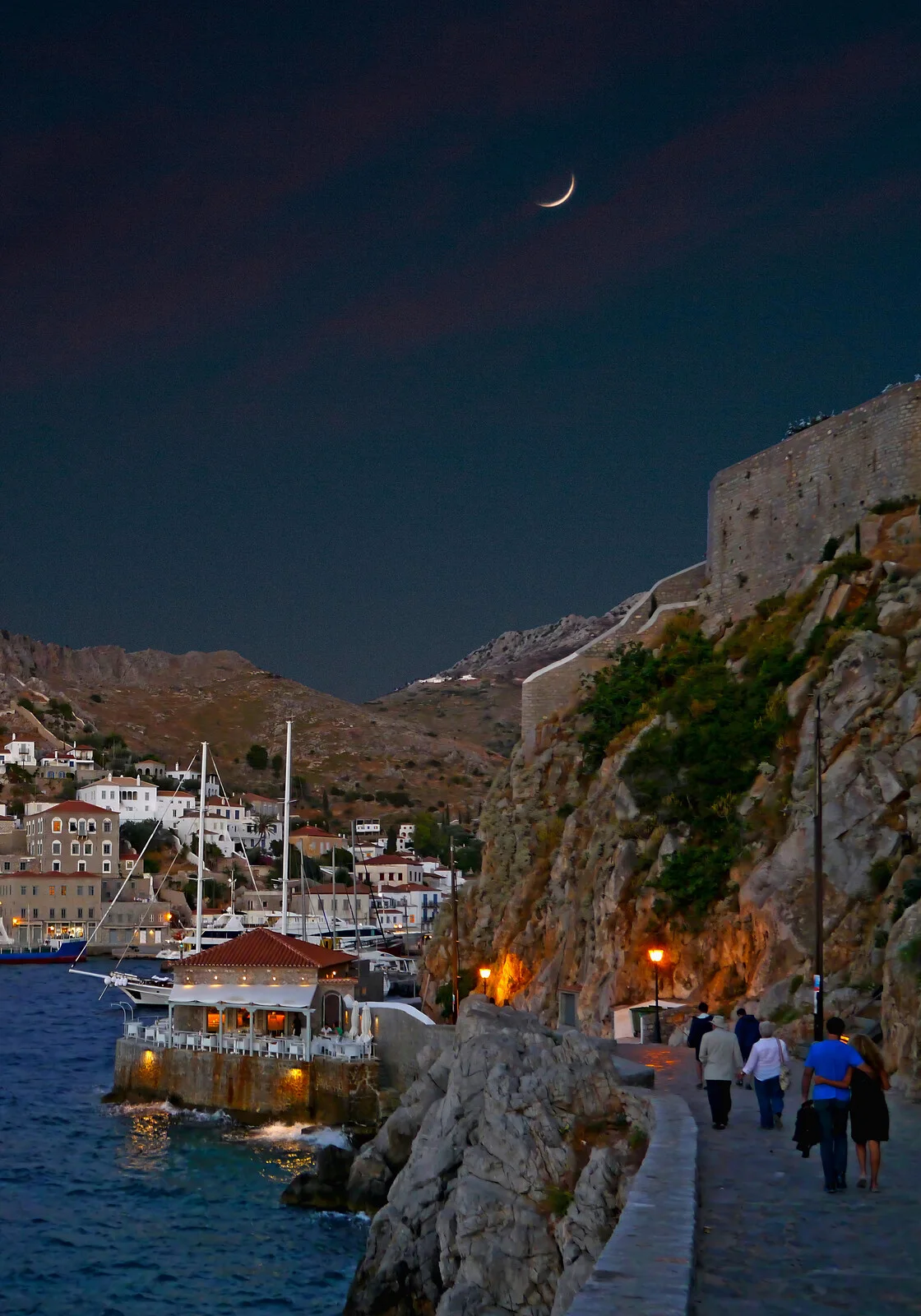
Jörgen Thornberg
So Long Marianne – A love story, 2020
Digital
50 x 70 cm
"If the sun would lose its light
And we lived an endless night
And there was nothing left that you could feel
That's how it would be
What my life would seem to me
If I didn't have your love to make it real."
Leonard Cohen, 2016
Had I not caught a fleeting glimpse of their faces as they passed me, standing between two of Hydra's best restaurants, Sunset and Omilos, their backs could have belonged to anyone. Leonard wore a simple blue short-sleeved t-shirt, blue chinos, and elegant black shoes. Marianne donned a plain blue linen dress. They were tightly wrapped in each other's arms like a newly in love couple, despite their love story beginning sixty years ago. This was the reason for their return visit to Hydra, four years after both had left Earth to move together to a distant star. Like all Time-Travellers, they can choose their appearance when they show themselves. Leonard looked the same, but Marianne had longer, slightly curly hair and her colour had toned down to a dark blonde, not the oat blonde we were used to.
The vibrations of eternal love were palpable in the seconds they passed by, for eternal is the love one holds in eternity. The sun had just set, and old and young love strolled along Hydra's beautiful coastal road as usual. Many had perhaps enjoyed a drink at Hydronetta with the setting sun before them and were now on their way to the harbour for supper.
But of course, even without that brief glimpse of their profiles, the song humming inside me—'If I Didn't Have Your Love,' sung in Leonard's voice—should have been enough.
"It is a voice raked by the claws of Cupid; a voice rubbed raw by the philosopher's stone. A voice marinated in Kirschwasser, sulfur, deer musk, and snow, bandaged with sackcloth from a ruined monastery, warmed by the embers left down near the river after the gipsies have gone.
It is a penitent's voice, a rabbinical voice, a crust of unleavened vocal toasts - spread with smoke and subversive wit. He has a voice like a carpet in an old hotel, like a bad itch on the hunchback of love. It is a voice meant for pronouncing women's names - and cataloguing their sometimes-hazardous charms. Nobody can say the word "naked" as nakedly as Cohen. He makes us see the markings where the pantyhose have been." That is how the American novelist Tom Robbins described Leonard's voice. And it was that voice I heard singing a few lines.
As the sun set over Hydra, casting a golden glow over the island, let me share with you the unique love story of Marianne and Leonard. It was a journey filled with triumph and tragedy, a narrative that was not always as successful for others in their circle on Hydra. Marianne, Leonard's constant companion, experienced the highs and lows of his career, ever aware of her profound influence over him. And at the centre of their love story was Hydra.
Hydra had a mythical and primitive charm. Cars were forbidden. Mules trudged up the long stairways to the houses, carrying water. Electricity was intermittent at best. Leonard rented a place for fourteen dollars a month. Eventually, thanks to an inheritance from his grandmother, he bought a whitewashed house of his own for fifteen hundred dollars.
Hydra offered Leonard the simple, creative life he had always longed for: empty pages waiting to be filled, romance under the stars, and a sense of tranquillity. He gathered a few paraffin lamps and some secondhand furniture: a Russian wrought-iron bed, a writing table, and chairs reminiscent of Van Gogh's paintings. During the day, he worked on a sensual, dreamlike novel called "The Favorite Game" and poems for a collection titled "Flowers for Hitler." His life was a blend of strict discipline and wild abandon. Some days, he fasted to sharpen his mind; other days, he experimented with pot, speed, and acid to expand it. "I took trip after trip, sitting on my terrace in Greece, waiting to see God," he later recalled. "Generally, I ended up with a bad hangover."
Every so often, Leonard would catch sight of a beautiful Norwegian woman named Marianne Ihlen. She had grown up near Oslo, where her grandmother told her, "You are going to meet a man who speaks with a tongue of gold." Marianne thought she had already met him in Axel Jensen, a novelist from home who wrote in the style of Jack Kerouac and William Burroughs. She married Jensen, and they had a son, little Axel. But Jensen wasn't the most reliable husband. By the time their child was four months old, Jensen was, as Marianne put it, "over the hills again" with another woman.
When Marianne was younger, she would steal moments to read about Genghis Khan. She daydreamed about the ruthless Mongolian conqueror who ruled a kingdom stretching from the Pacific Ocean to the Black Sea. In her trance, Marianne donned fluttering, brightly coloured garments and rode horseback beside Genghis Khan, transported back more than seven hundred years. She always dreamed that a dashing man would come and whisk her away from her lethargy. Whenever life presented struggles or setbacks, Marianne would close her eyes and yearn to be conquered and carried away. Marianne was a lost girl who searched for salvation in a handsome man instead of discovering it within herself.
One spring day, Marianne was in a grocery store and café with her infant son. "I was standing in the shop with my basket waiting to pick up bottled water and milk," she recalled decades later. "He was standing in the doorway with the sun behind him," Leonard asked her to join him and his friends outside. He wore khaki pants, sneakers, a rolled-sleeved shirt, and a cap. Marianne remembered him radiating "enormous compassion for me and my child." She was immediately taken with him. "I felt it throughout my body," she said. "A lightness had come over me."
Leonard began spending more and more time with Marianne. They went to the beach, made love, and kept house together. Once, when they were apart—Marianne and Axel in Norway, Leonard in Montreal scraping up some money—he sent her a telegram: "Have house all I need is my woman and her son. Love, Leonard."
There were times of separation, times of argument and jealousy. When Marianne drank, she could go into a dark rage. And there were infidelities on both sides. "Good gracious. All the girls were panting for him," Marianne said later. "I would dare go as far as to say that I was on the verge of killing myself due to it."
In the second half of the sixties, as Leonard started to record his songs and achieve worldly success, Marianne became known to his fans as his muse. A memorable photograph of her, dressed only in a towel and sitting at the desk in the house on Hydra, appeared on the back of Leonard's second album, "Songs from a Room." But after eight years together, their relationship began to unravel, little by little—"like falling ashes," as Leonard put it.
Leonard spent more time away from Hydra pursuing his career. Marianne and Axel stayed on Hydra for a while, then left for Norway. Eventually, Marianne married again. But life had its burdens, particularly for Axel, who had persistent health problems; I would blame his father's genes. What Leonard's fans knew of Marianne was her beauty and what it had inspired: "Bird on the Wire," "Hey, That's No Way to Say Goodbye," and, most famously, "So Long, Marianne." She and Leonard stayed in touch, and he supported her financially. When he toured in Scandinavia, she visited him backstage. They exchanged letters and e-mails. When they spoke to journalists and friends about their love affair, it was always in the fondest terms.
Leonard had known early success with women and would know much more. For a troubadour of sadness—later dubbed the "godfather of gloom"—Leonard found frequent solace in the arms of beautiful women. When Leonard was younger, he had a kind of Michael Corleone Before the Fall look: dark, sloe-eyed, a little hunched, but his high courtesy and verbal fluency were his charm. When he was thirteen, he read a book on hypnotism and tried his new skill on the family housekeeper, who promptly removed her clothes. What happened next varies in different versions, but it is clear that Leonard developed a taste for sex early on. Over the years, not everyone was quite as bewitched. Nico spurned him, and Joni Mitchell, once his lover, remained a friend but dismissed him as a "boudoir poet." But these were the exceptions. Leonard Cohen was the high priest of pathos with a voice exuding misery, but he never discussed his mistresses or tailors.
Like any young writer and every young person, Leonard was greedy for experience. He craved the company of many women, various experiences, different countries, diverse climates, and countless love affairs. Unbeknownst to him at the time, it was only natural for him to view life as a buffet, each dish offering a unique flavour to savour.
We all make foolish decisions in our attempts to find ourselves and discover love. This was no different for Marianne. In hindsight, her struggles seem distant, and her all-too-human, universal flaws feel trivial, even amusing. Perhaps we should skip the films and books and embrace the song 'So Long, Marianne,' letting its mystery stir our imaginations.
Leonard's song "If I Didn't Have Your Love"—the eternal love poem—was the ultimate proof of a love that rusted but never disappeared, only to reunite in the afterlife.
" If the sun would lose its light
And we lived an endless night
And there was nothing left that you could feel
That's how it would be
What my life would seem to me
If I didn't have your love to make it real
If the stars were all unpinned
And a cold and bitter wind
Swallowed up the world without a trace
Ah, well that's where I would be
What my life would seem to me
If I couldn't lift the veil and see your face
And if no leaves were on the tree
And no water in the sea
And the break of day had nothing to reveal
That's how broken I would be
What my life would seem to me
If I didn't have your love to make it real
If the sun would lose its light
And we lived in an endless night
And there was nothing left that you could feel
If the sea were sand alone
And the flowers made of stone
And no one that you hurt could ever heal
Well that's how broken I would be
What my life would seem to me
If I didn't have your love to make it real."
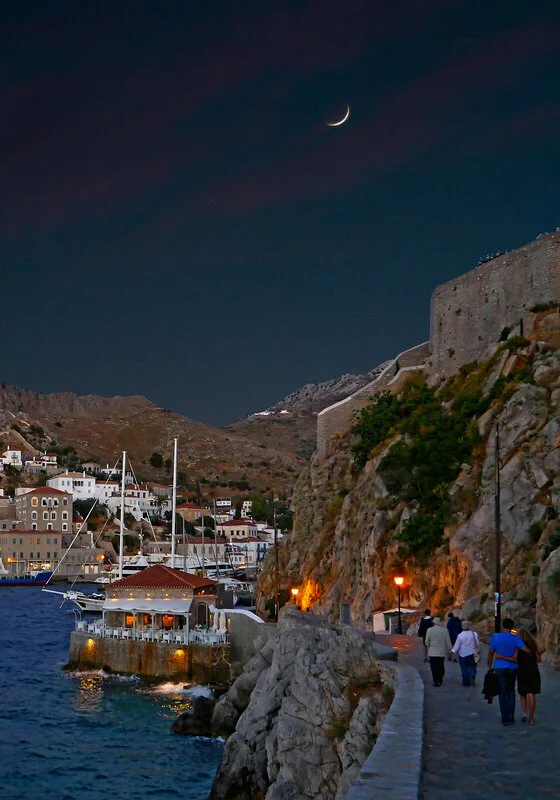
Jörgen Thornberg
So Long Marianne – A love story, 2020
Digital
50 x 70 cm
"If the sun would lose its light
And we lived an endless night
And there was nothing left that you could feel
That's how it would be
What my life would seem to me
If I didn't have your love to make it real."
Leonard Cohen, 2016
Had I not caught a fleeting glimpse of their faces as they passed me, standing between two of Hydra's best restaurants, Sunset and Omilos, their backs could have belonged to anyone. Leonard wore a simple blue short-sleeved t-shirt, blue chinos, and elegant black shoes. Marianne donned a plain blue linen dress. They were tightly wrapped in each other's arms like a newly in love couple, despite their love story beginning sixty years ago. This was the reason for their return visit to Hydra, four years after both had left Earth to move together to a distant star. Like all Time-Travellers, they can choose their appearance when they show themselves. Leonard looked the same, but Marianne had longer, slightly curly hair and her colour had toned down to a dark blonde, not the oat blonde we were used to.
The vibrations of eternal love were palpable in the seconds they passed by, for eternal is the love one holds in eternity. The sun had just set, and old and young love strolled along Hydra's beautiful coastal road as usual. Many had perhaps enjoyed a drink at Hydronetta with the setting sun before them and were now on their way to the harbour for supper.
But of course, even without that brief glimpse of their profiles, the song humming inside me—'If I Didn't Have Your Love,' sung in Leonard's voice—should have been enough.
"It is a voice raked by the claws of Cupid; a voice rubbed raw by the philosopher's stone. A voice marinated in Kirschwasser, sulfur, deer musk, and snow, bandaged with sackcloth from a ruined monastery, warmed by the embers left down near the river after the gipsies have gone.
It is a penitent's voice, a rabbinical voice, a crust of unleavened vocal toasts - spread with smoke and subversive wit. He has a voice like a carpet in an old hotel, like a bad itch on the hunchback of love. It is a voice meant for pronouncing women's names - and cataloguing their sometimes-hazardous charms. Nobody can say the word "naked" as nakedly as Cohen. He makes us see the markings where the pantyhose have been." That is how the American novelist Tom Robbins described Leonard's voice. And it was that voice I heard singing a few lines.
As the sun set over Hydra, casting a golden glow over the island, let me share with you the unique love story of Marianne and Leonard. It was a journey filled with triumph and tragedy, a narrative that was not always as successful for others in their circle on Hydra. Marianne, Leonard's constant companion, experienced the highs and lows of his career, ever aware of her profound influence over him. And at the centre of their love story was Hydra.
Hydra had a mythical and primitive charm. Cars were forbidden. Mules trudged up the long stairways to the houses, carrying water. Electricity was intermittent at best. Leonard rented a place for fourteen dollars a month. Eventually, thanks to an inheritance from his grandmother, he bought a whitewashed house of his own for fifteen hundred dollars.
Hydra offered Leonard the simple, creative life he had always longed for: empty pages waiting to be filled, romance under the stars, and a sense of tranquillity. He gathered a few paraffin lamps and some secondhand furniture: a Russian wrought-iron bed, a writing table, and chairs reminiscent of Van Gogh's paintings. During the day, he worked on a sensual, dreamlike novel called "The Favorite Game" and poems for a collection titled "Flowers for Hitler." His life was a blend of strict discipline and wild abandon. Some days, he fasted to sharpen his mind; other days, he experimented with pot, speed, and acid to expand it. "I took trip after trip, sitting on my terrace in Greece, waiting to see God," he later recalled. "Generally, I ended up with a bad hangover."
Every so often, Leonard would catch sight of a beautiful Norwegian woman named Marianne Ihlen. She had grown up near Oslo, where her grandmother told her, "You are going to meet a man who speaks with a tongue of gold." Marianne thought she had already met him in Axel Jensen, a novelist from home who wrote in the style of Jack Kerouac and William Burroughs. She married Jensen, and they had a son, little Axel. But Jensen wasn't the most reliable husband. By the time their child was four months old, Jensen was, as Marianne put it, "over the hills again" with another woman.
When Marianne was younger, she would steal moments to read about Genghis Khan. She daydreamed about the ruthless Mongolian conqueror who ruled a kingdom stretching from the Pacific Ocean to the Black Sea. In her trance, Marianne donned fluttering, brightly coloured garments and rode horseback beside Genghis Khan, transported back more than seven hundred years. She always dreamed that a dashing man would come and whisk her away from her lethargy. Whenever life presented struggles or setbacks, Marianne would close her eyes and yearn to be conquered and carried away. Marianne was a lost girl who searched for salvation in a handsome man instead of discovering it within herself.
One spring day, Marianne was in a grocery store and café with her infant son. "I was standing in the shop with my basket waiting to pick up bottled water and milk," she recalled decades later. "He was standing in the doorway with the sun behind him," Leonard asked her to join him and his friends outside. He wore khaki pants, sneakers, a rolled-sleeved shirt, and a cap. Marianne remembered him radiating "enormous compassion for me and my child." She was immediately taken with him. "I felt it throughout my body," she said. "A lightness had come over me."
Leonard began spending more and more time with Marianne. They went to the beach, made love, and kept house together. Once, when they were apart—Marianne and Axel in Norway, Leonard in Montreal scraping up some money—he sent her a telegram: "Have house all I need is my woman and her son. Love, Leonard."
There were times of separation, times of argument and jealousy. When Marianne drank, she could go into a dark rage. And there were infidelities on both sides. "Good gracious. All the girls were panting for him," Marianne said later. "I would dare go as far as to say that I was on the verge of killing myself due to it."
In the second half of the sixties, as Leonard started to record his songs and achieve worldly success, Marianne became known to his fans as his muse. A memorable photograph of her, dressed only in a towel and sitting at the desk in the house on Hydra, appeared on the back of Leonard's second album, "Songs from a Room." But after eight years together, their relationship began to unravel, little by little—"like falling ashes," as Leonard put it.
Leonard spent more time away from Hydra pursuing his career. Marianne and Axel stayed on Hydra for a while, then left for Norway. Eventually, Marianne married again. But life had its burdens, particularly for Axel, who had persistent health problems; I would blame his father's genes. What Leonard's fans knew of Marianne was her beauty and what it had inspired: "Bird on the Wire," "Hey, That's No Way to Say Goodbye," and, most famously, "So Long, Marianne." She and Leonard stayed in touch, and he supported her financially. When he toured in Scandinavia, she visited him backstage. They exchanged letters and e-mails. When they spoke to journalists and friends about their love affair, it was always in the fondest terms.
Leonard had known early success with women and would know much more. For a troubadour of sadness—later dubbed the "godfather of gloom"—Leonard found frequent solace in the arms of beautiful women. When Leonard was younger, he had a kind of Michael Corleone Before the Fall look: dark, sloe-eyed, a little hunched, but his high courtesy and verbal fluency were his charm. When he was thirteen, he read a book on hypnotism and tried his new skill on the family housekeeper, who promptly removed her clothes. What happened next varies in different versions, but it is clear that Leonard developed a taste for sex early on. Over the years, not everyone was quite as bewitched. Nico spurned him, and Joni Mitchell, once his lover, remained a friend but dismissed him as a "boudoir poet." But these were the exceptions. Leonard Cohen was the high priest of pathos with a voice exuding misery, but he never discussed his mistresses or tailors.
Like any young writer and every young person, Leonard was greedy for experience. He craved the company of many women, various experiences, different countries, diverse climates, and countless love affairs. Unbeknownst to him at the time, it was only natural for him to view life as a buffet, each dish offering a unique flavour to savour.
We all make foolish decisions in our attempts to find ourselves and discover love. This was no different for Marianne. In hindsight, her struggles seem distant, and her all-too-human, universal flaws feel trivial, even amusing. Perhaps we should skip the films and books and embrace the song 'So Long, Marianne,' letting its mystery stir our imaginations.
Leonard's song "If I Didn't Have Your Love"—the eternal love poem—was the ultimate proof of a love that rusted but never disappeared, only to reunite in the afterlife.
" If the sun would lose its light
And we lived an endless night
And there was nothing left that you could feel
That's how it would be
What my life would seem to me
If I didn't have your love to make it real
If the stars were all unpinned
And a cold and bitter wind
Swallowed up the world without a trace
Ah, well that's where I would be
What my life would seem to me
If I couldn't lift the veil and see your face
And if no leaves were on the tree
And no water in the sea
And the break of day had nothing to reveal
That's how broken I would be
What my life would seem to me
If I didn't have your love to make it real
If the sun would lose its light
And we lived in an endless night
And there was nothing left that you could feel
If the sea were sand alone
And the flowers made of stone
And no one that you hurt could ever heal
Well that's how broken I would be
What my life would seem to me
If I didn't have your love to make it real."

Jörgen Thornberg
Malmö
Lite om bilder och mig. Translation in English at the end.
Jag är en nyfiken person som ser allt i bilder, även det jag fäster i ord, gärna tillsammans för bakom alla mina bilder finns en berättelse. Till vissa bilder hör en kortare eller längre novell som följer med bilden.
Bilder berättar historier. Jag omges av naturlig skönhet, intressanta människor och historia var jag än går. Jag använder min kamera för att dokumentera världen och blanda det jag ser med vad jag känner för att fånga den dolda magin.
Mina bilder berättar mina historier. Genom mina bilder, tryck och berättelser. Jag bjuder in dig att ta del av dessa berättelser, in i ditt liv och hem och dela min mycket personliga syn på vår värld. Mer än vad ögat ser. Jag tänker i bilder, drömmer och skriver och pratar om dem; följaktligen måste jag också skapa bilder. De blir vad jag ser, inte nödvändigtvis begränsade till verkligheten. Det finns en bild runt varje hörn. Jag hoppas att du kommer att se vad jag såg och gilla det.
Jag är också en skrivande person och till många bilder hör en kortare eller längre essay. Den följer med tavlan, tryckt på fint papper och med en personlig hälsning från mig.
Flertalet bilder startar sin resa i min kamera. Enkelt förklarat beskriver jag bilden jag ser i mitt inre, upplevd eller fantiserad. Bilden uppstår inom mig redan innan jag fått okularet till ögat. På bråkdelen av ett ögonblick ser jag vad jag vill ha och vad som kan göras med bilden. Här skall jag stoppa in en giraff, stålmannen, Titanic eller vad det är min fantasi finner ut. Ännu märkligare är att jag kommer ihåg minnesbilden långt efteråt när det blir tid att skapa verket. Om jag lyckas eller inte, är upp till betraktaren, oftast präglat av en stråk av svart humor – meningen är att man skall bli underhållen. Mina bilder blir ofta en snackis där de hänger.
Jag föredrar bilder som förmedlar ett budskap i flera lager. Vid första anblicken fylld av feel-good, en vacker utsikt, fint väder, solen skiner, blommor på ängen eller vattnet som ligger förrädiskt spegelblankt. I en sådan bild kan jag gömma min egentliga berättelse, mitt förakt för förtryckare och våldsverkare, rasister och fördomsfulla människor - ett gärna återkommande motiv mer eller mindre dolt i det vackra motivet. Jag försöker förena dem i ett gemensamt narrativ.
Bild och formgivning har löpt som en röd tråd genom livet. Fotokonst känns som en värdig final som jag gärna delar med mig.
Min genre är vid som framgår av mina bilder, temat en blandning av pop- och gatukonst i kollage som kan bestå av hundratals lager. Vissa bilder kan ta veckor, andra någon dag innan det är dags att överlämna resultatet till printverkstaden. Fine Art Prints är digitala fotocollage. I dessa kollage sker rivandet, klippandet, pusslandet, målandet, ritandet och sprayningen digitalt. Det jag monterar in kan vara hundratals år gamla bilder som jag omsorgsfullt frilägger så att de ser ut att vara en del av tavlan men också bilder skapade av mig själv efter min egen fantasi. Därefter besöks printstudion och för vissa bilder numrera en limiterad upplaga (oftast 7 exemplar) och signera för hand. Vissa bilder kan köpas i olika format. Det är bara att fråga efter vilka. Gillar man en bild som är 70x100 men inte har plats på väggen, går den kanske att få i 50x70 cm istället. Frågan är fri.
Metoden Giclée eller Fine Art Print som det också kallas är det moderna sättet för framställning av grafisk konst. Villkoret för denna typ av utskrifter är att en högkvalitativ storformatskrivare används med åldersbeständigt färgpigment och konstnärspapper eller i förekommande fall på duk. Pappret som används möter de krav på livslängd som ställs av museer och gallerier. Normalt säljer jag mina bilder oinramade så att den nya ägaren själv kan bestämma hur de skall se ut, med eller utan passepartout färg på ram, med eller utan glas etc..
Under många år ställde jag bara ut på nätet, i valda grupper och på min egen Facebooksida - https://www.facebook.com/jorgen.thornberg.9
Jag finns också på en egen hemsida som tyvärr inte alltid är uppdaterad – https://www.jth.life/ Där kan du också läsa en del av de berättelser som följer med bilden.
UTSTÄLLNINGAR
Luftkastellet, oktober 2022
Konst i Lund, november 2022
Luftkastellet, mars 2023
Engleson Galleri Caroli, april 2023
Hydra, Greece June 2023
Engleson Galleri Caroli, oktober 2023
Toppen, Höllviken december 2023
Luftkastellet, mars 2024
Torups Galleri, mars 2024
Venice, May 2024
Luftkastellet, oktober 2024
Konst i Advent, December 2024
Galleri Engleson, Caroli December 2024
Jäger & Jansson Galleri, april 2025
A bit about pictures and me.
I'm a curious person who sees everything in pictures, even what I express in words, often combining them, for behind all my pictures lies a story. These narratives, some as short as a single image and others as long as a novel, are the heart and soul of my work.
Pictures tell stories. Wherever I go, I'm surrounded by natural beauty, exciting people, and history. I use my camera to document the world and blend what I see with what I feel to capture the hidden magic.
My images tell my stories. Through my pictures, prints, and narratives, I invite you to partake in these stories in your life and home and share my deeply personal perspective of our world. More than meets the eye. I think in pictures, dream, write, and talk about them; consequently, I must create images too. They become what I see, not necessarily confined to reality. There's a picture around every corner. I hope you'll see what I saw and enjoy it.
I'm also a writer, and many images come with a shorter or longer essay. It accompanies the painting, printed on fine paper with my personal greeting.
Many pictures start their journey on my camera. Simply put, I describe the image I see in my mind, experienced or imagined. The image arises within me even before I bring the eyepiece to my eye. In a fraction of a moment, I see what I want and what can be done with the picture. Here, I'll insert a giraffe, Superman, the Titanic, or whatever my imagination conjures up. Even stranger is that I remember the mental image long after it's time to create the work. Whether I succeed is up to the observer, often imbued with a streak of black humour – the aim is to entertain. My pictures usually become a talking point wherever they hang.
I prefer pictures that convey a message in multiple layers. At first glance, they're filled with feel-good vibes, a beautiful view, lovely weather, the sun shining, flowers in the meadow, or the water lying deceptively calm. But beneath this surface beauty, I often conceal a deeper story, a narrative that challenges societal norms or explores the human condition. I invite you to delve into these hidden narratives and discover the layers of meaning within my work.
Picture and design have been a thread running through my life. Photographic art feels like a fitting finale, and I'm happy to share it.
My genre is varied, as seen in my pictures; the theme is a blend of pop and street art in collages that can consist of hundreds of layers. Some images can take weeks, others just a day before it's time to hand over the result to the print workshop. Fine Art Prints are digital photo collages. In these collages, tearing, cutting, puzzling, painting, drawing, and spraying happen digitally. What I insert can be images hundreds of years old that I carefully extract so they appear to be part of the painting, but also images created by myself, now also generated from my imagination. Next, visit the print studio and, for certain images, number a limited edition (usually 7 copies) and sign them by hand. Some images may be available in other formats. Just ask which ones. If you like an image that's 70x100 but doesn't have space on the wall, you might be able to get it in 50x70 cm instead. The question is open.
The Giclée method, or Fine Art Print as it's also called, is the modern way of producing graphic art. This method ensures the highest quality and longevity of the artwork, using a high-quality large-format printer with archival pigment inks and artist paper or, in some cases, canvas. The paper used meets the longevity requirements set by museums and galleries. I sell my pictures unframed, allowing the new owner to personalise their artwork, confident in the lasting value and quality of the piece.
For many years, I only exhibited online, in selected groups, and on my Facebook page - https://www.facebook.com/jorgen.thornberg.9. I also have my website, which unfortunately is not constantly updated - https://www.jth.life/. You can also read some of the stories accompanying the pictures there.
EXHIBITIONS
Luftkastellet, October 2022
Art in Lund, November 2022
Luftkastellet, March 2023
Engleson Gallery Caroli, April 2023
Hydra, Greece June 2023
Engleson Gallery Caroli, October 2023
Toppen, Höllviken December 2023
Luftkastellet, March 2024
Torup Gallery, March 2024
Venice, May 2024
UTSTÄLLNINGAR
Luftkastellet, oktober 2022
Konst i Lund, november 2022
Luftkastellet, mars 2023
Engleson Galleri Caroli, april 2023
Hydra, Greece June 2023
Engleson Galleri Caroli, oktober 2023
Toppen, Höllviken december 2023
Luftkastellet, mars 2024
Torups Galleri, mars 2024
Venice, May 2024
Luftkastellet, October 2024
Konst i Advent, December 2024
Galleri Engleson, Caroli December 2024
Jäger & Jansson Galleri, April 2025
Utbildning
Autodidakt
Medlem i konstnärsförening
Öppna Sinnen
Med i konstrunda
Konstrundan i Skåne
Utställningar
Luftkastellet, October 2022
Art in Lund, November 2022
Luftkastellet, March 2023
Engleson Gallery Caroli, April 2023
Hydra, Greece June 2023
Engleson Gallery Caroli, October 2023
Toppen, Höllviken December 2023
Luftkastellet, March 2024
Torup Gallery, March 2024
Venice, May 2024