Vi använder cookies för att ge dig bästa möjliga upplevelse. Välj vilka cookies du tillåter.
Läs mer i vår integritetspolicy
Jörgen Thornberg
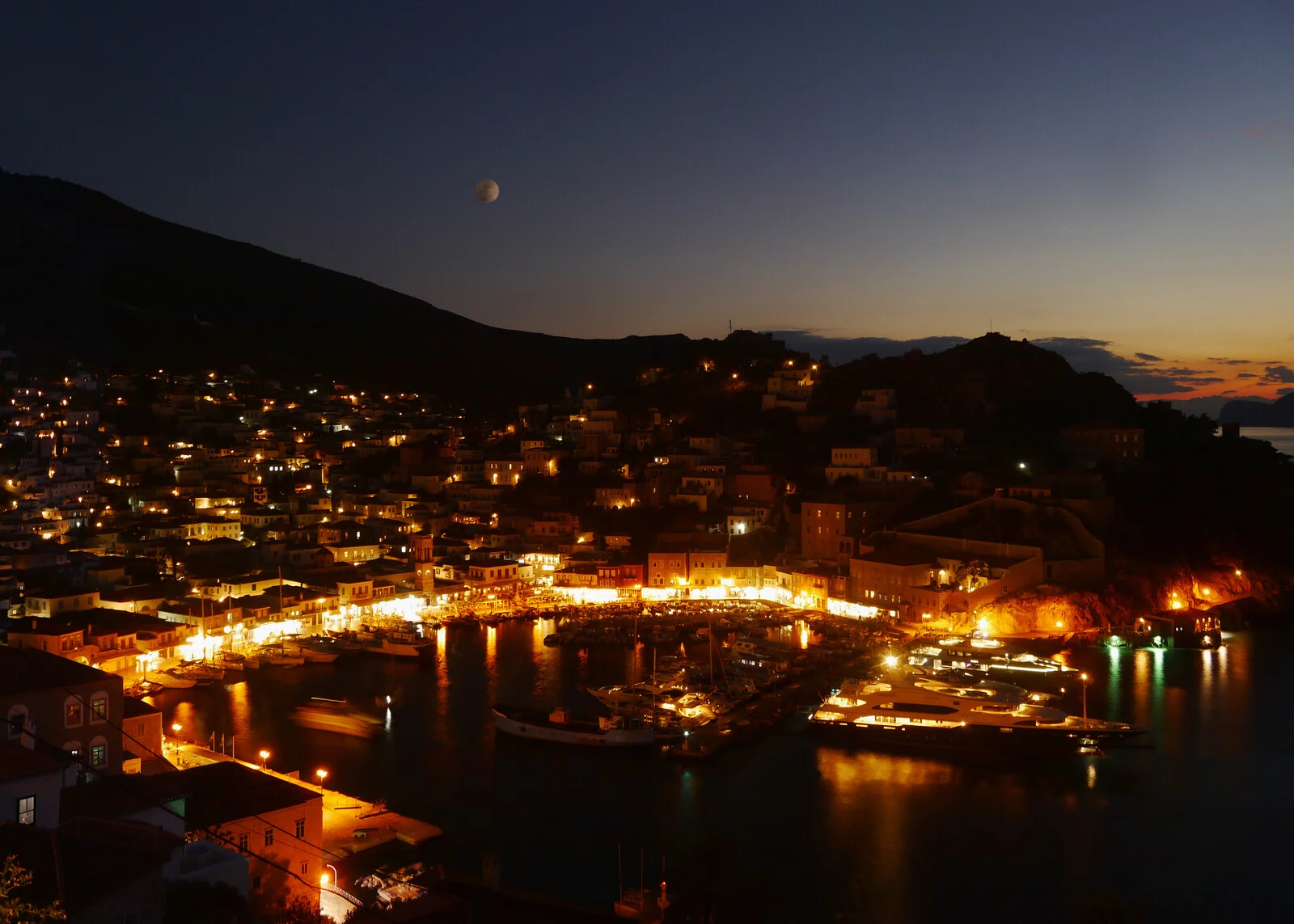
Girl Reading in the Harbour, 2022
Digital
70 x 100 cm
I loved you, Atthis, years ago,
When my youth was still all flowers……..
Someone, I tell you, will remember us,
Even at another time.
The lines come from a poem by Sappho, the most important lyric poet of Ancient Greece, born in the 7th century BC in Lesvos. Greeks have had a fling with eternal love since ancient days. An evening when the full moon hovers above the Hydra Amphitheatre, an old poem, reminds us how little we have changed over 2500 years. Love is love and will remain because it’s the generator of life. The scenery we see also fascinated our forerunners. Don’t think that people in caves did not enjoy sets. They did, combining comfort, protection, and a good view. Hydra would have been perfect for a Stone Age couple raising their kids, inviting friends and family to a roast by the fire. The reading girl in the window at the picture’s far bottom left is romantic, though studying architecture. Her favourite architect, Polykleitos the Younger, has inspired her with Epidaurus, his most famous work. Even though it is second in size among ancient theatres, there is room for many such in the Hydra Amphitheatre, the largest and most spectacular ever.
An amphitheatre is an open-air venue for entertainment, performances, and sports. The term derives from the ancient Greek ‘amfithéatron’, from ‘amfí’, meaning "on both sides" or "around", and ‘théatron’, meaning "place for viewing". The largest ancient amphitheatres could accommodate up to 60,000 spectators. The most elaborate featured multi-storeyed, arcaded marble façades lavishly decorated with stucco and sculpture in every portal and window. The best-known are Epidaurus, on Peloponnesus near Hydra and the Colosseum in Rome, also known as the Flavian Amphitheatre. These are huge even by modern comparison. The largest stadium today, Narendra Modi stadium in India, easily room inside both. These scenes fall short of the biggest of them all, Hydra Harbour. The elliptical Colosseum, the second in size, 189x156 metres could float in the Hydra basin between Isalos and Papagalos and, having its longer side, reach from where the donkeys stay to level Omilos and on the Historical Archives Museum opposite. Then you could put Epidaurus’ ‘Theatron’ - its seating area with 51 rows of seats - together with ‘Orchestra’ - the circular piece of ground where the chorus and actors performed and the backdrop or scenic wall, called the ‘Skené’ from which the word scene derives outside Colosseum. Epidaurus half-circle - about 120 metres in diameter – would align with Admiral Miaoulis’s statue and at the opposite side, curious spectators at Spilia bar.
The Colosseum is one of the world's most well-known tourist traps. In the incredible arena, people were killed by wild animals for the amusement of others. The far more enormous Hydra may kill some time but has never been more violent than that. Four hundred thousand people died within the walls of the Colosseum. Over 390 years, that equates to around 1,000 deaths per year - Some gladiators, of course, but mostly marginalised people or those looked down on by the upper classes. And Christians.
It wasn’t only humans being killed in action. Around 1,000,000 animals were slaughtered in a ‘sport’ called ‘Venatio’, literally “Hunting”. Wild animal killing would often occur in the morning ahead of the gladiatorial battles in the afternoon. Animals would be obtained from far-flung corners of the Roman Empire, a display of the empire’s wealth, a frivolous thing to do. The animals used in games were exotic at the time: elephants, hippopotamuses and beastly rhinoceros, hungry crocodiles, roaring lions, leopards, bears and tigers, wild goats and even wilder boars, dogs, lions and what else could be found. Wolves were, however, not used because they were held in religious significance by the ancient Romans.
These animals would be slaughtered, but occasionally, it was the other way around. Now and then, people were no match for the strength of the animals and failed to hunt them down. Animals were also used as a form of execution for convicted Roman citizens who happened to be lower class. This was known as ‘Damnatio ad Bestias’. The prisoner was left alone with one (or more) wild animals, primarily ravenous Lions or Leopards. Of course, this was a cruel way of executing a prisoner and gained much attention from the mob at the Colosseum.
The far more peaceful Epidaurus on the southeast end of the sanctuary, dedicated to the ancient Greek God of medicine, Asclepius, was a place for more sophisticated entertainment, theatre, music and dance. It was built by the architect from Argos, Polykleitos the Younger, in the late 4th century BC on the west side of Cynortion Mountain in the Epidaurus Municipality. It is the perfect ancient Greek theatre for acoustics and aesthetics. It and the Temple of Asclepius were inscribed on the UNESCO World Heritage List in 1988. The Theatre has been revived thanks to an annual festival since 1955.
Impressive as these ruined establishments are, they fall flat compared to the living Hydra with its crescent-shaped port, embracing a strand of restaurants, cafés and bars, shops, markets, and galleries that cater to tourists and Hydriots). Steep stone streets lead up and outward from the harbour area to the North, South and East. Suppose you consider the port the ‘Orchestra’, the scene, including all the extras sipping cocktails and eating, chatting, and enjoying the ‘Theatron’, the auditorium. In that case, we talk about an arena, in theory, capable of about half a million spectators. Luckily, this will never happen. Hundreds of houses and mansions are on the sloping auditorium, giving Hydra its charm. Sitting on their terraces and balconies is perfect for watching a never-ending theatrical performance. The backdrop changes with the time of the day and season but is more spectacular than any theatre worldwide.
That leads to the girl reading behind a window at the lower left corner of the picture. She was the one giving me all the facts about amphitheatres. She studies architecture and prepares hard for her exam. Polykleitos the Younger is one of her favourite architects, along with Italian Andrea Palladio, who is considered one of the most influential individuals in the history of architecture. Even busy with her exam, the girl relaxes with a poem by Sappho, a romantic poetess suitable for an evening like this with the full moon hovering above the Hydra amphitheatre.
I loved you, Atthis, years ago,
when my youth was still all flowers
and sighs, and you — you seemed to me
such a small, ungainly girl.
Do you remember what happened earlier?
If not, I’ll remind you how while laying
beside me, you wove a garland of crocuses
I then braided it into strands of your hair.
Once, when you’d plaited a double necklace
from a hundred blooms, I tied them, swanning
around the sun-licked ring of your neck.
And on more than one occasion — there were two
of them, to be exact — while I looked on too
silent with adoration to say your name.
You glazed your breasts and arms with oil.
No holy place existed without us then,
No woodland, No dance, No sound.
Beyond all hope, I prayed those timeless days
Days we spend might be made twice as long.
I prayed one word: I desire.
Someone, I tell you, will remember us,
Even at another time.
It is late this year to celebrate World Theatre Day. It was already on 27 March, but if you are on Hydra, you can honour it daily in the port.
Jörgen Thornberg
Girl Reading in the Harbour, 2022
Digital
70 x 100 cm
I loved you, Atthis, years ago,
When my youth was still all flowers……..
Someone, I tell you, will remember us,
Even at another time.
The lines come from a poem by Sappho, the most important lyric poet of Ancient Greece, born in the 7th century BC in Lesvos. Greeks have had a fling with eternal love since ancient days. An evening when the full moon hovers above the Hydra Amphitheatre, an old poem, reminds us how little we have changed over 2500 years. Love is love and will remain because it’s the generator of life. The scenery we see also fascinated our forerunners. Don’t think that people in caves did not enjoy sets. They did, combining comfort, protection, and a good view. Hydra would have been perfect for a Stone Age couple raising their kids, inviting friends and family to a roast by the fire. The reading girl in the window at the picture’s far bottom left is romantic, though studying architecture. Her favourite architect, Polykleitos the Younger, has inspired her with Epidaurus, his most famous work. Even though it is second in size among ancient theatres, there is room for many such in the Hydra Amphitheatre, the largest and most spectacular ever.
An amphitheatre is an open-air venue for entertainment, performances, and sports. The term derives from the ancient Greek ‘amfithéatron’, from ‘amfí’, meaning "on both sides" or "around", and ‘théatron’, meaning "place for viewing". The largest ancient amphitheatres could accommodate up to 60,000 spectators. The most elaborate featured multi-storeyed, arcaded marble façades lavishly decorated with stucco and sculpture in every portal and window. The best-known are Epidaurus, on Peloponnesus near Hydra and the Colosseum in Rome, also known as the Flavian Amphitheatre. These are huge even by modern comparison. The largest stadium today, Narendra Modi stadium in India, easily room inside both. These scenes fall short of the biggest of them all, Hydra Harbour. The elliptical Colosseum, the second in size, 189x156 metres could float in the Hydra basin between Isalos and Papagalos and, having its longer side, reach from where the donkeys stay to level Omilos and on the Historical Archives Museum opposite. Then you could put Epidaurus’ ‘Theatron’ - its seating area with 51 rows of seats - together with ‘Orchestra’ - the circular piece of ground where the chorus and actors performed and the backdrop or scenic wall, called the ‘Skené’ from which the word scene derives outside Colosseum. Epidaurus half-circle - about 120 metres in diameter – would align with Admiral Miaoulis’s statue and at the opposite side, curious spectators at Spilia bar.
The Colosseum is one of the world's most well-known tourist traps. In the incredible arena, people were killed by wild animals for the amusement of others. The far more enormous Hydra may kill some time but has never been more violent than that. Four hundred thousand people died within the walls of the Colosseum. Over 390 years, that equates to around 1,000 deaths per year - Some gladiators, of course, but mostly marginalised people or those looked down on by the upper classes. And Christians.
It wasn’t only humans being killed in action. Around 1,000,000 animals were slaughtered in a ‘sport’ called ‘Venatio’, literally “Hunting”. Wild animal killing would often occur in the morning ahead of the gladiatorial battles in the afternoon. Animals would be obtained from far-flung corners of the Roman Empire, a display of the empire’s wealth, a frivolous thing to do. The animals used in games were exotic at the time: elephants, hippopotamuses and beastly rhinoceros, hungry crocodiles, roaring lions, leopards, bears and tigers, wild goats and even wilder boars, dogs, lions and what else could be found. Wolves were, however, not used because they were held in religious significance by the ancient Romans.
These animals would be slaughtered, but occasionally, it was the other way around. Now and then, people were no match for the strength of the animals and failed to hunt them down. Animals were also used as a form of execution for convicted Roman citizens who happened to be lower class. This was known as ‘Damnatio ad Bestias’. The prisoner was left alone with one (or more) wild animals, primarily ravenous Lions or Leopards. Of course, this was a cruel way of executing a prisoner and gained much attention from the mob at the Colosseum.
The far more peaceful Epidaurus on the southeast end of the sanctuary, dedicated to the ancient Greek God of medicine, Asclepius, was a place for more sophisticated entertainment, theatre, music and dance. It was built by the architect from Argos, Polykleitos the Younger, in the late 4th century BC on the west side of Cynortion Mountain in the Epidaurus Municipality. It is the perfect ancient Greek theatre for acoustics and aesthetics. It and the Temple of Asclepius were inscribed on the UNESCO World Heritage List in 1988. The Theatre has been revived thanks to an annual festival since 1955.
Impressive as these ruined establishments are, they fall flat compared to the living Hydra with its crescent-shaped port, embracing a strand of restaurants, cafés and bars, shops, markets, and galleries that cater to tourists and Hydriots). Steep stone streets lead up and outward from the harbour area to the North, South and East. Suppose you consider the port the ‘Orchestra’, the scene, including all the extras sipping cocktails and eating, chatting, and enjoying the ‘Theatron’, the auditorium. In that case, we talk about an arena, in theory, capable of about half a million spectators. Luckily, this will never happen. Hundreds of houses and mansions are on the sloping auditorium, giving Hydra its charm. Sitting on their terraces and balconies is perfect for watching a never-ending theatrical performance. The backdrop changes with the time of the day and season but is more spectacular than any theatre worldwide.
That leads to the girl reading behind a window at the lower left corner of the picture. She was the one giving me all the facts about amphitheatres. She studies architecture and prepares hard for her exam. Polykleitos the Younger is one of her favourite architects, along with Italian Andrea Palladio, who is considered one of the most influential individuals in the history of architecture. Even busy with her exam, the girl relaxes with a poem by Sappho, a romantic poetess suitable for an evening like this with the full moon hovering above the Hydra amphitheatre.
I loved you, Atthis, years ago,
when my youth was still all flowers
and sighs, and you — you seemed to me
such a small, ungainly girl.
Do you remember what happened earlier?
If not, I’ll remind you how while laying
beside me, you wove a garland of crocuses
I then braided it into strands of your hair.
Once, when you’d plaited a double necklace
from a hundred blooms, I tied them, swanning
around the sun-licked ring of your neck.
And on more than one occasion — there were two
of them, to be exact — while I looked on too
silent with adoration to say your name.
You glazed your breasts and arms with oil.
No holy place existed without us then,
No woodland, No dance, No sound.
Beyond all hope, I prayed those timeless days
Days we spend might be made twice as long.
I prayed one word: I desire.
Someone, I tell you, will remember us,
Even at another time.
It is late this year to celebrate World Theatre Day. It was already on 27 March, but if you are on Hydra, you can honour it daily in the port.

Jörgen Thornberg
Malmö
Lite om bilder och mig. Translation in English at the end.
Jag är en nyfiken person som ser allt i bilder, även det jag fäster i ord, gärna tillsammans för bakom alla mina bilder finns en berättelse. Till vissa bilder hör en kortare eller längre novell som följer med bilden.
Bilder berättar historier. Jag omges av naturlig skönhet, intressanta människor och historia var jag än går. Jag använder min kamera för att dokumentera världen och blanda det jag ser med vad jag känner för att fånga den dolda magin.
Mina bilder berättar mina historier. Genom mina bilder, tryck och berättelser. Jag bjuder in dig att ta del av dessa berättelser, in i ditt liv och hem och dela min mycket personliga syn på vår värld. Mer än vad ögat ser. Jag tänker i bilder, drömmer och skriver och pratar om dem; följaktligen måste jag också skapa bilder. De blir vad jag ser, inte nödvändigtvis begränsade till verkligheten. Det finns en bild runt varje hörn. Jag hoppas att du kommer att se vad jag såg och gilla det.
Jag är också en skrivande person och till många bilder hör en kortare eller längre essay. Den följer med tavlan, tryckt på fint papper och med en personlig hälsning från mig.
Flertalet bilder startar sin resa i min kamera. Enkelt förklarat beskriver jag bilden jag ser i mitt inre, upplevd eller fantiserad. Bilden uppstår inom mig redan innan jag fått okularet till ögat. På bråkdelen av ett ögonblick ser jag vad jag vill ha och vad som kan göras med bilden. Här skall jag stoppa in en giraff, stålmannen, Titanic eller vad det är min fantasi finner ut. Ännu märkligare är att jag kommer ihåg minnesbilden långt efteråt när det blir tid att skapa verket. Om jag lyckas eller inte, är upp till betraktaren, oftast präglat av en stråk av svart humor – meningen är att man skall bli underhållen. Mina bilder blir ofta en snackis där de hänger.
Jag föredrar bilder som förmedlar ett budskap i flera lager. Vid första anblicken fylld av feel-good, en vacker utsikt, fint väder, solen skiner, blommor på ängen eller vattnet som ligger förrädiskt spegelblankt. I en sådan bild kan jag gömma min egentliga berättelse, mitt förakt för förtryckare och våldsverkare, rasister och fördomsfulla människor - ett gärna återkommande motiv mer eller mindre dolt i det vackra motivet. Jag försöker förena dem i ett gemensamt narrativ.
Bild och formgivning har löpt som en röd tråd genom livet. Fotokonst känns som en värdig final som jag gärna delar med mig.
Min genre är vid som framgår av mina bilder, temat en blandning av pop- och gatukonst i kollage som kan bestå av hundratals lager. Vissa bilder kan ta veckor, andra någon dag innan det är dags att överlämna resultatet till printverkstaden. Fine Art Prints är digitala fotocollage. I dessa kollage sker rivandet, klippandet, pusslandet, målandet, ritandet och sprayningen digitalt. Det jag monterar in kan vara hundratals år gamla bilder som jag omsorgsfullt frilägger så att de ser ut att vara en del av tavlan men också bilder skapade av mig själv efter min egen fantasi. Därefter besöks printstudion och för vissa bilder numrera en limiterad upplaga (oftast 7 exemplar) och signera för hand. Vissa bilder kan köpas i olika format. Det är bara att fråga efter vilka. Gillar man en bild som är 70x100 men inte har plats på väggen, går den kanske att få i 50x70 cm istället. Frågan är fri.
Metoden Giclée eller Fine Art Print som det också kallas är det moderna sättet för framställning av grafisk konst. Villkoret för denna typ av utskrifter är att en högkvalitativ storformatskrivare används med åldersbeständigt färgpigment och konstnärspapper eller i förekommande fall på duk. Pappret som används möter de krav på livslängd som ställs av museer och gallerier. Normalt säljer jag mina bilder oinramade så att den nya ägaren själv kan bestämma hur de skall se ut, med eller utan passepartout färg på ram, med eller utan glas etc..
Under många år ställde jag bara ut på nätet, i valda grupper och på min egen Facebooksida - https://www.facebook.com/jorgen.thornberg.9
Jag finns också på en egen hemsida som tyvärr inte alltid är uppdaterad – https://www.jth.life/ Där kan du också läsa en del av de berättelser som följer med bilden.
UTSTÄLLNINGAR
Luftkastellet, oktober 2022
Konst i Lund, november 2022
Luftkastellet, mars 2023
Engleson Galleri Caroli, april 2023
Hydra, Greece June 2023
Engleson Galleri Caroli, oktober 2023
Toppen, Höllviken december 2023
Luftkastellet, mars 2024
Torups Galleri, mars 2024
Venice, May 2024
Luftkastellet, oktober 2024
Konst i Advent, December 2024
Galleri Engleson, Caroli December 2024
Jäger & Jansson Galleri, april 2025
A bit about pictures and me.
I'm a curious person who sees everything in pictures, even what I express in words, often combining them, for behind all my pictures lies a story. These narratives, some as short as a single image and others as long as a novel, are the heart and soul of my work.
Pictures tell stories. Wherever I go, I'm surrounded by natural beauty, exciting people, and history. I use my camera to document the world and blend what I see with what I feel to capture the hidden magic.
My images tell my stories. Through my pictures, prints, and narratives, I invite you to partake in these stories in your life and home and share my deeply personal perspective of our world. More than meets the eye. I think in pictures, dream, write, and talk about them; consequently, I must create images too. They become what I see, not necessarily confined to reality. There's a picture around every corner. I hope you'll see what I saw and enjoy it.
I'm also a writer, and many images come with a shorter or longer essay. It accompanies the painting, printed on fine paper with my personal greeting.
Many pictures start their journey on my camera. Simply put, I describe the image I see in my mind, experienced or imagined. The image arises within me even before I bring the eyepiece to my eye. In a fraction of a moment, I see what I want and what can be done with the picture. Here, I'll insert a giraffe, Superman, the Titanic, or whatever my imagination conjures up. Even stranger is that I remember the mental image long after it's time to create the work. Whether I succeed is up to the observer, often imbued with a streak of black humour – the aim is to entertain. My pictures usually become a talking point wherever they hang.
I prefer pictures that convey a message in multiple layers. At first glance, they're filled with feel-good vibes, a beautiful view, lovely weather, the sun shining, flowers in the meadow, or the water lying deceptively calm. But beneath this surface beauty, I often conceal a deeper story, a narrative that challenges societal norms or explores the human condition. I invite you to delve into these hidden narratives and discover the layers of meaning within my work.
Picture and design have been a thread running through my life. Photographic art feels like a fitting finale, and I'm happy to share it.
My genre is varied, as seen in my pictures; the theme is a blend of pop and street art in collages that can consist of hundreds of layers. Some images can take weeks, others just a day before it's time to hand over the result to the print workshop. Fine Art Prints are digital photo collages. In these collages, tearing, cutting, puzzling, painting, drawing, and spraying happen digitally. What I insert can be images hundreds of years old that I carefully extract so they appear to be part of the painting, but also images created by myself, now also generated from my imagination. Next, visit the print studio and, for certain images, number a limited edition (usually 7 copies) and sign them by hand. Some images may be available in other formats. Just ask which ones. If you like an image that's 70x100 but doesn't have space on the wall, you might be able to get it in 50x70 cm instead. The question is open.
The Giclée method, or Fine Art Print as it's also called, is the modern way of producing graphic art. This method ensures the highest quality and longevity of the artwork, using a high-quality large-format printer with archival pigment inks and artist paper or, in some cases, canvas. The paper used meets the longevity requirements set by museums and galleries. I sell my pictures unframed, allowing the new owner to personalise their artwork, confident in the lasting value and quality of the piece.
For many years, I only exhibited online, in selected groups, and on my Facebook page - https://www.facebook.com/jorgen.thornberg.9. I also have my website, which unfortunately is not constantly updated - https://www.jth.life/. You can also read some of the stories accompanying the pictures there.
EXHIBITIONS
Luftkastellet, October 2022
Art in Lund, November 2022
Luftkastellet, March 2023
Engleson Gallery Caroli, April 2023
Hydra, Greece June 2023
Engleson Gallery Caroli, October 2023
Toppen, Höllviken December 2023
Luftkastellet, March 2024
Torup Gallery, March 2024
Venice, May 2024
UTSTÄLLNINGAR
Luftkastellet, oktober 2022
Konst i Lund, november 2022
Luftkastellet, mars 2023
Engleson Galleri Caroli, april 2023
Hydra, Greece June 2023
Engleson Galleri Caroli, oktober 2023
Toppen, Höllviken december 2023
Luftkastellet, mars 2024
Torups Galleri, mars 2024
Venice, May 2024
Luftkastellet, October 2024
Konst i Advent, December 2024
Galleri Engleson, Caroli December 2024
Jäger & Jansson Galleri, April 2025
Utbildning
Autodidakt
Medlem i konstnärsförening
Öppna Sinnen
Med i konstrunda
Konstrundan i Skåne
Utställningar
Luftkastellet, October 2022
Art in Lund, November 2022
Luftkastellet, March 2023
Engleson Gallery Caroli, April 2023
Hydra, Greece June 2023
Engleson Gallery Caroli, October 2023
Toppen, Höllviken December 2023
Luftkastellet, March 2024
Torup Gallery, March 2024
Venice, May 2024