Vi använder cookies för att ge dig bästa möjliga upplevelse. Välj vilka cookies du tillåter.
Läs mer i vår integritetspolicy
Jörgen Thornberg
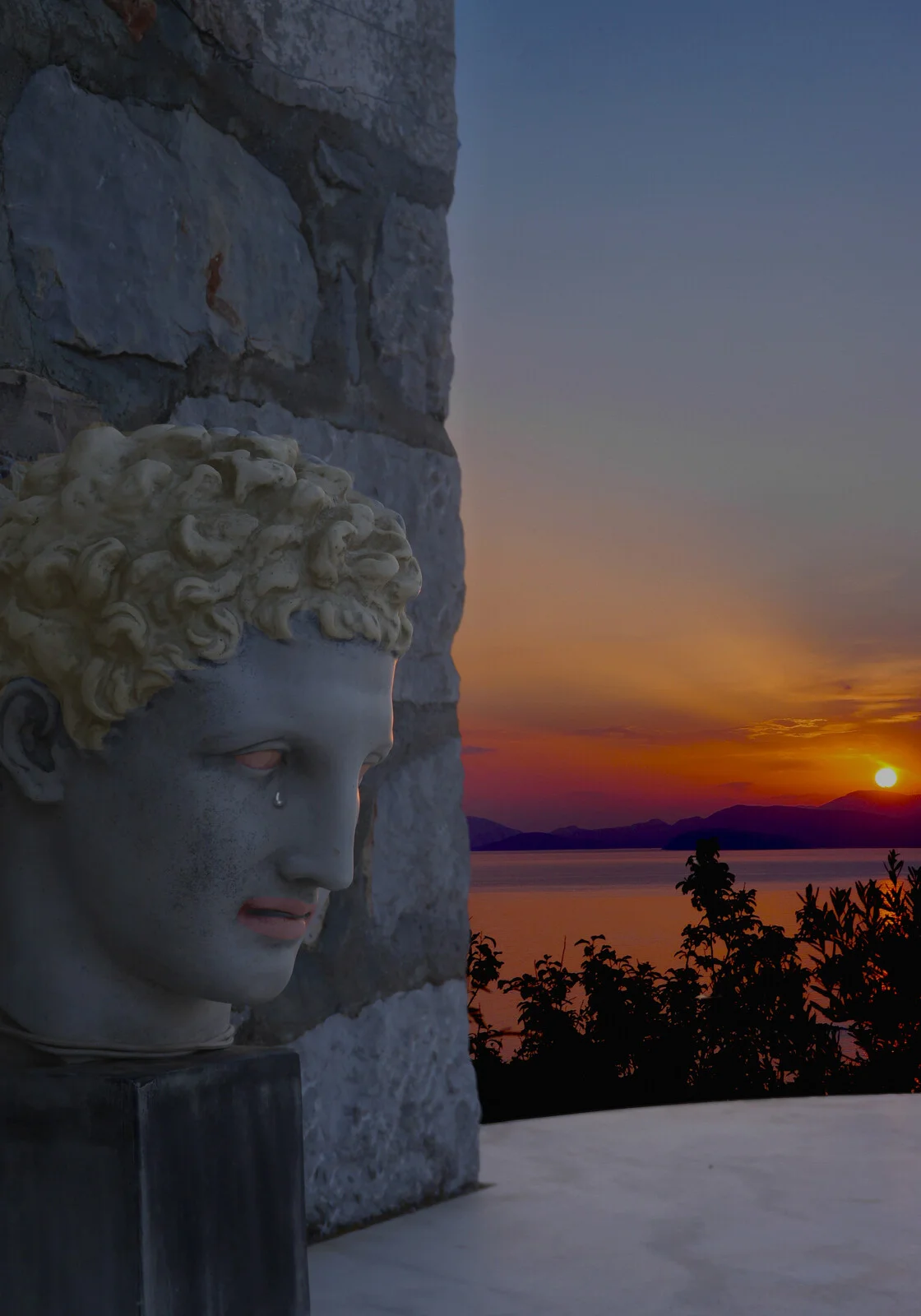
Apollo's Tears, 2023
Digital
50 x 70 cm
In the last light of twilight's grace,
where the marble bench rests still,
a bust of Apollo quietly remains,
with the sky's fiery hues, so vivid and real.
The red sun sinking in the distance,
blue and grey in a perfect blend,
mixed with the reddest tint,
creating the evening's lovely end.
Apollo, of stone and mythical might,
his gaze is heavy, his mind burdened deep,
a tear rolls slowly down his cheek,
as if sorrow was too vast to keep.
With eyes so sombre, he looks down,
into marble's cold embrace,
where thoughts are dark,
and memories wear a grieving face.
Sunset's splendour adorns the scene,
but within Apollo lies a profound sorrow,
a heart of stone,
that still can feel the echo of woe.
So he stands in evening's beauty,
with the sky a canvas of pain and grace,
a tear in the silence of the night,
an eternal moment in art's embrace.
Apollo's Melancholy: A Tale of Love, Loss, and Introspection
Apollo had endured a string of unfortunate events that left him discouraged. His laurel wreath, crafted from the leaves of Daphne's sacred tree, had been snatched away by a mischievous dove while he was walking near the ochre villa above my house. Apollo already harboured a dislike for doves, and this theft only deepened his disdain. But the worst blow came when a string on his kithara snapped. These strings, made from the gut of specially selected black-fleeced rams that grazed on the northwest slopes of Mount Olympus, were rare and difficult to replace. Without his music, which usually lifted his spirits, Apollo felt the weight of his melancholy grow.
Apollo felt utterly sorry for himself, his self-pity boundless that evening. The stunning sunset before him brought no comfort. Instead, it signified an ending rather than a promise of a new day. The memories of happier times only deepened his sorrow, for he longed to reclaim those moments, unwilling to let them slip away.
As Apollo brooded, his inner dialogue intensified. Apollo Pythios, the patron deity of Delphi and his more assertive persona, chided Apollo Agyieus, the protector of public streets and places, for wallowing in self-pity. "Look at you, moping like a mortal," Pythios scoffed. "You are a god, yet you allow yourself to be undone by such trivialities."
Apollo Agyieus, feeling the sting of Pythios' words, tried to muster a defence. "It's not just the wreath or the kithara," he murmured. "It's everything. The constant reminder of what I've lost and can never regain."
"Self-pity is unbecoming of a god," Pythios retorted. "We have the power to shape our destiny, to overcome and rise above our sorrows. You must find that strength within you."
Apollo Agyieus knew Pythios was right, yet his grief was overwhelming. Several times, he had tried to turn back time to bring back those who had died. Each attempt had ended in sorrow, with new flowers, a hyacinth, a cypress tree, and a laurel wreath, but never with the return of his loved ones. He felt anxiety gripping his soul, and a tear threatened to escape his eye. As a god, he told himself he must not cry—tears were for mortals and weak men.
Apollo Pythios, seeking to divert Agyieus from his dark thoughts, began recounting their cherished memories. "Do you remember the first time we saw Hyacinthus?" he began. "He was so captivating, with his tall, strong, muscular frame. His easy grace and shared love for nature made him an ideal companion. Those days spent playing music together and rejoicing in the harmony of our relationship were truly divine."
Agyieus sighed, "Yes, I remember. But those memories only serve to deepen my sorrow. Hyacinthus' death was such a tragedy. He was struck down by the very discus I threw, or worse, by the jealousy of Zephyrus, the god of the west wind. How can I find solace in memories tainted by such loss?"
Pythios, undeterred, continued. "Hyacinthus became an important religious figure in Sparta. The festival of Hyacinthia was celebrated for three days, and he was honoured for his life and death, followed by his rebirth as a flower. It's a testament to our shared love and its impact on the world."
Agyieus, feeling the familiar sting of grief, added, "Yet, no matter how many festivals or flowers, I cannot bring him back. Each attempt to defy time and fate has ended in sorrow. First Hyacinthus, then others. Adonis, Cyparissus—all loved and lost. Each transformed into something beautiful but never returned to me."
"Remember, Adonis," Pythios interjected. We deeply loved him. He was androgynous, a lover of both us and Aphrodite. His love brought warmth and passion to our lives."
Agyieus replied, "And yet, he too was taken. Just like Cyparissus, who was transformed into a cypress tree out of grief for a lost pet. It seems that all we touch turns to sorrow."
Pythios, attempting to uplift his other half, spoke of their triumphs. "Despite these losses, we have had moments of victory and love. Think of Daphne, who became our eternal symbol even though she became a laurel tree. Our love, though unfulfilled, gave us the laurel wreath, a symbol of triumph in sports, music, and poetry."
Agyieus retorted, "But Daphne's transformation was a curse, not a blessing. I chased her out of love, but it turned into a nightmare. She feared me and chose to become a tree rather than be with me. And what of Cassandra? She tricked me into giving her the gift of prophecy and then spurned my love. Each memory, each triumph, is tainted by loss and rejection."
Pythios, ever the optimist, tried to steer the conversation to a lighter note. "Remember, not all our endeavours ended in tragedy. There were moments of joy and companionship. We had our share of lovers and admirers, both male and female. We brought music, light, and prophecy to the world. Our legacy is not one of sorrow alone."
Agyieus, however, could not be easily swayed. "But those moments are overshadowed by the losses. The string breaking on my kithara is symbolic of my life. A subsequent sorrow has marred every joy I have ever known. And now, without my music, I am left alone with my thoughts, haunted by the ghosts of my past."
Pythios, sensing the depth of Agyieus' despair, softened his tone. "I understand your pain. We have lived through more love and loss than any mortal could endure. But we are gods, and our story is not yet finished. We must find the strength to continue, to create new memories, and to find joy in the present, even if it is fleeting."
Agyieus nodded slowly, acknowledging Pythios' wisdom. "Perhaps you are right. Maybe there is still hope for us. But for now, let me mourn. Let me grieve for all that we have lost. Tomorrow, we can begin anew."
As the conversation lulled, Apollo Agyieus could not help but remember Marpessa, a princess of Aitolia. "Do you recall Marpessa?" he asked Pythios. "She chose Idas over us, fearing we would abandon her in old age. She was wise beyond her years, and though her decision crushed me, it was rooted in truth."
Pythios nodded, "Indeed, Marpessa was a sharp reminder of our nature. We are not meant to be tied down, yet each rejection cuts deep. Her choice was pragmatic, and we must respect that."
Agyieus continued, "And then there was Adonis, the prince of Kypros Island. He was our love for hire, and his androgyny allowed him to be with us and Aphrodite. His beauty was unmatched, yet he too was taken from us."
"Do not forget Cyparissus," Pythios added. "His grief over a pet led to his transformation into a cypress tree. Each love story ends in metamorphosis rather than reunion."
Agyieus sighed deeply. "Even our brief solace in the embrace of Boreas, the cold north wind, was fleeting. Winter's chill could not last forever, and with the arrival of spring, our comfort vanished."
Like many of the Greek gods, Apollo was bisexual. Apollo had male and female lovers in myths, just like his father, Zeus. His most famous male lover was the young Hyacinthus, whose tragic story explains the origin of the eponymous flower. Greek sexuality thus clearly challenges the limits of modern heteronormativity.
Apollo is the model of Greek male excellence in physical, intellectual, and ethical terms. This model of masculine perfection was compatible with sexuality beyond the limits of heterosexuality. His male and female relationships highlighted the fluidity of love and desire among the gods.
However, ancient Greece was not a paradise of sexual freedom and tolerance. The rules about what sexual relations were right and wrong in Hellenic society did not depend so much on the gender of individuals as on their status. In Greek culture, the free citizen was at the top of society, and below him lived those considered to be of lower status, the 'others' who were subject to the citizen: women, foreigners, and slaves.
In all areas, including that of sexuality, the Greek citizen was expected to assume a dominant role within asymmetrical relationships established with people of lower rank. A Greek male citizen could thus have sex with his wife, with a concubine, with male and female slaves, and with male and female prostitutes. However, he was not to have relations with a citizen of his age or to assume a passive role with any male of any status. This does not mean there were no relationships outside these norms, but rather that those relationships were rejected and ridiculed.
Pythios tried to bring some closure to their introspective dialogue. "Despite our losses and the constraints of society, we have left a legacy. Our love stories, our music, our prophecies—they all live on. We must not let sorrow define us."
Agyieus, with a hint of hope in his voice, replied, "You are right. We are gods, and
Our story is one of both joy and sorrow. Let us honour our past and look forward to the future, for even in the darkest nights, the promise of a new dawn is never far away."
As the sun set and the stars twinkled in the night sky, Apollo felt the total weight of his sorrow. He mourned for Hyacinthus, Adonis, Cyparissus, and all the others he had loved and lost. He mourned for the broken kithara and the stolen laurel wreath. But he also held onto the hope that Pythios had offered. Even in the darkest nights, the promise of a new dawn was never far away.
Jörgen Thornberg
Apollo's Tears, 2023
Digital
50 x 70 cm
In the last light of twilight's grace,
where the marble bench rests still,
a bust of Apollo quietly remains,
with the sky's fiery hues, so vivid and real.
The red sun sinking in the distance,
blue and grey in a perfect blend,
mixed with the reddest tint,
creating the evening's lovely end.
Apollo, of stone and mythical might,
his gaze is heavy, his mind burdened deep,
a tear rolls slowly down his cheek,
as if sorrow was too vast to keep.
With eyes so sombre, he looks down,
into marble's cold embrace,
where thoughts are dark,
and memories wear a grieving face.
Sunset's splendour adorns the scene,
but within Apollo lies a profound sorrow,
a heart of stone,
that still can feel the echo of woe.
So he stands in evening's beauty,
with the sky a canvas of pain and grace,
a tear in the silence of the night,
an eternal moment in art's embrace.
Apollo's Melancholy: A Tale of Love, Loss, and Introspection
Apollo had endured a string of unfortunate events that left him discouraged. His laurel wreath, crafted from the leaves of Daphne's sacred tree, had been snatched away by a mischievous dove while he was walking near the ochre villa above my house. Apollo already harboured a dislike for doves, and this theft only deepened his disdain. But the worst blow came when a string on his kithara snapped. These strings, made from the gut of specially selected black-fleeced rams that grazed on the northwest slopes of Mount Olympus, were rare and difficult to replace. Without his music, which usually lifted his spirits, Apollo felt the weight of his melancholy grow.
Apollo felt utterly sorry for himself, his self-pity boundless that evening. The stunning sunset before him brought no comfort. Instead, it signified an ending rather than a promise of a new day. The memories of happier times only deepened his sorrow, for he longed to reclaim those moments, unwilling to let them slip away.
As Apollo brooded, his inner dialogue intensified. Apollo Pythios, the patron deity of Delphi and his more assertive persona, chided Apollo Agyieus, the protector of public streets and places, for wallowing in self-pity. "Look at you, moping like a mortal," Pythios scoffed. "You are a god, yet you allow yourself to be undone by such trivialities."
Apollo Agyieus, feeling the sting of Pythios' words, tried to muster a defence. "It's not just the wreath or the kithara," he murmured. "It's everything. The constant reminder of what I've lost and can never regain."
"Self-pity is unbecoming of a god," Pythios retorted. "We have the power to shape our destiny, to overcome and rise above our sorrows. You must find that strength within you."
Apollo Agyieus knew Pythios was right, yet his grief was overwhelming. Several times, he had tried to turn back time to bring back those who had died. Each attempt had ended in sorrow, with new flowers, a hyacinth, a cypress tree, and a laurel wreath, but never with the return of his loved ones. He felt anxiety gripping his soul, and a tear threatened to escape his eye. As a god, he told himself he must not cry—tears were for mortals and weak men.
Apollo Pythios, seeking to divert Agyieus from his dark thoughts, began recounting their cherished memories. "Do you remember the first time we saw Hyacinthus?" he began. "He was so captivating, with his tall, strong, muscular frame. His easy grace and shared love for nature made him an ideal companion. Those days spent playing music together and rejoicing in the harmony of our relationship were truly divine."
Agyieus sighed, "Yes, I remember. But those memories only serve to deepen my sorrow. Hyacinthus' death was such a tragedy. He was struck down by the very discus I threw, or worse, by the jealousy of Zephyrus, the god of the west wind. How can I find solace in memories tainted by such loss?"
Pythios, undeterred, continued. "Hyacinthus became an important religious figure in Sparta. The festival of Hyacinthia was celebrated for three days, and he was honoured for his life and death, followed by his rebirth as a flower. It's a testament to our shared love and its impact on the world."
Agyieus, feeling the familiar sting of grief, added, "Yet, no matter how many festivals or flowers, I cannot bring him back. Each attempt to defy time and fate has ended in sorrow. First Hyacinthus, then others. Adonis, Cyparissus—all loved and lost. Each transformed into something beautiful but never returned to me."
"Remember, Adonis," Pythios interjected. We deeply loved him. He was androgynous, a lover of both us and Aphrodite. His love brought warmth and passion to our lives."
Agyieus replied, "And yet, he too was taken. Just like Cyparissus, who was transformed into a cypress tree out of grief for a lost pet. It seems that all we touch turns to sorrow."
Pythios, attempting to uplift his other half, spoke of their triumphs. "Despite these losses, we have had moments of victory and love. Think of Daphne, who became our eternal symbol even though she became a laurel tree. Our love, though unfulfilled, gave us the laurel wreath, a symbol of triumph in sports, music, and poetry."
Agyieus retorted, "But Daphne's transformation was a curse, not a blessing. I chased her out of love, but it turned into a nightmare. She feared me and chose to become a tree rather than be with me. And what of Cassandra? She tricked me into giving her the gift of prophecy and then spurned my love. Each memory, each triumph, is tainted by loss and rejection."
Pythios, ever the optimist, tried to steer the conversation to a lighter note. "Remember, not all our endeavours ended in tragedy. There were moments of joy and companionship. We had our share of lovers and admirers, both male and female. We brought music, light, and prophecy to the world. Our legacy is not one of sorrow alone."
Agyieus, however, could not be easily swayed. "But those moments are overshadowed by the losses. The string breaking on my kithara is symbolic of my life. A subsequent sorrow has marred every joy I have ever known. And now, without my music, I am left alone with my thoughts, haunted by the ghosts of my past."
Pythios, sensing the depth of Agyieus' despair, softened his tone. "I understand your pain. We have lived through more love and loss than any mortal could endure. But we are gods, and our story is not yet finished. We must find the strength to continue, to create new memories, and to find joy in the present, even if it is fleeting."
Agyieus nodded slowly, acknowledging Pythios' wisdom. "Perhaps you are right. Maybe there is still hope for us. But for now, let me mourn. Let me grieve for all that we have lost. Tomorrow, we can begin anew."
As the conversation lulled, Apollo Agyieus could not help but remember Marpessa, a princess of Aitolia. "Do you recall Marpessa?" he asked Pythios. "She chose Idas over us, fearing we would abandon her in old age. She was wise beyond her years, and though her decision crushed me, it was rooted in truth."
Pythios nodded, "Indeed, Marpessa was a sharp reminder of our nature. We are not meant to be tied down, yet each rejection cuts deep. Her choice was pragmatic, and we must respect that."
Agyieus continued, "And then there was Adonis, the prince of Kypros Island. He was our love for hire, and his androgyny allowed him to be with us and Aphrodite. His beauty was unmatched, yet he too was taken from us."
"Do not forget Cyparissus," Pythios added. "His grief over a pet led to his transformation into a cypress tree. Each love story ends in metamorphosis rather than reunion."
Agyieus sighed deeply. "Even our brief solace in the embrace of Boreas, the cold north wind, was fleeting. Winter's chill could not last forever, and with the arrival of spring, our comfort vanished."
Like many of the Greek gods, Apollo was bisexual. Apollo had male and female lovers in myths, just like his father, Zeus. His most famous male lover was the young Hyacinthus, whose tragic story explains the origin of the eponymous flower. Greek sexuality thus clearly challenges the limits of modern heteronormativity.
Apollo is the model of Greek male excellence in physical, intellectual, and ethical terms. This model of masculine perfection was compatible with sexuality beyond the limits of heterosexuality. His male and female relationships highlighted the fluidity of love and desire among the gods.
However, ancient Greece was not a paradise of sexual freedom and tolerance. The rules about what sexual relations were right and wrong in Hellenic society did not depend so much on the gender of individuals as on their status. In Greek culture, the free citizen was at the top of society, and below him lived those considered to be of lower status, the 'others' who were subject to the citizen: women, foreigners, and slaves.
In all areas, including that of sexuality, the Greek citizen was expected to assume a dominant role within asymmetrical relationships established with people of lower rank. A Greek male citizen could thus have sex with his wife, with a concubine, with male and female slaves, and with male and female prostitutes. However, he was not to have relations with a citizen of his age or to assume a passive role with any male of any status. This does not mean there were no relationships outside these norms, but rather that those relationships were rejected and ridiculed.
Pythios tried to bring some closure to their introspective dialogue. "Despite our losses and the constraints of society, we have left a legacy. Our love stories, our music, our prophecies—they all live on. We must not let sorrow define us."
Agyieus, with a hint of hope in his voice, replied, "You are right. We are gods, and
Our story is one of both joy and sorrow. Let us honour our past and look forward to the future, for even in the darkest nights, the promise of a new dawn is never far away."
As the sun set and the stars twinkled in the night sky, Apollo felt the total weight of his sorrow. He mourned for Hyacinthus, Adonis, Cyparissus, and all the others he had loved and lost. He mourned for the broken kithara and the stolen laurel wreath. But he also held onto the hope that Pythios had offered. Even in the darkest nights, the promise of a new dawn was never far away.

Jörgen Thornberg
Malmö
Lite om bilder och mig. Translation in English at the end.
Jag är en nyfiken person som ser allt i bilder, även det jag fäster i ord, gärna tillsammans för bakom alla mina bilder finns en berättelse. Till vissa bilder hör en kortare eller längre novell som följer med bilden.
Bilder berättar historier. Jag omges av naturlig skönhet, intressanta människor och historia var jag än går. Jag använder min kamera för att dokumentera världen och blanda det jag ser med vad jag känner för att fånga den dolda magin.
Mina bilder berättar mina historier. Genom mina bilder, tryck och berättelser. Jag bjuder in dig att ta del av dessa berättelser, in i ditt liv och hem och dela min mycket personliga syn på vår värld. Mer än vad ögat ser. Jag tänker i bilder, drömmer och skriver och pratar om dem; följaktligen måste jag också skapa bilder. De blir vad jag ser, inte nödvändigtvis begränsade till verkligheten. Det finns en bild runt varje hörn. Jag hoppas att du kommer att se vad jag såg och gilla det.
Jag är också en skrivande person och till många bilder hör en kortare eller längre essay. Den följer med tavlan, tryckt på fint papper och med en personlig hälsning från mig.
Flertalet bilder startar sin resa i min kamera. Enkelt förklarat beskriver jag bilden jag ser i mitt inre, upplevd eller fantiserad. Bilden uppstår inom mig redan innan jag fått okularet till ögat. På bråkdelen av ett ögonblick ser jag vad jag vill ha och vad som kan göras med bilden. Här skall jag stoppa in en giraff, stålmannen, Titanic eller vad det är min fantasi finner ut. Ännu märkligare är att jag kommer ihåg minnesbilden långt efteråt när det blir tid att skapa verket. Om jag lyckas eller inte, är upp till betraktaren, oftast präglat av en stråk av svart humor – meningen är att man skall bli underhållen. Mina bilder blir ofta en snackis där de hänger.
Jag föredrar bilder som förmedlar ett budskap i flera lager. Vid första anblicken fylld av feel-good, en vacker utsikt, fint väder, solen skiner, blommor på ängen eller vattnet som ligger förrädiskt spegelblankt. I en sådan bild kan jag gömma min egentliga berättelse, mitt förakt för förtryckare och våldsverkare, rasister och fördomsfulla människor - ett gärna återkommande motiv mer eller mindre dolt i det vackra motivet. Jag försöker förena dem i ett gemensamt narrativ.
Bild och formgivning har löpt som en röd tråd genom livet. Fotokonst känns som en värdig final som jag gärna delar med mig.
Min genre är vid som framgår av mina bilder, temat en blandning av pop- och gatukonst i kollage som kan bestå av hundratals lager. Vissa bilder kan ta veckor, andra någon dag innan det är dags att överlämna resultatet till printverkstaden. Fine Art Prints är digitala fotocollage. I dessa kollage sker rivandet, klippandet, pusslandet, målandet, ritandet och sprayningen digitalt. Det jag monterar in kan vara hundratals år gamla bilder som jag omsorgsfullt frilägger så att de ser ut att vara en del av tavlan men också bilder skapade av mig själv efter min egen fantasi. Därefter besöks printstudion och för vissa bilder numrera en limiterad upplaga (oftast 7 exemplar) och signera för hand. Vissa bilder kan köpas i olika format. Det är bara att fråga efter vilka. Gillar man en bild som är 70x100 men inte har plats på väggen, går den kanske att få i 50x70 cm istället. Frågan är fri.
Metoden Giclée eller Fine Art Print som det också kallas är det moderna sättet för framställning av grafisk konst. Villkoret för denna typ av utskrifter är att en högkvalitativ storformatskrivare används med åldersbeständigt färgpigment och konstnärspapper eller i förekommande fall på duk. Pappret som används möter de krav på livslängd som ställs av museer och gallerier. Normalt säljer jag mina bilder oinramade så att den nya ägaren själv kan bestämma hur de skall se ut, med eller utan passepartout färg på ram, med eller utan glas etc..
Under många år ställde jag bara ut på nätet, i valda grupper och på min egen Facebooksida - https://www.facebook.com/jorgen.thornberg.9
Jag finns också på en egen hemsida som tyvärr inte alltid är uppdaterad – https://www.jth.life/ Där kan du också läsa en del av de berättelser som följer med bilden.
UTSTÄLLNINGAR
Luftkastellet, oktober 2022
Konst i Lund, november 2022
Luftkastellet, mars 2023
Engleson Galleri Caroli, april 2023
Hydra, Greece June 2023
Engleson Galleri Caroli, oktober 2023
Toppen, Höllviken december 2023
Luftkastellet, mars 2024
Torups Galleri, mars 2024
Venice, May 2024
Luftkastellet, oktober 2024
Konst i Advent, December 2024
Galleri Engleson, Caroli December 2024
Jäger & Jansson Galleri, april 2025
A bit about pictures and me.
I'm a curious person who sees everything in pictures, even what I express in words, often combining them, for behind all my pictures lies a story. These narratives, some as short as a single image and others as long as a novel, are the heart and soul of my work.
Pictures tell stories. Wherever I go, I'm surrounded by natural beauty, exciting people, and history. I use my camera to document the world and blend what I see with what I feel to capture the hidden magic.
My images tell my stories. Through my pictures, prints, and narratives, I invite you to partake in these stories in your life and home and share my deeply personal perspective of our world. More than meets the eye. I think in pictures, dream, write, and talk about them; consequently, I must create images too. They become what I see, not necessarily confined to reality. There's a picture around every corner. I hope you'll see what I saw and enjoy it.
I'm also a writer, and many images come with a shorter or longer essay. It accompanies the painting, printed on fine paper with my personal greeting.
Many pictures start their journey on my camera. Simply put, I describe the image I see in my mind, experienced or imagined. The image arises within me even before I bring the eyepiece to my eye. In a fraction of a moment, I see what I want and what can be done with the picture. Here, I'll insert a giraffe, Superman, the Titanic, or whatever my imagination conjures up. Even stranger is that I remember the mental image long after it's time to create the work. Whether I succeed is up to the observer, often imbued with a streak of black humour – the aim is to entertain. My pictures usually become a talking point wherever they hang.
I prefer pictures that convey a message in multiple layers. At first glance, they're filled with feel-good vibes, a beautiful view, lovely weather, the sun shining, flowers in the meadow, or the water lying deceptively calm. But beneath this surface beauty, I often conceal a deeper story, a narrative that challenges societal norms or explores the human condition. I invite you to delve into these hidden narratives and discover the layers of meaning within my work.
Picture and design have been a thread running through my life. Photographic art feels like a fitting finale, and I'm happy to share it.
My genre is varied, as seen in my pictures; the theme is a blend of pop and street art in collages that can consist of hundreds of layers. Some images can take weeks, others just a day before it's time to hand over the result to the print workshop. Fine Art Prints are digital photo collages. In these collages, tearing, cutting, puzzling, painting, drawing, and spraying happen digitally. What I insert can be images hundreds of years old that I carefully extract so they appear to be part of the painting, but also images created by myself, now also generated from my imagination. Next, visit the print studio and, for certain images, number a limited edition (usually 7 copies) and sign them by hand. Some images may be available in other formats. Just ask which ones. If you like an image that's 70x100 but doesn't have space on the wall, you might be able to get it in 50x70 cm instead. The question is open.
The Giclée method, or Fine Art Print as it's also called, is the modern way of producing graphic art. This method ensures the highest quality and longevity of the artwork, using a high-quality large-format printer with archival pigment inks and artist paper or, in some cases, canvas. The paper used meets the longevity requirements set by museums and galleries. I sell my pictures unframed, allowing the new owner to personalise their artwork, confident in the lasting value and quality of the piece.
For many years, I only exhibited online, in selected groups, and on my Facebook page - https://www.facebook.com/jorgen.thornberg.9. I also have my website, which unfortunately is not constantly updated - https://www.jth.life/. You can also read some of the stories accompanying the pictures there.
EXHIBITIONS
Luftkastellet, October 2022
Art in Lund, November 2022
Luftkastellet, March 2023
Engleson Gallery Caroli, April 2023
Hydra, Greece June 2023
Engleson Gallery Caroli, October 2023
Toppen, Höllviken December 2023
Luftkastellet, March 2024
Torup Gallery, March 2024
Venice, May 2024
UTSTÄLLNINGAR
Luftkastellet, oktober 2022
Konst i Lund, november 2022
Luftkastellet, mars 2023
Engleson Galleri Caroli, april 2023
Hydra, Greece June 2023
Engleson Galleri Caroli, oktober 2023
Toppen, Höllviken december 2023
Luftkastellet, mars 2024
Torups Galleri, mars 2024
Venice, May 2024
Luftkastellet, October 2024
Konst i Advent, December 2024
Galleri Engleson, Caroli December 2024
Jäger & Jansson Galleri, April 2025
Utbildning
Autodidakt
Medlem i konstnärsförening
Öppna Sinnen
Med i konstrunda
Konstrundan i Skåne
Utställningar
Luftkastellet, October 2022
Art in Lund, November 2022
Luftkastellet, March 2023
Engleson Gallery Caroli, April 2023
Hydra, Greece June 2023
Engleson Gallery Caroli, October 2023
Toppen, Höllviken December 2023
Luftkastellet, March 2024
Torup Gallery, March 2024
Venice, May 2024