Vi använder cookies för att ge dig bästa möjliga upplevelse. Välj vilka cookies du tillåter.
Läs mer i vår integritetspolicy
Jörgen Thornberg
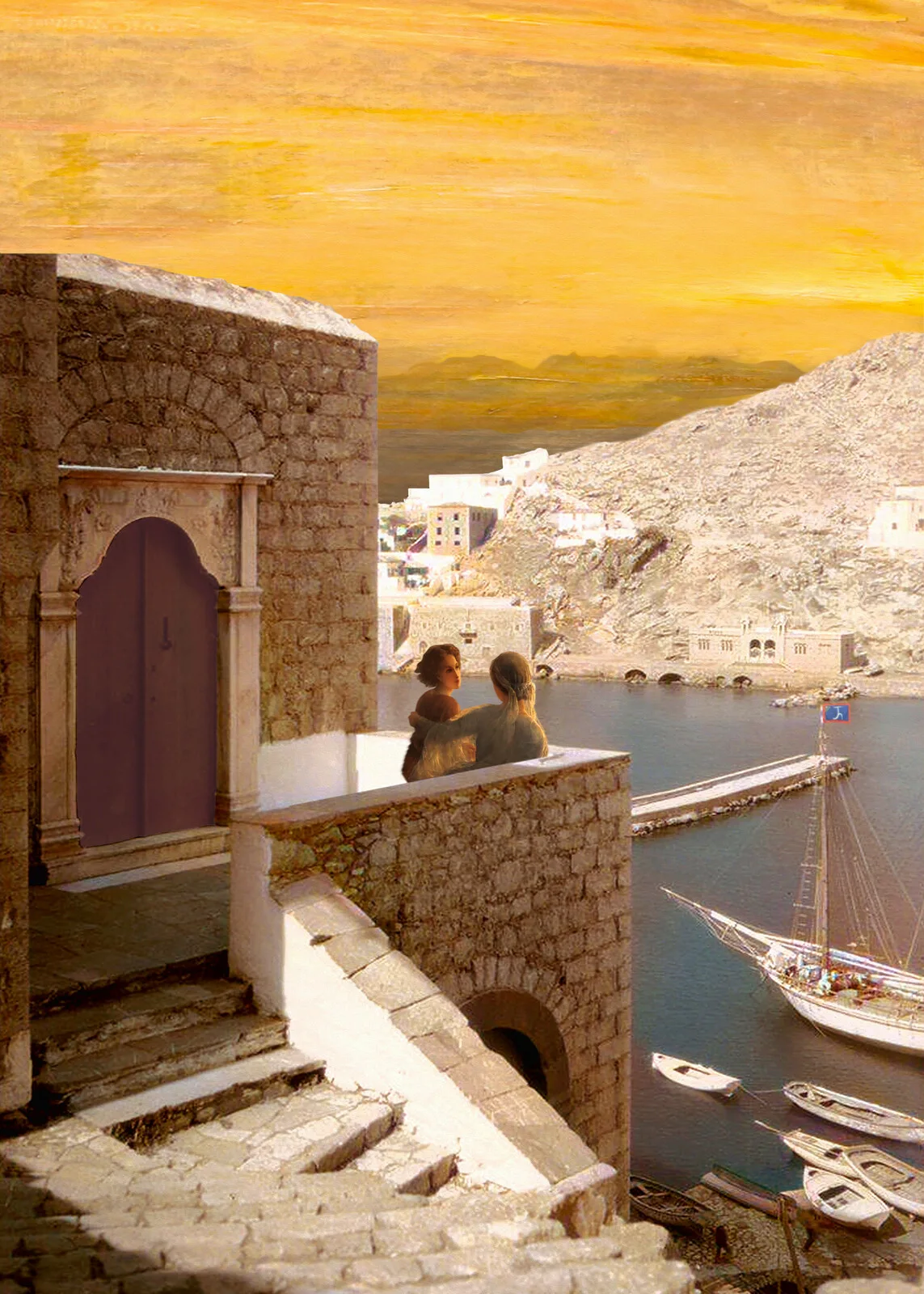
Sunrise with Minerva and Flora, 2022
Digital
50 x 70 cm
Oh, Flora, my goddess of blooms, of fields aglow,
In your presence, life itself seems to grow.
Your beauty rivals the morning's first light,
And in your laughter, all sorrows take flight.
With petals soft as a lover's caress,
You transform the world with your tender finesse.
The flowers bow down to your gentle touch,
Their colours proclaim they owe you so much.
I, Minerva, in wisdom's embrace,
I am enchanted by the grace on your face.
For knowledge and beauty in harmony blend,
In you, Flora, my heart finds a friend.
Your gardens, a tapestry of vivid hues,
Inspire my mind and banish the blues.
Together, we stand, both fierce and divine,
In this timeless dance, our fates intertwine.
No man can understand the bond that we share,
A love that transcends beyond compare.
For in your eyes, I see the eternal spring,
A promise of joy, of everything.
Let the men dream of virgins in paradise,
While we revel in each other's sighs.
For your love is a garden where I am free,
In your arms, Flora, I am truly me.
Oh, Flora, my love, my heart's gentle flower,
With you, each moment becomes an hour.
In our sacred bond, let the ages flow,
For with you, my dear, my soul will always grow.
Minerva's Ode to Flora
Far-away guests are common in Hydra. People come from all over the world, some from other eras, like these women from Antiquity living together on a star. One had been on the island many times. She told her girlfriend about how Hydra had changed from her first visit during the Hellenistic period. Back then, it was a virgin place full of pine trees and animals, but no people, just occasionally visitors. She said it was called 'Hydrea' because there was plenty of water.
The female friends stood at the entrance terrace to the Manor of Tompazi, nowadays the School of Arts on Hydra. In front of them was a view since long changed today full of houses. The woman called Flora described the scenery as it once was. Time-travellers have no problems telepathically transferring inner pictures to each other, and her friend Minerva could enjoy a stream of images from 1918. They both agreed that the current view was better. Terrängen var lite väl karg tidigare, den sortens utsikter finns det gott om om man vänder sig mot bergen. Det märkliga, tyckte bägge två, var att det länge var sidan med eftermiddagssolen som bebyggts sist på Hydra. Den beresta Minerva kunde Italien bra och där var det precis tvärtom. Sidan som vette mot solen längst var också där de finaste husen låg. På vintern fick husen på västra sidan hamnen inte mycket ljus och värme, båda sådant italienarna älskade.
To the left in Flora's inner picture lay one of the two buildings that once served as quarantine for people who arrived on the island. A plague in 1792 killed a large part of the population. Those who managed temporarily fled the island. It took a decade for the already rich town to recover its former wealth. Today, it is a community hall and exhibition centre named after the Greek actress Melina Mercouri. A little bit to the right, directly in front of the distinguished ladies, was the old Museum, the predecessor to today's more prominent Historical Archive Museum. The original building was more beautiful but understandably too small. Flora told me about a concert on the Museum's terrace ten years ago.
They were two proud, eternally young women who were even looked upon with modern eyes as independent and emancipated, an inspiration for contemporary women. They visited Hydra to meet with their Greek counterparts, Pallas Athena and Chloris. The Hellenic goddesses were busy with a family meeting at Olympos and would not arrive until the day after.
Minerva is often identified with the Greek goddess Athena, but her origins ran far more profound. They often laughed together about this confusion. Neither had anything to complain about their childhood and youth.
But for Chloris, it started with abduction and, most probably, sex without consent – all too common in the old Olympus world. In Greek mythology, Athena was believed to have been born from her father's forehead, Zeus, so she had a better start than her friend. Flora was a twin sister to Fauna, the goddess of animals and wildlife, and was called Sabine initially. Flora was originally a nymph named Chloris who was raped by the west wind Zephyrus and turned into Flora.
Minerva was an important goddess in the pantheon of the ancient Romans. She was worshipped primarily as the goddess of wisdom. Nevertheless, she was also believed to be the goddess of trade, the arts, and warfare. Furthermore, Minerva's domains included medicine, poetry, and handicrafts. Minerva ruled over so many aspects of life that the poet Ovid called her the 'goddess of a thousand works.' Minerva is often identified as the equivalent of the Greek goddess Athena. They were not even cousins. But best friends and colleagues.
Minerva is thought to have been originally an Etruscan goddess. Her name, for instance, is almost identical to 'Menrva', the Etruscan goddess of the arts. The Romans adopted the worship of Minerva, who associated the goddess' name with the Latin word 'mens', which means 'mind'. Much later, Minerva became identified with the Greek Athena. Subsequently, Minerva became associated with war like her Greek colleague., This was traditionally under the domain of Mars (his Greek equivalent being Ares), but women took over male domains before our time.
In Roman mythology, Minerva was regarded as the daughter of Jupiter (whose Greek equivalent was Zeus). The story of her birth is the same as that of Athena. In this myth, Jupiter receives a prophecy that the child of Wisdom (Metis in the Greek version of the tale) will be more powerful than him. You see! Male domains are under attack! Jupiter marries the goddess, has sexual intercourse with her, and then brutally swallows her to safeguard his position as king of the gods. Wisdom, however, was already impregnated by Jupiter, though it seems that none of the gods nor even Jupiter himself understood.
Flora was the Roman goddess of flowers, vegetation, and fertility. Spring was her season, and she had her festival, the Floralia. Her Greek counterpart is Chloris, her name meaning 'greenish-yellow', the colours of spring. That was also the colour she wore that day, a multilayer silk dress lighter than air.
Zephyrus, the god of the west wind, abducted Chloris. In Greece, however, it was Boreas, the North Wind raping Orithyia of Athens. Chloris transformed Chloris into a deity known as Flora after they were married. Together, they had a son named Karpos. Flora transformed Adonis, Attis, Crocus, Hyacinthus and Narcissus into flowers. Not bad for a girl and so lovely in our modern gardens.
The two girlfriends had much to discuss, so we left them here. However, I can reveal that they compared the revolution of Lysistrata 411 BC to the Meetoo movement a couple of years ago. Their conclusion was over two millennia had passed, and so little had happened. They had decided to visit the theatre on Hydra. It was performing Aristophanes' comedy the same evening.
In the ageless play, Lysistrata persuaded the women of the warring cities to deny sexual privileges to their husbands and lovers. This was carried out to force their men to negotiate peace. The strategy, however, backfired and inflamed the battle between the sexes. There was a compromise and a happy ending, and the men and women danced together. Both genders praised the wise Athene, also the goddess of chastity. Her implied blessing brought about a happy ending to the play. The Nobel Peace Prize cannot be given retroactively; in other cases, Athena was a given candidate. Nobel himself has said so many times among the stars.
"The terrain was a bit too rugged earlier," said Flora, glancing towards the surrounding mountains. "There are plenty of barren views if you turn towards the mountains. But in spring, the mountainside is gorgeous with all the wildflowers. All flowers are burnt greyish brown this time of year and lay like dull carpets along the mountain slopes. The houses built on the other side over the last century all have lovely gardens, and you know how much I adore flowers."
Minerva nodded. "The strange thing," Flora continued, "is that the side with the afternoon sun was the last to be built upon on Hydra."
"That's true," said Minerva. "In winter, the houses on the harbour's west side don't get much light and warmth, which Italians and their gardens love. You can see that there are mostly trees and no lush gardens on this side."
Flora chuckled softly and took Minerva's hand. "Yes, but it also means we have our private sanctuary, free from all those lush gardens and their owners who always seem to have something to prove."
Minerva smiled and squeezed Flora's hand tighter. "That's true. And it gives us time to be ourselves without worrying about impressing anyone else."
Flora looked into Minerva's eyes and found the same warmth and affection. "You know, Minerva, being forced into a marriage with the west wind wasn't exactly what I wished for. But it did leave its mark on me."
Minerva sighed understandingly. "Men have always expected us to play certain roles, to fit into their fantasies. But we've both found our paths, haven't we? I'm one of the three virgin goddesses, and though I haven't had a man, it doesn't mean I'm not interested in love."
Flora nodded, her gaze softening. "It's a common misunderstanding fueled by men who fantasise about virgins. Muslim men, for example, expect 72 virgins when they arrive in paradise as fallen heroes. But the truth is much simpler and much more beautiful. I'm in love with you, Minerva, and you're in love with me. That's enough to shatter their wishful thinking."
"They'll have to make do with other virgins." Minerva leaned in and kissed Flora gently on the cheek. "We've found each other, and that's all that matters. Let them have their fantasies. We have our reality."
As they strolled through the garden, Minerva reminisced about their many adventures. "Do you remember the time we visited the Hanging Gardens of Babylon? It was a marvel, wasn't it? The way the gardens were suspended in the air, the fragrance of the flowers, and the sound of the water cascading down the terraces were like a dream."
Flora's eyes sparkled with the memory. "Yes, and the way the flowers' colours changed with the setting sun's light. It was breathtaking. We spent hours there, just talking and enjoying the beauty of it all. Those were truly magical times."
Minerva smiled. "And what about our visit to the Library of Alexandria? The wisdom in those walls and the scrolls were filled with knowledge and stories from worldwide. It was a treasure trove."
Flora nodded. "I remember how we would sit for hours, reading and discussing the ideas we found. It was a place of endless inspiration. I miss those days."
Minerva sighed. "Much has changed over the centuries, but our bond has remained strong. We've seen empires rise and fall, witnessed the wonders of the ancient world, and yet, here we are, still together."
Flora squeezed Minerva's hand. "Yes, and we've learned so much along the way. We've seen the best and worst of humanity, but we've also seen incredible acts of kindness and love. It's those moments that make it all worthwhile."
Minerva looked out over the landscape. "And now, here we are on Hydra, a place that has seen its share of history. This island has its own stories, and I'm glad we're here to experience them together."
Flora nodded. "It's a beautiful place, allowing us to reflect on our journey. We've been through so much, but we've always had each other. That's something to be grateful for."
Minerva smiled. "Indeed. And as we continue our journey, I know we'll face whatever comes our way with strength and love. After all, we've already faced the trials of the gods and come out stronger."
Flora chuckled. "Yes, and we'll continue to do so. Our love is timeless, just like the beauty of this island."
Minerva and Flora felt a deep sense of peace as they stood hand in hand. They had travelled the world, experienced its wonders, and faced challenges, but they had each other through it all. Their love was a beacon of hope, a reminder that beauty and love could endure despite adversity.
Flora turned to Minerva with a playful smile. "Do you remember the time we tricked that pompous Roman senator? He thought he could outsmart us, but we showed him, didn't we?"
Minerva laughed. "Oh, yes! That was one of our finest moments. He was so sure of himself, but he never saw us coming. We left him speechless and a little bit poorer."
Flora grinned. "And what about that time in the Venetian court? We danced the night away, and everyone was captivated by our presence. They had no idea who we were but couldn't take their eyes off us."
Minerva's eyes twinkled with the memory. "We have had some extraordinary adventures, haven't we? And through it all, we've remained true to ourselves and each other."
Flora nodded. "We've always found joy in the simplest things, like the beauty of a flower or the sun's warmth. Those are the moments that matter most."
Minerva sighed contentedly. "And now, we can create new memories here on Hydra. This island enchants everyone who visits, and I'm sure it will continue to inspire us."
Flora squeezed Minerva's hand gently. "As long as we have each other, we can face anything. Our love is our greatest strength and will guide us through whatever lies ahead."
With the sun rising over the mountains in the East, casting a golden glow over the landscape, Minerva and Flora stood together, their hearts filled with love and hope. They knew their journey was far from over, and they were ready to face whatever came next, hand in hand, just as they always had.
As they walked back towards the Manor, Minerva turned to Flora with a mischievous grin. "And who knows, maybe we'll find new adventures here on Hydra. After all, we've always had a knack for finding excitement wherever we go."
Flora laughed, her eyes sparkling with anticipation. "Indeed. Here's to many more adventures, my love. May our journey continue to be filled with wonder and joy."
And with that, they continued their stroll, ready to embrace whatever the future held, secure in the knowledge that their love was eternal and unbreakable.
Jörgen Thornberg
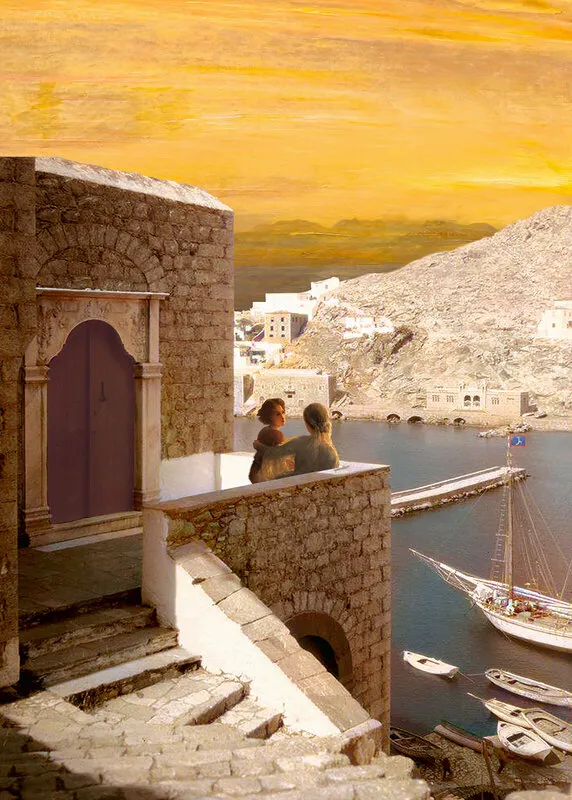
Sunrise with Minerva and Flora, 2022
Digital
50 x 70 cm
Oh, Flora, my goddess of blooms, of fields aglow,
In your presence, life itself seems to grow.
Your beauty rivals the morning's first light,
And in your laughter, all sorrows take flight.
With petals soft as a lover's caress,
You transform the world with your tender finesse.
The flowers bow down to your gentle touch,
Their colours proclaim they owe you so much.
I, Minerva, in wisdom's embrace,
I am enchanted by the grace on your face.
For knowledge and beauty in harmony blend,
In you, Flora, my heart finds a friend.
Your gardens, a tapestry of vivid hues,
Inspire my mind and banish the blues.
Together, we stand, both fierce and divine,
In this timeless dance, our fates intertwine.
No man can understand the bond that we share,
A love that transcends beyond compare.
For in your eyes, I see the eternal spring,
A promise of joy, of everything.
Let the men dream of virgins in paradise,
While we revel in each other's sighs.
For your love is a garden where I am free,
In your arms, Flora, I am truly me.
Oh, Flora, my love, my heart's gentle flower,
With you, each moment becomes an hour.
In our sacred bond, let the ages flow,
For with you, my dear, my soul will always grow.
Minerva's Ode to Flora
Far-away guests are common in Hydra. People come from all over the world, some from other eras, like these women from Antiquity living together on a star. One had been on the island many times. She told her girlfriend about how Hydra had changed from her first visit during the Hellenistic period. Back then, it was a virgin place full of pine trees and animals, but no people, just occasionally visitors. She said it was called 'Hydrea' because there was plenty of water.
The female friends stood at the entrance terrace to the Manor of Tompazi, nowadays the School of Arts on Hydra. In front of them was a view since long changed today full of houses. The woman called Flora described the scenery as it once was. Time-travellers have no problems telepathically transferring inner pictures to each other, and her friend Minerva could enjoy a stream of images from 1918. They both agreed that the current view was better. Terrängen var lite väl karg tidigare, den sortens utsikter finns det gott om om man vänder sig mot bergen. Det märkliga, tyckte bägge två, var att det länge var sidan med eftermiddagssolen som bebyggts sist på Hydra. Den beresta Minerva kunde Italien bra och där var det precis tvärtom. Sidan som vette mot solen längst var också där de finaste husen låg. På vintern fick husen på västra sidan hamnen inte mycket ljus och värme, båda sådant italienarna älskade.
To the left in Flora's inner picture lay one of the two buildings that once served as quarantine for people who arrived on the island. A plague in 1792 killed a large part of the population. Those who managed temporarily fled the island. It took a decade for the already rich town to recover its former wealth. Today, it is a community hall and exhibition centre named after the Greek actress Melina Mercouri. A little bit to the right, directly in front of the distinguished ladies, was the old Museum, the predecessor to today's more prominent Historical Archive Museum. The original building was more beautiful but understandably too small. Flora told me about a concert on the Museum's terrace ten years ago.
They were two proud, eternally young women who were even looked upon with modern eyes as independent and emancipated, an inspiration for contemporary women. They visited Hydra to meet with their Greek counterparts, Pallas Athena and Chloris. The Hellenic goddesses were busy with a family meeting at Olympos and would not arrive until the day after.
Minerva is often identified with the Greek goddess Athena, but her origins ran far more profound. They often laughed together about this confusion. Neither had anything to complain about their childhood and youth.
But for Chloris, it started with abduction and, most probably, sex without consent – all too common in the old Olympus world. In Greek mythology, Athena was believed to have been born from her father's forehead, Zeus, so she had a better start than her friend. Flora was a twin sister to Fauna, the goddess of animals and wildlife, and was called Sabine initially. Flora was originally a nymph named Chloris who was raped by the west wind Zephyrus and turned into Flora.
Minerva was an important goddess in the pantheon of the ancient Romans. She was worshipped primarily as the goddess of wisdom. Nevertheless, she was also believed to be the goddess of trade, the arts, and warfare. Furthermore, Minerva's domains included medicine, poetry, and handicrafts. Minerva ruled over so many aspects of life that the poet Ovid called her the 'goddess of a thousand works.' Minerva is often identified as the equivalent of the Greek goddess Athena. They were not even cousins. But best friends and colleagues.
Minerva is thought to have been originally an Etruscan goddess. Her name, for instance, is almost identical to 'Menrva', the Etruscan goddess of the arts. The Romans adopted the worship of Minerva, who associated the goddess' name with the Latin word 'mens', which means 'mind'. Much later, Minerva became identified with the Greek Athena. Subsequently, Minerva became associated with war like her Greek colleague., This was traditionally under the domain of Mars (his Greek equivalent being Ares), but women took over male domains before our time.
In Roman mythology, Minerva was regarded as the daughter of Jupiter (whose Greek equivalent was Zeus). The story of her birth is the same as that of Athena. In this myth, Jupiter receives a prophecy that the child of Wisdom (Metis in the Greek version of the tale) will be more powerful than him. You see! Male domains are under attack! Jupiter marries the goddess, has sexual intercourse with her, and then brutally swallows her to safeguard his position as king of the gods. Wisdom, however, was already impregnated by Jupiter, though it seems that none of the gods nor even Jupiter himself understood.
Flora was the Roman goddess of flowers, vegetation, and fertility. Spring was her season, and she had her festival, the Floralia. Her Greek counterpart is Chloris, her name meaning 'greenish-yellow', the colours of spring. That was also the colour she wore that day, a multilayer silk dress lighter than air.
Zephyrus, the god of the west wind, abducted Chloris. In Greece, however, it was Boreas, the North Wind raping Orithyia of Athens. Chloris transformed Chloris into a deity known as Flora after they were married. Together, they had a son named Karpos. Flora transformed Adonis, Attis, Crocus, Hyacinthus and Narcissus into flowers. Not bad for a girl and so lovely in our modern gardens.
The two girlfriends had much to discuss, so we left them here. However, I can reveal that they compared the revolution of Lysistrata 411 BC to the Meetoo movement a couple of years ago. Their conclusion was over two millennia had passed, and so little had happened. They had decided to visit the theatre on Hydra. It was performing Aristophanes' comedy the same evening.
In the ageless play, Lysistrata persuaded the women of the warring cities to deny sexual privileges to their husbands and lovers. This was carried out to force their men to negotiate peace. The strategy, however, backfired and inflamed the battle between the sexes. There was a compromise and a happy ending, and the men and women danced together. Both genders praised the wise Athene, also the goddess of chastity. Her implied blessing brought about a happy ending to the play. The Nobel Peace Prize cannot be given retroactively; in other cases, Athena was a given candidate. Nobel himself has said so many times among the stars.
"The terrain was a bit too rugged earlier," said Flora, glancing towards the surrounding mountains. "There are plenty of barren views if you turn towards the mountains. But in spring, the mountainside is gorgeous with all the wildflowers. All flowers are burnt greyish brown this time of year and lay like dull carpets along the mountain slopes. The houses built on the other side over the last century all have lovely gardens, and you know how much I adore flowers."
Minerva nodded. "The strange thing," Flora continued, "is that the side with the afternoon sun was the last to be built upon on Hydra."
"That's true," said Minerva. "In winter, the houses on the harbour's west side don't get much light and warmth, which Italians and their gardens love. You can see that there are mostly trees and no lush gardens on this side."
Flora chuckled softly and took Minerva's hand. "Yes, but it also means we have our private sanctuary, free from all those lush gardens and their owners who always seem to have something to prove."
Minerva smiled and squeezed Flora's hand tighter. "That's true. And it gives us time to be ourselves without worrying about impressing anyone else."
Flora looked into Minerva's eyes and found the same warmth and affection. "You know, Minerva, being forced into a marriage with the west wind wasn't exactly what I wished for. But it did leave its mark on me."
Minerva sighed understandingly. "Men have always expected us to play certain roles, to fit into their fantasies. But we've both found our paths, haven't we? I'm one of the three virgin goddesses, and though I haven't had a man, it doesn't mean I'm not interested in love."
Flora nodded, her gaze softening. "It's a common misunderstanding fueled by men who fantasise about virgins. Muslim men, for example, expect 72 virgins when they arrive in paradise as fallen heroes. But the truth is much simpler and much more beautiful. I'm in love with you, Minerva, and you're in love with me. That's enough to shatter their wishful thinking."
"They'll have to make do with other virgins." Minerva leaned in and kissed Flora gently on the cheek. "We've found each other, and that's all that matters. Let them have their fantasies. We have our reality."
As they strolled through the garden, Minerva reminisced about their many adventures. "Do you remember the time we visited the Hanging Gardens of Babylon? It was a marvel, wasn't it? The way the gardens were suspended in the air, the fragrance of the flowers, and the sound of the water cascading down the terraces were like a dream."
Flora's eyes sparkled with the memory. "Yes, and the way the flowers' colours changed with the setting sun's light. It was breathtaking. We spent hours there, just talking and enjoying the beauty of it all. Those were truly magical times."
Minerva smiled. "And what about our visit to the Library of Alexandria? The wisdom in those walls and the scrolls were filled with knowledge and stories from worldwide. It was a treasure trove."
Flora nodded. "I remember how we would sit for hours, reading and discussing the ideas we found. It was a place of endless inspiration. I miss those days."
Minerva sighed. "Much has changed over the centuries, but our bond has remained strong. We've seen empires rise and fall, witnessed the wonders of the ancient world, and yet, here we are, still together."
Flora squeezed Minerva's hand. "Yes, and we've learned so much along the way. We've seen the best and worst of humanity, but we've also seen incredible acts of kindness and love. It's those moments that make it all worthwhile."
Minerva looked out over the landscape. "And now, here we are on Hydra, a place that has seen its share of history. This island has its own stories, and I'm glad we're here to experience them together."
Flora nodded. "It's a beautiful place, allowing us to reflect on our journey. We've been through so much, but we've always had each other. That's something to be grateful for."
Minerva smiled. "Indeed. And as we continue our journey, I know we'll face whatever comes our way with strength and love. After all, we've already faced the trials of the gods and come out stronger."
Flora chuckled. "Yes, and we'll continue to do so. Our love is timeless, just like the beauty of this island."
Minerva and Flora felt a deep sense of peace as they stood hand in hand. They had travelled the world, experienced its wonders, and faced challenges, but they had each other through it all. Their love was a beacon of hope, a reminder that beauty and love could endure despite adversity.
Flora turned to Minerva with a playful smile. "Do you remember the time we tricked that pompous Roman senator? He thought he could outsmart us, but we showed him, didn't we?"
Minerva laughed. "Oh, yes! That was one of our finest moments. He was so sure of himself, but he never saw us coming. We left him speechless and a little bit poorer."
Flora grinned. "And what about that time in the Venetian court? We danced the night away, and everyone was captivated by our presence. They had no idea who we were but couldn't take their eyes off us."
Minerva's eyes twinkled with the memory. "We have had some extraordinary adventures, haven't we? And through it all, we've remained true to ourselves and each other."
Flora nodded. "We've always found joy in the simplest things, like the beauty of a flower or the sun's warmth. Those are the moments that matter most."
Minerva sighed contentedly. "And now, we can create new memories here on Hydra. This island enchants everyone who visits, and I'm sure it will continue to inspire us."
Flora squeezed Minerva's hand gently. "As long as we have each other, we can face anything. Our love is our greatest strength and will guide us through whatever lies ahead."
With the sun rising over the mountains in the East, casting a golden glow over the landscape, Minerva and Flora stood together, their hearts filled with love and hope. They knew their journey was far from over, and they were ready to face whatever came next, hand in hand, just as they always had.
As they walked back towards the Manor, Minerva turned to Flora with a mischievous grin. "And who knows, maybe we'll find new adventures here on Hydra. After all, we've always had a knack for finding excitement wherever we go."
Flora laughed, her eyes sparkling with anticipation. "Indeed. Here's to many more adventures, my love. May our journey continue to be filled with wonder and joy."
And with that, they continued their stroll, ready to embrace whatever the future held, secure in the knowledge that their love was eternal and unbreakable.

Jörgen Thornberg
Malmö
Lite om bilder och mig. Translation in English at the end.
Jag är en nyfiken person som ser allt i bilder, även det jag fäster i ord, gärna tillsammans för bakom alla mina bilder finns en berättelse. Till vissa bilder hör en kortare eller längre novell som följer med bilden.
Bilder berättar historier. Jag omges av naturlig skönhet, intressanta människor och historia var jag än går. Jag använder min kamera för att dokumentera världen och blanda det jag ser med vad jag känner för att fånga den dolda magin.
Mina bilder berättar mina historier. Genom mina bilder, tryck och berättelser. Jag bjuder in dig att ta del av dessa berättelser, in i ditt liv och hem och dela min mycket personliga syn på vår värld. Mer än vad ögat ser. Jag tänker i bilder, drömmer och skriver och pratar om dem; följaktligen måste jag också skapa bilder. De blir vad jag ser, inte nödvändigtvis begränsade till verkligheten. Det finns en bild runt varje hörn. Jag hoppas att du kommer att se vad jag såg och gilla det.
Jag är också en skrivande person och till många bilder hör en kortare eller längre essay. Den följer med tavlan, tryckt på fint papper och med en personlig hälsning från mig.
Flertalet bilder startar sin resa i min kamera. Enkelt förklarat beskriver jag bilden jag ser i mitt inre, upplevd eller fantiserad. Bilden uppstår inom mig redan innan jag fått okularet till ögat. På bråkdelen av ett ögonblick ser jag vad jag vill ha och vad som kan göras med bilden. Här skall jag stoppa in en giraff, stålmannen, Titanic eller vad det är min fantasi finner ut. Ännu märkligare är att jag kommer ihåg minnesbilden långt efteråt när det blir tid att skapa verket. Om jag lyckas eller inte, är upp till betraktaren, oftast präglat av en stråk av svart humor – meningen är att man skall bli underhållen. Mina bilder blir ofta en snackis där de hänger.
Jag föredrar bilder som förmedlar ett budskap i flera lager. Vid första anblicken fylld av feel-good, en vacker utsikt, fint väder, solen skiner, blommor på ängen eller vattnet som ligger förrädiskt spegelblankt. I en sådan bild kan jag gömma min egentliga berättelse, mitt förakt för förtryckare och våldsverkare, rasister och fördomsfulla människor - ett gärna återkommande motiv mer eller mindre dolt i det vackra motivet. Jag försöker förena dem i ett gemensamt narrativ.
Bild och formgivning har löpt som en röd tråd genom livet. Fotokonst känns som en värdig final som jag gärna delar med mig.
Min genre är vid som framgår av mina bilder, temat en blandning av pop- och gatukonst i kollage som kan bestå av hundratals lager. Vissa bilder kan ta veckor, andra någon dag innan det är dags att överlämna resultatet till printverkstaden. Fine Art Prints är digitala fotocollage. I dessa kollage sker rivandet, klippandet, pusslandet, målandet, ritandet och sprayningen digitalt. Det jag monterar in kan vara hundratals år gamla bilder som jag omsorgsfullt frilägger så att de ser ut att vara en del av tavlan men också bilder skapade av mig själv efter min egen fantasi. Därefter besöks printstudion och för vissa bilder numrera en limiterad upplaga (oftast 7 exemplar) och signera för hand. Vissa bilder kan köpas i olika format. Det är bara att fråga efter vilka. Gillar man en bild som är 70x100 men inte har plats på väggen, går den kanske att få i 50x70 cm istället. Frågan är fri.
Metoden Giclée eller Fine Art Print som det också kallas är det moderna sättet för framställning av grafisk konst. Villkoret för denna typ av utskrifter är att en högkvalitativ storformatskrivare används med åldersbeständigt färgpigment och konstnärspapper eller i förekommande fall på duk. Pappret som används möter de krav på livslängd som ställs av museer och gallerier. Normalt säljer jag mina bilder oinramade så att den nya ägaren själv kan bestämma hur de skall se ut, med eller utan passepartout färg på ram, med eller utan glas etc..
Under många år ställde jag bara ut på nätet, i valda grupper och på min egen Facebooksida - https://www.facebook.com/jorgen.thornberg.9
Jag finns också på en egen hemsida som tyvärr inte alltid är uppdaterad – https://www.jth.life/ Där kan du också läsa en del av de berättelser som följer med bilden.
UTSTÄLLNINGAR
Luftkastellet, oktober 2022
Konst i Lund, november 2022
Luftkastellet, mars 2023
Engleson Galleri Caroli, april 2023
Hydra, Greece June 2023
Engleson Galleri Caroli, oktober 2023
Toppen, Höllviken december 2023
Luftkastellet, mars 2024
Torups Galleri, mars 2024
Venice, May 2024
Luftkastellet, oktober 2024
Konst i Advent, December 2024
Galleri Engleson, Caroli December 2024
Jäger & Jansson Galleri, april 2025
A bit about pictures and me.
I'm a curious person who sees everything in pictures, even what I express in words, often combining them, for behind all my pictures lies a story. These narratives, some as short as a single image and others as long as a novel, are the heart and soul of my work.
Pictures tell stories. Wherever I go, I'm surrounded by natural beauty, exciting people, and history. I use my camera to document the world and blend what I see with what I feel to capture the hidden magic.
My images tell my stories. Through my pictures, prints, and narratives, I invite you to partake in these stories in your life and home and share my deeply personal perspective of our world. More than meets the eye. I think in pictures, dream, write, and talk about them; consequently, I must create images too. They become what I see, not necessarily confined to reality. There's a picture around every corner. I hope you'll see what I saw and enjoy it.
I'm also a writer, and many images come with a shorter or longer essay. It accompanies the painting, printed on fine paper with my personal greeting.
Many pictures start their journey on my camera. Simply put, I describe the image I see in my mind, experienced or imagined. The image arises within me even before I bring the eyepiece to my eye. In a fraction of a moment, I see what I want and what can be done with the picture. Here, I'll insert a giraffe, Superman, the Titanic, or whatever my imagination conjures up. Even stranger is that I remember the mental image long after it's time to create the work. Whether I succeed is up to the observer, often imbued with a streak of black humour – the aim is to entertain. My pictures usually become a talking point wherever they hang.
I prefer pictures that convey a message in multiple layers. At first glance, they're filled with feel-good vibes, a beautiful view, lovely weather, the sun shining, flowers in the meadow, or the water lying deceptively calm. But beneath this surface beauty, I often conceal a deeper story, a narrative that challenges societal norms or explores the human condition. I invite you to delve into these hidden narratives and discover the layers of meaning within my work.
Picture and design have been a thread running through my life. Photographic art feels like a fitting finale, and I'm happy to share it.
My genre is varied, as seen in my pictures; the theme is a blend of pop and street art in collages that can consist of hundreds of layers. Some images can take weeks, others just a day before it's time to hand over the result to the print workshop. Fine Art Prints are digital photo collages. In these collages, tearing, cutting, puzzling, painting, drawing, and spraying happen digitally. What I insert can be images hundreds of years old that I carefully extract so they appear to be part of the painting, but also images created by myself, now also generated from my imagination. Next, visit the print studio and, for certain images, number a limited edition (usually 7 copies) and sign them by hand. Some images may be available in other formats. Just ask which ones. If you like an image that's 70x100 but doesn't have space on the wall, you might be able to get it in 50x70 cm instead. The question is open.
The Giclée method, or Fine Art Print as it's also called, is the modern way of producing graphic art. This method ensures the highest quality and longevity of the artwork, using a high-quality large-format printer with archival pigment inks and artist paper or, in some cases, canvas. The paper used meets the longevity requirements set by museums and galleries. I sell my pictures unframed, allowing the new owner to personalise their artwork, confident in the lasting value and quality of the piece.
For many years, I only exhibited online, in selected groups, and on my Facebook page - https://www.facebook.com/jorgen.thornberg.9. I also have my website, which unfortunately is not constantly updated - https://www.jth.life/. You can also read some of the stories accompanying the pictures there.
EXHIBITIONS
Luftkastellet, October 2022
Art in Lund, November 2022
Luftkastellet, March 2023
Engleson Gallery Caroli, April 2023
Hydra, Greece June 2023
Engleson Gallery Caroli, October 2023
Toppen, Höllviken December 2023
Luftkastellet, March 2024
Torup Gallery, March 2024
Venice, May 2024
UTSTÄLLNINGAR
Luftkastellet, oktober 2022
Konst i Lund, november 2022
Luftkastellet, mars 2023
Engleson Galleri Caroli, april 2023
Hydra, Greece June 2023
Engleson Galleri Caroli, oktober 2023
Toppen, Höllviken december 2023
Luftkastellet, mars 2024
Torups Galleri, mars 2024
Venice, May 2024
Luftkastellet, October 2024
Konst i Advent, December 2024
Galleri Engleson, Caroli December 2024
Jäger & Jansson Galleri, April 2025
Utbildning
Autodidakt
Medlem i konstnärsförening
Öppna Sinnen
Med i konstrunda
Konstrundan i Skåne
Utställningar
Luftkastellet, October 2022
Art in Lund, November 2022
Luftkastellet, March 2023
Engleson Gallery Caroli, April 2023
Hydra, Greece June 2023
Engleson Gallery Caroli, October 2023
Toppen, Höllviken December 2023
Luftkastellet, March 2024
Torup Gallery, March 2024
Venice, May 2024