Vi använder cookies för att ge dig bästa möjliga upplevelse. Välj vilka cookies du tillåter.
Läs mer i vår integritetspolicy
Jörgen Thornberg
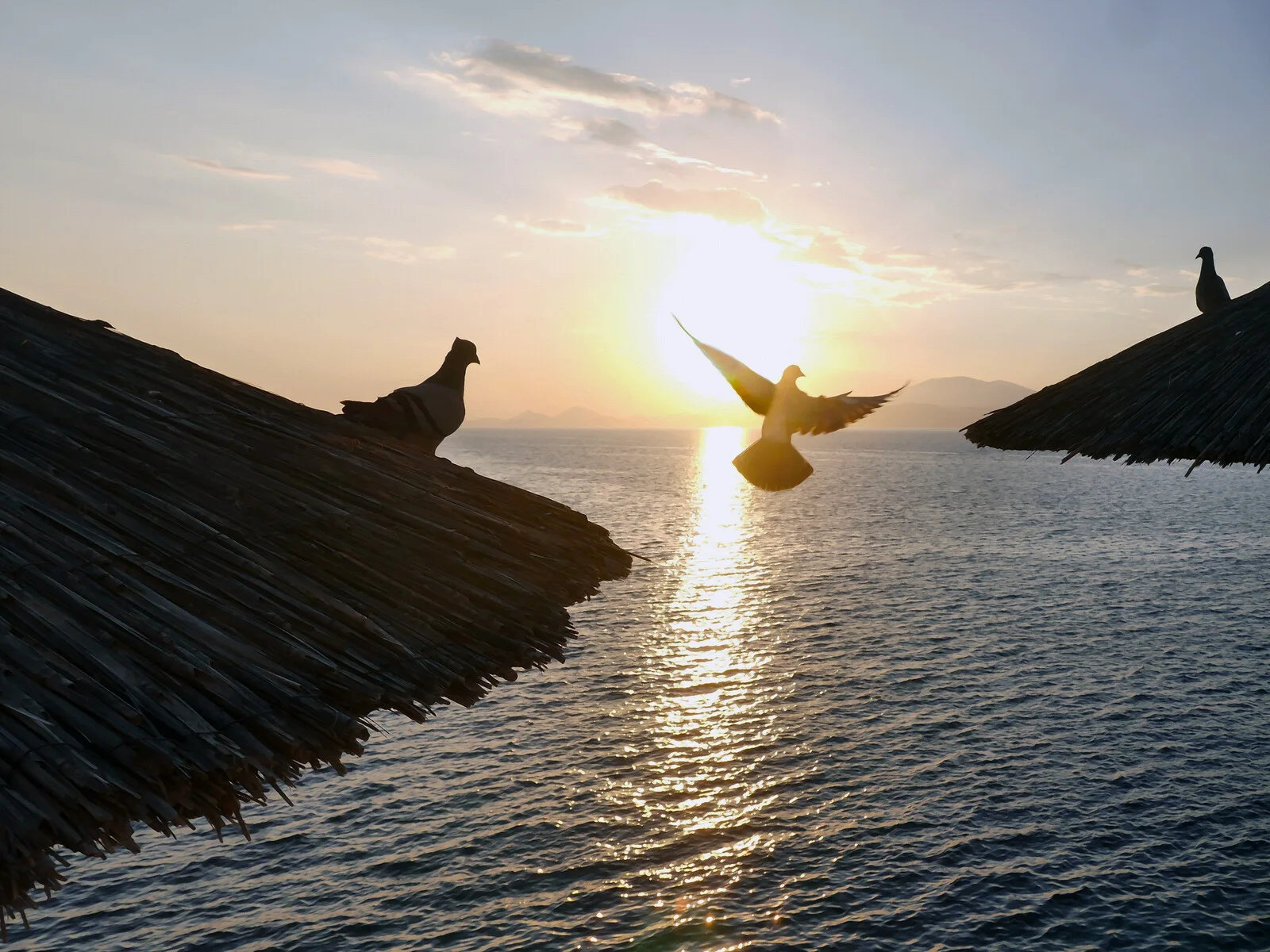
Jonathan waltzes with the setting sun, 2018
Digital
70 x 50 cm
Jonathan Livingston Seagull, filled with exhilaration, dances between two pigeon girls. The anticipation of who he will choose, or more accurately, which one will pick him, adds to the thrill. Jonathan, a seasoned seagull who has mastered the arts of flying, personal reflection, freedom, and self-realisation, has been a global sensation since the 1970s and the publication of his memoirs. Today, his spirits are soaring higher than ever, adding to the celebratory atmosphere.
'Miaoulia' and 'Midsummer Eve' are not just ordinary festivities but profound cultural expressions that command immense respect. On the idyllic Greek island of Hydra, 'Miaoulia' is a testament to Greece's hard-fought freedom, commemorating the triumph over the Ottomans. In stark contrast, 'Midsummer Eve' in Scandinavia is a joyous celebration of the victory of summer light over the winter darkness, a powerful symbol of the resilience and joy of the human spirit.
Midsummer's Day is not just any day in Sweden, especially the Saturday evening before. It's their unofficial national day, even more significant than the Flag Day on June 6. In Hydra, preparations are underway for the definitive combat, the sea battle where the Turks received their final defeat and the flagship was blown up in the air. Miaoulia literally explodes on Saturday night with fireworks and the disintegration of the poor Turk's effigy, representing a Turk. Meanwhile, in Sweden, people sing songs together and enjoy a few drinks. The atmosphere can get quite lively, both in the North and South.
Twilight arrives, calling for another dove ball, but the pigeon girls are aloof. None of the young females sitting stuck on the straw umbrellas wanted to dance to the setting sun's glory. Old Jonathan Livingstone Seagull did not mind but swung up in a swirl around the sun, and in his mind, the girls waltzed with him. Tight, tight on the starry arcadia above, hope always endures in the land of dreams. That's how dreams work with seniors – mature but forever young, clinging in their belated adolescence - perpetually falling in love again and again with people they meet and want to dance with. That's Jonathan in a nutshell. His eternal dance passes among stars and planets even if it never leaves the sealed ballroom between his ears. The sun finally sets and prepares for another day, and the dream will dance until the morning when the sun shines it away. Nice to have, but so fragile and fleeting, and he has to endure another day until the twilight frees him once more. Then it's time for fireworks and for some dancing.
The Swedish poet and troubadour Evert Taube has captured the essence of unfulfilled love with poignant clarity. His passion for women remained unabated, his heart forever young, never growing too old to stop wishing upon a star. In his chant "Dansen på Sunnanö", Dancing at the Southern Reef, his alter ego Runnerdahl - an elderly fiddler appearing in several Taube songs – dreams of a romance with the young beauty Eva. He gets a dance, but no more, and Eva instead falls into the arms of a young cadet. Runnerdahl, refusing to see what he does not want to see, plays his fiddle like a stoned Bacchus. In his mind, he and Eva dance more closely together; she is his bride. A wistful peace settles in, a feeling that resonates with the heart.
My translation of Taube's chant is a testament to the transformative power of dreams. It can transport you to a Hydra Ballroom and be sung if you know the tune. The play is set by Just replacing the cuckoo with an Athenian Owl. Dreams are not forbidden; they are essential for our survival. Despite being married to the same woman until his last day, Evert Taube never ceased to dream. Relentlessly, he continued composing chants about love and life in the Stockholm archipelago, his music resonating from Pampas to the Mediterranean. Perhaps his dreams reached Hydra, and the little Athenian owl became his muse. Today, Evert and his wife, Astrid, reside among the stars, their music and art carrying their legacy to generations. For this is the truth – dreams make dreams come true, at least until Aurora calls for a break until the next night when you can embark on an odyssey among the stars, leaving this life behind.
Dancing at the Southern Reef
free after “Dansen på Sunnanö” by Evert Taube
"They're twirling at the Southern Reef, and Runnerdahl is flash,
Waltzing Miss Eva Liljeback at the guesthouse summer bash.
Through open panes, a fragrant breeze, to the pension dancing hall
The scent of lilac and jasmine from beyond the festive ball.
The scent of lilac and jasmine from beyond the festive ball.
And Eva's arm holds him tight, and freckled is her skin,
Ripe red berries are her lips, and her skirt is tight and thin.
- Oh Runnerdahl, I know your kind; you'll take any girl you see,
Of all the girls around the world, you cannot let one be, tee-hee.
Of all the girls around the world, you cannot let one be, tee-hee.
- To take is not my way of life, my dear Miss, but to give!
A wastrel I might be, but rich as long as I may live.
- Oh, Runnerdahl, how you stare! And fumbling the skirt muslin
- Of course, but even somewhat more! Pass me a good violin.
- Of course, but even somewhat more! Pass me a good violin.
They twirl around the Baltic's edge to Runnerdahl's pochette.
They waltz the waves; they skip the wind, she sees a young cadet.
All makes a song that sweeps around through Pension Park and Hall,
As summer morning gleams in East, and cuckoos sing their call,
As summer morning gleams in East, and cuckoos sing their call.
Now Eva waltzes at the ball in the cadet's soft embrace,
and all the freckles are seen no more, so flushed is Eva's face.
But Runnerdahl is pale and true and plays with all his pride,
Dreaming of a world anew, where Eva is his bride.
Dreaming of a world anew, where Eva is his bride."
A 'pension' is a modest hotel, like a guest house on Hydra. The golden age of these pensions in Sweden lasted until the 1950s. There was no pension on Southern Reef, Sunnanö (an island in the Stockholm archipelago). Taube is told to have based this song on a so-called 'Pensionat' in Södermöja, a larger island. As far as I know, none of the hotels or pensions on Hydra arrange dances. It could be an excellent idea.
About the meaning of a cuckoo's calling from the South. It means no good news for poor old Runnerdahl, but he only hears his fiddle. Any Swede knows, since the Vikings, what the cuckoo call means. Cuckoos occur in folklore widely and frequently. I suppose also on Hydra, though we have the forlorn Athenian Owl in the absence of cuckoos. The little owl calls from different winds, foretelling the next day and our future. At least, that is what you're supposed to believe.
'Waltz at Cuckoo's Dawn', also by Evert Taube. In Swedish, it's called '*Vals I gökottan'. Gökotta is a very particular Swedish word meaning 'rising at dawn to listen to birdsong'.
'Hear hear, hear the cuckoo, Miss! It calls in the West.
Miss, the Western cuckoo is the best,
The Northern one is a real bore,
but the Southern predicts evil sudden death.
The Eastern is a comforting cuckoo,
Listen, Miss. The cuckoo now calls in the West.
Do you hear him? Kuku!'
In Sweden, they believed the cuckoo could predict the future, and still today, the word is heard. The cuckoo's call from the West is the best; singing in the North is melancholy, the South calls for sudden, often cruel death, and the East means a call for consolation. Now, everyone on Hydra also knows how to interpret the sound of the Athenian owl. If it calls from the direction of Athens, take care! So stay alert, as it can tell important things about the coming days. If you don't like the news, you can always have an extra glass of Greek wine. That makes you immune to unwanted prophecies.
Oh dear, even more things to think about when on holiday
Miaoulis
Andreas Vokos from Hydra, better known under his moniker Miaoulis, was a pivotal figure in the Greek War of Independence, serving as an admiral and politician. Born on May 20, 1768, in Euboea and of Arvanite descent, Miaoulis was not just a native islander of Hydra but a prosperous merchant captain. His early life as a trader, a period marked by prosperity and success, was shaped by his upbringing in a family of seafarers and his exposure to the bustling trade routes of the Mediterranean. This transformation from a successful trader to a strategic naval commander is a testament to his adaptability and leadership skills, and it would shape the course of Greek history.
Before he assumed command of the Greek naval forces, Miaoulis was a successful corn trader who had amassed considerable wealth. His financial success during the Napoleonic Wars was a testament to his business acumen and a means to support the Greek cause against Ottoman rule. His generous contributions, both in wealth and spirit, were not just a show of his wealth but a lifeline for many ordinary Greeks. His financial support provided the struggling revolutionaries with food, shelter, and medical supplies, demonstrating a commitment beyond his military leadership and making him a true champion of Greek independence.
Miaoulis's tenure as a naval commander was marked by critical victories and strategic prowess. From May 1825 to January 1826, he led the Greeks in victorious skirmishes against the Ottomans at several locations, including Modon, Cape Matapan, Suda, and Cape Papas. His early appointment in 1822 as Admiral signalled his crucial role in orchestrating the Greek naval strategy. His command at the revenge attack for the massacre of Chios was a masterstroke, employing a combination of surprise, speed, and superior firepower to overwhelm the Ottoman fleet. This strategic brilliance and leadership would shape the course of Greek history.
Throughout 1824 and 1825, Miaoulis faced formidable challenges, notably the occupation of Navarino by Egyptian forces and the dire situations at Messolonghi during its sieges. Despite the vast disproportion of naval strength and the failure of his attempts to disrupt the sea communications of the Egyptian troops, Miaoulis's spirit remained relentless. This relentless spirit, this refusal to give up in the face of adversity, is a testament to his unwavering commitment to the Greek cause, something we can all find inspiring and learn from.
However, the escalating war saw a decline in Greek naval power, driven by financial constraints and the growing piracy that plagued the Eastern Mediterranean. The arrival of Thomas Cochrane, a former Royal Navy officer, in 1827 marked a turning point in Miaoulis's career. Cochrane's reputation and experience brought a new level of professionalism and discipline to the Greek navy, prompting Miaoulis to recognise his superior abilities and step aside. This decision was not easy for Miaoulis, but it was a testament to his selflessness and commitment to the Greek cause.
Miaoulis's life after the war was as turbulent as his times. He was entangled in the civil conflicts that swept through Greece after its independence. Notably, he opposed the governance of Capodistrias and the Russian party's influence, taking dramatic actions such as seizing and destroying key ships from the Greek fleet during a counterattack by the Russian fleet. His opposition was not just a result of personal disagreements but a reflection of his deep-seated belief in the principles of democracy and self-determination, which he felt were being undermined by foreign influence.
After the war, Miaoulis's life took a political turn. He was not just a passive observer but an active participant in the delegation that invited King Otto to accept the Greek crown, a significant step towards establishing a stable government. His political involvement was a formality and testament to his continued dedication to the nation. His subsequent appointments and honours were not just accolades but a recognition of his contributions. Miaoulis's post-war life was not just a reflection of the turbulent times he lived in but a testament to his unwavering commitment to Greece.
Miaoulis passed away on June 24, 1835, in Athens, leaving a legacy intertwined with Greece's maritime and national history. He was laid to rest near the tomb of Themistocles in Piraeus, a symbolic gesture that linked him to the great heroes of Greece's past and underscored his contributions to the nation. His heart was preserved in an urn at the Ministry of Commercial Navy, a testament to his unwavering love for the sea and lifelong dedication to the navy. In remembrance, the Hellenic Navy christened a cruiser, the Navarchos Miaoulis, in 1879, and his memory is celebrated annually in Hydra through Miaoulia. This festival echoes his significant role in the 1821 Greek Revolution and serves as a reminder of his enduring legacy and the values he stood for.
Jörgen Thornberg
Jonathan waltzes with the setting sun, 2018
Digital
70 x 50 cm
Jonathan Livingston Seagull, filled with exhilaration, dances between two pigeon girls. The anticipation of who he will choose, or more accurately, which one will pick him, adds to the thrill. Jonathan, a seasoned seagull who has mastered the arts of flying, personal reflection, freedom, and self-realisation, has been a global sensation since the 1970s and the publication of his memoirs. Today, his spirits are soaring higher than ever, adding to the celebratory atmosphere.
'Miaoulia' and 'Midsummer Eve' are not just ordinary festivities but profound cultural expressions that command immense respect. On the idyllic Greek island of Hydra, 'Miaoulia' is a testament to Greece's hard-fought freedom, commemorating the triumph over the Ottomans. In stark contrast, 'Midsummer Eve' in Scandinavia is a joyous celebration of the victory of summer light over the winter darkness, a powerful symbol of the resilience and joy of the human spirit.
Midsummer's Day is not just any day in Sweden, especially the Saturday evening before. It's their unofficial national day, even more significant than the Flag Day on June 6. In Hydra, preparations are underway for the definitive combat, the sea battle where the Turks received their final defeat and the flagship was blown up in the air. Miaoulia literally explodes on Saturday night with fireworks and the disintegration of the poor Turk's effigy, representing a Turk. Meanwhile, in Sweden, people sing songs together and enjoy a few drinks. The atmosphere can get quite lively, both in the North and South.
Twilight arrives, calling for another dove ball, but the pigeon girls are aloof. None of the young females sitting stuck on the straw umbrellas wanted to dance to the setting sun's glory. Old Jonathan Livingstone Seagull did not mind but swung up in a swirl around the sun, and in his mind, the girls waltzed with him. Tight, tight on the starry arcadia above, hope always endures in the land of dreams. That's how dreams work with seniors – mature but forever young, clinging in their belated adolescence - perpetually falling in love again and again with people they meet and want to dance with. That's Jonathan in a nutshell. His eternal dance passes among stars and planets even if it never leaves the sealed ballroom between his ears. The sun finally sets and prepares for another day, and the dream will dance until the morning when the sun shines it away. Nice to have, but so fragile and fleeting, and he has to endure another day until the twilight frees him once more. Then it's time for fireworks and for some dancing.
The Swedish poet and troubadour Evert Taube has captured the essence of unfulfilled love with poignant clarity. His passion for women remained unabated, his heart forever young, never growing too old to stop wishing upon a star. In his chant "Dansen på Sunnanö", Dancing at the Southern Reef, his alter ego Runnerdahl - an elderly fiddler appearing in several Taube songs – dreams of a romance with the young beauty Eva. He gets a dance, but no more, and Eva instead falls into the arms of a young cadet. Runnerdahl, refusing to see what he does not want to see, plays his fiddle like a stoned Bacchus. In his mind, he and Eva dance more closely together; she is his bride. A wistful peace settles in, a feeling that resonates with the heart.
My translation of Taube's chant is a testament to the transformative power of dreams. It can transport you to a Hydra Ballroom and be sung if you know the tune. The play is set by Just replacing the cuckoo with an Athenian Owl. Dreams are not forbidden; they are essential for our survival. Despite being married to the same woman until his last day, Evert Taube never ceased to dream. Relentlessly, he continued composing chants about love and life in the Stockholm archipelago, his music resonating from Pampas to the Mediterranean. Perhaps his dreams reached Hydra, and the little Athenian owl became his muse. Today, Evert and his wife, Astrid, reside among the stars, their music and art carrying their legacy to generations. For this is the truth – dreams make dreams come true, at least until Aurora calls for a break until the next night when you can embark on an odyssey among the stars, leaving this life behind.
Dancing at the Southern Reef
free after “Dansen på Sunnanö” by Evert Taube
"They're twirling at the Southern Reef, and Runnerdahl is flash,
Waltzing Miss Eva Liljeback at the guesthouse summer bash.
Through open panes, a fragrant breeze, to the pension dancing hall
The scent of lilac and jasmine from beyond the festive ball.
The scent of lilac and jasmine from beyond the festive ball.
And Eva's arm holds him tight, and freckled is her skin,
Ripe red berries are her lips, and her skirt is tight and thin.
- Oh Runnerdahl, I know your kind; you'll take any girl you see,
Of all the girls around the world, you cannot let one be, tee-hee.
Of all the girls around the world, you cannot let one be, tee-hee.
- To take is not my way of life, my dear Miss, but to give!
A wastrel I might be, but rich as long as I may live.
- Oh, Runnerdahl, how you stare! And fumbling the skirt muslin
- Of course, but even somewhat more! Pass me a good violin.
- Of course, but even somewhat more! Pass me a good violin.
They twirl around the Baltic's edge to Runnerdahl's pochette.
They waltz the waves; they skip the wind, she sees a young cadet.
All makes a song that sweeps around through Pension Park and Hall,
As summer morning gleams in East, and cuckoos sing their call,
As summer morning gleams in East, and cuckoos sing their call.
Now Eva waltzes at the ball in the cadet's soft embrace,
and all the freckles are seen no more, so flushed is Eva's face.
But Runnerdahl is pale and true and plays with all his pride,
Dreaming of a world anew, where Eva is his bride.
Dreaming of a world anew, where Eva is his bride."
A 'pension' is a modest hotel, like a guest house on Hydra. The golden age of these pensions in Sweden lasted until the 1950s. There was no pension on Southern Reef, Sunnanö (an island in the Stockholm archipelago). Taube is told to have based this song on a so-called 'Pensionat' in Södermöja, a larger island. As far as I know, none of the hotels or pensions on Hydra arrange dances. It could be an excellent idea.
About the meaning of a cuckoo's calling from the South. It means no good news for poor old Runnerdahl, but he only hears his fiddle. Any Swede knows, since the Vikings, what the cuckoo call means. Cuckoos occur in folklore widely and frequently. I suppose also on Hydra, though we have the forlorn Athenian Owl in the absence of cuckoos. The little owl calls from different winds, foretelling the next day and our future. At least, that is what you're supposed to believe.
'Waltz at Cuckoo's Dawn', also by Evert Taube. In Swedish, it's called '*Vals I gökottan'. Gökotta is a very particular Swedish word meaning 'rising at dawn to listen to birdsong'.
'Hear hear, hear the cuckoo, Miss! It calls in the West.
Miss, the Western cuckoo is the best,
The Northern one is a real bore,
but the Southern predicts evil sudden death.
The Eastern is a comforting cuckoo,
Listen, Miss. The cuckoo now calls in the West.
Do you hear him? Kuku!'
In Sweden, they believed the cuckoo could predict the future, and still today, the word is heard. The cuckoo's call from the West is the best; singing in the North is melancholy, the South calls for sudden, often cruel death, and the East means a call for consolation. Now, everyone on Hydra also knows how to interpret the sound of the Athenian owl. If it calls from the direction of Athens, take care! So stay alert, as it can tell important things about the coming days. If you don't like the news, you can always have an extra glass of Greek wine. That makes you immune to unwanted prophecies.
Oh dear, even more things to think about when on holiday
Miaoulis
Andreas Vokos from Hydra, better known under his moniker Miaoulis, was a pivotal figure in the Greek War of Independence, serving as an admiral and politician. Born on May 20, 1768, in Euboea and of Arvanite descent, Miaoulis was not just a native islander of Hydra but a prosperous merchant captain. His early life as a trader, a period marked by prosperity and success, was shaped by his upbringing in a family of seafarers and his exposure to the bustling trade routes of the Mediterranean. This transformation from a successful trader to a strategic naval commander is a testament to his adaptability and leadership skills, and it would shape the course of Greek history.
Before he assumed command of the Greek naval forces, Miaoulis was a successful corn trader who had amassed considerable wealth. His financial success during the Napoleonic Wars was a testament to his business acumen and a means to support the Greek cause against Ottoman rule. His generous contributions, both in wealth and spirit, were not just a show of his wealth but a lifeline for many ordinary Greeks. His financial support provided the struggling revolutionaries with food, shelter, and medical supplies, demonstrating a commitment beyond his military leadership and making him a true champion of Greek independence.
Miaoulis's tenure as a naval commander was marked by critical victories and strategic prowess. From May 1825 to January 1826, he led the Greeks in victorious skirmishes against the Ottomans at several locations, including Modon, Cape Matapan, Suda, and Cape Papas. His early appointment in 1822 as Admiral signalled his crucial role in orchestrating the Greek naval strategy. His command at the revenge attack for the massacre of Chios was a masterstroke, employing a combination of surprise, speed, and superior firepower to overwhelm the Ottoman fleet. This strategic brilliance and leadership would shape the course of Greek history.
Throughout 1824 and 1825, Miaoulis faced formidable challenges, notably the occupation of Navarino by Egyptian forces and the dire situations at Messolonghi during its sieges. Despite the vast disproportion of naval strength and the failure of his attempts to disrupt the sea communications of the Egyptian troops, Miaoulis's spirit remained relentless. This relentless spirit, this refusal to give up in the face of adversity, is a testament to his unwavering commitment to the Greek cause, something we can all find inspiring and learn from.
However, the escalating war saw a decline in Greek naval power, driven by financial constraints and the growing piracy that plagued the Eastern Mediterranean. The arrival of Thomas Cochrane, a former Royal Navy officer, in 1827 marked a turning point in Miaoulis's career. Cochrane's reputation and experience brought a new level of professionalism and discipline to the Greek navy, prompting Miaoulis to recognise his superior abilities and step aside. This decision was not easy for Miaoulis, but it was a testament to his selflessness and commitment to the Greek cause.
Miaoulis's life after the war was as turbulent as his times. He was entangled in the civil conflicts that swept through Greece after its independence. Notably, he opposed the governance of Capodistrias and the Russian party's influence, taking dramatic actions such as seizing and destroying key ships from the Greek fleet during a counterattack by the Russian fleet. His opposition was not just a result of personal disagreements but a reflection of his deep-seated belief in the principles of democracy and self-determination, which he felt were being undermined by foreign influence.
After the war, Miaoulis's life took a political turn. He was not just a passive observer but an active participant in the delegation that invited King Otto to accept the Greek crown, a significant step towards establishing a stable government. His political involvement was a formality and testament to his continued dedication to the nation. His subsequent appointments and honours were not just accolades but a recognition of his contributions. Miaoulis's post-war life was not just a reflection of the turbulent times he lived in but a testament to his unwavering commitment to Greece.
Miaoulis passed away on June 24, 1835, in Athens, leaving a legacy intertwined with Greece's maritime and national history. He was laid to rest near the tomb of Themistocles in Piraeus, a symbolic gesture that linked him to the great heroes of Greece's past and underscored his contributions to the nation. His heart was preserved in an urn at the Ministry of Commercial Navy, a testament to his unwavering love for the sea and lifelong dedication to the navy. In remembrance, the Hellenic Navy christened a cruiser, the Navarchos Miaoulis, in 1879, and his memory is celebrated annually in Hydra through Miaoulia. This festival echoes his significant role in the 1821 Greek Revolution and serves as a reminder of his enduring legacy and the values he stood for.

Jörgen Thornberg
Malmö
Lite om bilder och mig. Translation in English at the end.
Jag är en nyfiken person som ser allt i bilder, även det jag fäster i ord, gärna tillsammans för bakom alla mina bilder finns en berättelse. Till vissa bilder hör en kortare eller längre novell som följer med bilden.
Bilder berättar historier. Jag omges av naturlig skönhet, intressanta människor och historia var jag än går. Jag använder min kamera för att dokumentera världen och blanda det jag ser med vad jag känner för att fånga den dolda magin.
Mina bilder berättar mina historier. Genom mina bilder, tryck och berättelser. Jag bjuder in dig att ta del av dessa berättelser, in i ditt liv och hem och dela min mycket personliga syn på vår värld. Mer än vad ögat ser. Jag tänker i bilder, drömmer och skriver och pratar om dem; följaktligen måste jag också skapa bilder. De blir vad jag ser, inte nödvändigtvis begränsade till verkligheten. Det finns en bild runt varje hörn. Jag hoppas att du kommer att se vad jag såg och gilla det.
Jag är också en skrivande person och till många bilder hör en kortare eller längre essay. Den följer med tavlan, tryckt på fint papper och med en personlig hälsning från mig.
Flertalet bilder startar sin resa i min kamera. Enkelt förklarat beskriver jag bilden jag ser i mitt inre, upplevd eller fantiserad. Bilden uppstår inom mig redan innan jag fått okularet till ögat. På bråkdelen av ett ögonblick ser jag vad jag vill ha och vad som kan göras med bilden. Här skall jag stoppa in en giraff, stålmannen, Titanic eller vad det är min fantasi finner ut. Ännu märkligare är att jag kommer ihåg minnesbilden långt efteråt när det blir tid att skapa verket. Om jag lyckas eller inte, är upp till betraktaren, oftast präglat av en stråk av svart humor – meningen är att man skall bli underhållen. Mina bilder blir ofta en snackis där de hänger.
Jag föredrar bilder som förmedlar ett budskap i flera lager. Vid första anblicken fylld av feel-good, en vacker utsikt, fint väder, solen skiner, blommor på ängen eller vattnet som ligger förrädiskt spegelblankt. I en sådan bild kan jag gömma min egentliga berättelse, mitt förakt för förtryckare och våldsverkare, rasister och fördomsfulla människor - ett gärna återkommande motiv mer eller mindre dolt i det vackra motivet. Jag försöker förena dem i ett gemensamt narrativ.
Bild och formgivning har löpt som en röd tråd genom livet. Fotokonst känns som en värdig final som jag gärna delar med mig.
Min genre är vid som framgår av mina bilder, temat en blandning av pop- och gatukonst i kollage som kan bestå av hundratals lager. Vissa bilder kan ta veckor, andra någon dag innan det är dags att överlämna resultatet till printverkstaden. Fine Art Prints är digitala fotocollage. I dessa kollage sker rivandet, klippandet, pusslandet, målandet, ritandet och sprayningen digitalt. Det jag monterar in kan vara hundratals år gamla bilder som jag omsorgsfullt frilägger så att de ser ut att vara en del av tavlan men också bilder skapade av mig själv efter min egen fantasi. Därefter besöks printstudion och för vissa bilder numrera en limiterad upplaga (oftast 7 exemplar) och signera för hand. Vissa bilder kan köpas i olika format. Det är bara att fråga efter vilka. Gillar man en bild som är 70x100 men inte har plats på väggen, går den kanske att få i 50x70 cm istället. Frågan är fri.
Metoden Giclée eller Fine Art Print som det också kallas är det moderna sättet för framställning av grafisk konst. Villkoret för denna typ av utskrifter är att en högkvalitativ storformatskrivare används med åldersbeständigt färgpigment och konstnärspapper eller i förekommande fall på duk. Pappret som används möter de krav på livslängd som ställs av museer och gallerier. Normalt säljer jag mina bilder oinramade så att den nya ägaren själv kan bestämma hur de skall se ut, med eller utan passepartout färg på ram, med eller utan glas etc..
Under många år ställde jag bara ut på nätet, i valda grupper och på min egen Facebooksida - https://www.facebook.com/jorgen.thornberg.9
Jag finns också på en egen hemsida som tyvärr inte alltid är uppdaterad – https://www.jth.life/ Där kan du också läsa en del av de berättelser som följer med bilden.
UTSTÄLLNINGAR
Luftkastellet, oktober 2022
Konst i Lund, november 2022
Luftkastellet, mars 2023
Engleson Galleri Caroli, april 2023
Hydra, Greece June 2023
Engleson Galleri Caroli, oktober 2023
Toppen, Höllviken december 2023
Luftkastellet, mars 2024
Torups Galleri, mars 2024
Venice, May 2024
Luftkastellet, oktober 2024
Konst i Advent, December 2024
Galleri Engleson, Caroli December 2024
Jäger & Jansson Galleri, april 2025
A bit about pictures and me.
I'm a curious person who sees everything in pictures, even what I express in words, often combining them, for behind all my pictures lies a story. These narratives, some as short as a single image and others as long as a novel, are the heart and soul of my work.
Pictures tell stories. Wherever I go, I'm surrounded by natural beauty, exciting people, and history. I use my camera to document the world and blend what I see with what I feel to capture the hidden magic.
My images tell my stories. Through my pictures, prints, and narratives, I invite you to partake in these stories in your life and home and share my deeply personal perspective of our world. More than meets the eye. I think in pictures, dream, write, and talk about them; consequently, I must create images too. They become what I see, not necessarily confined to reality. There's a picture around every corner. I hope you'll see what I saw and enjoy it.
I'm also a writer, and many images come with a shorter or longer essay. It accompanies the painting, printed on fine paper with my personal greeting.
Many pictures start their journey on my camera. Simply put, I describe the image I see in my mind, experienced or imagined. The image arises within me even before I bring the eyepiece to my eye. In a fraction of a moment, I see what I want and what can be done with the picture. Here, I'll insert a giraffe, Superman, the Titanic, or whatever my imagination conjures up. Even stranger is that I remember the mental image long after it's time to create the work. Whether I succeed is up to the observer, often imbued with a streak of black humour – the aim is to entertain. My pictures usually become a talking point wherever they hang.
I prefer pictures that convey a message in multiple layers. At first glance, they're filled with feel-good vibes, a beautiful view, lovely weather, the sun shining, flowers in the meadow, or the water lying deceptively calm. But beneath this surface beauty, I often conceal a deeper story, a narrative that challenges societal norms or explores the human condition. I invite you to delve into these hidden narratives and discover the layers of meaning within my work.
Picture and design have been a thread running through my life. Photographic art feels like a fitting finale, and I'm happy to share it.
My genre is varied, as seen in my pictures; the theme is a blend of pop and street art in collages that can consist of hundreds of layers. Some images can take weeks, others just a day before it's time to hand over the result to the print workshop. Fine Art Prints are digital photo collages. In these collages, tearing, cutting, puzzling, painting, drawing, and spraying happen digitally. What I insert can be images hundreds of years old that I carefully extract so they appear to be part of the painting, but also images created by myself, now also generated from my imagination. Next, visit the print studio and, for certain images, number a limited edition (usually 7 copies) and sign them by hand. Some images may be available in other formats. Just ask which ones. If you like an image that's 70x100 but doesn't have space on the wall, you might be able to get it in 50x70 cm instead. The question is open.
The Giclée method, or Fine Art Print as it's also called, is the modern way of producing graphic art. This method ensures the highest quality and longevity of the artwork, using a high-quality large-format printer with archival pigment inks and artist paper or, in some cases, canvas. The paper used meets the longevity requirements set by museums and galleries. I sell my pictures unframed, allowing the new owner to personalise their artwork, confident in the lasting value and quality of the piece.
For many years, I only exhibited online, in selected groups, and on my Facebook page - https://www.facebook.com/jorgen.thornberg.9. I also have my website, which unfortunately is not constantly updated - https://www.jth.life/. You can also read some of the stories accompanying the pictures there.
EXHIBITIONS
Luftkastellet, October 2022
Art in Lund, November 2022
Luftkastellet, March 2023
Engleson Gallery Caroli, April 2023
Hydra, Greece June 2023
Engleson Gallery Caroli, October 2023
Toppen, Höllviken December 2023
Luftkastellet, March 2024
Torup Gallery, March 2024
Venice, May 2024
UTSTÄLLNINGAR
Luftkastellet, oktober 2022
Konst i Lund, november 2022
Luftkastellet, mars 2023
Engleson Galleri Caroli, april 2023
Hydra, Greece June 2023
Engleson Galleri Caroli, oktober 2023
Toppen, Höllviken december 2023
Luftkastellet, mars 2024
Torups Galleri, mars 2024
Venice, May 2024
Luftkastellet, October 2024
Konst i Advent, December 2024
Galleri Engleson, Caroli December 2024
Jäger & Jansson Galleri, April 2025
Utbildning
Autodidakt
Medlem i konstnärsförening
Öppna Sinnen
Med i konstrunda
Konstrundan i Skåne
Utställningar
Luftkastellet, October 2022
Art in Lund, November 2022
Luftkastellet, March 2023
Engleson Gallery Caroli, April 2023
Hydra, Greece June 2023
Engleson Gallery Caroli, October 2023
Toppen, Höllviken December 2023
Luftkastellet, March 2024
Torup Gallery, March 2024
Venice, May 2024