Vi använder cookies för att ge dig bästa möjliga upplevelse. Välj vilka cookies du tillåter.
Läs mer i vår integritetspolicy
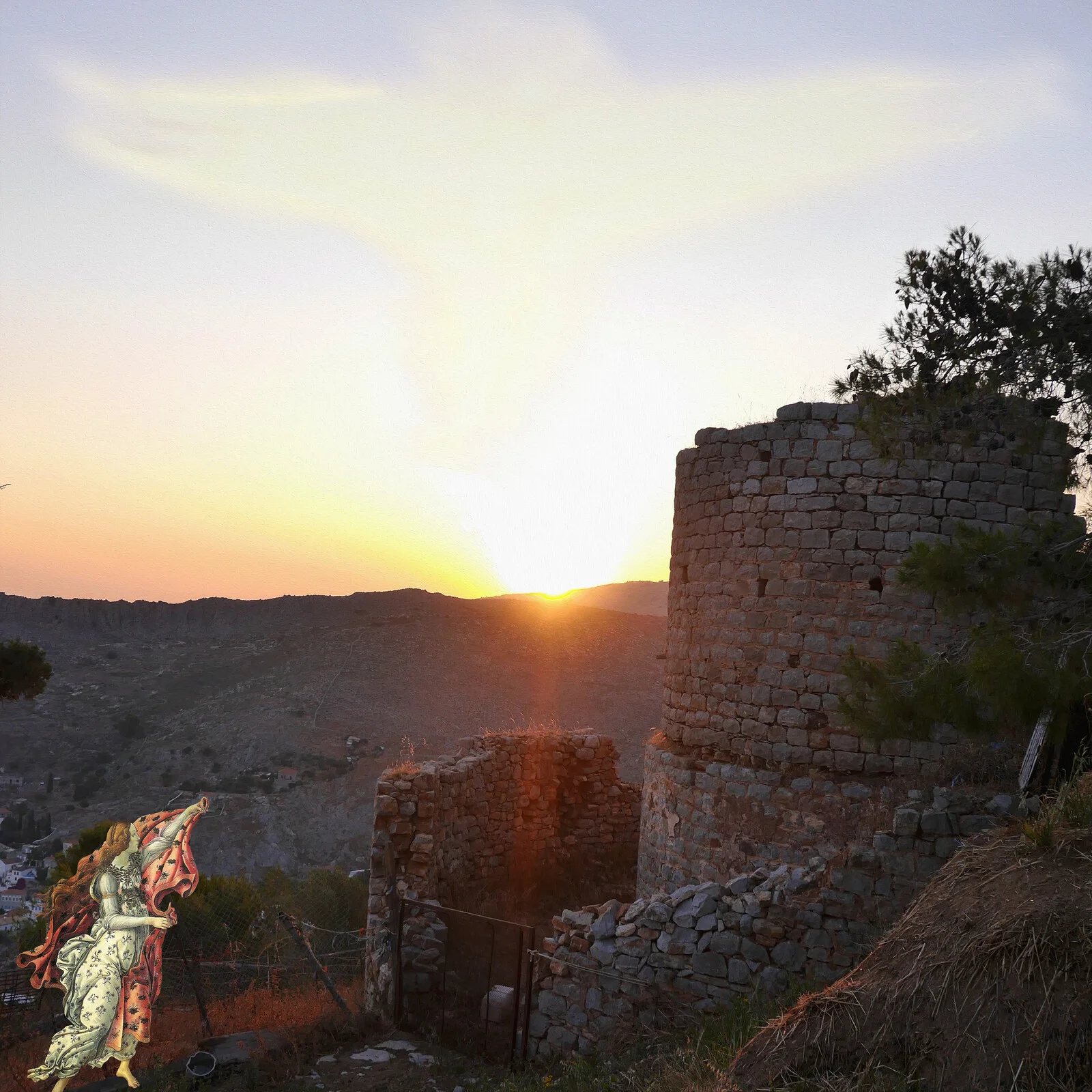
Jörgen Thornberg
The Mill of the Rising Sun, 2016
Digital
50 x 50 cm
There was a mill in Hydra, ever-greys,
On the hill below the Rising Sun,
A ruin since we left those dire days,
And God, forgot this one.
My old man was the milling man,
Grinding flour night and day,
But Papa became a travelin' man,
And left overseas by Jervis Bay.
Light was the old traveller's needs,
Stacked in a suitcase and trunk,
Full of memories from ol' Greece,
Some drachmas hid in his bunk.
"Oh, dear Anna, tell our kids,
Not to do what I have done.
Spend their lives in dust and sids",
Pa said about the Mill of the Rising Sun.
Now he's six feet below down under,
Gramps' soul forever is lost,
Pa never came back to Hydra; no wonder,
Killed when Aussie farmers bossed.
Well, there was a mill on top of Hydra Bay,
The place they still call the Rising Sun,
Though ruined for ages, it's still at the brae,
But the timeworn millstones are gone.
The ruined mill is full of mules and sheep,
In mornings bleating at the Rising Sun,
Banning all poor men's futile weep.
Dear God, I wish dear Pa not been one.
The morale is as simple as plain.
Again, all Greek money is gone.
History repeats again, again and again,
Poorer than ever under the Rising Sun.
When millers leave, flour gets scarce.
So many quit after Pa was on the run.
They left Kiafa emptied, full of scars,
Like the Ol' man's ruin of the Rising Sun.
Today, tourists and ex-pats can sight,
Crumbling walls and what's become,
When shadows are cut in stone with light,
By the strong and relentless rising sun.
I've turned a long way to my Pa's ol' mill,
A farfetched dream almost run',
I'm back for timeless partying still,
With Babis and pals 'til the rising sun.
Persephone, the goddess of Spring and Venus' lady-in-waiting, welcomes the morning as she has since the beginning of time. The early morning hour is like spring; it is the beginning of everything and a time full of possibilities. Persephone reminded me of the peculiar story of Empress Soraya being on Hydra and losing her valuable piece of jewellery and how a miller managed to lift her spirits again. Although fundamentally tragic, his song, 'The Mill of the Rising Sun', evokes positive feelings through its beauty. It was this very mill he sang about, once his childhood home with sunrises just as beautiful back then.
"We stepped onto the rear terrace, leaving Soraya staring after us. Outside, the sun stubbornly shone as usual, and from inside, we could hear Babis's servant bustling about, arranging chairs and small tables, hanging up paintings, garlands, and peculiar decorations, and placing all sorts of knick-knacks. Everything, including gilded furniture in the Empire style, or as Babis called it, the imperial style, he had brought along from above, stored in the evening's bar, the container. Everywhere, tucked among Eberhard's furniture in the Hydra style, were Babis's otherworldly influences: gold, gold, and more gold. Perhaps Trimalchio, the freed slave from Satyricon, would recognise himself among this newly acquired wealth. If this is how Babis lives on his sun, it's understandable that one must let the objects shine to be noticed on Earth.
"Dimitri doesn't make much noise when he doesn't have his bouzouki. He's here to practice," Babis pointed to a man in Cossack boots sitting on the pedestal of an old sundial. "He looks worn and outdated quite rightly for a man born in 1897, the same year as the Thirty Days' War with the Turks over who would rule Crete. When he played for me at Lagoudera for the first time, Dimitri's voice had matured, and his fingers handled the bouzouki's eight strings better than anyone on the island, perhaps in all of Greece. He quickly became a welcome break from the dance music. I remember it was the autumn of '59 when we discovered each other, he a potential performer and me a shy but complete entertainer. 'I play,' Dimitri said, pulling out his instrument from what looked like a jute flour sack. I gestured for him to try it in front of the evening audience. Dimitri performed a few rebetiko songs, and the whole club swung along. He had a unique, more blues-inspired style. The audience was delighted, and Dimitri remained a permanent fixture until his final performance in September 1966. I'll never forget it," Babis shook his head. "How could I? Dimitri died with his boots on, in the middle of a riff that had become his signature melody - first during the years at Lagoudera and then up there. 'Synnefiasmeni Kyriaki, cloudy Sunday, you resemble my always cloudy heart.' Dimitri often sang that song together with Melina. I hope they're singing it tonight, too."
"Mercouri?" I asked hopefully.
"Yep! Dimitri had a hard life despite everything looking good. Born to be a miller like generations before him, everything changed when Dimitri's heavily indebted father deserted by the emigrant ship Jervis Bay to Australia, leaving the family behind. It was a hard blow, especially for Dimitri, the eldest son. The responsibility was now his, with a mother paralysed by grief and many younger siblings. The mill was mortgaged up to its dome. Barely had the father left the country when the creditors came and took the windmill's sails, the front door, three mules, saddles, and anything else of value," Babis said indignantly. "The heartless creditors left behind only a scrawny rooster, a pair of worn-out millstones, and a stockpile of mouldy jute sacks. The ingrained flour dust on the walls kept hunger at bay and was enough to make porridge for a whole winter. The rooster, along with the backyard nettles, became a soup. No one lends their grain on credit to a destitute miller's apprentice, so Dimitri was left as the loneliest person on Hydra."
"What year was it?"
"1922. Greece was impoverished after a new war with Turkey, the loss of Anatolia, and the destruction of Smyrna in 1922. Millions of Greeks found themselves in flight, and Hydra had a couple of too many mills. The question Dimitri asked himself was whether he should follow his father. The family held him back because, unlike his father, Dimitri was no deserter."
"Not just a cloudy Sunday song but a gloomy life, it seems," I shook my head and glanced discreetly at the frail figure a few meters away. "It must have been a troubling time for many."
"That doesn't even begin to describe it. The Greek diaspora, known as 'Omogenia,' is also a Hydra phenomenon. The refugee influx grew like a cancerous tumour during these years. Many, like Dimitri's father, ended up far away, forced by necessity to leave their beloved island. Once with a population of around 30,000, Hydra was reduced to a tenth," Babis sighed. "Can you imagine Hydra at a time when some Hydriots were richer than the trolls? There were three thousand shacks with an average of ten people per household. Children and adults must have slept everywhere. And all the animals too! What a damn life it must have been."
"We see the traces up here. A great part of the former foundation of Hydra, Kiafa, was wiped out by emigration. Today, only ruins, parts of walls, and abandoned terraces bear witness to how many people lived on the island until not so long ago. It's mournful and part of the Greek people's melancholic vein. The one that resonates in the Greek song treasury, including rebetiko."
"You've got it right, Jorgos," Babis put his arm around my shoulder. "At the same time, we Greeks are proud of our families scattered across the world and the cosmos—successful, proud, and never forgetting where they come from."
"I have read that the Greek diaspora is one of the oldest, dating back to Homeric times. The influence of Greek immigrants on other civilisations since the Bronze Age is immense. After Alexander, a Greek dynasty was established in ancient Egypt; Greeks scattered around laid the foundation for modern philosophy and science in Europe; they formed the backbone of Roman culture and medicine and played a leading role during the Renaissance, being involved in various liberal and nationalist movements and ultimately contributing to the dismantling of the Ottoman Empire. The puzzle is, what went wrong afterwards? Where did it all go? The question is anything but rhetorical. The oracles at Delphi would surely have been rendered speechless by this question."
"I don't think so, to be honest. Oracles were wonders of communication and could express themselves in a way that always made them right. It was up to the questioner to interpret the answers. That art has been lost. As for the aftermath of the Greeks' contributions to others, it has often meant ingratitude and persecution. The most recent example was when Nasser, filled with Arab nationalism, expelled the Greeks living in Egypt since Alexander the Great. Egypt and Greece are still suffering from that foolishness. But what good does it do to the innocent ones who were affected? They had to start anew somewhere else, like Dimitri. He was graciously allowed to start as a dough kneader for a baker who had been a customer of his father and grandfather. Eventually, he was promoted to shaping dough balls, and after a few tough years as a filo pastry roller, Dimitri became a journeyman. When we met, he ran Hydra's finest bakery, and only the walls remained of his family's old mill."
"I sense a burden weighing on his shoulders." Dimitri was truly slumped, and his head low.
"Jorgos, what kind of view of reality do you have? Only an incurable optimist would come up with the idea that time heals all wounds and that grief can be overcome. Even the ancient Greeks realised that it not only stays with you throughout your life but also passes through generations. Grief is changeable and constantly assumes new forms, but it can also be dressed up for a celebration, shaken off, polished, and temporarily transformed into its opposite. Tragedy and comedy are siblings and coexist in harmony. Greece is like old Dimitri."
"How do you mean?"
"Look now!" Babis nodded towards Dimitri, who had risen from his marble pedestal. The former miller's apprentice - dough roller, filo pastry maker, and journeyman turned successful baker and the owner of a splendid star in the centre of the Perseus Arm - lifted his Bouzouki out of a flour sack and walked over to the large almond tree and the simple stage that Babis had set up. I could sense that his back was straighter and his head held higher. Dimitri settled into one of the stage chairs, crossing his legs so that his proud Cossack boots displayed their embroidered shafts in their entirety. He placed the instrument in his lap and delicately gripped its neck with his left hand. Then he looked at his audience. Besides Babis and me, it was limited to a few of the household staff who had stuck around and a wind-driven seagull from the harbour. Dimitri's eyes were grey, and his gaze was steadfast.
Dimitri cleared his throat and struck a few sweeping chords. Immediately, the improvised stage under the almond tree transformed. The old Hydriot underwent a metamorphosis; everything changed - his soul, voice, and eyes. From head to toe, his entire body seemed to rise like the sun he sang about. He introduced the lyrics he had written himself as 'The Mill of the Rising Sun.' His fingers glided over the strings, his boots marked the rhythm, and the sun painted a halo around Dimitri's flowing hair—the melody he had picked up from an old recording from the 1930s. The Animals' version from the previous year had nothing to do with what we heard. What a feeling, what immersion from Dimitri, who was a part of the song.
I smiled as I watched Dimitri transform into a radiant artist. The Bouzouki vibrated in his hands with an intensity that permeated the entire scene. Each chord and each note created an atmosphere of magic and nostalgia. His voice filled the air, telling the story of a time lost but still lived on through music.
Dimitri sang about the old Hydra, the mill that had once been the heart of his family, and about the flight and loss that had forced him to start anew. He sang about the sorrow and longing that would always be a part of him and the strength and joy from sharing his music with the world.
There was a mill in Hydra, ever-greys,
On the hill below the Rising Sun,
A ruin since we left those dire days,
And God, forgot this one.
My old man was the milling man,
Grinding flour night and day,
But Papa became a travelin' man,
And left overseas by Jervis Bay.
Light was the old traveller's needs,
Stacked in a suitcase and trunk,
Full of memories from ol' Greece,
Some drachmas hid in his bunk.
"Oh, dear Anna, tell our kids,
Not to do what I have done.
Spend their lives in dust and sids",
Pa said about the Mill of the Rising Sun.
Now he's six feet below down under,
Gramps' soul forever is lost,
Pa never came back to Hydra; no wonder,
Killed when Aussie farmers bossed.
Well, there was a mill on top of Hydra Bay,
The place they still call the Rising Sun,
Though ruined for ages, it's still at the brae,
But the timeworn millstones are gone.
The ruined mill is full of mules and sheep,
In mornings bleating at the Rising Sun,
Banning all poor men's futile weep.
Dear God, I wish dear Pa not been one.
The morale is as simple as plain.
Again, all Greek money is gone.
History repeats again, again and again,
Poorer than ever under the Rising Sun.
When millers leave, flour gets scarce.
So many quit after Pa was on the run.
They left Kiafa emptied, full of scars,
Like the Ol' man's ruin of the Rising Sun.
Today, tourists and ex-pats can sight,
Crumbling walls and what's become,
When shadows are cut in stone with light,
By the strong and relentless rising sun.
I've turned a long way to my Pa's ol' mill,
A farfetched dream almost run',
I'm back for timeless partying still,
With Babis and pals 'til the rising sun.
"Thought-provoking," I said, deeply moved by his account of his life, so concise and brutal, yet a fate not uncommon for his generation. With a pleasantly soft baritone, Dimitri had opened the door to old, impoverished Hydra and the poem about his own family.
I had never heard such a beautiful voice before. Greek men had completely different, darker and more complex voices, often in two modes. Either loudly, as if they were on the other side of a valley, or softly and exhausted during the evening meal after a long work day. I had never heard any of my Greek friends sing, unlike in Italy, where men gladly filled the bathrooms with a song - each one his own Caruso. In Sweden, hymn singing had trained men for generations, while the Greek priests' recitative effectively shut out the congregation.
"Bravo!!" We applauded warmly, and a rumble joined in from above in the cloudless sky. The old baker stood up and gave a ceremonial bow in gratitude for the applause. The performance was over, the metamorphosis had gone, and Dimitri's melancholy returned.
The late afternoon air felt lighter, the heat less palpable, and a possible misunderstanding dissipated - a circumstance clarified, something to keep in mind during the evening's glamour—respect for the past. Reality is measured against reality with all senses wide open. Today against yesterday, added to eternity. The outward appearance. The houses we live and celebrate in. The contemporary chic, renovated and glamorous, once constituted other people's meagre huts. The stone floor was once trampled Earth, today's polished whitewashed walls rough stone, and the coffered ceiling was once a slouched mat of rotting sticks under a leaky roof. Decayed doors and windows then let in both weather and the sounds of the surroundings, unabashedly sharing the pungent fumes of their reality, poor hygiene, and the scent of a simple kitchen. Nowadays, carpentry is finely varnished and often shielded by shutters that help maintain two climates, one outside and one inside, and keep the neighbours away from our everyday lives.
"Fortunes fall differently," I said, feeling guilty. Perhaps my sentiment didn't apply to Eberhard's ochre abode long ago, which belonged to a prosperous Hydra family. Hydra's stately manors and pretentious captain's houses once lived their own lives, filled with riches accumulated during the island's heyday. Nevertheless, most of today's renovated houses, the smaller ones being more apparent, once merely provided shelter for a large family - and little more.
"Drama, farce, tragedy, and hints of comedy are in the same play. Isn't that precisely like life, even in your own time, Jorgos?"
"Indeed, Babis. Everything is intertwined in an amalgamation where one depends on the other. We won't have more fun tonight than we make for ourselves."
"So be it. Not even in eternity can we change the laws of nature. Joy and sorrow are the same for everyone, both Time Travelers and the living.
I couldn't help but admire Dimitri and all those who, despite setbacks and losses, continue to express themselves through art and music. His performance was a reminder that even in the darkest moments, art can illuminate and provide comfort and hope.
Dimitri gave us a gift that evening: a glimpse of the past and a reminder of the timeless power of music. And I was grateful to be a part of that moment, to listen to and share his story with Babis, who had been there from the beginning.
We remained below the almond tree, enjoying the evening filled with the magic of music and the weight of history.
To be continued...
Footnote:
This is an extract from a novel I have almost finished. Unfortunately, English is not my native language, so please overlook any poor translation from Swedish. Regardless, you will still get a rough idea of the novel.
The original text has been slightly altered to follow an early morning on-the-road rendezvous with Leonard and Marianne. The couple is on one of their regular visits to Hydra, where they live together on the star Algebar, forever continuing their love affair that was momentarily interrupted.
Leonard and Marianne are riding two donkeys on their way to their old house for a weekend on the Greek island of Hydra. We have met before, at a party. That party is the novel. During our leisurely pace on the old, cobbled road to Hydra town, I get some answers to questions that I and many others have pondered over the years.
The text is meant to evoke the impression of a novel about Time-travellers having a grand celebration in a hijacked villa. When people from the stars party, they spare no expense because the day after is eternal.
What do Leonard Cohen, Marianne Ihlen, Onassis, Jackie O, Maria Callas, Ernest Hemingway, Alan Ladd, Empress Soraya, Audrey Hepburn, Princess Grace Kelly, Greta Garbo, Princess Margaret, and a few hundred other celebrities have in common? The most obvious answer is that they no longer live on Earth. What may be new to some is that they now reside on their stars in space. They have also been to the Greek island of Hydra and the nightclub Lagoudera, which, during its golden age, was one of Europe's most renowned watering holes among jetsetters.
Together with seven hundred other Time-travellers, they return to Earth on the autumn equinox of 2018 for a real party. Hence the name of the novel - "The Last Dance." The forever jet setters once again come to Greece, the birthplace of European civilisation, which serves as the foundation. They arrive on the island of Hydra, the backdrop, and the former club Lagoudera acts as the platform. An ocher villa high above the town of Hydra serves as the party venue, and the Time-travellers are the main characters. Club owner Babis More narrates the anecdotes surrounding the spices. I am the only Earthling observer present at the party, while the Hydriots and tourists serve as extras, unaware of what is happening around them. The reader gains a good understanding of how a small island is affected by these guests from the past. Who wouldn't want to read about a real party? About how the guests from the rock and pop music era danced on the ceiling, gossiped, and indulged in a grand buffet.
The guest list was impressive, and so were the accompanying anecdotes. The reader learns how Empress Soraya stood up to playboy Baby Pignatari and how a fifty-year-old mystery involving a missing brooch was solved the day after the big party while the royal house was being cleaned. Leonard Cohen explains his fondness for women with the help of his girlfriend, Marianne Ihlen, forever his muse. Audrey Hepburn, delicate as ever, dances with style while Princess Grace of Monaco joins in with her fierce moves. The quartet of Liz Taylor, Richard Burton, Eddie Fisher, and Debbie Reynolds, who married, divorced, and remarried, were all present at the party without resulting bloodshed. However, there was a commotion when John Kennedy arrived uninvited and encountered his successor, shipping magnate Aristotle Onassis. Anthony Perkins was caught in a corner, passionately kissing Tab Hunter, his 1960s lover. And let's not forget Greta Garbo, who revealed whose panties she was wearing. The Time-travellers didn't worry about such matters as they enjoyed Marianne's specially prepared cannabis buns. It was a great trip, to say the least.
The literary giant and game fisherman Ernest Hemingway hooked something in the strait outside Hydra. Still different than he intended - he caught a mini-submarine with three girls dressed for a party onboard one of the luxury yachts anchored at Plakes. However, "The Last Dance" maintains a distance from these tales.
Nevertheless, it is easy to smile. One of these stories reveals that Hydra's seemingly least intelligent and most bullied girl turns out to be the smartest. By thinking outside the box, quite literally, she becomes rich. Together with club owner and party organiser Babis Mores, the reader encounters a poorer Hydra that, even in the late 1950s, still suffers from the scars of war, where eight per cent of the population perished.
PS.
If anybody wonders about Time-travellers and life after leaving Earth, consider Albert Einstein and his theories - particularly the one about how energy is perpetual, in fact, indestructible. It is one of physics' indisputable facts and a cornerstone of science. That Leonard's poetry and music represent energy is familiar. Creating such art also requires a significant amount of energy. So do thoughts. Scholars say that each thought demands 0.02 kcal, while writing one of Leonard's songs requires much more - we're talking about hundreds of kcal. Therefore, thoughts cannot be destroyed; they must persist in one way or another. Eternally imperishable. "It does not take a god to figure that out," Leonard said during our walk.
So, what happens when we leave life on Earth? Draw your conclusions. It has nothing to do with religion. Leonard told me the universe is full of gods, prophets, priests, seers, and soothsayers. But few listen anymore. Leonard searched for truth among different religions throughout his life, only to find it after he left. Living on a star has its advantages—author's comment.
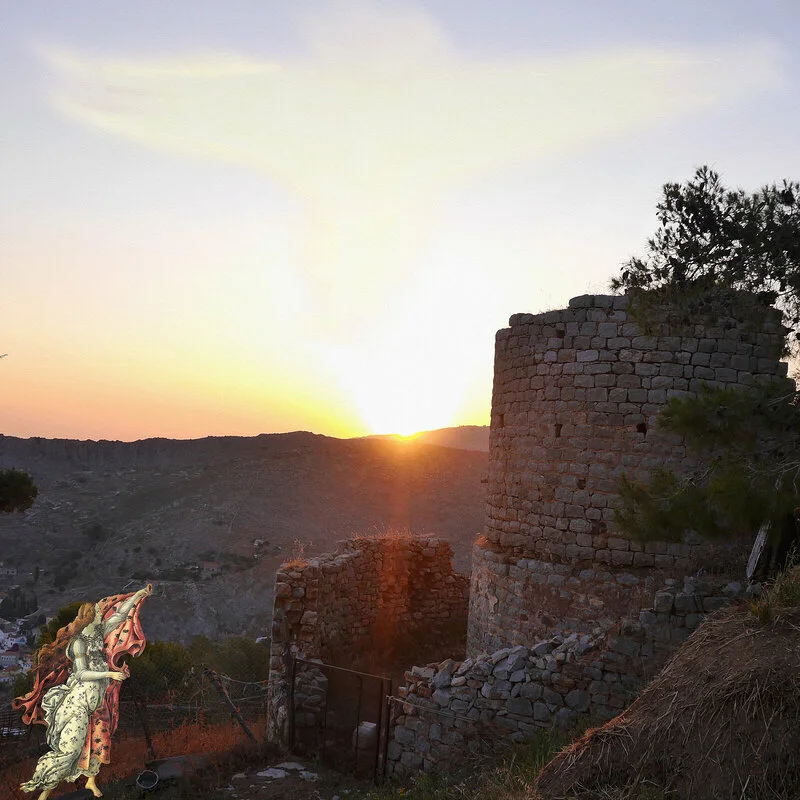
Jörgen Thornberg
The Mill of the Rising Sun, 2016
Digital
50 x 50 cm
There was a mill in Hydra, ever-greys,
On the hill below the Rising Sun,
A ruin since we left those dire days,
And God, forgot this one.
My old man was the milling man,
Grinding flour night and day,
But Papa became a travelin' man,
And left overseas by Jervis Bay.
Light was the old traveller's needs,
Stacked in a suitcase and trunk,
Full of memories from ol' Greece,
Some drachmas hid in his bunk.
"Oh, dear Anna, tell our kids,
Not to do what I have done.
Spend their lives in dust and sids",
Pa said about the Mill of the Rising Sun.
Now he's six feet below down under,
Gramps' soul forever is lost,
Pa never came back to Hydra; no wonder,
Killed when Aussie farmers bossed.
Well, there was a mill on top of Hydra Bay,
The place they still call the Rising Sun,
Though ruined for ages, it's still at the brae,
But the timeworn millstones are gone.
The ruined mill is full of mules and sheep,
In mornings bleating at the Rising Sun,
Banning all poor men's futile weep.
Dear God, I wish dear Pa not been one.
The morale is as simple as plain.
Again, all Greek money is gone.
History repeats again, again and again,
Poorer than ever under the Rising Sun.
When millers leave, flour gets scarce.
So many quit after Pa was on the run.
They left Kiafa emptied, full of scars,
Like the Ol' man's ruin of the Rising Sun.
Today, tourists and ex-pats can sight,
Crumbling walls and what's become,
When shadows are cut in stone with light,
By the strong and relentless rising sun.
I've turned a long way to my Pa's ol' mill,
A farfetched dream almost run',
I'm back for timeless partying still,
With Babis and pals 'til the rising sun.
Persephone, the goddess of Spring and Venus' lady-in-waiting, welcomes the morning as she has since the beginning of time. The early morning hour is like spring; it is the beginning of everything and a time full of possibilities. Persephone reminded me of the peculiar story of Empress Soraya being on Hydra and losing her valuable piece of jewellery and how a miller managed to lift her spirits again. Although fundamentally tragic, his song, 'The Mill of the Rising Sun', evokes positive feelings through its beauty. It was this very mill he sang about, once his childhood home with sunrises just as beautiful back then.
"We stepped onto the rear terrace, leaving Soraya staring after us. Outside, the sun stubbornly shone as usual, and from inside, we could hear Babis's servant bustling about, arranging chairs and small tables, hanging up paintings, garlands, and peculiar decorations, and placing all sorts of knick-knacks. Everything, including gilded furniture in the Empire style, or as Babis called it, the imperial style, he had brought along from above, stored in the evening's bar, the container. Everywhere, tucked among Eberhard's furniture in the Hydra style, were Babis's otherworldly influences: gold, gold, and more gold. Perhaps Trimalchio, the freed slave from Satyricon, would recognise himself among this newly acquired wealth. If this is how Babis lives on his sun, it's understandable that one must let the objects shine to be noticed on Earth.
"Dimitri doesn't make much noise when he doesn't have his bouzouki. He's here to practice," Babis pointed to a man in Cossack boots sitting on the pedestal of an old sundial. "He looks worn and outdated quite rightly for a man born in 1897, the same year as the Thirty Days' War with the Turks over who would rule Crete. When he played for me at Lagoudera for the first time, Dimitri's voice had matured, and his fingers handled the bouzouki's eight strings better than anyone on the island, perhaps in all of Greece. He quickly became a welcome break from the dance music. I remember it was the autumn of '59 when we discovered each other, he a potential performer and me a shy but complete entertainer. 'I play,' Dimitri said, pulling out his instrument from what looked like a jute flour sack. I gestured for him to try it in front of the evening audience. Dimitri performed a few rebetiko songs, and the whole club swung along. He had a unique, more blues-inspired style. The audience was delighted, and Dimitri remained a permanent fixture until his final performance in September 1966. I'll never forget it," Babis shook his head. "How could I? Dimitri died with his boots on, in the middle of a riff that had become his signature melody - first during the years at Lagoudera and then up there. 'Synnefiasmeni Kyriaki, cloudy Sunday, you resemble my always cloudy heart.' Dimitri often sang that song together with Melina. I hope they're singing it tonight, too."
"Mercouri?" I asked hopefully.
"Yep! Dimitri had a hard life despite everything looking good. Born to be a miller like generations before him, everything changed when Dimitri's heavily indebted father deserted by the emigrant ship Jervis Bay to Australia, leaving the family behind. It was a hard blow, especially for Dimitri, the eldest son. The responsibility was now his, with a mother paralysed by grief and many younger siblings. The mill was mortgaged up to its dome. Barely had the father left the country when the creditors came and took the windmill's sails, the front door, three mules, saddles, and anything else of value," Babis said indignantly. "The heartless creditors left behind only a scrawny rooster, a pair of worn-out millstones, and a stockpile of mouldy jute sacks. The ingrained flour dust on the walls kept hunger at bay and was enough to make porridge for a whole winter. The rooster, along with the backyard nettles, became a soup. No one lends their grain on credit to a destitute miller's apprentice, so Dimitri was left as the loneliest person on Hydra."
"What year was it?"
"1922. Greece was impoverished after a new war with Turkey, the loss of Anatolia, and the destruction of Smyrna in 1922. Millions of Greeks found themselves in flight, and Hydra had a couple of too many mills. The question Dimitri asked himself was whether he should follow his father. The family held him back because, unlike his father, Dimitri was no deserter."
"Not just a cloudy Sunday song but a gloomy life, it seems," I shook my head and glanced discreetly at the frail figure a few meters away. "It must have been a troubling time for many."
"That doesn't even begin to describe it. The Greek diaspora, known as 'Omogenia,' is also a Hydra phenomenon. The refugee influx grew like a cancerous tumour during these years. Many, like Dimitri's father, ended up far away, forced by necessity to leave their beloved island. Once with a population of around 30,000, Hydra was reduced to a tenth," Babis sighed. "Can you imagine Hydra at a time when some Hydriots were richer than the trolls? There were three thousand shacks with an average of ten people per household. Children and adults must have slept everywhere. And all the animals too! What a damn life it must have been."
"We see the traces up here. A great part of the former foundation of Hydra, Kiafa, was wiped out by emigration. Today, only ruins, parts of walls, and abandoned terraces bear witness to how many people lived on the island until not so long ago. It's mournful and part of the Greek people's melancholic vein. The one that resonates in the Greek song treasury, including rebetiko."
"You've got it right, Jorgos," Babis put his arm around my shoulder. "At the same time, we Greeks are proud of our families scattered across the world and the cosmos—successful, proud, and never forgetting where they come from."
"I have read that the Greek diaspora is one of the oldest, dating back to Homeric times. The influence of Greek immigrants on other civilisations since the Bronze Age is immense. After Alexander, a Greek dynasty was established in ancient Egypt; Greeks scattered around laid the foundation for modern philosophy and science in Europe; they formed the backbone of Roman culture and medicine and played a leading role during the Renaissance, being involved in various liberal and nationalist movements and ultimately contributing to the dismantling of the Ottoman Empire. The puzzle is, what went wrong afterwards? Where did it all go? The question is anything but rhetorical. The oracles at Delphi would surely have been rendered speechless by this question."
"I don't think so, to be honest. Oracles were wonders of communication and could express themselves in a way that always made them right. It was up to the questioner to interpret the answers. That art has been lost. As for the aftermath of the Greeks' contributions to others, it has often meant ingratitude and persecution. The most recent example was when Nasser, filled with Arab nationalism, expelled the Greeks living in Egypt since Alexander the Great. Egypt and Greece are still suffering from that foolishness. But what good does it do to the innocent ones who were affected? They had to start anew somewhere else, like Dimitri. He was graciously allowed to start as a dough kneader for a baker who had been a customer of his father and grandfather. Eventually, he was promoted to shaping dough balls, and after a few tough years as a filo pastry roller, Dimitri became a journeyman. When we met, he ran Hydra's finest bakery, and only the walls remained of his family's old mill."
"I sense a burden weighing on his shoulders." Dimitri was truly slumped, and his head low.
"Jorgos, what kind of view of reality do you have? Only an incurable optimist would come up with the idea that time heals all wounds and that grief can be overcome. Even the ancient Greeks realised that it not only stays with you throughout your life but also passes through generations. Grief is changeable and constantly assumes new forms, but it can also be dressed up for a celebration, shaken off, polished, and temporarily transformed into its opposite. Tragedy and comedy are siblings and coexist in harmony. Greece is like old Dimitri."
"How do you mean?"
"Look now!" Babis nodded towards Dimitri, who had risen from his marble pedestal. The former miller's apprentice - dough roller, filo pastry maker, and journeyman turned successful baker and the owner of a splendid star in the centre of the Perseus Arm - lifted his Bouzouki out of a flour sack and walked over to the large almond tree and the simple stage that Babis had set up. I could sense that his back was straighter and his head held higher. Dimitri settled into one of the stage chairs, crossing his legs so that his proud Cossack boots displayed their embroidered shafts in their entirety. He placed the instrument in his lap and delicately gripped its neck with his left hand. Then he looked at his audience. Besides Babis and me, it was limited to a few of the household staff who had stuck around and a wind-driven seagull from the harbour. Dimitri's eyes were grey, and his gaze was steadfast.
Dimitri cleared his throat and struck a few sweeping chords. Immediately, the improvised stage under the almond tree transformed. The old Hydriot underwent a metamorphosis; everything changed - his soul, voice, and eyes. From head to toe, his entire body seemed to rise like the sun he sang about. He introduced the lyrics he had written himself as 'The Mill of the Rising Sun.' His fingers glided over the strings, his boots marked the rhythm, and the sun painted a halo around Dimitri's flowing hair—the melody he had picked up from an old recording from the 1930s. The Animals' version from the previous year had nothing to do with what we heard. What a feeling, what immersion from Dimitri, who was a part of the song.
I smiled as I watched Dimitri transform into a radiant artist. The Bouzouki vibrated in his hands with an intensity that permeated the entire scene. Each chord and each note created an atmosphere of magic and nostalgia. His voice filled the air, telling the story of a time lost but still lived on through music.
Dimitri sang about the old Hydra, the mill that had once been the heart of his family, and about the flight and loss that had forced him to start anew. He sang about the sorrow and longing that would always be a part of him and the strength and joy from sharing his music with the world.
There was a mill in Hydra, ever-greys,
On the hill below the Rising Sun,
A ruin since we left those dire days,
And God, forgot this one.
My old man was the milling man,
Grinding flour night and day,
But Papa became a travelin' man,
And left overseas by Jervis Bay.
Light was the old traveller's needs,
Stacked in a suitcase and trunk,
Full of memories from ol' Greece,
Some drachmas hid in his bunk.
"Oh, dear Anna, tell our kids,
Not to do what I have done.
Spend their lives in dust and sids",
Pa said about the Mill of the Rising Sun.
Now he's six feet below down under,
Gramps' soul forever is lost,
Pa never came back to Hydra; no wonder,
Killed when Aussie farmers bossed.
Well, there was a mill on top of Hydra Bay,
The place they still call the Rising Sun,
Though ruined for ages, it's still at the brae,
But the timeworn millstones are gone.
The ruined mill is full of mules and sheep,
In mornings bleating at the Rising Sun,
Banning all poor men's futile weep.
Dear God, I wish dear Pa not been one.
The morale is as simple as plain.
Again, all Greek money is gone.
History repeats again, again and again,
Poorer than ever under the Rising Sun.
When millers leave, flour gets scarce.
So many quit after Pa was on the run.
They left Kiafa emptied, full of scars,
Like the Ol' man's ruin of the Rising Sun.
Today, tourists and ex-pats can sight,
Crumbling walls and what's become,
When shadows are cut in stone with light,
By the strong and relentless rising sun.
I've turned a long way to my Pa's ol' mill,
A farfetched dream almost run',
I'm back for timeless partying still,
With Babis and pals 'til the rising sun.
"Thought-provoking," I said, deeply moved by his account of his life, so concise and brutal, yet a fate not uncommon for his generation. With a pleasantly soft baritone, Dimitri had opened the door to old, impoverished Hydra and the poem about his own family.
I had never heard such a beautiful voice before. Greek men had completely different, darker and more complex voices, often in two modes. Either loudly, as if they were on the other side of a valley, or softly and exhausted during the evening meal after a long work day. I had never heard any of my Greek friends sing, unlike in Italy, where men gladly filled the bathrooms with a song - each one his own Caruso. In Sweden, hymn singing had trained men for generations, while the Greek priests' recitative effectively shut out the congregation.
"Bravo!!" We applauded warmly, and a rumble joined in from above in the cloudless sky. The old baker stood up and gave a ceremonial bow in gratitude for the applause. The performance was over, the metamorphosis had gone, and Dimitri's melancholy returned.
The late afternoon air felt lighter, the heat less palpable, and a possible misunderstanding dissipated - a circumstance clarified, something to keep in mind during the evening's glamour—respect for the past. Reality is measured against reality with all senses wide open. Today against yesterday, added to eternity. The outward appearance. The houses we live and celebrate in. The contemporary chic, renovated and glamorous, once constituted other people's meagre huts. The stone floor was once trampled Earth, today's polished whitewashed walls rough stone, and the coffered ceiling was once a slouched mat of rotting sticks under a leaky roof. Decayed doors and windows then let in both weather and the sounds of the surroundings, unabashedly sharing the pungent fumes of their reality, poor hygiene, and the scent of a simple kitchen. Nowadays, carpentry is finely varnished and often shielded by shutters that help maintain two climates, one outside and one inside, and keep the neighbours away from our everyday lives.
"Fortunes fall differently," I said, feeling guilty. Perhaps my sentiment didn't apply to Eberhard's ochre abode long ago, which belonged to a prosperous Hydra family. Hydra's stately manors and pretentious captain's houses once lived their own lives, filled with riches accumulated during the island's heyday. Nevertheless, most of today's renovated houses, the smaller ones being more apparent, once merely provided shelter for a large family - and little more.
"Drama, farce, tragedy, and hints of comedy are in the same play. Isn't that precisely like life, even in your own time, Jorgos?"
"Indeed, Babis. Everything is intertwined in an amalgamation where one depends on the other. We won't have more fun tonight than we make for ourselves."
"So be it. Not even in eternity can we change the laws of nature. Joy and sorrow are the same for everyone, both Time Travelers and the living.
I couldn't help but admire Dimitri and all those who, despite setbacks and losses, continue to express themselves through art and music. His performance was a reminder that even in the darkest moments, art can illuminate and provide comfort and hope.
Dimitri gave us a gift that evening: a glimpse of the past and a reminder of the timeless power of music. And I was grateful to be a part of that moment, to listen to and share his story with Babis, who had been there from the beginning.
We remained below the almond tree, enjoying the evening filled with the magic of music and the weight of history.
To be continued...
Footnote:
This is an extract from a novel I have almost finished. Unfortunately, English is not my native language, so please overlook any poor translation from Swedish. Regardless, you will still get a rough idea of the novel.
The original text has been slightly altered to follow an early morning on-the-road rendezvous with Leonard and Marianne. The couple is on one of their regular visits to Hydra, where they live together on the star Algebar, forever continuing their love affair that was momentarily interrupted.
Leonard and Marianne are riding two donkeys on their way to their old house for a weekend on the Greek island of Hydra. We have met before, at a party. That party is the novel. During our leisurely pace on the old, cobbled road to Hydra town, I get some answers to questions that I and many others have pondered over the years.
The text is meant to evoke the impression of a novel about Time-travellers having a grand celebration in a hijacked villa. When people from the stars party, they spare no expense because the day after is eternal.
What do Leonard Cohen, Marianne Ihlen, Onassis, Jackie O, Maria Callas, Ernest Hemingway, Alan Ladd, Empress Soraya, Audrey Hepburn, Princess Grace Kelly, Greta Garbo, Princess Margaret, and a few hundred other celebrities have in common? The most obvious answer is that they no longer live on Earth. What may be new to some is that they now reside on their stars in space. They have also been to the Greek island of Hydra and the nightclub Lagoudera, which, during its golden age, was one of Europe's most renowned watering holes among jetsetters.
Together with seven hundred other Time-travellers, they return to Earth on the autumn equinox of 2018 for a real party. Hence the name of the novel - "The Last Dance." The forever jet setters once again come to Greece, the birthplace of European civilisation, which serves as the foundation. They arrive on the island of Hydra, the backdrop, and the former club Lagoudera acts as the platform. An ocher villa high above the town of Hydra serves as the party venue, and the Time-travellers are the main characters. Club owner Babis More narrates the anecdotes surrounding the spices. I am the only Earthling observer present at the party, while the Hydriots and tourists serve as extras, unaware of what is happening around them. The reader gains a good understanding of how a small island is affected by these guests from the past. Who wouldn't want to read about a real party? About how the guests from the rock and pop music era danced on the ceiling, gossiped, and indulged in a grand buffet.
The guest list was impressive, and so were the accompanying anecdotes. The reader learns how Empress Soraya stood up to playboy Baby Pignatari and how a fifty-year-old mystery involving a missing brooch was solved the day after the big party while the royal house was being cleaned. Leonard Cohen explains his fondness for women with the help of his girlfriend, Marianne Ihlen, forever his muse. Audrey Hepburn, delicate as ever, dances with style while Princess Grace of Monaco joins in with her fierce moves. The quartet of Liz Taylor, Richard Burton, Eddie Fisher, and Debbie Reynolds, who married, divorced, and remarried, were all present at the party without resulting bloodshed. However, there was a commotion when John Kennedy arrived uninvited and encountered his successor, shipping magnate Aristotle Onassis. Anthony Perkins was caught in a corner, passionately kissing Tab Hunter, his 1960s lover. And let's not forget Greta Garbo, who revealed whose panties she was wearing. The Time-travellers didn't worry about such matters as they enjoyed Marianne's specially prepared cannabis buns. It was a great trip, to say the least.
The literary giant and game fisherman Ernest Hemingway hooked something in the strait outside Hydra. Still different than he intended - he caught a mini-submarine with three girls dressed for a party onboard one of the luxury yachts anchored at Plakes. However, "The Last Dance" maintains a distance from these tales.
Nevertheless, it is easy to smile. One of these stories reveals that Hydra's seemingly least intelligent and most bullied girl turns out to be the smartest. By thinking outside the box, quite literally, she becomes rich. Together with club owner and party organiser Babis Mores, the reader encounters a poorer Hydra that, even in the late 1950s, still suffers from the scars of war, where eight per cent of the population perished.
PS.
If anybody wonders about Time-travellers and life after leaving Earth, consider Albert Einstein and his theories - particularly the one about how energy is perpetual, in fact, indestructible. It is one of physics' indisputable facts and a cornerstone of science. That Leonard's poetry and music represent energy is familiar. Creating such art also requires a significant amount of energy. So do thoughts. Scholars say that each thought demands 0.02 kcal, while writing one of Leonard's songs requires much more - we're talking about hundreds of kcal. Therefore, thoughts cannot be destroyed; they must persist in one way or another. Eternally imperishable. "It does not take a god to figure that out," Leonard said during our walk.
So, what happens when we leave life on Earth? Draw your conclusions. It has nothing to do with religion. Leonard told me the universe is full of gods, prophets, priests, seers, and soothsayers. But few listen anymore. Leonard searched for truth among different religions throughout his life, only to find it after he left. Living on a star has its advantages—author's comment.

Jörgen Thornberg
Malmö
Lite om bilder och mig. Translation in English at the end.
Jag är en nyfiken person som ser allt i bilder, även det jag fäster i ord, gärna tillsammans för bakom alla mina bilder finns en berättelse. Till vissa bilder hör en kortare eller längre novell som följer med bilden.
Bilder berättar historier. Jag omges av naturlig skönhet, intressanta människor och historia var jag än går. Jag använder min kamera för att dokumentera världen och blanda det jag ser med vad jag känner för att fånga den dolda magin.
Mina bilder berättar mina historier. Genom mina bilder, tryck och berättelser. Jag bjuder in dig att ta del av dessa berättelser, in i ditt liv och hem och dela min mycket personliga syn på vår värld. Mer än vad ögat ser. Jag tänker i bilder, drömmer och skriver och pratar om dem; följaktligen måste jag också skapa bilder. De blir vad jag ser, inte nödvändigtvis begränsade till verkligheten. Det finns en bild runt varje hörn. Jag hoppas att du kommer att se vad jag såg och gilla det.
Jag är också en skrivande person och till många bilder hör en kortare eller längre essay. Den följer med tavlan, tryckt på fint papper och med en personlig hälsning från mig.
Flertalet bilder startar sin resa i min kamera. Enkelt förklarat beskriver jag bilden jag ser i mitt inre, upplevd eller fantiserad. Bilden uppstår inom mig redan innan jag fått okularet till ögat. På bråkdelen av ett ögonblick ser jag vad jag vill ha och vad som kan göras med bilden. Här skall jag stoppa in en giraff, stålmannen, Titanic eller vad det är min fantasi finner ut. Ännu märkligare är att jag kommer ihåg minnesbilden långt efteråt när det blir tid att skapa verket. Om jag lyckas eller inte, är upp till betraktaren, oftast präglat av en stråk av svart humor – meningen är att man skall bli underhållen. Mina bilder blir ofta en snackis där de hänger.
Jag föredrar bilder som förmedlar ett budskap i flera lager. Vid första anblicken fylld av feel-good, en vacker utsikt, fint väder, solen skiner, blommor på ängen eller vattnet som ligger förrädiskt spegelblankt. I en sådan bild kan jag gömma min egentliga berättelse, mitt förakt för förtryckare och våldsverkare, rasister och fördomsfulla människor - ett gärna återkommande motiv mer eller mindre dolt i det vackra motivet. Jag försöker förena dem i ett gemensamt narrativ.
Bild och formgivning har löpt som en röd tråd genom livet. Fotokonst känns som en värdig final som jag gärna delar med mig.
Min genre är vid som framgår av mina bilder, temat en blandning av pop- och gatukonst i kollage som kan bestå av hundratals lager. Vissa bilder kan ta veckor, andra någon dag innan det är dags att överlämna resultatet till printverkstaden. Fine Art Prints är digitala fotocollage. I dessa kollage sker rivandet, klippandet, pusslandet, målandet, ritandet och sprayningen digitalt. Det jag monterar in kan vara hundratals år gamla bilder som jag omsorgsfullt frilägger så att de ser ut att vara en del av tavlan men också bilder skapade av mig själv efter min egen fantasi. Därefter besöks printstudion och för vissa bilder numrera en limiterad upplaga (oftast 7 exemplar) och signera för hand. Vissa bilder kan köpas i olika format. Det är bara att fråga efter vilka. Gillar man en bild som är 70x100 men inte har plats på väggen, går den kanske att få i 50x70 cm istället. Frågan är fri.
Metoden Giclée eller Fine Art Print som det också kallas är det moderna sättet för framställning av grafisk konst. Villkoret för denna typ av utskrifter är att en högkvalitativ storformatskrivare används med åldersbeständigt färgpigment och konstnärspapper eller i förekommande fall på duk. Pappret som används möter de krav på livslängd som ställs av museer och gallerier. Normalt säljer jag mina bilder oinramade så att den nya ägaren själv kan bestämma hur de skall se ut, med eller utan passepartout färg på ram, med eller utan glas etc..
Under många år ställde jag bara ut på nätet, i valda grupper och på min egen Facebooksida - https://www.facebook.com/jorgen.thornberg.9
Jag finns också på en egen hemsida som tyvärr inte alltid är uppdaterad – https://www.jth.life/ Där kan du också läsa en del av de berättelser som följer med bilden.
UTSTÄLLNINGAR
Luftkastellet, oktober 2022
Konst i Lund, november 2022
Luftkastellet, mars 2023
Engleson Galleri Caroli, april 2023
Hydra, Greece June 2023
Engleson Galleri Caroli, oktober 2023
Toppen, Höllviken december 2023
Luftkastellet, mars 2024
Torups Galleri, mars 2024
Venice, May 2024
Luftkastellet, oktober 2024
Konst i Advent, December 2024
Galleri Engleson, Caroli December 2024
Jäger & Jansson Galleri, april 2025
A bit about pictures and me.
I'm a curious person who sees everything in pictures, even what I express in words, often combining them, for behind all my pictures lies a story. These narratives, some as short as a single image and others as long as a novel, are the heart and soul of my work.
Pictures tell stories. Wherever I go, I'm surrounded by natural beauty, exciting people, and history. I use my camera to document the world and blend what I see with what I feel to capture the hidden magic.
My images tell my stories. Through my pictures, prints, and narratives, I invite you to partake in these stories in your life and home and share my deeply personal perspective of our world. More than meets the eye. I think in pictures, dream, write, and talk about them; consequently, I must create images too. They become what I see, not necessarily confined to reality. There's a picture around every corner. I hope you'll see what I saw and enjoy it.
I'm also a writer, and many images come with a shorter or longer essay. It accompanies the painting, printed on fine paper with my personal greeting.
Many pictures start their journey on my camera. Simply put, I describe the image I see in my mind, experienced or imagined. The image arises within me even before I bring the eyepiece to my eye. In a fraction of a moment, I see what I want and what can be done with the picture. Here, I'll insert a giraffe, Superman, the Titanic, or whatever my imagination conjures up. Even stranger is that I remember the mental image long after it's time to create the work. Whether I succeed is up to the observer, often imbued with a streak of black humour – the aim is to entertain. My pictures usually become a talking point wherever they hang.
I prefer pictures that convey a message in multiple layers. At first glance, they're filled with feel-good vibes, a beautiful view, lovely weather, the sun shining, flowers in the meadow, or the water lying deceptively calm. But beneath this surface beauty, I often conceal a deeper story, a narrative that challenges societal norms or explores the human condition. I invite you to delve into these hidden narratives and discover the layers of meaning within my work.
Picture and design have been a thread running through my life. Photographic art feels like a fitting finale, and I'm happy to share it.
My genre is varied, as seen in my pictures; the theme is a blend of pop and street art in collages that can consist of hundreds of layers. Some images can take weeks, others just a day before it's time to hand over the result to the print workshop. Fine Art Prints are digital photo collages. In these collages, tearing, cutting, puzzling, painting, drawing, and spraying happen digitally. What I insert can be images hundreds of years old that I carefully extract so they appear to be part of the painting, but also images created by myself, now also generated from my imagination. Next, visit the print studio and, for certain images, number a limited edition (usually 7 copies) and sign them by hand. Some images may be available in other formats. Just ask which ones. If you like an image that's 70x100 but doesn't have space on the wall, you might be able to get it in 50x70 cm instead. The question is open.
The Giclée method, or Fine Art Print as it's also called, is the modern way of producing graphic art. This method ensures the highest quality and longevity of the artwork, using a high-quality large-format printer with archival pigment inks and artist paper or, in some cases, canvas. The paper used meets the longevity requirements set by museums and galleries. I sell my pictures unframed, allowing the new owner to personalise their artwork, confident in the lasting value and quality of the piece.
For many years, I only exhibited online, in selected groups, and on my Facebook page - https://www.facebook.com/jorgen.thornberg.9. I also have my website, which unfortunately is not constantly updated - https://www.jth.life/. You can also read some of the stories accompanying the pictures there.
EXHIBITIONS
Luftkastellet, October 2022
Art in Lund, November 2022
Luftkastellet, March 2023
Engleson Gallery Caroli, April 2023
Hydra, Greece June 2023
Engleson Gallery Caroli, October 2023
Toppen, Höllviken December 2023
Luftkastellet, March 2024
Torup Gallery, March 2024
Venice, May 2024
UTSTÄLLNINGAR
Luftkastellet, oktober 2022
Konst i Lund, november 2022
Luftkastellet, mars 2023
Engleson Galleri Caroli, april 2023
Hydra, Greece June 2023
Engleson Galleri Caroli, oktober 2023
Toppen, Höllviken december 2023
Luftkastellet, mars 2024
Torups Galleri, mars 2024
Venice, May 2024
Luftkastellet, October 2024
Konst i Advent, December 2024
Galleri Engleson, Caroli December 2024
Jäger & Jansson Galleri, April 2025
Utbildning
Autodidakt
Medlem i konstnärsförening
Öppna Sinnen
Med i konstrunda
Konstrundan i Skåne
Utställningar
Luftkastellet, October 2022
Art in Lund, November 2022
Luftkastellet, March 2023
Engleson Gallery Caroli, April 2023
Hydra, Greece June 2023
Engleson Gallery Caroli, October 2023
Toppen, Höllviken December 2023
Luftkastellet, March 2024
Torup Gallery, March 2024
Venice, May 2024