Vi använder cookies för att ge dig bästa möjliga upplevelse. Välj vilka cookies du tillåter.
Läs mer i vår integritetspolicy
Jörgen Thornberg
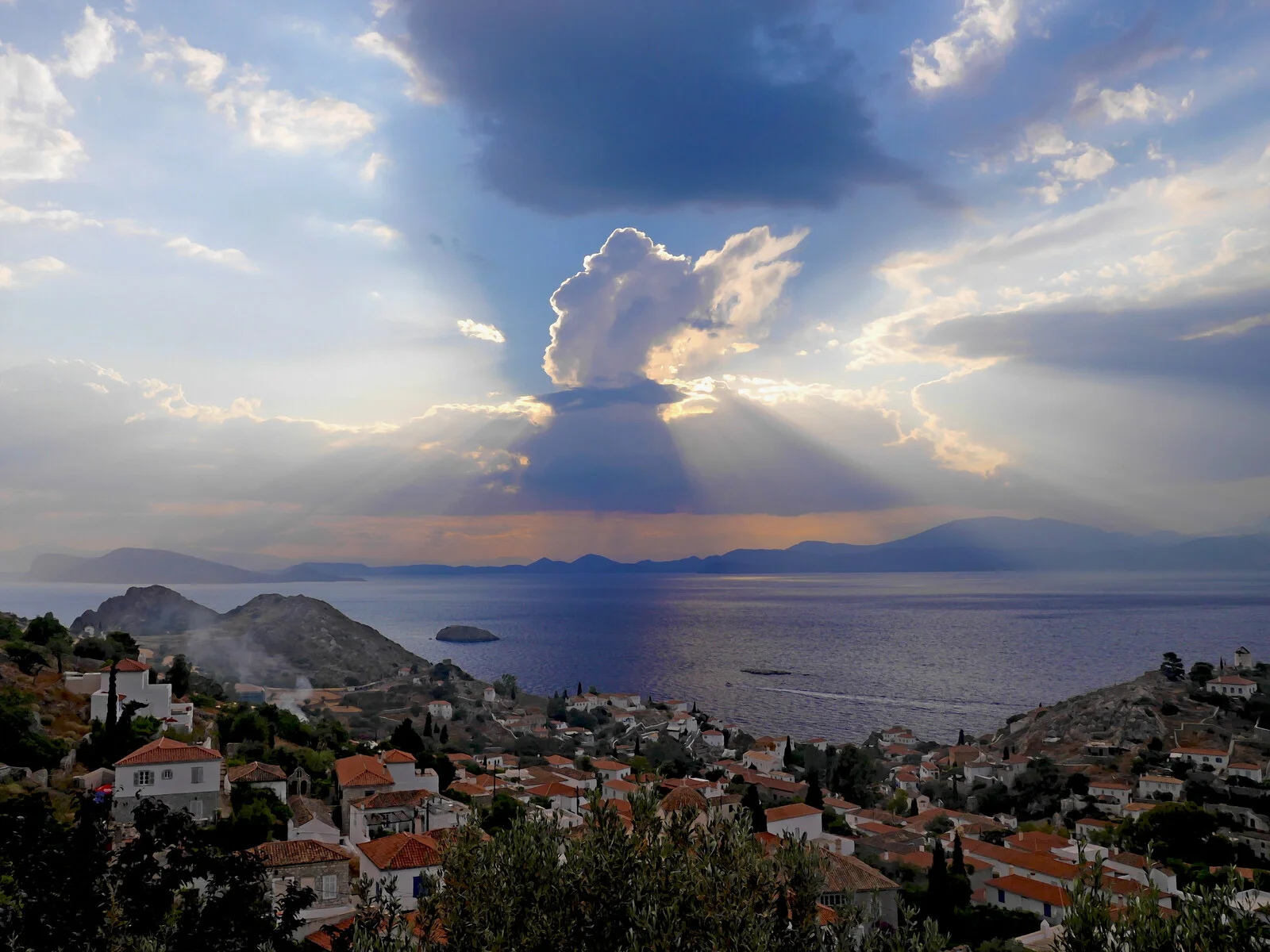
Indian Summer, 2017
Digital
100 x 70 cm
When I gaze upwards, nature unfolds its tale. On Hydra, my Greek island, the sky is a frequent narrator, allowing the clouds to skim the cream of history. The sky reveals past and future events, but one must read swiftly due to the fast and erratic winds on the upper side of the clouds. What may resemble a familiar shape one moment can transform into a shapeless mass of water vapour the next, captivating yet unpredictable to the imagination.
Cloudwatching is a patient pursuit, often at odds with the weather. In Summer, the sky is sparkling blue, the sun mercilessly shining from a clear sky. Some days, a haze may diffuse the sky, but it creates no exciting figures. The most reasonable times are spring, early Summer, and autumn, when weather systems follow one another. Small, beautiful cloud tufts rarely become exciting. The front passages promise a better show, turning the weather map into a theatre program. One must wait for the highlights of the performance.
My cloud collection boasts a variety of peculiar images: snakes that have slithered across the sky, dragons that have swallowed the sun, and Star Wars characters like the friendly Yoda who grinned at me over the horizon. It was a delight to spot the always amiable Jedi Obi-Wan Kenobi with his lightsaber. However, I still await the ominous Darth Vader, who would make a striking silhouette against the Western sky. I have a distinct cloud image of Greta Garbo, her silhouette nearly identical to the Swedish artist Einar Nerman's classic profile picture; he captured her piquant profile with just a few strokes. So did the sky.
Sometimes, the sky is cheeky. I have both an obscene, pointing finger and a penis-like cloud with testicles and clear glans in the sky. The clouds paint themselves through all phases of art history, best as expressionists, presenting the world in the sky solely from a subjective perspective, radically distorting it for the emotional effect of evoking moods or ideas.
On the twenty-first of May 2017, just before sunset, Greece was visited by one of the most exciting representatives of the indigenous people of the Americas, colloquially called Indians. The sky began to turn pink, significantly below the dark grey cloud base. Suddenly, a mass shot up from a vast cumulus, much like when a sculptor is about to begin work on a bust; with the sun as backlight, a face was built up, clay pieces were added and removed, bit by bit; the winds modelled an unmistakable face, the profile of the chief Sitting Bull, the man who stopped the racist General Custer at Little Big Horn. I took several pictures until the sky was finished and even got, if not his entire feathered headdress, then a couple of wing feathers in the sky behind his neck. Bit by bit, the wind tore pieces from the face, and soon, only a multifaceted cloud remained, reminiscent of others. Those of you looking at this see a piece of photo art at its best when nature itself has created it. I have helped by evening out contrasts in the city below me that ended up in the shadow of the natural phenomenon.
Sitting Bull was one of my childhood heroes; I preferred him over all the cowboys the other boys liked. Bang, bang, you're dead. But they could not kill Sitting Bull because he was immortal, although he had long since left the earth. This fantastic early summer day, when Sitting Bull appeared among the clouds above the Peloponnese, gave Indian Summer a comprehensible etymology. The concept means many different things depending on which country and culture one finds oneself in. Indians, the indigenous people of America, are only on the other side of the Atlantic. Indians from India are other people who also have their Indian Summer. However, they call it something else and not for the same reason as why I called the weather that May evening Indian Summer.
Cloudwatching is not merely a pastime for dreamers; it's a captivating art form, a symphony of science and imagination. Clouds, those ethereal storytellers of the sky, paint a myriad of tales, from the whimsical cumulus to the ethereal cirrus. They are the weather's heralds and the muse of our imagination, nature's Rorschach test. Join us on a delightful journey into the art of cloud spotting and the enchanting world of cloud interpretation.
Let's dive into the world of clouds, starting with the Cumulus cloud. Imagine these as the cheerful blobs of the cloud community, like fluffy cotton balls drifting lazily across a vast blue canvas. These clouds, often spotted on sunny days, are known for their low altitude and puffy appearance. If you're a weather enthusiast, cumulus clouds are reassuring, usually indicating fair weather. But beware, when they grow taller, they transform into cumulonimbus clouds, the drama queens of the atmosphere, ready to unleash thunderstorms.
Next in our cast are the Stratus clouds, the flat, featureless sheets that cover the sky like a dull grey blanket. These clouds are the background artists of the sky, setting a subdued tone and often heralding rain or drizzle. While they might not provide much inspiration for the imaginative cloud spotter, they are a dependable indicator of consistent weather.
Then there are the Cirrus clouds, high-altitude drifters that streak the sky with their wispy, delicate formations. Often appearing like soft brush strokes from a painter's hand, these ice-crystal clouds are the sophisticates of the skies. Weather-wise, cirrus clouds usually indicate a change in the weather, suggesting that a new front is moving in. For the imaginative observer, they can morph into fantastical shapes—dragons, feathers, or even the trails of distant shooting stars.
Cloudwatching also taps into our human tendency to find patterns in randomness, a phenomenon psychologists call pareidolia. Just as some might see faces or animals in the random splotches of a Rorschach inkblot test, cloud spotters can see an entire zoo in the sky—elephants, whales, or even the occasional octopus.
For those who enjoy blending creativity with a touch of meteorology, cloud-watching can be a fascinating form of amateur weather forecasting. For instance, altocumulus clouds, often resembling a flock of sheep or scaled fish, might hint at a storm brewing on the horizon. Or consider the mackerel sky, adorned with rippled altocumulus formations, a subtle suggestion that rain might be on its way.
The art of cloud interpretation is a testament to nature's infinite capacity to inspire awe. It beckons us to pause, to look up, and to marvel. Each cloud formation is a unique story, a weather forecast or a reflection of the boundless creativity of the human mind. So, the next time you find yourself reclining on a grassy knoll or gazing out a window, remember: the sky is not just a space; it's a living canvas on which nature etches its ever-evolving tales.
Indian Summer can be a quirky serenade to autumn's unexpected warmth but is also connected, like my experience, to other events and during different periods, like winter.
The term "Indian Summer," rooted in mystery and whimsy, evokes images of an unexpected, warm embrace from the sun during the crisp autumn days. Although the exact origins of the term are uncertain, it's speculated that it was named so because it was first observed in regions inhabited by Native Americans or perhaps because the natives first described these surprising warm spells to Europeans. This delightful weather anomaly, arriving after the first frost, is nature's encore to the Summer past.
Across the globe, this phenomenon wears many cultural hats. In Germany, it's known as "Altweibersommer" (old women's Summer), a nod perhaps to the spider webs that glisten in the warm sunlight of fall mornings, likened to an old woman's silvery hair. In Slavic countries, it's also affectionately termed "women's summer," suggesting a gentle and generous season. Over in Bulgaria, it's called "gipsy summer" or "poor man's summer," hinting at its brief yet rich respite before the harsh winter sets in.
In literature, Indian Summer takes on a poignant role. For instance, Boris Pasternak uses the term in his epic novel "Doctor Zhivago" to describe the eerily warm weather leading up to the October Revolution, adding a layer of dramatic irony to the storm of change brewing on the horizon. This juxtaposition of calm weather and societal turmoil presents a fascinating metaphorical narrative: the last gasp of warmth before the cold sweep of revolution.
The notion of Indian Summer is not lost in folklore. In Sweden, this period is called "Brittsommar," named after Saint Birgitta and Britta, who have their name days in early October, thereby personalising this meteorological gift. Ireland refers to it as the "little autumn of the geese," romantically linking it to the migration patterns of geese. In Spain, the phenomenon is colloquially known as "the little summer of the quince tree," painting a pastoral picture of ripe quinces under a benevolent sun.
One could even venture into the realm of myth and legend to find the ancient Greeks speaking of "halcyon days," a term derived from a fable in which calm weather was magically created amid winter for the halcyon bird to nest on the sea, which could be seen as a mirror to the Indian Summer's serene days amidst the season's transition.
Sitting Bull, the chief whose name still echoes through the corridors of history, was a complex and deeply respected leader among the Hunkpapa Lakota Sioux. His colourful and tumultuous life spanned heroic battles, the dark times of capitulation, and circus performances.
Sitting Bull, born around 1831 near the Grand River in what is now South Dakota, was destined for a life of leadership. As chief, he boldly resisted the U.S. government's attempts to suppress the free tribes on the Great Plains. His strategic leadership at the Battle of Little Big Horn in 1876, where General Custer met his fateful defeat, solidified his place in history as a fearless leader. This battle, often called Custer's Last Stand, symbolised Native American resilience and Sitting Bull's legendary status.
However, Sitting Bull's life took a tragic turn when he and his people were forced to capitulate due to growing military pressure and a lack of resources. After spending several years as a prisoner, he chose to join Buffalo Bill's Wild West show, where he performed as part of a living history exhibition. Despite being transformed into an entertainment figure, he retained his pride and dignity, a testament to his unwavering resilience. This earned him admiration and respect from those who saw him.
Sitting Bull's life was marked by his determination to protect his people's traditions and way of life. This determination was evident in a famous 1877 "New York Herald" interview. Sitting Bull is portrayed as a profound, sometimes profane, and often enigmatic figure in the interview. The intelligent, young reporter sent to interview him found it difficult to understand the complicated chief fully. Despite language barriers and cultural differences, the interview illuminated Sitting Bull's thoughts during a tumultuous time. Their conversation was between two individuals and a collision of two worlds.
The interview also highlighted something as unusual as humour and anger when Sitting Bull commented on the actions of the American military and their consequences for the native tribes. He laughed at Custer's fate at Little Big Horn, although he admitted that he had not witnessed this event; he was recovering from wounds but led his warriors in battle from a tipi nearby. This moment in the interview and survivor Peter Thompson's account of Billy Jackson's encounter with Custer at the start of the fight has contributed to the historical image of Custer as a laughing lunatic—a portrayal later popularised in Thomas Berger's "Little Big Man".
Despite his later years in subjugation and humiliation, Sitting Bull's story reminds us of a man who stood by his principles until the end of his life. He was tragically murdered in 1890 by Indian police in an attempt to arrest him amid tensions arising from the Ghost Dance movement, a religious movement embraced by the Sioux in hopes of reviving the times when their cultures thrived.
Sitting Bull leaves behind a legacy of strength and resistance that continues to inspire and evoke deep emotions. His life and leadership, from the battlefield to the circus arena, from reservation to world exhibitions, continue to testify to an individual's and a people's endurance and courage.
I will use four quotes from Sitting Bull to conclude his story and his people's.
"I am a red man. If the Great Spirit had desired me to be a white man, he would have made me so in the first place."
"When I was a boy, the Sioux owned the world. The sun rose and set on their land; they sent ten thousand men to battle. Where are the warriors today? Who slew them? Where are our lands? Who owns them?"
"What white man has ever seen me drunk? Who has ever come to me hungry and left me unfed? Who has seen me beat my wives or abuse my children? What law have I broken?"
" Only seven years ago, we made a treaty by which we were assured that the buffalo country would be left to us forever. Now they threaten to take that from us also."
And now, there are some words about his opponent, General George Armstrong Custer—a name that can make history books chuckle so heartily that the pages almost fold. Custer, often described as one of the most overrated military figures in American history, is as colourful as he is controversial. His life and career were filled with so many failures that he almost comes across as a caricature of the overly ambitious general who not only led his men to slaughter but did so with a near-comic self-assurance.
Born in 1839, Custer quickly rose through the ranks, largely thanks to his bold style and ability to capture the media's and superiors' attention. However, what is often forgotten in the tales of his heroic charges is that he was as likely to fall off his horse due to his clumsiness as he was to stay in the saddle through skill.
Custer is perhaps most infamous for his role in the Battle of Little Big Horn in 1876, often called Custer's Last Stand. There, in a moment of what could be seen as bravery or sheer folly, he decided to attack a superior force of Lakota Sioux and Cheyenne warriors. The result? It was a catastrophic defeat where Custer and his men were annihilated. It's a story that could have been told with Benny Hill music in the background to underscore the absurd tactics.
Custer's racist attitude and his aggressive strategy against Native Americans have retrospectively been seen not just as ethically questionable but downright harmful, creating deep scars in U.S. history. He pushed policies and military actions that led to great suffering and death for many indigenous peoples.
After his death, Custer has often been portrayed as a hero in popular culture, an image that many historians have questioned and criticised. Ironically, he has become somewhat of a legend, not for his successes but for his spectacular ability to fail in the most dramatic ways possible.
"They died with their boots on," as Custer fans say. This likely holds, considering the Indians removed them from the corpses afterwards. A scalp or two also went along with them.
Despite all this, it's hard not to find some entertainment in Custer's fate. His life was a series of miscalculated decisions and tactical blunders that would make any satirist green with envy. So next time you think of Custer, remember that his most outstanding achievement may have been becoming such an excellent story—a reminder that even in history, the biggest bunglers can give us something to laugh at, albeit with a tinge of bitterness. There are varying accounts of what Custer is supposed to have said and done before he died. He was said to have laughed like a madman, while the only survivor claimed he cursed and damned the Indians. More on this in the following anecdote from the hundredth-anniversary celebration of the battle.
The Battle of the Little Bighorn, known to the Lakota and other Plains Indians as the Battle of the Greasy Grass, took place on June 25–26, 1876.
It was time to celebrate the battle's centennial in the small town of Hardin, Montana, the county seat of Big Horn County. The mayor had long planned for this event. A couple of years earlier, he had announced a competition to paint a gigantic mural in the planned new county house. As usual, the commission went through strange channels via friends of friends, the governor's cousin, and so on.
The mayor finally commissioned a mural by a well-known local artist to be drawn in the future assembly room. A gigantic curtain hid the wall from everyone's view. It had been the artist's condition. He, like Michelangelo, did not want other eyes on him while he worked. The mayor and his wife were going out of town on a month-long business trip in Asia. The President of the United States had been on an official visit to China the year before. Now, China invited all American dignitaries curious to see how a communist country operated.
Before he left, he told the artist that they wanted the mural to depict Custer's last thoughts and words and expected it to be done by the time he returned. The mayor paid the artist in advance and went to China, planning a tiny detour home via the paradise of the Seychelles, all at the taxpayers' expense. Thank him for that; he offered his and his wife's precious time.
He returned eight weeks later, excited to see the painting. They had been forced to travel via New York because there was something his wife needed to shop for, and then he needed to stay a few days in Washington to bribe some congressmen so they would contribute to the upcoming anniversary.
When he returned, he looked upon the painting in horror, as the painter on the colossal wall had drawn a giant cow with a halo around its head and hundreds of Indians surrounding it in every sex position imaginable. So infuriated, the mayor called up the painter, asking:
"What the hell is this? I said I wanted Custer's last words to inspire you, and you painted this atrocity on my wall!" The artist was amazed and pulled out a book the mayor had given him. He flipped to page 127 and pointed to something he had underlined, which, according to Frank Finkel, the only survivor from the massacre, purported to be what he heard the general scream before he died from an axe to the skull.
There on the page, the quote was in black and white, "Holy Cow, look at all those fucking Indians."
Jörgen Thornberg
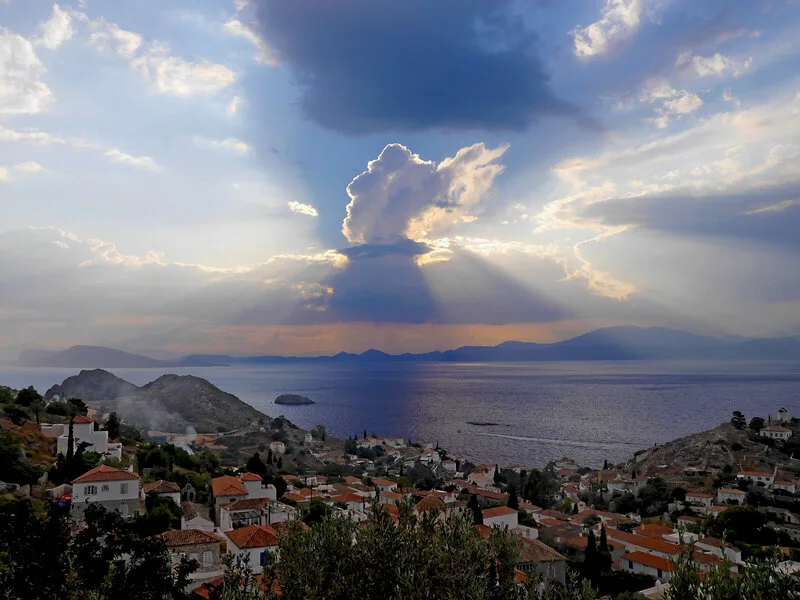
Indian Summer, 2017
Digital
100 x 70 cm
When I gaze upwards, nature unfolds its tale. On Hydra, my Greek island, the sky is a frequent narrator, allowing the clouds to skim the cream of history. The sky reveals past and future events, but one must read swiftly due to the fast and erratic winds on the upper side of the clouds. What may resemble a familiar shape one moment can transform into a shapeless mass of water vapour the next, captivating yet unpredictable to the imagination.
Cloudwatching is a patient pursuit, often at odds with the weather. In Summer, the sky is sparkling blue, the sun mercilessly shining from a clear sky. Some days, a haze may diffuse the sky, but it creates no exciting figures. The most reasonable times are spring, early Summer, and autumn, when weather systems follow one another. Small, beautiful cloud tufts rarely become exciting. The front passages promise a better show, turning the weather map into a theatre program. One must wait for the highlights of the performance.
My cloud collection boasts a variety of peculiar images: snakes that have slithered across the sky, dragons that have swallowed the sun, and Star Wars characters like the friendly Yoda who grinned at me over the horizon. It was a delight to spot the always amiable Jedi Obi-Wan Kenobi with his lightsaber. However, I still await the ominous Darth Vader, who would make a striking silhouette against the Western sky. I have a distinct cloud image of Greta Garbo, her silhouette nearly identical to the Swedish artist Einar Nerman's classic profile picture; he captured her piquant profile with just a few strokes. So did the sky.
Sometimes, the sky is cheeky. I have both an obscene, pointing finger and a penis-like cloud with testicles and clear glans in the sky. The clouds paint themselves through all phases of art history, best as expressionists, presenting the world in the sky solely from a subjective perspective, radically distorting it for the emotional effect of evoking moods or ideas.
On the twenty-first of May 2017, just before sunset, Greece was visited by one of the most exciting representatives of the indigenous people of the Americas, colloquially called Indians. The sky began to turn pink, significantly below the dark grey cloud base. Suddenly, a mass shot up from a vast cumulus, much like when a sculptor is about to begin work on a bust; with the sun as backlight, a face was built up, clay pieces were added and removed, bit by bit; the winds modelled an unmistakable face, the profile of the chief Sitting Bull, the man who stopped the racist General Custer at Little Big Horn. I took several pictures until the sky was finished and even got, if not his entire feathered headdress, then a couple of wing feathers in the sky behind his neck. Bit by bit, the wind tore pieces from the face, and soon, only a multifaceted cloud remained, reminiscent of others. Those of you looking at this see a piece of photo art at its best when nature itself has created it. I have helped by evening out contrasts in the city below me that ended up in the shadow of the natural phenomenon.
Sitting Bull was one of my childhood heroes; I preferred him over all the cowboys the other boys liked. Bang, bang, you're dead. But they could not kill Sitting Bull because he was immortal, although he had long since left the earth. This fantastic early summer day, when Sitting Bull appeared among the clouds above the Peloponnese, gave Indian Summer a comprehensible etymology. The concept means many different things depending on which country and culture one finds oneself in. Indians, the indigenous people of America, are only on the other side of the Atlantic. Indians from India are other people who also have their Indian Summer. However, they call it something else and not for the same reason as why I called the weather that May evening Indian Summer.
Cloudwatching is not merely a pastime for dreamers; it's a captivating art form, a symphony of science and imagination. Clouds, those ethereal storytellers of the sky, paint a myriad of tales, from the whimsical cumulus to the ethereal cirrus. They are the weather's heralds and the muse of our imagination, nature's Rorschach test. Join us on a delightful journey into the art of cloud spotting and the enchanting world of cloud interpretation.
Let's dive into the world of clouds, starting with the Cumulus cloud. Imagine these as the cheerful blobs of the cloud community, like fluffy cotton balls drifting lazily across a vast blue canvas. These clouds, often spotted on sunny days, are known for their low altitude and puffy appearance. If you're a weather enthusiast, cumulus clouds are reassuring, usually indicating fair weather. But beware, when they grow taller, they transform into cumulonimbus clouds, the drama queens of the atmosphere, ready to unleash thunderstorms.
Next in our cast are the Stratus clouds, the flat, featureless sheets that cover the sky like a dull grey blanket. These clouds are the background artists of the sky, setting a subdued tone and often heralding rain or drizzle. While they might not provide much inspiration for the imaginative cloud spotter, they are a dependable indicator of consistent weather.
Then there are the Cirrus clouds, high-altitude drifters that streak the sky with their wispy, delicate formations. Often appearing like soft brush strokes from a painter's hand, these ice-crystal clouds are the sophisticates of the skies. Weather-wise, cirrus clouds usually indicate a change in the weather, suggesting that a new front is moving in. For the imaginative observer, they can morph into fantastical shapes—dragons, feathers, or even the trails of distant shooting stars.
Cloudwatching also taps into our human tendency to find patterns in randomness, a phenomenon psychologists call pareidolia. Just as some might see faces or animals in the random splotches of a Rorschach inkblot test, cloud spotters can see an entire zoo in the sky—elephants, whales, or even the occasional octopus.
For those who enjoy blending creativity with a touch of meteorology, cloud-watching can be a fascinating form of amateur weather forecasting. For instance, altocumulus clouds, often resembling a flock of sheep or scaled fish, might hint at a storm brewing on the horizon. Or consider the mackerel sky, adorned with rippled altocumulus formations, a subtle suggestion that rain might be on its way.
The art of cloud interpretation is a testament to nature's infinite capacity to inspire awe. It beckons us to pause, to look up, and to marvel. Each cloud formation is a unique story, a weather forecast or a reflection of the boundless creativity of the human mind. So, the next time you find yourself reclining on a grassy knoll or gazing out a window, remember: the sky is not just a space; it's a living canvas on which nature etches its ever-evolving tales.
Indian Summer can be a quirky serenade to autumn's unexpected warmth but is also connected, like my experience, to other events and during different periods, like winter.
The term "Indian Summer," rooted in mystery and whimsy, evokes images of an unexpected, warm embrace from the sun during the crisp autumn days. Although the exact origins of the term are uncertain, it's speculated that it was named so because it was first observed in regions inhabited by Native Americans or perhaps because the natives first described these surprising warm spells to Europeans. This delightful weather anomaly, arriving after the first frost, is nature's encore to the Summer past.
Across the globe, this phenomenon wears many cultural hats. In Germany, it's known as "Altweibersommer" (old women's Summer), a nod perhaps to the spider webs that glisten in the warm sunlight of fall mornings, likened to an old woman's silvery hair. In Slavic countries, it's also affectionately termed "women's summer," suggesting a gentle and generous season. Over in Bulgaria, it's called "gipsy summer" or "poor man's summer," hinting at its brief yet rich respite before the harsh winter sets in.
In literature, Indian Summer takes on a poignant role. For instance, Boris Pasternak uses the term in his epic novel "Doctor Zhivago" to describe the eerily warm weather leading up to the October Revolution, adding a layer of dramatic irony to the storm of change brewing on the horizon. This juxtaposition of calm weather and societal turmoil presents a fascinating metaphorical narrative: the last gasp of warmth before the cold sweep of revolution.
The notion of Indian Summer is not lost in folklore. In Sweden, this period is called "Brittsommar," named after Saint Birgitta and Britta, who have their name days in early October, thereby personalising this meteorological gift. Ireland refers to it as the "little autumn of the geese," romantically linking it to the migration patterns of geese. In Spain, the phenomenon is colloquially known as "the little summer of the quince tree," painting a pastoral picture of ripe quinces under a benevolent sun.
One could even venture into the realm of myth and legend to find the ancient Greeks speaking of "halcyon days," a term derived from a fable in which calm weather was magically created amid winter for the halcyon bird to nest on the sea, which could be seen as a mirror to the Indian Summer's serene days amidst the season's transition.
Sitting Bull, the chief whose name still echoes through the corridors of history, was a complex and deeply respected leader among the Hunkpapa Lakota Sioux. His colourful and tumultuous life spanned heroic battles, the dark times of capitulation, and circus performances.
Sitting Bull, born around 1831 near the Grand River in what is now South Dakota, was destined for a life of leadership. As chief, he boldly resisted the U.S. government's attempts to suppress the free tribes on the Great Plains. His strategic leadership at the Battle of Little Big Horn in 1876, where General Custer met his fateful defeat, solidified his place in history as a fearless leader. This battle, often called Custer's Last Stand, symbolised Native American resilience and Sitting Bull's legendary status.
However, Sitting Bull's life took a tragic turn when he and his people were forced to capitulate due to growing military pressure and a lack of resources. After spending several years as a prisoner, he chose to join Buffalo Bill's Wild West show, where he performed as part of a living history exhibition. Despite being transformed into an entertainment figure, he retained his pride and dignity, a testament to his unwavering resilience. This earned him admiration and respect from those who saw him.
Sitting Bull's life was marked by his determination to protect his people's traditions and way of life. This determination was evident in a famous 1877 "New York Herald" interview. Sitting Bull is portrayed as a profound, sometimes profane, and often enigmatic figure in the interview. The intelligent, young reporter sent to interview him found it difficult to understand the complicated chief fully. Despite language barriers and cultural differences, the interview illuminated Sitting Bull's thoughts during a tumultuous time. Their conversation was between two individuals and a collision of two worlds.
The interview also highlighted something as unusual as humour and anger when Sitting Bull commented on the actions of the American military and their consequences for the native tribes. He laughed at Custer's fate at Little Big Horn, although he admitted that he had not witnessed this event; he was recovering from wounds but led his warriors in battle from a tipi nearby. This moment in the interview and survivor Peter Thompson's account of Billy Jackson's encounter with Custer at the start of the fight has contributed to the historical image of Custer as a laughing lunatic—a portrayal later popularised in Thomas Berger's "Little Big Man".
Despite his later years in subjugation and humiliation, Sitting Bull's story reminds us of a man who stood by his principles until the end of his life. He was tragically murdered in 1890 by Indian police in an attempt to arrest him amid tensions arising from the Ghost Dance movement, a religious movement embraced by the Sioux in hopes of reviving the times when their cultures thrived.
Sitting Bull leaves behind a legacy of strength and resistance that continues to inspire and evoke deep emotions. His life and leadership, from the battlefield to the circus arena, from reservation to world exhibitions, continue to testify to an individual's and a people's endurance and courage.
I will use four quotes from Sitting Bull to conclude his story and his people's.
"I am a red man. If the Great Spirit had desired me to be a white man, he would have made me so in the first place."
"When I was a boy, the Sioux owned the world. The sun rose and set on their land; they sent ten thousand men to battle. Where are the warriors today? Who slew them? Where are our lands? Who owns them?"
"What white man has ever seen me drunk? Who has ever come to me hungry and left me unfed? Who has seen me beat my wives or abuse my children? What law have I broken?"
" Only seven years ago, we made a treaty by which we were assured that the buffalo country would be left to us forever. Now they threaten to take that from us also."
And now, there are some words about his opponent, General George Armstrong Custer—a name that can make history books chuckle so heartily that the pages almost fold. Custer, often described as one of the most overrated military figures in American history, is as colourful as he is controversial. His life and career were filled with so many failures that he almost comes across as a caricature of the overly ambitious general who not only led his men to slaughter but did so with a near-comic self-assurance.
Born in 1839, Custer quickly rose through the ranks, largely thanks to his bold style and ability to capture the media's and superiors' attention. However, what is often forgotten in the tales of his heroic charges is that he was as likely to fall off his horse due to his clumsiness as he was to stay in the saddle through skill.
Custer is perhaps most infamous for his role in the Battle of Little Big Horn in 1876, often called Custer's Last Stand. There, in a moment of what could be seen as bravery or sheer folly, he decided to attack a superior force of Lakota Sioux and Cheyenne warriors. The result? It was a catastrophic defeat where Custer and his men were annihilated. It's a story that could have been told with Benny Hill music in the background to underscore the absurd tactics.
Custer's racist attitude and his aggressive strategy against Native Americans have retrospectively been seen not just as ethically questionable but downright harmful, creating deep scars in U.S. history. He pushed policies and military actions that led to great suffering and death for many indigenous peoples.
After his death, Custer has often been portrayed as a hero in popular culture, an image that many historians have questioned and criticised. Ironically, he has become somewhat of a legend, not for his successes but for his spectacular ability to fail in the most dramatic ways possible.
"They died with their boots on," as Custer fans say. This likely holds, considering the Indians removed them from the corpses afterwards. A scalp or two also went along with them.
Despite all this, it's hard not to find some entertainment in Custer's fate. His life was a series of miscalculated decisions and tactical blunders that would make any satirist green with envy. So next time you think of Custer, remember that his most outstanding achievement may have been becoming such an excellent story—a reminder that even in history, the biggest bunglers can give us something to laugh at, albeit with a tinge of bitterness. There are varying accounts of what Custer is supposed to have said and done before he died. He was said to have laughed like a madman, while the only survivor claimed he cursed and damned the Indians. More on this in the following anecdote from the hundredth-anniversary celebration of the battle.
The Battle of the Little Bighorn, known to the Lakota and other Plains Indians as the Battle of the Greasy Grass, took place on June 25–26, 1876.
It was time to celebrate the battle's centennial in the small town of Hardin, Montana, the county seat of Big Horn County. The mayor had long planned for this event. A couple of years earlier, he had announced a competition to paint a gigantic mural in the planned new county house. As usual, the commission went through strange channels via friends of friends, the governor's cousin, and so on.
The mayor finally commissioned a mural by a well-known local artist to be drawn in the future assembly room. A gigantic curtain hid the wall from everyone's view. It had been the artist's condition. He, like Michelangelo, did not want other eyes on him while he worked. The mayor and his wife were going out of town on a month-long business trip in Asia. The President of the United States had been on an official visit to China the year before. Now, China invited all American dignitaries curious to see how a communist country operated.
Before he left, he told the artist that they wanted the mural to depict Custer's last thoughts and words and expected it to be done by the time he returned. The mayor paid the artist in advance and went to China, planning a tiny detour home via the paradise of the Seychelles, all at the taxpayers' expense. Thank him for that; he offered his and his wife's precious time.
He returned eight weeks later, excited to see the painting. They had been forced to travel via New York because there was something his wife needed to shop for, and then he needed to stay a few days in Washington to bribe some congressmen so they would contribute to the upcoming anniversary.
When he returned, he looked upon the painting in horror, as the painter on the colossal wall had drawn a giant cow with a halo around its head and hundreds of Indians surrounding it in every sex position imaginable. So infuriated, the mayor called up the painter, asking:
"What the hell is this? I said I wanted Custer's last words to inspire you, and you painted this atrocity on my wall!" The artist was amazed and pulled out a book the mayor had given him. He flipped to page 127 and pointed to something he had underlined, which, according to Frank Finkel, the only survivor from the massacre, purported to be what he heard the general scream before he died from an axe to the skull.
There on the page, the quote was in black and white, "Holy Cow, look at all those fucking Indians."

Jörgen Thornberg
Malmö
Lite om bilder och mig. Translation in English at the end.
Jag är en nyfiken person som ser allt i bilder, även det jag fäster i ord, gärna tillsammans för bakom alla mina bilder finns en berättelse. Till vissa bilder hör en kortare eller längre novell som följer med bilden.
Bilder berättar historier. Jag omges av naturlig skönhet, intressanta människor och historia var jag än går. Jag använder min kamera för att dokumentera världen och blanda det jag ser med vad jag känner för att fånga den dolda magin.
Mina bilder berättar mina historier. Genom mina bilder, tryck och berättelser. Jag bjuder in dig att ta del av dessa berättelser, in i ditt liv och hem och dela min mycket personliga syn på vår värld. Mer än vad ögat ser. Jag tänker i bilder, drömmer och skriver och pratar om dem; följaktligen måste jag också skapa bilder. De blir vad jag ser, inte nödvändigtvis begränsade till verkligheten. Det finns en bild runt varje hörn. Jag hoppas att du kommer att se vad jag såg och gilla det.
Jag är också en skrivande person och till många bilder hör en kortare eller längre essay. Den följer med tavlan, tryckt på fint papper och med en personlig hälsning från mig.
Flertalet bilder startar sin resa i min kamera. Enkelt förklarat beskriver jag bilden jag ser i mitt inre, upplevd eller fantiserad. Bilden uppstår inom mig redan innan jag fått okularet till ögat. På bråkdelen av ett ögonblick ser jag vad jag vill ha och vad som kan göras med bilden. Här skall jag stoppa in en giraff, stålmannen, Titanic eller vad det är min fantasi finner ut. Ännu märkligare är att jag kommer ihåg minnesbilden långt efteråt när det blir tid att skapa verket. Om jag lyckas eller inte, är upp till betraktaren, oftast präglat av en stråk av svart humor – meningen är att man skall bli underhållen. Mina bilder blir ofta en snackis där de hänger.
Jag föredrar bilder som förmedlar ett budskap i flera lager. Vid första anblicken fylld av feel-good, en vacker utsikt, fint väder, solen skiner, blommor på ängen eller vattnet som ligger förrädiskt spegelblankt. I en sådan bild kan jag gömma min egentliga berättelse, mitt förakt för förtryckare och våldsverkare, rasister och fördomsfulla människor - ett gärna återkommande motiv mer eller mindre dolt i det vackra motivet. Jag försöker förena dem i ett gemensamt narrativ.
Bild och formgivning har löpt som en röd tråd genom livet. Fotokonst känns som en värdig final som jag gärna delar med mig.
Min genre är vid som framgår av mina bilder, temat en blandning av pop- och gatukonst i kollage som kan bestå av hundratals lager. Vissa bilder kan ta veckor, andra någon dag innan det är dags att överlämna resultatet till printverkstaden. Fine Art Prints är digitala fotocollage. I dessa kollage sker rivandet, klippandet, pusslandet, målandet, ritandet och sprayningen digitalt. Det jag monterar in kan vara hundratals år gamla bilder som jag omsorgsfullt frilägger så att de ser ut att vara en del av tavlan men också bilder skapade av mig själv efter min egen fantasi. Därefter besöks printstudion och för vissa bilder numrera en limiterad upplaga (oftast 7 exemplar) och signera för hand. Vissa bilder kan köpas i olika format. Det är bara att fråga efter vilka. Gillar man en bild som är 70x100 men inte har plats på väggen, går den kanske att få i 50x70 cm istället. Frågan är fri.
Metoden Giclée eller Fine Art Print som det också kallas är det moderna sättet för framställning av grafisk konst. Villkoret för denna typ av utskrifter är att en högkvalitativ storformatskrivare används med åldersbeständigt färgpigment och konstnärspapper eller i förekommande fall på duk. Pappret som används möter de krav på livslängd som ställs av museer och gallerier. Normalt säljer jag mina bilder oinramade så att den nya ägaren själv kan bestämma hur de skall se ut, med eller utan passepartout färg på ram, med eller utan glas etc..
Under många år ställde jag bara ut på nätet, i valda grupper och på min egen Facebooksida - https://www.facebook.com/jorgen.thornberg.9
Jag finns också på en egen hemsida som tyvärr inte alltid är uppdaterad – https://www.jth.life/ Där kan du också läsa en del av de berättelser som följer med bilden.
UTSTÄLLNINGAR
Luftkastellet, oktober 2022
Konst i Lund, november 2022
Luftkastellet, mars 2023
Engleson Galleri Caroli, april 2023
Hydra, Greece June 2023
Engleson Galleri Caroli, oktober 2023
Toppen, Höllviken december 2023
Luftkastellet, mars 2024
Torups Galleri, mars 2024
Venice, May 2024
Luftkastellet, oktober 2024
Konst i Advent, December 2024
Galleri Engleson, Caroli December 2024
Jäger & Jansson Galleri, april 2025
A bit about pictures and me.
I'm a curious person who sees everything in pictures, even what I express in words, often combining them, for behind all my pictures lies a story. These narratives, some as short as a single image and others as long as a novel, are the heart and soul of my work.
Pictures tell stories. Wherever I go, I'm surrounded by natural beauty, exciting people, and history. I use my camera to document the world and blend what I see with what I feel to capture the hidden magic.
My images tell my stories. Through my pictures, prints, and narratives, I invite you to partake in these stories in your life and home and share my deeply personal perspective of our world. More than meets the eye. I think in pictures, dream, write, and talk about them; consequently, I must create images too. They become what I see, not necessarily confined to reality. There's a picture around every corner. I hope you'll see what I saw and enjoy it.
I'm also a writer, and many images come with a shorter or longer essay. It accompanies the painting, printed on fine paper with my personal greeting.
Many pictures start their journey on my camera. Simply put, I describe the image I see in my mind, experienced or imagined. The image arises within me even before I bring the eyepiece to my eye. In a fraction of a moment, I see what I want and what can be done with the picture. Here, I'll insert a giraffe, Superman, the Titanic, or whatever my imagination conjures up. Even stranger is that I remember the mental image long after it's time to create the work. Whether I succeed is up to the observer, often imbued with a streak of black humour – the aim is to entertain. My pictures usually become a talking point wherever they hang.
I prefer pictures that convey a message in multiple layers. At first glance, they're filled with feel-good vibes, a beautiful view, lovely weather, the sun shining, flowers in the meadow, or the water lying deceptively calm. But beneath this surface beauty, I often conceal a deeper story, a narrative that challenges societal norms or explores the human condition. I invite you to delve into these hidden narratives and discover the layers of meaning within my work.
Picture and design have been a thread running through my life. Photographic art feels like a fitting finale, and I'm happy to share it.
My genre is varied, as seen in my pictures; the theme is a blend of pop and street art in collages that can consist of hundreds of layers. Some images can take weeks, others just a day before it's time to hand over the result to the print workshop. Fine Art Prints are digital photo collages. In these collages, tearing, cutting, puzzling, painting, drawing, and spraying happen digitally. What I insert can be images hundreds of years old that I carefully extract so they appear to be part of the painting, but also images created by myself, now also generated from my imagination. Next, visit the print studio and, for certain images, number a limited edition (usually 7 copies) and sign them by hand. Some images may be available in other formats. Just ask which ones. If you like an image that's 70x100 but doesn't have space on the wall, you might be able to get it in 50x70 cm instead. The question is open.
The Giclée method, or Fine Art Print as it's also called, is the modern way of producing graphic art. This method ensures the highest quality and longevity of the artwork, using a high-quality large-format printer with archival pigment inks and artist paper or, in some cases, canvas. The paper used meets the longevity requirements set by museums and galleries. I sell my pictures unframed, allowing the new owner to personalise their artwork, confident in the lasting value and quality of the piece.
For many years, I only exhibited online, in selected groups, and on my Facebook page - https://www.facebook.com/jorgen.thornberg.9. I also have my website, which unfortunately is not constantly updated - https://www.jth.life/. You can also read some of the stories accompanying the pictures there.
EXHIBITIONS
Luftkastellet, October 2022
Art in Lund, November 2022
Luftkastellet, March 2023
Engleson Gallery Caroli, April 2023
Hydra, Greece June 2023
Engleson Gallery Caroli, October 2023
Toppen, Höllviken December 2023
Luftkastellet, March 2024
Torup Gallery, March 2024
Venice, May 2024
UTSTÄLLNINGAR
Luftkastellet, oktober 2022
Konst i Lund, november 2022
Luftkastellet, mars 2023
Engleson Galleri Caroli, april 2023
Hydra, Greece June 2023
Engleson Galleri Caroli, oktober 2023
Toppen, Höllviken december 2023
Luftkastellet, mars 2024
Torups Galleri, mars 2024
Venice, May 2024
Luftkastellet, October 2024
Konst i Advent, December 2024
Galleri Engleson, Caroli December 2024
Jäger & Jansson Galleri, April 2025
Utbildning
Autodidakt
Medlem i konstnärsförening
Öppna Sinnen
Med i konstrunda
Konstrundan i Skåne
Utställningar
Luftkastellet, October 2022
Art in Lund, November 2022
Luftkastellet, March 2023
Engleson Gallery Caroli, April 2023
Hydra, Greece June 2023
Engleson Gallery Caroli, October 2023
Toppen, Höllviken December 2023
Luftkastellet, March 2024
Torup Gallery, March 2024
Venice, May 2024