Vi använder cookies för att ge dig bästa möjliga upplevelse. Välj vilka cookies du tillåter.
Läs mer i vår integritetspolicy
Jörgen Thornberg
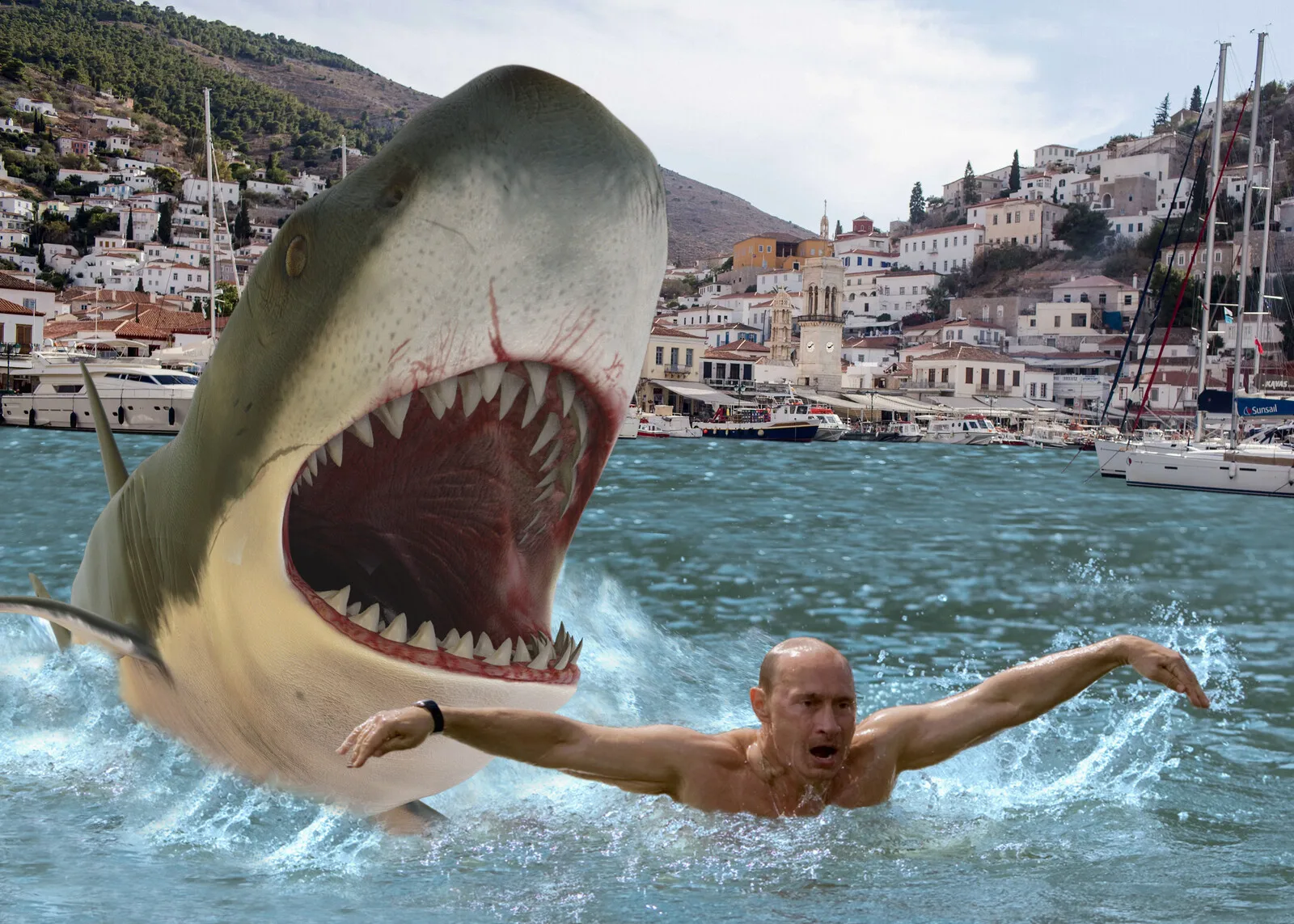
Hydra no refuge for everybody, 2023
Digital
70 x 50 cm
Hydra is a sanctuary for visitors, where unpleasant encounters are almost unheard of unless one happens to trip while under the influence. Crime, except tax evasion, is a rarity, a peculiarity of Greek culture. I can confidently affirm that crimes against individuals, mainly tourists, are extremely rare. You can freely wander the island, even in the most secluded corners, without a trace of fear or the need to constantly watch your back. The local authorities and community are committed to maintaining a safe environment, with regular patrols and a strong sense of community vigilance.
Hydra is also renowned for its allure to celebrities, with countless stars gracing the island since tourism took off in the 1950s. Furthermore, Hydra is not a place that appeals to modern-day criminals. It's hard to blend in; more importantly, the only way to enter or exit is by boat. The taxi boat drivers are watchful, a fact that some have learned the hard way. Beyond its safety, Hydra offers a unique blend of history, culture, and natural beauty, with its picturesque harbour, charming cobblestone streets, and a wealth of historical sites waiting to be explored.
A few real villains have been on the island. Serbian war criminal Slobodan Milošević was on the island while being hunted across Europe. His family still owns a formidable villa away from Hydra town. Greece and Serbia, both Greek Orthodox countries, have good relations, and he may have felt safe here.
The likelihood of a high-profile war criminal visiting Hydra is about as high as finding a great white shark in our waters, which is nearly non-existent. If both happened simultaneously, the outcome would be almost the opposite. The visitor would get wet, and the shark would get fed. No tribunals or courtrooms filled with legal gymnastics are needed to handle that.
Hydra has an old tradition of throwing unpleasant and undesirable people into the harbour basin. Putin has few friends in Greece and would surely end up in the wet, especially if the unlikely great white shark lurks in the azure waters.
The thought of it pleased me so much that I couldn't help but share the joy. Killing war criminals of Putin's stature hasn't been on the shark menu since the Nuremberg trials of World War II. I rejoice with those who rejoice and do not care about those who do not.
The Hydriots, once skilled sailors and even notorious pirates reigned over the waters of the Greek archipelago. When the war of independence erupted, and the call to drive the Turks out of Greece echoed, the Hydriots and their formidable fleet led the charge. Their mastery of sailing and combat, and their unwavering efforts, led to Greece's liberation after three hundred sixty years. Eighteen hundred, if you consider the time since Rome absorbed classical Greece. The Greeks had their share of oppressors, and their victory stands as a testament to the unique history and spirit of Hydra.
A great white shark has indeed been on Hydra. It was a stuffed one, part of a practical joke at the classic nightclub Lagoudera, set up by the owner, Babis Mores. It happened during one of his legendary parties, almost as wet as the sea outside. Babis had purchased the already deceased shark, which had been displayed for money along the southern coast of the Peloponnese. Loads of ice had managed to preserve it for several weeks, but the owners wanted to get rid of the monster shark that stank worse than it looked. Babis got it cheaply and transported the beast, well-packed in ice, to Hydra. After lying on ice for a few days, it was lowered into the water outside the club, anchored with cleverly arranged ropes that led up to the club. It was a gift to one of Babis's frequent guests, the notorious ladies' man, the Spanish Count of Barcelona, Juan Carlos. He had a habit of diving directly into the sea from the club's terrace, a three-meter swan dive intended to impress some new skirt he had brought along. This time, a shark appeared just as he jumped. That it was stone dead, he could not know. Everyone laughed at the intermezzo, including Juan Carlos, who had a good sense of humour.
The Mediterranean Sea, a vast body of water stretching from the coast of Syria in the east to Spain in the west, is a popular destination for many Scandinavians. The European countries bordering the Mediterranean, such as France, Italy, and Greece, are treasure troves for sun-worshipping Scandinavians seeking a sun-sure holiday without flying more than a couple of hours. While the Mediterranean can offer many surprises – both pleasant and unpleasant- shark attacks are extremely rare, providing a safe environment for your marine adventures.
The great white shark, the largest and perhaps most fearsome shark in the world (also known as the man-eater), is indeed present in the Mediterranean—but to a minimal extent. There are so few that the International Union for Conservation of Nature (IUCN) classifies them as' endangered', a status that reflects their vulnerability to extinction due to various threats, including overfishing and habitat degradation. This rarity of sightings adds to the intrigue and fascination of encountering these majestic creatures in the Mediterranean.
There are about 45 different species of sharks in the Mediterranean, but most are very small and live in the deep sea. Shark encounters are rare near the Mediterranean coast, and when they do occur, they are often a result of mistaken identity, with sharks mistaking humans for their natural prey. Since 1900, just over 100 shark encounters have been reported in countries like Italy, Greece, and Croatia. The last time a shark drew attention in the Mediterranean was in June 2017, when a lost blue shark frightened bathers in Mallorca.
The most common sharks in the Mediterranean are:
The hammerhead shark looks funny, and the name explains why. It can grow up to 4 meters long and weigh 400 kg. It is characteristically shaped with a hammer-shaped head.
- The tiger shark, a faintly striped grey shark, usually grows up to 3.5 meters and has sharp teeth, which it uses to tear apart its prey.
The thresher shark is a smaller, rare shark with a slender tail fin. It mainly feeds on schooling fish and squid.
The blue shark, a dark blue shark with a classic shark appearance, grows up to 3.5 meters long. It is an omnivore that feeds on everything from squid to sea birds.
- The porbeagle, resembling the appearance of the great white, primarily feeds on schooling fish such as herring. No attacks on humans have been documented.
The spiny dogfish is a small, popular food fish that rarely grows longer than one meter. It is also found in Swedish waters.
The great white shark, a natural part of the Mediterranean, boasts a native population genetically distinct from other significant white shark populations. Today, the number of great whites in the Mediterranean remains a mystery. Still, we know that the number of observations and attacks has decreased over the last hundred years, making each encounter exceptional. This rich history and the current presence of great whites in the Mediterranean are a testament to their resilience and adaptability, inspiring awe and respect in all who encounter them.
Research on the presence of the great white shark in the Mediterranean has confirmed approximately 630 reported cases. The great white shark has attacked humans 42 times in the Mediterranean, and human remains have been found 11 times as stomach contents.
Statistically, the largest great whites are found in the western Mediterranean, especially around the popular destination of Mallorca and the nearby islands (Balearic Islands). This part of the Mediterranean houses a high biomass due to a local upwelling area of nutrient-rich deep water. The sardine has the highest occurrence of great whites in the Mediterranean, where smaller great whites and newborns are also found. Great whites can be observed near the coast in August. Most great white sightings occur during the summer half of the year.
The world's most significant number of great whites was reported in the Mediterranean.
Historically, the Mediterranean houses some of the largest great whites ever caught, up to about 6 meters in total length. For example, the Maguelone great white from the French Riviera is the world's largest reported great white. Great whites are documented in natural history museums in countries around the Mediterranean. Old photographs testify to how large great whites can get, but stuffed great whites and casts are confirmed evidence of some of the world's largest excellent white specimens.
Over the last few decades, great whites in the Mediterranean have decreased in total length and become more common in smaller sizes. This trend is not unique to the Mediterranean but is widespread among marine fish worldwide. Great whites are getting smaller due to high fishing pressure. Large individuals, often the most awe-inspiring, have become rare due to this pressure. Understanding and advocating for responsible fishing practices can empower us to protect these magnificent creatures and ensure their continued presence in our seas.
Areas where great whites have been found in the Mediterranean. There are many places where great whites have historically been found, most often in the Adriatic Sea, followed by the Tyrrhenian Sea, the Sicilian Channel, the Balearic Sea, the Gulf of Lions, the Ligurian Sea, the Aegean Sea, the Sea of Marmara, and the Ionian Sea.
Over the last hundred years, the presence of great whites in the Mediterranean has almost halved based on observation and catch reports. Today, great whites are mainly reported from the Tyrrhenian Sea, Sicilian Channel, and Adriatic Sea. Great whites are rarely found near land; catches, observations, and attacks have mostly occurred.
It is intriguing how sharks have caught goats, sheep, cats, dogs, and even the occasional horse, not to mention pigs. It is well known that pigs are proficient swimmers and that horses enjoy bathing, but who has ever seen a sheep splashing around Hydra despite the thousands of them there? Cats avoid water like the plague, so the statistics have made me ponder. It smells like human involvement.
Jörgen Thornberg
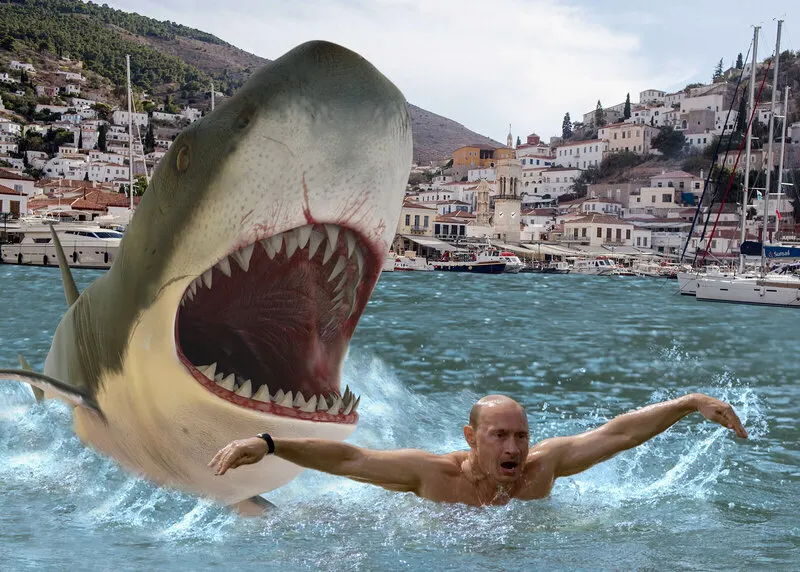
Hydra no refuge for everybody, 2023
Digital
70 x 50 cm
Hydra is a sanctuary for visitors, where unpleasant encounters are almost unheard of unless one happens to trip while under the influence. Crime, except tax evasion, is a rarity, a peculiarity of Greek culture. I can confidently affirm that crimes against individuals, mainly tourists, are extremely rare. You can freely wander the island, even in the most secluded corners, without a trace of fear or the need to constantly watch your back. The local authorities and community are committed to maintaining a safe environment, with regular patrols and a strong sense of community vigilance.
Hydra is also renowned for its allure to celebrities, with countless stars gracing the island since tourism took off in the 1950s. Furthermore, Hydra is not a place that appeals to modern-day criminals. It's hard to blend in; more importantly, the only way to enter or exit is by boat. The taxi boat drivers are watchful, a fact that some have learned the hard way. Beyond its safety, Hydra offers a unique blend of history, culture, and natural beauty, with its picturesque harbour, charming cobblestone streets, and a wealth of historical sites waiting to be explored.
A few real villains have been on the island. Serbian war criminal Slobodan Milošević was on the island while being hunted across Europe. His family still owns a formidable villa away from Hydra town. Greece and Serbia, both Greek Orthodox countries, have good relations, and he may have felt safe here.
The likelihood of a high-profile war criminal visiting Hydra is about as high as finding a great white shark in our waters, which is nearly non-existent. If both happened simultaneously, the outcome would be almost the opposite. The visitor would get wet, and the shark would get fed. No tribunals or courtrooms filled with legal gymnastics are needed to handle that.
Hydra has an old tradition of throwing unpleasant and undesirable people into the harbour basin. Putin has few friends in Greece and would surely end up in the wet, especially if the unlikely great white shark lurks in the azure waters.
The thought of it pleased me so much that I couldn't help but share the joy. Killing war criminals of Putin's stature hasn't been on the shark menu since the Nuremberg trials of World War II. I rejoice with those who rejoice and do not care about those who do not.
The Hydriots, once skilled sailors and even notorious pirates reigned over the waters of the Greek archipelago. When the war of independence erupted, and the call to drive the Turks out of Greece echoed, the Hydriots and their formidable fleet led the charge. Their mastery of sailing and combat, and their unwavering efforts, led to Greece's liberation after three hundred sixty years. Eighteen hundred, if you consider the time since Rome absorbed classical Greece. The Greeks had their share of oppressors, and their victory stands as a testament to the unique history and spirit of Hydra.
A great white shark has indeed been on Hydra. It was a stuffed one, part of a practical joke at the classic nightclub Lagoudera, set up by the owner, Babis Mores. It happened during one of his legendary parties, almost as wet as the sea outside. Babis had purchased the already deceased shark, which had been displayed for money along the southern coast of the Peloponnese. Loads of ice had managed to preserve it for several weeks, but the owners wanted to get rid of the monster shark that stank worse than it looked. Babis got it cheaply and transported the beast, well-packed in ice, to Hydra. After lying on ice for a few days, it was lowered into the water outside the club, anchored with cleverly arranged ropes that led up to the club. It was a gift to one of Babis's frequent guests, the notorious ladies' man, the Spanish Count of Barcelona, Juan Carlos. He had a habit of diving directly into the sea from the club's terrace, a three-meter swan dive intended to impress some new skirt he had brought along. This time, a shark appeared just as he jumped. That it was stone dead, he could not know. Everyone laughed at the intermezzo, including Juan Carlos, who had a good sense of humour.
The Mediterranean Sea, a vast body of water stretching from the coast of Syria in the east to Spain in the west, is a popular destination for many Scandinavians. The European countries bordering the Mediterranean, such as France, Italy, and Greece, are treasure troves for sun-worshipping Scandinavians seeking a sun-sure holiday without flying more than a couple of hours. While the Mediterranean can offer many surprises – both pleasant and unpleasant- shark attacks are extremely rare, providing a safe environment for your marine adventures.
The great white shark, the largest and perhaps most fearsome shark in the world (also known as the man-eater), is indeed present in the Mediterranean—but to a minimal extent. There are so few that the International Union for Conservation of Nature (IUCN) classifies them as' endangered', a status that reflects their vulnerability to extinction due to various threats, including overfishing and habitat degradation. This rarity of sightings adds to the intrigue and fascination of encountering these majestic creatures in the Mediterranean.
There are about 45 different species of sharks in the Mediterranean, but most are very small and live in the deep sea. Shark encounters are rare near the Mediterranean coast, and when they do occur, they are often a result of mistaken identity, with sharks mistaking humans for their natural prey. Since 1900, just over 100 shark encounters have been reported in countries like Italy, Greece, and Croatia. The last time a shark drew attention in the Mediterranean was in June 2017, when a lost blue shark frightened bathers in Mallorca.
The most common sharks in the Mediterranean are:
The hammerhead shark looks funny, and the name explains why. It can grow up to 4 meters long and weigh 400 kg. It is characteristically shaped with a hammer-shaped head.
- The tiger shark, a faintly striped grey shark, usually grows up to 3.5 meters and has sharp teeth, which it uses to tear apart its prey.
The thresher shark is a smaller, rare shark with a slender tail fin. It mainly feeds on schooling fish and squid.
The blue shark, a dark blue shark with a classic shark appearance, grows up to 3.5 meters long. It is an omnivore that feeds on everything from squid to sea birds.
- The porbeagle, resembling the appearance of the great white, primarily feeds on schooling fish such as herring. No attacks on humans have been documented.
The spiny dogfish is a small, popular food fish that rarely grows longer than one meter. It is also found in Swedish waters.
The great white shark, a natural part of the Mediterranean, boasts a native population genetically distinct from other significant white shark populations. Today, the number of great whites in the Mediterranean remains a mystery. Still, we know that the number of observations and attacks has decreased over the last hundred years, making each encounter exceptional. This rich history and the current presence of great whites in the Mediterranean are a testament to their resilience and adaptability, inspiring awe and respect in all who encounter them.
Research on the presence of the great white shark in the Mediterranean has confirmed approximately 630 reported cases. The great white shark has attacked humans 42 times in the Mediterranean, and human remains have been found 11 times as stomach contents.
Statistically, the largest great whites are found in the western Mediterranean, especially around the popular destination of Mallorca and the nearby islands (Balearic Islands). This part of the Mediterranean houses a high biomass due to a local upwelling area of nutrient-rich deep water. The sardine has the highest occurrence of great whites in the Mediterranean, where smaller great whites and newborns are also found. Great whites can be observed near the coast in August. Most great white sightings occur during the summer half of the year.
The world's most significant number of great whites was reported in the Mediterranean.
Historically, the Mediterranean houses some of the largest great whites ever caught, up to about 6 meters in total length. For example, the Maguelone great white from the French Riviera is the world's largest reported great white. Great whites are documented in natural history museums in countries around the Mediterranean. Old photographs testify to how large great whites can get, but stuffed great whites and casts are confirmed evidence of some of the world's largest excellent white specimens.
Over the last few decades, great whites in the Mediterranean have decreased in total length and become more common in smaller sizes. This trend is not unique to the Mediterranean but is widespread among marine fish worldwide. Great whites are getting smaller due to high fishing pressure. Large individuals, often the most awe-inspiring, have become rare due to this pressure. Understanding and advocating for responsible fishing practices can empower us to protect these magnificent creatures and ensure their continued presence in our seas.
Areas where great whites have been found in the Mediterranean. There are many places where great whites have historically been found, most often in the Adriatic Sea, followed by the Tyrrhenian Sea, the Sicilian Channel, the Balearic Sea, the Gulf of Lions, the Ligurian Sea, the Aegean Sea, the Sea of Marmara, and the Ionian Sea.
Over the last hundred years, the presence of great whites in the Mediterranean has almost halved based on observation and catch reports. Today, great whites are mainly reported from the Tyrrhenian Sea, Sicilian Channel, and Adriatic Sea. Great whites are rarely found near land; catches, observations, and attacks have mostly occurred.
It is intriguing how sharks have caught goats, sheep, cats, dogs, and even the occasional horse, not to mention pigs. It is well known that pigs are proficient swimmers and that horses enjoy bathing, but who has ever seen a sheep splashing around Hydra despite the thousands of them there? Cats avoid water like the plague, so the statistics have made me ponder. It smells like human involvement.

Jörgen Thornberg
Malmö
Lite om bilder och mig. Translation in English at the end.
Jag är en nyfiken person som ser allt i bilder, även det jag fäster i ord, gärna tillsammans för bakom alla mina bilder finns en berättelse. Till vissa bilder hör en kortare eller längre novell som följer med bilden.
Bilder berättar historier. Jag omges av naturlig skönhet, intressanta människor och historia var jag än går. Jag använder min kamera för att dokumentera världen och blanda det jag ser med vad jag känner för att fånga den dolda magin.
Mina bilder berättar mina historier. Genom mina bilder, tryck och berättelser. Jag bjuder in dig att ta del av dessa berättelser, in i ditt liv och hem och dela min mycket personliga syn på vår värld. Mer än vad ögat ser. Jag tänker i bilder, drömmer och skriver och pratar om dem; följaktligen måste jag också skapa bilder. De blir vad jag ser, inte nödvändigtvis begränsade till verkligheten. Det finns en bild runt varje hörn. Jag hoppas att du kommer att se vad jag såg och gilla det.
Jag är också en skrivande person och till många bilder hör en kortare eller längre essay. Den följer med tavlan, tryckt på fint papper och med en personlig hälsning från mig.
Flertalet bilder startar sin resa i min kamera. Enkelt förklarat beskriver jag bilden jag ser i mitt inre, upplevd eller fantiserad. Bilden uppstår inom mig redan innan jag fått okularet till ögat. På bråkdelen av ett ögonblick ser jag vad jag vill ha och vad som kan göras med bilden. Här skall jag stoppa in en giraff, stålmannen, Titanic eller vad det är min fantasi finner ut. Ännu märkligare är att jag kommer ihåg minnesbilden långt efteråt när det blir tid att skapa verket. Om jag lyckas eller inte, är upp till betraktaren, oftast präglat av en stråk av svart humor – meningen är att man skall bli underhållen. Mina bilder blir ofta en snackis där de hänger.
Jag föredrar bilder som förmedlar ett budskap i flera lager. Vid första anblicken fylld av feel-good, en vacker utsikt, fint väder, solen skiner, blommor på ängen eller vattnet som ligger förrädiskt spegelblankt. I en sådan bild kan jag gömma min egentliga berättelse, mitt förakt för förtryckare och våldsverkare, rasister och fördomsfulla människor - ett gärna återkommande motiv mer eller mindre dolt i det vackra motivet. Jag försöker förena dem i ett gemensamt narrativ.
Bild och formgivning har löpt som en röd tråd genom livet. Fotokonst känns som en värdig final som jag gärna delar med mig.
Min genre är vid som framgår av mina bilder, temat en blandning av pop- och gatukonst i kollage som kan bestå av hundratals lager. Vissa bilder kan ta veckor, andra någon dag innan det är dags att överlämna resultatet till printverkstaden. Fine Art Prints är digitala fotocollage. I dessa kollage sker rivandet, klippandet, pusslandet, målandet, ritandet och sprayningen digitalt. Det jag monterar in kan vara hundratals år gamla bilder som jag omsorgsfullt frilägger så att de ser ut att vara en del av tavlan men också bilder skapade av mig själv efter min egen fantasi. Därefter besöks printstudion och för vissa bilder numrera en limiterad upplaga (oftast 7 exemplar) och signera för hand. Vissa bilder kan köpas i olika format. Det är bara att fråga efter vilka. Gillar man en bild som är 70x100 men inte har plats på väggen, går den kanske att få i 50x70 cm istället. Frågan är fri.
Metoden Giclée eller Fine Art Print som det också kallas är det moderna sättet för framställning av grafisk konst. Villkoret för denna typ av utskrifter är att en högkvalitativ storformatskrivare används med åldersbeständigt färgpigment och konstnärspapper eller i förekommande fall på duk. Pappret som används möter de krav på livslängd som ställs av museer och gallerier. Normalt säljer jag mina bilder oinramade så att den nya ägaren själv kan bestämma hur de skall se ut, med eller utan passepartout färg på ram, med eller utan glas etc..
Under många år ställde jag bara ut på nätet, i valda grupper och på min egen Facebooksida - https://www.facebook.com/jorgen.thornberg.9
Jag finns också på en egen hemsida som tyvärr inte alltid är uppdaterad – https://www.jth.life/ Där kan du också läsa en del av de berättelser som följer med bilden.
UTSTÄLLNINGAR
Luftkastellet, oktober 2022
Konst i Lund, november 2022
Luftkastellet, mars 2023
Engleson Galleri Caroli, april 2023
Hydra, Greece June 2023
Engleson Galleri Caroli, oktober 2023
Toppen, Höllviken december 2023
Luftkastellet, mars 2024
Torups Galleri, mars 2024
Venice, May 2024
Luftkastellet, oktober 2024
Konst i Advent, December 2024
Galleri Engleson, Caroli December 2024
Jäger & Jansson Galleri, april 2025
A bit about pictures and me.
I'm a curious person who sees everything in pictures, even what I express in words, often combining them, for behind all my pictures lies a story. These narratives, some as short as a single image and others as long as a novel, are the heart and soul of my work.
Pictures tell stories. Wherever I go, I'm surrounded by natural beauty, exciting people, and history. I use my camera to document the world and blend what I see with what I feel to capture the hidden magic.
My images tell my stories. Through my pictures, prints, and narratives, I invite you to partake in these stories in your life and home and share my deeply personal perspective of our world. More than meets the eye. I think in pictures, dream, write, and talk about them; consequently, I must create images too. They become what I see, not necessarily confined to reality. There's a picture around every corner. I hope you'll see what I saw and enjoy it.
I'm also a writer, and many images come with a shorter or longer essay. It accompanies the painting, printed on fine paper with my personal greeting.
Many pictures start their journey on my camera. Simply put, I describe the image I see in my mind, experienced or imagined. The image arises within me even before I bring the eyepiece to my eye. In a fraction of a moment, I see what I want and what can be done with the picture. Here, I'll insert a giraffe, Superman, the Titanic, or whatever my imagination conjures up. Even stranger is that I remember the mental image long after it's time to create the work. Whether I succeed is up to the observer, often imbued with a streak of black humour – the aim is to entertain. My pictures usually become a talking point wherever they hang.
I prefer pictures that convey a message in multiple layers. At first glance, they're filled with feel-good vibes, a beautiful view, lovely weather, the sun shining, flowers in the meadow, or the water lying deceptively calm. But beneath this surface beauty, I often conceal a deeper story, a narrative that challenges societal norms or explores the human condition. I invite you to delve into these hidden narratives and discover the layers of meaning within my work.
Picture and design have been a thread running through my life. Photographic art feels like a fitting finale, and I'm happy to share it.
My genre is varied, as seen in my pictures; the theme is a blend of pop and street art in collages that can consist of hundreds of layers. Some images can take weeks, others just a day before it's time to hand over the result to the print workshop. Fine Art Prints are digital photo collages. In these collages, tearing, cutting, puzzling, painting, drawing, and spraying happen digitally. What I insert can be images hundreds of years old that I carefully extract so they appear to be part of the painting, but also images created by myself, now also generated from my imagination. Next, visit the print studio and, for certain images, number a limited edition (usually 7 copies) and sign them by hand. Some images may be available in other formats. Just ask which ones. If you like an image that's 70x100 but doesn't have space on the wall, you might be able to get it in 50x70 cm instead. The question is open.
The Giclée method, or Fine Art Print as it's also called, is the modern way of producing graphic art. This method ensures the highest quality and longevity of the artwork, using a high-quality large-format printer with archival pigment inks and artist paper or, in some cases, canvas. The paper used meets the longevity requirements set by museums and galleries. I sell my pictures unframed, allowing the new owner to personalise their artwork, confident in the lasting value and quality of the piece.
For many years, I only exhibited online, in selected groups, and on my Facebook page - https://www.facebook.com/jorgen.thornberg.9. I also have my website, which unfortunately is not constantly updated - https://www.jth.life/. You can also read some of the stories accompanying the pictures there.
EXHIBITIONS
Luftkastellet, October 2022
Art in Lund, November 2022
Luftkastellet, March 2023
Engleson Gallery Caroli, April 2023
Hydra, Greece June 2023
Engleson Gallery Caroli, October 2023
Toppen, Höllviken December 2023
Luftkastellet, March 2024
Torup Gallery, March 2024
Venice, May 2024
UTSTÄLLNINGAR
Luftkastellet, oktober 2022
Konst i Lund, november 2022
Luftkastellet, mars 2023
Engleson Galleri Caroli, april 2023
Hydra, Greece June 2023
Engleson Galleri Caroli, oktober 2023
Toppen, Höllviken december 2023
Luftkastellet, mars 2024
Torups Galleri, mars 2024
Venice, May 2024
Luftkastellet, October 2024
Konst i Advent, December 2024
Galleri Engleson, Caroli December 2024
Jäger & Jansson Galleri, April 2025
Utbildning
Autodidakt
Medlem i konstnärsförening
Öppna Sinnen
Med i konstrunda
Konstrundan i Skåne
Utställningar
Luftkastellet, October 2022
Art in Lund, November 2022
Luftkastellet, March 2023
Engleson Gallery Caroli, April 2023
Hydra, Greece June 2023
Engleson Gallery Caroli, October 2023
Toppen, Höllviken December 2023
Luftkastellet, March 2024
Torup Gallery, March 2024
Venice, May 2024