Vi använder cookies för att ge dig bästa möjliga upplevelse. Välj vilka cookies du tillåter.
Läs mer i vår integritetspolicy
Jörgen Thornberg
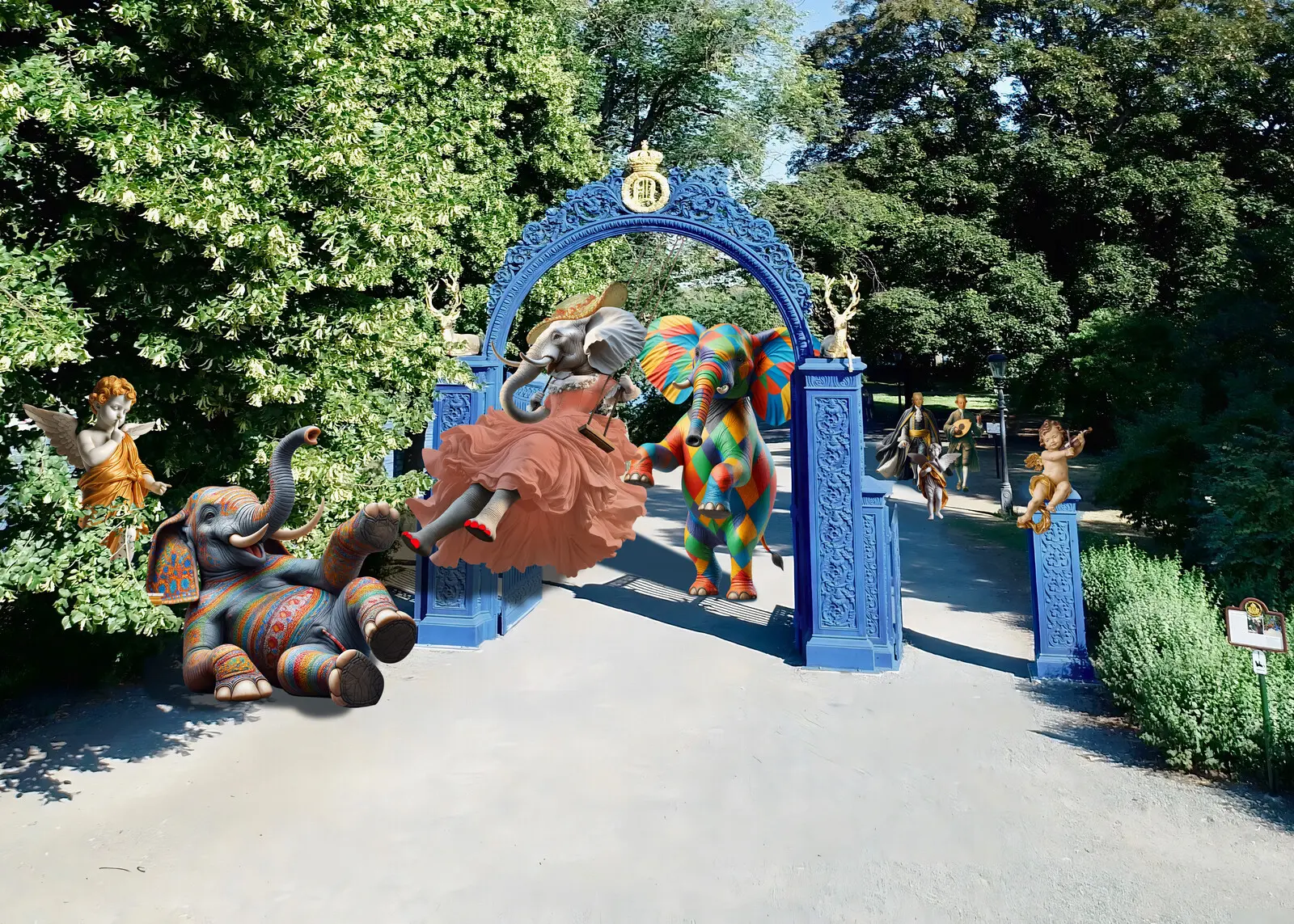
The Swing, 2024
Digital
70 x 50 cm
3 200 kr
When the two competing giants in my picture brought the white elephant girl to Djurgården and its Blue Gate, it was done in more than one way on historical grounds. Read on to understand the background.
It was rather strange to find Djurgården so empty of people, even though the hour was early on this last day of June. But as the saying goes, "When the cat's away, the mice will play." I'm an early riser and took my walk just before five. Not a soul was around, and the sun was about to climb over the treetops in Djurgården, but the shadows still cast long lines over the paths. On a whim, I took the route via Blå Porten instead of along the shoreline and the Pavilion Bar. Maybe it was a peculiar giggle or trumpet sounds that piqued my curiosity. What I experienced is reserved only for those who wake before the rooster crows. The picture tells the story better than I do, but still, I want to share it with those unfamiliar. The rest of you, please forgive my lines.
I couldn’t see everything from my position as I cautiously approached the cheerful trio of elephants. Elephants! They disappeared from Skansen over thirty years ago. They're also no longer allowed in circuses. The nearest place to see them is Kolmården Wildlife Park, about 150 kilometres away. It takes almost two hours by car, whereas an elephant running at full speed would need four hours. Additionally, they must have stopped by the Royal Dramatic Theatre and borrowed clothes from their wardrobe. This scene exuded the 18th century when no elephant had yet set foot in Sweden. That would happen in 1804 when a young Asian bull elephant from Ceylon arrived. Jean Baptiste Gautier had bought the elephant in London and travelled via Prussia, Poland, Russia, and Finland to Sweden with his family and menagerie in the fall of 1804. They lodged in a barrack at Brunkebergstorg, possibly at the current quarter named ‘Elefanten’, and the public was invited to come and see it and the other animals.
After showing the elephant in Stockholm for almost two years, Gautier toured Sweden with his menagerie. The elephant was transported on a wagon drawn by eight pairs of horses, but in Skänninge, the tour ended in terror. The elephant was housed in a hall in the town hall, and the public was invited to view the marvel. There were long queues, and people thought it was expensive to see. The irritation culminated when someone started throwing stones at the town hall windows, broke in, and stole the entire cash register. Gautier and the elephant ended up in Denmark instead. The elephant is said to have died during the British navy's siege of Copenhagen during the Napoleonic Wars in 1807. Their artillery destroyed large parts of the Danish capital. Whether the elephant died from a shell to the head or from the shock of all the explosions is unknown, but its northern journey ended there.
It certainly wasn't that elephant in Djurgården this morning. Moreover, the elephant girl swinging at Blå Porten was white, a type that has probably never been in Sweden. More about white elephants later.
It wasn't their unusual outfits that struck me because all kinds of fashion flourish simultaneously in Stockholm. It was the scene I saw, a well-known painting, 'The Swing,' also known as 'The Happy Accidents of the Swing,' an 18th-century oil painting by Jean-Honoré Fragonard. An equally entertaining and, in its time, controversial image. Aside from the elephants, everything was there: the exuberant atmosphere and the enchanted surroundings.
‘The Swing’, also known as ‘The Happy Accidents of the Swing’, is an 18th-century oil painting by Jean-Honoré Fragonard.
The girl's billowing dress reveals more than just her legs. Underwear, often called “the unmentionables,” was previously a topic shrouded in secrecy. It was an additional layer of clothing, discreetly covering the most private parts of the body. However, despite its hidden nature, underwear has always reflected our societal views on health, fashion, morality, and social status. It was a subtle yet powerful indicator of a person's identity.
Preserving medieval undergarments is scarce, but we know that women wore a shift and men a shirt next to their bodies. These garments, often made of soft and easily washable linen or wool, were a common sight for centuries. However, the adoption of panties and underwear was a slower process. It wasn't until the late 19th century that women began to protect their thighs and genitals with underpants, while men's underwear became more prevalent a few decades earlier.
The introduction of new women's undergarments was met with scepticism and resistance. Even at the turn of the 20th century, it was considered indecent and unnecessary in some places. The term' Ladies' underpants' was associated with the provocative attire of cabaret and theatre actresses. However, there were also practical reasons for the hesitation. Women had previously dressed in layers of petticoats, with the innermost layer as menstrual protection, and a warm padded or knitted dress in winter.
In more refined circles, open-crotch drawers were sometimes used, a design that allowed women to relieve themselves standing with legs wide apart. This innovation, however, was not without its challenges. Men, on the other hand, found comfort in wrapping their long shirts around their groin under their trousers, while farmers often resorted to wearing multiple layers of trousers. Though amusing retrospectively, these peculiar practices offer a glimpse into our ancestors' ingenuity and adaptability.
Nowadays, it is said that you must have clean underwear, especially with short skirts or if, like Marilyn Monroe, you walk over a fan that blows your skirt up and exposes your bottom.
From this perspective, it is clear that the young man in Fragonard's painting saw everything. That's undoubtedly why he looks so pleased. And she enjoyed teasing him. The same goes for the elephant boy in my illustration. Then, one understands why the cherub puts a finger to its lips. The genderless angel has seen nothing, and its lips remain sealed.
‘The Swing’, also known as ‘L’Escarpolette’ in French (c. 1767-1768) by Jean-Honoré Fragonard, is a renowned Rococo painting that seemingly portrays a carefree and wild woman on a swing. This woman, with her billowing dress and playful demeanour, is a typical representation of the Rococo era's fascination with the leisurely and carefree lifestyle of the French aristocracy. However, beneath this surface, intriguing hidden meanings await those well-versed in 18th-century customs. This masterpiece of the Rococo era is Fragonard's most celebrated work, inviting you to delve deeper into its secrets.
Behind its pastoral surface, the painting hides ideas of infidelity, desire, eroticism, love, and power. The woman on a swing symbolises desire and possibly the mistress of the man in the bushes gazing up at her, peeking into her open dress.
You see an elegantly dressed young woman on a swing. A smiling young man, hiding in the bushes below and to the left, points towards her billowing dress with a hat in hand. A smiling older man, nearly hidden in the shadows on the right, propels the swing with ropes as a small white dog barks nearby. The lady is wearing a bergère hat, a sort of shepherdess hat, as she deliberately kicks off her shoe with an outstretched left foot. The young woman, in a playful and flirtatious gesture, lets the admirer see her legs, initiating a game of seduction between herself and the man below. Two statues are present, one of a ‘putto’, who watches from above the young man on the left with its finger in front of its lips, and the other of two putti is on the right beside the older man.
Unveiling a fascinating historical anecdote, the memoirs of the dramatist Charles Collé reveal that a courtier (homme de la cour) initially commissioned Gabriel François Doyen to create this painting of him and his mistress. Unwilling to undertake such a frivolous task, Doyen passed on the commission to Fragonard. The man had requested a portrait of his mistress seated on a swing, pushed by a bishop, a request that was in line with the Rococo era's fascination with playful and erotic themes. However, Fragonard, known for his artistic independence and creativity, depicted a layman instead, adding a layer of intrigue to the painting's narrative and possibly reflecting his interpretation of the commission.
This seemingly 'frivolous' painting style was soon targeted by Enlightenment philosophers, who, in their pursuit of reason and rationality, criticised the Rococo style for its perceived excesses and lack of seriousness. They advocated a more severe art showcasing man's nobility and intellectual depth. ‘The Swing’ is not just a depiction of a woman on a swing; it's a window into the 18th-century French aristocratic customs and cultures, including the prevalent art style of the time, Rococo. To truly grasp the essence of ‘The Swing’, it’s crucial first to understand the Rococo style, which emerged in France, spread throughout Europe, and even reached Sweden.
The Rococo era, a period of artistic and cultural movement, emerged in France after the French Baroque and the reign of King Louis XIV but before the French Revolution. It was a time when the French aristocracy and nobility, having come into power after King Louis XIV died in 1715, expressed their grandiosity through art and culture. Understanding this era is crucial to fully appreciate the context and significance of 'The Swing' and other Rococo masterpieces.
The Blue Gate
The Blue Gate, or Blå Porten, is not just a structure but a living testament to the past. It mirrors the gates that once guarded the royal hunting park on Djurgården in the 17th and 18th centuries. This gate, a relic from 1848, silently holds the history of this place. Intriguingly, entry fees to Djurgården were charged until 1862, a practice that harks back to a bygone era, sparking curiosity about the past. Blå Porten is the entrance to Djurgården, a central park in Stockholm and part of Ekoparken, the world’s first national urban park. ‘Djurgård’ can be translated to ‘Game park’ or ‘Deer park’ in English. This term refers to a large, enclosed area where wild animals are kept for hunting or public enjoyment.
The restaurant, Blå Porten, which shares its name with the gate, was established at the end of the 1600s near the iron gates leading into Djurgården, the king's hunting park. It was a witness to a lively social scene. Djurgården was a bustling hub where people of all ages and classes, including royals and commoners, converged. Visitors engaged in leisurely walks played the lute, enjoyed ballet performances, or watched fireworks in summer. In winter, they embarked on sleigh rides, bundled up in furs and blankets, adding to the cultural richness of the place.
Although Djurgården ceased to be a hunting park in the 18th century, it remained a popular green space, attracting many visitors, including the wealthy, such as members of parliament and merchants. Rumour has it that priests were secretly allowed in through the back entrance, humorously referred to as “the theological way.”
In April 1869, a fire broke out in the bakery, burning the restaurant to the ground. The name Blå Porten was revived in 1916 at a new location on the island. Restaurateur Agnar Meurling opened a summer restaurant next to the newly built Liljevalchs Art Gallery, featuring an Italian-inspired garden. An azure blue doorway was incorporated into the wall as an entrance to honour its name.
The Blue Gate, also known as Djurgårdsporten or Lusthusporten, is a remarkable architectural masterpiece. It stands as the only surviving gateway to Djurgården in Stockholm, situated on Djurgårdsvägen, just south of Djurgårdsbron. This gate, a product of the visionary architect Johan Adolf Hawerman, was erected in 1849 and is made of cast iron. It proudly showcases Oscar I’s crowned insignia, flanked by two crowned stags. Its unique beauty and historical value were recognised when it was declared a state heritage building in 1965. The term ‘Lusthus’ can be translated to ‘Pavilion’, ‘Summerhouse’ or ‘Gazebo’ in English, and it refers to a small, decorative building typically found in gardens or parks for relaxation or as a shelter from the sun.
The gate was initially situated about 300 meters south of its current location. It was a wooden gate called Lusthusporten, named after Queen Kristina’s nearby pavilion, from which organised animal fights could be observed in the 1600s. The wooden gate, which became worn over time, was replaced by a more durable cast iron gate funded by King Oscar I.
The cast iron gate, a product of Brevens Bruk, was cast in 1848 and installed in its original location. However, it was not a permanent fixture there. It was moved twice: in 1882 to the entrance of the then Forestry Institute (now Nobel Park) and in 1916 to the university area of Frescati at the entrance to the Experimental Field. It returned to its near-original location between 1967 and 1968. The gate was then renovated and painted dark blue with gilded sculptures, a testament to its enduring beauty and historical significance.
The Blå Porten Restaurant, located next to the Liljevalchs Art Gallery, has been famous for almost a hundred years. But the history of Blå Porten goes back much further. First mentioned in 1692, it was initially called Lusthusporten and located on the east side of Djurgårdsbron, where the blue-painted and gilded cast iron gate stands today. This was a place for royal entertainment, including animal fights, and inspired poet Carl Michael Bellman’s work. It was also the site of the debut of “Studentsången,” composed by Prince Gustaf in 1851 and famous for its dill and parsley-cooked perch.
The gate ‘Blå Porten’ is today the sole symbol of the fence that enclosed Djurgården from the late 1600s to the 1800s, serving as a significant example of 19th-century decorative cast iron art. Djurgården, a royal hunting park in the 1600s, was fenced off at the end of the century to protect game and deter predators and poachers. As royal interest in hunting waned in the mid-18th century, the public gained access to Djurgården, transforming it into a significant and popular excursion spot. It's intriguing to learn that an entrance fee was charged until 1862 for pedestrians and 1877 for vehicles, adding a layer of historical context to this green space.
Though the fence was removed in the 1820s, the gates remained as entry points. The gate at Djurgårdsbron was replaced in 1848 by the current cast iron gate, designed by Johan Adolf Hawerman and funded by Oscar I. It was cast at Brevens Bruk.
The gate was moved in 1882 to the entrance of the Forestry Institute on the other side of Djurgårdsbron and again in 1921 to Frescati as the entrance to the Agricultural Academy’s Experimental Field. It became a heritage site in 1965, and with the establishment of Stockholm University, the gate was restored and moved back to its original location in 1966.
Djurgården was necessary for agriculture and defence, ensuring a supply of game. Hunting was popular, and in the 1570s, Johan III established a hunting park with reindeer, deer, and elk. By the 1680s, Karl XI enclosed all Northern and Southern Djurgården for hunting, a common practice among European royalty.
The park extended from Stora Lappkärrsberget in the north to Täcka Udden in the south, enclosed by a two-mile-long, two-meter-high fence to keep game in and predators and poachers out. The wall was set back from the shore, with lots outside for sailors, carpenters, and fishermen. Parts of the park were fenced for hay to feed the game in winter. At its peak, the park had about 1,500 deer.
A Djurgården administration with supervisors, gatekeepers, and royal hunters was established, with small farms allocated to them. The fence needed regular maintenance and repair, as reflected in Blå Porten, erected in the 1840s as a replacement for an older gate.
Djurgården’s shores offered good fishing, especially in Husarviken, where Karl XI built a fishing lodge. The lodge is now the oldest building in the National City Park, but land elevation has moved it away from the water.
Royal hunters sometimes had the right to distil and sell spirits, supplementing their income. In 1733, there were 32 taverns in Southern Djurgården, usually near the hunters’ lodges by the gates. The most popular was Lill-Jans, near today’s Technical University. In 1755, taverns were banned and converted to temperance inns serving warm milk- a disaster only second to war.
The hunting park thrived until the mid-18th century. King Adolf Fredrik, less interested in hunting, opened the area for public excursions. By the late 1820s, the fence was removed, and the remaining deer moved to a smaller enclosure. Entrance fees for pedestrians ended in 1862 and for vehicles in 1877.
Hunting was organised into four areas: Kammarjakten at Gärdet, Stora Jakten in southern Djurgården, Biskopsjakten near Waldemarsudde, and Stora Vargjakten at Lappkärrsberget. Stoorjacten had a central clearing with radial paths for better shooting opportunities. At its peak, the park had about 1,500 deer.
The many oaks in the park are a result of the hunting park. Extensive grazing hindered the regeneration of many tree species, benefiting the development of oaks.
Gated communities
Even though Djurgården is an open part of today's Stockholm, its historical function as a gated community is worth mentioning. Gated communities, with their secure perimeters and exclusive access, represent a phenomenon that stretches back through history, a fascinating journey that continues to spark debate in contemporary society. These enclaves, designed to segregate and protect, have evolved significantly but consistently reflect underlying social, economic, and political dynamics.
Historical Roots
The concept of gated communities is not a modern invention. Ancient civilisations, such as those in Mesopotamia and Egypt, constructed walled cities to safeguard inhabitants from external threats. In medieval Europe, castles and fortified towns served a similar purpose, offering protection from invaders and bandits. These early examples were driven by the need for security in a world where external dangers were omnipresent.
In the 17th and 18th centuries, the idea of gated living took on a more refined form with the development of private estates and hunting parks, such as Djurgården in Stockholm. These spaces were enclosed not merely for protection but to delineate boundaries of privilege and leisure. For instance, the Blue Gate at Djurgården was an entry point to the king's hunting grounds, symbolising exclusivity and control.
Modern Gated Communities
Gated communities, a global phenomenon, have seen a significant rise in popularity in the modern era, particularly in the United States, Latin America, and Asia. These communities, characterised by physical barriers—walls, gates, and security personnel—that restrict access to residents and guests, often boast amenities such as private parks, swimming pools, and clubhouses, creating a self-contained environment that caters to the desires of the affluent.
The appeal of gated communities lies in their promise of security, privacy, and a higher quality of life. For residents, these enclaves offer a refuge from the perceived dangers of the outside world—crime, noise, and urban decay. The controlled access points deter criminals, creating a safer environment for families. Moreover, the exclusivity of these communities often translates into higher property values, making them attractive investments.
Controversies and Criticisms
Despite their perceived advantages, gated communities have their share of controversies. Critics argue that they exacerbate social inequalities by physically and symbolically separating the wealthy from the less affluent. This segregation fosters a sense of division and exclusion, undermining social cohesion and perpetuating economic disparities. In many cities, the proliferation of gated communities contributes to urban sprawl, with affluent neighbourhoods disconnected from the broader urban fabric.
Moreover, gated communities can be seen as a retreat from civic responsibility. By isolating themselves from the wider community, residents may become less engaged in public life and less invested in addressing broader societal issues. This withdrawal from the public sphere can weaken democratic processes and reduce the pressure on governments to improve public services and infrastructure.
The security provided by gated communities is also a subject of debate. While these areas may experience lower crime rates, the presence of walls and guards does not address the root causes of crime, such as poverty and lack of opportunity. In some cases, the perceived safety of gated communities can create a false sense of security, leading residents to become complacent about broader safety concerns.
Power Dynamics and Social Implications
By their very nature, Gated communities underscore the power dynamics between different social groups. They serve as a stark reminder of the wealthy's ability to insulate themselves from the challenges faced by the wider population. This separation can lead to a lack of understanding and empathy between different socioeconomic groups, further entrenching social divides.
Historically, the construction of gated spaces was often a means for those in power to maintain control and order. In contemporary settings, the same principle applies. Gated communities allow the affluent to control their environment, maintaining order and exclusivity. However, this control can come at the cost of broader social harmony and inclusivity.
Gated communities, both historically and today, serve as a lens through which we can examine issues of security, exclusivity, and social inequality. While they offer tangible benefits to their residents, they also raise important questions about the kind of society we want to build. The challenge lies in finding a balance between the desire for security and the need for social cohesion, a pressing need to ensure that the pursuit of safety for some does not come at the expense of justice and inclusivity for all.
And I should not forget to tell you something about white elephants. A white elephant is a possession that its owner cannot dispose of without significant difficulty, often because its maintenance costs are disproportionately high compared to its utility. In contemporary language, it metaphorically describes an expensive object, project, business venture, or facility that offers little practical value relative to its acquisition or maintenance costs.
The term originates from the sacred white elephants kept by Southeast Asian monarchs in countries like Burma, Thailand (formerly Siam), Laos, and Cambodia. These elephants symbolised the monarch's justice and power and their kingdoms' prosperity and peace. Owning a white elephant required great luxury, and laws protected these animals from labour due to their sacred status. Therefore, receiving a white elephant from a monarch was both an honour and a burden—it symbolised the monarch's favour and imposed high maintenance costs without practical utility.
In the West, the term "white elephant" started to be used in the 17th century and gained popularity in the 19th century. One notable incident that helped popularise the term was P. T. Barnum's acquisition of an elephant named Toung Taloung, billed as the "Sacred White Elephant of Burma." After great effort and expense, Barnum discovered that the elephant was a dirty grey with pink spots, far from the pristine white he had advertised.
Today, "white elephant" refers to any burdensome possession or project, especially large-scale infrastructure projects that are costly to maintain and fail to meet expectations. Examples include:
- Infrastructure Projects: Prestigious but uneconomic projects like airports, dams, bridges, shopping malls, and football stadiums.
- Military Projects: Outdated or underperforming projects like the U.S. Navy's Alaska-class cruiser.
- Buildings: Expensive projects that fail to serve their intended purpose or become costly.
In the U.S., the Oakland Athletics baseball team adopted a white elephant as a symbol after being sarcastically labelled as such by John McGraw in 1902. Other notable examples include the Al Maktoum International Airport in Dubai and Japan's Yurikamome transit line, which was initially feared as a costly burden.
In Austria, "white elephants" refer to workers of little or no use but cannot be dismissed. In Sweden, we are more accustomed to pink elephants, which appear after consuming too much alcohol.
The term is also used in "white elephant sales", where people can offload unwanted items, capitalising on the idea that "one man's trash is another man's treasure. White elephants remind us of the complexities and potential pitfalls of owning or managing costly assets with limited utility in historical and modern contexts.
Bellman and Gustav III strolled along a little behind the elephants, Bellman playing his lute to the king's delight. They were friends in the 18th century and have continued their companionship among the stars as Time-Travellers.
Carl Michael Bellman, a poet and ballad singer cherished by Sweden, was born in Stockholm on February 4, 1740. His life and works, deeply intertwined with Swedish culture, have been a source of joy for generations of Swedes. Bellman's 'Fredman's Epistles' and 'Fredman's Songs' stand out, such as the renowned 'Gubben Noach,' a masterpiece that humorously and seriously depicts life in 18th-century Stockholm, showcasing his unparalleled understanding of the human condition.
Studies and musical discoveries marked Bellman's youth. Although he began studying at Uppsala University, he never completed his studies. Instead, he was drawn to Stockholm's vibrant cultural life, where he became a central figure. Bellman was known for his improvised songs and poems, which he performed in the city's taverns and finer salons. One of his earliest known songs, "Gubben Noach," was written when he was just 17 years old and quickly became popular.
One of the most beloved characters in Bellman's repertoire is Fredman, a fictional watchmaker who graces many of his epistles. Through Fredman and his companions, such as Movitz and Ulla Winblad, Bellman paints a vivid picture of life's joys, sorrows, celebrations, and miseries. 'Fredman's Epistles' are not just letters but windows into the human soul. One of the most famous, 'Fredman's Epistle No. 23,' opens with the immortal words: 'Ack du min moder' ('Ah, you my mother'). In this epistle, a heart-rending scene unfolds as Fredman seeks his mother's forgiveness for his indulgent life.
Another central figure in Bellman's work is the charming and carefree Movitz, a musician and friend of Fredman. In "Fredman's Epistle No. 45," which begins with the words "Fader Movitz, bro" ("Father Movitz, brother"), Bellman describes a touching scene where Fredman encourages Movitz to drink to forget his sorrows. Movitz's life is marked by humour and tragedy, which Bellman depicts with a masterful mix of irony and empathy.
Bellman's songs and epistles are known for their vivid characters, stories, and musical richness. He was a skilled musician who used a variety of musical styles, from folk melodies to the complex compositions of the Baroque era. His texts contain literary references and biblical allusions, giving them a deep and multifaceted quality. His musical style was influenced by [specific musical influences], which can be heard in his [specific songs or compositions].
An anecdote often told about Bellman is how he improvised songs on the spot. This unique skill significantly influenced his popularity, allowing him to connect with his audience spontaneously and engagingly. It is said that he was once asked to write a song about a hat, and without hesitation, he began singing a newly composed melody with the words: "Det var en gång en hatt, som låg på ett fat" ("Once there was a hat, lying on a plate"). His improvisational ability and humour made him a beloved entertainer in all social classes.
Despite his popularity, Bellman lived a life filled with financial difficulties. These challenges significantly impacted his life and work, as he periodically worked as a civil servant and sometimes received support from wealthy patrons. His indulgent lifestyle often led to debts. Despite this, he maintained good humour and continued to write and perform his songs until his death on February 11, 1795.
Bellman's works transcend time, continuing to captivate and inspire. His vivid portrayals of 18th-century Stockholm, with its bustling tavern life and vibrant characters, offer a window into a bygone era. Yet, his songs and poems speak directly to the human heart, blending joy and sorrow, humour and seriousness, making them as pertinent today as they were when first penned. They are not just historical artefacts but living, breathing works that touch the soul.
When my generation was children, we often told what were known as Bellman jokes. These simple jokes, always featuring a character named Bellman, were a staple of our schoolyard humour. The Bellman joke is a joke cycle popular among Swedish schoolchildren, with Bellman as the main character.
The Bellman jokes first became popular in the 19th century and were initially inspired by the life of the poet and composer Carl Michael Bellman. The first known Bellman joke appears in the preface to an 1835 collection of Bellman's works, in which the publisher reprints an 1808 letter from a contemporary of Bellman containing the following anecdote:
"[Bellman] rarely owned more than one coat. Once, when King Gustav met him in the street, he was wearing no more than a nightdress, at which the King said: 'But my dear Bellman, you look so ill-clad,' to which he bowed and replied, 'I humbly assure your Majesty that I have the whole of my wardrobe on me.'"
In the 19th century, Bellman's jokes focused on Bellman's life at court and often contained sexual humour. Over time, however, the Bellman character in these jokes evolved into a generic Swede rather than a historical figure. The shift from jokes told by adults to those mainly told by young schoolchildren up to 10 years of age probably occurred in the first half of the 20th century.
Modern versions of Bellman jokes often include Bellman and two other characters of different nationalities, with Bellman typically emerging victorious from a tricky situation. However, in many jokes, Bellman is portrayed as an anti-hero who may cheat, lie, or even smell bad to get the last laugh. Another common theme is that Bellman fools or makes fun of a priest, policeman, or other authority figure. He can thus be seen as a modern sort of trickster. The jokes tend to involve bodily functions such as urinating or defecating.
The stories' ubiquitous character and the fact that they have been told in various forms for so many years have made them subject to study by ethnologists such as Bengt af Klintberg and researchers in children's culture.
Here are some examples of contemporary Bellman jokes:
"A Russian, a German, and Bellman wanted to see who could swim the fastest across the Atlantic. First out was the German. He swam one kilometre and drowned. Next came the Russian. He swam 10 kilometres, and then he drowned. Now, it was Bellman's turn. He swam and swam until he almost reached the coast of America – then he got tired and swam back."
"A Dane, a Norwegian, and Bellman made a wager on who could remain inside a goat pen the longest. First out was the Dane, who came out after just 10 minutes yelling, 'Damn! The goat stinks!' After him, the Norwegian went in, and after half an hour he came out yelling, 'Damn! The goat stinks!' Finally, Bellman went in. After two hours, the goat came rushing out, yelling, 'Damn! Bellman stinks!'"
"A Frenchman, a Finn, and a Bellman bragged about who had the tallest flagpole. 'My flagpole is so tall that it reaches the clouds,' the Frenchman said. 'My flagpole is so tall that it reaches higher than the clouds!' the Finn said. 'My flagpole is so tall that it pokes God in his butt!' Bellman said."
Bellman jokes were a cherished part of our childhood, a humorous escape and a way to bond with friends through shared laughter.
King Gustav III, Bellman's Friend and Patron, was born in 1746. He was a monarch with a flair for drama, a penchant for culture, and an appetite for grand gestures. His reign from 1771 until his assassination in 1792 was marked by significant cultural and political reform, but perhaps most charming was his friendship with one of Sweden's most beloved poets and musicians, Carl Michael Bellman.
Gustav III was no ordinary king. He had an unquenchable thirst for the arts and a knack for theatricality. Under his rule, the Swedish court transformed into a vibrant cultural hub, with Gustav often leading the charge. He wrote plays, hosted lavish masquerades, and even took the stage as an actor. But beyond his creative exploits, he was a generous patron to artists, writers, and musicians, among whom Bellman stood out as a favourite.
Bellman captured the spirit of Stockholm's vibrant streets and taverns with witty verses and infectious melodies. His works, notably "Fredman's Epistles" and "Fredman's Songs," painted vivid portraits of everyday life, brimming with humour, pathos, and a deep understanding of human nature. This unique talent endeared him to King Gustav III, who saw a musician and a chronicler of their times in Bellman.
The story of their friendship is filled with delightful anecdotes. One famous tale recounts how Bellman, rarely owning more than one coat, once met King Gustav on the street wearing nothing but a nightdress. The king, ever the observer, remarked on Bellman's scant attire. With his quick wit, Bellman bowed and said, "I humbly assure Your Majesty that I have the whole of my wardrobe on me." Far from being offended, the king was amused and charmed by Bellman's candour.
Gustav III's patronage provided Bellman with much-needed stability. Life as a poet and musician was not without hardships, and Bellman often found himself in financial straits. But with the king's support, he enjoyed periods of comfort and the freedom to create his enduring works. With its lavish events and cultural gatherings, the royal court offered Bellman inspiration and a stage for his talents.
Their friendship wasn't just a matter of royal patronage but a genuine camaraderie. Gustav III appreciated Bellman's ability to capture the essence of Swedish life, from the joyous to the melancholic. Bellman's songs, often performed at court, reflected the king's interests in the human condition and societal observation. They shared a mutual respect and a love for the arts that transcended their disparate social standings.
As Time-Travellers, it's easy to imagine Gustav III and Bellman continuing their companionship among the stars. Perhaps they stroll together in some celestial garden, Bellman strumming his lute while the king listens with rapt attention. Their conversations, no doubt, would still revolve around the arts, politics, and the quirks of human nature, just as they did centuries ago.
Bellman's legacy as a poet and musician is inextricably linked to Gustav III's reign. The king's support allowed Bellman to flourish, and in turn, Bellman's works have immortalised the era of Gustav III. Their friendship is a testament to the power of patronage and the timeless bond between artist and admirer. In the grand tapestry of history, the story of Gustav III and Bellman is a vibrant, colourful thread, full of wit, music, and the enduring spirit of camaraderie.
Jörgen Thornberg
The Swing, 2024
Digital
70 x 50 cm
3 200 kr
When the two competing giants in my picture brought the white elephant girl to Djurgården and its Blue Gate, it was done in more than one way on historical grounds. Read on to understand the background.
It was rather strange to find Djurgården so empty of people, even though the hour was early on this last day of June. But as the saying goes, "When the cat's away, the mice will play." I'm an early riser and took my walk just before five. Not a soul was around, and the sun was about to climb over the treetops in Djurgården, but the shadows still cast long lines over the paths. On a whim, I took the route via Blå Porten instead of along the shoreline and the Pavilion Bar. Maybe it was a peculiar giggle or trumpet sounds that piqued my curiosity. What I experienced is reserved only for those who wake before the rooster crows. The picture tells the story better than I do, but still, I want to share it with those unfamiliar. The rest of you, please forgive my lines.
I couldn’t see everything from my position as I cautiously approached the cheerful trio of elephants. Elephants! They disappeared from Skansen over thirty years ago. They're also no longer allowed in circuses. The nearest place to see them is Kolmården Wildlife Park, about 150 kilometres away. It takes almost two hours by car, whereas an elephant running at full speed would need four hours. Additionally, they must have stopped by the Royal Dramatic Theatre and borrowed clothes from their wardrobe. This scene exuded the 18th century when no elephant had yet set foot in Sweden. That would happen in 1804 when a young Asian bull elephant from Ceylon arrived. Jean Baptiste Gautier had bought the elephant in London and travelled via Prussia, Poland, Russia, and Finland to Sweden with his family and menagerie in the fall of 1804. They lodged in a barrack at Brunkebergstorg, possibly at the current quarter named ‘Elefanten’, and the public was invited to come and see it and the other animals.
After showing the elephant in Stockholm for almost two years, Gautier toured Sweden with his menagerie. The elephant was transported on a wagon drawn by eight pairs of horses, but in Skänninge, the tour ended in terror. The elephant was housed in a hall in the town hall, and the public was invited to view the marvel. There were long queues, and people thought it was expensive to see. The irritation culminated when someone started throwing stones at the town hall windows, broke in, and stole the entire cash register. Gautier and the elephant ended up in Denmark instead. The elephant is said to have died during the British navy's siege of Copenhagen during the Napoleonic Wars in 1807. Their artillery destroyed large parts of the Danish capital. Whether the elephant died from a shell to the head or from the shock of all the explosions is unknown, but its northern journey ended there.
It certainly wasn't that elephant in Djurgården this morning. Moreover, the elephant girl swinging at Blå Porten was white, a type that has probably never been in Sweden. More about white elephants later.
It wasn't their unusual outfits that struck me because all kinds of fashion flourish simultaneously in Stockholm. It was the scene I saw, a well-known painting, 'The Swing,' also known as 'The Happy Accidents of the Swing,' an 18th-century oil painting by Jean-Honoré Fragonard. An equally entertaining and, in its time, controversial image. Aside from the elephants, everything was there: the exuberant atmosphere and the enchanted surroundings.
‘The Swing’, also known as ‘The Happy Accidents of the Swing’, is an 18th-century oil painting by Jean-Honoré Fragonard.
The girl's billowing dress reveals more than just her legs. Underwear, often called “the unmentionables,” was previously a topic shrouded in secrecy. It was an additional layer of clothing, discreetly covering the most private parts of the body. However, despite its hidden nature, underwear has always reflected our societal views on health, fashion, morality, and social status. It was a subtle yet powerful indicator of a person's identity.
Preserving medieval undergarments is scarce, but we know that women wore a shift and men a shirt next to their bodies. These garments, often made of soft and easily washable linen or wool, were a common sight for centuries. However, the adoption of panties and underwear was a slower process. It wasn't until the late 19th century that women began to protect their thighs and genitals with underpants, while men's underwear became more prevalent a few decades earlier.
The introduction of new women's undergarments was met with scepticism and resistance. Even at the turn of the 20th century, it was considered indecent and unnecessary in some places. The term' Ladies' underpants' was associated with the provocative attire of cabaret and theatre actresses. However, there were also practical reasons for the hesitation. Women had previously dressed in layers of petticoats, with the innermost layer as menstrual protection, and a warm padded or knitted dress in winter.
In more refined circles, open-crotch drawers were sometimes used, a design that allowed women to relieve themselves standing with legs wide apart. This innovation, however, was not without its challenges. Men, on the other hand, found comfort in wrapping their long shirts around their groin under their trousers, while farmers often resorted to wearing multiple layers of trousers. Though amusing retrospectively, these peculiar practices offer a glimpse into our ancestors' ingenuity and adaptability.
Nowadays, it is said that you must have clean underwear, especially with short skirts or if, like Marilyn Monroe, you walk over a fan that blows your skirt up and exposes your bottom.
From this perspective, it is clear that the young man in Fragonard's painting saw everything. That's undoubtedly why he looks so pleased. And she enjoyed teasing him. The same goes for the elephant boy in my illustration. Then, one understands why the cherub puts a finger to its lips. The genderless angel has seen nothing, and its lips remain sealed.
‘The Swing’, also known as ‘L’Escarpolette’ in French (c. 1767-1768) by Jean-Honoré Fragonard, is a renowned Rococo painting that seemingly portrays a carefree and wild woman on a swing. This woman, with her billowing dress and playful demeanour, is a typical representation of the Rococo era's fascination with the leisurely and carefree lifestyle of the French aristocracy. However, beneath this surface, intriguing hidden meanings await those well-versed in 18th-century customs. This masterpiece of the Rococo era is Fragonard's most celebrated work, inviting you to delve deeper into its secrets.
Behind its pastoral surface, the painting hides ideas of infidelity, desire, eroticism, love, and power. The woman on a swing symbolises desire and possibly the mistress of the man in the bushes gazing up at her, peeking into her open dress.
You see an elegantly dressed young woman on a swing. A smiling young man, hiding in the bushes below and to the left, points towards her billowing dress with a hat in hand. A smiling older man, nearly hidden in the shadows on the right, propels the swing with ropes as a small white dog barks nearby. The lady is wearing a bergère hat, a sort of shepherdess hat, as she deliberately kicks off her shoe with an outstretched left foot. The young woman, in a playful and flirtatious gesture, lets the admirer see her legs, initiating a game of seduction between herself and the man below. Two statues are present, one of a ‘putto’, who watches from above the young man on the left with its finger in front of its lips, and the other of two putti is on the right beside the older man.
Unveiling a fascinating historical anecdote, the memoirs of the dramatist Charles Collé reveal that a courtier (homme de la cour) initially commissioned Gabriel François Doyen to create this painting of him and his mistress. Unwilling to undertake such a frivolous task, Doyen passed on the commission to Fragonard. The man had requested a portrait of his mistress seated on a swing, pushed by a bishop, a request that was in line with the Rococo era's fascination with playful and erotic themes. However, Fragonard, known for his artistic independence and creativity, depicted a layman instead, adding a layer of intrigue to the painting's narrative and possibly reflecting his interpretation of the commission.
This seemingly 'frivolous' painting style was soon targeted by Enlightenment philosophers, who, in their pursuit of reason and rationality, criticised the Rococo style for its perceived excesses and lack of seriousness. They advocated a more severe art showcasing man's nobility and intellectual depth. ‘The Swing’ is not just a depiction of a woman on a swing; it's a window into the 18th-century French aristocratic customs and cultures, including the prevalent art style of the time, Rococo. To truly grasp the essence of ‘The Swing’, it’s crucial first to understand the Rococo style, which emerged in France, spread throughout Europe, and even reached Sweden.
The Rococo era, a period of artistic and cultural movement, emerged in France after the French Baroque and the reign of King Louis XIV but before the French Revolution. It was a time when the French aristocracy and nobility, having come into power after King Louis XIV died in 1715, expressed their grandiosity through art and culture. Understanding this era is crucial to fully appreciate the context and significance of 'The Swing' and other Rococo masterpieces.
The Blue Gate
The Blue Gate, or Blå Porten, is not just a structure but a living testament to the past. It mirrors the gates that once guarded the royal hunting park on Djurgården in the 17th and 18th centuries. This gate, a relic from 1848, silently holds the history of this place. Intriguingly, entry fees to Djurgården were charged until 1862, a practice that harks back to a bygone era, sparking curiosity about the past. Blå Porten is the entrance to Djurgården, a central park in Stockholm and part of Ekoparken, the world’s first national urban park. ‘Djurgård’ can be translated to ‘Game park’ or ‘Deer park’ in English. This term refers to a large, enclosed area where wild animals are kept for hunting or public enjoyment.
The restaurant, Blå Porten, which shares its name with the gate, was established at the end of the 1600s near the iron gates leading into Djurgården, the king's hunting park. It was a witness to a lively social scene. Djurgården was a bustling hub where people of all ages and classes, including royals and commoners, converged. Visitors engaged in leisurely walks played the lute, enjoyed ballet performances, or watched fireworks in summer. In winter, they embarked on sleigh rides, bundled up in furs and blankets, adding to the cultural richness of the place.
Although Djurgården ceased to be a hunting park in the 18th century, it remained a popular green space, attracting many visitors, including the wealthy, such as members of parliament and merchants. Rumour has it that priests were secretly allowed in through the back entrance, humorously referred to as “the theological way.”
In April 1869, a fire broke out in the bakery, burning the restaurant to the ground. The name Blå Porten was revived in 1916 at a new location on the island. Restaurateur Agnar Meurling opened a summer restaurant next to the newly built Liljevalchs Art Gallery, featuring an Italian-inspired garden. An azure blue doorway was incorporated into the wall as an entrance to honour its name.
The Blue Gate, also known as Djurgårdsporten or Lusthusporten, is a remarkable architectural masterpiece. It stands as the only surviving gateway to Djurgården in Stockholm, situated on Djurgårdsvägen, just south of Djurgårdsbron. This gate, a product of the visionary architect Johan Adolf Hawerman, was erected in 1849 and is made of cast iron. It proudly showcases Oscar I’s crowned insignia, flanked by two crowned stags. Its unique beauty and historical value were recognised when it was declared a state heritage building in 1965. The term ‘Lusthus’ can be translated to ‘Pavilion’, ‘Summerhouse’ or ‘Gazebo’ in English, and it refers to a small, decorative building typically found in gardens or parks for relaxation or as a shelter from the sun.
The gate was initially situated about 300 meters south of its current location. It was a wooden gate called Lusthusporten, named after Queen Kristina’s nearby pavilion, from which organised animal fights could be observed in the 1600s. The wooden gate, which became worn over time, was replaced by a more durable cast iron gate funded by King Oscar I.
The cast iron gate, a product of Brevens Bruk, was cast in 1848 and installed in its original location. However, it was not a permanent fixture there. It was moved twice: in 1882 to the entrance of the then Forestry Institute (now Nobel Park) and in 1916 to the university area of Frescati at the entrance to the Experimental Field. It returned to its near-original location between 1967 and 1968. The gate was then renovated and painted dark blue with gilded sculptures, a testament to its enduring beauty and historical significance.
The Blå Porten Restaurant, located next to the Liljevalchs Art Gallery, has been famous for almost a hundred years. But the history of Blå Porten goes back much further. First mentioned in 1692, it was initially called Lusthusporten and located on the east side of Djurgårdsbron, where the blue-painted and gilded cast iron gate stands today. This was a place for royal entertainment, including animal fights, and inspired poet Carl Michael Bellman’s work. It was also the site of the debut of “Studentsången,” composed by Prince Gustaf in 1851 and famous for its dill and parsley-cooked perch.
The gate ‘Blå Porten’ is today the sole symbol of the fence that enclosed Djurgården from the late 1600s to the 1800s, serving as a significant example of 19th-century decorative cast iron art. Djurgården, a royal hunting park in the 1600s, was fenced off at the end of the century to protect game and deter predators and poachers. As royal interest in hunting waned in the mid-18th century, the public gained access to Djurgården, transforming it into a significant and popular excursion spot. It's intriguing to learn that an entrance fee was charged until 1862 for pedestrians and 1877 for vehicles, adding a layer of historical context to this green space.
Though the fence was removed in the 1820s, the gates remained as entry points. The gate at Djurgårdsbron was replaced in 1848 by the current cast iron gate, designed by Johan Adolf Hawerman and funded by Oscar I. It was cast at Brevens Bruk.
The gate was moved in 1882 to the entrance of the Forestry Institute on the other side of Djurgårdsbron and again in 1921 to Frescati as the entrance to the Agricultural Academy’s Experimental Field. It became a heritage site in 1965, and with the establishment of Stockholm University, the gate was restored and moved back to its original location in 1966.
Djurgården was necessary for agriculture and defence, ensuring a supply of game. Hunting was popular, and in the 1570s, Johan III established a hunting park with reindeer, deer, and elk. By the 1680s, Karl XI enclosed all Northern and Southern Djurgården for hunting, a common practice among European royalty.
The park extended from Stora Lappkärrsberget in the north to Täcka Udden in the south, enclosed by a two-mile-long, two-meter-high fence to keep game in and predators and poachers out. The wall was set back from the shore, with lots outside for sailors, carpenters, and fishermen. Parts of the park were fenced for hay to feed the game in winter. At its peak, the park had about 1,500 deer.
A Djurgården administration with supervisors, gatekeepers, and royal hunters was established, with small farms allocated to them. The fence needed regular maintenance and repair, as reflected in Blå Porten, erected in the 1840s as a replacement for an older gate.
Djurgården’s shores offered good fishing, especially in Husarviken, where Karl XI built a fishing lodge. The lodge is now the oldest building in the National City Park, but land elevation has moved it away from the water.
Royal hunters sometimes had the right to distil and sell spirits, supplementing their income. In 1733, there were 32 taverns in Southern Djurgården, usually near the hunters’ lodges by the gates. The most popular was Lill-Jans, near today’s Technical University. In 1755, taverns were banned and converted to temperance inns serving warm milk- a disaster only second to war.
The hunting park thrived until the mid-18th century. King Adolf Fredrik, less interested in hunting, opened the area for public excursions. By the late 1820s, the fence was removed, and the remaining deer moved to a smaller enclosure. Entrance fees for pedestrians ended in 1862 and for vehicles in 1877.
Hunting was organised into four areas: Kammarjakten at Gärdet, Stora Jakten in southern Djurgården, Biskopsjakten near Waldemarsudde, and Stora Vargjakten at Lappkärrsberget. Stoorjacten had a central clearing with radial paths for better shooting opportunities. At its peak, the park had about 1,500 deer.
The many oaks in the park are a result of the hunting park. Extensive grazing hindered the regeneration of many tree species, benefiting the development of oaks.
Gated communities
Even though Djurgården is an open part of today's Stockholm, its historical function as a gated community is worth mentioning. Gated communities, with their secure perimeters and exclusive access, represent a phenomenon that stretches back through history, a fascinating journey that continues to spark debate in contemporary society. These enclaves, designed to segregate and protect, have evolved significantly but consistently reflect underlying social, economic, and political dynamics.
Historical Roots
The concept of gated communities is not a modern invention. Ancient civilisations, such as those in Mesopotamia and Egypt, constructed walled cities to safeguard inhabitants from external threats. In medieval Europe, castles and fortified towns served a similar purpose, offering protection from invaders and bandits. These early examples were driven by the need for security in a world where external dangers were omnipresent.
In the 17th and 18th centuries, the idea of gated living took on a more refined form with the development of private estates and hunting parks, such as Djurgården in Stockholm. These spaces were enclosed not merely for protection but to delineate boundaries of privilege and leisure. For instance, the Blue Gate at Djurgården was an entry point to the king's hunting grounds, symbolising exclusivity and control.
Modern Gated Communities
Gated communities, a global phenomenon, have seen a significant rise in popularity in the modern era, particularly in the United States, Latin America, and Asia. These communities, characterised by physical barriers—walls, gates, and security personnel—that restrict access to residents and guests, often boast amenities such as private parks, swimming pools, and clubhouses, creating a self-contained environment that caters to the desires of the affluent.
The appeal of gated communities lies in their promise of security, privacy, and a higher quality of life. For residents, these enclaves offer a refuge from the perceived dangers of the outside world—crime, noise, and urban decay. The controlled access points deter criminals, creating a safer environment for families. Moreover, the exclusivity of these communities often translates into higher property values, making them attractive investments.
Controversies and Criticisms
Despite their perceived advantages, gated communities have their share of controversies. Critics argue that they exacerbate social inequalities by physically and symbolically separating the wealthy from the less affluent. This segregation fosters a sense of division and exclusion, undermining social cohesion and perpetuating economic disparities. In many cities, the proliferation of gated communities contributes to urban sprawl, with affluent neighbourhoods disconnected from the broader urban fabric.
Moreover, gated communities can be seen as a retreat from civic responsibility. By isolating themselves from the wider community, residents may become less engaged in public life and less invested in addressing broader societal issues. This withdrawal from the public sphere can weaken democratic processes and reduce the pressure on governments to improve public services and infrastructure.
The security provided by gated communities is also a subject of debate. While these areas may experience lower crime rates, the presence of walls and guards does not address the root causes of crime, such as poverty and lack of opportunity. In some cases, the perceived safety of gated communities can create a false sense of security, leading residents to become complacent about broader safety concerns.
Power Dynamics and Social Implications
By their very nature, Gated communities underscore the power dynamics between different social groups. They serve as a stark reminder of the wealthy's ability to insulate themselves from the challenges faced by the wider population. This separation can lead to a lack of understanding and empathy between different socioeconomic groups, further entrenching social divides.
Historically, the construction of gated spaces was often a means for those in power to maintain control and order. In contemporary settings, the same principle applies. Gated communities allow the affluent to control their environment, maintaining order and exclusivity. However, this control can come at the cost of broader social harmony and inclusivity.
Gated communities, both historically and today, serve as a lens through which we can examine issues of security, exclusivity, and social inequality. While they offer tangible benefits to their residents, they also raise important questions about the kind of society we want to build. The challenge lies in finding a balance between the desire for security and the need for social cohesion, a pressing need to ensure that the pursuit of safety for some does not come at the expense of justice and inclusivity for all.
And I should not forget to tell you something about white elephants. A white elephant is a possession that its owner cannot dispose of without significant difficulty, often because its maintenance costs are disproportionately high compared to its utility. In contemporary language, it metaphorically describes an expensive object, project, business venture, or facility that offers little practical value relative to its acquisition or maintenance costs.
The term originates from the sacred white elephants kept by Southeast Asian monarchs in countries like Burma, Thailand (formerly Siam), Laos, and Cambodia. These elephants symbolised the monarch's justice and power and their kingdoms' prosperity and peace. Owning a white elephant required great luxury, and laws protected these animals from labour due to their sacred status. Therefore, receiving a white elephant from a monarch was both an honour and a burden—it symbolised the monarch's favour and imposed high maintenance costs without practical utility.
In the West, the term "white elephant" started to be used in the 17th century and gained popularity in the 19th century. One notable incident that helped popularise the term was P. T. Barnum's acquisition of an elephant named Toung Taloung, billed as the "Sacred White Elephant of Burma." After great effort and expense, Barnum discovered that the elephant was a dirty grey with pink spots, far from the pristine white he had advertised.
Today, "white elephant" refers to any burdensome possession or project, especially large-scale infrastructure projects that are costly to maintain and fail to meet expectations. Examples include:
- Infrastructure Projects: Prestigious but uneconomic projects like airports, dams, bridges, shopping malls, and football stadiums.
- Military Projects: Outdated or underperforming projects like the U.S. Navy's Alaska-class cruiser.
- Buildings: Expensive projects that fail to serve their intended purpose or become costly.
In the U.S., the Oakland Athletics baseball team adopted a white elephant as a symbol after being sarcastically labelled as such by John McGraw in 1902. Other notable examples include the Al Maktoum International Airport in Dubai and Japan's Yurikamome transit line, which was initially feared as a costly burden.
In Austria, "white elephants" refer to workers of little or no use but cannot be dismissed. In Sweden, we are more accustomed to pink elephants, which appear after consuming too much alcohol.
The term is also used in "white elephant sales", where people can offload unwanted items, capitalising on the idea that "one man's trash is another man's treasure. White elephants remind us of the complexities and potential pitfalls of owning or managing costly assets with limited utility in historical and modern contexts.
Bellman and Gustav III strolled along a little behind the elephants, Bellman playing his lute to the king's delight. They were friends in the 18th century and have continued their companionship among the stars as Time-Travellers.
Carl Michael Bellman, a poet and ballad singer cherished by Sweden, was born in Stockholm on February 4, 1740. His life and works, deeply intertwined with Swedish culture, have been a source of joy for generations of Swedes. Bellman's 'Fredman's Epistles' and 'Fredman's Songs' stand out, such as the renowned 'Gubben Noach,' a masterpiece that humorously and seriously depicts life in 18th-century Stockholm, showcasing his unparalleled understanding of the human condition.
Studies and musical discoveries marked Bellman's youth. Although he began studying at Uppsala University, he never completed his studies. Instead, he was drawn to Stockholm's vibrant cultural life, where he became a central figure. Bellman was known for his improvised songs and poems, which he performed in the city's taverns and finer salons. One of his earliest known songs, "Gubben Noach," was written when he was just 17 years old and quickly became popular.
One of the most beloved characters in Bellman's repertoire is Fredman, a fictional watchmaker who graces many of his epistles. Through Fredman and his companions, such as Movitz and Ulla Winblad, Bellman paints a vivid picture of life's joys, sorrows, celebrations, and miseries. 'Fredman's Epistles' are not just letters but windows into the human soul. One of the most famous, 'Fredman's Epistle No. 23,' opens with the immortal words: 'Ack du min moder' ('Ah, you my mother'). In this epistle, a heart-rending scene unfolds as Fredman seeks his mother's forgiveness for his indulgent life.
Another central figure in Bellman's work is the charming and carefree Movitz, a musician and friend of Fredman. In "Fredman's Epistle No. 45," which begins with the words "Fader Movitz, bro" ("Father Movitz, brother"), Bellman describes a touching scene where Fredman encourages Movitz to drink to forget his sorrows. Movitz's life is marked by humour and tragedy, which Bellman depicts with a masterful mix of irony and empathy.
Bellman's songs and epistles are known for their vivid characters, stories, and musical richness. He was a skilled musician who used a variety of musical styles, from folk melodies to the complex compositions of the Baroque era. His texts contain literary references and biblical allusions, giving them a deep and multifaceted quality. His musical style was influenced by [specific musical influences], which can be heard in his [specific songs or compositions].
An anecdote often told about Bellman is how he improvised songs on the spot. This unique skill significantly influenced his popularity, allowing him to connect with his audience spontaneously and engagingly. It is said that he was once asked to write a song about a hat, and without hesitation, he began singing a newly composed melody with the words: "Det var en gång en hatt, som låg på ett fat" ("Once there was a hat, lying on a plate"). His improvisational ability and humour made him a beloved entertainer in all social classes.
Despite his popularity, Bellman lived a life filled with financial difficulties. These challenges significantly impacted his life and work, as he periodically worked as a civil servant and sometimes received support from wealthy patrons. His indulgent lifestyle often led to debts. Despite this, he maintained good humour and continued to write and perform his songs until his death on February 11, 1795.
Bellman's works transcend time, continuing to captivate and inspire. His vivid portrayals of 18th-century Stockholm, with its bustling tavern life and vibrant characters, offer a window into a bygone era. Yet, his songs and poems speak directly to the human heart, blending joy and sorrow, humour and seriousness, making them as pertinent today as they were when first penned. They are not just historical artefacts but living, breathing works that touch the soul.
When my generation was children, we often told what were known as Bellman jokes. These simple jokes, always featuring a character named Bellman, were a staple of our schoolyard humour. The Bellman joke is a joke cycle popular among Swedish schoolchildren, with Bellman as the main character.
The Bellman jokes first became popular in the 19th century and were initially inspired by the life of the poet and composer Carl Michael Bellman. The first known Bellman joke appears in the preface to an 1835 collection of Bellman's works, in which the publisher reprints an 1808 letter from a contemporary of Bellman containing the following anecdote:
"[Bellman] rarely owned more than one coat. Once, when King Gustav met him in the street, he was wearing no more than a nightdress, at which the King said: 'But my dear Bellman, you look so ill-clad,' to which he bowed and replied, 'I humbly assure your Majesty that I have the whole of my wardrobe on me.'"
In the 19th century, Bellman's jokes focused on Bellman's life at court and often contained sexual humour. Over time, however, the Bellman character in these jokes evolved into a generic Swede rather than a historical figure. The shift from jokes told by adults to those mainly told by young schoolchildren up to 10 years of age probably occurred in the first half of the 20th century.
Modern versions of Bellman jokes often include Bellman and two other characters of different nationalities, with Bellman typically emerging victorious from a tricky situation. However, in many jokes, Bellman is portrayed as an anti-hero who may cheat, lie, or even smell bad to get the last laugh. Another common theme is that Bellman fools or makes fun of a priest, policeman, or other authority figure. He can thus be seen as a modern sort of trickster. The jokes tend to involve bodily functions such as urinating or defecating.
The stories' ubiquitous character and the fact that they have been told in various forms for so many years have made them subject to study by ethnologists such as Bengt af Klintberg and researchers in children's culture.
Here are some examples of contemporary Bellman jokes:
"A Russian, a German, and Bellman wanted to see who could swim the fastest across the Atlantic. First out was the German. He swam one kilometre and drowned. Next came the Russian. He swam 10 kilometres, and then he drowned. Now, it was Bellman's turn. He swam and swam until he almost reached the coast of America – then he got tired and swam back."
"A Dane, a Norwegian, and Bellman made a wager on who could remain inside a goat pen the longest. First out was the Dane, who came out after just 10 minutes yelling, 'Damn! The goat stinks!' After him, the Norwegian went in, and after half an hour he came out yelling, 'Damn! The goat stinks!' Finally, Bellman went in. After two hours, the goat came rushing out, yelling, 'Damn! Bellman stinks!'"
"A Frenchman, a Finn, and a Bellman bragged about who had the tallest flagpole. 'My flagpole is so tall that it reaches the clouds,' the Frenchman said. 'My flagpole is so tall that it reaches higher than the clouds!' the Finn said. 'My flagpole is so tall that it pokes God in his butt!' Bellman said."
Bellman jokes were a cherished part of our childhood, a humorous escape and a way to bond with friends through shared laughter.
King Gustav III, Bellman's Friend and Patron, was born in 1746. He was a monarch with a flair for drama, a penchant for culture, and an appetite for grand gestures. His reign from 1771 until his assassination in 1792 was marked by significant cultural and political reform, but perhaps most charming was his friendship with one of Sweden's most beloved poets and musicians, Carl Michael Bellman.
Gustav III was no ordinary king. He had an unquenchable thirst for the arts and a knack for theatricality. Under his rule, the Swedish court transformed into a vibrant cultural hub, with Gustav often leading the charge. He wrote plays, hosted lavish masquerades, and even took the stage as an actor. But beyond his creative exploits, he was a generous patron to artists, writers, and musicians, among whom Bellman stood out as a favourite.
Bellman captured the spirit of Stockholm's vibrant streets and taverns with witty verses and infectious melodies. His works, notably "Fredman's Epistles" and "Fredman's Songs," painted vivid portraits of everyday life, brimming with humour, pathos, and a deep understanding of human nature. This unique talent endeared him to King Gustav III, who saw a musician and a chronicler of their times in Bellman.
The story of their friendship is filled with delightful anecdotes. One famous tale recounts how Bellman, rarely owning more than one coat, once met King Gustav on the street wearing nothing but a nightdress. The king, ever the observer, remarked on Bellman's scant attire. With his quick wit, Bellman bowed and said, "I humbly assure Your Majesty that I have the whole of my wardrobe on me." Far from being offended, the king was amused and charmed by Bellman's candour.
Gustav III's patronage provided Bellman with much-needed stability. Life as a poet and musician was not without hardships, and Bellman often found himself in financial straits. But with the king's support, he enjoyed periods of comfort and the freedom to create his enduring works. With its lavish events and cultural gatherings, the royal court offered Bellman inspiration and a stage for his talents.
Their friendship wasn't just a matter of royal patronage but a genuine camaraderie. Gustav III appreciated Bellman's ability to capture the essence of Swedish life, from the joyous to the melancholic. Bellman's songs, often performed at court, reflected the king's interests in the human condition and societal observation. They shared a mutual respect and a love for the arts that transcended their disparate social standings.
As Time-Travellers, it's easy to imagine Gustav III and Bellman continuing their companionship among the stars. Perhaps they stroll together in some celestial garden, Bellman strumming his lute while the king listens with rapt attention. Their conversations, no doubt, would still revolve around the arts, politics, and the quirks of human nature, just as they did centuries ago.
Bellman's legacy as a poet and musician is inextricably linked to Gustav III's reign. The king's support allowed Bellman to flourish, and in turn, Bellman's works have immortalised the era of Gustav III. Their friendship is a testament to the power of patronage and the timeless bond between artist and admirer. In the grand tapestry of history, the story of Gustav III and Bellman is a vibrant, colourful thread, full of wit, music, and the enduring spirit of camaraderie.
3 200 kr

Jörgen Thornberg
Malmö
Lite om bilder och mig. Translation in English at the end.
Jag är en nyfiken person som ser allt i bilder, även det jag fäster i ord, gärna tillsammans för bakom alla mina bilder finns en berättelse. Till vissa bilder hör en kortare eller längre novell som följer med bilden.
Bilder berättar historier. Jag omges av naturlig skönhet, intressanta människor och historia var jag än går. Jag använder min kamera för att dokumentera världen och blanda det jag ser med vad jag känner för att fånga den dolda magin.
Mina bilder berättar mina historier. Genom mina bilder, tryck och berättelser. Jag bjuder in dig att ta del av dessa berättelser, in i ditt liv och hem och dela min mycket personliga syn på vår värld. Mer än vad ögat ser. Jag tänker i bilder, drömmer och skriver och pratar om dem; följaktligen måste jag också skapa bilder. De blir vad jag ser, inte nödvändigtvis begränsade till verkligheten. Det finns en bild runt varje hörn. Jag hoppas att du kommer att se vad jag såg och gilla det.
Jag är också en skrivande person och till många bilder hör en kortare eller längre essay. Den följer med tavlan, tryckt på fint papper och med en personlig hälsning från mig.
Flertalet bilder startar sin resa i min kamera. Enkelt förklarat beskriver jag bilden jag ser i mitt inre, upplevd eller fantiserad. Bilden uppstår inom mig redan innan jag fått okularet till ögat. På bråkdelen av ett ögonblick ser jag vad jag vill ha och vad som kan göras med bilden. Här skall jag stoppa in en giraff, stålmannen, Titanic eller vad det är min fantasi finner ut. Ännu märkligare är att jag kommer ihåg minnesbilden långt efteråt när det blir tid att skapa verket. Om jag lyckas eller inte, är upp till betraktaren, oftast präglat av en stråk av svart humor – meningen är att man skall bli underhållen. Mina bilder blir ofta en snackis där de hänger.
Jag föredrar bilder som förmedlar ett budskap i flera lager. Vid första anblicken fylld av feel-good, en vacker utsikt, fint väder, solen skiner, blommor på ängen eller vattnet som ligger förrädiskt spegelblankt. I en sådan bild kan jag gömma min egentliga berättelse, mitt förakt för förtryckare och våldsverkare, rasister och fördomsfulla människor - ett gärna återkommande motiv mer eller mindre dolt i det vackra motivet. Jag försöker förena dem i ett gemensamt narrativ.
Bild och formgivning har löpt som en röd tråd genom livet. Fotokonst känns som en värdig final som jag gärna delar med mig.
Min genre är vid som framgår av mina bilder, temat en blandning av pop- och gatukonst i kollage som kan bestå av hundratals lager. Vissa bilder kan ta veckor, andra någon dag innan det är dags att överlämna resultatet till printverkstaden. Fine Art Prints är digitala fotocollage. I dessa kollage sker rivandet, klippandet, pusslandet, målandet, ritandet och sprayningen digitalt. Det jag monterar in kan vara hundratals år gamla bilder som jag omsorgsfullt frilägger så att de ser ut att vara en del av tavlan men också bilder skapade av mig själv efter min egen fantasi. Därefter besöks printstudion och för vissa bilder numrera en limiterad upplaga (oftast 7 exemplar) och signera för hand. Vissa bilder kan köpas i olika format. Det är bara att fråga efter vilka. Gillar man en bild som är 70x100 men inte har plats på väggen, går den kanske att få i 50x70 cm istället. Frågan är fri.
Metoden Giclée eller Fine Art Print som det också kallas är det moderna sättet för framställning av grafisk konst. Villkoret för denna typ av utskrifter är att en högkvalitativ storformatskrivare används med åldersbeständigt färgpigment och konstnärspapper eller i förekommande fall på duk. Pappret som används möter de krav på livslängd som ställs av museer och gallerier. Normalt säljer jag mina bilder oinramade så att den nya ägaren själv kan bestämma hur de skall se ut, med eller utan passepartout färg på ram, med eller utan glas etc..
Under många år ställde jag bara ut på nätet, i valda grupper och på min egen Facebooksida - https://www.facebook.com/jorgen.thornberg.9
Jag finns också på en egen hemsida som tyvärr inte alltid är uppdaterad – https://www.jth.life/ Där kan du också läsa en del av de berättelser som följer med bilden.
UTSTÄLLNINGAR
Luftkastellet, oktober 2022
Konst i Lund, november 2022
Luftkastellet, mars 2023
Engleson Galleri Caroli, april 2023
Hydra, Greece June 2023
Engleson Galleri Caroli, oktober 2023
Toppen, Höllviken december 2023
Luftkastellet, mars 2024
Torups Galleri, mars 2024
Venice, May 2024
Luftkastellet, oktober 2024
Konst i Advent, December 2024
Galleri Engleson, Caroli December 2024
Jäger & Jansson Galleri, april 2025
A bit about pictures and me.
I'm a curious person who sees everything in pictures, even what I express in words, often combining them, for behind all my pictures lies a story. These narratives, some as short as a single image and others as long as a novel, are the heart and soul of my work.
Pictures tell stories. Wherever I go, I'm surrounded by natural beauty, exciting people, and history. I use my camera to document the world and blend what I see with what I feel to capture the hidden magic.
My images tell my stories. Through my pictures, prints, and narratives, I invite you to partake in these stories in your life and home and share my deeply personal perspective of our world. More than meets the eye. I think in pictures, dream, write, and talk about them; consequently, I must create images too. They become what I see, not necessarily confined to reality. There's a picture around every corner. I hope you'll see what I saw and enjoy it.
I'm also a writer, and many images come with a shorter or longer essay. It accompanies the painting, printed on fine paper with my personal greeting.
Many pictures start their journey on my camera. Simply put, I describe the image I see in my mind, experienced or imagined. The image arises within me even before I bring the eyepiece to my eye. In a fraction of a moment, I see what I want and what can be done with the picture. Here, I'll insert a giraffe, Superman, the Titanic, or whatever my imagination conjures up. Even stranger is that I remember the mental image long after it's time to create the work. Whether I succeed is up to the observer, often imbued with a streak of black humour – the aim is to entertain. My pictures usually become a talking point wherever they hang.
I prefer pictures that convey a message in multiple layers. At first glance, they're filled with feel-good vibes, a beautiful view, lovely weather, the sun shining, flowers in the meadow, or the water lying deceptively calm. But beneath this surface beauty, I often conceal a deeper story, a narrative that challenges societal norms or explores the human condition. I invite you to delve into these hidden narratives and discover the layers of meaning within my work.
Picture and design have been a thread running through my life. Photographic art feels like a fitting finale, and I'm happy to share it.
My genre is varied, as seen in my pictures; the theme is a blend of pop and street art in collages that can consist of hundreds of layers. Some images can take weeks, others just a day before it's time to hand over the result to the print workshop. Fine Art Prints are digital photo collages. In these collages, tearing, cutting, puzzling, painting, drawing, and spraying happen digitally. What I insert can be images hundreds of years old that I carefully extract so they appear to be part of the painting, but also images created by myself, now also generated from my imagination. Next, visit the print studio and, for certain images, number a limited edition (usually 7 copies) and sign them by hand. Some images may be available in other formats. Just ask which ones. If you like an image that's 70x100 but doesn't have space on the wall, you might be able to get it in 50x70 cm instead. The question is open.
The Giclée method, or Fine Art Print as it's also called, is the modern way of producing graphic art. This method ensures the highest quality and longevity of the artwork, using a high-quality large-format printer with archival pigment inks and artist paper or, in some cases, canvas. The paper used meets the longevity requirements set by museums and galleries. I sell my pictures unframed, allowing the new owner to personalise their artwork, confident in the lasting value and quality of the piece.
For many years, I only exhibited online, in selected groups, and on my Facebook page - https://www.facebook.com/jorgen.thornberg.9. I also have my website, which unfortunately is not constantly updated - https://www.jth.life/. You can also read some of the stories accompanying the pictures there.
EXHIBITIONS
Luftkastellet, October 2022
Art in Lund, November 2022
Luftkastellet, March 2023
Engleson Gallery Caroli, April 2023
Hydra, Greece June 2023
Engleson Gallery Caroli, October 2023
Toppen, Höllviken December 2023
Luftkastellet, March 2024
Torup Gallery, March 2024
Venice, May 2024
UTSTÄLLNINGAR
Luftkastellet, oktober 2022
Konst i Lund, november 2022
Luftkastellet, mars 2023
Engleson Galleri Caroli, april 2023
Hydra, Greece June 2023
Engleson Galleri Caroli, oktober 2023
Toppen, Höllviken december 2023
Luftkastellet, mars 2024
Torups Galleri, mars 2024
Venice, May 2024
Luftkastellet, October 2024
Konst i Advent, December 2024
Galleri Engleson, Caroli December 2024
Jäger & Jansson Galleri, April 2025
Utbildning
Autodidakt
Medlem i konstnärsförening
Öppna Sinnen
Med i konstrunda
Konstrundan i Skåne
Utställningar
Luftkastellet, October 2022
Art in Lund, November 2022
Luftkastellet, March 2023
Engleson Gallery Caroli, April 2023
Hydra, Greece June 2023
Engleson Gallery Caroli, October 2023
Toppen, Höllviken December 2023
Luftkastellet, March 2024
Torup Gallery, March 2024
Venice, May 2024