Vi använder cookies för att ge dig bästa möjliga upplevelse. Välj vilka cookies du tillåter.
Läs mer i vår integritetspolicy
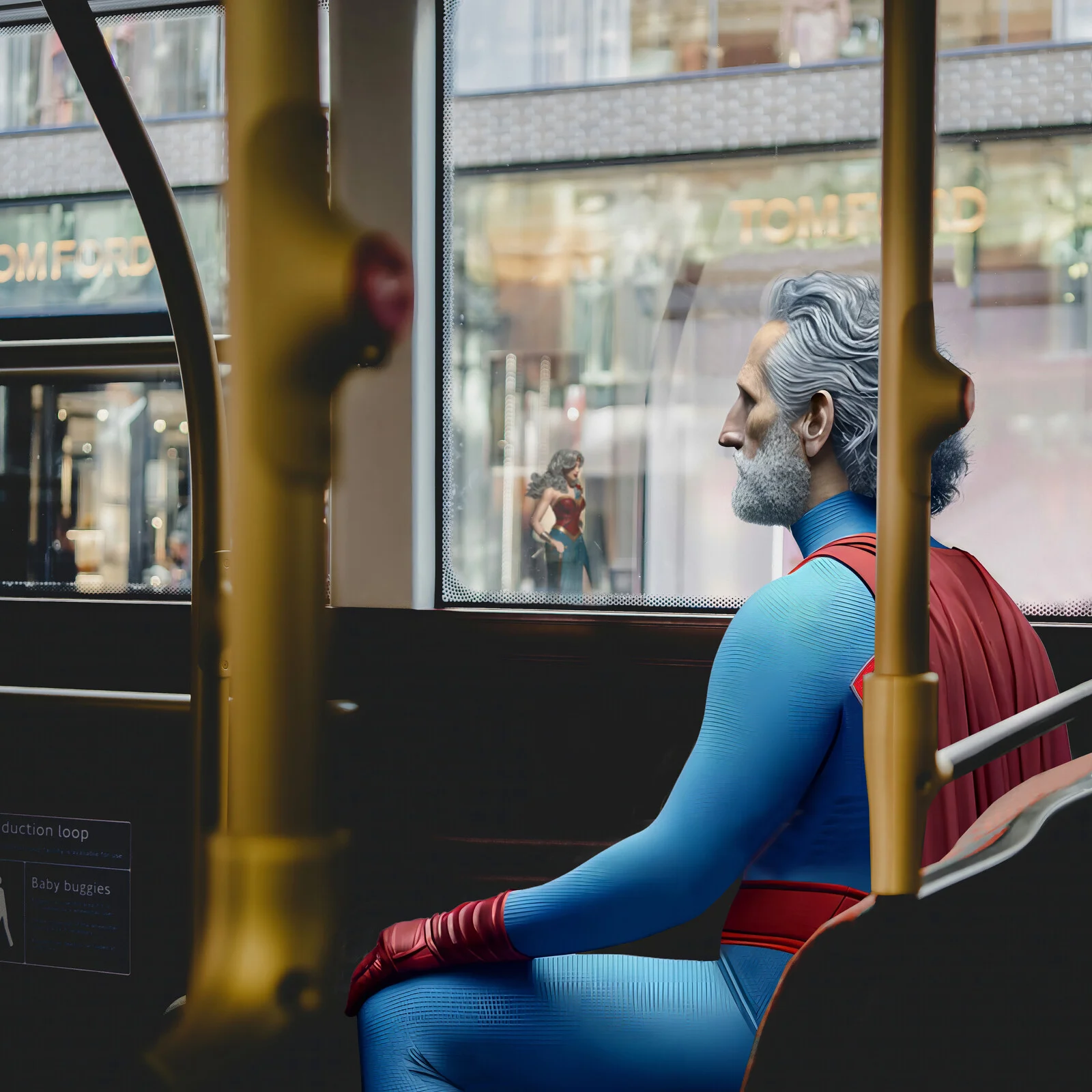
Jörgen Thornberg
Pensioners ride for free, 2023
Digital
70 x 70 cm
3 500 kr
"When I get older, losing my hair
Many years from now
Will you still be sending me a Valentine,
Birthday greetings bottle of wine
If I'd been out till quarter to three
Would you lock the door?
Will you still need me, will you still feed me
When I'm sixty-four?"
When Paul McCartney penned the lyrics to "When I'm 64" in 1967, he was only 14, but over 20 years later, the melody fell into place. With its contemplation of ageing and the need for preparation, this song resonates with the essence of gerontology and the importance of understanding the ageing process.
Ageing is a complex, natural process that occurs in all living organisms. It involves progressive physiological changes that ultimately lead to senescence or a decline in biological functions and the organism's ability to adapt to metabolic stress. This intricate process unfolds at the cellular, organ, and organism levels over time, encompassing the entire adult lifespan of an organism.
Gerontology, the scientific study of ageing, seeks to comprehend and manage all factors contributing to the finite nature of individual life. While it often addresses incapacity issues, it also encompasses a broader spectrum of phenomena. Each species possesses a unique life history where individual lifespan is intricately linked to reproductive lifespan, reproductive mechanisms, and developmental trajectories. Understanding these relationships' evolution is essential to gerontology and evolutionary biology. It's crucial to differentiate between the physicochemical processes of ageing, such as the breakdown of proteins and DNA damage, and organismic processes, such as disease (e.g., cancer) and injury (e.g., heart attack) that lead to death.
Gerontology encompasses longevity, ageing, and death, examined through evolutionary and individual perspectives. Longevity denotes an organism's lifespan, while ageing refers to the sequential or progressive changes that increase susceptibility to infirmity, disease, and death. Senescence, a term used in gerontology, encompasses the manifestations of the ageing process, including physical, psychological, and social changes.
Population viability is assessed through actuarial functions like survivorship curves and age-specific death rates (Gompertz function). When combined with factors like ageing characteristics, constitutional vigour, environmental exposure, and genetic influences, these functions offer valuable insights into the ageing process. For instance, they can help us understand how environmental factors like pollution or genetic factors like mutations can influence the rate of ageing and the lifespan of a population.
The age-specific mortality rate is a crucial actuarial function for ageing investigations, first elucidated by Benjamin Gompertz in 1825. This rate measures the number of deaths in a population at different ages and demonstrates mortality rate escalation in geometric progression across successive age intervals. It is a vital tool in understanding the ageing process, as it shows how the risk of death increases with age. Although diseases and disabilities often follow a similar geometric pattern, exceptions exist, notably in infectious and immunological diseases.
In industrialised nations, life expectancy has notably increased over the past century, owing to various advancements. These include improvements in healthcare, such as the development of vaccines and antibiotics, which have reduced the impact of infectious diseases. Nutrition has also played a significant role, with the widespread availability of a diverse and balanced diet. Lastly, living standards have improved, with better sanitation, housing, and working conditions. At the dawn of the 20th century, life expectancy ranged between 30 and 45 years, rising to approximately 67 years by the century's end. Projections suggest continued increases in life expectancy, particularly for individuals adhering to healthier lifestyles. In the United States, centenarians—individuals aged 100 or older—constituted the fastest-growing segment of the population in the early 21st century.
In places like my hometown, Malmö, pensioners are shown enough respect to travel on public transportation for free, except for certain morning and afternoon rush hours. Weekends are also free. The same generosity applies in London. Travel free on bus, tram, Tube, DLR, London Overground, and Elizabeth line with your Older Person's Freedom Pass anytime Monday to Friday, except between 04:30-09:00. You can travel free anytime at weekends and on bank holidays. It was a Saturday when I saw Superman take advantage of this privilege, and I noticed that Wonder Woman was out window shopping.
Like other superheroes, Superman suffers from poor pension benefits. It was different in their glory days, even though money was never discussed. In the comics, Superman is often depicted as being incredibly wealthy. Superman's alter ego, Clark Kent, is a reporter for the Daily Planet in Metropolis. While his salary as a reporter would not make him particularly wealthy, his superhero alter ego is known to have access to vast resources due to his association with the Justice League and his connections to various influential individuals and organisations.
Additionally, Superman's Fortress of Solitude, a remote headquarters located in the Arctic, is often portrayed as containing advanced technology and valuable artefacts. This, combined with his ability to use his superpowers for various purposes, suggests that Superman's wealth is not easily quantifiable in traditional terms.
Money held little significance for Superman, as he once could create diamonds from coal by closing his fist, retrieving lost sea treasures, and extracting precious metals effortlessly. Additionally, he had access to invaluable alien artefacts, fauna, flora, and technology. He could quickly capitalise on his capabilities by charging exorbitant fees for services like placing satellites into orbit. The automated systems in the Fortress of Solitude could generate virtually any material goods Superman might require, allowing him to acquire wealth limitlessly.
Since Superman lacked material desires, his expenses primarily consisted of his city apartment rent, clothing, furnishings, and romantic outings with Lois. The remainder of his earnings was typically sent to his adoptive mother, Ma Kent. She was a gambling addict, so both Clark's and his father's money ended up in the hands of the gambling devil.
To delve into specifics, let's consider Clark Kent's income. As an experienced investigative journalist and occasional columnist for the New York Times, his annual earnings likely fall around $175,000, resulting in a net income of approximately $112,488.51 after taxes. With the cost of living in a city like NYC averaging $36,000-$72,000 per year, Ma Kent had likely gambled away $400,000 of Clark's earnings over a decade.
Moving on to the Kent family farm, which spanned approximately 231 acres, was typical for a family farm. Valued at $4,000 per acre in Kansas, the land alone was worth around $924,000. Adding the cost of the farmhouse, barn, silo, animals, and equipment, the total investment amounted to an estimated $1.5 million. It could have been good money, but it is all gone.
Given Clark's rural upbringing and preference for property ownership, he would likely have purchased a condominium in Metropolis instead of renting. Assuming a mortgage of $1 million over 20 years for a 2-bedroom condo valued at $1.5 million, Clark may have approximately $500,000 paid off on his mortgage. Not at all. He lived with Lois Lane for years, who eventually grew tired of the man who couldn't do the dishes due to his superpowers and broke most things for the same reason. He tossed his Superman underwear around carelessly. And he couldn't even wash his indestructible underpants in a washing machine because it would break. He was simply a spoiled man, in short. Without his superpowers and now with regular unwashed underwear, he was kicked out after a wet eightieth birthday in 2018. Over the years, with dwindling body strength and confidence, he sought solace in the bottle. It had the same devastating effect on him as kryptonite once did.
That he would have collected in the barns was a theory. In reality, Superman had too much to do fighting criminals and saving girls who fell like ripe fruit from Metropolis skyscrapers. Some stayed in his arms for a while, and gods know that girls are expensive to keep. He sold his parents' farm after they both passed away. Superman grew tired when the weeds took over at a faster rate than he could blow them away with his super breath. Plus, earth flight became difficult. Burning away the weeds with his fiery gaze didn't work either. The grass fires that followed spread to the neighbours, who complained. None of his city friends were interested in the countryside, nor were the girls who preferred the city's vibrant discos. In the end, he gave up.
As he aged, his problems increased. With Lex Luthor, it all comes back to Superman. First, Luthor swindled Superman in a pyramid scheme in the early nineties. Shortly after turning the century, Luthor got hold of Superman's PIN codes and emptied all his bank accounts. Gone were a lifetime of savings, and his superpowers were gone so that Superman couldn't squeeze diamonds out of coal anymore. He became a poor pensioner, plain and simple. As such, he appreciated the opportunity to ride public transportation for free. He could ride around for hours, memorising London's streets, sights, and shops, all to exercise his brain and keep Alzheimer's at bay. Otherwise, he sat at Waterloo Station with his friends Batman and Wonder Woman, both in the same situation as him. Easy come, easy go.
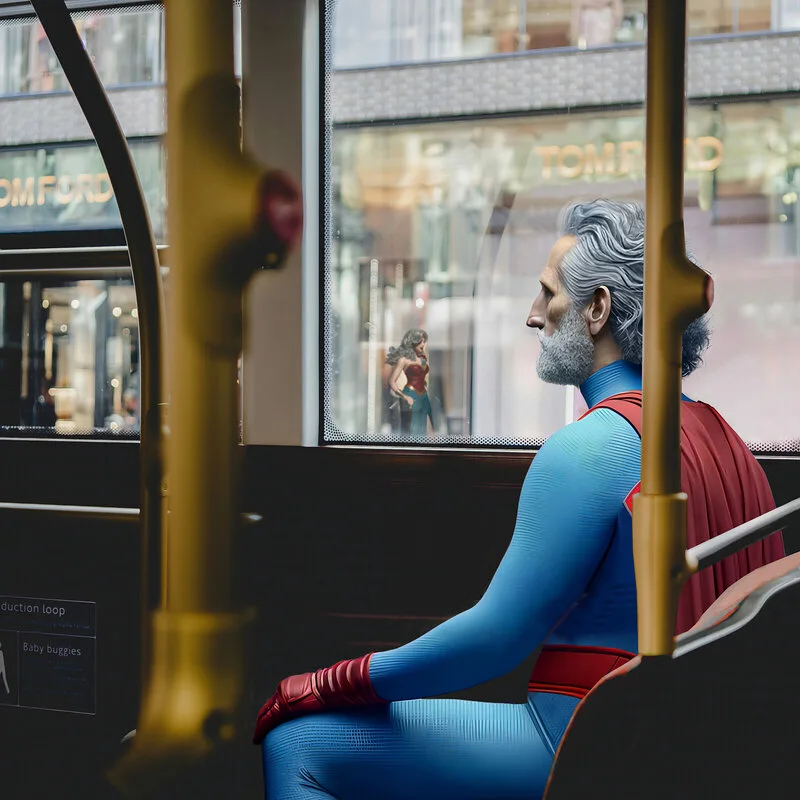
Jörgen Thornberg
Pensioners ride for free, 2023
Digital
70 x 70 cm
3 500 kr
"When I get older, losing my hair
Many years from now
Will you still be sending me a Valentine,
Birthday greetings bottle of wine
If I'd been out till quarter to three
Would you lock the door?
Will you still need me, will you still feed me
When I'm sixty-four?"
When Paul McCartney penned the lyrics to "When I'm 64" in 1967, he was only 14, but over 20 years later, the melody fell into place. With its contemplation of ageing and the need for preparation, this song resonates with the essence of gerontology and the importance of understanding the ageing process.
Ageing is a complex, natural process that occurs in all living organisms. It involves progressive physiological changes that ultimately lead to senescence or a decline in biological functions and the organism's ability to adapt to metabolic stress. This intricate process unfolds at the cellular, organ, and organism levels over time, encompassing the entire adult lifespan of an organism.
Gerontology, the scientific study of ageing, seeks to comprehend and manage all factors contributing to the finite nature of individual life. While it often addresses incapacity issues, it also encompasses a broader spectrum of phenomena. Each species possesses a unique life history where individual lifespan is intricately linked to reproductive lifespan, reproductive mechanisms, and developmental trajectories. Understanding these relationships' evolution is essential to gerontology and evolutionary biology. It's crucial to differentiate between the physicochemical processes of ageing, such as the breakdown of proteins and DNA damage, and organismic processes, such as disease (e.g., cancer) and injury (e.g., heart attack) that lead to death.
Gerontology encompasses longevity, ageing, and death, examined through evolutionary and individual perspectives. Longevity denotes an organism's lifespan, while ageing refers to the sequential or progressive changes that increase susceptibility to infirmity, disease, and death. Senescence, a term used in gerontology, encompasses the manifestations of the ageing process, including physical, psychological, and social changes.
Population viability is assessed through actuarial functions like survivorship curves and age-specific death rates (Gompertz function). When combined with factors like ageing characteristics, constitutional vigour, environmental exposure, and genetic influences, these functions offer valuable insights into the ageing process. For instance, they can help us understand how environmental factors like pollution or genetic factors like mutations can influence the rate of ageing and the lifespan of a population.
The age-specific mortality rate is a crucial actuarial function for ageing investigations, first elucidated by Benjamin Gompertz in 1825. This rate measures the number of deaths in a population at different ages and demonstrates mortality rate escalation in geometric progression across successive age intervals. It is a vital tool in understanding the ageing process, as it shows how the risk of death increases with age. Although diseases and disabilities often follow a similar geometric pattern, exceptions exist, notably in infectious and immunological diseases.
In industrialised nations, life expectancy has notably increased over the past century, owing to various advancements. These include improvements in healthcare, such as the development of vaccines and antibiotics, which have reduced the impact of infectious diseases. Nutrition has also played a significant role, with the widespread availability of a diverse and balanced diet. Lastly, living standards have improved, with better sanitation, housing, and working conditions. At the dawn of the 20th century, life expectancy ranged between 30 and 45 years, rising to approximately 67 years by the century's end. Projections suggest continued increases in life expectancy, particularly for individuals adhering to healthier lifestyles. In the United States, centenarians—individuals aged 100 or older—constituted the fastest-growing segment of the population in the early 21st century.
In places like my hometown, Malmö, pensioners are shown enough respect to travel on public transportation for free, except for certain morning and afternoon rush hours. Weekends are also free. The same generosity applies in London. Travel free on bus, tram, Tube, DLR, London Overground, and Elizabeth line with your Older Person's Freedom Pass anytime Monday to Friday, except between 04:30-09:00. You can travel free anytime at weekends and on bank holidays. It was a Saturday when I saw Superman take advantage of this privilege, and I noticed that Wonder Woman was out window shopping.
Like other superheroes, Superman suffers from poor pension benefits. It was different in their glory days, even though money was never discussed. In the comics, Superman is often depicted as being incredibly wealthy. Superman's alter ego, Clark Kent, is a reporter for the Daily Planet in Metropolis. While his salary as a reporter would not make him particularly wealthy, his superhero alter ego is known to have access to vast resources due to his association with the Justice League and his connections to various influential individuals and organisations.
Additionally, Superman's Fortress of Solitude, a remote headquarters located in the Arctic, is often portrayed as containing advanced technology and valuable artefacts. This, combined with his ability to use his superpowers for various purposes, suggests that Superman's wealth is not easily quantifiable in traditional terms.
Money held little significance for Superman, as he once could create diamonds from coal by closing his fist, retrieving lost sea treasures, and extracting precious metals effortlessly. Additionally, he had access to invaluable alien artefacts, fauna, flora, and technology. He could quickly capitalise on his capabilities by charging exorbitant fees for services like placing satellites into orbit. The automated systems in the Fortress of Solitude could generate virtually any material goods Superman might require, allowing him to acquire wealth limitlessly.
Since Superman lacked material desires, his expenses primarily consisted of his city apartment rent, clothing, furnishings, and romantic outings with Lois. The remainder of his earnings was typically sent to his adoptive mother, Ma Kent. She was a gambling addict, so both Clark's and his father's money ended up in the hands of the gambling devil.
To delve into specifics, let's consider Clark Kent's income. As an experienced investigative journalist and occasional columnist for the New York Times, his annual earnings likely fall around $175,000, resulting in a net income of approximately $112,488.51 after taxes. With the cost of living in a city like NYC averaging $36,000-$72,000 per year, Ma Kent had likely gambled away $400,000 of Clark's earnings over a decade.
Moving on to the Kent family farm, which spanned approximately 231 acres, was typical for a family farm. Valued at $4,000 per acre in Kansas, the land alone was worth around $924,000. Adding the cost of the farmhouse, barn, silo, animals, and equipment, the total investment amounted to an estimated $1.5 million. It could have been good money, but it is all gone.
Given Clark's rural upbringing and preference for property ownership, he would likely have purchased a condominium in Metropolis instead of renting. Assuming a mortgage of $1 million over 20 years for a 2-bedroom condo valued at $1.5 million, Clark may have approximately $500,000 paid off on his mortgage. Not at all. He lived with Lois Lane for years, who eventually grew tired of the man who couldn't do the dishes due to his superpowers and broke most things for the same reason. He tossed his Superman underwear around carelessly. And he couldn't even wash his indestructible underpants in a washing machine because it would break. He was simply a spoiled man, in short. Without his superpowers and now with regular unwashed underwear, he was kicked out after a wet eightieth birthday in 2018. Over the years, with dwindling body strength and confidence, he sought solace in the bottle. It had the same devastating effect on him as kryptonite once did.
That he would have collected in the barns was a theory. In reality, Superman had too much to do fighting criminals and saving girls who fell like ripe fruit from Metropolis skyscrapers. Some stayed in his arms for a while, and gods know that girls are expensive to keep. He sold his parents' farm after they both passed away. Superman grew tired when the weeds took over at a faster rate than he could blow them away with his super breath. Plus, earth flight became difficult. Burning away the weeds with his fiery gaze didn't work either. The grass fires that followed spread to the neighbours, who complained. None of his city friends were interested in the countryside, nor were the girls who preferred the city's vibrant discos. In the end, he gave up.
As he aged, his problems increased. With Lex Luthor, it all comes back to Superman. First, Luthor swindled Superman in a pyramid scheme in the early nineties. Shortly after turning the century, Luthor got hold of Superman's PIN codes and emptied all his bank accounts. Gone were a lifetime of savings, and his superpowers were gone so that Superman couldn't squeeze diamonds out of coal anymore. He became a poor pensioner, plain and simple. As such, he appreciated the opportunity to ride public transportation for free. He could ride around for hours, memorising London's streets, sights, and shops, all to exercise his brain and keep Alzheimer's at bay. Otherwise, he sat at Waterloo Station with his friends Batman and Wonder Woman, both in the same situation as him. Easy come, easy go.
3 500 kr

Jörgen Thornberg
Malmö
Lite om bilder och mig. Translation in English at the end.
Jag är en nyfiken person som ser allt i bilder, även det jag fäster i ord, gärna tillsammans för bakom alla mina bilder finns en berättelse. Till vissa bilder hör en kortare eller längre novell som följer med bilden.
Bilder berättar historier. Jag omges av naturlig skönhet, intressanta människor och historia var jag än går. Jag använder min kamera för att dokumentera världen och blanda det jag ser med vad jag känner för att fånga den dolda magin.
Mina bilder berättar mina historier. Genom mina bilder, tryck och berättelser. Jag bjuder in dig att ta del av dessa berättelser, in i ditt liv och hem och dela min mycket personliga syn på vår värld. Mer än vad ögat ser. Jag tänker i bilder, drömmer och skriver och pratar om dem; följaktligen måste jag också skapa bilder. De blir vad jag ser, inte nödvändigtvis begränsade till verkligheten. Det finns en bild runt varje hörn. Jag hoppas att du kommer att se vad jag såg och gilla det.
Jag är också en skrivande person och till många bilder hör en kortare eller längre essay. Den följer med tavlan, tryckt på fint papper och med en personlig hälsning från mig.
Flertalet bilder startar sin resa i min kamera. Enkelt förklarat beskriver jag bilden jag ser i mitt inre, upplevd eller fantiserad. Bilden uppstår inom mig redan innan jag fått okularet till ögat. På bråkdelen av ett ögonblick ser jag vad jag vill ha och vad som kan göras med bilden. Här skall jag stoppa in en giraff, stålmannen, Titanic eller vad det är min fantasi finner ut. Ännu märkligare är att jag kommer ihåg minnesbilden långt efteråt när det blir tid att skapa verket. Om jag lyckas eller inte, är upp till betraktaren, oftast präglat av en stråk av svart humor – meningen är att man skall bli underhållen. Mina bilder blir ofta en snackis där de hänger.
Jag föredrar bilder som förmedlar ett budskap i flera lager. Vid första anblicken fylld av feel-good, en vacker utsikt, fint väder, solen skiner, blommor på ängen eller vattnet som ligger förrädiskt spegelblankt. I en sådan bild kan jag gömma min egentliga berättelse, mitt förakt för förtryckare och våldsverkare, rasister och fördomsfulla människor - ett gärna återkommande motiv mer eller mindre dolt i det vackra motivet. Jag försöker förena dem i ett gemensamt narrativ.
Bild och formgivning har löpt som en röd tråd genom livet. Fotokonst känns som en värdig final som jag gärna delar med mig.
Min genre är vid som framgår av mina bilder, temat en blandning av pop- och gatukonst i kollage som kan bestå av hundratals lager. Vissa bilder kan ta veckor, andra någon dag innan det är dags att överlämna resultatet till printverkstaden. Fine Art Prints är digitala fotocollage. I dessa kollage sker rivandet, klippandet, pusslandet, målandet, ritandet och sprayningen digitalt. Det jag monterar in kan vara hundratals år gamla bilder som jag omsorgsfullt frilägger så att de ser ut att vara en del av tavlan men också bilder skapade av mig själv efter min egen fantasi. Därefter besöks printstudion och för vissa bilder numrera en limiterad upplaga (oftast 7 exemplar) och signera för hand. Vissa bilder kan köpas i olika format. Det är bara att fråga efter vilka. Gillar man en bild som är 70x100 men inte har plats på väggen, går den kanske att få i 50x70 cm istället. Frågan är fri.
Metoden Giclée eller Fine Art Print som det också kallas är det moderna sättet för framställning av grafisk konst. Villkoret för denna typ av utskrifter är att en högkvalitativ storformatskrivare används med åldersbeständigt färgpigment och konstnärspapper eller i förekommande fall på duk. Pappret som används möter de krav på livslängd som ställs av museer och gallerier. Normalt säljer jag mina bilder oinramade så att den nya ägaren själv kan bestämma hur de skall se ut, med eller utan passepartout färg på ram, med eller utan glas etc..
Under många år ställde jag bara ut på nätet, i valda grupper och på min egen Facebooksida - https://www.facebook.com/jorgen.thornberg.9
Jag finns också på en egen hemsida som tyvärr inte alltid är uppdaterad – https://www.jth.life/ Där kan du också läsa en del av de berättelser som följer med bilden.
UTSTÄLLNINGAR
Luftkastellet, oktober 2022
Konst i Lund, november 2022
Luftkastellet, mars 2023
Engleson Galleri Caroli, april 2023
Hydra, Greece June 2023
Engleson Galleri Caroli, oktober 2023
Toppen, Höllviken december 2023
Luftkastellet, mars 2024
Torups Galleri, mars 2024
Venice, May 2024
Luftkastellet, oktober 2024
Konst i Advent, December 2024
Galleri Engleson, Caroli December 2024
Jäger & Jansson Galleri, april 2025
A bit about pictures and me.
I'm a curious person who sees everything in pictures, even what I express in words, often combining them, for behind all my pictures lies a story. These narratives, some as short as a single image and others as long as a novel, are the heart and soul of my work.
Pictures tell stories. Wherever I go, I'm surrounded by natural beauty, exciting people, and history. I use my camera to document the world and blend what I see with what I feel to capture the hidden magic.
My images tell my stories. Through my pictures, prints, and narratives, I invite you to partake in these stories in your life and home and share my deeply personal perspective of our world. More than meets the eye. I think in pictures, dream, write, and talk about them; consequently, I must create images too. They become what I see, not necessarily confined to reality. There's a picture around every corner. I hope you'll see what I saw and enjoy it.
I'm also a writer, and many images come with a shorter or longer essay. It accompanies the painting, printed on fine paper with my personal greeting.
Many pictures start their journey on my camera. Simply put, I describe the image I see in my mind, experienced or imagined. The image arises within me even before I bring the eyepiece to my eye. In a fraction of a moment, I see what I want and what can be done with the picture. Here, I'll insert a giraffe, Superman, the Titanic, or whatever my imagination conjures up. Even stranger is that I remember the mental image long after it's time to create the work. Whether I succeed is up to the observer, often imbued with a streak of black humour – the aim is to entertain. My pictures usually become a talking point wherever they hang.
I prefer pictures that convey a message in multiple layers. At first glance, they're filled with feel-good vibes, a beautiful view, lovely weather, the sun shining, flowers in the meadow, or the water lying deceptively calm. But beneath this surface beauty, I often conceal a deeper story, a narrative that challenges societal norms or explores the human condition. I invite you to delve into these hidden narratives and discover the layers of meaning within my work.
Picture and design have been a thread running through my life. Photographic art feels like a fitting finale, and I'm happy to share it.
My genre is varied, as seen in my pictures; the theme is a blend of pop and street art in collages that can consist of hundreds of layers. Some images can take weeks, others just a day before it's time to hand over the result to the print workshop. Fine Art Prints are digital photo collages. In these collages, tearing, cutting, puzzling, painting, drawing, and spraying happen digitally. What I insert can be images hundreds of years old that I carefully extract so they appear to be part of the painting, but also images created by myself, now also generated from my imagination. Next, visit the print studio and, for certain images, number a limited edition (usually 7 copies) and sign them by hand. Some images may be available in other formats. Just ask which ones. If you like an image that's 70x100 but doesn't have space on the wall, you might be able to get it in 50x70 cm instead. The question is open.
The Giclée method, or Fine Art Print as it's also called, is the modern way of producing graphic art. This method ensures the highest quality and longevity of the artwork, using a high-quality large-format printer with archival pigment inks and artist paper or, in some cases, canvas. The paper used meets the longevity requirements set by museums and galleries. I sell my pictures unframed, allowing the new owner to personalise their artwork, confident in the lasting value and quality of the piece.
For many years, I only exhibited online, in selected groups, and on my Facebook page - https://www.facebook.com/jorgen.thornberg.9. I also have my website, which unfortunately is not constantly updated - https://www.jth.life/. You can also read some of the stories accompanying the pictures there.
EXHIBITIONS
Luftkastellet, October 2022
Art in Lund, November 2022
Luftkastellet, March 2023
Engleson Gallery Caroli, April 2023
Hydra, Greece June 2023
Engleson Gallery Caroli, October 2023
Toppen, Höllviken December 2023
Luftkastellet, March 2024
Torup Gallery, March 2024
Venice, May 2024
UTSTÄLLNINGAR
Luftkastellet, oktober 2022
Konst i Lund, november 2022
Luftkastellet, mars 2023
Engleson Galleri Caroli, april 2023
Hydra, Greece June 2023
Engleson Galleri Caroli, oktober 2023
Toppen, Höllviken december 2023
Luftkastellet, mars 2024
Torups Galleri, mars 2024
Venice, May 2024
Luftkastellet, October 2024
Konst i Advent, December 2024
Galleri Engleson, Caroli December 2024
Jäger & Jansson Galleri, April 2025
Utbildning
Autodidakt
Medlem i konstnärsförening
Öppna Sinnen
Med i konstrunda
Konstrundan i Skåne
Utställningar
Luftkastellet, October 2022
Art in Lund, November 2022
Luftkastellet, March 2023
Engleson Gallery Caroli, April 2023
Hydra, Greece June 2023
Engleson Gallery Caroli, October 2023
Toppen, Höllviken December 2023
Luftkastellet, March 2024
Torup Gallery, March 2024
Venice, May 2024