Vi använder cookies för att ge dig bästa möjliga upplevelse. Välj vilka cookies du tillåter.
Läs mer i vår integritetspolicy
Jörgen Thornberg
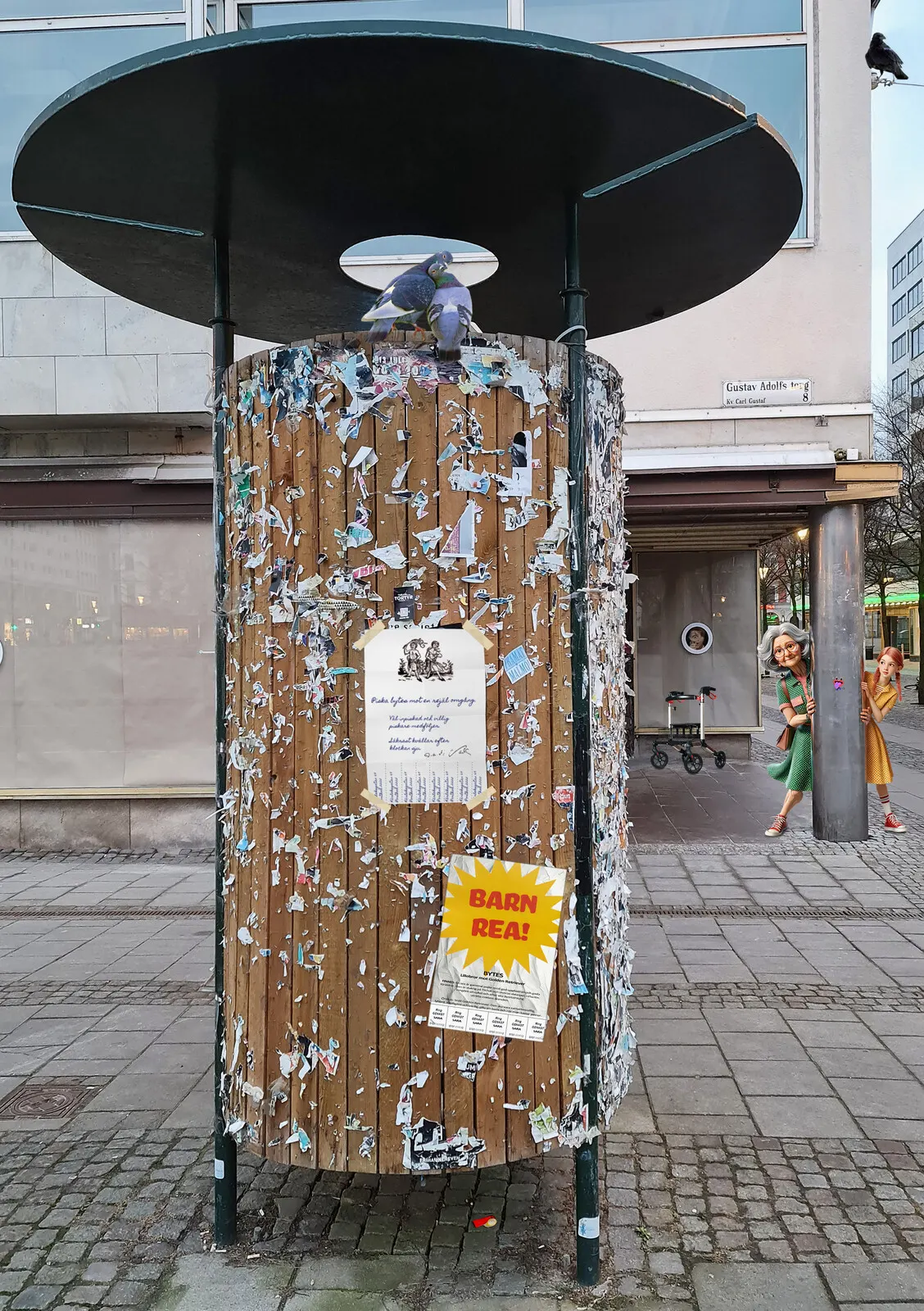
Whose is whose - Tortyr till Salu, 2022
Digital
50 x 70 cm
3 200 kr
Whose is whose? Which advertisement belongs to whom on the billboard? It isn't easy to be categorical these times, but feel free to guess. Another question is if they found any customers. Unfortunately, I can't answer that. I couldn't stay there and wait. Some curious onlookers glanced, but no one tore off a coupon while I was there.
From papyrus wall posters to pop-up ads, advertising has undoubtedly taken a wild ride through history. Consider the ingenuity of the ancient Egyptians, weaving sales pitches into their scrolls, or the cleverness of lost-and-found ads for runaway slaves circulating in ancient Greece. The first-ever written ad, dating back to 3000 BC in Thebes, Egypt, was a brilliant blend of seeking a fugitive slave and promoting a weaving shop—truly a testament to our ancestors' multitasking skills!
Fast forward to the 15th century, and we have Johannes Gutenberg rocking the advertising world with his invention of the printing press. Suddenly, posters and handbills flooded the streets of Europe, promoting everything from Shakespearean plays to medieval medicine.
Then came the 1700s, when newspapers became the go-to for advertising. Imagine yourself flipping through the Boston News-Letter in 1704, only to stumble upon an ad for an estate sale – the OG clickbait. This was a pivotal moment in advertising history, marking the birth of billboards in the early 1800s. Jared Bell’s genius move to advertise the Barnum & Bailey Circus in New York set the stage for larger-than-life promotions, shaping how we perceive and interact with advertisements today.
By the 20th century, radio and television took the spotlight. Imagine tuning in to WEAF radio in 1922 and being hit with a 15-minute ad for apartments in Jackson Heights – now that’s commitment. And let’s not forget Bulova Watch Company's ten-second TV spot in 1941, kicking off the Golden Age of Advertising and captivating audiences across New York City.
But the story doesn't end there! The Internet burst onto the scene in the early 2000s, sparking a digital revolution. Suddenly, we had online display ads, search engine marketing, and the birth of social media advertising. AT&T's iconic 'click your mouse right HERE' ad from 1994 still holds the record for click-through rates, a testament to the power of early digital advertising.
And here we are in the modern age of advertising, where smartphones and influencers reign supreme. From mobile ads infiltrating our favourite apps to influencers peddling products on Instagram, advertising has seamlessly integrated into every aspect of our digital lives.
As we journey through the ever-changing advertising landscape, one thing remains clear: adaptability is vital. Whether embracing new technologies or leveraging the power of social media, advertisers must stay ahead of the curve to connect with consumers in this fast-paced, interconnected world. This is a testament to the resilience and evolution of advertising, a wild ride that continues to captivate audiences and shape our world.
Picture this: ASML's lithography machines working their magic on the tiniest of scales, churning out microchips smaller than you can even fathom – we're talking nanometers here, folks (that's a millionth of a millimetre)! These microchips are the backbone of our electronic world, making our devices cheaper, faster, and more powerful than ever.
Hold onto your hats because ASML just scored a spot in the Guinness World Records with the most minor advertisement known to humankind. We're talking a surface area of a measly 258 micrometres squared, measuring a mere 33.27 micrometres by 7.76 micrometres. To put that into perspective, it's so tiny that a single strand of a human hair could easily conceal it – and those bad boys are about 75 micrometres wide (to clarify, one micrometre is a thousandth of a millimetre). Now, that's what we call microscopic marketing prowess!
Get ready to have your mind blown: Arby's, in a bid to announce their switch to Coca-Cola products, went all out and created the most prominent advertising poster known to humanity. We're talking a whopping 28,922.10 square meters (or 311,314 square feet if you're into imperial measurements), folks! This mammoth ad was unveiled in Monowi, Nebraska, USA, on June 13, 2018.
Now, why Monowi, you ask? Well, according to the US census, this tiny town holds the title of the smallest city in America. Picture this: one resident wearing multiple hats as the mayor, librarian, and bartender – talk about wearing many hats! So, naturally, it was the perfect spot to make a colossal statement about Arby's newfound love for Coke.
The ad itself reads, "Arby's Now Has Coke." It's Short, sweet, and more significant than life, just like the spirit of advertising!
A pinboard, known by many names, including noticeboard or noticeboard in British English, boasts a rich history and versatile utility. As a platform for public messages, it facilitates the advertisement of items for sale, announcement of events, and provision of information. Typically crafted from materials like cork to facilitate easy attachment and removal of messages, pinboards often incorporate a writing surface such as a blackboard or whiteboard. A combination bulletin board merges the functionality of a pinboard with that of a writing surface, offering a multifaceted communication tool. Additionally, bulletin boards have found their digital counterparts in computer networks, enabling users to leave and erase messages for others to view, akin to a bulletin board system.
Schools and universities frequently host bulletin boards utilised by sports teams, extracurricular groups, and establishments ranging from local shops to official bodies. They can be found in dormitory corridors, bustling hallways, lobbies, and freestanding kiosks, providing convenient spaces for posting notices. Impromptu posting sites often emerge on lampposts, bollards, trees, and walls in areas lacking official boards. In my depiction, one of the municipality's poster pillars serves as a hub for the public to affix their urgent messages, some more eccentric than others.
The most significant message ever posted on a bulletin board, in this case, on a church door, is undoubtedly Martin Luther's 95 Theses. In 1517, in Wittenberg, Germany, Luther challenged the Catholic Church's sale of indulgences by nailing his 95 Theses to the door of the Castle Church. This act marked the beginning of the Protestant Reformation, a pivotal event that reshaped Christianity and world history.
Luther's theses challenged the church's doctrines and practices, raising questions about penance, grace, and authority. Utilising the newly invented printing press, Luther's theses spread rapidly across Germany and Europe, sparking a wave of religious upheaval and division within the Christian church. The Protestant movement profoundly affected Europe's politics, culture, and society, shaping the modern world as we know it today.
This historical moment, when Luther publicly challenged the church's authority and initiated a religious revolution, demonstrates the power of a simple message on a bulletin board. It illustrates how a single act can unleash changes of epic proportions and inspire generations of people to question, challenge, and redefine norms and values. Martin Luther's courage to stand up for his convictions and his nailing his theses to the church door has cemented his place in history as a pioneering reformer and a symbol of religious freedom and change.
Internet forums have revolutionised communication, offering a modern alternative to traditional bulletin boards. These virtual platforms, also known as message boards, replicate the functionality of physical bulletin boards while transcending geographical limitations. Terms like bulletin board, message board, and internet forum are used interchangeably, with individual boards hosting multiple forums or discussion groups.
Magnetic bulletin boards, or magnet boards, have emerged as a practical and innovative alternative to traditional cork boards. Addressing concerns of board deterioration due to pin insertion and removal, these boards offer a durable and user-friendly solution and are gaining popularity in various settings.
In the annals of human communication, one humble yet ubiquitous tool has stood the test of time: the bulletin board. From ancient Rome to the digital age, these boards have been a canvas for everything from mundane announcements to quirky advertisements, reflecting society's collective consciousness. Let's take a whimsical journey through the ages, exploring the evolution of bulletin boards and the colourful anecdotes they've inspired along the way.
Our story begins in ancient Rome, where the Forum served as the epicentre of public life. Imagine bustling crowds, merchants hawking their wares, and the original bulletin boards adorned with wax tablets. Here, citizens would pin notices about political debates, gladiatorial contests, and even lost togas. Legend has it that Julius Caesar once posted a bulletin seeking his lost laurel wreath after a particularly rowdy night of revelry.
Fast forward to medieval Europe, where town criers and heralds roamed the streets, spreading the news to the illiterate masses. However, the advent of the printing press in the 15th century revolutionised communication. Suddenly, broadsheets adorned with woodcut illustrations began to appear on town squares, heralding everything from royal decrees to the latest gossip. In London's bustling markets, it wasn't uncommon to find bulletin boards overflowing with advertisements for quack remedies, rat catchers, and even public executions (a macabre form of entertainment for some).
As society evolved, so too did the humble bulletin board. In 18th-century coffeehouses, patrons would gather to exchange ideas, debate politics, and peruse the latest postings. Here, the seeds of revolution were sown as Enlightenment thinkers like Voltaire and Rousseau penned incendiary pamphlets that found their way onto bulletin boards across Europe.
But perhaps the golden age of bulletin boards dawned with the rise of the Internet. In the early days of cyberspace, before social media dominated our digital lives, forums and message boards reigned supreme. From the obscure realms of Usenet to the bustling communities of early online gaming, these virtual bulletin boards became hubs of creativity, camaraderie, and occasional chaos. Who could forget the legendary flame wars, the epic trolling campaigns, or the heartfelt confessions of lovesick teenagers seeking advice?
Even today, in our hyper-connected world, the bulletin board endures. Sure, it may have gone digital, but its essence remains the same: a place for people to share information, express themselves, and connect. Whether it's a neighbourhood forum where neighbours trade gossip and recommendations or a subreddit dedicated to niche hobbies like artisanal cheese-making or underwater basket weaving, the spirit of the bulletin board lives on.
Jörgen Thornberg
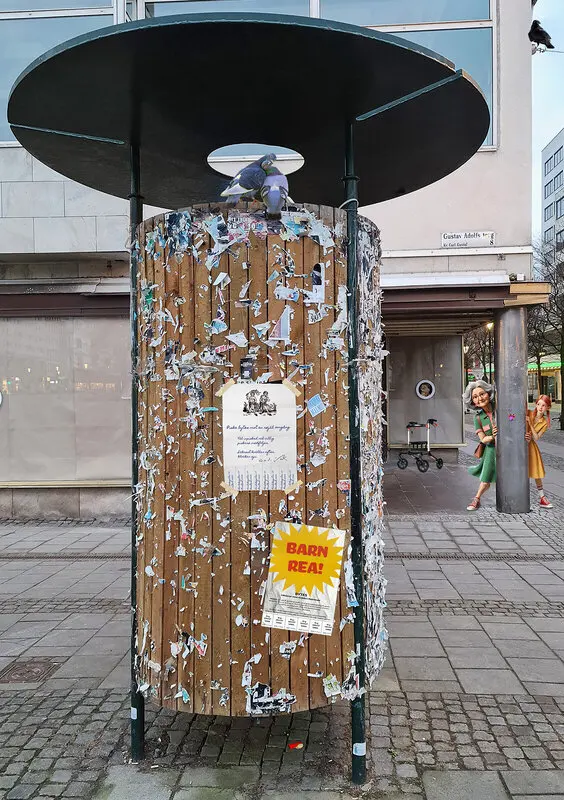
Whose is whose - Tortyr till Salu, 2022
Digital
50 x 70 cm
3 200 kr
Whose is whose? Which advertisement belongs to whom on the billboard? It isn't easy to be categorical these times, but feel free to guess. Another question is if they found any customers. Unfortunately, I can't answer that. I couldn't stay there and wait. Some curious onlookers glanced, but no one tore off a coupon while I was there.
From papyrus wall posters to pop-up ads, advertising has undoubtedly taken a wild ride through history. Consider the ingenuity of the ancient Egyptians, weaving sales pitches into their scrolls, or the cleverness of lost-and-found ads for runaway slaves circulating in ancient Greece. The first-ever written ad, dating back to 3000 BC in Thebes, Egypt, was a brilliant blend of seeking a fugitive slave and promoting a weaving shop—truly a testament to our ancestors' multitasking skills!
Fast forward to the 15th century, and we have Johannes Gutenberg rocking the advertising world with his invention of the printing press. Suddenly, posters and handbills flooded the streets of Europe, promoting everything from Shakespearean plays to medieval medicine.
Then came the 1700s, when newspapers became the go-to for advertising. Imagine yourself flipping through the Boston News-Letter in 1704, only to stumble upon an ad for an estate sale – the OG clickbait. This was a pivotal moment in advertising history, marking the birth of billboards in the early 1800s. Jared Bell’s genius move to advertise the Barnum & Bailey Circus in New York set the stage for larger-than-life promotions, shaping how we perceive and interact with advertisements today.
By the 20th century, radio and television took the spotlight. Imagine tuning in to WEAF radio in 1922 and being hit with a 15-minute ad for apartments in Jackson Heights – now that’s commitment. And let’s not forget Bulova Watch Company's ten-second TV spot in 1941, kicking off the Golden Age of Advertising and captivating audiences across New York City.
But the story doesn't end there! The Internet burst onto the scene in the early 2000s, sparking a digital revolution. Suddenly, we had online display ads, search engine marketing, and the birth of social media advertising. AT&T's iconic 'click your mouse right HERE' ad from 1994 still holds the record for click-through rates, a testament to the power of early digital advertising.
And here we are in the modern age of advertising, where smartphones and influencers reign supreme. From mobile ads infiltrating our favourite apps to influencers peddling products on Instagram, advertising has seamlessly integrated into every aspect of our digital lives.
As we journey through the ever-changing advertising landscape, one thing remains clear: adaptability is vital. Whether embracing new technologies or leveraging the power of social media, advertisers must stay ahead of the curve to connect with consumers in this fast-paced, interconnected world. This is a testament to the resilience and evolution of advertising, a wild ride that continues to captivate audiences and shape our world.
Picture this: ASML's lithography machines working their magic on the tiniest of scales, churning out microchips smaller than you can even fathom – we're talking nanometers here, folks (that's a millionth of a millimetre)! These microchips are the backbone of our electronic world, making our devices cheaper, faster, and more powerful than ever.
Hold onto your hats because ASML just scored a spot in the Guinness World Records with the most minor advertisement known to humankind. We're talking a surface area of a measly 258 micrometres squared, measuring a mere 33.27 micrometres by 7.76 micrometres. To put that into perspective, it's so tiny that a single strand of a human hair could easily conceal it – and those bad boys are about 75 micrometres wide (to clarify, one micrometre is a thousandth of a millimetre). Now, that's what we call microscopic marketing prowess!
Get ready to have your mind blown: Arby's, in a bid to announce their switch to Coca-Cola products, went all out and created the most prominent advertising poster known to humanity. We're talking a whopping 28,922.10 square meters (or 311,314 square feet if you're into imperial measurements), folks! This mammoth ad was unveiled in Monowi, Nebraska, USA, on June 13, 2018.
Now, why Monowi, you ask? Well, according to the US census, this tiny town holds the title of the smallest city in America. Picture this: one resident wearing multiple hats as the mayor, librarian, and bartender – talk about wearing many hats! So, naturally, it was the perfect spot to make a colossal statement about Arby's newfound love for Coke.
The ad itself reads, "Arby's Now Has Coke." It's Short, sweet, and more significant than life, just like the spirit of advertising!
A pinboard, known by many names, including noticeboard or noticeboard in British English, boasts a rich history and versatile utility. As a platform for public messages, it facilitates the advertisement of items for sale, announcement of events, and provision of information. Typically crafted from materials like cork to facilitate easy attachment and removal of messages, pinboards often incorporate a writing surface such as a blackboard or whiteboard. A combination bulletin board merges the functionality of a pinboard with that of a writing surface, offering a multifaceted communication tool. Additionally, bulletin boards have found their digital counterparts in computer networks, enabling users to leave and erase messages for others to view, akin to a bulletin board system.
Schools and universities frequently host bulletin boards utilised by sports teams, extracurricular groups, and establishments ranging from local shops to official bodies. They can be found in dormitory corridors, bustling hallways, lobbies, and freestanding kiosks, providing convenient spaces for posting notices. Impromptu posting sites often emerge on lampposts, bollards, trees, and walls in areas lacking official boards. In my depiction, one of the municipality's poster pillars serves as a hub for the public to affix their urgent messages, some more eccentric than others.
The most significant message ever posted on a bulletin board, in this case, on a church door, is undoubtedly Martin Luther's 95 Theses. In 1517, in Wittenberg, Germany, Luther challenged the Catholic Church's sale of indulgences by nailing his 95 Theses to the door of the Castle Church. This act marked the beginning of the Protestant Reformation, a pivotal event that reshaped Christianity and world history.
Luther's theses challenged the church's doctrines and practices, raising questions about penance, grace, and authority. Utilising the newly invented printing press, Luther's theses spread rapidly across Germany and Europe, sparking a wave of religious upheaval and division within the Christian church. The Protestant movement profoundly affected Europe's politics, culture, and society, shaping the modern world as we know it today.
This historical moment, when Luther publicly challenged the church's authority and initiated a religious revolution, demonstrates the power of a simple message on a bulletin board. It illustrates how a single act can unleash changes of epic proportions and inspire generations of people to question, challenge, and redefine norms and values. Martin Luther's courage to stand up for his convictions and his nailing his theses to the church door has cemented his place in history as a pioneering reformer and a symbol of religious freedom and change.
Internet forums have revolutionised communication, offering a modern alternative to traditional bulletin boards. These virtual platforms, also known as message boards, replicate the functionality of physical bulletin boards while transcending geographical limitations. Terms like bulletin board, message board, and internet forum are used interchangeably, with individual boards hosting multiple forums or discussion groups.
Magnetic bulletin boards, or magnet boards, have emerged as a practical and innovative alternative to traditional cork boards. Addressing concerns of board deterioration due to pin insertion and removal, these boards offer a durable and user-friendly solution and are gaining popularity in various settings.
In the annals of human communication, one humble yet ubiquitous tool has stood the test of time: the bulletin board. From ancient Rome to the digital age, these boards have been a canvas for everything from mundane announcements to quirky advertisements, reflecting society's collective consciousness. Let's take a whimsical journey through the ages, exploring the evolution of bulletin boards and the colourful anecdotes they've inspired along the way.
Our story begins in ancient Rome, where the Forum served as the epicentre of public life. Imagine bustling crowds, merchants hawking their wares, and the original bulletin boards adorned with wax tablets. Here, citizens would pin notices about political debates, gladiatorial contests, and even lost togas. Legend has it that Julius Caesar once posted a bulletin seeking his lost laurel wreath after a particularly rowdy night of revelry.
Fast forward to medieval Europe, where town criers and heralds roamed the streets, spreading the news to the illiterate masses. However, the advent of the printing press in the 15th century revolutionised communication. Suddenly, broadsheets adorned with woodcut illustrations began to appear on town squares, heralding everything from royal decrees to the latest gossip. In London's bustling markets, it wasn't uncommon to find bulletin boards overflowing with advertisements for quack remedies, rat catchers, and even public executions (a macabre form of entertainment for some).
As society evolved, so too did the humble bulletin board. In 18th-century coffeehouses, patrons would gather to exchange ideas, debate politics, and peruse the latest postings. Here, the seeds of revolution were sown as Enlightenment thinkers like Voltaire and Rousseau penned incendiary pamphlets that found their way onto bulletin boards across Europe.
But perhaps the golden age of bulletin boards dawned with the rise of the Internet. In the early days of cyberspace, before social media dominated our digital lives, forums and message boards reigned supreme. From the obscure realms of Usenet to the bustling communities of early online gaming, these virtual bulletin boards became hubs of creativity, camaraderie, and occasional chaos. Who could forget the legendary flame wars, the epic trolling campaigns, or the heartfelt confessions of lovesick teenagers seeking advice?
Even today, in our hyper-connected world, the bulletin board endures. Sure, it may have gone digital, but its essence remains the same: a place for people to share information, express themselves, and connect. Whether it's a neighbourhood forum where neighbours trade gossip and recommendations or a subreddit dedicated to niche hobbies like artisanal cheese-making or underwater basket weaving, the spirit of the bulletin board lives on.
3 200 kr

Jörgen Thornberg
Malmö
Lite om bilder och mig. Translation in English at the end.
Jag är en nyfiken person som ser allt i bilder, även det jag fäster i ord, gärna tillsammans för bakom alla mina bilder finns en berättelse. Till vissa bilder hör en kortare eller längre novell som följer med bilden.
Bilder berättar historier. Jag omges av naturlig skönhet, intressanta människor och historia var jag än går. Jag använder min kamera för att dokumentera världen och blanda det jag ser med vad jag känner för att fånga den dolda magin.
Mina bilder berättar mina historier. Genom mina bilder, tryck och berättelser. Jag bjuder in dig att ta del av dessa berättelser, in i ditt liv och hem och dela min mycket personliga syn på vår värld. Mer än vad ögat ser. Jag tänker i bilder, drömmer och skriver och pratar om dem; följaktligen måste jag också skapa bilder. De blir vad jag ser, inte nödvändigtvis begränsade till verkligheten. Det finns en bild runt varje hörn. Jag hoppas att du kommer att se vad jag såg och gilla det.
Jag är också en skrivande person och till många bilder hör en kortare eller längre essay. Den följer med tavlan, tryckt på fint papper och med en personlig hälsning från mig.
Flertalet bilder startar sin resa i min kamera. Enkelt förklarat beskriver jag bilden jag ser i mitt inre, upplevd eller fantiserad. Bilden uppstår inom mig redan innan jag fått okularet till ögat. På bråkdelen av ett ögonblick ser jag vad jag vill ha och vad som kan göras med bilden. Här skall jag stoppa in en giraff, stålmannen, Titanic eller vad det är min fantasi finner ut. Ännu märkligare är att jag kommer ihåg minnesbilden långt efteråt när det blir tid att skapa verket. Om jag lyckas eller inte, är upp till betraktaren, oftast präglat av en stråk av svart humor – meningen är att man skall bli underhållen. Mina bilder blir ofta en snackis där de hänger.
Jag föredrar bilder som förmedlar ett budskap i flera lager. Vid första anblicken fylld av feel-good, en vacker utsikt, fint väder, solen skiner, blommor på ängen eller vattnet som ligger förrädiskt spegelblankt. I en sådan bild kan jag gömma min egentliga berättelse, mitt förakt för förtryckare och våldsverkare, rasister och fördomsfulla människor - ett gärna återkommande motiv mer eller mindre dolt i det vackra motivet. Jag försöker förena dem i ett gemensamt narrativ.
Bild och formgivning har löpt som en röd tråd genom livet. Fotokonst känns som en värdig final som jag gärna delar med mig.
Min genre är vid som framgår av mina bilder, temat en blandning av pop- och gatukonst i kollage som kan bestå av hundratals lager. Vissa bilder kan ta veckor, andra någon dag innan det är dags att överlämna resultatet till printverkstaden. Fine Art Prints är digitala fotocollage. I dessa kollage sker rivandet, klippandet, pusslandet, målandet, ritandet och sprayningen digitalt. Det jag monterar in kan vara hundratals år gamla bilder som jag omsorgsfullt frilägger så att de ser ut att vara en del av tavlan men också bilder skapade av mig själv efter min egen fantasi. Därefter besöks printstudion och för vissa bilder numrera en limiterad upplaga (oftast 7 exemplar) och signera för hand. Vissa bilder kan köpas i olika format. Det är bara att fråga efter vilka. Gillar man en bild som är 70x100 men inte har plats på väggen, går den kanske att få i 50x70 cm istället. Frågan är fri.
Metoden Giclée eller Fine Art Print som det också kallas är det moderna sättet för framställning av grafisk konst. Villkoret för denna typ av utskrifter är att en högkvalitativ storformatskrivare används med åldersbeständigt färgpigment och konstnärspapper eller i förekommande fall på duk. Pappret som används möter de krav på livslängd som ställs av museer och gallerier. Normalt säljer jag mina bilder oinramade så att den nya ägaren själv kan bestämma hur de skall se ut, med eller utan passepartout färg på ram, med eller utan glas etc..
Under många år ställde jag bara ut på nätet, i valda grupper och på min egen Facebooksida - https://www.facebook.com/jorgen.thornberg.9
Jag finns också på en egen hemsida som tyvärr inte alltid är uppdaterad – https://www.jth.life/ Där kan du också läsa en del av de berättelser som följer med bilden.
UTSTÄLLNINGAR
Luftkastellet, oktober 2022
Konst i Lund, november 2022
Luftkastellet, mars 2023
Engleson Galleri Caroli, april 2023
Hydra, Greece June 2023
Engleson Galleri Caroli, oktober 2023
Toppen, Höllviken december 2023
Luftkastellet, mars 2024
Torups Galleri, mars 2024
Venice, May 2024
Luftkastellet, oktober 2024
Konst i Advent, December 2024
Galleri Engleson, Caroli December 2024
Jäger & Jansson Galleri, april 2025
A bit about pictures and me.
I'm a curious person who sees everything in pictures, even what I express in words, often combining them, for behind all my pictures lies a story. These narratives, some as short as a single image and others as long as a novel, are the heart and soul of my work.
Pictures tell stories. Wherever I go, I'm surrounded by natural beauty, exciting people, and history. I use my camera to document the world and blend what I see with what I feel to capture the hidden magic.
My images tell my stories. Through my pictures, prints, and narratives, I invite you to partake in these stories in your life and home and share my deeply personal perspective of our world. More than meets the eye. I think in pictures, dream, write, and talk about them; consequently, I must create images too. They become what I see, not necessarily confined to reality. There's a picture around every corner. I hope you'll see what I saw and enjoy it.
I'm also a writer, and many images come with a shorter or longer essay. It accompanies the painting, printed on fine paper with my personal greeting.
Many pictures start their journey on my camera. Simply put, I describe the image I see in my mind, experienced or imagined. The image arises within me even before I bring the eyepiece to my eye. In a fraction of a moment, I see what I want and what can be done with the picture. Here, I'll insert a giraffe, Superman, the Titanic, or whatever my imagination conjures up. Even stranger is that I remember the mental image long after it's time to create the work. Whether I succeed is up to the observer, often imbued with a streak of black humour – the aim is to entertain. My pictures usually become a talking point wherever they hang.
I prefer pictures that convey a message in multiple layers. At first glance, they're filled with feel-good vibes, a beautiful view, lovely weather, the sun shining, flowers in the meadow, or the water lying deceptively calm. But beneath this surface beauty, I often conceal a deeper story, a narrative that challenges societal norms or explores the human condition. I invite you to delve into these hidden narratives and discover the layers of meaning within my work.
Picture and design have been a thread running through my life. Photographic art feels like a fitting finale, and I'm happy to share it.
My genre is varied, as seen in my pictures; the theme is a blend of pop and street art in collages that can consist of hundreds of layers. Some images can take weeks, others just a day before it's time to hand over the result to the print workshop. Fine Art Prints are digital photo collages. In these collages, tearing, cutting, puzzling, painting, drawing, and spraying happen digitally. What I insert can be images hundreds of years old that I carefully extract so they appear to be part of the painting, but also images created by myself, now also generated from my imagination. Next, visit the print studio and, for certain images, number a limited edition (usually 7 copies) and sign them by hand. Some images may be available in other formats. Just ask which ones. If you like an image that's 70x100 but doesn't have space on the wall, you might be able to get it in 50x70 cm instead. The question is open.
The Giclée method, or Fine Art Print as it's also called, is the modern way of producing graphic art. This method ensures the highest quality and longevity of the artwork, using a high-quality large-format printer with archival pigment inks and artist paper or, in some cases, canvas. The paper used meets the longevity requirements set by museums and galleries. I sell my pictures unframed, allowing the new owner to personalise their artwork, confident in the lasting value and quality of the piece.
For many years, I only exhibited online, in selected groups, and on my Facebook page - https://www.facebook.com/jorgen.thornberg.9. I also have my website, which unfortunately is not constantly updated - https://www.jth.life/. You can also read some of the stories accompanying the pictures there.
EXHIBITIONS
Luftkastellet, October 2022
Art in Lund, November 2022
Luftkastellet, March 2023
Engleson Gallery Caroli, April 2023
Hydra, Greece June 2023
Engleson Gallery Caroli, October 2023
Toppen, Höllviken December 2023
Luftkastellet, March 2024
Torup Gallery, March 2024
Venice, May 2024
UTSTÄLLNINGAR
Luftkastellet, oktober 2022
Konst i Lund, november 2022
Luftkastellet, mars 2023
Engleson Galleri Caroli, april 2023
Hydra, Greece June 2023
Engleson Galleri Caroli, oktober 2023
Toppen, Höllviken december 2023
Luftkastellet, mars 2024
Torups Galleri, mars 2024
Venice, May 2024
Luftkastellet, October 2024
Konst i Advent, December 2024
Galleri Engleson, Caroli December 2024
Jäger & Jansson Galleri, April 2025
Utbildning
Autodidakt
Medlem i konstnärsförening
Öppna Sinnen
Med i konstrunda
Konstrundan i Skåne
Utställningar
Luftkastellet, October 2022
Art in Lund, November 2022
Luftkastellet, March 2023
Engleson Gallery Caroli, April 2023
Hydra, Greece June 2023
Engleson Gallery Caroli, October 2023
Toppen, Höllviken December 2023
Luftkastellet, March 2024
Torup Gallery, March 2024
Venice, May 2024