Vi använder cookies för att ge dig bästa möjliga upplevelse. Välj vilka cookies du tillåter.
Läs mer i vår integritetspolicy
Jörgen Thornberg
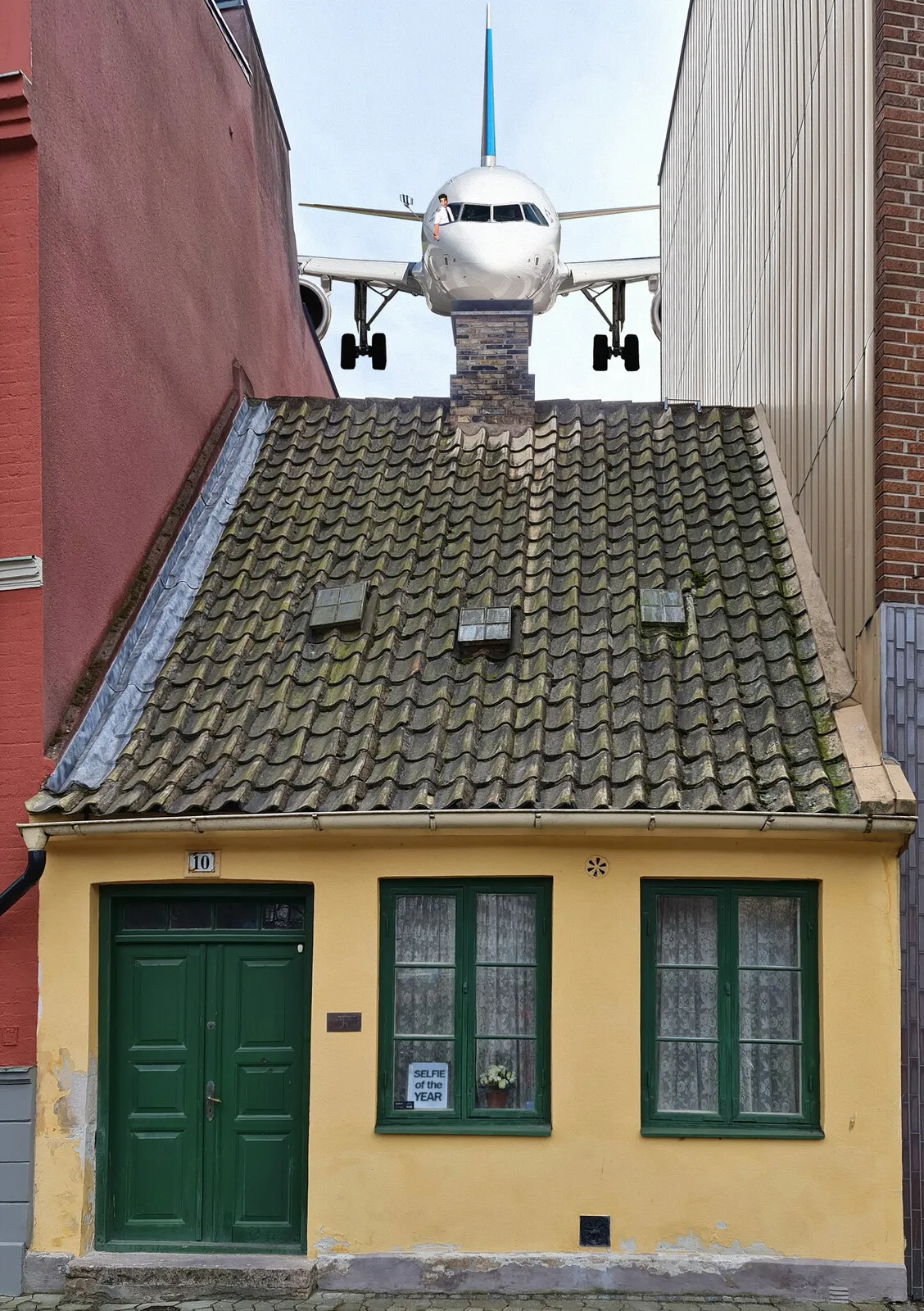
Selfie of the year, 2023
Digital
50 x 70 cm
3 200 kr
A dramatic image was born one day as I stood in front of Malmö's most miniature house, gazing up at the blue sky that opened up between the colossal roofs of neighbouring homes and above the tiny house's single-pitched yellow brick roof. A plane was visible in the peephole to the sky, heading westward towards Kastrup Airport. Just moments before, a middle-aged couple had taken a selfie in front of the yellow house and gigglingly posted the picture on Facebook. From their dialect, I deduced they were from Jutland. That's when the quirky image came to me.
A selfie is a self-portrait photograph or a short video, typically taken with an electronic camera or smartphone and often shared on social media via social networking services such as Facebook, Instagram, Threads, Twitter, and Snapchat. It's a modern way to send postcards to make folks back home jealous. If you manage to include a celebrity in the picture, it's a plus. Showing food in the picture is now a clear sign of being a dork. The image of the pilot taking a selfie with himself and his aeroplane emerged, his last one. Even though pilots indeed hesitate to follow the example of the picture, hundreds of them die annually worldwide from selfie-related accidents.
The facts speak for themselves. More people die from taking selfies than from shark attacks.
A woman in Yellowstone National Park was gored by an American bison while taking a selfie. She was treated for injuries. A Japanese tourist fell down a staircase to his death while taking a selfie at the Taj Mahal in India. People fall off bridges, get run over by cars and trains, get mauled by a walrus, maimed by bulls in Pamplona, electrocuted on top of trains, drowned, or cause a helicopter crash with many dead or eleven killed in a boat crash due to the driver's selfie. So, no one can claim that my imagination was entirely off the mark.
On Snapperupsgatan 10 within the Caroli neighbourhood sits Ebba's abode, a quaint little yellow dwelling. It's Malmö's tiniest treasure. Once a member of the countless small residences that defined Malmö's cityscape from the 1700s until the outbreak of the First World War. This house survived the demolition frenzy of the 1960s, a time when everything around it vanished to make room for more contemporary structures.
Stepping through its threshold, you're transported into the world of the Olsson family. Two cosy rooms, a kitchen, a chamber tucked in the attic, an outhouse, a woodshed, and a courtyard paved with cobblestones are all remnants of a bygone era from the 1910s. The wood-burning stove, zinc sink, and cellar are testaments to days past.
Ebba Olsson, the shoemaker, was the heart and soul of this home for most of her days. Her grandfather, Jöns Olsson, a city surveyor, acquired the house in 1873 when it was already a century old. Being a city surveyor, weighing goods as they entered the country, was considered prestigious work. Her father, Olof, also a city surveyor, took the helm of the household in 1911. The family—Olof, Anna, Ebba, and Thure—shared the space with two cherished pets: a canary named Jutta and a faithful dog.
Ebba's residence was nestled amidst vice beside the infamous Tosinga House. The blocks surrounding Snapperupsgatan were never part of Malmö's high society. In the early 1900s, this area was notorious for its brothels and beer taverns, earning the blocks around Caroli Church a less-than-favourable reputation. Across the street, hidden behind a tall fence, lay Malmö Hospital, known colloquially as the Asylum, further tarnishing the neighbourhood's image. Adjacent to Ebba's house was Concordia Garden, initially a den of iniquity that transformed into a more respectable venue after being acquired by the Good Templar Order.
Ebba was born in 1899, and at 15, she ventured out to train as a milliner. Moving away on her own was a rare step for an unmarried woman at that time. In her twenties, she relocated to Vetlanda. When her father suffered a stroke in the 1920s, leaving him unable to work, she returned to Malmö to care for him.
When Ebba turned 43, her father passed away, leaving her with no immediate family of her own. She and her mother were skilled seamstresses, earning their livelihood by crafting shoelaces, sewing buttons, and altering curtains. Shoemakers were esteemed artisans, fashioning intricate cords and ribbons on specialised looms before industrialisation. The home retained its original appearance when her parents moved in as newlyweds in 1911. After her mother's demise in 1961, Ebba remained the house's sole inhabitant.
This petite yellow domicile, with its steeply pitched roof adorned with quaint tiles, spans a mere 44 square meters and is nestled amidst towering, contemporary structures.
The simplistic construction technique, brought by immigrants from Skåne's countryside during the dawn of industrialisation, was prevalent in Malmö's more superficial structures from the 1700s until the First World War. Yellow lime paint, often tinted with ochre and iron vitriol, characterised these buildings with verdant carpentry and underlined brick roofs.
The narrow yet inviting kitchen boasts a cast-iron stove and a cobbler's lamp casting a soft glow over vintage baking tins and white tiles adorned with blue trim. Likewise, the living room, decorated with mahogany furnishings custom-ordered by Ebba's parents, was the heart of the home. A steep, narrow staircase ascends to the attic bedroom, where the family once shared their dreams.
The courtyard, a tiny sanctuary behind tall fences, shelters an outhouse and cellar where provisions are stored coolly. The installation of electricity and water in 1913 represents the only modernisation effort made to the property.
When Ebba moved to a modern apartment in 1984, she and her sister-in-law generously donated the house to the Malmö Museum. They envisioned it being used for educational purposes, allowing visitors to glimpse the past. Following Ebba's passing in 1989, the museum acquired the original furnishings, placing them exactly where they once stood. In 1991, Ebba's house opened its doors to visitors, preserving a piece of history for future generations to explore.
This was the era before mobile cameras and selfies, so few pictures of Ebba exist. This certainly contributed to her longevity, as she passed away at ninety. Thank you, Ebba, for the glimpse and the idea.
Jörgen Thornberg
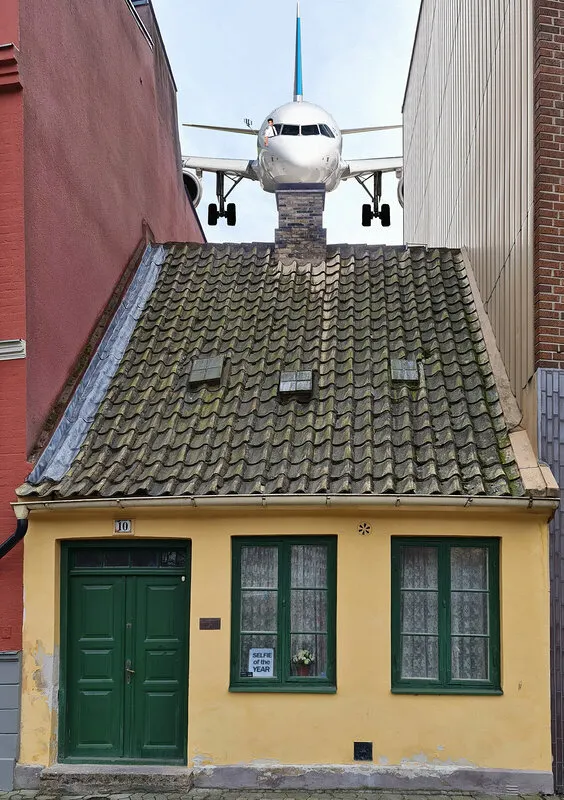
Selfie of the year, 2023
Digital
50 x 70 cm
3 200 kr
A dramatic image was born one day as I stood in front of Malmö's most miniature house, gazing up at the blue sky that opened up between the colossal roofs of neighbouring homes and above the tiny house's single-pitched yellow brick roof. A plane was visible in the peephole to the sky, heading westward towards Kastrup Airport. Just moments before, a middle-aged couple had taken a selfie in front of the yellow house and gigglingly posted the picture on Facebook. From their dialect, I deduced they were from Jutland. That's when the quirky image came to me.
A selfie is a self-portrait photograph or a short video, typically taken with an electronic camera or smartphone and often shared on social media via social networking services such as Facebook, Instagram, Threads, Twitter, and Snapchat. It's a modern way to send postcards to make folks back home jealous. If you manage to include a celebrity in the picture, it's a plus. Showing food in the picture is now a clear sign of being a dork. The image of the pilot taking a selfie with himself and his aeroplane emerged, his last one. Even though pilots indeed hesitate to follow the example of the picture, hundreds of them die annually worldwide from selfie-related accidents.
The facts speak for themselves. More people die from taking selfies than from shark attacks.
A woman in Yellowstone National Park was gored by an American bison while taking a selfie. She was treated for injuries. A Japanese tourist fell down a staircase to his death while taking a selfie at the Taj Mahal in India. People fall off bridges, get run over by cars and trains, get mauled by a walrus, maimed by bulls in Pamplona, electrocuted on top of trains, drowned, or cause a helicopter crash with many dead or eleven killed in a boat crash due to the driver's selfie. So, no one can claim that my imagination was entirely off the mark.
On Snapperupsgatan 10 within the Caroli neighbourhood sits Ebba's abode, a quaint little yellow dwelling. It's Malmö's tiniest treasure. Once a member of the countless small residences that defined Malmö's cityscape from the 1700s until the outbreak of the First World War. This house survived the demolition frenzy of the 1960s, a time when everything around it vanished to make room for more contemporary structures.
Stepping through its threshold, you're transported into the world of the Olsson family. Two cosy rooms, a kitchen, a chamber tucked in the attic, an outhouse, a woodshed, and a courtyard paved with cobblestones are all remnants of a bygone era from the 1910s. The wood-burning stove, zinc sink, and cellar are testaments to days past.
Ebba Olsson, the shoemaker, was the heart and soul of this home for most of her days. Her grandfather, Jöns Olsson, a city surveyor, acquired the house in 1873 when it was already a century old. Being a city surveyor, weighing goods as they entered the country, was considered prestigious work. Her father, Olof, also a city surveyor, took the helm of the household in 1911. The family—Olof, Anna, Ebba, and Thure—shared the space with two cherished pets: a canary named Jutta and a faithful dog.
Ebba's residence was nestled amidst vice beside the infamous Tosinga House. The blocks surrounding Snapperupsgatan were never part of Malmö's high society. In the early 1900s, this area was notorious for its brothels and beer taverns, earning the blocks around Caroli Church a less-than-favourable reputation. Across the street, hidden behind a tall fence, lay Malmö Hospital, known colloquially as the Asylum, further tarnishing the neighbourhood's image. Adjacent to Ebba's house was Concordia Garden, initially a den of iniquity that transformed into a more respectable venue after being acquired by the Good Templar Order.
Ebba was born in 1899, and at 15, she ventured out to train as a milliner. Moving away on her own was a rare step for an unmarried woman at that time. In her twenties, she relocated to Vetlanda. When her father suffered a stroke in the 1920s, leaving him unable to work, she returned to Malmö to care for him.
When Ebba turned 43, her father passed away, leaving her with no immediate family of her own. She and her mother were skilled seamstresses, earning their livelihood by crafting shoelaces, sewing buttons, and altering curtains. Shoemakers were esteemed artisans, fashioning intricate cords and ribbons on specialised looms before industrialisation. The home retained its original appearance when her parents moved in as newlyweds in 1911. After her mother's demise in 1961, Ebba remained the house's sole inhabitant.
This petite yellow domicile, with its steeply pitched roof adorned with quaint tiles, spans a mere 44 square meters and is nestled amidst towering, contemporary structures.
The simplistic construction technique, brought by immigrants from Skåne's countryside during the dawn of industrialisation, was prevalent in Malmö's more superficial structures from the 1700s until the First World War. Yellow lime paint, often tinted with ochre and iron vitriol, characterised these buildings with verdant carpentry and underlined brick roofs.
The narrow yet inviting kitchen boasts a cast-iron stove and a cobbler's lamp casting a soft glow over vintage baking tins and white tiles adorned with blue trim. Likewise, the living room, decorated with mahogany furnishings custom-ordered by Ebba's parents, was the heart of the home. A steep, narrow staircase ascends to the attic bedroom, where the family once shared their dreams.
The courtyard, a tiny sanctuary behind tall fences, shelters an outhouse and cellar where provisions are stored coolly. The installation of electricity and water in 1913 represents the only modernisation effort made to the property.
When Ebba moved to a modern apartment in 1984, she and her sister-in-law generously donated the house to the Malmö Museum. They envisioned it being used for educational purposes, allowing visitors to glimpse the past. Following Ebba's passing in 1989, the museum acquired the original furnishings, placing them exactly where they once stood. In 1991, Ebba's house opened its doors to visitors, preserving a piece of history for future generations to explore.
This was the era before mobile cameras and selfies, so few pictures of Ebba exist. This certainly contributed to her longevity, as she passed away at ninety. Thank you, Ebba, for the glimpse and the idea.
3 200 kr

Jörgen Thornberg
Malmö
Lite om bilder och mig. Translation in English at the end.
Jag är en nyfiken person som ser allt i bilder, även det jag fäster i ord, gärna tillsammans för bakom alla mina bilder finns en berättelse. Till vissa bilder hör en kortare eller längre novell som följer med bilden.
Bilder berättar historier. Jag omges av naturlig skönhet, intressanta människor och historia var jag än går. Jag använder min kamera för att dokumentera världen och blanda det jag ser med vad jag känner för att fånga den dolda magin.
Mina bilder berättar mina historier. Genom mina bilder, tryck och berättelser. Jag bjuder in dig att ta del av dessa berättelser, in i ditt liv och hem och dela min mycket personliga syn på vår värld. Mer än vad ögat ser. Jag tänker i bilder, drömmer och skriver och pratar om dem; följaktligen måste jag också skapa bilder. De blir vad jag ser, inte nödvändigtvis begränsade till verkligheten. Det finns en bild runt varje hörn. Jag hoppas att du kommer att se vad jag såg och gilla det.
Jag är också en skrivande person och till många bilder hör en kortare eller längre essay. Den följer med tavlan, tryckt på fint papper och med en personlig hälsning från mig.
Flertalet bilder startar sin resa i min kamera. Enkelt förklarat beskriver jag bilden jag ser i mitt inre, upplevd eller fantiserad. Bilden uppstår inom mig redan innan jag fått okularet till ögat. På bråkdelen av ett ögonblick ser jag vad jag vill ha och vad som kan göras med bilden. Här skall jag stoppa in en giraff, stålmannen, Titanic eller vad det är min fantasi finner ut. Ännu märkligare är att jag kommer ihåg minnesbilden långt efteråt när det blir tid att skapa verket. Om jag lyckas eller inte, är upp till betraktaren, oftast präglat av en stråk av svart humor – meningen är att man skall bli underhållen. Mina bilder blir ofta en snackis där de hänger.
Jag föredrar bilder som förmedlar ett budskap i flera lager. Vid första anblicken fylld av feel-good, en vacker utsikt, fint väder, solen skiner, blommor på ängen eller vattnet som ligger förrädiskt spegelblankt. I en sådan bild kan jag gömma min egentliga berättelse, mitt förakt för förtryckare och våldsverkare, rasister och fördomsfulla människor - ett gärna återkommande motiv mer eller mindre dolt i det vackra motivet. Jag försöker förena dem i ett gemensamt narrativ.
Bild och formgivning har löpt som en röd tråd genom livet. Fotokonst känns som en värdig final som jag gärna delar med mig.
Min genre är vid som framgår av mina bilder, temat en blandning av pop- och gatukonst i kollage som kan bestå av hundratals lager. Vissa bilder kan ta veckor, andra någon dag innan det är dags att överlämna resultatet till printverkstaden. Fine Art Prints är digitala fotocollage. I dessa kollage sker rivandet, klippandet, pusslandet, målandet, ritandet och sprayningen digitalt. Det jag monterar in kan vara hundratals år gamla bilder som jag omsorgsfullt frilägger så att de ser ut att vara en del av tavlan men också bilder skapade av mig själv efter min egen fantasi. Därefter besöks printstudion och för vissa bilder numrera en limiterad upplaga (oftast 7 exemplar) och signera för hand. Vissa bilder kan köpas i olika format. Det är bara att fråga efter vilka. Gillar man en bild som är 70x100 men inte har plats på väggen, går den kanske att få i 50x70 cm istället. Frågan är fri.
Metoden Giclée eller Fine Art Print som det också kallas är det moderna sättet för framställning av grafisk konst. Villkoret för denna typ av utskrifter är att en högkvalitativ storformatskrivare används med åldersbeständigt färgpigment och konstnärspapper eller i förekommande fall på duk. Pappret som används möter de krav på livslängd som ställs av museer och gallerier. Normalt säljer jag mina bilder oinramade så att den nya ägaren själv kan bestämma hur de skall se ut, med eller utan passepartout färg på ram, med eller utan glas etc..
Under många år ställde jag bara ut på nätet, i valda grupper och på min egen Facebooksida - https://www.facebook.com/jorgen.thornberg.9
Jag finns också på en egen hemsida som tyvärr inte alltid är uppdaterad – https://www.jth.life/ Där kan du också läsa en del av de berättelser som följer med bilden.
UTSTÄLLNINGAR
Luftkastellet, oktober 2022
Konst i Lund, november 2022
Luftkastellet, mars 2023
Engleson Galleri Caroli, april 2023
Hydra, Greece June 2023
Engleson Galleri Caroli, oktober 2023
Toppen, Höllviken december 2023
Luftkastellet, mars 2024
Torups Galleri, mars 2024
Venice, May 2024
Luftkastellet, oktober 2024
Konst i Advent, December 2024
Galleri Engleson, Caroli December 2024
Jäger & Jansson Galleri, april 2025
A bit about pictures and me.
I'm a curious person who sees everything in pictures, even what I express in words, often combining them, for behind all my pictures lies a story. These narratives, some as short as a single image and others as long as a novel, are the heart and soul of my work.
Pictures tell stories. Wherever I go, I'm surrounded by natural beauty, exciting people, and history. I use my camera to document the world and blend what I see with what I feel to capture the hidden magic.
My images tell my stories. Through my pictures, prints, and narratives, I invite you to partake in these stories in your life and home and share my deeply personal perspective of our world. More than meets the eye. I think in pictures, dream, write, and talk about them; consequently, I must create images too. They become what I see, not necessarily confined to reality. There's a picture around every corner. I hope you'll see what I saw and enjoy it.
I'm also a writer, and many images come with a shorter or longer essay. It accompanies the painting, printed on fine paper with my personal greeting.
Many pictures start their journey on my camera. Simply put, I describe the image I see in my mind, experienced or imagined. The image arises within me even before I bring the eyepiece to my eye. In a fraction of a moment, I see what I want and what can be done with the picture. Here, I'll insert a giraffe, Superman, the Titanic, or whatever my imagination conjures up. Even stranger is that I remember the mental image long after it's time to create the work. Whether I succeed is up to the observer, often imbued with a streak of black humour – the aim is to entertain. My pictures usually become a talking point wherever they hang.
I prefer pictures that convey a message in multiple layers. At first glance, they're filled with feel-good vibes, a beautiful view, lovely weather, the sun shining, flowers in the meadow, or the water lying deceptively calm. But beneath this surface beauty, I often conceal a deeper story, a narrative that challenges societal norms or explores the human condition. I invite you to delve into these hidden narratives and discover the layers of meaning within my work.
Picture and design have been a thread running through my life. Photographic art feels like a fitting finale, and I'm happy to share it.
My genre is varied, as seen in my pictures; the theme is a blend of pop and street art in collages that can consist of hundreds of layers. Some images can take weeks, others just a day before it's time to hand over the result to the print workshop. Fine Art Prints are digital photo collages. In these collages, tearing, cutting, puzzling, painting, drawing, and spraying happen digitally. What I insert can be images hundreds of years old that I carefully extract so they appear to be part of the painting, but also images created by myself, now also generated from my imagination. Next, visit the print studio and, for certain images, number a limited edition (usually 7 copies) and sign them by hand. Some images may be available in other formats. Just ask which ones. If you like an image that's 70x100 but doesn't have space on the wall, you might be able to get it in 50x70 cm instead. The question is open.
The Giclée method, or Fine Art Print as it's also called, is the modern way of producing graphic art. This method ensures the highest quality and longevity of the artwork, using a high-quality large-format printer with archival pigment inks and artist paper or, in some cases, canvas. The paper used meets the longevity requirements set by museums and galleries. I sell my pictures unframed, allowing the new owner to personalise their artwork, confident in the lasting value and quality of the piece.
For many years, I only exhibited online, in selected groups, and on my Facebook page - https://www.facebook.com/jorgen.thornberg.9. I also have my website, which unfortunately is not constantly updated - https://www.jth.life/. You can also read some of the stories accompanying the pictures there.
EXHIBITIONS
Luftkastellet, October 2022
Art in Lund, November 2022
Luftkastellet, March 2023
Engleson Gallery Caroli, April 2023
Hydra, Greece June 2023
Engleson Gallery Caroli, October 2023
Toppen, Höllviken December 2023
Luftkastellet, March 2024
Torup Gallery, March 2024
Venice, May 2024
UTSTÄLLNINGAR
Luftkastellet, oktober 2022
Konst i Lund, november 2022
Luftkastellet, mars 2023
Engleson Galleri Caroli, april 2023
Hydra, Greece June 2023
Engleson Galleri Caroli, oktober 2023
Toppen, Höllviken december 2023
Luftkastellet, mars 2024
Torups Galleri, mars 2024
Venice, May 2024
Luftkastellet, October 2024
Konst i Advent, December 2024
Galleri Engleson, Caroli December 2024
Jäger & Jansson Galleri, April 2025
Utbildning
Autodidakt
Medlem i konstnärsförening
Öppna Sinnen
Med i konstrunda
Konstrundan i Skåne
Utställningar
Luftkastellet, October 2022
Art in Lund, November 2022
Luftkastellet, March 2023
Engleson Gallery Caroli, April 2023
Hydra, Greece June 2023
Engleson Gallery Caroli, October 2023
Toppen, Höllviken December 2023
Luftkastellet, March 2024
Torup Gallery, March 2024
Venice, May 2024