Vi använder cookies för att ge dig bästa möjliga upplevelse. Välj vilka cookies du tillåter.
Läs mer i vår integritetspolicy
Jörgen Thornberg
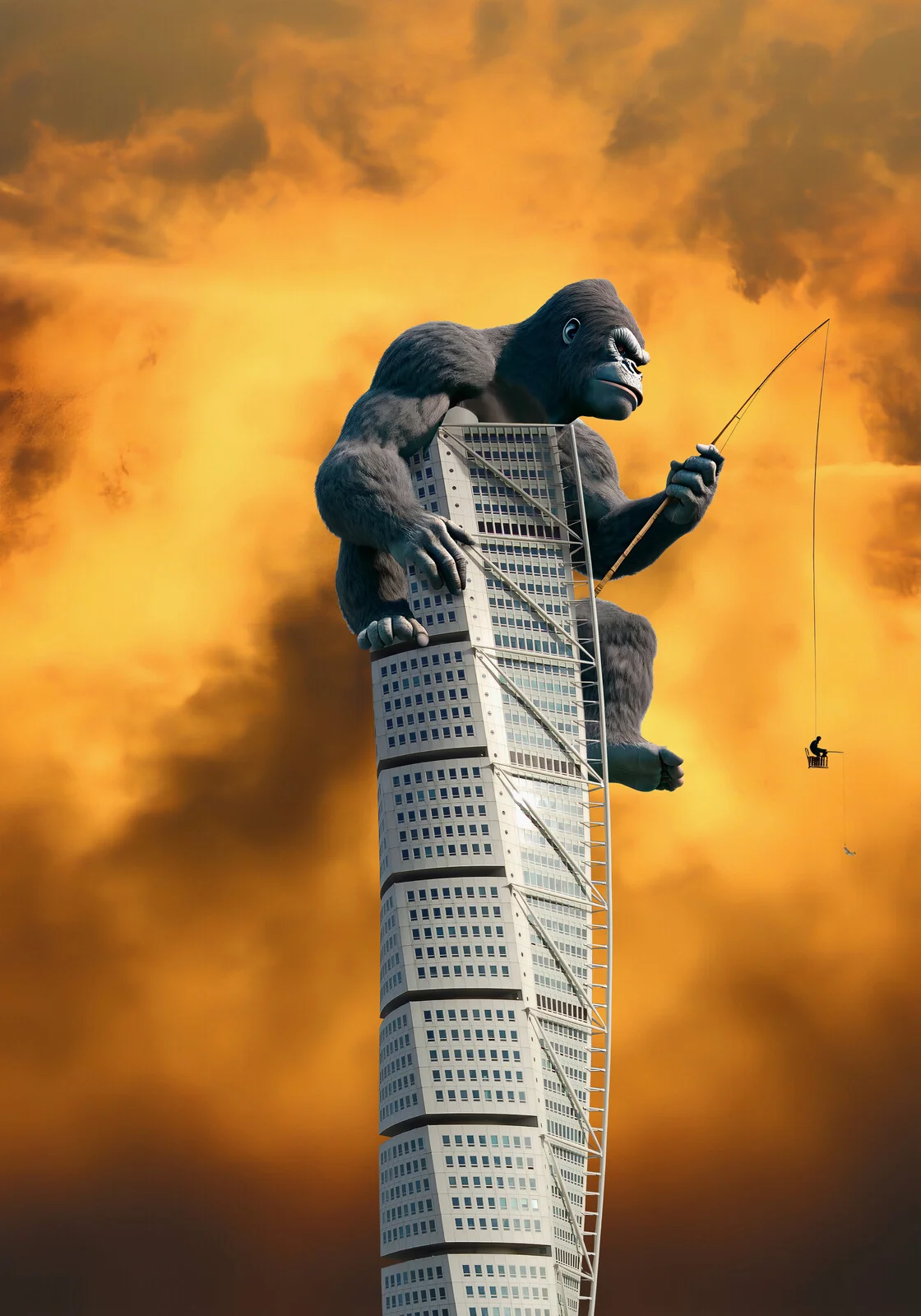
King Kong har fått napp på Turning Torso, 2023
Digital
70 x 100 cm
5 200 kr
The picture's King Kong, bordering Malmö's phallic symbol Turning Torso, hasn't hooked a glamorous bride, that angle is passé, but a poor recreational fisherman who, in turn, caught a cod wriggling in the fishing line. The cod is now almost as extinct as prehistoric monsters like King Kong. Hopefully, the symbolism comes across.
Nearly 90 years have passed since producer Carl Denham introduced an enraptured audience to the mighty King Kong, yet time has done little to diminish the ape's pop culture status. Kong is a tragic figure in his own right; a symbol of nature and purity destroyed by needless greed is iconic, and so is the mythology around him.
The first 1933 version is still rated higher than its many successors. It's exciting in many ways and conceals a critique of society far ahead of its time. Kong represents a Depression-stricken people lashing out against society; Kong is a Christ figure crucified on a stage before an audience of spectators; Kong symbolises the black man and his conflict against his white oppressors; Kong on the Empire State Building depicts the most spectacular phallic symbol. The original version stoked anxieties about black male hypersexuality. Kong snatches Ann Darrow up and makes off with her as she screams in horror. It was censored afterwards and cut several times but recently restored to its former glory, including all cut scenes.
Some feminists later claimed King Kong voices the fears, fantasies, and failings of subjugated women. This exploitation film was promoted as a documentary, but it wasn't. It was a guy in an ape suit raping a woman in a 1930s way.
The 1933 original still stands tall among its many successors. It's a captivating tale that harbours a critique of society far ahead of its time. Kong embodies various themes: a symbol of Depression-era struggles against society, a Christ-like figure crucified on a stage, a representation of the black man's conflict against white oppressors, and atop the Empire State Building, the most spectacular phallic symbol.
Initially, the film sparked anxieties about black male hypersexuality. Kong snatches Ann Darrow, and her horrified screams punctuate the scene. Though censored and cut multiple times, it's now restored to its former glory, including all the clipped scenes.
Later, some feminists interpreted King Kong as voicing the fears, fantasies, and failings of oppressed women. Essentially, it was an exploitation film masquerading as a documentary—albeit a guy in an ape suit engaging in '30s-style non-consensual activities.
The plot is straightforward yet compelling. Filmmaker Carl Denham, on the hunt for an incredible new project, persuades the crew of the S.S. Venture—led by Captain Englehorn and first mate Jack Driscoll—to accompany him and his newly discovered lead actress, Ann Darrow, to a mysterious island. There, lured by a strange map and the allure of the enigmatic Kong, their adventure unfolds.
In New York Harbor, Carl Denham, famed for his wildlife films in remote locales, charters Captain Englehorn's ship, the Venture, for a new venture. Struggling to find an actress for a female role he's kept under wraps, he stumbles upon Ann Darrow in the streets of New York City, promising her the adventure of a lifetime. The crew sets sail for Skull Island, an uncharted territory. Denham hints at a mysterious being named Kong, who is rumoured to inhabit the island. Anchoring offshore, they encounter a native village and witness a tribal ritual involving a young woman dubbed the "Bride of Kong." That night, the natives abduct Ann and offer her to Kong. As Denham, Jack, and volunteers venture into the jungle to rescue her, their encounter with Kong and the island's inhabitants sets off a chain of thrilling events.
The story culminates in Kong's capture and transport to New York City, where he's showcased as the "Eighth Wonder of the World." But the spectacle turns tragic as Kong breaks free and embarks on a rampage through the city, culminating in his iconic climb up the Empire State Building. There, amid a flurry of gunfire, Kong meets his end, leaving behind a tale of beauty and the beast.
In summary, "King Kong" is more than just a monster movie—it reflects society's fears, desires, and moral complexities, wrapped in a thrilling adventure that continues to captivate audiences today.
Denham arrives and pushes through a crowd surrounding Kong's enormous corpse in the street. When a policeman remarks that the planes got him, Denham says, "No, it wasn't the aeroplanes. It was Beauty killed the Beast."
In the 19th and early 20th centuries, people of African descent were commonly represented visually as ape-like, a metaphor that fit racist stereotypes further bolstered by the emergence of scientific racism. Early films frequently mirrored racial tensions. Although often compared to Beauty and the Beast, many film scholars contend that King Kong is a cautionary tale about interracial romance, depicting blackness not through human characters but symbolically as an ape.
Through his visual imagery and specific dialogue, Cooper conveys themes of racism, sexuality, and gender numerous times to open the minds of cultural differences. Cooper reveals his views on racism through visual and behavioural contrasts between indigenous and urban people.
Modern time versus the old world. The film's producer, Merian C. Cooper, later explained the film's deeper meaning. The inspiration for the climactic scene came when, as he was leaving his office in Manhattan, he heard the sound of an aeroplane motor. He reflexively looked up as the sun glinted off the wings of a plane flying extremely close to the tallest building in the city. Cooper realised that if he had placed the giant gorilla on top of the tallest building in the world and had him shot down by the most modern of weapons, the armed aeroplane, he would have a story of the primitive doomed by contemporary civilisation. David och Goliat.
Fishing from a phallic symbol wasn't a bad idea. The view, with the Øresund Bridge in the background and the silhouette of Copenhagen on the other side of the strait, must have been reconciling. After snatching the cod from the fisherman, King Kong kindly climbed down to calmly grill his fish and eat it by the bridge abutment, the link between the old kingdom and the new.
Jörgen Thornberg
King Kong har fått napp på Turning Torso, 2023
Digital
70 x 100 cm
5 200 kr
The picture's King Kong, bordering Malmö's phallic symbol Turning Torso, hasn't hooked a glamorous bride, that angle is passé, but a poor recreational fisherman who, in turn, caught a cod wriggling in the fishing line. The cod is now almost as extinct as prehistoric monsters like King Kong. Hopefully, the symbolism comes across.
Nearly 90 years have passed since producer Carl Denham introduced an enraptured audience to the mighty King Kong, yet time has done little to diminish the ape's pop culture status. Kong is a tragic figure in his own right; a symbol of nature and purity destroyed by needless greed is iconic, and so is the mythology around him.
The first 1933 version is still rated higher than its many successors. It's exciting in many ways and conceals a critique of society far ahead of its time. Kong represents a Depression-stricken people lashing out against society; Kong is a Christ figure crucified on a stage before an audience of spectators; Kong symbolises the black man and his conflict against his white oppressors; Kong on the Empire State Building depicts the most spectacular phallic symbol. The original version stoked anxieties about black male hypersexuality. Kong snatches Ann Darrow up and makes off with her as she screams in horror. It was censored afterwards and cut several times but recently restored to its former glory, including all cut scenes.
Some feminists later claimed King Kong voices the fears, fantasies, and failings of subjugated women. This exploitation film was promoted as a documentary, but it wasn't. It was a guy in an ape suit raping a woman in a 1930s way.
The 1933 original still stands tall among its many successors. It's a captivating tale that harbours a critique of society far ahead of its time. Kong embodies various themes: a symbol of Depression-era struggles against society, a Christ-like figure crucified on a stage, a representation of the black man's conflict against white oppressors, and atop the Empire State Building, the most spectacular phallic symbol.
Initially, the film sparked anxieties about black male hypersexuality. Kong snatches Ann Darrow, and her horrified screams punctuate the scene. Though censored and cut multiple times, it's now restored to its former glory, including all the clipped scenes.
Later, some feminists interpreted King Kong as voicing the fears, fantasies, and failings of oppressed women. Essentially, it was an exploitation film masquerading as a documentary—albeit a guy in an ape suit engaging in '30s-style non-consensual activities.
The plot is straightforward yet compelling. Filmmaker Carl Denham, on the hunt for an incredible new project, persuades the crew of the S.S. Venture—led by Captain Englehorn and first mate Jack Driscoll—to accompany him and his newly discovered lead actress, Ann Darrow, to a mysterious island. There, lured by a strange map and the allure of the enigmatic Kong, their adventure unfolds.
In New York Harbor, Carl Denham, famed for his wildlife films in remote locales, charters Captain Englehorn's ship, the Venture, for a new venture. Struggling to find an actress for a female role he's kept under wraps, he stumbles upon Ann Darrow in the streets of New York City, promising her the adventure of a lifetime. The crew sets sail for Skull Island, an uncharted territory. Denham hints at a mysterious being named Kong, who is rumoured to inhabit the island. Anchoring offshore, they encounter a native village and witness a tribal ritual involving a young woman dubbed the "Bride of Kong." That night, the natives abduct Ann and offer her to Kong. As Denham, Jack, and volunteers venture into the jungle to rescue her, their encounter with Kong and the island's inhabitants sets off a chain of thrilling events.
The story culminates in Kong's capture and transport to New York City, where he's showcased as the "Eighth Wonder of the World." But the spectacle turns tragic as Kong breaks free and embarks on a rampage through the city, culminating in his iconic climb up the Empire State Building. There, amid a flurry of gunfire, Kong meets his end, leaving behind a tale of beauty and the beast.
In summary, "King Kong" is more than just a monster movie—it reflects society's fears, desires, and moral complexities, wrapped in a thrilling adventure that continues to captivate audiences today.
Denham arrives and pushes through a crowd surrounding Kong's enormous corpse in the street. When a policeman remarks that the planes got him, Denham says, "No, it wasn't the aeroplanes. It was Beauty killed the Beast."
In the 19th and early 20th centuries, people of African descent were commonly represented visually as ape-like, a metaphor that fit racist stereotypes further bolstered by the emergence of scientific racism. Early films frequently mirrored racial tensions. Although often compared to Beauty and the Beast, many film scholars contend that King Kong is a cautionary tale about interracial romance, depicting blackness not through human characters but symbolically as an ape.
Through his visual imagery and specific dialogue, Cooper conveys themes of racism, sexuality, and gender numerous times to open the minds of cultural differences. Cooper reveals his views on racism through visual and behavioural contrasts between indigenous and urban people.
Modern time versus the old world. The film's producer, Merian C. Cooper, later explained the film's deeper meaning. The inspiration for the climactic scene came when, as he was leaving his office in Manhattan, he heard the sound of an aeroplane motor. He reflexively looked up as the sun glinted off the wings of a plane flying extremely close to the tallest building in the city. Cooper realised that if he had placed the giant gorilla on top of the tallest building in the world and had him shot down by the most modern of weapons, the armed aeroplane, he would have a story of the primitive doomed by contemporary civilisation. David och Goliat.
Fishing from a phallic symbol wasn't a bad idea. The view, with the Øresund Bridge in the background and the silhouette of Copenhagen on the other side of the strait, must have been reconciling. After snatching the cod from the fisherman, King Kong kindly climbed down to calmly grill his fish and eat it by the bridge abutment, the link between the old kingdom and the new.
5 200 kr

Jörgen Thornberg
Malmö
Lite om bilder och mig. Translation in English at the end.
Jag är en nyfiken person som ser allt i bilder, även det jag fäster i ord, gärna tillsammans för bakom alla mina bilder finns en berättelse. Till vissa bilder hör en kortare eller längre novell som följer med bilden.
Bilder berättar historier. Jag omges av naturlig skönhet, intressanta människor och historia var jag än går. Jag använder min kamera för att dokumentera världen och blanda det jag ser med vad jag känner för att fånga den dolda magin.
Mina bilder berättar mina historier. Genom mina bilder, tryck och berättelser. Jag bjuder in dig att ta del av dessa berättelser, in i ditt liv och hem och dela min mycket personliga syn på vår värld. Mer än vad ögat ser. Jag tänker i bilder, drömmer och skriver och pratar om dem; följaktligen måste jag också skapa bilder. De blir vad jag ser, inte nödvändigtvis begränsade till verkligheten. Det finns en bild runt varje hörn. Jag hoppas att du kommer att se vad jag såg och gilla det.
Jag är också en skrivande person och till många bilder hör en kortare eller längre essay. Den följer med tavlan, tryckt på fint papper och med en personlig hälsning från mig.
Flertalet bilder startar sin resa i min kamera. Enkelt förklarat beskriver jag bilden jag ser i mitt inre, upplevd eller fantiserad. Bilden uppstår inom mig redan innan jag fått okularet till ögat. På bråkdelen av ett ögonblick ser jag vad jag vill ha och vad som kan göras med bilden. Här skall jag stoppa in en giraff, stålmannen, Titanic eller vad det är min fantasi finner ut. Ännu märkligare är att jag kommer ihåg minnesbilden långt efteråt när det blir tid att skapa verket. Om jag lyckas eller inte, är upp till betraktaren, oftast präglat av en stråk av svart humor – meningen är att man skall bli underhållen. Mina bilder blir ofta en snackis där de hänger.
Jag föredrar bilder som förmedlar ett budskap i flera lager. Vid första anblicken fylld av feel-good, en vacker utsikt, fint väder, solen skiner, blommor på ängen eller vattnet som ligger förrädiskt spegelblankt. I en sådan bild kan jag gömma min egentliga berättelse, mitt förakt för förtryckare och våldsverkare, rasister och fördomsfulla människor - ett gärna återkommande motiv mer eller mindre dolt i det vackra motivet. Jag försöker förena dem i ett gemensamt narrativ.
Bild och formgivning har löpt som en röd tråd genom livet. Fotokonst känns som en värdig final som jag gärna delar med mig.
Min genre är vid som framgår av mina bilder, temat en blandning av pop- och gatukonst i kollage som kan bestå av hundratals lager. Vissa bilder kan ta veckor, andra någon dag innan det är dags att överlämna resultatet till printverkstaden. Fine Art Prints är digitala fotocollage. I dessa kollage sker rivandet, klippandet, pusslandet, målandet, ritandet och sprayningen digitalt. Det jag monterar in kan vara hundratals år gamla bilder som jag omsorgsfullt frilägger så att de ser ut att vara en del av tavlan men också bilder skapade av mig själv efter min egen fantasi. Därefter besöks printstudion och för vissa bilder numrera en limiterad upplaga (oftast 7 exemplar) och signera för hand. Vissa bilder kan köpas i olika format. Det är bara att fråga efter vilka. Gillar man en bild som är 70x100 men inte har plats på väggen, går den kanske att få i 50x70 cm istället. Frågan är fri.
Metoden Giclée eller Fine Art Print som det också kallas är det moderna sättet för framställning av grafisk konst. Villkoret för denna typ av utskrifter är att en högkvalitativ storformatskrivare används med åldersbeständigt färgpigment och konstnärspapper eller i förekommande fall på duk. Pappret som används möter de krav på livslängd som ställs av museer och gallerier. Normalt säljer jag mina bilder oinramade så att den nya ägaren själv kan bestämma hur de skall se ut, med eller utan passepartout färg på ram, med eller utan glas etc..
Under många år ställde jag bara ut på nätet, i valda grupper och på min egen Facebooksida - https://www.facebook.com/jorgen.thornberg.9
Jag finns också på en egen hemsida som tyvärr inte alltid är uppdaterad – https://www.jth.life/ Där kan du också läsa en del av de berättelser som följer med bilden.
UTSTÄLLNINGAR
Luftkastellet, oktober 2022
Konst i Lund, november 2022
Luftkastellet, mars 2023
Engleson Galleri Caroli, april 2023
Hydra, Greece June 2023
Engleson Galleri Caroli, oktober 2023
Toppen, Höllviken december 2023
Luftkastellet, mars 2024
Torups Galleri, mars 2024
Venice, May 2024
Luftkastellet, oktober 2024
Konst i Advent, December 2024
Galleri Engleson, Caroli December 2024
Jäger & Jansson Galleri, april 2025
A bit about pictures and me.
I'm a curious person who sees everything in pictures, even what I express in words, often combining them, for behind all my pictures lies a story. These narratives, some as short as a single image and others as long as a novel, are the heart and soul of my work.
Pictures tell stories. Wherever I go, I'm surrounded by natural beauty, exciting people, and history. I use my camera to document the world and blend what I see with what I feel to capture the hidden magic.
My images tell my stories. Through my pictures, prints, and narratives, I invite you to partake in these stories in your life and home and share my deeply personal perspective of our world. More than meets the eye. I think in pictures, dream, write, and talk about them; consequently, I must create images too. They become what I see, not necessarily confined to reality. There's a picture around every corner. I hope you'll see what I saw and enjoy it.
I'm also a writer, and many images come with a shorter or longer essay. It accompanies the painting, printed on fine paper with my personal greeting.
Many pictures start their journey on my camera. Simply put, I describe the image I see in my mind, experienced or imagined. The image arises within me even before I bring the eyepiece to my eye. In a fraction of a moment, I see what I want and what can be done with the picture. Here, I'll insert a giraffe, Superman, the Titanic, or whatever my imagination conjures up. Even stranger is that I remember the mental image long after it's time to create the work. Whether I succeed is up to the observer, often imbued with a streak of black humour – the aim is to entertain. My pictures usually become a talking point wherever they hang.
I prefer pictures that convey a message in multiple layers. At first glance, they're filled with feel-good vibes, a beautiful view, lovely weather, the sun shining, flowers in the meadow, or the water lying deceptively calm. But beneath this surface beauty, I often conceal a deeper story, a narrative that challenges societal norms or explores the human condition. I invite you to delve into these hidden narratives and discover the layers of meaning within my work.
Picture and design have been a thread running through my life. Photographic art feels like a fitting finale, and I'm happy to share it.
My genre is varied, as seen in my pictures; the theme is a blend of pop and street art in collages that can consist of hundreds of layers. Some images can take weeks, others just a day before it's time to hand over the result to the print workshop. Fine Art Prints are digital photo collages. In these collages, tearing, cutting, puzzling, painting, drawing, and spraying happen digitally. What I insert can be images hundreds of years old that I carefully extract so they appear to be part of the painting, but also images created by myself, now also generated from my imagination. Next, visit the print studio and, for certain images, number a limited edition (usually 7 copies) and sign them by hand. Some images may be available in other formats. Just ask which ones. If you like an image that's 70x100 but doesn't have space on the wall, you might be able to get it in 50x70 cm instead. The question is open.
The Giclée method, or Fine Art Print as it's also called, is the modern way of producing graphic art. This method ensures the highest quality and longevity of the artwork, using a high-quality large-format printer with archival pigment inks and artist paper or, in some cases, canvas. The paper used meets the longevity requirements set by museums and galleries. I sell my pictures unframed, allowing the new owner to personalise their artwork, confident in the lasting value and quality of the piece.
For many years, I only exhibited online, in selected groups, and on my Facebook page - https://www.facebook.com/jorgen.thornberg.9. I also have my website, which unfortunately is not constantly updated - https://www.jth.life/. You can also read some of the stories accompanying the pictures there.
EXHIBITIONS
Luftkastellet, October 2022
Art in Lund, November 2022
Luftkastellet, March 2023
Engleson Gallery Caroli, April 2023
Hydra, Greece June 2023
Engleson Gallery Caroli, October 2023
Toppen, Höllviken December 2023
Luftkastellet, March 2024
Torup Gallery, March 2024
Venice, May 2024
UTSTÄLLNINGAR
Luftkastellet, oktober 2022
Konst i Lund, november 2022
Luftkastellet, mars 2023
Engleson Galleri Caroli, april 2023
Hydra, Greece June 2023
Engleson Galleri Caroli, oktober 2023
Toppen, Höllviken december 2023
Luftkastellet, mars 2024
Torups Galleri, mars 2024
Venice, May 2024
Luftkastellet, October 2024
Konst i Advent, December 2024
Galleri Engleson, Caroli December 2024
Jäger & Jansson Galleri, April 2025
Utbildning
Autodidakt
Medlem i konstnärsförening
Öppna Sinnen
Med i konstrunda
Konstrundan i Skåne
Utställningar
Luftkastellet, October 2022
Art in Lund, November 2022
Luftkastellet, March 2023
Engleson Gallery Caroli, April 2023
Hydra, Greece June 2023
Engleson Gallery Caroli, October 2023
Toppen, Höllviken December 2023
Luftkastellet, March 2024
Torup Gallery, March 2024
Venice, May 2024