Vi använder cookies för att ge dig bästa möjliga upplevelse. Välj vilka cookies du tillåter.
Läs mer i vår integritetspolicy
Jörgen Thornberg
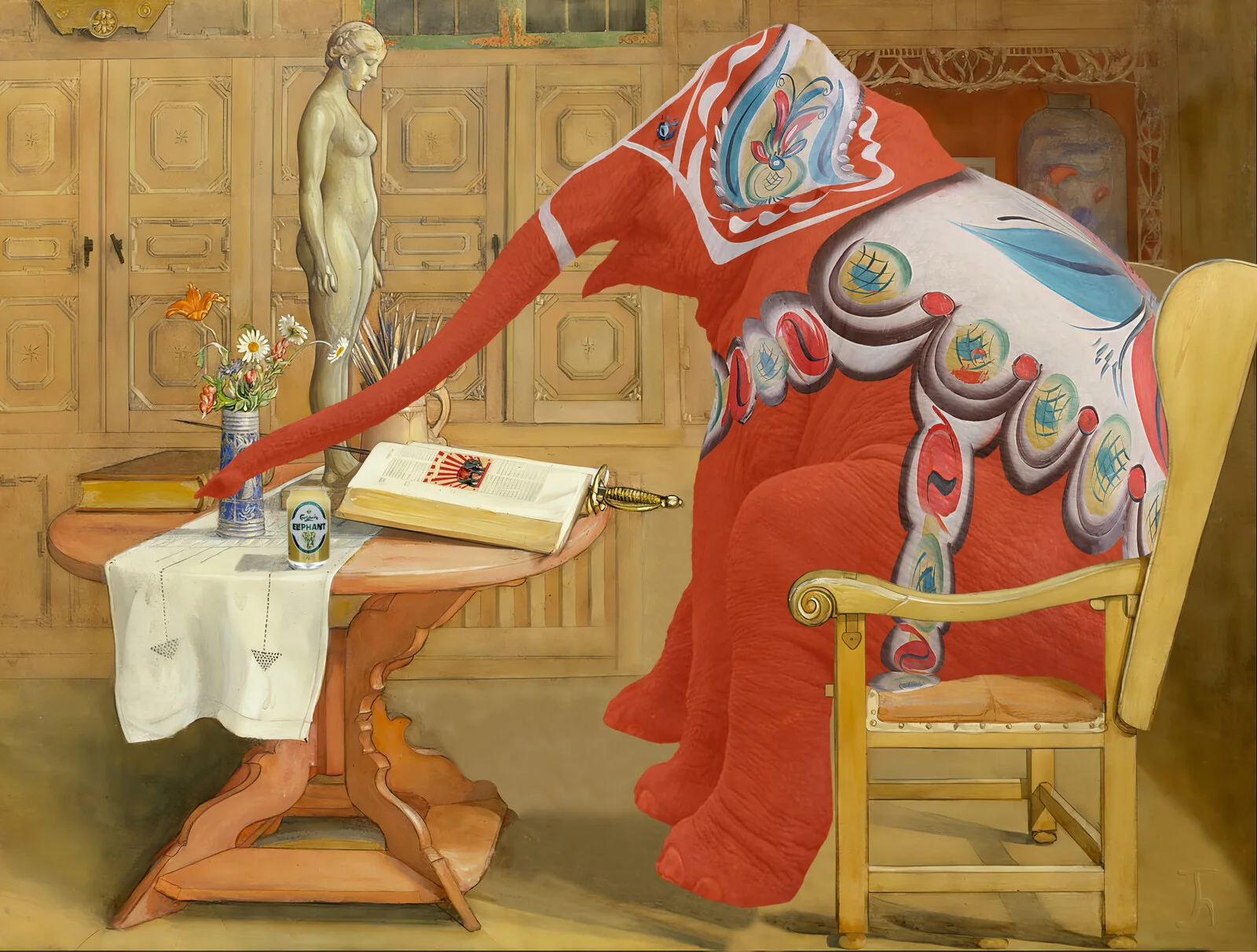
En elefant i rummet, 2023
Digital
100 x 70 cm
5 200 kr
Why an elephant in the room at Sundborn? When we talk about "the elephant in the room," it's like opening the door to a world of hidden laughs and often awkward situations. What could be more comical and simultaneously absurd than having an elephant hidden right in the middle of the living room?
But let's rewind the tape and see how this fantastic expression, 'the elephant in the room,' came about. It's a metaphorical idiom that refers to an obvious problem or risk that no one wants to discuss. Imagine you're at an elegant gathering, with people in their finest attire and smiling faces. Everything is as it should be - until someone mentions something that no one dares to discuss. It's as if a massive elephant suddenly appears in the room, and everyone pretends it isn't there. There you have it - an elephant in the room.
It's like trying to ignore the pink gorilla in the glass cage at the zoo or shutting your eyes to a giant neon sign flashing right in front of your face. We know it's there, but we pretend it doesn't exist. Why? Acknowledging its presence would be like opening Pandora's box of awkwardness and uncomfortable conversations. So why not a pink elephant?
What makes the phrase 'the elephant in the room' so delightful is its inherent humour and absurdity. Witnessing people's attempts to navigate around the colossal pachyderm in the room, from feeble efforts to strategically placed potted plants, is a source of amusement. This light-hearted perspective can entertain and engage the audience, making them chuckle at the situation's absurdity.
We encounter unwanted guests, not just in social settings. They can show up at work, in family discussions, and even at dinner parties with friends. Sometimes, they're so big that they completely take over the room; sometimes, they're just a nagging feeling of discomfort that we try to ignore.
But regardless of its size or shape, it's difficult not to smile when confronted with 'the elephant in the room.' Because despite everything, it's these absurd, comedic moments that make life wonderfully unpredictable. So, the next time you're faced with an elephant in the room, don't hesitate to acknowledge it - after all, it's the best way to handle such an unexpected guest!
I'm referring to how Carl Larsson, in his way, was an elephant in his own house, a phenomenon that concealed the fact that as an artist, perhaps he lagged behind his wife, something he and many others did their best to hide. The idyll that characterises all his depictions of their home and life in Sundborn is the home called 'Carl Larsson's house' despite it being his wife Karin's life's work. He painted it, but she created the place and filled it with life. Hence, the elephant in the room, adorned as it should be in curbits costume, is a rose-painting type typical for the landscape Dalarna.
Carl Larsson's view of women wasn't always amusing. Amidst the idyll, he was clear that women shouldn't become artists; yet, he was conflicted because he constantly needed Karin's skills and her opinions. This tension in their relationship, between societal expectations and their dynamics, is a crucial aspect of their story and dramatically influences their artistic output.
Carl Larsson's wife, Karin, was a pioneering designer far ahead of her time and an artist who could have developed into something remarkable. Despite the societal expectations of her time, Karin wasn't a subdued wife to the great artist, as one might assume from the motifs in Carl's paintings. She was constantly busy within the walls of their home—watering geraniums, ironing, baking bread, embroidering, and shelling peas. Her ability to balance her domestic responsibilities with her creative pursuits is a testament to her resilience and creativity, inspiring us all.
The position of women at the end of the 19th and beginning of the 20th centuries was weak in society—and in the family. Women were often expected to prioritise their roles as wives and mothers over their ambitions. However, Carl and Karin weren't just husband and wife; they were artistic colleagues who respected each other's work. For their time, Karin and Carl had an unusually egalitarian relationship, which allowed Karin to pursue her creative endeavours alongside her domestic responsibilities. In the face of societal challenges, this collaborative spirit between them can evoke empathy and admiration from the audience.
Look at Karin's and Carl's clothes! Carl wears a spattered colour artist's smock, as artists usually do, while Karin appears in a dress and apron—also a kind of artist's smock. She designed and sewed them in everything from coarse linen to silk. In our time, we would have called her a stylist. She managed the building projects where local carpenters constantly renovated and expanded the house. She designed both furniture and interior decoration, designed and coloured. She was Carl's muse and best critic. He didn't sign a painting until she approved it. This unique collaborative approach to their art, where they respected and relied on each other's opinions, is a testament to their dynamic and intriguing relationship.
Karin Bergöö, born in 1859, was a woman of exceptional artistic talent. Her early studies at the School of Crafts in Stockholm and later at the Royal Academy of Fine Arts from 1877 to 1882 marked the beginning of her significant contributions to the art world. In an era when women's roles were often limited to the domestic sphere, Karin's achievements were remarkable and a testament to her talent and determination. She overcame societal barriers and pursued her passion, leaving a lasting impact on the art world.
After the Royal Academy, she went to the Scandinavian artists' colony in the small village of Grez-sur-Loing outside Paris. There, she met Carl Larsson and fell head over heels in love. They married in 1883, and their first daughter, Suzanne, was born in 1884. Their artistic journey continued in Sweden, where they made significant contributions to the Swedish art scene. Their unique style and collaborative approach to art left a lasting impact on Swedish art, making them key figures in Swedish art history.
In 1885, they moved back to Sweden, first to Stockholm and then to Gothenburg, where Carl worked as a teacher at Valand's School of Art. Karin had stopped painting and devoted all her energy to the large family (eight children) and the home. Karin never lost her creative spirit despite the challenges of raising a large family and managing a household. She found joy in the small moments, from watering geraniums to baking bread, and her creativity infused every aspect of their home and family life.
"One cannot serve two masters," said Karin, putting down her paintbrushes. That didn't mean she stopped creating.
Karin was a modern woman who had discarded the corset long before Coco Chanel. She changed her attire to be comfortable. Karin wanted to be able to move in her clothes; they should be beautiful but comfortable. The same was true of the children's clothes—while other children looked like mini-adults, the Larsson children's clothes were designed for playing in. The girls wore an apron over their dresses, so it was okay to get dirty.
In 1888, Karin's father, Adolf Bergöö, gifted them a small cottage, Lilla Hyttnäs. Initially, it was a modest pair of timber cottages from 1837. However, with their artistic vision and creativity, Karin and Carl transformed it into one of the world's most famous and personal artist homes. They added their unique touches to every corner, from the furniture to the interior decoration, turning it into a testament to their creative prowess and collaborative spirit. This home, known as 'Carl Larsson's house,' symbolises their artistic achievements and unique relationship.
Karin Larsson's life situation left less and less room for further development in painting. Two children had already come into the world—there would be seven more. As a young mother with artistic ambitions, home in Sundborn increasingly became Karin Larsson's canvas. The paintbrush was replaced by needle and thread, and the colour palette was replaced by wool, yarn and silk. By focusing her energy on the home's interior, she created a home with exciting colour schemes and fashionable textile patterns. Inspired by the English Arts and Crafts movement led by William Morris, she let plant motifs wind themselves over the chair backs and backplates. Names like "The Rose of Love" and "The Four Elements" show that she saw textiles as textile works, not just a way to decorate rooms. In addition to the many textile works that filled the home, she also tried designing furniture, such as a functional rocking chair for the large studio, long before the advent of the functionalist style. There were also tables and a brilliant flower shelf with room for many plants. The colour scheme was bold with bright orange-red and green at a time when style elements in murky colours dominated according to the late 19th-century bourgeois style ideal.
The home in Sundborn became her life's work—an all-encompassing work of art in the spirit of William Morris and John Ruskin. By creating an appealing environment where art, form, and beauty were central, people would be positively influenced in their way of life.
Karin's creative force and personal style are crucial to Carl's artistic work. She designed most of the bold interiors, modern textiles, and rustic furniture herself. Their creative work lived in a strong symbiosis—she created the home that he depicted. This mutual respect and collaboration between Carl and Karin underline the depth of their relationship and its profound impact on their work.
Today, Karin has stepped forward and received recognition as an artist in her own right. The breakthrough came with the groundbreaking exhibition at the prestigious Victoria & Albert Museum in London in 1997, a testament to the significance of her work. The exhibition showcased her diverse artistic talents, from painting and weaving to furniture design, and was a turning point in recognising her contributions to the world of art and design.
"Karin was Carl Larsson's muse. So thoughtful and quiet, he portrayed her as his idol, forever young. She was, in fact, hardworking, unwavering, and highly creative. Carl trusted her as a critic of his work. She trained as an artist at the Royal Academy of Fine Arts in Stockholm and Paris. After Suzanne's birth in 1884, she turned her artistic talent to decorating the home, especially with weaving and embroidery. She also designed furniture and her and the children's clothes. Her most creative period was between 1900 and 1910.
The transition from painting to textile art and home decor was an accepted solution for the female artists who married. Perhaps it wasn't just compulsion that led Karin Larsson to give up painting. In creating the artist's home, she found various forms of expression—textile, furniture, and interior design. These art forms experienced a boom at this time and received much attention in artistic circles. Here, she could show her strength and be far ahead of her time. A home for artists emerged, a stimulating environment for family and friends. The work reached the public through Carl Larsson's watercolours and books.
Karin's textiles were very original. She preceded the upcoming abstract textile art. Her bold compositions were executed in vibrant colours; her embroidery often used stylised plants. In black and white linen, she reinterpreted Japanese motifs. Technically adventurous, she explored traditional folk techniques and experimented with others. An excellent example of her bold weaving art is the tapestry "The Four Elements," composed by Karin Larsson in 1903, to be hung above the new sofa in the dining room.
In Sundborn, the Larssons developed an aesthetic camaraderie. He was exuberant, covering the walls with flowers and leaves. She arranged living flowers but was Spartan and often abstract in her designs. The colours in the interiors seem to have been chosen together. Their combined efforts created a perfect whole."
In bourgeois families, parents didn't interact much with their children at the time, but Carl and Karin ate with their children and spent time with them. It was unique. Ellen Key inspired them, and vice versa. Carl let the children be in the studio when he painted and wasn't bothered by them playing around his legs.
Over the years, many have been appalled by the idyllic nature of the Larssons. Karin's secluded life has also been provocative. Feminists find it challenging to see that this was a different time and that the artist couple would naturally have lived a different life today. Their talents might have developed completely differently.
The idyll in Sundborn still evokes emotions. Karin's and Carl's artistic work and lifestyle, initially seen as odd and extreme, have become iconic. Over time, when their motifs are more often seen on mugs, shower curtains, placemats, and postcards, the impression of their artistic work is sometimes smoothed out and frequently ridiculed.
For many years, Karin's memory lived in the shadow of her husband's and was mentioned as Carl Larsson's wife. Time has caught up today, and she is called an art icon. Books are written about her food, textiles, garden, and house. It would take more than sixty years after her passing for everyone to understand.
Karin uses a soft brushstroke in her paintings, which allows the details to be guessed. Her watercolours are excellent examples of her value painting, where she primarily wanted to capture a feeling and convey an experience. It's interesting to compare when they painted the same motif simultaneously. Carl Larsson's painting is less painterly than hers. His sure eye for detail has a delicate balance in the picture. Their paintings have remarkable stylistic similarities besides the purely thematic. Yet they seem so different.
In the spring of 1884, on a sun-drenched hill at Grez, the Larssons painted side by side an elegantly dressed young woman with a parasol surrounded by delicate cherry blossoms under blue skies. Even though Carl has developed immensely as a watercolourist, it's hard not to feel that Karin's version of the motif is the winner. Some believe Karin could have also evolved into something truly extraordinary in painting. What could have been? We will never know.
The colourful saga of the Dala horses begins in the quaint village of Bergkarlås, nestled in the heart of Dalarna, Sweden. But it's not just Bergkarlås that had a hoof in the game; neighbouring villages like Risa, Vattnäs, and Nusnäs also played a role in crafting these iconic equines. Back then, these villages weren't just horsing around – they were also busy with furniture and clock-making.
Believe it or not, the earliest rumblings of wooden horses for sale date back to 1623. And here's a nugget of trivia: those charming Dala horses we all know and love weren't always painted. Many strutted around in their natural wooden glory until the early 19th century, when a splash of colour became all the rage. White or red – pick your pony's hue!
But it wasn't just about slapping on some paint. Oh no, decorating these horses had deep roots in furniture painting, evolving and refining over the years. Legend has it that a wandering painter stumbled upon a Dala horse while sprucing up a farmhouse. When a curious kid asked why the horse wasn't as dazzling as the ones on the walls, the painter worked his magic, adorning the horse in the same vibrant style.
And so, the tradition was born – a stroke of genius aimed at upping the ante in the Dala horse market. From humble beginnings in the 17th century to becoming a cherished symbol of Swedish craftsmanship, these wooden wonders continue to trot through history with their colourful tales.
To my knowledge, my elephant is the first ever and the result of a spontaneous visit to Sundborn. My elephant can be ridden, but it's still a junior compared to the largest, the thirteen-meter-high and 67-ton heavy Dala horse in Avesta. On the other hand, it wouldn't have had a chance to sit in Carl Larsson's old chair.
But the herd has spread to America, such as Mora in Minnesota. There's a whole flock over there, spread out across North America.
Jörgen Thornberg
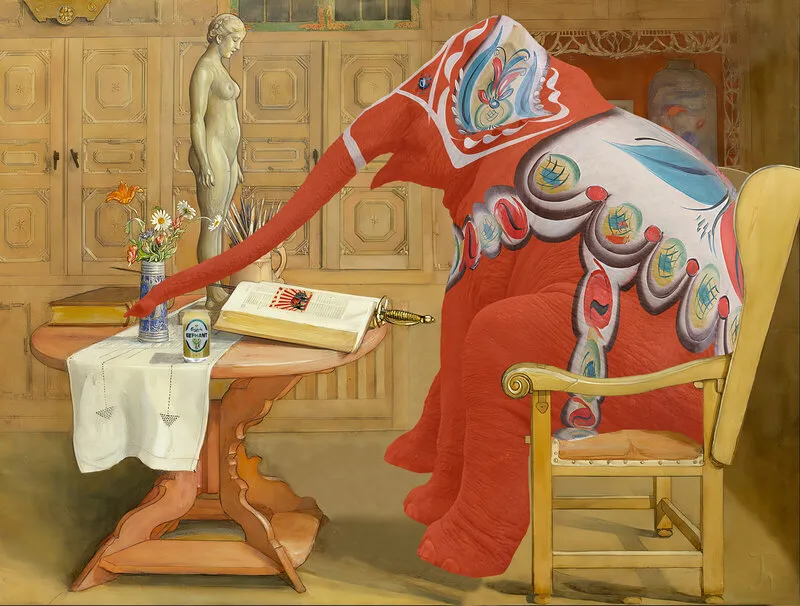
En elefant i rummet, 2023
Digital
100 x 70 cm
5 200 kr
Why an elephant in the room at Sundborn? When we talk about "the elephant in the room," it's like opening the door to a world of hidden laughs and often awkward situations. What could be more comical and simultaneously absurd than having an elephant hidden right in the middle of the living room?
But let's rewind the tape and see how this fantastic expression, 'the elephant in the room,' came about. It's a metaphorical idiom that refers to an obvious problem or risk that no one wants to discuss. Imagine you're at an elegant gathering, with people in their finest attire and smiling faces. Everything is as it should be - until someone mentions something that no one dares to discuss. It's as if a massive elephant suddenly appears in the room, and everyone pretends it isn't there. There you have it - an elephant in the room.
It's like trying to ignore the pink gorilla in the glass cage at the zoo or shutting your eyes to a giant neon sign flashing right in front of your face. We know it's there, but we pretend it doesn't exist. Why? Acknowledging its presence would be like opening Pandora's box of awkwardness and uncomfortable conversations. So why not a pink elephant?
What makes the phrase 'the elephant in the room' so delightful is its inherent humour and absurdity. Witnessing people's attempts to navigate around the colossal pachyderm in the room, from feeble efforts to strategically placed potted plants, is a source of amusement. This light-hearted perspective can entertain and engage the audience, making them chuckle at the situation's absurdity.
We encounter unwanted guests, not just in social settings. They can show up at work, in family discussions, and even at dinner parties with friends. Sometimes, they're so big that they completely take over the room; sometimes, they're just a nagging feeling of discomfort that we try to ignore.
But regardless of its size or shape, it's difficult not to smile when confronted with 'the elephant in the room.' Because despite everything, it's these absurd, comedic moments that make life wonderfully unpredictable. So, the next time you're faced with an elephant in the room, don't hesitate to acknowledge it - after all, it's the best way to handle such an unexpected guest!
I'm referring to how Carl Larsson, in his way, was an elephant in his own house, a phenomenon that concealed the fact that as an artist, perhaps he lagged behind his wife, something he and many others did their best to hide. The idyll that characterises all his depictions of their home and life in Sundborn is the home called 'Carl Larsson's house' despite it being his wife Karin's life's work. He painted it, but she created the place and filled it with life. Hence, the elephant in the room, adorned as it should be in curbits costume, is a rose-painting type typical for the landscape Dalarna.
Carl Larsson's view of women wasn't always amusing. Amidst the idyll, he was clear that women shouldn't become artists; yet, he was conflicted because he constantly needed Karin's skills and her opinions. This tension in their relationship, between societal expectations and their dynamics, is a crucial aspect of their story and dramatically influences their artistic output.
Carl Larsson's wife, Karin, was a pioneering designer far ahead of her time and an artist who could have developed into something remarkable. Despite the societal expectations of her time, Karin wasn't a subdued wife to the great artist, as one might assume from the motifs in Carl's paintings. She was constantly busy within the walls of their home—watering geraniums, ironing, baking bread, embroidering, and shelling peas. Her ability to balance her domestic responsibilities with her creative pursuits is a testament to her resilience and creativity, inspiring us all.
The position of women at the end of the 19th and beginning of the 20th centuries was weak in society—and in the family. Women were often expected to prioritise their roles as wives and mothers over their ambitions. However, Carl and Karin weren't just husband and wife; they were artistic colleagues who respected each other's work. For their time, Karin and Carl had an unusually egalitarian relationship, which allowed Karin to pursue her creative endeavours alongside her domestic responsibilities. In the face of societal challenges, this collaborative spirit between them can evoke empathy and admiration from the audience.
Look at Karin's and Carl's clothes! Carl wears a spattered colour artist's smock, as artists usually do, while Karin appears in a dress and apron—also a kind of artist's smock. She designed and sewed them in everything from coarse linen to silk. In our time, we would have called her a stylist. She managed the building projects where local carpenters constantly renovated and expanded the house. She designed both furniture and interior decoration, designed and coloured. She was Carl's muse and best critic. He didn't sign a painting until she approved it. This unique collaborative approach to their art, where they respected and relied on each other's opinions, is a testament to their dynamic and intriguing relationship.
Karin Bergöö, born in 1859, was a woman of exceptional artistic talent. Her early studies at the School of Crafts in Stockholm and later at the Royal Academy of Fine Arts from 1877 to 1882 marked the beginning of her significant contributions to the art world. In an era when women's roles were often limited to the domestic sphere, Karin's achievements were remarkable and a testament to her talent and determination. She overcame societal barriers and pursued her passion, leaving a lasting impact on the art world.
After the Royal Academy, she went to the Scandinavian artists' colony in the small village of Grez-sur-Loing outside Paris. There, she met Carl Larsson and fell head over heels in love. They married in 1883, and their first daughter, Suzanne, was born in 1884. Their artistic journey continued in Sweden, where they made significant contributions to the Swedish art scene. Their unique style and collaborative approach to art left a lasting impact on Swedish art, making them key figures in Swedish art history.
In 1885, they moved back to Sweden, first to Stockholm and then to Gothenburg, where Carl worked as a teacher at Valand's School of Art. Karin had stopped painting and devoted all her energy to the large family (eight children) and the home. Karin never lost her creative spirit despite the challenges of raising a large family and managing a household. She found joy in the small moments, from watering geraniums to baking bread, and her creativity infused every aspect of their home and family life.
"One cannot serve two masters," said Karin, putting down her paintbrushes. That didn't mean she stopped creating.
Karin was a modern woman who had discarded the corset long before Coco Chanel. She changed her attire to be comfortable. Karin wanted to be able to move in her clothes; they should be beautiful but comfortable. The same was true of the children's clothes—while other children looked like mini-adults, the Larsson children's clothes were designed for playing in. The girls wore an apron over their dresses, so it was okay to get dirty.
In 1888, Karin's father, Adolf Bergöö, gifted them a small cottage, Lilla Hyttnäs. Initially, it was a modest pair of timber cottages from 1837. However, with their artistic vision and creativity, Karin and Carl transformed it into one of the world's most famous and personal artist homes. They added their unique touches to every corner, from the furniture to the interior decoration, turning it into a testament to their creative prowess and collaborative spirit. This home, known as 'Carl Larsson's house,' symbolises their artistic achievements and unique relationship.
Karin Larsson's life situation left less and less room for further development in painting. Two children had already come into the world—there would be seven more. As a young mother with artistic ambitions, home in Sundborn increasingly became Karin Larsson's canvas. The paintbrush was replaced by needle and thread, and the colour palette was replaced by wool, yarn and silk. By focusing her energy on the home's interior, she created a home with exciting colour schemes and fashionable textile patterns. Inspired by the English Arts and Crafts movement led by William Morris, she let plant motifs wind themselves over the chair backs and backplates. Names like "The Rose of Love" and "The Four Elements" show that she saw textiles as textile works, not just a way to decorate rooms. In addition to the many textile works that filled the home, she also tried designing furniture, such as a functional rocking chair for the large studio, long before the advent of the functionalist style. There were also tables and a brilliant flower shelf with room for many plants. The colour scheme was bold with bright orange-red and green at a time when style elements in murky colours dominated according to the late 19th-century bourgeois style ideal.
The home in Sundborn became her life's work—an all-encompassing work of art in the spirit of William Morris and John Ruskin. By creating an appealing environment where art, form, and beauty were central, people would be positively influenced in their way of life.
Karin's creative force and personal style are crucial to Carl's artistic work. She designed most of the bold interiors, modern textiles, and rustic furniture herself. Their creative work lived in a strong symbiosis—she created the home that he depicted. This mutual respect and collaboration between Carl and Karin underline the depth of their relationship and its profound impact on their work.
Today, Karin has stepped forward and received recognition as an artist in her own right. The breakthrough came with the groundbreaking exhibition at the prestigious Victoria & Albert Museum in London in 1997, a testament to the significance of her work. The exhibition showcased her diverse artistic talents, from painting and weaving to furniture design, and was a turning point in recognising her contributions to the world of art and design.
"Karin was Carl Larsson's muse. So thoughtful and quiet, he portrayed her as his idol, forever young. She was, in fact, hardworking, unwavering, and highly creative. Carl trusted her as a critic of his work. She trained as an artist at the Royal Academy of Fine Arts in Stockholm and Paris. After Suzanne's birth in 1884, she turned her artistic talent to decorating the home, especially with weaving and embroidery. She also designed furniture and her and the children's clothes. Her most creative period was between 1900 and 1910.
The transition from painting to textile art and home decor was an accepted solution for the female artists who married. Perhaps it wasn't just compulsion that led Karin Larsson to give up painting. In creating the artist's home, she found various forms of expression—textile, furniture, and interior design. These art forms experienced a boom at this time and received much attention in artistic circles. Here, she could show her strength and be far ahead of her time. A home for artists emerged, a stimulating environment for family and friends. The work reached the public through Carl Larsson's watercolours and books.
Karin's textiles were very original. She preceded the upcoming abstract textile art. Her bold compositions were executed in vibrant colours; her embroidery often used stylised plants. In black and white linen, she reinterpreted Japanese motifs. Technically adventurous, she explored traditional folk techniques and experimented with others. An excellent example of her bold weaving art is the tapestry "The Four Elements," composed by Karin Larsson in 1903, to be hung above the new sofa in the dining room.
In Sundborn, the Larssons developed an aesthetic camaraderie. He was exuberant, covering the walls with flowers and leaves. She arranged living flowers but was Spartan and often abstract in her designs. The colours in the interiors seem to have been chosen together. Their combined efforts created a perfect whole."
In bourgeois families, parents didn't interact much with their children at the time, but Carl and Karin ate with their children and spent time with them. It was unique. Ellen Key inspired them, and vice versa. Carl let the children be in the studio when he painted and wasn't bothered by them playing around his legs.
Over the years, many have been appalled by the idyllic nature of the Larssons. Karin's secluded life has also been provocative. Feminists find it challenging to see that this was a different time and that the artist couple would naturally have lived a different life today. Their talents might have developed completely differently.
The idyll in Sundborn still evokes emotions. Karin's and Carl's artistic work and lifestyle, initially seen as odd and extreme, have become iconic. Over time, when their motifs are more often seen on mugs, shower curtains, placemats, and postcards, the impression of their artistic work is sometimes smoothed out and frequently ridiculed.
For many years, Karin's memory lived in the shadow of her husband's and was mentioned as Carl Larsson's wife. Time has caught up today, and she is called an art icon. Books are written about her food, textiles, garden, and house. It would take more than sixty years after her passing for everyone to understand.
Karin uses a soft brushstroke in her paintings, which allows the details to be guessed. Her watercolours are excellent examples of her value painting, where she primarily wanted to capture a feeling and convey an experience. It's interesting to compare when they painted the same motif simultaneously. Carl Larsson's painting is less painterly than hers. His sure eye for detail has a delicate balance in the picture. Their paintings have remarkable stylistic similarities besides the purely thematic. Yet they seem so different.
In the spring of 1884, on a sun-drenched hill at Grez, the Larssons painted side by side an elegantly dressed young woman with a parasol surrounded by delicate cherry blossoms under blue skies. Even though Carl has developed immensely as a watercolourist, it's hard not to feel that Karin's version of the motif is the winner. Some believe Karin could have also evolved into something truly extraordinary in painting. What could have been? We will never know.
The colourful saga of the Dala horses begins in the quaint village of Bergkarlås, nestled in the heart of Dalarna, Sweden. But it's not just Bergkarlås that had a hoof in the game; neighbouring villages like Risa, Vattnäs, and Nusnäs also played a role in crafting these iconic equines. Back then, these villages weren't just horsing around – they were also busy with furniture and clock-making.
Believe it or not, the earliest rumblings of wooden horses for sale date back to 1623. And here's a nugget of trivia: those charming Dala horses we all know and love weren't always painted. Many strutted around in their natural wooden glory until the early 19th century, when a splash of colour became all the rage. White or red – pick your pony's hue!
But it wasn't just about slapping on some paint. Oh no, decorating these horses had deep roots in furniture painting, evolving and refining over the years. Legend has it that a wandering painter stumbled upon a Dala horse while sprucing up a farmhouse. When a curious kid asked why the horse wasn't as dazzling as the ones on the walls, the painter worked his magic, adorning the horse in the same vibrant style.
And so, the tradition was born – a stroke of genius aimed at upping the ante in the Dala horse market. From humble beginnings in the 17th century to becoming a cherished symbol of Swedish craftsmanship, these wooden wonders continue to trot through history with their colourful tales.
To my knowledge, my elephant is the first ever and the result of a spontaneous visit to Sundborn. My elephant can be ridden, but it's still a junior compared to the largest, the thirteen-meter-high and 67-ton heavy Dala horse in Avesta. On the other hand, it wouldn't have had a chance to sit in Carl Larsson's old chair.
But the herd has spread to America, such as Mora in Minnesota. There's a whole flock over there, spread out across North America.
5 200 kr

Jörgen Thornberg
Malmö
Lite om bilder och mig. Translation in English at the end.
Jag är en nyfiken person som ser allt i bilder, även det jag fäster i ord, gärna tillsammans för bakom alla mina bilder finns en berättelse. Till vissa bilder hör en kortare eller längre novell som följer med bilden.
Bilder berättar historier. Jag omges av naturlig skönhet, intressanta människor och historia var jag än går. Jag använder min kamera för att dokumentera världen och blanda det jag ser med vad jag känner för att fånga den dolda magin.
Mina bilder berättar mina historier. Genom mina bilder, tryck och berättelser. Jag bjuder in dig att ta del av dessa berättelser, in i ditt liv och hem och dela min mycket personliga syn på vår värld. Mer än vad ögat ser. Jag tänker i bilder, drömmer och skriver och pratar om dem; följaktligen måste jag också skapa bilder. De blir vad jag ser, inte nödvändigtvis begränsade till verkligheten. Det finns en bild runt varje hörn. Jag hoppas att du kommer att se vad jag såg och gilla det.
Jag är också en skrivande person och till många bilder hör en kortare eller längre essay. Den följer med tavlan, tryckt på fint papper och med en personlig hälsning från mig.
Flertalet bilder startar sin resa i min kamera. Enkelt förklarat beskriver jag bilden jag ser i mitt inre, upplevd eller fantiserad. Bilden uppstår inom mig redan innan jag fått okularet till ögat. På bråkdelen av ett ögonblick ser jag vad jag vill ha och vad som kan göras med bilden. Här skall jag stoppa in en giraff, stålmannen, Titanic eller vad det är min fantasi finner ut. Ännu märkligare är att jag kommer ihåg minnesbilden långt efteråt när det blir tid att skapa verket. Om jag lyckas eller inte, är upp till betraktaren, oftast präglat av en stråk av svart humor – meningen är att man skall bli underhållen. Mina bilder blir ofta en snackis där de hänger.
Jag föredrar bilder som förmedlar ett budskap i flera lager. Vid första anblicken fylld av feel-good, en vacker utsikt, fint väder, solen skiner, blommor på ängen eller vattnet som ligger förrädiskt spegelblankt. I en sådan bild kan jag gömma min egentliga berättelse, mitt förakt för förtryckare och våldsverkare, rasister och fördomsfulla människor - ett gärna återkommande motiv mer eller mindre dolt i det vackra motivet. Jag försöker förena dem i ett gemensamt narrativ.
Bild och formgivning har löpt som en röd tråd genom livet. Fotokonst känns som en värdig final som jag gärna delar med mig.
Min genre är vid som framgår av mina bilder, temat en blandning av pop- och gatukonst i kollage som kan bestå av hundratals lager. Vissa bilder kan ta veckor, andra någon dag innan det är dags att överlämna resultatet till printverkstaden. Fine Art Prints är digitala fotocollage. I dessa kollage sker rivandet, klippandet, pusslandet, målandet, ritandet och sprayningen digitalt. Det jag monterar in kan vara hundratals år gamla bilder som jag omsorgsfullt frilägger så att de ser ut att vara en del av tavlan men också bilder skapade av mig själv efter min egen fantasi. Därefter besöks printstudion och för vissa bilder numrera en limiterad upplaga (oftast 7 exemplar) och signera för hand. Vissa bilder kan köpas i olika format. Det är bara att fråga efter vilka. Gillar man en bild som är 70x100 men inte har plats på väggen, går den kanske att få i 50x70 cm istället. Frågan är fri.
Metoden Giclée eller Fine Art Print som det också kallas är det moderna sättet för framställning av grafisk konst. Villkoret för denna typ av utskrifter är att en högkvalitativ storformatskrivare används med åldersbeständigt färgpigment och konstnärspapper eller i förekommande fall på duk. Pappret som används möter de krav på livslängd som ställs av museer och gallerier. Normalt säljer jag mina bilder oinramade så att den nya ägaren själv kan bestämma hur de skall se ut, med eller utan passepartout färg på ram, med eller utan glas etc..
Under många år ställde jag bara ut på nätet, i valda grupper och på min egen Facebooksida - https://www.facebook.com/jorgen.thornberg.9
Jag finns också på en egen hemsida som tyvärr inte alltid är uppdaterad – https://www.jth.life/ Där kan du också läsa en del av de berättelser som följer med bilden.
UTSTÄLLNINGAR
Luftkastellet, oktober 2022
Konst i Lund, november 2022
Luftkastellet, mars 2023
Engleson Galleri Caroli, april 2023
Hydra, Greece June 2023
Engleson Galleri Caroli, oktober 2023
Toppen, Höllviken december 2023
Luftkastellet, mars 2024
Torups Galleri, mars 2024
Venice, May 2024
Luftkastellet, oktober 2024
Konst i Advent, December 2024
Galleri Engleson, Caroli December 2024
Jäger & Jansson Galleri, april 2025
A bit about pictures and me.
I'm a curious person who sees everything in pictures, even what I express in words, often combining them, for behind all my pictures lies a story. These narratives, some as short as a single image and others as long as a novel, are the heart and soul of my work.
Pictures tell stories. Wherever I go, I'm surrounded by natural beauty, exciting people, and history. I use my camera to document the world and blend what I see with what I feel to capture the hidden magic.
My images tell my stories. Through my pictures, prints, and narratives, I invite you to partake in these stories in your life and home and share my deeply personal perspective of our world. More than meets the eye. I think in pictures, dream, write, and talk about them; consequently, I must create images too. They become what I see, not necessarily confined to reality. There's a picture around every corner. I hope you'll see what I saw and enjoy it.
I'm also a writer, and many images come with a shorter or longer essay. It accompanies the painting, printed on fine paper with my personal greeting.
Many pictures start their journey on my camera. Simply put, I describe the image I see in my mind, experienced or imagined. The image arises within me even before I bring the eyepiece to my eye. In a fraction of a moment, I see what I want and what can be done with the picture. Here, I'll insert a giraffe, Superman, the Titanic, or whatever my imagination conjures up. Even stranger is that I remember the mental image long after it's time to create the work. Whether I succeed is up to the observer, often imbued with a streak of black humour – the aim is to entertain. My pictures usually become a talking point wherever they hang.
I prefer pictures that convey a message in multiple layers. At first glance, they're filled with feel-good vibes, a beautiful view, lovely weather, the sun shining, flowers in the meadow, or the water lying deceptively calm. But beneath this surface beauty, I often conceal a deeper story, a narrative that challenges societal norms or explores the human condition. I invite you to delve into these hidden narratives and discover the layers of meaning within my work.
Picture and design have been a thread running through my life. Photographic art feels like a fitting finale, and I'm happy to share it.
My genre is varied, as seen in my pictures; the theme is a blend of pop and street art in collages that can consist of hundreds of layers. Some images can take weeks, others just a day before it's time to hand over the result to the print workshop. Fine Art Prints are digital photo collages. In these collages, tearing, cutting, puzzling, painting, drawing, and spraying happen digitally. What I insert can be images hundreds of years old that I carefully extract so they appear to be part of the painting, but also images created by myself, now also generated from my imagination. Next, visit the print studio and, for certain images, number a limited edition (usually 7 copies) and sign them by hand. Some images may be available in other formats. Just ask which ones. If you like an image that's 70x100 but doesn't have space on the wall, you might be able to get it in 50x70 cm instead. The question is open.
The Giclée method, or Fine Art Print as it's also called, is the modern way of producing graphic art. This method ensures the highest quality and longevity of the artwork, using a high-quality large-format printer with archival pigment inks and artist paper or, in some cases, canvas. The paper used meets the longevity requirements set by museums and galleries. I sell my pictures unframed, allowing the new owner to personalise their artwork, confident in the lasting value and quality of the piece.
For many years, I only exhibited online, in selected groups, and on my Facebook page - https://www.facebook.com/jorgen.thornberg.9. I also have my website, which unfortunately is not constantly updated - https://www.jth.life/. You can also read some of the stories accompanying the pictures there.
EXHIBITIONS
Luftkastellet, October 2022
Art in Lund, November 2022
Luftkastellet, March 2023
Engleson Gallery Caroli, April 2023
Hydra, Greece June 2023
Engleson Gallery Caroli, October 2023
Toppen, Höllviken December 2023
Luftkastellet, March 2024
Torup Gallery, March 2024
Venice, May 2024
UTSTÄLLNINGAR
Luftkastellet, oktober 2022
Konst i Lund, november 2022
Luftkastellet, mars 2023
Engleson Galleri Caroli, april 2023
Hydra, Greece June 2023
Engleson Galleri Caroli, oktober 2023
Toppen, Höllviken december 2023
Luftkastellet, mars 2024
Torups Galleri, mars 2024
Venice, May 2024
Luftkastellet, October 2024
Konst i Advent, December 2024
Galleri Engleson, Caroli December 2024
Jäger & Jansson Galleri, April 2025
Utbildning
Autodidakt
Medlem i konstnärsförening
Öppna Sinnen
Med i konstrunda
Konstrundan i Skåne
Utställningar
Luftkastellet, October 2022
Art in Lund, November 2022
Luftkastellet, March 2023
Engleson Gallery Caroli, April 2023
Hydra, Greece June 2023
Engleson Gallery Caroli, October 2023
Toppen, Höllviken December 2023
Luftkastellet, March 2024
Torup Gallery, March 2024
Venice, May 2024