Vi använder cookies för att ge dig bästa möjliga upplevelse. Välj vilka cookies du tillåter.
Läs mer i vår integritetspolicy
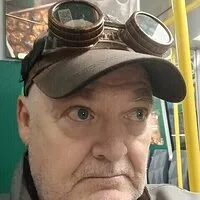
Victor Finnigan
Hässelby
Born i Hökarängen, Stockholm. Sweden the 9th of October 1957.
65 years old, I started to paint again after 40 years of non-artistic life. During this life-time I was searching for the Reality. No expectations. No dreams. Just ordinary everyday-life.
Objective reality?
Today our reality is not out, outside of our selves, in the fysical Nature. We are living in a digital media disturbed version of an filtrered consumption Global Village. You can buy everything everywhere, but not without the right app in your smart phone.
The artistic expression has to be wild and untamed. An art artificial and synthetic, inside and outside of Cyberspace, the Matrix, Virtual Reality and Artificial Intelligence.
There is no Fantasic Imagination in A I. There are no artificial chemicals in organic art.
If A I has a future, it depends if we, now living, believe in the future. A I without human beings, is nothing...
Utbildning
Grundskolan för Konstnärlig utbildning 1975-76. Gerlesborgsskolan 1976-79. Militärtjänst som tecknarbiträde på Kustflottans stab 1978. Arbete som konstnärlig assistent hos Konstprofessor Nils G Stenquist 1976-82. Konstvetenskap Stockholms Universitet 19879-81.
Utställningar
Larrys corner 2022 och 2024.
Aktuellt
SALE$$$ SALE$$$ SALE$$$
Only this month!
19 of October - 31 of October 2026, until 23:59
All paintings:
Instead of 2000 SEK/each or 3000 SEK/each, only
500 SEK/each
No restrictions! Buy as many as you want!
Only this month!
19 of October - 31 of October 2026, until 23:59
All paintings:
Instead of 2000 SEK/each or 3000 SEK/each, only
500 SEK/each
No restrictions! Buy as many as you want!
Publicerat 23 oktober
Still on top:
115 ) Dreaming is free, Blondie, 2026
115 ) Dreaming is free, Blondie, 2026
Publicerat 19 oktober
Google AI about POP-art and Symbolism. What do the two genres have in common:
Pop art and Symbolism emerged during entirely different eras and possess radically different visual expressions, yet they share a fundamental core: both styles employ signs, symbols, and allegories to convey deeper messages, rather than merely depicting reality as it appears.
Here are the key commonalities between these two artistic movements:
1. The rejection of realism
Neither genre sought to portray the world exactly as the human eye perceives it.
• Symbolism (late 19th century) arose as a reaction against Naturalism and Realism. Its proponents aimed to explore the inner life, dreams, and the mystical.
• Pop art (1950s and 60s) emerged as a reaction against abstraction, as well as against traditional "fine art" painting. It utilized mass-produced, flat imagery rather than lifelike representations.
2. Symbols as foundational elements
Both styles rely on the viewer’s ability to "read" and interpret the images through the symbols employed.
• Symbolists used myths, biblical figures, swans, lilies, and skulls to represent abstract concepts such as decay, purity, sin, or death.
• Pop artists (such as Andy Warhol and Roy Lichtenstein) utilized more contemporary icons—like Campbell’s soup cans, Coca-Cola bottles, or Marilyn Monroe—as symbols of consumer society, mass production, and celebrity culture.
3. A focus on the idea rather than the craftsmanship
In both genres, the concept or idea behind the artwork is often more significant than the demonstration of technical skill in the traditional sense. Art becomes a tool for conveying an underlying message or a feeling.
Publicerat 17 oktober
9th of October 2026. My age is now 69.
From POP to Symbolism. POP as a kind of Symbolism.
Still reading James Joyce's Finnegans Wake, Andy Warhol, Walter Benjamin and Jonna Bornemark.
From POP to Symbolism. POP as a kind of Symbolism.
Still reading James Joyce's Finnegans Wake, Andy Warhol, Walter Benjamin and Jonna Bornemark.
Publicerat 17 oktober
Still on top:
115 ) Dreaming is free, Blondie, 2026
115 ) Dreaming is free, Blondie, 2026
Publicerat 12 oktober