Vi använder cookies för att ge dig bästa möjliga upplevelse. Välj vilka cookies du tillåter.
Läs mer i vår integritetspolicy
Jörgen Thornberg
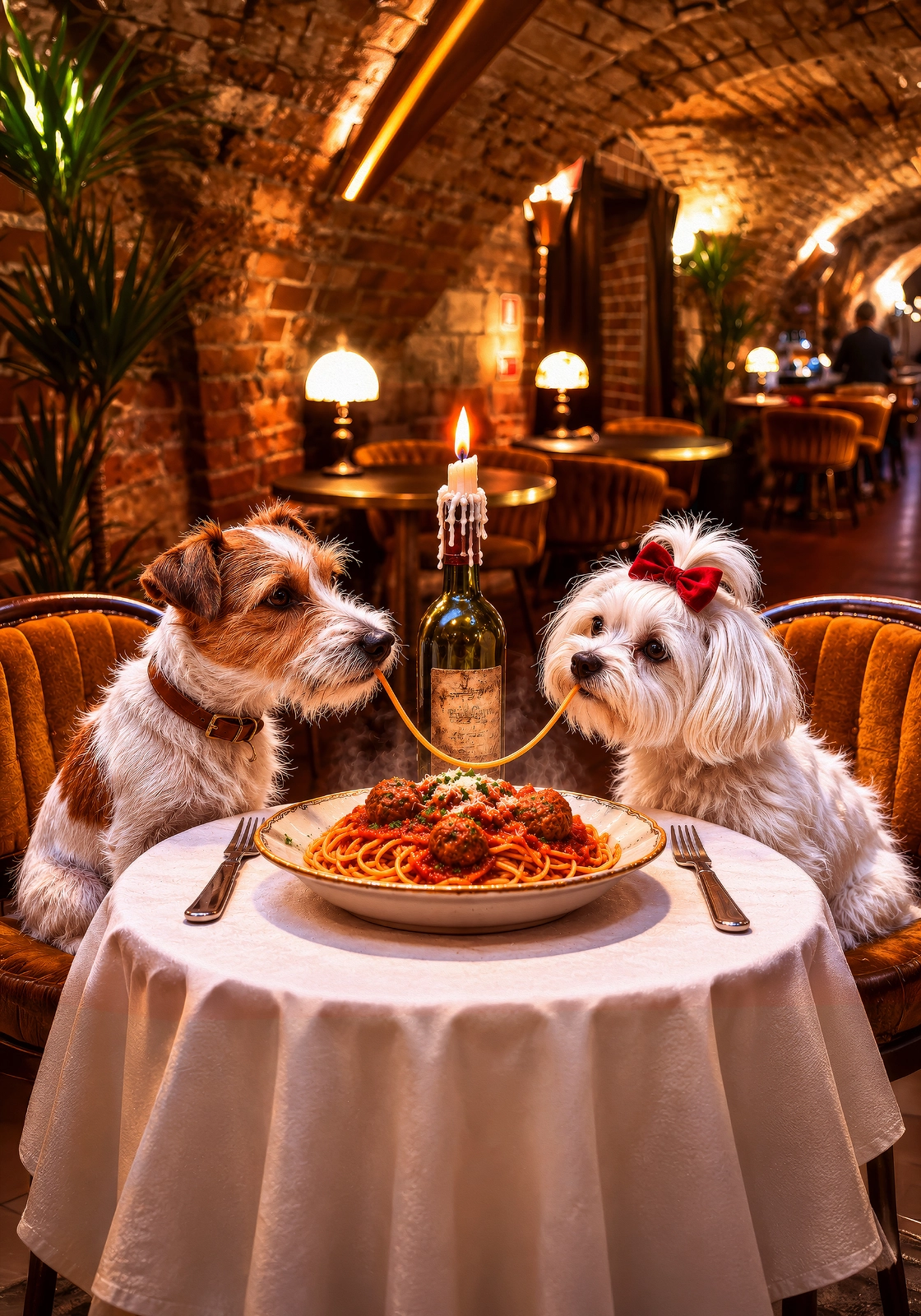
Amore al Dente, 2026
Digital
50 × 70 cm
2 900 kr
Amore al Dente
If you're intrigued by this story, I invite you to explore more of my published work on similar themes by clicking the link for further reflections on traditions and societal critique.
https://www.konst.se/jorgen-thornberg
Introduction – Bon Vivants: Kockska Huset in Malmö
Some love stories have survived the centuries, inspiring poets, playwrights, composers, and artists. Romeo and Juliet, Tristan and Isolde, Orpheus and Eurydice. But there is also a love story in which both protagonists have four legs, the romantic dinner consists of spaghetti and meatballs, and the first kiss occurs through a gastronomic coincidence.
My picture, “Amore al dente,” is a free interpretation of one of cinema's most beloved moments. In one version, I have set the encounter in the historic vaulted cellars of the Årstiderna restaurant in Kockska huset in Malmö; in another, in an Italian alleyway where a street singer provides musical accompaniment for the two lovers.
An American Cocker Spaniel has given way to a white Maltese, and a stray mongrel to a somewhat scruffy but charming Jack Russell Terrier.
Love, however, remains the same.
"Amore al dente
A Canine Serenade
Beneath the stars, by candlelight,
Two little dogs sat down one night.
A Maltese lady, snowy white,
A scruffy terrier, her delight.
She wore a bow of velvet red,
His coat had never seen a shed.
She came from wealth and pedigree,
He had no home, but he was free.
The waiter brought a splendid feast,
Enough to feed a hungry beast.
With meatballs, pasta, herbs and spice,
And not a single grain of rice.
A street musician, standing near,
Sang songs of love for all to hear.
His old guitar, beneath the moon,
Accompanied a tender tune.
They took a strand from either side,
And chewed away, all starry-eyed.
They moved towards their first romance,
A most unlikely dinner dance.
The singer reached his sweetest note,
As pasta vanished down each throat.
Their noses met, their eyes grew wide,
And neither wished to turn aside.
A kiss! A blush! A wagging tail!
Where words of love so often fail,
A single strand of pasta proved
How easily two hearts are moved.
One meatball lay upon the plate,
A final test of love and fate.
He pushed it gently to his bride,
And watched her eat with tender pride.
The singer smiled and played again,
A tender old Italian refrain.
And underneath the evening skies,
Two lovers gazed into each other's eyes.
Let poets praise the moon above,
Let scholars write their books on love.
These little dogs knew more than most,
Without a speech or champagne toast.
No diamond ring, no grand affair,
Just candlelight and love to share.
A serenade, a meal for two,
And suddenly the world seemed new.
So if your romance loses heat,
Forget the flowers – find somewhere to eat.
Order spaghetti, share a plate,
And leave the rest to love and fate.
For Cupid, when his arrows miss,
May use spaghetti for a kiss.”
Malmö, November 2026
---
Amore al dente
“On the nature of love, the most famous strand of spaghetti in cinema history, and a romantic dinner in Malmö.”
Prologue
Neither diamonds, red roses, nor expensive champagne are necessary to create romance. Sometimes a checkered tablecloth, an old wine bottle, a candle and a generous serving of spaghetti are quite sufficient.
The notion that love might arise when two individuals happen to start eating from opposite ends of the same strand of spaghetti probably never occurred to either Shakespeare or Ovid. Yet this very culinary coincidence would become one of the world's most recognisable love scenes.
And the strangest thing of all is that the man behind the film—Walt Disney himself—initially had little faith in it.
A Love Story on Four Legs
One might imagine that the story of “Lady and the Tramp” originated in an ancient European fairy tale, perhaps recorded by the Brothers Grimm or told by Hans Christian Andersen. After all, it contains all the elements that have characterised the classic love story since time immemorial: two individuals from different social classes, the prejudices of those around them, adventure, danger, and the ultimate triumph of love over social conventions.
But the story is considerably younger. It was born in modern America, emerging from two initially unrelated stories, one of which actually concerned a real dog.
In 1937, Disney artist Joe Grant (1908–2005) became interested in how family life changes after a child is born. His English Springer Spaniel, Lady, had until then been the undisputed centre of family life. Suddenly, she found herself competing for attention with a tiny human being who could neither walk nor talk, and who didn’t even wag its tail.
Grant began sketching his dog and developed a story based on his observations. Walt Disney appreciated the drawings but felt the story lacked the drama needed for a feature film, so the project was shelved.
Lady evidently needed more than a comfortable home and a loving family.
She needed a male in her life.
A Gentleman from the Streets
In 1943, Walt Disney discovered a story by the American author and journalist Ward Greene (1892–1956), published in the magazine Cosmopolitan under the title ”Happy Dan, the Whistling Dog."
Here, readers encountered a completely different kind of dog. An independent, carefree vagabond who saw freedom as life's greatest asset and had little desire to join respectable, well-ordered society. To him, a collar symbolised captivity rather than security.
Walt Disney recognised the potential of bringing these two worlds together. The well-brought-up girl from an affluent home and the carefree street boy who relied on his charm, ingenuity, and ability to find his next meal.
It was, in essence, a very old love story in entirely new packaging.
The history of literature and cinema is full of stories about respectable young ladies who fall in love with men who fail to meet their families' expectations. Such a man may lack both wealth and respectable prospects. Still, he compensates with a wealth of experience and a charm often absent from the establishment's impeccably groomed candidates.
Tramp also enjoyed the considerable advantage of never having to worry about neckties, tax returns or pension plans.
Disney acquired the rights to Greene's story, and work on bringing the two dogs' destinies together could begin.
The Book Born from the Film
Ordinarily, a successful novel precedes its film adaptation. In the case of ”Lady and the Tramp," the relationship was almost entirely reversed.
Commissioned by Disney, Ward Greene wrote the novel ”Lady and the Tramp: The Story of Two Dogs," published in 1953 by the American publishing house Simon & Schuster, with a foreword by Walt Disney.
The book was written during the film's production and introduced the story and its protagonists to the public before the film's theatrical release.
On 16 June 1955, the film premiered in Chicago. It was Disney's first animated feature in the widescreen CinemaScope format, a technological innovation that gave animators entirely new ways to depict settings and dramatic events.
Joe Grant's English Springer Spaniel had become an American Cocker Spaniel. In contrast, her prospective suitor had become a mongrel with a generous heart and an almost philosophical indifference to society's conventions.
Neither of them could, of course, have imagined that their dinner in the courtyard behind an Italian restaurant would make them immortal.
The Kiss That Rarely Happened
One of the many ironies of cinema history is that Walt Disney was initially sceptical about the scene that would become the film's most famous.
He found it hard to imagine how two dogs eating spaghetti from the same plate could be romantic. He feared the whole affair would look messy and comical rather than romantic.
Animator Frank Thomas (1912–2004), one of Disney's most distinguished artists, saw it differently. He realised the romance lay not in the meal itself, but in the dogs' expressions, their tentative approach to one another, and the surprise when their noses met.
On his own initiative, Thomas produced a test animation of the scene. When Walt Disney saw the result, he changed his mind.
Accompanied by the strains of “Bella Notte,” written by Sonny Burke and Peggy Lee, a love scene unfolded that proved remarkably capable of transcending generational and cultural differences.
It contains no passionate declaration of love, no dramatic gestures, and no solemn promises of eternal fidelity. All it takes is two dogs who happen to grab the same strand of spaghetti.
When their noses finally meet, embarrassment, tenderness, and delight follow. And when Tramp subsequently pushes the last meatball towards Lady, the declaration of love is complete.
A gesture that probably says more about the nature of love than several volumes of romantic literature.
From Hollywood to a Swedish Christmas Eve
In Sweden, the story has developed its own cultural life through a Christmas television tradition. Since 1960, “Donald Duck and His Friends Wish You a Merry Christmas” has been an integral part of Swedish Christmas celebrations.
Generation after generation has experienced the romantic atmosphere of Italian restaurants, the singing restaurateurs, and the famous spaghetti kiss.
It is, in fact, a rather peculiar Swedish Christmas tradition. While snow hopefully falls outside the windows, the Christmas ham sits on the table, and the fragrance of mulled wine fills the home. The entire nation gathers to watch two American dogs eat Italian food.
Perhaps it is one of the finest examples of culture's ability to move freely across national borders.
Love, evidently, requires no passport.
Amore al dente – Love with a Little Bite
More than seventy years after the film's premiere, I have reunited the two dogs in my own pictures.
In one version, I set their romantic dinner at restaurant Årstiderna, in the ancient vaulted cellars of Kockska huset in Malmö. In the other, I let them return to an Italian setting, where the warm glow of street lamps falls on the cobblestones, and a street singer with a guitar provides musical accompaniment to their dinner.
A little white Maltese has replaced the American Cocker Spaniel, sporting an impeccably groomed coat and a red velvet bow. Her suitor is a rough-coated Jack Russell Terrier whose somewhat dishevelled appearance suggests he rarely visits the dog groomer.
The little Maltese girl with her bow represents elegance; the scruffy terrier represents a free and carefree existence. She has probably never had to wonder where her next meal might come from, whereas he appears to be a gentleman who prefers to take each day as it comes.
Nevertheless, the two share a common interest: Italian gastronomy.
The title “Amore al dente” plays on the Italian culinary expression “al dente,” which literally means “to the tooth” and describes pasta cooked so it retains a slight firmness when bitten.
But the expression may also have philosophical significance.
Love is rarely entirely frictionless. It requires patience, generosity, compromise, and sometimes the ability to swallow things one might not have ordered.
A love without the slightest resistance might well be as uninteresting as overcooked spaghetti.
Epilogue
When historians of the future attempt to summarise humanity's understanding of love, they will probably devote numerous pages to ancient mythology, Renaissance poetry, Romantic literature and the great love dramas of cinema.
But somewhere among these solemn accounts, there ought also to be room for two dogs, an old wine bottle, a burning candle and a plate of spaghetti.
Love cannot always be described in grand words. It often arises in the unexpected, in the ordinary, and in small gestures that seem insignificant yet prove decisive in retrospect.
Perhaps this was precisely what Frank Thomas understood when, despite Walt Disney's reservations, he insisted on animating the romantic dinner.
He understood that love doesn't require a magnificent setting or an elaborate plot. It needs only two individuals who, for a moment, forget the world around them.
And sometimes the distance between two hearts is no greater than a strand of spaghetti.
“Amore al dente.”
“Love with a little bite – and one last meatball to share.”
Introduktion
Det finns kärlekshistorier som har överlevt århundraden, berättelser som har inspirerat poeter, dramatiker, kompositörer och konstnärer. Romeo och Julia, Tristan och Isolde, Orfeus och Eurydike. Men det finns också en kärlekshistoria där båda huvudpersonerna har fyra ben, där den romantiska middagen består av spaghetti och köttbullar och där den första kyssen uppstår genom en gastronomisk tillfällighet.
Min bild ”Amore al dente” är en fri tolkning av ett av filmhistoriens mest älskade ögonblick. I en version har jag förlagt mötet till Årstidernas historiska källarvalv i Kockska huset i Malmö, i en annan till en italiensk gränd där en gatusångare ackompanjerar de båda förälskade.
En amerikansk cockerspaniel har fått lämna plats åt en vit malteser och en herrelös blandrashund åt en något ovårdad men charmfull Jack Russell-terrier.
Kärleken är däremot densamma.
Amore al dente
”Om kärlekens väsen, filmhistoriens mest berömda spagettistrå och en romantisk middag i Malmö.”
Prolog
Det behövs varken diamanter, röda rosor eller dyr champagne för att skapa romantik. Ibland räcker det med en rutig bordsduk, en gammal vinflaska, ett stearinljus och en generös portion spaghetti.
Att kärleken skulle kunna uppstå genom att två individer, av en händelse, börjar äta från var sin ände av samma spagettistrå är en tanke som knappast föresvävade vare sig Shakespeare eller Ovidius. Ändå skulle just denna kulinariska tillfällighet komma att bli en av världens mest igenkännbara kärleksscener.
Och det märkligaste av allt är att mannen bakom filmen, Walt Disney själv, från början inte trodde på den.
En kärlekshistoria på fyra ben
Man skulle kunna föreställa sig att berättelsen om Lady och Lufsen hade sitt ursprung i någon gammal europeisk folksaga, kanske nedtecknad av bröderna Grimm eller berättad av H.C. Andersen. Den innehåller ju alla de ingredienser som sedan urminnes tider har kännetecknat den klassiska kärlekssagan: två individer från skilda samhällsklasser, omgivningens fördomar, äventyret, faran och kärlekens slutliga triumf över de sociala konventionerna.
Men historien är betydligt yngre. Den föddes i det moderna Amerika och har sitt ursprung i två, till en början helt oberoende, berättelser, varav den ena faktiskt handlade om en verklig hund.
År 1937 började Disneytecknaren Joe Grant (1908–2005) intressera sig för de förändringar som inträffade i familjelivet när ett barn föddes. Hans engelska springerspaniel, som hette Lady, hade fram till dess varit familjens självklara mittpunkt. Plötsligt fick hon konkurrens om uppmärksamheten av en liten människa som varken kunde gå, tala eller ens vifta med svansen.
Grant började teckna sin hund och utvecklade en berättelse om sin upplevelse. Walt Disney uppskattade teckningarna men ansåg att berättelsen saknade den dramatik som krävdes för en långfilm. Projektet lades därför åt sidan.
Lady behövde uppenbarligen mer än ett tryggt hem och en kärleksfull familj.
Hon behövde en man i sitt liv.
En gentleman från gatan
År 1943 fick Walt Disney upp ögonen för en berättelse av den amerikanske författaren och journalisten Ward Greene (1892–1956), publicerad i tidskriften ”Cosmopolitan” under titeln ”Happy Dan, the Whistling Dog”.
Här mötte läsaren en helt annan sorts hund. En självständig och levnadsglad vagabond som betraktade friheten som livets främsta tillgång och som inte hade några större ambitioner att låta sig infogas i det välordnade borgerliga samhället. Ett halsband var för honom snarare ett tecken på ofrihet än på trygghet.
Walt Disney såg möjligheterna i att låta dessa två världar mötas. Den väluppfostrade flickan från det välbärgade hemmet och den obekymrade gatupojken, som levde på sin charm, sin uppfinningsrikedom och sin förmåga att hitta dagens måltid.
Det var egentligen en mycket gammal kärlekshistoria i en alldeles ny förpackning.
Litteraturen och filmhistorien är fulla av berättelser om den fina flickan som förälskar sig i en man som inte riktigt uppfyller familjens förväntningar. Han saknar kanske både förmögenhet och anständiga framtidsutsikter, men besitter i gengäld en livserfarenhet och en charm som den etablerade världens välkammade kandidater ofta saknar.
Lufsen hade dessutom den stora fördelen att han aldrig behövde bekymra sig om vare sig slips, deklarationer eller pensionsförsäkringar.
Disney förvärvade rättigheterna till Greenes berättelse och arbetet med att förena de båda hundarnas öden kunde börja.
Boken som föddes ur filmen
Vanligtvis brukar en framgångsrik roman föregå en filmatisering. I fallet med ”Lady och Lufsen” blev förhållandet närmast det omvända.
På Disneys uppdrag skrev Ward Greene romanen ”Lady and the Tramp: The Story of Two Dogs”, som publicerades 1953 av det amerikanska förlaget Simon & Schuster och som var försedd med ett förord av Walt Disney.
Boken tillkom alltså under arbetet med filmen och var ett sätt att introducera berättelsen och dess huvudpersoner för publiken redan före biopremiären.
Den 16 juni 1955 hade filmen sin världspremiär i Chicago. Det var Disneys första animerade långfilm i det breda CinemaScope-formatet, en teknisk nyhet som gav animatörerna helt andra möjligheter att gestalta miljöer och dramatiska händelser.
Joe Grants engelska springerspaniel hade nu förvandlats till en amerikansk cockerspaniel, medan hennes tilltänkte kavaljer hade blivit en blandrashund med ett stort hjärta och ett närmast filosofiskt ointresse för samhällets konventioner.
Ingen av dem kunde naturligtvis ana att deras middag på en italiensk restaurangs bakgård skulle göra dem odödliga.
Kyssen som nästan aldrig blev av
Det hör till filmhistoriens många ironier att Walt Disney från början var tveksam till den scen som skulle bli filmens mest berömda.
Han hade svårt att föreställa sig hur två hundar som åt spaghetti från samma tallrik skulle kunna uppfattas som romantiska. Risken var, menade han, att det hela snarare skulle framstå som kladdigt och komiskt än som en kärleksscen.
Animatören Frank Thomas (1912–2004), en av Disneys mest framstående tecknare, hade en annan uppfattning. Han insåg att det romantiska inte låg i själva måltiden utan i hundarnas blickar, deras försiktiga närmande och den överraskning som uppstod när deras nosar möttes.
Thomas gjorde på eget initiativ en provanimation av scenen. När Walt Disney fick se resultatet ändrade han sig i sin uppfattning.
Till tonerna av ”Bella Notte”, skriven av Sonny Burke och Peggy Lee, utspelades därefter en kärleksscen som skulle visa sig ha en märklig förmåga att överskrida både generationsgränser och kulturella skillnader.
Den innehåller ingen passionerad kärleksförklaring, inga dramatiska gester och inga högtidliga löften om evig trohet. Allt som behövs är två hundar som råkar få tag i samma spagettistrå.
När deras nosar slutligen möts uppstår ett ögonblick av förlägenhet, ömhet och förtjusning. Och när Lufsen därefter generöst skjuter den sista köttbullen över till Lady, fullbordas kärleksförklaringen.
En gest som förmodligen säger mer om kärlekens väsen än åtskilliga volymer av romantisk litteratur.
Från Hollywood till den svenska julaftonen
I Sverige har berättelsen dessutom fått ett alldeles eget kulturellt liv genom televisionens jultradition. Sedan 1960 har ”Kalle Anka och hans vänner önskar God Jul” varit en del av det svenska julfirandet.
Generation efter generation har upplevt den italienska restaurangens romantiska atmosfär, de sjungande restaurangmännen och den berömda spagettikyssen.
Det är egentligen en ganska märklig svensk jultradition. Medan snön förhoppningsvis faller utanför fönstren står julskinkan på bordet och doften av glögg sprider sig genom bostaden. Ett helt folk samlas för att betrakta två amerikanska hundar som äter italiensk mat.
Kanske är det ett av de bästa exemplen på kulturens förmåga att röra sig obehindrat över nationsgränser.
Kärleken behöver uppenbarligen inget pass.
Amore al dente – kärlek med tuggmotstånd
Drygt sjuttio år efter filmens premiär har jag låtit de båda hundarna återförenas i mina egna bilder.
I den ena versionen har jag förlagt den romantiska middagen till restaurang Årstiderna i Kockska husets gamla källarvalv i Malmö. I den andra har jag låtit dem återvända till en italiensk miljö, där gatlyktornas varma sken faller över kullerstenarna och en gatusångare med gitarr förser middagen med sitt musikaliska ackompanjemang.
Den amerikanska cockerspanieln har ersatts av en liten vit malteser med välvårdad päls och en röd sammetsrosett. Hennes kavaljer är en strävhårig Jack Russell-terrier, vars något ovårdade yttre antyder att han kanske inte tillbringar alltför mycket tid hos hundfrisören.
Den lilla malteserflickan med sin rosett representerar elegans; den rufsiga terriern representerar det fria och obekymrade livet. Hon har förmodligen aldrig behövt fundera över varifrån nästa måltid ska komma, medan han förefaller vara en gentleman som gärna tar dagen som den kommer.
De båda har emellertid ett gemensamt intresse: italiensk gastronomi.
Titeln ”Amore al dente” är en lek med det italienska gastronomiska uttrycket ”al dente”, som bokstavligen betyder ”till tanden” och betecknar pasta som kokats så att den fortfarande har ett visst tuggmotstånd.
Men uttrycket kan också ha en filosofisk innebörd.
Kärleken är sällan en helt friktionsfri tillvaro. Den kräver tålamod, generositet, kompromisser och ibland en viss förmåga att tugga i sig sådant som man kanske inte riktigt hade beställt.
En kärlek utan minsta motstånd skulle möjligen vara lika ointressant som överkokt spaghetti.
Epilog
När historiker en gång i framtiden försöker sammanfatta människans föreställningar om kärleken kommer de sannolikt att ägna åtskilliga sidor åt antikens mytologi, renässansens poesi, romantikens litteratur och filmens stora kärleksdramer.
Men någonstans bland dessa högtidliga redogörelser borde det också finnas plats för två hundar, en gammal vinflaska, ett brinnande stearinljus och en tallrik spaghetti.
Ty kärleken låter sig inte alltid beskrivas med stora ord. Den uppstår ofta i det oväntade, i det vardagliga och i de små gesterna som till synes saknar betydelse men som i efterhand visar sig ha varit avgörande.
Kanske var det just detta som Frank Thomas förstod när han, trots Walt Disneys tveksamhet, insisterade på att animera den romantiska middagen.
Han förstod att kärleken inte nödvändigtvis behöver en storslagen scenografi eller en komplicerad intrig. Den behöver bara två individer som för ett ögonblick glömmer bort världen omkring sig.
Och ibland är avståndet mellan två hjärtan inte längre än ett spagettistrå.
”Amore al dente.”
”Kärlek med tuggmotstånd – och en sista köttbulle att dela.”
Jörgen Thornberg
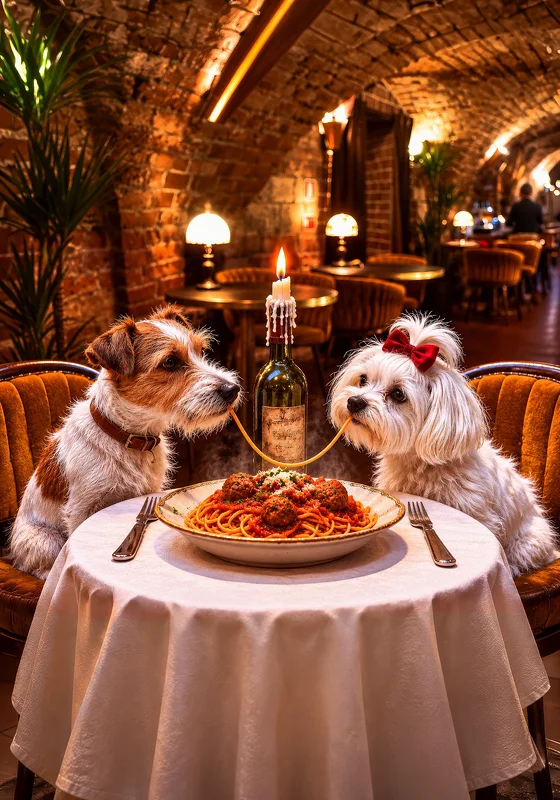
Amore al Dente, 2026
Digital
50 × 70 cm
2 900 kr
Amore al Dente
If you're intrigued by this story, I invite you to explore more of my published work on similar themes by clicking the link for further reflections on traditions and societal critique.
https://www.konst.se/jorgen-thornberg
Introduction – Bon Vivants: Kockska Huset in Malmö
Some love stories have survived the centuries, inspiring poets, playwrights, composers, and artists. Romeo and Juliet, Tristan and Isolde, Orpheus and Eurydice. But there is also a love story in which both protagonists have four legs, the romantic dinner consists of spaghetti and meatballs, and the first kiss occurs through a gastronomic coincidence.
My picture, “Amore al dente,” is a free interpretation of one of cinema's most beloved moments. In one version, I have set the encounter in the historic vaulted cellars of the Årstiderna restaurant in Kockska huset in Malmö; in another, in an Italian alleyway where a street singer provides musical accompaniment for the two lovers.
An American Cocker Spaniel has given way to a white Maltese, and a stray mongrel to a somewhat scruffy but charming Jack Russell Terrier.
Love, however, remains the same.
"Amore al dente
A Canine Serenade
Beneath the stars, by candlelight,
Two little dogs sat down one night.
A Maltese lady, snowy white,
A scruffy terrier, her delight.
She wore a bow of velvet red,
His coat had never seen a shed.
She came from wealth and pedigree,
He had no home, but he was free.
The waiter brought a splendid feast,
Enough to feed a hungry beast.
With meatballs, pasta, herbs and spice,
And not a single grain of rice.
A street musician, standing near,
Sang songs of love for all to hear.
His old guitar, beneath the moon,
Accompanied a tender tune.
They took a strand from either side,
And chewed away, all starry-eyed.
They moved towards their first romance,
A most unlikely dinner dance.
The singer reached his sweetest note,
As pasta vanished down each throat.
Their noses met, their eyes grew wide,
And neither wished to turn aside.
A kiss! A blush! A wagging tail!
Where words of love so often fail,
A single strand of pasta proved
How easily two hearts are moved.
One meatball lay upon the plate,
A final test of love and fate.
He pushed it gently to his bride,
And watched her eat with tender pride.
The singer smiled and played again,
A tender old Italian refrain.
And underneath the evening skies,
Two lovers gazed into each other's eyes.
Let poets praise the moon above,
Let scholars write their books on love.
These little dogs knew more than most,
Without a speech or champagne toast.
No diamond ring, no grand affair,
Just candlelight and love to share.
A serenade, a meal for two,
And suddenly the world seemed new.
So if your romance loses heat,
Forget the flowers – find somewhere to eat.
Order spaghetti, share a plate,
And leave the rest to love and fate.
For Cupid, when his arrows miss,
May use spaghetti for a kiss.”
Malmö, November 2026
---
Amore al dente
“On the nature of love, the most famous strand of spaghetti in cinema history, and a romantic dinner in Malmö.”
Prologue
Neither diamonds, red roses, nor expensive champagne are necessary to create romance. Sometimes a checkered tablecloth, an old wine bottle, a candle and a generous serving of spaghetti are quite sufficient.
The notion that love might arise when two individuals happen to start eating from opposite ends of the same strand of spaghetti probably never occurred to either Shakespeare or Ovid. Yet this very culinary coincidence would become one of the world's most recognisable love scenes.
And the strangest thing of all is that the man behind the film—Walt Disney himself—initially had little faith in it.
A Love Story on Four Legs
One might imagine that the story of “Lady and the Tramp” originated in an ancient European fairy tale, perhaps recorded by the Brothers Grimm or told by Hans Christian Andersen. After all, it contains all the elements that have characterised the classic love story since time immemorial: two individuals from different social classes, the prejudices of those around them, adventure, danger, and the ultimate triumph of love over social conventions.
But the story is considerably younger. It was born in modern America, emerging from two initially unrelated stories, one of which actually concerned a real dog.
In 1937, Disney artist Joe Grant (1908–2005) became interested in how family life changes after a child is born. His English Springer Spaniel, Lady, had until then been the undisputed centre of family life. Suddenly, she found herself competing for attention with a tiny human being who could neither walk nor talk, and who didn’t even wag its tail.
Grant began sketching his dog and developed a story based on his observations. Walt Disney appreciated the drawings but felt the story lacked the drama needed for a feature film, so the project was shelved.
Lady evidently needed more than a comfortable home and a loving family.
She needed a male in her life.
A Gentleman from the Streets
In 1943, Walt Disney discovered a story by the American author and journalist Ward Greene (1892–1956), published in the magazine Cosmopolitan under the title ”Happy Dan, the Whistling Dog."
Here, readers encountered a completely different kind of dog. An independent, carefree vagabond who saw freedom as life's greatest asset and had little desire to join respectable, well-ordered society. To him, a collar symbolised captivity rather than security.
Walt Disney recognised the potential of bringing these two worlds together. The well-brought-up girl from an affluent home and the carefree street boy who relied on his charm, ingenuity, and ability to find his next meal.
It was, in essence, a very old love story in entirely new packaging.
The history of literature and cinema is full of stories about respectable young ladies who fall in love with men who fail to meet their families' expectations. Such a man may lack both wealth and respectable prospects. Still, he compensates with a wealth of experience and a charm often absent from the establishment's impeccably groomed candidates.
Tramp also enjoyed the considerable advantage of never having to worry about neckties, tax returns or pension plans.
Disney acquired the rights to Greene's story, and work on bringing the two dogs' destinies together could begin.
The Book Born from the Film
Ordinarily, a successful novel precedes its film adaptation. In the case of ”Lady and the Tramp," the relationship was almost entirely reversed.
Commissioned by Disney, Ward Greene wrote the novel ”Lady and the Tramp: The Story of Two Dogs," published in 1953 by the American publishing house Simon & Schuster, with a foreword by Walt Disney.
The book was written during the film's production and introduced the story and its protagonists to the public before the film's theatrical release.
On 16 June 1955, the film premiered in Chicago. It was Disney's first animated feature in the widescreen CinemaScope format, a technological innovation that gave animators entirely new ways to depict settings and dramatic events.
Joe Grant's English Springer Spaniel had become an American Cocker Spaniel. In contrast, her prospective suitor had become a mongrel with a generous heart and an almost philosophical indifference to society's conventions.
Neither of them could, of course, have imagined that their dinner in the courtyard behind an Italian restaurant would make them immortal.
The Kiss That Rarely Happened
One of the many ironies of cinema history is that Walt Disney was initially sceptical about the scene that would become the film's most famous.
He found it hard to imagine how two dogs eating spaghetti from the same plate could be romantic. He feared the whole affair would look messy and comical rather than romantic.
Animator Frank Thomas (1912–2004), one of Disney's most distinguished artists, saw it differently. He realised the romance lay not in the meal itself, but in the dogs' expressions, their tentative approach to one another, and the surprise when their noses met.
On his own initiative, Thomas produced a test animation of the scene. When Walt Disney saw the result, he changed his mind.
Accompanied by the strains of “Bella Notte,” written by Sonny Burke and Peggy Lee, a love scene unfolded that proved remarkably capable of transcending generational and cultural differences.
It contains no passionate declaration of love, no dramatic gestures, and no solemn promises of eternal fidelity. All it takes is two dogs who happen to grab the same strand of spaghetti.
When their noses finally meet, embarrassment, tenderness, and delight follow. And when Tramp subsequently pushes the last meatball towards Lady, the declaration of love is complete.
A gesture that probably says more about the nature of love than several volumes of romantic literature.
From Hollywood to a Swedish Christmas Eve
In Sweden, the story has developed its own cultural life through a Christmas television tradition. Since 1960, “Donald Duck and His Friends Wish You a Merry Christmas” has been an integral part of Swedish Christmas celebrations.
Generation after generation has experienced the romantic atmosphere of Italian restaurants, the singing restaurateurs, and the famous spaghetti kiss.
It is, in fact, a rather peculiar Swedish Christmas tradition. While snow hopefully falls outside the windows, the Christmas ham sits on the table, and the fragrance of mulled wine fills the home. The entire nation gathers to watch two American dogs eat Italian food.
Perhaps it is one of the finest examples of culture's ability to move freely across national borders.
Love, evidently, requires no passport.
Amore al dente – Love with a Little Bite
More than seventy years after the film's premiere, I have reunited the two dogs in my own pictures.
In one version, I set their romantic dinner at restaurant Årstiderna, in the ancient vaulted cellars of Kockska huset in Malmö. In the other, I let them return to an Italian setting, where the warm glow of street lamps falls on the cobblestones, and a street singer with a guitar provides musical accompaniment to their dinner.
A little white Maltese has replaced the American Cocker Spaniel, sporting an impeccably groomed coat and a red velvet bow. Her suitor is a rough-coated Jack Russell Terrier whose somewhat dishevelled appearance suggests he rarely visits the dog groomer.
The little Maltese girl with her bow represents elegance; the scruffy terrier represents a free and carefree existence. She has probably never had to wonder where her next meal might come from, whereas he appears to be a gentleman who prefers to take each day as it comes.
Nevertheless, the two share a common interest: Italian gastronomy.
The title “Amore al dente” plays on the Italian culinary expression “al dente,” which literally means “to the tooth” and describes pasta cooked so it retains a slight firmness when bitten.
But the expression may also have philosophical significance.
Love is rarely entirely frictionless. It requires patience, generosity, compromise, and sometimes the ability to swallow things one might not have ordered.
A love without the slightest resistance might well be as uninteresting as overcooked spaghetti.
Epilogue
When historians of the future attempt to summarise humanity's understanding of love, they will probably devote numerous pages to ancient mythology, Renaissance poetry, Romantic literature and the great love dramas of cinema.
But somewhere among these solemn accounts, there ought also to be room for two dogs, an old wine bottle, a burning candle and a plate of spaghetti.
Love cannot always be described in grand words. It often arises in the unexpected, in the ordinary, and in small gestures that seem insignificant yet prove decisive in retrospect.
Perhaps this was precisely what Frank Thomas understood when, despite Walt Disney's reservations, he insisted on animating the romantic dinner.
He understood that love doesn't require a magnificent setting or an elaborate plot. It needs only two individuals who, for a moment, forget the world around them.
And sometimes the distance between two hearts is no greater than a strand of spaghetti.
“Amore al dente.”
“Love with a little bite – and one last meatball to share.”
Introduktion
Det finns kärlekshistorier som har överlevt århundraden, berättelser som har inspirerat poeter, dramatiker, kompositörer och konstnärer. Romeo och Julia, Tristan och Isolde, Orfeus och Eurydike. Men det finns också en kärlekshistoria där båda huvudpersonerna har fyra ben, där den romantiska middagen består av spaghetti och köttbullar och där den första kyssen uppstår genom en gastronomisk tillfällighet.
Min bild ”Amore al dente” är en fri tolkning av ett av filmhistoriens mest älskade ögonblick. I en version har jag förlagt mötet till Årstidernas historiska källarvalv i Kockska huset i Malmö, i en annan till en italiensk gränd där en gatusångare ackompanjerar de båda förälskade.
En amerikansk cockerspaniel har fått lämna plats åt en vit malteser och en herrelös blandrashund åt en något ovårdad men charmfull Jack Russell-terrier.
Kärleken är däremot densamma.
Amore al dente
”Om kärlekens väsen, filmhistoriens mest berömda spagettistrå och en romantisk middag i Malmö.”
Prolog
Det behövs varken diamanter, röda rosor eller dyr champagne för att skapa romantik. Ibland räcker det med en rutig bordsduk, en gammal vinflaska, ett stearinljus och en generös portion spaghetti.
Att kärleken skulle kunna uppstå genom att två individer, av en händelse, börjar äta från var sin ände av samma spagettistrå är en tanke som knappast föresvävade vare sig Shakespeare eller Ovidius. Ändå skulle just denna kulinariska tillfällighet komma att bli en av världens mest igenkännbara kärleksscener.
Och det märkligaste av allt är att mannen bakom filmen, Walt Disney själv, från början inte trodde på den.
En kärlekshistoria på fyra ben
Man skulle kunna föreställa sig att berättelsen om Lady och Lufsen hade sitt ursprung i någon gammal europeisk folksaga, kanske nedtecknad av bröderna Grimm eller berättad av H.C. Andersen. Den innehåller ju alla de ingredienser som sedan urminnes tider har kännetecknat den klassiska kärlekssagan: två individer från skilda samhällsklasser, omgivningens fördomar, äventyret, faran och kärlekens slutliga triumf över de sociala konventionerna.
Men historien är betydligt yngre. Den föddes i det moderna Amerika och har sitt ursprung i två, till en början helt oberoende, berättelser, varav den ena faktiskt handlade om en verklig hund.
År 1937 började Disneytecknaren Joe Grant (1908–2005) intressera sig för de förändringar som inträffade i familjelivet när ett barn föddes. Hans engelska springerspaniel, som hette Lady, hade fram till dess varit familjens självklara mittpunkt. Plötsligt fick hon konkurrens om uppmärksamheten av en liten människa som varken kunde gå, tala eller ens vifta med svansen.
Grant började teckna sin hund och utvecklade en berättelse om sin upplevelse. Walt Disney uppskattade teckningarna men ansåg att berättelsen saknade den dramatik som krävdes för en långfilm. Projektet lades därför åt sidan.
Lady behövde uppenbarligen mer än ett tryggt hem och en kärleksfull familj.
Hon behövde en man i sitt liv.
En gentleman från gatan
År 1943 fick Walt Disney upp ögonen för en berättelse av den amerikanske författaren och journalisten Ward Greene (1892–1956), publicerad i tidskriften ”Cosmopolitan” under titeln ”Happy Dan, the Whistling Dog”.
Här mötte läsaren en helt annan sorts hund. En självständig och levnadsglad vagabond som betraktade friheten som livets främsta tillgång och som inte hade några större ambitioner att låta sig infogas i det välordnade borgerliga samhället. Ett halsband var för honom snarare ett tecken på ofrihet än på trygghet.
Walt Disney såg möjligheterna i att låta dessa två världar mötas. Den väluppfostrade flickan från det välbärgade hemmet och den obekymrade gatupojken, som levde på sin charm, sin uppfinningsrikedom och sin förmåga att hitta dagens måltid.
Det var egentligen en mycket gammal kärlekshistoria i en alldeles ny förpackning.
Litteraturen och filmhistorien är fulla av berättelser om den fina flickan som förälskar sig i en man som inte riktigt uppfyller familjens förväntningar. Han saknar kanske både förmögenhet och anständiga framtidsutsikter, men besitter i gengäld en livserfarenhet och en charm som den etablerade världens välkammade kandidater ofta saknar.
Lufsen hade dessutom den stora fördelen att han aldrig behövde bekymra sig om vare sig slips, deklarationer eller pensionsförsäkringar.
Disney förvärvade rättigheterna till Greenes berättelse och arbetet med att förena de båda hundarnas öden kunde börja.
Boken som föddes ur filmen
Vanligtvis brukar en framgångsrik roman föregå en filmatisering. I fallet med ”Lady och Lufsen” blev förhållandet närmast det omvända.
På Disneys uppdrag skrev Ward Greene romanen ”Lady and the Tramp: The Story of Two Dogs”, som publicerades 1953 av det amerikanska förlaget Simon & Schuster och som var försedd med ett förord av Walt Disney.
Boken tillkom alltså under arbetet med filmen och var ett sätt att introducera berättelsen och dess huvudpersoner för publiken redan före biopremiären.
Den 16 juni 1955 hade filmen sin världspremiär i Chicago. Det var Disneys första animerade långfilm i det breda CinemaScope-formatet, en teknisk nyhet som gav animatörerna helt andra möjligheter att gestalta miljöer och dramatiska händelser.
Joe Grants engelska springerspaniel hade nu förvandlats till en amerikansk cockerspaniel, medan hennes tilltänkte kavaljer hade blivit en blandrashund med ett stort hjärta och ett närmast filosofiskt ointresse för samhällets konventioner.
Ingen av dem kunde naturligtvis ana att deras middag på en italiensk restaurangs bakgård skulle göra dem odödliga.
Kyssen som nästan aldrig blev av
Det hör till filmhistoriens många ironier att Walt Disney från början var tveksam till den scen som skulle bli filmens mest berömda.
Han hade svårt att föreställa sig hur två hundar som åt spaghetti från samma tallrik skulle kunna uppfattas som romantiska. Risken var, menade han, att det hela snarare skulle framstå som kladdigt och komiskt än som en kärleksscen.
Animatören Frank Thomas (1912–2004), en av Disneys mest framstående tecknare, hade en annan uppfattning. Han insåg att det romantiska inte låg i själva måltiden utan i hundarnas blickar, deras försiktiga närmande och den överraskning som uppstod när deras nosar möttes.
Thomas gjorde på eget initiativ en provanimation av scenen. När Walt Disney fick se resultatet ändrade han sig i sin uppfattning.
Till tonerna av ”Bella Notte”, skriven av Sonny Burke och Peggy Lee, utspelades därefter en kärleksscen som skulle visa sig ha en märklig förmåga att överskrida både generationsgränser och kulturella skillnader.
Den innehåller ingen passionerad kärleksförklaring, inga dramatiska gester och inga högtidliga löften om evig trohet. Allt som behövs är två hundar som råkar få tag i samma spagettistrå.
När deras nosar slutligen möts uppstår ett ögonblick av förlägenhet, ömhet och förtjusning. Och när Lufsen därefter generöst skjuter den sista köttbullen över till Lady, fullbordas kärleksförklaringen.
En gest som förmodligen säger mer om kärlekens väsen än åtskilliga volymer av romantisk litteratur.
Från Hollywood till den svenska julaftonen
I Sverige har berättelsen dessutom fått ett alldeles eget kulturellt liv genom televisionens jultradition. Sedan 1960 har ”Kalle Anka och hans vänner önskar God Jul” varit en del av det svenska julfirandet.
Generation efter generation har upplevt den italienska restaurangens romantiska atmosfär, de sjungande restaurangmännen och den berömda spagettikyssen.
Det är egentligen en ganska märklig svensk jultradition. Medan snön förhoppningsvis faller utanför fönstren står julskinkan på bordet och doften av glögg sprider sig genom bostaden. Ett helt folk samlas för att betrakta två amerikanska hundar som äter italiensk mat.
Kanske är det ett av de bästa exemplen på kulturens förmåga att röra sig obehindrat över nationsgränser.
Kärleken behöver uppenbarligen inget pass.
Amore al dente – kärlek med tuggmotstånd
Drygt sjuttio år efter filmens premiär har jag låtit de båda hundarna återförenas i mina egna bilder.
I den ena versionen har jag förlagt den romantiska middagen till restaurang Årstiderna i Kockska husets gamla källarvalv i Malmö. I den andra har jag låtit dem återvända till en italiensk miljö, där gatlyktornas varma sken faller över kullerstenarna och en gatusångare med gitarr förser middagen med sitt musikaliska ackompanjemang.
Den amerikanska cockerspanieln har ersatts av en liten vit malteser med välvårdad päls och en röd sammetsrosett. Hennes kavaljer är en strävhårig Jack Russell-terrier, vars något ovårdade yttre antyder att han kanske inte tillbringar alltför mycket tid hos hundfrisören.
Den lilla malteserflickan med sin rosett representerar elegans; den rufsiga terriern representerar det fria och obekymrade livet. Hon har förmodligen aldrig behövt fundera över varifrån nästa måltid ska komma, medan han förefaller vara en gentleman som gärna tar dagen som den kommer.
De båda har emellertid ett gemensamt intresse: italiensk gastronomi.
Titeln ”Amore al dente” är en lek med det italienska gastronomiska uttrycket ”al dente”, som bokstavligen betyder ”till tanden” och betecknar pasta som kokats så att den fortfarande har ett visst tuggmotstånd.
Men uttrycket kan också ha en filosofisk innebörd.
Kärleken är sällan en helt friktionsfri tillvaro. Den kräver tålamod, generositet, kompromisser och ibland en viss förmåga att tugga i sig sådant som man kanske inte riktigt hade beställt.
En kärlek utan minsta motstånd skulle möjligen vara lika ointressant som överkokt spaghetti.
Epilog
När historiker en gång i framtiden försöker sammanfatta människans föreställningar om kärleken kommer de sannolikt att ägna åtskilliga sidor åt antikens mytologi, renässansens poesi, romantikens litteratur och filmens stora kärleksdramer.
Men någonstans bland dessa högtidliga redogörelser borde det också finnas plats för två hundar, en gammal vinflaska, ett brinnande stearinljus och en tallrik spaghetti.
Ty kärleken låter sig inte alltid beskrivas med stora ord. Den uppstår ofta i det oväntade, i det vardagliga och i de små gesterna som till synes saknar betydelse men som i efterhand visar sig ha varit avgörande.
Kanske var det just detta som Frank Thomas förstod när han, trots Walt Disneys tveksamhet, insisterade på att animera den romantiska middagen.
Han förstod att kärleken inte nödvändigtvis behöver en storslagen scenografi eller en komplicerad intrig. Den behöver bara två individer som för ett ögonblick glömmer bort världen omkring sig.
Och ibland är avståndet mellan två hjärtan inte längre än ett spagettistrå.
”Amore al dente.”
”Kärlek med tuggmotstånd – och en sista köttbulle att dela.”
2 900 kr

Jörgen Thornberg
Malmö
Lite om bilder och mig. Translation in English at the end.
Jag är en nyfiken person som ser allt i bilder, även det jag fäster i ord, gärna tillsammans för bakom alla mina bilder finns en berättelse. Till vissa bilder hör en kortare eller längre novell som följer med bilden.
Bilder berättar historier. Jag omges av naturlig skönhet, intressanta människor och historia var jag än går. Jag använder min kamera för att dokumentera världen och blanda det jag ser med vad jag känner för att fånga den dolda magin.
Mina bilder berättar mina historier. Genom mina bilder, tryck och berättelser. Jag bjuder in dig att ta del av dessa berättelser, in i ditt liv och hem och dela min mycket personliga syn på vår värld. Mer än vad ögat ser. Jag tänker i bilder, drömmer och skriver och pratar om dem; följaktligen måste jag också skapa bilder. De blir vad jag ser, inte nödvändigtvis begränsade till verkligheten. Det finns en bild runt varje hörn. Jag hoppas att du kommer att se vad jag såg och gilla det.
Jag är också en skrivande person och till många bilder hör en kortare eller längre essay. Den följer med tavlan, tryckt på fint papper och med en personlig hälsning från mig.
Flertalet bilder startar sin resa i min kamera. Enkelt förklarat beskriver jag bilden jag ser i mitt inre, upplevd eller fantiserad. Bilden uppstår inom mig redan innan jag fått okularet till ögat. På bråkdelen av ett ögonblick ser jag vad jag vill ha och vad som kan göras med bilden. Här skall jag stoppa in en giraff, stålmannen, Titanic eller vad det är min fantasi finner ut. Ännu märkligare är att jag kommer ihåg minnesbilden långt efteråt när det blir tid att skapa verket. Om jag lyckas eller inte, är upp till betraktaren, oftast präglat av en stråk av svart humor – meningen är att man skall bli underhållen. Mina bilder blir ofta en snackis där de hänger.
Jag föredrar bilder som förmedlar ett budskap i flera lager. Vid första anblicken fylld av feel-good, en vacker utsikt, fint väder, solen skiner, blommor på ängen eller vattnet som ligger förrädiskt spegelblankt. I en sådan bild kan jag gömma min egentliga berättelse, mitt förakt för förtryckare och våldsverkare, rasister och fördomsfulla människor - ett gärna återkommande motiv mer eller mindre dolt i det vackra motivet. Jag försöker förena dem i ett gemensamt narrativ.
Bild och formgivning har löpt som en röd tråd genom livet. Fotokonst känns som en värdig final som jag gärna delar med mig.
Min genre är vid som framgår av mina bilder, temat en blandning av pop- och gatukonst i kollage som kan bestå av hundratals lager. Vissa bilder kan ta veckor, andra någon dag innan det är dags att överlämna resultatet till printverkstaden. Fine Art Prints är digitala fotocollage. I dessa kollage sker rivandet, klippandet, pusslandet, målandet, ritandet och sprayningen digitalt. Det jag monterar in kan vara hundratals år gamla bilder som jag omsorgsfullt frilägger så att de ser ut att vara en del av tavlan men också bilder skapade av mig själv efter min egen fantasi. Därefter besöks printstudion och för vissa bilder numrera en limiterad upplaga (oftast 7 exemplar) och signera för hand. Vissa bilder kan köpas i olika format. Det är bara att fråga efter vilka. Gillar man en bild som är 70x100 men inte har plats på väggen, går den kanske att få i 50x70 cm istället. Frågan är fri.
Metoden Giclée eller Fine Art Print som det också kallas är det moderna sättet för framställning av grafisk konst. Villkoret för denna typ av utskrifter är att en högkvalitativ storformatskrivare används med åldersbeständigt färgpigment och konstnärspapper eller i förekommande fall på duk. Pappret som används möter de krav på livslängd som ställs av museer och gallerier. Normalt säljer jag mina bilder oinramade så att den nya ägaren själv kan bestämma hur de skall se ut, med eller utan passepartout färg på ram, med eller utan glas etc..
Under många år ställde jag bara ut på nätet, i valda grupper och på min egen Facebooksida - https://www.facebook.com/jorgen.thornberg.9
Jag finns också på en egen hemsida som tyvärr inte alltid är uppdaterad – https://www.jth.life/ Där kan du också läsa en del av de berättelser som följer med bilden.
UTSTÄLLNINGAR
Luftkastellet, oktober 2022
Konst i Lund, november 2022
Luftkastellet, mars 2023
Engleson Galleri Caroli, april 2023
Hydra, Greece June 2023
Engleson Galleri Caroli, oktober 2023
Toppen, Höllviken december 2023
Luftkastellet, mars 2024
Torups Galleri, mars 2024
Venice, May 2024
Luftkastellet, oktober 2024
Konst i Advent, December 2024
Galleri Engleson, Caroli December 2024
Jäger & Jansson Galleri, april 2025
A bit about pictures and me.
I'm a curious person who sees everything in pictures, even what I express in words, often combining them, for behind all my pictures lies a story. These narratives, some as short as a single image and others as long as a novel, are the heart and soul of my work.
Pictures tell stories. Wherever I go, I'm surrounded by natural beauty, exciting people, and history. I use my camera to document the world and blend what I see with what I feel to capture the hidden magic.
My images tell my stories. Through my pictures, prints, and narratives, I invite you to partake in these stories in your life and home and share my deeply personal perspective of our world. More than meets the eye. I think in pictures, dream, write, and talk about them; consequently, I must create images too. They become what I see, not necessarily confined to reality. There's a picture around every corner. I hope you'll see what I saw and enjoy it.
I'm also a writer, and many images come with a shorter or longer essay. It accompanies the painting, printed on fine paper with my personal greeting.
Many pictures start their journey on my camera. Simply put, I describe the image I see in my mind, experienced or imagined. The image arises within me even before I bring the eyepiece to my eye. In a fraction of a moment, I see what I want and what can be done with the picture. Here, I'll insert a giraffe, Superman, the Titanic, or whatever my imagination conjures up. Even stranger is that I remember the mental image long after it's time to create the work. Whether I succeed is up to the observer, often imbued with a streak of black humour – the aim is to entertain. My pictures usually become a talking point wherever they hang.
I prefer pictures that convey a message in multiple layers. At first glance, they're filled with feel-good vibes, a beautiful view, lovely weather, the sun shining, flowers in the meadow, or the water lying deceptively calm. But beneath this surface beauty, I often conceal a deeper story, a narrative that challenges societal norms or explores the human condition. I invite you to delve into these hidden narratives and discover the layers of meaning within my work.
Picture and design have been a thread running through my life. Photographic art feels like a fitting finale, and I'm happy to share it.
My genre is varied, as seen in my pictures; the theme is a blend of pop and street art in collages that can consist of hundreds of layers. Some images can take weeks, others just a day before it's time to hand over the result to the print workshop. Fine Art Prints are digital photo collages. In these collages, tearing, cutting, puzzling, painting, drawing, and spraying happen digitally. What I insert can be images hundreds of years old that I carefully extract so they appear to be part of the painting, but also images created by myself, now also generated from my imagination. Next, visit the print studio and, for certain images, number a limited edition (usually 7 copies) and sign them by hand. Some images may be available in other formats. Just ask which ones. If you like an image that's 70x100 but doesn't have space on the wall, you might be able to get it in 50x70 cm instead. The question is open.
The Giclée method, or Fine Art Print as it's also called, is the modern way of producing graphic art. This method ensures the highest quality and longevity of the artwork, using a high-quality large-format printer with archival pigment inks and artist paper or, in some cases, canvas. The paper used meets the longevity requirements set by museums and galleries. I sell my pictures unframed, allowing the new owner to personalise their artwork, confident in the lasting value and quality of the piece.
For many years, I only exhibited online, in selected groups, and on my Facebook page - https://www.facebook.com/jorgen.thornberg.9. I also have my website, which unfortunately is not constantly updated - https://www.jth.life/. You can also read some of the stories accompanying the pictures there.
EXHIBITIONS
Luftkastellet, October 2022
Art in Lund, November 2022
Luftkastellet, March 2023
Engleson Gallery Caroli, April 2023
Hydra, Greece June 2023
Engleson Gallery Caroli, October 2023
Toppen, Höllviken December 2023
Luftkastellet, March 2024
Torup Gallery, March 2024
Venice, May 2024
UTSTÄLLNINGAR
Luftkastellet, oktober 2022
Konst i Lund, november 2022
Luftkastellet, mars 2023
Engleson Galleri Caroli, april 2023
Hydra, Greece June 2023
Engleson Galleri Caroli, oktober 2023
Toppen, Höllviken december 2023
Luftkastellet, mars 2024
Torups Galleri, mars 2024
Venice, May 2024
Luftkastellet, October 2024
Konst i Advent, December 2024
Galleri Engleson, Caroli December 2024
Jäger & Jansson Galleri, April 2025
Utbildning
Autodidakt
Medlem i konstnärsförening
Öppna Sinnen
Med i konstrunda
Konstrundan i Skåne
Utställningar
Luftkastellet, October 2022
Art in Lund, November 2022
Luftkastellet, March 2023
Engleson Gallery Caroli, April 2023
Hydra, Greece June 2023
Engleson Gallery Caroli, October 2023
Toppen, Höllviken December 2023
Luftkastellet, March 2024
Torup Gallery, March 2024
Venice, May 2024