Vi använder cookies för att ge dig bästa möjliga upplevelse. Välj vilka cookies du tillåter.
Läs mer i vår integritetspolicy
Jörgen Thornberg
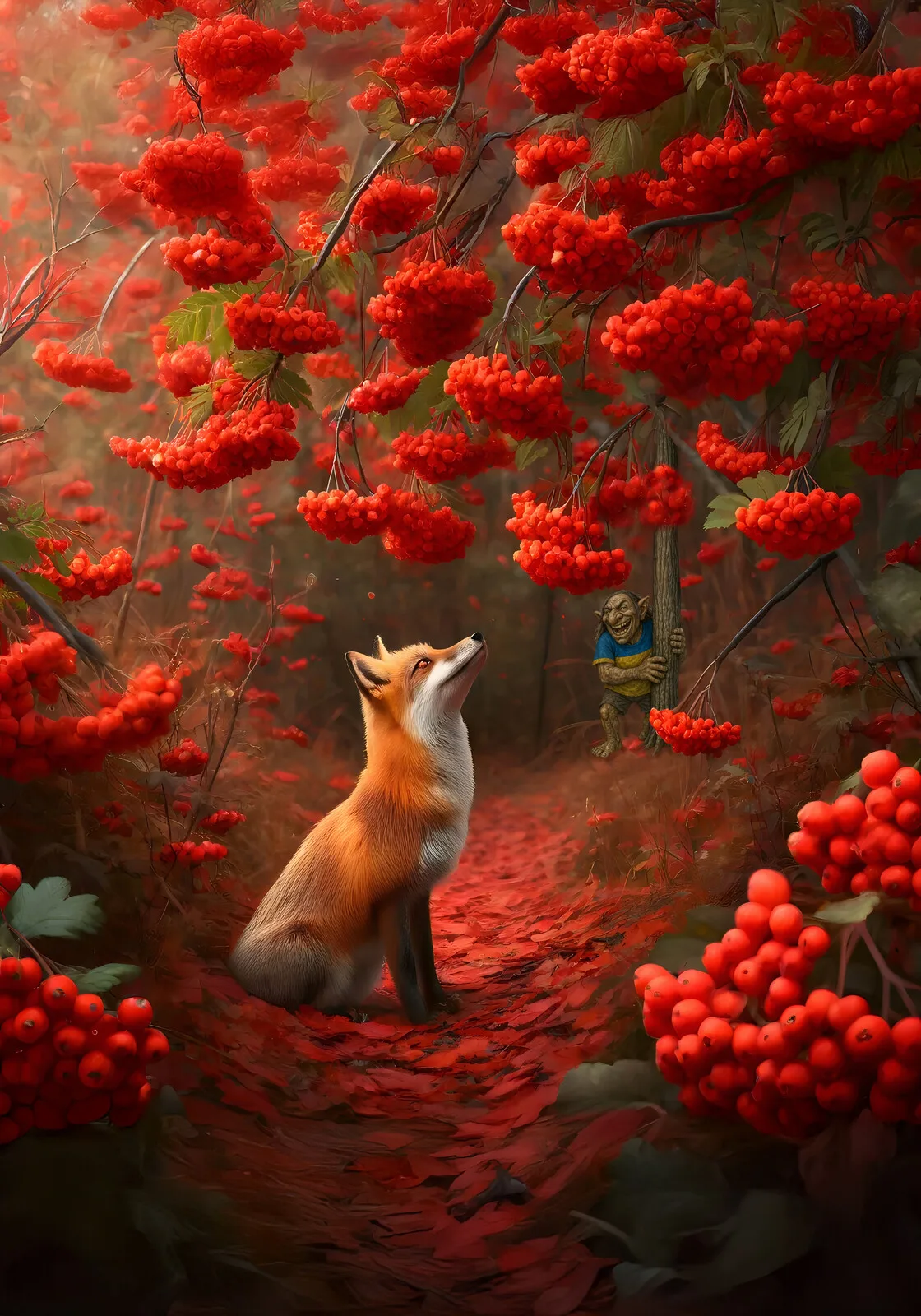
Sour Grapes - Surt sa Räven, 2025
Digital
50 x 70 cm
3 200 kr
Sour Grapes - Surt sa Räven
Autumn arrives like a master painter with a bold red brush, creating a masterpiece of nature. The forests glow with clusters of rowan berries, vivid and bitter, hanging heavily against the fading green. Birds gather in flocks to feast, bears lumber through orchards in search of sweetness, and the season itself seems to overflow with abundance. The beauty of autumn, with its vibrant colours and rich harvest, inspires awe and wonder. Yet, in the midst of this richness, there lies a paradox: the things we cannot reach are often dismissed as worthless. From Aesop’s fox, a cunning and determined creature, beneath the unreachable grapes to the Swedish proverb about rowan berries, the story has echoed for more than two thousand years. It is not really about berries at all—it is about us, about the human habit of turning desire into disdain whenever reality denies us what we crave.
“Aesop’s Animal Chorus
The fox with grapes beyond his snout,
declared them sour, then stormed about.
We smile, for humans do the same—
we curse the prize we failed to claim.
The crow with cheese held proud and high,
believed the fox’s flattery was a lie.
She croaked a song, the cheese was gone—
A fool is fooled, the trick goes on.
The tortoise plodded, slow but sure,
while the hare sped off with pride secure.
The race was won by steady feet—
A boastful heart can face defeat.
The dog that growled, with meat in its jaw,
saw in the stream another paw.
He snapped at shadows, lost his bone—
We grasp for more and end with none.
The ants who laboured, day by day,
stored food for winter, come what may.
The grasshopper laughed, but when snow came,
he found that work can trump a game.
The lion roared, the mouse was small,
yet even mice can save us all.
A tiny tooth, a gnawing deed,
proved mercy is the noblest creed.
So Aesop’s beasts still speak with grace,
each tale is a mirror of our race.
For wise or foolish, kind or sly,
we see ourselves in the fur and eye.
High on a bough with stolen cheese,
a glossy crow felt quite at ease.
A velvet fox with courtly grace
unfurled a smile and upturned face.
“Your plumage! Silk—no, meteor light!
Your voice could charm the owls at night.
Pray, sing for me, one golden note—
a hymn to crown your silver throat!”
She fluffed her feathers, proud and slow,
then opened wide to let it go.
Mid-aria, with squeak and sneeze,
down tumbled glory—goodbye, cheese.
The fox, no fool, with half a bow,
received the prize and murmured, “Wow.”
He tipped his tail and sauntered through:
“Fine songs are nice—fine lunches, too.”
Moral: Beware the honeyed line;
A starving tongue can sound divine.
Hold fast to what you mean to keep—
Not every compliment runs deep.
She learned at last another day
to nod, not sing, and guard her prey.
The fox returned with velvet guile—
and left without his dinner…smile.
So when your pride demands a show,
recall that crafty, crooning crow:
The praise you crave may not be true—
It fattens him and is cheating you.”
Malmö. October 2025
Sour Grapes - Surt sa Räven
Autumn has arrived, a charming time for harvesting a wide range of crops. In the woods, the rowan trees are heavy with deeply red berries, a sight that is both stunning and inspiring. These bitter or sour berries, with their unique cultural significance, yield some of the finest jams, offering a lovely mix of sweet and tart flavours enjoyed in kitchens worldwide. The rowan berries, often associated with wisdom and protection in various cultures, play a significant role in the fables and proverbs we are about to explore.
The role of rowan berries in bird migration is a beautiful testament to the interconnectedness of nature and its cycles. This interconnectedness, where the fruit of one season becomes the sustenance of the next, is a marvel of the natural world. It inspires a sense of wonder and respect for the intricate balance of nature. Eating them straight from the tree is not something I would ever consider. Most people share my view. Rowan berries are mainly consumed by bird species such as thrushes, waxwings, and starlings, which are attracted to the fruit in autumn. Even bears include rowan berries in their diet as part of their plant-based food. In autumn, waxwings gather in large flocks. They are migrating from their breeding grounds, searching for their favourite food: fruit and berries.
Waxwings possess slightly larger livers than other birds to process the alcohol produced in fermented rowan berries, for example. “Drunk as a waxwing” refers to a bird exhibiting abnormal behaviour, such as crashing into objects or seeming disoriented, which can occur after consuming fermented fruit like overripe rowan berries. This is similar to the Swedish expression full som en alika (“drunk as a jackdaw”), meaning to be heavily intoxicated with alcohol. Alika is a dialect term from southern Sweden for a jackdaw. The origin of this expression comes from the practice of brewery workers in earlier times feeding jackdaws mash (a brewing by-product) mixed with spirits, which quickly made the birds intoxicated. Cruel, really. From this mischief, the Swedish word fyllkaja (“drunken jackdaw”) is derived.
The Swedish expression ‘fyllkaja’ has no direct, established equivalent in English. However, there are similar sayings where birds are associated with drunkenness or erratic behaviour.
“Drunk as a lord” or “drunk as a skunk” – common English idioms for being very drunk, though without birds.
There are numerous other idioms in various languages that associate birds with drunkenness or erratic behaviour. For instance, in British dialect, one might say "pissed as a newt" (just as odd as fyllkaja, but without the bird reference). In Russian, there's a saying about bears becoming tipsy from fermented apples. Each of these idioms offers a unique insight into cultural attitudes and perceptions, sparking curiosity and a deeper understanding of different cultures.
In British dialect, one might say “pissed as a newt” (just as odd as fyllkaja, but without birds).
The closest cultural phenomenon might be the English anecdotes about “drunken starlings” or “tipsy blackbirds” becoming intoxicated on fermented berries – but those are descriptions, not idioms.
So ‘fyllkaja’ is unique to Swedish. One could translate it idiomatically as “drunken jackdaw” to keep the wordplay and context, but it would require explanation.
Rowan berries, with their protective power in Nordic folklore, hold a unique and intriguing cultural significance. The rowan tree was often planted near houses or gateposts, not for its taste but to ward off misfortune. Its red berries were believed to drive away witches and keep the homestead safe. This unique cultural belief, deeply rooted in Nordic folklore, adds depth to the story, making it more engaging and thought-provoking.
In this context, it is almost ironic that rowan berries became the object of the fox’s disdain in the Swedish fable. He turns away from something that in our culture symbolised meaning and protection, reducing it to mere sourness. This twist reveals more about humankind’s tendency to reject the ordinary and the familiar, favouring the unattainable, and it's a story that engages and amuses us.
That waxwings or starlings can become intoxicated on fermented berries might seem like a curiosity, but it touches on a more profound symbolism. English country chronicles mention of “drunken starlings,” and in Russia, bears are said to become tipsy from fermented apples. In fables and stories, this animal drunkenness is often used as an allegory for our own missteps: we laugh at the waxwing, but we see ourselves in its unsteady flight. Perhaps “sour grapes” is just a more refined version of the same idea – an intellectual intoxication in which we hide our defeats. It's a reflection that makes us contemplate our own actions.
The idea that foxes would be drawn to rowan berries is something I've only ever heard in Aesop’s famous tale. No, foxes do not eat rowan berries, except in the realm of fables. The expression “Surt sa räven om rönnbären” (“Sour, said the fox, about the rowan berries”) originates from Aesop’s fable ‘The Fox and the Grapes’, where the fox cannot reach a bunch of grapes and then dismisses wanting them by claiming they are sour. This fable, deeply ingrained in our cultural consciousness, teaches us about human psychology and the tendency to devalue what we cannot have.
“The Fox and the Grapes” is a classic Aesop’s fable that imparts a profound moral lesson, one that transcends time and culture. In this tale, a hungry fox attempts to reach a bunch of ripe grapes hanging too high, failing despite multiple attempts. The fox eventually gives up, claiming the grapes were sour anyway. This fable teaches us that people often scorn what they cannot have or make excuses for things they cannot obtain, a behaviour that is not unique to the fox but is a part of our shared human experience. It prompts us to reflect on our own behaviours and attitudes, encouraging us to consider our actions and the motivations behind our desires. It's a lesson that resonates with all of us, regardless of our cultural or historical context, and invites us to contemplate our own actions.
The tendency for humans to reinterpret failure is not unique to Aesop. In Japanese ‘Nō plays’, some characters hide their longing by disguising it as wisdom. Shakespeare often allows his characters to rationalise in the same way: Malvolio in Twelfth Night convinces himself that he does not desire the love he has rejected, and in Much Ado About Nothing, we see Benedick and Beatrice pretend to scorn each other until love becomes impossible to deny.
The fable inspired the Swedish proverb “Surt sa räven om rönnbären” (“Sour, said the fox about the rowan berries”) or sometimes simply “Surt sa räven.” The background of this saying lies in a mistranslation, where the Greek words for fox (αλεπού) and grapes (αμπέλου) create an alliteration, both starting with the same vowel sound. In the Swedish translation, priority was given to preserving the alliteration between ‘räv’ and ‘rönnbär’ rather than accurately conveying the correct fruit. As a result, the moral of the story was lost, for rowan berries are, in fact, always sour. This explains why the proverb about the fox and the rowan berries exists only in Swedish and Finnish (through the Swedish translation). Another reason is probably that grapes do not usually grow in the north, whereas rowan berries, unlike cherries, for example, grow low enough for a fox to reach.
When the fable reached the north, it was not the grapes but the rowan berries that conveyed the moral. Perhaps the climate was signalling here—grapes were a luxury from afar, while rowan berries could be found at every homestead. One could almost say that the translators not only changed the word but also adapted the climate itself. However, in this adaptation, some of the original impact was lost. Where the original relies on contradiction—grapes being both sweet and sour—the Swedish version fell flat: rowan berries are always sour. The alliteration between fox and rowan was tempting, but the psychological depth was lost. Ironically, the translation itself is an example of “sour grapes”—choosing the easier path and convincing oneself that it was good enough. This loss of psychological depth in the adaptation is a testament to the complexity of human behaviour that the fable initially sought to capture.
Let us read what Aesop once wrote.
A fox one day saw a bunch of fine, ripe grapes hanging from a vine that trailed along a branch of a tree. The grapes looked ready to burst with juice, and the fox’s mouth watered as he gazed longingly at them.
The bunch hung from a high branch, and the fox had to jump for it. The first time he jumped, he did not even come close. So, he backed up a bit and made a running leap, but again failed to reach them. Time after time, he tried, but always in vain.
At last, he sat down and looked at the grapes in disgust.
“What a fool I am,” he said. “Here I am wearing myself out to get a bunch of sour grapes that are not worth gaping for.”
And very disdainfully, he walked away.
One can interpret Aesop’s fable as a miniature drama in three acts. Act one: desire—the fox beneath the grapes, mouth watering. Act two: struggle—the jumps, the leaps, the comic physicality of failure repeated again and again. Act three: the line—“They’re probably sour anyway.” A laconic jab, delivered as a comic exit. The audience laughs but also feels a sense of exposure. For who has not rationalised in the same way? In this sense, the fable is not only a moral lesson but also a mirror, reflecting our own tendencies to rationalise and devalue what we cannot have.
The enduring relevance of the fable is evident in the fox’s declaration that the grapes are probably sour, a psychological observation that has lasted for over two thousand years. It is a reaction many of us can relate to when we desire something we believe we cannot attain. We devalue the things we cannot reach or achieve, making it seem as if we never wanted them in the first place. This is a way of saving face, of avoiding the admission of defeat or shortcoming. The fable's wisdom continues to resonate with us, offering a timeless lesson in human behaviour that is as relevant today as it was in Aesop's time.
As a neighbour once loudly declared: “I don’t want a robotic lawnmower, I like the exercise I get when mowing.” “Sour grapes,” I said to my wife after he had gone. “He simply can’t afford one. I’ve heard him tell his wife so, with regret.”
On social media, we observe the same pattern every day: someone dismisses a trip, a car, an education, or a partner as “unimportant” only after failing to acquire it. In the world of film, Disney’s classic Frozen illustrates this mechanism: Prince Hans rejects love when he does not gain power, and Elsa distances herself from the world by claiming she does not need it. Both behave like the fox—calling what one cannot have sour or dangerous is easier than exposing their own vulnerability.
Like many proverbs, this one becomes easier to understand once you know its story. It originates from a fable by the Greek fabulist Aesop, dating back to around 600 BC. In the story, a fox desires grapes, but they are so high that he cannot reach them. Not wanting to admit his defeat, he claims he never wanted them anyway because they were unripe—meaning sour. In the Swedish translation, the grapes were changed to rowan berries. This makes the expression confusing in context because rowan berries are always sour, which means they are not something one would desire in the first place.
The fox will never know whether he is right or not—grapes can be sour or sweet, depending on the soil’s lime content, whether they have grown on a south-facing slope, and other factors best left to the enologists to explain.
But what happens in the Swedish version of the fable? The fox spots a bunch of rowan berries and declares them sour, which they obviously are. The fox is quite right. The question is whether the translator sacrificed the entire meaning of the tale for a cheap alliteration, or if this sour twist of the moral is instead rooted in the psychology of the Swede.
The Swedish version is quite pointless: all the fox conveys is a dull everyday observation—rowan berries are sour, as everyone knows, and surely foxes do as well. If one attempts to extract a moral lesson from this story, it would be that the aims of our longing are never truly worth pursuing. And that only offers limited moral uplift.
It is like on stage when an actor delivers a line without emotion—the audience neither laughs nor reflects. The Swedish version of the fable lacks the sharpness of the original dramatic narrative. Consequently, it has become more of a folk saying than a true moral lesson.
Aesop’s timeless tale deserves a fresh perspective in Swedish culture—why not imagine the fox seeing a patch of wild strawberries beyond a stream and claiming they are sour? (moral: the goals we yearn for are always sweet and worth chasing—only laziness can hold us back).
Or perhaps even better: the fox notices the gooseberries and claims that they sting the mouth, so he abstains. The moral then would be that our desires face some resistance before we can taste the sweetness inside.
By experimenting with the dramaturgy of fables, we can uncover new layers of meaning. Imagine the fox gazing at a strawberry patch on the far side of a brook and turning away. The moral takes on a different, almost typically Swedish, meaning: that laziness is our greatest enemy. Or picture the fox before a gooseberry bush: that the journey to sweetness sometimes involves walking through thorns and pricks. Such reinterpretations would restore the fable’s psychological sharpness, but with a local flavour, demonstrating the adaptability and applicability of these stories to different cultures.
But foxes are not regarded as fools; on the contrary, they are said to be clever and inventive. Just ask a henkeeper.
Another Aesop fable takes a different tone, featuring the crow as both foolish and vain.
A crow perched in a tree to feast on some cheese she had stolen from the humans’ table. She had not even tasted it when a fox passed by and spotted the cheese. The quick-witted fox sat down and looked up with feigned admiration at the crow.
“Madame Crow, what an honour to meet you!” he said with affected charm. “Everyone I meet says you are the most beautiful bird in existence, and now that I see you myself, I can tell they do not exaggerate. Your gleaming plumage is like human haute couture. It is also said that your voice is even more beautiful.” He tilted his head.
The foolish crow was so pleased that she decided to let the fox enjoy her singing voice, something she should have known, if she had been sensible, amounted to no more than a hoarse caw.
When the vain crow opened her beak, she dropped the cheese, which the fox snatched as it fell and devoured immediately.
MORAL
Don’t trust those who flatter you. They probably want something for themselves.
In the fable of the crow, it is not bitterness but vanity that causes her to lose her prize. Two fables, two different human flaws: one about belittling what one cannot have, the other about exaggerating one’s own worth. Both persist in our culture because they are timeless ways of describing how we defend our egos. These stories, despite their ancient origins, continue to reflect our human nature, underscoring their enduring relevance and our timeless need for self-reflection.
This trait appears throughout our cultural history. Oscar Wilde’s ‘Dorian Grey’ denies the passage of time and labels beauty as “meaningless” once he has lost it. Ibsen’s ‘Hedda Gabler’ dismisses the happiness and love of others because she cannot attain it herself. In Molière’s comedies, we laugh at how envy and desire are hidden behind a mask of disdain. On the cinema screen, Scarlett O’Hara in ‘Gone with the Wind’ does the same when she convinces herself that what she has lost was never valuable. All of these are variations on the same theme as Aesop’s fox—the eternal human need to justify one’s failures.
Jörgen Thornberg
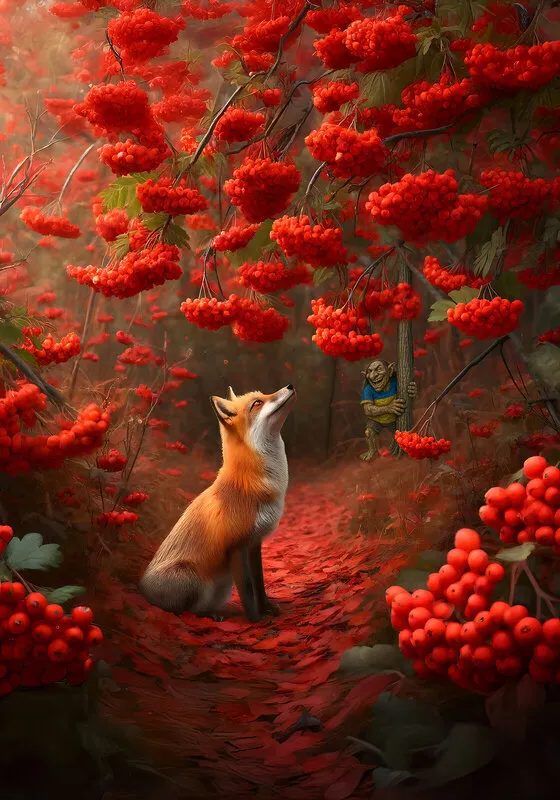
Sour Grapes - Surt sa Räven, 2025
Digital
50 x 70 cm
3 200 kr
Sour Grapes - Surt sa Räven
Autumn arrives like a master painter with a bold red brush, creating a masterpiece of nature. The forests glow with clusters of rowan berries, vivid and bitter, hanging heavily against the fading green. Birds gather in flocks to feast, bears lumber through orchards in search of sweetness, and the season itself seems to overflow with abundance. The beauty of autumn, with its vibrant colours and rich harvest, inspires awe and wonder. Yet, in the midst of this richness, there lies a paradox: the things we cannot reach are often dismissed as worthless. From Aesop’s fox, a cunning and determined creature, beneath the unreachable grapes to the Swedish proverb about rowan berries, the story has echoed for more than two thousand years. It is not really about berries at all—it is about us, about the human habit of turning desire into disdain whenever reality denies us what we crave.
“Aesop’s Animal Chorus
The fox with grapes beyond his snout,
declared them sour, then stormed about.
We smile, for humans do the same—
we curse the prize we failed to claim.
The crow with cheese held proud and high,
believed the fox’s flattery was a lie.
She croaked a song, the cheese was gone—
A fool is fooled, the trick goes on.
The tortoise plodded, slow but sure,
while the hare sped off with pride secure.
The race was won by steady feet—
A boastful heart can face defeat.
The dog that growled, with meat in its jaw,
saw in the stream another paw.
He snapped at shadows, lost his bone—
We grasp for more and end with none.
The ants who laboured, day by day,
stored food for winter, come what may.
The grasshopper laughed, but when snow came,
he found that work can trump a game.
The lion roared, the mouse was small,
yet even mice can save us all.
A tiny tooth, a gnawing deed,
proved mercy is the noblest creed.
So Aesop’s beasts still speak with grace,
each tale is a mirror of our race.
For wise or foolish, kind or sly,
we see ourselves in the fur and eye.
High on a bough with stolen cheese,
a glossy crow felt quite at ease.
A velvet fox with courtly grace
unfurled a smile and upturned face.
“Your plumage! Silk—no, meteor light!
Your voice could charm the owls at night.
Pray, sing for me, one golden note—
a hymn to crown your silver throat!”
She fluffed her feathers, proud and slow,
then opened wide to let it go.
Mid-aria, with squeak and sneeze,
down tumbled glory—goodbye, cheese.
The fox, no fool, with half a bow,
received the prize and murmured, “Wow.”
He tipped his tail and sauntered through:
“Fine songs are nice—fine lunches, too.”
Moral: Beware the honeyed line;
A starving tongue can sound divine.
Hold fast to what you mean to keep—
Not every compliment runs deep.
She learned at last another day
to nod, not sing, and guard her prey.
The fox returned with velvet guile—
and left without his dinner…smile.
So when your pride demands a show,
recall that crafty, crooning crow:
The praise you crave may not be true—
It fattens him and is cheating you.”
Malmö. October 2025
Sour Grapes - Surt sa Räven
Autumn has arrived, a charming time for harvesting a wide range of crops. In the woods, the rowan trees are heavy with deeply red berries, a sight that is both stunning and inspiring. These bitter or sour berries, with their unique cultural significance, yield some of the finest jams, offering a lovely mix of sweet and tart flavours enjoyed in kitchens worldwide. The rowan berries, often associated with wisdom and protection in various cultures, play a significant role in the fables and proverbs we are about to explore.
The role of rowan berries in bird migration is a beautiful testament to the interconnectedness of nature and its cycles. This interconnectedness, where the fruit of one season becomes the sustenance of the next, is a marvel of the natural world. It inspires a sense of wonder and respect for the intricate balance of nature. Eating them straight from the tree is not something I would ever consider. Most people share my view. Rowan berries are mainly consumed by bird species such as thrushes, waxwings, and starlings, which are attracted to the fruit in autumn. Even bears include rowan berries in their diet as part of their plant-based food. In autumn, waxwings gather in large flocks. They are migrating from their breeding grounds, searching for their favourite food: fruit and berries.
Waxwings possess slightly larger livers than other birds to process the alcohol produced in fermented rowan berries, for example. “Drunk as a waxwing” refers to a bird exhibiting abnormal behaviour, such as crashing into objects or seeming disoriented, which can occur after consuming fermented fruit like overripe rowan berries. This is similar to the Swedish expression full som en alika (“drunk as a jackdaw”), meaning to be heavily intoxicated with alcohol. Alika is a dialect term from southern Sweden for a jackdaw. The origin of this expression comes from the practice of brewery workers in earlier times feeding jackdaws mash (a brewing by-product) mixed with spirits, which quickly made the birds intoxicated. Cruel, really. From this mischief, the Swedish word fyllkaja (“drunken jackdaw”) is derived.
The Swedish expression ‘fyllkaja’ has no direct, established equivalent in English. However, there are similar sayings where birds are associated with drunkenness or erratic behaviour.
“Drunk as a lord” or “drunk as a skunk” – common English idioms for being very drunk, though without birds.
There are numerous other idioms in various languages that associate birds with drunkenness or erratic behaviour. For instance, in British dialect, one might say "pissed as a newt" (just as odd as fyllkaja, but without the bird reference). In Russian, there's a saying about bears becoming tipsy from fermented apples. Each of these idioms offers a unique insight into cultural attitudes and perceptions, sparking curiosity and a deeper understanding of different cultures.
In British dialect, one might say “pissed as a newt” (just as odd as fyllkaja, but without birds).
The closest cultural phenomenon might be the English anecdotes about “drunken starlings” or “tipsy blackbirds” becoming intoxicated on fermented berries – but those are descriptions, not idioms.
So ‘fyllkaja’ is unique to Swedish. One could translate it idiomatically as “drunken jackdaw” to keep the wordplay and context, but it would require explanation.
Rowan berries, with their protective power in Nordic folklore, hold a unique and intriguing cultural significance. The rowan tree was often planted near houses or gateposts, not for its taste but to ward off misfortune. Its red berries were believed to drive away witches and keep the homestead safe. This unique cultural belief, deeply rooted in Nordic folklore, adds depth to the story, making it more engaging and thought-provoking.
In this context, it is almost ironic that rowan berries became the object of the fox’s disdain in the Swedish fable. He turns away from something that in our culture symbolised meaning and protection, reducing it to mere sourness. This twist reveals more about humankind’s tendency to reject the ordinary and the familiar, favouring the unattainable, and it's a story that engages and amuses us.
That waxwings or starlings can become intoxicated on fermented berries might seem like a curiosity, but it touches on a more profound symbolism. English country chronicles mention of “drunken starlings,” and in Russia, bears are said to become tipsy from fermented apples. In fables and stories, this animal drunkenness is often used as an allegory for our own missteps: we laugh at the waxwing, but we see ourselves in its unsteady flight. Perhaps “sour grapes” is just a more refined version of the same idea – an intellectual intoxication in which we hide our defeats. It's a reflection that makes us contemplate our own actions.
The idea that foxes would be drawn to rowan berries is something I've only ever heard in Aesop’s famous tale. No, foxes do not eat rowan berries, except in the realm of fables. The expression “Surt sa räven om rönnbären” (“Sour, said the fox, about the rowan berries”) originates from Aesop’s fable ‘The Fox and the Grapes’, where the fox cannot reach a bunch of grapes and then dismisses wanting them by claiming they are sour. This fable, deeply ingrained in our cultural consciousness, teaches us about human psychology and the tendency to devalue what we cannot have.
“The Fox and the Grapes” is a classic Aesop’s fable that imparts a profound moral lesson, one that transcends time and culture. In this tale, a hungry fox attempts to reach a bunch of ripe grapes hanging too high, failing despite multiple attempts. The fox eventually gives up, claiming the grapes were sour anyway. This fable teaches us that people often scorn what they cannot have or make excuses for things they cannot obtain, a behaviour that is not unique to the fox but is a part of our shared human experience. It prompts us to reflect on our own behaviours and attitudes, encouraging us to consider our actions and the motivations behind our desires. It's a lesson that resonates with all of us, regardless of our cultural or historical context, and invites us to contemplate our own actions.
The tendency for humans to reinterpret failure is not unique to Aesop. In Japanese ‘Nō plays’, some characters hide their longing by disguising it as wisdom. Shakespeare often allows his characters to rationalise in the same way: Malvolio in Twelfth Night convinces himself that he does not desire the love he has rejected, and in Much Ado About Nothing, we see Benedick and Beatrice pretend to scorn each other until love becomes impossible to deny.
The fable inspired the Swedish proverb “Surt sa räven om rönnbären” (“Sour, said the fox about the rowan berries”) or sometimes simply “Surt sa räven.” The background of this saying lies in a mistranslation, where the Greek words for fox (αλεπού) and grapes (αμπέλου) create an alliteration, both starting with the same vowel sound. In the Swedish translation, priority was given to preserving the alliteration between ‘räv’ and ‘rönnbär’ rather than accurately conveying the correct fruit. As a result, the moral of the story was lost, for rowan berries are, in fact, always sour. This explains why the proverb about the fox and the rowan berries exists only in Swedish and Finnish (through the Swedish translation). Another reason is probably that grapes do not usually grow in the north, whereas rowan berries, unlike cherries, for example, grow low enough for a fox to reach.
When the fable reached the north, it was not the grapes but the rowan berries that conveyed the moral. Perhaps the climate was signalling here—grapes were a luxury from afar, while rowan berries could be found at every homestead. One could almost say that the translators not only changed the word but also adapted the climate itself. However, in this adaptation, some of the original impact was lost. Where the original relies on contradiction—grapes being both sweet and sour—the Swedish version fell flat: rowan berries are always sour. The alliteration between fox and rowan was tempting, but the psychological depth was lost. Ironically, the translation itself is an example of “sour grapes”—choosing the easier path and convincing oneself that it was good enough. This loss of psychological depth in the adaptation is a testament to the complexity of human behaviour that the fable initially sought to capture.
Let us read what Aesop once wrote.
A fox one day saw a bunch of fine, ripe grapes hanging from a vine that trailed along a branch of a tree. The grapes looked ready to burst with juice, and the fox’s mouth watered as he gazed longingly at them.
The bunch hung from a high branch, and the fox had to jump for it. The first time he jumped, he did not even come close. So, he backed up a bit and made a running leap, but again failed to reach them. Time after time, he tried, but always in vain.
At last, he sat down and looked at the grapes in disgust.
“What a fool I am,” he said. “Here I am wearing myself out to get a bunch of sour grapes that are not worth gaping for.”
And very disdainfully, he walked away.
One can interpret Aesop’s fable as a miniature drama in three acts. Act one: desire—the fox beneath the grapes, mouth watering. Act two: struggle—the jumps, the leaps, the comic physicality of failure repeated again and again. Act three: the line—“They’re probably sour anyway.” A laconic jab, delivered as a comic exit. The audience laughs but also feels a sense of exposure. For who has not rationalised in the same way? In this sense, the fable is not only a moral lesson but also a mirror, reflecting our own tendencies to rationalise and devalue what we cannot have.
The enduring relevance of the fable is evident in the fox’s declaration that the grapes are probably sour, a psychological observation that has lasted for over two thousand years. It is a reaction many of us can relate to when we desire something we believe we cannot attain. We devalue the things we cannot reach or achieve, making it seem as if we never wanted them in the first place. This is a way of saving face, of avoiding the admission of defeat or shortcoming. The fable's wisdom continues to resonate with us, offering a timeless lesson in human behaviour that is as relevant today as it was in Aesop's time.
As a neighbour once loudly declared: “I don’t want a robotic lawnmower, I like the exercise I get when mowing.” “Sour grapes,” I said to my wife after he had gone. “He simply can’t afford one. I’ve heard him tell his wife so, with regret.”
On social media, we observe the same pattern every day: someone dismisses a trip, a car, an education, or a partner as “unimportant” only after failing to acquire it. In the world of film, Disney’s classic Frozen illustrates this mechanism: Prince Hans rejects love when he does not gain power, and Elsa distances herself from the world by claiming she does not need it. Both behave like the fox—calling what one cannot have sour or dangerous is easier than exposing their own vulnerability.
Like many proverbs, this one becomes easier to understand once you know its story. It originates from a fable by the Greek fabulist Aesop, dating back to around 600 BC. In the story, a fox desires grapes, but they are so high that he cannot reach them. Not wanting to admit his defeat, he claims he never wanted them anyway because they were unripe—meaning sour. In the Swedish translation, the grapes were changed to rowan berries. This makes the expression confusing in context because rowan berries are always sour, which means they are not something one would desire in the first place.
The fox will never know whether he is right or not—grapes can be sour or sweet, depending on the soil’s lime content, whether they have grown on a south-facing slope, and other factors best left to the enologists to explain.
But what happens in the Swedish version of the fable? The fox spots a bunch of rowan berries and declares them sour, which they obviously are. The fox is quite right. The question is whether the translator sacrificed the entire meaning of the tale for a cheap alliteration, or if this sour twist of the moral is instead rooted in the psychology of the Swede.
The Swedish version is quite pointless: all the fox conveys is a dull everyday observation—rowan berries are sour, as everyone knows, and surely foxes do as well. If one attempts to extract a moral lesson from this story, it would be that the aims of our longing are never truly worth pursuing. And that only offers limited moral uplift.
It is like on stage when an actor delivers a line without emotion—the audience neither laughs nor reflects. The Swedish version of the fable lacks the sharpness of the original dramatic narrative. Consequently, it has become more of a folk saying than a true moral lesson.
Aesop’s timeless tale deserves a fresh perspective in Swedish culture—why not imagine the fox seeing a patch of wild strawberries beyond a stream and claiming they are sour? (moral: the goals we yearn for are always sweet and worth chasing—only laziness can hold us back).
Or perhaps even better: the fox notices the gooseberries and claims that they sting the mouth, so he abstains. The moral then would be that our desires face some resistance before we can taste the sweetness inside.
By experimenting with the dramaturgy of fables, we can uncover new layers of meaning. Imagine the fox gazing at a strawberry patch on the far side of a brook and turning away. The moral takes on a different, almost typically Swedish, meaning: that laziness is our greatest enemy. Or picture the fox before a gooseberry bush: that the journey to sweetness sometimes involves walking through thorns and pricks. Such reinterpretations would restore the fable’s psychological sharpness, but with a local flavour, demonstrating the adaptability and applicability of these stories to different cultures.
But foxes are not regarded as fools; on the contrary, they are said to be clever and inventive. Just ask a henkeeper.
Another Aesop fable takes a different tone, featuring the crow as both foolish and vain.
A crow perched in a tree to feast on some cheese she had stolen from the humans’ table. She had not even tasted it when a fox passed by and spotted the cheese. The quick-witted fox sat down and looked up with feigned admiration at the crow.
“Madame Crow, what an honour to meet you!” he said with affected charm. “Everyone I meet says you are the most beautiful bird in existence, and now that I see you myself, I can tell they do not exaggerate. Your gleaming plumage is like human haute couture. It is also said that your voice is even more beautiful.” He tilted his head.
The foolish crow was so pleased that she decided to let the fox enjoy her singing voice, something she should have known, if she had been sensible, amounted to no more than a hoarse caw.
When the vain crow opened her beak, she dropped the cheese, which the fox snatched as it fell and devoured immediately.
MORAL
Don’t trust those who flatter you. They probably want something for themselves.
In the fable of the crow, it is not bitterness but vanity that causes her to lose her prize. Two fables, two different human flaws: one about belittling what one cannot have, the other about exaggerating one’s own worth. Both persist in our culture because they are timeless ways of describing how we defend our egos. These stories, despite their ancient origins, continue to reflect our human nature, underscoring their enduring relevance and our timeless need for self-reflection.
This trait appears throughout our cultural history. Oscar Wilde’s ‘Dorian Grey’ denies the passage of time and labels beauty as “meaningless” once he has lost it. Ibsen’s ‘Hedda Gabler’ dismisses the happiness and love of others because she cannot attain it herself. In Molière’s comedies, we laugh at how envy and desire are hidden behind a mask of disdain. On the cinema screen, Scarlett O’Hara in ‘Gone with the Wind’ does the same when she convinces herself that what she has lost was never valuable. All of these are variations on the same theme as Aesop’s fox—the eternal human need to justify one’s failures.
3 200 kr

Jörgen Thornberg
Malmö
Lite om bilder och mig. Translation in English at the end.
Jag är en nyfiken person som ser allt i bilder, även det jag fäster i ord, gärna tillsammans för bakom alla mina bilder finns en berättelse. Till vissa bilder hör en kortare eller längre novell som följer med bilden.
Bilder berättar historier. Jag omges av naturlig skönhet, intressanta människor och historia var jag än går. Jag använder min kamera för att dokumentera världen och blanda det jag ser med vad jag känner för att fånga den dolda magin.
Mina bilder berättar mina historier. Genom mina bilder, tryck och berättelser. Jag bjuder in dig att ta del av dessa berättelser, in i ditt liv och hem och dela min mycket personliga syn på vår värld. Mer än vad ögat ser. Jag tänker i bilder, drömmer och skriver och pratar om dem; följaktligen måste jag också skapa bilder. De blir vad jag ser, inte nödvändigtvis begränsade till verkligheten. Det finns en bild runt varje hörn. Jag hoppas att du kommer att se vad jag såg och gilla det.
Jag är också en skrivande person och till många bilder hör en kortare eller längre essay. Den följer med tavlan, tryckt på fint papper och med en personlig hälsning från mig.
Flertalet bilder startar sin resa i min kamera. Enkelt förklarat beskriver jag bilden jag ser i mitt inre, upplevd eller fantiserad. Bilden uppstår inom mig redan innan jag fått okularet till ögat. På bråkdelen av ett ögonblick ser jag vad jag vill ha och vad som kan göras med bilden. Här skall jag stoppa in en giraff, stålmannen, Titanic eller vad det är min fantasi finner ut. Ännu märkligare är att jag kommer ihåg minnesbilden långt efteråt när det blir tid att skapa verket. Om jag lyckas eller inte, är upp till betraktaren, oftast präglat av en stråk av svart humor – meningen är att man skall bli underhållen. Mina bilder blir ofta en snackis där de hänger.
Jag föredrar bilder som förmedlar ett budskap i flera lager. Vid första anblicken fylld av feel-good, en vacker utsikt, fint väder, solen skiner, blommor på ängen eller vattnet som ligger förrädiskt spegelblankt. I en sådan bild kan jag gömma min egentliga berättelse, mitt förakt för förtryckare och våldsverkare, rasister och fördomsfulla människor - ett gärna återkommande motiv mer eller mindre dolt i det vackra motivet. Jag försöker förena dem i ett gemensamt narrativ.
Bild och formgivning har löpt som en röd tråd genom livet. Fotokonst känns som en värdig final som jag gärna delar med mig.
Min genre är vid som framgår av mina bilder, temat en blandning av pop- och gatukonst i kollage som kan bestå av hundratals lager. Vissa bilder kan ta veckor, andra någon dag innan det är dags att överlämna resultatet till printverkstaden. Fine Art Prints är digitala fotocollage. I dessa kollage sker rivandet, klippandet, pusslandet, målandet, ritandet och sprayningen digitalt. Det jag monterar in kan vara hundratals år gamla bilder som jag omsorgsfullt frilägger så att de ser ut att vara en del av tavlan men också bilder skapade av mig själv efter min egen fantasi. Därefter besöks printstudion och för vissa bilder numrera en limiterad upplaga (oftast 7 exemplar) och signera för hand. Vissa bilder kan köpas i olika format. Det är bara att fråga efter vilka. Gillar man en bild som är 70x100 men inte har plats på väggen, går den kanske att få i 50x70 cm istället. Frågan är fri.
Metoden Giclée eller Fine Art Print som det också kallas är det moderna sättet för framställning av grafisk konst. Villkoret för denna typ av utskrifter är att en högkvalitativ storformatskrivare används med åldersbeständigt färgpigment och konstnärspapper eller i förekommande fall på duk. Pappret som används möter de krav på livslängd som ställs av museer och gallerier. Normalt säljer jag mina bilder oinramade så att den nya ägaren själv kan bestämma hur de skall se ut, med eller utan passepartout färg på ram, med eller utan glas etc..
Under många år ställde jag bara ut på nätet, i valda grupper och på min egen Facebooksida - https://www.facebook.com/jorgen.thornberg.9
Jag finns också på en egen hemsida som tyvärr inte alltid är uppdaterad – https://www.jth.life/ Där kan du också läsa en del av de berättelser som följer med bilden.
UTSTÄLLNINGAR
Luftkastellet, oktober 2022
Konst i Lund, november 2022
Luftkastellet, mars 2023
Engleson Galleri Caroli, april 2023
Hydra, Greece June 2023
Engleson Galleri Caroli, oktober 2023
Toppen, Höllviken december 2023
Luftkastellet, mars 2024
Torups Galleri, mars 2024
Venice, May 2024
Luftkastellet, oktober 2024
Konst i Advent, December 2024
Galleri Engleson, Caroli December 2024
Jäger & Jansson Galleri, april 2025
A bit about pictures and me.
I'm a curious person who sees everything in pictures, even what I express in words, often combining them, for behind all my pictures lies a story. These narratives, some as short as a single image and others as long as a novel, are the heart and soul of my work.
Pictures tell stories. Wherever I go, I'm surrounded by natural beauty, exciting people, and history. I use my camera to document the world and blend what I see with what I feel to capture the hidden magic.
My images tell my stories. Through my pictures, prints, and narratives, I invite you to partake in these stories in your life and home and share my deeply personal perspective of our world. More than meets the eye. I think in pictures, dream, write, and talk about them; consequently, I must create images too. They become what I see, not necessarily confined to reality. There's a picture around every corner. I hope you'll see what I saw and enjoy it.
I'm also a writer, and many images come with a shorter or longer essay. It accompanies the painting, printed on fine paper with my personal greeting.
Many pictures start their journey on my camera. Simply put, I describe the image I see in my mind, experienced or imagined. The image arises within me even before I bring the eyepiece to my eye. In a fraction of a moment, I see what I want and what can be done with the picture. Here, I'll insert a giraffe, Superman, the Titanic, or whatever my imagination conjures up. Even stranger is that I remember the mental image long after it's time to create the work. Whether I succeed is up to the observer, often imbued with a streak of black humour – the aim is to entertain. My pictures usually become a talking point wherever they hang.
I prefer pictures that convey a message in multiple layers. At first glance, they're filled with feel-good vibes, a beautiful view, lovely weather, the sun shining, flowers in the meadow, or the water lying deceptively calm. But beneath this surface beauty, I often conceal a deeper story, a narrative that challenges societal norms or explores the human condition. I invite you to delve into these hidden narratives and discover the layers of meaning within my work.
Picture and design have been a thread running through my life. Photographic art feels like a fitting finale, and I'm happy to share it.
My genre is varied, as seen in my pictures; the theme is a blend of pop and street art in collages that can consist of hundreds of layers. Some images can take weeks, others just a day before it's time to hand over the result to the print workshop. Fine Art Prints are digital photo collages. In these collages, tearing, cutting, puzzling, painting, drawing, and spraying happen digitally. What I insert can be images hundreds of years old that I carefully extract so they appear to be part of the painting, but also images created by myself, now also generated from my imagination. Next, visit the print studio and, for certain images, number a limited edition (usually 7 copies) and sign them by hand. Some images may be available in other formats. Just ask which ones. If you like an image that's 70x100 but doesn't have space on the wall, you might be able to get it in 50x70 cm instead. The question is open.
The Giclée method, or Fine Art Print as it's also called, is the modern way of producing graphic art. This method ensures the highest quality and longevity of the artwork, using a high-quality large-format printer with archival pigment inks and artist paper or, in some cases, canvas. The paper used meets the longevity requirements set by museums and galleries. I sell my pictures unframed, allowing the new owner to personalise their artwork, confident in the lasting value and quality of the piece.
For many years, I only exhibited online, in selected groups, and on my Facebook page - https://www.facebook.com/jorgen.thornberg.9. I also have my website, which unfortunately is not constantly updated - https://www.jth.life/. You can also read some of the stories accompanying the pictures there.
EXHIBITIONS
Luftkastellet, October 2022
Art in Lund, November 2022
Luftkastellet, March 2023
Engleson Gallery Caroli, April 2023
Hydra, Greece June 2023
Engleson Gallery Caroli, October 2023
Toppen, Höllviken December 2023
Luftkastellet, March 2024
Torup Gallery, March 2024
Venice, May 2024
UTSTÄLLNINGAR
Luftkastellet, oktober 2022
Konst i Lund, november 2022
Luftkastellet, mars 2023
Engleson Galleri Caroli, april 2023
Hydra, Greece June 2023
Engleson Galleri Caroli, oktober 2023
Toppen, Höllviken december 2023
Luftkastellet, mars 2024
Torups Galleri, mars 2024
Venice, May 2024
Luftkastellet, October 2024
Konst i Advent, December 2024
Galleri Engleson, Caroli December 2024
Jäger & Jansson Galleri, April 2025
Utbildning
Autodidakt
Medlem i konstnärsförening
Öppna Sinnen
Med i konstrunda
Konstrundan i Skåne
Utställningar
Luftkastellet, October 2022
Art in Lund, November 2022
Luftkastellet, March 2023
Engleson Gallery Caroli, April 2023
Hydra, Greece June 2023
Engleson Gallery Caroli, October 2023
Toppen, Höllviken December 2023
Luftkastellet, March 2024
Torup Gallery, March 2024
Venice, May 2024