Vi använder cookies för att ge dig bästa möjliga upplevelse. Välj vilka cookies du tillåter.
Läs mer i vår integritetspolicy
Thomas Kalyvas
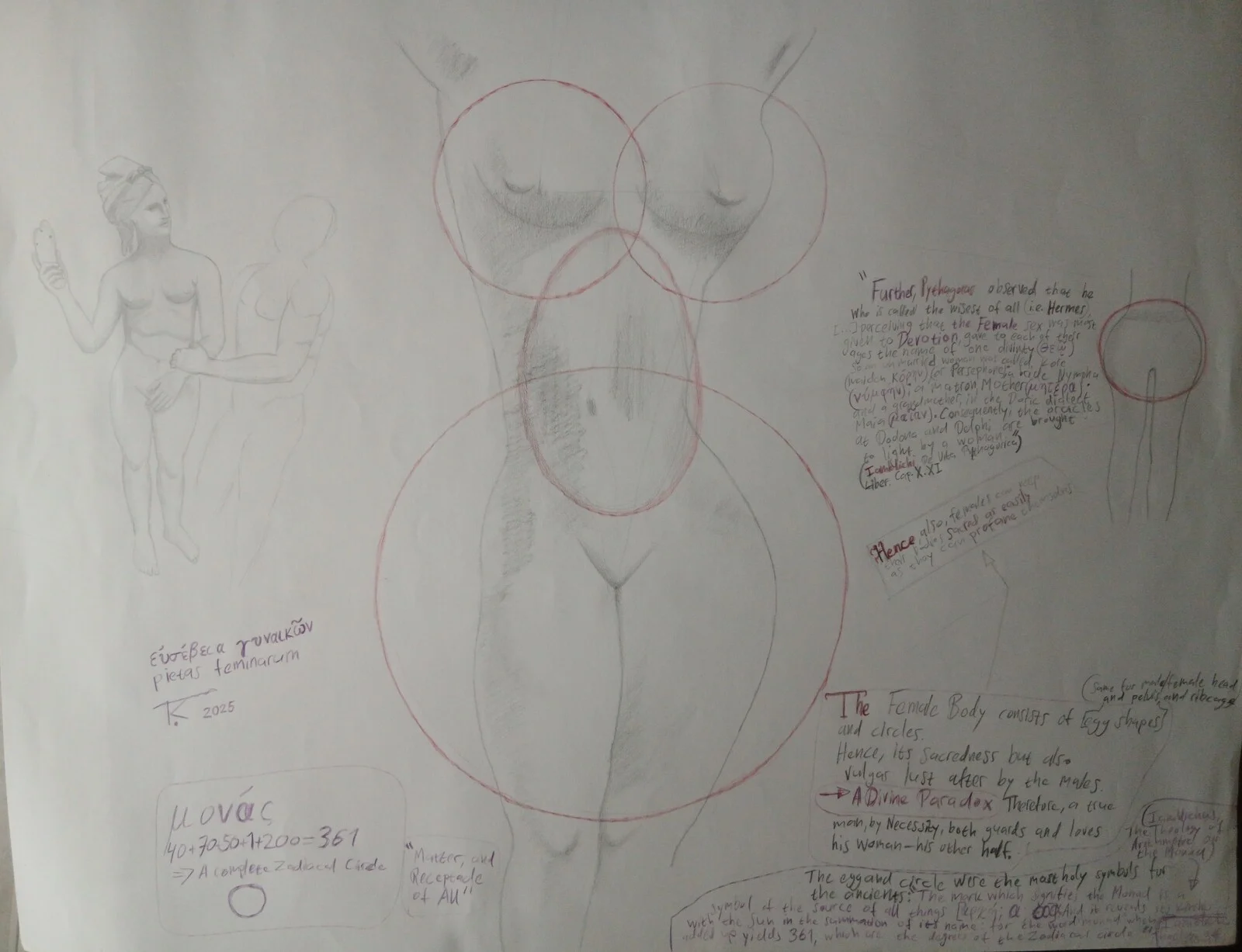
Pietas Feminarum (Women's Devotion), 2025
Olja
63,5 x 51 cm
Pietas Feminarum ('Women's Devotion') - Egg shapes and Circles were the most holy symbols and shapes for the ancient sages (cf. Proclus, In. Euc. Com. Liber & Iamblichus, 'The Theology of Arithmetic').
"My cloak is thin; for me there is no repose. Pale is my visage; [...] And I will predict, before the end of the world, women without shame, and men without manliness." -Myrddin Wyllt/Merlin (Yr Oianau, 'The Greetings').
"Further, Pythagoras observed that he who is called the wisest of all (i.e. Hermes), [...] perceiving that the Female gender was most given to Devotion, gave to each of their ages the name of one Divinity (θεῷ). So an unmarried woman was called 'Kore' ('maiden', κόρη), or 'Persephone'; a bride 'Nympha' (νύμφη); a matron, 'Mother' (μήτηρ/μάτηρ); and a grandmother, in the Doric dialect 'Maia' (μαῖα). Consequently, the oracles at Dodona and Delphi are brought to light by a woman."
(Iamblichus, 'De Vita Pythagorica Liber', Cap. X. XI.)
The female body protrudes egg shapes and circles. Hence, its sacredness but also vulgar lust for by the males: A Divine Paradox. Therefore, a proper man, by necessity, both guards and loves his woman - his other half. Also, a proper woman guards her sacredness which her body has borrowed from the gods. The paradox also shows that females can keep their bodies sacred as easily as they can profane themselves.
Thomas Kalyvas
Pietas Feminarum (Women's Devotion), 2025
Olja
63,5 x 51 cm
Pietas Feminarum ('Women's Devotion') - Egg shapes and Circles were the most holy symbols and shapes for the ancient sages (cf. Proclus, In. Euc. Com. Liber & Iamblichus, 'The Theology of Arithmetic').
"My cloak is thin; for me there is no repose. Pale is my visage; [...] And I will predict, before the end of the world, women without shame, and men without manliness." -Myrddin Wyllt/Merlin (Yr Oianau, 'The Greetings').
"Further, Pythagoras observed that he who is called the wisest of all (i.e. Hermes), [...] perceiving that the Female gender was most given to Devotion, gave to each of their ages the name of one Divinity (θεῷ). So an unmarried woman was called 'Kore' ('maiden', κόρη), or 'Persephone'; a bride 'Nympha' (νύμφη); a matron, 'Mother' (μήτηρ/μάτηρ); and a grandmother, in the Doric dialect 'Maia' (μαῖα). Consequently, the oracles at Dodona and Delphi are brought to light by a woman."
(Iamblichus, 'De Vita Pythagorica Liber', Cap. X. XI.)
The female body protrudes egg shapes and circles. Hence, its sacredness but also vulgar lust for by the males: A Divine Paradox. Therefore, a proper man, by necessity, both guards and loves his woman - his other half. Also, a proper woman guards her sacredness which her body has borrowed from the gods. The paradox also shows that females can keep their bodies sacred as easily as they can profane themselves.