Vi använder cookies för att ge dig bästa möjliga upplevelse. Välj vilka cookies du tillåter.
Läs mer i vår integritetspolicy
Jörgen Thornberg
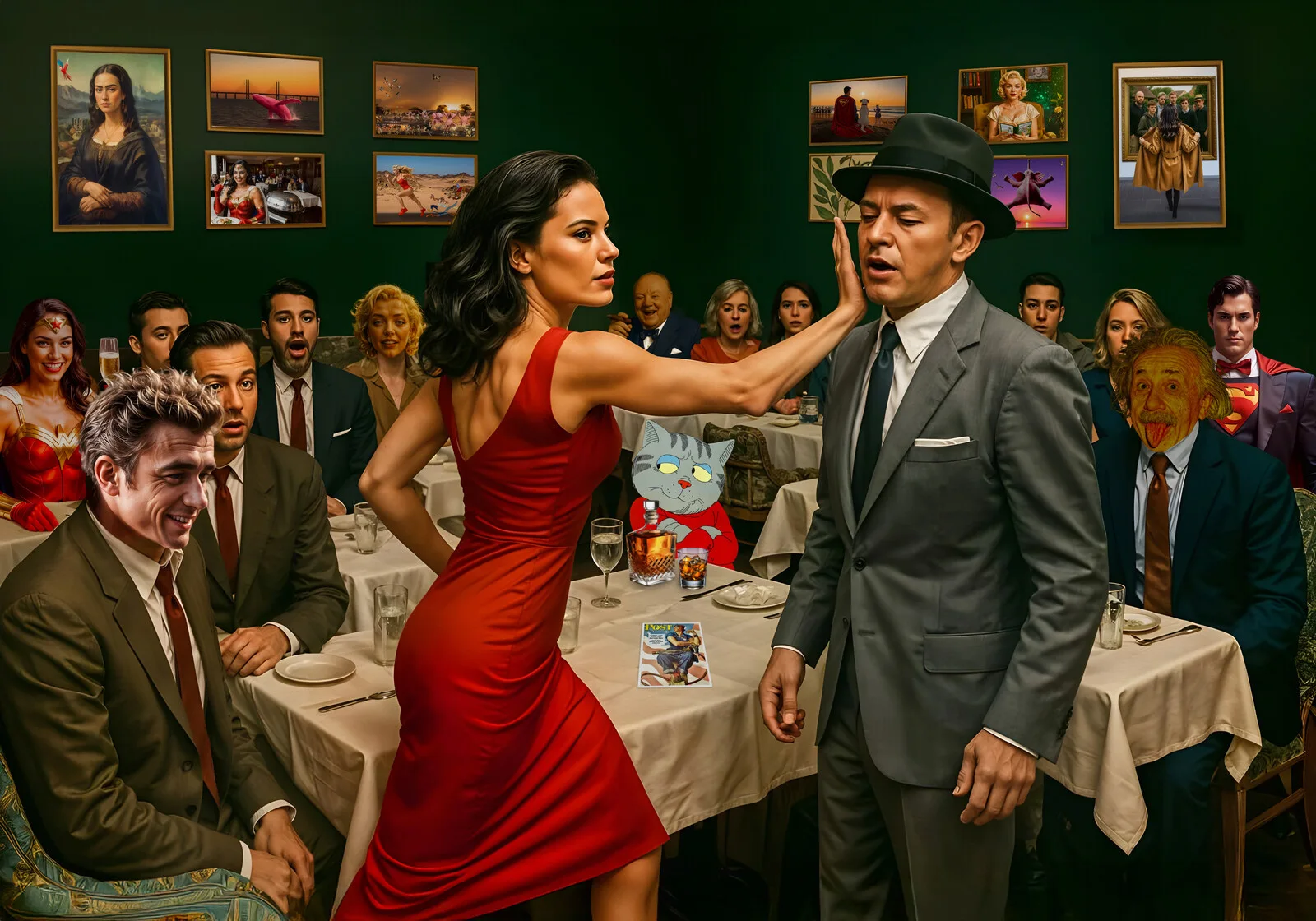
The Night Natalie slapped Frankie, 2025
Digital
70 x 50 cm
3 200 kr
The Night Natalie slapped Frankie:
This was a landmark moment in Hollywood history. This essay, based on a true story, captures a crucial event in Hollywood's past, a moment that echoed through the industry and beyond, permanently shifting the balance of power.
Hollywood is not just a physical location; it is a dramatic network of salons and shadows where a mere gesture can hold more power than a signed contract. In this context, a single second becomes a turning point: one fateful evening in 1958 at Romanoff’s, when the hum of conversation fell silent and Natalie Wood, only twenty years old but already an industry veteran, spun on her heel and slapped Frank Sinatra—a quiet, sharp moment that shifted the balance of power in the room. It's the kind of moment that transforms reality into myth and reveals the exhilarating unpredictability of history's swift changes.
Join me on a journey to explore the captivating world of Hollywood, often metaphorically called the “moon” for its mysterious and enchanting character. Like the moon, Hollywood's allure is undeniable, its influence extensive, and its mysteries enticing. This essay, with the dual aim of entertaining and educating, will illuminate Hollywood’s historical role and its deep cultural impact. Importantly, we will also unravel how a single slap reshaped the course of this iconic industry, connecting us to its rich past.
“The Slap
A hush fell over Romanoff’s hall,
a whisper, a crack, and that was all.
Her palm was swift, his cheek was red,
a legend born where gossip fed.
The giver stood with steady grace,
no tremble in her hand, her face.
She drew a line with her fingertip,
and marked it out with one sharp whip.
The victim blinked, the Chairman reeled,
his grin disarmed, his power sealed.
A thousand tales would later grow,
from one quick strike, a stinging blow.
The crowd around could scarcely contain,
their gasps of joy, their sweet refrain.
They feasted on the whispered lore,
a slap repeated evermore.
Some said it sparked, some said it burned,
but all agreed the tide had turned.
For in that room, with glasses raised,
a woman struck — and all were dazed.”
Malmö. August 2025
The Night Natalie Slapped Frankie - A moment that changed Hollywood’s balance of power.
The image itself feels like a fever dream of cultural history brought into one room. At the centre stands Natalie Wood in a crimson dress, her arm outstretched with the precision of judgment, delivering a slap to Frank Sinatra, dapper in grey with his fedora tilted back in shock. Around them, the diners of Romanoff’s have become an impossible audience: Winston Churchill with his fat cigar, Albert Einstein with his tongue stuck out as if mocking authority itself, Marilyn Monroe radiant in blonde curls, James Dean grinning at the edge of rebellion, Wonder Woman and Superman transformed into spectators instead of saviors, even Fritz the Cat—Robert Crumb’s scandalous feline anarchist—lounging at a table with a drink. On one of the tables rests a copy of The Saturday Evening Post with Norman Rockwell’s wartime Rosie the Riveter on the cover, a reminder of women’s strength in another battle. Each face is turned toward the scene, eyes wide, mouths half-open: astonishment made communal. It is not merely a depiction of an incident—it is an assembly of icons, epochs, and myths, all drawn together to witness the single instant when a young woman’s defiance unsettled the order of power.
And from this tableau, we turn to the night itself, Romanoff’s in 1958, when Natalie Wood’s open palm silenced Frank Sinatra and shifted Hollywood’s balance of power.
In the late 1950s, Hollywood had its sanctuaries, temples where the powerful gathered away from the camera flashes. One of the most renowned was Romanoff’s in Beverly Hills—the crown jewel of glittering dining rooms, run by restaurateur Michael Romanoff. Frequented by moguls, producers, and stars who shaped the industry, Romanoff’s was like stepping into the throne room of American cinema. It was the place where deals were struck, careers whispered into existence, and reputations shattered. In Hollywood's male-dominated, power-driven world, a young woman's act of defiance was about to shift the balance of power.
And in 1958, on an otherwise ordinary night, a single act of defiance electrified that throne room.
Natalie Wood, twenty years old, already a seasoned figure in Hollywood despite her youth, walked past Frank Sinatra’s table. Sinatra—the Chairman, the legend, the untouchable presence whose voice dominated radios and whose temper controlled studios—made a loud, crude remark directed at her. The kind of remark that had silenced or shamed countless women before.
But Natalie did not back down. She halted, pivoted, and with unyielding courage strode directly towards him. Then, without a word, she delivered a resounding slap across his face, a daring act that echoed through the room, a testament to her defiance and resolve.
The sound was sharp enough to cut through the music, even sharper because no one expected it. Forks froze mid-air. The hum of conversation fell silent. Sinatra’s grin— the one that could charm an audience or scare an underling—vanished. For a moment, time seemed to stand still. Natalie’s eyes locked onto his. Then she turned and walked away, as if nothing at all had happened, leaving the audience in a state of shock and awe; their wide eyes and half-open mouths were a testament to the unprecedented nature of the event.
A Porcelain Doll No More
By that time, Natalie Wood was a familiar face in Hollywood. She had been acting since childhood, cast in Miracle on 34th Street at the age of eight, directed by Orson Welles before she was ten. The studios portrayed her as the porcelain doll: charming, radiant, the ideal ingénue.
But inside, Natalie was already restless. She had grown up within the machine, having survived the relentless expectations of a child star. By her early twenties, she was unwilling to accept its terms any longer. Her performance in Rebel Without a Cause (1955) alongside James Dean and Sal Mineo revealed her capacity for depth, vulnerability, and rage. Critics and audiences alike realised she wasn’t just “cute” or “marketable”—she was magnetic. And she herself knew it.
By her early twenties, she was tired of being told what to wear, what to say, and how to smile. Hollywood was a place where women were expected to conform, to be grateful for what was given to them. Natalie was quietly but firmly breaking free from that mould.
So when Sinatra tested her with a blunt remark in Romanoff’s, the slap was not merely a reaction. It was a declaration: I am not porcelain. I am flesh, fire, and I will not be diminished.
Sinatra’s Unexpected Response
The room anticipated an explosion. Frank Sinatra, after all, was notorious for holding grudges. He had ended friendships over perceived slights and walked away from business deals at the slightest insult. He could make careers and break them with equal ease. He was the man who could freeze out producers, blocklist directors, and humiliate rivals with a single word.
But after a stunned pause, Sinatra leaned back, rubbed his jaw, and muttered to someone nearby: “She’s got guts. That kid’s going to last.” His unexpected respect was a twist in the tale that intrigued everyone in the room, including Natalie herself, a clear indication of the shift in power dynamics.
That was everything. The storm never arrived. He never spoke of the incident again. And he never held it against her. In fact, quite the reverse. Sinatra, who admired boldness even as he demanded loyalty, appeared to respect her more from that night onwards.
Natalie appeared on The Frank Sinatra Show in 1958, not long after the incident, and was seen socialising with him in the years that followed, including as late as 1961. Whatever had happened that night at Romanoff’s did not harm her career. If anything, it enhanced her reputation, reassuring everyone about her bright future in Hollywood.
A Whispered Legend
Hollywood’s walls were thin. Stories spread quickly, carried by agents, makeup artists, secretaries, and columnists. Soon, everyone in the industry knew: Natalie Wood slapped Sinatra. She had done what few men dared, and no woman was expected to do.
For the women of Hollywood, it was more than gossip. It was a symbol, a small victory in a world that demanded silence. They, too, had endured unwanted comments, humiliations, and compromises. Natalie had responded for all of them, not with tears or retreat, but with an open palm and a steady stride. Her action was a significant step toward challenging gender norms in Hollywood, inspiring many to stand up against such injustices and leaving a lasting mark on the industry.
She never discussed it publicly. There was no interview, no memoir entry, no confessional tone. She didn’t need to. The story persisted, whispered and retold, increasing in its resonance.
The Meaning of the Slap
The slap was not about violence. It was not about revenge. It was about drawing a line in a room where women were not supposed to draw lines. In that single unscripted moment, Natalie redefined herself—and by extension, redefined what a leading lady could be.
It is significant that Sinatra, who could humiliate or ostracise rivals, chose not to retaliate. He may have recognised at that moment that his power, however vast, met its match in a twenty-year-old actress who refused to be cowed.
Natalie Wood, 157 cm tall, with dark eyes and a luminous smile, silenced Frank Sinatra not with a scandal, not with a headline, but with an act of courage.
And for those who saw it, or who later heard the story, that was the moment she stopped being merely a star. She became something greater: a woman in control of her own dignity.
Echoes of Resistance: Other Women, Other Moments
Natalie Wood’s slap at Romanoff’s was not the only act of defiance in Hollywood’s golden age. The industry at the time was a male-dominated, studio-controlled system, where women were often relegated to stereotypical roles and subjected to intense scrutiny. Still, it was one of the most visible, precisely because it was so physical and unambiguous. Yet, throughout the industry’s history, women have quietly resisted, sometimes through words, sometimes through silence, and sometimes through art.
Judy Garland was signed to MGM at thirteen, marketed as the eternal girl-next-door, and was drugged with pills to control her weight and sleeping patterns, being pushed through an endless cycle of films. Yet, even under the studio’s control, she fought back in small, devastating ways: refusing to smile on command, missing rehearsals, and insisting on her own interpretations of songs. In her haunting performance of "Over the Rainbow," Judy turned a studio demand into a raw cry of longing that has become timeless. It was resistance disguised as melody.
Marilyn Monroe, perhaps the most scrutinised woman of the 20th century, also resisted the intense examination. Beneath her breathy voice and dazzling smile, she fought a quiet war against being stereotyped. She founded her own production company in 1954—something unheard of for a woman in Hollywood at the time—and insisted on control over her roles. It cost her contracts and friendships, but she succeeded, producing The Prince and the Showgirl and negotiating better terms for herself. Each contract signed on her terms was its own kind of slap.
Rita Hayworth, known as “The Love Goddess,” understood better than anyone how an image could be used as a weapon against its owner. In the 1940s, she astonished the world by removing her long opera gloves in Gilda. Men gasped at the striptease, but Rita once said: “Men go to bed with Gilda, but they wake up with me.” With that line, she revealed the gap between fantasy and reality—and reclaimed her own humanity from the myth-making machine.
Like Wood, these women found ways to assert themselves against the tides of a system built to control them: some used silence, some used contracts, some used performance itself. Natalie’s slap revealed the unseen.
A Line in Hollywood’s Sand
The night Natalie Wood slapped Frank Sinatra stands as a symbol of something greater than the conflict between two stars. It was the visible crack in the polished surface of Hollywood’s power, the kind of moment that whispered: the rules can be broken.
For Judy Garland, resistance meant refusing to conform to a studio’s ruthless demands. For Marilyn Monroe, it meant establishing her own company to combat typecasting. For Rita Hayworth, it meant turning an industry’s fantasy into an indictment of that very illusion. And for Natalie Wood, it meant delivering a sharp slap to a man who represented untouchable authority. These acts of resistance, born from courage, continue to inspire and empower women in Hollywood and beyond.
Each of these women bore scars from their struggles. Some faced punishment, others paid a heavy price in secret. But each also forged a sense of freedom—not only for themselves but for those who would come after. Their actions continue to resonate, shaping the Hollywood landscape and inspiring future generations of women in the industry.
Natalie never aimed to be a martyr or a crusader. She was, like all of them, an actress trying to live and work with dignity. But the strength of her gesture lay in its simplicity. No speech, no lawsuit, no spectacle—just the sound of a hand across a cheek, and the silence that followed.
And in that silence, the industry transformed. A single second of defiance carried more weight than years of compliance, showing that even in Hollywood, an instant could alter the balance of power. The transformative power of these women's actions is a testament to their resilience and the enduring impact of their defiance.
Jörgen Thornberg
The Night Natalie slapped Frankie, 2025
Digital
70 x 50 cm
3 200 kr
The Night Natalie slapped Frankie:
This was a landmark moment in Hollywood history. This essay, based on a true story, captures a crucial event in Hollywood's past, a moment that echoed through the industry and beyond, permanently shifting the balance of power.
Hollywood is not just a physical location; it is a dramatic network of salons and shadows where a mere gesture can hold more power than a signed contract. In this context, a single second becomes a turning point: one fateful evening in 1958 at Romanoff’s, when the hum of conversation fell silent and Natalie Wood, only twenty years old but already an industry veteran, spun on her heel and slapped Frank Sinatra—a quiet, sharp moment that shifted the balance of power in the room. It's the kind of moment that transforms reality into myth and reveals the exhilarating unpredictability of history's swift changes.
Join me on a journey to explore the captivating world of Hollywood, often metaphorically called the “moon” for its mysterious and enchanting character. Like the moon, Hollywood's allure is undeniable, its influence extensive, and its mysteries enticing. This essay, with the dual aim of entertaining and educating, will illuminate Hollywood’s historical role and its deep cultural impact. Importantly, we will also unravel how a single slap reshaped the course of this iconic industry, connecting us to its rich past.
“The Slap
A hush fell over Romanoff’s hall,
a whisper, a crack, and that was all.
Her palm was swift, his cheek was red,
a legend born where gossip fed.
The giver stood with steady grace,
no tremble in her hand, her face.
She drew a line with her fingertip,
and marked it out with one sharp whip.
The victim blinked, the Chairman reeled,
his grin disarmed, his power sealed.
A thousand tales would later grow,
from one quick strike, a stinging blow.
The crowd around could scarcely contain,
their gasps of joy, their sweet refrain.
They feasted on the whispered lore,
a slap repeated evermore.
Some said it sparked, some said it burned,
but all agreed the tide had turned.
For in that room, with glasses raised,
a woman struck — and all were dazed.”
Malmö. August 2025
The Night Natalie Slapped Frankie - A moment that changed Hollywood’s balance of power.
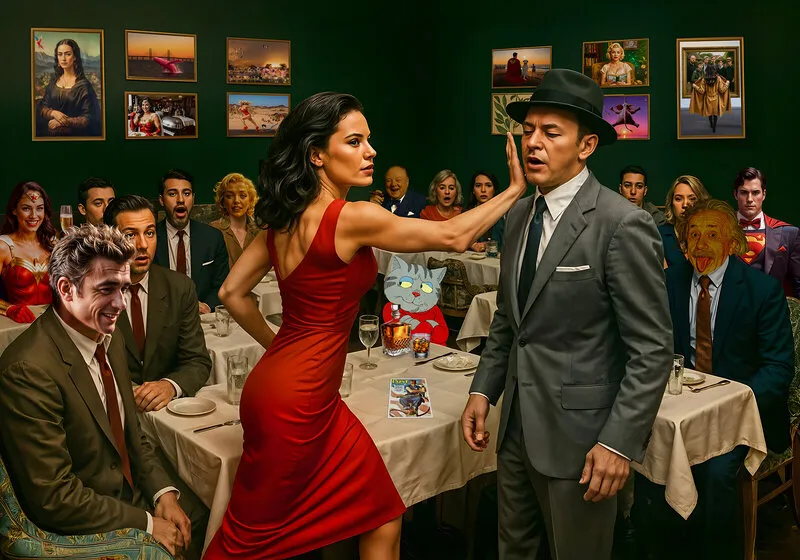
The image itself feels like a fever dream of cultural history brought into one room. At the centre stands Natalie Wood in a crimson dress, her arm outstretched with the precision of judgment, delivering a slap to Frank Sinatra, dapper in grey with his fedora tilted back in shock. Around them, the diners of Romanoff’s have become an impossible audience: Winston Churchill with his fat cigar, Albert Einstein with his tongue stuck out as if mocking authority itself, Marilyn Monroe radiant in blonde curls, James Dean grinning at the edge of rebellion, Wonder Woman and Superman transformed into spectators instead of saviors, even Fritz the Cat—Robert Crumb’s scandalous feline anarchist—lounging at a table with a drink. On one of the tables rests a copy of The Saturday Evening Post with Norman Rockwell’s wartime Rosie the Riveter on the cover, a reminder of women’s strength in another battle. Each face is turned toward the scene, eyes wide, mouths half-open: astonishment made communal. It is not merely a depiction of an incident—it is an assembly of icons, epochs, and myths, all drawn together to witness the single instant when a young woman’s defiance unsettled the order of power.
And from this tableau, we turn to the night itself, Romanoff’s in 1958, when Natalie Wood’s open palm silenced Frank Sinatra and shifted Hollywood’s balance of power.
In the late 1950s, Hollywood had its sanctuaries, temples where the powerful gathered away from the camera flashes. One of the most renowned was Romanoff’s in Beverly Hills—the crown jewel of glittering dining rooms, run by restaurateur Michael Romanoff. Frequented by moguls, producers, and stars who shaped the industry, Romanoff’s was like stepping into the throne room of American cinema. It was the place where deals were struck, careers whispered into existence, and reputations shattered. In Hollywood's male-dominated, power-driven world, a young woman's act of defiance was about to shift the balance of power.
And in 1958, on an otherwise ordinary night, a single act of defiance electrified that throne room.
Natalie Wood, twenty years old, already a seasoned figure in Hollywood despite her youth, walked past Frank Sinatra’s table. Sinatra—the Chairman, the legend, the untouchable presence whose voice dominated radios and whose temper controlled studios—made a loud, crude remark directed at her. The kind of remark that had silenced or shamed countless women before.
But Natalie did not back down. She halted, pivoted, and with unyielding courage strode directly towards him. Then, without a word, she delivered a resounding slap across his face, a daring act that echoed through the room, a testament to her defiance and resolve.
The sound was sharp enough to cut through the music, even sharper because no one expected it. Forks froze mid-air. The hum of conversation fell silent. Sinatra’s grin— the one that could charm an audience or scare an underling—vanished. For a moment, time seemed to stand still. Natalie’s eyes locked onto his. Then she turned and walked away, as if nothing at all had happened, leaving the audience in a state of shock and awe; their wide eyes and half-open mouths were a testament to the unprecedented nature of the event.
A Porcelain Doll No More
By that time, Natalie Wood was a familiar face in Hollywood. She had been acting since childhood, cast in Miracle on 34th Street at the age of eight, directed by Orson Welles before she was ten. The studios portrayed her as the porcelain doll: charming, radiant, the ideal ingénue.
But inside, Natalie was already restless. She had grown up within the machine, having survived the relentless expectations of a child star. By her early twenties, she was unwilling to accept its terms any longer. Her performance in Rebel Without a Cause (1955) alongside James Dean and Sal Mineo revealed her capacity for depth, vulnerability, and rage. Critics and audiences alike realised she wasn’t just “cute” or “marketable”—she was magnetic. And she herself knew it.
By her early twenties, she was tired of being told what to wear, what to say, and how to smile. Hollywood was a place where women were expected to conform, to be grateful for what was given to them. Natalie was quietly but firmly breaking free from that mould.
So when Sinatra tested her with a blunt remark in Romanoff’s, the slap was not merely a reaction. It was a declaration: I am not porcelain. I am flesh, fire, and I will not be diminished.
Sinatra’s Unexpected Response
The room anticipated an explosion. Frank Sinatra, after all, was notorious for holding grudges. He had ended friendships over perceived slights and walked away from business deals at the slightest insult. He could make careers and break them with equal ease. He was the man who could freeze out producers, blocklist directors, and humiliate rivals with a single word.
But after a stunned pause, Sinatra leaned back, rubbed his jaw, and muttered to someone nearby: “She’s got guts. That kid’s going to last.” His unexpected respect was a twist in the tale that intrigued everyone in the room, including Natalie herself, a clear indication of the shift in power dynamics.
That was everything. The storm never arrived. He never spoke of the incident again. And he never held it against her. In fact, quite the reverse. Sinatra, who admired boldness even as he demanded loyalty, appeared to respect her more from that night onwards.
Natalie appeared on The Frank Sinatra Show in 1958, not long after the incident, and was seen socialising with him in the years that followed, including as late as 1961. Whatever had happened that night at Romanoff’s did not harm her career. If anything, it enhanced her reputation, reassuring everyone about her bright future in Hollywood.
A Whispered Legend
Hollywood’s walls were thin. Stories spread quickly, carried by agents, makeup artists, secretaries, and columnists. Soon, everyone in the industry knew: Natalie Wood slapped Sinatra. She had done what few men dared, and no woman was expected to do.
For the women of Hollywood, it was more than gossip. It was a symbol, a small victory in a world that demanded silence. They, too, had endured unwanted comments, humiliations, and compromises. Natalie had responded for all of them, not with tears or retreat, but with an open palm and a steady stride. Her action was a significant step toward challenging gender norms in Hollywood, inspiring many to stand up against such injustices and leaving a lasting mark on the industry.
She never discussed it publicly. There was no interview, no memoir entry, no confessional tone. She didn’t need to. The story persisted, whispered and retold, increasing in its resonance.
The Meaning of the Slap
The slap was not about violence. It was not about revenge. It was about drawing a line in a room where women were not supposed to draw lines. In that single unscripted moment, Natalie redefined herself—and by extension, redefined what a leading lady could be.
It is significant that Sinatra, who could humiliate or ostracise rivals, chose not to retaliate. He may have recognised at that moment that his power, however vast, met its match in a twenty-year-old actress who refused to be cowed.
Natalie Wood, 157 cm tall, with dark eyes and a luminous smile, silenced Frank Sinatra not with a scandal, not with a headline, but with an act of courage.
And for those who saw it, or who later heard the story, that was the moment she stopped being merely a star. She became something greater: a woman in control of her own dignity.
Echoes of Resistance: Other Women, Other Moments
Natalie Wood’s slap at Romanoff’s was not the only act of defiance in Hollywood’s golden age. The industry at the time was a male-dominated, studio-controlled system, where women were often relegated to stereotypical roles and subjected to intense scrutiny. Still, it was one of the most visible, precisely because it was so physical and unambiguous. Yet, throughout the industry’s history, women have quietly resisted, sometimes through words, sometimes through silence, and sometimes through art.
Judy Garland was signed to MGM at thirteen, marketed as the eternal girl-next-door, and was drugged with pills to control her weight and sleeping patterns, being pushed through an endless cycle of films. Yet, even under the studio’s control, she fought back in small, devastating ways: refusing to smile on command, missing rehearsals, and insisting on her own interpretations of songs. In her haunting performance of "Over the Rainbow," Judy turned a studio demand into a raw cry of longing that has become timeless. It was resistance disguised as melody.
Marilyn Monroe, perhaps the most scrutinised woman of the 20th century, also resisted the intense examination. Beneath her breathy voice and dazzling smile, she fought a quiet war against being stereotyped. She founded her own production company in 1954—something unheard of for a woman in Hollywood at the time—and insisted on control over her roles. It cost her contracts and friendships, but she succeeded, producing The Prince and the Showgirl and negotiating better terms for herself. Each contract signed on her terms was its own kind of slap.
Rita Hayworth, known as “The Love Goddess,” understood better than anyone how an image could be used as a weapon against its owner. In the 1940s, she astonished the world by removing her long opera gloves in Gilda. Men gasped at the striptease, but Rita once said: “Men go to bed with Gilda, but they wake up with me.” With that line, she revealed the gap between fantasy and reality—and reclaimed her own humanity from the myth-making machine.
Like Wood, these women found ways to assert themselves against the tides of a system built to control them: some used silence, some used contracts, some used performance itself. Natalie’s slap revealed the unseen.
A Line in Hollywood’s Sand
The night Natalie Wood slapped Frank Sinatra stands as a symbol of something greater than the conflict between two stars. It was the visible crack in the polished surface of Hollywood’s power, the kind of moment that whispered: the rules can be broken.
For Judy Garland, resistance meant refusing to conform to a studio’s ruthless demands. For Marilyn Monroe, it meant establishing her own company to combat typecasting. For Rita Hayworth, it meant turning an industry’s fantasy into an indictment of that very illusion. And for Natalie Wood, it meant delivering a sharp slap to a man who represented untouchable authority. These acts of resistance, born from courage, continue to inspire and empower women in Hollywood and beyond.
Each of these women bore scars from their struggles. Some faced punishment, others paid a heavy price in secret. But each also forged a sense of freedom—not only for themselves but for those who would come after. Their actions continue to resonate, shaping the Hollywood landscape and inspiring future generations of women in the industry.
Natalie never aimed to be a martyr or a crusader. She was, like all of them, an actress trying to live and work with dignity. But the strength of her gesture lay in its simplicity. No speech, no lawsuit, no spectacle—just the sound of a hand across a cheek, and the silence that followed.
And in that silence, the industry transformed. A single second of defiance carried more weight than years of compliance, showing that even in Hollywood, an instant could alter the balance of power. The transformative power of these women's actions is a testament to their resilience and the enduring impact of their defiance.
3 200 kr

Jörgen Thornberg
Malmö
Lite om bilder och mig. Translation in English at the end.
Jag är en nyfiken person som ser allt i bilder, även det jag fäster i ord, gärna tillsammans för bakom alla mina bilder finns en berättelse. Till vissa bilder hör en kortare eller längre novell som följer med bilden.
Bilder berättar historier. Jag omges av naturlig skönhet, intressanta människor och historia var jag än går. Jag använder min kamera för att dokumentera världen och blanda det jag ser med vad jag känner för att fånga den dolda magin.
Mina bilder berättar mina historier. Genom mina bilder, tryck och berättelser. Jag bjuder in dig att ta del av dessa berättelser, in i ditt liv och hem och dela min mycket personliga syn på vår värld. Mer än vad ögat ser. Jag tänker i bilder, drömmer och skriver och pratar om dem; följaktligen måste jag också skapa bilder. De blir vad jag ser, inte nödvändigtvis begränsade till verkligheten. Det finns en bild runt varje hörn. Jag hoppas att du kommer att se vad jag såg och gilla det.
Jag är också en skrivande person och till många bilder hör en kortare eller längre essay. Den följer med tavlan, tryckt på fint papper och med en personlig hälsning från mig.
Flertalet bilder startar sin resa i min kamera. Enkelt förklarat beskriver jag bilden jag ser i mitt inre, upplevd eller fantiserad. Bilden uppstår inom mig redan innan jag fått okularet till ögat. På bråkdelen av ett ögonblick ser jag vad jag vill ha och vad som kan göras med bilden. Här skall jag stoppa in en giraff, stålmannen, Titanic eller vad det är min fantasi finner ut. Ännu märkligare är att jag kommer ihåg minnesbilden långt efteråt när det blir tid att skapa verket. Om jag lyckas eller inte, är upp till betraktaren, oftast präglat av en stråk av svart humor – meningen är att man skall bli underhållen. Mina bilder blir ofta en snackis där de hänger.
Jag föredrar bilder som förmedlar ett budskap i flera lager. Vid första anblicken fylld av feel-good, en vacker utsikt, fint väder, solen skiner, blommor på ängen eller vattnet som ligger förrädiskt spegelblankt. I en sådan bild kan jag gömma min egentliga berättelse, mitt förakt för förtryckare och våldsverkare, rasister och fördomsfulla människor - ett gärna återkommande motiv mer eller mindre dolt i det vackra motivet. Jag försöker förena dem i ett gemensamt narrativ.
Bild och formgivning har löpt som en röd tråd genom livet. Fotokonst känns som en värdig final som jag gärna delar med mig.
Min genre är vid som framgår av mina bilder, temat en blandning av pop- och gatukonst i kollage som kan bestå av hundratals lager. Vissa bilder kan ta veckor, andra någon dag innan det är dags att överlämna resultatet till printverkstaden. Fine Art Prints är digitala fotocollage. I dessa kollage sker rivandet, klippandet, pusslandet, målandet, ritandet och sprayningen digitalt. Det jag monterar in kan vara hundratals år gamla bilder som jag omsorgsfullt frilägger så att de ser ut att vara en del av tavlan men också bilder skapade av mig själv efter min egen fantasi. Därefter besöks printstudion och för vissa bilder numrera en limiterad upplaga (oftast 7 exemplar) och signera för hand. Vissa bilder kan köpas i olika format. Det är bara att fråga efter vilka. Gillar man en bild som är 70x100 men inte har plats på väggen, går den kanske att få i 50x70 cm istället. Frågan är fri.
Metoden Giclée eller Fine Art Print som det också kallas är det moderna sättet för framställning av grafisk konst. Villkoret för denna typ av utskrifter är att en högkvalitativ storformatskrivare används med åldersbeständigt färgpigment och konstnärspapper eller i förekommande fall på duk. Pappret som används möter de krav på livslängd som ställs av museer och gallerier. Normalt säljer jag mina bilder oinramade så att den nya ägaren själv kan bestämma hur de skall se ut, med eller utan passepartout färg på ram, med eller utan glas etc..
Under många år ställde jag bara ut på nätet, i valda grupper och på min egen Facebooksida - https://www.facebook.com/jorgen.thornberg.9
Jag finns också på en egen hemsida som tyvärr inte alltid är uppdaterad – https://www.jth.life/ Där kan du också läsa en del av de berättelser som följer med bilden.
UTSTÄLLNINGAR
Luftkastellet, oktober 2022
Konst i Lund, november 2022
Luftkastellet, mars 2023
Engleson Galleri Caroli, april 2023
Hydra, Greece June 2023
Engleson Galleri Caroli, oktober 2023
Toppen, Höllviken december 2023
Luftkastellet, mars 2024
Torups Galleri, mars 2024
Venice, May 2024
Luftkastellet, oktober 2024
Konst i Advent, December 2024
Galleri Engleson, Caroli December 2024
Jäger & Jansson Galleri, april 2025
A bit about pictures and me.
I'm a curious person who sees everything in pictures, even what I express in words, often combining them, for behind all my pictures lies a story. These narratives, some as short as a single image and others as long as a novel, are the heart and soul of my work.
Pictures tell stories. Wherever I go, I'm surrounded by natural beauty, exciting people, and history. I use my camera to document the world and blend what I see with what I feel to capture the hidden magic.
My images tell my stories. Through my pictures, prints, and narratives, I invite you to partake in these stories in your life and home and share my deeply personal perspective of our world. More than meets the eye. I think in pictures, dream, write, and talk about them; consequently, I must create images too. They become what I see, not necessarily confined to reality. There's a picture around every corner. I hope you'll see what I saw and enjoy it.
I'm also a writer, and many images come with a shorter or longer essay. It accompanies the painting, printed on fine paper with my personal greeting.
Many pictures start their journey on my camera. Simply put, I describe the image I see in my mind, experienced or imagined. The image arises within me even before I bring the eyepiece to my eye. In a fraction of a moment, I see what I want and what can be done with the picture. Here, I'll insert a giraffe, Superman, the Titanic, or whatever my imagination conjures up. Even stranger is that I remember the mental image long after it's time to create the work. Whether I succeed is up to the observer, often imbued with a streak of black humour – the aim is to entertain. My pictures usually become a talking point wherever they hang.
I prefer pictures that convey a message in multiple layers. At first glance, they're filled with feel-good vibes, a beautiful view, lovely weather, the sun shining, flowers in the meadow, or the water lying deceptively calm. But beneath this surface beauty, I often conceal a deeper story, a narrative that challenges societal norms or explores the human condition. I invite you to delve into these hidden narratives and discover the layers of meaning within my work.
Picture and design have been a thread running through my life. Photographic art feels like a fitting finale, and I'm happy to share it.
My genre is varied, as seen in my pictures; the theme is a blend of pop and street art in collages that can consist of hundreds of layers. Some images can take weeks, others just a day before it's time to hand over the result to the print workshop. Fine Art Prints are digital photo collages. In these collages, tearing, cutting, puzzling, painting, drawing, and spraying happen digitally. What I insert can be images hundreds of years old that I carefully extract so they appear to be part of the painting, but also images created by myself, now also generated from my imagination. Next, visit the print studio and, for certain images, number a limited edition (usually 7 copies) and sign them by hand. Some images may be available in other formats. Just ask which ones. If you like an image that's 70x100 but doesn't have space on the wall, you might be able to get it in 50x70 cm instead. The question is open.
The Giclée method, or Fine Art Print as it's also called, is the modern way of producing graphic art. This method ensures the highest quality and longevity of the artwork, using a high-quality large-format printer with archival pigment inks and artist paper or, in some cases, canvas. The paper used meets the longevity requirements set by museums and galleries. I sell my pictures unframed, allowing the new owner to personalise their artwork, confident in the lasting value and quality of the piece.
For many years, I only exhibited online, in selected groups, and on my Facebook page - https://www.facebook.com/jorgen.thornberg.9. I also have my website, which unfortunately is not constantly updated - https://www.jth.life/. You can also read some of the stories accompanying the pictures there.
EXHIBITIONS
Luftkastellet, October 2022
Art in Lund, November 2022
Luftkastellet, March 2023
Engleson Gallery Caroli, April 2023
Hydra, Greece June 2023
Engleson Gallery Caroli, October 2023
Toppen, Höllviken December 2023
Luftkastellet, March 2024
Torup Gallery, March 2024
Venice, May 2024
UTSTÄLLNINGAR
Luftkastellet, oktober 2022
Konst i Lund, november 2022
Luftkastellet, mars 2023
Engleson Galleri Caroli, april 2023
Hydra, Greece June 2023
Engleson Galleri Caroli, oktober 2023
Toppen, Höllviken december 2023
Luftkastellet, mars 2024
Torups Galleri, mars 2024
Venice, May 2024
Luftkastellet, October 2024
Konst i Advent, December 2024
Galleri Engleson, Caroli December 2024
Jäger & Jansson Galleri, April 2025
Utbildning
Autodidakt
Medlem i konstnärsförening
Öppna Sinnen
Med i konstrunda
Konstrundan i Skåne
Utställningar
Luftkastellet, October 2022
Art in Lund, November 2022
Luftkastellet, March 2023
Engleson Gallery Caroli, April 2023
Hydra, Greece June 2023
Engleson Gallery Caroli, October 2023
Toppen, Höllviken December 2023
Luftkastellet, March 2024
Torup Gallery, March 2024
Venice, May 2024