Vi använder cookies för att ge dig bästa möjliga upplevelse. Välj vilka cookies du tillåter.
Läs mer i vår integritetspolicy
Jörgen Thornberg
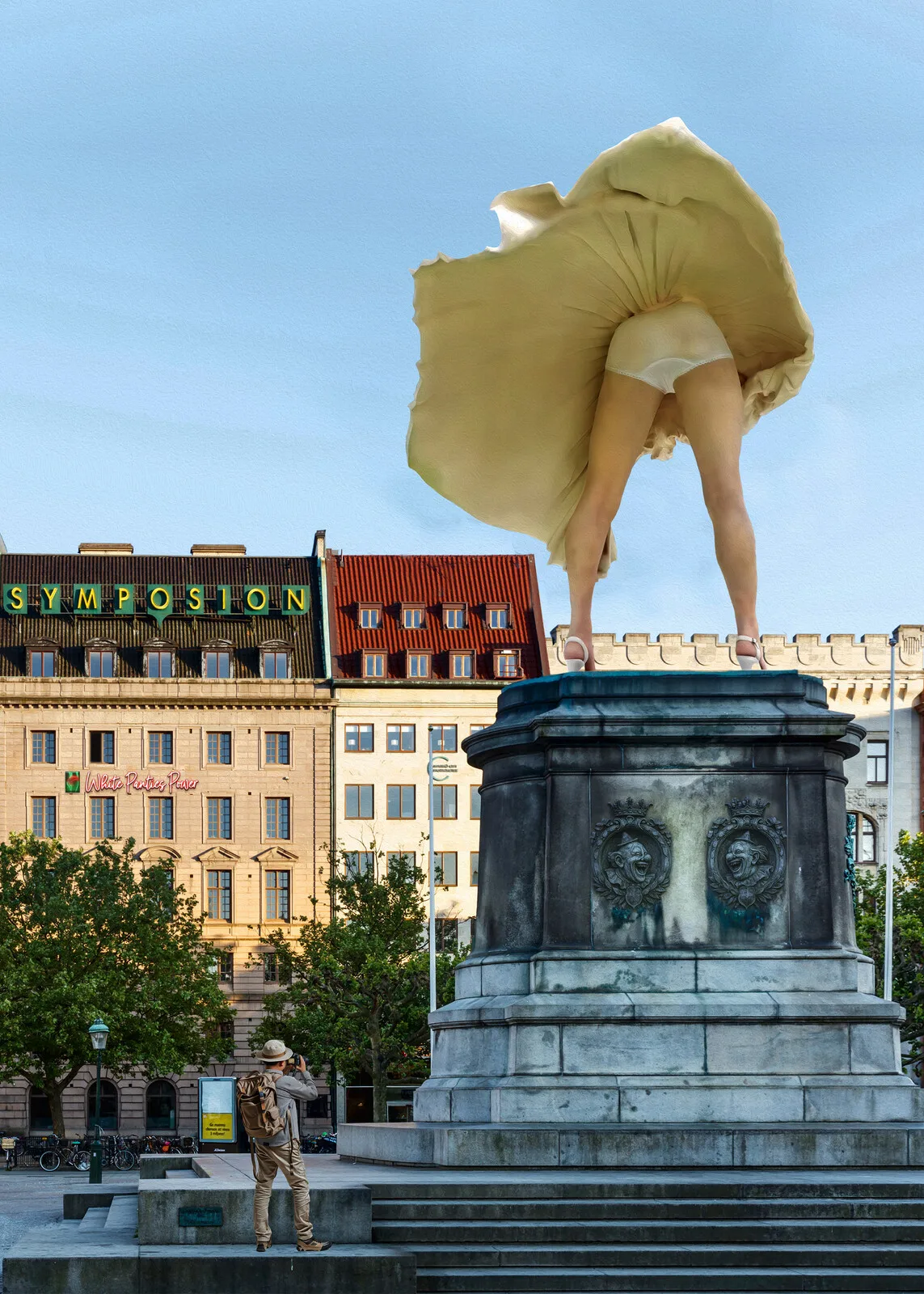
A Lift for Malmö - Forever Marilyn, 2024
Digital
50 x 70 cm
3 200 kr
A Lift for Malmö - Forever Marilyn
Malmö is a city in transition, where the past is constantly in flux, making way for the new. This story is about one such transition, a tale of how a reviled statue, a shaky bridge, a fraudulent municipal treasurer, and a less-than-honest scrap dealer were all part of a grand scam. Even after sixty-five years, the story still resonates, sparking laughter, indignation, and a certain respect for its audacious elegance.
At the centre stand Niels—a seasoned gentleman with many layers of past, including his experiences during the war—and Police Commissioner Pagen, his conversational partner and inquisitive mirror. Together, they unravel a web of memories, betrayals, ideals, and tall tales, in which Johnny Bode—an infamous trickster, singer of bawdy ballads, and self-appointed fiscal councillor—takes the lead. It's a story about selling what isn't for sale, outsmarting someone who thinks himself the cleverest man in the land, and using bureaucracy not as a safeguard but as a smokescreen. These characters, each with their unique role and perspective shaped by their historical context, are key to understanding the intricacies of the scam.
However, it is also a tale of lost illusions, political opportunism, and the human tendency to believe what one wants to believe—especially when it promises wealth, fame, or revenge. We see how a casual visit to a pub becomes a business deal, how a night fog obscures more than it reveals, and how a statue that never moved somehow managed to lose its soul.
It’s true. Almost. Or maybe just well told, which in Malmö is often the same thing. Because the statue still stands, and Marilyn Monroe... well, we might have to wait a bit longer for her.
If you're intrigued by this story, I invite you to explore more of my published work by clicking the link.
https://www.konst.se/jorgen-thornberg
“Shimmering Scrap
Bode sold a bridge that wasn’t for sale,
signed his name on air
and turned rust into promises.
With his silver tongue as a wand
he conjured away both guilt and truth,
a trickster in borrowed clothes,
Comptroller General in his mind.
The bridge stayed, but the tale travelled farther.
The statue remained, hollowed of its soul.
The money vanished, but the myth refined.
Pigeon droppings became laughter,
what was a scam became a story,
and the lie gained a shimmer
that only image can bestow.
Bode was a fraud,
but he knew more of the human heart
than most saints ever dared.
And perhaps that’s why
everyone kept listening.
A postscript from behind the smokescreen:
“A quarter of something, my friend,
is worth more than three-quarters of nothing,”
wrote Bode with a hand light as deceit,
deducting six hundred for the hotel.
As a balm, his share in a rotting bridge.
Signed: Bode, alias Comptroller General.
So ends the poem—
not with these lines,
but with a receipt in aluminium
and a quiet bow
from Orpheus among the swindlers.”
Malmö July 2025
Put One’s Foot Down – Att sätta ner foten
Whether it was a prophetic dream or a vision of a better Malmö, I can't say — only the future can tell.
In my dream, the monstrous King Gropealot — the infamous wife-beater Karl X Gustav — was dethroned from his pedestal at Stortorget, horse and all. In his place stood a colossal statue of Marilyn Monroe, a figure so far removed from the king's brutality that it was almost comical. The dream was a historical hiccup, a royal dethronement in heels, a gust of poetic justice, or a moment of glorious absurdity — I can scarcely find the words for such an occasion.
The statue had been a source of contention from the beginning, a divisive symbol that split the town. The number of those who admired the king in the square was small; most people accepted him simply because he had always been there, providing the pigeons with a perch, and through their droppings, expressing what many wished they could do if only they had managed to reach that height. To say you appreciated the statue was to invite a beating. This controversy sparked societal debates about the acceptance of historical figures, the power of symbols, and the need for cultural change, provoking reflection on these issues.
The statue of Zlatan was removed when he turned his back on Malmö and MFF, investing his money in Stockholm’s Hammarby instead. Why not use him as an example — and seize the chance to demolish Karl X Gustav’s statue as well?
This was no surprise to the mayor, who, over a glass of wine, confessed her dislike for the sculpture — a sentiment shared by most of her voters. Leading a movement to remove unpleasant figures from history—ninety—nine per cent of them men—was hardly a challenge for a woman. It was a political reality that complicated matters. Doing so would set a precedent—and enrage Stockholm’s royalists and nationalists, not to mention the local fascists. They, like their Stockholm counterparts with their marching Karl XII, had no intention of relinquishing their symbol of violence.
In Malmö, protests against the statue came steadily. But the main argument was not the king’s mistreatment of women — it was something far more shocking to the civic mind: the unprecedented historical symbolism of the statue in the free world — building a monument to one’s conqueror in the city’s main square. It would be like erecting a statue of Stalin in Budapest today. Not even Orbán would dare suggest that — and he’s practically Putin’s lapdog.
As the debate grew more heated, city leaders sought a compromise. Maybe people would relax if the statue were moved to one of Malmö’s parks — a complex decision, but better than locking it away in storage. That’s how it’s done in the U.S., where dozens of statues have been taken down in recent years.
“Let the people vote,” said one adviser, implying that, afterwards, City Hall could do as it pleased anyway. It might end up like the referendum on switching to right-hand traffic — discarded — or like the nuclear energy vote: a neutered compromise.
Perhaps there was also a third option — taking the sword from King Gropealot’s hand and swapping it for a bronze bouquet, a symbol of peace and equality, while permitting an annual feminist demonstration beneath the statue.
Ideas flooded in, and similar to the Brexit referendum, the mayor relied on experienced strategists, who were seasoned political advisors with a deep understanding of public sentiment. They assured her that people disliked anything that appeared on their tax bill. The more costly it seemed to replace something already paid for with something new and expensive, the more likely a majority would vote against change, regardless of their feelings about violent men.
The mayor thought herself clever for choosing this path, even if it meant, in the spirit of compromise, accepting a binding referendum. She staked her and her party’s honour on respecting the result. Her bet was simple: if the vote were close, people would, as usual, opt for the cheaper option. Surely, keeping the statue — even with a bronze bouquet — would cost less than replacing it, a significant financial consideration.
What she didn’t know was that other cities in the world were experiencing their issues with statues. “Forever Marilyn” — a massive sculpture of Marilyn Monroe striking her iconic pose from The Seven Year Itch, with her white dress billowing above a subway grate — had sparked controversy in several American cities since its installation in 2011, much like the debate over the Malmö statue.
Created by Seward Johnson, an American sculptor known for his lifelike and often hyper-populist works, the statue was initially erected in downtown Chicago, where it was both celebrated and condemned.
Some regarded it as kitsch, while others saw it as a pop-cultural triumph. Either way, the critics emerged victorious, and the statue toured until it ultimately found a permanent home in downtown Palm Springs, where the city aimed to honour Marilyn. It wasn’t that original statue that suddenly sparked Malmö’s election debate — it was a copy, one that had previously stood in Key West, Florida. The statue is gender-politically charged and consistently ignites discussion – some deem it sexist or voyeuristic. Conversely, others praise it as an iconic tribute to 20th-century pop culture and female stardom. Since it was on private property, and the owner faced significant personal criticism that began to impact his business, the lease was terminated. Securing a new home for a copy proved challenging, as the original had already travelled around the U.S. for decades.
In America, the statue caused such a fuss that Johnson’s heirs placed an ad on the world’s largest auction site, eBay. “Statue of Woman, Free to a Good Home,” the headline read – and it caught the eye of Jesper Jolle, vice-chairman of the committee ’Keep Scania Scanian’ and a film enthusiast with a deep admiration for Marilyn Monroe. To add to that, his wife chaired the foundation ’Raise More Statues of Women’ – the more iconic, the better, as a counterbalance to all the dull men cast in bronze across the city’s public spaces. The foundation had a small fund raised by enlightened citizens, but when it came to erecting statues, they still depended on the municipality. City officials were cautious, since ultimately, it was the taxpayers who would foot most of the bill. And when it came to the statue in Stortorget, it all came back to square one.
Using their modest funds, the two foundations launched a campaign for an alternative that wasn’t just free but could also generate much-needed revenue for the city. Jesper argued that the Marilyn statue was highly Instagrammable, and with the right marketing strategy, it could attract a significant number of tourists, thereby boosting the city's economy.
Regardless of one's personal opinion, the statue remained a tourist magnet in the U.S. People loved posing in front of it – or beneath the flying skirt, which had itself become part of the controversy. Malmö’s most notable selling point as a tourist destination had long been that it sits at the end of a bridge from Copenhagen. The Marilyn statue, with its iconic status, could further enhance Malmö's appeal to tourists.
Placing Marilyn in the most prominent spot could attract visitors from across the globe. “Marilyn in the Heart of Europe” – Jesper had already secured it as both a trademark and a domain name. And in fact, he had a point: measured from Cape Roca in Portugal to the Ural Mountains in Russia, Malmö is roughly in the middle, with a climate suitable for most. With Marilyn as a unique attraction, Malmö could become a tourism sensation, turning Copenhagen into the city at the end of the bridge that begins in Malmö.
Faced with three options – Remove Karl, Karl with a bouquet, or an iconic woman with tourist appeal, entirely free thanks to the foundation’s modest fund that covered both transport and installation – the referendum ended with a surprising victory for the film star. She fulfilled criterion number one convincingly, having departed this world 63 years ago. That she was also, globally, more famous than all Swedish kings combined, including the current one, only strengthened her case.
Now she was in place, and the first tourist, a gentleman from Japan, was being interviewed by Sydsvenskan. According to him, the only thing that could prevent the Great Buddha of Kamakura from dropping to second place among the world’s statues would be if that nearly eight-hundred-year-old giant suddenly started to dance. His perspective added a touch of humour to the situation. What good is surviving tsunamis, earthquakes, and typhoons— which have given it an almost mythical status as a symbol of resilience and spiritual weight— against a Marilyn with a billowing skirt?
This introduction offers the background to another event, centred around King Gropealot — one that took place several years ago. The central figure in that story is Niels, a nearly ninety-year-old half-Dane I had lunch with the other day. Also at the table was a female police commissioner whom I will refer to as “the Page”, after her hairstyle.
It wasn’t that Niels had anything specific against kings, whether mounted or seated on a throne with crown, orb, and sceptre in hand. He felt pretty neutral about the whole phenomenon. His indifference towards kings was palpable. Nor did he hold any special grudge against Karl X Gustav, his gaze fixed in the distance beyond the façade of Malmö’s City Hall. Born in Denmark, Niels might have felt strongly about the Swedish king who took Scania from his former homeland. But as a naturalised Scanian, Niels had accepted the course of history. They never fantasised counterfactually about the ice giving way beneath the fat king during the march across the Great and Little Belt in the winter of 1658. Niels was content with his life and felt no longing for the country of his birth. There was nothing left for him there but a bad memory and his mother’s grave.
Nor did he care about the variant of ‘Columba livia’, the city pigeon that roughly divided the people of Malmö on whether the king should stay or go.
“I nearly got rid of that statue back in the ’50s,” said Niels after a few thoughtful bites. Even though the Page was a police officer, the statute of limitations would surely cover the crime.
“Oh? How so?” asked the Page, interested, slipping a meringue into her mouth.
It was 1953. Just as it is now, the debate about Stortorget and the statue is ongoing. And a battle raged between bird lovers and pigeon haters. I used that, but for a noble cause. How noble, depending on your perspective, but the inner conflict was not something Niels intended to share with the Page.
“What could be more noble than blackening the memory of a rapist? You were ahead of your time,” said the Page, casting him an appreciative glance.
“Maybe stepping on a Nazi. Cheers, by the way!” Niels raised his golden-yellow glass, which caught an extra shimmer in the warm light of the lamps.
“Depends on the severity of the violence,” said the Page, who was too young to understand. Even though she worked on terrorism cases – or perhaps because of it – she was forced to think like the letter of the law: that everyone has the same rights, even the most despicable murderer.
“I was born in Denmark, and the Nazis murdered my mother. That’s how I ended up in Sweden.”
“How terrible,” said the Page, looking shocked. “What happened?” She carefully set her glass down.
“She was a freedom fighter. I’m sure you can understand why I find it hard to support Nazis.” Niels didn’t want to go into the whole story, because now the conversation was about the statue.
“Absolutely!” The Page still looked shaken, but appreciated that he chose not to reveal more. In her police training, there was a section on historical terror groups. Authorities do not discriminate based on the type of violence used by civilian groups. Violence is considered a tool of the state, regardless of whether it is later deemed justified or not. A resistance movement is classified as a terrorist group, and as such, must be countered. Whether called guerrilla, partisans, or people’s front, in its own time, it is rarely accepted. That was the case in Denmark during the war. The population was divided, even if most disliked both the Germans and the Nazis.
Only with some historical distance can the women and men of the resistance be transformed from violent offenders into heroes – and even then, rarely by a unified nation. One person’s hero is another’s outlaw. The group that attempted to assassinate Hitler still stirs strong emotions in Germany. The same applies to the Snapphane rebels of Scania, and not everyone mourns Niels’s mother, Estrid or the Danish resistance. The Page had been programmed to follow the law as it existed, no matter how unjust it might be. In her policing world, statues are not to be toppled just because someone dislikes the figure they depict. Even if it’s a male perpetrator of violence, privately, the Page could think freely and feel deep disgust for both brutal kings and rapists, and fantasise about evil things a woman might do to such men. Karl X Gustav was a poorly chosen symbol, but as long as the city authorities allowed him to stand, it was her duty to safeguard the artwork. That was why she was at Rådhuskällaren now, listening to what sounded like a crime long past its statute of limitations. She understood the complexity of historical events and the different perspectives that can shape our understanding of them, a perspective that is often overlooked in discussions about history and justice.
In any case, I found myself standing outside the City Hall, a place steeped in history, sometime in the spring of ’53. The statue was covered in scaffolding, its grandeur temporarily hidden from view. I’d read in the paper that a complete cleaning and restoration were planned, a testament to the city's commitment to preserving its heritage. It was, of course, a coincidence – unless you believe in fate. A couple of pigeons flew by and disappeared behind the Lord of the Pigeons. They’d found their outhouse closed.” Niels smiled slyly.
“The Lord of the Pigeons?” The Page gently wiped a bit of mousse from her lower lip with her napkin.
One of the busts along the gallery façade that faces Stortorget is Old Flensburg, the one farthest to the right. He was a steamship pioneer who built the corner house at Södergatan and Skomakaregatan. Mathias is known as the Lord of the Pigeons because behind his bust used to be the entrance to a death trap. Inside, a couple of dozen white, tame pigeons cooed in two cages, helping to attract their wild cousins, who were then killed because they relieved themselves on the king. As early as the beginning of the last century, a battle began between those who cared for the pigeons’ lives and those who claimed their droppings corroded the bronze. Mathias and I are kindred spirits, you should know.” Niels turned the wineglass between his fingers. “He also came to Malmö as an orphan – Mathias at thirteen, almost to the day, 150 years before me, who was only twelve.”
“What a cool story,” said the Page.
“Well. I’m not done yet. Just when the pigeons had perched on either side of Mathias, my eyes caught one of the women in full figure atop the City Hall.” Niels took a cautious sip of wine, a mischievous glint in his eye, hinting at the unexpected turn the story was about to take.
“The five terracotta figures of nameless women who, since time immemorial, have borne the weight of society,” said the Page with a sharp look in her eyes. “They represent agriculture, seafaring, justice, craftsmanship, and trade – I heard that on a guided tour a few years ago. In school, I had a history teacher who would go on and on about the men who ruled Malmö. The woman he stayed silent about. He was a man, of course.” Her knowledge and understanding of history were evident, and Niels couldn't help but admire her for it.
“The most important is the one in the middle, Themis – divine justice. That’s the one I spotted.” Niels didn’t comment on the Page’s remark, though he agreed with it in principle. A little further away stood a newspaper vendor, and I noticed the headline: ‘Nazism Not Dead!’ Sometimes it’s hard to understand how associations are triggered – and with them, ideas.
Suddenly, I just knew how I was going to con a Nazi. And I already knew who, because his name had come up in another context. He was a scrap dealer from Sjöbo, Truls Valfridsson. A name that easily sticks with a Dane. Truls is a short form of the Old Danish Trugils or Torgils, which comprises Thor and gisl, meaning arrow or ray. Valfrid is of German origin, and from what I understand, it has something to do with ruling by protecting. A wishful name for a Nazi – because a Nazi he was, a core member of the movement. The Page listened carefully. She hadn’t even been born when it occurred, but she understood that history never lets go. Karl X was a prime example of that.
Niels kept talking about the silence; how few wanted to discuss what had happened in Sweden during the war; about the pragmatists in the coalition government; the hush around fortunes made through deals with Hitler’s Germany; how people turned a blind eye to Nazis who plotted a coup and others who created escape routes for war criminals fleeing to Argentina. While waiting for a coup and a German occupation, Truls funded blueprints for a concentration camp. Everything was ready for a Swedish Holocaust in the Sjöbo area. Hidden among his scrap, Truls stockpiled barbed wire and building materials for barracks and watchtowers. In his warehouse, he kept black uniforms for the guards. The scrap dealer’s secret network held lists of more than 8,000 Jews and political opponents marked for extermination. The existence of the lists was revealed after the war, but no one was arrested or even questioned—a Swedish tiger, as the wartime slogan described it.
Hitler’s most vocal critics had also fallen silent. Revue star Karl Gerhard wrote his memoirs when no one cared to hear his sharp-tongued songs any longer,” Niels continued, shaking his head. “The bravest of them all – Torgny Segerstedt, editor-in-chief of the Göteborgs Handels- och Sjöfartstidning – died before he even saw the peace.” Nazi leader Sven Olov Lindholm did disband his party in 1950, and many believed Nazism was dead and the threat was over. Gullible fools.” The Page nodded. She knew. It was part of her job to be aware of such things.
“But I also had lists. With a future film star, I stole the Swedish Nazis’ membership roll. There were some very respectable old Scanian names. You wouldn’t believe it.” The Page absolutely would, because all of that was in the Security Police archives.
“Noble nobility from castles and manors, though counts and barons were rarely card-carrying Nazis,” Niels rambled on. The memories always made him uneasy. “They were part of a broader circle of German sympathisers; colonels, majors, captains and seventeen lieutenants plus foot soldiers of every kind – all envious of the German order and discipline, though neither a general nor an admiral, who likely saw no future under the command of a German corporal; medical licentiates, law graduates, Latinists and other academics anxious about competition from highly educated Jews; from business: bankers, merchants, wholesalers, shopkeepers, managers and directors high and low, who envisioned Lebensraum for their enterprises with German help; several dentists and doctors, all with German textbooks; some wives and a few unmarried ladies who liked Wagner and dashing uniforms; some men under the title ‘Mr.’—often concealing someone with so much wealth they needed no title, though everyone knew. That way, a couple of priests avoided awkward questions from the cathedral chapter. What God had to say surely depended on whether they believed in him or not.” Niels gave a crooked smile. He believed that when it’s over, it’s over. Nearness to death hadn’t changed that, but the moral ambiguities of the past still haunted him.
“Well, one may wonder,” said the Page, amused.
“On the list were friends and acquaintances of the family, though I never told my parents. Thankfully, neither my father nor my mother were Nazis – that would never have worked. I found very few titles with working-class ties, but plenty of smallholders and farmers. There were both sitting and future members of parliament, a future Minister of Education and Ecclesiastical Affairs, and one member of the Swedish Academy, along with a host of other future prominent figures. So the growth curve was secure.” This was nothing new to the Page, but it also had no impact on her work. She was busy with the present – with those who had learned nothing from history and inherited the ideals of the old Nazis. Not many were militant any longer. In 2018, they adopted a different strategy and experienced growth in both size and influence. She nodded, so Niels wouldn’t think she disagreed.
Many later claimed they were only opportunists. In that case, Germany alone had millions of them. It cost millions of Jews their lives and ignited fire across Europe. And my mother.” For a second, his voice faltered because time does not heal wounds of that kind. “A bear hibernates in winter, but it isn’t dead. Wake a sleeping grizzly, and you’ll find out,” said Niels gravely. “Sweden is still full of that kind of beast. And they’re not the cuddly kind.” The personal sacrifices made during the war were immense, and the wounds they left behind are still fresh. This narrative aims to evoke a sense of empathy in the readers for those who suffered during this tumultuous period.
“I’m well aware of that,” said the Page, who had a whole pack of brown bears in various databases at work, sorted by level of threat—a fact she wasn’t permitted to confirm. “But go on. It’s fascinating.”
“There were many more than Lindholm biding their time – Assar Oredsson, Manne Bergh, Lindholm’s men Gustaf Ekström and Bergqvist, the SS veteran Somberg, and fascist Engdahl, the champion of corporatism. I conned him already in the ’40s, when a girl friend and I stole his registries of Swedish Nazis. But I’ve already mentioned that. Truls Valfridsson was, of course, on those lists too,” Niels could tell from the look in the Page’s eyes that she knew about the registries and almost certainly had access to the most recent and updated ones. Few of the old names were still alive, but the succession remained secure. A couple of them even sat in parliament. The narrative is filled with intrigue and mystery, engaging the readers and keeping them hooked.
“Sweden’s own Führer Engdahl from Malmö praised Hitler and lauded Nazi Germany before and during the war – but it was more Mussolini’s Italy that inspired him. In some way, he was never truly dangerous-a sort of intellectual softie, a brown plush toy, a Hitler light.” Niels swirled the glass of exquisite Sauternes wine.
“Sounds like you had your hands full.”
You bet I did – but even if I was young and wild back then, at twenty-three I didn’t hold any particular grudge against kings, whether on horseback or lounging on a throne. I felt pretty neutral about the whole phenomenon. I did miss the Danish king, though, who had been a source of comfort during the war, when Kong Christian rode around Copenhagen on his horse. We actually met – but that’s a story for another time. Born in Denmark, I might have harboured strong feelings about the Swedish king Karl X Gustav, who took Scania. But I was content with my new life in Sweden and felt no longing for the old country. All that remained there were bad memories – and my mother Estrid’s grave.” Niels stared blankly at the ceiling. Despite the hardships and losses, the characters in this narrative display remarkable resilience, which is sure to inspire the readers.
“I didn’t care about pigeons either. That bird, which divided the people of Malmö roughly evenly over whether the winged creatures should be allowed to keep their king or not. That attitude would change. It was those cooing birds that eventually led the powers that be to decide on a proper cleaning of the king. Without that decision in the City Council and the notice in Sydsvenskan, I’d hardly have come up with my idea.” Niels chuckled, and the Page joined in.
Even then, some people held opinions about the fat king and the horse. The arguments were the same as today – perhaps more literary, as the king was compared to Hannibal and the horse to the one in Troy, though it seemed people had mixed up the king and the horse. These comparisons were not just random musings, but they held a significant place in the story. That winter, a petition reminded all Scanian newspapers of Karl X’s existence. Bold headlines declared that a militant group wanted the statue removed. The matter was said to be under review by Malmö’s city council.
“That must have suited your sudden brainwave quite well,” said the Page.
“It wasn’t a brainwave – it was a long-term plan,” said Niels, annoyed.
“Sorry, wrong word. I meant idea, of course.” The Page smiled with exaggerated sweetness.
Exactly! My plan was based on common sense and basic logic. Scrap dealer Truls was as wealthy as a troll and should have been immune to risky investments. However, greed often betrays wisdom, and many people desire more. I had already learned that in primary school in Nørrebro – the fable of the dog on the footbridge, by heart. You know it, surely? The one about the dog with the marrowbone in its mouth who sees the reflection of the bone in the stream, lunges for another, and drops his treat in the water. He who reaches for too much often loses everything. That was precisely what I wanted Truls Valfridsson to experience. My plan was not just a simple scheme, but a carefully crafted strategy that took into account human nature and the economic conditions of the time. The Page nodded, even though the fable hadn’t made it into her generation’s curriculum.
Niels explained, between small sips of wine, that the six-and-a-half-ton statue had cost 75,000 kronor in 1896, which was a significant amount of money at the time. That would be nearly five million in today’s value. In 1953, the king and horse had a theoretical value of 186,000 on the open market – still a staggering sum for a young man. And even for a scrap dealer. That’s 2.7 million in today’s money. The Korean War was still ongoing, and the demand for copper was high. That, plus the global economy, meant that the scrap value that spring was climbing. Analysts expected a fifty per cent increase within the year. Niels’s concern was how he could contact Valfridsson without exposing himself. In the end, chance solved the problem.
Niels needed an accomplice, a partner. There was no one in his social circle he’d consider sending to someone like scrap dealer Valfridsson. Niels looked out for his friends, even if someone like Aniiita would probably have thought it was impossible. Aniiita was not just a casual friend but a significant figure in Niels's life, whose opinion and influence mattered to him. The scrap dealer was a clever devil – a dangerous opponent if anything went wrong. He nearly abandoned the whole idea along with all his other grand plans that never materialised. That Aniiita was a transvestite and called Tage was something Niels mentioned to the Page in passing. That Niels had many unusual friends was something she’d already realised. One of the more unusual ones was about to appear.
Over a tray lunch at Epa, a few pieces fell into place. Albin—every Scanian dog’s best friend—was a mate I could confide in. He was someone with the most obscure connections, someone who might know someone who could be a way out of my dilemma. Albin made a living boiling cow stomachs and mixing in the occasional fox or badger for good measure. During the war, no one asked unnecessary questions – you took what you could get.
While the senior representative was being entertained at the Governor’s Residence, I was indulging in a sumptuous feast with my grunting guest in the heart of the family estate beneath chandeliers and wall sconces. The finest table, usually occupied by the connoisseur and academic snob Sten Broman, was laden with glassware. A boiled lobster slipped down easily, as did two gratinéed. The vintage champagne was superb, but eating the king of the sea is a messy business. As if the towel-sized napkin wasn’t enough, the scrap dealer used the heavy cretonne curtain for extra protection. Country oaf! However, the indulgence of the lobster was undeniable, and my guest agreed that a hearty meal was a good idea. The maître d’ held a brief lecture with the menu in hand. Young Lendrop preferred traditional Swedish fare, he told us. The boss used to say that if forced to choose between oysters and foie gras, junior Lendrop would opt for potato pancakes with lingonberries. He who listens to advice is wise – but why be forced to choose when you can order both?
“I have to laugh again,” said the Page. She and Niels also needed a refill. Niels had been clever enough to snatch the bottle of sacred Italian wine, a rare and highly prized vintage. He continued after clinking glasses in a posthumous toast to the king of swindlers – or emperor, as Niels put it.
Foie gras is best enjoyed with a rare vintage Château Mouton Rothschild from the year of peace, 1945. A Premier Cru wine tasting like paradise – blackcurrants, liquorice, spice, and graphite. When the sommelier respectfully poured the rare wine, it gleamed like a garnet, its rich aroma filling the air. To pair such a gem with potato pancakes would be a misalliance. On both ends, actually. Valfridsson grunted in agreement. Hearty food requires strength and manly courage – and for that, schnapps is the perfect conduit. The scrap dealer’s nose glowed as red as the wine from the second bottle we’d now finished. The last one in the cellar. For that occasion, a funeral beer was in order.
‘Flavour of pine and lingon,’ hummed Truls, who had now become just Truls to councilman Johnny, a close friend and confidant. No more formal titles like director, chamber councillor, manufacturer, or legal adviser – just a straight-up ‘you’ and ‘brother.’ Truls’s humming referred to Lendrop Junior’s specially spiced schnapps, initially intended for the Christmas table, but, according to the schnapps steward, it was excellent with foie gras. To that, we added a few glasses of malty, foaming porter, dark as chocolate with hints of rye bread, nuts, and coffee – the closest thing to liquid food one could find. In the rush, we nearly forgot the Bohuslän oysters. The vintage champagne stood emptied and upside down in its ice bucket, but according to the wine list, there was a crisp Krug Grand Cuvée. I loudly and clearly stated that it would suit our palates – and the city’s budget.
Truls was not too proud to burp loudly and boldly – a sign that enough was enough. Even a scrap dealer has his limits, and we were soon to inspect the bridge. But first, a stiff drink at the bar. To gather strength for the inspection. Truls managed a grunt, just barely. The few steps to the bar passed via the men’s restroom, which provided a much-needed pause. ‘Po di ijen,’ said Truls, which roughly means, ‘we’ve got work to do – we can’t hang around here.’ The bartender had been instructed to fetch from the reserve beneath the counter. There, bottles were stored for the city’s top brass. To clarify: my stiff drink has nothing to do with the sad mixture known among the common folk – a thimble of eau-de-vie watered down with beer. My luxurious blend of top-shelf champagne and Johnnie Walker is famous–or somewhat notorious–among those who never got paid—expensive stuff. I taught a renowned alto saxophonist how to mix during his tour of Sweden three years ago. That it was Charlie Parker, and the story of my adventures with the Black musician, I did not tell the scrap dealer. You had done proper research on our mark and knew that Black faces made the scrap dealer from Sjöbo see red. And in that case, it wouldn’t have stopped at a few grunts. This exclusivity made us all feel privileged and part of an elite circle.
The page burst out laughing at the sight of the red and black. Niels took the opportunity to mention that Parker had blown his last riff in 1955, and that some still blame Bode for the jazz legend’s early death from liver cirrhosis at only 34 years old. Another round of laughter, tragic as his fate had been. Niels continued from memory, and we all felt a part of the shared history and camaraderie.
If crayfish and lobster require certain drinks, then stiff cocktails call for a midnight snack. Caviar starts to feel a bit repetitive. Although Beluga is considered a Premium Brand, the black pearls from Iran proved just as exceptional. They shimmered slightly more brown than black but were worth a Kockums worker’s weekly wage per mouthful. It was getting late, the scrap dealer’s grunts were growing weaker, and the maître d’ had made several nervous passes through the bar. The kitchen was shut, but the cold larder, kept on standby, was becoming irritable. The liquor steward had closed for the night but had left the key to the cold larder behind. It didn’t matter, as the bartender, with his insider knowledge, headed straight for his hidden stash. He also knew that the liquor spies required overtime after midnight, and the state alcohol commission had no budget for such luxuries.
Finally, despite the pleasant atmosphere and our conversation about future possibilities, it was time to call it a night. The scrap dealer had passed out on the bar couch, showing that an Österlen man – if one can even call someone from Sjöbo that – couldn’t outlast a Västgöte. The final bill was, as agreed, made out to the Malmö City Mayor’s Office, with Thomas Munck af Rosenschöld as the payee. I signed with a signature that was both illegible and elegant, a testament to my state of mind despite the evening’s drinks. Psta is a Finnish abbreviation of puolesta and is used in our neighbouring country when signing letters and documents on someone else’s behalf, which was precisely what I had done. I asked the maître d’ to call for a cab to Sjöbo. He had no qualms about covering the fare on behalf of the city tab.
I shook our friend awake, who, with a grumpy displeasure, managed to stumble towards the entrance on Norra Vallgatan. I reminded the scrap dealer that it was time to inspect the bridge, which, as the crow flies, lay just over four hundred metres away in the direction of the Court of Appeal. The latter being a place I sincerely hope to avoid. The scrap dealer squinted into the damp night fog drifting in from the harbour and the Öresund. He gave a faint grunt-and-a-half.
In the scattered light from Norra Vallgatan’s streetlamps, the underside of Hönsabron appeared dark enough to seem exactly as black and rusty as an old iron bridge should be. The balustrade above had been painted red, and from a distance and in shadow, it could be mistaken for bronze with a high copper content.
The scrap dealer, in a state of inebriation, thought he was sober enough from the cocktails to judge from a distance that my measurements and weight looked reasonable. No matter how much Truls squinted, the image blurred before him, but the odds were in his favour – so why take extra steps? Besides, the scrap dealer was so drunk that walking any further would have been akin to suicide. His drunken state was so pronounced that it added a layer of absurdity to the situation. “Then the profit goes to my heir – a useless nephew,” slurred the scrap dealer Truls, who grunted twice. At that very moment, the cab arrived.
“This is going to turn out just fine,” said Truls, his voice trembling with gratitude. The last thing the scrap dealer did before stepping into the taxi was pull two envelopes from the inside pocket of his jacket and press them into my hand. “Fair’s fair, and next Thursday I’ll be the one heading to the Finance Office to pay the deposit. It was ninety thousand we agreed on, wasn’t it?” slurred Truls. I believe he passed out before the cab even made it around Stortorget.” The irony was thick in the air, as the scrap dealer’s trust in Truls was as misplaced as his faith in his own sobriety.
“That was the last the two ever saw of each other, even though Bode eventually moved to Malmö. But that’s another story,” said Niels.
“What a pair of characters,” said the Page, who had been laughing almost constantly. It was the funniest thing she’d heard since the scandal where the police chief and former head of the police academy, Captain Gown, was convicted of rape.
“It doesn’t quite end there – but almost,” said Niels. “First, I’ll recite from memory a Post Scriptum from Bode – that devil always got the last word.”
Niels read aloud Bode’s PS, the most painful part for him personally:
Niels, my friend, remember that a quarter of something is better than seventy-five per cent of nothing. My original share of 2,600 kronor now belongs to you. Congratulations! I’m sure you’ll also overlook my deduction of six hundred for hotel and miscellaneous costs. As a consolation, you may take over my certificate entitling you to two and a half per cent of the scrap value of a particular pontoon bridge between Norra Vallgatan and the harbour.
I’m sure we’ll meet again someday on the right side of the bench, old friend.
Johnny Börjeson
Finance Councilor
/alias Johnny Bode”
“So he ripped you off completely.” The Page tried to look serious but failed, as laughter bubbled up behind her ribboned composure. Not least because Niels himself seemed to have a healthy distance from the incident; sixty-five years ago, sure, it had troubled him at the time – not because of the money, but because he had been so naïve. A small comfort was that the trickster had been the best of them – the Houdini of hustlers, an escape artist who slipped through nearly everything.
“Clean cut, no frills,” laughed Niels. When Bode next appeared in Malmö, Niels had already moved to Italy, and they never met again. In the 1970s, Bode earned a considerable sum from the album Bordellmammas visor, only to see it disappear as quickly as it had appeared. The conman made frequent trips to Copenhagen, performing and singing on the Centrum Line ferries and at a few of Lund’s student societies. His resilience was as remarkable as his scams.
Niels shared that he had become an honorary member of the Johnny Bode Society the previous year, one of the few surviving victims Bode had scammed. For this, he received a medal, the chocolate kind, though the society board had eaten the contents and sent only the golden aluminium foil, entirely in Bode’s spirit. The Johnny Bode Society was a group formed by Bode's victims, a testament to the impact of his scams and the camaraderie among those he had deceived. The camaraderie among the victims was palpable, with more laughter and another round of drinks.
Regarding Truls Valfridsson’s ongoing involvement in the matter, it became increasingly clear over time, Niels concluded. It wasn’t as if the scrap dealer was boasting about being duped by a lowly civil servant from Malmö City Administration. This “Finance Councillor” had been discreetly approached by Truls for years, at every city department and institution. All denied that anyone by that name had ever existed. Truls found no leads in the underworld either. By the time Bode once again happened to land in Malmö, Truls had long since filed his last false tax return. The scrap dealer gave his final grunt in misery in 1963. He wouldn’t have recognised Bode anyway. The man had become an eccentric old character, supplementing his scammed earnings by playing piano on the Copenhagen ferries or singing his bawdy songs at Lund’s student clubs. His payment was mainly in the form of food and accommodation, and Bode died in 1983, a drunken shadow of his former swindling self. Bode continued scamming until his last breath. He and the scrap dealer not only shared a political allegiance during the war but also, in every other respect, were cut from the same cloth. Truls also missed his chance to join his old comrades in founding the Sweden Democrats in 1988.
Truls arrived at the Finance Office at the scheduled time. Although the cashier couldn’t locate any record of such a case, it was entirely feasible to pay the ninety-thousand-kronor deposit related to the statue and the bridge. Given the sensitive nature of the deal, Truls believed it was part of the finance councillor’s smokescreens. The councillor operated discreetly, like the Wallenbergs – though on a different level.
After a few weeks, Truls grew impatient and contacted the head of the Finance Department. No procurement matching Valfridsson's description existed, nor was there any finance councillor named Johnny Börjeson. The official Truls requested could not be found in either the municipal department or any other location. It must be a misunderstanding, or perhaps a different city—maybe Stockholm. Karl X Gustav also rides in front of the Nordic Museum. The same day the scrap dealer finally realised he’d been outsmarted, the statue gleamed newly polished and fine in the square. Truls's heart sank as he grasped the full extent of Bode's deception, a wave of anger and regret washing over him.
Filing a police report about the loss was out of the question. Truls would, for obvious reasons, have had difficulty explaining where he got the fifteen thousand untaxed kronor he had handed to a non-existent finance councillor. Niels had looked up the scrap dealer’s official income at the city library. Over the past ten years, in the tax calendars, Truls had not, in a single year, exceeded the basic income of a small farmer on Söderslätt. At that level, no one could afford a Cadillac or a square-built estate. An indoor pool with a floating bar in the stable was something only the penniless could dream of. Such things didn’t even happen in Sjöbo, where Truls himself chaired the local tax committee. As for the deposit, it was considered forfeited due to the suspect's alleged criminal intent. The scrap dealer was welcome to appeal, which would be unwise. The injustice of it all weighed heavily on Truls.
The fool didn’t give up, though – he appealed and fell into the hands of the Swedish Tax Agency. Once the agency had completed its audit, scrutinising every scrap and proving beyond a doubt that the money had been dishonestly earned and undeclared, the scrap dealer, Truls Enok Efraim Valfridsson, was left without life, house, or holdings. With a massive tax debt and having been evicted from his life’s work, the former scrap dealer hanged himself from an old oak tree, solitary in the glade where the concentration camp had once been planned – on the gentle slope facing Lake Vomb and Övedskloster.
The maître d’ was allowed to keep his job because it was Lendrop senior who had taken the order. “I damn well knew how Munck sounded – no one can miss the mayor’s voice,” said Lendrop senior, who found it hard to accept that he might have been the victim of a practical joke by his friend.
It must rank as one of Bode’s most extraordinary feats to have sold Hönsabron – a precarious pontoon bridge made of warped timber – as high-grade and valuable scrap metal, and to have collected the commission in advance, sight unseen.
A vague boundary between wishful thinking and reason can explain Bode’s trick. Unmasking someone like that should be straightforward. The phenomenon is described in literature as the so-called duck test.
“If it looks like a duck, waddles like a duck, swims like a duck, and quacks like a duck, then it’s probably a duck,” said Niels for perhaps the hundredth time. So if Bode seemed like a swindler, acted like one, talked like one, and promised things too good to be true – what reason was there to believe he wasn’t one? None. Absolutely none. And yet Niels let himself be fooled, just like the scrap dealer and many others.
“Didn’t it affect you, though, working with a Nazi – given what you told me?” asked the Page.
Of course it did. But the point was to get at the scrap dealer, who was an actual Nazi. Bode was, above all, an opportunist—someone who would sell his soul for money. As soon as the wind shifted, he jumped on the next trend if it meant making a profit. That made him dangerous, naturally. His flirtation with Nazism ended with him becoming their victim. Bode ended up, for a time, at Grini, outside Oslo—the closest thing to a concentration camp we had in the Nordic countries.
Valfridsson’s project never materialised. I think Bode gave it his all to take down the scrap dealer, whom he believed was far more of a Nazi than he ever was. Valfridsson would suffer for his misfortune. Bode was a wounded narcissist. The Swedish mental health system had neutered him. He, a genius in his own eyes, was branded five-five – a nutcase. That’s no excuse, only an attempt to explain how he ended up the way he did.
“There are no excuses, only explanations.”
“You’re right. To protect my reputation, I would like to clarify that my share of the scrap dealer’s money was donated to a charitable cause. I care about children who get caught in the crossfire of adult conflicts. Think of today’s unaccompanied boys, often sent off to send money back to their families. No child chooses to leave the only reality they’ve known. Ask me."
“As you understand, I have a fair amount of insight into that. More into the consequences than the children themselves.” The Page looked concerned.
Malmö är en stad i förvandling, där det gamla alltid står på lut att bytas ut – ibland med beslut från ovan, ibland med hjälp av mer kreativa initiativ. Den här historien handlar om ett sådant initiativ. Om hur en hatad staty, en skröplig bro, ett fejkat drätselkammarråd och en allt annat än rättrådig skrothandlare kom att sammanflätas i ett makalöst bedrägeri som ännu, sextiofem år senare, väcker skratt, indignation och viss beundran för sin fräcka elegans.
I centrum står Niels – en äldre herre med många lager av förflutet – och Poliskommissarien Pagen, hans samtalspartner och nyfikna spegel. Tillsammans drar de upp trådarna ur ett nät av minnen, svek, ideal och rövarhistorier där Johnny Bode – berykta skojare, sångare av snuskiga visor och självutnämnt drätselkammarråd – spelar förstafiol. Det handlar om att sälja något som inte är till salu, lura någon som tror sig vara listigast i landet, och om att använda byråkratin som rökridå snarare än skydd.
Men det är också en berättelse om förlorade illusioner, om politisk opportunism och om den mänskliga förmågan att tro på det man vill tro på – särskilt om det luktar pengar, ära eller hämnd. Här får vi följa hur ett barbesök blir till affärsuppgörelse, hur en nattdimma döljer mer än vad den avslöjar, och hur en staty som aldrig ens flyttades ändå förlorade sin själ.
Det är sant, nästan. Eller kanske bara väl berättat. Vilket i Malmö ofta är samma sak. För ännu står statyn där och på Marilyn Monroe får vi vänta ett tag till.
”Skimrande skrot
Bode sålde en bro som inte var till salu,
satte sin signatur på luft
och förvandlade rost till löften.
Med munläder som magikerstav
trollade han bort både skuld och sanning,
en trickster i lånad kostym,
drätselkammarråd i fantasin.
Bron höll stånd, men berättelsen bar längre.
Statyn stod kvar, med sin förlorade själ.
Pengarna försvann, men myten förädlades.
Duvornas skit blev till skratt,
det som var bluff blev till bildning,
och lögnen fick ett skimmer
som bara bilden kan ge den.
Bode var en bedragare,
men han visste mer om människan
än de flesta helgon.
Och kanske var det därför
alla gärna lyssnade.
Ett PS från andra sidan rökridån:
”En fjärdedel av något, min vän,
är mer än tre fjärdedelar av ingenting,”
skrev Bode med handen lätt av lögn,
och drog sexhundra för hotellet.
Som plåster – en andel i en ruttnande bro.
Signerat: Bode, alias drätselkammarråd.
Så slutar dikten –
inte med dessa rader
men med en kvittens i aluminium
och en stilla bugning
från skojarnas Orfeus
Om det var en sanndröm eller en vision om ett bättre Malmö vet jag inte, det kan bara framtiden utvisa. I min dröm hade den fule Tjockkalle, kvinnovåldföraren Karl X Gustav detroniserats från sitt fundament på Stortorget i Malmö, med häst och allt. Borta var 130 års förolämpning mot varje sann skåning och feminist, kvinna som man. Det som kom i stället var kungens antipod, en jättestaty av Marilyn Monroe. Hur det hade gått till berättade drömmen, för det var onekligen en history hiccups, a royal dethronement in heels, a gust of poetic justice or a moment of glorious absurdity – jag har svårt att hitta orden för ett sådant tillfälle.
Statyn hade varit kontroversiell från början och delade staden. Antalet som gillade kungen på torget var liten, många accepterade den eftersom den stod där och erbjöd duvorna någonstans att sitta och dessutom med sitt träck göra det många velat göra om de bara kunde tagit sig upp på statyn. Att säga att man tyckte om staty, vore att be om smörj.
Statyn av Zlatan förstördes när han vände Malmö och MFF ryggen och investerade pengar i stockholmska Hammarby. Varför inte låta honom statuera exempel och passa på att demolera statyn av Karl X Gustav.
Det här var inga nyheter för borgmästaren som mellan skål och vägg ogillade verket liksom flertalet av sina väljare. Att gå i bräschen för en utveckling där man plockade bort obehagliga figurer ur historien, nittionio procent män, var i och för sig inget problem för en kvinna. Den politiska verkligheten ställer till det. Det vore att skapa ett prejudikat och att reta upp stockholmska rojalister och nationalister, för att inte tala om lokala fascister. De ville lika lite som kumpanerna i Stockholm, som hade sin Karl XII att paradera nedanför, bli av med sin våldssymbol.
Det motionerades flitigt och ofta i Malmö mot statyn. Det främsta argumentet var inte kungens övergrepp mot kvinnor utan att dess historiska betydelse saknar motstycke i den fria världen, att resa en staty över sin erövrare på stadens främsta torg. Det vore samma som om man idag skulle sätta upp Stalin i Budapest, Ungerns huvudstad. Det skulle inte ens Orban våga föreslå även om han är Putinkramare.
Tonen blev alltmer aggressiv och stadens ledning letade efter en kompromiss. Kanske lugnade sig folk om statyn flyttade till en av stadens parker, snarare en sådan lösning än att stoppa den i ett magasin. Så gör man i USA med alla statyer som rensats ut under senare år.
”Låt folk rösta om det,” sa en medarbetare underförstått att sedan kunde stadens ledning göra som den ville. Det kunde bli som med omröstningen om högertrafik, att hela saken hamnade i papperskorgen, eller likt kärnkraftsomröstningen leda till en tandlös kompromiss. Kanske kunde man formulera en tredje väg för statyn också, plocka bort svärdet i Tjockkalles hand och ersätta det med en blomsterkvast och tillåta en årlig feministisk demonstration nedanför statyn.
Förslagen var många och liksom med Brexitomröstningen litade borgmästaren på sina erfarna strateger som sa att folk avskyr kostnader som hamnar på skattsedeln. Ju mer oförmånligt det framstår att byta ut något som redan är betalt med något som kostar en massa pengar, desto sannolikare är det att en majoritet röstar nej till en förändring, alldeles oavsett vad de tycker om våldsamma män.
Borgmästaren tyckte hon var smart som gick på denna linje även om hon i kompromissens anda var tvungen att acceptera en tvingande folkomröstning. Hon satte sitt och partiets ära i pant för att följa röstutslaget. Hon räknade med att stod det och vägde skulle folk om vanligt rösta på det som var billigast. Det är klart att det borde kosta mindre att behålla statyn än att ersätta den med en ny även inkluderat en blomsterkvast i brons.
Hon kunde ju inte veta att det fanns andra städer på jorden som hade problem med sina statyer. "Forever Marilyn" – en gigantisk staty föreställande Marilyn Monroe i sin ikoniska pose från filmen ’The Seven Year Itch’, där hennes vita klänning blåser upp över ett tunnelgaller hade delat befolkningen på flera platser i USA sedan den först ställdes upp 201. Statyn av Seward Johnson, amerikansk skulptör känd för realistiska och ofta hyperpopulistiska statyer, restes först i centrala Chicago, där den både hyllades och kritiserades.
Vissa såg den som kitsch – andra som en populärkulturell triumf. I vilket fall vann motståndarna och den ambulerade tills den fann en plats i centrala Palm Springs i samband med att staden ville hedra Marilyn. Det var inte den som plötsligt dök upp under valdebatten i Malmö utan en kopia, som stått i Key West i Florida. Den är könspolitiskt laddad och väcker debatt – vissa kallar den sexistisk eller voyeuristisk, medan andra hyllar den som ett ikoniskt uttryck för 1900-talets popkultur och kvinnlig stjärnglans. Eftersom den stod på privat mark och fastighetsägaren fick utstå mycket personlig kritik som drabbade hans affärer, sa han upp hyreskontraktet. Det var inte lätt att finna en ersättningsplats för en kopia när originalet valsat runt i decennier.
I USA hade statyn rört upp så mycket damm att Johnsons arvingar satte in en annons i världens största auktionssajt eBay. ’Staty av kvinna bortskänkes’ löd rubriken som Jesper Jolle uppmärksammade. Han var vice ordförande i kommittén ’Bevara Skåne Skånskt’ och cineast, tillika en stor beundrare av Marilyn Monroe. Lägg därtill att hans fru satt ordförande i stiftelsen ’Res fler kvinnliga statyer’ - ju mer ikoniska desto bättre som motvikt till alla tråkmånsar till män i stadens offentliga miljöer. Stiftelsen satt på en mindre påse pengar insamlade bland upplysta medborgare, men för att finna platser var de beroende av kommunen. De var restriktiva eftersom til syvende og sidst var det stadens skattebetalare som fick stå för huvuddelen av kalaset. Och i fråga om statyn på Stortorget var man då tillbaka på ruta ett.
Med hjälp av påsen med pengar kampanjade de båda stiftelsen för ett alternativ som inte bara var gratis utan med säkerhet skulle dra in välbehövliga pengar till stadens kassa.
Jesper hävdade att Marilynstatyn var i högsta grad Instagramvänlig. Oavsett kritik hade den varit en turistmagnet i USA. Människor älskar att posera framför (eller under) kjolen – vilket i sig också blivit en del av diskussionen. Malmös främsta argument som turistmål är att ligga i änden på en bro från Köpenhamn. Det räckte inte långt men med Marilyn på bästa plats torde den locka turister från hela världen. Marilyn mitt i Europa, hade Jesper redan skyddat som varumärke och webbadress. Faktum är att han har rätt. Mätt från Kap Roca i Portugal till Uralbergen i Ryssland ligger Malmö mitt emellan och erbjuder ett klimat lagom för de flesta. Kryddat med Marilyn skulle det bli en turistisk sensation och förvandla Köpenhamn till staden som låg i änden på bron som började i Malmö.
Ställda inför tre alternativ - Bort med Karl, Karl med blomsterkvast och en ikonisk kvinna med turistisk guldkant, tillika helt gratis eftersom stiftelsens pengapåse betalade såväl transport som uppsättning – slutade omröstningen med ett klart utslag för filmstjärnan. Kriterium nummer ett uppfyllde hon med råge eftersom hon gick ur tiden för 63 år sedan. Att hon dessutom globalt var mer känd är alla Sveriges kungar sammanräknade, inklusive dagens. Gjorde bara hennes ställning starkare.
Nu var hon på plats och den förste turisten, en herre från Japan, intervjuades av Sydsvenskan. Enligt honom var det enda som kunde rädda den stora Buddhan i Kamakura från att bli två bland världens statyer, vore om den snart åttahundraåriga pjäsen började dansa. Vad hjälper att ha överlevt tsunamier, jordbävningar och tyfoner, vilket gett den en nästan mytisk status som symbol för tålighet och andlig tyngd mot en Marilyn med uppblåst kjol.
Denna introduktion berättar bakgrunden till en annan händelse med Tjockkalle i centrum, en som har några år på nacken. Den drivande i den historien är Niels, en snart nittioårig halvdansk som jag åt lunch med häromdagen. Med runt bordet var också en kvinnlig poliskommissarie som jag nöjer mig att kalla för Pagen här efter hennes frisyr.
Det var inte så att Niels hade något särskilt mot kungar, varken beridna eller de som satt på en tron krönta med en krona och ett riksäpple och spira i vardera handen. Han var rätt nollställd inför fenomenet. Inte heller hyste Niels något sär-skilt agg till Karl X Gustav med blicken fäst i fjärran bortom Rådhusets fasad. Född i Danmark kunde Niels möjligen haft starka känslor inför den svenske kungen som rövade Skåne från hans gamla hemland. Nu hade Niels som naturaliserad skåning accepterat historiens gång och inte kontrafaktiskt fantiserat om att isen brustit under den fete kungen vid marschen över Stora och Lilla Bält vintern 1658. Niels trivdes bra med sitt liv och kände faktiskt ingen längtan efter fäderneslandet. Där fanns inget annat kvar än ett ont minne och en mors grav.
Inte heller brydde han sig om varianten av ’Columba livia’, stadsduvan som delade malmöborna i ungefär lika stora delar huruvida kungen borde få vara kvar eller inte.
”Jag var nära att göra av med statyn redan på 50talet”, sa Niels efter en stunds mumsande. Även om Pagen var polis fick brottet anses preskriberat.
”Jaså. Hur då?” frågade Pagen intresserat och stoppade en maräng i munnen.
”Det var 1953. Då som nu pågick debatten om Stortorget och statyn. Dessutom rasade en kamp mellan djurvänner och duvhatare. Det utnyttjade jag. Men i ett ädelt syfte.” Hur ädelt beror på hur man såg det, men den inre tvisten var ingen Niels tänkte dela med Pagen.
”Vad kan vara mer ädelt än att svärta minnet av en våldtäktsman. Du var minsann tidigt ute”, sa Pagen och gav honom ett uppskattande ögonkast.
”Möjligen att trampa på en nazist. Skål förresten!” Niels höjde det guldgula glaset som fick ett extra skimmer i lampornas varma ljus.
”Beror på graden av våld”, sa Pagen som var alltför ung för att förstå. Trots att hon arbetade med terrorfrågor – eller på grund avvar hon tvungen att tänka som lagens text – att alla har samma rättigheter, även den mest avskyvärda mördare.
”Jag är född i Danmark och min mor mördades av nazisterna. Det var så jag hamnade i Sverige.”
”Va förfärligt”, sa Pagen och såg chockad ut. ”Vad hände?” Hon satte försiktigt ner glaset.
”Hon var frihetskämpe. Du förstår säkert varför jag har svårt med nazister.” Niels tänkte inte dra hela historien, för nu var det om statyn det handlade.
”Absolut!” Pagen såg fortfarande bestört ut men respekterade att han inte ville berätta. I hennes polisiära utbildning hade ingått ett avsnitt om terrorgrupper förr. Myndigheter gör ingen skillnad på vad slags våld som utövas av civila krafter. Våld är förbehållet staten, oavsett om det i efterhand kan anses berättigat eller inte. En motståndsrörelse är en terrorgrupp och som sådan måste den bekämpas. Kalla den gerilla, partisaner eller folkfront, av sin samtid är den sällan accepterad. Så var det i Danmark under kriget. Befolkningen var splittrad, även om flertalet inte gillade vare sig tyskar eller nazister. Bara med viss distans kan motståndets kvinnor och män förvandlas från våldsverkare till hjältar – och då sällan av en enig befolkning. Den enes hjälte är den andres bandit. Gruppen som försökte mörda Hitler väcker fortfarande starka känslor i Tyskland. Samma gäller Skånes snapphanar och inte alla sörjer Niels mor Estrid och den danska motståndsrörelsen. Pagen var programmerad att följa gällande lag, oavsett hur orättmätig den kunde vara. I hennes polisiära värld välter man inga statyer bara för att man ogillar personen som stått modell. Även om det är en manlig våldsverkare. Privat kunde Pagen tänka fritt och tycka riktigt illa om såväl brutala kungar som våldtäktsmän och tänka ut riktigt elaka saker en kvinna kunde utsätta våldsverkare för. Karl X Gustav var en illa vald symbol, men så länge stadens styre lät honom vara, var det hennes uppgift att skydda konstverket. Det var därför hon var på Rådhuskällaren och nu lyssnade på vad som lät som ett preskriberat brott.
”I vilket fall som helst, stod jag utanför rådhuset någon gång på våren 53. Statyn var täckt av en byggnadsställning, man såg inte ens fundamentet. Jag hade läst i tidningen att det planerades en ordentlig rengöring och restaurerin
Jörgen Thornberg
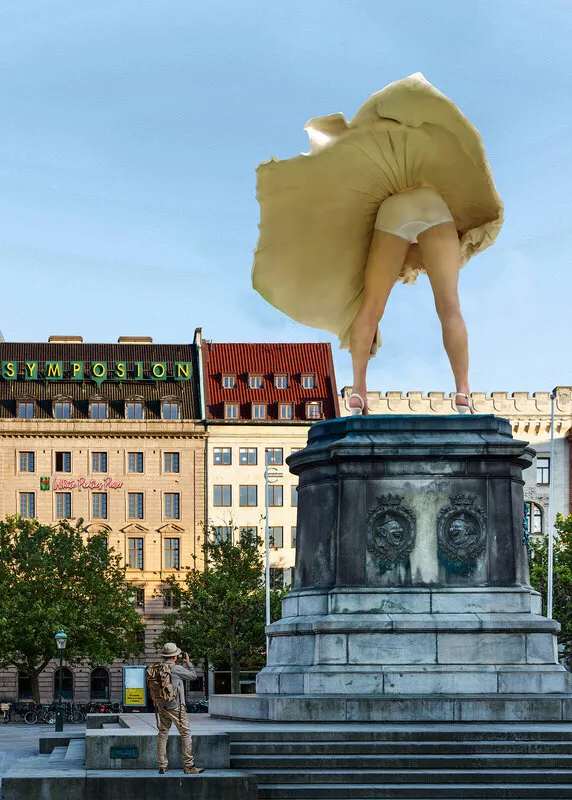
A Lift for Malmö - Forever Marilyn, 2024
Digital
50 x 70 cm
3 200 kr
A Lift for Malmö - Forever Marilyn
Malmö is a city in transition, where the past is constantly in flux, making way for the new. This story is about one such transition, a tale of how a reviled statue, a shaky bridge, a fraudulent municipal treasurer, and a less-than-honest scrap dealer were all part of a grand scam. Even after sixty-five years, the story still resonates, sparking laughter, indignation, and a certain respect for its audacious elegance.
At the centre stand Niels—a seasoned gentleman with many layers of past, including his experiences during the war—and Police Commissioner Pagen, his conversational partner and inquisitive mirror. Together, they unravel a web of memories, betrayals, ideals, and tall tales, in which Johnny Bode—an infamous trickster, singer of bawdy ballads, and self-appointed fiscal councillor—takes the lead. It's a story about selling what isn't for sale, outsmarting someone who thinks himself the cleverest man in the land, and using bureaucracy not as a safeguard but as a smokescreen. These characters, each with their unique role and perspective shaped by their historical context, are key to understanding the intricacies of the scam.
However, it is also a tale of lost illusions, political opportunism, and the human tendency to believe what one wants to believe—especially when it promises wealth, fame, or revenge. We see how a casual visit to a pub becomes a business deal, how a night fog obscures more than it reveals, and how a statue that never moved somehow managed to lose its soul.
It’s true. Almost. Or maybe just well told, which in Malmö is often the same thing. Because the statue still stands, and Marilyn Monroe... well, we might have to wait a bit longer for her.
If you're intrigued by this story, I invite you to explore more of my published work by clicking the link.
https://www.konst.se/jorgen-thornberg
“Shimmering Scrap
Bode sold a bridge that wasn’t for sale,
signed his name on air
and turned rust into promises.
With his silver tongue as a wand
he conjured away both guilt and truth,
a trickster in borrowed clothes,
Comptroller General in his mind.
The bridge stayed, but the tale travelled farther.
The statue remained, hollowed of its soul.
The money vanished, but the myth refined.
Pigeon droppings became laughter,
what was a scam became a story,
and the lie gained a shimmer
that only image can bestow.
Bode was a fraud,
but he knew more of the human heart
than most saints ever dared.
And perhaps that’s why
everyone kept listening.
A postscript from behind the smokescreen:
“A quarter of something, my friend,
is worth more than three-quarters of nothing,”
wrote Bode with a hand light as deceit,
deducting six hundred for the hotel.
As a balm, his share in a rotting bridge.
Signed: Bode, alias Comptroller General.
So ends the poem—
not with these lines,
but with a receipt in aluminium
and a quiet bow
from Orpheus among the swindlers.”
Malmö July 2025
Put One’s Foot Down – Att sätta ner foten
Whether it was a prophetic dream or a vision of a better Malmö, I can't say — only the future can tell.
In my dream, the monstrous King Gropealot — the infamous wife-beater Karl X Gustav — was dethroned from his pedestal at Stortorget, horse and all. In his place stood a colossal statue of Marilyn Monroe, a figure so far removed from the king's brutality that it was almost comical. The dream was a historical hiccup, a royal dethronement in heels, a gust of poetic justice, or a moment of glorious absurdity — I can scarcely find the words for such an occasion.
The statue had been a source of contention from the beginning, a divisive symbol that split the town. The number of those who admired the king in the square was small; most people accepted him simply because he had always been there, providing the pigeons with a perch, and through their droppings, expressing what many wished they could do if only they had managed to reach that height. To say you appreciated the statue was to invite a beating. This controversy sparked societal debates about the acceptance of historical figures, the power of symbols, and the need for cultural change, provoking reflection on these issues.
The statue of Zlatan was removed when he turned his back on Malmö and MFF, investing his money in Stockholm’s Hammarby instead. Why not use him as an example — and seize the chance to demolish Karl X Gustav’s statue as well?
This was no surprise to the mayor, who, over a glass of wine, confessed her dislike for the sculpture — a sentiment shared by most of her voters. Leading a movement to remove unpleasant figures from history—ninety—nine per cent of them men—was hardly a challenge for a woman. It was a political reality that complicated matters. Doing so would set a precedent—and enrage Stockholm’s royalists and nationalists, not to mention the local fascists. They, like their Stockholm counterparts with their marching Karl XII, had no intention of relinquishing their symbol of violence.
In Malmö, protests against the statue came steadily. But the main argument was not the king’s mistreatment of women — it was something far more shocking to the civic mind: the unprecedented historical symbolism of the statue in the free world — building a monument to one’s conqueror in the city’s main square. It would be like erecting a statue of Stalin in Budapest today. Not even Orbán would dare suggest that — and he’s practically Putin’s lapdog.
As the debate grew more heated, city leaders sought a compromise. Maybe people would relax if the statue were moved to one of Malmö’s parks — a complex decision, but better than locking it away in storage. That’s how it’s done in the U.S., where dozens of statues have been taken down in recent years.
“Let the people vote,” said one adviser, implying that, afterwards, City Hall could do as it pleased anyway. It might end up like the referendum on switching to right-hand traffic — discarded — or like the nuclear energy vote: a neutered compromise.
Perhaps there was also a third option — taking the sword from King Gropealot’s hand and swapping it for a bronze bouquet, a symbol of peace and equality, while permitting an annual feminist demonstration beneath the statue.
Ideas flooded in, and similar to the Brexit referendum, the mayor relied on experienced strategists, who were seasoned political advisors with a deep understanding of public sentiment. They assured her that people disliked anything that appeared on their tax bill. The more costly it seemed to replace something already paid for with something new and expensive, the more likely a majority would vote against change, regardless of their feelings about violent men.
The mayor thought herself clever for choosing this path, even if it meant, in the spirit of compromise, accepting a binding referendum. She staked her and her party’s honour on respecting the result. Her bet was simple: if the vote were close, people would, as usual, opt for the cheaper option. Surely, keeping the statue — even with a bronze bouquet — would cost less than replacing it, a significant financial consideration.
What she didn’t know was that other cities in the world were experiencing their issues with statues. “Forever Marilyn” — a massive sculpture of Marilyn Monroe striking her iconic pose from The Seven Year Itch, with her white dress billowing above a subway grate — had sparked controversy in several American cities since its installation in 2011, much like the debate over the Malmö statue.
Created by Seward Johnson, an American sculptor known for his lifelike and often hyper-populist works, the statue was initially erected in downtown Chicago, where it was both celebrated and condemned.
Some regarded it as kitsch, while others saw it as a pop-cultural triumph. Either way, the critics emerged victorious, and the statue toured until it ultimately found a permanent home in downtown Palm Springs, where the city aimed to honour Marilyn. It wasn’t that original statue that suddenly sparked Malmö’s election debate — it was a copy, one that had previously stood in Key West, Florida. The statue is gender-politically charged and consistently ignites discussion – some deem it sexist or voyeuristic. Conversely, others praise it as an iconic tribute to 20th-century pop culture and female stardom. Since it was on private property, and the owner faced significant personal criticism that began to impact his business, the lease was terminated. Securing a new home for a copy proved challenging, as the original had already travelled around the U.S. for decades.
In America, the statue caused such a fuss that Johnson’s heirs placed an ad on the world’s largest auction site, eBay. “Statue of Woman, Free to a Good Home,” the headline read – and it caught the eye of Jesper Jolle, vice-chairman of the committee ’Keep Scania Scanian’ and a film enthusiast with a deep admiration for Marilyn Monroe. To add to that, his wife chaired the foundation ’Raise More Statues of Women’ – the more iconic, the better, as a counterbalance to all the dull men cast in bronze across the city’s public spaces. The foundation had a small fund raised by enlightened citizens, but when it came to erecting statues, they still depended on the municipality. City officials were cautious, since ultimately, it was the taxpayers who would foot most of the bill. And when it came to the statue in Stortorget, it all came back to square one.
Using their modest funds, the two foundations launched a campaign for an alternative that wasn’t just free but could also generate much-needed revenue for the city. Jesper argued that the Marilyn statue was highly Instagrammable, and with the right marketing strategy, it could attract a significant number of tourists, thereby boosting the city's economy.
Regardless of one's personal opinion, the statue remained a tourist magnet in the U.S. People loved posing in front of it – or beneath the flying skirt, which had itself become part of the controversy. Malmö’s most notable selling point as a tourist destination had long been that it sits at the end of a bridge from Copenhagen. The Marilyn statue, with its iconic status, could further enhance Malmö's appeal to tourists.
Placing Marilyn in the most prominent spot could attract visitors from across the globe. “Marilyn in the Heart of Europe” – Jesper had already secured it as both a trademark and a domain name. And in fact, he had a point: measured from Cape Roca in Portugal to the Ural Mountains in Russia, Malmö is roughly in the middle, with a climate suitable for most. With Marilyn as a unique attraction, Malmö could become a tourism sensation, turning Copenhagen into the city at the end of the bridge that begins in Malmö.
Faced with three options – Remove Karl, Karl with a bouquet, or an iconic woman with tourist appeal, entirely free thanks to the foundation’s modest fund that covered both transport and installation – the referendum ended with a surprising victory for the film star. She fulfilled criterion number one convincingly, having departed this world 63 years ago. That she was also, globally, more famous than all Swedish kings combined, including the current one, only strengthened her case.
Now she was in place, and the first tourist, a gentleman from Japan, was being interviewed by Sydsvenskan. According to him, the only thing that could prevent the Great Buddha of Kamakura from dropping to second place among the world’s statues would be if that nearly eight-hundred-year-old giant suddenly started to dance. His perspective added a touch of humour to the situation. What good is surviving tsunamis, earthquakes, and typhoons— which have given it an almost mythical status as a symbol of resilience and spiritual weight— against a Marilyn with a billowing skirt?
This introduction offers the background to another event, centred around King Gropealot — one that took place several years ago. The central figure in that story is Niels, a nearly ninety-year-old half-Dane I had lunch with the other day. Also at the table was a female police commissioner whom I will refer to as “the Page”, after her hairstyle.
It wasn’t that Niels had anything specific against kings, whether mounted or seated on a throne with crown, orb, and sceptre in hand. He felt pretty neutral about the whole phenomenon. His indifference towards kings was palpable. Nor did he hold any special grudge against Karl X Gustav, his gaze fixed in the distance beyond the façade of Malmö’s City Hall. Born in Denmark, Niels might have felt strongly about the Swedish king who took Scania from his former homeland. But as a naturalised Scanian, Niels had accepted the course of history. They never fantasised counterfactually about the ice giving way beneath the fat king during the march across the Great and Little Belt in the winter of 1658. Niels was content with his life and felt no longing for the country of his birth. There was nothing left for him there but a bad memory and his mother’s grave.
Nor did he care about the variant of ‘Columba livia’, the city pigeon that roughly divided the people of Malmö on whether the king should stay or go.
“I nearly got rid of that statue back in the ’50s,” said Niels after a few thoughtful bites. Even though the Page was a police officer, the statute of limitations would surely cover the crime.
“Oh? How so?” asked the Page, interested, slipping a meringue into her mouth.
It was 1953. Just as it is now, the debate about Stortorget and the statue is ongoing. And a battle raged between bird lovers and pigeon haters. I used that, but for a noble cause. How noble, depending on your perspective, but the inner conflict was not something Niels intended to share with the Page.
“What could be more noble than blackening the memory of a rapist? You were ahead of your time,” said the Page, casting him an appreciative glance.
“Maybe stepping on a Nazi. Cheers, by the way!” Niels raised his golden-yellow glass, which caught an extra shimmer in the warm light of the lamps.
“Depends on the severity of the violence,” said the Page, who was too young to understand. Even though she worked on terrorism cases – or perhaps because of it – she was forced to think like the letter of the law: that everyone has the same rights, even the most despicable murderer.
“I was born in Denmark, and the Nazis murdered my mother. That’s how I ended up in Sweden.”
“How terrible,” said the Page, looking shocked. “What happened?” She carefully set her glass down.
“She was a freedom fighter. I’m sure you can understand why I find it hard to support Nazis.” Niels didn’t want to go into the whole story, because now the conversation was about the statue.
“Absolutely!” The Page still looked shaken, but appreciated that he chose not to reveal more. In her police training, there was a section on historical terror groups. Authorities do not discriminate based on the type of violence used by civilian groups. Violence is considered a tool of the state, regardless of whether it is later deemed justified or not. A resistance movement is classified as a terrorist group, and as such, must be countered. Whether called guerrilla, partisans, or people’s front, in its own time, it is rarely accepted. That was the case in Denmark during the war. The population was divided, even if most disliked both the Germans and the Nazis.
Only with some historical distance can the women and men of the resistance be transformed from violent offenders into heroes – and even then, rarely by a unified nation. One person’s hero is another’s outlaw. The group that attempted to assassinate Hitler still stirs strong emotions in Germany. The same applies to the Snapphane rebels of Scania, and not everyone mourns Niels’s mother, Estrid or the Danish resistance. The Page had been programmed to follow the law as it existed, no matter how unjust it might be. In her policing world, statues are not to be toppled just because someone dislikes the figure they depict. Even if it’s a male perpetrator of violence, privately, the Page could think freely and feel deep disgust for both brutal kings and rapists, and fantasise about evil things a woman might do to such men. Karl X Gustav was a poorly chosen symbol, but as long as the city authorities allowed him to stand, it was her duty to safeguard the artwork. That was why she was at Rådhuskällaren now, listening to what sounded like a crime long past its statute of limitations. She understood the complexity of historical events and the different perspectives that can shape our understanding of them, a perspective that is often overlooked in discussions about history and justice.
In any case, I found myself standing outside the City Hall, a place steeped in history, sometime in the spring of ’53. The statue was covered in scaffolding, its grandeur temporarily hidden from view. I’d read in the paper that a complete cleaning and restoration were planned, a testament to the city's commitment to preserving its heritage. It was, of course, a coincidence – unless you believe in fate. A couple of pigeons flew by and disappeared behind the Lord of the Pigeons. They’d found their outhouse closed.” Niels smiled slyly.
“The Lord of the Pigeons?” The Page gently wiped a bit of mousse from her lower lip with her napkin.
One of the busts along the gallery façade that faces Stortorget is Old Flensburg, the one farthest to the right. He was a steamship pioneer who built the corner house at Södergatan and Skomakaregatan. Mathias is known as the Lord of the Pigeons because behind his bust used to be the entrance to a death trap. Inside, a couple of dozen white, tame pigeons cooed in two cages, helping to attract their wild cousins, who were then killed because they relieved themselves on the king. As early as the beginning of the last century, a battle began between those who cared for the pigeons’ lives and those who claimed their droppings corroded the bronze. Mathias and I are kindred spirits, you should know.” Niels turned the wineglass between his fingers. “He also came to Malmö as an orphan – Mathias at thirteen, almost to the day, 150 years before me, who was only twelve.”
“What a cool story,” said the Page.
“Well. I’m not done yet. Just when the pigeons had perched on either side of Mathias, my eyes caught one of the women in full figure atop the City Hall.” Niels took a cautious sip of wine, a mischievous glint in his eye, hinting at the unexpected turn the story was about to take.
“The five terracotta figures of nameless women who, since time immemorial, have borne the weight of society,” said the Page with a sharp look in her eyes. “They represent agriculture, seafaring, justice, craftsmanship, and trade – I heard that on a guided tour a few years ago. In school, I had a history teacher who would go on and on about the men who ruled Malmö. The woman he stayed silent about. He was a man, of course.” Her knowledge and understanding of history were evident, and Niels couldn't help but admire her for it.
“The most important is the one in the middle, Themis – divine justice. That’s the one I spotted.” Niels didn’t comment on the Page’s remark, though he agreed with it in principle. A little further away stood a newspaper vendor, and I noticed the headline: ‘Nazism Not Dead!’ Sometimes it’s hard to understand how associations are triggered – and with them, ideas.
Suddenly, I just knew how I was going to con a Nazi. And I already knew who, because his name had come up in another context. He was a scrap dealer from Sjöbo, Truls Valfridsson. A name that easily sticks with a Dane. Truls is a short form of the Old Danish Trugils or Torgils, which comprises Thor and gisl, meaning arrow or ray. Valfrid is of German origin, and from what I understand, it has something to do with ruling by protecting. A wishful name for a Nazi – because a Nazi he was, a core member of the movement. The Page listened carefully. She hadn’t even been born when it occurred, but she understood that history never lets go. Karl X was a prime example of that.
Niels kept talking about the silence; how few wanted to discuss what had happened in Sweden during the war; about the pragmatists in the coalition government; the hush around fortunes made through deals with Hitler’s Germany; how people turned a blind eye to Nazis who plotted a coup and others who created escape routes for war criminals fleeing to Argentina. While waiting for a coup and a German occupation, Truls funded blueprints for a concentration camp. Everything was ready for a Swedish Holocaust in the Sjöbo area. Hidden among his scrap, Truls stockpiled barbed wire and building materials for barracks and watchtowers. In his warehouse, he kept black uniforms for the guards. The scrap dealer’s secret network held lists of more than 8,000 Jews and political opponents marked for extermination. The existence of the lists was revealed after the war, but no one was arrested or even questioned—a Swedish tiger, as the wartime slogan described it.
Hitler’s most vocal critics had also fallen silent. Revue star Karl Gerhard wrote his memoirs when no one cared to hear his sharp-tongued songs any longer,” Niels continued, shaking his head. “The bravest of them all – Torgny Segerstedt, editor-in-chief of the Göteborgs Handels- och Sjöfartstidning – died before he even saw the peace.” Nazi leader Sven Olov Lindholm did disband his party in 1950, and many believed Nazism was dead and the threat was over. Gullible fools.” The Page nodded. She knew. It was part of her job to be aware of such things.
“But I also had lists. With a future film star, I stole the Swedish Nazis’ membership roll. There were some very respectable old Scanian names. You wouldn’t believe it.” The Page absolutely would, because all of that was in the Security Police archives.
“Noble nobility from castles and manors, though counts and barons were rarely card-carrying Nazis,” Niels rambled on. The memories always made him uneasy. “They were part of a broader circle of German sympathisers; colonels, majors, captains and seventeen lieutenants plus foot soldiers of every kind – all envious of the German order and discipline, though neither a general nor an admiral, who likely saw no future under the command of a German corporal; medical licentiates, law graduates, Latinists and other academics anxious about competition from highly educated Jews; from business: bankers, merchants, wholesalers, shopkeepers, managers and directors high and low, who envisioned Lebensraum for their enterprises with German help; several dentists and doctors, all with German textbooks; some wives and a few unmarried ladies who liked Wagner and dashing uniforms; some men under the title ‘Mr.’—often concealing someone with so much wealth they needed no title, though everyone knew. That way, a couple of priests avoided awkward questions from the cathedral chapter. What God had to say surely depended on whether they believed in him or not.” Niels gave a crooked smile. He believed that when it’s over, it’s over. Nearness to death hadn’t changed that, but the moral ambiguities of the past still haunted him.
“Well, one may wonder,” said the Page, amused.
“On the list were friends and acquaintances of the family, though I never told my parents. Thankfully, neither my father nor my mother were Nazis – that would never have worked. I found very few titles with working-class ties, but plenty of smallholders and farmers. There were both sitting and future members of parliament, a future Minister of Education and Ecclesiastical Affairs, and one member of the Swedish Academy, along with a host of other future prominent figures. So the growth curve was secure.” This was nothing new to the Page, but it also had no impact on her work. She was busy with the present – with those who had learned nothing from history and inherited the ideals of the old Nazis. Not many were militant any longer. In 2018, they adopted a different strategy and experienced growth in both size and influence. She nodded, so Niels wouldn’t think she disagreed.
Many later claimed they were only opportunists. In that case, Germany alone had millions of them. It cost millions of Jews their lives and ignited fire across Europe. And my mother.” For a second, his voice faltered because time does not heal wounds of that kind. “A bear hibernates in winter, but it isn’t dead. Wake a sleeping grizzly, and you’ll find out,” said Niels gravely. “Sweden is still full of that kind of beast. And they’re not the cuddly kind.” The personal sacrifices made during the war were immense, and the wounds they left behind are still fresh. This narrative aims to evoke a sense of empathy in the readers for those who suffered during this tumultuous period.
“I’m well aware of that,” said the Page, who had a whole pack of brown bears in various databases at work, sorted by level of threat—a fact she wasn’t permitted to confirm. “But go on. It’s fascinating.”
“There were many more than Lindholm biding their time – Assar Oredsson, Manne Bergh, Lindholm’s men Gustaf Ekström and Bergqvist, the SS veteran Somberg, and fascist Engdahl, the champion of corporatism. I conned him already in the ’40s, when a girl friend and I stole his registries of Swedish Nazis. But I’ve already mentioned that. Truls Valfridsson was, of course, on those lists too,” Niels could tell from the look in the Page’s eyes that she knew about the registries and almost certainly had access to the most recent and updated ones. Few of the old names were still alive, but the succession remained secure. A couple of them even sat in parliament. The narrative is filled with intrigue and mystery, engaging the readers and keeping them hooked.
“Sweden’s own Führer Engdahl from Malmö praised Hitler and lauded Nazi Germany before and during the war – but it was more Mussolini’s Italy that inspired him. In some way, he was never truly dangerous-a sort of intellectual softie, a brown plush toy, a Hitler light.” Niels swirled the glass of exquisite Sauternes wine.
“Sounds like you had your hands full.”
You bet I did – but even if I was young and wild back then, at twenty-three I didn’t hold any particular grudge against kings, whether on horseback or lounging on a throne. I felt pretty neutral about the whole phenomenon. I did miss the Danish king, though, who had been a source of comfort during the war, when Kong Christian rode around Copenhagen on his horse. We actually met – but that’s a story for another time. Born in Denmark, I might have harboured strong feelings about the Swedish king Karl X Gustav, who took Scania. But I was content with my new life in Sweden and felt no longing for the old country. All that remained there were bad memories – and my mother Estrid’s grave.” Niels stared blankly at the ceiling. Despite the hardships and losses, the characters in this narrative display remarkable resilience, which is sure to inspire the readers.
“I didn’t care about pigeons either. That bird, which divided the people of Malmö roughly evenly over whether the winged creatures should be allowed to keep their king or not. That attitude would change. It was those cooing birds that eventually led the powers that be to decide on a proper cleaning of the king. Without that decision in the City Council and the notice in Sydsvenskan, I’d hardly have come up with my idea.” Niels chuckled, and the Page joined in.
Even then, some people held opinions about the fat king and the horse. The arguments were the same as today – perhaps more literary, as the king was compared to Hannibal and the horse to the one in Troy, though it seemed people had mixed up the king and the horse. These comparisons were not just random musings, but they held a significant place in the story. That winter, a petition reminded all Scanian newspapers of Karl X’s existence. Bold headlines declared that a militant group wanted the statue removed. The matter was said to be under review by Malmö’s city council.
“That must have suited your sudden brainwave quite well,” said the Page.
“It wasn’t a brainwave – it was a long-term plan,” said Niels, annoyed.
“Sorry, wrong word. I meant idea, of course.” The Page smiled with exaggerated sweetness.
Exactly! My plan was based on common sense and basic logic. Scrap dealer Truls was as wealthy as a troll and should have been immune to risky investments. However, greed often betrays wisdom, and many people desire more. I had already learned that in primary school in Nørrebro – the fable of the dog on the footbridge, by heart. You know it, surely? The one about the dog with the marrowbone in its mouth who sees the reflection of the bone in the stream, lunges for another, and drops his treat in the water. He who reaches for too much often loses everything. That was precisely what I wanted Truls Valfridsson to experience. My plan was not just a simple scheme, but a carefully crafted strategy that took into account human nature and the economic conditions of the time. The Page nodded, even though the fable hadn’t made it into her generation’s curriculum.
Niels explained, between small sips of wine, that the six-and-a-half-ton statue had cost 75,000 kronor in 1896, which was a significant amount of money at the time. That would be nearly five million in today’s value. In 1953, the king and horse had a theoretical value of 186,000 on the open market – still a staggering sum for a young man. And even for a scrap dealer. That’s 2.7 million in today’s money. The Korean War was still ongoing, and the demand for copper was high. That, plus the global economy, meant that the scrap value that spring was climbing. Analysts expected a fifty per cent increase within the year. Niels’s concern was how he could contact Valfridsson without exposing himself. In the end, chance solved the problem.
Niels needed an accomplice, a partner. There was no one in his social circle he’d consider sending to someone like scrap dealer Valfridsson. Niels looked out for his friends, even if someone like Aniiita would probably have thought it was impossible. Aniiita was not just a casual friend but a significant figure in Niels's life, whose opinion and influence mattered to him. The scrap dealer was a clever devil – a dangerous opponent if anything went wrong. He nearly abandoned the whole idea along with all his other grand plans that never materialised. That Aniiita was a transvestite and called Tage was something Niels mentioned to the Page in passing. That Niels had many unusual friends was something she’d already realised. One of the more unusual ones was about to appear.
Over a tray lunch at Epa, a few pieces fell into place. Albin—every Scanian dog’s best friend—was a mate I could confide in. He was someone with the most obscure connections, someone who might know someone who could be a way out of my dilemma. Albin made a living boiling cow stomachs and mixing in the occasional fox or badger for good measure. During the war, no one asked unnecessary questions – you took what you could get.
While the senior representative was being entertained at the Governor’s Residence, I was indulging in a sumptuous feast with my grunting guest in the heart of the family estate beneath chandeliers and wall sconces. The finest table, usually occupied by the connoisseur and academic snob Sten Broman, was laden with glassware. A boiled lobster slipped down easily, as did two gratinéed. The vintage champagne was superb, but eating the king of the sea is a messy business. As if the towel-sized napkin wasn’t enough, the scrap dealer used the heavy cretonne curtain for extra protection. Country oaf! However, the indulgence of the lobster was undeniable, and my guest agreed that a hearty meal was a good idea. The maître d’ held a brief lecture with the menu in hand. Young Lendrop preferred traditional Swedish fare, he told us. The boss used to say that if forced to choose between oysters and foie gras, junior Lendrop would opt for potato pancakes with lingonberries. He who listens to advice is wise – but why be forced to choose when you can order both?
“I have to laugh again,” said the Page. She and Niels also needed a refill. Niels had been clever enough to snatch the bottle of sacred Italian wine, a rare and highly prized vintage. He continued after clinking glasses in a posthumous toast to the king of swindlers – or emperor, as Niels put it.
Foie gras is best enjoyed with a rare vintage Château Mouton Rothschild from the year of peace, 1945. A Premier Cru wine tasting like paradise – blackcurrants, liquorice, spice, and graphite. When the sommelier respectfully poured the rare wine, it gleamed like a garnet, its rich aroma filling the air. To pair such a gem with potato pancakes would be a misalliance. On both ends, actually. Valfridsson grunted in agreement. Hearty food requires strength and manly courage – and for that, schnapps is the perfect conduit. The scrap dealer’s nose glowed as red as the wine from the second bottle we’d now finished. The last one in the cellar. For that occasion, a funeral beer was in order.
‘Flavour of pine and lingon,’ hummed Truls, who had now become just Truls to councilman Johnny, a close friend and confidant. No more formal titles like director, chamber councillor, manufacturer, or legal adviser – just a straight-up ‘you’ and ‘brother.’ Truls’s humming referred to Lendrop Junior’s specially spiced schnapps, initially intended for the Christmas table, but, according to the schnapps steward, it was excellent with foie gras. To that, we added a few glasses of malty, foaming porter, dark as chocolate with hints of rye bread, nuts, and coffee – the closest thing to liquid food one could find. In the rush, we nearly forgot the Bohuslän oysters. The vintage champagne stood emptied and upside down in its ice bucket, but according to the wine list, there was a crisp Krug Grand Cuvée. I loudly and clearly stated that it would suit our palates – and the city’s budget.
Truls was not too proud to burp loudly and boldly – a sign that enough was enough. Even a scrap dealer has his limits, and we were soon to inspect the bridge. But first, a stiff drink at the bar. To gather strength for the inspection. Truls managed a grunt, just barely. The few steps to the bar passed via the men’s restroom, which provided a much-needed pause. ‘Po di ijen,’ said Truls, which roughly means, ‘we’ve got work to do – we can’t hang around here.’ The bartender had been instructed to fetch from the reserve beneath the counter. There, bottles were stored for the city’s top brass. To clarify: my stiff drink has nothing to do with the sad mixture known among the common folk – a thimble of eau-de-vie watered down with beer. My luxurious blend of top-shelf champagne and Johnnie Walker is famous–or somewhat notorious–among those who never got paid—expensive stuff. I taught a renowned alto saxophonist how to mix during his tour of Sweden three years ago. That it was Charlie Parker, and the story of my adventures with the Black musician, I did not tell the scrap dealer. You had done proper research on our mark and knew that Black faces made the scrap dealer from Sjöbo see red. And in that case, it wouldn’t have stopped at a few grunts. This exclusivity made us all feel privileged and part of an elite circle.
The page burst out laughing at the sight of the red and black. Niels took the opportunity to mention that Parker had blown his last riff in 1955, and that some still blame Bode for the jazz legend’s early death from liver cirrhosis at only 34 years old. Another round of laughter, tragic as his fate had been. Niels continued from memory, and we all felt a part of the shared history and camaraderie.
If crayfish and lobster require certain drinks, then stiff cocktails call for a midnight snack. Caviar starts to feel a bit repetitive. Although Beluga is considered a Premium Brand, the black pearls from Iran proved just as exceptional. They shimmered slightly more brown than black but were worth a Kockums worker’s weekly wage per mouthful. It was getting late, the scrap dealer’s grunts were growing weaker, and the maître d’ had made several nervous passes through the bar. The kitchen was shut, but the cold larder, kept on standby, was becoming irritable. The liquor steward had closed for the night but had left the key to the cold larder behind. It didn’t matter, as the bartender, with his insider knowledge, headed straight for his hidden stash. He also knew that the liquor spies required overtime after midnight, and the state alcohol commission had no budget for such luxuries.
Finally, despite the pleasant atmosphere and our conversation about future possibilities, it was time to call it a night. The scrap dealer had passed out on the bar couch, showing that an Österlen man – if one can even call someone from Sjöbo that – couldn’t outlast a Västgöte. The final bill was, as agreed, made out to the Malmö City Mayor’s Office, with Thomas Munck af Rosenschöld as the payee. I signed with a signature that was both illegible and elegant, a testament to my state of mind despite the evening’s drinks. Psta is a Finnish abbreviation of puolesta and is used in our neighbouring country when signing letters and documents on someone else’s behalf, which was precisely what I had done. I asked the maître d’ to call for a cab to Sjöbo. He had no qualms about covering the fare on behalf of the city tab.
I shook our friend awake, who, with a grumpy displeasure, managed to stumble towards the entrance on Norra Vallgatan. I reminded the scrap dealer that it was time to inspect the bridge, which, as the crow flies, lay just over four hundred metres away in the direction of the Court of Appeal. The latter being a place I sincerely hope to avoid. The scrap dealer squinted into the damp night fog drifting in from the harbour and the Öresund. He gave a faint grunt-and-a-half.
In the scattered light from Norra Vallgatan’s streetlamps, the underside of Hönsabron appeared dark enough to seem exactly as black and rusty as an old iron bridge should be. The balustrade above had been painted red, and from a distance and in shadow, it could be mistaken for bronze with a high copper content.
The scrap dealer, in a state of inebriation, thought he was sober enough from the cocktails to judge from a distance that my measurements and weight looked reasonable. No matter how much Truls squinted, the image blurred before him, but the odds were in his favour – so why take extra steps? Besides, the scrap dealer was so drunk that walking any further would have been akin to suicide. His drunken state was so pronounced that it added a layer of absurdity to the situation. “Then the profit goes to my heir – a useless nephew,” slurred the scrap dealer Truls, who grunted twice. At that very moment, the cab arrived.
“This is going to turn out just fine,” said Truls, his voice trembling with gratitude. The last thing the scrap dealer did before stepping into the taxi was pull two envelopes from the inside pocket of his jacket and press them into my hand. “Fair’s fair, and next Thursday I’ll be the one heading to the Finance Office to pay the deposit. It was ninety thousand we agreed on, wasn’t it?” slurred Truls. I believe he passed out before the cab even made it around Stortorget.” The irony was thick in the air, as the scrap dealer’s trust in Truls was as misplaced as his faith in his own sobriety.
“That was the last the two ever saw of each other, even though Bode eventually moved to Malmö. But that’s another story,” said Niels.
“What a pair of characters,” said the Page, who had been laughing almost constantly. It was the funniest thing she’d heard since the scandal where the police chief and former head of the police academy, Captain Gown, was convicted of rape.
“It doesn’t quite end there – but almost,” said Niels. “First, I’ll recite from memory a Post Scriptum from Bode – that devil always got the last word.”
Niels read aloud Bode’s PS, the most painful part for him personally:
Niels, my friend, remember that a quarter of something is better than seventy-five per cent of nothing. My original share of 2,600 kronor now belongs to you. Congratulations! I’m sure you’ll also overlook my deduction of six hundred for hotel and miscellaneous costs. As a consolation, you may take over my certificate entitling you to two and a half per cent of the scrap value of a particular pontoon bridge between Norra Vallgatan and the harbour.
I’m sure we’ll meet again someday on the right side of the bench, old friend.
Johnny Börjeson
Finance Councilor
/alias Johnny Bode”
“So he ripped you off completely.” The Page tried to look serious but failed, as laughter bubbled up behind her ribboned composure. Not least because Niels himself seemed to have a healthy distance from the incident; sixty-five years ago, sure, it had troubled him at the time – not because of the money, but because he had been so naïve. A small comfort was that the trickster had been the best of them – the Houdini of hustlers, an escape artist who slipped through nearly everything.
“Clean cut, no frills,” laughed Niels. When Bode next appeared in Malmö, Niels had already moved to Italy, and they never met again. In the 1970s, Bode earned a considerable sum from the album Bordellmammas visor, only to see it disappear as quickly as it had appeared. The conman made frequent trips to Copenhagen, performing and singing on the Centrum Line ferries and at a few of Lund’s student societies. His resilience was as remarkable as his scams.
Niels shared that he had become an honorary member of the Johnny Bode Society the previous year, one of the few surviving victims Bode had scammed. For this, he received a medal, the chocolate kind, though the society board had eaten the contents and sent only the golden aluminium foil, entirely in Bode’s spirit. The Johnny Bode Society was a group formed by Bode's victims, a testament to the impact of his scams and the camaraderie among those he had deceived. The camaraderie among the victims was palpable, with more laughter and another round of drinks.
Regarding Truls Valfridsson’s ongoing involvement in the matter, it became increasingly clear over time, Niels concluded. It wasn’t as if the scrap dealer was boasting about being duped by a lowly civil servant from Malmö City Administration. This “Finance Councillor” had been discreetly approached by Truls for years, at every city department and institution. All denied that anyone by that name had ever existed. Truls found no leads in the underworld either. By the time Bode once again happened to land in Malmö, Truls had long since filed his last false tax return. The scrap dealer gave his final grunt in misery in 1963. He wouldn’t have recognised Bode anyway. The man had become an eccentric old character, supplementing his scammed earnings by playing piano on the Copenhagen ferries or singing his bawdy songs at Lund’s student clubs. His payment was mainly in the form of food and accommodation, and Bode died in 1983, a drunken shadow of his former swindling self. Bode continued scamming until his last breath. He and the scrap dealer not only shared a political allegiance during the war but also, in every other respect, were cut from the same cloth. Truls also missed his chance to join his old comrades in founding the Sweden Democrats in 1988.
Truls arrived at the Finance Office at the scheduled time. Although the cashier couldn’t locate any record of such a case, it was entirely feasible to pay the ninety-thousand-kronor deposit related to the statue and the bridge. Given the sensitive nature of the deal, Truls believed it was part of the finance councillor’s smokescreens. The councillor operated discreetly, like the Wallenbergs – though on a different level.
After a few weeks, Truls grew impatient and contacted the head of the Finance Department. No procurement matching Valfridsson's description existed, nor was there any finance councillor named Johnny Börjeson. The official Truls requested could not be found in either the municipal department or any other location. It must be a misunderstanding, or perhaps a different city—maybe Stockholm. Karl X Gustav also rides in front of the Nordic Museum. The same day the scrap dealer finally realised he’d been outsmarted, the statue gleamed newly polished and fine in the square. Truls's heart sank as he grasped the full extent of Bode's deception, a wave of anger and regret washing over him.
Filing a police report about the loss was out of the question. Truls would, for obvious reasons, have had difficulty explaining where he got the fifteen thousand untaxed kronor he had handed to a non-existent finance councillor. Niels had looked up the scrap dealer’s official income at the city library. Over the past ten years, in the tax calendars, Truls had not, in a single year, exceeded the basic income of a small farmer on Söderslätt. At that level, no one could afford a Cadillac or a square-built estate. An indoor pool with a floating bar in the stable was something only the penniless could dream of. Such things didn’t even happen in Sjöbo, where Truls himself chaired the local tax committee. As for the deposit, it was considered forfeited due to the suspect's alleged criminal intent. The scrap dealer was welcome to appeal, which would be unwise. The injustice of it all weighed heavily on Truls.
The fool didn’t give up, though – he appealed and fell into the hands of the Swedish Tax Agency. Once the agency had completed its audit, scrutinising every scrap and proving beyond a doubt that the money had been dishonestly earned and undeclared, the scrap dealer, Truls Enok Efraim Valfridsson, was left without life, house, or holdings. With a massive tax debt and having been evicted from his life’s work, the former scrap dealer hanged himself from an old oak tree, solitary in the glade where the concentration camp had once been planned – on the gentle slope facing Lake Vomb and Övedskloster.
The maître d’ was allowed to keep his job because it was Lendrop senior who had taken the order. “I damn well knew how Munck sounded – no one can miss the mayor’s voice,” said Lendrop senior, who found it hard to accept that he might have been the victim of a practical joke by his friend.
It must rank as one of Bode’s most extraordinary feats to have sold Hönsabron – a precarious pontoon bridge made of warped timber – as high-grade and valuable scrap metal, and to have collected the commission in advance, sight unseen.
A vague boundary between wishful thinking and reason can explain Bode’s trick. Unmasking someone like that should be straightforward. The phenomenon is described in literature as the so-called duck test.
“If it looks like a duck, waddles like a duck, swims like a duck, and quacks like a duck, then it’s probably a duck,” said Niels for perhaps the hundredth time. So if Bode seemed like a swindler, acted like one, talked like one, and promised things too good to be true – what reason was there to believe he wasn’t one? None. Absolutely none. And yet Niels let himself be fooled, just like the scrap dealer and many others.
“Didn’t it affect you, though, working with a Nazi – given what you told me?” asked the Page.
Of course it did. But the point was to get at the scrap dealer, who was an actual Nazi. Bode was, above all, an opportunist—someone who would sell his soul for money. As soon as the wind shifted, he jumped on the next trend if it meant making a profit. That made him dangerous, naturally. His flirtation with Nazism ended with him becoming their victim. Bode ended up, for a time, at Grini, outside Oslo—the closest thing to a concentration camp we had in the Nordic countries.
Valfridsson’s project never materialised. I think Bode gave it his all to take down the scrap dealer, whom he believed was far more of a Nazi than he ever was. Valfridsson would suffer for his misfortune. Bode was a wounded narcissist. The Swedish mental health system had neutered him. He, a genius in his own eyes, was branded five-five – a nutcase. That’s no excuse, only an attempt to explain how he ended up the way he did.
“There are no excuses, only explanations.”
“You’re right. To protect my reputation, I would like to clarify that my share of the scrap dealer’s money was donated to a charitable cause. I care about children who get caught in the crossfire of adult conflicts. Think of today’s unaccompanied boys, often sent off to send money back to their families. No child chooses to leave the only reality they’ve known. Ask me."
“As you understand, I have a fair amount of insight into that. More into the consequences than the children themselves.” The Page looked concerned.
Malmö är en stad i förvandling, där det gamla alltid står på lut att bytas ut – ibland med beslut från ovan, ibland med hjälp av mer kreativa initiativ. Den här historien handlar om ett sådant initiativ. Om hur en hatad staty, en skröplig bro, ett fejkat drätselkammarråd och en allt annat än rättrådig skrothandlare kom att sammanflätas i ett makalöst bedrägeri som ännu, sextiofem år senare, väcker skratt, indignation och viss beundran för sin fräcka elegans.
I centrum står Niels – en äldre herre med många lager av förflutet – och Poliskommissarien Pagen, hans samtalspartner och nyfikna spegel. Tillsammans drar de upp trådarna ur ett nät av minnen, svek, ideal och rövarhistorier där Johnny Bode – berykta skojare, sångare av snuskiga visor och självutnämnt drätselkammarråd – spelar förstafiol. Det handlar om att sälja något som inte är till salu, lura någon som tror sig vara listigast i landet, och om att använda byråkratin som rökridå snarare än skydd.
Men det är också en berättelse om förlorade illusioner, om politisk opportunism och om den mänskliga förmågan att tro på det man vill tro på – särskilt om det luktar pengar, ära eller hämnd. Här får vi följa hur ett barbesök blir till affärsuppgörelse, hur en nattdimma döljer mer än vad den avslöjar, och hur en staty som aldrig ens flyttades ändå förlorade sin själ.
Det är sant, nästan. Eller kanske bara väl berättat. Vilket i Malmö ofta är samma sak. För ännu står statyn där och på Marilyn Monroe får vi vänta ett tag till.
”Skimrande skrot
Bode sålde en bro som inte var till salu,
satte sin signatur på luft
och förvandlade rost till löften.
Med munläder som magikerstav
trollade han bort både skuld och sanning,
en trickster i lånad kostym,
drätselkammarråd i fantasin.
Bron höll stånd, men berättelsen bar längre.
Statyn stod kvar, med sin förlorade själ.
Pengarna försvann, men myten förädlades.
Duvornas skit blev till skratt,
det som var bluff blev till bildning,
och lögnen fick ett skimmer
som bara bilden kan ge den.
Bode var en bedragare,
men han visste mer om människan
än de flesta helgon.
Och kanske var det därför
alla gärna lyssnade.
Ett PS från andra sidan rökridån:
”En fjärdedel av något, min vän,
är mer än tre fjärdedelar av ingenting,”
skrev Bode med handen lätt av lögn,
och drog sexhundra för hotellet.
Som plåster – en andel i en ruttnande bro.
Signerat: Bode, alias drätselkammarråd.
Så slutar dikten –
inte med dessa rader
men med en kvittens i aluminium
och en stilla bugning
från skojarnas Orfeus
Om det var en sanndröm eller en vision om ett bättre Malmö vet jag inte, det kan bara framtiden utvisa. I min dröm hade den fule Tjockkalle, kvinnovåldföraren Karl X Gustav detroniserats från sitt fundament på Stortorget i Malmö, med häst och allt. Borta var 130 års förolämpning mot varje sann skåning och feminist, kvinna som man. Det som kom i stället var kungens antipod, en jättestaty av Marilyn Monroe. Hur det hade gått till berättade drömmen, för det var onekligen en history hiccups, a royal dethronement in heels, a gust of poetic justice or a moment of glorious absurdity – jag har svårt att hitta orden för ett sådant tillfälle.
Statyn hade varit kontroversiell från början och delade staden. Antalet som gillade kungen på torget var liten, många accepterade den eftersom den stod där och erbjöd duvorna någonstans att sitta och dessutom med sitt träck göra det många velat göra om de bara kunde tagit sig upp på statyn. Att säga att man tyckte om staty, vore att be om smörj.
Statyn av Zlatan förstördes när han vände Malmö och MFF ryggen och investerade pengar i stockholmska Hammarby. Varför inte låta honom statuera exempel och passa på att demolera statyn av Karl X Gustav.
Det här var inga nyheter för borgmästaren som mellan skål och vägg ogillade verket liksom flertalet av sina väljare. Att gå i bräschen för en utveckling där man plockade bort obehagliga figurer ur historien, nittionio procent män, var i och för sig inget problem för en kvinna. Den politiska verkligheten ställer till det. Det vore att skapa ett prejudikat och att reta upp stockholmska rojalister och nationalister, för att inte tala om lokala fascister. De ville lika lite som kumpanerna i Stockholm, som hade sin Karl XII att paradera nedanför, bli av med sin våldssymbol.
Det motionerades flitigt och ofta i Malmö mot statyn. Det främsta argumentet var inte kungens övergrepp mot kvinnor utan att dess historiska betydelse saknar motstycke i den fria världen, att resa en staty över sin erövrare på stadens främsta torg. Det vore samma som om man idag skulle sätta upp Stalin i Budapest, Ungerns huvudstad. Det skulle inte ens Orban våga föreslå även om han är Putinkramare.
Tonen blev alltmer aggressiv och stadens ledning letade efter en kompromiss. Kanske lugnade sig folk om statyn flyttade till en av stadens parker, snarare en sådan lösning än att stoppa den i ett magasin. Så gör man i USA med alla statyer som rensats ut under senare år.
”Låt folk rösta om det,” sa en medarbetare underförstått att sedan kunde stadens ledning göra som den ville. Det kunde bli som med omröstningen om högertrafik, att hela saken hamnade i papperskorgen, eller likt kärnkraftsomröstningen leda till en tandlös kompromiss. Kanske kunde man formulera en tredje väg för statyn också, plocka bort svärdet i Tjockkalles hand och ersätta det med en blomsterkvast och tillåta en årlig feministisk demonstration nedanför statyn.
Förslagen var många och liksom med Brexitomröstningen litade borgmästaren på sina erfarna strateger som sa att folk avskyr kostnader som hamnar på skattsedeln. Ju mer oförmånligt det framstår att byta ut något som redan är betalt med något som kostar en massa pengar, desto sannolikare är det att en majoritet röstar nej till en förändring, alldeles oavsett vad de tycker om våldsamma män.
Borgmästaren tyckte hon var smart som gick på denna linje även om hon i kompromissens anda var tvungen att acceptera en tvingande folkomröstning. Hon satte sitt och partiets ära i pant för att följa röstutslaget. Hon räknade med att stod det och vägde skulle folk om vanligt rösta på det som var billigast. Det är klart att det borde kosta mindre att behålla statyn än att ersätta den med en ny även inkluderat en blomsterkvast i brons.
Hon kunde ju inte veta att det fanns andra städer på jorden som hade problem med sina statyer. "Forever Marilyn" – en gigantisk staty föreställande Marilyn Monroe i sin ikoniska pose från filmen ’The Seven Year Itch’, där hennes vita klänning blåser upp över ett tunnelgaller hade delat befolkningen på flera platser i USA sedan den först ställdes upp 201. Statyn av Seward Johnson, amerikansk skulptör känd för realistiska och ofta hyperpopulistiska statyer, restes först i centrala Chicago, där den både hyllades och kritiserades.
Vissa såg den som kitsch – andra som en populärkulturell triumf. I vilket fall vann motståndarna och den ambulerade tills den fann en plats i centrala Palm Springs i samband med att staden ville hedra Marilyn. Det var inte den som plötsligt dök upp under valdebatten i Malmö utan en kopia, som stått i Key West i Florida. Den är könspolitiskt laddad och väcker debatt – vissa kallar den sexistisk eller voyeuristisk, medan andra hyllar den som ett ikoniskt uttryck för 1900-talets popkultur och kvinnlig stjärnglans. Eftersom den stod på privat mark och fastighetsägaren fick utstå mycket personlig kritik som drabbade hans affärer, sa han upp hyreskontraktet. Det var inte lätt att finna en ersättningsplats för en kopia när originalet valsat runt i decennier.
I USA hade statyn rört upp så mycket damm att Johnsons arvingar satte in en annons i världens största auktionssajt eBay. ’Staty av kvinna bortskänkes’ löd rubriken som Jesper Jolle uppmärksammade. Han var vice ordförande i kommittén ’Bevara Skåne Skånskt’ och cineast, tillika en stor beundrare av Marilyn Monroe. Lägg därtill att hans fru satt ordförande i stiftelsen ’Res fler kvinnliga statyer’ - ju mer ikoniska desto bättre som motvikt till alla tråkmånsar till män i stadens offentliga miljöer. Stiftelsen satt på en mindre påse pengar insamlade bland upplysta medborgare, men för att finna platser var de beroende av kommunen. De var restriktiva eftersom til syvende og sidst var det stadens skattebetalare som fick stå för huvuddelen av kalaset. Och i fråga om statyn på Stortorget var man då tillbaka på ruta ett.
Med hjälp av påsen med pengar kampanjade de båda stiftelsen för ett alternativ som inte bara var gratis utan med säkerhet skulle dra in välbehövliga pengar till stadens kassa.
Jesper hävdade att Marilynstatyn var i högsta grad Instagramvänlig. Oavsett kritik hade den varit en turistmagnet i USA. Människor älskar att posera framför (eller under) kjolen – vilket i sig också blivit en del av diskussionen. Malmös främsta argument som turistmål är att ligga i änden på en bro från Köpenhamn. Det räckte inte långt men med Marilyn på bästa plats torde den locka turister från hela världen. Marilyn mitt i Europa, hade Jesper redan skyddat som varumärke och webbadress. Faktum är att han har rätt. Mätt från Kap Roca i Portugal till Uralbergen i Ryssland ligger Malmö mitt emellan och erbjuder ett klimat lagom för de flesta. Kryddat med Marilyn skulle det bli en turistisk sensation och förvandla Köpenhamn till staden som låg i änden på bron som började i Malmö.
Ställda inför tre alternativ - Bort med Karl, Karl med blomsterkvast och en ikonisk kvinna med turistisk guldkant, tillika helt gratis eftersom stiftelsens pengapåse betalade såväl transport som uppsättning – slutade omröstningen med ett klart utslag för filmstjärnan. Kriterium nummer ett uppfyllde hon med råge eftersom hon gick ur tiden för 63 år sedan. Att hon dessutom globalt var mer känd är alla Sveriges kungar sammanräknade, inklusive dagens. Gjorde bara hennes ställning starkare.
Nu var hon på plats och den förste turisten, en herre från Japan, intervjuades av Sydsvenskan. Enligt honom var det enda som kunde rädda den stora Buddhan i Kamakura från att bli två bland världens statyer, vore om den snart åttahundraåriga pjäsen började dansa. Vad hjälper att ha överlevt tsunamier, jordbävningar och tyfoner, vilket gett den en nästan mytisk status som symbol för tålighet och andlig tyngd mot en Marilyn med uppblåst kjol.
Denna introduktion berättar bakgrunden till en annan händelse med Tjockkalle i centrum, en som har några år på nacken. Den drivande i den historien är Niels, en snart nittioårig halvdansk som jag åt lunch med häromdagen. Med runt bordet var också en kvinnlig poliskommissarie som jag nöjer mig att kalla för Pagen här efter hennes frisyr.
Det var inte så att Niels hade något särskilt mot kungar, varken beridna eller de som satt på en tron krönta med en krona och ett riksäpple och spira i vardera handen. Han var rätt nollställd inför fenomenet. Inte heller hyste Niels något sär-skilt agg till Karl X Gustav med blicken fäst i fjärran bortom Rådhusets fasad. Född i Danmark kunde Niels möjligen haft starka känslor inför den svenske kungen som rövade Skåne från hans gamla hemland. Nu hade Niels som naturaliserad skåning accepterat historiens gång och inte kontrafaktiskt fantiserat om att isen brustit under den fete kungen vid marschen över Stora och Lilla Bält vintern 1658. Niels trivdes bra med sitt liv och kände faktiskt ingen längtan efter fäderneslandet. Där fanns inget annat kvar än ett ont minne och en mors grav.
Inte heller brydde han sig om varianten av ’Columba livia’, stadsduvan som delade malmöborna i ungefär lika stora delar huruvida kungen borde få vara kvar eller inte.
”Jag var nära att göra av med statyn redan på 50talet”, sa Niels efter en stunds mumsande. Även om Pagen var polis fick brottet anses preskriberat.
”Jaså. Hur då?” frågade Pagen intresserat och stoppade en maräng i munnen.
”Det var 1953. Då som nu pågick debatten om Stortorget och statyn. Dessutom rasade en kamp mellan djurvänner och duvhatare. Det utnyttjade jag. Men i ett ädelt syfte.” Hur ädelt beror på hur man såg det, men den inre tvisten var ingen Niels tänkte dela med Pagen.
”Vad kan vara mer ädelt än att svärta minnet av en våldtäktsman. Du var minsann tidigt ute”, sa Pagen och gav honom ett uppskattande ögonkast.
”Möjligen att trampa på en nazist. Skål förresten!” Niels höjde det guldgula glaset som fick ett extra skimmer i lampornas varma ljus.
”Beror på graden av våld”, sa Pagen som var alltför ung för att förstå. Trots att hon arbetade med terrorfrågor – eller på grund avvar hon tvungen att tänka som lagens text – att alla har samma rättigheter, även den mest avskyvärda mördare.
”Jag är född i Danmark och min mor mördades av nazisterna. Det var så jag hamnade i Sverige.”
”Va förfärligt”, sa Pagen och såg chockad ut. ”Vad hände?” Hon satte försiktigt ner glaset.
”Hon var frihetskämpe. Du förstår säkert varför jag har svårt med nazister.” Niels tänkte inte dra hela historien, för nu var det om statyn det handlade.
”Absolut!” Pagen såg fortfarande bestört ut men respekterade att han inte ville berätta. I hennes polisiära utbildning hade ingått ett avsnitt om terrorgrupper förr. Myndigheter gör ingen skillnad på vad slags våld som utövas av civila krafter. Våld är förbehållet staten, oavsett om det i efterhand kan anses berättigat eller inte. En motståndsrörelse är en terrorgrupp och som sådan måste den bekämpas. Kalla den gerilla, partisaner eller folkfront, av sin samtid är den sällan accepterad. Så var det i Danmark under kriget. Befolkningen var splittrad, även om flertalet inte gillade vare sig tyskar eller nazister. Bara med viss distans kan motståndets kvinnor och män förvandlas från våldsverkare till hjältar – och då sällan av en enig befolkning. Den enes hjälte är den andres bandit. Gruppen som försökte mörda Hitler väcker fortfarande starka känslor i Tyskland. Samma gäller Skånes snapphanar och inte alla sörjer Niels mor Estrid och den danska motståndsrörelsen. Pagen var programmerad att följa gällande lag, oavsett hur orättmätig den kunde vara. I hennes polisiära värld välter man inga statyer bara för att man ogillar personen som stått modell. Även om det är en manlig våldsverkare. Privat kunde Pagen tänka fritt och tycka riktigt illa om såväl brutala kungar som våldtäktsmän och tänka ut riktigt elaka saker en kvinna kunde utsätta våldsverkare för. Karl X Gustav var en illa vald symbol, men så länge stadens styre lät honom vara, var det hennes uppgift att skydda konstverket. Det var därför hon var på Rådhuskällaren och nu lyssnade på vad som lät som ett preskriberat brott.
”I vilket fall som helst, stod jag utanför rådhuset någon gång på våren 53. Statyn var täckt av en byggnadsställning, man såg inte ens fundamentet. Jag hade läst i tidningen att det planerades en ordentlig rengöring och restaurerin
3 200 kr

Jörgen Thornberg
Malmö
Lite om bilder och mig. Translation in English at the end.
Jag är en nyfiken person som ser allt i bilder, även det jag fäster i ord, gärna tillsammans för bakom alla mina bilder finns en berättelse. Till vissa bilder hör en kortare eller längre novell som följer med bilden.
Bilder berättar historier. Jag omges av naturlig skönhet, intressanta människor och historia var jag än går. Jag använder min kamera för att dokumentera världen och blanda det jag ser med vad jag känner för att fånga den dolda magin.
Mina bilder berättar mina historier. Genom mina bilder, tryck och berättelser. Jag bjuder in dig att ta del av dessa berättelser, in i ditt liv och hem och dela min mycket personliga syn på vår värld. Mer än vad ögat ser. Jag tänker i bilder, drömmer och skriver och pratar om dem; följaktligen måste jag också skapa bilder. De blir vad jag ser, inte nödvändigtvis begränsade till verkligheten. Det finns en bild runt varje hörn. Jag hoppas att du kommer att se vad jag såg och gilla det.
Jag är också en skrivande person och till många bilder hör en kortare eller längre essay. Den följer med tavlan, tryckt på fint papper och med en personlig hälsning från mig.
Flertalet bilder startar sin resa i min kamera. Enkelt förklarat beskriver jag bilden jag ser i mitt inre, upplevd eller fantiserad. Bilden uppstår inom mig redan innan jag fått okularet till ögat. På bråkdelen av ett ögonblick ser jag vad jag vill ha och vad som kan göras med bilden. Här skall jag stoppa in en giraff, stålmannen, Titanic eller vad det är min fantasi finner ut. Ännu märkligare är att jag kommer ihåg minnesbilden långt efteråt när det blir tid att skapa verket. Om jag lyckas eller inte, är upp till betraktaren, oftast präglat av en stråk av svart humor – meningen är att man skall bli underhållen. Mina bilder blir ofta en snackis där de hänger.
Jag föredrar bilder som förmedlar ett budskap i flera lager. Vid första anblicken fylld av feel-good, en vacker utsikt, fint väder, solen skiner, blommor på ängen eller vattnet som ligger förrädiskt spegelblankt. I en sådan bild kan jag gömma min egentliga berättelse, mitt förakt för förtryckare och våldsverkare, rasister och fördomsfulla människor - ett gärna återkommande motiv mer eller mindre dolt i det vackra motivet. Jag försöker förena dem i ett gemensamt narrativ.
Bild och formgivning har löpt som en röd tråd genom livet. Fotokonst känns som en värdig final som jag gärna delar med mig.
Min genre är vid som framgår av mina bilder, temat en blandning av pop- och gatukonst i kollage som kan bestå av hundratals lager. Vissa bilder kan ta veckor, andra någon dag innan det är dags att överlämna resultatet till printverkstaden. Fine Art Prints är digitala fotocollage. I dessa kollage sker rivandet, klippandet, pusslandet, målandet, ritandet och sprayningen digitalt. Det jag monterar in kan vara hundratals år gamla bilder som jag omsorgsfullt frilägger så att de ser ut att vara en del av tavlan men också bilder skapade av mig själv efter min egen fantasi. Därefter besöks printstudion och för vissa bilder numrera en limiterad upplaga (oftast 7 exemplar) och signera för hand. Vissa bilder kan köpas i olika format. Det är bara att fråga efter vilka. Gillar man en bild som är 70x100 men inte har plats på väggen, går den kanske att få i 50x70 cm istället. Frågan är fri.
Metoden Giclée eller Fine Art Print som det också kallas är det moderna sättet för framställning av grafisk konst. Villkoret för denna typ av utskrifter är att en högkvalitativ storformatskrivare används med åldersbeständigt färgpigment och konstnärspapper eller i förekommande fall på duk. Pappret som används möter de krav på livslängd som ställs av museer och gallerier. Normalt säljer jag mina bilder oinramade så att den nya ägaren själv kan bestämma hur de skall se ut, med eller utan passepartout färg på ram, med eller utan glas etc..
Under många år ställde jag bara ut på nätet, i valda grupper och på min egen Facebooksida - https://www.facebook.com/jorgen.thornberg.9
Jag finns också på en egen hemsida som tyvärr inte alltid är uppdaterad – https://www.jth.life/ Där kan du också läsa en del av de berättelser som följer med bilden.
UTSTÄLLNINGAR
Luftkastellet, oktober 2022
Konst i Lund, november 2022
Luftkastellet, mars 2023
Engleson Galleri Caroli, april 2023
Hydra, Greece June 2023
Engleson Galleri Caroli, oktober 2023
Toppen, Höllviken december 2023
Luftkastellet, mars 2024
Torups Galleri, mars 2024
Venice, May 2024
Luftkastellet, oktober 2024
Konst i Advent, December 2024
Galleri Engleson, Caroli December 2024
Jäger & Jansson Galleri, april 2025
A bit about pictures and me.
I'm a curious person who sees everything in pictures, even what I express in words, often combining them, for behind all my pictures lies a story. These narratives, some as short as a single image and others as long as a novel, are the heart and soul of my work.
Pictures tell stories. Wherever I go, I'm surrounded by natural beauty, exciting people, and history. I use my camera to document the world and blend what I see with what I feel to capture the hidden magic.
My images tell my stories. Through my pictures, prints, and narratives, I invite you to partake in these stories in your life and home and share my deeply personal perspective of our world. More than meets the eye. I think in pictures, dream, write, and talk about them; consequently, I must create images too. They become what I see, not necessarily confined to reality. There's a picture around every corner. I hope you'll see what I saw and enjoy it.
I'm also a writer, and many images come with a shorter or longer essay. It accompanies the painting, printed on fine paper with my personal greeting.
Many pictures start their journey on my camera. Simply put, I describe the image I see in my mind, experienced or imagined. The image arises within me even before I bring the eyepiece to my eye. In a fraction of a moment, I see what I want and what can be done with the picture. Here, I'll insert a giraffe, Superman, the Titanic, or whatever my imagination conjures up. Even stranger is that I remember the mental image long after it's time to create the work. Whether I succeed is up to the observer, often imbued with a streak of black humour – the aim is to entertain. My pictures usually become a talking point wherever they hang.
I prefer pictures that convey a message in multiple layers. At first glance, they're filled with feel-good vibes, a beautiful view, lovely weather, the sun shining, flowers in the meadow, or the water lying deceptively calm. But beneath this surface beauty, I often conceal a deeper story, a narrative that challenges societal norms or explores the human condition. I invite you to delve into these hidden narratives and discover the layers of meaning within my work.
Picture and design have been a thread running through my life. Photographic art feels like a fitting finale, and I'm happy to share it.
My genre is varied, as seen in my pictures; the theme is a blend of pop and street art in collages that can consist of hundreds of layers. Some images can take weeks, others just a day before it's time to hand over the result to the print workshop. Fine Art Prints are digital photo collages. In these collages, tearing, cutting, puzzling, painting, drawing, and spraying happen digitally. What I insert can be images hundreds of years old that I carefully extract so they appear to be part of the painting, but also images created by myself, now also generated from my imagination. Next, visit the print studio and, for certain images, number a limited edition (usually 7 copies) and sign them by hand. Some images may be available in other formats. Just ask which ones. If you like an image that's 70x100 but doesn't have space on the wall, you might be able to get it in 50x70 cm instead. The question is open.
The Giclée method, or Fine Art Print as it's also called, is the modern way of producing graphic art. This method ensures the highest quality and longevity of the artwork, using a high-quality large-format printer with archival pigment inks and artist paper or, in some cases, canvas. The paper used meets the longevity requirements set by museums and galleries. I sell my pictures unframed, allowing the new owner to personalise their artwork, confident in the lasting value and quality of the piece.
For many years, I only exhibited online, in selected groups, and on my Facebook page - https://www.facebook.com/jorgen.thornberg.9. I also have my website, which unfortunately is not constantly updated - https://www.jth.life/. You can also read some of the stories accompanying the pictures there.
EXHIBITIONS
Luftkastellet, October 2022
Art in Lund, November 2022
Luftkastellet, March 2023
Engleson Gallery Caroli, April 2023
Hydra, Greece June 2023
Engleson Gallery Caroli, October 2023
Toppen, Höllviken December 2023
Luftkastellet, March 2024
Torup Gallery, March 2024
Venice, May 2024
UTSTÄLLNINGAR
Luftkastellet, oktober 2022
Konst i Lund, november 2022
Luftkastellet, mars 2023
Engleson Galleri Caroli, april 2023
Hydra, Greece June 2023
Engleson Galleri Caroli, oktober 2023
Toppen, Höllviken december 2023
Luftkastellet, mars 2024
Torups Galleri, mars 2024
Venice, May 2024
Luftkastellet, October 2024
Konst i Advent, December 2024
Galleri Engleson, Caroli December 2024
Jäger & Jansson Galleri, April 2025
Utbildning
Autodidakt
Medlem i konstnärsförening
Öppna Sinnen
Med i konstrunda
Konstrundan i Skåne
Utställningar
Luftkastellet, October 2022
Art in Lund, November 2022
Luftkastellet, March 2023
Engleson Gallery Caroli, April 2023
Hydra, Greece June 2023
Engleson Gallery Caroli, October 2023
Toppen, Höllviken December 2023
Luftkastellet, March 2024
Torup Gallery, March 2024
Venice, May 2024