Vi använder cookies för att ge dig bästa möjliga upplevelse. Välj vilka cookies du tillåter.
Läs mer i vår integritetspolicy
Jörgen Thornberg
Utan titel, 2025
Digital
50 x 70 cm
3 200 kr
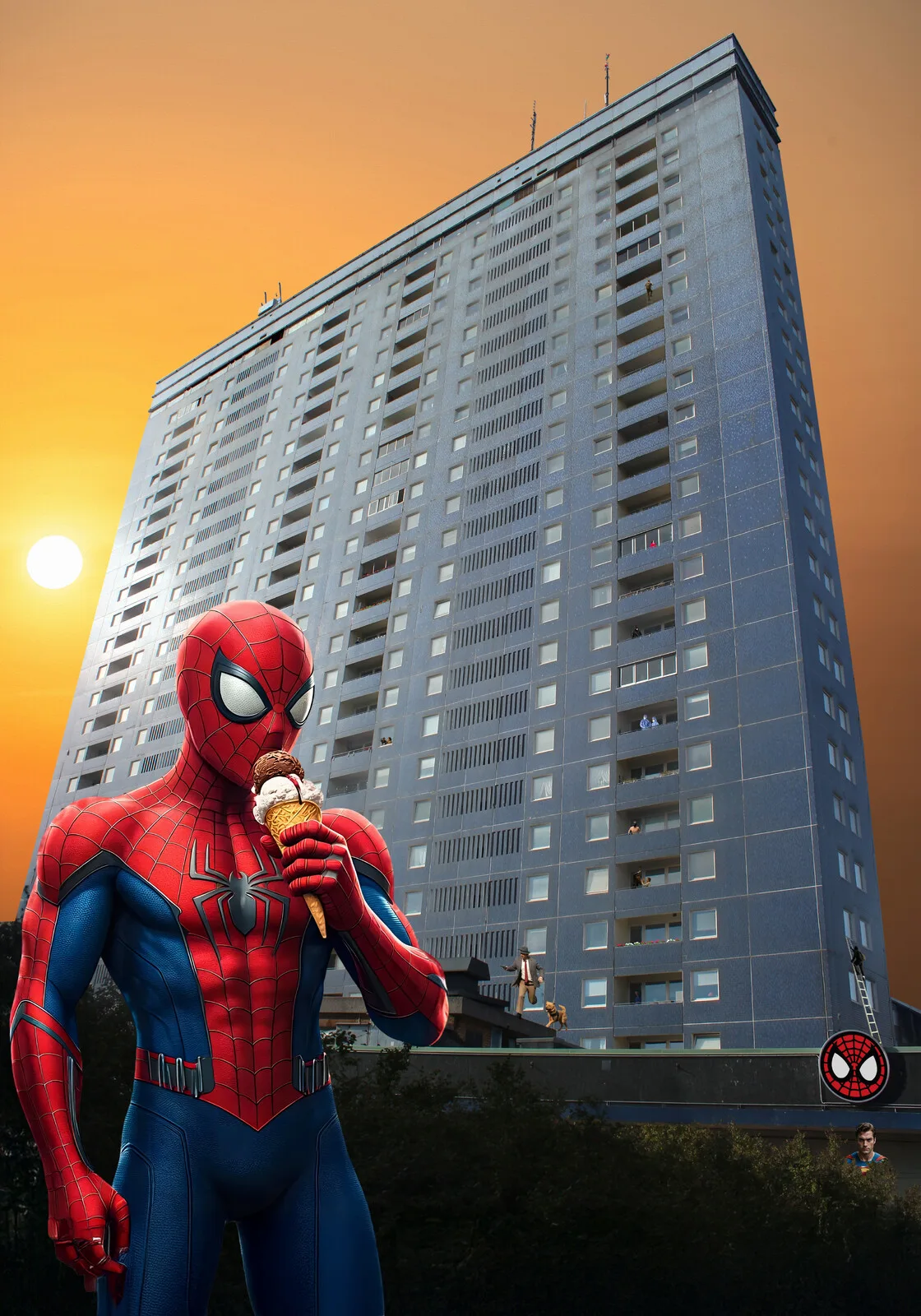
Crime Can Wait
In my picture, we see Spider-Man enjoying a colourful ice cream cone in front of the sky-blue mini skyscraper Kronprinsen, one of the buildings that lured him to Malmö. As the sun sank low in the western sky, the scene took on an almost unreal beauty, captivating the onlookers.
Spider-Man, known to attract crooks and shady elements like a magnet, seemed to be in his element this afternoon. The building, a potential hub for trouble, seemed to have arranged a meeting. But Spider-Man, unfazed, continued to enjoy his ice cream, bought from a mobile ice cream van that had arrived with a cheerful jingle. His companion, Spider-Woman, had disappeared into the building, a familiar sight for those who follow their adventures in comic books and movie screens.
”The Sweet Tooth Ballad
It starts in childhood, in Candyland's glow,
With sticky, small fingers and marshmallow snow.
A whisper of sugar, a marvellous caramel den,
And grown-ups who warn, “You'll spoil dinner again.”
But sweet tooths don’t listen, they sneak and they scheme,
They rummage through cupboards in chocolatey dreams.
By moonlight, they tiptoe with jellybean stealth,
Their loot is not in gold but in sweet-toothed wealth.
Now Spidey, you say? Oh, he’s not immune.
He swings through the skyline, but dreams of a spoon.
His web is a weapon, his senses are keen,
But one glance at gumdrops and he’s not so serene.
He tucks a few Snickers in the folds of his suit,
Keeps Skittles and liquorice handy to boot.
A hero of justice with great power and grace,
But also a chocolate bar hidden in place.
He’s fast and he’s nimble, he’s noble and neat
But he’s helplessly drawn to a sugary treat.
And when a rooftop chase seems like a must,
He’s lured by a whisper… of waffle cone crust.
A jingle, a bell, the ice cream truck nears,
And suddenly crime feels less urgent, less fierce.
He pauses. He ponders. He breathes in the air—
Of pistachio promise and lemony flair.
For some time, the bravest thing one can do
It's not chasing a thief, but pausing for a chew.
A scoop in the hand, with toppings that sing—
Even Spider-Man needs a sweet little fling.”
Malmö, June 2025
A love story in wax and fire
In my image, Spider-Man is munching on a colourful ice cream cone, drawn to Malmö by one of the buildings that caught his attention: the sky-blue Kronprinsen. At this hour, with the low sun sinking in the west, the scene is almost unreal in its beauty. Since Spider-Man has a reputation for attracting criminals and shady characters like a magnet, the building seems to be teeming with them this afternoon. It is as if they had all arranged to meet there. But Spidey doesn’t seem to care—he calmly licks his ice cream, bought from a cheerful ice cream truck that arrived jingling a while earlier. His travel companion, Spider-Woman, has already disappeared into the building—she too is a notorious trouble-seeker. One has to be, if you're going to fill comic book panels and movie frames year after year.
From now on, for brevity’s sake, I’ll use Spider-Man’s well-established nickname: Spidey. It’s used primarily in lighter or more friendly contexts, sometimes even by villains trying to diminish him. Peter Parker often refers to himself in the third person as “your friendly neighbourhood Spidey,” especially in the comics and animated versions. It’s a kind of ironic, self-aware brand. The Avengers and heroes like Tony Stark (Iron Man) sometimes refer to him as Spidey, too, especially in the MCU films. It reinforces the dynamic of mentor and “the kid.”
Spider-Man, despite his superhuman abilities, has a relatable weakness- a sweet tooth. This fact, often hidden from readers, adds a touch of humanity to his character. For older fans, his love for snacking is a source of moral pressure from health-conscious critics, as they understand the allure of things that are far too delicious to be good for you. This relatable weakness is what makes Spider-Man more than just a superhero; it's a character we can all understand and empathise with.
Spider-Man’s love for food has even put Sweden on the map. The recent popularity of pick-and-mix candy in the U.S. is a testament to this. However, the U.S. prices for these sinful delights are significantly higher than in Sweden. This cultural impact is what brings Spidey and Jessica Drew to Malmö, home to what is probably the world’s largest candy store, ‘Candy People,’ with over 2,000 kinds of these irresistible treats. Spider-Man's influence extends beyond the pages of comics, shaping the way we enjoy and appreciate food worldwide.
And yes—we’re going to let it sparkle properly in Malmö, because Jessica Drew loves candy too, and their interest in tall buildings is mutual.
Spider-Man’s private life—or more accurately, Peter Parker’s—is one of the most dramatic and multifaceted in the superhero world. Here’s a summary of what I’ve gathered (and what so often complicates his life):
So, who is the sweet tooth?
Peter Parker is Spider-Man’s civilian identity. He’s an orphaned teenager raised by his Aunt May and Uncle Ben in Queens, New York. When a radioactive spider bites him, he gains superpowers—but also a heavy responsibility, which becomes painfully apparent after Uncle Ben’s death.
Spider-Man's love life is a web of complexity. His relationships, often marked by flirtation, separation, and even retconned marriages, reflect the real-life complexities that many readers face.
Mary Jane Watson: The most well-known love interest. Their relationship has swung between flirtation, separation, and marriage (which was later retconned by Marvel’s editorial team in the controversial storyline “One More Day”).
Gwen Stacy: Peter’s first great love. She died tragically in one of the most iconic and heartbreaking comic book panels ever (“The Night Gwen Stacy Died”), an event that marked Peter forever.
Felicia Hardy (Black Cat): A more ambiguous romantic partner. She’s a cat burglar with a penchant for the masked Spider-Man—but has a more difficult time dealing with the ordinary Peter Parker.
Other shorter relationships: Betty Brant, Liz Allan, Debra Whitman, among others, each adding a layer of complexity to Spider-Man's personal life.
Career and jobs:
Peter always struggles financially. Despite his brilliance (he’s a gifted scientist), he often works below his potential.
His job at the Daily Bugle is a perfect example of his double life. Here, he works as a photographer, selling photos of himself as Spider-Man to J. Jonah Jameson, who ironically despises Spider-Man.
Research assistant, teacher, grad student – in various versions, he’s pursued an academic career, particularly in more modern interpretations.
Family and friends:
May Parker: His aunt and moral compass. She often senses more than she lets on.
Harry Osborn: Best friend, but also the son of arch-enemy Green Goblin. Their friendship is complex and tragic.
Flash Thompson: The school bully who later becomes an unexpected friend—and even a hero himself (Agent Venom).
Miles Morales: In later versions, Peter becomes a mentor to this younger Spider-Man from another universe.
Identity crises and double life:
Spider-Man may be the superhero who most realistically grapples with a double life. Peter Parker suffers from many syndromes, including a chronic sense of guilt for not doing enough, a constant battle between personal life and heroic duties, and a feeling of alienation, both as a teenager and as an adult. His struggle serves as a continuous source of empathy for his fans. We see ourselves in his guilt, his struggle to balance work and personal life, and his feelings of isolation. Spider-Man's struggles are what make him more than just a hero, but a character we can all relate to.
A chronic sense of guilt for not doing enough. A constant battle between personal life and heroic duties. A feeling of alienation, both as a teenager and as an adult.
Add to that a fractured personality lost to the multiverse and all the variations his editors have envisioned. There are countless versions of Spider-Man:
Spider-Gwen
Spider-Ham (yes, a pig)
Spider-Man 2099
Noir-Spidey
Miles Morales
…and many more.
But Peter Parker—our Spidey—remains the original: the guilty, struggling, kind-hearted nerd with spider-sense and a heart of gold. And a perpetually empty stomach, because our main character consumes surprisingly ordinary food for a superhero. His eating habits, often reflecting his New York upbringing and his eternal battle with poverty, are a testament to his relatability and what makes him so endearing to fans.
Favourite foods—what he’d call “grub”—were always what regular people ate.
Pizza – He lives in New York. Naturally, he eats pizza. Often, it’s a cheap slice from the corner—it’s fast food for a man who’s always in a hurry, a symbol of the city's fast-paced lifestyle that he embodies.
Hot dogs – A recurring feature in many comics. Is he on a rooftop? There’s a good chance he’s holding a hot dog while waiting for a crook—because, just like in war, most of the time is spent waiting. It’s only in the comic panels that everything happens at lightning speed.
Chilli rolls and junk food – Peter isn’t a health nut. When he doesn’t have time (or money), he eats a lot of fast food.
Chinese takeout – Another classic in his cramped flat. Sometimes, you’ll spot old takeout boxes in his overflowing rubbish bin.
Unlike, say, Captain America or Wolverine, Peter Parker doesn’t adhere to a strict superhero diet. He’s lean, athletic, and burns thousands of calories swinging through the city—so he eats whatever he can get. The spider bite likely enhances his metabolism.
Last but not least: Aunt May’s wheatcakes – In the early comics, these were a staple. Pancakes were made by his Aunt May. He loves them.
Desserts, snacks, cookies, and everyday sweets. Doughnuts, especially, were his go-to comfort food.
Coffee – essential in a life filled with late nights, science projects, and crime-fighting. A necessary fuel to wash down the treats. We have plenty of evidence of his junk food habits in the comics, the films, and pop culture, often with a humorous twist, because Spidey can be a bit clumsy:
In Spider-Man 2 (2004), he famously drops the pizzas he’s supposed to deliver.
In ‘Into the Spider-Verse’, we see an older Peter B. Parker comforting himself with pizza and burgers, sometimes even in the shower.
In ‘No Way Home’, we also get small glimpses of his everyday meals – often alone, often lukewarm.
His favourite food, Aunt May’s Wheatcakes, is mentioned in ‘Amazing Fantasy #15’ (1962) – Spider-Man’s very first appearance. In one early panel, Peter says he doesn’t want to be late for breakfast because “Aunt May’s wheatcakes” are something special. The actual recipe is never revealed in the comics, but I’ll share a real 1950s–60s version at the end. First, however, let’s discuss Spidey and sweets, because that’s his real weakness. His love for sweets is not just a trivial detail, but a reflection of his youthful energy and his ability to find joy in simple things. As with all Marvel Comics, there was no room for anything else. The company has long maintained a restrictive policy on tobacco, especially for its heroes. Spidey was created in 1962 as a young, moral, and responsibility-laden teenager. Smoking was incompatible with his character. His personality blends scientific curiosity, moral idealism, and civic duty. He’s the chap who says no to peer pressure, protects his friends, and stays sober even in tough times. But candy? That’s a different story.
Ah – Spider-Man and candy! A topic that doesn’t always make it into the crime-fighting seriousness of the comics but occasionally peeks through. Here’s what we know – blended from comics, films, and fan theories:
Does he eat candy? Absolutely! Spidey and his alter ego, Peter Parker, are total sweet-tooths. Not on the same level as, say, Deadpool (who lives on chimichangas and candy) – but Spidey is a young man with a supercharged metabolism. Of course, he treats himself. His love for sweets, especially his Aunt May's Wheatcakes, is a charming aspect of his character that endears him to many fans.
There was already plenty of candy in Spider-Man’s universe long before he arrived in Malmö and discovered the real stuff.
Gummy raspberries and M&Ms practically melt in his presence. In several comic panels (especially in more comedic or kid-friendly versions), we see Spidey stuffing colourful candy into his mouth while pondering his next move. At one point, he even says he “burns calories faster than a microwave,” which justifies the snacking. This love for sweets is not just a trivial detail, but a reflection of his youthful energy and his ability to find joy in simple things —a trait that endears him to many fans.
In the ‘Ultimate Spider-Man’ series, he even hands out sweets on Halloween, dressed in his costume. In some versions, he grows weary of it and eats part of the stash himself—a classic move.
In American ad campaigns, Spidey often features in commercials for sweets, especially gum, Twizzlers (those red strawberry ropes), and chocolate. It’s usually more PR than canon, but it still builds the image of a candy-loving superhero—a sweet excuse to indulge.
Some fans argue he should avoid sugar highs because they could interfere with his spider-sense – imagine experiencing an energy spike while you’re already sensing danger on a microscopic level. Not something Spidey worries about.
What else does he enjoy? Snickers or Mars – quick energy, easy to grab on the go. Skittles – colourful, affordable, nostalgic. Peanut-filled chocolate bars – Spidey may be a science nerd, but he’s also a kid from Queens. No frills.
Pop Rocks – the crackling sweets that explode in your mouth? Seems fitting for a bloke who climbs walls.
Despite his love for sweets, Spider-Man's practicality during crime-fighting often takes precedence. After all, sticky caramel fingers aren’t the most ideal when trying to apprehend a robber while swinging from rooftop to rooftop.
Spidey – or Spider-Man, as he’s referred to in the original – resides in New York City. More specifically, Peter Parker, in his civilian identity, lives in Queens and often commutes to Manhattan, where most of the crime-fighting takes place.
Where does Spidey physically live? For a long time, he resided with his aunt, who managed all the domestic chores. A superhero is above making beds, cleaning, or doing dishes. That’s still the case, although it’s often the editors who sweep away the mundane. Spidey has never ironed a shirt or laundered his tights. No comic book editor would ever write something that tedious.
In many versions of the series, he lives with his aunt in a typical row house in Queens after his parents died and his Uncle Ben was murdered (a central part of his origin story).
As he matures, he often transitions to a modest apartment in Manhattan – in the Lower East Side or Greenwich Village, depending on the version. It’s usually quite an affordable rental, a reflection of his financial struggles as a superhero.
What’s his living situation?
His living situation is simple and often a bit messy. He’s a student or freelance photographer (for ‘The Daily Bugle’), so he can’t afford luxury, just like many of us.
He has a secret storage spot for his costume and web-shooters.
In some stories, he shares an apartment with roommates or a girlfriend (e.g., Mary Jane Watson).
Why New York?
New York City, with its towering skyscrapers and bustling streets, serves as the perfect backdrop for Spider-Man’s acrobatic swinging between buildings, adding a unique charm to his adventures.
New York is also where Marvel’s heroes often congregate – it’s a kind of hub for superhero activity.
Spider-Man is a true globetrotter and has left New York countless times – on holiday, on missions, or sometimes even to other planets or dimensions. He had missed out on Malmö and Sweden. That mistake he corrected as soon as he realised Malmö was the candy capital of the world. His adventures abroad are always filled with excitement and unexpected turns.
Here are a few examples of holidays and other trips:
During his trip to Europe in the film ‘Spider-Man: Far From Home’ (2019), Peter Parker finds himself in a series of unexpected events. From a school trip to Venice, Prague, Berlin, and London, to getting pulled into a fight against villains, his adaptability in unfamiliar environments is truly tested.
Los Angeles: In some comics, he visits California, sometimes to assist other heroes or take part in superhero conferences (Marvel has sometimes poked fun at those).
Team-ups and primary missions – the list is long, but I’ll highlight a few goodies.
Wakanda: In some crossovers, he has travelled to Wakanda (Black Panther’s homeland) alongside the Avengers.
Latveria: He has had confrontations with Doctor Doom in Latveria, the fictional Eastern European country.
Space: He has been involved in cosmic events like ‘Secret Wars’ (1984), where he receives his black suit, which later turns out to be Venom!
Alternate worlds and the multiverse:
In the ‘Spider-Verse’ stories (both comics and films like ‘Into the Spider-Verse’), he encounters other versions of himself from different universes – such as Spider-Gwen, Spider-Man Noir, Spider-Ham, and even a Japanese Spider-Man with a giant robot!
He has sometimes been transported through time or to other realities – for instance, by Dr. Strange or other magical/multiversal beings.
Venice! That doesn’t sound like the right place for him. Did he fall in?
Oh yes – one could say that. Venice and Spidey’s web-swinging style does not make an ideal match. Things got… wet, to say the least.
In ‘Spider-Man: Far From Home’ (2019), we follow Peter Parker on a school trip to Europe. When they arrive in Venice, he tries to maintain a low profile – but of course, a giant water monster (Hydro-Man, or an illusion of him) appears and starts wreaking havoc in the city.
How did it go?
Peter doesn’t have his proper suit with him, just a few helpful gadgets from Nick Fury. No real protection, no preparation.
He attempts to swing as he does back home, but it quickly becomes evident that Venice’s lack of tall buildings and its abundance of bridges, boats, and canals create a nightmare for someone who relies on skyscrapers.
The result? He misses his grip, loses his balance, slips on old plaster, and plunges straight into the canal.
Not just once, but several times, he slips around like a novice in rubber boots. It’s both comical and frustrating, yet his unwavering determination to save his classmates amidst these mishaps is genuinely inspiring.
As he struggles to gain control in the water, he attempts to use gondolas and bridges as swing points. However, they don’t provide much resistance, and he often brings them down with him—the result: broken scaffolding, confused tourists, and a very soggy hero.
Spidey has an entire travel diary filled with mishaps, embarrassments, and heroic deeds at the wrong place and wrong time. You won’t find it at your local newsstand, but here are some of his most memorable travel anecdotes – outside the safe skyscrapers of New York, where the sheer absurdity of his situations often leaves you in stitches:
Paris – in a 1990s Marvel comic, Peter visits Paris. He tries swinging around as usual, but the Eiffel Tower is too pointy and lacks anchor points close to the ground. He gets his web stuck in a tourist’s selfie stick. He’s nearly arrested for hanging his suit on the Venus de Milo in the Louvre. He drops his backpack into the Seine – fortunately, his costume is made from a water-resistant material that doesn’t shrink. Spidey’s learned from experience: the same thing once happened in Florida during the comic’s early days, when he wore his old spandex. After slipping mid-swing when his web snapped and landing in a pool, the suit shrank so much it would barely fit a teenager.
Egypt – while helping Moon Knight battle a cult in Cairo, he tries to swing between the pyramids, only to realise there aren’t enough of them and they aren’t close together. A real spider – not symbolic – crawls on him in the desert, and he screams louder than he ever did facing Venom. A local guide nicknames him “Spider-Camel” after he panics and climbs on top of a tourist camel.
The Arctic – in a special issue where Spidey joins the Avengers at an Arctic research station, his sticky web freezes mid-air and turns into icicles. He slips constantly and uses his webbing as makeshift crampons – inventive, but not graceful. He gets frostbite on his fingers because his costume is not designed for cold weather, like ice storms.
In a Marvel Team-Up from the 1970s, he meets Dracula. He gets bitten – but not turned into a vampire, since radioactive blood tastes strange, according to Dracula. He stays in a castle where the bedsheets are embroidered with bats. His webbing sticks to a coffin that turns out to be Dracula on holiday.
Tokyo – in an anime-inspired series, he visits Tokyo. He struggles with the language and Googles the wrong thing, ending up at a karaoke event instead of a robotics factory. He loses control of a newly upgraded AI-driven web-shooter; it starts autonomous network attacks and cocoons an entire subway train. Mistaken for a cosplayer, he enters a contest unwillingly, winning second prize. He’s deeply unhappy with this outcome, as Spidey is competitive, and second place feels like a catastrophe.
So, how does Spidey travel abroad anyway? He’s not Batman with a private jet, nor Tony Stark with a flight suit. And certainly not Superman, who crosses the Atlantic faster than lightning. Spidey is, at heart, a working-class New Yorker on a tight budget. So when he travels internationally, it’s sometimes delightfully mundane and sometimes superhero-level absurd. He also doesn’t have the luxury of wearing his costume under his clothes like Superman, who needs a phone booth to transform. If Spidey tried that, it’d cause a stir – a naked man in a phone booth. Not to mention that phone booths are practically extinct now, which has posed serious issues for Superman lately, especially as stores and malls have become stricter about allowing people to use their restrooms. But back to Spidey’s costume logistics. Here are some ways he travels:
Peter Parker, like many of us, often finds himself in financial straits – a journalist, freelance photographer, and teacher. So, when he travels as a civilian, Peter flies on commercial flights, just like anyone else. With a passport and sometimes even visa issues, he’s constantly stressed about how to pack his suit without being caught by customs or TSA. In Amazing Spider-Man 119 from 1973, he travels to Canada and ends up fighting Hulk, but starts the trip like any regular tourist. Spidey can’t wear his suit all the time, so he sews it into the lining of his jacket or keeps it in his backpack, which sometimes backfires when a customs officer digs through it. “It’s for a masquerade,” he’ll claim. In some versions, he nearly forgets his passport or money and has to rely on local kindness – a detail that hits close to home.
When he travels abroad as Spider-Man, like to Wakanda, Latveria, or parts of Asia, he usually gets a lift from the Avengers or SHIELD, or uses some tech transport – sometimes portals from Doctor Strange, sometimes futuristic aircraft. He’s even travelled in space, but always as a passenger, not the pilot.
Japan 1978 – In the eccentric Japanese live-action series, he possesses a giant robot. There, he journeys like a typical Japanese superhero, almost reminiscent of the Power Rangers.
London – in ‘Amazing Spider-Man 95’, Peter travels to England without his costume. When he needs to act as Spidey, he borrows costume pieces from a stagehand at a theatre—the result: an improvised Spider-Man wearing a beret.
Europe – in ‘Far From Home’, he joins a school trip to Venice, Prague, and Berlin. It begins as an attempt to be a typical tourist, but he swiftly becomes entangled in mysteries. He travels with his class, flies economy, and stays in hotels – yet the suit brings complications, like being left behind in airport baggage handling.
When Spidey travels as Peter Parker, he flies economy, stays on a budget, attempts to remain low-key, and prefers walking or public transportation over taxis. As a hero, he hitches rides with wealthier friends, utilises portals, or receives SHIELD air support. As a rookie hero back in the day, he frequently encountered trouble with customs, packing, and inadvertently carrying photos of supervillains in the same suitcase as his mask.
It's pretty fascinating! Spider-Man and Spider-Woman share much in common – but they are not merely “male and female versions” of the same character. Here's a brief overview of how it works:
Spider-Man (Peter Parker) – the original. There are others, created in 1962 by Stan Lee and Steve Ditko for Marvel Comics. Peter Parker is a teenage nerd who is bitten by a radioactive spider and gains superpowers – spider-sense, strength, agility, and the ability to climb walls. He invents his web-shooters and is driven by the motto: "With great power comes great responsibility." He’s an iconic figure and has become a symbol of the everyday superhero, burdened with moral dilemmas, job troubles, love, and guilt.
Spider-Woman (Jessica Drew) – not a copy. Spider-Woman first appeared in 1977, but she’s not simply a female version of Spider-Man. Jessica Drew gained her powers through an experiment in which her ailing body was treated with a serum derived from a genetically altered spider, rather than through a bite like Peter's. She has a different origin, different powers (including bio-electric “venom blasts,” immunity to toxins, as well as gliding and flying abilities), and a career that leans more toward espionage and thrillers. She’s worked for both SHIELD and Hydra and is often portrayed as a complex and challenging hero in a more adult-oriented world. The name Spider-Woman was initially chosen because Marvel sought to secure the rights to a female spider-name before another publisher could. Nonetheless, over time, the character developed a strong and independent identity.
Other spider-women also exist. There are several other female spider figures within the Marvel universe. Gwen Stacy / Spider-Gwen / Ghost-Spider hails from an alternate universe where Gwen, not Peter, is bitten. Her character has gained immense popularity in recent years. Julia Carpenter is another Spider-Woman with a different backstory. She was created through a secret government project and was sometimes referred to as “Arachne.” May “Mayday” Parker / Spider-Girl is the daughter of Peter Parker in an alternate future universe. Silk (Cindy Moon) is a woman who was bitten by the same spider as Peter, but she possesses entirely different powers and her own unique story.
To sum up: Spider-Man is the iconic original hero. Spider-Woman (Jessica Drew) is not merely his female counterpart, but possesses her origin and tone. Several spider-women exist within Marvel, many from alternate realities or having distinct backstories. Today, Marvel’s spider-mythology comprises an entire web of characters with their own lives and symbolism.
Spider-Man and Spider-Woman have collaborated numerous times across various comics and line-ups. Their relationship has always been professional, showcasing their respect and appreciation for each other's abilities. Here are some examples of their partnerships and how they are frequently portrayed together.
Spider-Man and Jessica Drew (the original Spider-Woman) have appeared together in several teams, particularly in the Avengers. Both have been members of various Avengers rosters, notably during the 2000s-era New Avengers, where they often fought side by side. In Secret Invasion (2008), Jessica Drew plays a pivotal role – it turns out a Skrull (an alien infiltrator) had been impersonating her for quite some time. Spider-Man is one of those confronting this betrayal, fostering tension between them. In Spider-Verse, the grand multiverse adventure from 2014–15, a multitude of spider-characters are summoned – including Peter Parker and Jessica Drew – to combat threats endangering all the universes' spider-beings. They respect one another, but there has rarely been any suggestion of a deeper connection. It’s more reminiscent of mutual recognition – both bear the burden of solitary heroism.
Spider-Man and Spider-Gwen (Ghost-Spider) represent a more emotionally complex pairing. In the Spider-Verse stories and later series, Peter from our universe meets Gwen from Earth-65. Their relationship unfolds with tenderness but also sorrow and loss, creating a bond that many readers can empathise with. In the comics, it’s more mixed – sometimes just friends, hinting at something more – yet their bond often possesses a sense of unspoken understanding. Both have lost someone dear (Peter lost Gwen; Gwen lost Peter), which establishes a powerful mirroring between them.
Spider-Man and Silk (Cindy Moon) share one of the oddest dynamics. The same radioactive spider bit both Cindy and Peter, and when they first meet, there’s a biological, almost primal attraction between them that makes it difficult to resist... making out amid a fight. They collaborate in several series, but their relationship is often complicated: both colleagues and potential lovers. Over time, their bond evolves into that of kindred survivors rather than romantic partners.
Spider-Verse and Spider-Geddon bring together all the Spider-characters: Peter, Jessica, Gwen, Silk, Miles Morales, Ben Reilly, Spider-Ham (yes!), Peni Parker, and more. They fight together against threats like Morlun and The Inheritors, who hunt spider-beings across universes. These grand crossover sagas highlight the shared “spider spirit” connecting them all, regardless of gender, background, or dimension. It’s a kind of collective hero myth, where they view each other as siblings rather than rivals.
SCENE: Copenhagen Airport, Kastrup.
TIME: 06:42 AM.
ENVIRONMENT: Fluorescent lighting. Sleepy travellers. A waft of coffee, stale fabric, and aluminium.
PASSPORT OFFICER JENSEN (experienced, sceptical, collects memorable Americans):
— Mr. Peter Benjamin Parker. From Queens?
PETER:
— Yes, sir. The one without corgis or castles.
JENSEN (scans the passport):
— Hmm.
(A soft chime is heard from the monitor. A box flashes. Not red. Not green. Yellow. A special protocol Jensen hasn’t encountered before. The message is short:)
“LEVEL: SPECIAL / AV-ALPHA. Do not detain. Flag: AVENGERS INTL.”
JENSEN (grumbling to himself):
— Hvad fan er "AV-ALPHA"...?
(He clicks. Nothing more. No crimes. No visa issues. Just a steady yellow icon beside the name.)
PETER (nervously):
— Something wrong?
JENSEN (looking up slowly):
— No… but you seem to be… a sort of… priority traveller?
PETER (playing dumb):
— I do have frequent-flyer miles.
JENSEN:
— Are you… with some authority?
PETER:
— I’m in science education. Big fan of Newton. And gravity. Not so much customs.
(Jensen sighs and opens the suitcase. He starts rummaging through it. He pulls out: a crumpled map of central Copenhagen, a jar of peanut butter, a half-broken phone… and finally: a pair of shiny silk underpants with cheerful little spiders, adding to the absurdity of the situation.)
He holds them up with two fingers.
JENSEN (dryly):
— Is this camouflage?
PETER (quietly):
— They’re… symbolic.
JENSEN (after a long look):
— I’ve seen worse. Once an American arrived in a bear costume and wanted to go to Roskilde.
(He carefully puts the underpants back, closes the suitcase, and leans forward.)
JENSEN:
— Well, Mr Parker. I don’t know who you are. But someone does. And apparently, that’s enough. Welcome to Denmark.
(He stamps the passport with a thud. Hands it back with a symbolic nod. Peter nods too – stiffly, but gratefully.)
PETER (walking away, muttering):
It should be locked in a spiderweb.
CUSTOMS OFFICER (a dull sort):
— Hrm. Bag please.
(Peter hands over his backpack, nervously. It’s stuffed. A book on Kant sticks out beside a rolled-up umbrella and something that looks like a squashed shoelace.)
CUSTOMS OFFICER:
— You packed this yourself?
PETER:
— I had help from gravity.
CUSTOMS OFFICER (starts rummaging, methodically):
— What’s this?
(He holds up something soft and red that glimmers under the fluorescent lights. A pair of shiny red silk underpants with small smiling blue spiders on them.)
CUSTOMS OFFICER (turns to his colleague with a grin):
— Hans Andersen, look here! The American has exclusive nightwear.
ANDERSEN (a secret fan of the comic character Spider-Man. If he had known who stood on the other side of the counter, he would probably have shown more respect. [He is a middle-aged man with a slight paunch, wearing a slightly too-tight uniform that he's outgrown.])
— Is that Spider-Man Limited Edition? Or just… Spider-Guy on vacation?
PETER (blushing):
— They’re a gag gift from my Aunt May. She has a strange sense of humour. And a sewing machine.
CUSTOMS OFFICER (waving theatrically):
— Looks like they could crawl by themselves. Should we send them to the Technical Institute?
PETER:
— Please don’t. They’re… emotionally radioactive.
(The customs officer returns the underpants to the backpack with about as much respect as one might handle a Russian matryoshka doll – that is, these days, none at all. [He does this with dramatic flair, as if handling a delicate and dangerous object.])
PASSPORT OFFICER:
— Welcome to Denmark, Mr. Parker. Mind the bicycles. And the wind. And public opinion.
(Parker walks on, his face so red you could fry bacon on it. But he’s in. And the underpants… survived.)
The promised recipe for Aunt May’s Wheatcakes
Imagine something between pancakes and old-fashioned American graham griddlecakes – soft, hearty, nostalgic.
Ingredients (about four servings / 12 small cakes):
– 1 cup whole wheat flour (graham or sifted wholemeal)
– ⅔ cup all-purpose flour
– 1 tbsp sugar
– 1 tsp baking powder
– ½ tsp baking soda
– ½ tsp salt
– 1 cup buttermilk (or ¾ cup milk + 1 tbsp lemon juice)
– 1 egg
– 2 tbsp melted butter or neutral oil
– A little vanilla sugar (optional, but not wrong)
To serve:
Maple syrup (or honey)
Butter
Berries if you want to be modern, bacon if you're traditional
Instructions:
Mix the dry ingredients in a large bowl: both flours, sugar, baking powder, baking soda, salt (and vanilla sugar, if using).
In another bowl, whisk together the buttermilk, egg, and melted butter.
Stir the wet into the dry until you achieve a thick batter. Let it rest for 5–10 minutes.
Heat a frying pan with a bit of butter. Drop the batter into small rounds (about 4 inches in diameter).
Fry on medium heat until bubbles appear and the edges are set, then flip and cook the other side.
Tip from Aunt May:
Want an authentic 1960s vibe? Serve with a cold glass of milk and have the radio on in the background.
Want more “hero fuel”? Mix in half a mashed banana or a spoonful of peanut butter – it works! or a spoonful of peanut butter – it works!
Jörgen Thornberg
Utan titel, 2025
Digital
50 x 70 cm
3 200 kr
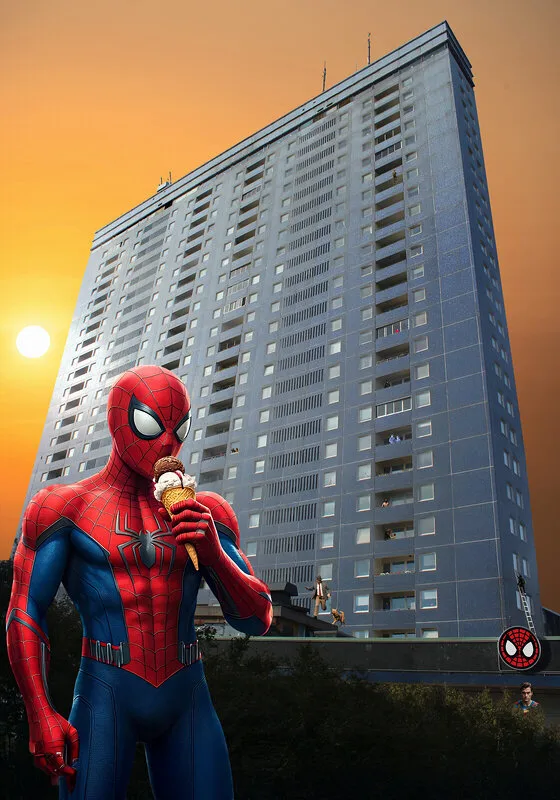
Crime Can Wait
In my picture, we see Spider-Man enjoying a colourful ice cream cone in front of the sky-blue mini skyscraper Kronprinsen, one of the buildings that lured him to Malmö. As the sun sank low in the western sky, the scene took on an almost unreal beauty, captivating the onlookers.
Spider-Man, known to attract crooks and shady elements like a magnet, seemed to be in his element this afternoon. The building, a potential hub for trouble, seemed to have arranged a meeting. But Spider-Man, unfazed, continued to enjoy his ice cream, bought from a mobile ice cream van that had arrived with a cheerful jingle. His companion, Spider-Woman, had disappeared into the building, a familiar sight for those who follow their adventures in comic books and movie screens.
”The Sweet Tooth Ballad
It starts in childhood, in Candyland's glow,
With sticky, small fingers and marshmallow snow.
A whisper of sugar, a marvellous caramel den,
And grown-ups who warn, “You'll spoil dinner again.”
But sweet tooths don’t listen, they sneak and they scheme,
They rummage through cupboards in chocolatey dreams.
By moonlight, they tiptoe with jellybean stealth,
Their loot is not in gold but in sweet-toothed wealth.
Now Spidey, you say? Oh, he’s not immune.
He swings through the skyline, but dreams of a spoon.
His web is a weapon, his senses are keen,
But one glance at gumdrops and he’s not so serene.
He tucks a few Snickers in the folds of his suit,
Keeps Skittles and liquorice handy to boot.
A hero of justice with great power and grace,
But also a chocolate bar hidden in place.
He’s fast and he’s nimble, he’s noble and neat
But he’s helplessly drawn to a sugary treat.
And when a rooftop chase seems like a must,
He’s lured by a whisper… of waffle cone crust.
A jingle, a bell, the ice cream truck nears,
And suddenly crime feels less urgent, less fierce.
He pauses. He ponders. He breathes in the air—
Of pistachio promise and lemony flair.
For some time, the bravest thing one can do
It's not chasing a thief, but pausing for a chew.
A scoop in the hand, with toppings that sing—
Even Spider-Man needs a sweet little fling.”
Malmö, June 2025
A love story in wax and fire
In my image, Spider-Man is munching on a colourful ice cream cone, drawn to Malmö by one of the buildings that caught his attention: the sky-blue Kronprinsen. At this hour, with the low sun sinking in the west, the scene is almost unreal in its beauty. Since Spider-Man has a reputation for attracting criminals and shady characters like a magnet, the building seems to be teeming with them this afternoon. It is as if they had all arranged to meet there. But Spidey doesn’t seem to care—he calmly licks his ice cream, bought from a cheerful ice cream truck that arrived jingling a while earlier. His travel companion, Spider-Woman, has already disappeared into the building—she too is a notorious trouble-seeker. One has to be, if you're going to fill comic book panels and movie frames year after year.
From now on, for brevity’s sake, I’ll use Spider-Man’s well-established nickname: Spidey. It’s used primarily in lighter or more friendly contexts, sometimes even by villains trying to diminish him. Peter Parker often refers to himself in the third person as “your friendly neighbourhood Spidey,” especially in the comics and animated versions. It’s a kind of ironic, self-aware brand. The Avengers and heroes like Tony Stark (Iron Man) sometimes refer to him as Spidey, too, especially in the MCU films. It reinforces the dynamic of mentor and “the kid.”
Spider-Man, despite his superhuman abilities, has a relatable weakness- a sweet tooth. This fact, often hidden from readers, adds a touch of humanity to his character. For older fans, his love for snacking is a source of moral pressure from health-conscious critics, as they understand the allure of things that are far too delicious to be good for you. This relatable weakness is what makes Spider-Man more than just a superhero; it's a character we can all understand and empathise with.
Spider-Man’s love for food has even put Sweden on the map. The recent popularity of pick-and-mix candy in the U.S. is a testament to this. However, the U.S. prices for these sinful delights are significantly higher than in Sweden. This cultural impact is what brings Spidey and Jessica Drew to Malmö, home to what is probably the world’s largest candy store, ‘Candy People,’ with over 2,000 kinds of these irresistible treats. Spider-Man's influence extends beyond the pages of comics, shaping the way we enjoy and appreciate food worldwide.
And yes—we’re going to let it sparkle properly in Malmö, because Jessica Drew loves candy too, and their interest in tall buildings is mutual.
Spider-Man’s private life—or more accurately, Peter Parker’s—is one of the most dramatic and multifaceted in the superhero world. Here’s a summary of what I’ve gathered (and what so often complicates his life):
So, who is the sweet tooth?
Peter Parker is Spider-Man’s civilian identity. He’s an orphaned teenager raised by his Aunt May and Uncle Ben in Queens, New York. When a radioactive spider bites him, he gains superpowers—but also a heavy responsibility, which becomes painfully apparent after Uncle Ben’s death.
Spider-Man's love life is a web of complexity. His relationships, often marked by flirtation, separation, and even retconned marriages, reflect the real-life complexities that many readers face.
Mary Jane Watson: The most well-known love interest. Their relationship has swung between flirtation, separation, and marriage (which was later retconned by Marvel’s editorial team in the controversial storyline “One More Day”).
Gwen Stacy: Peter’s first great love. She died tragically in one of the most iconic and heartbreaking comic book panels ever (“The Night Gwen Stacy Died”), an event that marked Peter forever.
Felicia Hardy (Black Cat): A more ambiguous romantic partner. She’s a cat burglar with a penchant for the masked Spider-Man—but has a more difficult time dealing with the ordinary Peter Parker.
Other shorter relationships: Betty Brant, Liz Allan, Debra Whitman, among others, each adding a layer of complexity to Spider-Man's personal life.
Career and jobs:
Peter always struggles financially. Despite his brilliance (he’s a gifted scientist), he often works below his potential.
His job at the Daily Bugle is a perfect example of his double life. Here, he works as a photographer, selling photos of himself as Spider-Man to J. Jonah Jameson, who ironically despises Spider-Man.
Research assistant, teacher, grad student – in various versions, he’s pursued an academic career, particularly in more modern interpretations.
Family and friends:
May Parker: His aunt and moral compass. She often senses more than she lets on.
Harry Osborn: Best friend, but also the son of arch-enemy Green Goblin. Their friendship is complex and tragic.
Flash Thompson: The school bully who later becomes an unexpected friend—and even a hero himself (Agent Venom).
Miles Morales: In later versions, Peter becomes a mentor to this younger Spider-Man from another universe.
Identity crises and double life:
Spider-Man may be the superhero who most realistically grapples with a double life. Peter Parker suffers from many syndromes, including a chronic sense of guilt for not doing enough, a constant battle between personal life and heroic duties, and a feeling of alienation, both as a teenager and as an adult. His struggle serves as a continuous source of empathy for his fans. We see ourselves in his guilt, his struggle to balance work and personal life, and his feelings of isolation. Spider-Man's struggles are what make him more than just a hero, but a character we can all relate to.
A chronic sense of guilt for not doing enough. A constant battle between personal life and heroic duties. A feeling of alienation, both as a teenager and as an adult.
Add to that a fractured personality lost to the multiverse and all the variations his editors have envisioned. There are countless versions of Spider-Man:
Spider-Gwen
Spider-Ham (yes, a pig)
Spider-Man 2099
Noir-Spidey
Miles Morales
…and many more.
But Peter Parker—our Spidey—remains the original: the guilty, struggling, kind-hearted nerd with spider-sense and a heart of gold. And a perpetually empty stomach, because our main character consumes surprisingly ordinary food for a superhero. His eating habits, often reflecting his New York upbringing and his eternal battle with poverty, are a testament to his relatability and what makes him so endearing to fans.
Favourite foods—what he’d call “grub”—were always what regular people ate.
Pizza – He lives in New York. Naturally, he eats pizza. Often, it’s a cheap slice from the corner—it’s fast food for a man who’s always in a hurry, a symbol of the city's fast-paced lifestyle that he embodies.
Hot dogs – A recurring feature in many comics. Is he on a rooftop? There’s a good chance he’s holding a hot dog while waiting for a crook—because, just like in war, most of the time is spent waiting. It’s only in the comic panels that everything happens at lightning speed.
Chilli rolls and junk food – Peter isn’t a health nut. When he doesn’t have time (or money), he eats a lot of fast food.
Chinese takeout – Another classic in his cramped flat. Sometimes, you’ll spot old takeout boxes in his overflowing rubbish bin.
Unlike, say, Captain America or Wolverine, Peter Parker doesn’t adhere to a strict superhero diet. He’s lean, athletic, and burns thousands of calories swinging through the city—so he eats whatever he can get. The spider bite likely enhances his metabolism.
Last but not least: Aunt May’s wheatcakes – In the early comics, these were a staple. Pancakes were made by his Aunt May. He loves them.
Desserts, snacks, cookies, and everyday sweets. Doughnuts, especially, were his go-to comfort food.
Coffee – essential in a life filled with late nights, science projects, and crime-fighting. A necessary fuel to wash down the treats. We have plenty of evidence of his junk food habits in the comics, the films, and pop culture, often with a humorous twist, because Spidey can be a bit clumsy:
In Spider-Man 2 (2004), he famously drops the pizzas he’s supposed to deliver.
In ‘Into the Spider-Verse’, we see an older Peter B. Parker comforting himself with pizza and burgers, sometimes even in the shower.
In ‘No Way Home’, we also get small glimpses of his everyday meals – often alone, often lukewarm.
His favourite food, Aunt May’s Wheatcakes, is mentioned in ‘Amazing Fantasy #15’ (1962) – Spider-Man’s very first appearance. In one early panel, Peter says he doesn’t want to be late for breakfast because “Aunt May’s wheatcakes” are something special. The actual recipe is never revealed in the comics, but I’ll share a real 1950s–60s version at the end. First, however, let’s discuss Spidey and sweets, because that’s his real weakness. His love for sweets is not just a trivial detail, but a reflection of his youthful energy and his ability to find joy in simple things. As with all Marvel Comics, there was no room for anything else. The company has long maintained a restrictive policy on tobacco, especially for its heroes. Spidey was created in 1962 as a young, moral, and responsibility-laden teenager. Smoking was incompatible with his character. His personality blends scientific curiosity, moral idealism, and civic duty. He’s the chap who says no to peer pressure, protects his friends, and stays sober even in tough times. But candy? That’s a different story.
Ah – Spider-Man and candy! A topic that doesn’t always make it into the crime-fighting seriousness of the comics but occasionally peeks through. Here’s what we know – blended from comics, films, and fan theories:
Does he eat candy? Absolutely! Spidey and his alter ego, Peter Parker, are total sweet-tooths. Not on the same level as, say, Deadpool (who lives on chimichangas and candy) – but Spidey is a young man with a supercharged metabolism. Of course, he treats himself. His love for sweets, especially his Aunt May's Wheatcakes, is a charming aspect of his character that endears him to many fans.
There was already plenty of candy in Spider-Man’s universe long before he arrived in Malmö and discovered the real stuff.
Gummy raspberries and M&Ms practically melt in his presence. In several comic panels (especially in more comedic or kid-friendly versions), we see Spidey stuffing colourful candy into his mouth while pondering his next move. At one point, he even says he “burns calories faster than a microwave,” which justifies the snacking. This love for sweets is not just a trivial detail, but a reflection of his youthful energy and his ability to find joy in simple things —a trait that endears him to many fans.
In the ‘Ultimate Spider-Man’ series, he even hands out sweets on Halloween, dressed in his costume. In some versions, he grows weary of it and eats part of the stash himself—a classic move.
In American ad campaigns, Spidey often features in commercials for sweets, especially gum, Twizzlers (those red strawberry ropes), and chocolate. It’s usually more PR than canon, but it still builds the image of a candy-loving superhero—a sweet excuse to indulge.
Some fans argue he should avoid sugar highs because they could interfere with his spider-sense – imagine experiencing an energy spike while you’re already sensing danger on a microscopic level. Not something Spidey worries about.
What else does he enjoy? Snickers or Mars – quick energy, easy to grab on the go. Skittles – colourful, affordable, nostalgic. Peanut-filled chocolate bars – Spidey may be a science nerd, but he’s also a kid from Queens. No frills.
Pop Rocks – the crackling sweets that explode in your mouth? Seems fitting for a bloke who climbs walls.
Despite his love for sweets, Spider-Man's practicality during crime-fighting often takes precedence. After all, sticky caramel fingers aren’t the most ideal when trying to apprehend a robber while swinging from rooftop to rooftop.
Spidey – or Spider-Man, as he’s referred to in the original – resides in New York City. More specifically, Peter Parker, in his civilian identity, lives in Queens and often commutes to Manhattan, where most of the crime-fighting takes place.
Where does Spidey physically live? For a long time, he resided with his aunt, who managed all the domestic chores. A superhero is above making beds, cleaning, or doing dishes. That’s still the case, although it’s often the editors who sweep away the mundane. Spidey has never ironed a shirt or laundered his tights. No comic book editor would ever write something that tedious.
In many versions of the series, he lives with his aunt in a typical row house in Queens after his parents died and his Uncle Ben was murdered (a central part of his origin story).
As he matures, he often transitions to a modest apartment in Manhattan – in the Lower East Side or Greenwich Village, depending on the version. It’s usually quite an affordable rental, a reflection of his financial struggles as a superhero.
What’s his living situation?
His living situation is simple and often a bit messy. He’s a student or freelance photographer (for ‘The Daily Bugle’), so he can’t afford luxury, just like many of us.
He has a secret storage spot for his costume and web-shooters.
In some stories, he shares an apartment with roommates or a girlfriend (e.g., Mary Jane Watson).
Why New York?
New York City, with its towering skyscrapers and bustling streets, serves as the perfect backdrop for Spider-Man’s acrobatic swinging between buildings, adding a unique charm to his adventures.
New York is also where Marvel’s heroes often congregate – it’s a kind of hub for superhero activity.
Spider-Man is a true globetrotter and has left New York countless times – on holiday, on missions, or sometimes even to other planets or dimensions. He had missed out on Malmö and Sweden. That mistake he corrected as soon as he realised Malmö was the candy capital of the world. His adventures abroad are always filled with excitement and unexpected turns.
Here are a few examples of holidays and other trips:
During his trip to Europe in the film ‘Spider-Man: Far From Home’ (2019), Peter Parker finds himself in a series of unexpected events. From a school trip to Venice, Prague, Berlin, and London, to getting pulled into a fight against villains, his adaptability in unfamiliar environments is truly tested.
Los Angeles: In some comics, he visits California, sometimes to assist other heroes or take part in superhero conferences (Marvel has sometimes poked fun at those).
Team-ups and primary missions – the list is long, but I’ll highlight a few goodies.
Wakanda: In some crossovers, he has travelled to Wakanda (Black Panther’s homeland) alongside the Avengers.
Latveria: He has had confrontations with Doctor Doom in Latveria, the fictional Eastern European country.
Space: He has been involved in cosmic events like ‘Secret Wars’ (1984), where he receives his black suit, which later turns out to be Venom!
Alternate worlds and the multiverse:
In the ‘Spider-Verse’ stories (both comics and films like ‘Into the Spider-Verse’), he encounters other versions of himself from different universes – such as Spider-Gwen, Spider-Man Noir, Spider-Ham, and even a Japanese Spider-Man with a giant robot!
He has sometimes been transported through time or to other realities – for instance, by Dr. Strange or other magical/multiversal beings.
Venice! That doesn’t sound like the right place for him. Did he fall in?
Oh yes – one could say that. Venice and Spidey’s web-swinging style does not make an ideal match. Things got… wet, to say the least.
In ‘Spider-Man: Far From Home’ (2019), we follow Peter Parker on a school trip to Europe. When they arrive in Venice, he tries to maintain a low profile – but of course, a giant water monster (Hydro-Man, or an illusion of him) appears and starts wreaking havoc in the city.
How did it go?
Peter doesn’t have his proper suit with him, just a few helpful gadgets from Nick Fury. No real protection, no preparation.
He attempts to swing as he does back home, but it quickly becomes evident that Venice’s lack of tall buildings and its abundance of bridges, boats, and canals create a nightmare for someone who relies on skyscrapers.
The result? He misses his grip, loses his balance, slips on old plaster, and plunges straight into the canal.
Not just once, but several times, he slips around like a novice in rubber boots. It’s both comical and frustrating, yet his unwavering determination to save his classmates amidst these mishaps is genuinely inspiring.
As he struggles to gain control in the water, he attempts to use gondolas and bridges as swing points. However, they don’t provide much resistance, and he often brings them down with him—the result: broken scaffolding, confused tourists, and a very soggy hero.
Spidey has an entire travel diary filled with mishaps, embarrassments, and heroic deeds at the wrong place and wrong time. You won’t find it at your local newsstand, but here are some of his most memorable travel anecdotes – outside the safe skyscrapers of New York, where the sheer absurdity of his situations often leaves you in stitches:
Paris – in a 1990s Marvel comic, Peter visits Paris. He tries swinging around as usual, but the Eiffel Tower is too pointy and lacks anchor points close to the ground. He gets his web stuck in a tourist’s selfie stick. He’s nearly arrested for hanging his suit on the Venus de Milo in the Louvre. He drops his backpack into the Seine – fortunately, his costume is made from a water-resistant material that doesn’t shrink. Spidey’s learned from experience: the same thing once happened in Florida during the comic’s early days, when he wore his old spandex. After slipping mid-swing when his web snapped and landing in a pool, the suit shrank so much it would barely fit a teenager.
Egypt – while helping Moon Knight battle a cult in Cairo, he tries to swing between the pyramids, only to realise there aren’t enough of them and they aren’t close together. A real spider – not symbolic – crawls on him in the desert, and he screams louder than he ever did facing Venom. A local guide nicknames him “Spider-Camel” after he panics and climbs on top of a tourist camel.
The Arctic – in a special issue where Spidey joins the Avengers at an Arctic research station, his sticky web freezes mid-air and turns into icicles. He slips constantly and uses his webbing as makeshift crampons – inventive, but not graceful. He gets frostbite on his fingers because his costume is not designed for cold weather, like ice storms.
In a Marvel Team-Up from the 1970s, he meets Dracula. He gets bitten – but not turned into a vampire, since radioactive blood tastes strange, according to Dracula. He stays in a castle where the bedsheets are embroidered with bats. His webbing sticks to a coffin that turns out to be Dracula on holiday.
Tokyo – in an anime-inspired series, he visits Tokyo. He struggles with the language and Googles the wrong thing, ending up at a karaoke event instead of a robotics factory. He loses control of a newly upgraded AI-driven web-shooter; it starts autonomous network attacks and cocoons an entire subway train. Mistaken for a cosplayer, he enters a contest unwillingly, winning second prize. He’s deeply unhappy with this outcome, as Spidey is competitive, and second place feels like a catastrophe.
So, how does Spidey travel abroad anyway? He’s not Batman with a private jet, nor Tony Stark with a flight suit. And certainly not Superman, who crosses the Atlantic faster than lightning. Spidey is, at heart, a working-class New Yorker on a tight budget. So when he travels internationally, it’s sometimes delightfully mundane and sometimes superhero-level absurd. He also doesn’t have the luxury of wearing his costume under his clothes like Superman, who needs a phone booth to transform. If Spidey tried that, it’d cause a stir – a naked man in a phone booth. Not to mention that phone booths are practically extinct now, which has posed serious issues for Superman lately, especially as stores and malls have become stricter about allowing people to use their restrooms. But back to Spidey’s costume logistics. Here are some ways he travels:
Peter Parker, like many of us, often finds himself in financial straits – a journalist, freelance photographer, and teacher. So, when he travels as a civilian, Peter flies on commercial flights, just like anyone else. With a passport and sometimes even visa issues, he’s constantly stressed about how to pack his suit without being caught by customs or TSA. In Amazing Spider-Man 119 from 1973, he travels to Canada and ends up fighting Hulk, but starts the trip like any regular tourist. Spidey can’t wear his suit all the time, so he sews it into the lining of his jacket or keeps it in his backpack, which sometimes backfires when a customs officer digs through it. “It’s for a masquerade,” he’ll claim. In some versions, he nearly forgets his passport or money and has to rely on local kindness – a detail that hits close to home.
When he travels abroad as Spider-Man, like to Wakanda, Latveria, or parts of Asia, he usually gets a lift from the Avengers or SHIELD, or uses some tech transport – sometimes portals from Doctor Strange, sometimes futuristic aircraft. He’s even travelled in space, but always as a passenger, not the pilot.
Japan 1978 – In the eccentric Japanese live-action series, he possesses a giant robot. There, he journeys like a typical Japanese superhero, almost reminiscent of the Power Rangers.
London – in ‘Amazing Spider-Man 95’, Peter travels to England without his costume. When he needs to act as Spidey, he borrows costume pieces from a stagehand at a theatre—the result: an improvised Spider-Man wearing a beret.
Europe – in ‘Far From Home’, he joins a school trip to Venice, Prague, and Berlin. It begins as an attempt to be a typical tourist, but he swiftly becomes entangled in mysteries. He travels with his class, flies economy, and stays in hotels – yet the suit brings complications, like being left behind in airport baggage handling.
When Spidey travels as Peter Parker, he flies economy, stays on a budget, attempts to remain low-key, and prefers walking or public transportation over taxis. As a hero, he hitches rides with wealthier friends, utilises portals, or receives SHIELD air support. As a rookie hero back in the day, he frequently encountered trouble with customs, packing, and inadvertently carrying photos of supervillains in the same suitcase as his mask.
It's pretty fascinating! Spider-Man and Spider-Woman share much in common – but they are not merely “male and female versions” of the same character. Here's a brief overview of how it works:
Spider-Man (Peter Parker) – the original. There are others, created in 1962 by Stan Lee and Steve Ditko for Marvel Comics. Peter Parker is a teenage nerd who is bitten by a radioactive spider and gains superpowers – spider-sense, strength, agility, and the ability to climb walls. He invents his web-shooters and is driven by the motto: "With great power comes great responsibility." He’s an iconic figure and has become a symbol of the everyday superhero, burdened with moral dilemmas, job troubles, love, and guilt.
Spider-Woman (Jessica Drew) – not a copy. Spider-Woman first appeared in 1977, but she’s not simply a female version of Spider-Man. Jessica Drew gained her powers through an experiment in which her ailing body was treated with a serum derived from a genetically altered spider, rather than through a bite like Peter's. She has a different origin, different powers (including bio-electric “venom blasts,” immunity to toxins, as well as gliding and flying abilities), and a career that leans more toward espionage and thrillers. She’s worked for both SHIELD and Hydra and is often portrayed as a complex and challenging hero in a more adult-oriented world. The name Spider-Woman was initially chosen because Marvel sought to secure the rights to a female spider-name before another publisher could. Nonetheless, over time, the character developed a strong and independent identity.
Other spider-women also exist. There are several other female spider figures within the Marvel universe. Gwen Stacy / Spider-Gwen / Ghost-Spider hails from an alternate universe where Gwen, not Peter, is bitten. Her character has gained immense popularity in recent years. Julia Carpenter is another Spider-Woman with a different backstory. She was created through a secret government project and was sometimes referred to as “Arachne.” May “Mayday” Parker / Spider-Girl is the daughter of Peter Parker in an alternate future universe. Silk (Cindy Moon) is a woman who was bitten by the same spider as Peter, but she possesses entirely different powers and her own unique story.
To sum up: Spider-Man is the iconic original hero. Spider-Woman (Jessica Drew) is not merely his female counterpart, but possesses her origin and tone. Several spider-women exist within Marvel, many from alternate realities or having distinct backstories. Today, Marvel’s spider-mythology comprises an entire web of characters with their own lives and symbolism.
Spider-Man and Spider-Woman have collaborated numerous times across various comics and line-ups. Their relationship has always been professional, showcasing their respect and appreciation for each other's abilities. Here are some examples of their partnerships and how they are frequently portrayed together.
Spider-Man and Jessica Drew (the original Spider-Woman) have appeared together in several teams, particularly in the Avengers. Both have been members of various Avengers rosters, notably during the 2000s-era New Avengers, where they often fought side by side. In Secret Invasion (2008), Jessica Drew plays a pivotal role – it turns out a Skrull (an alien infiltrator) had been impersonating her for quite some time. Spider-Man is one of those confronting this betrayal, fostering tension between them. In Spider-Verse, the grand multiverse adventure from 2014–15, a multitude of spider-characters are summoned – including Peter Parker and Jessica Drew – to combat threats endangering all the universes' spider-beings. They respect one another, but there has rarely been any suggestion of a deeper connection. It’s more reminiscent of mutual recognition – both bear the burden of solitary heroism.
Spider-Man and Spider-Gwen (Ghost-Spider) represent a more emotionally complex pairing. In the Spider-Verse stories and later series, Peter from our universe meets Gwen from Earth-65. Their relationship unfolds with tenderness but also sorrow and loss, creating a bond that many readers can empathise with. In the comics, it’s more mixed – sometimes just friends, hinting at something more – yet their bond often possesses a sense of unspoken understanding. Both have lost someone dear (Peter lost Gwen; Gwen lost Peter), which establishes a powerful mirroring between them.
Spider-Man and Silk (Cindy Moon) share one of the oddest dynamics. The same radioactive spider bit both Cindy and Peter, and when they first meet, there’s a biological, almost primal attraction between them that makes it difficult to resist... making out amid a fight. They collaborate in several series, but their relationship is often complicated: both colleagues and potential lovers. Over time, their bond evolves into that of kindred survivors rather than romantic partners.
Spider-Verse and Spider-Geddon bring together all the Spider-characters: Peter, Jessica, Gwen, Silk, Miles Morales, Ben Reilly, Spider-Ham (yes!), Peni Parker, and more. They fight together against threats like Morlun and The Inheritors, who hunt spider-beings across universes. These grand crossover sagas highlight the shared “spider spirit” connecting them all, regardless of gender, background, or dimension. It’s a kind of collective hero myth, where they view each other as siblings rather than rivals.
SCENE: Copenhagen Airport, Kastrup.
TIME: 06:42 AM.
ENVIRONMENT: Fluorescent lighting. Sleepy travellers. A waft of coffee, stale fabric, and aluminium.
PASSPORT OFFICER JENSEN (experienced, sceptical, collects memorable Americans):
— Mr. Peter Benjamin Parker. From Queens?
PETER:
— Yes, sir. The one without corgis or castles.
JENSEN (scans the passport):
— Hmm.
(A soft chime is heard from the monitor. A box flashes. Not red. Not green. Yellow. A special protocol Jensen hasn’t encountered before. The message is short:)
“LEVEL: SPECIAL / AV-ALPHA. Do not detain. Flag: AVENGERS INTL.”
JENSEN (grumbling to himself):
— Hvad fan er "AV-ALPHA"...?
(He clicks. Nothing more. No crimes. No visa issues. Just a steady yellow icon beside the name.)
PETER (nervously):
— Something wrong?
JENSEN (looking up slowly):
— No… but you seem to be… a sort of… priority traveller?
PETER (playing dumb):
— I do have frequent-flyer miles.
JENSEN:
— Are you… with some authority?
PETER:
— I’m in science education. Big fan of Newton. And gravity. Not so much customs.
(Jensen sighs and opens the suitcase. He starts rummaging through it. He pulls out: a crumpled map of central Copenhagen, a jar of peanut butter, a half-broken phone… and finally: a pair of shiny silk underpants with cheerful little spiders, adding to the absurdity of the situation.)
He holds them up with two fingers.
JENSEN (dryly):
— Is this camouflage?
PETER (quietly):
— They’re… symbolic.
JENSEN (after a long look):
— I’ve seen worse. Once an American arrived in a bear costume and wanted to go to Roskilde.
(He carefully puts the underpants back, closes the suitcase, and leans forward.)
JENSEN:
— Well, Mr Parker. I don’t know who you are. But someone does. And apparently, that’s enough. Welcome to Denmark.
(He stamps the passport with a thud. Hands it back with a symbolic nod. Peter nods too – stiffly, but gratefully.)
PETER (walking away, muttering):
It should be locked in a spiderweb.
CUSTOMS OFFICER (a dull sort):
— Hrm. Bag please.
(Peter hands over his backpack, nervously. It’s stuffed. A book on Kant sticks out beside a rolled-up umbrella and something that looks like a squashed shoelace.)
CUSTOMS OFFICER:
— You packed this yourself?
PETER:
— I had help from gravity.
CUSTOMS OFFICER (starts rummaging, methodically):
— What’s this?
(He holds up something soft and red that glimmers under the fluorescent lights. A pair of shiny red silk underpants with small smiling blue spiders on them.)
CUSTOMS OFFICER (turns to his colleague with a grin):
— Hans Andersen, look here! The American has exclusive nightwear.
ANDERSEN (a secret fan of the comic character Spider-Man. If he had known who stood on the other side of the counter, he would probably have shown more respect. [He is a middle-aged man with a slight paunch, wearing a slightly too-tight uniform that he's outgrown.])
— Is that Spider-Man Limited Edition? Or just… Spider-Guy on vacation?
PETER (blushing):
— They’re a gag gift from my Aunt May. She has a strange sense of humour. And a sewing machine.
CUSTOMS OFFICER (waving theatrically):
— Looks like they could crawl by themselves. Should we send them to the Technical Institute?
PETER:
— Please don’t. They’re… emotionally radioactive.
(The customs officer returns the underpants to the backpack with about as much respect as one might handle a Russian matryoshka doll – that is, these days, none at all. [He does this with dramatic flair, as if handling a delicate and dangerous object.])
PASSPORT OFFICER:
— Welcome to Denmark, Mr. Parker. Mind the bicycles. And the wind. And public opinion.
(Parker walks on, his face so red you could fry bacon on it. But he’s in. And the underpants… survived.)
The promised recipe for Aunt May’s Wheatcakes
Imagine something between pancakes and old-fashioned American graham griddlecakes – soft, hearty, nostalgic.
Ingredients (about four servings / 12 small cakes):
– 1 cup whole wheat flour (graham or sifted wholemeal)
– ⅔ cup all-purpose flour
– 1 tbsp sugar
– 1 tsp baking powder
– ½ tsp baking soda
– ½ tsp salt
– 1 cup buttermilk (or ¾ cup milk + 1 tbsp lemon juice)
– 1 egg
– 2 tbsp melted butter or neutral oil
– A little vanilla sugar (optional, but not wrong)
To serve:
Maple syrup (or honey)
Butter
Berries if you want to be modern, bacon if you're traditional
Instructions:
Mix the dry ingredients in a large bowl: both flours, sugar, baking powder, baking soda, salt (and vanilla sugar, if using).
In another bowl, whisk together the buttermilk, egg, and melted butter.
Stir the wet into the dry until you achieve a thick batter. Let it rest for 5–10 minutes.
Heat a frying pan with a bit of butter. Drop the batter into small rounds (about 4 inches in diameter).
Fry on medium heat until bubbles appear and the edges are set, then flip and cook the other side.
Tip from Aunt May:
Want an authentic 1960s vibe? Serve with a cold glass of milk and have the radio on in the background.
Want more “hero fuel”? Mix in half a mashed banana or a spoonful of peanut butter – it works! or a spoonful of peanut butter – it works!
3 200 kr

Jörgen Thornberg
Malmö
Lite om bilder och mig. Translation in English at the end.
Jag är en nyfiken person som ser allt i bilder, även det jag fäster i ord, gärna tillsammans för bakom alla mina bilder finns en berättelse. Till vissa bilder hör en kortare eller längre novell som följer med bilden.
Bilder berättar historier. Jag omges av naturlig skönhet, intressanta människor och historia var jag än går. Jag använder min kamera för att dokumentera världen och blanda det jag ser med vad jag känner för att fånga den dolda magin.
Mina bilder berättar mina historier. Genom mina bilder, tryck och berättelser. Jag bjuder in dig att ta del av dessa berättelser, in i ditt liv och hem och dela min mycket personliga syn på vår värld. Mer än vad ögat ser. Jag tänker i bilder, drömmer och skriver och pratar om dem; följaktligen måste jag också skapa bilder. De blir vad jag ser, inte nödvändigtvis begränsade till verkligheten. Det finns en bild runt varje hörn. Jag hoppas att du kommer att se vad jag såg och gilla det.
Jag är också en skrivande person och till många bilder hör en kortare eller längre essay. Den följer med tavlan, tryckt på fint papper och med en personlig hälsning från mig.
Flertalet bilder startar sin resa i min kamera. Enkelt förklarat beskriver jag bilden jag ser i mitt inre, upplevd eller fantiserad. Bilden uppstår inom mig redan innan jag fått okularet till ögat. På bråkdelen av ett ögonblick ser jag vad jag vill ha och vad som kan göras med bilden. Här skall jag stoppa in en giraff, stålmannen, Titanic eller vad det är min fantasi finner ut. Ännu märkligare är att jag kommer ihåg minnesbilden långt efteråt när det blir tid att skapa verket. Om jag lyckas eller inte, är upp till betraktaren, oftast präglat av en stråk av svart humor – meningen är att man skall bli underhållen. Mina bilder blir ofta en snackis där de hänger.
Jag föredrar bilder som förmedlar ett budskap i flera lager. Vid första anblicken fylld av feel-good, en vacker utsikt, fint väder, solen skiner, blommor på ängen eller vattnet som ligger förrädiskt spegelblankt. I en sådan bild kan jag gömma min egentliga berättelse, mitt förakt för förtryckare och våldsverkare, rasister och fördomsfulla människor - ett gärna återkommande motiv mer eller mindre dolt i det vackra motivet. Jag försöker förena dem i ett gemensamt narrativ.
Bild och formgivning har löpt som en röd tråd genom livet. Fotokonst känns som en värdig final som jag gärna delar med mig.
Min genre är vid som framgår av mina bilder, temat en blandning av pop- och gatukonst i kollage som kan bestå av hundratals lager. Vissa bilder kan ta veckor, andra någon dag innan det är dags att överlämna resultatet till printverkstaden. Fine Art Prints är digitala fotocollage. I dessa kollage sker rivandet, klippandet, pusslandet, målandet, ritandet och sprayningen digitalt. Det jag monterar in kan vara hundratals år gamla bilder som jag omsorgsfullt frilägger så att de ser ut att vara en del av tavlan men också bilder skapade av mig själv efter min egen fantasi. Därefter besöks printstudion och för vissa bilder numrera en limiterad upplaga (oftast 7 exemplar) och signera för hand. Vissa bilder kan köpas i olika format. Det är bara att fråga efter vilka. Gillar man en bild som är 70x100 men inte har plats på väggen, går den kanske att få i 50x70 cm istället. Frågan är fri.
Metoden Giclée eller Fine Art Print som det också kallas är det moderna sättet för framställning av grafisk konst. Villkoret för denna typ av utskrifter är att en högkvalitativ storformatskrivare används med åldersbeständigt färgpigment och konstnärspapper eller i förekommande fall på duk. Pappret som används möter de krav på livslängd som ställs av museer och gallerier. Normalt säljer jag mina bilder oinramade så att den nya ägaren själv kan bestämma hur de skall se ut, med eller utan passepartout färg på ram, med eller utan glas etc..
Under många år ställde jag bara ut på nätet, i valda grupper och på min egen Facebooksida - https://www.facebook.com/jorgen.thornberg.9
Jag finns också på en egen hemsida som tyvärr inte alltid är uppdaterad – https://www.jth.life/ Där kan du också läsa en del av de berättelser som följer med bilden.
UTSTÄLLNINGAR
Luftkastellet, oktober 2022
Konst i Lund, november 2022
Luftkastellet, mars 2023
Engleson Galleri Caroli, april 2023
Hydra, Greece June 2023
Engleson Galleri Caroli, oktober 2023
Toppen, Höllviken december 2023
Luftkastellet, mars 2024
Torups Galleri, mars 2024
Venice, May 2024
Luftkastellet, oktober 2024
Konst i Advent, December 2024
Galleri Engleson, Caroli December 2024
Jäger & Jansson Galleri, april 2025
A bit about pictures and me.
I'm a curious person who sees everything in pictures, even what I express in words, often combining them, for behind all my pictures lies a story. These narratives, some as short as a single image and others as long as a novel, are the heart and soul of my work.
Pictures tell stories. Wherever I go, I'm surrounded by natural beauty, exciting people, and history. I use my camera to document the world and blend what I see with what I feel to capture the hidden magic.
My images tell my stories. Through my pictures, prints, and narratives, I invite you to partake in these stories in your life and home and share my deeply personal perspective of our world. More than meets the eye. I think in pictures, dream, write, and talk about them; consequently, I must create images too. They become what I see, not necessarily confined to reality. There's a picture around every corner. I hope you'll see what I saw and enjoy it.
I'm also a writer, and many images come with a shorter or longer essay. It accompanies the painting, printed on fine paper with my personal greeting.
Many pictures start their journey on my camera. Simply put, I describe the image I see in my mind, experienced or imagined. The image arises within me even before I bring the eyepiece to my eye. In a fraction of a moment, I see what I want and what can be done with the picture. Here, I'll insert a giraffe, Superman, the Titanic, or whatever my imagination conjures up. Even stranger is that I remember the mental image long after it's time to create the work. Whether I succeed is up to the observer, often imbued with a streak of black humour – the aim is to entertain. My pictures usually become a talking point wherever they hang.
I prefer pictures that convey a message in multiple layers. At first glance, they're filled with feel-good vibes, a beautiful view, lovely weather, the sun shining, flowers in the meadow, or the water lying deceptively calm. But beneath this surface beauty, I often conceal a deeper story, a narrative that challenges societal norms or explores the human condition. I invite you to delve into these hidden narratives and discover the layers of meaning within my work.
Picture and design have been a thread running through my life. Photographic art feels like a fitting finale, and I'm happy to share it.
My genre is varied, as seen in my pictures; the theme is a blend of pop and street art in collages that can consist of hundreds of layers. Some images can take weeks, others just a day before it's time to hand over the result to the print workshop. Fine Art Prints are digital photo collages. In these collages, tearing, cutting, puzzling, painting, drawing, and spraying happen digitally. What I insert can be images hundreds of years old that I carefully extract so they appear to be part of the painting, but also images created by myself, now also generated from my imagination. Next, visit the print studio and, for certain images, number a limited edition (usually 7 copies) and sign them by hand. Some images may be available in other formats. Just ask which ones. If you like an image that's 70x100 but doesn't have space on the wall, you might be able to get it in 50x70 cm instead. The question is open.
The Giclée method, or Fine Art Print as it's also called, is the modern way of producing graphic art. This method ensures the highest quality and longevity of the artwork, using a high-quality large-format printer with archival pigment inks and artist paper or, in some cases, canvas. The paper used meets the longevity requirements set by museums and galleries. I sell my pictures unframed, allowing the new owner to personalise their artwork, confident in the lasting value and quality of the piece.
For many years, I only exhibited online, in selected groups, and on my Facebook page - https://www.facebook.com/jorgen.thornberg.9. I also have my website, which unfortunately is not constantly updated - https://www.jth.life/. You can also read some of the stories accompanying the pictures there.
EXHIBITIONS
Luftkastellet, October 2022
Art in Lund, November 2022
Luftkastellet, March 2023
Engleson Gallery Caroli, April 2023
Hydra, Greece June 2023
Engleson Gallery Caroli, October 2023
Toppen, Höllviken December 2023
Luftkastellet, March 2024
Torup Gallery, March 2024
Venice, May 2024
UTSTÄLLNINGAR
Luftkastellet, oktober 2022
Konst i Lund, november 2022
Luftkastellet, mars 2023
Engleson Galleri Caroli, april 2023
Hydra, Greece June 2023
Engleson Galleri Caroli, oktober 2023
Toppen, Höllviken december 2023
Luftkastellet, mars 2024
Torups Galleri, mars 2024
Venice, May 2024
Luftkastellet, October 2024
Konst i Advent, December 2024
Galleri Engleson, Caroli December 2024
Jäger & Jansson Galleri, April 2025
Utbildning
Autodidakt
Medlem i konstnärsförening
Öppna Sinnen
Med i konstrunda
Konstrundan i Skåne
Utställningar
Luftkastellet, October 2022
Art in Lund, November 2022
Luftkastellet, March 2023
Engleson Gallery Caroli, April 2023
Hydra, Greece June 2023
Engleson Gallery Caroli, October 2023
Toppen, Höllviken December 2023
Luftkastellet, March 2024
Torup Gallery, March 2024
Venice, May 2024