Vi använder cookies för att ge dig bästa möjliga upplevelse. Välj vilka cookies du tillåter.
Läs mer i vår integritetspolicy
Jörgen Thornberg
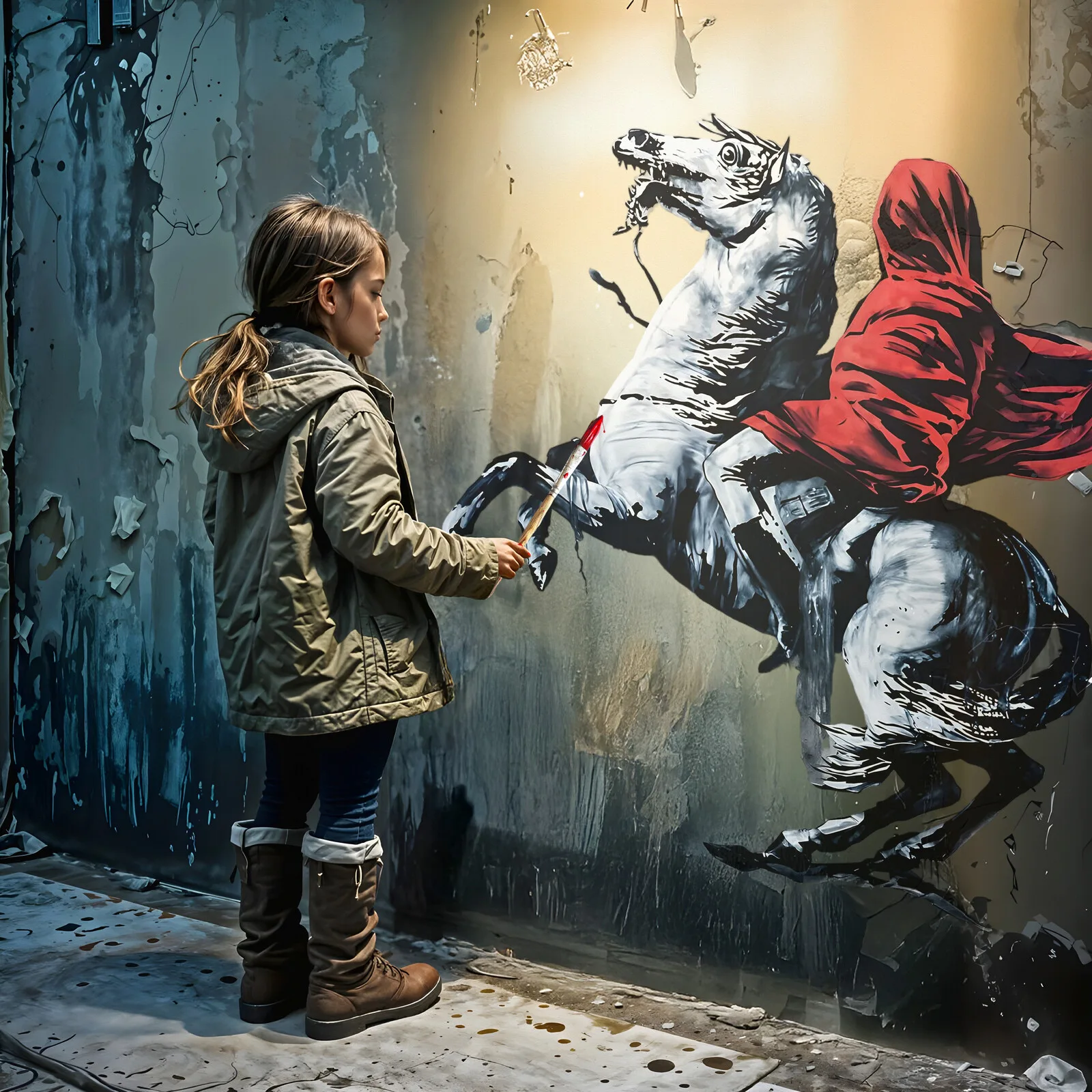
Red Handed, 2025
Digital
80 x 80 cm
3 500 kr
Red Handed
A Brush Against the Wall: A Conversation with Banksy
The title symbolises the fleeting nature of his art and its impact on the world. What unfolds when myth intersects with reflection, and a veiled artist steps into the narrative of his myth? In this imagined yet eerily believable conversation, I share thoughts, barbs, and confidences with Banksy—the enigma of aerosol, the jester of capitalism, the poet of crumbling walls. From the backstreets of Bristol to the auction houses of London and murals fading into the West Bank dust, we chart the trajectory of a voice that has never officially spoken.
Together, we explore why children with red hands sometimes grasp more than generals, how cloaks of glory can blind emperors, and why graffiti might be the last honest form of protest. The conversation flows through philosophy, satire, street politics, and personal memory, all supported by humour, defiance, and a profound moral compass.
Banksy is more than just a person or a name; he's a state of mind: a dissident spirit armed with a paintbrush and a purpose. Whether he's whispering through a stencil or shouting from a shredder, he poses the questions we’d rather avoid—and hands us the can. Please continue reading to grasp the full scope of his impact.
“Banksy’s Bluff
He came with a ladder, a hoodie, and a grin,
A whisper of spray paint, and chaos within.
No passport, no face, not a hint of a plan—
Just a rat with a message and legs that could run.
He stencilled a queen with a smirk and a beer,
A cop on a pony, a dove full of fear.
He doodled on walls what most wouldn’t say,
Then vanished by sunrise (or breakfast buffet).
One day, he hung art in the Louvre—no invite.
They framed it and frowned: “Was this here last night?”
Another, he shredded his million-pound prize
While posh folks applauded with tear-salted eyes.
He’s painted on prisons, on elephants too,
He’s made Mickey cry and McDonald look blue.
He’s sneaked into Gaza, sprayed hope on the wall—
Then slipped via a tunnel, a chimney, or a stall.
You think it’s a prank? Or postmodern jest?
He’s Robin with mischief and irony dressed.
A jester in boots, with a message to drop:
Empires collapse when you question the top.
He’s not in it for likes or the Sotheby’s bid,
He’s the scream on the canvas galleries hid.
He’s the child in the story who yells through the din:
“The emperor’s naked! And covered in sin!”
So, Banksy keeps painting, unseen in the crowd,
With the world at his feet and his head in a cloud.
And we, the observers, so clever and wise—
Still stand with our trousers caught round our thighs.”
Malmö May 2025
Red Handed
I received a strange comment on one of my images on Facebook—the one above, although in an earlier version, where it was part of a street scene with children playing satirical versions of adult life. Not the usual mum-dad-baby routine, but more like “Dad's drunk again” and “Mum hugged the neighbour.” A reverse family idyll. The kind of image that dismantles the myth of harmony at home. Because it’s not always there, and many children suffer deeply.
"You're on the right track," wrote Robin Banx, a comment that left me intrigued. They didn’t specify whether their comment referred to the image or the accompanying text. Naturally curious, I replied with a thumbs-up and a question: “Which part do you mean—the image or what I wrote?”
Of course, I checked the profile. Located in Bristol. I searched for Robin Banx on Facebook—a name suffering from inflation. There were hundreds of them living all over the world, doing everything from working demolition crews to being Facebook administrators. No one claimed to be a street artist—or even an artist at all. I didn’t go through them all; I just browsed Robin’s page. Predictably, the privacy settings were locked down to “friends only.” The profile picture revealed nothing—no age, no gender. Just a hoodie pulled low, the face shadowed to near black. Only faint contours hinted at a delicate face and a soft jawline.
The reply arrived the next day, adding to the suspense: “Both.” It was short and concise but not particularly enlightening. So I followed up: “You’ll have to elaborate on that.” The answer came a few hours later.
“In your essay—not just this one, but others I’ve read—you highlight social and political issues like poverty, war, consumerism, political incompetence, corruption, and let’s not forget plain stupidity. You support feminism. And your visuals contain dark humour and razor-sharp irony. Like me, you deserve the title of social and political activist. Welcome to the club.”
The message was written in the first person, and the suspicion stirring inside me waited for confirmation.
“Are you Banksy?” I asked, my voice betraying the suspicion that lingered within me, waiting for confirmation. The answer was not what I expected.
Banksy: That I am. I turn fifty this year. I am white and scruffy. I wear casual, worn-out jeans and a T-shirt without text. I have silver teeth, a silver chain, and a matching silver earring. No tattoos—I prefer painting on walls. People say I look like a cross between singer-songwriter Jimmy Nail and rapper Mike Skinner. Music’s always been part of me. I played the trombone for a few months in my youth but spared the world further noise and chose art instead. Art can scream its message without waking up the neighbourhood mid-performance. It’s enough that they get outraged the next morning—I’m long gone by then. I was fourteen when I decorated my first wall—the council house in Bristol.
Me: What did you paint?
Banksy: Paddington Bear throwing a Molotov cocktail at riot police.
Me: Can it still be seen?
Banksy: Only in my sketchbook. It wasn’t exactly appreciated by the moral guardians of the day.
Me: When was that?
Banksy: 1989. That same year, I got expelled from school and spent a few nights in a police cell—not prison, as some claim.
Me: So you’re from Bristol?
Banksy: Yep. Easton—Lawrence Hill, to be precise. Grew up in a semi-worn-out townhouse built on top of Bristol’s medieval leper colony. Learning about the suffering of those poor outcasts from the 13th century—that was part of what triggered my political consciousness. It made me want to become a knight for the persecuted. Even though the last leper in England died in 1798, there are still plenty of groups treated the same way. I’ve been speaking for them ever since.
Me: So we have leprosy to thank for your art?
Banksy: That—and Schiller.
Me: Schiller? The German poet? What was he doing in Bristol, and what was the life of a fourteen-year-old would-be artist like?
Banksy: “Against stupidity, the gods themselves contend in vain,” Schiller wrote. My grandfather used to quote it. He built fighter-plane engines at the old Rolls-Royce plant—but he was a cultured man, and his god was the philosopher Samuel Taylor Coleridge.
As for me, at fourteen? The outer world was narrow—mates and girls, in that order. The inner world was chaos. Thoughts clattered around like loose change in a washing machine. I didn’t have the words, not then. But I had spray cans. That wall at the council building in Easton? It wasn’t just graffiti—it was an exorcism. I needed those thoughts to get out, take shape, and shout back at a world that didn’t ask me anything but expected me to behave.
Painting gave me oxygen. That was the year everything shifted—school booted me, the cops nabbed me, and I realised nobody was coming to save me from stupidity. So I started answering back with pictures, each stroke a defiance, each colour a rebellion.
Me: Aha! You’ll have to explain that. (I honestly didn’t understand a thing.)
Banksy: Fair enough. Right—Samuel Taylor Coleridge. He was an English poet and philosopher around the time of Napoleon. Bit of a dreamer, bit of a genius. He's the one who coined the phrase “suspension of disbelief.” He meant that if you tell a story with ghosts, magic, or surreal stuff—like a girl letting go of a balloon shaped like a bleeding heart—the audience must willingly set aside their doubt for a while. Not because they’re stupid, but because they want to be moved.
It’s not about being fooled. It’s about making space for something more profound to slip through—a feeling, a truth, something unspoken. And that stuck with me. My walls aren't literal. They're stories. You don’t have to believe they’re real. You have to think they matter.
Me: Who is Coleridge?
Banksy: The man who translated Schiller into English and coined the phrase “suspension of disbelief.” It's the idea that we can temporarily set aside our disbelief and accept the unreal or impossible in a work of art or literature for enjoyment or understanding.
Me: Aha! You’ll have to explain that. (I honestly had no idea what he meant.)
Banksy: In my world, ‘suspension of disbelief’ plays out not through dragons or epic quests, but through deceptively simple stencils sprayed onto walls. My most talked-about work, Girl with Balloon, is a perfect example. It's a stencil of a small child reaching toward a red, heart-shaped balloon floating away, at once innocent and emotionally charged.
But is the girl sad or hopeful? Has she accidentally let go of the balloon—or is she releasing it willingly, as an act of letting go? The answer doesn’t lie in the image itself but in you. You, the viewer, are an integral part of the artistic process, shaping the meaning of the art with your unique perspective and experiences.
Your interpretation shifts with your mood, beliefs, and personal history. A grieving parent might see loss. A refugee might see escape. A romantic might see love. A cynic might see despair. The image remains still, but its meaning flows, shaped by the viewer’s emotional climate. This is the power of personal interpretation in art; it's not about what the artist intended but what you see and feel. I want to sharpen that ambiguity and force people to take a stand.
Me: This is where your brilliance lies. Your works don’t ask us to “believe” in a fantasy—they invite us to project our inner truths onto your visual riddles. We don’t suspend disbelief—we suspend certainty. We step into the artwork with open questions, not fixed answers.
Banksy: Thanks. Like Coleridge’s original idea, this only works because the image holds “a human interest and a semblance of truth.” It feels real, not because it imitates reality but echoes something internal.
So you're saying we must challenge critical thinking and logic, not to abandon them but to understand that even seemingly persuasive claims can be untrue. You must let it in to recognise the lie long enough to understand and resist it. It’s like going to the theatre: you allow yourself to be moved, even if what’s said on stage doesn’t match your beliefs. Shakespeare was a master at that, centuries before Schiller or Coleridge gave it a name. This is a call to action, an inspiration to think critically and challenge the status quo.
Me: Like how Americans keep voting for Trump, even when it’s obvious he’s no Messiah. It’s not logical—but it’s real. Turning off Fox News won’t fix it.
Banksy: Exactly. Those old 18th-century thinkers helped me spot stupidity—the kind that spreads like bedbugs. I kick at anything that smells wrong. Seeking facts and learning isn’t fashionable—neither is critical thinking. If someone disagrees with you, they must be wrong by default.
Me: That applies to most public discourse these days.
Banksy: The trick is learning to see the forest despite the trees. Reading Tolkien helps.
Me: How so?
Banksy: Tolkien said disbelief only needs suspending when the story fails to build a secondary belief.
Me: That sounds complicated.
Banksy: He meant that when a story stops working, the reader drops out of it. At that point, you force yourself to keep going or close the book.
Me: That would be a shame.
Banksy: Exactly! If you keep reading, the story starts explaining supernatural things in plausible terms. The unbelievable feels real. You see the forest, not just the trees. And you stop caring about conventional, short-sighted truths. Instead, you act from conscience and instinct.
Me: “I see,” I said, though I wasn’t sure I did. “You surprise me. That you see injustice is obvious—but I didn’t expect you to be so… deep. You come across as a street poet and a philosophical trickster, which fits the mythology around you.”
Banksy: Your words, not mine. (he laughed.) “I suspect you're the same yourself—so why are you surprised?”
Me: Can’t you tell me how you climbed out of the slums of Bristol and somehow ended up on the walls of the Louvre?
Banksy: Ha! That’s a long climb for a lad with no ladder. But alright—picture this: 1990s Bristol. Grey skies. Cheap spray paint. I tagged walls with the DryBreadZ Crew—Kato, Tes, and me. We weren’t exactly Picasso; we were more like vandals with ambition.
Me: And no one stopped you?
Banksy: Only the police, occasionally. That’s how I discovered stencilling—hiding under a bin lorry from the cops. I noticed the clean, sharp numbers sprayed on the chassis. Thought to myself, “That’s a trick worth stealing.” Next time out, I brought a stencil—spray, dash, done. No more pants-round-your-ankles escapes.
Me: So you went from bin lorries to world tours?
Banksy: Sort of. First came Bristol’s walls, then London. Somewhere in between, I met Steve Lazarides, a photographer who became my agent. He was the first to treat what I liked as art, not just vandalism. That helped.
Me: And yet people still call it vandalism.
Banksy: Of course. Some people see spray paint and panic. Others see potential. You can't please both. But I've learned to keep going and creating despite the naysayers. That's the only way to make a mark in this world.
Me: When did people start noticing?
Banksy: 1997. I painted ‘The Mild Mild West’—a teddy bear chucking a Molotov cocktail at riot police. Covered up some solicitor’s advert in Stokes Croft. That bear got me noticed.
Me: Then came the rats and the girls with balloons?
Banksy: And the monkeys, cops, lovers, and skeletons. I painted on cows, walls, fuel tanks, and once, briefly, on an elephant. That got me into trouble.
Me: The elephant in the room?
Banksy: Literally. Painted her pink and gold to highlight world poverty. People went mad. Animal rights activists chained themselves to railings. It was a three-day warehouse show in LA—called ‘Barely Legal.’ Subtle, I know.
Me: Did you ever do anything illegal in the strong sense?
Banksy: Define illegal. I printed fake £10 notes with Princess Di’s face instead of the Queen’s and threw them into the crowd at Notting Hill Carnival. Some folks tried to spend them. I call that street performance. The Bank of England called it forgery. But I see it as a bold act of challenging norms.
Me: What did they do?
Banksy: Sent a strongly worded letter. I kept it as a souvenir. And then there was ‘Napalm’—my take on that horrific Vietnam photo. I gave the girl two new friends: Mickey Mouse and Ronald McDonald. You’d be amazed how fast you can lose fans doing that.
Me: You’ve been political from the start.
Banksy: Art without purpose is just interior decoration. I've always believed in the power of art to make a statement, provoke thought, and challenge the status quo. That's why I’ve painted on the West Bank wall, in Gaza, outside Parliament, and even donated a piece to the NHS. I like making noise in silence.
Me: And then came the museums?
Banksy: Sneaked in the back door. I hung one of my pieces in the Louvre—just walked in with a disguise, stuck it on the wall, and left. Same in the Tate. Guerilla curating.
Me: You did that?
Banksy: Cross my heart. I've always believed that art should infiltrate, not just decorate. That's why I've taken such unconventional approaches, like sneaking into the Louvre and the Tate to hang my pieces. Besides, the Louvre could use some fresh air.
Me: But seriously—how does one guy go from tagging walls in Easton to building a post-apocalyptic theme park with Damien Hirst?
Banksy: Ah, Dismaland. My most cheerful piece of dystopia yet. A family attraction not suitable for children. A theme park for people who hate theme parks. It was Weston-super-Mare's biggest tourist magnet since the pier caught fire. We had security guards who looked genuinely depressed, a decaying Cinderella, and killer seagulls. But behind the absurdity was the usual message: that society, like Disneyland, only works if you pretend everything’s fine.
Me: That must have taken an army to pull off. Are you sure you're not a collective?
Banksy: That old chestnut. Am I one man? Or a committee in hoodies? The truth is less mysterious: I’ve got a team, sure. Just like Rubens had a hundred painters churning out cherubs and drapery, I’ve got talented collaborators who help execute the work. I design the key elements, the message, and the punchline. Please think of me as the face on the coin. The rest is workshop tradition, with spray cans.
Me: So the stencils are yours, but others fill them in?
Banksy: Exactly. It’s like Warhol with screen prints—if Warhol had to leg it from the cops every other Tuesday. The irony is, I create these stencils, and others fill them in. It's a bit like Warhol's screen prints, but with a dash of Banksy irony.
Me: So you’ve got a theme park, a workshop like Rubens, an Oscar-nominated film, and probably an unpaid parking fine or two. Still, people seem more obsessed with your name than your message.
Banksy: That’s the tragedy of it. I spend years building metaphors out of crumbling brickwork and spray fumes, and what do they want? A signature. The art world’s like a bad Tinder date—more interested in your face than your soul.
Me: But it got pretty serious with the trademark stuff. The pop-up shop, Gross Domestic Product?
Banksy: Yeah, that was fun. Before a greeting card company nicked it, I had to prove I was using my trademark. So I opened the most miserable gift shop in Croydon. We sold things no one needed: a baby mobile made of CCTV cameras, a welcome mat woven by refugees out of life vests. All ironic. All entirely legal. This experience with the trademark issue and the pop-up shop in Croydon further solidified my views on the commercialisation of art and the role of irony in my work.
Me: And still, the court ruled against you?
Banksy: The irony writes itself. They said I was acting in “bad faith.” I was hiding my identity to avoid proper copyright law, which is true. What kind of anarchist would I be if I played by the rules? But I didn't let that stop me. I fought the law, and the law called me a conceptual loophole.
Me: You even quoted yourself: “Copyright is for losers.”
Banksy: Yeah. Not my wisest branding decision, in hindsight. But you’ve got to laugh. I fought the law, and the law called me a conceptual loophole.
Me: And yet you don’t just sit behind a stencil and sulk. You’ve gone places. Literal war zones.
Banksy: Yeah, the West Bank. August 2005. I didn’t exactly pack a beach towel. I brought paint, a passport, and a sharp sense of irony.
Me: What did you paint?
Banksy: I painted nine pieces on the wall—not a metaphorical one—a real, looming, concrete monster. One depicted a little girl frisking a soldier. Another featured a ladder going nowhere. One revealed a hole that exposed a tropical paradise; on the other side, illusions of freedom were framed in grey. The impact on the locals was mixed. Some asked me to leave. Some thanked me. One old man nodded and said, "We need more holes." That one stuck.
Me: And the locals?
Banksy: Mixed reactions. Some asked me to leave. Some thanked me. One old man nodded and said, “We need more holes.” That one stuck.
Me: And then a few years later, you wade into climate change?
Banksy: December 2009, right after the UN Climate Conference. Everyone was patting themselves on the back for doing absolutely nothing. So, I painted the phrase “I don’t believe in global warming” half-submerged in water.
Me: Subtle.
Banksy: The water did the real work. Every time the tide rose, the message sank a little deeper. People called it my most eloquent silence. This use of irony, where the water, a natural force, was the one delivering the message, is a key aspect of my creative process and the meaning behind my works.
Me: And yet Trump fans waved it like a banner.
Banksy: Of course. Irony is wasted on the willfully dim. They think it’s a joke on the climate, not about them. If you shout “I don’t believe in gravity” as you fall off a cliff, does it make you a prophet? It's always interesting to see how different people interpret my work.
Me: People still talk about that Gaza trip. You painted a kitten?
Banksy: Yeah. A kitten playing with rubble. Posted it online with the caption, “People only look at pictures of kittens.” Which, depressingly, is true.
Me: But there was more than one?
Banksy: A swing hanging from a guard tower. A child wearing a flak helmet. Nothing is subtle. I wasn’t trying to charm anyone. I was trying to convey: if you flatten someone’s home, don’t be shocked when they grow up angry.
Me: You once said it looks like “a giant outdoor recruitment centre for terrorists.”
Banksy: I did, and I stand by that. When all people see is ruin, someone will offer them revenge dressed up as purpose. Art can’t rebuild homes but can interrupt the noise, if only for a second.
Me: And then there was the shredder incident.
Banksy: Ah, Sotheby’s. 2018. Balloon Girl on the wall, the gavel hits, the frame clicks—and the bottom half of the painting shreds itself.
Me: I remember that stunned silence.
Banksy: Art history made in three seconds. They paid a million pounds for the piece and watched half of it become confetti.
Me: But wasn’t it supposed to shred completely?
Banksy: That was the plan. In rehearsal, it worked every time. At the moment, it only shredded halfway. Call it poetic malfunction. I was gutted… then I realised: half-shredded is better. Now it’s a metaphor.
Me: Love is in the Bin.
Banksy: Exactly. It became the first artwork created at auction, not just sold. There’s beauty in breaking the frame. Best £1 million prank ever pulled. Now it's called ‘Love is in the Bin’ and is worth £18 million. Madness. This incident demonstrated the power of Banksy's art to challenge and disrupt traditional art world norms and significantly increased the value and cultural impact of the 'Love is in the Bin' piece.
Me: And now?
Banksy: I paint trees with pressure washers and rats that tell bedtime stories. I go where the noise is. Sometimes that’s Gaza. Sometimes it’s Islington. Sometimes it’s eBay. It depends on the mood. It depends on the message.
Me: What about the tree in Upper Holloway? People said it was your most poetic in years.
Banksy: I sprayed municipal green on a wall behind a mutilated tree. The council had butchered it and pruned it like it owed them money. I gave it its leaves back. From the right angle, it almost breathes.
Me: And the man with the pressure washer?
Banksy: Well, someone’s always got to clean up after beauty. Or erase it.
Me: Jeremy Corbyn showed up.
Banksy: I know. The man loves a tree. And graffiti. Maybe I’ll do his portrait next—on the back of a Tesco truck.
Me: You’re still playing with visibility and disappearance. Graffiti, shredded canvases, pop-up shops… and now trees.
Banksy: It’s all the same game. You appear. You disappear—the work’s the footprint, not the foot.
Me: Christo wrapped the Reichstag in Berlin, but his dream was to wrap New York. Hard to beat. But what did Christo want? And what do you do?
Banksy: Christo wanted to remind us how absurdly fragile power is. Wrap a parliament in cloth, and suddenly it looks like a gift—or a corpse. He covered monuments to make us see through them. That’s a kind of X-ray for the public mind.
Me: And your dream piece?
Banksy: Something no one could ignore. A mural on the Moon, maybe. A giant crying emoji they could see from Earth. Or... paint Buckingham Palace pink and hang a "Flat for Rent" sign. But honestly? The bigger the canvas, the easier it is to miss the point.
Me: And what would the point be?
Banksy: That there is no safe place left to hide from meaning. Not in museums, not in banks, not even on the Moon. Art should ambush you while you’re buying milk or scrolling your feed. If it doesn’t catch you off guard, it’s just wallpaper.
Me: Getting back to where we started, your comment on my version. Your Napoleon piece got under my skin. At first, it looked like a good gag—he was wrapped up, blinded by his glory. But then I thought: this is deeper than parody.
Banksy: That’s the hope. The original by Jacques-Louis David shows Napoleon conquering Europe on horseback, looking like some marble demigod—pure myth-making. My version—he’s still on the horse, still moving forward, but with the red cape wrapped tight around his head. He can’t see. Can’t lead. Can’t think. He’s just... charging blindly.
Me: And in red—same colour as power, empire, revolution, blood.
Banksy: Exactly. Red used to mean liberty. Now it’s more often used to distract. My title, "Liberté, Égalité, Cable TV," says it all. The promise of freedom and equality has been replaced with consumption and numbing entertainment. Bread and circuses. Or worse—propaganda.
Me: You painted it in one of Paris’s most immigrant-heavy areas, right?
Banksy: Yes, that’s no coincidence. The mural also nods to France’s so-called burka ban. It’s ironic. The state bans women from covering their faces, then blinds itself with a patriotic cape. My Napoleon symbolises how the republic, in its attempt to enforce visibility, has made itself blind.
Me: So it’s about hypocrisy?
Banksy: Hypocrisy, but also fear. Governments act like they’re defending enlightenment values but are terrified of change. They cover their faces with symbols and slogans, but the people pay the price.
Me: So the girl in your version, red-handed, might not be vandalising history—she might be trying to rescue it.
Banksy: Or warn us that we’re riding the same horse, wearing the same cloak, thinking we’re going somewhere new.
Me: So the girl in my version, red-handed, might not be vandalising history—she might be trying to rescue it.
Banksy: Or warn us that we’re riding the same horse, wearing the same cloak, thinking we’re going somewhere new. But it’s the same old parade. Just dressed up in patriotism and cable subscriptions.
Me: She’s like a tiny Cassandra. Everyone ignores her because she’s too quiet, young, and inconvenient.
Banksy: And yet she sees what Napoleon doesn’t. That he’s not leading a revolution—he’s sleepwalking through one. Or worse, staging a rerun of an old empire with better marketing.
Me: That’s why she doesn’t run. She stares back at us. Not angry. Not afraid. Just... asking: “You see this, right?”
Banksy: And the red on her hands—it’s not shame. It’s proof. She’s done what most won’t. She’s intervened even if all she had was a brush.
Me: It’s funny. We build myths to feel safe. But it takes a child to point out that the costume is empty, or that the emperor’s cape is over his eyes.
Banksy: That’s why your piece works. It flips the power dynamic. The conqueror becomes the clown. The child becomes the truth-teller. And the audience? They’ve got to choose who they believe.
Me: So, what about your latest piece? The one with the pruned tree and the green explosion behind it—what’s next?
Banksy: That one was simple. A wall, a tree, and some paint the colour of council signage. It was about camouflage. About how we hide destruction under the aesthetics of order. Prune something hard enough, and it looks tidy—but it’s dead.
Me: A lot of people thought it was hopeful.
Banksy: That’s the trick. Hope or warning—it’s the same green paint. The viewer brings the verdict. I leave the clue.
Me: And now?
Banksy: I’m thinking smaller. Not louder, sharper. Maybe something on a single grain of rice. Or perhaps I’ll stencil a rat whispering into the ear of the King during a garden party. Depends on the weather.
Jörgen Thornberg
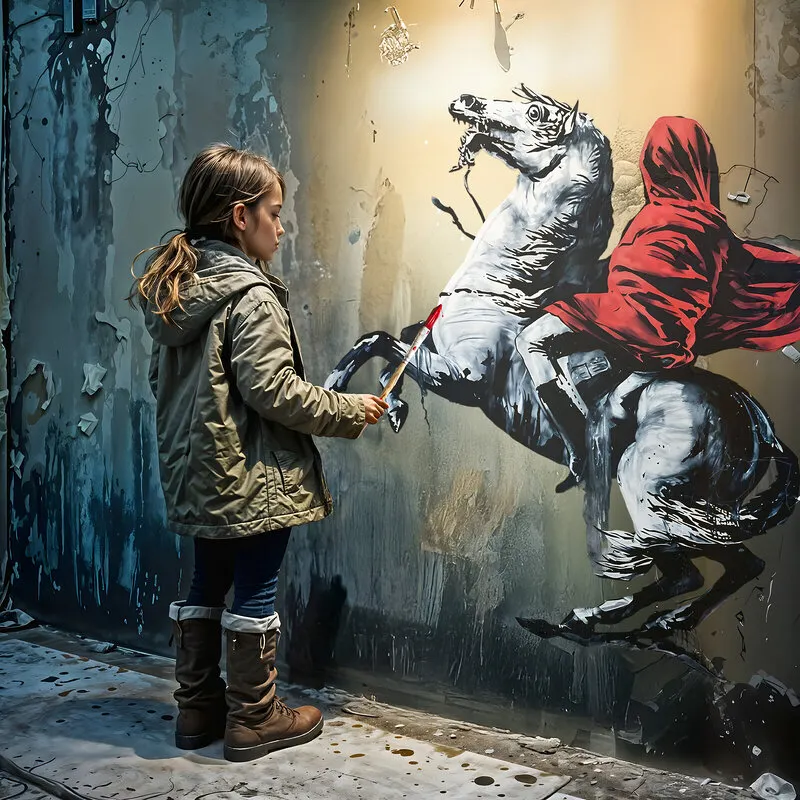
Red Handed, 2025
Digital
80 x 80 cm
3 500 kr
Red Handed
A Brush Against the Wall: A Conversation with Banksy
The title symbolises the fleeting nature of his art and its impact on the world. What unfolds when myth intersects with reflection, and a veiled artist steps into the narrative of his myth? In this imagined yet eerily believable conversation, I share thoughts, barbs, and confidences with Banksy—the enigma of aerosol, the jester of capitalism, the poet of crumbling walls. From the backstreets of Bristol to the auction houses of London and murals fading into the West Bank dust, we chart the trajectory of a voice that has never officially spoken.
Together, we explore why children with red hands sometimes grasp more than generals, how cloaks of glory can blind emperors, and why graffiti might be the last honest form of protest. The conversation flows through philosophy, satire, street politics, and personal memory, all supported by humour, defiance, and a profound moral compass.
Banksy is more than just a person or a name; he's a state of mind: a dissident spirit armed with a paintbrush and a purpose. Whether he's whispering through a stencil or shouting from a shredder, he poses the questions we’d rather avoid—and hands us the can. Please continue reading to grasp the full scope of his impact.
“Banksy’s Bluff
He came with a ladder, a hoodie, and a grin,
A whisper of spray paint, and chaos within.
No passport, no face, not a hint of a plan—
Just a rat with a message and legs that could run.
He stencilled a queen with a smirk and a beer,
A cop on a pony, a dove full of fear.
He doodled on walls what most wouldn’t say,
Then vanished by sunrise (or breakfast buffet).
One day, he hung art in the Louvre—no invite.
They framed it and frowned: “Was this here last night?”
Another, he shredded his million-pound prize
While posh folks applauded with tear-salted eyes.
He’s painted on prisons, on elephants too,
He’s made Mickey cry and McDonald look blue.
He’s sneaked into Gaza, sprayed hope on the wall—
Then slipped via a tunnel, a chimney, or a stall.
You think it’s a prank? Or postmodern jest?
He’s Robin with mischief and irony dressed.
A jester in boots, with a message to drop:
Empires collapse when you question the top.
He’s not in it for likes or the Sotheby’s bid,
He’s the scream on the canvas galleries hid.
He’s the child in the story who yells through the din:
“The emperor’s naked! And covered in sin!”
So, Banksy keeps painting, unseen in the crowd,
With the world at his feet and his head in a cloud.
And we, the observers, so clever and wise—
Still stand with our trousers caught round our thighs.”
Malmö May 2025
Red Handed
I received a strange comment on one of my images on Facebook—the one above, although in an earlier version, where it was part of a street scene with children playing satirical versions of adult life. Not the usual mum-dad-baby routine, but more like “Dad's drunk again” and “Mum hugged the neighbour.” A reverse family idyll. The kind of image that dismantles the myth of harmony at home. Because it’s not always there, and many children suffer deeply.
"You're on the right track," wrote Robin Banx, a comment that left me intrigued. They didn’t specify whether their comment referred to the image or the accompanying text. Naturally curious, I replied with a thumbs-up and a question: “Which part do you mean—the image or what I wrote?”
Of course, I checked the profile. Located in Bristol. I searched for Robin Banx on Facebook—a name suffering from inflation. There were hundreds of them living all over the world, doing everything from working demolition crews to being Facebook administrators. No one claimed to be a street artist—or even an artist at all. I didn’t go through them all; I just browsed Robin’s page. Predictably, the privacy settings were locked down to “friends only.” The profile picture revealed nothing—no age, no gender. Just a hoodie pulled low, the face shadowed to near black. Only faint contours hinted at a delicate face and a soft jawline.
The reply arrived the next day, adding to the suspense: “Both.” It was short and concise but not particularly enlightening. So I followed up: “You’ll have to elaborate on that.” The answer came a few hours later.
“In your essay—not just this one, but others I’ve read—you highlight social and political issues like poverty, war, consumerism, political incompetence, corruption, and let’s not forget plain stupidity. You support feminism. And your visuals contain dark humour and razor-sharp irony. Like me, you deserve the title of social and political activist. Welcome to the club.”
The message was written in the first person, and the suspicion stirring inside me waited for confirmation.
“Are you Banksy?” I asked, my voice betraying the suspicion that lingered within me, waiting for confirmation. The answer was not what I expected.
Banksy: That I am. I turn fifty this year. I am white and scruffy. I wear casual, worn-out jeans and a T-shirt without text. I have silver teeth, a silver chain, and a matching silver earring. No tattoos—I prefer painting on walls. People say I look like a cross between singer-songwriter Jimmy Nail and rapper Mike Skinner. Music’s always been part of me. I played the trombone for a few months in my youth but spared the world further noise and chose art instead. Art can scream its message without waking up the neighbourhood mid-performance. It’s enough that they get outraged the next morning—I’m long gone by then. I was fourteen when I decorated my first wall—the council house in Bristol.
Me: What did you paint?
Banksy: Paddington Bear throwing a Molotov cocktail at riot police.
Me: Can it still be seen?
Banksy: Only in my sketchbook. It wasn’t exactly appreciated by the moral guardians of the day.
Me: When was that?
Banksy: 1989. That same year, I got expelled from school and spent a few nights in a police cell—not prison, as some claim.
Me: So you’re from Bristol?
Banksy: Yep. Easton—Lawrence Hill, to be precise. Grew up in a semi-worn-out townhouse built on top of Bristol’s medieval leper colony. Learning about the suffering of those poor outcasts from the 13th century—that was part of what triggered my political consciousness. It made me want to become a knight for the persecuted. Even though the last leper in England died in 1798, there are still plenty of groups treated the same way. I’ve been speaking for them ever since.
Me: So we have leprosy to thank for your art?
Banksy: That—and Schiller.
Me: Schiller? The German poet? What was he doing in Bristol, and what was the life of a fourteen-year-old would-be artist like?
Banksy: “Against stupidity, the gods themselves contend in vain,” Schiller wrote. My grandfather used to quote it. He built fighter-plane engines at the old Rolls-Royce plant—but he was a cultured man, and his god was the philosopher Samuel Taylor Coleridge.
As for me, at fourteen? The outer world was narrow—mates and girls, in that order. The inner world was chaos. Thoughts clattered around like loose change in a washing machine. I didn’t have the words, not then. But I had spray cans. That wall at the council building in Easton? It wasn’t just graffiti—it was an exorcism. I needed those thoughts to get out, take shape, and shout back at a world that didn’t ask me anything but expected me to behave.
Painting gave me oxygen. That was the year everything shifted—school booted me, the cops nabbed me, and I realised nobody was coming to save me from stupidity. So I started answering back with pictures, each stroke a defiance, each colour a rebellion.
Me: Aha! You’ll have to explain that. (I honestly didn’t understand a thing.)
Banksy: Fair enough. Right—Samuel Taylor Coleridge. He was an English poet and philosopher around the time of Napoleon. Bit of a dreamer, bit of a genius. He's the one who coined the phrase “suspension of disbelief.” He meant that if you tell a story with ghosts, magic, or surreal stuff—like a girl letting go of a balloon shaped like a bleeding heart—the audience must willingly set aside their doubt for a while. Not because they’re stupid, but because they want to be moved.
It’s not about being fooled. It’s about making space for something more profound to slip through—a feeling, a truth, something unspoken. And that stuck with me. My walls aren't literal. They're stories. You don’t have to believe they’re real. You have to think they matter.
Me: Who is Coleridge?
Banksy: The man who translated Schiller into English and coined the phrase “suspension of disbelief.” It's the idea that we can temporarily set aside our disbelief and accept the unreal or impossible in a work of art or literature for enjoyment or understanding.
Me: Aha! You’ll have to explain that. (I honestly had no idea what he meant.)
Banksy: In my world, ‘suspension of disbelief’ plays out not through dragons or epic quests, but through deceptively simple stencils sprayed onto walls. My most talked-about work, Girl with Balloon, is a perfect example. It's a stencil of a small child reaching toward a red, heart-shaped balloon floating away, at once innocent and emotionally charged.
But is the girl sad or hopeful? Has she accidentally let go of the balloon—or is she releasing it willingly, as an act of letting go? The answer doesn’t lie in the image itself but in you. You, the viewer, are an integral part of the artistic process, shaping the meaning of the art with your unique perspective and experiences.
Your interpretation shifts with your mood, beliefs, and personal history. A grieving parent might see loss. A refugee might see escape. A romantic might see love. A cynic might see despair. The image remains still, but its meaning flows, shaped by the viewer’s emotional climate. This is the power of personal interpretation in art; it's not about what the artist intended but what you see and feel. I want to sharpen that ambiguity and force people to take a stand.
Me: This is where your brilliance lies. Your works don’t ask us to “believe” in a fantasy—they invite us to project our inner truths onto your visual riddles. We don’t suspend disbelief—we suspend certainty. We step into the artwork with open questions, not fixed answers.
Banksy: Thanks. Like Coleridge’s original idea, this only works because the image holds “a human interest and a semblance of truth.” It feels real, not because it imitates reality but echoes something internal.
So you're saying we must challenge critical thinking and logic, not to abandon them but to understand that even seemingly persuasive claims can be untrue. You must let it in to recognise the lie long enough to understand and resist it. It’s like going to the theatre: you allow yourself to be moved, even if what’s said on stage doesn’t match your beliefs. Shakespeare was a master at that, centuries before Schiller or Coleridge gave it a name. This is a call to action, an inspiration to think critically and challenge the status quo.
Me: Like how Americans keep voting for Trump, even when it’s obvious he’s no Messiah. It’s not logical—but it’s real. Turning off Fox News won’t fix it.
Banksy: Exactly. Those old 18th-century thinkers helped me spot stupidity—the kind that spreads like bedbugs. I kick at anything that smells wrong. Seeking facts and learning isn’t fashionable—neither is critical thinking. If someone disagrees with you, they must be wrong by default.
Me: That applies to most public discourse these days.
Banksy: The trick is learning to see the forest despite the trees. Reading Tolkien helps.
Me: How so?
Banksy: Tolkien said disbelief only needs suspending when the story fails to build a secondary belief.
Me: That sounds complicated.
Banksy: He meant that when a story stops working, the reader drops out of it. At that point, you force yourself to keep going or close the book.
Me: That would be a shame.
Banksy: Exactly! If you keep reading, the story starts explaining supernatural things in plausible terms. The unbelievable feels real. You see the forest, not just the trees. And you stop caring about conventional, short-sighted truths. Instead, you act from conscience and instinct.
Me: “I see,” I said, though I wasn’t sure I did. “You surprise me. That you see injustice is obvious—but I didn’t expect you to be so… deep. You come across as a street poet and a philosophical trickster, which fits the mythology around you.”
Banksy: Your words, not mine. (he laughed.) “I suspect you're the same yourself—so why are you surprised?”
Me: Can’t you tell me how you climbed out of the slums of Bristol and somehow ended up on the walls of the Louvre?
Banksy: Ha! That’s a long climb for a lad with no ladder. But alright—picture this: 1990s Bristol. Grey skies. Cheap spray paint. I tagged walls with the DryBreadZ Crew—Kato, Tes, and me. We weren’t exactly Picasso; we were more like vandals with ambition.
Me: And no one stopped you?
Banksy: Only the police, occasionally. That’s how I discovered stencilling—hiding under a bin lorry from the cops. I noticed the clean, sharp numbers sprayed on the chassis. Thought to myself, “That’s a trick worth stealing.” Next time out, I brought a stencil—spray, dash, done. No more pants-round-your-ankles escapes.
Me: So you went from bin lorries to world tours?
Banksy: Sort of. First came Bristol’s walls, then London. Somewhere in between, I met Steve Lazarides, a photographer who became my agent. He was the first to treat what I liked as art, not just vandalism. That helped.
Me: And yet people still call it vandalism.
Banksy: Of course. Some people see spray paint and panic. Others see potential. You can't please both. But I've learned to keep going and creating despite the naysayers. That's the only way to make a mark in this world.
Me: When did people start noticing?
Banksy: 1997. I painted ‘The Mild Mild West’—a teddy bear chucking a Molotov cocktail at riot police. Covered up some solicitor’s advert in Stokes Croft. That bear got me noticed.
Me: Then came the rats and the girls with balloons?
Banksy: And the monkeys, cops, lovers, and skeletons. I painted on cows, walls, fuel tanks, and once, briefly, on an elephant. That got me into trouble.
Me: The elephant in the room?
Banksy: Literally. Painted her pink and gold to highlight world poverty. People went mad. Animal rights activists chained themselves to railings. It was a three-day warehouse show in LA—called ‘Barely Legal.’ Subtle, I know.
Me: Did you ever do anything illegal in the strong sense?
Banksy: Define illegal. I printed fake £10 notes with Princess Di’s face instead of the Queen’s and threw them into the crowd at Notting Hill Carnival. Some folks tried to spend them. I call that street performance. The Bank of England called it forgery. But I see it as a bold act of challenging norms.
Me: What did they do?
Banksy: Sent a strongly worded letter. I kept it as a souvenir. And then there was ‘Napalm’—my take on that horrific Vietnam photo. I gave the girl two new friends: Mickey Mouse and Ronald McDonald. You’d be amazed how fast you can lose fans doing that.
Me: You’ve been political from the start.
Banksy: Art without purpose is just interior decoration. I've always believed in the power of art to make a statement, provoke thought, and challenge the status quo. That's why I’ve painted on the West Bank wall, in Gaza, outside Parliament, and even donated a piece to the NHS. I like making noise in silence.
Me: And then came the museums?
Banksy: Sneaked in the back door. I hung one of my pieces in the Louvre—just walked in with a disguise, stuck it on the wall, and left. Same in the Tate. Guerilla curating.
Me: You did that?
Banksy: Cross my heart. I've always believed that art should infiltrate, not just decorate. That's why I've taken such unconventional approaches, like sneaking into the Louvre and the Tate to hang my pieces. Besides, the Louvre could use some fresh air.
Me: But seriously—how does one guy go from tagging walls in Easton to building a post-apocalyptic theme park with Damien Hirst?
Banksy: Ah, Dismaland. My most cheerful piece of dystopia yet. A family attraction not suitable for children. A theme park for people who hate theme parks. It was Weston-super-Mare's biggest tourist magnet since the pier caught fire. We had security guards who looked genuinely depressed, a decaying Cinderella, and killer seagulls. But behind the absurdity was the usual message: that society, like Disneyland, only works if you pretend everything’s fine.
Me: That must have taken an army to pull off. Are you sure you're not a collective?
Banksy: That old chestnut. Am I one man? Or a committee in hoodies? The truth is less mysterious: I’ve got a team, sure. Just like Rubens had a hundred painters churning out cherubs and drapery, I’ve got talented collaborators who help execute the work. I design the key elements, the message, and the punchline. Please think of me as the face on the coin. The rest is workshop tradition, with spray cans.
Me: So the stencils are yours, but others fill them in?
Banksy: Exactly. It’s like Warhol with screen prints—if Warhol had to leg it from the cops every other Tuesday. The irony is, I create these stencils, and others fill them in. It's a bit like Warhol's screen prints, but with a dash of Banksy irony.
Me: So you’ve got a theme park, a workshop like Rubens, an Oscar-nominated film, and probably an unpaid parking fine or two. Still, people seem more obsessed with your name than your message.
Banksy: That’s the tragedy of it. I spend years building metaphors out of crumbling brickwork and spray fumes, and what do they want? A signature. The art world’s like a bad Tinder date—more interested in your face than your soul.
Me: But it got pretty serious with the trademark stuff. The pop-up shop, Gross Domestic Product?
Banksy: Yeah, that was fun. Before a greeting card company nicked it, I had to prove I was using my trademark. So I opened the most miserable gift shop in Croydon. We sold things no one needed: a baby mobile made of CCTV cameras, a welcome mat woven by refugees out of life vests. All ironic. All entirely legal. This experience with the trademark issue and the pop-up shop in Croydon further solidified my views on the commercialisation of art and the role of irony in my work.
Me: And still, the court ruled against you?
Banksy: The irony writes itself. They said I was acting in “bad faith.” I was hiding my identity to avoid proper copyright law, which is true. What kind of anarchist would I be if I played by the rules? But I didn't let that stop me. I fought the law, and the law called me a conceptual loophole.
Me: You even quoted yourself: “Copyright is for losers.”
Banksy: Yeah. Not my wisest branding decision, in hindsight. But you’ve got to laugh. I fought the law, and the law called me a conceptual loophole.
Me: And yet you don’t just sit behind a stencil and sulk. You’ve gone places. Literal war zones.
Banksy: Yeah, the West Bank. August 2005. I didn’t exactly pack a beach towel. I brought paint, a passport, and a sharp sense of irony.
Me: What did you paint?
Banksy: I painted nine pieces on the wall—not a metaphorical one—a real, looming, concrete monster. One depicted a little girl frisking a soldier. Another featured a ladder going nowhere. One revealed a hole that exposed a tropical paradise; on the other side, illusions of freedom were framed in grey. The impact on the locals was mixed. Some asked me to leave. Some thanked me. One old man nodded and said, "We need more holes." That one stuck.
Me: And the locals?
Banksy: Mixed reactions. Some asked me to leave. Some thanked me. One old man nodded and said, “We need more holes.” That one stuck.
Me: And then a few years later, you wade into climate change?
Banksy: December 2009, right after the UN Climate Conference. Everyone was patting themselves on the back for doing absolutely nothing. So, I painted the phrase “I don’t believe in global warming” half-submerged in water.
Me: Subtle.
Banksy: The water did the real work. Every time the tide rose, the message sank a little deeper. People called it my most eloquent silence. This use of irony, where the water, a natural force, was the one delivering the message, is a key aspect of my creative process and the meaning behind my works.
Me: And yet Trump fans waved it like a banner.
Banksy: Of course. Irony is wasted on the willfully dim. They think it’s a joke on the climate, not about them. If you shout “I don’t believe in gravity” as you fall off a cliff, does it make you a prophet? It's always interesting to see how different people interpret my work.
Me: People still talk about that Gaza trip. You painted a kitten?
Banksy: Yeah. A kitten playing with rubble. Posted it online with the caption, “People only look at pictures of kittens.” Which, depressingly, is true.
Me: But there was more than one?
Banksy: A swing hanging from a guard tower. A child wearing a flak helmet. Nothing is subtle. I wasn’t trying to charm anyone. I was trying to convey: if you flatten someone’s home, don’t be shocked when they grow up angry.
Me: You once said it looks like “a giant outdoor recruitment centre for terrorists.”
Banksy: I did, and I stand by that. When all people see is ruin, someone will offer them revenge dressed up as purpose. Art can’t rebuild homes but can interrupt the noise, if only for a second.
Me: And then there was the shredder incident.
Banksy: Ah, Sotheby’s. 2018. Balloon Girl on the wall, the gavel hits, the frame clicks—and the bottom half of the painting shreds itself.
Me: I remember that stunned silence.
Banksy: Art history made in three seconds. They paid a million pounds for the piece and watched half of it become confetti.
Me: But wasn’t it supposed to shred completely?
Banksy: That was the plan. In rehearsal, it worked every time. At the moment, it only shredded halfway. Call it poetic malfunction. I was gutted… then I realised: half-shredded is better. Now it’s a metaphor.
Me: Love is in the Bin.
Banksy: Exactly. It became the first artwork created at auction, not just sold. There’s beauty in breaking the frame. Best £1 million prank ever pulled. Now it's called ‘Love is in the Bin’ and is worth £18 million. Madness. This incident demonstrated the power of Banksy's art to challenge and disrupt traditional art world norms and significantly increased the value and cultural impact of the 'Love is in the Bin' piece.
Me: And now?
Banksy: I paint trees with pressure washers and rats that tell bedtime stories. I go where the noise is. Sometimes that’s Gaza. Sometimes it’s Islington. Sometimes it’s eBay. It depends on the mood. It depends on the message.
Me: What about the tree in Upper Holloway? People said it was your most poetic in years.
Banksy: I sprayed municipal green on a wall behind a mutilated tree. The council had butchered it and pruned it like it owed them money. I gave it its leaves back. From the right angle, it almost breathes.
Me: And the man with the pressure washer?
Banksy: Well, someone’s always got to clean up after beauty. Or erase it.
Me: Jeremy Corbyn showed up.
Banksy: I know. The man loves a tree. And graffiti. Maybe I’ll do his portrait next—on the back of a Tesco truck.
Me: You’re still playing with visibility and disappearance. Graffiti, shredded canvases, pop-up shops… and now trees.
Banksy: It’s all the same game. You appear. You disappear—the work’s the footprint, not the foot.
Me: Christo wrapped the Reichstag in Berlin, but his dream was to wrap New York. Hard to beat. But what did Christo want? And what do you do?
Banksy: Christo wanted to remind us how absurdly fragile power is. Wrap a parliament in cloth, and suddenly it looks like a gift—or a corpse. He covered monuments to make us see through them. That’s a kind of X-ray for the public mind.
Me: And your dream piece?
Banksy: Something no one could ignore. A mural on the Moon, maybe. A giant crying emoji they could see from Earth. Or... paint Buckingham Palace pink and hang a "Flat for Rent" sign. But honestly? The bigger the canvas, the easier it is to miss the point.
Me: And what would the point be?
Banksy: That there is no safe place left to hide from meaning. Not in museums, not in banks, not even on the Moon. Art should ambush you while you’re buying milk or scrolling your feed. If it doesn’t catch you off guard, it’s just wallpaper.
Me: Getting back to where we started, your comment on my version. Your Napoleon piece got under my skin. At first, it looked like a good gag—he was wrapped up, blinded by his glory. But then I thought: this is deeper than parody.
Banksy: That’s the hope. The original by Jacques-Louis David shows Napoleon conquering Europe on horseback, looking like some marble demigod—pure myth-making. My version—he’s still on the horse, still moving forward, but with the red cape wrapped tight around his head. He can’t see. Can’t lead. Can’t think. He’s just... charging blindly.
Me: And in red—same colour as power, empire, revolution, blood.
Banksy: Exactly. Red used to mean liberty. Now it’s more often used to distract. My title, "Liberté, Égalité, Cable TV," says it all. The promise of freedom and equality has been replaced with consumption and numbing entertainment. Bread and circuses. Or worse—propaganda.
Me: You painted it in one of Paris’s most immigrant-heavy areas, right?
Banksy: Yes, that’s no coincidence. The mural also nods to France’s so-called burka ban. It’s ironic. The state bans women from covering their faces, then blinds itself with a patriotic cape. My Napoleon symbolises how the republic, in its attempt to enforce visibility, has made itself blind.
Me: So it’s about hypocrisy?
Banksy: Hypocrisy, but also fear. Governments act like they’re defending enlightenment values but are terrified of change. They cover their faces with symbols and slogans, but the people pay the price.
Me: So the girl in your version, red-handed, might not be vandalising history—she might be trying to rescue it.
Banksy: Or warn us that we’re riding the same horse, wearing the same cloak, thinking we’re going somewhere new.
Me: So the girl in my version, red-handed, might not be vandalising history—she might be trying to rescue it.
Banksy: Or warn us that we’re riding the same horse, wearing the same cloak, thinking we’re going somewhere new. But it’s the same old parade. Just dressed up in patriotism and cable subscriptions.
Me: She’s like a tiny Cassandra. Everyone ignores her because she’s too quiet, young, and inconvenient.
Banksy: And yet she sees what Napoleon doesn’t. That he’s not leading a revolution—he’s sleepwalking through one. Or worse, staging a rerun of an old empire with better marketing.
Me: That’s why she doesn’t run. She stares back at us. Not angry. Not afraid. Just... asking: “You see this, right?”
Banksy: And the red on her hands—it’s not shame. It’s proof. She’s done what most won’t. She’s intervened even if all she had was a brush.
Me: It’s funny. We build myths to feel safe. But it takes a child to point out that the costume is empty, or that the emperor’s cape is over his eyes.
Banksy: That’s why your piece works. It flips the power dynamic. The conqueror becomes the clown. The child becomes the truth-teller. And the audience? They’ve got to choose who they believe.
Me: So, what about your latest piece? The one with the pruned tree and the green explosion behind it—what’s next?
Banksy: That one was simple. A wall, a tree, and some paint the colour of council signage. It was about camouflage. About how we hide destruction under the aesthetics of order. Prune something hard enough, and it looks tidy—but it’s dead.
Me: A lot of people thought it was hopeful.
Banksy: That’s the trick. Hope or warning—it’s the same green paint. The viewer brings the verdict. I leave the clue.
Me: And now?
Banksy: I’m thinking smaller. Not louder, sharper. Maybe something on a single grain of rice. Or perhaps I’ll stencil a rat whispering into the ear of the King during a garden party. Depends on the weather.
3 500 kr

Jörgen Thornberg
Malmö
Lite om bilder och mig. Translation in English at the end.
Jag är en nyfiken person som ser allt i bilder, även det jag fäster i ord, gärna tillsammans för bakom alla mina bilder finns en berättelse. Till vissa bilder hör en kortare eller längre novell som följer med bilden.
Bilder berättar historier. Jag omges av naturlig skönhet, intressanta människor och historia var jag än går. Jag använder min kamera för att dokumentera världen och blanda det jag ser med vad jag känner för att fånga den dolda magin.
Mina bilder berättar mina historier. Genom mina bilder, tryck och berättelser. Jag bjuder in dig att ta del av dessa berättelser, in i ditt liv och hem och dela min mycket personliga syn på vår värld. Mer än vad ögat ser. Jag tänker i bilder, drömmer och skriver och pratar om dem; följaktligen måste jag också skapa bilder. De blir vad jag ser, inte nödvändigtvis begränsade till verkligheten. Det finns en bild runt varje hörn. Jag hoppas att du kommer att se vad jag såg och gilla det.
Jag är också en skrivande person och till många bilder hör en kortare eller längre essay. Den följer med tavlan, tryckt på fint papper och med en personlig hälsning från mig.
Flertalet bilder startar sin resa i min kamera. Enkelt förklarat beskriver jag bilden jag ser i mitt inre, upplevd eller fantiserad. Bilden uppstår inom mig redan innan jag fått okularet till ögat. På bråkdelen av ett ögonblick ser jag vad jag vill ha och vad som kan göras med bilden. Här skall jag stoppa in en giraff, stålmannen, Titanic eller vad det är min fantasi finner ut. Ännu märkligare är att jag kommer ihåg minnesbilden långt efteråt när det blir tid att skapa verket. Om jag lyckas eller inte, är upp till betraktaren, oftast präglat av en stråk av svart humor – meningen är att man skall bli underhållen. Mina bilder blir ofta en snackis där de hänger.
Jag föredrar bilder som förmedlar ett budskap i flera lager. Vid första anblicken fylld av feel-good, en vacker utsikt, fint väder, solen skiner, blommor på ängen eller vattnet som ligger förrädiskt spegelblankt. I en sådan bild kan jag gömma min egentliga berättelse, mitt förakt för förtryckare och våldsverkare, rasister och fördomsfulla människor - ett gärna återkommande motiv mer eller mindre dolt i det vackra motivet. Jag försöker förena dem i ett gemensamt narrativ.
Bild och formgivning har löpt som en röd tråd genom livet. Fotokonst känns som en värdig final som jag gärna delar med mig.
Min genre är vid som framgår av mina bilder, temat en blandning av pop- och gatukonst i kollage som kan bestå av hundratals lager. Vissa bilder kan ta veckor, andra någon dag innan det är dags att överlämna resultatet till printverkstaden. Fine Art Prints är digitala fotocollage. I dessa kollage sker rivandet, klippandet, pusslandet, målandet, ritandet och sprayningen digitalt. Det jag monterar in kan vara hundratals år gamla bilder som jag omsorgsfullt frilägger så att de ser ut att vara en del av tavlan men också bilder skapade av mig själv efter min egen fantasi. Därefter besöks printstudion och för vissa bilder numrera en limiterad upplaga (oftast 7 exemplar) och signera för hand. Vissa bilder kan köpas i olika format. Det är bara att fråga efter vilka. Gillar man en bild som är 70x100 men inte har plats på väggen, går den kanske att få i 50x70 cm istället. Frågan är fri.
Metoden Giclée eller Fine Art Print som det också kallas är det moderna sättet för framställning av grafisk konst. Villkoret för denna typ av utskrifter är att en högkvalitativ storformatskrivare används med åldersbeständigt färgpigment och konstnärspapper eller i förekommande fall på duk. Pappret som används möter de krav på livslängd som ställs av museer och gallerier. Normalt säljer jag mina bilder oinramade så att den nya ägaren själv kan bestämma hur de skall se ut, med eller utan passepartout färg på ram, med eller utan glas etc..
Under många år ställde jag bara ut på nätet, i valda grupper och på min egen Facebooksida - https://www.facebook.com/jorgen.thornberg.9
Jag finns också på en egen hemsida som tyvärr inte alltid är uppdaterad – https://www.jth.life/ Där kan du också läsa en del av de berättelser som följer med bilden.
UTSTÄLLNINGAR
Luftkastellet, oktober 2022
Konst i Lund, november 2022
Luftkastellet, mars 2023
Engleson Galleri Caroli, april 2023
Hydra, Greece June 2023
Engleson Galleri Caroli, oktober 2023
Toppen, Höllviken december 2023
Luftkastellet, mars 2024
Torups Galleri, mars 2024
Venice, May 2024
Luftkastellet, oktober 2024
Konst i Advent, December 2024
Galleri Engleson, Caroli December 2024
Jäger & Jansson Galleri, april 2025
A bit about pictures and me.
I'm a curious person who sees everything in pictures, even what I express in words, often combining them, for behind all my pictures lies a story. These narratives, some as short as a single image and others as long as a novel, are the heart and soul of my work.
Pictures tell stories. Wherever I go, I'm surrounded by natural beauty, exciting people, and history. I use my camera to document the world and blend what I see with what I feel to capture the hidden magic.
My images tell my stories. Through my pictures, prints, and narratives, I invite you to partake in these stories in your life and home and share my deeply personal perspective of our world. More than meets the eye. I think in pictures, dream, write, and talk about them; consequently, I must create images too. They become what I see, not necessarily confined to reality. There's a picture around every corner. I hope you'll see what I saw and enjoy it.
I'm also a writer, and many images come with a shorter or longer essay. It accompanies the painting, printed on fine paper with my personal greeting.
Many pictures start their journey on my camera. Simply put, I describe the image I see in my mind, experienced or imagined. The image arises within me even before I bring the eyepiece to my eye. In a fraction of a moment, I see what I want and what can be done with the picture. Here, I'll insert a giraffe, Superman, the Titanic, or whatever my imagination conjures up. Even stranger is that I remember the mental image long after it's time to create the work. Whether I succeed is up to the observer, often imbued with a streak of black humour – the aim is to entertain. My pictures usually become a talking point wherever they hang.
I prefer pictures that convey a message in multiple layers. At first glance, they're filled with feel-good vibes, a beautiful view, lovely weather, the sun shining, flowers in the meadow, or the water lying deceptively calm. But beneath this surface beauty, I often conceal a deeper story, a narrative that challenges societal norms or explores the human condition. I invite you to delve into these hidden narratives and discover the layers of meaning within my work.
Picture and design have been a thread running through my life. Photographic art feels like a fitting finale, and I'm happy to share it.
My genre is varied, as seen in my pictures; the theme is a blend of pop and street art in collages that can consist of hundreds of layers. Some images can take weeks, others just a day before it's time to hand over the result to the print workshop. Fine Art Prints are digital photo collages. In these collages, tearing, cutting, puzzling, painting, drawing, and spraying happen digitally. What I insert can be images hundreds of years old that I carefully extract so they appear to be part of the painting, but also images created by myself, now also generated from my imagination. Next, visit the print studio and, for certain images, number a limited edition (usually 7 copies) and sign them by hand. Some images may be available in other formats. Just ask which ones. If you like an image that's 70x100 but doesn't have space on the wall, you might be able to get it in 50x70 cm instead. The question is open.
The Giclée method, or Fine Art Print as it's also called, is the modern way of producing graphic art. This method ensures the highest quality and longevity of the artwork, using a high-quality large-format printer with archival pigment inks and artist paper or, in some cases, canvas. The paper used meets the longevity requirements set by museums and galleries. I sell my pictures unframed, allowing the new owner to personalise their artwork, confident in the lasting value and quality of the piece.
For many years, I only exhibited online, in selected groups, and on my Facebook page - https://www.facebook.com/jorgen.thornberg.9. I also have my website, which unfortunately is not constantly updated - https://www.jth.life/. You can also read some of the stories accompanying the pictures there.
EXHIBITIONS
Luftkastellet, October 2022
Art in Lund, November 2022
Luftkastellet, March 2023
Engleson Gallery Caroli, April 2023
Hydra, Greece June 2023
Engleson Gallery Caroli, October 2023
Toppen, Höllviken December 2023
Luftkastellet, March 2024
Torup Gallery, March 2024
Venice, May 2024
UTSTÄLLNINGAR
Luftkastellet, oktober 2022
Konst i Lund, november 2022
Luftkastellet, mars 2023
Engleson Galleri Caroli, april 2023
Hydra, Greece June 2023
Engleson Galleri Caroli, oktober 2023
Toppen, Höllviken december 2023
Luftkastellet, mars 2024
Torups Galleri, mars 2024
Venice, May 2024
Luftkastellet, October 2024
Konst i Advent, December 2024
Galleri Engleson, Caroli December 2024
Jäger & Jansson Galleri, April 2025
Utbildning
Autodidakt
Medlem i konstnärsförening
Öppna Sinnen
Med i konstrunda
Konstrundan i Skåne
Utställningar
Luftkastellet, October 2022
Art in Lund, November 2022
Luftkastellet, March 2023
Engleson Gallery Caroli, April 2023
Hydra, Greece June 2023
Engleson Gallery Caroli, October 2023
Toppen, Höllviken December 2023
Luftkastellet, March 2024
Torup Gallery, March 2024
Venice, May 2024