Vi använder cookies för att ge dig bästa möjliga upplevelse. Välj vilka cookies du tillåter.
Läs mer i vår integritetspolicy
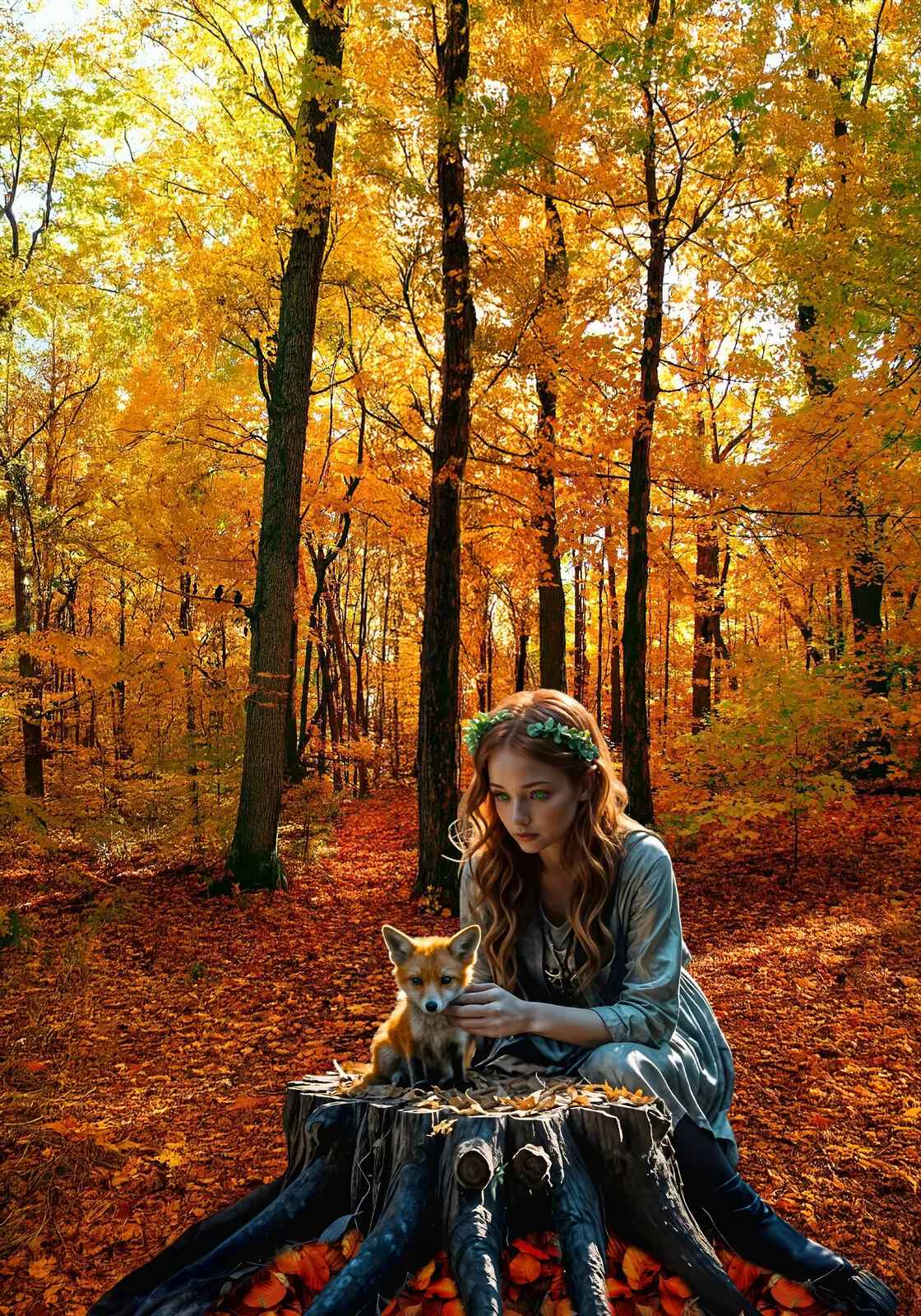
Jörgen Thornberg
Red hair and Beech forest, 2025
Digital
50 x 70 cm
3 200 kr
The Flame and the Fur
“In her red hair the wind does sleep,
It curls and dances, wild and deep.
No comb can tame, no hand can hold
Those fiery threads of autumn gold.
It glows against the winter’s frost,
A flame the snow has never lost.
Not born to blend, not made to please—
She walks beneath rebellious trees.
The beechwood bows with whispering grace,
She moves with time, but leaves no trace.
Her eyes are green as woodland moss,
Her path is hers, no bridge to cross.
She doesn’t bloom where others grow,
She finds her light where shadows go.
She hums a tune the birches know,
A song too old for streams to flow.
And when the dusk begins to creep,
She stirs the fox from forest sleep.
She scratches gently near his ear—
Two souls of flame, alone, but near.”
Malmö 21 April 2025
Red Hair and Beech Forest – Nordic Wildness and Defiance.
The historical and cultural significance of red hair is a topic that has intrigued scholars and enthusiasts for centuries. Let us delve into the rich folklore and history of this unique trait.
“Red hair and pine forest don’t grow on fertile ground,” says an old Norwegian proverb with a tone as dry as a northern pine heath. And like much in Nordic folklore, it holds more than meets the eye. Let us wander among the whispering pines and fiery manes to uncover what this saying means.
In my image, a red-haired girl with green eyes sits scratching a fox cub behind the ears. She is a ‘skogsrå’, a forest spirit living in the Beech Forest outside Malmö. Beech forests thrive on better soil than pines, but the dense canopy of the beech tree allows little light and nourishment to reach the ground below, so the undergrowth tends to look very much the same.
But now to the saying itself. One might wonder where it comes from. The pine forest is the stoic character of the Nordic woods. While the leafy deciduous forest spreads over rich soil and enjoys a lush and relatively comfortable life, the pine tree battles on dry heights, rocky outcrops, and rarely visited moraines. It grows where it seems unprofitable to do so—straight and lean, tough as tar, and often twisted by the wind.
Then, quite suddenly, a parallel appears: the redhead, for this proverb is not merely an ecological observation but a subtle comment on human nature. The redhead, often seen as unusual, fiery-tempered, and hard to grasp, finds a Nordic cousin in the pine. Both grow on “poor soil,” which in this context refers as much to personal and social circumstances as to literal earth.
Historically, red hair has been surrounded by myths and contradictions. In some cultures, it has been considered noble or royal; in others, a sign of witchcraft, desire, or untrustworthiness. However, it has often been associated with primal force in the North. Vikings are frequently depicted with flaming manes, and on the Bayeux Tapestry, we see William the Conqueror himself embroidered with red hair. One can almost hear the needle scoff: “This man didn’t grow on good soil—he took it.” This unique and powerful nature of redheads makes them so intriguing.
In ancient Egypt, red hair was viewed with suspicion. It was believed that red-haired individuals were under the influence of Seth, the god of chaos and desert storms. Archaeologists have found that certain mummies with red hair were treated differently—sometimes their images were burned or buried with special rites. Seth was often depicted with reddish features, and the colour symbolised fire, danger, and otherness. Yet, this might also hint at the power and threat of redheads: one does not fear what is insignificant.
In Babylon, there are no direct references to red hair. Still, Assyrian reliefs occasionally show warriors with light or reddish hair, which may suggest a fascination with northern or exotic peoples. Then, as now, red hair could symbolise something beyond the ordinary—a trait that stood out in a sea of dark-skinned and black-haired individuals.
Classical Greece held a more ambivalent view of red hair. Aristotle believed redheads possessed fiery tempers, and some tragedians gave their heroes or villains red hair to emphasise passion or intensity. In Homer’s works, we find suggestions of fair and reddish tones among warriors, sometimes used to highlight heroism and imply a threat.
And what of the Romans? Red hair was seen as a typically barbaric trait. Germans, Celts, Gauls—all the northern peoples that the Romans battled—were often described as red-haired giants. Julius Caesar spoke of Gauls with fire-like hair, and Tacitus described Germans as fair-haired, tall, and unpredictable. The redhead became a mirror for Rome’s fears and admiration of strength. Ironically, some Roman women dyed red hair with henna to attain a more exotic and desirable appearance. What is first seen as dangerous soon becomes a fashion trend.
And perhaps here lies the key to the proverb. It is not meant to diminish, but to illuminate. Those who grow on fertile ground may live straight, safe lives. But those who emerge from poor soil—from wind, frost, and stony barrens—must harden, adapt, and become something else. Perhaps something better. Or at least, something more interesting.
Like many Nordic sayings, the proverb is neither a warning nor full praise. It is a laconic observation, a poetic reflection on how distinction does not arise from comfort. Red hair and pine forest—two expressions of resilience, stubbornness, and vitality, growing where others wouldn’t even try to take root. This resilience and defiance of red hair is what inspires and empowers us.
So the next time you see a red-haired person striding through a pine forest, perhaps you’ll smile at each other before you are two beings that did not grow on good soil. And that, possibly, is the greatest gift of all.
Famous Redheads Through the Ages
Throughout history, red hair has inspired awe, admiration, suspicion, and myth. From thrones to battlefields, from fiction to the silver screen, redheads have blazed their trails – sometimes feared, often adored, and always remembered.
One of the most iconic was Elizabeth I of England, whose flaming red hair symbolised regal power and fierce independence. She ruled with unmatched political cunning and made her hair part of her identity, her image almost mythic in its intensity. William the Conqueror, famously depicted with red hair in the Bayeux Tapestry, was another – a man who, as we’ve said, didn’t grow on good soil, but conquered it.
Across the Atlantic, Thomas Jefferson, one of the United States' founding fathers, was a redhead known for his intellect and revolutionary spirit. In Sweden, the unstable yet fascinating Eric XIV, red-blond and gifted, met his downfall through paranoia and poison.
Redheads appear not only in history books but in myth and legend. In many artistic depictions, Medusa has fiery red hair – a dangerous, magnetic symbol of feminine power. Lilith, the rebellious first wife of Adam in apocryphal tales, is sometimes imagined with red hair, embodying defiance and wildness. In Norse mythology, Freyja, goddess of love and war, is occasionally envisioned with burnished red-gold hair – equal parts seduction and strength.
In literature, redheads have captured imaginations for generations. Anne Shirley, from Anne of Green Gables, is a passionate and fiercely imaginative girl who battles prejudice and embraces life radiantly. With her iconic red braids, Pippi Longstocking is a force of pure, playful anarchy – Astrid Lindgren’s red-haired rebellion incarnate. Then there's Tintin, the inquisitive reporter with a tuft of orange hair and endless courage. Ygritte, the wildling in Game of Thrones, whose flame-red hair and fierce independence captivated viewers and readers alike.
Modern culture offers no shortage of striking redheads. Lucille Ball, the trailblazing queen of comedy, turned her fiery hair into a cultural trademark. Julianne Moore became one of Hollywood’s most respected actresses with her luminous presence and quiet strength. Once the royal rebel, Prince Harry, brought global attention back to the ginger crown. Actors like Jessica Chastain, Isla Fisher, Domhnall Gleeson, and Eddie Redmayne prove that red hair continues to intrigue and enchant on screen.
Even in fantasy, red hair often signals boldness. Disney’s Merida, the Scottish princess from Brave, defies tradition with wild curls and a warrior’s heart. Ariel, the little mermaid of Disney’s imagination, swims against the current with her iconic red hair and longing for another world. Ron Weasley, Harry Potter’s loyal friend, gives redheads a place of warmth and humour at the heart of one of the most beloved stories of our time.
Red hair is more than a colour – it’s a signal flare, a story, a contradiction. Those who wear it, whether by chance or choice, carry centuries of myth, power, and the peculiar magic of being just a little different.
Jörgen Thornberg
Red hair and Beech forest, 2025
Digital
50 x 70 cm
3 200 kr
The Flame and the Fur
“In her red hair the wind does sleep,
It curls and dances, wild and deep.
No comb can tame, no hand can hold
Those fiery threads of autumn gold.
It glows against the winter’s frost,
A flame the snow has never lost.
Not born to blend, not made to please—
She walks beneath rebellious trees.
The beechwood bows with whispering grace,
She moves with time, but leaves no trace.
Her eyes are green as woodland moss,
Her path is hers, no bridge to cross.
She doesn’t bloom where others grow,
She finds her light where shadows go.
She hums a tune the birches know,
A song too old for streams to flow.
And when the dusk begins to creep,
She stirs the fox from forest sleep.
She scratches gently near his ear—
Two souls of flame, alone, but near.”
Malmö 21 April 2025
Red Hair and Beech Forest – Nordic Wildness and Defiance.
The historical and cultural significance of red hair is a topic that has intrigued scholars and enthusiasts for centuries. Let us delve into the rich folklore and history of this unique trait.
“Red hair and pine forest don’t grow on fertile ground,” says an old Norwegian proverb with a tone as dry as a northern pine heath. And like much in Nordic folklore, it holds more than meets the eye. Let us wander among the whispering pines and fiery manes to uncover what this saying means.
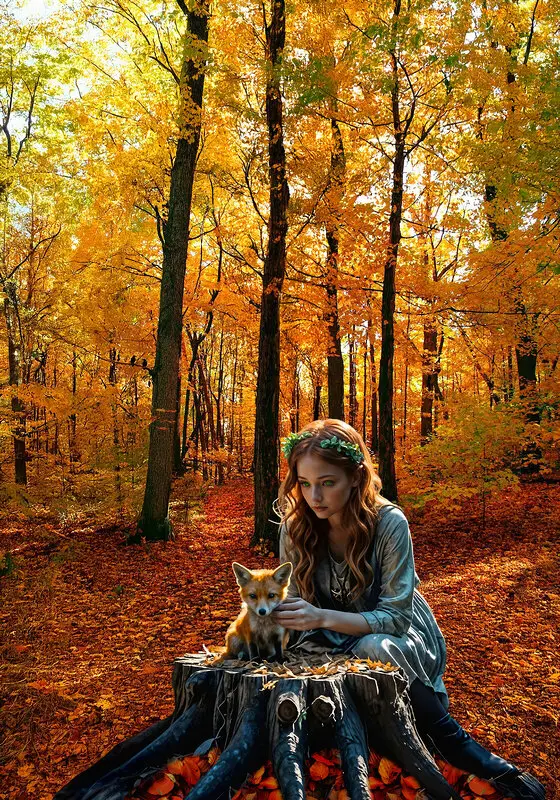
In my image, a red-haired girl with green eyes sits scratching a fox cub behind the ears. She is a ‘skogsrå’, a forest spirit living in the Beech Forest outside Malmö. Beech forests thrive on better soil than pines, but the dense canopy of the beech tree allows little light and nourishment to reach the ground below, so the undergrowth tends to look very much the same.
But now to the saying itself. One might wonder where it comes from. The pine forest is the stoic character of the Nordic woods. While the leafy deciduous forest spreads over rich soil and enjoys a lush and relatively comfortable life, the pine tree battles on dry heights, rocky outcrops, and rarely visited moraines. It grows where it seems unprofitable to do so—straight and lean, tough as tar, and often twisted by the wind.
Then, quite suddenly, a parallel appears: the redhead, for this proverb is not merely an ecological observation but a subtle comment on human nature. The redhead, often seen as unusual, fiery-tempered, and hard to grasp, finds a Nordic cousin in the pine. Both grow on “poor soil,” which in this context refers as much to personal and social circumstances as to literal earth.
Historically, red hair has been surrounded by myths and contradictions. In some cultures, it has been considered noble or royal; in others, a sign of witchcraft, desire, or untrustworthiness. However, it has often been associated with primal force in the North. Vikings are frequently depicted with flaming manes, and on the Bayeux Tapestry, we see William the Conqueror himself embroidered with red hair. One can almost hear the needle scoff: “This man didn’t grow on good soil—he took it.” This unique and powerful nature of redheads makes them so intriguing.
In ancient Egypt, red hair was viewed with suspicion. It was believed that red-haired individuals were under the influence of Seth, the god of chaos and desert storms. Archaeologists have found that certain mummies with red hair were treated differently—sometimes their images were burned or buried with special rites. Seth was often depicted with reddish features, and the colour symbolised fire, danger, and otherness. Yet, this might also hint at the power and threat of redheads: one does not fear what is insignificant.
In Babylon, there are no direct references to red hair. Still, Assyrian reliefs occasionally show warriors with light or reddish hair, which may suggest a fascination with northern or exotic peoples. Then, as now, red hair could symbolise something beyond the ordinary—a trait that stood out in a sea of dark-skinned and black-haired individuals.
Classical Greece held a more ambivalent view of red hair. Aristotle believed redheads possessed fiery tempers, and some tragedians gave their heroes or villains red hair to emphasise passion or intensity. In Homer’s works, we find suggestions of fair and reddish tones among warriors, sometimes used to highlight heroism and imply a threat.
And what of the Romans? Red hair was seen as a typically barbaric trait. Germans, Celts, Gauls—all the northern peoples that the Romans battled—were often described as red-haired giants. Julius Caesar spoke of Gauls with fire-like hair, and Tacitus described Germans as fair-haired, tall, and unpredictable. The redhead became a mirror for Rome’s fears and admiration of strength. Ironically, some Roman women dyed red hair with henna to attain a more exotic and desirable appearance. What is first seen as dangerous soon becomes a fashion trend.
And perhaps here lies the key to the proverb. It is not meant to diminish, but to illuminate. Those who grow on fertile ground may live straight, safe lives. But those who emerge from poor soil—from wind, frost, and stony barrens—must harden, adapt, and become something else. Perhaps something better. Or at least, something more interesting.
Like many Nordic sayings, the proverb is neither a warning nor full praise. It is a laconic observation, a poetic reflection on how distinction does not arise from comfort. Red hair and pine forest—two expressions of resilience, stubbornness, and vitality, growing where others wouldn’t even try to take root. This resilience and defiance of red hair is what inspires and empowers us.
So the next time you see a red-haired person striding through a pine forest, perhaps you’ll smile at each other before you are two beings that did not grow on good soil. And that, possibly, is the greatest gift of all.
Famous Redheads Through the Ages
Throughout history, red hair has inspired awe, admiration, suspicion, and myth. From thrones to battlefields, from fiction to the silver screen, redheads have blazed their trails – sometimes feared, often adored, and always remembered.
One of the most iconic was Elizabeth I of England, whose flaming red hair symbolised regal power and fierce independence. She ruled with unmatched political cunning and made her hair part of her identity, her image almost mythic in its intensity. William the Conqueror, famously depicted with red hair in the Bayeux Tapestry, was another – a man who, as we’ve said, didn’t grow on good soil, but conquered it.
Across the Atlantic, Thomas Jefferson, one of the United States' founding fathers, was a redhead known for his intellect and revolutionary spirit. In Sweden, the unstable yet fascinating Eric XIV, red-blond and gifted, met his downfall through paranoia and poison.
Redheads appear not only in history books but in myth and legend. In many artistic depictions, Medusa has fiery red hair – a dangerous, magnetic symbol of feminine power. Lilith, the rebellious first wife of Adam in apocryphal tales, is sometimes imagined with red hair, embodying defiance and wildness. In Norse mythology, Freyja, goddess of love and war, is occasionally envisioned with burnished red-gold hair – equal parts seduction and strength.
In literature, redheads have captured imaginations for generations. Anne Shirley, from Anne of Green Gables, is a passionate and fiercely imaginative girl who battles prejudice and embraces life radiantly. With her iconic red braids, Pippi Longstocking is a force of pure, playful anarchy – Astrid Lindgren’s red-haired rebellion incarnate. Then there's Tintin, the inquisitive reporter with a tuft of orange hair and endless courage. Ygritte, the wildling in Game of Thrones, whose flame-red hair and fierce independence captivated viewers and readers alike.
Modern culture offers no shortage of striking redheads. Lucille Ball, the trailblazing queen of comedy, turned her fiery hair into a cultural trademark. Julianne Moore became one of Hollywood’s most respected actresses with her luminous presence and quiet strength. Once the royal rebel, Prince Harry, brought global attention back to the ginger crown. Actors like Jessica Chastain, Isla Fisher, Domhnall Gleeson, and Eddie Redmayne prove that red hair continues to intrigue and enchant on screen.
Even in fantasy, red hair often signals boldness. Disney’s Merida, the Scottish princess from Brave, defies tradition with wild curls and a warrior’s heart. Ariel, the little mermaid of Disney’s imagination, swims against the current with her iconic red hair and longing for another world. Ron Weasley, Harry Potter’s loyal friend, gives redheads a place of warmth and humour at the heart of one of the most beloved stories of our time.
Red hair is more than a colour – it’s a signal flare, a story, a contradiction. Those who wear it, whether by chance or choice, carry centuries of myth, power, and the peculiar magic of being just a little different.
3 200 kr

Jörgen Thornberg
Malmö
Lite om bilder och mig. Translation in English at the end.
Jag är en nyfiken person som ser allt i bilder, även det jag fäster i ord, gärna tillsammans för bakom alla mina bilder finns en berättelse. Till vissa bilder hör en kortare eller längre novell som följer med bilden.
Bilder berättar historier. Jag omges av naturlig skönhet, intressanta människor och historia var jag än går. Jag använder min kamera för att dokumentera världen och blanda det jag ser med vad jag känner för att fånga den dolda magin.
Mina bilder berättar mina historier. Genom mina bilder, tryck och berättelser. Jag bjuder in dig att ta del av dessa berättelser, in i ditt liv och hem och dela min mycket personliga syn på vår värld. Mer än vad ögat ser. Jag tänker i bilder, drömmer och skriver och pratar om dem; följaktligen måste jag också skapa bilder. De blir vad jag ser, inte nödvändigtvis begränsade till verkligheten. Det finns en bild runt varje hörn. Jag hoppas att du kommer att se vad jag såg och gilla det.
Jag är också en skrivande person och till många bilder hör en kortare eller längre essay. Den följer med tavlan, tryckt på fint papper och med en personlig hälsning från mig.
Flertalet bilder startar sin resa i min kamera. Enkelt förklarat beskriver jag bilden jag ser i mitt inre, upplevd eller fantiserad. Bilden uppstår inom mig redan innan jag fått okularet till ögat. På bråkdelen av ett ögonblick ser jag vad jag vill ha och vad som kan göras med bilden. Här skall jag stoppa in en giraff, stålmannen, Titanic eller vad det är min fantasi finner ut. Ännu märkligare är att jag kommer ihåg minnesbilden långt efteråt när det blir tid att skapa verket. Om jag lyckas eller inte, är upp till betraktaren, oftast präglat av en stråk av svart humor – meningen är att man skall bli underhållen. Mina bilder blir ofta en snackis där de hänger.
Jag föredrar bilder som förmedlar ett budskap i flera lager. Vid första anblicken fylld av feel-good, en vacker utsikt, fint väder, solen skiner, blommor på ängen eller vattnet som ligger förrädiskt spegelblankt. I en sådan bild kan jag gömma min egentliga berättelse, mitt förakt för förtryckare och våldsverkare, rasister och fördomsfulla människor - ett gärna återkommande motiv mer eller mindre dolt i det vackra motivet. Jag försöker förena dem i ett gemensamt narrativ.
Bild och formgivning har löpt som en röd tråd genom livet. Fotokonst känns som en värdig final som jag gärna delar med mig.
Min genre är vid som framgår av mina bilder, temat en blandning av pop- och gatukonst i kollage som kan bestå av hundratals lager. Vissa bilder kan ta veckor, andra någon dag innan det är dags att överlämna resultatet till printverkstaden. Fine Art Prints är digitala fotocollage. I dessa kollage sker rivandet, klippandet, pusslandet, målandet, ritandet och sprayningen digitalt. Det jag monterar in kan vara hundratals år gamla bilder som jag omsorgsfullt frilägger så att de ser ut att vara en del av tavlan men också bilder skapade av mig själv efter min egen fantasi. Därefter besöks printstudion och för vissa bilder numrera en limiterad upplaga (oftast 7 exemplar) och signera för hand. Vissa bilder kan köpas i olika format. Det är bara att fråga efter vilka. Gillar man en bild som är 70x100 men inte har plats på väggen, går den kanske att få i 50x70 cm istället. Frågan är fri.
Metoden Giclée eller Fine Art Print som det också kallas är det moderna sättet för framställning av grafisk konst. Villkoret för denna typ av utskrifter är att en högkvalitativ storformatskrivare används med åldersbeständigt färgpigment och konstnärspapper eller i förekommande fall på duk. Pappret som används möter de krav på livslängd som ställs av museer och gallerier. Normalt säljer jag mina bilder oinramade så att den nya ägaren själv kan bestämma hur de skall se ut, med eller utan passepartout färg på ram, med eller utan glas etc..
Under många år ställde jag bara ut på nätet, i valda grupper och på min egen Facebooksida - https://www.facebook.com/jorgen.thornberg.9
Jag finns också på en egen hemsida som tyvärr inte alltid är uppdaterad – https://www.jth.life/ Där kan du också läsa en del av de berättelser som följer med bilden.
UTSTÄLLNINGAR
Luftkastellet, oktober 2022
Konst i Lund, november 2022
Luftkastellet, mars 2023
Engleson Galleri Caroli, april 2023
Hydra, Greece June 2023
Engleson Galleri Caroli, oktober 2023
Toppen, Höllviken december 2023
Luftkastellet, mars 2024
Torups Galleri, mars 2024
Venice, May 2024
Luftkastellet, oktober 2024
Konst i Advent, December 2024
Galleri Engleson, Caroli December 2024
Jäger & Jansson Galleri, april 2025
A bit about pictures and me.
I'm a curious person who sees everything in pictures, even what I express in words, often combining them, for behind all my pictures lies a story. These narratives, some as short as a single image and others as long as a novel, are the heart and soul of my work.
Pictures tell stories. Wherever I go, I'm surrounded by natural beauty, exciting people, and history. I use my camera to document the world and blend what I see with what I feel to capture the hidden magic.
My images tell my stories. Through my pictures, prints, and narratives, I invite you to partake in these stories in your life and home and share my deeply personal perspective of our world. More than meets the eye. I think in pictures, dream, write, and talk about them; consequently, I must create images too. They become what I see, not necessarily confined to reality. There's a picture around every corner. I hope you'll see what I saw and enjoy it.
I'm also a writer, and many images come with a shorter or longer essay. It accompanies the painting, printed on fine paper with my personal greeting.
Many pictures start their journey on my camera. Simply put, I describe the image I see in my mind, experienced or imagined. The image arises within me even before I bring the eyepiece to my eye. In a fraction of a moment, I see what I want and what can be done with the picture. Here, I'll insert a giraffe, Superman, the Titanic, or whatever my imagination conjures up. Even stranger is that I remember the mental image long after it's time to create the work. Whether I succeed is up to the observer, often imbued with a streak of black humour – the aim is to entertain. My pictures usually become a talking point wherever they hang.
I prefer pictures that convey a message in multiple layers. At first glance, they're filled with feel-good vibes, a beautiful view, lovely weather, the sun shining, flowers in the meadow, or the water lying deceptively calm. But beneath this surface beauty, I often conceal a deeper story, a narrative that challenges societal norms or explores the human condition. I invite you to delve into these hidden narratives and discover the layers of meaning within my work.
Picture and design have been a thread running through my life. Photographic art feels like a fitting finale, and I'm happy to share it.
My genre is varied, as seen in my pictures; the theme is a blend of pop and street art in collages that can consist of hundreds of layers. Some images can take weeks, others just a day before it's time to hand over the result to the print workshop. Fine Art Prints are digital photo collages. In these collages, tearing, cutting, puzzling, painting, drawing, and spraying happen digitally. What I insert can be images hundreds of years old that I carefully extract so they appear to be part of the painting, but also images created by myself, now also generated from my imagination. Next, visit the print studio and, for certain images, number a limited edition (usually 7 copies) and sign them by hand. Some images may be available in other formats. Just ask which ones. If you like an image that's 70x100 but doesn't have space on the wall, you might be able to get it in 50x70 cm instead. The question is open.
The Giclée method, or Fine Art Print as it's also called, is the modern way of producing graphic art. This method ensures the highest quality and longevity of the artwork, using a high-quality large-format printer with archival pigment inks and artist paper or, in some cases, canvas. The paper used meets the longevity requirements set by museums and galleries. I sell my pictures unframed, allowing the new owner to personalise their artwork, confident in the lasting value and quality of the piece.
For many years, I only exhibited online, in selected groups, and on my Facebook page - https://www.facebook.com/jorgen.thornberg.9. I also have my website, which unfortunately is not constantly updated - https://www.jth.life/. You can also read some of the stories accompanying the pictures there.
EXHIBITIONS
Luftkastellet, October 2022
Art in Lund, November 2022
Luftkastellet, March 2023
Engleson Gallery Caroli, April 2023
Hydra, Greece June 2023
Engleson Gallery Caroli, October 2023
Toppen, Höllviken December 2023
Luftkastellet, March 2024
Torup Gallery, March 2024
Venice, May 2024
UTSTÄLLNINGAR
Luftkastellet, oktober 2022
Konst i Lund, november 2022
Luftkastellet, mars 2023
Engleson Galleri Caroli, april 2023
Hydra, Greece June 2023
Engleson Galleri Caroli, oktober 2023
Toppen, Höllviken december 2023
Luftkastellet, mars 2024
Torups Galleri, mars 2024
Venice, May 2024
Luftkastellet, October 2024
Konst i Advent, December 2024
Galleri Engleson, Caroli December 2024
Jäger & Jansson Galleri, April 2025
Utbildning
Autodidakt
Medlem i konstnärsförening
Öppna Sinnen
Med i konstrunda
Konstrundan i Skåne
Utställningar
Luftkastellet, October 2022
Art in Lund, November 2022
Luftkastellet, March 2023
Engleson Gallery Caroli, April 2023
Hydra, Greece June 2023
Engleson Gallery Caroli, October 2023
Toppen, Höllviken December 2023
Luftkastellet, March 2024
Torup Gallery, March 2024
Venice, May 2024