Vi använder cookies för att ge dig bästa möjliga upplevelse. Välj vilka cookies du tillåter.
Läs mer i vår integritetspolicy
Jörgen Thornberg
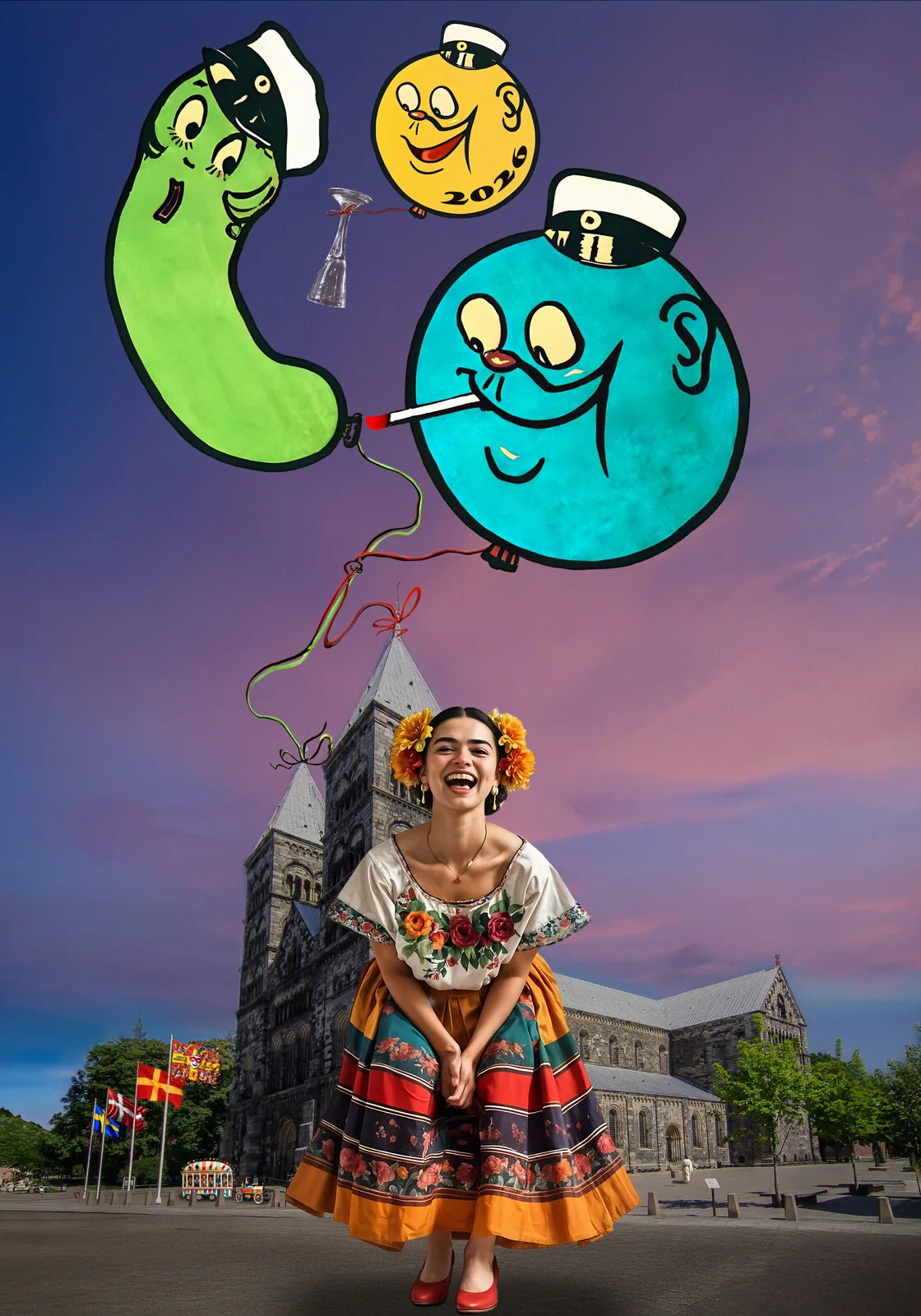
A Carnival worth laughter - En Karneval att skratta till, 2025
Digital
30 x 40 cm
2 500 kr
A Carnival worth laughter - En Karneval att skratta till
Hoaxes, Tricks, and Spectacle – From Bucket to Sensation
A simple bucket can hold more than just water—it can carry a story, a moment of laughter, and one of the most legendary student pranks in the history of the Lund Carnival. But Lund’s students were hardly the first to fool an audience with a clever twist. From circus master P.T. Barnum’s ingenious trap to the classic bluff of the **"Genuine Span Jor,"** there is something timeless about a well-executed hoax. What makes us love being deceived? Perhaps it’s the thrill of expectation, the surprise of the reveal, and the unexpected joy of realising that we, too, are part of the joke.
Lund is a city of academic brilliance, scholarly traditions, and fun, so please continue reading to learn more about the humorous picture and its connection to knowledge and carnivals.
"The Bucket and the Greatest Hoax
A bucket stood lonely, silver and bright,
its lid gleamed softly in shimmering light.
On its side, in a student’s hand,
"Genuine Span Jor"—a promise so grand.
The crowd gathered, eager and warm,
drawn to the magic, the carnival’s charm.
No dancer appeared, no fire, no song,
just a bucket—and laughter, echoing strong.
But the world has witnessed an even greater scene,
where the curtain fell, yet the lie stayed pristine.
A tent filled with people, a master of wit,
who sold them a hoax—and made them all sit.
They waited silently; excitement ran high,
when the curtain was raised—faces nearby.
Was the greatest hoax, laughter, shame,
trickery, or a genius’s game?
So the bucket and hoax walk hand in hand
in the students’ Lund and circus land.
The world loves a lie so grand and wide
that we become the show inside.”
Lund, March 2025
The History of the Carnival – A Long and Colourful Tradition
The history of the Lund Carnival is a fascinating journey with roots tracing back to 1849. That year, students from Smålands Nation, dressed as a rustic wedding party from Värend, marched from the tavern Finkelborg, through Lund, and out to the ‘Brunnssalong’ (a place with natural mineral water) in Lilla Råby. The drinking vessels were raised frequently, but there was no wedding since no bride was available. Student life was exclusively male then, and the revelry knew no bounds. This spontaneous celebration laid the foundation for the following structured and themed carnivals.
From Spontaneous Festivities to Organised Tradition
Over the ensuing decades, the carnival adopted a more structured format. When the Student Union was formally established in 1867, its president automatically became the carnival committee chairman. However, this responsibility was hardly burdensome—the carnival could be planned and executed within a week.
The May festivals continued, and in 1860, all of Lund’s students gathered for a joint carnival. In 1863, the first themed carnival procession was introduced: ‘The Sale of the Greek Throne’, inspired by contemporary political events in Greece. From there, the tradition grew stronger. The Lund Student Union, founded in 1867, officially took over the organisation of the carnival. Initially, the event was held annually, then every other year, and from 1892, it became a quadrennial tradition—with interruptions during world wars and economic depressions that occasionally disrupted the schedule.
From Prince Carnival to Carnival General
The carnival had a figurehead, Prince Carnival, who proudly rode through the city on horseback for a long time. However, in 1904, the horse was replaced by one of Lund’s first automobiles—a three-wheeled vehicle. Behind the wheel was Sam Ask, an eternal student and a driving force behind several carnivals. Over time, Prince Carnival was succeeded by a Carnival General who continues to lead the festivities today.
The Carnival Newspaper – Humour and Satire
One of the carnival’s most enduring traditions is the carnival newspaper. Over the years, its humour has ranged from challenging to decipher to sharply critical, and those who its satire has targeted have seldom found it as amusing as the readers.
In 1886, the newspaper was named Tumelilla Weckoblad, Torrt och Gammalt, a clear parody of the conservative Lunds Weckoblad, Nytt och Gammalt. The response was swift—the offended newspaper retaliated with a scathing review, declaring that the carnival was now nothing more than a bankrupt tradition. But the carnival paper survived and continues to thrive to this day.
Circus, Films, and Student Theatre
The carnival circus has always been a crowd favourite. But here, it’s not about world-class acrobatics—instead, the aim is to be as ridiculous and unexpected as possible.
At Circus Leonardi in 1900, the highlight was ‘The Queen of the Air’, a tightrope walker who floated so high that she was invisible to the human eye.
The festivities took on a new dimension with the first carnival film 1908. ‘The Lion Hunt’, one of Sweden’s first feature films, became a classic. That same year, the carnival theatre spectacle Uarda was performed—a production that was later adapted into a three-act play and remains one of the greatest triumphs of Lund student theatre.
The Entrance of Female Students
Women were initially excluded from the carnival procession. However, in 1912, they made their first appearance—though only as a separate group. It didn’t take long before female drum majors and revue primadonnas became integral to the celebrations. In 2014, for the first time in history, the carnival was led by a female general, marking a new era in its long tradition. This inclusion of female students added a new dimension to the carnival and marked a significant step towards gender equality in the student community.
Culture’s Carnival and a Floating Royal Parade
In 1928, a mysterious boat slowly made its way through Lund’s streets—majestic and deliberate. One would have to go back to the Viking Age to find a vessel of this size navigating Lund’s waters. The Höje River, now little more than a trickle, was once navigable 1,200 years ago.
Crowds of Lund citizens lined the streets, and those who had invested 50 öre in a carnival programme could follow along and understand what was happening. For the more frugally minded, the programme was also available "free of charge, against a payment of 40 öre"—a pricing model entirely in line with student humour.
The theme for that year was "Culture," founded on the undeniable premise that Lund was not only the centre of the universe but also the Capital of Culture.
*"Many other cities have culture too, but theirs is dead."*
With this motto in mind, the carnival procession transformed into a travelling Museum of cultural history. Marching ahead of the enormous boat were the bearers of culture, including Alexander the Great and the Swedish boxer Harry Persson.
Most people likely recognise Alexander the Great, even though he died over two thousand years ago. But Harry Persson? That may pose a more formidable challenge for today’s audience.
A Floating Royal Parade and a Cultural Battle
In the grand boat that floated through Lund in 1928, patrons and enthusiasts of culture held court. Against a jubilee fund of blue and yellow, the modern cultural state’s foremost representative stood out—His Majesty King Carnival (Mr. K).
But who was Mr. K? Today, few would immediately recognise the reference to King Gustav V and his notorious alias as a tennis player—Mr. G. Humour, as always, is a perishable commodity, and since Mr G’s passing, Sweden has welcomed two new monarchs.
Royal figures often play a role in the carnival, but how many museum directors have been immortalised in such a setting? One was Georg Karlin, director of Kulturen, who took his place in the parade leading the renowned cultural battle "Hasard." A clever play on words of the highest order—"Kamp" means "horse" in Swedish, and "Hazard" was the name of the last enlisted soldier’s horse, which was taxidermied and displayed at Kulturen. However, the name also alluded to the lotteries that financed the museum’s activities.
Karlin was accompanied by three "hasardspelmän" (gambling fiddlers), a nod to either gambling, folk music, or perhaps both.
This carnival blended cultural heritage, royal satire, and student humour, unfurling in a slow yet grand procession through Lund.
The Animal Kingdom and the Three Little Swines
Lund Carnival has always mirrored its era, sometimes bluntly and satirically. The 1934 carnival was no exception. The theme, "The Third Reich. The Animal Kingdom," was a naïve and time-typical mix of contemporary world affairs and animalistic humour. Among the carnival’s menagerie, three little swine—Hitler, Göring, and Goebbels—appeared alongside Mickey Mouse. The carnival newspaper was aptly titled Vårkamp (Spring Struggle), and the turnout was impressive.
Newspapers arranged group trips to Lund, and the reviews were glowing. No one reacted to the theme—yet. The self-criticism arrived much later when history passed its judgment on the "little swines" that had been so casually depicted in the carnival parade.
The next carnival did not occur until twelve years later, a long hiatus that evidenced a changed reality. The world had transformed, and so had the carnival. The 1946 edition adopted the theme "The Great People's University." Prince Carnival was gone—replaced by Miss Carnival.
Science became a pivotal issue in the post-war era, and the Carnival’s Institute for Scientific Research tackled the most pressing topics. But no academic debate occurred here. Instead, it evolved into a student-inspired spectacle featuring the atomic bomb—and the anatomical bomb. Blonde bombshells and Bombi Bitt were also present, not to mention the ever-present carnival traditions—wordplay, temporal twists, and academic irreverence.
The blissful ignorance of 1934 had vanished. The carnival continued, but the world would never be the same again.
1954 – The Scandal Carnival That Left Its Mark
Lund carnivals are generally memorable, but the 1954 edition elevated the experience—it became a scandalous carnival of historic proportions.
The carnival's theatrical production, Djingis Kahn, featured a script penned by Hasse Alfredson, who also took to the stage. Cilla Ingvar was a celebrated revue prima donna, and Folke Spuling directed Circus Zoodom.
Four years later, in 1958, the Morality Carnival was nearly cancelled—not due to moral outcry but because of political tensions. The battle over pensions had intensified, and the government threatened new elections.
During a student evening event in March, amid political turbulence, Cilla Ingvar confronted the Prime Minister with a defining question:
"Election or Carnival?"
The answer was clear—Carnival. And so, Jan-Öjvind Swahn stepped in as Carnival Admiral—a good compromise.
As always, the Lund Carnival straddled the intersection of politics, student antics, and grand spectacle.
1970 – The Carnival’s True Heroes
For the first carnival of the 1970s, the carnival committee was hailed as its true heroes—and rightly so. Following the student revolts of 1968, the carnival faced an unexpected enemy—its student union. The resistance was fierce.
An ideological opposition had emerged, asserting that student carnivals were outdated, bourgeois distractions. In the Magazine Lundagård, students were urged to fight the carnival by any means necessary.
It could have been a severe crisis, but instead of retreating, the carnival committee chose a different path:
They invited the opposition to a party. An alternative carnival was held in Stadsparken, where the leftist resistance was neutralised with copious red wine.
The result? The Maximal Carnival unfolded as expected—and was an overwhelming success.
More Amusements – and More Hoaxes
The Lund Carnival has never stood still. Over the years, its attractions have expanded in number and variety. The children’s parking area has been transformed into Barnevalen, now a must-see for visitors of all ages.
And, of course, there are the classic carnival hoaxes. Who could forget Prince Porridge in Breakfast Land, a highlight of the 1990 Double Morality Carnival, where Johan Wester and Anders Jansson dominated the stage? Yet perhaps the most iconic hoax of them all was the tent with separate entrances for men and women—a setup that built anticipation for something forbidden, something daring. As the curtain rose, they sat—eye to eye, equally deceived and entertained.
The Ever-Expanding Carnival
Size does matter, and the Lund Carnival has grown year upon year. More attractions, more carnivalists, more puns—and more tickets sold.
Interest in the 2014 Futural Carnival reached unprecedented heights. More than 5,500 students queued to participate, volunteer, miss exams, entertain, and be entertained.
The revenue? A staggering 30 million kronor. Quite a sum for a bunch of broke students.
But what is the essence of the Lund Carnival? This question has been posed countless times. Per Lindström offers one possible answer:
"Perhaps it is the preservation of old traditions, combined with constant renewal and an ongoing questioning of the past."
The carnival’s history blends facts and atmosphere. It has even been jokingly dubbed "Karnevöl," a nod to the enormous quantity of beer (öl) consumed during the event. It is where generations of students can find "their" carnival and chuckle in recognition.
Claes Virdeborn, General of the 1990 Double Morality Carnival, once remarked, "It wasn’t better in the past. But it will be." They still work towards that.
Politics, Prophecies, and Hoaxes – The Eternal Ingredients of the Carnival
Let’s fast-forward a bit in the history of the Lund Carnival, specifically to the 1990 Double Morality Carnival. That year, Prime Minister Ingvar Carlsson appeared on multiple floats in the parade. On one of them, he was seated under "The World’s Best Carlsson"—a publicity campaign he had little reason to complain about. The year before, in 1989, he had been awarded an honorary doctorate in Lund and signed a blank guarantee for the carnival—a gesture that endeared him to students. But then again, students are easily amused.
The 2006 Dual Carnival was even more delightful, with one float eliciting laughter. A lone Uppsala student sat on it, looking dejected and miserable, surrounded by playful revellers, musicians, and the carnival's exuberance. The contrast was stark because life must be trying for the students up north, so close to the North Pole.
During the 2014 Futural Carnival, the parade delivered a prophetic message—years in advance. The sign on one of the vehicles read: "Santa sees your web history – He sees you when you are sleeping."
Even then, students had an uncanny premonition of the future of surveillance. The fact that the message was in English was no accident—it was aimed at America. A decade later, it is hardly a laughing matter anymore.
The 2014 parade, witnessed by 200,000 spectators, should have sparked reflection and debate—or at least, it should have. Other prophetic themes that year included "Moscow Pride" and "Vasaloppet in the Tracks of the Future," insights that have only sharpened with time.
But while carnivals are all good, the recurring hoaxes capture the crowd's heart. The legendary "Spaniard" of the Lund Carnival deserves the spotlight—situating it within the broader history of the most ingenious hoaxes ever.
A Small Journey – From the Lund Carnival to P.T. Barnum’s Ingenious Hoax
In 1954, the Lund Carnival drew massive crowds with its satirical and student-driven humour, and one particularly memorable hoax was brilliantly executed. The carnival programme promoted an exclusive performance by the world-renowned Spanish flamenco dancer Señorita Estrella de España. Lund locals and visitors eagerly anticipated witnessing this exotic artist perform on stage.
However, when the curtain rose, there was no dancer in sight. Instead, the audience was confronted with a large metal bucket emblazoned with the words "Äkta Spanjor" ("Genuine Spaniard") painted on its side.
The joke? The word "Spanjor" was a clever pun—a blend of "Spann" (bucket, in the Skåne dialect) and "jor" (a phonetic play on "jord," meaning soil in Swedish). When read aloud, it sounded like "Spaniard" in Swedish.
The tense anticipation transformed into roaring laughter as the audience realised they had just been deceived by one of the most legendary pranks in Lund's student history.
But this was far from the first well-executed hoax to amuse an audience. A similar yet far grander deception is attributed to the American showman P.T. Barnum—the man behind the phrase "There’s a sucker born every minute" and a true master of drawing crowds into the unexpected.
P.T. Barnum’s Greatest Hoax
Phineas Taylor Barnum was a showman like no other—a man who could sell anything with the proper marketing. He gained fame for exhibiting extraordinary attractions, such as the ‘Feejee Mermaid’—a grotesque stitched-together amalgamation of a monkey and a fish—and ‘General Tom Thumb’, a diminutive performer whom Barnum branded as a miniature aristocrat.
Yet one of his most straightforward yet clever hoaxes was "The Greatest Hoax in the World"—a show that attracted enormous crowds.
Barnum advertised extensively, promising audiences something truly unbelievable—"the greatest hoax the world had ever seen." Tickets sold out in record time, and as the show commenced, a massive tent was packed to the brim.
Excitement electrified the air as the audience settled into their seats.
Then the curtain rose.
And what did they see?
Nothing.
Or rather—each other.
By stretching a large curtain across the tent, Barnum had divided the audience into two groups. When the curtain lifted, they sat there—two puzzled halves of a crowd, staring straight at one another.
That was the entire show.
They were the hoax.
At first, stunned silence. Then laughter erupted. Barnum had delivered exactly what he had promised—an unparalleled hoax.
According to some accounts, Barnum offered to refund the ticket price, but very few accepted. Whether out of embarrassment for having been tricked or simply because they still found it entertaining, one thing was clear:
Barnum had once again proven himself to be the ultimate master of deception.
The Allure of Deception and the Magic of Theatre
What is it that makes hoaxes like these so effective? The Lund students' "Genuine Span Jor" and Barnum's "Greatest Hoax in the World" rely on the same simple principle: expectation and surprise. The audience is led to believe they are about to witness something spectacular, only to realise, in the end, that they are part of the joke.
But this is precisely what makes a brilliant hoax—it turns our perception of reality upside down and plays on our curiosity. We are willing to believe the incredible, and when confronted with the truth, we laugh at our gullibility.
Both the Lund Carnival and Barnum’s Circus have demonstrated that the grand and bombastic do not always leave the most remarkable impression—sometimes, all it takes is a bucket and a curtain.
Not a Joke, but Deadly Serious
A far cry from student pranks is the man who has turned deception into a system and is believed to be constantly exposed. His falsehoods are called alternative truths. If this were merely part of a carnival parade, it would be bad enough—but this is real and not a joke.
According to The Washington Post, during his first presidential term (2017–2021), Donald Trump made over 30,000 false or misleading statements, an average of about 21 falsehoods per day. Claims regarding election fraud, pandemic management, economic success, and international relations spread despite being repeatedly debunked. He has started his second run in the same manner.
This extensive use of misinformation has made the term "alternative facts" synonymous with Trump's administration. Even though his falsehoods have been exposed repeatedly, many supporters believe them. It is a political version of "The Greatest Hoax in the World", but unlike Barnum's audience, many do not even laugh when the curtain rises.
Trump's strategy of repeating falsehoods, even after they have been debunked, has created an environment where the line between truth and lies is blurred. Facts become relative, trust in traditional sources of information erodes, and democracy is tested.
This is no longer a carnival parade, a student prank, or a clever illusion—it is the new political playing field, where the deception is never fully revealed or ignored because it does not fit certain people’s worldviews.
A Bit of Inspiring Advertising
The chaotic brilliance of the Lund Carnival, which erupts every fourth May, where everything and everyone is mocked without mercy, where puns run rampant, and joy knows no bounds, is captured in a book well worth acquiring—
Lundakarnevalens historia by Per Lindström.
The author has followed and documented every carnival since 1974, amassing an enormous archive of images. Now, he has also penned the history of every carnival, drawing from archival materials, programmes, publications, interviews, and first-hand recollections of those who participated.
The book also serves as the Lund University Historical Society's Yearbook for 2015.
Jörgen Thornberg
A Carnival worth laughter - En Karneval att skratta till, 2025
Digital
30 x 40 cm
2 500 kr
A Carnival worth laughter - En Karneval att skratta till
Hoaxes, Tricks, and Spectacle – From Bucket to Sensation
A simple bucket can hold more than just water—it can carry a story, a moment of laughter, and one of the most legendary student pranks in the history of the Lund Carnival. But Lund’s students were hardly the first to fool an audience with a clever twist. From circus master P.T. Barnum’s ingenious trap to the classic bluff of the **"Genuine Span Jor,"** there is something timeless about a well-executed hoax. What makes us love being deceived? Perhaps it’s the thrill of expectation, the surprise of the reveal, and the unexpected joy of realising that we, too, are part of the joke.
Lund is a city of academic brilliance, scholarly traditions, and fun, so please continue reading to learn more about the humorous picture and its connection to knowledge and carnivals.
"The Bucket and the Greatest Hoax
A bucket stood lonely, silver and bright,
its lid gleamed softly in shimmering light.
On its side, in a student’s hand,
"Genuine Span Jor"—a promise so grand.
The crowd gathered, eager and warm,
drawn to the magic, the carnival’s charm.
No dancer appeared, no fire, no song,
just a bucket—and laughter, echoing strong.
But the world has witnessed an even greater scene,
where the curtain fell, yet the lie stayed pristine.
A tent filled with people, a master of wit,
who sold them a hoax—and made them all sit.
They waited silently; excitement ran high,
when the curtain was raised—faces nearby.
Was the greatest hoax, laughter, shame,
trickery, or a genius’s game?
So the bucket and hoax walk hand in hand
in the students’ Lund and circus land.
The world loves a lie so grand and wide
that we become the show inside.”
Lund, March 2025
The History of the Carnival – A Long and Colourful Tradition
The history of the Lund Carnival is a fascinating journey with roots tracing back to 1849. That year, students from Smålands Nation, dressed as a rustic wedding party from Värend, marched from the tavern Finkelborg, through Lund, and out to the ‘Brunnssalong’ (a place with natural mineral water) in Lilla Råby. The drinking vessels were raised frequently, but there was no wedding since no bride was available. Student life was exclusively male then, and the revelry knew no bounds. This spontaneous celebration laid the foundation for the following structured and themed carnivals.
From Spontaneous Festivities to Organised Tradition
Over the ensuing decades, the carnival adopted a more structured format. When the Student Union was formally established in 1867, its president automatically became the carnival committee chairman. However, this responsibility was hardly burdensome—the carnival could be planned and executed within a week.
The May festivals continued, and in 1860, all of Lund’s students gathered for a joint carnival. In 1863, the first themed carnival procession was introduced: ‘The Sale of the Greek Throne’, inspired by contemporary political events in Greece. From there, the tradition grew stronger. The Lund Student Union, founded in 1867, officially took over the organisation of the carnival. Initially, the event was held annually, then every other year, and from 1892, it became a quadrennial tradition—with interruptions during world wars and economic depressions that occasionally disrupted the schedule.
From Prince Carnival to Carnival General
The carnival had a figurehead, Prince Carnival, who proudly rode through the city on horseback for a long time. However, in 1904, the horse was replaced by one of Lund’s first automobiles—a three-wheeled vehicle. Behind the wheel was Sam Ask, an eternal student and a driving force behind several carnivals. Over time, Prince Carnival was succeeded by a Carnival General who continues to lead the festivities today.
The Carnival Newspaper – Humour and Satire
One of the carnival’s most enduring traditions is the carnival newspaper. Over the years, its humour has ranged from challenging to decipher to sharply critical, and those who its satire has targeted have seldom found it as amusing as the readers.
In 1886, the newspaper was named Tumelilla Weckoblad, Torrt och Gammalt, a clear parody of the conservative Lunds Weckoblad, Nytt och Gammalt. The response was swift—the offended newspaper retaliated with a scathing review, declaring that the carnival was now nothing more than a bankrupt tradition. But the carnival paper survived and continues to thrive to this day.
Circus, Films, and Student Theatre
The carnival circus has always been a crowd favourite. But here, it’s not about world-class acrobatics—instead, the aim is to be as ridiculous and unexpected as possible.
At Circus Leonardi in 1900, the highlight was ‘The Queen of the Air’, a tightrope walker who floated so high that she was invisible to the human eye.
The festivities took on a new dimension with the first carnival film 1908. ‘The Lion Hunt’, one of Sweden’s first feature films, became a classic. That same year, the carnival theatre spectacle Uarda was performed—a production that was later adapted into a three-act play and remains one of the greatest triumphs of Lund student theatre.
The Entrance of Female Students
Women were initially excluded from the carnival procession. However, in 1912, they made their first appearance—though only as a separate group. It didn’t take long before female drum majors and revue primadonnas became integral to the celebrations. In 2014, for the first time in history, the carnival was led by a female general, marking a new era in its long tradition. This inclusion of female students added a new dimension to the carnival and marked a significant step towards gender equality in the student community.
Culture’s Carnival and a Floating Royal Parade
In 1928, a mysterious boat slowly made its way through Lund’s streets—majestic and deliberate. One would have to go back to the Viking Age to find a vessel of this size navigating Lund’s waters. The Höje River, now little more than a trickle, was once navigable 1,200 years ago.
Crowds of Lund citizens lined the streets, and those who had invested 50 öre in a carnival programme could follow along and understand what was happening. For the more frugally minded, the programme was also available "free of charge, against a payment of 40 öre"—a pricing model entirely in line with student humour.
The theme for that year was "Culture," founded on the undeniable premise that Lund was not only the centre of the universe but also the Capital of Culture.
*"Many other cities have culture too, but theirs is dead."*
With this motto in mind, the carnival procession transformed into a travelling Museum of cultural history. Marching ahead of the enormous boat were the bearers of culture, including Alexander the Great and the Swedish boxer Harry Persson.
Most people likely recognise Alexander the Great, even though he died over two thousand years ago. But Harry Persson? That may pose a more formidable challenge for today’s audience.
A Floating Royal Parade and a Cultural Battle
In the grand boat that floated through Lund in 1928, patrons and enthusiasts of culture held court. Against a jubilee fund of blue and yellow, the modern cultural state’s foremost representative stood out—His Majesty King Carnival (Mr. K).
But who was Mr. K? Today, few would immediately recognise the reference to King Gustav V and his notorious alias as a tennis player—Mr. G. Humour, as always, is a perishable commodity, and since Mr G’s passing, Sweden has welcomed two new monarchs.
Royal figures often play a role in the carnival, but how many museum directors have been immortalised in such a setting? One was Georg Karlin, director of Kulturen, who took his place in the parade leading the renowned cultural battle "Hasard." A clever play on words of the highest order—"Kamp" means "horse" in Swedish, and "Hazard" was the name of the last enlisted soldier’s horse, which was taxidermied and displayed at Kulturen. However, the name also alluded to the lotteries that financed the museum’s activities.
Karlin was accompanied by three "hasardspelmän" (gambling fiddlers), a nod to either gambling, folk music, or perhaps both.
This carnival blended cultural heritage, royal satire, and student humour, unfurling in a slow yet grand procession through Lund.
The Animal Kingdom and the Three Little Swines
Lund Carnival has always mirrored its era, sometimes bluntly and satirically. The 1934 carnival was no exception. The theme, "The Third Reich. The Animal Kingdom," was a naïve and time-typical mix of contemporary world affairs and animalistic humour. Among the carnival’s menagerie, three little swine—Hitler, Göring, and Goebbels—appeared alongside Mickey Mouse. The carnival newspaper was aptly titled Vårkamp (Spring Struggle), and the turnout was impressive.
Newspapers arranged group trips to Lund, and the reviews were glowing. No one reacted to the theme—yet. The self-criticism arrived much later when history passed its judgment on the "little swines" that had been so casually depicted in the carnival parade.
The next carnival did not occur until twelve years later, a long hiatus that evidenced a changed reality. The world had transformed, and so had the carnival. The 1946 edition adopted the theme "The Great People's University." Prince Carnival was gone—replaced by Miss Carnival.
Science became a pivotal issue in the post-war era, and the Carnival’s Institute for Scientific Research tackled the most pressing topics. But no academic debate occurred here. Instead, it evolved into a student-inspired spectacle featuring the atomic bomb—and the anatomical bomb. Blonde bombshells and Bombi Bitt were also present, not to mention the ever-present carnival traditions—wordplay, temporal twists, and academic irreverence.
The blissful ignorance of 1934 had vanished. The carnival continued, but the world would never be the same again.
1954 – The Scandal Carnival That Left Its Mark
Lund carnivals are generally memorable, but the 1954 edition elevated the experience—it became a scandalous carnival of historic proportions.
The carnival's theatrical production, Djingis Kahn, featured a script penned by Hasse Alfredson, who also took to the stage. Cilla Ingvar was a celebrated revue prima donna, and Folke Spuling directed Circus Zoodom.
Four years later, in 1958, the Morality Carnival was nearly cancelled—not due to moral outcry but because of political tensions. The battle over pensions had intensified, and the government threatened new elections.
During a student evening event in March, amid political turbulence, Cilla Ingvar confronted the Prime Minister with a defining question:
"Election or Carnival?"
The answer was clear—Carnival. And so, Jan-Öjvind Swahn stepped in as Carnival Admiral—a good compromise.
As always, the Lund Carnival straddled the intersection of politics, student antics, and grand spectacle.
1970 – The Carnival’s True Heroes
For the first carnival of the 1970s, the carnival committee was hailed as its true heroes—and rightly so. Following the student revolts of 1968, the carnival faced an unexpected enemy—its student union. The resistance was fierce.
An ideological opposition had emerged, asserting that student carnivals were outdated, bourgeois distractions. In the Magazine Lundagård, students were urged to fight the carnival by any means necessary.
It could have been a severe crisis, but instead of retreating, the carnival committee chose a different path:
They invited the opposition to a party. An alternative carnival was held in Stadsparken, where the leftist resistance was neutralised with copious red wine.
The result? The Maximal Carnival unfolded as expected—and was an overwhelming success.
More Amusements – and More Hoaxes
The Lund Carnival has never stood still. Over the years, its attractions have expanded in number and variety. The children’s parking area has been transformed into Barnevalen, now a must-see for visitors of all ages.
And, of course, there are the classic carnival hoaxes. Who could forget Prince Porridge in Breakfast Land, a highlight of the 1990 Double Morality Carnival, where Johan Wester and Anders Jansson dominated the stage? Yet perhaps the most iconic hoax of them all was the tent with separate entrances for men and women—a setup that built anticipation for something forbidden, something daring. As the curtain rose, they sat—eye to eye, equally deceived and entertained.
The Ever-Expanding Carnival
Size does matter, and the Lund Carnival has grown year upon year. More attractions, more carnivalists, more puns—and more tickets sold.
Interest in the 2014 Futural Carnival reached unprecedented heights. More than 5,500 students queued to participate, volunteer, miss exams, entertain, and be entertained.
The revenue? A staggering 30 million kronor. Quite a sum for a bunch of broke students.
But what is the essence of the Lund Carnival? This question has been posed countless times. Per Lindström offers one possible answer:
"Perhaps it is the preservation of old traditions, combined with constant renewal and an ongoing questioning of the past."
The carnival’s history blends facts and atmosphere. It has even been jokingly dubbed "Karnevöl," a nod to the enormous quantity of beer (öl) consumed during the event. It is where generations of students can find "their" carnival and chuckle in recognition.
Claes Virdeborn, General of the 1990 Double Morality Carnival, once remarked, "It wasn’t better in the past. But it will be." They still work towards that.
Politics, Prophecies, and Hoaxes – The Eternal Ingredients of the Carnival
Let’s fast-forward a bit in the history of the Lund Carnival, specifically to the 1990 Double Morality Carnival. That year, Prime Minister Ingvar Carlsson appeared on multiple floats in the parade. On one of them, he was seated under "The World’s Best Carlsson"—a publicity campaign he had little reason to complain about. The year before, in 1989, he had been awarded an honorary doctorate in Lund and signed a blank guarantee for the carnival—a gesture that endeared him to students. But then again, students are easily amused.
The 2006 Dual Carnival was even more delightful, with one float eliciting laughter. A lone Uppsala student sat on it, looking dejected and miserable, surrounded by playful revellers, musicians, and the carnival's exuberance. The contrast was stark because life must be trying for the students up north, so close to the North Pole.
During the 2014 Futural Carnival, the parade delivered a prophetic message—years in advance. The sign on one of the vehicles read: "Santa sees your web history – He sees you when you are sleeping."
Even then, students had an uncanny premonition of the future of surveillance. The fact that the message was in English was no accident—it was aimed at America. A decade later, it is hardly a laughing matter anymore.
The 2014 parade, witnessed by 200,000 spectators, should have sparked reflection and debate—or at least, it should have. Other prophetic themes that year included "Moscow Pride" and "Vasaloppet in the Tracks of the Future," insights that have only sharpened with time.
But while carnivals are all good, the recurring hoaxes capture the crowd's heart. The legendary "Spaniard" of the Lund Carnival deserves the spotlight—situating it within the broader history of the most ingenious hoaxes ever.
A Small Journey – From the Lund Carnival to P.T. Barnum’s Ingenious Hoax
In 1954, the Lund Carnival drew massive crowds with its satirical and student-driven humour, and one particularly memorable hoax was brilliantly executed. The carnival programme promoted an exclusive performance by the world-renowned Spanish flamenco dancer Señorita Estrella de España. Lund locals and visitors eagerly anticipated witnessing this exotic artist perform on stage.
However, when the curtain rose, there was no dancer in sight. Instead, the audience was confronted with a large metal bucket emblazoned with the words "Äkta Spanjor" ("Genuine Spaniard") painted on its side.
The joke? The word "Spanjor" was a clever pun—a blend of "Spann" (bucket, in the Skåne dialect) and "jor" (a phonetic play on "jord," meaning soil in Swedish). When read aloud, it sounded like "Spaniard" in Swedish.
The tense anticipation transformed into roaring laughter as the audience realised they had just been deceived by one of the most legendary pranks in Lund's student history.
But this was far from the first well-executed hoax to amuse an audience. A similar yet far grander deception is attributed to the American showman P.T. Barnum—the man behind the phrase "There’s a sucker born every minute" and a true master of drawing crowds into the unexpected.
P.T. Barnum’s Greatest Hoax
Phineas Taylor Barnum was a showman like no other—a man who could sell anything with the proper marketing. He gained fame for exhibiting extraordinary attractions, such as the ‘Feejee Mermaid’—a grotesque stitched-together amalgamation of a monkey and a fish—and ‘General Tom Thumb’, a diminutive performer whom Barnum branded as a miniature aristocrat.
Yet one of his most straightforward yet clever hoaxes was "The Greatest Hoax in the World"—a show that attracted enormous crowds.
Barnum advertised extensively, promising audiences something truly unbelievable—"the greatest hoax the world had ever seen." Tickets sold out in record time, and as the show commenced, a massive tent was packed to the brim.
Excitement electrified the air as the audience settled into their seats.
Then the curtain rose.
And what did they see?
Nothing.
Or rather—each other.
By stretching a large curtain across the tent, Barnum had divided the audience into two groups. When the curtain lifted, they sat there—two puzzled halves of a crowd, staring straight at one another.
That was the entire show.
They were the hoax.
At first, stunned silence. Then laughter erupted. Barnum had delivered exactly what he had promised—an unparalleled hoax.
According to some accounts, Barnum offered to refund the ticket price, but very few accepted. Whether out of embarrassment for having been tricked or simply because they still found it entertaining, one thing was clear:
Barnum had once again proven himself to be the ultimate master of deception.
The Allure of Deception and the Magic of Theatre
What is it that makes hoaxes like these so effective? The Lund students' "Genuine Span Jor" and Barnum's "Greatest Hoax in the World" rely on the same simple principle: expectation and surprise. The audience is led to believe they are about to witness something spectacular, only to realise, in the end, that they are part of the joke.
But this is precisely what makes a brilliant hoax—it turns our perception of reality upside down and plays on our curiosity. We are willing to believe the incredible, and when confronted with the truth, we laugh at our gullibility.
Both the Lund Carnival and Barnum’s Circus have demonstrated that the grand and bombastic do not always leave the most remarkable impression—sometimes, all it takes is a bucket and a curtain.
Not a Joke, but Deadly Serious
A far cry from student pranks is the man who has turned deception into a system and is believed to be constantly exposed. His falsehoods are called alternative truths. If this were merely part of a carnival parade, it would be bad enough—but this is real and not a joke.
According to The Washington Post, during his first presidential term (2017–2021), Donald Trump made over 30,000 false or misleading statements, an average of about 21 falsehoods per day. Claims regarding election fraud, pandemic management, economic success, and international relations spread despite being repeatedly debunked. He has started his second run in the same manner.
This extensive use of misinformation has made the term "alternative facts" synonymous with Trump's administration. Even though his falsehoods have been exposed repeatedly, many supporters believe them. It is a political version of "The Greatest Hoax in the World", but unlike Barnum's audience, many do not even laugh when the curtain rises.
Trump's strategy of repeating falsehoods, even after they have been debunked, has created an environment where the line between truth and lies is blurred. Facts become relative, trust in traditional sources of information erodes, and democracy is tested.
This is no longer a carnival parade, a student prank, or a clever illusion—it is the new political playing field, where the deception is never fully revealed or ignored because it does not fit certain people’s worldviews.
A Bit of Inspiring Advertising
The chaotic brilliance of the Lund Carnival, which erupts every fourth May, where everything and everyone is mocked without mercy, where puns run rampant, and joy knows no bounds, is captured in a book well worth acquiring—
Lundakarnevalens historia by Per Lindström.
The author has followed and documented every carnival since 1974, amassing an enormous archive of images. Now, he has also penned the history of every carnival, drawing from archival materials, programmes, publications, interviews, and first-hand recollections of those who participated.
The book also serves as the Lund University Historical Society's Yearbook for 2015.
2 500 kr

Jörgen Thornberg
Malmö
Lite om bilder och mig. Translation in English at the end.
Jag är en nyfiken person som ser allt i bilder, även det jag fäster i ord, gärna tillsammans för bakom alla mina bilder finns en berättelse. Till vissa bilder hör en kortare eller längre novell som följer med bilden.
Bilder berättar historier. Jag omges av naturlig skönhet, intressanta människor och historia var jag än går. Jag använder min kamera för att dokumentera världen och blanda det jag ser med vad jag känner för att fånga den dolda magin.
Mina bilder berättar mina historier. Genom mina bilder, tryck och berättelser. Jag bjuder in dig att ta del av dessa berättelser, in i ditt liv och hem och dela min mycket personliga syn på vår värld. Mer än vad ögat ser. Jag tänker i bilder, drömmer och skriver och pratar om dem; följaktligen måste jag också skapa bilder. De blir vad jag ser, inte nödvändigtvis begränsade till verkligheten. Det finns en bild runt varje hörn. Jag hoppas att du kommer att se vad jag såg och gilla det.
Jag är också en skrivande person och till många bilder hör en kortare eller längre essay. Den följer med tavlan, tryckt på fint papper och med en personlig hälsning från mig.
Flertalet bilder startar sin resa i min kamera. Enkelt förklarat beskriver jag bilden jag ser i mitt inre, upplevd eller fantiserad. Bilden uppstår inom mig redan innan jag fått okularet till ögat. På bråkdelen av ett ögonblick ser jag vad jag vill ha och vad som kan göras med bilden. Här skall jag stoppa in en giraff, stålmannen, Titanic eller vad det är min fantasi finner ut. Ännu märkligare är att jag kommer ihåg minnesbilden långt efteråt när det blir tid att skapa verket. Om jag lyckas eller inte, är upp till betraktaren, oftast präglat av en stråk av svart humor – meningen är att man skall bli underhållen. Mina bilder blir ofta en snackis där de hänger.
Jag föredrar bilder som förmedlar ett budskap i flera lager. Vid första anblicken fylld av feel-good, en vacker utsikt, fint väder, solen skiner, blommor på ängen eller vattnet som ligger förrädiskt spegelblankt. I en sådan bild kan jag gömma min egentliga berättelse, mitt förakt för förtryckare och våldsverkare, rasister och fördomsfulla människor - ett gärna återkommande motiv mer eller mindre dolt i det vackra motivet. Jag försöker förena dem i ett gemensamt narrativ.
Bild och formgivning har löpt som en röd tråd genom livet. Fotokonst känns som en värdig final som jag gärna delar med mig.
Min genre är vid som framgår av mina bilder, temat en blandning av pop- och gatukonst i kollage som kan bestå av hundratals lager. Vissa bilder kan ta veckor, andra någon dag innan det är dags att överlämna resultatet till printverkstaden. Fine Art Prints är digitala fotocollage. I dessa kollage sker rivandet, klippandet, pusslandet, målandet, ritandet och sprayningen digitalt. Det jag monterar in kan vara hundratals år gamla bilder som jag omsorgsfullt frilägger så att de ser ut att vara en del av tavlan men också bilder skapade av mig själv efter min egen fantasi. Därefter besöks printstudion och för vissa bilder numrera en limiterad upplaga (oftast 7 exemplar) och signera för hand. Vissa bilder kan köpas i olika format. Det är bara att fråga efter vilka. Gillar man en bild som är 70x100 men inte har plats på väggen, går den kanske att få i 50x70 cm istället. Frågan är fri.
Metoden Giclée eller Fine Art Print som det också kallas är det moderna sättet för framställning av grafisk konst. Villkoret för denna typ av utskrifter är att en högkvalitativ storformatskrivare används med åldersbeständigt färgpigment och konstnärspapper eller i förekommande fall på duk. Pappret som används möter de krav på livslängd som ställs av museer och gallerier. Normalt säljer jag mina bilder oinramade så att den nya ägaren själv kan bestämma hur de skall se ut, med eller utan passepartout färg på ram, med eller utan glas etc..
Under många år ställde jag bara ut på nätet, i valda grupper och på min egen Facebooksida - https://www.facebook.com/jorgen.thornberg.9
Jag finns också på en egen hemsida som tyvärr inte alltid är uppdaterad – https://www.jth.life/ Där kan du också läsa en del av de berättelser som följer med bilden.
UTSTÄLLNINGAR
Luftkastellet, oktober 2022
Konst i Lund, november 2022
Luftkastellet, mars 2023
Engleson Galleri Caroli, april 2023
Hydra, Greece June 2023
Engleson Galleri Caroli, oktober 2023
Toppen, Höllviken december 2023
Luftkastellet, mars 2024
Torups Galleri, mars 2024
Venice, May 2024
Luftkastellet, oktober 2024
Konst i Advent, December 2024
Galleri Engleson, Caroli December 2024
Jäger & Jansson Galleri, april 2025
A bit about pictures and me.
I'm a curious person who sees everything in pictures, even what I express in words, often combining them, for behind all my pictures lies a story. These narratives, some as short as a single image and others as long as a novel, are the heart and soul of my work.
Pictures tell stories. Wherever I go, I'm surrounded by natural beauty, exciting people, and history. I use my camera to document the world and blend what I see with what I feel to capture the hidden magic.
My images tell my stories. Through my pictures, prints, and narratives, I invite you to partake in these stories in your life and home and share my deeply personal perspective of our world. More than meets the eye. I think in pictures, dream, write, and talk about them; consequently, I must create images too. They become what I see, not necessarily confined to reality. There's a picture around every corner. I hope you'll see what I saw and enjoy it.
I'm also a writer, and many images come with a shorter or longer essay. It accompanies the painting, printed on fine paper with my personal greeting.
Many pictures start their journey on my camera. Simply put, I describe the image I see in my mind, experienced or imagined. The image arises within me even before I bring the eyepiece to my eye. In a fraction of a moment, I see what I want and what can be done with the picture. Here, I'll insert a giraffe, Superman, the Titanic, or whatever my imagination conjures up. Even stranger is that I remember the mental image long after it's time to create the work. Whether I succeed is up to the observer, often imbued with a streak of black humour – the aim is to entertain. My pictures usually become a talking point wherever they hang.
I prefer pictures that convey a message in multiple layers. At first glance, they're filled with feel-good vibes, a beautiful view, lovely weather, the sun shining, flowers in the meadow, or the water lying deceptively calm. But beneath this surface beauty, I often conceal a deeper story, a narrative that challenges societal norms or explores the human condition. I invite you to delve into these hidden narratives and discover the layers of meaning within my work.
Picture and design have been a thread running through my life. Photographic art feels like a fitting finale, and I'm happy to share it.
My genre is varied, as seen in my pictures; the theme is a blend of pop and street art in collages that can consist of hundreds of layers. Some images can take weeks, others just a day before it's time to hand over the result to the print workshop. Fine Art Prints are digital photo collages. In these collages, tearing, cutting, puzzling, painting, drawing, and spraying happen digitally. What I insert can be images hundreds of years old that I carefully extract so they appear to be part of the painting, but also images created by myself, now also generated from my imagination. Next, visit the print studio and, for certain images, number a limited edition (usually 7 copies) and sign them by hand. Some images may be available in other formats. Just ask which ones. If you like an image that's 70x100 but doesn't have space on the wall, you might be able to get it in 50x70 cm instead. The question is open.
The Giclée method, or Fine Art Print as it's also called, is the modern way of producing graphic art. This method ensures the highest quality and longevity of the artwork, using a high-quality large-format printer with archival pigment inks and artist paper or, in some cases, canvas. The paper used meets the longevity requirements set by museums and galleries. I sell my pictures unframed, allowing the new owner to personalise their artwork, confident in the lasting value and quality of the piece.
For many years, I only exhibited online, in selected groups, and on my Facebook page - https://www.facebook.com/jorgen.thornberg.9. I also have my website, which unfortunately is not constantly updated - https://www.jth.life/. You can also read some of the stories accompanying the pictures there.
EXHIBITIONS
Luftkastellet, October 2022
Art in Lund, November 2022
Luftkastellet, March 2023
Engleson Gallery Caroli, April 2023
Hydra, Greece June 2023
Engleson Gallery Caroli, October 2023
Toppen, Höllviken December 2023
Luftkastellet, March 2024
Torup Gallery, March 2024
Venice, May 2024
UTSTÄLLNINGAR
Luftkastellet, oktober 2022
Konst i Lund, november 2022
Luftkastellet, mars 2023
Engleson Galleri Caroli, april 2023
Hydra, Greece June 2023
Engleson Galleri Caroli, oktober 2023
Toppen, Höllviken december 2023
Luftkastellet, mars 2024
Torups Galleri, mars 2024
Venice, May 2024
Luftkastellet, October 2024
Konst i Advent, December 2024
Galleri Engleson, Caroli December 2024
Jäger & Jansson Galleri, April 2025
Utbildning
Autodidakt
Medlem i konstnärsförening
Öppna Sinnen
Med i konstrunda
Konstrundan i Skåne
Utställningar
Luftkastellet, October 2022
Art in Lund, November 2022
Luftkastellet, March 2023
Engleson Gallery Caroli, April 2023
Hydra, Greece June 2023
Engleson Gallery Caroli, October 2023
Toppen, Höllviken December 2023
Luftkastellet, March 2024
Torup Gallery, March 2024
Venice, May 2024