Vi använder cookies för att ge dig bästa möjliga upplevelse. Välj vilka cookies du tillåter.
Läs mer i vår integritetspolicy
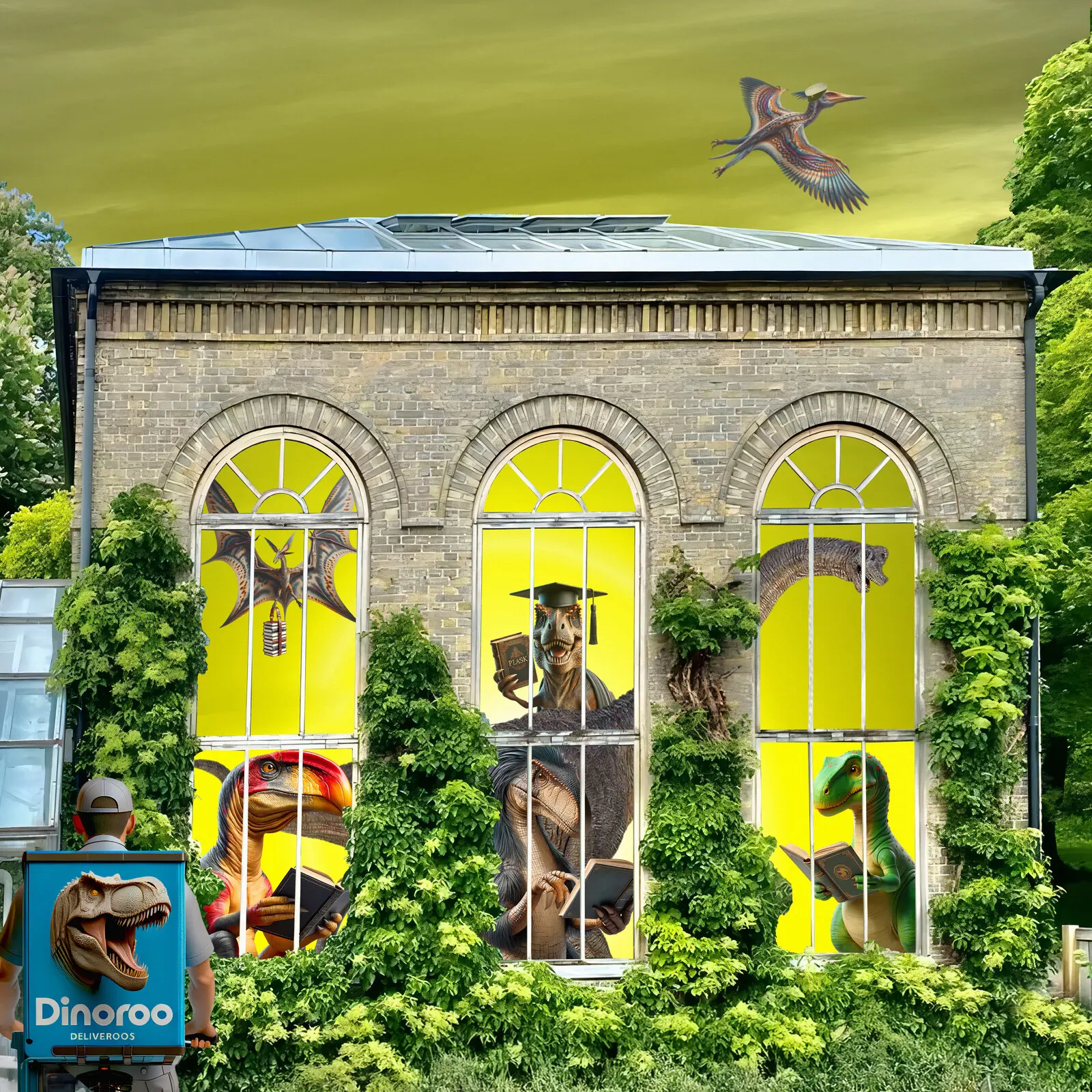
Jörgen Thornberg
En förunderlig natt på Lunds Botaniska, 2025
Digital
80 x 80 cm
4 200 kr
En förunderlig natt på Lunds Botaniska
A Wondrous Night at Lund’s Botanical Garden
Lund is a city of academic brilliance, scholarly traditions, and bookshelves weighed down by centuries of knowledge. But let’s be honest—it’s also a place where hats roll, punch flows, and the spirit of student revelry echoes through every cobblestone alley. And no one embodies this balance between wisdom and indulgence better than dinosaurs, who, in this unique narrative, have adopted the drinking culture of Lund as their own, adding a humorous twist to the story.
Please continue reading to learn more about the humorous picture and its connection to knowledge and drinking habits.
"Drunk as a Skunk – An Ode to Boozers and Beasts
Down the alley, tipsy and proud,
Boozehound howls, drunk and loud.
He wobbles left, he stumbles right,
barking mad in pale moonlight.
"Three sheets to the wind!" he cries,
then promptly in the gutter lies.
Grog-guzzler clings to his last champagne,
dancing like a runaway train.
"Off his trolley!" folks declare,
as he tumbles down the stairs.
His hat rolls off, his coat’s a mess,
his dignity? Well, more or less…
Tipsy Bird, decked in a feathered coat,
gulps her gin and starts to gloat.
"To the bitter end!" she screams,
then faceplants into someone’s dreams.
A sailor’s curse, a siren’s song,
this drunken diva won’t last long!
Boozy Hog, oh what a sight,
snorting whiskey through the night.
"Hammered! Plastered! Blitzed!" they shout,
as he gulps his final stout.
Rolling in the pub’s embrace,
with ale-soaked beard upon his face.
BUT WAIT!
Who lurks beyond the neon haze,
ancient wisdom in their gaze?
Not the rookies, not the bums—
but seasoned drinkers, millions strong!
Brachiosaurus, tall and wise,
sips his drink and rolls his eyes.
"One too many, and you’ll see
how fast extinction comes to be!"
Tyrannosaurus, harsh and grand,
holds his whiskey in one hand.
"Moderation, that’s the trick."
"Too much grog, and you’ll go extinct!"
And so, my friends, this tale is spun,
of drinking fools and drinking fun.
Some may brawl, some may crawl,
but dinosaurs? They outdrink them all!”
Lund, March 2025
A Wondrous Night at Lund’s Botanical Garden
A peculiar light had settled over the Lund night—not quite the northern lights, but an eerie glow that shouldn’t exist in June when the midnight sky still holds a hint of daylight. The same strange radiance flickered inside the worn-down Palm House at the botanical garden, where the dinosaurs had found refuge and a sense of community. Soon, it would close for renovations, so now was the time to seize the moment.
And seizing it were some truly ancient scholars—their average age clocking in at a respectable 234 million years. This age, even by Lund’s standards, with its medieval origins dating back to a Franciscan studium generale in 1425 and its official founding as a Swedish university in 1666, is unfathomable. It's a testament to their enduring wisdom and knowledge and adds a humorous twist to the story, imagining dinosaurs as students in a university.
With their youthful vigour and enthusiasm, the dinosaurs wasted no time enrolling when Lund University opened its doors to senior students. No entrance exam was required—who would dare argue with their self-styled professor, a Tyrannosaurus Rex? Among this scholarly assembly, the mighty king of lizards was practically a youth at a mere 66 million years old. The true elder statesman of the group was Brachiosaurus, a towering 150-million-year-old giant whose head nearly brushed the Palm House ceiling. Yet, despite their ancient age, these dinosaurs were full of youthful vigour and enthusiasm, ready to embark on their academic journey.
The towering herbivore had already ordered a vegetarian pizza, and other delicacies were en route—a Dinoroo Delivery bicycle courier stood outside, balancing a stack of boxes filled with the dinosaurs’ favourite dishes. The dinosaurs' love for food was as immense as their size and a sight to behold.
Meanwhile, the chatty Psittacosaurus, known for its ability to mimic all sorts of sounds like its distant parrot relatives, entertained the group by reading aloud from a book on nuts. This unique skill of the Psittacosaurus added a touch of humor to the scholarly gathering of dinosaurs.
Everyone’s favourite vegan of the prehistoric world, the long-necked Brachiosaurus, secretly flipped through a copy of Arlo’s book, inspired by The Good Dinosaur.
A familiar figure was trotting towards the entrance just outside the Palm House. It was Dino, the loyal but not-so-bright Snorkasaurus from The Flintstones, tasked—yet again—with picking up the pizzas. Since the poor fellow wasn’t exactly renowned for his intelligence, he always got stuck with the dirty work.
A Flying Pterosaur had also been on a critical mission, swooping to Lund’s Central Station to procure strong beverages from the city’s more dubious suppliers. These suppliers, known for their questionable practices and less-than-legal products, were the perfect source for the dinosaurs' needs. Pteranodon—the iconic crest-headed flyer—was the perfect candidate for this daring task. As his name suggests—"Winged and Toothless"—his comrades knew he wouldn’t be gnawing through the bottle corks on the flight back. His slender, toothless beak was perfect for grabbing fish from the ocean but utterly hopeless when opening bottles. No matter—he had carried back four IKEA bags stuffed with alcohol, having single-handedly drained the city’s entire black-market supply.
The honour of uncorking the bottles fell to Nothronychus, the clawed vegetarian whose name translates to “Sloth Claw”. But don’t let the name fool you—he was quick enough to keep up with this thirsty crowd. His favourite title? Bartender.
The group’s trusted mixologist also sported a timeless hairstyle, unchanged for millions of years. His majestic mane could make even the proudest stallion look bald by comparison.
When I took the photo, the bartender was poring over a book on the history of cocktails—and understandably so, as it was a rather thick volume. The oldest alcoholic drink known to humanity is mead, dating back about 9,000 years, a thousand years older than wine, which originated in the Caucasus region (modern-day Georgia). Made from fermented honey and water, mead was popular in ancient China and Viking-era Scandinavia. However, it wasn’t potent, meaning students of that era had to drink copious amounts to become appropriately inebriated.
But let’s be honest—humanity likely discovered intoxication much earlier by observing the animals. Many creatures have been noted getting drunk on naturally fermented fruit, particularly in warmer climates where fallen fruit ferments rapidly.
Fermented fruit produces ethanol; since most animals share similar metabolic processes with humans, they experience the same effects. Some animals even seek out fermented fruit, suggesting they enjoy the buzz—who could blame them?
Of course, being tipsy can be perilous in the animal kingdom. Some drunken creatures have flown into windows, wandered into traffic, or made themselves easy prey. But in most cases, it’s merely a natural part of the ecosystem, where fermented fruit provides unexpected energy and entertainment.
Primates, in particular, have shown a striking resemblance to their human descendants. Wild chimpanzees, orangutans, and certain monkeys have been observed consuming fermented fruit, staggering about, losing balance, and behaving more loudly and playfully than usual.
In other words, they party just like us.
Birds, Beasts, and Boozy Feasts
Surprisingly, birds such as starlings and waxwings are notorious for becoming tipsy on fermented berries, especially in winter when fermentation lasts longer. Sometimes, they become so intoxicated that they crash into windows or struggle to balance on branches—a stark reminder of why pilots must remain completely sober.
Deer and moose have been observed snacking on fermented apples and other fruits. In Sweden, moose sometimes get drunk on fallen fruit in gardens and start behaving oddly—like the now-legendary case of a moose stuck in an apple tree, a sight that indeed brings a chuckle.
Bears in North America and Russia happily gorge on fermented berries and fruits. Once inebriated, they become sluggish and overly playful—unpredictable and aggressive, yet undeniably entertaining.
There are plenty of examples of naturally fermented fruit-based drinks in the animal kingdom:
- Marula fruit (Sclerocarya birrea) – This African fruit ferments quickly and is known to induce drunken behaviour in elephants and monkeys.
- Natural palm wine (from sap and nectar) – Certain birds and insects, like honeyguides and bees, have been observed consuming nectar from fermented flowers and trees.
- Apples and berries in colder climates – In the autumn, fallen apples and rowanberries ferment naturally and can intoxicate moose, deer, and birds.
- Figs – Under the right conditions, they provide a long and pleasant buzz for animals fortunate enough to find them.
Although naturally fermented fruit rarely reaches the alcohol content of distilled beverages, some highly fermented fruits and liquids can reach 8–10% alcohol, comparable to strong beer or weak wine. This occurs when fermentation lasts long enough and the yeast is resilient enough.
The Boozy Fruits of the Dinosaur Era
During the time of the dinosaurs, particularly in the Cretaceous period (around 145–66 million years ago), flowering plants (angiosperms) began to spread and produce fruit. While today’s familiar fruits didn’t yet exist, certain prehistoric plants developed sweet, sugar-rich fruits and seeds that may have been part of herbivorous dinosaurs’ diets.
Examples of high-sugar prehistoric fruits include:
- Early fig-like fruits – Fossil evidence shows that early relatives of figs (from the ‘Moraceae family’) existed during the Cretaceous period. Scientists believe these fruits contained high sugar levels, making them attractive to certain dinosaurs.
This was hardly news to the students in the Palm House. The only difference? Today’s fermented and distilled fruits are much more convenient—and free of grit, twigs, and other unwanted debris. What a luxury.
Dinosaurs had to make do with other fermented materials: Cycad seeds and cones were abundant during the dinosaur era and contained a sweet, fleshy outer layer similar to modern ginkgo seeds. When fermented, they likely packed quite a punch.
Ginkgo biloba is one of the oldest surviving plant species. Its seeds are encased in a fruity pulp that can ferment and become sugar-rich. Need I say more?
- Primitive magnolia fruits – Some early magnolia species may have borne pineapple- or lychee-like fruits, which could have fermented on the forest floor, providing a tasty prehistoric buzz.
- Berry-like angiosperms – Fossil evidence suggests that small, berry-like fruits evolved during the later Cretaceous period, containing high sugar levels to attract pollinators and plant-eating dinosaurs.
- Palm-like plants (Arecaceae) – Some early palm trees produced energy-rich fruits, possibly resembling modern dates. They may have tasted similar to today’s date liqueur, which is still produced in parts of the Middle East and North Africa. Rutab Date Liqueur, made in the United Arab Emirates, is fermented from dates and has a sweet, spiced flavour. The dinosaurs in the Palm House would have loved it.
Given the sugar-rich nature of these fruits and the warm, humid climate of the dinosaur era, it’s likely that fallen fruit fermented naturally. This means that some dinosaurs—especially herbivores—may have unknowingly indulged in alcohol.
Certain dinosaurs may have gotten a little tipsy like today's animals from fermented fruit. Perhaps some tiny therizinosaurs or hadrosaurs occasionally wobbled about after consuming one too many fermented treats.
Could a Brachiosaurus have stumbled about inebriated after eating fermented cycads? We may never know, but the thought is amusing. Picture the earth-shaking crash of such a colossal creature toppling over.
As for those in the Palm House, no speculation was necessary. They were living proof—with millions of years of experience in fermented indulgences.
I would call them a responsible bunch... Sort of
For any morally concerned readers: Yes, these prehistoric partygoers may have indulged in revelry, but they were responsible drinkers. Or perhaps the fear of T-Rex’s sharp teeth—or his heavy tome—kept them in check.
I didn’t inquire. Some matters are best left unexamined.
And if you glance at the picture again, no one seems particularly drunk. At most, slightly tipsy. Not even close to being called ‘Drunken Dogs’ and ‘Boozy Swine’ –
Both “fyllehund” (‘drunken dog’) and “fyllesvin” (‘drunken swine’) are established Swedish expressions for someone who drinks excessively. Still, their origins are deeply rooted in the historical context of Sweden's drinking culture.
Fyllehund – A Loyal but Not-So-Graceful Companion
A ‘fyllehund’ describes a person who frequently becomes inebriated, sometimes acting wildly or recklessly—much like a dog that excitedly wags its tail and follows its owner regardless of its owner's condition.
Possible Origins:
Drinking companions—Dogs have historically been loyal to humans, and folklore suggests that they accompanied their owners to drinking establishments. In some texts, "fyllehund" refers to someone who never turns down a drink.
The influence of the German term ‘Saufhund’ (where ‘saufen’ means 'to drink excessively') on the Swedish expression 'fyllehund' is a significant aspect of its etymology, reflecting the cultural exchange and linguistic evolution between the two countries.
- Unpredictable behaviour – A ‘fyllehund’ might be loud, cheerful, or slightly dishevelled, much like an actual dog—making the metaphor quite apt.
19th-Century Examples: Historical Swedish texts from the 19th century vividly describe ‘fyllehundar’ as individuals who never leave the tavern until the last drop is consumed, providing a clear picture of the term's historical usage.
Fyllesvin – Messy, Gluttonous, and Unapologetic
A ‘fyllesvin’ is a less flattering term for someone who drinks excessively and loses all self-control.
Possible Origins:
- Pigs as symbols of gluttony – In Christian tradition, pigs have often been associated with excess and indulgence (one of the seven deadly sins).
- Pigs and filth – Drunken individuals passed out in the gutter have been likened to pigs wallowing in the mud.
- Old insults – As early as the 1600s, drunkards were called "swine" in derogatory contexts.
Historical Examples:
Old Swedish texts contain phrases like "he drank like a pig" or "a swine of a man", referring to someone who drank shamelessly.
Dog or Pig – Which Is Worse?
Being called a ‘fyllehund’ sounds charming—a drinker who enjoys having a good time but remains sociable and affable.
Conversely, being labelled a ‘fyllesvin’ implies utter drunken disgrace, often with shameful consequences.
So, if you had to choose, would you rather be a jolly drunken dog or a disastrous drunken pig?
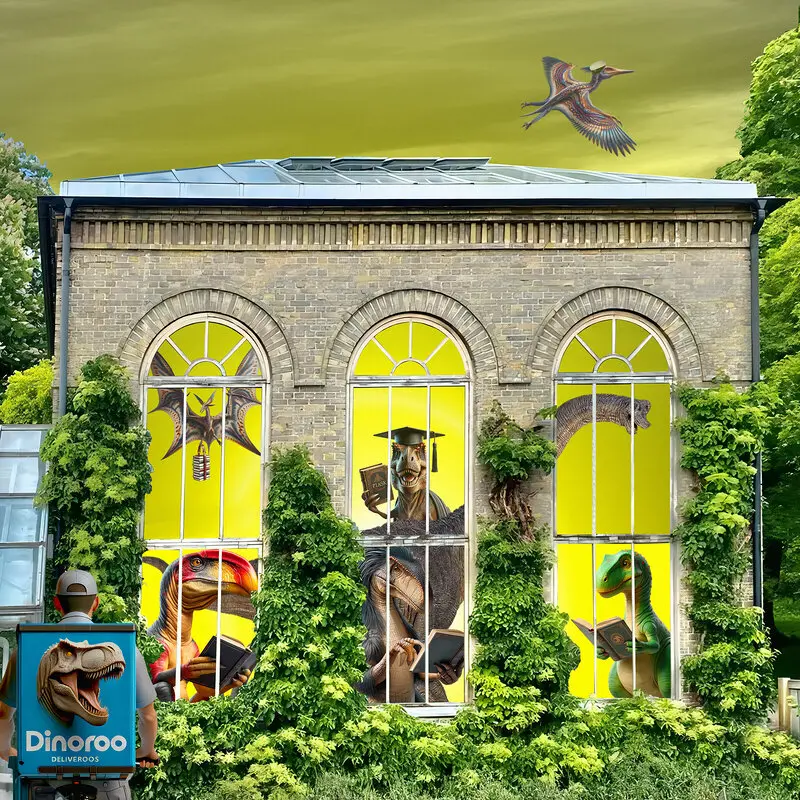
Jörgen Thornberg
En förunderlig natt på Lunds Botaniska, 2025
Digital
80 x 80 cm
4 200 kr
En förunderlig natt på Lunds Botaniska
A Wondrous Night at Lund’s Botanical Garden
Lund is a city of academic brilliance, scholarly traditions, and bookshelves weighed down by centuries of knowledge. But let’s be honest—it’s also a place where hats roll, punch flows, and the spirit of student revelry echoes through every cobblestone alley. And no one embodies this balance between wisdom and indulgence better than dinosaurs, who, in this unique narrative, have adopted the drinking culture of Lund as their own, adding a humorous twist to the story.
Please continue reading to learn more about the humorous picture and its connection to knowledge and drinking habits.
"Drunk as a Skunk – An Ode to Boozers and Beasts
Down the alley, tipsy and proud,
Boozehound howls, drunk and loud.
He wobbles left, he stumbles right,
barking mad in pale moonlight.
"Three sheets to the wind!" he cries,
then promptly in the gutter lies.
Grog-guzzler clings to his last champagne,
dancing like a runaway train.
"Off his trolley!" folks declare,
as he tumbles down the stairs.
His hat rolls off, his coat’s a mess,
his dignity? Well, more or less…
Tipsy Bird, decked in a feathered coat,
gulps her gin and starts to gloat.
"To the bitter end!" she screams,
then faceplants into someone’s dreams.
A sailor’s curse, a siren’s song,
this drunken diva won’t last long!
Boozy Hog, oh what a sight,
snorting whiskey through the night.
"Hammered! Plastered! Blitzed!" they shout,
as he gulps his final stout.
Rolling in the pub’s embrace,
with ale-soaked beard upon his face.
BUT WAIT!
Who lurks beyond the neon haze,
ancient wisdom in their gaze?
Not the rookies, not the bums—
but seasoned drinkers, millions strong!
Brachiosaurus, tall and wise,
sips his drink and rolls his eyes.
"One too many, and you’ll see
how fast extinction comes to be!"
Tyrannosaurus, harsh and grand,
holds his whiskey in one hand.
"Moderation, that’s the trick."
"Too much grog, and you’ll go extinct!"
And so, my friends, this tale is spun,
of drinking fools and drinking fun.
Some may brawl, some may crawl,
but dinosaurs? They outdrink them all!”
Lund, March 2025
A Wondrous Night at Lund’s Botanical Garden
A peculiar light had settled over the Lund night—not quite the northern lights, but an eerie glow that shouldn’t exist in June when the midnight sky still holds a hint of daylight. The same strange radiance flickered inside the worn-down Palm House at the botanical garden, where the dinosaurs had found refuge and a sense of community. Soon, it would close for renovations, so now was the time to seize the moment.
And seizing it were some truly ancient scholars—their average age clocking in at a respectable 234 million years. This age, even by Lund’s standards, with its medieval origins dating back to a Franciscan studium generale in 1425 and its official founding as a Swedish university in 1666, is unfathomable. It's a testament to their enduring wisdom and knowledge and adds a humorous twist to the story, imagining dinosaurs as students in a university.
With their youthful vigour and enthusiasm, the dinosaurs wasted no time enrolling when Lund University opened its doors to senior students. No entrance exam was required—who would dare argue with their self-styled professor, a Tyrannosaurus Rex? Among this scholarly assembly, the mighty king of lizards was practically a youth at a mere 66 million years old. The true elder statesman of the group was Brachiosaurus, a towering 150-million-year-old giant whose head nearly brushed the Palm House ceiling. Yet, despite their ancient age, these dinosaurs were full of youthful vigour and enthusiasm, ready to embark on their academic journey.
The towering herbivore had already ordered a vegetarian pizza, and other delicacies were en route—a Dinoroo Delivery bicycle courier stood outside, balancing a stack of boxes filled with the dinosaurs’ favourite dishes. The dinosaurs' love for food was as immense as their size and a sight to behold.
Meanwhile, the chatty Psittacosaurus, known for its ability to mimic all sorts of sounds like its distant parrot relatives, entertained the group by reading aloud from a book on nuts. This unique skill of the Psittacosaurus added a touch of humor to the scholarly gathering of dinosaurs.
Everyone’s favourite vegan of the prehistoric world, the long-necked Brachiosaurus, secretly flipped through a copy of Arlo’s book, inspired by The Good Dinosaur.
A familiar figure was trotting towards the entrance just outside the Palm House. It was Dino, the loyal but not-so-bright Snorkasaurus from The Flintstones, tasked—yet again—with picking up the pizzas. Since the poor fellow wasn’t exactly renowned for his intelligence, he always got stuck with the dirty work.
A Flying Pterosaur had also been on a critical mission, swooping to Lund’s Central Station to procure strong beverages from the city’s more dubious suppliers. These suppliers, known for their questionable practices and less-than-legal products, were the perfect source for the dinosaurs' needs. Pteranodon—the iconic crest-headed flyer—was the perfect candidate for this daring task. As his name suggests—"Winged and Toothless"—his comrades knew he wouldn’t be gnawing through the bottle corks on the flight back. His slender, toothless beak was perfect for grabbing fish from the ocean but utterly hopeless when opening bottles. No matter—he had carried back four IKEA bags stuffed with alcohol, having single-handedly drained the city’s entire black-market supply.
The honour of uncorking the bottles fell to Nothronychus, the clawed vegetarian whose name translates to “Sloth Claw”. But don’t let the name fool you—he was quick enough to keep up with this thirsty crowd. His favourite title? Bartender.
The group’s trusted mixologist also sported a timeless hairstyle, unchanged for millions of years. His majestic mane could make even the proudest stallion look bald by comparison.
When I took the photo, the bartender was poring over a book on the history of cocktails—and understandably so, as it was a rather thick volume. The oldest alcoholic drink known to humanity is mead, dating back about 9,000 years, a thousand years older than wine, which originated in the Caucasus region (modern-day Georgia). Made from fermented honey and water, mead was popular in ancient China and Viking-era Scandinavia. However, it wasn’t potent, meaning students of that era had to drink copious amounts to become appropriately inebriated.
But let’s be honest—humanity likely discovered intoxication much earlier by observing the animals. Many creatures have been noted getting drunk on naturally fermented fruit, particularly in warmer climates where fallen fruit ferments rapidly.
Fermented fruit produces ethanol; since most animals share similar metabolic processes with humans, they experience the same effects. Some animals even seek out fermented fruit, suggesting they enjoy the buzz—who could blame them?
Of course, being tipsy can be perilous in the animal kingdom. Some drunken creatures have flown into windows, wandered into traffic, or made themselves easy prey. But in most cases, it’s merely a natural part of the ecosystem, where fermented fruit provides unexpected energy and entertainment.
Primates, in particular, have shown a striking resemblance to their human descendants. Wild chimpanzees, orangutans, and certain monkeys have been observed consuming fermented fruit, staggering about, losing balance, and behaving more loudly and playfully than usual.
In other words, they party just like us.
Birds, Beasts, and Boozy Feasts
Surprisingly, birds such as starlings and waxwings are notorious for becoming tipsy on fermented berries, especially in winter when fermentation lasts longer. Sometimes, they become so intoxicated that they crash into windows or struggle to balance on branches—a stark reminder of why pilots must remain completely sober.
Deer and moose have been observed snacking on fermented apples and other fruits. In Sweden, moose sometimes get drunk on fallen fruit in gardens and start behaving oddly—like the now-legendary case of a moose stuck in an apple tree, a sight that indeed brings a chuckle.
Bears in North America and Russia happily gorge on fermented berries and fruits. Once inebriated, they become sluggish and overly playful—unpredictable and aggressive, yet undeniably entertaining.
There are plenty of examples of naturally fermented fruit-based drinks in the animal kingdom:
- Marula fruit (Sclerocarya birrea) – This African fruit ferments quickly and is known to induce drunken behaviour in elephants and monkeys.
- Natural palm wine (from sap and nectar) – Certain birds and insects, like honeyguides and bees, have been observed consuming nectar from fermented flowers and trees.
- Apples and berries in colder climates – In the autumn, fallen apples and rowanberries ferment naturally and can intoxicate moose, deer, and birds.
- Figs – Under the right conditions, they provide a long and pleasant buzz for animals fortunate enough to find them.
Although naturally fermented fruit rarely reaches the alcohol content of distilled beverages, some highly fermented fruits and liquids can reach 8–10% alcohol, comparable to strong beer or weak wine. This occurs when fermentation lasts long enough and the yeast is resilient enough.
The Boozy Fruits of the Dinosaur Era
During the time of the dinosaurs, particularly in the Cretaceous period (around 145–66 million years ago), flowering plants (angiosperms) began to spread and produce fruit. While today’s familiar fruits didn’t yet exist, certain prehistoric plants developed sweet, sugar-rich fruits and seeds that may have been part of herbivorous dinosaurs’ diets.
Examples of high-sugar prehistoric fruits include:
- Early fig-like fruits – Fossil evidence shows that early relatives of figs (from the ‘Moraceae family’) existed during the Cretaceous period. Scientists believe these fruits contained high sugar levels, making them attractive to certain dinosaurs.
This was hardly news to the students in the Palm House. The only difference? Today’s fermented and distilled fruits are much more convenient—and free of grit, twigs, and other unwanted debris. What a luxury.
Dinosaurs had to make do with other fermented materials: Cycad seeds and cones were abundant during the dinosaur era and contained a sweet, fleshy outer layer similar to modern ginkgo seeds. When fermented, they likely packed quite a punch.
Ginkgo biloba is one of the oldest surviving plant species. Its seeds are encased in a fruity pulp that can ferment and become sugar-rich. Need I say more?
- Primitive magnolia fruits – Some early magnolia species may have borne pineapple- or lychee-like fruits, which could have fermented on the forest floor, providing a tasty prehistoric buzz.
- Berry-like angiosperms – Fossil evidence suggests that small, berry-like fruits evolved during the later Cretaceous period, containing high sugar levels to attract pollinators and plant-eating dinosaurs.
- Palm-like plants (Arecaceae) – Some early palm trees produced energy-rich fruits, possibly resembling modern dates. They may have tasted similar to today’s date liqueur, which is still produced in parts of the Middle East and North Africa. Rutab Date Liqueur, made in the United Arab Emirates, is fermented from dates and has a sweet, spiced flavour. The dinosaurs in the Palm House would have loved it.
Given the sugar-rich nature of these fruits and the warm, humid climate of the dinosaur era, it’s likely that fallen fruit fermented naturally. This means that some dinosaurs—especially herbivores—may have unknowingly indulged in alcohol.
Certain dinosaurs may have gotten a little tipsy like today's animals from fermented fruit. Perhaps some tiny therizinosaurs or hadrosaurs occasionally wobbled about after consuming one too many fermented treats.
Could a Brachiosaurus have stumbled about inebriated after eating fermented cycads? We may never know, but the thought is amusing. Picture the earth-shaking crash of such a colossal creature toppling over.
As for those in the Palm House, no speculation was necessary. They were living proof—with millions of years of experience in fermented indulgences.
I would call them a responsible bunch... Sort of
For any morally concerned readers: Yes, these prehistoric partygoers may have indulged in revelry, but they were responsible drinkers. Or perhaps the fear of T-Rex’s sharp teeth—or his heavy tome—kept them in check.
I didn’t inquire. Some matters are best left unexamined.
And if you glance at the picture again, no one seems particularly drunk. At most, slightly tipsy. Not even close to being called ‘Drunken Dogs’ and ‘Boozy Swine’ –
Both “fyllehund” (‘drunken dog’) and “fyllesvin” (‘drunken swine’) are established Swedish expressions for someone who drinks excessively. Still, their origins are deeply rooted in the historical context of Sweden's drinking culture.
Fyllehund – A Loyal but Not-So-Graceful Companion
A ‘fyllehund’ describes a person who frequently becomes inebriated, sometimes acting wildly or recklessly—much like a dog that excitedly wags its tail and follows its owner regardless of its owner's condition.
Possible Origins:
Drinking companions—Dogs have historically been loyal to humans, and folklore suggests that they accompanied their owners to drinking establishments. In some texts, "fyllehund" refers to someone who never turns down a drink.
The influence of the German term ‘Saufhund’ (where ‘saufen’ means 'to drink excessively') on the Swedish expression 'fyllehund' is a significant aspect of its etymology, reflecting the cultural exchange and linguistic evolution between the two countries.
- Unpredictable behaviour – A ‘fyllehund’ might be loud, cheerful, or slightly dishevelled, much like an actual dog—making the metaphor quite apt.
19th-Century Examples: Historical Swedish texts from the 19th century vividly describe ‘fyllehundar’ as individuals who never leave the tavern until the last drop is consumed, providing a clear picture of the term's historical usage.
Fyllesvin – Messy, Gluttonous, and Unapologetic
A ‘fyllesvin’ is a less flattering term for someone who drinks excessively and loses all self-control.
Possible Origins:
- Pigs as symbols of gluttony – In Christian tradition, pigs have often been associated with excess and indulgence (one of the seven deadly sins).
- Pigs and filth – Drunken individuals passed out in the gutter have been likened to pigs wallowing in the mud.
- Old insults – As early as the 1600s, drunkards were called "swine" in derogatory contexts.
Historical Examples:
Old Swedish texts contain phrases like "he drank like a pig" or "a swine of a man", referring to someone who drank shamelessly.
Dog or Pig – Which Is Worse?
Being called a ‘fyllehund’ sounds charming—a drinker who enjoys having a good time but remains sociable and affable.
Conversely, being labelled a ‘fyllesvin’ implies utter drunken disgrace, often with shameful consequences.
So, if you had to choose, would you rather be a jolly drunken dog or a disastrous drunken pig?
4 200 kr

Jörgen Thornberg
Malmö
Lite om bilder och mig. Translation in English at the end.
Jag är en nyfiken person som ser allt i bilder, även det jag fäster i ord, gärna tillsammans för bakom alla mina bilder finns en berättelse. Till vissa bilder hör en kortare eller längre novell som följer med bilden.
Bilder berättar historier. Jag omges av naturlig skönhet, intressanta människor och historia var jag än går. Jag använder min kamera för att dokumentera världen och blanda det jag ser med vad jag känner för att fånga den dolda magin.
Mina bilder berättar mina historier. Genom mina bilder, tryck och berättelser. Jag bjuder in dig att ta del av dessa berättelser, in i ditt liv och hem och dela min mycket personliga syn på vår värld. Mer än vad ögat ser. Jag tänker i bilder, drömmer och skriver och pratar om dem; följaktligen måste jag också skapa bilder. De blir vad jag ser, inte nödvändigtvis begränsade till verkligheten. Det finns en bild runt varje hörn. Jag hoppas att du kommer att se vad jag såg och gilla det.
Jag är också en skrivande person och till många bilder hör en kortare eller längre essay. Den följer med tavlan, tryckt på fint papper och med en personlig hälsning från mig.
Flertalet bilder startar sin resa i min kamera. Enkelt förklarat beskriver jag bilden jag ser i mitt inre, upplevd eller fantiserad. Bilden uppstår inom mig redan innan jag fått okularet till ögat. På bråkdelen av ett ögonblick ser jag vad jag vill ha och vad som kan göras med bilden. Här skall jag stoppa in en giraff, stålmannen, Titanic eller vad det är min fantasi finner ut. Ännu märkligare är att jag kommer ihåg minnesbilden långt efteråt när det blir tid att skapa verket. Om jag lyckas eller inte, är upp till betraktaren, oftast präglat av en stråk av svart humor – meningen är att man skall bli underhållen. Mina bilder blir ofta en snackis där de hänger.
Jag föredrar bilder som förmedlar ett budskap i flera lager. Vid första anblicken fylld av feel-good, en vacker utsikt, fint väder, solen skiner, blommor på ängen eller vattnet som ligger förrädiskt spegelblankt. I en sådan bild kan jag gömma min egentliga berättelse, mitt förakt för förtryckare och våldsverkare, rasister och fördomsfulla människor - ett gärna återkommande motiv mer eller mindre dolt i det vackra motivet. Jag försöker förena dem i ett gemensamt narrativ.
Bild och formgivning har löpt som en röd tråd genom livet. Fotokonst känns som en värdig final som jag gärna delar med mig.
Min genre är vid som framgår av mina bilder, temat en blandning av pop- och gatukonst i kollage som kan bestå av hundratals lager. Vissa bilder kan ta veckor, andra någon dag innan det är dags att överlämna resultatet till printverkstaden. Fine Art Prints är digitala fotocollage. I dessa kollage sker rivandet, klippandet, pusslandet, målandet, ritandet och sprayningen digitalt. Det jag monterar in kan vara hundratals år gamla bilder som jag omsorgsfullt frilägger så att de ser ut att vara en del av tavlan men också bilder skapade av mig själv efter min egen fantasi. Därefter besöks printstudion och för vissa bilder numrera en limiterad upplaga (oftast 7 exemplar) och signera för hand. Vissa bilder kan köpas i olika format. Det är bara att fråga efter vilka. Gillar man en bild som är 70x100 men inte har plats på väggen, går den kanske att få i 50x70 cm istället. Frågan är fri.
Metoden Giclée eller Fine Art Print som det också kallas är det moderna sättet för framställning av grafisk konst. Villkoret för denna typ av utskrifter är att en högkvalitativ storformatskrivare används med åldersbeständigt färgpigment och konstnärspapper eller i förekommande fall på duk. Pappret som används möter de krav på livslängd som ställs av museer och gallerier. Normalt säljer jag mina bilder oinramade så att den nya ägaren själv kan bestämma hur de skall se ut, med eller utan passepartout färg på ram, med eller utan glas etc..
Under många år ställde jag bara ut på nätet, i valda grupper och på min egen Facebooksida - https://www.facebook.com/jorgen.thornberg.9
Jag finns också på en egen hemsida som tyvärr inte alltid är uppdaterad – https://www.jth.life/ Där kan du också läsa en del av de berättelser som följer med bilden.
UTSTÄLLNINGAR
Luftkastellet, oktober 2022
Konst i Lund, november 2022
Luftkastellet, mars 2023
Engleson Galleri Caroli, april 2023
Hydra, Greece June 2023
Engleson Galleri Caroli, oktober 2023
Toppen, Höllviken december 2023
Luftkastellet, mars 2024
Torups Galleri, mars 2024
Venice, May 2024
Luftkastellet, oktober 2024
Konst i Advent, December 2024
Galleri Engleson, Caroli December 2024
Jäger & Jansson Galleri, april 2025
A bit about pictures and me.
I'm a curious person who sees everything in pictures, even what I express in words, often combining them, for behind all my pictures lies a story. These narratives, some as short as a single image and others as long as a novel, are the heart and soul of my work.
Pictures tell stories. Wherever I go, I'm surrounded by natural beauty, exciting people, and history. I use my camera to document the world and blend what I see with what I feel to capture the hidden magic.
My images tell my stories. Through my pictures, prints, and narratives, I invite you to partake in these stories in your life and home and share my deeply personal perspective of our world. More than meets the eye. I think in pictures, dream, write, and talk about them; consequently, I must create images too. They become what I see, not necessarily confined to reality. There's a picture around every corner. I hope you'll see what I saw and enjoy it.
I'm also a writer, and many images come with a shorter or longer essay. It accompanies the painting, printed on fine paper with my personal greeting.
Many pictures start their journey on my camera. Simply put, I describe the image I see in my mind, experienced or imagined. The image arises within me even before I bring the eyepiece to my eye. In a fraction of a moment, I see what I want and what can be done with the picture. Here, I'll insert a giraffe, Superman, the Titanic, or whatever my imagination conjures up. Even stranger is that I remember the mental image long after it's time to create the work. Whether I succeed is up to the observer, often imbued with a streak of black humour – the aim is to entertain. My pictures usually become a talking point wherever they hang.
I prefer pictures that convey a message in multiple layers. At first glance, they're filled with feel-good vibes, a beautiful view, lovely weather, the sun shining, flowers in the meadow, or the water lying deceptively calm. But beneath this surface beauty, I often conceal a deeper story, a narrative that challenges societal norms or explores the human condition. I invite you to delve into these hidden narratives and discover the layers of meaning within my work.
Picture and design have been a thread running through my life. Photographic art feels like a fitting finale, and I'm happy to share it.
My genre is varied, as seen in my pictures; the theme is a blend of pop and street art in collages that can consist of hundreds of layers. Some images can take weeks, others just a day before it's time to hand over the result to the print workshop. Fine Art Prints are digital photo collages. In these collages, tearing, cutting, puzzling, painting, drawing, and spraying happen digitally. What I insert can be images hundreds of years old that I carefully extract so they appear to be part of the painting, but also images created by myself, now also generated from my imagination. Next, visit the print studio and, for certain images, number a limited edition (usually 7 copies) and sign them by hand. Some images may be available in other formats. Just ask which ones. If you like an image that's 70x100 but doesn't have space on the wall, you might be able to get it in 50x70 cm instead. The question is open.
The Giclée method, or Fine Art Print as it's also called, is the modern way of producing graphic art. This method ensures the highest quality and longevity of the artwork, using a high-quality large-format printer with archival pigment inks and artist paper or, in some cases, canvas. The paper used meets the longevity requirements set by museums and galleries. I sell my pictures unframed, allowing the new owner to personalise their artwork, confident in the lasting value and quality of the piece.
For many years, I only exhibited online, in selected groups, and on my Facebook page - https://www.facebook.com/jorgen.thornberg.9. I also have my website, which unfortunately is not constantly updated - https://www.jth.life/. You can also read some of the stories accompanying the pictures there.
EXHIBITIONS
Luftkastellet, October 2022
Art in Lund, November 2022
Luftkastellet, March 2023
Engleson Gallery Caroli, April 2023
Hydra, Greece June 2023
Engleson Gallery Caroli, October 2023
Toppen, Höllviken December 2023
Luftkastellet, March 2024
Torup Gallery, March 2024
Venice, May 2024
UTSTÄLLNINGAR
Luftkastellet, oktober 2022
Konst i Lund, november 2022
Luftkastellet, mars 2023
Engleson Galleri Caroli, april 2023
Hydra, Greece June 2023
Engleson Galleri Caroli, oktober 2023
Toppen, Höllviken december 2023
Luftkastellet, mars 2024
Torups Galleri, mars 2024
Venice, May 2024
Luftkastellet, October 2024
Konst i Advent, December 2024
Galleri Engleson, Caroli December 2024
Jäger & Jansson Galleri, April 2025
Utbildning
Autodidakt
Medlem i konstnärsförening
Öppna Sinnen
Med i konstrunda
Konstrundan i Skåne
Utställningar
Luftkastellet, October 2022
Art in Lund, November 2022
Luftkastellet, March 2023
Engleson Gallery Caroli, April 2023
Hydra, Greece June 2023
Engleson Gallery Caroli, October 2023
Toppen, Höllviken December 2023
Luftkastellet, March 2024
Torup Gallery, March 2024
Venice, May 2024