Vi använder cookies för att ge dig bästa möjliga upplevelse. Välj vilka cookies du tillåter.
Läs mer i vår integritetspolicy
Jörgen Thornberg
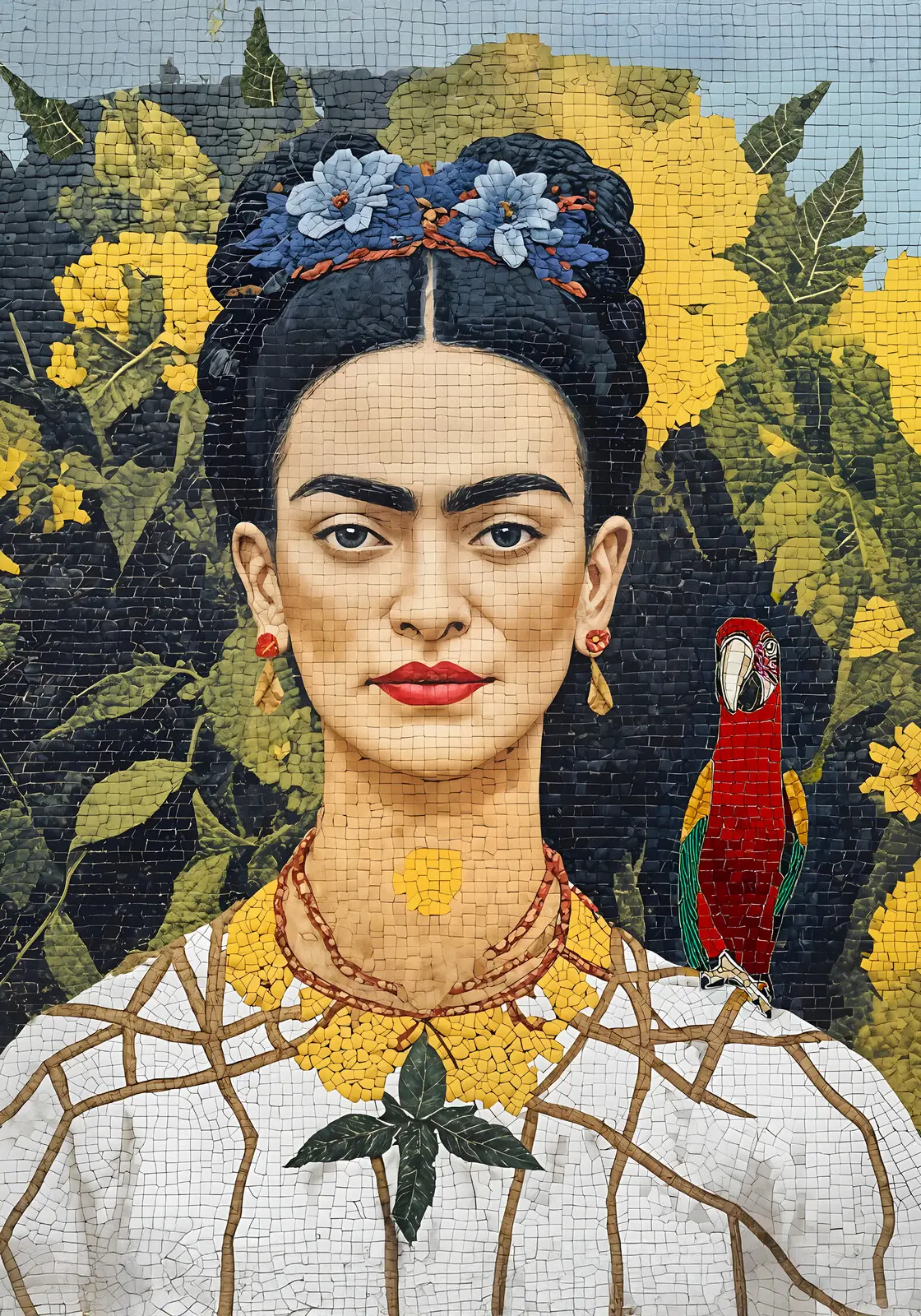
Frida Nobilis, 2025
Digital
70 x 100 cm
5 200 kr
Frida Nobilis: The Eternal Victor
Frida Kahlo, a beacon of resilience, triumphed over pain, adversity, and the limitations imposed upon her by her body and society. In life, she defied expectations; in death, she ascended to the realm of icons. In a newly discovered ancient mosaic, a woman eerily resembling Frida gazes back from the past, crowned with a laurel wreath—an eternal symbol of victory, intellect, and artistic greatness.
For millennia, the laurel (Laurus nobilis) has adorned the heads of poets, warriors, and scholars, symbolising their achievements. In Rome, victorious generals wore it in their triumphs; in ancient Greece, it was the prize of Olympians and the chosen emblem of Apollo. This rich history of the laurel invokes a sense of reverence, even today, it remains a mark of distinction in academia, with Swedish universities bestowing it upon new doctors.
Frida, who lived and painted through suffering, now wears her laurel not as a mere decoration but as a testament to her enduring legacy. The symbolism of the laurel in Frida's life is profound. ‘Frida Nobilis’—Frida, the noble, the victorious, the eternal.
Read on to get Frida’s view on Mosaic as an art form.
"Frida Nobilis
She wore neither crown of gold nor pearl,
No sceptre, carved for queens,
Yet in her grasp, the brush unfurled
A reign that transcends regimes.
Her laurels did not grow from conquest,
Nor from battles fought with steel,
But from every stroke of colour pressed—
A truth that the world could feel.
No empire bowed before her feet,
No palace bore her name,
Yet suffering she turned to heat,
And fire became her flame.
She limped, she laughed, she cursed the sky,
She painted through her pain,
Each wound transformed, she learned to fly,
And rose through loss again.
A victor crowned, yet never chained,
With laurel leaves so bright,
Not won through war, nor wealth attained,
But through unyielding light.
Call her noble, call her free,
A name that time cannot spoil—
‘Frida Nobilis’, eternally,
A rebel crowned in toil.”
Malmö, February 2025
Frida Nobilis
In the mosaic, Frida wears a star of laurel leaves at the end of her necklace. This laurel symbolism is significant as it represents her as a victor, crowned with the same leaves that have long adorned champions in great competitions, such as the classical Olympic Games in ancient Greece. The use of laurel in this context is a powerful symbol of triumph over adversity, a theme central to Frida's life and work. ‘Laurus nobilis’, the noble, reflects not only her artistic triumphs but also her personal victories over physical and emotional pain.
The aromatic leaves of the laurel tree have been praised for millennia as more than just a spice, as its name ‘Nobilis’—noble or esteemed—suggests. In antiquity, laurels were awarded as crowns of knowledge and victory, a tradition that continues today in ceremonial contexts. New doctoral graduates at Swedish universities receive a laurel wreath annually during conferment ceremonies. However, this tradition is primarily a Swedish academic custom, particularly at the universities of Uppsala and Lund. Internationally, doctoral graduation traditions vary. In many countries, such as the United Kingdom and the United States, postgraduate candidates receive elaborate academic hats or hoods in different colours, depending on their discipline and institution. In some European countries, such as Italy, the laurel wreath, or ‘corona laurea’, is occasionally used in certain academic ceremonies, especially in philosophy and the humanities. Nonetheless, the laurel wreath has remained a powerful symbol of learning and triumph throughout history.
As a posthumous honorary doctor with the eternal title ‘Frida Nobilis’, Frida’s significance should be self-evident. The title carries a Latin dignity that reinforces her triumphant status as an artist and icon. ‘Nobilis’ reflects her grace and greatness. Simultaneously, the laurel crown, a symbol of victory and triumph, highlights her enduring conquest over pain, physical limitations, and the narrow-mindedness of the world around her. Using the laurel crown in the context of Frida's life and work makes a powerful statement about her resilience and strength.
The laurel tree, belonging to the Lauraceae family, can grow up to 20 metres tall. It blooms from March to April in the northern hemisphere, producing small greenish-yellow flowers with a sweet fragrance. The aromatic leaves of the laurel tree have been treasured for thousands of years as more than just a culinary ingredient. The tree's resilience and evergreen nature render it a fitting symbol of victory and endurance.
According to the poet Ovid, the laurel has been the sacred attribute of the god Apollo ever since the nymph Daphne transformed into a laurel tree to escape Apollo’s lustful pursuit. This mythological connection to Apollo, the god of poetry and music, solidified the laurel’s association with artistic and intellectual achievement. The laurel wreath became an emblem for poets and scholars, symbolising their victory in the pursuit of knowledge and creativity.
In Rome, the laurel wreath (corona triumphalis) was worn by victorious generals who, after a resounding victory, were granted a triumphal procession by the Roman Senate upon their return to Rome. Those awarded the laurel wreath had the right to wear it at public occasions thereafter. Typically, the wreath was made of laurel, but it could also be fashioned from gold. The poet Juvenal described a variant of the golden wreath adorned with gemstones held over the head of the general during the triumphal parade. During the imperial era, the laurel wreath evolved into an imperial symbol. Laurel wreaths were also used to decorate houses, often displayed outside the doors of emperors and high priests.
The laurel was thought to offer protection against lightning, leading Emperor Tiberius to wear a laurel wreath upon his head during thunderstorms. Julius Caesar is depicted donning a laurel wreath on various coins—though it did not save him from assassination.
In the image, Frida adorns a star of laurel leaves around her neck and a laurel crown set with blue flowers in her hair, representing ‘desire, love, and her metaphysical striving for the infinite and unreachable’. It embodies hope, the beauty of existence, and ‘victory’—magnificently illustrated in a 2,000-year-old mosaic of a woman strikingly resembling Frida Kahlo. The mosaic, a stunning work of art, captures the essence of Frida's spirit and her enduring legacy.
Frida shared her connection to them when I inquired about mosaics and their history. Although she never created mosaics herself, she explained that Casa Azul, her former home and now a museum, contains several decorative elements reminiscent of mosaic techniques, particularly in its traditional Mexican-style tile and ceramic decorations. This personal insight into her life and home provides us with a deeper understanding of her artistic influences.
She spoke with pride of one of the world’s most impressive mosaic façades—the Biblioteca de la Universidad Nacional Autónoma de México. The entire building is adorned with a mosaic illustrating Mexico’s history from ancient times to the present, incorporating elements from Aztec and colonial art. It is one of the most iconic examples of Mexican mosaic artistry and has been designated a UNESCO World Heritage Site.
She also expressed pride in her husband Diego’s grand mosaic façade on the Olympic Stadium at UNAM. This artwork, combining pre-Hispanic, colonial, and modern history, is a testament to Diego's artistic vision and skill, and Frida's admiration for his work is evident.
Archaeologists have uncovered remarkable turquoise and obsidian mosaics at the Templo Mayor excavations, the grand Aztec pyramid in Tenochtitlán (modern-day Mexico City).
Mexico boasts a vibrant mosaic tradition, ranging from pre-Hispanic times to the modernist muralists of the 20th century.
Then, Frida transitioned into recounting the broader history of mosaics.
A mosaic is a pattern or image created from small, regular, or irregular pieces of coloured stone, glass, or ceramic set in plaster or mortar, covering a surface. Mosaics are decorative elements for floors and walls and were particularly popular in Ancient Roman times.
The earliest known examples of mosaics made from various materials were discovered in a temple building in Abra, Mesopotamia. These mosaics, consisting of coloured stones, shells, and ivory pieces, date from the latter half of the 3rd millennium BC. Excavations reveal evidence of the first glazed tiles, which date from around 1500 BC.
As an ancient and enduring artistic expression, mosaics have been utilised to decorate temples, palaces, churches, and even modest homes for millennia. From their origins in Mesopotamia to their peak in Roman and Byzantine art, mosaics have continued to evolve, preserving cultural and historical narratives in intricate detail. Mosaics' artistic and historical significance instils a sense of reverence for this ancient art form.
The Most Famous Mosaic
Perhaps the most renowned mosaic in history is the Alexander Mosaic, discovered in the House of the Faun in Pompeii. Dating back to around 100 BC, this massive work, composed of over one and a half million tesserae, depicts the Battle of Issus, where Alexander the Great confronted the Persian king Darius III. The detail in the figures, horses, and expressions of fear and determination renders it a masterpiece of ancient art. Today, the mosaic is housed in the Naples National Archaeological Museum, where it remains a prime example of Hellenistic influence on Roman art—a period celebrated for its artistic and cultural achievements.
The Largest Mosaic
Few mosaics can rival the Sheikh Zayed Grand Mosque mosaic in Abu Dhabi in sheer scale. Covering an area of over 17,000 square metres, this stunning floral design adorns the mosque’s courtyard and was created using a variety of natural stones, including marble, amethyst, lapis lazuli, and jasper. Crafted by artisans from Italy and India, this record-breaking mosaic exemplifies modern craftsmanship and pays homage to the rich tradition of Islamic art. The intricate details and the use of various stones make it a true masterpiece of mosaic art.
The Smallest Mosaic
On the opposite end of the spectrum, the micro-mosaics of the Vatican stand as some of the tiniest and most delicate examples of this art form. The Vatican’s secretive tradition of micro-mosaic creation flourished in the 18th and 19th centuries, with artisans using minuscule tesserae—some barely visible to the naked eye—to reproduce classical paintings. British artist David Arnott created one of the most miniature known mosaics, utilising small fragments that required a microscope to be adequately appreciated. His work fits on the head of a pin and depicts the face of Queen Elizabeth II.
The Strangest Mosaic
Mosaics often serve religious, historical, or decorative purposes, yet some stretch the boundaries of our expectations for the art form. One of the most unusual examples is the Cosmati Pavement in Westminster Abbey. Created in the 13th century, this floor mosaic comprises marble, glass, and precious stones arranged in intricate geometric patterns. What makes it distinctive is that it also includes an inscription predicting the end of the world—a rare and uncanny addition to an otherwise magnificent design. The inscription, written in Latin, purportedly calculates the duration of the world’s existence based on medieval numerology—something one does not typically expect to find beneath the feet of British monarchs during their coronations.
Embraced risqué mosaic art
The most scandalous mosaic known today is likely the Lupanar mosaic from Pompeii, the ancient Roman city famously preserved by the eruption of Mount Vesuvius in 79 AD. The Lupanar, Pompeii’s largest and most renowned brothel, offers a glimpse into ancient Roman culture's intriguing and sometimes shocking aspects. Its walls were adorned with explicit erotic mosaics and frescoes depicting various sexual acts, serving as a sort of menu for the services available within.
Another contender for the title of the most provocative mosaic is the Bathing Venus from Antioch, a testament to the Romans' sophisticated artistic taste. This mosaic, uncovered in the ruins of a Roman villa, portrays the goddess sensually emerging from her bath with intricate detail, highlighting the Romans' appreciation for both the erotic and the artistic. The Bathing Venus from Antioch reflects the Romans' complex relationship with art, beauty, and sensuality.
Contemporary artists have also embraced risqué mosaic art in a captivating display of continuity, blending classical techniques with controversial subject matter. These artists, much like their ancient predecessors, push boundaries and keep this provocative art form alive in the modern world.
Several ancient mosaics exhibit enormous phallic motifs, some of the most remarkable of which originate from the Roman Empire:
The Mosaics of Casa del Centenario (Pompeii) – This house contains a mosaic depicting Priapus, the god of fertility and abundance, with a grotesquely large penis. Priapus was a well-known figure in Roman art, often humorously portrayed with exaggerated phallic symbolism believed to bring good fortune and ward off the evil eye.
The Mosaics of Dionysos Villa (Cyprus) – A mosaic in this villa illustrates a procession dedicated to Dionysos, the god of wine and fertility, with phallic symbols prominently displayed. In ancient Rome and Greece, such imagery was frequently employed to ward off evil spirits, as it was thought to bring good fortune and fertility. The imagery in ancient mosaics reflects phallic symbols' cultural and religious significance.
The Mosaics of Ostia Antica – One of the most renowned Roman mosaics featuring exaggerated phallic motifs can be found in Ostia Antica, the ancient port city of Rome. Many of these mosaics were located in bathhouses and brothels, portraying enormous penises as part of ritualistic or humorous representations.
Hedonistic Mosaics in North Africa – Certain mosaics from Roman villas in Tunisia and Algeria depict satyrs and other mythological creatures with grotesquely large genitalia, reflecting the Roman fascination with both eroticism and humour.
Roman art was far more explicit than what we are accustomed to today, with phallic symbols often linked to luck, fertility, and ritualistic practices rather than merely sexual themes.
Also Sweden
Sweden boasts several remarkable mosaics, both historical and modern. A notable example is the Golden Hall in Stockholm City Hall, created by Einar Forseth in the 1920s. The hall is adorned with extensive mosaic artworks depicting Swedish historical motifs.
In Lund Cathedral is an impressive apse mosaic by Joakim Skovgaard, which contributes to the grandeur of the church’s interior. Additionally, artist Sven Ljungberg has created several mosaics in Swedish churches, including one at Gottsunda Church in Uppsala.
A Humorous Mosaic Anecdote
One of the most amusing mosaic-related stories originates from modern archaeology. In 2018, a team of Turkish archaeologists working at the ancient site of Zeugma in southeastern Turkey unearthed a Roman mosaic with an unexpectedly humorous message. The mosaic, featuring a skeleton lounging comfortably with a cup of wine, bore the Greek inscription “Be cheerful, enjoy life”—essentially an ancient version of "YOLO" (You Only Live Once). Dated to around the 3rd century AD, the mosaic provided an amusing insight into the Roman approach to mortality: acknowledge death but, in the meantime, embrace pleasure.
Mosaics are more than just decorative elements; they are time capsules, preserving cultures, humour, and the artistic ingenuity of past civilisations. From grand imperial commissions to quirky and personal creations, mosaics continue to fascinate and inspire, bridging the gap between antiquity and modernity. Whether found in the ruins of an ancient city or on the pavement of a modern cathedral, they serve as a reminder that artistry and storytelling through stone are as eternal as the tesserae.
Jörgen Thornberg
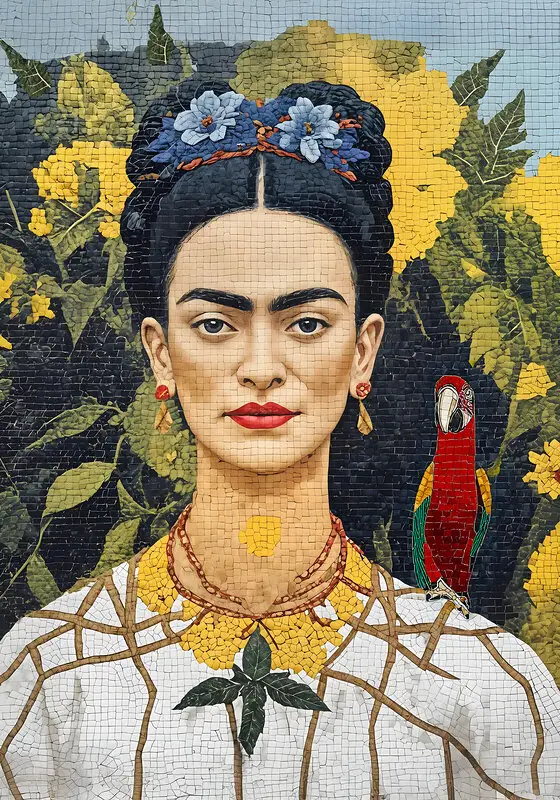
Frida Nobilis, 2025
Digital
70 x 100 cm
5 200 kr
Frida Nobilis: The Eternal Victor
Frida Kahlo, a beacon of resilience, triumphed over pain, adversity, and the limitations imposed upon her by her body and society. In life, she defied expectations; in death, she ascended to the realm of icons. In a newly discovered ancient mosaic, a woman eerily resembling Frida gazes back from the past, crowned with a laurel wreath—an eternal symbol of victory, intellect, and artistic greatness.
For millennia, the laurel (Laurus nobilis) has adorned the heads of poets, warriors, and scholars, symbolising their achievements. In Rome, victorious generals wore it in their triumphs; in ancient Greece, it was the prize of Olympians and the chosen emblem of Apollo. This rich history of the laurel invokes a sense of reverence, even today, it remains a mark of distinction in academia, with Swedish universities bestowing it upon new doctors.
Frida, who lived and painted through suffering, now wears her laurel not as a mere decoration but as a testament to her enduring legacy. The symbolism of the laurel in Frida's life is profound. ‘Frida Nobilis’—Frida, the noble, the victorious, the eternal.
Read on to get Frida’s view on Mosaic as an art form.
"Frida Nobilis
She wore neither crown of gold nor pearl,
No sceptre, carved for queens,
Yet in her grasp, the brush unfurled
A reign that transcends regimes.
Her laurels did not grow from conquest,
Nor from battles fought with steel,
But from every stroke of colour pressed—
A truth that the world could feel.
No empire bowed before her feet,
No palace bore her name,
Yet suffering she turned to heat,
And fire became her flame.
She limped, she laughed, she cursed the sky,
She painted through her pain,
Each wound transformed, she learned to fly,
And rose through loss again.
A victor crowned, yet never chained,
With laurel leaves so bright,
Not won through war, nor wealth attained,
But through unyielding light.
Call her noble, call her free,
A name that time cannot spoil—
‘Frida Nobilis’, eternally,
A rebel crowned in toil.”
Malmö, February 2025
Frida Nobilis
In the mosaic, Frida wears a star of laurel leaves at the end of her necklace. This laurel symbolism is significant as it represents her as a victor, crowned with the same leaves that have long adorned champions in great competitions, such as the classical Olympic Games in ancient Greece. The use of laurel in this context is a powerful symbol of triumph over adversity, a theme central to Frida's life and work. ‘Laurus nobilis’, the noble, reflects not only her artistic triumphs but also her personal victories over physical and emotional pain.
The aromatic leaves of the laurel tree have been praised for millennia as more than just a spice, as its name ‘Nobilis’—noble or esteemed—suggests. In antiquity, laurels were awarded as crowns of knowledge and victory, a tradition that continues today in ceremonial contexts. New doctoral graduates at Swedish universities receive a laurel wreath annually during conferment ceremonies. However, this tradition is primarily a Swedish academic custom, particularly at the universities of Uppsala and Lund. Internationally, doctoral graduation traditions vary. In many countries, such as the United Kingdom and the United States, postgraduate candidates receive elaborate academic hats or hoods in different colours, depending on their discipline and institution. In some European countries, such as Italy, the laurel wreath, or ‘corona laurea’, is occasionally used in certain academic ceremonies, especially in philosophy and the humanities. Nonetheless, the laurel wreath has remained a powerful symbol of learning and triumph throughout history.
As a posthumous honorary doctor with the eternal title ‘Frida Nobilis’, Frida’s significance should be self-evident. The title carries a Latin dignity that reinforces her triumphant status as an artist and icon. ‘Nobilis’ reflects her grace and greatness. Simultaneously, the laurel crown, a symbol of victory and triumph, highlights her enduring conquest over pain, physical limitations, and the narrow-mindedness of the world around her. Using the laurel crown in the context of Frida's life and work makes a powerful statement about her resilience and strength.
The laurel tree, belonging to the Lauraceae family, can grow up to 20 metres tall. It blooms from March to April in the northern hemisphere, producing small greenish-yellow flowers with a sweet fragrance. The aromatic leaves of the laurel tree have been treasured for thousands of years as more than just a culinary ingredient. The tree's resilience and evergreen nature render it a fitting symbol of victory and endurance.
According to the poet Ovid, the laurel has been the sacred attribute of the god Apollo ever since the nymph Daphne transformed into a laurel tree to escape Apollo’s lustful pursuit. This mythological connection to Apollo, the god of poetry and music, solidified the laurel’s association with artistic and intellectual achievement. The laurel wreath became an emblem for poets and scholars, symbolising their victory in the pursuit of knowledge and creativity.
In Rome, the laurel wreath (corona triumphalis) was worn by victorious generals who, after a resounding victory, were granted a triumphal procession by the Roman Senate upon their return to Rome. Those awarded the laurel wreath had the right to wear it at public occasions thereafter. Typically, the wreath was made of laurel, but it could also be fashioned from gold. The poet Juvenal described a variant of the golden wreath adorned with gemstones held over the head of the general during the triumphal parade. During the imperial era, the laurel wreath evolved into an imperial symbol. Laurel wreaths were also used to decorate houses, often displayed outside the doors of emperors and high priests.
The laurel was thought to offer protection against lightning, leading Emperor Tiberius to wear a laurel wreath upon his head during thunderstorms. Julius Caesar is depicted donning a laurel wreath on various coins—though it did not save him from assassination.
In the image, Frida adorns a star of laurel leaves around her neck and a laurel crown set with blue flowers in her hair, representing ‘desire, love, and her metaphysical striving for the infinite and unreachable’. It embodies hope, the beauty of existence, and ‘victory’—magnificently illustrated in a 2,000-year-old mosaic of a woman strikingly resembling Frida Kahlo. The mosaic, a stunning work of art, captures the essence of Frida's spirit and her enduring legacy.
Frida shared her connection to them when I inquired about mosaics and their history. Although she never created mosaics herself, she explained that Casa Azul, her former home and now a museum, contains several decorative elements reminiscent of mosaic techniques, particularly in its traditional Mexican-style tile and ceramic decorations. This personal insight into her life and home provides us with a deeper understanding of her artistic influences.
She spoke with pride of one of the world’s most impressive mosaic façades—the Biblioteca de la Universidad Nacional Autónoma de México. The entire building is adorned with a mosaic illustrating Mexico’s history from ancient times to the present, incorporating elements from Aztec and colonial art. It is one of the most iconic examples of Mexican mosaic artistry and has been designated a UNESCO World Heritage Site.
She also expressed pride in her husband Diego’s grand mosaic façade on the Olympic Stadium at UNAM. This artwork, combining pre-Hispanic, colonial, and modern history, is a testament to Diego's artistic vision and skill, and Frida's admiration for his work is evident.
Archaeologists have uncovered remarkable turquoise and obsidian mosaics at the Templo Mayor excavations, the grand Aztec pyramid in Tenochtitlán (modern-day Mexico City).
Mexico boasts a vibrant mosaic tradition, ranging from pre-Hispanic times to the modernist muralists of the 20th century.
Then, Frida transitioned into recounting the broader history of mosaics.
A mosaic is a pattern or image created from small, regular, or irregular pieces of coloured stone, glass, or ceramic set in plaster or mortar, covering a surface. Mosaics are decorative elements for floors and walls and were particularly popular in Ancient Roman times.
The earliest known examples of mosaics made from various materials were discovered in a temple building in Abra, Mesopotamia. These mosaics, consisting of coloured stones, shells, and ivory pieces, date from the latter half of the 3rd millennium BC. Excavations reveal evidence of the first glazed tiles, which date from around 1500 BC.
As an ancient and enduring artistic expression, mosaics have been utilised to decorate temples, palaces, churches, and even modest homes for millennia. From their origins in Mesopotamia to their peak in Roman and Byzantine art, mosaics have continued to evolve, preserving cultural and historical narratives in intricate detail. Mosaics' artistic and historical significance instils a sense of reverence for this ancient art form.
The Most Famous Mosaic
Perhaps the most renowned mosaic in history is the Alexander Mosaic, discovered in the House of the Faun in Pompeii. Dating back to around 100 BC, this massive work, composed of over one and a half million tesserae, depicts the Battle of Issus, where Alexander the Great confronted the Persian king Darius III. The detail in the figures, horses, and expressions of fear and determination renders it a masterpiece of ancient art. Today, the mosaic is housed in the Naples National Archaeological Museum, where it remains a prime example of Hellenistic influence on Roman art—a period celebrated for its artistic and cultural achievements.
The Largest Mosaic
Few mosaics can rival the Sheikh Zayed Grand Mosque mosaic in Abu Dhabi in sheer scale. Covering an area of over 17,000 square metres, this stunning floral design adorns the mosque’s courtyard and was created using a variety of natural stones, including marble, amethyst, lapis lazuli, and jasper. Crafted by artisans from Italy and India, this record-breaking mosaic exemplifies modern craftsmanship and pays homage to the rich tradition of Islamic art. The intricate details and the use of various stones make it a true masterpiece of mosaic art.
The Smallest Mosaic
On the opposite end of the spectrum, the micro-mosaics of the Vatican stand as some of the tiniest and most delicate examples of this art form. The Vatican’s secretive tradition of micro-mosaic creation flourished in the 18th and 19th centuries, with artisans using minuscule tesserae—some barely visible to the naked eye—to reproduce classical paintings. British artist David Arnott created one of the most miniature known mosaics, utilising small fragments that required a microscope to be adequately appreciated. His work fits on the head of a pin and depicts the face of Queen Elizabeth II.
The Strangest Mosaic
Mosaics often serve religious, historical, or decorative purposes, yet some stretch the boundaries of our expectations for the art form. One of the most unusual examples is the Cosmati Pavement in Westminster Abbey. Created in the 13th century, this floor mosaic comprises marble, glass, and precious stones arranged in intricate geometric patterns. What makes it distinctive is that it also includes an inscription predicting the end of the world—a rare and uncanny addition to an otherwise magnificent design. The inscription, written in Latin, purportedly calculates the duration of the world’s existence based on medieval numerology—something one does not typically expect to find beneath the feet of British monarchs during their coronations.
Embraced risqué mosaic art
The most scandalous mosaic known today is likely the Lupanar mosaic from Pompeii, the ancient Roman city famously preserved by the eruption of Mount Vesuvius in 79 AD. The Lupanar, Pompeii’s largest and most renowned brothel, offers a glimpse into ancient Roman culture's intriguing and sometimes shocking aspects. Its walls were adorned with explicit erotic mosaics and frescoes depicting various sexual acts, serving as a sort of menu for the services available within.
Another contender for the title of the most provocative mosaic is the Bathing Venus from Antioch, a testament to the Romans' sophisticated artistic taste. This mosaic, uncovered in the ruins of a Roman villa, portrays the goddess sensually emerging from her bath with intricate detail, highlighting the Romans' appreciation for both the erotic and the artistic. The Bathing Venus from Antioch reflects the Romans' complex relationship with art, beauty, and sensuality.
Contemporary artists have also embraced risqué mosaic art in a captivating display of continuity, blending classical techniques with controversial subject matter. These artists, much like their ancient predecessors, push boundaries and keep this provocative art form alive in the modern world.
Several ancient mosaics exhibit enormous phallic motifs, some of the most remarkable of which originate from the Roman Empire:
The Mosaics of Casa del Centenario (Pompeii) – This house contains a mosaic depicting Priapus, the god of fertility and abundance, with a grotesquely large penis. Priapus was a well-known figure in Roman art, often humorously portrayed with exaggerated phallic symbolism believed to bring good fortune and ward off the evil eye.
The Mosaics of Dionysos Villa (Cyprus) – A mosaic in this villa illustrates a procession dedicated to Dionysos, the god of wine and fertility, with phallic symbols prominently displayed. In ancient Rome and Greece, such imagery was frequently employed to ward off evil spirits, as it was thought to bring good fortune and fertility. The imagery in ancient mosaics reflects phallic symbols' cultural and religious significance.
The Mosaics of Ostia Antica – One of the most renowned Roman mosaics featuring exaggerated phallic motifs can be found in Ostia Antica, the ancient port city of Rome. Many of these mosaics were located in bathhouses and brothels, portraying enormous penises as part of ritualistic or humorous representations.
Hedonistic Mosaics in North Africa – Certain mosaics from Roman villas in Tunisia and Algeria depict satyrs and other mythological creatures with grotesquely large genitalia, reflecting the Roman fascination with both eroticism and humour.
Roman art was far more explicit than what we are accustomed to today, with phallic symbols often linked to luck, fertility, and ritualistic practices rather than merely sexual themes.
Also Sweden
Sweden boasts several remarkable mosaics, both historical and modern. A notable example is the Golden Hall in Stockholm City Hall, created by Einar Forseth in the 1920s. The hall is adorned with extensive mosaic artworks depicting Swedish historical motifs.
In Lund Cathedral is an impressive apse mosaic by Joakim Skovgaard, which contributes to the grandeur of the church’s interior. Additionally, artist Sven Ljungberg has created several mosaics in Swedish churches, including one at Gottsunda Church in Uppsala.
A Humorous Mosaic Anecdote
One of the most amusing mosaic-related stories originates from modern archaeology. In 2018, a team of Turkish archaeologists working at the ancient site of Zeugma in southeastern Turkey unearthed a Roman mosaic with an unexpectedly humorous message. The mosaic, featuring a skeleton lounging comfortably with a cup of wine, bore the Greek inscription “Be cheerful, enjoy life”—essentially an ancient version of "YOLO" (You Only Live Once). Dated to around the 3rd century AD, the mosaic provided an amusing insight into the Roman approach to mortality: acknowledge death but, in the meantime, embrace pleasure.
Mosaics are more than just decorative elements; they are time capsules, preserving cultures, humour, and the artistic ingenuity of past civilisations. From grand imperial commissions to quirky and personal creations, mosaics continue to fascinate and inspire, bridging the gap between antiquity and modernity. Whether found in the ruins of an ancient city or on the pavement of a modern cathedral, they serve as a reminder that artistry and storytelling through stone are as eternal as the tesserae.
5 200 kr

Jörgen Thornberg
Malmö
Lite om bilder och mig. Translation in English at the end.
Jag är en nyfiken person som ser allt i bilder, även det jag fäster i ord, gärna tillsammans för bakom alla mina bilder finns en berättelse. Till vissa bilder hör en kortare eller längre novell som följer med bilden.
Bilder berättar historier. Jag omges av naturlig skönhet, intressanta människor och historia var jag än går. Jag använder min kamera för att dokumentera världen och blanda det jag ser med vad jag känner för att fånga den dolda magin.
Mina bilder berättar mina historier. Genom mina bilder, tryck och berättelser. Jag bjuder in dig att ta del av dessa berättelser, in i ditt liv och hem och dela min mycket personliga syn på vår värld. Mer än vad ögat ser. Jag tänker i bilder, drömmer och skriver och pratar om dem; följaktligen måste jag också skapa bilder. De blir vad jag ser, inte nödvändigtvis begränsade till verkligheten. Det finns en bild runt varje hörn. Jag hoppas att du kommer att se vad jag såg och gilla det.
Jag är också en skrivande person och till många bilder hör en kortare eller längre essay. Den följer med tavlan, tryckt på fint papper och med en personlig hälsning från mig.
Flertalet bilder startar sin resa i min kamera. Enkelt förklarat beskriver jag bilden jag ser i mitt inre, upplevd eller fantiserad. Bilden uppstår inom mig redan innan jag fått okularet till ögat. På bråkdelen av ett ögonblick ser jag vad jag vill ha och vad som kan göras med bilden. Här skall jag stoppa in en giraff, stålmannen, Titanic eller vad det är min fantasi finner ut. Ännu märkligare är att jag kommer ihåg minnesbilden långt efteråt när det blir tid att skapa verket. Om jag lyckas eller inte, är upp till betraktaren, oftast präglat av en stråk av svart humor – meningen är att man skall bli underhållen. Mina bilder blir ofta en snackis där de hänger.
Jag föredrar bilder som förmedlar ett budskap i flera lager. Vid första anblicken fylld av feel-good, en vacker utsikt, fint väder, solen skiner, blommor på ängen eller vattnet som ligger förrädiskt spegelblankt. I en sådan bild kan jag gömma min egentliga berättelse, mitt förakt för förtryckare och våldsverkare, rasister och fördomsfulla människor - ett gärna återkommande motiv mer eller mindre dolt i det vackra motivet. Jag försöker förena dem i ett gemensamt narrativ.
Bild och formgivning har löpt som en röd tråd genom livet. Fotokonst känns som en värdig final som jag gärna delar med mig.
Min genre är vid som framgår av mina bilder, temat en blandning av pop- och gatukonst i kollage som kan bestå av hundratals lager. Vissa bilder kan ta veckor, andra någon dag innan det är dags att överlämna resultatet till printverkstaden. Fine Art Prints är digitala fotocollage. I dessa kollage sker rivandet, klippandet, pusslandet, målandet, ritandet och sprayningen digitalt. Det jag monterar in kan vara hundratals år gamla bilder som jag omsorgsfullt frilägger så att de ser ut att vara en del av tavlan men också bilder skapade av mig själv efter min egen fantasi. Därefter besöks printstudion och för vissa bilder numrera en limiterad upplaga (oftast 7 exemplar) och signera för hand. Vissa bilder kan köpas i olika format. Det är bara att fråga efter vilka. Gillar man en bild som är 70x100 men inte har plats på väggen, går den kanske att få i 50x70 cm istället. Frågan är fri.
Metoden Giclée eller Fine Art Print som det också kallas är det moderna sättet för framställning av grafisk konst. Villkoret för denna typ av utskrifter är att en högkvalitativ storformatskrivare används med åldersbeständigt färgpigment och konstnärspapper eller i förekommande fall på duk. Pappret som används möter de krav på livslängd som ställs av museer och gallerier. Normalt säljer jag mina bilder oinramade så att den nya ägaren själv kan bestämma hur de skall se ut, med eller utan passepartout färg på ram, med eller utan glas etc..
Under många år ställde jag bara ut på nätet, i valda grupper och på min egen Facebooksida - https://www.facebook.com/jorgen.thornberg.9
Jag finns också på en egen hemsida som tyvärr inte alltid är uppdaterad – https://www.jth.life/ Där kan du också läsa en del av de berättelser som följer med bilden.
UTSTÄLLNINGAR
Luftkastellet, oktober 2022
Konst i Lund, november 2022
Luftkastellet, mars 2023
Engleson Galleri Caroli, april 2023
Hydra, Greece June 2023
Engleson Galleri Caroli, oktober 2023
Toppen, Höllviken december 2023
Luftkastellet, mars 2024
Torups Galleri, mars 2024
Venice, May 2024
Luftkastellet, oktober 2024
Konst i Advent, December 2024
Galleri Engleson, Caroli December 2024
Jäger & Jansson Galleri, april 2025
A bit about pictures and me.
I'm a curious person who sees everything in pictures, even what I express in words, often combining them, for behind all my pictures lies a story. These narratives, some as short as a single image and others as long as a novel, are the heart and soul of my work.
Pictures tell stories. Wherever I go, I'm surrounded by natural beauty, exciting people, and history. I use my camera to document the world and blend what I see with what I feel to capture the hidden magic.
My images tell my stories. Through my pictures, prints, and narratives, I invite you to partake in these stories in your life and home and share my deeply personal perspective of our world. More than meets the eye. I think in pictures, dream, write, and talk about them; consequently, I must create images too. They become what I see, not necessarily confined to reality. There's a picture around every corner. I hope you'll see what I saw and enjoy it.
I'm also a writer, and many images come with a shorter or longer essay. It accompanies the painting, printed on fine paper with my personal greeting.
Many pictures start their journey on my camera. Simply put, I describe the image I see in my mind, experienced or imagined. The image arises within me even before I bring the eyepiece to my eye. In a fraction of a moment, I see what I want and what can be done with the picture. Here, I'll insert a giraffe, Superman, the Titanic, or whatever my imagination conjures up. Even stranger is that I remember the mental image long after it's time to create the work. Whether I succeed is up to the observer, often imbued with a streak of black humour – the aim is to entertain. My pictures usually become a talking point wherever they hang.
I prefer pictures that convey a message in multiple layers. At first glance, they're filled with feel-good vibes, a beautiful view, lovely weather, the sun shining, flowers in the meadow, or the water lying deceptively calm. But beneath this surface beauty, I often conceal a deeper story, a narrative that challenges societal norms or explores the human condition. I invite you to delve into these hidden narratives and discover the layers of meaning within my work.
Picture and design have been a thread running through my life. Photographic art feels like a fitting finale, and I'm happy to share it.
My genre is varied, as seen in my pictures; the theme is a blend of pop and street art in collages that can consist of hundreds of layers. Some images can take weeks, others just a day before it's time to hand over the result to the print workshop. Fine Art Prints are digital photo collages. In these collages, tearing, cutting, puzzling, painting, drawing, and spraying happen digitally. What I insert can be images hundreds of years old that I carefully extract so they appear to be part of the painting, but also images created by myself, now also generated from my imagination. Next, visit the print studio and, for certain images, number a limited edition (usually 7 copies) and sign them by hand. Some images may be available in other formats. Just ask which ones. If you like an image that's 70x100 but doesn't have space on the wall, you might be able to get it in 50x70 cm instead. The question is open.
The Giclée method, or Fine Art Print as it's also called, is the modern way of producing graphic art. This method ensures the highest quality and longevity of the artwork, using a high-quality large-format printer with archival pigment inks and artist paper or, in some cases, canvas. The paper used meets the longevity requirements set by museums and galleries. I sell my pictures unframed, allowing the new owner to personalise their artwork, confident in the lasting value and quality of the piece.
For many years, I only exhibited online, in selected groups, and on my Facebook page - https://www.facebook.com/jorgen.thornberg.9. I also have my website, which unfortunately is not constantly updated - https://www.jth.life/. You can also read some of the stories accompanying the pictures there.
EXHIBITIONS
Luftkastellet, October 2022
Art in Lund, November 2022
Luftkastellet, March 2023
Engleson Gallery Caroli, April 2023
Hydra, Greece June 2023
Engleson Gallery Caroli, October 2023
Toppen, Höllviken December 2023
Luftkastellet, March 2024
Torup Gallery, March 2024
Venice, May 2024
UTSTÄLLNINGAR
Luftkastellet, oktober 2022
Konst i Lund, november 2022
Luftkastellet, mars 2023
Engleson Galleri Caroli, april 2023
Hydra, Greece June 2023
Engleson Galleri Caroli, oktober 2023
Toppen, Höllviken december 2023
Luftkastellet, mars 2024
Torups Galleri, mars 2024
Venice, May 2024
Luftkastellet, October 2024
Konst i Advent, December 2024
Galleri Engleson, Caroli December 2024
Jäger & Jansson Galleri, April 2025
Utbildning
Autodidakt
Medlem i konstnärsförening
Öppna Sinnen
Med i konstrunda
Konstrundan i Skåne
Utställningar
Luftkastellet, October 2022
Art in Lund, November 2022
Luftkastellet, March 2023
Engleson Gallery Caroli, April 2023
Hydra, Greece June 2023
Engleson Gallery Caroli, October 2023
Toppen, Höllviken December 2023
Luftkastellet, March 2024
Torup Gallery, March 2024
Venice, May 2024