Vi använder cookies för att ge dig bästa möjliga upplevelse. Välj vilka cookies du tillåter.
Läs mer i vår integritetspolicy
Jörgen Thornberg
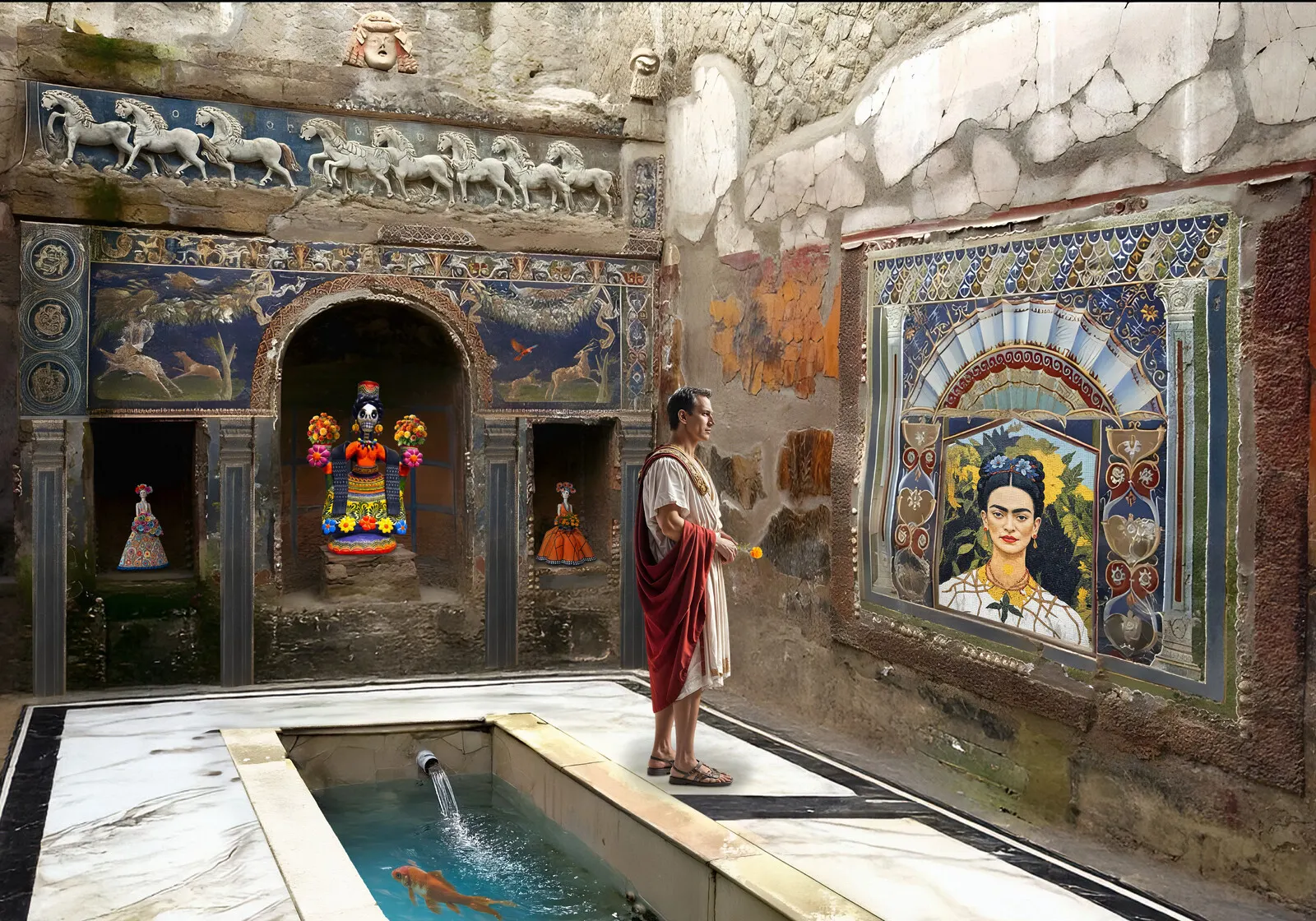
A stunning resemblance, 2025
Digital
100 x 70 cm
3 200 kr
A stunning resemblance
Please take a peek at more of my work. You're in for a delightful surprise. Click the link below to discover more.
https://www.konst.se/jorgen-thornberg
A Journey Through Time and Memory
Frida Kahlo had been to Italy once before, in 1950, when she was awarded a prize at the Venice Biennale—one of the few moments of international recognition she received during her lifetime. Back then, her health was in rapid decline, making travel exhausting. She spent a week in Venice and a few days in Rome and Milan, admiring Renaissance art and historic landscapes, yet she never made it to Pompeii or Herculaneum.
Now, as a Time-traveller, free from pain and earthly limitations, Frida was back, determined to experience what she had missed. Her journey led her to Herculaneum, the city buried by Vesuvius in 79 AD, where a recent discovery had piqued her curiosity—an ancient mosaic of a woman who bore an uncanny resemblance to herself. The resemblance was stunning.
In this place, standing in the cool shade of a Nymphaeum, Frida encountered another Time-traveller—Gaius Plinius Caecilius Secundus, better known as Pliny the Younger. A man of letters, a historian, and an eyewitness to the disaster that had entombed this city, he had returned for the first time since the eruption. Their meeting would become an extraordinary exchange of history, art, and mystery. Who was the woman immortalised in the mosaic? Could it be an artist lost to time, or had Frida truly lived before? In the echoes of antiquity, past and present intertwined in a conversation neither of them had expected, but both were destined to have.
Read on to explore a tale about tragedy that unfolded amidst the looming threat of Vesuvius.
"Ash and Fire, Night and Fear
The sky was calm, the sea was bright,
A peaceful noon bathed in golden light.
Then rose a cloud, vast and high,
A towering plume in the endless sky.
Like a pine, it spread its crown,
Raining dust upon the town.
A scholar stood upon the shore,
A man of wisdom, seeking more.
He watched, he wrote, he traced its flight,
Unaware of the coming night.
A letter called, a plea was made,
A cry for help in fear’s cascade.
Across the waves, into the haze,
A fleet of warships cut their ways.
The air grew thick, the heavens dimmed,
The mountain roared, the fires brimmed.
Pumice rained like shattered glass,
Darkness fell—no day could pass.
The earth groaned, the sea withdrew,
Flames leapt high where vineyards grew.
The air was choked with heat and death,
And poison stole the strongest breath.
Yet, in the storm, he faced his fate,
Fortune favours the brave—too late.
Among the stones, where silence weeps,
A body lies as if it sleeps.
No wounds to show, no scars to tell,
Only dust where once he fell.
And in the night, beneath the stars,
His story drifts through time’s memoirs.
Two thousand years, the tale remains,
Etched in fire, ash, and chains.
A voice recalls what fate designed—
A scholar lost, a world enshrined.
And through the ages, whispers sound,
Of what was buried yet still found.
Frida stood where time stood still,
A mosaic face, a fate fulfilled.
On the wall, the past looked back,
Tesserae set in careful track.
A woman’s gaze, so fierce, so free—
Was it her, or was it me?
Gaius pondered, brow set deep,
Across two worlds, through time’s lost sweep.
“I knew her once,” his voice so low,
“Yet here you stand, and still I know—
If fate has played its endless thread,
She lives in stone, and you in red.”
Malmö, February 2025
A stunning resemblance
Frida found herself in Italy for the second time—now as a tourist. The first occasion was in 1950 when she was awarded a prize at the Venice Biennale, a significant moment as it marked one of the few instances she received international recognition during her lifetime.
By then, Frida’s health had declined markedly, making the journey arduous, but she still spent a week in Venice and a few days each in Rome and Milan. She was captivated by Renaissance art and historical sites, but visiting Pompeii and Herculaneum had been beyond her strength. This time, she intended to make up for that.
Herculaneum, like its more renowned sister city, Pompeii, was destroyed by the eruption of Mount Vesuvius in 79 AD. Today, it remains only partially excavated. According to available sources, approximately a quarter of the city has been uncovered, while the rest lies buried beneath volcanic material and the modern town of Ercolano. The thick layer of tuff (hardened volcanic rock) covering the site and parts of the ancient city lies beneath contemporary buildings, limiting the possibilities for archaeological excavation. Despite these challenges, the uncovered sections have revealed exceptionally well-preserved artefacts, offering an unparalleled glimpse into Roman life. Recently, yet another remarkably intact villa has been discovered—relatively small but exquisitely decorated—a townhouse known as the House of Frida, presumably belonging to a wealthy family. For this reason, Frida was here now: a mosaic depicting a woman who could have been her twin. The resemblance was striking.
At the back of the house, in a secluded courtyard, a lush garden provides a tranquil oasis away from the street. At its heart lies a nymphaeum, an artificial grotto with a fountain and a small pool where golden fish swim in the clear water. Against the back wall stands the mosaic that had given the house its name—a Frida Kahlo from nearly two thousand years ago. Living as Frida did, among a hundred billion souls in eternity, she had long since become accustomed to encountering faces resembling her own—at least on the surface. It didn’t bother her in the slightest. A closer look, a glimpse into the personality behind the face, always revealed the profound differences.
Modern science could explain it: the number of DNA bases in a single human being exceeds the number of stars in the Milky Way by several orders of magnitude. If one were to imagine a person as an image composed of infinite pixels, there would always be combinations never repeated throughout the millions of years humans have existed on Earth. But the mosaic—this mosaic—was genuinely striking.
Like the other mosaics adorning the walls, it shimmered with vivid colours. Yet, the figures surrounding the central portrait truly captivated Frida. She recognised them.
It wasn’t just Roman deities depicted in the nymphaeum. Two figures unmistakably represented the house’s former mistress. But the sizeable central figure—
"Impossible," Frida whispered under her breath. It was not a Roman god at all; it reminded her of the deities of the Aztecs. Could they have been in Rome or vice versa?
A shiver ran down her spine. The past was never as distant as people thought.
Just then, she noticed a man standing a short distance away, intently studying the mosaic. He, too, had seen her.
His gaze flickered between the artwork and Frida and then back again. He was dressed in a toga and sandals and held a single marigold in his hand.
"Is that you in the mosaic?" the man asked.
Frida turned towards him fully, realising instantly that he, like her, was a Time-traveller who had returned to Earth for a visit.
"Not that I know of," she replied. "But I suppose I could have been reincarnated. I encountered myself in Bologna five hundred years ago. At that time, I was a sculptor named Properzia de’ Rossi. Although men dominated art during the Renaissance, there were female artists—but their names and works often faded from history due to a lack of recognition. Properzia de’ Rossi was one of the few whose name has endured. She departed this Earth far too soon, at the age of forty."
“I didn’t live much longer myself,” the man said, introducing himself as Gaius Plinius Caecilius Secundus—Pliny the Younger. “We haven’t had the pleasure of meeting up there. Are you newly arrived?” He had, of course, recognised that Frida was a Time-traveller, and understanding her Spanish as well as she did his Latin, he knew they shared the same abilities.
“It’s been ninety years since I left Earth,” Frida said, introducing herself as an artist.
“The woman in the mosaic was named Claudia, and according to my uncle, Pliny the Elder, she was a talented painter and sculptor. This mosaic serves as a self-portrait."
Frida’s eyes widened slightly. Gaius continued:
“I met her briefly during my visit here in 79 AD. She was a striking woman, much like yourself—but she was married and significantly older than I, a mere eighteen-year-old at the time. That was my first and only visit to Herculaneum until now. I was here when the city was buried under metres of ash. I do not know whether she survived the catastrophe, for neither my uncle nor I ever encountered her among the stars. But yes, I was in this house and saw this mosaic two thousand years ago. If you are not the woman in the image, tell me—who are you?”
Frida studied him for a moment, then smiled. Time-travellers do not need words. She projected her life into his mind as they all did—a rapid, seamless sharing of memory and experience. One thousandth the speed of thought, yet not a single detail lost. Forty-seven years on Earth and seventy in eternity, compressed into mere minutes.
Gaius absorbed everything, his gaze never leaving hers.
“Now,” she said at last, tilting her head, “please tell me about your visit here back then.”
A small fountain poured clear water into a basin. Golden fish darted between the rippling reflections, their bright scales shimmering in the light that filtered through an opening in the ceiling. The air was scented with damp stone and a faint aroma of flowers from the garden outside. Mosaics adorned the walls, intricate and alive with the stories of another time.
One mosaic, in particular, held Frida in its enigmatic grip. It depicted a woman whose features were strikingly familiar—too familiar to be mere coincidence. Frida tilted her head and studied the image closely, her mind swirling with questions.
“She looks like me,” she murmured, glancing at Gaius. “Did you know her?”
Gaius followed her gaze, his expression pensive. He traced a finger lightly over the ancient tesserae, the pieces of stone, glass, and ceramic used to create a mosaic, as if he could unlock its secrets by touch alone. Then, with a slow shake of his head, he admitted, “No. Neither my uncle nor I ever met this woman among the stars. But who knows? Eternity holds its mysteries.”
He turned back to Frida with a small smile conveying amusement and something else—perhaps a hint of nostalgia. “But you didn’t want to discuss unfamiliar women in mosaics,” he remarked. “You wished to hear about Herculaneum.”
Frida nodded, leaning against one of the marble columns, waiting for his cue to begin.
“My uncle, Pliny the Elder, was stationed at Misenum, commanding the fleet,” Gaius stated, his voice shifting into the measured tone of a storyteller. “On the twenty-fourth of August, in the early afternoon, my mother pointed out an unusual cloud in the sky. He had just been out in the sun, taken a cold bath, and reclined with his books. However, when he saw it, he immediately rose and climbed to a higher vantage point to get a better view.
Frida narrowed her eyes. “What did it look like?”
“Like an umbrella pine,” Gaius said, gesturing upwards. “A thick trunk rising straight up, then spreading into a broad canopy. He believed it was thrust upwards by an immense force before losing support and sagging under its own weight. Some parts were pure white, while others were blotched with darkness, depending on how much earth and ash it carried. He immediately recognised that this was not merely a passing phenomenon—something unprecedented.”
Frida nodded approvingly. “He was a scientist at heart.”
Gaius smiled. “Indeed. His first instinct was to investigate. He ordered a boat to be prepared and asked if I wished to accompany him. I refused—I had my studies.”
Frida let out a laugh, shaking her head. “So you missed history being made because you were busy with homework?”
“Something of the sort,” Gaius admitted wryly. “But my uncle—he set off, eager to observe the event firsthand. Then, as he was leaving, a message arrived from Rectina, Tascus's wife. She lived at the foot of the mountain, and with no escape except by sea, she begged him to rescue her. Suddenly, this was no longer a scientific expedition. It became a mission of mercy.”
Frida crossed her arms, intrigued. “And he went?”
Gaius nodded. “Straight into danger, while others fled in the opposite direction. He ordered the warships to set sail and steered directly towards the coast. The closer they got, the heavier the ashfall became. Fragments of pumice and fire-blackened stones rained down upon them. The sea grew shallower as debris from the mountain choked the shore. For a moment, he considered turning back. But when his helmsman suggested it, he refused.”
Frida raised an eyebrow. “What did he say?”
Gaius' lips curved into a small smile. “‘Fortune favours the brave.’”
Frida gave an approving nod. “A true Roman.”
“At Stabiae, he found Pomponianus, another friend. The wind had trapped him there, preventing his escape. My uncle, fearless as ever, embraced him, calmed him, and even had a bath before dinner. He dined cheerfully—at least he pretended to, which was just as courageous. He reassured everyone, insisting that the fires they saw on the mountainside were merely abandoned houses burning, nothing more. Then, astonishingly, he lay down to sleep.
Frida’s jaw dropped. “He slept? In the midst of all that?”
Gaius shrugged. “He was a large man. He snored loudly enough that those outside his door could hear him.”
Frida shook her head in disbelief. “And then?”
“The ashfall thickened. The ground outside his room began to rise, burying the courtyard. Had he waited any longer, escape would have become impossible. He woke, gathered his companions, and deliberated their next move. Stay inside, where the walls trembled with each quake, or venture out into the falling stones? They chose the latter. My uncle, ever the leader, took charge. They wrapped their heads in cloth to shield themselves from the falling debris and set out towards the shore.”
Frida’s fingers traced the rim of the fountain absentmindedly. “Did they make it?”
Gaius exhaled slowly. “No. The air was thick with ash, and the sulfur smell was suffocating. He struggled to breathe. He had always suffered from a weak throat, prone to inflammation. In the end, it was not fire or falling stones that killed him—it was the air itself. He collapsed, overcome by the fumes.”
Frida was silent for a long moment. The gentle trickle of water and the quiet movement of the fish seemed louder in the stillness. “That’s a terrible way to die,” she said at last.
Gaius nodded. “But he was found two days later, untouched, his body unburned. He looked as if he had simply fallen asleep.”
Frida sighed. “A strange kind of peace amid all that destruction.”
Gaius turned his gaze back to the mosaic. The woman’s eyes—so eerily familiar—appeared to stare right through him. “We think we shape history,” he murmured, “but the truth is, history shapes us.”
Frida stepped closer to the image on the wall. “This woman—” she began, then hesitated. “If neither you nor your uncle met her beyond the stars, perhaps she’s someone else entirely.”
Gaius watched her, something inscrutable in his expression. “Or perhaps she was you,” he said softly.
Frida let out a small laugh, but her fingers lingered on the ancient mosaic. “Perhaps,” she admitted. “But only the stars know for certain.”
Jörgen Thornberg
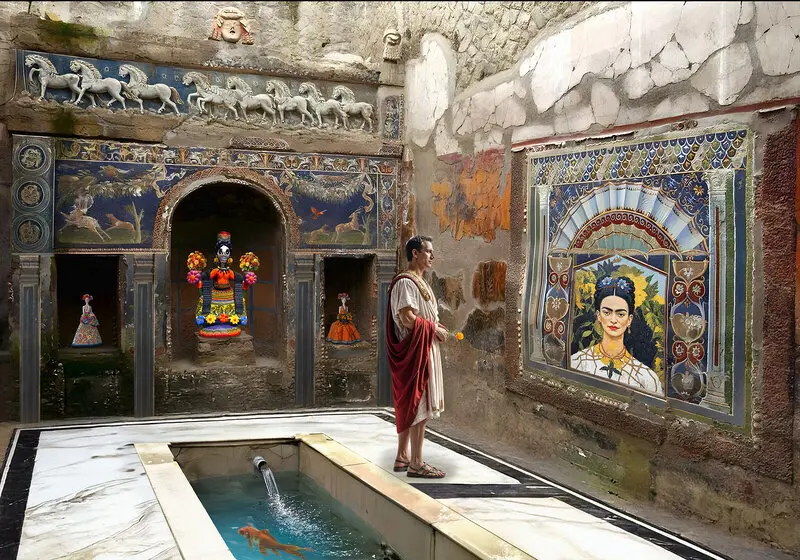
A stunning resemblance, 2025
Digital
100 x 70 cm
3 200 kr
A stunning resemblance
Please take a peek at more of my work. You're in for a delightful surprise. Click the link below to discover more.
https://www.konst.se/jorgen-thornberg
A Journey Through Time and Memory
Frida Kahlo had been to Italy once before, in 1950, when she was awarded a prize at the Venice Biennale—one of the few moments of international recognition she received during her lifetime. Back then, her health was in rapid decline, making travel exhausting. She spent a week in Venice and a few days in Rome and Milan, admiring Renaissance art and historic landscapes, yet she never made it to Pompeii or Herculaneum.
Now, as a Time-traveller, free from pain and earthly limitations, Frida was back, determined to experience what she had missed. Her journey led her to Herculaneum, the city buried by Vesuvius in 79 AD, where a recent discovery had piqued her curiosity—an ancient mosaic of a woman who bore an uncanny resemblance to herself. The resemblance was stunning.
In this place, standing in the cool shade of a Nymphaeum, Frida encountered another Time-traveller—Gaius Plinius Caecilius Secundus, better known as Pliny the Younger. A man of letters, a historian, and an eyewitness to the disaster that had entombed this city, he had returned for the first time since the eruption. Their meeting would become an extraordinary exchange of history, art, and mystery. Who was the woman immortalised in the mosaic? Could it be an artist lost to time, or had Frida truly lived before? In the echoes of antiquity, past and present intertwined in a conversation neither of them had expected, but both were destined to have.
Read on to explore a tale about tragedy that unfolded amidst the looming threat of Vesuvius.
"Ash and Fire, Night and Fear
The sky was calm, the sea was bright,
A peaceful noon bathed in golden light.
Then rose a cloud, vast and high,
A towering plume in the endless sky.
Like a pine, it spread its crown,
Raining dust upon the town.
A scholar stood upon the shore,
A man of wisdom, seeking more.
He watched, he wrote, he traced its flight,
Unaware of the coming night.
A letter called, a plea was made,
A cry for help in fear’s cascade.
Across the waves, into the haze,
A fleet of warships cut their ways.
The air grew thick, the heavens dimmed,
The mountain roared, the fires brimmed.
Pumice rained like shattered glass,
Darkness fell—no day could pass.
The earth groaned, the sea withdrew,
Flames leapt high where vineyards grew.
The air was choked with heat and death,
And poison stole the strongest breath.
Yet, in the storm, he faced his fate,
Fortune favours the brave—too late.
Among the stones, where silence weeps,
A body lies as if it sleeps.
No wounds to show, no scars to tell,
Only dust where once he fell.
And in the night, beneath the stars,
His story drifts through time’s memoirs.
Two thousand years, the tale remains,
Etched in fire, ash, and chains.
A voice recalls what fate designed—
A scholar lost, a world enshrined.
And through the ages, whispers sound,
Of what was buried yet still found.
Frida stood where time stood still,
A mosaic face, a fate fulfilled.
On the wall, the past looked back,
Tesserae set in careful track.
A woman’s gaze, so fierce, so free—
Was it her, or was it me?
Gaius pondered, brow set deep,
Across two worlds, through time’s lost sweep.
“I knew her once,” his voice so low,
“Yet here you stand, and still I know—
If fate has played its endless thread,
She lives in stone, and you in red.”
Malmö, February 2025
A stunning resemblance
Frida found herself in Italy for the second time—now as a tourist. The first occasion was in 1950 when she was awarded a prize at the Venice Biennale, a significant moment as it marked one of the few instances she received international recognition during her lifetime.
By then, Frida’s health had declined markedly, making the journey arduous, but she still spent a week in Venice and a few days each in Rome and Milan. She was captivated by Renaissance art and historical sites, but visiting Pompeii and Herculaneum had been beyond her strength. This time, she intended to make up for that.
Herculaneum, like its more renowned sister city, Pompeii, was destroyed by the eruption of Mount Vesuvius in 79 AD. Today, it remains only partially excavated. According to available sources, approximately a quarter of the city has been uncovered, while the rest lies buried beneath volcanic material and the modern town of Ercolano. The thick layer of tuff (hardened volcanic rock) covering the site and parts of the ancient city lies beneath contemporary buildings, limiting the possibilities for archaeological excavation. Despite these challenges, the uncovered sections have revealed exceptionally well-preserved artefacts, offering an unparalleled glimpse into Roman life. Recently, yet another remarkably intact villa has been discovered—relatively small but exquisitely decorated—a townhouse known as the House of Frida, presumably belonging to a wealthy family. For this reason, Frida was here now: a mosaic depicting a woman who could have been her twin. The resemblance was striking.
At the back of the house, in a secluded courtyard, a lush garden provides a tranquil oasis away from the street. At its heart lies a nymphaeum, an artificial grotto with a fountain and a small pool where golden fish swim in the clear water. Against the back wall stands the mosaic that had given the house its name—a Frida Kahlo from nearly two thousand years ago. Living as Frida did, among a hundred billion souls in eternity, she had long since become accustomed to encountering faces resembling her own—at least on the surface. It didn’t bother her in the slightest. A closer look, a glimpse into the personality behind the face, always revealed the profound differences.
Modern science could explain it: the number of DNA bases in a single human being exceeds the number of stars in the Milky Way by several orders of magnitude. If one were to imagine a person as an image composed of infinite pixels, there would always be combinations never repeated throughout the millions of years humans have existed on Earth. But the mosaic—this mosaic—was genuinely striking.
Like the other mosaics adorning the walls, it shimmered with vivid colours. Yet, the figures surrounding the central portrait truly captivated Frida. She recognised them.
It wasn’t just Roman deities depicted in the nymphaeum. Two figures unmistakably represented the house’s former mistress. But the sizeable central figure—
"Impossible," Frida whispered under her breath. It was not a Roman god at all; it reminded her of the deities of the Aztecs. Could they have been in Rome or vice versa?
A shiver ran down her spine. The past was never as distant as people thought.
Just then, she noticed a man standing a short distance away, intently studying the mosaic. He, too, had seen her.
His gaze flickered between the artwork and Frida and then back again. He was dressed in a toga and sandals and held a single marigold in his hand.
"Is that you in the mosaic?" the man asked.
Frida turned towards him fully, realising instantly that he, like her, was a Time-traveller who had returned to Earth for a visit.
"Not that I know of," she replied. "But I suppose I could have been reincarnated. I encountered myself in Bologna five hundred years ago. At that time, I was a sculptor named Properzia de’ Rossi. Although men dominated art during the Renaissance, there were female artists—but their names and works often faded from history due to a lack of recognition. Properzia de’ Rossi was one of the few whose name has endured. She departed this Earth far too soon, at the age of forty."
“I didn’t live much longer myself,” the man said, introducing himself as Gaius Plinius Caecilius Secundus—Pliny the Younger. “We haven’t had the pleasure of meeting up there. Are you newly arrived?” He had, of course, recognised that Frida was a Time-traveller, and understanding her Spanish as well as she did his Latin, he knew they shared the same abilities.
“It’s been ninety years since I left Earth,” Frida said, introducing herself as an artist.
“The woman in the mosaic was named Claudia, and according to my uncle, Pliny the Elder, she was a talented painter and sculptor. This mosaic serves as a self-portrait."
Frida’s eyes widened slightly. Gaius continued:
“I met her briefly during my visit here in 79 AD. She was a striking woman, much like yourself—but she was married and significantly older than I, a mere eighteen-year-old at the time. That was my first and only visit to Herculaneum until now. I was here when the city was buried under metres of ash. I do not know whether she survived the catastrophe, for neither my uncle nor I ever encountered her among the stars. But yes, I was in this house and saw this mosaic two thousand years ago. If you are not the woman in the image, tell me—who are you?”
Frida studied him for a moment, then smiled. Time-travellers do not need words. She projected her life into his mind as they all did—a rapid, seamless sharing of memory and experience. One thousandth the speed of thought, yet not a single detail lost. Forty-seven years on Earth and seventy in eternity, compressed into mere minutes.
Gaius absorbed everything, his gaze never leaving hers.
“Now,” she said at last, tilting her head, “please tell me about your visit here back then.”
A small fountain poured clear water into a basin. Golden fish darted between the rippling reflections, their bright scales shimmering in the light that filtered through an opening in the ceiling. The air was scented with damp stone and a faint aroma of flowers from the garden outside. Mosaics adorned the walls, intricate and alive with the stories of another time.
One mosaic, in particular, held Frida in its enigmatic grip. It depicted a woman whose features were strikingly familiar—too familiar to be mere coincidence. Frida tilted her head and studied the image closely, her mind swirling with questions.
“She looks like me,” she murmured, glancing at Gaius. “Did you know her?”
Gaius followed her gaze, his expression pensive. He traced a finger lightly over the ancient tesserae, the pieces of stone, glass, and ceramic used to create a mosaic, as if he could unlock its secrets by touch alone. Then, with a slow shake of his head, he admitted, “No. Neither my uncle nor I ever met this woman among the stars. But who knows? Eternity holds its mysteries.”
He turned back to Frida with a small smile conveying amusement and something else—perhaps a hint of nostalgia. “But you didn’t want to discuss unfamiliar women in mosaics,” he remarked. “You wished to hear about Herculaneum.”
Frida nodded, leaning against one of the marble columns, waiting for his cue to begin.
“My uncle, Pliny the Elder, was stationed at Misenum, commanding the fleet,” Gaius stated, his voice shifting into the measured tone of a storyteller. “On the twenty-fourth of August, in the early afternoon, my mother pointed out an unusual cloud in the sky. He had just been out in the sun, taken a cold bath, and reclined with his books. However, when he saw it, he immediately rose and climbed to a higher vantage point to get a better view.
Frida narrowed her eyes. “What did it look like?”
“Like an umbrella pine,” Gaius said, gesturing upwards. “A thick trunk rising straight up, then spreading into a broad canopy. He believed it was thrust upwards by an immense force before losing support and sagging under its own weight. Some parts were pure white, while others were blotched with darkness, depending on how much earth and ash it carried. He immediately recognised that this was not merely a passing phenomenon—something unprecedented.”
Frida nodded approvingly. “He was a scientist at heart.”
Gaius smiled. “Indeed. His first instinct was to investigate. He ordered a boat to be prepared and asked if I wished to accompany him. I refused—I had my studies.”
Frida let out a laugh, shaking her head. “So you missed history being made because you were busy with homework?”
“Something of the sort,” Gaius admitted wryly. “But my uncle—he set off, eager to observe the event firsthand. Then, as he was leaving, a message arrived from Rectina, Tascus's wife. She lived at the foot of the mountain, and with no escape except by sea, she begged him to rescue her. Suddenly, this was no longer a scientific expedition. It became a mission of mercy.”
Frida crossed her arms, intrigued. “And he went?”
Gaius nodded. “Straight into danger, while others fled in the opposite direction. He ordered the warships to set sail and steered directly towards the coast. The closer they got, the heavier the ashfall became. Fragments of pumice and fire-blackened stones rained down upon them. The sea grew shallower as debris from the mountain choked the shore. For a moment, he considered turning back. But when his helmsman suggested it, he refused.”
Frida raised an eyebrow. “What did he say?”
Gaius' lips curved into a small smile. “‘Fortune favours the brave.’”
Frida gave an approving nod. “A true Roman.”
“At Stabiae, he found Pomponianus, another friend. The wind had trapped him there, preventing his escape. My uncle, fearless as ever, embraced him, calmed him, and even had a bath before dinner. He dined cheerfully—at least he pretended to, which was just as courageous. He reassured everyone, insisting that the fires they saw on the mountainside were merely abandoned houses burning, nothing more. Then, astonishingly, he lay down to sleep.
Frida’s jaw dropped. “He slept? In the midst of all that?”
Gaius shrugged. “He was a large man. He snored loudly enough that those outside his door could hear him.”
Frida shook her head in disbelief. “And then?”
“The ashfall thickened. The ground outside his room began to rise, burying the courtyard. Had he waited any longer, escape would have become impossible. He woke, gathered his companions, and deliberated their next move. Stay inside, where the walls trembled with each quake, or venture out into the falling stones? They chose the latter. My uncle, ever the leader, took charge. They wrapped their heads in cloth to shield themselves from the falling debris and set out towards the shore.”
Frida’s fingers traced the rim of the fountain absentmindedly. “Did they make it?”
Gaius exhaled slowly. “No. The air was thick with ash, and the sulfur smell was suffocating. He struggled to breathe. He had always suffered from a weak throat, prone to inflammation. In the end, it was not fire or falling stones that killed him—it was the air itself. He collapsed, overcome by the fumes.”
Frida was silent for a long moment. The gentle trickle of water and the quiet movement of the fish seemed louder in the stillness. “That’s a terrible way to die,” she said at last.
Gaius nodded. “But he was found two days later, untouched, his body unburned. He looked as if he had simply fallen asleep.”
Frida sighed. “A strange kind of peace amid all that destruction.”
Gaius turned his gaze back to the mosaic. The woman’s eyes—so eerily familiar—appeared to stare right through him. “We think we shape history,” he murmured, “but the truth is, history shapes us.”
Frida stepped closer to the image on the wall. “This woman—” she began, then hesitated. “If neither you nor your uncle met her beyond the stars, perhaps she’s someone else entirely.”
Gaius watched her, something inscrutable in his expression. “Or perhaps she was you,” he said softly.
Frida let out a small laugh, but her fingers lingered on the ancient mosaic. “Perhaps,” she admitted. “But only the stars know for certain.”
3 200 kr

Jörgen Thornberg
Malmö
Lite om bilder och mig. Translation in English at the end.
Jag är en nyfiken person som ser allt i bilder, även det jag fäster i ord, gärna tillsammans för bakom alla mina bilder finns en berättelse. Till vissa bilder hör en kortare eller längre novell som följer med bilden.
Bilder berättar historier. Jag omges av naturlig skönhet, intressanta människor och historia var jag än går. Jag använder min kamera för att dokumentera världen och blanda det jag ser med vad jag känner för att fånga den dolda magin.
Mina bilder berättar mina historier. Genom mina bilder, tryck och berättelser. Jag bjuder in dig att ta del av dessa berättelser, in i ditt liv och hem och dela min mycket personliga syn på vår värld. Mer än vad ögat ser. Jag tänker i bilder, drömmer och skriver och pratar om dem; följaktligen måste jag också skapa bilder. De blir vad jag ser, inte nödvändigtvis begränsade till verkligheten. Det finns en bild runt varje hörn. Jag hoppas att du kommer att se vad jag såg och gilla det.
Jag är också en skrivande person och till många bilder hör en kortare eller längre essay. Den följer med tavlan, tryckt på fint papper och med en personlig hälsning från mig.
Flertalet bilder startar sin resa i min kamera. Enkelt förklarat beskriver jag bilden jag ser i mitt inre, upplevd eller fantiserad. Bilden uppstår inom mig redan innan jag fått okularet till ögat. På bråkdelen av ett ögonblick ser jag vad jag vill ha och vad som kan göras med bilden. Här skall jag stoppa in en giraff, stålmannen, Titanic eller vad det är min fantasi finner ut. Ännu märkligare är att jag kommer ihåg minnesbilden långt efteråt när det blir tid att skapa verket. Om jag lyckas eller inte, är upp till betraktaren, oftast präglat av en stråk av svart humor – meningen är att man skall bli underhållen. Mina bilder blir ofta en snackis där de hänger.
Jag föredrar bilder som förmedlar ett budskap i flera lager. Vid första anblicken fylld av feel-good, en vacker utsikt, fint väder, solen skiner, blommor på ängen eller vattnet som ligger förrädiskt spegelblankt. I en sådan bild kan jag gömma min egentliga berättelse, mitt förakt för förtryckare och våldsverkare, rasister och fördomsfulla människor - ett gärna återkommande motiv mer eller mindre dolt i det vackra motivet. Jag försöker förena dem i ett gemensamt narrativ.
Bild och formgivning har löpt som en röd tråd genom livet. Fotokonst känns som en värdig final som jag gärna delar med mig.
Min genre är vid som framgår av mina bilder, temat en blandning av pop- och gatukonst i kollage som kan bestå av hundratals lager. Vissa bilder kan ta veckor, andra någon dag innan det är dags att överlämna resultatet till printverkstaden. Fine Art Prints är digitala fotocollage. I dessa kollage sker rivandet, klippandet, pusslandet, målandet, ritandet och sprayningen digitalt. Det jag monterar in kan vara hundratals år gamla bilder som jag omsorgsfullt frilägger så att de ser ut att vara en del av tavlan men också bilder skapade av mig själv efter min egen fantasi. Därefter besöks printstudion och för vissa bilder numrera en limiterad upplaga (oftast 7 exemplar) och signera för hand. Vissa bilder kan köpas i olika format. Det är bara att fråga efter vilka. Gillar man en bild som är 70x100 men inte har plats på väggen, går den kanske att få i 50x70 cm istället. Frågan är fri.
Metoden Giclée eller Fine Art Print som det också kallas är det moderna sättet för framställning av grafisk konst. Villkoret för denna typ av utskrifter är att en högkvalitativ storformatskrivare används med åldersbeständigt färgpigment och konstnärspapper eller i förekommande fall på duk. Pappret som används möter de krav på livslängd som ställs av museer och gallerier. Normalt säljer jag mina bilder oinramade så att den nya ägaren själv kan bestämma hur de skall se ut, med eller utan passepartout färg på ram, med eller utan glas etc..
Under många år ställde jag bara ut på nätet, i valda grupper och på min egen Facebooksida - https://www.facebook.com/jorgen.thornberg.9
Jag finns också på en egen hemsida som tyvärr inte alltid är uppdaterad – https://www.jth.life/ Där kan du också läsa en del av de berättelser som följer med bilden.
UTSTÄLLNINGAR
Luftkastellet, oktober 2022
Konst i Lund, november 2022
Luftkastellet, mars 2023
Engleson Galleri Caroli, april 2023
Hydra, Greece June 2023
Engleson Galleri Caroli, oktober 2023
Toppen, Höllviken december 2023
Luftkastellet, mars 2024
Torups Galleri, mars 2024
Venice, May 2024
Luftkastellet, oktober 2024
Konst i Advent, December 2024
Galleri Engleson, Caroli December 2024
Jäger & Jansson Galleri, april 2025
A bit about pictures and me.
I'm a curious person who sees everything in pictures, even what I express in words, often combining them, for behind all my pictures lies a story. These narratives, some as short as a single image and others as long as a novel, are the heart and soul of my work.
Pictures tell stories. Wherever I go, I'm surrounded by natural beauty, exciting people, and history. I use my camera to document the world and blend what I see with what I feel to capture the hidden magic.
My images tell my stories. Through my pictures, prints, and narratives, I invite you to partake in these stories in your life and home and share my deeply personal perspective of our world. More than meets the eye. I think in pictures, dream, write, and talk about them; consequently, I must create images too. They become what I see, not necessarily confined to reality. There's a picture around every corner. I hope you'll see what I saw and enjoy it.
I'm also a writer, and many images come with a shorter or longer essay. It accompanies the painting, printed on fine paper with my personal greeting.
Many pictures start their journey on my camera. Simply put, I describe the image I see in my mind, experienced or imagined. The image arises within me even before I bring the eyepiece to my eye. In a fraction of a moment, I see what I want and what can be done with the picture. Here, I'll insert a giraffe, Superman, the Titanic, or whatever my imagination conjures up. Even stranger is that I remember the mental image long after it's time to create the work. Whether I succeed is up to the observer, often imbued with a streak of black humour – the aim is to entertain. My pictures usually become a talking point wherever they hang.
I prefer pictures that convey a message in multiple layers. At first glance, they're filled with feel-good vibes, a beautiful view, lovely weather, the sun shining, flowers in the meadow, or the water lying deceptively calm. But beneath this surface beauty, I often conceal a deeper story, a narrative that challenges societal norms or explores the human condition. I invite you to delve into these hidden narratives and discover the layers of meaning within my work.
Picture and design have been a thread running through my life. Photographic art feels like a fitting finale, and I'm happy to share it.
My genre is varied, as seen in my pictures; the theme is a blend of pop and street art in collages that can consist of hundreds of layers. Some images can take weeks, others just a day before it's time to hand over the result to the print workshop. Fine Art Prints are digital photo collages. In these collages, tearing, cutting, puzzling, painting, drawing, and spraying happen digitally. What I insert can be images hundreds of years old that I carefully extract so they appear to be part of the painting, but also images created by myself, now also generated from my imagination. Next, visit the print studio and, for certain images, number a limited edition (usually 7 copies) and sign them by hand. Some images may be available in other formats. Just ask which ones. If you like an image that's 70x100 but doesn't have space on the wall, you might be able to get it in 50x70 cm instead. The question is open.
The Giclée method, or Fine Art Print as it's also called, is the modern way of producing graphic art. This method ensures the highest quality and longevity of the artwork, using a high-quality large-format printer with archival pigment inks and artist paper or, in some cases, canvas. The paper used meets the longevity requirements set by museums and galleries. I sell my pictures unframed, allowing the new owner to personalise their artwork, confident in the lasting value and quality of the piece.
For many years, I only exhibited online, in selected groups, and on my Facebook page - https://www.facebook.com/jorgen.thornberg.9. I also have my website, which unfortunately is not constantly updated - https://www.jth.life/. You can also read some of the stories accompanying the pictures there.
EXHIBITIONS
Luftkastellet, October 2022
Art in Lund, November 2022
Luftkastellet, March 2023
Engleson Gallery Caroli, April 2023
Hydra, Greece June 2023
Engleson Gallery Caroli, October 2023
Toppen, Höllviken December 2023
Luftkastellet, March 2024
Torup Gallery, March 2024
Venice, May 2024
UTSTÄLLNINGAR
Luftkastellet, oktober 2022
Konst i Lund, november 2022
Luftkastellet, mars 2023
Engleson Galleri Caroli, april 2023
Hydra, Greece June 2023
Engleson Galleri Caroli, oktober 2023
Toppen, Höllviken december 2023
Luftkastellet, mars 2024
Torups Galleri, mars 2024
Venice, May 2024
Luftkastellet, October 2024
Konst i Advent, December 2024
Galleri Engleson, Caroli December 2024
Jäger & Jansson Galleri, April 2025
Utbildning
Autodidakt
Medlem i konstnärsförening
Öppna Sinnen
Med i konstrunda
Konstrundan i Skåne
Utställningar
Luftkastellet, October 2022
Art in Lund, November 2022
Luftkastellet, March 2023
Engleson Gallery Caroli, April 2023
Hydra, Greece June 2023
Engleson Gallery Caroli, October 2023
Toppen, Höllviken December 2023
Luftkastellet, March 2024
Torup Gallery, March 2024
Venice, May 2024