Vi använder cookies för att ge dig bästa möjliga upplevelse. Välj vilka cookies du tillåter.
Läs mer i vår integritetspolicy
Jörgen Thornberg
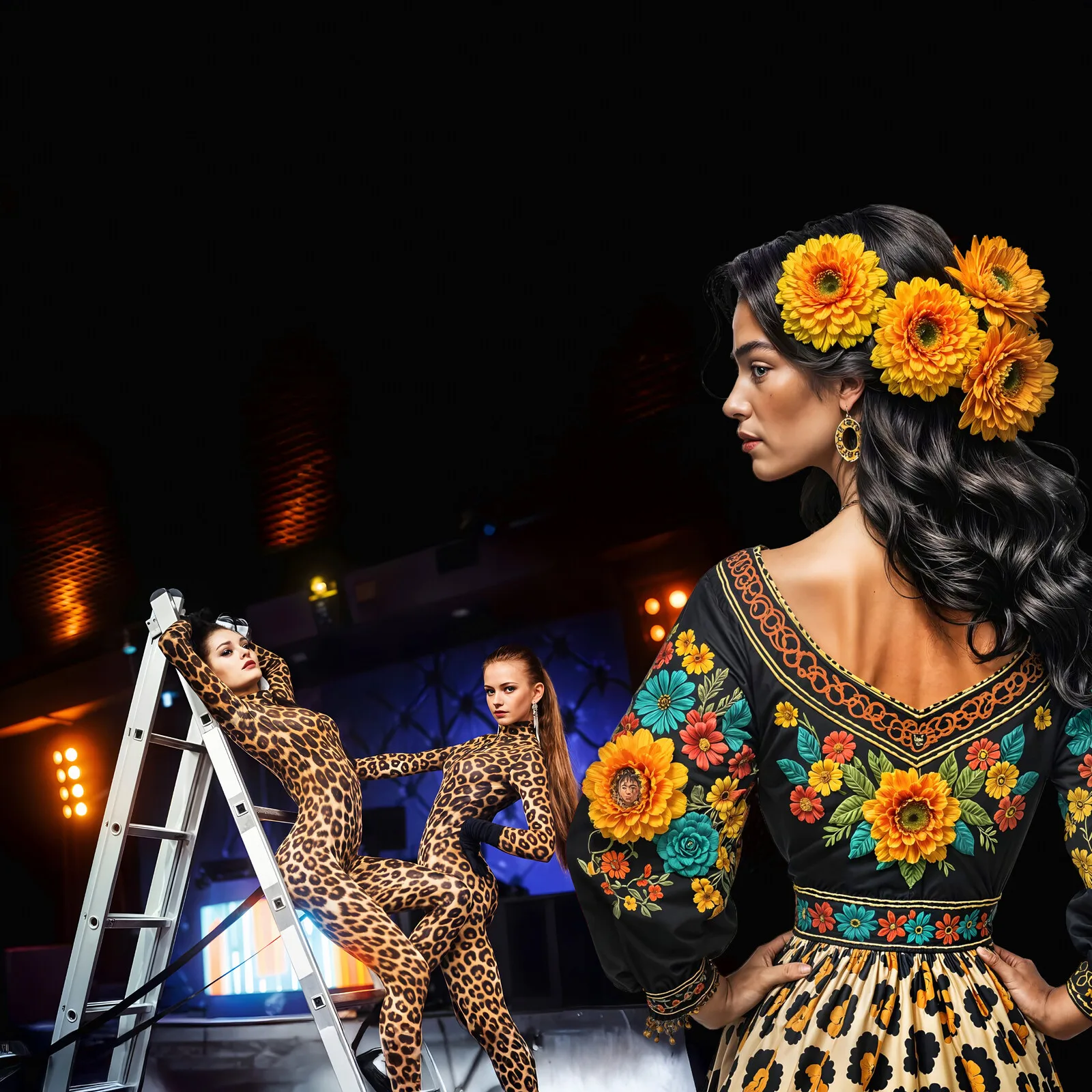
Leopards on the Catwalk, 2025
Digital
80 x 80 cm
3 200 kr
Leopards on the Catwalk
Frida Kahlo, ever the fashion enthusiast, had just emerged from a runway show at Hansa Kompaniet, her eyes gleaming with excitement—not at the so-called *new* trends, but at the familiar echoes of past styles reinvented. “Everything returns,” she mused, “nothing is truly original. Fashion is a cycle, a memory dressed in new fabrics.” Between bites and sips at Mando Steakhouse, the conversation turned effortlessly from haute couture to history, from celestial fashion weeks to earthly runways, from Anna Wintour’s icy reign to the timeless elegance of Diana Vreeland—because in Frida’s world, fashion was never just about clothes. It was about power, transformation, and immortality.
Stay tuned as we delve into the fascinating history of fashion, from ancient civilizations to modern runways, and uncover intriguing gossip about fashion from Eternity.
“The Devil’s Thread, the Timeless Game
From Pharaoh’s linen, pure and white,
To Rome’s deep purple, a conqueror’s right.
Silk from China spun like gold,
Fashioned for emperors, regal and bold.
Venetian lace, a lover’s delight,
Velvet gowns in candlelight.
The Sun King’s court, a gilded stage,
Where opulence marked the fashion age.
Marie’s gowns, a sculpted dream,
Till revolution cut the seam.
Poiret’s drapes, Chanel’s clean line,
Corsets burned to free design.
And there she stands, the Devil’s muse,
Clad in Prada, sharp and shrewd.
A crownless queen with an iron gaze,
Who bends the world to match her ways.
She speaks, they bow, her touch is law,
No thread is too fine, and no hem is too raw.
Yet high above where time won’t fray,
Vreeland laughs in Stardust’s sway.
She weaves with Edna, bold and grand,
A future stitched with silken hands.
And there they wait, their reign secure,
Till Prada’s Devil joins their tour.
But hush—forget the past for now,
The jungle moves; the beasts know-how.
Two figures glide, feline and free,
Leopard-clad in mystery.
They prowl, they purr, they own the night,
A walking roar, a flash of bite.
Not gowns nor lace, nor velvet fine,
But bodies draped in primal sign.
The crowd exhales, a spell is cast,
A moment fierce, too wild to last.
For fashion’s game is never tame,
The Devil smiles—it’s all the same.”
Malmö. January 2025
Leopards on the Catwalk
We had just been to a fashion show at Hansa Kompaniet, and all the new impressions exhilarated Frida—though, according to her, nothing is ever truly ‘new’. Everything is recycled; at some point in history, it was the height of fashion, only to be forgotten and later revived. We sat at Mando Steakhouse because Frida was craving a proper piece of meat.
The runway had seen its fair share of elegant gowns and daring cuts, but nothing had captured the room like the two women in skin-tight, leopard-print bodysuits. Their outfits were a bold statement, a daring challenge to the conventional norms of fashion. They moved with feline grace, sleek and untamed, owning the stage as if they were prowling through a jungle rather than strutting down a catwalk.
“They didn’t just wear those outfits,” Frida mused, twirling her fork. “They became them. Every pose, every step—predatory, confident, electric.” She smirked. “Fashion at its best. Not just fabric, but transformation. A statement. A challenge.”
She sipped her wine and added, “You know, it reminded me of something… Maybe Josephine, maybe Marlene, maybe even me. A woman who knows she’s dangerous.”
Frida leaned back comfortably in her chair, her outfit a perfect blend of bold modernity and traditional elegance. Her pleated skirt swayed with every movement, accentuating her lively gestures, while her top, embroidered with intricate Mexican folkloric patterns, was a clear nod to her heritage. She wore striking red pumps on her feet—sharp, confident, and impossible to ignore. She crossed one leg over the other, her turquoise ring catching the light as she lifted her hand animatedly.
"Fashion," she began with a sly smile, her voice rich with amusement and authority, "has never been just about fabric and thread. It has always been a mirror of power, status, and dreams. And believe me, I have met them all—every great designer across history. On Sirius, the cultural capital of the universe, where the fashion weeks are unlike anything on Earth, I’ve toasted champagne with Rose Bertin, debated cuts with Madeleine Vionnet, and heard Paul Poiret complain that designers today have become far too afraid to take risks." She shook her head, half in amusement, half in exasperation.
"But let’s go back to the beginning—long before Parisian couture houses and haute couture itself. Do you think Nefertiti did her makeup and happened to select a perfectly regal linen gown by chance?" She smirked. "Of course not. She had her own personal designer—a master named Imenet-Ra, who ensured every pleat fell just right, that her blue crown sat flawlessly, and that not a single soul in Egypt could question her divine presence. And Cleopatra? She may have been a strategist and seductress, but even a queen needs a couturier. Neferhotep, a brilliant designer and makeup artist, crafted her tunics in the rarest hues and ensured her kohl-lined eyes were dramatic enough to captivate Julius Caesar and Mark Antony." This is the historical significance of fashion, a testament to its evolution and influence.
She leaned back, her fingers idly toying with the rim of her glass, a bottomless green cocktail that looked like something concocted in a futuristic lounge. "So yes, even the most powerful historical figures needed fashion guidance."
She tilted her head, her brown eyes glinting with mischief. "But did ancient civilisations have anything resembling a catwalk? And when did fashion shows become a structured event?" She thoughtfully tapped her finger against the glass before launching into her next revelation.
"Ancient Egypt," she began, "was where clothing and jewellery were far more than just functional—symbols of power, status, and divine lineage. Fashion was displayed during religious ceremonies, processions, and temple festivals. Pharaohs adorned themselves in lavish garments and crown jewels for public rituals, while priests and priestesses had strictly regulated attire designed to inspire reverence. There was no ‘catwalk’ as we know it, but the people certainly looked on and took inspiration from the elite."
She placed her glass down and leaned forward, eyes alight with enthusiasm. "The Egyptians favoured linen—wool was considered impure and even forbidden in temples. The finest linen was so thin it was nearly transparent, flowing like silk against the skin. The wealthiest and most powerful wore elaborately pleated tunics and dresses, their volume and movement carefully crafted by masterful weavers. Embroideries were used sparingly, but accessories—now, those were a different story! Wide collars of lapis lazuli, turquoise, and carnelian adorned the most powerful, each gemstone symbolising something profound: lapis for protection, turquoise for fertility and luck, and carnelian for vitality."
She gestured broadly as if illustrating the vastness of the topic. "And colour—oh, colour was everything! White symbolised purity and was often worn by priests. Blue and green, derived from minerals like lapis lazuli and malachite, were associated with life and fertility—expensive, of course, and only for the privileged few. Red and gold represented the sun and power, sacred to Ra himself. But the most exclusive colour of all?" She paused, letting the suspense build. "Purple. Extracted from the murex sea snail, it was so rare and costly that only pharaohs and their highest officials could wear even the smallest detail in that shade."
She arched a brow. "We still think royalty wearing purple is a modern idea."
She took a sip of her drink before continuing. "Greece, now, they had a different philosophy. The art of drapery! Rather than meticulously tailored garments, they favoured simple but sophisticated chitons and peplos fastened with fibulae and belts. For example, the wealthiest had access to imported fabrics—silk-blended textiles from Persia. And while Egyptian fashion was dictated by structure and embellishment, Greek fashion was all about how the fabric fell and moved."
She smiled, eyes glinting. "And just like today, the theatre was an early fashion showcase. Greek actors, the influencers of their time, set trends through their costumes. Festivals like the Panathenaia? They were practically impromptu fashion parades, with aristocrats donning their finest textiles for all to admire."
Her smile grew wry. "And then came Rome, where clothing was no longer just about beauty—it became a political tool."
She snapped her fingers. "Romans wore their status like armour. The colour and embroidery of your toga determined your rank. Senators wore white with a purple stripe. The emperor alone could wear the toga picta—deep purple, embroidered in gold. And silk? It was so expensive that the government tried to ban its import from China, fearing it would drain Rome’s gold reserves. Did it stop them? Of course not. They smuggled it in any way."
She laughed and set her glass down with a decisive clink. "And no, they didn’t have catwalks. But their triumphs—victorious generals parading through the streets in gold and purple, surrounded by cheering crowds? That was as much a fashion spectacle as any Dior show."
She leaned back, crossing one leg over the other, her red pumps tapping lightly against the floor. "Fashion shows, as we know them, started in the Renaissance. Venetian masquerades and royal pageants were the first structured public displays of fashion. Men like Jean-Baptiste Martin and Jean-Baptiste Binet designed for kings in the French courts, ensuring that every stitch signified power and prestige."
Her expression grew more animated. "But real fashion designers? That didn’t happen until the 18th and 19th centuries. Not in the way you know it. Rose Bertin, Marie Antoinette’s ‘Minister of Fashion,’ made couture a statement. But Charles Frederick Worth revolutionised everything—he was the first to put his name on garments, creating the first true ‘designer brand.’ By the 20th century, Paul Poiret had freed women from corsets, and Coco Chanel had made elegance effortless."
She lifted her hands in a dramatic flourish. "And the catwalk? It evolved from small mannequin parades in Parisian salons to full-blown productions in the 1920s. By the 1950s, fashion weeks were an institution. And then, of course, the Americans had to do things differently. They called it a runway—evoking speed and spectacle—while the Europeans kept the more graceful, feline term catwalk."
She leaned toward me, eyes twinkling with mischief. "Have you ever wondered if we have fashion weeks here in eternity?" She laughed. "Oh, we do. On Sirius, we walk the runway with the best of them. Imagine Cleopatra, Marie Antoinette, and Chanel sitting in the front row, arguing whether corsets should return. You should come. I think you'd enjoy it."
She raised her glass in a toast, eyes sparkling. "To fashion, to power, and to never being forgotten.
Me: “Why ‘Catwalk’ and ‘Runway’?”
Frida: “The linguistic divide between "catwalk" and "runway" is an intriguing reflection of Anglo-American cultural differences. The British term "catwalk" evokes an image of sleek elegance, a feline gracefulness that aligns perfectly with how models are expected to glide down the stage. It suggests an organic, instinctive movement, like a cat carefully navigating its surroundings—poised, effortless, and self-assured.
On the other hand, the American "runway" carries connotations of propulsion, takeoff, and velocity. It suggests that a model is not just walking but launching, taking off toward stardom, or racing toward the next phase of their career. In the American ethos, where speed and ambition are central themes, "runway" fits the grand narrative of aspiration and upward mobility. It’s not just about fashion—it’s about getting somewhere fast.
Both terms imply a performance: a controlled, choreographed movement down a narrow path, whether a model's strut or a jet's acceleration. However, whereas "catwalk" suggests an innate, natural command of space, "runway" suggests an engineered, dynamic force. The British see a high-fashion moment as a display of effortless artistry, while the Americans see it as a launchpad to success.
This linguistic divergence is also reflected in how fashion is documented and celebrated. Catwalk, the 1993 documentary by Robert Leacock, immerses the audience in the world of haute couture through a black-and-white cinéma vérité lens. Featuring top designers like John Galliano, Karl Lagerfeld, and Gianni Versace, the film captures the artistry and chaos behind the scenes, presenting fashion as both a craft and a performance. Using both black-and-white and colour cinematography enhances the contrast between the glamour on stage and the grittier reality behind it.
The film was after my time on Earth, but I’ve seen it on our universal television network—ten thousand channels to choose from! Every era, every epoch, every culture must have its own. Don’t forget that up there, we all learn from and influence one another, especially women who always want to be beautiful.
Don’t think for a second that Neanderthals still wander around in musty fur and stiff leather garments or that Viking women wear coarse woven dresses on their star—unless they want to. Fashion in eternity is about choice, about self-expression without limits. My wardrobe, for example, is a marvellous mix of Renaissance gowns and the delightful short dresses of the roaring 1920s. This freedom of choice and self-expression in fashion is genuinely empowering.
But naturally, since I am who I am, most of what I wear reflects the iconic style I was known for on Earth. The vibrant Tehuana dresses, embroidered in bold colours and intricate floral motifs, are still a staple of my wardrobe. My huipiles, woven with the finest craftsmanship, symbolise my heritage and defiance. My long skirts, adorned with rich textures and layered fabrics, move with a weight of history yet dance with a lightness of spirit. The beauty and elegance of these garments are truly inspiring.
And the accessories! My oversized filigree and gold earrings caught the light like miniature suns—my chunky rings—turquoise, coral, onyx, each carrying a story. My rebozos were delicately fringed, some wrapped elegantly around my shoulders, others tossed casually like an afterthought but always part of my signature. And shoes—oh, my shoes! Red leather boots that lace up to the mid-calf, velvet slippers embroidered with golden thread, and sandals with intricate beadwork, all designed to carry me confidently, whether across a sun-drenched plaza or the pathways of a celestial garden.
I asked her about her flowers, and she smiled. "Of course, I have a garden," she said. "And it's not just any garden—Carl Linnaeus helped me design it. Every plant thrives as it should, and naturally, there isn’t a single variety of marigolds missing." The cultural significance of these marigolds in Frida's garden is genuinely intriguing and worth exploring.
Frida: “The documentary aligns more with the European concept of fashion—intimate, artistic, a study in movement and presence. The British title Catwalk feels fitting for a film that treats modelling as an art form rather than a mere career stepping stone. Had it been made with an American sensibility, perhaps it would have been called Runway: The Making of a Supermodel, emphasising ambition and success rather than aesthetics and elegance.
Whether it’s a catwalk or a runway, both define a space where beauty, performance, and commerce intersect. The difference lies in how the cultures perceive movement—one as a graceful stroll, the other as an unstoppable ascent.
Here's Frida's take on ‘The Devil Wears Prada’, fashion journalism, and the celestial version of ‘Vogue’:
---
Frida leaned back in her chair, tapping a lacquered fingernail against the rim of her glass. She looked impossibly elegant, as always—a flowing crimson skirt, a fitted embroidered blouse bursting with colour, and a pair of stunning cobalt-blue heels that matched the lapis lazuli in her earrings. Marigolds, bright as the sun, were woven into her dark braids. She adjusted one, smiling slyly.
"You know, ‘The Devil Wears Prada’ came after my time on Earth, but of course, I’ve seen it. We have a universal television network among the stars—ten thousand channels catering to a different era and culture. Every fashion moment, iconic look, and scandalous runway show is archived in eternity. Because fashion never really dies, does it? It just reinvents itself.”
She took a slow sip of her drink before continuing.
“Now, I may not have met Anna Wintour—for obvious reasons, given that she’s still alive on Earth—but her reputation precedes her, even here. The ‘Vogue’ editors here talk about her in hushed tones, as if preparing for some great celestial storm. Diana Vreeland, my dear friend and our current editor-in-chief of ‘The Celestial Vogue’, is particularly concerned. She and Edna Woolman Chase share the position—editorial power is collective here, unlike on Earth, where fashion’s monarchy reigns supreme. But even they, two of the most formidable women in fashion history, shiver at the thought of Wintour’s inevitable arrival."
Frida leaned in conspiratorially. “You see, Diana is a visionary. She was eccentric, theatrical, and obsessed with beauty in a way larger than life. ‘Elegance is refusal’, she used to say, and she meant it. She curated fashion like an artist composes a painting. She adored excess, not for excess’s sake, but for the poetry in it.”
She waved a hand dramatically, mimicking Diana’s signature flamboyance. “And then, you have Anna. Pragmatic, strategic, cold as a well-tailored glacier. Diana saw fashion as art, and Anna saw fashion as power. She is an enigma of efficiency and precision, the perfect blunt bob, the omnipresent sunglasses. Diana dreamed in colour; Anna calculates in neutrals."
Frida chuckled. “Imagine Diana—always in her signature red, always speaking in grand pronouncements—sharing a desk with Anna, whose entire demeanour screams 'No nonsense. Get to the point.' It’s no wonder Diana and Edna are nervous.”
She twirled the stem of her glass between her fingers, eyes gleaming with amusement. "Edna, bless her, is old-school. She built ‘Vogue’ into the empire, and it became long before Anna arrived. She saw fashion as a code of conduct—strict, disciplined, perfectly tailored. There is no room for improvisation, only mastery. She and Diana balance each other out and have curated ‘The Celestial Vogue’ into something spectacular."
Me: “What will happen when the Devil arrives?”
Frida leaned back with a wicked smile. "But when Anna finally joins us? Dios mío. The ice queen meets the dreamers. Will she bend? Will she adapt? Or will she take over?"
She shrugged playfully, adjusting the marigold in her hair. "One thing is certain—she won’t bring her assistants to fetch her coffee. And no one, not even Anna Wintour, dictates what ‘I’ wear."
She raised her glass in a toast. "To fashion, power, and the eternal drama of style."
Jörgen Thornberg
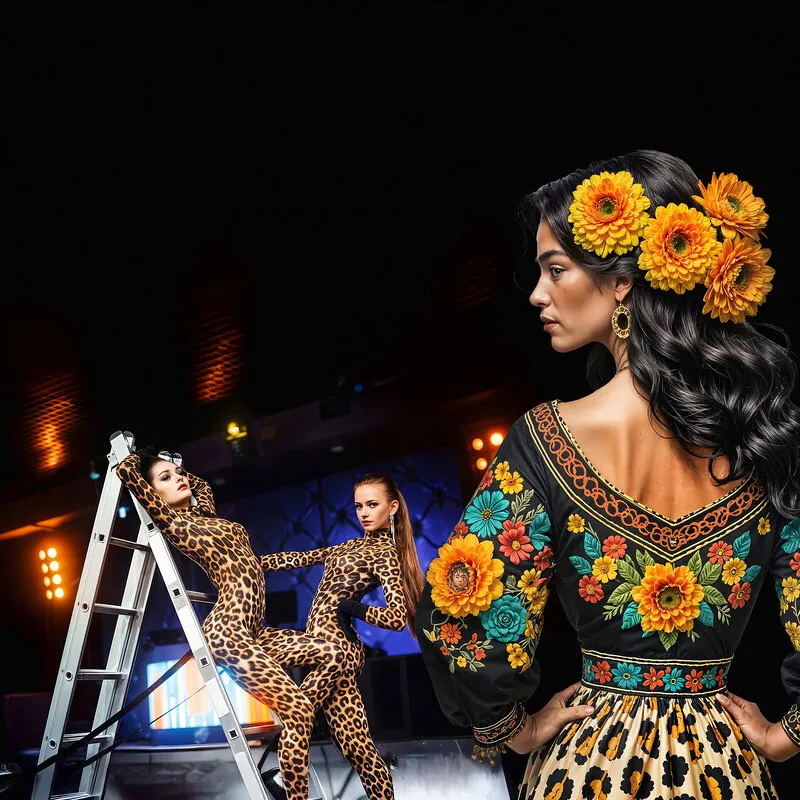
Leopards on the Catwalk, 2025
Digital
80 x 80 cm
3 200 kr
Leopards on the Catwalk
Frida Kahlo, ever the fashion enthusiast, had just emerged from a runway show at Hansa Kompaniet, her eyes gleaming with excitement—not at the so-called *new* trends, but at the familiar echoes of past styles reinvented. “Everything returns,” she mused, “nothing is truly original. Fashion is a cycle, a memory dressed in new fabrics.” Between bites and sips at Mando Steakhouse, the conversation turned effortlessly from haute couture to history, from celestial fashion weeks to earthly runways, from Anna Wintour’s icy reign to the timeless elegance of Diana Vreeland—because in Frida’s world, fashion was never just about clothes. It was about power, transformation, and immortality.
Stay tuned as we delve into the fascinating history of fashion, from ancient civilizations to modern runways, and uncover intriguing gossip about fashion from Eternity.
“The Devil’s Thread, the Timeless Game
From Pharaoh’s linen, pure and white,
To Rome’s deep purple, a conqueror’s right.
Silk from China spun like gold,
Fashioned for emperors, regal and bold.
Venetian lace, a lover’s delight,
Velvet gowns in candlelight.
The Sun King’s court, a gilded stage,
Where opulence marked the fashion age.
Marie’s gowns, a sculpted dream,
Till revolution cut the seam.
Poiret’s drapes, Chanel’s clean line,
Corsets burned to free design.
And there she stands, the Devil’s muse,
Clad in Prada, sharp and shrewd.
A crownless queen with an iron gaze,
Who bends the world to match her ways.
She speaks, they bow, her touch is law,
No thread is too fine, and no hem is too raw.
Yet high above where time won’t fray,
Vreeland laughs in Stardust’s sway.
She weaves with Edna, bold and grand,
A future stitched with silken hands.
And there they wait, their reign secure,
Till Prada’s Devil joins their tour.
But hush—forget the past for now,
The jungle moves; the beasts know-how.
Two figures glide, feline and free,
Leopard-clad in mystery.
They prowl, they purr, they own the night,
A walking roar, a flash of bite.
Not gowns nor lace, nor velvet fine,
But bodies draped in primal sign.
The crowd exhales, a spell is cast,
A moment fierce, too wild to last.
For fashion’s game is never tame,
The Devil smiles—it’s all the same.”
Malmö. January 2025
Leopards on the Catwalk
We had just been to a fashion show at Hansa Kompaniet, and all the new impressions exhilarated Frida—though, according to her, nothing is ever truly ‘new’. Everything is recycled; at some point in history, it was the height of fashion, only to be forgotten and later revived. We sat at Mando Steakhouse because Frida was craving a proper piece of meat.
The runway had seen its fair share of elegant gowns and daring cuts, but nothing had captured the room like the two women in skin-tight, leopard-print bodysuits. Their outfits were a bold statement, a daring challenge to the conventional norms of fashion. They moved with feline grace, sleek and untamed, owning the stage as if they were prowling through a jungle rather than strutting down a catwalk.
“They didn’t just wear those outfits,” Frida mused, twirling her fork. “They became them. Every pose, every step—predatory, confident, electric.” She smirked. “Fashion at its best. Not just fabric, but transformation. A statement. A challenge.”
She sipped her wine and added, “You know, it reminded me of something… Maybe Josephine, maybe Marlene, maybe even me. A woman who knows she’s dangerous.”
Frida leaned back comfortably in her chair, her outfit a perfect blend of bold modernity and traditional elegance. Her pleated skirt swayed with every movement, accentuating her lively gestures, while her top, embroidered with intricate Mexican folkloric patterns, was a clear nod to her heritage. She wore striking red pumps on her feet—sharp, confident, and impossible to ignore. She crossed one leg over the other, her turquoise ring catching the light as she lifted her hand animatedly.
"Fashion," she began with a sly smile, her voice rich with amusement and authority, "has never been just about fabric and thread. It has always been a mirror of power, status, and dreams. And believe me, I have met them all—every great designer across history. On Sirius, the cultural capital of the universe, where the fashion weeks are unlike anything on Earth, I’ve toasted champagne with Rose Bertin, debated cuts with Madeleine Vionnet, and heard Paul Poiret complain that designers today have become far too afraid to take risks." She shook her head, half in amusement, half in exasperation.
"But let’s go back to the beginning—long before Parisian couture houses and haute couture itself. Do you think Nefertiti did her makeup and happened to select a perfectly regal linen gown by chance?" She smirked. "Of course not. She had her own personal designer—a master named Imenet-Ra, who ensured every pleat fell just right, that her blue crown sat flawlessly, and that not a single soul in Egypt could question her divine presence. And Cleopatra? She may have been a strategist and seductress, but even a queen needs a couturier. Neferhotep, a brilliant designer and makeup artist, crafted her tunics in the rarest hues and ensured her kohl-lined eyes were dramatic enough to captivate Julius Caesar and Mark Antony." This is the historical significance of fashion, a testament to its evolution and influence.
She leaned back, her fingers idly toying with the rim of her glass, a bottomless green cocktail that looked like something concocted in a futuristic lounge. "So yes, even the most powerful historical figures needed fashion guidance."
She tilted her head, her brown eyes glinting with mischief. "But did ancient civilisations have anything resembling a catwalk? And when did fashion shows become a structured event?" She thoughtfully tapped her finger against the glass before launching into her next revelation.
"Ancient Egypt," she began, "was where clothing and jewellery were far more than just functional—symbols of power, status, and divine lineage. Fashion was displayed during religious ceremonies, processions, and temple festivals. Pharaohs adorned themselves in lavish garments and crown jewels for public rituals, while priests and priestesses had strictly regulated attire designed to inspire reverence. There was no ‘catwalk’ as we know it, but the people certainly looked on and took inspiration from the elite."
She placed her glass down and leaned forward, eyes alight with enthusiasm. "The Egyptians favoured linen—wool was considered impure and even forbidden in temples. The finest linen was so thin it was nearly transparent, flowing like silk against the skin. The wealthiest and most powerful wore elaborately pleated tunics and dresses, their volume and movement carefully crafted by masterful weavers. Embroideries were used sparingly, but accessories—now, those were a different story! Wide collars of lapis lazuli, turquoise, and carnelian adorned the most powerful, each gemstone symbolising something profound: lapis for protection, turquoise for fertility and luck, and carnelian for vitality."
She gestured broadly as if illustrating the vastness of the topic. "And colour—oh, colour was everything! White symbolised purity and was often worn by priests. Blue and green, derived from minerals like lapis lazuli and malachite, were associated with life and fertility—expensive, of course, and only for the privileged few. Red and gold represented the sun and power, sacred to Ra himself. But the most exclusive colour of all?" She paused, letting the suspense build. "Purple. Extracted from the murex sea snail, it was so rare and costly that only pharaohs and their highest officials could wear even the smallest detail in that shade."
She arched a brow. "We still think royalty wearing purple is a modern idea."
She took a sip of her drink before continuing. "Greece, now, they had a different philosophy. The art of drapery! Rather than meticulously tailored garments, they favoured simple but sophisticated chitons and peplos fastened with fibulae and belts. For example, the wealthiest had access to imported fabrics—silk-blended textiles from Persia. And while Egyptian fashion was dictated by structure and embellishment, Greek fashion was all about how the fabric fell and moved."
She smiled, eyes glinting. "And just like today, the theatre was an early fashion showcase. Greek actors, the influencers of their time, set trends through their costumes. Festivals like the Panathenaia? They were practically impromptu fashion parades, with aristocrats donning their finest textiles for all to admire."
Her smile grew wry. "And then came Rome, where clothing was no longer just about beauty—it became a political tool."
She snapped her fingers. "Romans wore their status like armour. The colour and embroidery of your toga determined your rank. Senators wore white with a purple stripe. The emperor alone could wear the toga picta—deep purple, embroidered in gold. And silk? It was so expensive that the government tried to ban its import from China, fearing it would drain Rome’s gold reserves. Did it stop them? Of course not. They smuggled it in any way."
She laughed and set her glass down with a decisive clink. "And no, they didn’t have catwalks. But their triumphs—victorious generals parading through the streets in gold and purple, surrounded by cheering crowds? That was as much a fashion spectacle as any Dior show."
She leaned back, crossing one leg over the other, her red pumps tapping lightly against the floor. "Fashion shows, as we know them, started in the Renaissance. Venetian masquerades and royal pageants were the first structured public displays of fashion. Men like Jean-Baptiste Martin and Jean-Baptiste Binet designed for kings in the French courts, ensuring that every stitch signified power and prestige."
Her expression grew more animated. "But real fashion designers? That didn’t happen until the 18th and 19th centuries. Not in the way you know it. Rose Bertin, Marie Antoinette’s ‘Minister of Fashion,’ made couture a statement. But Charles Frederick Worth revolutionised everything—he was the first to put his name on garments, creating the first true ‘designer brand.’ By the 20th century, Paul Poiret had freed women from corsets, and Coco Chanel had made elegance effortless."
She lifted her hands in a dramatic flourish. "And the catwalk? It evolved from small mannequin parades in Parisian salons to full-blown productions in the 1920s. By the 1950s, fashion weeks were an institution. And then, of course, the Americans had to do things differently. They called it a runway—evoking speed and spectacle—while the Europeans kept the more graceful, feline term catwalk."
She leaned toward me, eyes twinkling with mischief. "Have you ever wondered if we have fashion weeks here in eternity?" She laughed. "Oh, we do. On Sirius, we walk the runway with the best of them. Imagine Cleopatra, Marie Antoinette, and Chanel sitting in the front row, arguing whether corsets should return. You should come. I think you'd enjoy it."
She raised her glass in a toast, eyes sparkling. "To fashion, to power, and to never being forgotten.
Me: “Why ‘Catwalk’ and ‘Runway’?”
Frida: “The linguistic divide between "catwalk" and "runway" is an intriguing reflection of Anglo-American cultural differences. The British term "catwalk" evokes an image of sleek elegance, a feline gracefulness that aligns perfectly with how models are expected to glide down the stage. It suggests an organic, instinctive movement, like a cat carefully navigating its surroundings—poised, effortless, and self-assured.
On the other hand, the American "runway" carries connotations of propulsion, takeoff, and velocity. It suggests that a model is not just walking but launching, taking off toward stardom, or racing toward the next phase of their career. In the American ethos, where speed and ambition are central themes, "runway" fits the grand narrative of aspiration and upward mobility. It’s not just about fashion—it’s about getting somewhere fast.
Both terms imply a performance: a controlled, choreographed movement down a narrow path, whether a model's strut or a jet's acceleration. However, whereas "catwalk" suggests an innate, natural command of space, "runway" suggests an engineered, dynamic force. The British see a high-fashion moment as a display of effortless artistry, while the Americans see it as a launchpad to success.
This linguistic divergence is also reflected in how fashion is documented and celebrated. Catwalk, the 1993 documentary by Robert Leacock, immerses the audience in the world of haute couture through a black-and-white cinéma vérité lens. Featuring top designers like John Galliano, Karl Lagerfeld, and Gianni Versace, the film captures the artistry and chaos behind the scenes, presenting fashion as both a craft and a performance. Using both black-and-white and colour cinematography enhances the contrast between the glamour on stage and the grittier reality behind it.
The film was after my time on Earth, but I’ve seen it on our universal television network—ten thousand channels to choose from! Every era, every epoch, every culture must have its own. Don’t forget that up there, we all learn from and influence one another, especially women who always want to be beautiful.
Don’t think for a second that Neanderthals still wander around in musty fur and stiff leather garments or that Viking women wear coarse woven dresses on their star—unless they want to. Fashion in eternity is about choice, about self-expression without limits. My wardrobe, for example, is a marvellous mix of Renaissance gowns and the delightful short dresses of the roaring 1920s. This freedom of choice and self-expression in fashion is genuinely empowering.
But naturally, since I am who I am, most of what I wear reflects the iconic style I was known for on Earth. The vibrant Tehuana dresses, embroidered in bold colours and intricate floral motifs, are still a staple of my wardrobe. My huipiles, woven with the finest craftsmanship, symbolise my heritage and defiance. My long skirts, adorned with rich textures and layered fabrics, move with a weight of history yet dance with a lightness of spirit. The beauty and elegance of these garments are truly inspiring.
And the accessories! My oversized filigree and gold earrings caught the light like miniature suns—my chunky rings—turquoise, coral, onyx, each carrying a story. My rebozos were delicately fringed, some wrapped elegantly around my shoulders, others tossed casually like an afterthought but always part of my signature. And shoes—oh, my shoes! Red leather boots that lace up to the mid-calf, velvet slippers embroidered with golden thread, and sandals with intricate beadwork, all designed to carry me confidently, whether across a sun-drenched plaza or the pathways of a celestial garden.
I asked her about her flowers, and she smiled. "Of course, I have a garden," she said. "And it's not just any garden—Carl Linnaeus helped me design it. Every plant thrives as it should, and naturally, there isn’t a single variety of marigolds missing." The cultural significance of these marigolds in Frida's garden is genuinely intriguing and worth exploring.
Frida: “The documentary aligns more with the European concept of fashion—intimate, artistic, a study in movement and presence. The British title Catwalk feels fitting for a film that treats modelling as an art form rather than a mere career stepping stone. Had it been made with an American sensibility, perhaps it would have been called Runway: The Making of a Supermodel, emphasising ambition and success rather than aesthetics and elegance.
Whether it’s a catwalk or a runway, both define a space where beauty, performance, and commerce intersect. The difference lies in how the cultures perceive movement—one as a graceful stroll, the other as an unstoppable ascent.
Here's Frida's take on ‘The Devil Wears Prada’, fashion journalism, and the celestial version of ‘Vogue’:
---
Frida leaned back in her chair, tapping a lacquered fingernail against the rim of her glass. She looked impossibly elegant, as always—a flowing crimson skirt, a fitted embroidered blouse bursting with colour, and a pair of stunning cobalt-blue heels that matched the lapis lazuli in her earrings. Marigolds, bright as the sun, were woven into her dark braids. She adjusted one, smiling slyly.
"You know, ‘The Devil Wears Prada’ came after my time on Earth, but of course, I’ve seen it. We have a universal television network among the stars—ten thousand channels catering to a different era and culture. Every fashion moment, iconic look, and scandalous runway show is archived in eternity. Because fashion never really dies, does it? It just reinvents itself.”
She took a slow sip of her drink before continuing.
“Now, I may not have met Anna Wintour—for obvious reasons, given that she’s still alive on Earth—but her reputation precedes her, even here. The ‘Vogue’ editors here talk about her in hushed tones, as if preparing for some great celestial storm. Diana Vreeland, my dear friend and our current editor-in-chief of ‘The Celestial Vogue’, is particularly concerned. She and Edna Woolman Chase share the position—editorial power is collective here, unlike on Earth, where fashion’s monarchy reigns supreme. But even they, two of the most formidable women in fashion history, shiver at the thought of Wintour’s inevitable arrival."
Frida leaned in conspiratorially. “You see, Diana is a visionary. She was eccentric, theatrical, and obsessed with beauty in a way larger than life. ‘Elegance is refusal’, she used to say, and she meant it. She curated fashion like an artist composes a painting. She adored excess, not for excess’s sake, but for the poetry in it.”
She waved a hand dramatically, mimicking Diana’s signature flamboyance. “And then, you have Anna. Pragmatic, strategic, cold as a well-tailored glacier. Diana saw fashion as art, and Anna saw fashion as power. She is an enigma of efficiency and precision, the perfect blunt bob, the omnipresent sunglasses. Diana dreamed in colour; Anna calculates in neutrals."
Frida chuckled. “Imagine Diana—always in her signature red, always speaking in grand pronouncements—sharing a desk with Anna, whose entire demeanour screams 'No nonsense. Get to the point.' It’s no wonder Diana and Edna are nervous.”
She twirled the stem of her glass between her fingers, eyes gleaming with amusement. "Edna, bless her, is old-school. She built ‘Vogue’ into the empire, and it became long before Anna arrived. She saw fashion as a code of conduct—strict, disciplined, perfectly tailored. There is no room for improvisation, only mastery. She and Diana balance each other out and have curated ‘The Celestial Vogue’ into something spectacular."
Me: “What will happen when the Devil arrives?”
Frida leaned back with a wicked smile. "But when Anna finally joins us? Dios mío. The ice queen meets the dreamers. Will she bend? Will she adapt? Or will she take over?"
She shrugged playfully, adjusting the marigold in her hair. "One thing is certain—she won’t bring her assistants to fetch her coffee. And no one, not even Anna Wintour, dictates what ‘I’ wear."
She raised her glass in a toast. "To fashion, power, and the eternal drama of style."
3 200 kr

Jörgen Thornberg
Malmö
Lite om bilder och mig. Translation in English at the end.
Jag är en nyfiken person som ser allt i bilder, även det jag fäster i ord, gärna tillsammans för bakom alla mina bilder finns en berättelse. Till vissa bilder hör en kortare eller längre novell som följer med bilden.
Bilder berättar historier. Jag omges av naturlig skönhet, intressanta människor och historia var jag än går. Jag använder min kamera för att dokumentera världen och blanda det jag ser med vad jag känner för att fånga den dolda magin.
Mina bilder berättar mina historier. Genom mina bilder, tryck och berättelser. Jag bjuder in dig att ta del av dessa berättelser, in i ditt liv och hem och dela min mycket personliga syn på vår värld. Mer än vad ögat ser. Jag tänker i bilder, drömmer och skriver och pratar om dem; följaktligen måste jag också skapa bilder. De blir vad jag ser, inte nödvändigtvis begränsade till verkligheten. Det finns en bild runt varje hörn. Jag hoppas att du kommer att se vad jag såg och gilla det.
Jag är också en skrivande person och till många bilder hör en kortare eller längre essay. Den följer med tavlan, tryckt på fint papper och med en personlig hälsning från mig.
Flertalet bilder startar sin resa i min kamera. Enkelt förklarat beskriver jag bilden jag ser i mitt inre, upplevd eller fantiserad. Bilden uppstår inom mig redan innan jag fått okularet till ögat. På bråkdelen av ett ögonblick ser jag vad jag vill ha och vad som kan göras med bilden. Här skall jag stoppa in en giraff, stålmannen, Titanic eller vad det är min fantasi finner ut. Ännu märkligare är att jag kommer ihåg minnesbilden långt efteråt när det blir tid att skapa verket. Om jag lyckas eller inte, är upp till betraktaren, oftast präglat av en stråk av svart humor – meningen är att man skall bli underhållen. Mina bilder blir ofta en snackis där de hänger.
Jag föredrar bilder som förmedlar ett budskap i flera lager. Vid första anblicken fylld av feel-good, en vacker utsikt, fint väder, solen skiner, blommor på ängen eller vattnet som ligger förrädiskt spegelblankt. I en sådan bild kan jag gömma min egentliga berättelse, mitt förakt för förtryckare och våldsverkare, rasister och fördomsfulla människor - ett gärna återkommande motiv mer eller mindre dolt i det vackra motivet. Jag försöker förena dem i ett gemensamt narrativ.
Bild och formgivning har löpt som en röd tråd genom livet. Fotokonst känns som en värdig final som jag gärna delar med mig.
Min genre är vid som framgår av mina bilder, temat en blandning av pop- och gatukonst i kollage som kan bestå av hundratals lager. Vissa bilder kan ta veckor, andra någon dag innan det är dags att överlämna resultatet till printverkstaden. Fine Art Prints är digitala fotocollage. I dessa kollage sker rivandet, klippandet, pusslandet, målandet, ritandet och sprayningen digitalt. Det jag monterar in kan vara hundratals år gamla bilder som jag omsorgsfullt frilägger så att de ser ut att vara en del av tavlan men också bilder skapade av mig själv efter min egen fantasi. Därefter besöks printstudion och för vissa bilder numrera en limiterad upplaga (oftast 7 exemplar) och signera för hand. Vissa bilder kan köpas i olika format. Det är bara att fråga efter vilka. Gillar man en bild som är 70x100 men inte har plats på väggen, går den kanske att få i 50x70 cm istället. Frågan är fri.
Metoden Giclée eller Fine Art Print som det också kallas är det moderna sättet för framställning av grafisk konst. Villkoret för denna typ av utskrifter är att en högkvalitativ storformatskrivare används med åldersbeständigt färgpigment och konstnärspapper eller i förekommande fall på duk. Pappret som används möter de krav på livslängd som ställs av museer och gallerier. Normalt säljer jag mina bilder oinramade så att den nya ägaren själv kan bestämma hur de skall se ut, med eller utan passepartout färg på ram, med eller utan glas etc..
Under många år ställde jag bara ut på nätet, i valda grupper och på min egen Facebooksida - https://www.facebook.com/jorgen.thornberg.9
Jag finns också på en egen hemsida som tyvärr inte alltid är uppdaterad – https://www.jth.life/ Där kan du också läsa en del av de berättelser som följer med bilden.
UTSTÄLLNINGAR
Luftkastellet, oktober 2022
Konst i Lund, november 2022
Luftkastellet, mars 2023
Engleson Galleri Caroli, april 2023
Hydra, Greece June 2023
Engleson Galleri Caroli, oktober 2023
Toppen, Höllviken december 2023
Luftkastellet, mars 2024
Torups Galleri, mars 2024
Venice, May 2024
Luftkastellet, oktober 2024
Konst i Advent, December 2024
Galleri Engleson, Caroli December 2024
Jäger & Jansson Galleri, april 2025
A bit about pictures and me.
I'm a curious person who sees everything in pictures, even what I express in words, often combining them, for behind all my pictures lies a story. These narratives, some as short as a single image and others as long as a novel, are the heart and soul of my work.
Pictures tell stories. Wherever I go, I'm surrounded by natural beauty, exciting people, and history. I use my camera to document the world and blend what I see with what I feel to capture the hidden magic.
My images tell my stories. Through my pictures, prints, and narratives, I invite you to partake in these stories in your life and home and share my deeply personal perspective of our world. More than meets the eye. I think in pictures, dream, write, and talk about them; consequently, I must create images too. They become what I see, not necessarily confined to reality. There's a picture around every corner. I hope you'll see what I saw and enjoy it.
I'm also a writer, and many images come with a shorter or longer essay. It accompanies the painting, printed on fine paper with my personal greeting.
Many pictures start their journey on my camera. Simply put, I describe the image I see in my mind, experienced or imagined. The image arises within me even before I bring the eyepiece to my eye. In a fraction of a moment, I see what I want and what can be done with the picture. Here, I'll insert a giraffe, Superman, the Titanic, or whatever my imagination conjures up. Even stranger is that I remember the mental image long after it's time to create the work. Whether I succeed is up to the observer, often imbued with a streak of black humour – the aim is to entertain. My pictures usually become a talking point wherever they hang.
I prefer pictures that convey a message in multiple layers. At first glance, they're filled with feel-good vibes, a beautiful view, lovely weather, the sun shining, flowers in the meadow, or the water lying deceptively calm. But beneath this surface beauty, I often conceal a deeper story, a narrative that challenges societal norms or explores the human condition. I invite you to delve into these hidden narratives and discover the layers of meaning within my work.
Picture and design have been a thread running through my life. Photographic art feels like a fitting finale, and I'm happy to share it.
My genre is varied, as seen in my pictures; the theme is a blend of pop and street art in collages that can consist of hundreds of layers. Some images can take weeks, others just a day before it's time to hand over the result to the print workshop. Fine Art Prints are digital photo collages. In these collages, tearing, cutting, puzzling, painting, drawing, and spraying happen digitally. What I insert can be images hundreds of years old that I carefully extract so they appear to be part of the painting, but also images created by myself, now also generated from my imagination. Next, visit the print studio and, for certain images, number a limited edition (usually 7 copies) and sign them by hand. Some images may be available in other formats. Just ask which ones. If you like an image that's 70x100 but doesn't have space on the wall, you might be able to get it in 50x70 cm instead. The question is open.
The Giclée method, or Fine Art Print as it's also called, is the modern way of producing graphic art. This method ensures the highest quality and longevity of the artwork, using a high-quality large-format printer with archival pigment inks and artist paper or, in some cases, canvas. The paper used meets the longevity requirements set by museums and galleries. I sell my pictures unframed, allowing the new owner to personalise their artwork, confident in the lasting value and quality of the piece.
For many years, I only exhibited online, in selected groups, and on my Facebook page - https://www.facebook.com/jorgen.thornberg.9. I also have my website, which unfortunately is not constantly updated - https://www.jth.life/. You can also read some of the stories accompanying the pictures there.
EXHIBITIONS
Luftkastellet, October 2022
Art in Lund, November 2022
Luftkastellet, March 2023
Engleson Gallery Caroli, April 2023
Hydra, Greece June 2023
Engleson Gallery Caroli, October 2023
Toppen, Höllviken December 2023
Luftkastellet, March 2024
Torup Gallery, March 2024
Venice, May 2024
UTSTÄLLNINGAR
Luftkastellet, oktober 2022
Konst i Lund, november 2022
Luftkastellet, mars 2023
Engleson Galleri Caroli, april 2023
Hydra, Greece June 2023
Engleson Galleri Caroli, oktober 2023
Toppen, Höllviken december 2023
Luftkastellet, mars 2024
Torups Galleri, mars 2024
Venice, May 2024
Luftkastellet, October 2024
Konst i Advent, December 2024
Galleri Engleson, Caroli December 2024
Jäger & Jansson Galleri, April 2025
Utbildning
Autodidakt
Medlem i konstnärsförening
Öppna Sinnen
Med i konstrunda
Konstrundan i Skåne
Utställningar
Luftkastellet, October 2022
Art in Lund, November 2022
Luftkastellet, March 2023
Engleson Gallery Caroli, April 2023
Hydra, Greece June 2023
Engleson Gallery Caroli, October 2023
Toppen, Höllviken December 2023
Luftkastellet, March 2024
Torup Gallery, March 2024
Venice, May 2024