Vi använder cookies för att ge dig bästa möjliga upplevelse. Välj vilka cookies du tillåter.
Läs mer i vår integritetspolicy
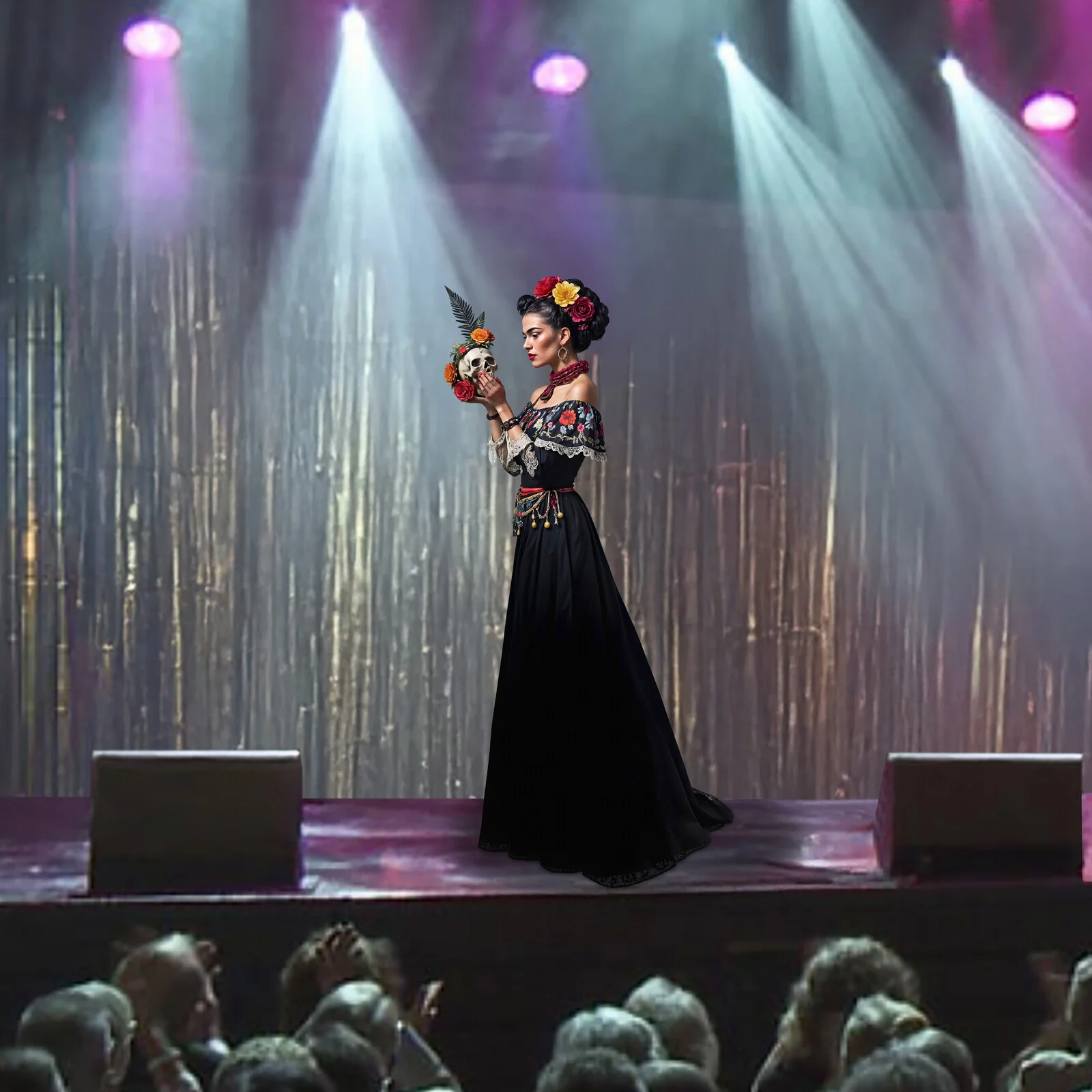
Jörgen Thornberg
To Be or Not to Be, 2024
Digital
80 x 80 cm
4 500 kr
To Be or Not to Be
“To Be
Upon the stage, her crown of pain,
A wreath of flowers, bright yet stained.
Frida steps where Hamlet trod,
To question life, to challenge God.
"To be," she whispers, fierce and raw,
Defying death, it's silent maw.
Her painted skull, her vibrant art,
Holds Yorick’s gaze, a beating heart.
Not paralysed by doubt like he,
She wields her grief as destiny.
While Hamlet mourns and stands alone,
Frida paints her broken throne.
Diego’s shadow, Claudius’ face,
Betrays her love, yet leaves a trace.
Of Ophelia’s sorrow, she won’t partake,
Instead, she rises for art’s own sake.
The skull she cradles speaks of life,
Of death adorned, not just of strife.
In every stroke, her colours sing,
Of pain, of passion, of everything.
Frida’s Hamlet, bold and free,
Chooses always: ‘to be.’ "
Malmö, December 2024
Frida Kahlo sat in her dressing room at Nöjesteatern in Malmö, her costume for the role of a female Hamlet shimmering in the warm glow of the makeup mirror. Adorned with flowers, her dark hair seemed regal and tragic—a fitting crown for this moment. She leaned forward to adjust her floral headdress and stared at her reflection. The ghostly pale makeup and dark eyeshadow gave her the haunted look of someone bearing the weight of loss, grief, and existential questioning.
On the table in front of her sat a replica of Hamlet’s skull, painted and decorated in a voodoo-inspired Mexican style, a blend of Shakespeare’s Europe and Frida’s Mexico. Her gaze shifted to the young journalist sitting nervously in the corner of the room. Frida waved her closer.
“Ah, Hamlet,” Frida began, her voice a mix of humour and melancholy. “He is not just a man or a prince; he echoes all of us who have wrestled with despair. Shakespeare may have placed him in Denmark, but Hamlet’s struggles belong to anyone who has ever felt the crushing weight of life’s injustices. And who knows more of injustice than I?”
The journalist leaned forward, her pen poised. “How do you see Hamlet in yourself, Señora Kahlo?”
Frida’s dark eyes sparkled with resilience. “Hamlet and I are both survivors of betrayal. His was by his uncle; mine was by my own body. Imagine my legs crushed, my spine twisted. Like Hamlet, I was once full of youthful dreams, but then life intervened. He lost his father to murder. I lost my future in a trolley crash. But neither of us could ever be the same again.”
She paused, lifting the skull in her hand. “This skull is Yorick’s, but it could also be mine. Hamlet questions death, yet he fears it. I, too, have danced with death. It sat beside me in my hospital bed; it whispered to me on the darkest nights. But unlike Hamlet, I do not hesitate. Death is not my enemy; it is my companion. I paint it, I wear it, I live alongside it.”
The journalist scribbled furiously. “You see Hamlet’s existential questioning in your own life?”
Frida leaned back in her chair, laughing softly. “Every day, I ask myself, ‘To be or not to be.’ But my question is not one of fear. It is defiance. His pain paralyses Hamlet. I channel mine. Where Hamlet hesitates, I act. I take my grief and rage and throw them onto the canvas. Every brushstroke, every colour, is a testament to my choice—to *be*, despite everything.”
She gestured to the paintings hanging on the walls of her dressing room, reproductions of her most famous works. “Do you see these? Each one is my answer to Hamlet’s question. The pain of my miscarriages, my broken body, Diego’s betrayals—they are all here. My art screams what Hamlet could only whisper.”
The journalist’s brow furrowed. “And what about Ophelia? She, too, is consumed by grief and betrayal. Do you relate to her as well?”
Frida’s expression darkened. “Ophelia,” she said softly, “is the woman I refuse to be. She drowned because the world was too cruel. Her sorrow consumed her. But I refuse to let my sorrow silence me. While Ophelia sinks, I rise. While her pain ends her life, mine creates.”
The journalist hesitated before speaking again. “And Diego… do you see him in Hamlet’s story?”
Frida’s expression softened, her eyes shadowed with bitterness and warmth. “Ah, Diego,” she murmured. “Yes, he is there. In Hamlet’s world, Diego would be Claudius and Ophelia, if you can imagine. Claudius, because his betrayals have killed parts of me. Every time he strayed, every time he dismissed my pain, he took something from me. And yet, he is also Ophelia. Fragile, chaotic, consumed by his guilt and passions. I see in Diego the drowning spirit of Ophelia, pulled under by forces beyond his control.” As Frida spoke of Diego, her gaze fell on the skull resting on her table, its vibrant patterns starkly contrasting with Hamlet’s Yorick. Her voice softened as she shifted to a different reflection.
She smiled wryly. “But I am no Hamlet driven solely by revenge. I do not seek to destroy Diego. I seek to understand him, to hold him close even as he threatens to undo me. Is that not love? To fight against its pain and embrace it still?”
She stood abruptly, pacing the room. “But Hamlet and I share more than our struggles. We are both performers in a world that demands masks. He wears madness-like armour, a disguise to shield his true self. I, too, have worn masks. My bright dresses, flowers, and bold persona hide the fractures underneath. Like Hamlet, I perform, not out of choice, but out of necessity.”
The journalist's gaze lingered on the skull resting on the dressing table, its surface adorned with intricate Mexican patterns and crowned with tiny, colourful flowers. “Señora Kahlo,” she asked hesitantly, “the skull—what does it mean to you? Hamlet’s skull symbolises death, decay, and the inevitability of mortality. But in your work, skulls seem to carry a very different weight.”
Frida leaned forward, cradling the skull like a cherished relic. Her fingers traced the delicate patterns with reverence. “Ah, Yorick,” she murmured, almost to herself, “the jester who reminds Hamlet that all lives, no matter how joyful or grand, end in dust. To Hamlet, the skull is a confrontation with mortality, a stark reminder of the futility of life’s ambitions. It is bleak, cold, and final.”
She turned her gaze to the journalist, her eyes fierce and alive. “But in Mexico, we do not fear death in the same way. For us, the skull is not just a symbol of decay. It is a celebration, a connection to the lives that came before us. It speaks of the cycle—life, death, and rebirth. That is why my skulls are vibrant and adorned with flowers and colour. They are not simply dead but still part of the story.”
The journalist nodded, scribbling furiously as Frida continued. “When Hamlet holds the skull, he is consumed by his despair, anger, and questions about the worth of existence. When I paint a skull, I embrace all that life and death have given me. I do not see death as the end but as a companion on this strange journey.”
She smiled faintly and held the skull closer. “Yorick may remind Hamlet of what is lost, but my skulls remind me of what remains. The ancestors who shaped me, the traditions that ground me, and the resilience that allows me to create even as my body fails. This skull,” she said, her voice softening, “is not just death. It is life, memory, and possibility.”
The journalist hesitated, then asked, “And in your personal life? Do you find it comforting or unsettling to work with such imagery?”
Frida’s smile grew broader. “Comforting, of course. Death and I have walked together for years, whispering through pain and loss. But I do not fear it. I dress it in flowers, make it part of the dance. My skulls laugh at despair, reminding me that even in suffering, there is beauty.”
She gently placed the skull back on the table, its painted eyes staring up at her as if silently agreeing. “So yes, my relationship with skulls is personal. They are my mirrors, muses, and reminders that life, even when shadowed by death, is still worth living.”
Her pacing slowed, and she turned back to the journalist. “And yet, Hamlet is not all tragedy. Beneath his grief is love—love for his father, love for Ophelia. That love drives him, even as it destroys him. I understand that. My love for Diego, my unborn children, and Mexico is my salvation and my curse. It keeps me alive, even as it breaks me.”
The stage manager knocked at the door, signalling the end of the intermission. Frida picked up the skull and turned it over in her hand. “Hamlet’s story is a mirror of my own but also a warning. His questions consumed him. Mine fuel me. His hesitation was his downfall. Mine is my salvation.”
She turned to the journalist one last time, her voice steady and fierce. “Hamlet asked, ‘To be or not to be.’ My answer? “To be.” Always. To paint, to create, to endure. That is my revenge against the pain, the betrayals, the death that has haunted me. That is why I am Hamlet.”
With that, she swept out of the room, the skull still in her hand, ready to face the audience again.
Jörgen Thornberg
To Be or Not to Be, 2024
Digital
80 x 80 cm
4 500 kr
To Be or Not to Be
“To Be
Upon the stage, her crown of pain,
A wreath of flowers, bright yet stained.
Frida steps where Hamlet trod,
To question life, to challenge God.
"To be," she whispers, fierce and raw,
Defying death, it's silent maw.
Her painted skull, her vibrant art,
Holds Yorick’s gaze, a beating heart.
Not paralysed by doubt like he,
She wields her grief as destiny.
While Hamlet mourns and stands alone,
Frida paints her broken throne.
Diego’s shadow, Claudius’ face,
Betrays her love, yet leaves a trace.
Of Ophelia’s sorrow, she won’t partake,
Instead, she rises for art’s own sake.
The skull she cradles speaks of life,
Of death adorned, not just of strife.
In every stroke, her colours sing,
Of pain, of passion, of everything.
Frida’s Hamlet, bold and free,
Chooses always: ‘to be.’ "
Malmö, December 2024
Frida Kahlo sat in her dressing room at Nöjesteatern in Malmö, her costume for the role of a female Hamlet shimmering in the warm glow of the makeup mirror. Adorned with flowers, her dark hair seemed regal and tragic—a fitting crown for this moment. She leaned forward to adjust her floral headdress and stared at her reflection. The ghostly pale makeup and dark eyeshadow gave her the haunted look of someone bearing the weight of loss, grief, and existential questioning.
On the table in front of her sat a replica of Hamlet’s skull, painted and decorated in a voodoo-inspired Mexican style, a blend of Shakespeare’s Europe and Frida’s Mexico. Her gaze shifted to the young journalist sitting nervously in the corner of the room. Frida waved her closer.
“Ah, Hamlet,” Frida began, her voice a mix of humour and melancholy. “He is not just a man or a prince; he echoes all of us who have wrestled with despair. Shakespeare may have placed him in Denmark, but Hamlet’s struggles belong to anyone who has ever felt the crushing weight of life’s injustices. And who knows more of injustice than I?”
The journalist leaned forward, her pen poised. “How do you see Hamlet in yourself, Señora Kahlo?”
Frida’s dark eyes sparkled with resilience. “Hamlet and I are both survivors of betrayal. His was by his uncle; mine was by my own body. Imagine my legs crushed, my spine twisted. Like Hamlet, I was once full of youthful dreams, but then life intervened. He lost his father to murder. I lost my future in a trolley crash. But neither of us could ever be the same again.”
She paused, lifting the skull in her hand. “This skull is Yorick’s, but it could also be mine. Hamlet questions death, yet he fears it. I, too, have danced with death. It sat beside me in my hospital bed; it whispered to me on the darkest nights. But unlike Hamlet, I do not hesitate. Death is not my enemy; it is my companion. I paint it, I wear it, I live alongside it.”
The journalist scribbled furiously. “You see Hamlet’s existential questioning in your own life?”
Frida leaned back in her chair, laughing softly. “Every day, I ask myself, ‘To be or not to be.’ But my question is not one of fear. It is defiance. His pain paralyses Hamlet. I channel mine. Where Hamlet hesitates, I act. I take my grief and rage and throw them onto the canvas. Every brushstroke, every colour, is a testament to my choice—to *be*, despite everything.”
She gestured to the paintings hanging on the walls of her dressing room, reproductions of her most famous works. “Do you see these? Each one is my answer to Hamlet’s question. The pain of my miscarriages, my broken body, Diego’s betrayals—they are all here. My art screams what Hamlet could only whisper.”
The journalist’s brow furrowed. “And what about Ophelia? She, too, is consumed by grief and betrayal. Do you relate to her as well?”
Frida’s expression darkened. “Ophelia,” she said softly, “is the woman I refuse to be. She drowned because the world was too cruel. Her sorrow consumed her. But I refuse to let my sorrow silence me. While Ophelia sinks, I rise. While her pain ends her life, mine creates.”
The journalist hesitated before speaking again. “And Diego… do you see him in Hamlet’s story?”
Frida’s expression softened, her eyes shadowed with bitterness and warmth. “Ah, Diego,” she murmured. “Yes, he is there. In Hamlet’s world, Diego would be Claudius and Ophelia, if you can imagine. Claudius, because his betrayals have killed parts of me. Every time he strayed, every time he dismissed my pain, he took something from me. And yet, he is also Ophelia. Fragile, chaotic, consumed by his guilt and passions. I see in Diego the drowning spirit of Ophelia, pulled under by forces beyond his control.” As Frida spoke of Diego, her gaze fell on the skull resting on her table, its vibrant patterns starkly contrasting with Hamlet’s Yorick. Her voice softened as she shifted to a different reflection.
She smiled wryly. “But I am no Hamlet driven solely by revenge. I do not seek to destroy Diego. I seek to understand him, to hold him close even as he threatens to undo me. Is that not love? To fight against its pain and embrace it still?”
She stood abruptly, pacing the room. “But Hamlet and I share more than our struggles. We are both performers in a world that demands masks. He wears madness-like armour, a disguise to shield his true self. I, too, have worn masks. My bright dresses, flowers, and bold persona hide the fractures underneath. Like Hamlet, I perform, not out of choice, but out of necessity.”
The journalist's gaze lingered on the skull resting on the dressing table, its surface adorned with intricate Mexican patterns and crowned with tiny, colourful flowers. “Señora Kahlo,” she asked hesitantly, “the skull—what does it mean to you? Hamlet’s skull symbolises death, decay, and the inevitability of mortality. But in your work, skulls seem to carry a very different weight.”
Frida leaned forward, cradling the skull like a cherished relic. Her fingers traced the delicate patterns with reverence. “Ah, Yorick,” she murmured, almost to herself, “the jester who reminds Hamlet that all lives, no matter how joyful or grand, end in dust. To Hamlet, the skull is a confrontation with mortality, a stark reminder of the futility of life’s ambitions. It is bleak, cold, and final.”
She turned her gaze to the journalist, her eyes fierce and alive. “But in Mexico, we do not fear death in the same way. For us, the skull is not just a symbol of decay. It is a celebration, a connection to the lives that came before us. It speaks of the cycle—life, death, and rebirth. That is why my skulls are vibrant and adorned with flowers and colour. They are not simply dead but still part of the story.”
The journalist nodded, scribbling furiously as Frida continued. “When Hamlet holds the skull, he is consumed by his despair, anger, and questions about the worth of existence. When I paint a skull, I embrace all that life and death have given me. I do not see death as the end but as a companion on this strange journey.”
She smiled faintly and held the skull closer. “Yorick may remind Hamlet of what is lost, but my skulls remind me of what remains. The ancestors who shaped me, the traditions that ground me, and the resilience that allows me to create even as my body fails. This skull,” she said, her voice softening, “is not just death. It is life, memory, and possibility.”
The journalist hesitated, then asked, “And in your personal life? Do you find it comforting or unsettling to work with such imagery?”
Frida’s smile grew broader. “Comforting, of course. Death and I have walked together for years, whispering through pain and loss. But I do not fear it. I dress it in flowers, make it part of the dance. My skulls laugh at despair, reminding me that even in suffering, there is beauty.”
She gently placed the skull back on the table, its painted eyes staring up at her as if silently agreeing. “So yes, my relationship with skulls is personal. They are my mirrors, muses, and reminders that life, even when shadowed by death, is still worth living.”
Her pacing slowed, and she turned back to the journalist. “And yet, Hamlet is not all tragedy. Beneath his grief is love—love for his father, love for Ophelia. That love drives him, even as it destroys him. I understand that. My love for Diego, my unborn children, and Mexico is my salvation and my curse. It keeps me alive, even as it breaks me.”
The stage manager knocked at the door, signalling the end of the intermission. Frida picked up the skull and turned it over in her hand. “Hamlet’s story is a mirror of my own but also a warning. His questions consumed him. Mine fuel me. His hesitation was his downfall. Mine is my salvation.”
She turned to the journalist one last time, her voice steady and fierce. “Hamlet asked, ‘To be or not to be.’ My answer? “To be.” Always. To paint, to create, to endure. That is my revenge against the pain, the betrayals, the death that has haunted me. That is why I am Hamlet.”
With that, she swept out of the room, the skull still in her hand, ready to face the audience again.
4 500 kr

Jörgen Thornberg
Malmö
Lite om bilder och mig. Translation in English at the end.
Jag är en nyfiken person som ser allt i bilder, även det jag fäster i ord, gärna tillsammans för bakom alla mina bilder finns en berättelse. Till vissa bilder hör en kortare eller längre novell som följer med bilden.
Bilder berättar historier. Jag omges av naturlig skönhet, intressanta människor och historia var jag än går. Jag använder min kamera för att dokumentera världen och blanda det jag ser med vad jag känner för att fånga den dolda magin.
Mina bilder berättar mina historier. Genom mina bilder, tryck och berättelser. Jag bjuder in dig att ta del av dessa berättelser, in i ditt liv och hem och dela min mycket personliga syn på vår värld. Mer än vad ögat ser. Jag tänker i bilder, drömmer och skriver och pratar om dem; följaktligen måste jag också skapa bilder. De blir vad jag ser, inte nödvändigtvis begränsade till verkligheten. Det finns en bild runt varje hörn. Jag hoppas att du kommer att se vad jag såg och gilla det.
Jag är också en skrivande person och till många bilder hör en kortare eller längre essay. Den följer med tavlan, tryckt på fint papper och med en personlig hälsning från mig.
Flertalet bilder startar sin resa i min kamera. Enkelt förklarat beskriver jag bilden jag ser i mitt inre, upplevd eller fantiserad. Bilden uppstår inom mig redan innan jag fått okularet till ögat. På bråkdelen av ett ögonblick ser jag vad jag vill ha och vad som kan göras med bilden. Här skall jag stoppa in en giraff, stålmannen, Titanic eller vad det är min fantasi finner ut. Ännu märkligare är att jag kommer ihåg minnesbilden långt efteråt när det blir tid att skapa verket. Om jag lyckas eller inte, är upp till betraktaren, oftast präglat av en stråk av svart humor – meningen är att man skall bli underhållen. Mina bilder blir ofta en snackis där de hänger.
Jag föredrar bilder som förmedlar ett budskap i flera lager. Vid första anblicken fylld av feel-good, en vacker utsikt, fint väder, solen skiner, blommor på ängen eller vattnet som ligger förrädiskt spegelblankt. I en sådan bild kan jag gömma min egentliga berättelse, mitt förakt för förtryckare och våldsverkare, rasister och fördomsfulla människor - ett gärna återkommande motiv mer eller mindre dolt i det vackra motivet. Jag försöker förena dem i ett gemensamt narrativ.
Bild och formgivning har löpt som en röd tråd genom livet. Fotokonst känns som en värdig final som jag gärna delar med mig.
Min genre är vid som framgår av mina bilder, temat en blandning av pop- och gatukonst i kollage som kan bestå av hundratals lager. Vissa bilder kan ta veckor, andra någon dag innan det är dags att överlämna resultatet till printverkstaden. Fine Art Prints är digitala fotocollage. I dessa kollage sker rivandet, klippandet, pusslandet, målandet, ritandet och sprayningen digitalt. Det jag monterar in kan vara hundratals år gamla bilder som jag omsorgsfullt frilägger så att de ser ut att vara en del av tavlan men också bilder skapade av mig själv efter min egen fantasi. Därefter besöks printstudion och för vissa bilder numrera en limiterad upplaga (oftast 7 exemplar) och signera för hand. Vissa bilder kan köpas i olika format. Det är bara att fråga efter vilka. Gillar man en bild som är 70x100 men inte har plats på väggen, går den kanske att få i 50x70 cm istället. Frågan är fri.
Metoden Giclée eller Fine Art Print som det också kallas är det moderna sättet för framställning av grafisk konst. Villkoret för denna typ av utskrifter är att en högkvalitativ storformatskrivare används med åldersbeständigt färgpigment och konstnärspapper eller i förekommande fall på duk. Pappret som används möter de krav på livslängd som ställs av museer och gallerier. Normalt säljer jag mina bilder oinramade så att den nya ägaren själv kan bestämma hur de skall se ut, med eller utan passepartout färg på ram, med eller utan glas etc..
Under många år ställde jag bara ut på nätet, i valda grupper och på min egen Facebooksida - https://www.facebook.com/jorgen.thornberg.9
Jag finns också på en egen hemsida som tyvärr inte alltid är uppdaterad – https://www.jth.life/ Där kan du också läsa en del av de berättelser som följer med bilden.
UTSTÄLLNINGAR
Luftkastellet, oktober 2022
Konst i Lund, november 2022
Luftkastellet, mars 2023
Engleson Galleri Caroli, april 2023
Hydra, Greece June 2023
Engleson Galleri Caroli, oktober 2023
Toppen, Höllviken december 2023
Luftkastellet, mars 2024
Torups Galleri, mars 2024
Venice, May 2024
Luftkastellet, oktober 2024
Konst i Advent, December 2024
Galleri Engleson, Caroli December 2024
Jäger & Jansson Galleri, april 2025
A bit about pictures and me.
I'm a curious person who sees everything in pictures, even what I express in words, often combining them, for behind all my pictures lies a story. These narratives, some as short as a single image and others as long as a novel, are the heart and soul of my work.
Pictures tell stories. Wherever I go, I'm surrounded by natural beauty, exciting people, and history. I use my camera to document the world and blend what I see with what I feel to capture the hidden magic.
My images tell my stories. Through my pictures, prints, and narratives, I invite you to partake in these stories in your life and home and share my deeply personal perspective of our world. More than meets the eye. I think in pictures, dream, write, and talk about them; consequently, I must create images too. They become what I see, not necessarily confined to reality. There's a picture around every corner. I hope you'll see what I saw and enjoy it.
I'm also a writer, and many images come with a shorter or longer essay. It accompanies the painting, printed on fine paper with my personal greeting.
Many pictures start their journey on my camera. Simply put, I describe the image I see in my mind, experienced or imagined. The image arises within me even before I bring the eyepiece to my eye. In a fraction of a moment, I see what I want and what can be done with the picture. Here, I'll insert a giraffe, Superman, the Titanic, or whatever my imagination conjures up. Even stranger is that I remember the mental image long after it's time to create the work. Whether I succeed is up to the observer, often imbued with a streak of black humour – the aim is to entertain. My pictures usually become a talking point wherever they hang.
I prefer pictures that convey a message in multiple layers. At first glance, they're filled with feel-good vibes, a beautiful view, lovely weather, the sun shining, flowers in the meadow, or the water lying deceptively calm. But beneath this surface beauty, I often conceal a deeper story, a narrative that challenges societal norms or explores the human condition. I invite you to delve into these hidden narratives and discover the layers of meaning within my work.
Picture and design have been a thread running through my life. Photographic art feels like a fitting finale, and I'm happy to share it.
My genre is varied, as seen in my pictures; the theme is a blend of pop and street art in collages that can consist of hundreds of layers. Some images can take weeks, others just a day before it's time to hand over the result to the print workshop. Fine Art Prints are digital photo collages. In these collages, tearing, cutting, puzzling, painting, drawing, and spraying happen digitally. What I insert can be images hundreds of years old that I carefully extract so they appear to be part of the painting, but also images created by myself, now also generated from my imagination. Next, visit the print studio and, for certain images, number a limited edition (usually 7 copies) and sign them by hand. Some images may be available in other formats. Just ask which ones. If you like an image that's 70x100 but doesn't have space on the wall, you might be able to get it in 50x70 cm instead. The question is open.
The Giclée method, or Fine Art Print as it's also called, is the modern way of producing graphic art. This method ensures the highest quality and longevity of the artwork, using a high-quality large-format printer with archival pigment inks and artist paper or, in some cases, canvas. The paper used meets the longevity requirements set by museums and galleries. I sell my pictures unframed, allowing the new owner to personalise their artwork, confident in the lasting value and quality of the piece.
For many years, I only exhibited online, in selected groups, and on my Facebook page - https://www.facebook.com/jorgen.thornberg.9. I also have my website, which unfortunately is not constantly updated - https://www.jth.life/. You can also read some of the stories accompanying the pictures there.
EXHIBITIONS
Luftkastellet, October 2022
Art in Lund, November 2022
Luftkastellet, March 2023
Engleson Gallery Caroli, April 2023
Hydra, Greece June 2023
Engleson Gallery Caroli, October 2023
Toppen, Höllviken December 2023
Luftkastellet, March 2024
Torup Gallery, March 2024
Venice, May 2024
UTSTÄLLNINGAR
Luftkastellet, oktober 2022
Konst i Lund, november 2022
Luftkastellet, mars 2023
Engleson Galleri Caroli, april 2023
Hydra, Greece June 2023
Engleson Galleri Caroli, oktober 2023
Toppen, Höllviken december 2023
Luftkastellet, mars 2024
Torups Galleri, mars 2024
Venice, May 2024
Luftkastellet, October 2024
Konst i Advent, December 2024
Galleri Engleson, Caroli December 2024
Jäger & Jansson Galleri, April 2025
Utbildning
Autodidakt
Medlem i konstnärsförening
Öppna Sinnen
Med i konstrunda
Konstrundan i Skåne
Utställningar
Luftkastellet, October 2022
Art in Lund, November 2022
Luftkastellet, March 2023
Engleson Gallery Caroli, April 2023
Hydra, Greece June 2023
Engleson Gallery Caroli, October 2023
Toppen, Höllviken December 2023
Luftkastellet, March 2024
Torup Gallery, March 2024
Venice, May 2024