Vi använder cookies för att ge dig bästa möjliga upplevelse. Välj vilka cookies du tillåter.
Läs mer i vår integritetspolicy
Jörgen Thornberg
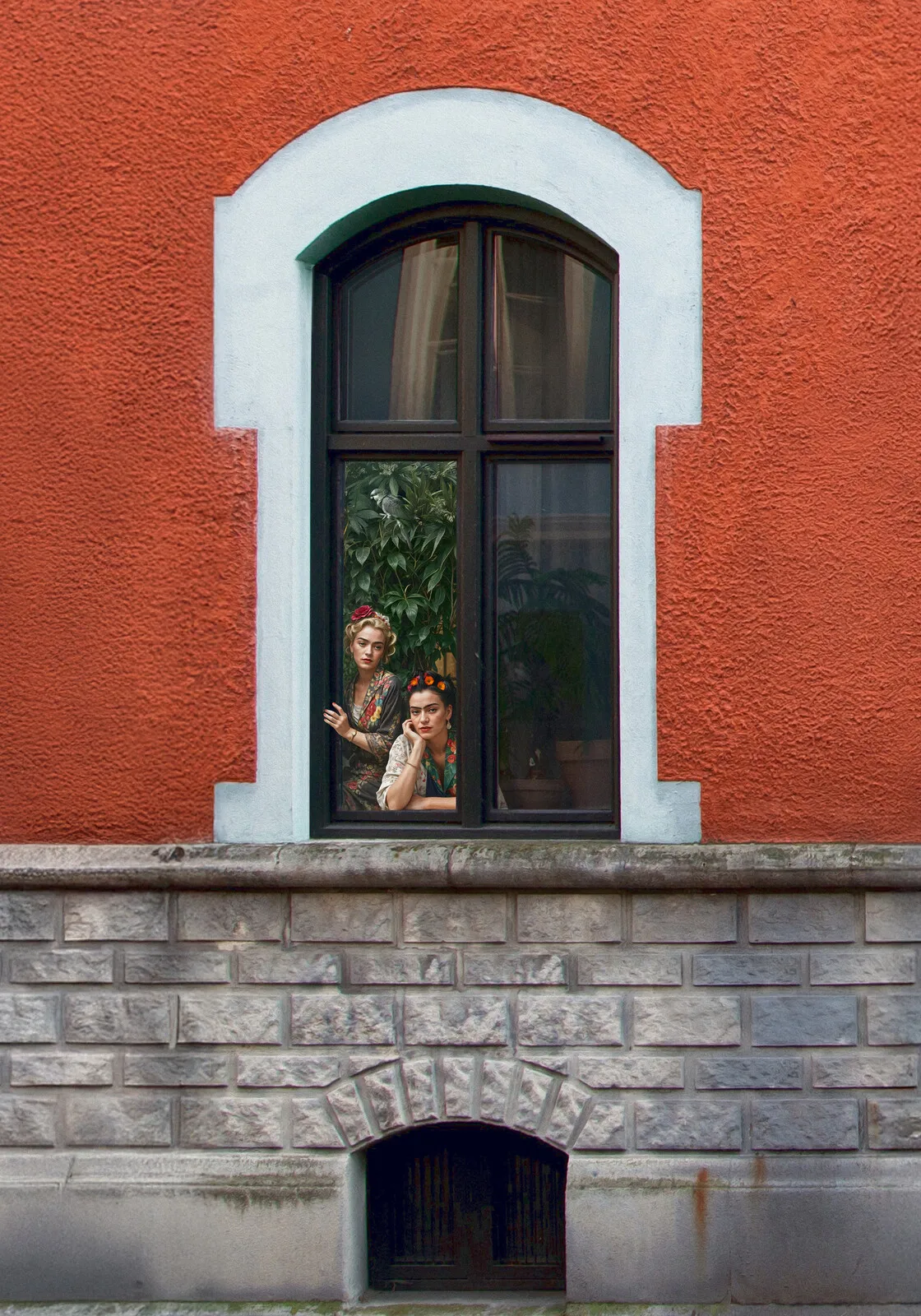
Om ett fönster kunde berätta sin historia, 2024
Digital
70 x 100 cm
5 200 kr
Om ett fönster kunde berätta sin historia
‘‘A Dialogue in Verse
Frida:
Through painted panes of shattered glass,
I spoke my truths, and I wore my scars.
Each stroke a scream, each hue a cry,
For the love that left, for the child denied.
Marilyn, tell me, what did you see,
Through the golden veil cast over thee?
Marilyn:
I saw the lights, their dazzling glow,
A stage that promised all you'd know.
But behind the script, behind the smile,
I was a girl who longed for love worthwhile.
Frida, did your colours soothe your ache,
Or did they echo the hearts men break?
Frida:
The canvas soothed; it also bled,
As Diego danced through others' beds.
But there were joys and fleeting sparks—
Josephine’s laughter, her fiery heart.
Tell me, Marilyn, in love’s cruel play,
Did anyone see the real you stay?
Marilyn:
Joe loved me deeply yet bound me tight,
Arthur adored my mind but not my light.
And the Kennedys, with their fleeting charms,
Left me lost in their shadowed arms.
Yet, like you, I found fleeting grace—
In tender women, a gentler embrace.
Frida:
And the world? Did it see your pain,
Behind the beauty, it sought to claim?
I was “Diego’s wife,” though I stood alone,
A heart of fire, a soul my own.
Did they call you “his,” did they take your name,
And strip your power to fan their flame?
Marilyn:
Always “his”—his starlet, his muse,
A body to take, a mind to refuse.
They saw the blonde, the sex, the face,
Never the fractures, never the space.
And you, Frida, with your broken frame,
Did your art set you free or deepen the flame?
Frida:
Both, my sister, it carved me raw,
But in its wounds, my strength I saw.
I painted my pain so the world would see,
That beauty lies in vulnerability.
And you, Marilyn, beneath the glow,
Did the camera’s lens let your spirit show?
Marilyn:
In fleeting frames, a flicker, a glance,
A moment of truth in Hollywood’s dance.
But the lens is cruel; it takes, it bends,
It reveals the mask but not the end.
Frida, we burned, we soared, we fell,
Our legacies live, and our stories tell.
Together:
Through fire and tears, we forged our art,
From broken bodies and fractured hearts.
The world remembers the beauty it sees,
Yet deeper within, we planted seeds.
Not just icons but women of fire,
Who turned their pain into fierce desire.
Frida:
So paint your truth, let colours scream,
And live, my sister, beyond the dream.
Marilyn:
And shine, Frida, with colours bright,
A beacon of courage in an endless night.
Together:
For we are more than what they demand—
We are the strength they’ll never understand.
Malmö, October 2024
Imagine if an old window could tell us what has been seen through its glass panes, who has sat on the windowsill gossiping. It doesn’t happen often, but it becomes all the more fascinating when it does.
When Marilyn Monroe and Frida Kahlo met in Malmö, their meeting was as colourful and intense as their lives. In their unique ways, these women became symbols of strength and vulnerability. Despite their different worlds, they had much in common.
Marilyn Monroe and Frida Kahlo never met during their time on earth. However, they lived during overlapping periods, though their worlds and social circles never intersected. Frida was born in 1907 and died in 1954, while Marilyn was born in 1926 and died in 1962. During the years their lives overlapped, Frida was based in Mexico, deeply rooted in the art world, while Marilyn pursued her career in Hollywood as an actress and sex symbol. Frida’s health struggles and focus on her artistic expression, combined with Marilyn’s hectic life in the spotlight, ensured their paths never crossed.
Despite the geographical and temporal chasm that separated them, Marilyn Monroe and Frida Kahlo were bound by a tapestry of shared struggles. Both grappled with physical and emotional pain, navigated complex relationships with men, and emerged as symbols of strength and vulnerability. This shared legacy of resilience and creativity forms the natural and deeply compelling backdrop for their dialogue.
Their meeting in Malmö, in the shadow of the booming global tour of the Frida Kahlo exhibition, resulted in a profound sense of understanding and shared experience. Their lifework, which continues to fascinate and inspire today, was also marked by pain, often destructive love, and a yearning for something always out of reach. Yet, despite these challenges, their enduring legacies continue to inspire and command respect.
In an apartment in Malmö's Old West district, Marilyn and Frida had a nuanced conversation, delving deeply into their experiences with love, betrayal, and the complex roles played by both men and women. Their discussion explored love, loss, and how they transformed their struggles into art and meaning. Despite their pain, both women found strength in their ability to create, leaving behind legacies that continue to inspire. Let us listen to the window’s story.
Marilyn:
“Frida, do you ever feel like the world only sees the surface? Like they see the smile, the glamour, but never the real pain underneath?”
Frida:
“All the time, Marilyn. They see the bright colours of my paintings and the flowers in my hair and think I am fearless. They do not see the nights I could not move from my bed because of pain. I paint my suffering because words are not enough.”
Marilyn:
“And I act because it’s the only time I feel alive when I’m someone else. But even then, I’m not sure anyone ever sees me. They see a blonde bombshell, the men’s fantasy, not the little girl wanting to be loved.”
Frida:
“Men have always wanted to define us, to control us. My Diego—he was a genius but also a fool. He hurt me so much, yet I kept coming back. And you, Marilyn? What did men take from you?”
Marilyn:
“They took my trust, my innocence. They told me to smile, look pretty, and be what they wanted. But love? I never found it. Not really. And every time I thought I was close, it slipped away. Like the children, I never got to hold.”
Frida:
“The loss of a child is the kind of pain no brush; no colour can truly capture. I tried to paint and understand it, but the emptiness remains. My body betrayed me, over and over.”
Marilyn:
“Same. My body... It looked perfect to the world, but inside, it was broken. I longed for a child. I thought it would fill the emptiness and give me something real to hold onto. But I guess we don’t always get what we dream of, do we?”
Frida:
“No, Marilyn. We do not. But we survive, somehow. We turn our pain into something else. You had your screen, your voice, your laughter. I had my canvases. We gave the world what we could, even when it felt like it was taking everything from us. Our art, our creativity, was our salvation, our way of turning pain into something beautiful, inspiring the audience to find their own ways of transformation.
Marilyn:
“And yet, Frida, don’t you wonder... what if we had been born men? Would the world have listened to us differently? Would we have been free to just... be?”
Frida:
Men do not suffer less, Marilyn. But they are allowed to suffer loudly. They do not conceal their scars under layers of makeup or vibrant hues. And they do not bear the burden of societal expectations and gender roles that we, as women, carry.
Marilyn:
“Maybe that’s why we burn so brightly. Because we carry it all—the pain, joy, love, and loss- we carry it for everyone.”
Frida:
Perhaps, in the end, it is this overwhelming capacity to feel that defines us as artists. We carry the weight of the world's pain, joy, love, and loss. And we transform it into something beautiful that will outlast our pain.
Marilyn:
“Frida, do you ever feel like your relationships defined you as much as your art? I mean, no matter what I achieved, people always saw me through the lens of the men in my life.”
Frida:
“Always, Marilyn. Diego—he was the sun and the storm of my life. His infidelities, his ego, his contradictions… they consumed me. But he also inspired and challenged me to paint the deepest parts of myself. It’s maddening, isn’t it? To love someone who breaks you even as they make you whole.”
Marilyn:
“I know that feeling all too well. Love was always... complicated for me. There was Joe DiMaggio, the great American hero. He adored and wanted to protect me but didn’t understand me. And then Arthur Miller, the intellectual, saw me as more than just Marilyn. But even he, in the end, couldn’t love the whole of me.”
Frida:
“It is the same story. Diego admired my strength but couldn’t resist weaker women, women he could dominate. And when I sought solace elsewhere, with both men and women, he accused me of betrayal as if my love for them diminished my love for him. Do you think men fear our independence?”
Marilyn:
“They do—even the most powerful ones, like John Kennedy. At first, he was charming and attentive. It was thrilling, Frida, to be desired by a man like that. But it didn’t take long to realise I was just another conquest, another secret he kept locked away. And his brother Robert? He pretended to care, to help me, but it was all politics, all lies. They used me, Frida, just like so many others.”
Frida:
“Powerful men rarely see women as equals. Despite his love of my art, even Diego could not accept that I was his equal—or more. But Marilyn, tell me, did you ever find love that felt true, even if only for a moment?”
Marilyn:
“There were moments, yes. Joe, for all his faults, truly loved me in his way. After my death, he sent roses to my grave every week for twenty years. And there were women too, Frida. Kind, soft women who didn’t demand anything from me, who just… understood. But it never lasted. My life was too messy, too public. What about you? Did you find that kind of love?”
Frida:
“Many times, but never completely. Diego, of course, and others—men and women- offered me escape from his betrayals. Josephine Baker, for one. She was like a storm, sweeping me away with her beauty and laughter. But none of it lasted. The pain of my body, of my miscarriages, of Diego’s infidelities—it overshadowed everything.”
Marilyn:
“I know that pain, Frida—the longing for a child, something real and permanent that could anchor me. But my body… it failed me every time. And the men always wanted me to be the fantasy, never the flawed, fragile person I was.”
Frida:
“And yet, we endured, didn’t we? Through the pain and the betrayals, we created something lasting. My paintings—my broken spine, my open wounds—they told my truth. And you, Marilyn, became an icon for your beauty, vulnerability, and humanity.”
Marilyn:
“I suppose that’s true. But sometimes I wonder if people truly see us, Frida. Do they see the women behind the art, behind the image? Or are we just symbols to them, projections of their desires?”
Frida:
“Both, I think. But symbols have power, Marilyn. They outlast the fleeting affections of men like John Kennedy or Diego Rivera. And perhaps that is our revenge—our legacy.”
Marilyn:
“Legacy. That’s a beautiful thought. But tell me, Frida, do you think we would have been happier if we had lived quieter lives, out of the spotlight, away from men like Diego and John?”
Frida:
“Perhaps. But quieter lives are not who we are. We are chaos, colour, fire. We loved recklessly, created fiercely, and lived fully. Would you trade that for a life without pain?”
Marilyn:
“No. The pain was the price of feeling everything so deeply. And despite everything, I wouldn’t change that. Would you?”
Frida:
“Never. Without the pain, there is no art, no truth. And truth, Marilyn, is the only thing that matters.”
Marilyn:
“Then here’s to the truth, Frida. To the fire we carried and to the legacies we left behind.”
Frida:
“To the truth, Marilyn. And to the women, we were—flawed, brilliant, and unforgettable.
Marilyn:
“Frida, have you heard of Louis B. Mayer? The man practically owned Hollywood, and every woman was trying to make it there. He was worse than any predator you can imagine. He perfected what we now call #MeToo long before anyone dared speak up.”
Frida:
“Tell me, Marilyn. What did he do to you and the others?”
Marilyn:
“Louis B. Mayer? He didn’t just exploit women; he built an empire on their silence. He’d lure young actresses with promises of stardom, then use their dreams to control them. And if you refused? He’d destroy your career before it even started. I wasn’t his direct victim, but I saw the aftermath in women who crossed his path. He was untouchable. No one dared speak against him.”
Frida:
“Sounds like Diego in his way, though Mayer’s crimes seem far worse. Diego wielded power over women because of his reputation and his charisma. Mayer’s power was systemic—an entire machine built to exploit.”
Marilyn:
“That’s the thing, Frida. Mayer didn’t need charm. He had contracts, casting couches, and the ability to make or break you with a single phone call. He controlled everything—what you wore, who you dated, what roles you got. And if you didn’t play his game, he’d smear your name or blacklist you entirely.”
Frida:
“So he traded their dignity for success. Did anyone ever stop him?”
Marilyn:
“Not in his time. He died a respected mogul, lauded for creating stars and glamorous films. But he was the original Harvey Weinstein. You’ve heard of him, right?”
Frida:
“Yes, his crimes have reached even my side of the world. Women finally rose and exposed him for what he was. Is he truly so similar to Mayer?”
Marilyn:
“Similar, yes, but with one key difference: Weinstein faced consequences. Mayer never did. Weinstein’s women found their voices in a world that was finally starting to listen. In my time? You’d be laughed out of the room—or worse.”
Frida:
“And what of the Kennedys? John and Robert, you said they used you. How?”
Marilyn:
“Oh, Frida, the Kennedys were different. They didn’t need contracts or casting couches; they had charm and power. John was magnetic. Meeting at Louis B. Mayer’s old estate near the ocean felt like stepping into a dream. He knew how to make you feel like you were the only woman in the world. But it wasn’t real.”
Frida:
“And Robert?”
Marilyn:
“Robert was calculated, strategic. While John swept me off my feet, Robert used his position to keep me quiet. They treated women like chess pieces—tools for pleasure or political gain. They distanced themselves when I became a liability, leaving me with nothing but whispers and innuendo.”
Frida:
“Men like that are cowards, Marilyn. They hide behind their power and charm, but in the end, they fear us—what we represent.”
Marilyn:
“And what’s that?”
Frida:
“Our ability to endure, to create something lasting from their destruction. Mayer, Weinstein, the Kennedys—they thought they could control us, silence us. But here we are, Frida, still speaking, still remembered.”
Marilyn:
“You’re right. Mayer’s empire is gone, Weinstein’s rotting in prison, and the Kennedy myth is tarnished. Meanwhile, your paintings hang in galleries worldwide, and my films still light up screens. We outlasted them.”
Frida:
“Yes, Marilyn. We did. And for every woman who comes after us, let them know: these men are not gods. They are small, petty creatures who only seem large because of the systems that protect them.”
Marilyn:
“Let’s hope those systems keep crumbling, Frida. And let’s keep speaking, even if the world isn’t ready to listen.”
Both highlighted how systemic exploitation evolves but remains rooted in the same abuse of power. Mayer used the studio system to entrap women; Weinstein exploited his status as a producer in modern Hollywood; and the Kennedys wielded political influence and charm to manipulate those around them. Monroe and Kahlo, two icons of their time, represent the resilience of women who endured these dynamics and ultimately left behind legacies far greater than the men who tried to control them.
Jörgen Thornberg
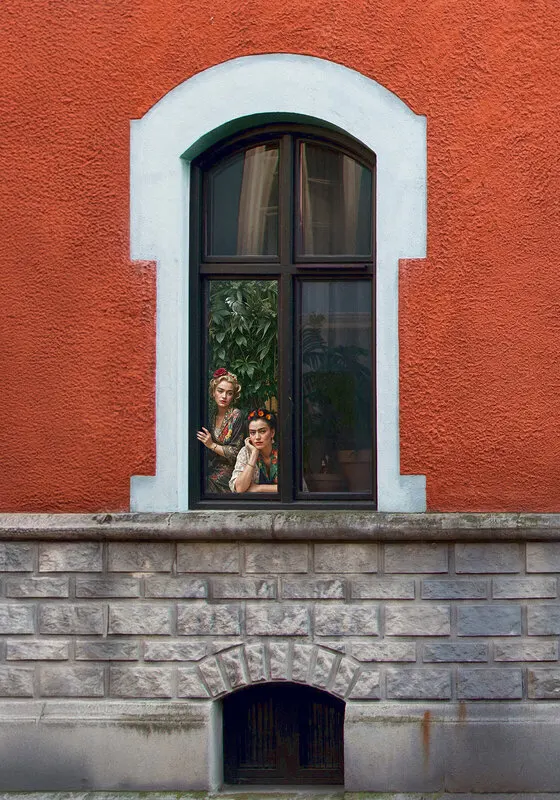
Om ett fönster kunde berätta sin historia, 2024
Digital
70 x 100 cm
5 200 kr
Om ett fönster kunde berätta sin historia
‘‘A Dialogue in Verse
Frida:
Through painted panes of shattered glass,
I spoke my truths, and I wore my scars.
Each stroke a scream, each hue a cry,
For the love that left, for the child denied.
Marilyn, tell me, what did you see,
Through the golden veil cast over thee?
Marilyn:
I saw the lights, their dazzling glow,
A stage that promised all you'd know.
But behind the script, behind the smile,
I was a girl who longed for love worthwhile.
Frida, did your colours soothe your ache,
Or did they echo the hearts men break?
Frida:
The canvas soothed; it also bled,
As Diego danced through others' beds.
But there were joys and fleeting sparks—
Josephine’s laughter, her fiery heart.
Tell me, Marilyn, in love’s cruel play,
Did anyone see the real you stay?
Marilyn:
Joe loved me deeply yet bound me tight,
Arthur adored my mind but not my light.
And the Kennedys, with their fleeting charms,
Left me lost in their shadowed arms.
Yet, like you, I found fleeting grace—
In tender women, a gentler embrace.
Frida:
And the world? Did it see your pain,
Behind the beauty, it sought to claim?
I was “Diego’s wife,” though I stood alone,
A heart of fire, a soul my own.
Did they call you “his,” did they take your name,
And strip your power to fan their flame?
Marilyn:
Always “his”—his starlet, his muse,
A body to take, a mind to refuse.
They saw the blonde, the sex, the face,
Never the fractures, never the space.
And you, Frida, with your broken frame,
Did your art set you free or deepen the flame?
Frida:
Both, my sister, it carved me raw,
But in its wounds, my strength I saw.
I painted my pain so the world would see,
That beauty lies in vulnerability.
And you, Marilyn, beneath the glow,
Did the camera’s lens let your spirit show?
Marilyn:
In fleeting frames, a flicker, a glance,
A moment of truth in Hollywood’s dance.
But the lens is cruel; it takes, it bends,
It reveals the mask but not the end.
Frida, we burned, we soared, we fell,
Our legacies live, and our stories tell.
Together:
Through fire and tears, we forged our art,
From broken bodies and fractured hearts.
The world remembers the beauty it sees,
Yet deeper within, we planted seeds.
Not just icons but women of fire,
Who turned their pain into fierce desire.
Frida:
So paint your truth, let colours scream,
And live, my sister, beyond the dream.
Marilyn:
And shine, Frida, with colours bright,
A beacon of courage in an endless night.
Together:
For we are more than what they demand—
We are the strength they’ll never understand.
Malmö, October 2024
Imagine if an old window could tell us what has been seen through its glass panes, who has sat on the windowsill gossiping. It doesn’t happen often, but it becomes all the more fascinating when it does.
When Marilyn Monroe and Frida Kahlo met in Malmö, their meeting was as colourful and intense as their lives. In their unique ways, these women became symbols of strength and vulnerability. Despite their different worlds, they had much in common.
Marilyn Monroe and Frida Kahlo never met during their time on earth. However, they lived during overlapping periods, though their worlds and social circles never intersected. Frida was born in 1907 and died in 1954, while Marilyn was born in 1926 and died in 1962. During the years their lives overlapped, Frida was based in Mexico, deeply rooted in the art world, while Marilyn pursued her career in Hollywood as an actress and sex symbol. Frida’s health struggles and focus on her artistic expression, combined with Marilyn’s hectic life in the spotlight, ensured their paths never crossed.
Despite the geographical and temporal chasm that separated them, Marilyn Monroe and Frida Kahlo were bound by a tapestry of shared struggles. Both grappled with physical and emotional pain, navigated complex relationships with men, and emerged as symbols of strength and vulnerability. This shared legacy of resilience and creativity forms the natural and deeply compelling backdrop for their dialogue.
Their meeting in Malmö, in the shadow of the booming global tour of the Frida Kahlo exhibition, resulted in a profound sense of understanding and shared experience. Their lifework, which continues to fascinate and inspire today, was also marked by pain, often destructive love, and a yearning for something always out of reach. Yet, despite these challenges, their enduring legacies continue to inspire and command respect.
In an apartment in Malmö's Old West district, Marilyn and Frida had a nuanced conversation, delving deeply into their experiences with love, betrayal, and the complex roles played by both men and women. Their discussion explored love, loss, and how they transformed their struggles into art and meaning. Despite their pain, both women found strength in their ability to create, leaving behind legacies that continue to inspire. Let us listen to the window’s story.
Marilyn:
“Frida, do you ever feel like the world only sees the surface? Like they see the smile, the glamour, but never the real pain underneath?”
Frida:
“All the time, Marilyn. They see the bright colours of my paintings and the flowers in my hair and think I am fearless. They do not see the nights I could not move from my bed because of pain. I paint my suffering because words are not enough.”
Marilyn:
“And I act because it’s the only time I feel alive when I’m someone else. But even then, I’m not sure anyone ever sees me. They see a blonde bombshell, the men’s fantasy, not the little girl wanting to be loved.”
Frida:
“Men have always wanted to define us, to control us. My Diego—he was a genius but also a fool. He hurt me so much, yet I kept coming back. And you, Marilyn? What did men take from you?”
Marilyn:
“They took my trust, my innocence. They told me to smile, look pretty, and be what they wanted. But love? I never found it. Not really. And every time I thought I was close, it slipped away. Like the children, I never got to hold.”
Frida:
“The loss of a child is the kind of pain no brush; no colour can truly capture. I tried to paint and understand it, but the emptiness remains. My body betrayed me, over and over.”
Marilyn:
“Same. My body... It looked perfect to the world, but inside, it was broken. I longed for a child. I thought it would fill the emptiness and give me something real to hold onto. But I guess we don’t always get what we dream of, do we?”
Frida:
“No, Marilyn. We do not. But we survive, somehow. We turn our pain into something else. You had your screen, your voice, your laughter. I had my canvases. We gave the world what we could, even when it felt like it was taking everything from us. Our art, our creativity, was our salvation, our way of turning pain into something beautiful, inspiring the audience to find their own ways of transformation.
Marilyn:
“And yet, Frida, don’t you wonder... what if we had been born men? Would the world have listened to us differently? Would we have been free to just... be?”
Frida:
Men do not suffer less, Marilyn. But they are allowed to suffer loudly. They do not conceal their scars under layers of makeup or vibrant hues. And they do not bear the burden of societal expectations and gender roles that we, as women, carry.
Marilyn:
“Maybe that’s why we burn so brightly. Because we carry it all—the pain, joy, love, and loss- we carry it for everyone.”
Frida:
Perhaps, in the end, it is this overwhelming capacity to feel that defines us as artists. We carry the weight of the world's pain, joy, love, and loss. And we transform it into something beautiful that will outlast our pain.
Marilyn:
“Frida, do you ever feel like your relationships defined you as much as your art? I mean, no matter what I achieved, people always saw me through the lens of the men in my life.”
Frida:
“Always, Marilyn. Diego—he was the sun and the storm of my life. His infidelities, his ego, his contradictions… they consumed me. But he also inspired and challenged me to paint the deepest parts of myself. It’s maddening, isn’t it? To love someone who breaks you even as they make you whole.”
Marilyn:
“I know that feeling all too well. Love was always... complicated for me. There was Joe DiMaggio, the great American hero. He adored and wanted to protect me but didn’t understand me. And then Arthur Miller, the intellectual, saw me as more than just Marilyn. But even he, in the end, couldn’t love the whole of me.”
Frida:
“It is the same story. Diego admired my strength but couldn’t resist weaker women, women he could dominate. And when I sought solace elsewhere, with both men and women, he accused me of betrayal as if my love for them diminished my love for him. Do you think men fear our independence?”
Marilyn:
“They do—even the most powerful ones, like John Kennedy. At first, he was charming and attentive. It was thrilling, Frida, to be desired by a man like that. But it didn’t take long to realise I was just another conquest, another secret he kept locked away. And his brother Robert? He pretended to care, to help me, but it was all politics, all lies. They used me, Frida, just like so many others.”
Frida:
“Powerful men rarely see women as equals. Despite his love of my art, even Diego could not accept that I was his equal—or more. But Marilyn, tell me, did you ever find love that felt true, even if only for a moment?”
Marilyn:
“There were moments, yes. Joe, for all his faults, truly loved me in his way. After my death, he sent roses to my grave every week for twenty years. And there were women too, Frida. Kind, soft women who didn’t demand anything from me, who just… understood. But it never lasted. My life was too messy, too public. What about you? Did you find that kind of love?”
Frida:
“Many times, but never completely. Diego, of course, and others—men and women- offered me escape from his betrayals. Josephine Baker, for one. She was like a storm, sweeping me away with her beauty and laughter. But none of it lasted. The pain of my body, of my miscarriages, of Diego’s infidelities—it overshadowed everything.”
Marilyn:
“I know that pain, Frida—the longing for a child, something real and permanent that could anchor me. But my body… it failed me every time. And the men always wanted me to be the fantasy, never the flawed, fragile person I was.”
Frida:
“And yet, we endured, didn’t we? Through the pain and the betrayals, we created something lasting. My paintings—my broken spine, my open wounds—they told my truth. And you, Marilyn, became an icon for your beauty, vulnerability, and humanity.”
Marilyn:
“I suppose that’s true. But sometimes I wonder if people truly see us, Frida. Do they see the women behind the art, behind the image? Or are we just symbols to them, projections of their desires?”
Frida:
“Both, I think. But symbols have power, Marilyn. They outlast the fleeting affections of men like John Kennedy or Diego Rivera. And perhaps that is our revenge—our legacy.”
Marilyn:
“Legacy. That’s a beautiful thought. But tell me, Frida, do you think we would have been happier if we had lived quieter lives, out of the spotlight, away from men like Diego and John?”
Frida:
“Perhaps. But quieter lives are not who we are. We are chaos, colour, fire. We loved recklessly, created fiercely, and lived fully. Would you trade that for a life without pain?”
Marilyn:
“No. The pain was the price of feeling everything so deeply. And despite everything, I wouldn’t change that. Would you?”
Frida:
“Never. Without the pain, there is no art, no truth. And truth, Marilyn, is the only thing that matters.”
Marilyn:
“Then here’s to the truth, Frida. To the fire we carried and to the legacies we left behind.”
Frida:
“To the truth, Marilyn. And to the women, we were—flawed, brilliant, and unforgettable.
Marilyn:
“Frida, have you heard of Louis B. Mayer? The man practically owned Hollywood, and every woman was trying to make it there. He was worse than any predator you can imagine. He perfected what we now call #MeToo long before anyone dared speak up.”
Frida:
“Tell me, Marilyn. What did he do to you and the others?”
Marilyn:
“Louis B. Mayer? He didn’t just exploit women; he built an empire on their silence. He’d lure young actresses with promises of stardom, then use their dreams to control them. And if you refused? He’d destroy your career before it even started. I wasn’t his direct victim, but I saw the aftermath in women who crossed his path. He was untouchable. No one dared speak against him.”
Frida:
“Sounds like Diego in his way, though Mayer’s crimes seem far worse. Diego wielded power over women because of his reputation and his charisma. Mayer’s power was systemic—an entire machine built to exploit.”
Marilyn:
“That’s the thing, Frida. Mayer didn’t need charm. He had contracts, casting couches, and the ability to make or break you with a single phone call. He controlled everything—what you wore, who you dated, what roles you got. And if you didn’t play his game, he’d smear your name or blacklist you entirely.”
Frida:
“So he traded their dignity for success. Did anyone ever stop him?”
Marilyn:
“Not in his time. He died a respected mogul, lauded for creating stars and glamorous films. But he was the original Harvey Weinstein. You’ve heard of him, right?”
Frida:
“Yes, his crimes have reached even my side of the world. Women finally rose and exposed him for what he was. Is he truly so similar to Mayer?”
Marilyn:
“Similar, yes, but with one key difference: Weinstein faced consequences. Mayer never did. Weinstein’s women found their voices in a world that was finally starting to listen. In my time? You’d be laughed out of the room—or worse.”
Frida:
“And what of the Kennedys? John and Robert, you said they used you. How?”
Marilyn:
“Oh, Frida, the Kennedys were different. They didn’t need contracts or casting couches; they had charm and power. John was magnetic. Meeting at Louis B. Mayer’s old estate near the ocean felt like stepping into a dream. He knew how to make you feel like you were the only woman in the world. But it wasn’t real.”
Frida:
“And Robert?”
Marilyn:
“Robert was calculated, strategic. While John swept me off my feet, Robert used his position to keep me quiet. They treated women like chess pieces—tools for pleasure or political gain. They distanced themselves when I became a liability, leaving me with nothing but whispers and innuendo.”
Frida:
“Men like that are cowards, Marilyn. They hide behind their power and charm, but in the end, they fear us—what we represent.”
Marilyn:
“And what’s that?”
Frida:
“Our ability to endure, to create something lasting from their destruction. Mayer, Weinstein, the Kennedys—they thought they could control us, silence us. But here we are, Frida, still speaking, still remembered.”
Marilyn:
“You’re right. Mayer’s empire is gone, Weinstein’s rotting in prison, and the Kennedy myth is tarnished. Meanwhile, your paintings hang in galleries worldwide, and my films still light up screens. We outlasted them.”
Frida:
“Yes, Marilyn. We did. And for every woman who comes after us, let them know: these men are not gods. They are small, petty creatures who only seem large because of the systems that protect them.”
Marilyn:
“Let’s hope those systems keep crumbling, Frida. And let’s keep speaking, even if the world isn’t ready to listen.”
Both highlighted how systemic exploitation evolves but remains rooted in the same abuse of power. Mayer used the studio system to entrap women; Weinstein exploited his status as a producer in modern Hollywood; and the Kennedys wielded political influence and charm to manipulate those around them. Monroe and Kahlo, two icons of their time, represent the resilience of women who endured these dynamics and ultimately left behind legacies far greater than the men who tried to control them.
5 200 kr

Jörgen Thornberg
Malmö
Lite om bilder och mig. Translation in English at the end.
Jag är en nyfiken person som ser allt i bilder, även det jag fäster i ord, gärna tillsammans för bakom alla mina bilder finns en berättelse. Till vissa bilder hör en kortare eller längre novell som följer med bilden.
Bilder berättar historier. Jag omges av naturlig skönhet, intressanta människor och historia var jag än går. Jag använder min kamera för att dokumentera världen och blanda det jag ser med vad jag känner för att fånga den dolda magin.
Mina bilder berättar mina historier. Genom mina bilder, tryck och berättelser. Jag bjuder in dig att ta del av dessa berättelser, in i ditt liv och hem och dela min mycket personliga syn på vår värld. Mer än vad ögat ser. Jag tänker i bilder, drömmer och skriver och pratar om dem; följaktligen måste jag också skapa bilder. De blir vad jag ser, inte nödvändigtvis begränsade till verkligheten. Det finns en bild runt varje hörn. Jag hoppas att du kommer att se vad jag såg och gilla det.
Jag är också en skrivande person och till många bilder hör en kortare eller längre essay. Den följer med tavlan, tryckt på fint papper och med en personlig hälsning från mig.
Flertalet bilder startar sin resa i min kamera. Enkelt förklarat beskriver jag bilden jag ser i mitt inre, upplevd eller fantiserad. Bilden uppstår inom mig redan innan jag fått okularet till ögat. På bråkdelen av ett ögonblick ser jag vad jag vill ha och vad som kan göras med bilden. Här skall jag stoppa in en giraff, stålmannen, Titanic eller vad det är min fantasi finner ut. Ännu märkligare är att jag kommer ihåg minnesbilden långt efteråt när det blir tid att skapa verket. Om jag lyckas eller inte, är upp till betraktaren, oftast präglat av en stråk av svart humor – meningen är att man skall bli underhållen. Mina bilder blir ofta en snackis där de hänger.
Jag föredrar bilder som förmedlar ett budskap i flera lager. Vid första anblicken fylld av feel-good, en vacker utsikt, fint väder, solen skiner, blommor på ängen eller vattnet som ligger förrädiskt spegelblankt. I en sådan bild kan jag gömma min egentliga berättelse, mitt förakt för förtryckare och våldsverkare, rasister och fördomsfulla människor - ett gärna återkommande motiv mer eller mindre dolt i det vackra motivet. Jag försöker förena dem i ett gemensamt narrativ.
Bild och formgivning har löpt som en röd tråd genom livet. Fotokonst känns som en värdig final som jag gärna delar med mig.
Min genre är vid som framgår av mina bilder, temat en blandning av pop- och gatukonst i kollage som kan bestå av hundratals lager. Vissa bilder kan ta veckor, andra någon dag innan det är dags att överlämna resultatet till printverkstaden. Fine Art Prints är digitala fotocollage. I dessa kollage sker rivandet, klippandet, pusslandet, målandet, ritandet och sprayningen digitalt. Det jag monterar in kan vara hundratals år gamla bilder som jag omsorgsfullt frilägger så att de ser ut att vara en del av tavlan men också bilder skapade av mig själv efter min egen fantasi. Därefter besöks printstudion och för vissa bilder numrera en limiterad upplaga (oftast 7 exemplar) och signera för hand. Vissa bilder kan köpas i olika format. Det är bara att fråga efter vilka. Gillar man en bild som är 70x100 men inte har plats på väggen, går den kanske att få i 50x70 cm istället. Frågan är fri.
Metoden Giclée eller Fine Art Print som det också kallas är det moderna sättet för framställning av grafisk konst. Villkoret för denna typ av utskrifter är att en högkvalitativ storformatskrivare används med åldersbeständigt färgpigment och konstnärspapper eller i förekommande fall på duk. Pappret som används möter de krav på livslängd som ställs av museer och gallerier. Normalt säljer jag mina bilder oinramade så att den nya ägaren själv kan bestämma hur de skall se ut, med eller utan passepartout färg på ram, med eller utan glas etc..
Under många år ställde jag bara ut på nätet, i valda grupper och på min egen Facebooksida - https://www.facebook.com/jorgen.thornberg.9
Jag finns också på en egen hemsida som tyvärr inte alltid är uppdaterad – https://www.jth.life/ Där kan du också läsa en del av de berättelser som följer med bilden.
UTSTÄLLNINGAR
Luftkastellet, oktober 2022
Konst i Lund, november 2022
Luftkastellet, mars 2023
Engleson Galleri Caroli, april 2023
Hydra, Greece June 2023
Engleson Galleri Caroli, oktober 2023
Toppen, Höllviken december 2023
Luftkastellet, mars 2024
Torups Galleri, mars 2024
Venice, May 2024
Luftkastellet, oktober 2024
Konst i Advent, December 2024
Galleri Engleson, Caroli December 2024
Jäger & Jansson Galleri, april 2025
A bit about pictures and me.
I'm a curious person who sees everything in pictures, even what I express in words, often combining them, for behind all my pictures lies a story. These narratives, some as short as a single image and others as long as a novel, are the heart and soul of my work.
Pictures tell stories. Wherever I go, I'm surrounded by natural beauty, exciting people, and history. I use my camera to document the world and blend what I see with what I feel to capture the hidden magic.
My images tell my stories. Through my pictures, prints, and narratives, I invite you to partake in these stories in your life and home and share my deeply personal perspective of our world. More than meets the eye. I think in pictures, dream, write, and talk about them; consequently, I must create images too. They become what I see, not necessarily confined to reality. There's a picture around every corner. I hope you'll see what I saw and enjoy it.
I'm also a writer, and many images come with a shorter or longer essay. It accompanies the painting, printed on fine paper with my personal greeting.
Many pictures start their journey on my camera. Simply put, I describe the image I see in my mind, experienced or imagined. The image arises within me even before I bring the eyepiece to my eye. In a fraction of a moment, I see what I want and what can be done with the picture. Here, I'll insert a giraffe, Superman, the Titanic, or whatever my imagination conjures up. Even stranger is that I remember the mental image long after it's time to create the work. Whether I succeed is up to the observer, often imbued with a streak of black humour – the aim is to entertain. My pictures usually become a talking point wherever they hang.
I prefer pictures that convey a message in multiple layers. At first glance, they're filled with feel-good vibes, a beautiful view, lovely weather, the sun shining, flowers in the meadow, or the water lying deceptively calm. But beneath this surface beauty, I often conceal a deeper story, a narrative that challenges societal norms or explores the human condition. I invite you to delve into these hidden narratives and discover the layers of meaning within my work.
Picture and design have been a thread running through my life. Photographic art feels like a fitting finale, and I'm happy to share it.
My genre is varied, as seen in my pictures; the theme is a blend of pop and street art in collages that can consist of hundreds of layers. Some images can take weeks, others just a day before it's time to hand over the result to the print workshop. Fine Art Prints are digital photo collages. In these collages, tearing, cutting, puzzling, painting, drawing, and spraying happen digitally. What I insert can be images hundreds of years old that I carefully extract so they appear to be part of the painting, but also images created by myself, now also generated from my imagination. Next, visit the print studio and, for certain images, number a limited edition (usually 7 copies) and sign them by hand. Some images may be available in other formats. Just ask which ones. If you like an image that's 70x100 but doesn't have space on the wall, you might be able to get it in 50x70 cm instead. The question is open.
The Giclée method, or Fine Art Print as it's also called, is the modern way of producing graphic art. This method ensures the highest quality and longevity of the artwork, using a high-quality large-format printer with archival pigment inks and artist paper or, in some cases, canvas. The paper used meets the longevity requirements set by museums and galleries. I sell my pictures unframed, allowing the new owner to personalise their artwork, confident in the lasting value and quality of the piece.
For many years, I only exhibited online, in selected groups, and on my Facebook page - https://www.facebook.com/jorgen.thornberg.9. I also have my website, which unfortunately is not constantly updated - https://www.jth.life/. You can also read some of the stories accompanying the pictures there.
EXHIBITIONS
Luftkastellet, October 2022
Art in Lund, November 2022
Luftkastellet, March 2023
Engleson Gallery Caroli, April 2023
Hydra, Greece June 2023
Engleson Gallery Caroli, October 2023
Toppen, Höllviken December 2023
Luftkastellet, March 2024
Torup Gallery, March 2024
Venice, May 2024
UTSTÄLLNINGAR
Luftkastellet, oktober 2022
Konst i Lund, november 2022
Luftkastellet, mars 2023
Engleson Galleri Caroli, april 2023
Hydra, Greece June 2023
Engleson Galleri Caroli, oktober 2023
Toppen, Höllviken december 2023
Luftkastellet, mars 2024
Torups Galleri, mars 2024
Venice, May 2024
Luftkastellet, October 2024
Konst i Advent, December 2024
Galleri Engleson, Caroli December 2024
Jäger & Jansson Galleri, April 2025
Utbildning
Autodidakt
Medlem i konstnärsförening
Öppna Sinnen
Med i konstrunda
Konstrundan i Skåne
Utställningar
Luftkastellet, October 2022
Art in Lund, November 2022
Luftkastellet, March 2023
Engleson Gallery Caroli, April 2023
Hydra, Greece June 2023
Engleson Gallery Caroli, October 2023
Toppen, Höllviken December 2023
Luftkastellet, March 2024
Torup Gallery, March 2024
Venice, May 2024