Vi använder cookies för att ge dig bästa möjliga upplevelse. Välj vilka cookies du tillåter.
Läs mer i vår integritetspolicy
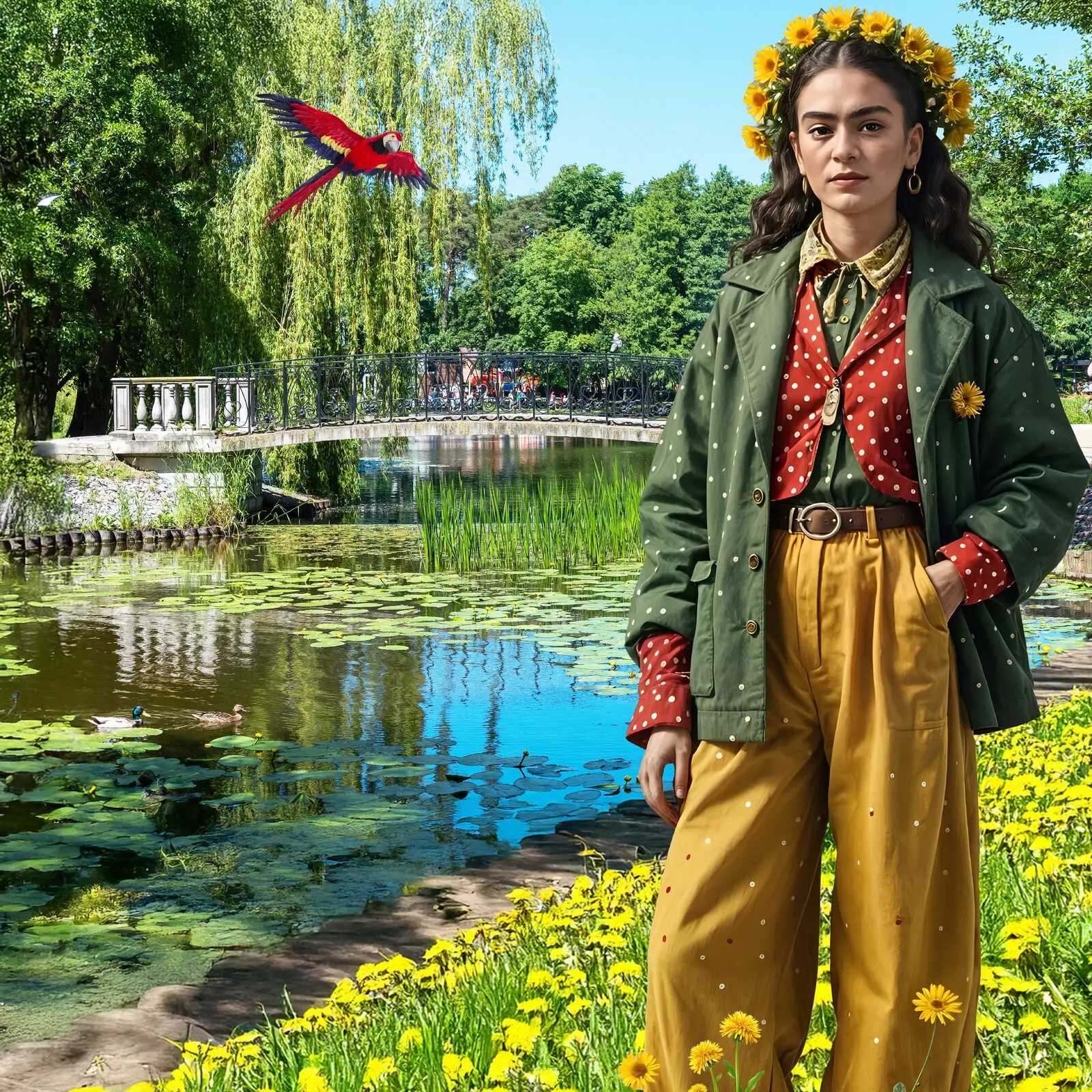
Jörgen Thornberg
Stadsträdgårdsmästarens mardröm, 2024
Digital
50 x 70 cm
3 200 kr
Stadsträdgårdsmästarens mardröm
‘‘Frida’s Canvas: A Poetic Ode’’
‘The Two Fridas’ sit, hearts laid bare,
A duality of love and despair.
One hand holds life, the other bleeds,
It’s a tale of self and broken needs.
‘The Broken Column’, her spine of stone,
Stands as proof she’s never alone.
Pain like arrows pierce her skin,
Yet strength is carved deep within.
‘Self-Portrait with Thorn Necklace and Hummingbird’,
A vibrant scene where emotions stir.
The thorns draw blood, the bird takes flight,
A symbol of freedom in an endless night.
‘Henry Ford Hospital’, where hope was lost,
Dreams of motherhood paid the cost.
Floating objects, her anguish laid,
On that stark white bed, her soul displayed.
‘What the Water Gave Me’ whispers loud,
Her memories swirl, her spirit unbowed.
A bathtub becomes a portal deep,
To visions of joy and pain, she keeps.
Each brushstroke sings, each hue commands,
A vibrant cry from trembling hands.
Through every canvas, bold and true,
Frida’s heart beats, and her spirit renews.
Now she soars, a bird set free,
Her message spans eternity.
Through ‘Viva Frida’, her spirit flies,
Across the world, where her truth lies.
Her art, her pain, her fierce acclaim,
A timeless echo of her name.
Malmö, October 2024
The Art of the Self-Portrait, Politics, and the Power of Pain
Frida Kahlo, the iconic Mexican artist, didn’t just paint self-portraits; she created portals into her soul. With her piercing gaze and vividly emotional canvases, she told the world, “Here I am—flawed, fierce, and unbroken.” Yet, Kahlo’s self-portraits weren’t just about gazing inward. They were bold proclamations of her pain, politics, identity, and unapologetic personality. She wore her suffering like an ‘offerkofta’ (a Swedish term for wallowing in one’s misfortunes). Still, instead of retreating into self-pity, she turned that pain into art that roared with defiance and brilliance.
The expression ‘Offerkofta’ as an Artistic Statement
Frida Kahlo's life was a testament to resilience. Despite enduring a lifetime of physical suffering, from polio as a child to a horrific bus accident at age 18 that left her with chronic pain, a shattered spine, and infertility, she didn't crumble. Instead, she donned her metaphorical ‘offerkofta’ and painted her anguish for all to see. In her self-portraits, her broken body symbolises not just pain, but also resilience, raw humanity, and the burdens women carry, both literally and figuratively.
Take ‘The Broken Column’ (1944), where her torso is split open to reveal a crumbling stone column in place of her spine. Tears streak her face, yet she stands tall, unyielding. It’s not just a depiction of her pain—it’s a declaration of strength. Through her art, she said, “Yes, I’m suffering. But I’m still here.”
Politics, Identity, and the Big, Bold Unibrow
Frida wasn’t just a painter of pain but a fiercely political figure. A committed Marxist, she infused her art with commentary on inequality, colonialism, and Mexican identity. Her love for indigenous Mexican culture shone through in her Tehuana dresses, which she wore in life and her paintings, turning herself into a walking celebration of Mexicanidad.
In ‘Self-Portrait on the Borderline Between Mexico and the United States’ (1932), she contrasts Mexico’s rich cultural heritage with the industrial bleakness of the United States. Frida’s unapologetic embrace of her Mexican roots wasn’t just a political statement; it was also profoundly personal, rejecting the European colonial legacy that sought to erase indigenous culture.
And then there was her face: the iconic unibrow and faint moustache she deliberately accentuated in her self-portraits. These were more than stylistic quirks—they were acts of rebellion against conventional standards of feminine beauty. She declared her independence from societal expectations by embracing her “masculine” features, making her a feminist icon long before the term became mainstream.
Bisexuality and Boundless Love
Frida Kahlo’s love life was as colourful as her art. Married to the famous muralist Diego Rivera, their union was fiery, passionate, and wildly unconventional. Both were unfaithful—Diego with numerous women and Frida with both men and women. Her lovers reportedly included photographer Nickolas Muray, artist Josephine Baker, and communist revolutionary Leon Trotsky.
Kahlo’s bisexuality wasn’t hidden; it was as unapologetic as the rest of her personality. She defied the heteronormative constraints of her time, and her relationships with women were often as passionate as those with men. In a letter to her lover and friend Chavela Vargas, she wrote, “I hope you want to come to Mexico—I need you and miss you.”
Her bisexuality wasn’t just a personal matter—it was also political. By living openly as a bisexual woman, Kahlo challenged societal norms and paved the way for greater acceptance of LGBTQ+ identities. She demonstrated that love, like art, refuses to be confined by labels or boundaries.
The Duality of Frida Kahlo
What makes Frida Kahlo such a compelling figure is her duality. She was deeply vulnerable and incredibly strong, a master of turning her weaknesses into weapons. Her self-portraits oscillate between tender introspection and bold defiance, creating a body of work that speaks to anyone who has ever felt pain or been told they don’t belong.
Kahlo didn’t just paint herself—she painted humanity. Her art reminds us that it’s okay to wear the Swedish expression ‘offerkofta’ sometimes, as long as you’re willing to use it to create something beautiful, powerful, and unforgettable. She reminds us that identity—whether shaped by culture, sexuality, or politics—should be celebrated, not hidden.
Legacy: Feminist Icon and Artistic Trailblazer
Today, Frida Kahlo’s legacy looms larger than ever. She’s celebrated as a feminist pioneer, an LGBTQ+ icon, and one of the most significant artists of the 20th century. Adorned with that unforgettable unibrow, her face graces everything from posters to tote bags, turning her into a symbol of individuality and resilience.
But beyond the commodification lies the real Frida: a woman who refused to be silenced, turned her pain into power and showed the world that greatness doesn’t mean being unbroken. It means embracing every crack and fracture, every piece of who you are, and letting it shine.
So, the next time you see one of her self-portraits, don't just admire the artistry. Remember the woman behind it: Frida Kahlo, who proudly wore her ‘offerkofta’ and turned it into a masterpiece.
How Would the Concept of "Playing the Victim" Apply to Frida Kahlo?
Regarding Frida Kahlo and the concept of "playing the victim," it’s a fascinating balancing act. She undeniably used her art to express her suffering, but she did so in a way that transformed pain into strength and defiance rather than simply portraying herself as a victim.
How "Playing the Victim" Might Relate to Frida Kahlo
Frida Kahlo painted her physical and emotional suffering with brutal honesty—her shattered body after the bus accident, her miscarriages, her tumultuous relationship with Diego Rivera, and her sense of isolation. In her self-portraits, she metaphorically wore a "victim cloak," often depicting herself as vulnerable or trapped by pain. For example, in ‘The Broken Column’ (1944), she appears broken but resilient. Here, she symbolically carries the weight of suffering, which could be interpreted as "playing the victim"—but with a crucial difference: she didn’t do it to seek pity.
The Difference Between "Playing the Victim" and Frida Kahlo’s Art
Victim or Warrior? Kahlo was far from passive in her suffering. She used it as a catalyst for her art, her political message, and her fight for identity. Her self-portraits weren’t self-pitying; they were a dialogue between herself and the world, where she both owned and challenged her pain.
Political Symbolism: Her self-portraits were also charged with political and feminist themes. She demonstrated that women are biological, emotional, political and intellectual. She brought the personal into the political sphere, giving her "victim cloak" a revolutionary edge.
A Celebration of Survival: Instead of allowing herself to be defined by her trauma, Frida used it as armour. She showed that suffering while still being robust and creative is possible. In a sense, she wore the "victim cloak," but only to unravel it and weave it into something more significant—a mantle of resistance and creation.
Translating "Victim Cloak" in Her Context
In English, phrases like "turning pain into power" or "wielding victimhood as art" might better capture how Frida Kahlo approached her suffering. She didn’t use it as an excuse to remain in the victim role but as a way to confront the world with her reality—painful, yes, but also beautiful and unexpectedly triumphant.
Frida’s Transformation of the "Victim Cloak"
Frida Kahlo may have "put on the victim cloak," but she wore it like a warrior wears their scars, showing the world what true strength means. Instead of a lament, her art was a bold proclamation: “This is my pain, and I will turn it into something unforgettable.” By doing so, she redefined her suffering and created a legacy that inspires generations.
Frida Kahlo's artistic legacy continues to captivate the world, and Malmö now has the honour of hosting a unique tribute to this iconic artist.
From February 1 to May 18, 2025, the "Viva Frida Kahlo – Immersive Experience" will be displayed at Amiralen in Malmö.
This multidimensional exhibition offers visitors a breathtaking journey into Kahlo's vibrant universe, where her works are brought to life through a 360-degree immersive experience.
Following successful presentations in cities like Zurich, Brussels, and Vienna, where over 500,000 visitors have experienced the exhibition, it now makes its Scandinavian debut in Malmö.
For a preview of what’s in store, you can watch an introduction to the exhibition here:
Viva Frida Kahlo - Immersive Experience https://www.youtube.com/watch?v=007uYQBXxqc
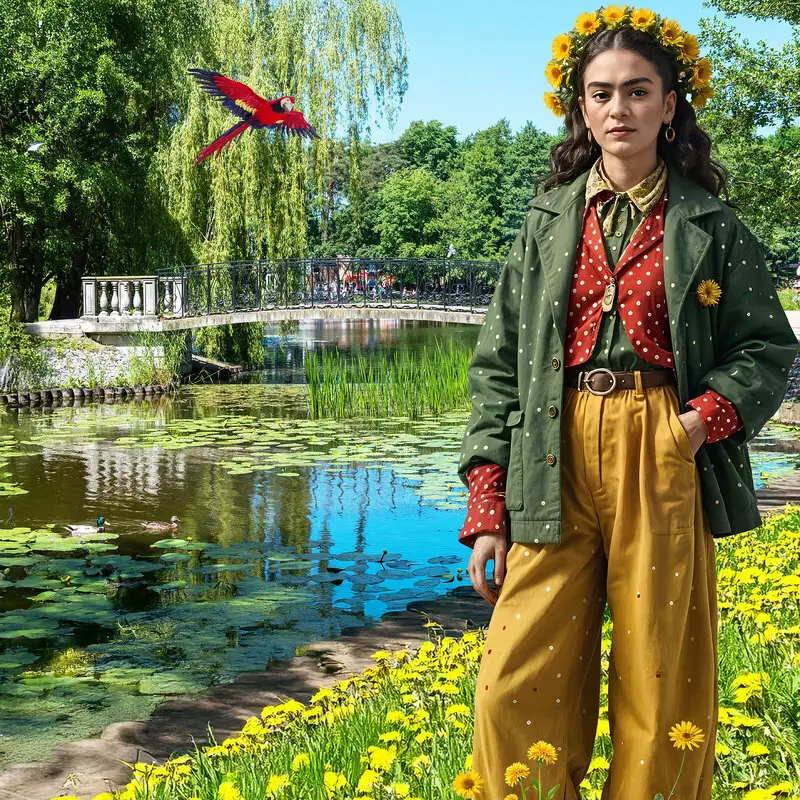
Jörgen Thornberg
Stadsträdgårdsmästarens mardröm, 2024
Digital
50 x 70 cm
3 200 kr
Stadsträdgårdsmästarens mardröm
‘‘Frida’s Canvas: A Poetic Ode’’
‘The Two Fridas’ sit, hearts laid bare,
A duality of love and despair.
One hand holds life, the other bleeds,
It’s a tale of self and broken needs.
‘The Broken Column’, her spine of stone,
Stands as proof she’s never alone.
Pain like arrows pierce her skin,
Yet strength is carved deep within.
‘Self-Portrait with Thorn Necklace and Hummingbird’,
A vibrant scene where emotions stir.
The thorns draw blood, the bird takes flight,
A symbol of freedom in an endless night.
‘Henry Ford Hospital’, where hope was lost,
Dreams of motherhood paid the cost.
Floating objects, her anguish laid,
On that stark white bed, her soul displayed.
‘What the Water Gave Me’ whispers loud,
Her memories swirl, her spirit unbowed.
A bathtub becomes a portal deep,
To visions of joy and pain, she keeps.
Each brushstroke sings, each hue commands,
A vibrant cry from trembling hands.
Through every canvas, bold and true,
Frida’s heart beats, and her spirit renews.
Now she soars, a bird set free,
Her message spans eternity.
Through ‘Viva Frida’, her spirit flies,
Across the world, where her truth lies.
Her art, her pain, her fierce acclaim,
A timeless echo of her name.
Malmö, October 2024
The Art of the Self-Portrait, Politics, and the Power of Pain
Frida Kahlo, the iconic Mexican artist, didn’t just paint self-portraits; she created portals into her soul. With her piercing gaze and vividly emotional canvases, she told the world, “Here I am—flawed, fierce, and unbroken.” Yet, Kahlo’s self-portraits weren’t just about gazing inward. They were bold proclamations of her pain, politics, identity, and unapologetic personality. She wore her suffering like an ‘offerkofta’ (a Swedish term for wallowing in one’s misfortunes). Still, instead of retreating into self-pity, she turned that pain into art that roared with defiance and brilliance.
The expression ‘Offerkofta’ as an Artistic Statement
Frida Kahlo's life was a testament to resilience. Despite enduring a lifetime of physical suffering, from polio as a child to a horrific bus accident at age 18 that left her with chronic pain, a shattered spine, and infertility, she didn't crumble. Instead, she donned her metaphorical ‘offerkofta’ and painted her anguish for all to see. In her self-portraits, her broken body symbolises not just pain, but also resilience, raw humanity, and the burdens women carry, both literally and figuratively.
Take ‘The Broken Column’ (1944), where her torso is split open to reveal a crumbling stone column in place of her spine. Tears streak her face, yet she stands tall, unyielding. It’s not just a depiction of her pain—it’s a declaration of strength. Through her art, she said, “Yes, I’m suffering. But I’m still here.”
Politics, Identity, and the Big, Bold Unibrow
Frida wasn’t just a painter of pain but a fiercely political figure. A committed Marxist, she infused her art with commentary on inequality, colonialism, and Mexican identity. Her love for indigenous Mexican culture shone through in her Tehuana dresses, which she wore in life and her paintings, turning herself into a walking celebration of Mexicanidad.
In ‘Self-Portrait on the Borderline Between Mexico and the United States’ (1932), she contrasts Mexico’s rich cultural heritage with the industrial bleakness of the United States. Frida’s unapologetic embrace of her Mexican roots wasn’t just a political statement; it was also profoundly personal, rejecting the European colonial legacy that sought to erase indigenous culture.
And then there was her face: the iconic unibrow and faint moustache she deliberately accentuated in her self-portraits. These were more than stylistic quirks—they were acts of rebellion against conventional standards of feminine beauty. She declared her independence from societal expectations by embracing her “masculine” features, making her a feminist icon long before the term became mainstream.
Bisexuality and Boundless Love
Frida Kahlo’s love life was as colourful as her art. Married to the famous muralist Diego Rivera, their union was fiery, passionate, and wildly unconventional. Both were unfaithful—Diego with numerous women and Frida with both men and women. Her lovers reportedly included photographer Nickolas Muray, artist Josephine Baker, and communist revolutionary Leon Trotsky.
Kahlo’s bisexuality wasn’t hidden; it was as unapologetic as the rest of her personality. She defied the heteronormative constraints of her time, and her relationships with women were often as passionate as those with men. In a letter to her lover and friend Chavela Vargas, she wrote, “I hope you want to come to Mexico—I need you and miss you.”
Her bisexuality wasn’t just a personal matter—it was also political. By living openly as a bisexual woman, Kahlo challenged societal norms and paved the way for greater acceptance of LGBTQ+ identities. She demonstrated that love, like art, refuses to be confined by labels or boundaries.
The Duality of Frida Kahlo
What makes Frida Kahlo such a compelling figure is her duality. She was deeply vulnerable and incredibly strong, a master of turning her weaknesses into weapons. Her self-portraits oscillate between tender introspection and bold defiance, creating a body of work that speaks to anyone who has ever felt pain or been told they don’t belong.
Kahlo didn’t just paint herself—she painted humanity. Her art reminds us that it’s okay to wear the Swedish expression ‘offerkofta’ sometimes, as long as you’re willing to use it to create something beautiful, powerful, and unforgettable. She reminds us that identity—whether shaped by culture, sexuality, or politics—should be celebrated, not hidden.
Legacy: Feminist Icon and Artistic Trailblazer
Today, Frida Kahlo’s legacy looms larger than ever. She’s celebrated as a feminist pioneer, an LGBTQ+ icon, and one of the most significant artists of the 20th century. Adorned with that unforgettable unibrow, her face graces everything from posters to tote bags, turning her into a symbol of individuality and resilience.
But beyond the commodification lies the real Frida: a woman who refused to be silenced, turned her pain into power and showed the world that greatness doesn’t mean being unbroken. It means embracing every crack and fracture, every piece of who you are, and letting it shine.
So, the next time you see one of her self-portraits, don't just admire the artistry. Remember the woman behind it: Frida Kahlo, who proudly wore her ‘offerkofta’ and turned it into a masterpiece.
How Would the Concept of "Playing the Victim" Apply to Frida Kahlo?
Regarding Frida Kahlo and the concept of "playing the victim," it’s a fascinating balancing act. She undeniably used her art to express her suffering, but she did so in a way that transformed pain into strength and defiance rather than simply portraying herself as a victim.
How "Playing the Victim" Might Relate to Frida Kahlo
Frida Kahlo painted her physical and emotional suffering with brutal honesty—her shattered body after the bus accident, her miscarriages, her tumultuous relationship with Diego Rivera, and her sense of isolation. In her self-portraits, she metaphorically wore a "victim cloak," often depicting herself as vulnerable or trapped by pain. For example, in ‘The Broken Column’ (1944), she appears broken but resilient. Here, she symbolically carries the weight of suffering, which could be interpreted as "playing the victim"—but with a crucial difference: she didn’t do it to seek pity.
The Difference Between "Playing the Victim" and Frida Kahlo’s Art
Victim or Warrior? Kahlo was far from passive in her suffering. She used it as a catalyst for her art, her political message, and her fight for identity. Her self-portraits weren’t self-pitying; they were a dialogue between herself and the world, where she both owned and challenged her pain.
Political Symbolism: Her self-portraits were also charged with political and feminist themes. She demonstrated that women are biological, emotional, political and intellectual. She brought the personal into the political sphere, giving her "victim cloak" a revolutionary edge.
A Celebration of Survival: Instead of allowing herself to be defined by her trauma, Frida used it as armour. She showed that suffering while still being robust and creative is possible. In a sense, she wore the "victim cloak," but only to unravel it and weave it into something more significant—a mantle of resistance and creation.
Translating "Victim Cloak" in Her Context
In English, phrases like "turning pain into power" or "wielding victimhood as art" might better capture how Frida Kahlo approached her suffering. She didn’t use it as an excuse to remain in the victim role but as a way to confront the world with her reality—painful, yes, but also beautiful and unexpectedly triumphant.
Frida’s Transformation of the "Victim Cloak"
Frida Kahlo may have "put on the victim cloak," but she wore it like a warrior wears their scars, showing the world what true strength means. Instead of a lament, her art was a bold proclamation: “This is my pain, and I will turn it into something unforgettable.” By doing so, she redefined her suffering and created a legacy that inspires generations.
Frida Kahlo's artistic legacy continues to captivate the world, and Malmö now has the honour of hosting a unique tribute to this iconic artist.
From February 1 to May 18, 2025, the "Viva Frida Kahlo – Immersive Experience" will be displayed at Amiralen in Malmö.
This multidimensional exhibition offers visitors a breathtaking journey into Kahlo's vibrant universe, where her works are brought to life through a 360-degree immersive experience.
Following successful presentations in cities like Zurich, Brussels, and Vienna, where over 500,000 visitors have experienced the exhibition, it now makes its Scandinavian debut in Malmö.
For a preview of what’s in store, you can watch an introduction to the exhibition here:
Viva Frida Kahlo - Immersive Experience https://www.youtube.com/watch?v=007uYQBXxqc
3 200 kr

Jörgen Thornberg
Malmö
Lite om bilder och mig. Translation in English at the end.
Jag är en nyfiken person som ser allt i bilder, även det jag fäster i ord, gärna tillsammans för bakom alla mina bilder finns en berättelse. Till vissa bilder hör en kortare eller längre novell som följer med bilden.
Bilder berättar historier. Jag omges av naturlig skönhet, intressanta människor och historia var jag än går. Jag använder min kamera för att dokumentera världen och blanda det jag ser med vad jag känner för att fånga den dolda magin.
Mina bilder berättar mina historier. Genom mina bilder, tryck och berättelser. Jag bjuder in dig att ta del av dessa berättelser, in i ditt liv och hem och dela min mycket personliga syn på vår värld. Mer än vad ögat ser. Jag tänker i bilder, drömmer och skriver och pratar om dem; följaktligen måste jag också skapa bilder. De blir vad jag ser, inte nödvändigtvis begränsade till verkligheten. Det finns en bild runt varje hörn. Jag hoppas att du kommer att se vad jag såg och gilla det.
Jag är också en skrivande person och till många bilder hör en kortare eller längre essay. Den följer med tavlan, tryckt på fint papper och med en personlig hälsning från mig.
Flertalet bilder startar sin resa i min kamera. Enkelt förklarat beskriver jag bilden jag ser i mitt inre, upplevd eller fantiserad. Bilden uppstår inom mig redan innan jag fått okularet till ögat. På bråkdelen av ett ögonblick ser jag vad jag vill ha och vad som kan göras med bilden. Här skall jag stoppa in en giraff, stålmannen, Titanic eller vad det är min fantasi finner ut. Ännu märkligare är att jag kommer ihåg minnesbilden långt efteråt när det blir tid att skapa verket. Om jag lyckas eller inte, är upp till betraktaren, oftast präglat av en stråk av svart humor – meningen är att man skall bli underhållen. Mina bilder blir ofta en snackis där de hänger.
Jag föredrar bilder som förmedlar ett budskap i flera lager. Vid första anblicken fylld av feel-good, en vacker utsikt, fint väder, solen skiner, blommor på ängen eller vattnet som ligger förrädiskt spegelblankt. I en sådan bild kan jag gömma min egentliga berättelse, mitt förakt för förtryckare och våldsverkare, rasister och fördomsfulla människor - ett gärna återkommande motiv mer eller mindre dolt i det vackra motivet. Jag försöker förena dem i ett gemensamt narrativ.
Bild och formgivning har löpt som en röd tråd genom livet. Fotokonst känns som en värdig final som jag gärna delar med mig.
Min genre är vid som framgår av mina bilder, temat en blandning av pop- och gatukonst i kollage som kan bestå av hundratals lager. Vissa bilder kan ta veckor, andra någon dag innan det är dags att överlämna resultatet till printverkstaden. Fine Art Prints är digitala fotocollage. I dessa kollage sker rivandet, klippandet, pusslandet, målandet, ritandet och sprayningen digitalt. Det jag monterar in kan vara hundratals år gamla bilder som jag omsorgsfullt frilägger så att de ser ut att vara en del av tavlan men också bilder skapade av mig själv efter min egen fantasi. Därefter besöks printstudion och för vissa bilder numrera en limiterad upplaga (oftast 7 exemplar) och signera för hand. Vissa bilder kan köpas i olika format. Det är bara att fråga efter vilka. Gillar man en bild som är 70x100 men inte har plats på väggen, går den kanske att få i 50x70 cm istället. Frågan är fri.
Metoden Giclée eller Fine Art Print som det också kallas är det moderna sättet för framställning av grafisk konst. Villkoret för denna typ av utskrifter är att en högkvalitativ storformatskrivare används med åldersbeständigt färgpigment och konstnärspapper eller i förekommande fall på duk. Pappret som används möter de krav på livslängd som ställs av museer och gallerier. Normalt säljer jag mina bilder oinramade så att den nya ägaren själv kan bestämma hur de skall se ut, med eller utan passepartout färg på ram, med eller utan glas etc..
Under många år ställde jag bara ut på nätet, i valda grupper och på min egen Facebooksida - https://www.facebook.com/jorgen.thornberg.9
Jag finns också på en egen hemsida som tyvärr inte alltid är uppdaterad – https://www.jth.life/ Där kan du också läsa en del av de berättelser som följer med bilden.
UTSTÄLLNINGAR
Luftkastellet, oktober 2022
Konst i Lund, november 2022
Luftkastellet, mars 2023
Engleson Galleri Caroli, april 2023
Hydra, Greece June 2023
Engleson Galleri Caroli, oktober 2023
Toppen, Höllviken december 2023
Luftkastellet, mars 2024
Torups Galleri, mars 2024
Venice, May 2024
Luftkastellet, oktober 2024
Konst i Advent, December 2024
Galleri Engleson, Caroli December 2024
Jäger & Jansson Galleri, april 2025
A bit about pictures and me.
I'm a curious person who sees everything in pictures, even what I express in words, often combining them, for behind all my pictures lies a story. These narratives, some as short as a single image and others as long as a novel, are the heart and soul of my work.
Pictures tell stories. Wherever I go, I'm surrounded by natural beauty, exciting people, and history. I use my camera to document the world and blend what I see with what I feel to capture the hidden magic.
My images tell my stories. Through my pictures, prints, and narratives, I invite you to partake in these stories in your life and home and share my deeply personal perspective of our world. More than meets the eye. I think in pictures, dream, write, and talk about them; consequently, I must create images too. They become what I see, not necessarily confined to reality. There's a picture around every corner. I hope you'll see what I saw and enjoy it.
I'm also a writer, and many images come with a shorter or longer essay. It accompanies the painting, printed on fine paper with my personal greeting.
Many pictures start their journey on my camera. Simply put, I describe the image I see in my mind, experienced or imagined. The image arises within me even before I bring the eyepiece to my eye. In a fraction of a moment, I see what I want and what can be done with the picture. Here, I'll insert a giraffe, Superman, the Titanic, or whatever my imagination conjures up. Even stranger is that I remember the mental image long after it's time to create the work. Whether I succeed is up to the observer, often imbued with a streak of black humour – the aim is to entertain. My pictures usually become a talking point wherever they hang.
I prefer pictures that convey a message in multiple layers. At first glance, they're filled with feel-good vibes, a beautiful view, lovely weather, the sun shining, flowers in the meadow, or the water lying deceptively calm. But beneath this surface beauty, I often conceal a deeper story, a narrative that challenges societal norms or explores the human condition. I invite you to delve into these hidden narratives and discover the layers of meaning within my work.
Picture and design have been a thread running through my life. Photographic art feels like a fitting finale, and I'm happy to share it.
My genre is varied, as seen in my pictures; the theme is a blend of pop and street art in collages that can consist of hundreds of layers. Some images can take weeks, others just a day before it's time to hand over the result to the print workshop. Fine Art Prints are digital photo collages. In these collages, tearing, cutting, puzzling, painting, drawing, and spraying happen digitally. What I insert can be images hundreds of years old that I carefully extract so they appear to be part of the painting, but also images created by myself, now also generated from my imagination. Next, visit the print studio and, for certain images, number a limited edition (usually 7 copies) and sign them by hand. Some images may be available in other formats. Just ask which ones. If you like an image that's 70x100 but doesn't have space on the wall, you might be able to get it in 50x70 cm instead. The question is open.
The Giclée method, or Fine Art Print as it's also called, is the modern way of producing graphic art. This method ensures the highest quality and longevity of the artwork, using a high-quality large-format printer with archival pigment inks and artist paper or, in some cases, canvas. The paper used meets the longevity requirements set by museums and galleries. I sell my pictures unframed, allowing the new owner to personalise their artwork, confident in the lasting value and quality of the piece.
For many years, I only exhibited online, in selected groups, and on my Facebook page - https://www.facebook.com/jorgen.thornberg.9. I also have my website, which unfortunately is not constantly updated - https://www.jth.life/. You can also read some of the stories accompanying the pictures there.
EXHIBITIONS
Luftkastellet, October 2022
Art in Lund, November 2022
Luftkastellet, March 2023
Engleson Gallery Caroli, April 2023
Hydra, Greece June 2023
Engleson Gallery Caroli, October 2023
Toppen, Höllviken December 2023
Luftkastellet, March 2024
Torup Gallery, March 2024
Venice, May 2024
UTSTÄLLNINGAR
Luftkastellet, oktober 2022
Konst i Lund, november 2022
Luftkastellet, mars 2023
Engleson Galleri Caroli, april 2023
Hydra, Greece June 2023
Engleson Galleri Caroli, oktober 2023
Toppen, Höllviken december 2023
Luftkastellet, mars 2024
Torups Galleri, mars 2024
Venice, May 2024
Luftkastellet, October 2024
Konst i Advent, December 2024
Galleri Engleson, Caroli December 2024
Jäger & Jansson Galleri, April 2025
Utbildning
Autodidakt
Medlem i konstnärsförening
Öppna Sinnen
Med i konstrunda
Konstrundan i Skåne
Utställningar
Luftkastellet, October 2022
Art in Lund, November 2022
Luftkastellet, March 2023
Engleson Gallery Caroli, April 2023
Hydra, Greece June 2023
Engleson Gallery Caroli, October 2023
Toppen, Höllviken December 2023
Luftkastellet, March 2024
Torup Gallery, March 2024
Venice, May 2024