Vi använder cookies för att ge dig bästa möjliga upplevelse. Välj vilka cookies du tillåter.
Läs mer i vår integritetspolicy
Jörgen Thornberg
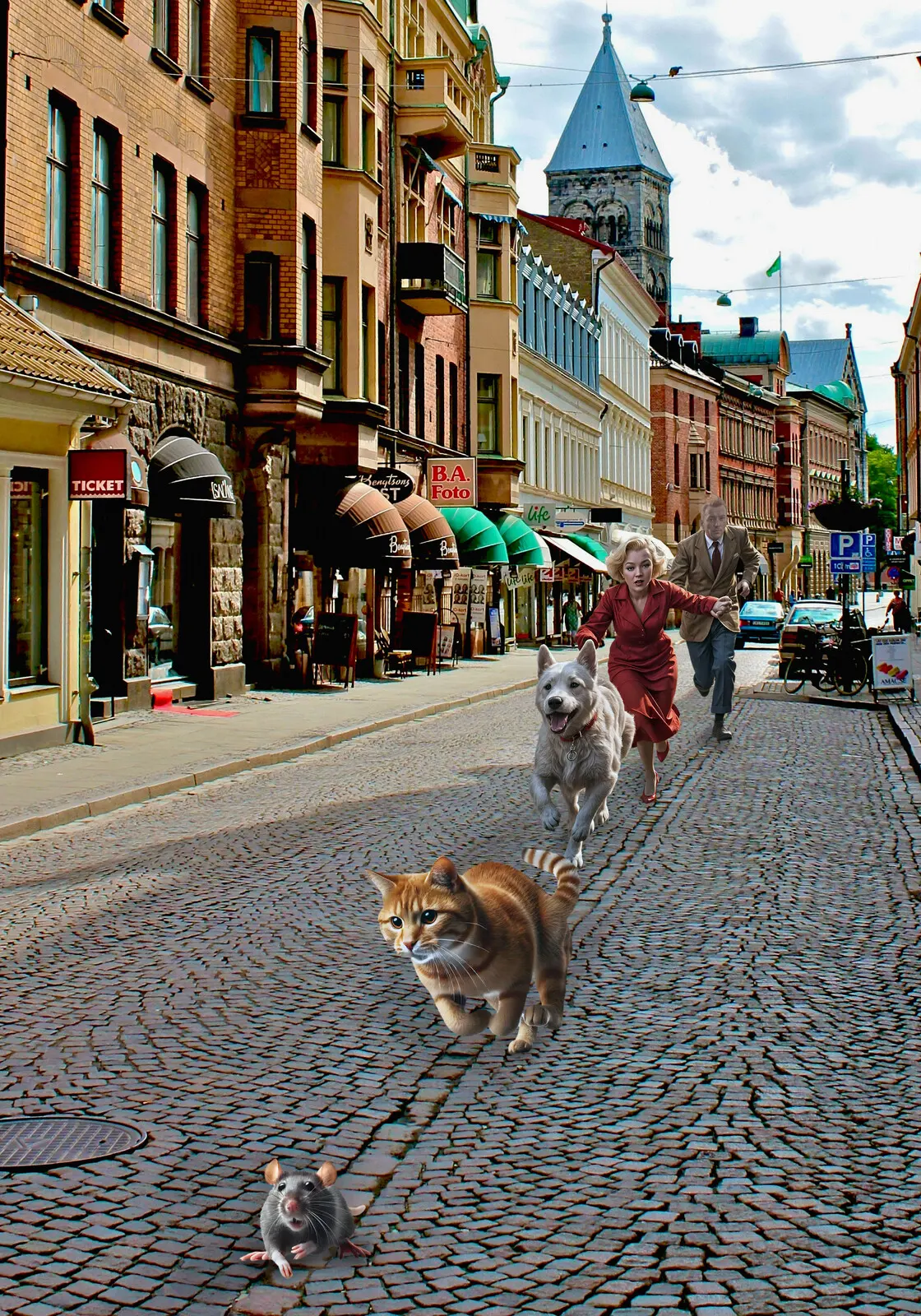
Tintin on Marilyn, Marilyn on Snowy, Snowy on the Cat and the Cat on the Rat in Lund, 2024
Digital
50 x 70 cm
3 200 kr
The Tale of a Boy Who Slept In Late
And All the Trouble He'd Set in Fate
"A sleepy lad lay snug in bed,
While his mother shook her weary head.
"Time for school, you lazy bones!"
She called and grumbled in weary tones.
First, to the rod, she went to plead,
"Dear Rod, help me with what I need.
The boy won't budge, he's deep in slumber—
Give him a tap, a wake-up thunder!"
But the rod replied, "No, not today,
I'll rest here still and not obey."
Then mother to the fire did go,
"Dear fire, please help the boy to show."
But the fire yawned, "I'll stay low,
For waking boys is not my show."
On to the water, Mother pressed,
Yet water, too, declined her quest.
The ox refused to drink the pond,
The butcher stood with arms all fond,
The rope lay slack, and the rat dismayed,
Until, at last, the cat obeyed.
Then came a rush, the wild relay,
A chain unbroken made its way—
The cat on the rat, the rat on the rope,
Until the boy was out, half-hope!
Yet as the clamour spread afar,
A strange pursuit took up the bar.
Tintin with Snowy on the chase,
While Marilyn's laugh filled the space.
The frightened rat, the red tabby cat,
Snowy's bark and Tintin's hat—
All joined the chaos, stirred the street,
In this wild hunt, no small feat!
And as the boy was swept along,
The bustling crowd, a comic throng,
It seemed a sight no one would forget—
A morning late, a town upset!"
Malmö, October 2024
The otherwise peaceful street Stora Gråbrödersgatan in the university town of Lund suddenly erupted into a commotion. It was a hullabaloo that rivalled the Franciscan monks' chase of Giant Finn in the twelfth century. But this time Lund saw a different cast of characters. Tintin, not from a comic strip but very much in the flesh, was dashing after Marilyn Monroe in hot pursuit of Snowy as he raced a red tabby cat. And leading this comical procession? A terrified rat, desperately trying to escape a feline fate.
As the dust settled, I managed to piece together the story behind the ruckus. The Time-traveler Tintin, accompanied by his faithful Snowy, has made a surprise appearance in Lund. But here's the twist: they don't quite match the images from Tintin's books. Instead of the youthful lad and his pint-sized terrier, we have a middle-aged man and a full-grown dog. And Marilyn Monroe? She's here too, on a mission to recover a necklace she mysteriously lost during her time on Earth. But that's a tale for another day.
Now, you might be wondering how Tintin and Marilyn Monroe ended up in Lund together. It's a simple answer, really. Despite Tintin's usual androgynous or aloof demeanor in his adventures, he had a soft spot for women—and they for him. In this case, Tintin gallantly offered to solve the mystery of Marilyn's missing jewellery, using his charm to get closer to the film star.
But enough about their flirtations. It might be worth a quick detour to explain who Giant Finn was to understand the scale of the ruckus.
Long, long ago, way back in the early 1100s, there lived a monk in Lund named Saint Laurentius—or Saint Lars, as people fondly called him. Saint Lars loved to preach to the people of Lund, gathering them on a big open hill known as Helgonabacken, just a bit outside the town. Now, a giant, along with his wife and children, lived under this hill. The giant wasn't too pleased with all the noise, especially as the monk kept drawing crowds to listen to his sermons.
So, one day, the giant grumbled his way up to the top of the hill and asked, "Why are you standing here on my hill, disturbing my family?"
Saint Lars, unfazed, replied that there wasn't a church in Lund where they could gather for services. Hearing this, the giant softened and felt sorry for the monk and the townsfolk. He promised to build them a church—but on one condition: when the church was complete, Saint Lars would have to pluck the sun and the moon from the sky as a gift for the giant's children.
Well, Saint Lars wasn't about to promise such a thing. "No one can pull the sun and moon down from the heavens," he said.
"Fine then," said the giant. "If not the sun and moon, then your eyes will do."
Saint Lars thought long and hard, but his desire for a church was so strong that he agreed to the bargain and promised the giant his eyes. The giant gave a sly grin and added one last twist: "Guess my name before the church is finished, and you may keep your eyes."
And so, the giant began his work. Finn hauled massive stones from the hill Romeleklint and Höör to Lund. Slowly but surely, the mighty church took shape. All the while, Saint Lars wandered around, scratching his head and trying every name he could think of. "Are you Gunnar?" he called out one day. "Or maybe Sture? How about Filip? Magnus?" But the giant just chuckled; none of these names was right.
As the church neared completion, Saint Lars grew more and more anxious. He took long walks to soak in the beauty around him, the forest, the flowers, and the sky, preparing himself for the moment he would lose his eyes. Then, one evening, as he passed by Helgonabacken, he heard a mother sing her children to sleep. It was such a lovely song that he paused to listen. And, just then, he heard the name in the lullaby: "Finn."
"Sleep, little Sölve, sleep, my son dear,
Your father, Finn
Is building high up, right near.
Sleep, little Gerda, fair daughter of mine,
Your father, Finn
Will bring you a gift come nighttime."
"Aha! The giant's name is Finn!" Overjoyed, Saint Lars sprinted down the hill to the church, where Finn was on the roof, placing the last stone. "Finn, Finn, place the last stone in!" he called out.
The giant whipped around, furious. He hurled the last stone and stormed down into the crypt, grabbing a pillar and trying with all his might to bring the church down with him. But all his strength left him instantly, and he turned to stone on the spot—shrinking just a bit in the process, too. To this day, if you venture down into the crypt of Lund Cathedral, you'll find Giant Finn still there, clutching his stone pillar, frozen in time.
While Tintin and Snowy continue their chase, let's dive into another pursuit — how one boy's morning grogginess sparked a chain reaction of epic proportions.
Now, let's delve into another pursuit-how one boy's morning grogginess sparked a chain reaction of epic proportions. The Moral Tale of the Lazy Boy Who Didn't Want to Go to School
Once upon a time, a lazy boy didn't want to go to school. So, his mother went to the Rod and said, "Dear Rod, whip the boy because he doesn't want to go to school." "No," said the Rod without hesitating.
Then the mother went to the Fire and said, "Dear fire, burn the Rod because the Rod doesn't want to whip the boy, and the boy doesn't want to go to school." "No," said the Fire.
Next, the mother went to the Water and asked, "Dear Water, put out the Fire because the Fire doesn't want to burn the Rod. The Rod doesn't want to whip the boy, and the boy doesn't want to go to school." "No," said the Water.
Then the mother went to the ox and said, "Dear ox, drink up the water because the water doesn't want to put out the fire, the fire doesn't want to burn the Rod, the Rod doesn't want to whip the boy, and the boy doesn't want to go to school." "No," said the ox.
The butcher, who stood outside his shop, was next. She politely asked, "Dear butcher, slaughter the ox because the ox doesn't want to drink the water, the water doesn't want to put out the fire, the fire doesn't want to burn the Rod, the Rod doesn't want to whip the boy, and the boy doesn't want to go to school." "No," said the butcher.
She then noticed a lazy rope lying by the roadside. She asked, "Dear rope, tie up the butcher because the butcher doesn't want to slaughter the ox, the ox doesn't want to drink the water, the water doesn't want to put out the fire, the fire doesn't want to burn the Rod, the Rod doesn't want to whip the boy, and the boy doesn't want to go to school." "No," yawned the lazy Rope.
Then she came across a rat and asked, "Dear rat, gnaw through the rope because the rope doesn't want to tie up the butcher, the butcher doesn't want to slaughter the ox, the ox doesn't want to drink the water, the water doesn't want to put out the fire, the fire doesn't want to burn the Rod, the Rod doesn't want to whip the boy, and the boy doesn't want to go to school." "No," said the Rat.
Finally, a bit farther off, a cat had not noticed the Rat. The mother asked respectfully, "Dear cat, eat the rat because the rat doesn't want to gnaw through the rope, the rope doesn't want to tie up the butcher, the butcher doesn't want to slaughter the ox,, the ox doesn't want to drink the water, the water doesn't want to put out the fire, the fire doesn't want to burn the Rod, the Rod doesn't want to whip the boy, and the boy doesn't want to go to school."
"Yes!" said the Cat, but only after the mother offered her a bit of cream. Thus, we learn that rewards may work better than threats and punishment. The story's moral is that cooperation and positive reinforcement can be more effective than coercion and punishment in achieving our goals.
And so it went: the Cat upon the Rat, the Rat upon the Rope, the Rope upon the butcher, the butcher upon the ox, the ox upon the Water, the Water upon the Fire, the Fire upon the Rod, the Rod upon the boy, and off the boy went to school! This story, with its chain reaction of actions, teaches us the importance of motivation and the power of collaboration. It demonstrates that rewards can be more effective than threats and punishment in achieving our goals and that positive change can occur when we work together.
The story highlights how one event triggers a chain reaction, where each participant is compelled to act only when threatened or coerced. This futility of coercion is a stark reminder of the need for more effective methods of persuasion. The Cat's role, sometimes portrayed as willing only if rewarded with cream, subtly suggests the power of incentives. This emphasis on the power of incentives is a hopeful reminder of the potential for positive change.
This strange 'cooperation' among the characters emphasizes the importance of collaboration for effecting change. This stress of working together for change is a powerful call to action. Though, in this case, it's more of a mob ganging up on a lone target, it serves as a reminder of the power of collective action. Cats were once valued for keeping rodents away; perhaps the Cat's central role here reminds us of that.
I've also heard the rhyme referenced in other contexts—such as when someone describes a boss who yells at an employee, then goes home and snaps at their spouse, passing the stress down the line. A wise wife refrained from passing it on to the children or the family dog, merely remarking dryly, "Well, it's like the cat after the rat and the rat after the rope."
For want of a nail is a well-known English proverb and exists in several variants, one of which is attributed to Benjamin Franklin, the American polymath: a leading writer, scientist, inventor, statesman, diplomat, printer, publisher and political philosopher but never held the office of the presidency. He was the governor of Pennsylvania, the first United States ambassador to France and Sweden and the first ever United States Postmaster General.
"For Want of a Nail
For want of a nail, the shoe was lost.
For want of a shoe, the horse was lost.
For want of a horse, the rider was lost.
For want of a rider, the message was lost.
For want of a message, the battle was lost.
For want of a battle, the kingdom was lost.
And all for the want of a horseshoe nail."
A much longer take on this theme is found in the old English tale 'c, also known as 'The Old Woman and Her Pig'. I think this is the closest story to the Swedish proverb in English. There is no idiom as such, but you could say something along the lines of the chain reaction of the story's domino effect. This is how it goes.
"An old woman was sweeping her house when she found a little crooked sixpence. "What," said she, "shall I do with this little sixpence? I will go to the market and buy a little pig." So she bought a little pig, but as she was coming home, she came to a stile, and the piggy would not go over the stile.
She went a little further, and she met a dog. So she said to him, "Dog! Dog! bite pig; piggy won't go over the stile, and I shan't get home till midnight." But the Dog wouldn't. She went a little further, and she met a stick. So she said, "Stick! Stick! beat Dog; Dog won't bite pig; piggy won't get over the stile; and I shan't get home till midnight." But the stick wouldn't.
She had to continue, and then she met a fire. So, she said, "Fire! Fire! burn stick; stick won't beat Dog; Dog won't bite pig; pig won't get over the stile; and I shan't get home till midnight." But the Fire wouldn't.
Of course, she got angry but had to go on. She met some water and said, "Water! Water! quench Fire; Fire won't burn stick; stick won't beat Dog; Dog won't bite pig; pig won't get over the stile; and I shan't get home till midnight." But the Water wouldn't.
Damn Water, but soon she met an ox and commanded the big animal, "Ox! Ox! Drink water; Water won't quench Fire; Fire won't burn stick; stick won't beat Dog; Dog won't bite pig; Pig won't get over the stile; and I shan't get home till midnight." But the ox wouldn't.
She had to walk further and met a butcher outside his shop. "Butcher! Butcher! Kill ox; ox won't drink Water; Water won't quench Fire; Fire won't burn stick; stick won't beat Dog; Dog won't bite pig; pig won't get over the stile; and I shan't get home till midnight," she said in vane because the butcher refused.
She went a little further, met a rope and screamed: 'Rope! Rope! Hang butcher; butcher won't kill ox; ox won't drink Water; Water won't quench Fire; Fire won't burn stick; stick won't beat Dog; Dog won't bite pig; piggy won't get over the stile; and I shan't get home tonight.' But the rope sa bestämy nej!.
The old woman continued and soon met a rat: "Rat! Rat! gnaw the Rope; the Rope won't tie the butcher; the butcher won't kill the ox; the ox won't drink the Water; the Water won't quench the Fire; the Fire won't burn the stick; the stick won't beat the Dog; the Dog won't bite the pig; the piggy won't go over the stile; and I shan't get home tonight." But the Rat wouldn't.
Desperate, she hurried along and soon came across a tabby cat: "Cat! Cat! kill the Rat; the Rat won't gnaw the Rope; the Rope won't tie the butcher; the butcher won't kill the ox; the ox won't drink the Water; the Water won't quench the Fire; the Fire won't burn the stick; the stick won't beat the Dog; the Dog won't bite the pig; the piggy won't go over the stile; and I shan't get home tonight." But the Cat replied, "If you go to the cow in the field and fetch me a saucer of milk, I will kill the rat." So away went the old woman to the cow.
But the cow said to her, "If you will fetch me a handful of hay, I'll give you the milk." The old woman went to a nearby haystack and brought hay to the cow.
As soon as the cow had eaten the hay, the old woman was given milk; she brought the saucer to the Cat.
As soon as the Cat had lapped up the milk, the Cat attacked the Rat; the Rat began to gnaw the Rope; the Rope started to tie the butcher; the butcher began to kill the ox; the ox began to drink the Water; the Water commenced to quench the Fire; the Fire began to burn the stick; the stick began to beat the Dog; the Dog began to bite the pig; the little pig, frightened, jumped over the stile; and so the old woman finally got home that night.
Yet another example of violence breeding violence, and a story that likely rests on many a ruler's bedside table. In a more literary form, it might have been penned by Niccolo Machiavelli or Sun Tzu long before our era. The incident in my image, however, had a much calmer outcome. The Rat slipped into a hole in the building's facade, leaving the Cat empty-handed—but soon enough, the Cat spotted a feline friend and was happily distracted. Meanwhile, Snowy got a scratch behind his ear from Marilyn, who had a fondness for dogs, especially one that let her feel a connection to Tintin, whom she had admired since her teenage years. She was a bit curious to know if he might be gay, as he was never seen with the fairer sex. Over a coffee later, Tintin confided, "For Hergé, my creator, I was always a girl. An androgynous and probably asexual redhead with blue eyes, combining the best of both sexes."
Jörgen Thornberg
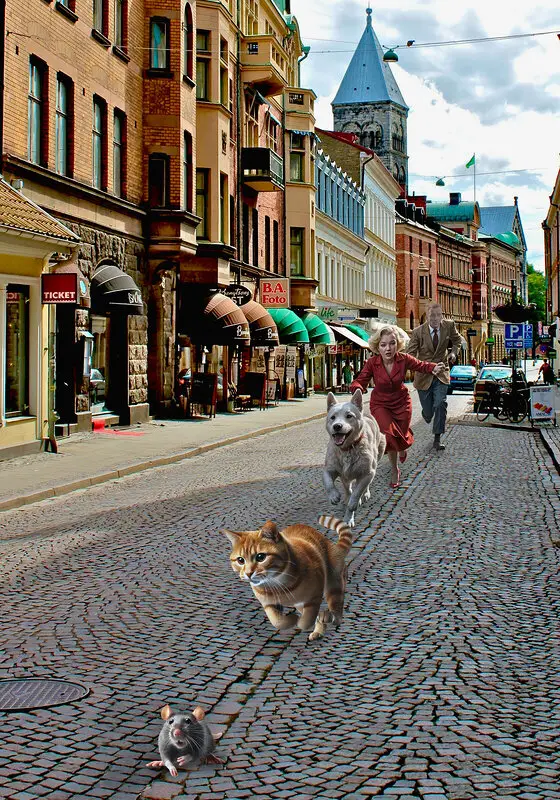
Tintin on Marilyn, Marilyn on Snowy, Snowy on the Cat and the Cat on the Rat in Lund, 2024
Digital
50 x 70 cm
3 200 kr
The Tale of a Boy Who Slept In Late
And All the Trouble He'd Set in Fate
"A sleepy lad lay snug in bed,
While his mother shook her weary head.
"Time for school, you lazy bones!"
She called and grumbled in weary tones.
First, to the rod, she went to plead,
"Dear Rod, help me with what I need.
The boy won't budge, he's deep in slumber—
Give him a tap, a wake-up thunder!"
But the rod replied, "No, not today,
I'll rest here still and not obey."
Then mother to the fire did go,
"Dear fire, please help the boy to show."
But the fire yawned, "I'll stay low,
For waking boys is not my show."
On to the water, Mother pressed,
Yet water, too, declined her quest.
The ox refused to drink the pond,
The butcher stood with arms all fond,
The rope lay slack, and the rat dismayed,
Until, at last, the cat obeyed.
Then came a rush, the wild relay,
A chain unbroken made its way—
The cat on the rat, the rat on the rope,
Until the boy was out, half-hope!
Yet as the clamour spread afar,
A strange pursuit took up the bar.
Tintin with Snowy on the chase,
While Marilyn's laugh filled the space.
The frightened rat, the red tabby cat,
Snowy's bark and Tintin's hat—
All joined the chaos, stirred the street,
In this wild hunt, no small feat!
And as the boy was swept along,
The bustling crowd, a comic throng,
It seemed a sight no one would forget—
A morning late, a town upset!"
Malmö, October 2024
The otherwise peaceful street Stora Gråbrödersgatan in the university town of Lund suddenly erupted into a commotion. It was a hullabaloo that rivalled the Franciscan monks' chase of Giant Finn in the twelfth century. But this time Lund saw a different cast of characters. Tintin, not from a comic strip but very much in the flesh, was dashing after Marilyn Monroe in hot pursuit of Snowy as he raced a red tabby cat. And leading this comical procession? A terrified rat, desperately trying to escape a feline fate.
As the dust settled, I managed to piece together the story behind the ruckus. The Time-traveler Tintin, accompanied by his faithful Snowy, has made a surprise appearance in Lund. But here's the twist: they don't quite match the images from Tintin's books. Instead of the youthful lad and his pint-sized terrier, we have a middle-aged man and a full-grown dog. And Marilyn Monroe? She's here too, on a mission to recover a necklace she mysteriously lost during her time on Earth. But that's a tale for another day.
Now, you might be wondering how Tintin and Marilyn Monroe ended up in Lund together. It's a simple answer, really. Despite Tintin's usual androgynous or aloof demeanor in his adventures, he had a soft spot for women—and they for him. In this case, Tintin gallantly offered to solve the mystery of Marilyn's missing jewellery, using his charm to get closer to the film star.
But enough about their flirtations. It might be worth a quick detour to explain who Giant Finn was to understand the scale of the ruckus.
Long, long ago, way back in the early 1100s, there lived a monk in Lund named Saint Laurentius—or Saint Lars, as people fondly called him. Saint Lars loved to preach to the people of Lund, gathering them on a big open hill known as Helgonabacken, just a bit outside the town. Now, a giant, along with his wife and children, lived under this hill. The giant wasn't too pleased with all the noise, especially as the monk kept drawing crowds to listen to his sermons.
So, one day, the giant grumbled his way up to the top of the hill and asked, "Why are you standing here on my hill, disturbing my family?"
Saint Lars, unfazed, replied that there wasn't a church in Lund where they could gather for services. Hearing this, the giant softened and felt sorry for the monk and the townsfolk. He promised to build them a church—but on one condition: when the church was complete, Saint Lars would have to pluck the sun and the moon from the sky as a gift for the giant's children.
Well, Saint Lars wasn't about to promise such a thing. "No one can pull the sun and moon down from the heavens," he said.
"Fine then," said the giant. "If not the sun and moon, then your eyes will do."
Saint Lars thought long and hard, but his desire for a church was so strong that he agreed to the bargain and promised the giant his eyes. The giant gave a sly grin and added one last twist: "Guess my name before the church is finished, and you may keep your eyes."
And so, the giant began his work. Finn hauled massive stones from the hill Romeleklint and Höör to Lund. Slowly but surely, the mighty church took shape. All the while, Saint Lars wandered around, scratching his head and trying every name he could think of. "Are you Gunnar?" he called out one day. "Or maybe Sture? How about Filip? Magnus?" But the giant just chuckled; none of these names was right.
As the church neared completion, Saint Lars grew more and more anxious. He took long walks to soak in the beauty around him, the forest, the flowers, and the sky, preparing himself for the moment he would lose his eyes. Then, one evening, as he passed by Helgonabacken, he heard a mother sing her children to sleep. It was such a lovely song that he paused to listen. And, just then, he heard the name in the lullaby: "Finn."
"Sleep, little Sölve, sleep, my son dear,
Your father, Finn
Is building high up, right near.
Sleep, little Gerda, fair daughter of mine,
Your father, Finn
Will bring you a gift come nighttime."
"Aha! The giant's name is Finn!" Overjoyed, Saint Lars sprinted down the hill to the church, where Finn was on the roof, placing the last stone. "Finn, Finn, place the last stone in!" he called out.
The giant whipped around, furious. He hurled the last stone and stormed down into the crypt, grabbing a pillar and trying with all his might to bring the church down with him. But all his strength left him instantly, and he turned to stone on the spot—shrinking just a bit in the process, too. To this day, if you venture down into the crypt of Lund Cathedral, you'll find Giant Finn still there, clutching his stone pillar, frozen in time.
While Tintin and Snowy continue their chase, let's dive into another pursuit — how one boy's morning grogginess sparked a chain reaction of epic proportions.
Now, let's delve into another pursuit-how one boy's morning grogginess sparked a chain reaction of epic proportions. The Moral Tale of the Lazy Boy Who Didn't Want to Go to School
Once upon a time, a lazy boy didn't want to go to school. So, his mother went to the Rod and said, "Dear Rod, whip the boy because he doesn't want to go to school." "No," said the Rod without hesitating.
Then the mother went to the Fire and said, "Dear fire, burn the Rod because the Rod doesn't want to whip the boy, and the boy doesn't want to go to school." "No," said the Fire.
Next, the mother went to the Water and asked, "Dear Water, put out the Fire because the Fire doesn't want to burn the Rod. The Rod doesn't want to whip the boy, and the boy doesn't want to go to school." "No," said the Water.
Then the mother went to the ox and said, "Dear ox, drink up the water because the water doesn't want to put out the fire, the fire doesn't want to burn the Rod, the Rod doesn't want to whip the boy, and the boy doesn't want to go to school." "No," said the ox.
The butcher, who stood outside his shop, was next. She politely asked, "Dear butcher, slaughter the ox because the ox doesn't want to drink the water, the water doesn't want to put out the fire, the fire doesn't want to burn the Rod, the Rod doesn't want to whip the boy, and the boy doesn't want to go to school." "No," said the butcher.
She then noticed a lazy rope lying by the roadside. She asked, "Dear rope, tie up the butcher because the butcher doesn't want to slaughter the ox, the ox doesn't want to drink the water, the water doesn't want to put out the fire, the fire doesn't want to burn the Rod, the Rod doesn't want to whip the boy, and the boy doesn't want to go to school." "No," yawned the lazy Rope.
Then she came across a rat and asked, "Dear rat, gnaw through the rope because the rope doesn't want to tie up the butcher, the butcher doesn't want to slaughter the ox, the ox doesn't want to drink the water, the water doesn't want to put out the fire, the fire doesn't want to burn the Rod, the Rod doesn't want to whip the boy, and the boy doesn't want to go to school." "No," said the Rat.
Finally, a bit farther off, a cat had not noticed the Rat. The mother asked respectfully, "Dear cat, eat the rat because the rat doesn't want to gnaw through the rope, the rope doesn't want to tie up the butcher, the butcher doesn't want to slaughter the ox,, the ox doesn't want to drink the water, the water doesn't want to put out the fire, the fire doesn't want to burn the Rod, the Rod doesn't want to whip the boy, and the boy doesn't want to go to school."
"Yes!" said the Cat, but only after the mother offered her a bit of cream. Thus, we learn that rewards may work better than threats and punishment. The story's moral is that cooperation and positive reinforcement can be more effective than coercion and punishment in achieving our goals.
And so it went: the Cat upon the Rat, the Rat upon the Rope, the Rope upon the butcher, the butcher upon the ox, the ox upon the Water, the Water upon the Fire, the Fire upon the Rod, the Rod upon the boy, and off the boy went to school! This story, with its chain reaction of actions, teaches us the importance of motivation and the power of collaboration. It demonstrates that rewards can be more effective than threats and punishment in achieving our goals and that positive change can occur when we work together.
The story highlights how one event triggers a chain reaction, where each participant is compelled to act only when threatened or coerced. This futility of coercion is a stark reminder of the need for more effective methods of persuasion. The Cat's role, sometimes portrayed as willing only if rewarded with cream, subtly suggests the power of incentives. This emphasis on the power of incentives is a hopeful reminder of the potential for positive change.
This strange 'cooperation' among the characters emphasizes the importance of collaboration for effecting change. This stress of working together for change is a powerful call to action. Though, in this case, it's more of a mob ganging up on a lone target, it serves as a reminder of the power of collective action. Cats were once valued for keeping rodents away; perhaps the Cat's central role here reminds us of that.
I've also heard the rhyme referenced in other contexts—such as when someone describes a boss who yells at an employee, then goes home and snaps at their spouse, passing the stress down the line. A wise wife refrained from passing it on to the children or the family dog, merely remarking dryly, "Well, it's like the cat after the rat and the rat after the rope."
For want of a nail is a well-known English proverb and exists in several variants, one of which is attributed to Benjamin Franklin, the American polymath: a leading writer, scientist, inventor, statesman, diplomat, printer, publisher and political philosopher but never held the office of the presidency. He was the governor of Pennsylvania, the first United States ambassador to France and Sweden and the first ever United States Postmaster General.
"For Want of a Nail
For want of a nail, the shoe was lost.
For want of a shoe, the horse was lost.
For want of a horse, the rider was lost.
For want of a rider, the message was lost.
For want of a message, the battle was lost.
For want of a battle, the kingdom was lost.
And all for the want of a horseshoe nail."
A much longer take on this theme is found in the old English tale 'c, also known as 'The Old Woman and Her Pig'. I think this is the closest story to the Swedish proverb in English. There is no idiom as such, but you could say something along the lines of the chain reaction of the story's domino effect. This is how it goes.
"An old woman was sweeping her house when she found a little crooked sixpence. "What," said she, "shall I do with this little sixpence? I will go to the market and buy a little pig." So she bought a little pig, but as she was coming home, she came to a stile, and the piggy would not go over the stile.
She went a little further, and she met a dog. So she said to him, "Dog! Dog! bite pig; piggy won't go over the stile, and I shan't get home till midnight." But the Dog wouldn't. She went a little further, and she met a stick. So she said, "Stick! Stick! beat Dog; Dog won't bite pig; piggy won't get over the stile; and I shan't get home till midnight." But the stick wouldn't.
She had to continue, and then she met a fire. So, she said, "Fire! Fire! burn stick; stick won't beat Dog; Dog won't bite pig; pig won't get over the stile; and I shan't get home till midnight." But the Fire wouldn't.
Of course, she got angry but had to go on. She met some water and said, "Water! Water! quench Fire; Fire won't burn stick; stick won't beat Dog; Dog won't bite pig; pig won't get over the stile; and I shan't get home till midnight." But the Water wouldn't.
Damn Water, but soon she met an ox and commanded the big animal, "Ox! Ox! Drink water; Water won't quench Fire; Fire won't burn stick; stick won't beat Dog; Dog won't bite pig; Pig won't get over the stile; and I shan't get home till midnight." But the ox wouldn't.
She had to walk further and met a butcher outside his shop. "Butcher! Butcher! Kill ox; ox won't drink Water; Water won't quench Fire; Fire won't burn stick; stick won't beat Dog; Dog won't bite pig; pig won't get over the stile; and I shan't get home till midnight," she said in vane because the butcher refused.
She went a little further, met a rope and screamed: 'Rope! Rope! Hang butcher; butcher won't kill ox; ox won't drink Water; Water won't quench Fire; Fire won't burn stick; stick won't beat Dog; Dog won't bite pig; piggy won't get over the stile; and I shan't get home tonight.' But the rope sa bestämy nej!.
The old woman continued and soon met a rat: "Rat! Rat! gnaw the Rope; the Rope won't tie the butcher; the butcher won't kill the ox; the ox won't drink the Water; the Water won't quench the Fire; the Fire won't burn the stick; the stick won't beat the Dog; the Dog won't bite the pig; the piggy won't go over the stile; and I shan't get home tonight." But the Rat wouldn't.
Desperate, she hurried along and soon came across a tabby cat: "Cat! Cat! kill the Rat; the Rat won't gnaw the Rope; the Rope won't tie the butcher; the butcher won't kill the ox; the ox won't drink the Water; the Water won't quench the Fire; the Fire won't burn the stick; the stick won't beat the Dog; the Dog won't bite the pig; the piggy won't go over the stile; and I shan't get home tonight." But the Cat replied, "If you go to the cow in the field and fetch me a saucer of milk, I will kill the rat." So away went the old woman to the cow.
But the cow said to her, "If you will fetch me a handful of hay, I'll give you the milk." The old woman went to a nearby haystack and brought hay to the cow.
As soon as the cow had eaten the hay, the old woman was given milk; she brought the saucer to the Cat.
As soon as the Cat had lapped up the milk, the Cat attacked the Rat; the Rat began to gnaw the Rope; the Rope started to tie the butcher; the butcher began to kill the ox; the ox began to drink the Water; the Water commenced to quench the Fire; the Fire began to burn the stick; the stick began to beat the Dog; the Dog began to bite the pig; the little pig, frightened, jumped over the stile; and so the old woman finally got home that night.
Yet another example of violence breeding violence, and a story that likely rests on many a ruler's bedside table. In a more literary form, it might have been penned by Niccolo Machiavelli or Sun Tzu long before our era. The incident in my image, however, had a much calmer outcome. The Rat slipped into a hole in the building's facade, leaving the Cat empty-handed—but soon enough, the Cat spotted a feline friend and was happily distracted. Meanwhile, Snowy got a scratch behind his ear from Marilyn, who had a fondness for dogs, especially one that let her feel a connection to Tintin, whom she had admired since her teenage years. She was a bit curious to know if he might be gay, as he was never seen with the fairer sex. Over a coffee later, Tintin confided, "For Hergé, my creator, I was always a girl. An androgynous and probably asexual redhead with blue eyes, combining the best of both sexes."
3 200 kr

Jörgen Thornberg
Malmö
Lite om bilder och mig. Translation in English at the end.
Jag är en nyfiken person som ser allt i bilder, även det jag fäster i ord, gärna tillsammans för bakom alla mina bilder finns en berättelse. Till vissa bilder hör en kortare eller längre novell som följer med bilden.
Bilder berättar historier. Jag omges av naturlig skönhet, intressanta människor och historia var jag än går. Jag använder min kamera för att dokumentera världen och blanda det jag ser med vad jag känner för att fånga den dolda magin.
Mina bilder berättar mina historier. Genom mina bilder, tryck och berättelser. Jag bjuder in dig att ta del av dessa berättelser, in i ditt liv och hem och dela min mycket personliga syn på vår värld. Mer än vad ögat ser. Jag tänker i bilder, drömmer och skriver och pratar om dem; följaktligen måste jag också skapa bilder. De blir vad jag ser, inte nödvändigtvis begränsade till verkligheten. Det finns en bild runt varje hörn. Jag hoppas att du kommer att se vad jag såg och gilla det.
Jag är också en skrivande person och till många bilder hör en kortare eller längre essay. Den följer med tavlan, tryckt på fint papper och med en personlig hälsning från mig.
Flertalet bilder startar sin resa i min kamera. Enkelt förklarat beskriver jag bilden jag ser i mitt inre, upplevd eller fantiserad. Bilden uppstår inom mig redan innan jag fått okularet till ögat. På bråkdelen av ett ögonblick ser jag vad jag vill ha och vad som kan göras med bilden. Här skall jag stoppa in en giraff, stålmannen, Titanic eller vad det är min fantasi finner ut. Ännu märkligare är att jag kommer ihåg minnesbilden långt efteråt när det blir tid att skapa verket. Om jag lyckas eller inte, är upp till betraktaren, oftast präglat av en stråk av svart humor – meningen är att man skall bli underhållen. Mina bilder blir ofta en snackis där de hänger.
Jag föredrar bilder som förmedlar ett budskap i flera lager. Vid första anblicken fylld av feel-good, en vacker utsikt, fint väder, solen skiner, blommor på ängen eller vattnet som ligger förrädiskt spegelblankt. I en sådan bild kan jag gömma min egentliga berättelse, mitt förakt för förtryckare och våldsverkare, rasister och fördomsfulla människor - ett gärna återkommande motiv mer eller mindre dolt i det vackra motivet. Jag försöker förena dem i ett gemensamt narrativ.
Bild och formgivning har löpt som en röd tråd genom livet. Fotokonst känns som en värdig final som jag gärna delar med mig.
Min genre är vid som framgår av mina bilder, temat en blandning av pop- och gatukonst i kollage som kan bestå av hundratals lager. Vissa bilder kan ta veckor, andra någon dag innan det är dags att överlämna resultatet till printverkstaden. Fine Art Prints är digitala fotocollage. I dessa kollage sker rivandet, klippandet, pusslandet, målandet, ritandet och sprayningen digitalt. Det jag monterar in kan vara hundratals år gamla bilder som jag omsorgsfullt frilägger så att de ser ut att vara en del av tavlan men också bilder skapade av mig själv efter min egen fantasi. Därefter besöks printstudion och för vissa bilder numrera en limiterad upplaga (oftast 7 exemplar) och signera för hand. Vissa bilder kan köpas i olika format. Det är bara att fråga efter vilka. Gillar man en bild som är 70x100 men inte har plats på väggen, går den kanske att få i 50x70 cm istället. Frågan är fri.
Metoden Giclée eller Fine Art Print som det också kallas är det moderna sättet för framställning av grafisk konst. Villkoret för denna typ av utskrifter är att en högkvalitativ storformatskrivare används med åldersbeständigt färgpigment och konstnärspapper eller i förekommande fall på duk. Pappret som används möter de krav på livslängd som ställs av museer och gallerier. Normalt säljer jag mina bilder oinramade så att den nya ägaren själv kan bestämma hur de skall se ut, med eller utan passepartout färg på ram, med eller utan glas etc..
Under många år ställde jag bara ut på nätet, i valda grupper och på min egen Facebooksida - https://www.facebook.com/jorgen.thornberg.9
Jag finns också på en egen hemsida som tyvärr inte alltid är uppdaterad – https://www.jth.life/ Där kan du också läsa en del av de berättelser som följer med bilden.
UTSTÄLLNINGAR
Luftkastellet, oktober 2022
Konst i Lund, november 2022
Luftkastellet, mars 2023
Engleson Galleri Caroli, april 2023
Hydra, Greece June 2023
Engleson Galleri Caroli, oktober 2023
Toppen, Höllviken december 2023
Luftkastellet, mars 2024
Torups Galleri, mars 2024
Venice, May 2024
Luftkastellet, oktober 2024
Konst i Advent, December 2024
Galleri Engleson, Caroli December 2024
Jäger & Jansson Galleri, april 2025
A bit about pictures and me.
I'm a curious person who sees everything in pictures, even what I express in words, often combining them, for behind all my pictures lies a story. These narratives, some as short as a single image and others as long as a novel, are the heart and soul of my work.
Pictures tell stories. Wherever I go, I'm surrounded by natural beauty, exciting people, and history. I use my camera to document the world and blend what I see with what I feel to capture the hidden magic.
My images tell my stories. Through my pictures, prints, and narratives, I invite you to partake in these stories in your life and home and share my deeply personal perspective of our world. More than meets the eye. I think in pictures, dream, write, and talk about them; consequently, I must create images too. They become what I see, not necessarily confined to reality. There's a picture around every corner. I hope you'll see what I saw and enjoy it.
I'm also a writer, and many images come with a shorter or longer essay. It accompanies the painting, printed on fine paper with my personal greeting.
Many pictures start their journey on my camera. Simply put, I describe the image I see in my mind, experienced or imagined. The image arises within me even before I bring the eyepiece to my eye. In a fraction of a moment, I see what I want and what can be done with the picture. Here, I'll insert a giraffe, Superman, the Titanic, or whatever my imagination conjures up. Even stranger is that I remember the mental image long after it's time to create the work. Whether I succeed is up to the observer, often imbued with a streak of black humour – the aim is to entertain. My pictures usually become a talking point wherever they hang.
I prefer pictures that convey a message in multiple layers. At first glance, they're filled with feel-good vibes, a beautiful view, lovely weather, the sun shining, flowers in the meadow, or the water lying deceptively calm. But beneath this surface beauty, I often conceal a deeper story, a narrative that challenges societal norms or explores the human condition. I invite you to delve into these hidden narratives and discover the layers of meaning within my work.
Picture and design have been a thread running through my life. Photographic art feels like a fitting finale, and I'm happy to share it.
My genre is varied, as seen in my pictures; the theme is a blend of pop and street art in collages that can consist of hundreds of layers. Some images can take weeks, others just a day before it's time to hand over the result to the print workshop. Fine Art Prints are digital photo collages. In these collages, tearing, cutting, puzzling, painting, drawing, and spraying happen digitally. What I insert can be images hundreds of years old that I carefully extract so they appear to be part of the painting, but also images created by myself, now also generated from my imagination. Next, visit the print studio and, for certain images, number a limited edition (usually 7 copies) and sign them by hand. Some images may be available in other formats. Just ask which ones. If you like an image that's 70x100 but doesn't have space on the wall, you might be able to get it in 50x70 cm instead. The question is open.
The Giclée method, or Fine Art Print as it's also called, is the modern way of producing graphic art. This method ensures the highest quality and longevity of the artwork, using a high-quality large-format printer with archival pigment inks and artist paper or, in some cases, canvas. The paper used meets the longevity requirements set by museums and galleries. I sell my pictures unframed, allowing the new owner to personalise their artwork, confident in the lasting value and quality of the piece.
For many years, I only exhibited online, in selected groups, and on my Facebook page - https://www.facebook.com/jorgen.thornberg.9. I also have my website, which unfortunately is not constantly updated - https://www.jth.life/. You can also read some of the stories accompanying the pictures there.
EXHIBITIONS
Luftkastellet, October 2022
Art in Lund, November 2022
Luftkastellet, March 2023
Engleson Gallery Caroli, April 2023
Hydra, Greece June 2023
Engleson Gallery Caroli, October 2023
Toppen, Höllviken December 2023
Luftkastellet, March 2024
Torup Gallery, March 2024
Venice, May 2024
UTSTÄLLNINGAR
Luftkastellet, oktober 2022
Konst i Lund, november 2022
Luftkastellet, mars 2023
Engleson Galleri Caroli, april 2023
Hydra, Greece June 2023
Engleson Galleri Caroli, oktober 2023
Toppen, Höllviken december 2023
Luftkastellet, mars 2024
Torups Galleri, mars 2024
Venice, May 2024
Luftkastellet, October 2024
Konst i Advent, December 2024
Galleri Engleson, Caroli December 2024
Jäger & Jansson Galleri, April 2025
Utbildning
Autodidakt
Medlem i konstnärsförening
Öppna Sinnen
Med i konstrunda
Konstrundan i Skåne
Utställningar
Luftkastellet, October 2022
Art in Lund, November 2022
Luftkastellet, March 2023
Engleson Gallery Caroli, April 2023
Hydra, Greece June 2023
Engleson Gallery Caroli, October 2023
Toppen, Höllviken December 2023
Luftkastellet, March 2024
Torup Gallery, March 2024
Venice, May 2024