Vi använder cookies för att ge dig bästa möjliga upplevelse. Välj vilka cookies du tillåter.
Läs mer i vår integritetspolicy
Jörgen Thornberg
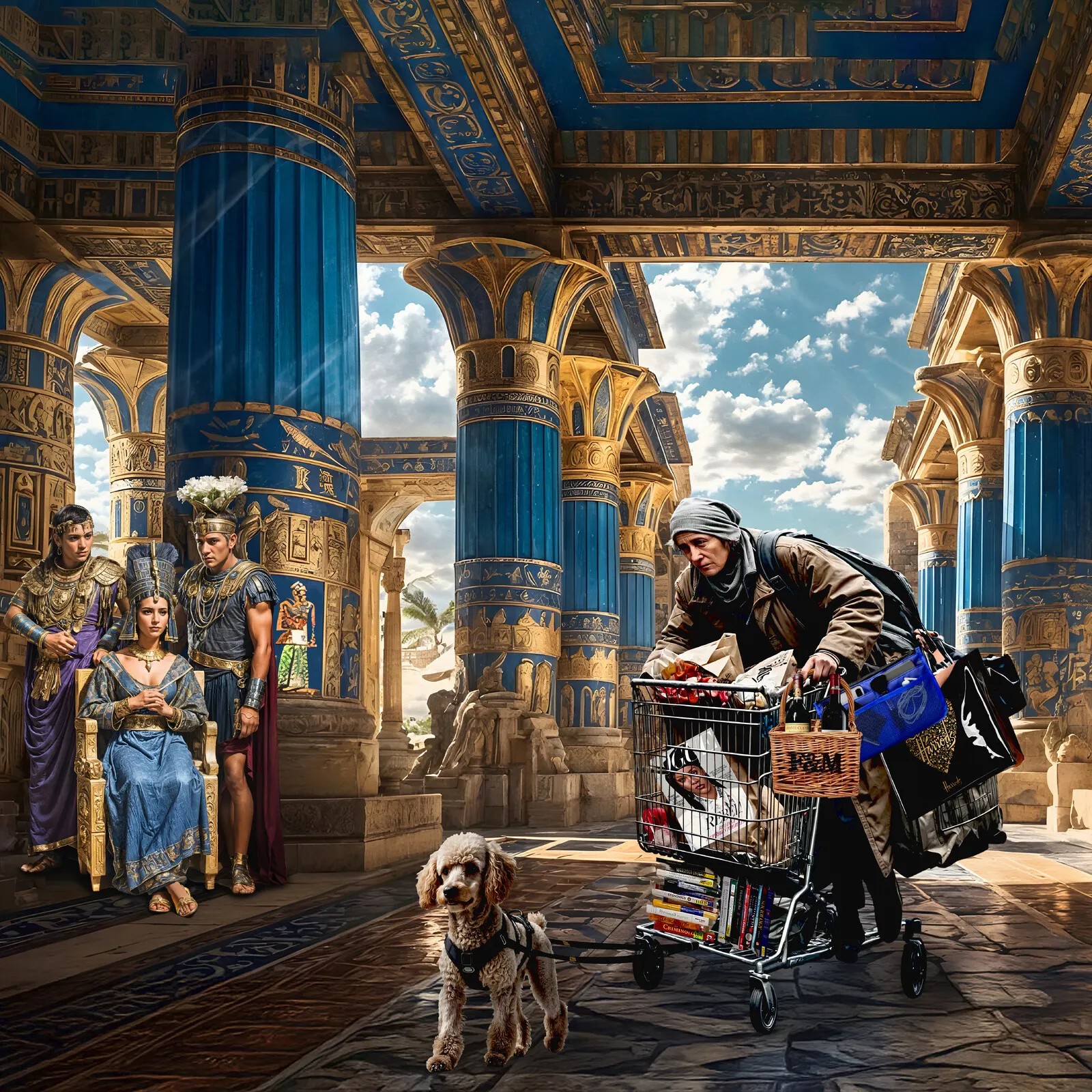
An audience granted with Cleopatra, 2024
Digital
80 x 80 cm
4 500 kr
A Homeless’ Lament
"In shadows deep, where city lights don’t reach,
I wander the streets, a life without a speech.
No roof to shield me, no bed to warm my bones,
Just endless nights on unforgiving stones.
Once I had a name, a place to call my own,
Now I drift unknown, like leaves wind-blown.
A face in crowds that never see my plight,
Invisible by day and lost by night.
The world moves on, with haste and hurried pace,
As I am swept aside, without a trace.
Yet, in my heart, a stubborn ember glows,
For dreams long faded, and love once known.
A weary soul beneath the autumn skies,
My life unfolds in quiet, unheard sighs.
A home is but a memory, faint and torn,
And hope, like warmth, feels foreign and forlorn."
Malmö, October 2024
An Audience Granted with Cleopatra
That Cleopatra would grant an audience to a poor homeless soul isn't so far-fetched, not due to any excessive social goodwill, but because charity used to be an essential element in a monarch's exercise of power. This historical context of charity, where illusions mattered in an era dominated by destitute citizens, sheds light on the evolution of societal structures. There was no middle class; graphically, the upper class consisted of a few hundred stones at the top of the Great Pyramid of Giza, which held 2.3 million blocks—one for each subject. Of course, allowing every citizen entry to the ruler's palace was impossible, but part of the performance was letting one or another occasionally catch a glimpse. Otherwise, people had to settle to admire their ruler from a respectful distance, as the Pharaoh, the demigod, cast gold coins on the crowd. This system continued for thousands of years, and in Rome, the practice of the so-called "cast coin" prevented the mob from revolting and killing the emperor.
Homelessness in today's sense wasn't a concept then, as a large portion of the population lived hand-to-mouth, under the mercy of someone. This societal structure, where one could be a servant or maid, granted a place to sleep and food in exchange for hard labour, shaped the perceptions of homelessness. It was not seen as a societal issue but as a norm, a part of the social fabric.
A modern monarch granting an audience to a homeless person is unheard of. Today, monarchs are more ornamental and only grant audiences to the established elite to bestow a medal or honour. Instead, it is in the borderlands between dream and reality where the occasional Time Traveller can give yesterday's society a chance for humanitarian symbolism. And so, it happened that Cleopatra and a homeless traveller traversed time and space so that Pharaoh could display her palace, hidden under the desert sands behind Alexandria for millennia.
Homelessness can strike anyone. With today's housing shortage in many countries, it has become harder for people to find and keep a home. This societal challenge of homelessness, a situation where a person lacks stable housing in a society where having a home is the norm, is more complex than it seems. The definition of homelessness varies from country to country. Different definitions encompass people lacking a roof over their heads or those with temporary accommodations that do not equate to proper housing. Homelessness is most common in large cities and their suburbs. Having a place to live is a human right, and a UN strategy 1990 describes states' responsibility to address their citizens' housing needs and the right for citizens to expect such action.
Housing shortages are one of our time's biggest challenges. Society must support individuals in asserting their right to housing and tackling the structural causes of homelessness. Nowadays, obtaining your own home is a demanding process. Large groups lack high enough incomes or a flawless financial record for a rental contract, and buying a home is equally out of reach. They are entirely excluded from the current housing market. If they aren't considered to have social issues like addiction or mental health issues, they are classified as "structurally homeless" and receive no help from society. A payment remark is a significant obstacle, which, combined with other issues, can shut someone out of housing.
Lacking a home creates additional problems. It makes it harder to find work, pursue education, raise children with stability, and maintain friendships. Only when all people have housing can we realize the vision of a more humane society—for everyone.
There are many causes of homelessness. Divorce, being fired, or a company downsizing can result in homelessness, as can addiction, family violence, mental illness, or a severe accident, fire, or natural disaster. A lack of affordable housing and long-term poverty are common causes. Poverty is the common thread in most causes of homelessness. Many who are homeless have been poor for a long time, only to lose their income or carry previous debts—something landlords generally avoid in tenants. Others were once better off but ended up poor and homeless due to bad decisions or changing circumstances. A significant group is asylum seekers or migrants, who often struggle to access the job market and thus seem less appealing as tenants.
Being different and not fitting in is another disadvantage in today's streamlined society. Yesterday's eccentrics are now simply inconveniences. Put it bluntly, it's enough to look different or lack charm. Searching for housing is much like applying for a job. It would be best to keep up your appearance; today's property owners want no tenant problems. The surplus of rundown houses from the 1960s, where anyone could get a demolition contract, is a thing of the past. Luxury-renovated apartments have long replaced those homes, and real estate companies operate on key performance indicators, not heart.
The so-called "bag lady" in this scene is deliberately provocative, for it's rare to see a woman pushing a cart full of belongings from the upscale grocery chain Waitrose, especially when the cart's contents hint at a glorious past filled with shopping habits from elite retailers like Harrods and Fortnum & Mason on Piccadilly. The latest issue of *Vogue* suggests her dreams are still alive. Her mini-library tells of an educated woman studying sociology and classical myths. Therefore, her fall from grace is unusually high, though not unheard of.
Fifty-six-year-old Helen McFarley didn't abuse drink or drugs, and she always paid her bills, but now she sleeps in a homeless shelter alone after her landlord sold her rented family home on the private market. Her personal story, one of an ordinary woman who faced extraordinary circumstances, is a stark reminder of the human side of homelessness. She was ordinary but, on a higher level, married to a man with a stable job and a good profession—until one day, everything fell apart. First, her husband died, and it turned out he had left massive gambling debts. The estate ended up in the red. Helen had worked part-time off and on, lacking a stable income. The timing was terrible since such jobs were scarce post-Brexit. Living with them were their daughter and granddaughter, whose lives had been turned upside down by divorce.
Helen's plunge into homelessness, which separated her from her daughter and grandchild and sent them to emergency shelters, has been a horrible, heartbreaking experience. After staying in a hotel room until the money ran out, Helen has spent the past six months at a London-based charity's temporary emergency accommodation centre, where house rules, like those in her daughter's family shelter, don't allow visits.
Fighting back tears on a bench in Kensington Gardens, clutching her grandchild's teddy bear, Helen said, "I have nowhere to meet my grandchildren, so now we meet on the street corners of ultra-fashionable Notting Hill, where I once lived. It's devastating."
"Homelessness," Helen warns, "can happen to anyone. It happened to me. People don't realize it. Until it happens, you think, 'This won't happen to me. I'm happily married, and my husband has a good job, so why worry?' I used to think, 'Definitely not me; why would it knock on my door?' You believe you have everything, not recognizing how fleeting life is. We had friends. They vanished after the funeral when they realized the widow was penniless. Both my parents are dead, and I have no siblings. I feel like the loneliest person on Earth." Her story is hard not to be moved by.
"A shortage of one-bedroom units has made exits from homelessness extraordinarily difficult, blocking access to emergency accommodation by single adults like me who are stuck too long in the temporary system," she continued. Despite her ordeal, Helen hopes she will one day "be able to cook for my grandchild and be a meaningful part of her and my daughter's lives."
Helen could tell me her story because she froze to death the previous winter. The climate crisis is playing tricks on humanity; as temperatures rise on average, extreme weather becomes more frequent. Record cold nights in London took Helen's life. Newly arrived among the stars, she was finally granted her own star, her first home in many years. Such is the irony of eternity. Re-visiting Earth, Helen found her old cart and recreated it for her audience with Cleopatra. In the afterlife, there is a kind of equality; no one is better than anyone else, though the customs remain. Helen had met Cleopatra by chance due to shared interests. In her youth, Helen had studied art history and especially admired the richly decorated tombs of the ancient pharaohs. Cleopatra was one of the speakers at a seminar on Sirius. Imagine there were 200 pharaohs from Egypt's First Dynasty (circa 3100 BCE) to its last, Cleopatra, who died in 30 BCE. Helen and Cleopatra bonded as women, finding plenty to talk about, and eventually, the female Pharaoh offered to show her grand palace, hidden under the desert sands. That was an offer one doesn't refuse.
“Meet you on Earth, dear!” said Cleopatra.
"What should I wear?" asked Helen.
"Come as you were accustomed to on Earth," Cleopatra replied unsuspectingly.
Jörgen Thornberg
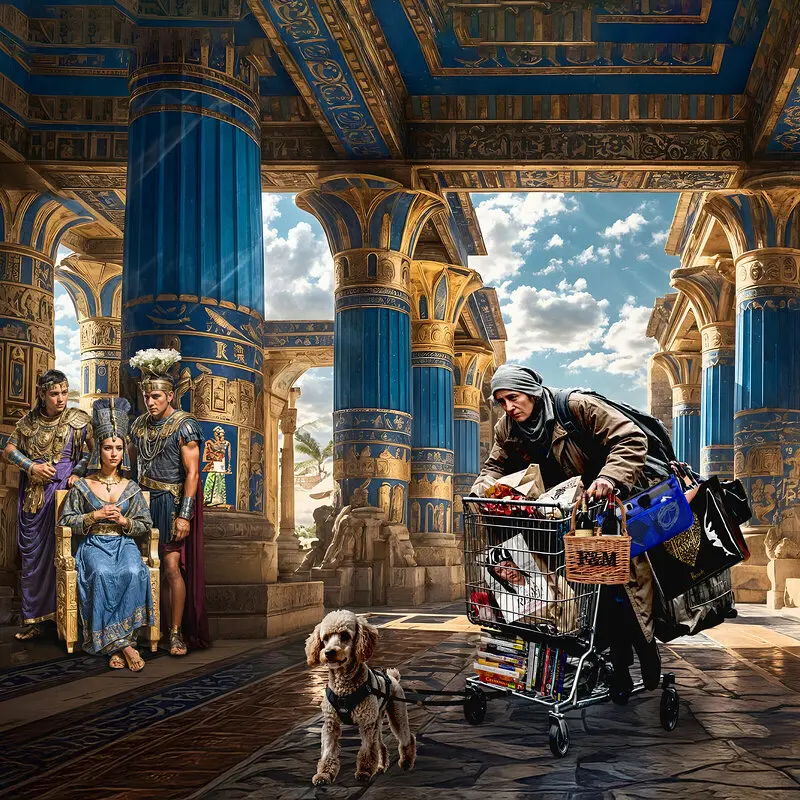
An audience granted with Cleopatra, 2024
Digital
80 x 80 cm
4 500 kr
A Homeless’ Lament
"In shadows deep, where city lights don’t reach,
I wander the streets, a life without a speech.
No roof to shield me, no bed to warm my bones,
Just endless nights on unforgiving stones.
Once I had a name, a place to call my own,
Now I drift unknown, like leaves wind-blown.
A face in crowds that never see my plight,
Invisible by day and lost by night.
The world moves on, with haste and hurried pace,
As I am swept aside, without a trace.
Yet, in my heart, a stubborn ember glows,
For dreams long faded, and love once known.
A weary soul beneath the autumn skies,
My life unfolds in quiet, unheard sighs.
A home is but a memory, faint and torn,
And hope, like warmth, feels foreign and forlorn."
Malmö, October 2024
An Audience Granted with Cleopatra
That Cleopatra would grant an audience to a poor homeless soul isn't so far-fetched, not due to any excessive social goodwill, but because charity used to be an essential element in a monarch's exercise of power. This historical context of charity, where illusions mattered in an era dominated by destitute citizens, sheds light on the evolution of societal structures. There was no middle class; graphically, the upper class consisted of a few hundred stones at the top of the Great Pyramid of Giza, which held 2.3 million blocks—one for each subject. Of course, allowing every citizen entry to the ruler's palace was impossible, but part of the performance was letting one or another occasionally catch a glimpse. Otherwise, people had to settle to admire their ruler from a respectful distance, as the Pharaoh, the demigod, cast gold coins on the crowd. This system continued for thousands of years, and in Rome, the practice of the so-called "cast coin" prevented the mob from revolting and killing the emperor.
Homelessness in today's sense wasn't a concept then, as a large portion of the population lived hand-to-mouth, under the mercy of someone. This societal structure, where one could be a servant or maid, granted a place to sleep and food in exchange for hard labour, shaped the perceptions of homelessness. It was not seen as a societal issue but as a norm, a part of the social fabric.
A modern monarch granting an audience to a homeless person is unheard of. Today, monarchs are more ornamental and only grant audiences to the established elite to bestow a medal or honour. Instead, it is in the borderlands between dream and reality where the occasional Time Traveller can give yesterday's society a chance for humanitarian symbolism. And so, it happened that Cleopatra and a homeless traveller traversed time and space so that Pharaoh could display her palace, hidden under the desert sands behind Alexandria for millennia.
Homelessness can strike anyone. With today's housing shortage in many countries, it has become harder for people to find and keep a home. This societal challenge of homelessness, a situation where a person lacks stable housing in a society where having a home is the norm, is more complex than it seems. The definition of homelessness varies from country to country. Different definitions encompass people lacking a roof over their heads or those with temporary accommodations that do not equate to proper housing. Homelessness is most common in large cities and their suburbs. Having a place to live is a human right, and a UN strategy 1990 describes states' responsibility to address their citizens' housing needs and the right for citizens to expect such action.
Housing shortages are one of our time's biggest challenges. Society must support individuals in asserting their right to housing and tackling the structural causes of homelessness. Nowadays, obtaining your own home is a demanding process. Large groups lack high enough incomes or a flawless financial record for a rental contract, and buying a home is equally out of reach. They are entirely excluded from the current housing market. If they aren't considered to have social issues like addiction or mental health issues, they are classified as "structurally homeless" and receive no help from society. A payment remark is a significant obstacle, which, combined with other issues, can shut someone out of housing.
Lacking a home creates additional problems. It makes it harder to find work, pursue education, raise children with stability, and maintain friendships. Only when all people have housing can we realize the vision of a more humane society—for everyone.
There are many causes of homelessness. Divorce, being fired, or a company downsizing can result in homelessness, as can addiction, family violence, mental illness, or a severe accident, fire, or natural disaster. A lack of affordable housing and long-term poverty are common causes. Poverty is the common thread in most causes of homelessness. Many who are homeless have been poor for a long time, only to lose their income or carry previous debts—something landlords generally avoid in tenants. Others were once better off but ended up poor and homeless due to bad decisions or changing circumstances. A significant group is asylum seekers or migrants, who often struggle to access the job market and thus seem less appealing as tenants.
Being different and not fitting in is another disadvantage in today's streamlined society. Yesterday's eccentrics are now simply inconveniences. Put it bluntly, it's enough to look different or lack charm. Searching for housing is much like applying for a job. It would be best to keep up your appearance; today's property owners want no tenant problems. The surplus of rundown houses from the 1960s, where anyone could get a demolition contract, is a thing of the past. Luxury-renovated apartments have long replaced those homes, and real estate companies operate on key performance indicators, not heart.
The so-called "bag lady" in this scene is deliberately provocative, for it's rare to see a woman pushing a cart full of belongings from the upscale grocery chain Waitrose, especially when the cart's contents hint at a glorious past filled with shopping habits from elite retailers like Harrods and Fortnum & Mason on Piccadilly. The latest issue of *Vogue* suggests her dreams are still alive. Her mini-library tells of an educated woman studying sociology and classical myths. Therefore, her fall from grace is unusually high, though not unheard of.
Fifty-six-year-old Helen McFarley didn't abuse drink or drugs, and she always paid her bills, but now she sleeps in a homeless shelter alone after her landlord sold her rented family home on the private market. Her personal story, one of an ordinary woman who faced extraordinary circumstances, is a stark reminder of the human side of homelessness. She was ordinary but, on a higher level, married to a man with a stable job and a good profession—until one day, everything fell apart. First, her husband died, and it turned out he had left massive gambling debts. The estate ended up in the red. Helen had worked part-time off and on, lacking a stable income. The timing was terrible since such jobs were scarce post-Brexit. Living with them were their daughter and granddaughter, whose lives had been turned upside down by divorce.
Helen's plunge into homelessness, which separated her from her daughter and grandchild and sent them to emergency shelters, has been a horrible, heartbreaking experience. After staying in a hotel room until the money ran out, Helen has spent the past six months at a London-based charity's temporary emergency accommodation centre, where house rules, like those in her daughter's family shelter, don't allow visits.
Fighting back tears on a bench in Kensington Gardens, clutching her grandchild's teddy bear, Helen said, "I have nowhere to meet my grandchildren, so now we meet on the street corners of ultra-fashionable Notting Hill, where I once lived. It's devastating."
"Homelessness," Helen warns, "can happen to anyone. It happened to me. People don't realize it. Until it happens, you think, 'This won't happen to me. I'm happily married, and my husband has a good job, so why worry?' I used to think, 'Definitely not me; why would it knock on my door?' You believe you have everything, not recognizing how fleeting life is. We had friends. They vanished after the funeral when they realized the widow was penniless. Both my parents are dead, and I have no siblings. I feel like the loneliest person on Earth." Her story is hard not to be moved by.
"A shortage of one-bedroom units has made exits from homelessness extraordinarily difficult, blocking access to emergency accommodation by single adults like me who are stuck too long in the temporary system," she continued. Despite her ordeal, Helen hopes she will one day "be able to cook for my grandchild and be a meaningful part of her and my daughter's lives."
Helen could tell me her story because she froze to death the previous winter. The climate crisis is playing tricks on humanity; as temperatures rise on average, extreme weather becomes more frequent. Record cold nights in London took Helen's life. Newly arrived among the stars, she was finally granted her own star, her first home in many years. Such is the irony of eternity. Re-visiting Earth, Helen found her old cart and recreated it for her audience with Cleopatra. In the afterlife, there is a kind of equality; no one is better than anyone else, though the customs remain. Helen had met Cleopatra by chance due to shared interests. In her youth, Helen had studied art history and especially admired the richly decorated tombs of the ancient pharaohs. Cleopatra was one of the speakers at a seminar on Sirius. Imagine there were 200 pharaohs from Egypt's First Dynasty (circa 3100 BCE) to its last, Cleopatra, who died in 30 BCE. Helen and Cleopatra bonded as women, finding plenty to talk about, and eventually, the female Pharaoh offered to show her grand palace, hidden under the desert sands. That was an offer one doesn't refuse.
“Meet you on Earth, dear!” said Cleopatra.
"What should I wear?" asked Helen.
"Come as you were accustomed to on Earth," Cleopatra replied unsuspectingly.
4 500 kr

Jörgen Thornberg
Malmö
Lite om bilder och mig. Translation in English at the end.
Jag är en nyfiken person som ser allt i bilder, även det jag fäster i ord, gärna tillsammans för bakom alla mina bilder finns en berättelse. Till vissa bilder hör en kortare eller längre novell som följer med bilden.
Bilder berättar historier. Jag omges av naturlig skönhet, intressanta människor och historia var jag än går. Jag använder min kamera för att dokumentera världen och blanda det jag ser med vad jag känner för att fånga den dolda magin.
Mina bilder berättar mina historier. Genom mina bilder, tryck och berättelser. Jag bjuder in dig att ta del av dessa berättelser, in i ditt liv och hem och dela min mycket personliga syn på vår värld. Mer än vad ögat ser. Jag tänker i bilder, drömmer och skriver och pratar om dem; följaktligen måste jag också skapa bilder. De blir vad jag ser, inte nödvändigtvis begränsade till verkligheten. Det finns en bild runt varje hörn. Jag hoppas att du kommer att se vad jag såg och gilla det.
Jag är också en skrivande person och till många bilder hör en kortare eller längre essay. Den följer med tavlan, tryckt på fint papper och med en personlig hälsning från mig.
Flertalet bilder startar sin resa i min kamera. Enkelt förklarat beskriver jag bilden jag ser i mitt inre, upplevd eller fantiserad. Bilden uppstår inom mig redan innan jag fått okularet till ögat. På bråkdelen av ett ögonblick ser jag vad jag vill ha och vad som kan göras med bilden. Här skall jag stoppa in en giraff, stålmannen, Titanic eller vad det är min fantasi finner ut. Ännu märkligare är att jag kommer ihåg minnesbilden långt efteråt när det blir tid att skapa verket. Om jag lyckas eller inte, är upp till betraktaren, oftast präglat av en stråk av svart humor – meningen är att man skall bli underhållen. Mina bilder blir ofta en snackis där de hänger.
Jag föredrar bilder som förmedlar ett budskap i flera lager. Vid första anblicken fylld av feel-good, en vacker utsikt, fint väder, solen skiner, blommor på ängen eller vattnet som ligger förrädiskt spegelblankt. I en sådan bild kan jag gömma min egentliga berättelse, mitt förakt för förtryckare och våldsverkare, rasister och fördomsfulla människor - ett gärna återkommande motiv mer eller mindre dolt i det vackra motivet. Jag försöker förena dem i ett gemensamt narrativ.
Bild och formgivning har löpt som en röd tråd genom livet. Fotokonst känns som en värdig final som jag gärna delar med mig.
Min genre är vid som framgår av mina bilder, temat en blandning av pop- och gatukonst i kollage som kan bestå av hundratals lager. Vissa bilder kan ta veckor, andra någon dag innan det är dags att överlämna resultatet till printverkstaden. Fine Art Prints är digitala fotocollage. I dessa kollage sker rivandet, klippandet, pusslandet, målandet, ritandet och sprayningen digitalt. Det jag monterar in kan vara hundratals år gamla bilder som jag omsorgsfullt frilägger så att de ser ut att vara en del av tavlan men också bilder skapade av mig själv efter min egen fantasi. Därefter besöks printstudion och för vissa bilder numrera en limiterad upplaga (oftast 7 exemplar) och signera för hand. Vissa bilder kan köpas i olika format. Det är bara att fråga efter vilka. Gillar man en bild som är 70x100 men inte har plats på väggen, går den kanske att få i 50x70 cm istället. Frågan är fri.
Metoden Giclée eller Fine Art Print som det också kallas är det moderna sättet för framställning av grafisk konst. Villkoret för denna typ av utskrifter är att en högkvalitativ storformatskrivare används med åldersbeständigt färgpigment och konstnärspapper eller i förekommande fall på duk. Pappret som används möter de krav på livslängd som ställs av museer och gallerier. Normalt säljer jag mina bilder oinramade så att den nya ägaren själv kan bestämma hur de skall se ut, med eller utan passepartout färg på ram, med eller utan glas etc..
Under många år ställde jag bara ut på nätet, i valda grupper och på min egen Facebooksida - https://www.facebook.com/jorgen.thornberg.9
Jag finns också på en egen hemsida som tyvärr inte alltid är uppdaterad – https://www.jth.life/ Där kan du också läsa en del av de berättelser som följer med bilden.
UTSTÄLLNINGAR
Luftkastellet, oktober 2022
Konst i Lund, november 2022
Luftkastellet, mars 2023
Engleson Galleri Caroli, april 2023
Hydra, Greece June 2023
Engleson Galleri Caroli, oktober 2023
Toppen, Höllviken december 2023
Luftkastellet, mars 2024
Torups Galleri, mars 2024
Venice, May 2024
Luftkastellet, oktober 2024
Konst i Advent, December 2024
Galleri Engleson, Caroli December 2024
Jäger & Jansson Galleri, april 2025
A bit about pictures and me.
I'm a curious person who sees everything in pictures, even what I express in words, often combining them, for behind all my pictures lies a story. These narratives, some as short as a single image and others as long as a novel, are the heart and soul of my work.
Pictures tell stories. Wherever I go, I'm surrounded by natural beauty, exciting people, and history. I use my camera to document the world and blend what I see with what I feel to capture the hidden magic.
My images tell my stories. Through my pictures, prints, and narratives, I invite you to partake in these stories in your life and home and share my deeply personal perspective of our world. More than meets the eye. I think in pictures, dream, write, and talk about them; consequently, I must create images too. They become what I see, not necessarily confined to reality. There's a picture around every corner. I hope you'll see what I saw and enjoy it.
I'm also a writer, and many images come with a shorter or longer essay. It accompanies the painting, printed on fine paper with my personal greeting.
Many pictures start their journey on my camera. Simply put, I describe the image I see in my mind, experienced or imagined. The image arises within me even before I bring the eyepiece to my eye. In a fraction of a moment, I see what I want and what can be done with the picture. Here, I'll insert a giraffe, Superman, the Titanic, or whatever my imagination conjures up. Even stranger is that I remember the mental image long after it's time to create the work. Whether I succeed is up to the observer, often imbued with a streak of black humour – the aim is to entertain. My pictures usually become a talking point wherever they hang.
I prefer pictures that convey a message in multiple layers. At first glance, they're filled with feel-good vibes, a beautiful view, lovely weather, the sun shining, flowers in the meadow, or the water lying deceptively calm. But beneath this surface beauty, I often conceal a deeper story, a narrative that challenges societal norms or explores the human condition. I invite you to delve into these hidden narratives and discover the layers of meaning within my work.
Picture and design have been a thread running through my life. Photographic art feels like a fitting finale, and I'm happy to share it.
My genre is varied, as seen in my pictures; the theme is a blend of pop and street art in collages that can consist of hundreds of layers. Some images can take weeks, others just a day before it's time to hand over the result to the print workshop. Fine Art Prints are digital photo collages. In these collages, tearing, cutting, puzzling, painting, drawing, and spraying happen digitally. What I insert can be images hundreds of years old that I carefully extract so they appear to be part of the painting, but also images created by myself, now also generated from my imagination. Next, visit the print studio and, for certain images, number a limited edition (usually 7 copies) and sign them by hand. Some images may be available in other formats. Just ask which ones. If you like an image that's 70x100 but doesn't have space on the wall, you might be able to get it in 50x70 cm instead. The question is open.
The Giclée method, or Fine Art Print as it's also called, is the modern way of producing graphic art. This method ensures the highest quality and longevity of the artwork, using a high-quality large-format printer with archival pigment inks and artist paper or, in some cases, canvas. The paper used meets the longevity requirements set by museums and galleries. I sell my pictures unframed, allowing the new owner to personalise their artwork, confident in the lasting value and quality of the piece.
For many years, I only exhibited online, in selected groups, and on my Facebook page - https://www.facebook.com/jorgen.thornberg.9. I also have my website, which unfortunately is not constantly updated - https://www.jth.life/. You can also read some of the stories accompanying the pictures there.
EXHIBITIONS
Luftkastellet, October 2022
Art in Lund, November 2022
Luftkastellet, March 2023
Engleson Gallery Caroli, April 2023
Hydra, Greece June 2023
Engleson Gallery Caroli, October 2023
Toppen, Höllviken December 2023
Luftkastellet, March 2024
Torup Gallery, March 2024
Venice, May 2024
UTSTÄLLNINGAR
Luftkastellet, oktober 2022
Konst i Lund, november 2022
Luftkastellet, mars 2023
Engleson Galleri Caroli, april 2023
Hydra, Greece June 2023
Engleson Galleri Caroli, oktober 2023
Toppen, Höllviken december 2023
Luftkastellet, mars 2024
Torups Galleri, mars 2024
Venice, May 2024
Luftkastellet, October 2024
Konst i Advent, December 2024
Galleri Engleson, Caroli December 2024
Jäger & Jansson Galleri, April 2025
Utbildning
Autodidakt
Medlem i konstnärsförening
Öppna Sinnen
Med i konstrunda
Konstrundan i Skåne
Utställningar
Luftkastellet, October 2022
Art in Lund, November 2022
Luftkastellet, March 2023
Engleson Gallery Caroli, April 2023
Hydra, Greece June 2023
Engleson Gallery Caroli, October 2023
Toppen, Höllviken December 2023
Luftkastellet, March 2024
Torup Gallery, March 2024
Venice, May 2024