Vi använder cookies för att ge dig bästa möjliga upplevelse. Välj vilka cookies du tillåter.
Läs mer i vår integritetspolicy
Jörgen Thornberg
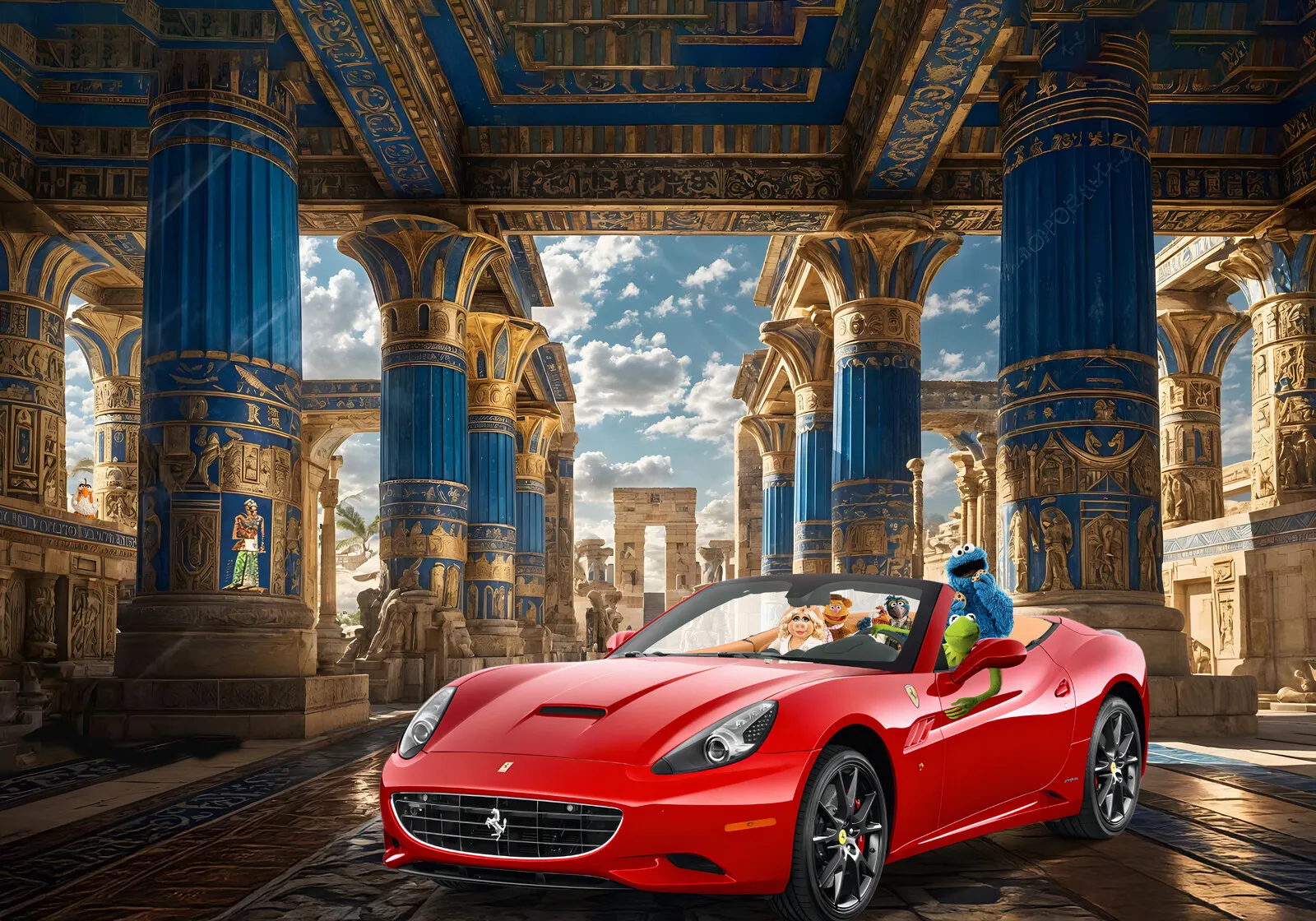
Green over heels - When a Ferrari Got an Audience with Cleopatra, 2024
Digital
70 x 50 cm
3 200 kr
Green, Pink and Royal Blue
"In Cleopatra's palace, grand and wide,
Kermit arrived with a heart open wide.
He saw Cleopatra, regal and fair,
And Miss Piggy beside him with a jealous glare.
A triangle tangled, the scene grew tense,
Miss Piggy's eyes sharp with immense offense.
For though Kermit was green, his blush was clear—
A frog head over heels for a queen so near.
Miss Piggy plotted, with a sly, quick mind,
She slipped a tack on the throne behind.
She grinned with triumph, pleased and sly,
For jealousy's flames had sparked her try.
Yet Cleopatra, timeless, wise and serene,
Felt no pain, just mildly annoyed by the scene.
A Time-traveller's soul immune to such stings,
Not fooled by pins or petty things.
Kermit looked on, his heart in a whirl,
Torn between two—the queen and his girl.
But peace returned as Piggy took his hand,
And Kermit revved his Ferrari so grand.
With a flash of red, they left the starry hall,
Cleopatra waved, amused by it all.
So off they sped, love renewed, delight,
Back to their star, through the sparkling night.
"
Malmö, October 2024
It's doubtful Cleopatra knew anything about a particular frog or his diva pig girlfriend, but she certainly couldn't have missed the fire-red Italian prestige racer making waves through eternity. Plenty of men among the stars were dreaming of one, after all. Sure, you *could* drive a car down the Milky Way, though the distances are daunting. A wormhole is a far better bet than flooring a Ferrari. But one starry-eyed soul who brought his car to the cosmos was Kermit the Frog. As an erratic driver with a flair for dramatic entrances, Kermit was known to show up in his blazing red Ferrari in all the wrong places. In any case, Kermit was head over heels for Cleopatra—or as it might be put in this instance, green over heels.
Kermit's driving style was as carefree as reckless, all to impress his beloved Miss Piggy. Miss Piggy is a diva of a pig who firmly believes she's a superstar. Madly is in love with Kermit the Frog; she's also a karate expert and queen of the theatrical. It was she who insisted on meeting Cleopatra. They had plenty in common, and against all odds, the two divas hit it off splendidly, making the audience a memorable affair. It was, incidentally, the first time a Ferrari had ever pulled up in Cleopatra's majestic palace, skidding to a show-stopping halt. Afterwards, Miss Piggy quickly claimed Cleopatra's beauty was overrated, asserting her charms were far superior. Since Elizabeth Taylor's iconic portrayal of Cleopatra in the 1963 film, the queen's beauty has been the stuff of legends. But Cleopatra's true allure lay less in her looks and more in her influence. Not that she lacked appeal—power is always captivating, and Egypt was a coveted prize even more than the queen.
Miss Piggy went on to become a mainstay on 'The Muppet Show,' her fame at one point eclipsing Cleopatra's. Meanwhile, her secret love interest, Kermit the Frog, who most notably hosted *The Muppet Show* and made appearances on 'Sesame Street,' commercials, and public service announcements, became the world's most famous frog. Cleopatra's charm was too much for Kermit to resist, and he fell for it—green over heels.
Roman propaganda loved painting Cleopatra as a scandalous seductress who supposedly used her allure as a potent political tool. But let's not overlook what was likely her actual claim to fame: an impressive intellect rather than a dazzling appearance. Cleopatra was not lightweight; she spoke a dozen languages and was schooled in mathematics, philosophy, oratory, and astronomy. Egyptian sources later celebrated her as a ruler "who elevated the ranks of scholars and enjoyed their company." As for her looks? Turns out she may not have been the stunning beauty often imagined. Coins from the time depict her with a rather rugged face—a robust and hooked nose. Some historians suggest she intentionally leaned into these features to convey authority and power. Plutarch, an ancient writer, dryly observed that Cleopatra's beauty was "not altogether incomparable"; her voice, smooth and captivating, and her "irresistible charm" left an indelible impression.
Cleopatra's lineage was as intricate as her life. The Ptolemaic dynasty, like many royal houses, practiced Intra-family marriage to maintain the 'purity' of the bloodline. Over a dozen of her ancestors married their cousins or siblings, and her parents were likely siblings. Cleopatra herself married her two younger brothers in succession, each serving as her ceremonial spouse and co-ruler at different times.
But family ties did not guarantee harmonious relationships. Power struggles and murder plots were as much a Ptolemaic tradition as intermarriage. Cleopatra's first sibling-husband, Ptolemy XIII, expelled her from Egypt in a bid to seize the throne. The two later clashed in a civil war, but Cleopatra gained the upper hand by allying with Julius Caesar. After a decisive victory, Ptolemy drowned in the Nile while fleeing battle. Cleopatra then married her youngest brother, Ptolemy XIV, only to later have him killed, likely to secure her son Caesarion as her co-ruler. She also arranged for the death of her sister Arsinoe, whom she saw as a rival.
One of Cleopatra's most legendary moments centres on her unforgettable entrance to meet Caesar. In 48 B.C., she famously arranged to be smuggled past her brother's watchful guards, rolled up in a carpet (or, as some sources suggest, a linen sack). When unfurled in Caesar's quarters, Cleopatra emerged in full royal splendour, leaving him thoroughly captivated. The bold gesture won him over instantly, and the two became political allies and lovers. Similarly, when she met Mark Antony in 41 B.C., she arrived on a golden barge adorned with purple sails and silver oars and dressed as Aphrodite, surrounded by attendants as cupids. Antony, who saw himself as Dionysus reincarnate, was captivated.
Cleopatra wasn't just Egypt-bound; she spent time in Rome, living there during Caesar's rule from 46 B.C. The sight of her and their son Caesarion caused a stir. Many Romans were scandalized, especially when Caesar displayed a gilded statue of her in the temple of Venus. When Caesar was assassinated, Cleopatra returned to Egypt. Still, her influence lingered—her exotic style inspired a Roman "Cleopatra look" that would later cause historians to misidentify statues as her likeness.
Cleopatra and Mark Antony were no doubt political allies but also lively companions. The couple famously formed a drinking club called "The Inimitable Livers." Together, they indulged in nightly revelries, elaborate games, and even mischievous pranks around Alexandria, often going incognito to surprise unsuspecting residents. Cleopatra's alliance with Antony provided crucial support to maintain Egypt's independence, yet it ultimately brought the two into conflict with Rome. Antony's rival, Octavian, seized the opportunity to paint him as a traitor bewitched by Cleopatra. By 32 B.C., the Roman Senate had formally declared war on her. Cleopatra commanded several Egyptian warships alongside Antony's fleet at the decisive Battle of Actium, but Octavian's forces outmanoeuvred them. The couple retreated to Egypt after the defeat to make their final stand.
Octavian, Antony's formidable rival, crafted a narrative that cast Antony as a Roman turncoat, hopelessly ensnared by Cleopatra's charms. The strategy was a triumph of propaganda, and by 32 B.C., the Roman Senate had officially declared war—not on Antony, but on Cleopatra herself. Cleopatra took command of her Egyptian ships at the ensuing Battle of Actium, joining Antony's fleet in a last stand against Octavian's mighty navy. But the odds were stacked against them. Routed and defeated, the two fled to Egypt, where their love and legacy would face their final chapter.
Already fit for legend, Cleopatra's story found its way to Hollywood in one of the grandest—and most chaotic—productions of all time: *Cleopatra* (1963), with Elizabeth Taylor in the lead. Like Cleopatra herself, the film's production was lavish to excess, plagued by obstacles that eventually pushed its cost to a jaw-dropping $44 million, the highest of any movie to date and nearly a death blow to its studio.
And then, the final mystery: Cleopatra's death. We've all heard of the fateful asp, but ancient sources provide competing theories. Some claim she hid poison in a hair comb, others that she applied a lethal ointment. Even Plutarch raised his hands, writing, "What truly took place, no one knows." Whether by asp, toxin, or something else altogether, Cleopatra's death sealed her fate as a historical enigma, a queen whose intellect, allure, and unforgettable life story cast a shadow across the centuries.
Jörgen Thornberg
Green over heels - When a Ferrari Got an Audience with Cleopatra, 2024
Digital
70 x 50 cm
3 200 kr
Green, Pink and Royal Blue
"In Cleopatra's palace, grand and wide,
Kermit arrived with a heart open wide.
He saw Cleopatra, regal and fair,
And Miss Piggy beside him with a jealous glare.
A triangle tangled, the scene grew tense,
Miss Piggy's eyes sharp with immense offense.
For though Kermit was green, his blush was clear—
A frog head over heels for a queen so near.
Miss Piggy plotted, with a sly, quick mind,
She slipped a tack on the throne behind.
She grinned with triumph, pleased and sly,
For jealousy's flames had sparked her try.
Yet Cleopatra, timeless, wise and serene,
Felt no pain, just mildly annoyed by the scene.
A Time-traveller's soul immune to such stings,
Not fooled by pins or petty things.
Kermit looked on, his heart in a whirl,
Torn between two—the queen and his girl.
But peace returned as Piggy took his hand,
And Kermit revved his Ferrari so grand.
With a flash of red, they left the starry hall,
Cleopatra waved, amused by it all.
So off they sped, love renewed, delight,
Back to their star, through the sparkling night.
"
Malmö, October 2024
It's doubtful Cleopatra knew anything about a particular frog or his diva pig girlfriend, but she certainly couldn't have missed the fire-red Italian prestige racer making waves through eternity. Plenty of men among the stars were dreaming of one, after all. Sure, you *could* drive a car down the Milky Way, though the distances are daunting. A wormhole is a far better bet than flooring a Ferrari. But one starry-eyed soul who brought his car to the cosmos was Kermit the Frog. As an erratic driver with a flair for dramatic entrances, Kermit was known to show up in his blazing red Ferrari in all the wrong places. In any case, Kermit was head over heels for Cleopatra—or as it might be put in this instance, green over heels.
Kermit's driving style was as carefree as reckless, all to impress his beloved Miss Piggy. Miss Piggy is a diva of a pig who firmly believes she's a superstar. Madly is in love with Kermit the Frog; she's also a karate expert and queen of the theatrical. It was she who insisted on meeting Cleopatra. They had plenty in common, and against all odds, the two divas hit it off splendidly, making the audience a memorable affair. It was, incidentally, the first time a Ferrari had ever pulled up in Cleopatra's majestic palace, skidding to a show-stopping halt. Afterwards, Miss Piggy quickly claimed Cleopatra's beauty was overrated, asserting her charms were far superior. Since Elizabeth Taylor's iconic portrayal of Cleopatra in the 1963 film, the queen's beauty has been the stuff of legends. But Cleopatra's true allure lay less in her looks and more in her influence. Not that she lacked appeal—power is always captivating, and Egypt was a coveted prize even more than the queen.
Miss Piggy went on to become a mainstay on 'The Muppet Show,' her fame at one point eclipsing Cleopatra's. Meanwhile, her secret love interest, Kermit the Frog, who most notably hosted *The Muppet Show* and made appearances on 'Sesame Street,' commercials, and public service announcements, became the world's most famous frog. Cleopatra's charm was too much for Kermit to resist, and he fell for it—green over heels.
Roman propaganda loved painting Cleopatra as a scandalous seductress who supposedly used her allure as a potent political tool. But let's not overlook what was likely her actual claim to fame: an impressive intellect rather than a dazzling appearance. Cleopatra was not lightweight; she spoke a dozen languages and was schooled in mathematics, philosophy, oratory, and astronomy. Egyptian sources later celebrated her as a ruler "who elevated the ranks of scholars and enjoyed their company." As for her looks? Turns out she may not have been the stunning beauty often imagined. Coins from the time depict her with a rather rugged face—a robust and hooked nose. Some historians suggest she intentionally leaned into these features to convey authority and power. Plutarch, an ancient writer, dryly observed that Cleopatra's beauty was "not altogether incomparable"; her voice, smooth and captivating, and her "irresistible charm" left an indelible impression.
Cleopatra's lineage was as intricate as her life. The Ptolemaic dynasty, like many royal houses, practiced Intra-family marriage to maintain the 'purity' of the bloodline. Over a dozen of her ancestors married their cousins or siblings, and her parents were likely siblings. Cleopatra herself married her two younger brothers in succession, each serving as her ceremonial spouse and co-ruler at different times.
But family ties did not guarantee harmonious relationships. Power struggles and murder plots were as much a Ptolemaic tradition as intermarriage. Cleopatra's first sibling-husband, Ptolemy XIII, expelled her from Egypt in a bid to seize the throne. The two later clashed in a civil war, but Cleopatra gained the upper hand by allying with Julius Caesar. After a decisive victory, Ptolemy drowned in the Nile while fleeing battle. Cleopatra then married her youngest brother, Ptolemy XIV, only to later have him killed, likely to secure her son Caesarion as her co-ruler. She also arranged for the death of her sister Arsinoe, whom she saw as a rival.
One of Cleopatra's most legendary moments centres on her unforgettable entrance to meet Caesar. In 48 B.C., she famously arranged to be smuggled past her brother's watchful guards, rolled up in a carpet (or, as some sources suggest, a linen sack). When unfurled in Caesar's quarters, Cleopatra emerged in full royal splendour, leaving him thoroughly captivated. The bold gesture won him over instantly, and the two became political allies and lovers. Similarly, when she met Mark Antony in 41 B.C., she arrived on a golden barge adorned with purple sails and silver oars and dressed as Aphrodite, surrounded by attendants as cupids. Antony, who saw himself as Dionysus reincarnate, was captivated.
Cleopatra wasn't just Egypt-bound; she spent time in Rome, living there during Caesar's rule from 46 B.C. The sight of her and their son Caesarion caused a stir. Many Romans were scandalized, especially when Caesar displayed a gilded statue of her in the temple of Venus. When Caesar was assassinated, Cleopatra returned to Egypt. Still, her influence lingered—her exotic style inspired a Roman "Cleopatra look" that would later cause historians to misidentify statues as her likeness.
Cleopatra and Mark Antony were no doubt political allies but also lively companions. The couple famously formed a drinking club called "The Inimitable Livers." Together, they indulged in nightly revelries, elaborate games, and even mischievous pranks around Alexandria, often going incognito to surprise unsuspecting residents. Cleopatra's alliance with Antony provided crucial support to maintain Egypt's independence, yet it ultimately brought the two into conflict with Rome. Antony's rival, Octavian, seized the opportunity to paint him as a traitor bewitched by Cleopatra. By 32 B.C., the Roman Senate had formally declared war on her. Cleopatra commanded several Egyptian warships alongside Antony's fleet at the decisive Battle of Actium, but Octavian's forces outmanoeuvred them. The couple retreated to Egypt after the defeat to make their final stand.
Octavian, Antony's formidable rival, crafted a narrative that cast Antony as a Roman turncoat, hopelessly ensnared by Cleopatra's charms. The strategy was a triumph of propaganda, and by 32 B.C., the Roman Senate had officially declared war—not on Antony, but on Cleopatra herself. Cleopatra took command of her Egyptian ships at the ensuing Battle of Actium, joining Antony's fleet in a last stand against Octavian's mighty navy. But the odds were stacked against them. Routed and defeated, the two fled to Egypt, where their love and legacy would face their final chapter.
Already fit for legend, Cleopatra's story found its way to Hollywood in one of the grandest—and most chaotic—productions of all time: *Cleopatra* (1963), with Elizabeth Taylor in the lead. Like Cleopatra herself, the film's production was lavish to excess, plagued by obstacles that eventually pushed its cost to a jaw-dropping $44 million, the highest of any movie to date and nearly a death blow to its studio.
And then, the final mystery: Cleopatra's death. We've all heard of the fateful asp, but ancient sources provide competing theories. Some claim she hid poison in a hair comb, others that she applied a lethal ointment. Even Plutarch raised his hands, writing, "What truly took place, no one knows." Whether by asp, toxin, or something else altogether, Cleopatra's death sealed her fate as a historical enigma, a queen whose intellect, allure, and unforgettable life story cast a shadow across the centuries.
3 200 kr

Jörgen Thornberg
Malmö
Lite om bilder och mig. Translation in English at the end.
Jag är en nyfiken person som ser allt i bilder, även det jag fäster i ord, gärna tillsammans för bakom alla mina bilder finns en berättelse. Till vissa bilder hör en kortare eller längre novell som följer med bilden.
Bilder berättar historier. Jag omges av naturlig skönhet, intressanta människor och historia var jag än går. Jag använder min kamera för att dokumentera världen och blanda det jag ser med vad jag känner för att fånga den dolda magin.
Mina bilder berättar mina historier. Genom mina bilder, tryck och berättelser. Jag bjuder in dig att ta del av dessa berättelser, in i ditt liv och hem och dela min mycket personliga syn på vår värld. Mer än vad ögat ser. Jag tänker i bilder, drömmer och skriver och pratar om dem; följaktligen måste jag också skapa bilder. De blir vad jag ser, inte nödvändigtvis begränsade till verkligheten. Det finns en bild runt varje hörn. Jag hoppas att du kommer att se vad jag såg och gilla det.
Jag är också en skrivande person och till många bilder hör en kortare eller längre essay. Den följer med tavlan, tryckt på fint papper och med en personlig hälsning från mig.
Flertalet bilder startar sin resa i min kamera. Enkelt förklarat beskriver jag bilden jag ser i mitt inre, upplevd eller fantiserad. Bilden uppstår inom mig redan innan jag fått okularet till ögat. På bråkdelen av ett ögonblick ser jag vad jag vill ha och vad som kan göras med bilden. Här skall jag stoppa in en giraff, stålmannen, Titanic eller vad det är min fantasi finner ut. Ännu märkligare är att jag kommer ihåg minnesbilden långt efteråt när det blir tid att skapa verket. Om jag lyckas eller inte, är upp till betraktaren, oftast präglat av en stråk av svart humor – meningen är att man skall bli underhållen. Mina bilder blir ofta en snackis där de hänger.
Jag föredrar bilder som förmedlar ett budskap i flera lager. Vid första anblicken fylld av feel-good, en vacker utsikt, fint väder, solen skiner, blommor på ängen eller vattnet som ligger förrädiskt spegelblankt. I en sådan bild kan jag gömma min egentliga berättelse, mitt förakt för förtryckare och våldsverkare, rasister och fördomsfulla människor - ett gärna återkommande motiv mer eller mindre dolt i det vackra motivet. Jag försöker förena dem i ett gemensamt narrativ.
Bild och formgivning har löpt som en röd tråd genom livet. Fotokonst känns som en värdig final som jag gärna delar med mig.
Min genre är vid som framgår av mina bilder, temat en blandning av pop- och gatukonst i kollage som kan bestå av hundratals lager. Vissa bilder kan ta veckor, andra någon dag innan det är dags att överlämna resultatet till printverkstaden. Fine Art Prints är digitala fotocollage. I dessa kollage sker rivandet, klippandet, pusslandet, målandet, ritandet och sprayningen digitalt. Det jag monterar in kan vara hundratals år gamla bilder som jag omsorgsfullt frilägger så att de ser ut att vara en del av tavlan men också bilder skapade av mig själv efter min egen fantasi. Därefter besöks printstudion och för vissa bilder numrera en limiterad upplaga (oftast 7 exemplar) och signera för hand. Vissa bilder kan köpas i olika format. Det är bara att fråga efter vilka. Gillar man en bild som är 70x100 men inte har plats på väggen, går den kanske att få i 50x70 cm istället. Frågan är fri.
Metoden Giclée eller Fine Art Print som det också kallas är det moderna sättet för framställning av grafisk konst. Villkoret för denna typ av utskrifter är att en högkvalitativ storformatskrivare används med åldersbeständigt färgpigment och konstnärspapper eller i förekommande fall på duk. Pappret som används möter de krav på livslängd som ställs av museer och gallerier. Normalt säljer jag mina bilder oinramade så att den nya ägaren själv kan bestämma hur de skall se ut, med eller utan passepartout färg på ram, med eller utan glas etc..
Under många år ställde jag bara ut på nätet, i valda grupper och på min egen Facebooksida - https://www.facebook.com/jorgen.thornberg.9
Jag finns också på en egen hemsida som tyvärr inte alltid är uppdaterad – https://www.jth.life/ Där kan du också läsa en del av de berättelser som följer med bilden.
UTSTÄLLNINGAR
Luftkastellet, oktober 2022
Konst i Lund, november 2022
Luftkastellet, mars 2023
Engleson Galleri Caroli, april 2023
Hydra, Greece June 2023
Engleson Galleri Caroli, oktober 2023
Toppen, Höllviken december 2023
Luftkastellet, mars 2024
Torups Galleri, mars 2024
Venice, May 2024
Luftkastellet, oktober 2024
Konst i Advent, December 2024
Galleri Engleson, Caroli December 2024
Jäger & Jansson Galleri, april 2025
A bit about pictures and me.
I'm a curious person who sees everything in pictures, even what I express in words, often combining them, for behind all my pictures lies a story. These narratives, some as short as a single image and others as long as a novel, are the heart and soul of my work.
Pictures tell stories. Wherever I go, I'm surrounded by natural beauty, exciting people, and history. I use my camera to document the world and blend what I see with what I feel to capture the hidden magic.
My images tell my stories. Through my pictures, prints, and narratives, I invite you to partake in these stories in your life and home and share my deeply personal perspective of our world. More than meets the eye. I think in pictures, dream, write, and talk about them; consequently, I must create images too. They become what I see, not necessarily confined to reality. There's a picture around every corner. I hope you'll see what I saw and enjoy it.
I'm also a writer, and many images come with a shorter or longer essay. It accompanies the painting, printed on fine paper with my personal greeting.
Many pictures start their journey on my camera. Simply put, I describe the image I see in my mind, experienced or imagined. The image arises within me even before I bring the eyepiece to my eye. In a fraction of a moment, I see what I want and what can be done with the picture. Here, I'll insert a giraffe, Superman, the Titanic, or whatever my imagination conjures up. Even stranger is that I remember the mental image long after it's time to create the work. Whether I succeed is up to the observer, often imbued with a streak of black humour – the aim is to entertain. My pictures usually become a talking point wherever they hang.
I prefer pictures that convey a message in multiple layers. At first glance, they're filled with feel-good vibes, a beautiful view, lovely weather, the sun shining, flowers in the meadow, or the water lying deceptively calm. But beneath this surface beauty, I often conceal a deeper story, a narrative that challenges societal norms or explores the human condition. I invite you to delve into these hidden narratives and discover the layers of meaning within my work.
Picture and design have been a thread running through my life. Photographic art feels like a fitting finale, and I'm happy to share it.
My genre is varied, as seen in my pictures; the theme is a blend of pop and street art in collages that can consist of hundreds of layers. Some images can take weeks, others just a day before it's time to hand over the result to the print workshop. Fine Art Prints are digital photo collages. In these collages, tearing, cutting, puzzling, painting, drawing, and spraying happen digitally. What I insert can be images hundreds of years old that I carefully extract so they appear to be part of the painting, but also images created by myself, now also generated from my imagination. Next, visit the print studio and, for certain images, number a limited edition (usually 7 copies) and sign them by hand. Some images may be available in other formats. Just ask which ones. If you like an image that's 70x100 but doesn't have space on the wall, you might be able to get it in 50x70 cm instead. The question is open.
The Giclée method, or Fine Art Print as it's also called, is the modern way of producing graphic art. This method ensures the highest quality and longevity of the artwork, using a high-quality large-format printer with archival pigment inks and artist paper or, in some cases, canvas. The paper used meets the longevity requirements set by museums and galleries. I sell my pictures unframed, allowing the new owner to personalise their artwork, confident in the lasting value and quality of the piece.
For many years, I only exhibited online, in selected groups, and on my Facebook page - https://www.facebook.com/jorgen.thornberg.9. I also have my website, which unfortunately is not constantly updated - https://www.jth.life/. You can also read some of the stories accompanying the pictures there.
EXHIBITIONS
Luftkastellet, October 2022
Art in Lund, November 2022
Luftkastellet, March 2023
Engleson Gallery Caroli, April 2023
Hydra, Greece June 2023
Engleson Gallery Caroli, October 2023
Toppen, Höllviken December 2023
Luftkastellet, March 2024
Torup Gallery, March 2024
Venice, May 2024
UTSTÄLLNINGAR
Luftkastellet, oktober 2022
Konst i Lund, november 2022
Luftkastellet, mars 2023
Engleson Galleri Caroli, april 2023
Hydra, Greece June 2023
Engleson Galleri Caroli, oktober 2023
Toppen, Höllviken december 2023
Luftkastellet, mars 2024
Torups Galleri, mars 2024
Venice, May 2024
Luftkastellet, October 2024
Konst i Advent, December 2024
Galleri Engleson, Caroli December 2024
Jäger & Jansson Galleri, April 2025
Utbildning
Autodidakt
Medlem i konstnärsförening
Öppna Sinnen
Med i konstrunda
Konstrundan i Skåne
Utställningar
Luftkastellet, October 2022
Art in Lund, November 2022
Luftkastellet, March 2023
Engleson Gallery Caroli, April 2023
Hydra, Greece June 2023
Engleson Gallery Caroli, October 2023
Toppen, Höllviken December 2023
Luftkastellet, March 2024
Torup Gallery, March 2024
Venice, May 2024